Ham Gets a Sporty Ride
Eleven days after the inauguration, Ham, a chimpanzee, was strapped down in Mercury Redstone (MR-2), ready for liftoff. The first launch of Mercury had occurred on the 19th of the previous December. The mission was unmanned and used a Redstone launch vehicle and a boiler-plate capsule. The results were sufficiently successful for a chimpanzee but not a human to board MR-2. Six chimpanzees were at the Cape, accompanied by 20 medical specialists and animal han-dlers from Holloman Air Force Base. At liftoff, Ham was pronounced stable, working his levers perfectly to avoid the punishment that came from inattention. At waist level, there was a dashboard with two lights and two levers. Ham knew well how to stay comfortable by avoiding the electrical shocks that followed errors. Each operation of his right-hand lever, cued by a white light, postponed a shock for 15 seconds. At the same time, Ham had to press a left-hand lever within 5 seconds of the flashing of a blue light every 2 minutes. During the flight, Ham achieved a perfect score with his left hand and made only two mistakes out of 50 prompts with his right. He did receive two mild shocks for his mistakes, but he also received banana pellets for his left-handed performances. The cockpit photos showed a surprising amount of dust and debris during weightlessness.
The Redstone Launch vehicle accelerated the capsule to too high a velocity at cutoff (5,857 miles per hour instead of 4,400 mph), so Ham experienced 14.7 g’s rather than 12 g’s on reentry, and he landed in the Atlantic 132 miles beyond the planned impact point. Because of leaks in the capsule, the capsule had 800 pounds of water at pickup. However, when deposited on the USS Donner, Ham appeared in good condition and readily ate an apple and half an orange. Could human beings have done as well?1
A manned lunar landing task group was established on 6 January 1961 as a result of the many questions that arose at the Exploration Council as noted in chapter 2. The report by the Manned Lunar Landing group was submitted to the Associate Administrator on 7 February 1961. The findings of this group were remarkably prescient and most important to NASA in the months that followed. The group found that no inventions or breakthroughs were believed to be required to ensure safe manned lunar flight. It went on to say that booster capability could be acquired either by a number of Saturn C-2 launches followed by rendezvous and docking or by Nova, a launch vehicle larger than the Saturn. The group found that rendezvous techniques could allow a lunar landing in significantly less time than the other two options.
The group’s report stated that Mercury would have most of the onboard systems required in the future. They expected that many of the systems for lunar landing would be outgrowths of this effort. The need for special guidance and navigation in lunar approach, orbit, and landing was omitted by the group members, but they did stress the importance of the F-1, J-2, and RL10 rocket engines for the development of the Saturn and Nova launch vehicles. From a biological standpoint, the group recommended that studies be accelerated on the effects of weightlessness and radiation. It noted that these environmental conditions would become increasingly important as astronauts extended their time in orbit and as missions moved farther from Earth and the protective shielding of Earth’s atmosphere and the magnetically induced Van Allen radiation belts.
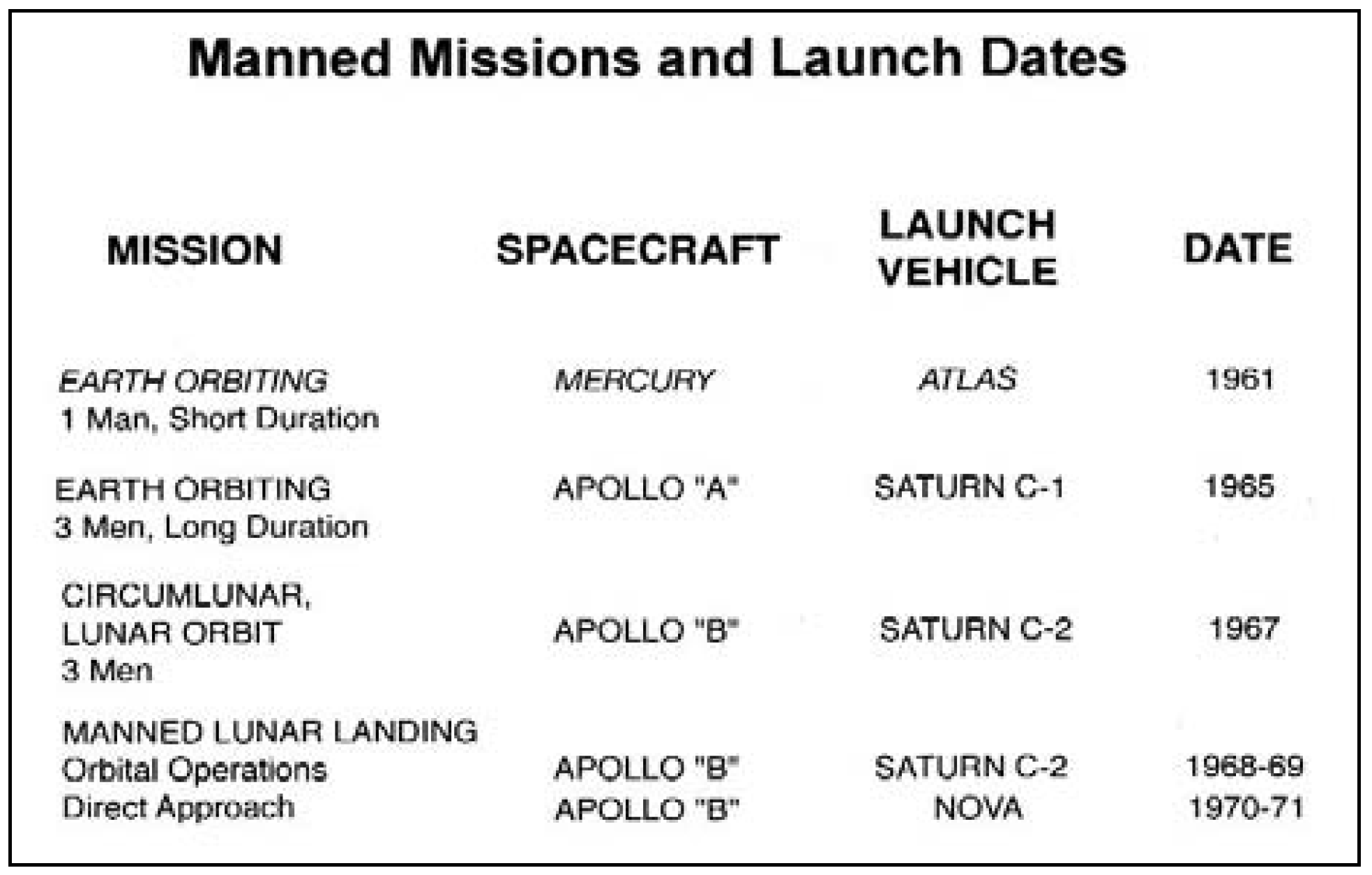
The Apollo A using the Saturn C-1 would allow multimanned orbital flights in 1965. The advanced, long-duration Apollo B launched by the Saturn C-2 would provide the capability for circumlunar and lunar orbital missions in 1967.
The group felt that the manned lunar landing could occur as early as 1968 and as late as 1971. Whether it would be early or late hinged on the viability of rendezvous operations. Rendezvous operations obviated the need for the super booster called Nova, which the group estimated would require an extra one to two years. Hence, the manned lunar landing was bracketed between 1968 and 1969 when using rendezvous maneuvers, or between 1970 and 1971 if direct ascent with a single launch vehicle was the chosen mode. The mission, spacecraft, launch vehicle, and dates are shown in figure 1. Fortunately, Nova was not required.
The cost estimates were low, with $3 billion for the spacecraft and $4 billion for the launch vehicle—a total of $7 billion. However, much was omitted, including the Gemini missions, and the estimated cost of facilities and operations was considerably less than what was actually required. Notwithstanding, the report by George Low and his group was most valuable in the meetings with the President and Congress that were soon to follow.
James E. Webb Takes Charge of NASA
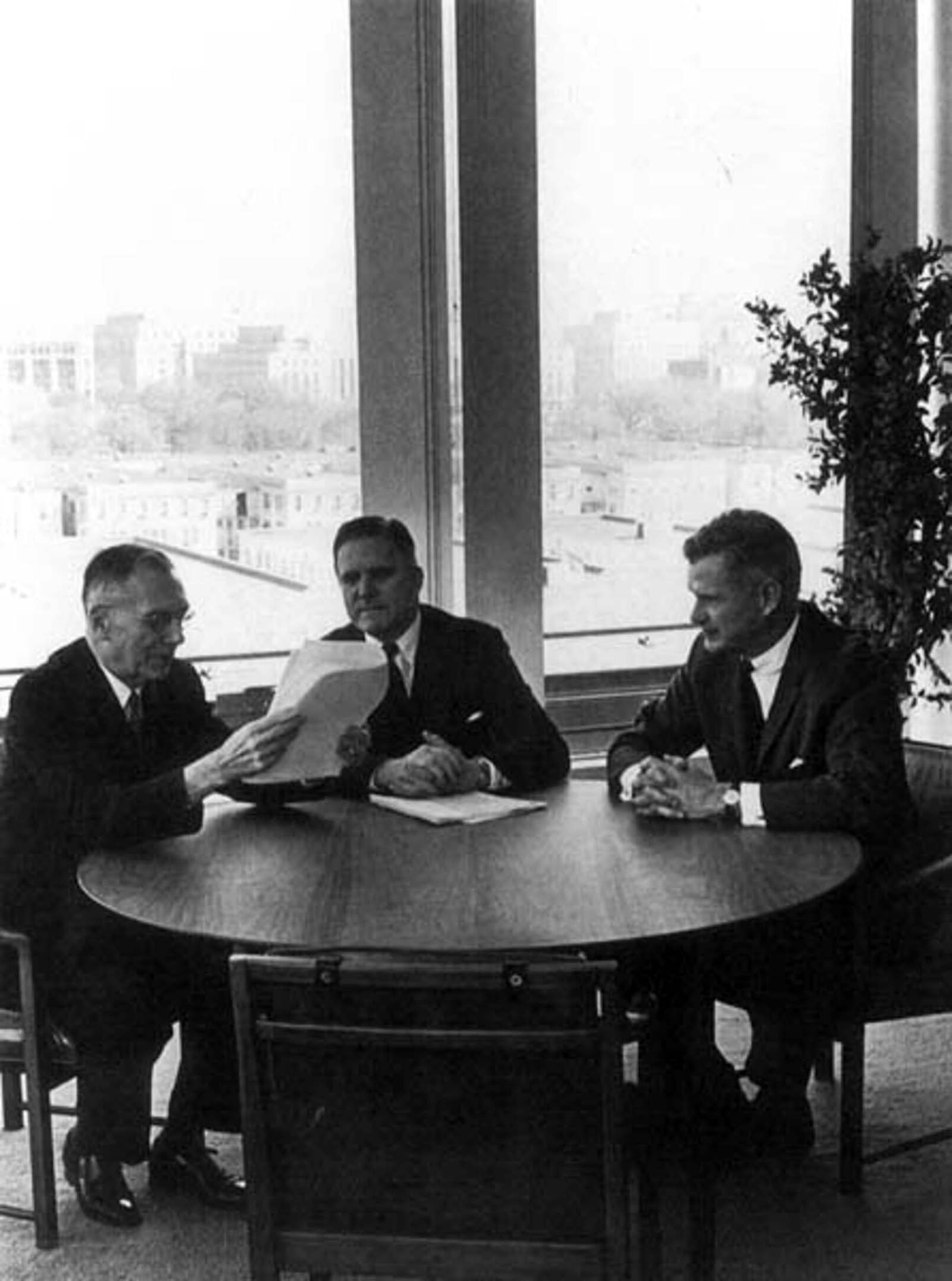
James E. Webb was nominated as the Administrator of NASA in early February 1961, and needless to say, I was most anxious for a meeting in order to find out whether I would soon be departing. At our first discussion, he emphasized leadership and asked my views on the effectiveness of Sears Roebuck’s dispersed management versus Montgomery Ward’s hierarchical organization. Fortunately, it was a subject I’d studied at Columbia’s advanced management program the previous summer, so I felt pretty comfortable in my exchange of ideas. Jim asked both Hugh Dryden and me to remain at NASA, and over time, we became known as the Triad—each of us had different skills and responsibilities, but we convened (figure 2) to make key decisions that were usually unanimous.
Jim was sworn in on 12 February 1961, and, soon thereafter, a meeting was arranged with the new Director for the Bureau of the Budget, Dave Bell. The previous administration had reduced our budget by $300 million, so we decided to request an additional $190 million for manned-flight-related projects and $10 million for communication satellites. Dave Bell told us that the President was most interested in space exploration and planned to get his mind around the issues in connection with the next fiscal year’s budget, that of FY 1963. Mr. Webb demurred, saying that the issues couldn’t wait, and so a session took place with the President, the Vice President, their staff, and the Director of BoB on 22 March.
First Meeting with President Kennedy
As was the custom, the Director of BoB started the meeting by advising the President that additional funding should await the review of the following year’s requirements. Mr. Webb then said that I would present NASA’s request. The President asked how long it would take; when Jim responded that it would be 30 minutes, the President said that he had only 15. The phone then rang, and the President had an extended conversation with the Speaker of the House. Ultimately, I had an opportunity to summarize our recommendations. The President looked at me and said, “That was very good; I would like your views in writing tomorrow.” I wrote the memo that evening, hand-delivered it to Jim Webb the following morning, and then joined my family in Mt. Tremblant, Canada, for a weekend of skiing. The memo was forwarded by Jim Webb and contained these requests:
The funding rates of five projects were discussed at the NASA-BoB conference with the Vice President and the President on March 22, 1961. An agenda prepared prior to the meeting summarized the objectives of these projects and indicated in each case the effect of the funding rate on the schedule. The multimanned orbital laboratory is contingent upon the Saturn C-1 which is adequately funded, and a new spacecraft for which NASA recommends an increase from $29.5 to $77.2 million. This increase starts an accelerated program leading to multimanned orbital flights in 1965 rather than 1967.
The multimanned circumlunar flight requires the Saturn C-2 and a spacecraft which will evolve from the design of the orbital spacecraft. The recommended $73 million increase in FY 1962 funding for the Saturn C-2 leads to the completion of the Saturn development in 1966, and manned circumlunar flight in 1967 rather than 1969.
A manned lunar landing requires a new launch vehicle with capabilities beyond Saturn. This vehicle, called Nova, is still under study. It would use a firststage cluster of the 1.5 million pound thrust, chemically fueled engines, which we have under development. We are requesting $10.3 million additional over the present FY1962 budget to accelerate the engine development. The first manned lunar landing depends upon this chemical engine as well as on the orbital and circumlunar programs and can be achieved in 1970 rather than 1973.2
Notice that the dates in this memo were consistent with those in George Low’s working group on lunar landing. Also included in the request was Centaur, which, with Atlas as the first stage, would send unmanned probes to softland on the Moon. The Centaur RL10 liquidhydrogen engines were also to be used in the Saturn I upper stage. Of the total $200 million requested, the President decided to support communication satellites with $10 million and propulsion projects with $115.7 million, but the money would not support the multimanned orbiting laboratory.3
A New Ball Game
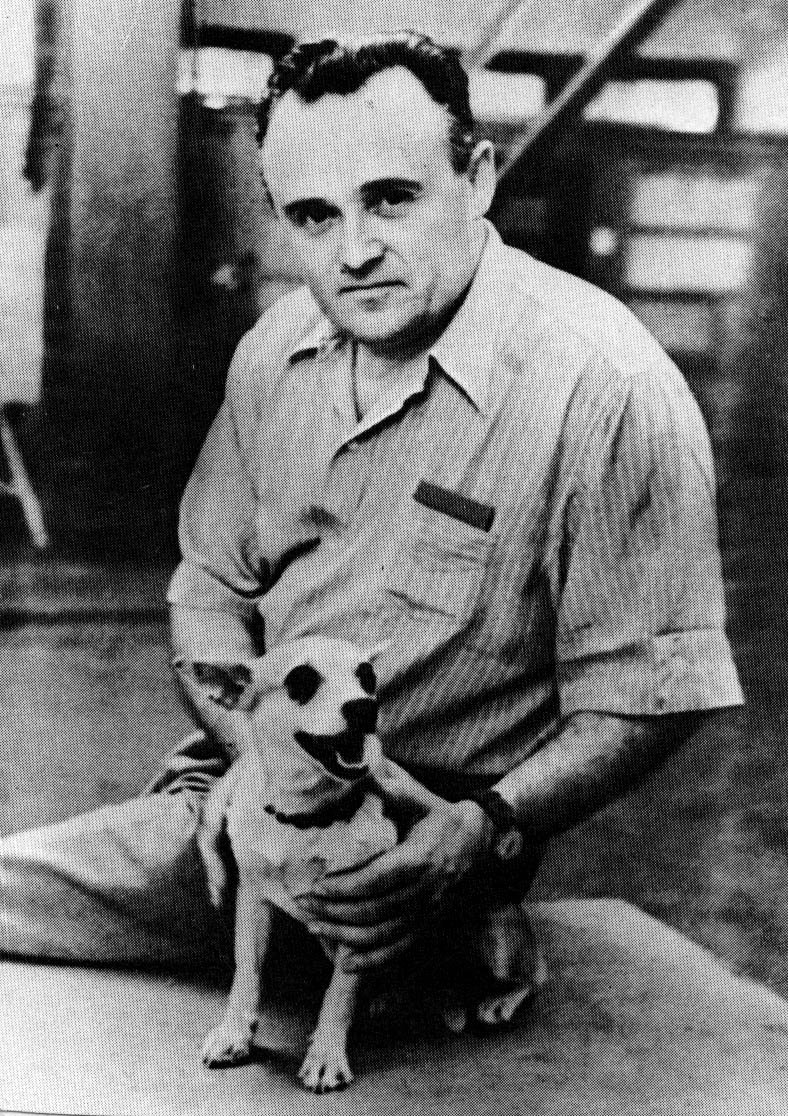
Sergei Korolev was the prime mover of the Soviet space program from its inception until his death in 1966. Originally an aeronautical engineer, he was imprisoned in the late 1930s after being accused of sabotage. Stalin, not noted for his receptivity to challenging ideas, banished Korolev to a forced labor camp in Siberia, where he languished until the Soviets were desperate for engineers in World War II. A special camp was established just outside Moscow, and Korolev was moved there. He performed so well that he was eventually released. At the war’s end, he was sent to Peenemünde to obtain engineers, technical information, and equipment related to the German V2 development. Later, he convinced Chairman Khrushchev to support a few satellite launches using the Soviet ballistic missile program. Sputnik was an instant success that opened the way for Korolev and his team to embark on a broadscale space endeavor. Korolev struck again on 12 April 1961 (see figure 3), when Yuri Gagarin orbited Earth and landed safely to tremendous acclaim in the Soviet Union and around the world. Our Congress went berserk, and President Kennedy was distressed. The following day, Mr. Webb and Dr. Dryden were called before the House Authorization Committee on Space and Aeronautics in the Caucus room. Jim and Hugh were pressed for bolder action and parried the thrust of the committee members in admirable fashion. The day after, it was back to the Manned Space Subcommittee for George Low and myself. The hearing was held in the old committee chambers. George began his testimony but was interrupted by Congressman David King of Utah:
MR. KING: May I make a comment there and then, and then, if you will, carry on. I understand the Russians have indicated at various times that their goal is to get a man on the Moon and return safely by 1967, the 50th anniversary of the Bolshevik Revolution. Now specifically I would like to know, yes or no, are we making that a specific target date to try to equal or surpass their achievement?
DR. SEAMANS: As I indicated in earlier testimony this morning, our dates are for a circumlunar flight in 1967 and a target date for the manned lunar landing in 1969 or 1970.
MR. KING: That of course—then that outlines the issue very squarely. As things are now programmed we have lost. The score will be three to nothing for the Russians. I would like to make it clear for the record that I personally—and I am not a technical man, I am speaking just as a Congressman, trying to do what I can for the country—that I would favor any such program, regardless of the cost, that would put us definitely in the race to reach the Moon first. I think anything short of that will be doing an injustice to our country. Let me just ask this final question. Do you think it would be conceivably possible, by increasing appropriations, by marshaling our manpower and resources and everything else we have available, to meet this target date of, let us say, 1967?
DR. SEAMANS: This is really a very major undertaking. To compress the program by 3 years means that greatly increased funding would be required for the interval of time between now and 1967. I certainly cannot state that this is an impossible objective. If it comes down to a matter of national policy, I would be the first to review it wholeheartedly and see what it would take to do the job. My estimate at this moment is that the goal may very well be achievable. That is the best answer I can give you at present.
MR. KING: I think that is a very significant statement and I am very grateful to get it4
There followed an exchange with a Republican member of the committee (J. Edgar Chenoweth of Colorado) and a final question by the committee’s chairman, Congressman George Miller (Democrat):
MR. CHENOWETH: I understood from your last answer to Mr. King that you thought it could be done. That impression will go out. I think you have to be very careful what you tell this committee because there will be those who will say, “All right, lets boost up our appropriation, double it, treble it. The most important thing is to put a man on the Moon.” I don’t know that it is. I doubt it. But some feel that way. I think it is a high policy decision to be made and to be made shortly. I think it is important you word your answers carefully here, because the wrong interpretations may be placed upon them not only by this committee but by those who will read stories that will go out.
DR. SEAMANS: I disagree on one point you touched upon earlier. I feel this committee is a most important forum for discussion of this issue. I believe there are other important forums. I agree this is a most important national issue.
MR. CHENOWETH: The question is whether it is of such great importance that we can afford to neglect other programs that perhaps may involve a change of our whole fiscal program in order to accomplish this one objective. Is it that important, in your opinion?
DR. SEAMANS: Obviously I cannot answer that question.
MR. CHENOWETH: It is a decision to be made at a higher level.
DR. SEAMANS: I think it is a decision to be made by the people of the United States.
MR. CHENOWETH: How will they make it?
DR. SEAMANS: Through the Congress and through the President. It is a matter of national importance to have specific objectives for our space effort.
MR. CHENOWETH: I disagree. The people of this country do not have the technical knowledge on this subject that you have. When you talk about placing a man on the Moon, they don’t know what you are talking about. They don’t know what expenditure is involved, nor the scientific and research work that has to be done. We can’t expect them to make that decision.
MR. MILLER: Is this not our responsibility as the representatives of the people5
When the hearing was over, George Low and I faced a barrage of reporters and a battery of TV cameras as we left the building. I felt there might be a concern about my performance and headed directly to Mr. Webb’s office, where Nina Scrivener, his secretary, listened thoughtfully to my message: “Tell Mr. Webb I did the best I could, but the White House may be quite unhappy.” I knew it was unwise for an underling to get out ahead of the President. I found out later that Ken O’Donnell, the President’s political advisor, wrote a strongly worded letter to Mr. Webb about my performance, but in his return letter dated 21 April, Jim supported me. He noted, “My judgment from the record and my personal experience with the committee is that our group, particularly Dr. Seamans has done a splendid job for this administration. Dr. Seamans bore the brunt of discussions as to our relations with the Bureau of the Budget and the President. From a reading of the testimony I believe Seamans has done an exceptionally fine job.”6 Keith Glennan wasn’t so kind. He wrote, “I think an unfortunate statement by Bob Seamans before a congressional committee gave the newspapers and through them the public, the idea that this flight [lunar landing] was to be accomplished by late 1967.”
A Call to the Vice President
On 20 April, President Kennedy wrote Vice President Johnson a memorandum in which he asked:
- Do we have a chance of beating the Soviets by putting a laboratory in space, or by a trip around the moon, or by a rocket to land on the moon, or by a rocket to go to the moon and back with a man? Is there any other space program which promises dramatic results in which we could win?
- How much additional would it cost?
- Are we working 24 hours a day on existing programs? If no, why not? If not, will you make recommendations to me as to how work can be speeded up.
- In building large boosters should we put our emphasis on nuclear, chemical, or liquid fuel, or a combination of these three?
- Are we making maximum effort? Are we achieving necessary results?
I have asked Jim Webb, Dr. Wiesner, Secretary McNamara and other responsible officials to cooperate with you fully. I would appreciate a report on this at the earliest possible moment.7
The Whirlwind Week of 2 May 1961
The week started with reasonable assurance that in a few days, NASA was going to be tested in the eyes of the world by Alan Shepard’s Mercury flight. And then, if that was successful, NASA was going to embark on a lunar program even before the United States had sent an astronaut to orbit Earth. If that happened, there would be a clear need for an indepth investigation of all the steps that would have to be taken and of the costs and time that would be involved. On 2 May, I sent a memorandum to the directors of the four program offices establishing an ad hoc task group for this study. Bill Fleming, my program assistant, was to head the study, and the individuals assigned to the study were to be on a fulltime basis for the duration of the effort.
Friday, 5 May 1961, Mercury Redstone (MR-3), Alan Shepard
Later in the week, all eyes were on Alan Shepard at Cape Canaveral. Jerry Wiesner, in his interregnum report, had alerted the Kennedy administration that if they weren’t careful, they’d own the Mercury project. The hour of truth had arrived. Should NASA be allowed to launch the MR3 with Alan Shepard aboard? The mission had been carefully and responsibly reviewed by a White House committee chaired by Donald Hornig. His committee was favorably impressed with NASA’s planning and testing. But supposing the launch was a disaster, especially following Gagarin’s achievement? Ed Welsh, secretary of the Space Council, joined me on Friday, 5 May, to follow the mission on an inhouse circuit. At that time, there was small, obscure room in NASA Headquarters, across from the White House, where the voice of the Mission Director was piped in. Ed confirmed that there was much concern about possible failure, but he had raised the question, what if we succeed? Anyway, it was now a “go.” Hugh Dryden was at the Cape as NASA’s senior observer. He had been close to the Mercury program since inception and was clearly the person to have on hand in the event of unexpected contingencies.
Freedom 7 roared off at 10:34 and started its climb. The ride was smooth and the voice communication clear for the first 45 seconds. Buffeting started in the transonic zone and became severe about 90 seconds into the flight at maximum dynamic pressure. Alan’s head was bouncing so hard that he couldn’t read the flight instruments.
The maximum g forces occurred after 2 minutes, and the engines cut off 22 seconds later. Alan was traveling 5,134 mph, the desired speed. He had been traveling faceforward when, at 3 minutes into the flight, the capsule automatically turned completely around in preparation for reentry. Now it was time for the most important task, determining whether a human could control the capsule. He switched onto manual control one axis at a time. He first used his right grip backward to tilt his heat-shield downward 34 degrees for reentry. Later, he was pleased to find that he could control the spacecraft’s movement about all three axes—roll, pitch, and yaw—and the fuel use was similar to what he had experienced with the Mercury trainer. When the retrorockets fired at the appropriate time, it provided what astronauts later described as a “comforting kick in the ass.”
As Freedom 7 approached the atmosphere, the 0.05-g light came on, and the acceleration rapidly built up to a peak of 11.6 g’s. As the spacecraft entered the atmosphere, the drogue chute first opened at 21,000 feet; the main chute followed at 10,000. The recovery forces were standing by for pickup. Alan felt that the thud at impact was comparable to that of a carrier landing. After landing, the chutes were released, with the capsule listing 60 degrees to starboard. The rescue helicopter was soon overhead, and Alan was taken aboard the carrier Lake Champlain 11 minutes after landing. Ed Welsh and I did a few war whoops in our cubicle, shook hands, and gave thanks for all those involved in the flight’s success.
Upon examination, doctors found that Alan had suffered no ill effects, and, as he reported himself, weightlessness was “quite pleasant.” A half hour into his free-dictation report, Alan was summoned to the bridge deck for a call from President Kennedy. Kennedy had followed the flight closely via television and was now offering his congratulations.
There was mostly worldwide acclaim, but chagrin in Moscow, where Premier Nikita Khrushchev asked why the “up and down” flight of Shepard gained such extensive media publicity even though Gagarin had long since orbited the world.8
Big Doings at the Pentagon
On Saturday, Hugh Dryden was still at Cape Canaveral awaiting Alan’s arrival and debriefing. Jim Webb, Abraham Hyatt (Director of Plans and Program Evaluation), and I arrived in Bob McNamara’s office at the Pentagon. Bob had Roswell Gilpatric, his deputy, and John Rubel, head of space research and development in the Department of Defense (DOD), with him. The Vice President had turned to NASA and DOD to help answer the President’s request for recommendations on U.S. space policy and direction. The Vice President said that NASA and DOD would have most of the action, so the administration needed our views on whether there was any space program that promised dramatic results that we could achieve before the Soviets.
McNamara greeted us crisply. Once seated, he suggested that we lay our cards on the table, and he asked Jim to go first. As per our plan, Jim first recommended that NASA proceed with a manned lunar landing mission. It was our view that the Soviets could conduct a manned orbital laboratory or a circumlunar mission with means already available. However, McNamara questioned our views and suggested a planetary trip to Mars. I found his suggestion horrifying and pointed out that we had neither the technology nor the physiological understanding to proceed with such a mission. The discussion recognized the previous day’s achievement by Alan Shepard and noted that the highly favorable media response resulted from the mission’s being carried out completely in the open. It had become obvious that national prestige should be recognized as one of four valid reasons for space undertakings. The other three reasons were scientific investigation, commercial value, and national security. From this meeting resulted a report to the Vice President that recommended a $626-million add-on for FY 1962, of which $549 million was for NASA.9 The line items for NASA funding included the following:
- Apollo for multimanned orbital laboratory
- Nova, a large launch vehicle, for manned lunar landing
- Scientific experiments in space
- Satellite communications
- Meteorological satellites
- Nuclear rocket developments
The major share of the funding recommendation was earmarked for Apollo and Nova. To quote from the report:
To achieve the goal of landing [a person] on the moon and returning him to earth in the latter part of the current decade requires immediate initiation of an accelerated program of spacecraft development. The program designated Project Apollo includes initial flights of a multi-manned orbiting laboratory to qualify the spacecraft and manned flights around the moon before attempting the difficult lunar landing.
The advanced goal of manned landing on the moon also requires the development of a launch vehicle (Nova) with a first stage thrust of about six times that of the largest vehicle now under development (Saturn I) [Nova was never started; however the Saturn
V had nearly five times the thrust of the Saturn I under development].10
In addition to the specifics in the report, there was a general section on the need for close cooperation and coordination between NASA and DOD. In particular, the report noted the importance of the manned lunar landing in the context of a total national effort.
The future of our efforts in space is going to depend on much more than this year’s appropriations or tomorrow’s new idea. It is going to depend in large measure upon the extent to which this country is able to establish and to direct an integrated national space program. To quote further from the report:
We recommend that our National Space Plan include the objective of manned lunar exploration before the end of this decade. It is our belief that manned exploration to the vicinity of and on the surface of the moon represents a major area in which international competition for achievement in space will be conducted. The orbiting of machines is not the same as the orbiting or landing of man. It is man, not merely machines, in space that capture the imagination of the world . . . .
The establishment of this major objective has many implications. It will cost a great deal of money. It will require large efforts for a long time. It requires parallel and supporting undertakings which are also costly and complex. Thus for example, the RANGER and SURVEYOR unmanned probes and the technology associated with them must be undertaken and must succeed to provide the data, the techniques and the experience without which manned lunar exploration cannot be undertaken.
The Soviets have announced lunar landing as a major objective of their program. They may have begun to plan for such an effort years ago. They may have undertaken important first steps which we have not begun.
It may be argued, therefore, that we undertake such an objective with several strikes against us. We cannot avoid announcing not only our general goals but many of our specific plans, and our successes and failures along the way. Our cards are and will be face up—theirs are face down.
Despite these considerations we recommend proceeding toward this objective. We are uncertain of Soviet intentions, plans or status. Their plans, whatever they may be, are not more certain of success than ours. Just as we accelerated our ICBM11 program we have accelerated and are passing the Soviets in important areas in space technology. If we set our sights on this difficult objective we may surpass them here as well. Accepting the goal gives us a chance. Finally, even if the Soviets get there first, as they may, and as some think they will, it is better for us to get there second than not at all. In any event we will have mastered the technology. If we fail to accept this challenge it may be interpreted as a lack of national vigor and capacity to respond.12
The DOD had already prepared a draft report for submission to the Vice President. John Rubel and I were given the job of editing the report and bringing it into concert with the Saturday meeting. We worked together well into the evening, when Jim Webb arrived after escorting Alan Shepard’s parents to their hotel. Jim, John, and I completed the final editing at 2:00 Monday morning. John and I reviewed the retyped copy and brought it to McNamara and Webb for signature on Monday morning, prior to the 9:00 a.m. ceremony at the White House honoring Alan Shepard.
A Hero’s Welcome
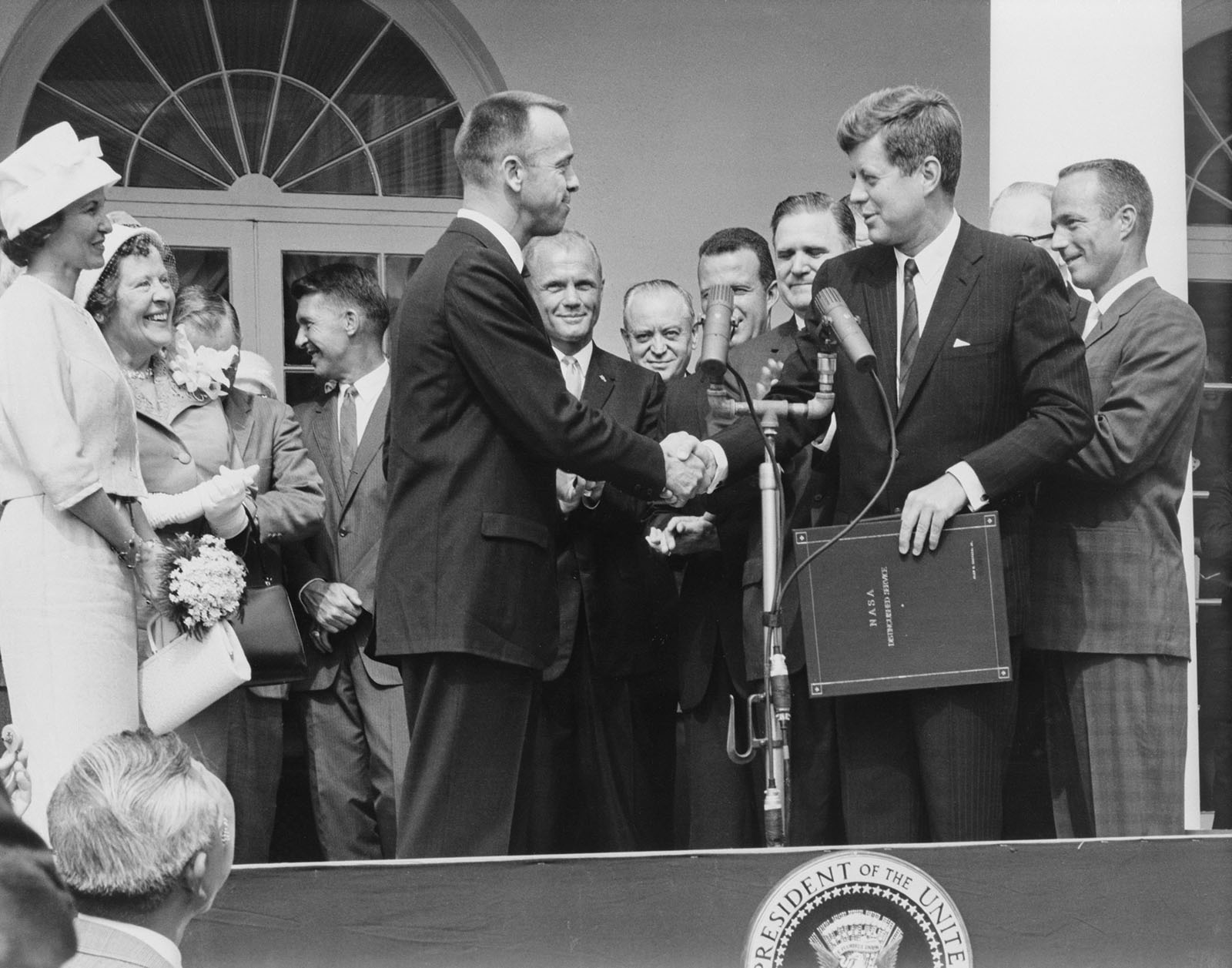
Following receipt of his honors at the White House (see figure 4), Alan Shepard was sped in a motorcade to the Capitol, where he addressed a joint session of Congress. There followed a special reception and luncheon, hosted by Vice President Johnson, at the State Department. Near the end of lunch, the Vice President stood to toast Alan and his family and then left to meet with the President before leaving for Vietnam. In his hand was the envelope containing the McNamara-Webb report completed earlier that morning.
A Special Message to Congress
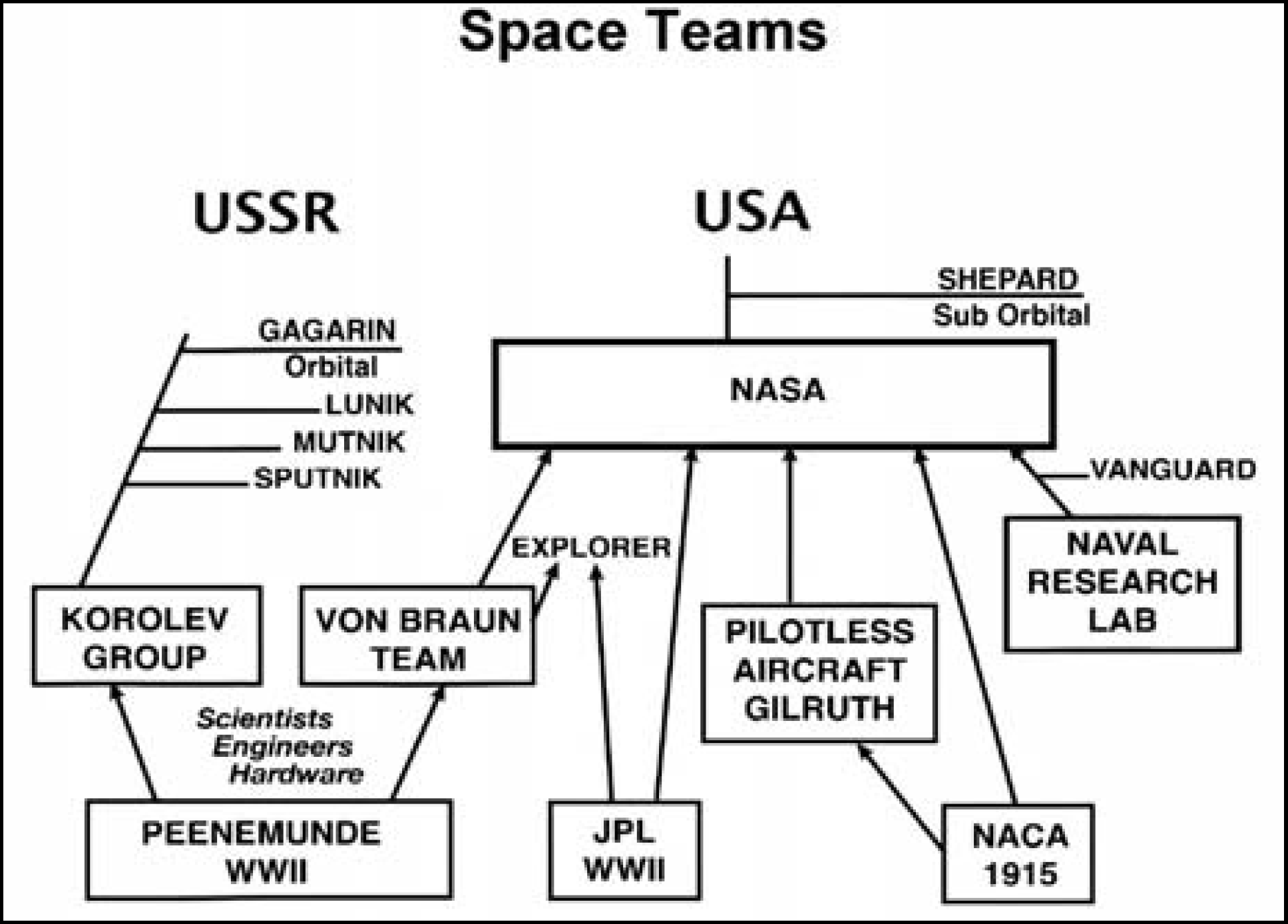
At this juncture in the space program, it is interesting to compare the derivation of the USSR and U.S. programs. Both derived considerable strength from the German effort at Peenemünde, the USSR from Korolev’s hiring of technical personnel and collectors of data and hardware and the United States from the capture of Dr. von Braun and his management team. The von Braun team became the Army’s Ballistic Missile Agency of the Redstone Arsenal prior to its transfer to NASA. Other ingredients transferred to NASA were the laboratories of the NACA, the Jet Propulsion Laboratory of the California Institute of Technology, and the Navy’s Vanguard team. Figure 5 shows how these diverse groups had coalesced by 1961.
Under Korolev, the Soviets had orbited the satellite Sputnik, a dog, and the cosmonaut Yuri Gagarin. They had also photographed the far side of the Moon. The United States had launched Explorer, a weather satellite, the Echo balloon, and Alan Shepard into suborbital flight.
Several days prior to 24 May, when President Kennedy was to address a joint session of Congress, Jim Webb received a copy of that part of the speech related to space. Sure enough, the President was recommending a manned lunar landing and safe return, but in 1967. Jim called Ted Sorensen, the President’s speechwriter, to request a change of date. The country should operate in the open, he said, but shouldn’t make such a bold commitment in terms of time. The compromise with the White House was “within the decade.” Excerpts from the President’s speech follow:
Since early in my term, our efforts in space have been under review. With the advice of the Vice President, who is Chairman of the National Space Council, we have examined where we are strong and where we are not. Now it is the time to take longer strides—time for a great new American enterprise—time for this nation to take a clearly leading role in space achievement, which in many ways may hold the key to our future on earth.
Recognizing the head start obtained by the Soviets with their large rocket engines, which gives them many months of leadtime, and recognizing the likelihood that they will exploit this lead for some time to come in still more impressive successes, we nevertheless are required to make new efforts on our own. For while we cannot guarantee that we shall one day be first, we can guarantee that any failure to make this effort will make us last. We take an additional risk by making it in full view of the world, but as shown by the feat of astronaut Shepard, this very risk enhances our stature when we are successful. But this is not merely a race. Space is open to us now; and our eagerness to share its meaning is not governed by the efforts of others. We go into space because whatever mankind must undertake, free men must fully share.
First, I believe that this nation should commit itself to achieving the goal, before this decade is out, of landing a man on the Moon and returning him safely to earth. No single space project in this period will be more impressive to mankind, or more important for the long-range exploration of space, and none will be so difficult or expensive to accomplish. Now this is a choice which this country must make, and I am confident that under the leadership of the Space Committees of the Congress, and the Appropriating Committees, that you will consider the matter carefully.
It is a most important decision that we make as a nation. But all of you have lived through the last four years and have seen the significance of space and the adventures in space, and no one can predict with certainty what the ultimate meaning will be of mastery of space.
I believe we should go to the Moon. But I think every citizen of this country as well as the Members of Congress should consider the matter carefully in making their judgment, to which we have given attention over many weeks and months, because it is a heavy burden, and there is no sense in agreeing or desiring that the United States take an affirmative position in outer space, unless we are prepared to do the work and bear the burden to make it successful.13
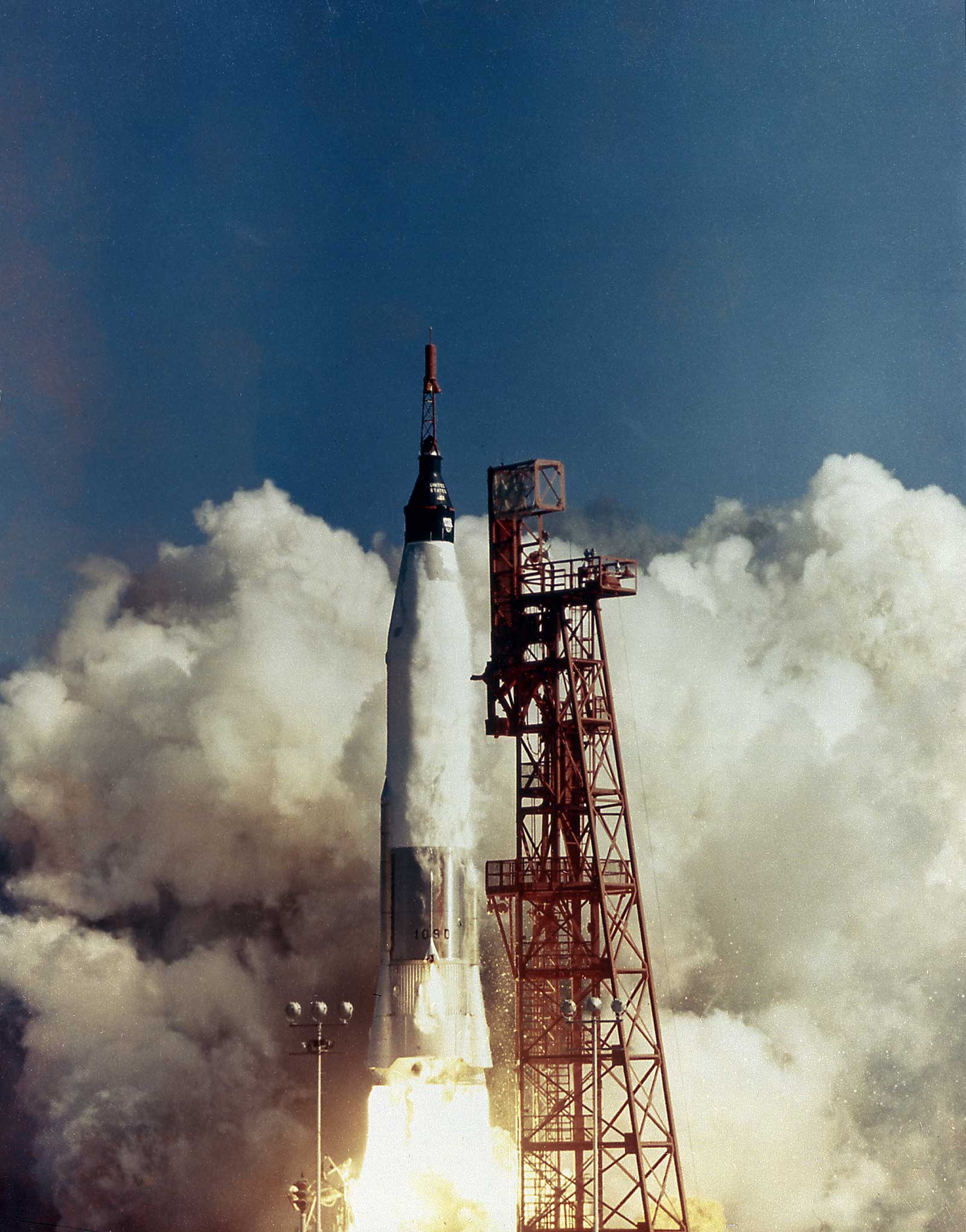
At the time Kennedy was delivering his address to Congress, Mr. Webb and I were meeting with Joe Charyk, Under Secretary of the Air Force. NASA was about to assume a tremendous responsibility, but the orbiting of John Glenn was still to be accomplished. And the Air Force was questioning our use of the Atlas booster. General Bernard Schriever, who had successfully directed the development of ICBMs, was concerned about whether the thin-skinned (0.010-inch) Atlas (see figure 6) could support the Mercury capsule—if it failed, would our nuclear deterrent remain credible? Of course, if the Atlas failed or if a decision was made not to use the Atlas, John Glenn would not achieve orbit and there would be no U.S. manned flight until another launch vehicle became available. I remember attending a detailed briefing on the structural integrity of the Atlas nose section with and without strengthening. The analysis convinced me that it was safe to proceed with the mission if a bellyband was sweated around the nose cone. Joe Charyk concurred. Ultimately, four manned Mercury capsules were successfully launched by the strengthened launch vehicle. But while we were still in the throes of Mercury, we had to start facing the many daunting challenges of President Kennedy’s new mandate.
Aiming at the Moon
Now that the President had recommended a major national effort to land man on the Moon within the decade, major decisions had to be made in a short period of time:
- How was the mission to be managed?
- How much of the effort would be performed by NASA? By other government agencies? By industry? By universities and other nonprofits?
- What were the long poles in the tent? That is, what projects required immediate attention?
- How were we to resolve a large number of technical issues?
One of the keys to the success of this daunting program was NASA’s internal management. NASA had four program offices when Keith Glennan was Administrator. They were Advanced Research Technology (headed by Ira Abbott), Life Sciences (Clark T. Brandt), Launch Vehicle (Don R. Ostrander), and Space Flight Programs (Abe Silverstein). Each of the research and flight centers reported to one of these program directors (see figure 19).
Each program office had its own budgeting and cost controlling, as well as its own research centers. It was decided to shift the entire project and program responsibility for NASA to the Associate Administrator. The shift of personnel from Silverstein to me followed. For the next seven years, project approval documents spelling out objectives, costs, and schedules were issued by this office and signed by the Associate Administrator (me) for all NASA activities. A fuller account of NASA management during this period is given in chapter 5. Second, much of NASA’s effort required close coordination with the DOD. A NASA-DOD board had been established in the Eisenhower administration with Hugh Dryden and Harold Brown as cochairmen. The board was called the Aeronautics and Astronautics Coordinating Board, or AACB. In the spring of 1961, I became the NASA cochair and Rubel the DOD one; both of us were closer to day-to-day management issues than our predecessors.
The most critical decision was the appointment of the Apollo manager. Discussions were held with the Air Force regarding Bernard “Bennie” Schriever and with the Navy regarding Levering Smith, who directed the Polaris and Poseidon submarine-launched ballistic missile programs. Levering was disappointed that he was still a captain. We succeeded in getting Levering promoted from captain to rear admiral, but not in acquiring him as a NASA manager.
While Dr. Dryden was away, Jim Webb and I had a conversation with Wernher von Braun about the possibility of his directing the lunar landing program. When Dryden returned, Webb asked me to try the idea on him for size, and his answer was, “You and Jim can do what you want, but I’ll retire if he’s given the job.” I suggested Brainerd Holmes. I had known him at Radio Corporation of America (RCA), where he had been in charge of the Ballistic Missile Early Warning System (BMEWS). It was a complex, high-technology project with large-scale construction in Scotland, northern Greenland, and Fairbanks, Alaska. I had a conversation with Brainerd’s boss, Art Malcarney, Executive Vice President for Defense Affairs, and he reluctantly helped us arrange a meeting with Brainerd at the Metropolitan Club. Jim Webb and I attended, and thanks to Webb’s great salesmanship, Brainerd accepted the position a week later and took the reins in October.
Extensive Planning
The period between the President’s recommendations to Congress in May 1961 and the arrival of Brainerd Holmes in October 1961 involved extensive planning as NASA initiated its greatly expanded program. Three of the efforts were carried out by Center-Headquarters committees established by the Associate Administrator; one was a product of Langley Research Center, and one was conducted jointly with the Department of Defense. These committees and their studies are listed below:
- “Various Vehicle Systems for the Manned Lunar Landing Mission,” completed 10 June 1961. A study initiated on 21 May 1961 and chaired by Bruce Lundin.
- “A Feasible Approach for an Early Manned Lunar Landing,” completed 16 June 1961. A study initiated on 2 May 1961 and chaired by William Fleming.
- “Earth Orbital Rendezvous for an Early Manned Lunar Landing,” completed August 1961. A study initiated on 20 June 1961 and chaired by Donald Heaton.
- “Manned Lunar Landing Through Use of Lunar Orbit Rendezvous,” completed 31 October 1961. A Langley Research Center report by John Houbolt.
- Large Launch Vehicles Including Rendezvous,” completed 24 September 1962. A joint DOD-NASA study initiated on 23 June 1961 and chaired by Nicholas Golovin (NASA) and Lawrence Kavanau (DOD).
During May, June, and July, when the first two studies (Lundin and Fleming) were under way, there were three Saturn launch vehicles under consideration. The two-stage Saturn I having eight H-1 engines in its first stage and six RL-10 engines in its second stage was of use only for Earth-orbiting payloads.
The advanced Saturn had two configurations: the C-2, for which NASA had contracted, and the C-3, a more powerful configuration. Both versions were in design and had similar first and third stages. The first stage in each used two F-1 engines, and the third stage in each was similar to the Saturn I second stage. However, the second stage of the C-2 used two J-2 hydrogen-oxygen engines with a total thrust of 400,000 pounds. The second stage of the C-3, with four J-2 engines, had a total thrust of 800,000 pounds.
“Various Vehicle Systems for the Manned Lunar Landing Mission,” a Study Chaired by Bruce Lundin, 10 June 1961
The report of this committee first discusses the use of the launch vehicle, at that time undergoing design, and the use of rendezvous in both Earth and lunar orbit. Then there is an outline of the pros and cons of the following options:
- Earth rendezvous with Saturn C-2s
- Earth rendezvous with Saturn C-3s
- Lunar rendezvous with Saturn C-3s
The report states in conclusion that the committee strongly recommends the second alternative. Excerpts from the report follow:
In response to the request of the Associate Administrator on May 25, 1961, a study has been undertaken to assess a wide variety of systems for accomplishing a manned lunar landing in the 1967–70 time period. This study has, as directed, placed primary emphasis on the launch vehicle portions of the [systems, including] vehicle sizes, types and staging. In addition a number of variations on the use of rendezvous to add flexibility and improve energy management in the lunar mission have been considered. The results of this study are the subject of this report.
Mission staging by rendezvous has been the subject of much investigation at Marshall, Langley, Ames, Lewis, and JPL. The work has concerned itself with analytical and simulator studies of orbital mechanics, and control and guidance problems as applied to rendezvous. Such critical questions as launch timing, and automatic and piloted guidance of the vehicles to a rendezvous have been carefully analyzed. Orbital refueling as well as attachment of self-contained modules have been considered.
Because the use of rendezvous permits the accomplishment of a given mission in a number of different ways employing different launch vehicles, the various groups working on rendezvous have arrived at a number of different concepts for accomplishing the lunar landing mission. The assumptions made by the different groups with regard to such parameters as return weight, specific impulse, etc. were however, consistent to the extent that meaningful comparisons can be made between the different concepts.
The vehicles considered were restricted to those employing engines presently under development. These vehicles are:
- Saturn C-2 which has the capability of placing about 45,000 pounds in earth orbit and 15,000 pounds in an escape trajectory;
- Saturn C-3 which has the capability of placing about 110,000 pounds in earth orbit and 35,000 pounds in an escape trajectory.
Lunar [Orbit] Rendezvous
A concept in which a rendezvous is made in lunar orbit possesses basic advantages in terms of energy management and thus launch vehicle requirements. This approach involves placing the complete spacecraft in orbit about the moon at a relatively low altitude. One or two of the three-man crew then descends to the lunar surface; after landing the capsule performs a rendezvous with that portion of the spacecraft which remained in lunar orbit. The lunar capsule is, of course, left behind on the return trip of the spacecraft to earth.
The basic advantage of the system is that the propellant required for the lunar landing and take-off is reduced which in turn translates into a reduction in the amount of weight which must be put into a lunar escape trajectory. The escape weight saving achieved is related to the fraction of the spacecraft weight which is retained in lunar orbit. The actual weight saving which can be realistically achieved by this method can only be determined after detailed consideration of the design and integration of the complete spacecraft. Calculations suggest, however, that the amount of weight which must be put into an escape trajectory for a given reentry vehicle weight might be reduced by a factor of two by use of the lunar rendezvous technique. The earth booster requirement might therefore be reduced to one C-3 with lunar rendezvous or two to three C-3’s with earth rendezvous. [I had already received a letter advocating this approach from John Houbolt dated 19 May 1961.]
Advantages and Disadvantages Peculiar to Methods Considered
- Earth Rendezvous with C-2’s (5–7 vehicles required)
- Advantages
- Fast reliability build up due to higher firing rate
- Assured launch capability from shore bases
- Disadvantages
- Large number of vehicles required
- Long time maintenance in orbit and long exposure to space hazards (up to six months with present AMR, Atlantic Mission Range, pad planning.
- Advantages
- Earth Rendezvous with C-3’s (2–3 vehicles required)
- Advantages
- Only 1 or 2 rendezvous operations required—simpler, less maintenance, and exposure time compared to C-2 vehicles systems.
- Vehicle has single shot lunar orbit mission capability.
- Could possibly launch from AMR
- Disadvantages
- Requires a new second stage compared to the C-2.
- Advantages
- Lunar rendezvous with C-3 (1 vehicle required)
- Advantages
- Energy, and thus vehicle size, potentially reducible by the order of 50%.
- Direct monitoring of landing opera-tion possible from orbiter. (Wide band communication available to enhance monitoring).
- Disadvantages
- A non fail-safe rendezvous
- Does not have effective assistance from surface tracking and communication networks for the rendezvous maneuver.
- No growth potential for increased mission requirements.
- Advantages
Of the various orbital operations considered, the use of rendezvous in earth orbit by two or three Saturn C-3 vehicles (depending on estimated payload requirements) was strongly favored. This preference stemmed largely from the small number of orbital operations required and the fact that the C-3 is considered an efficient vehicle of large and future growth.14
It’s interesting to note that as early as 10 June 1961, a Headquarters-Center study group made such a strong representation for Lunar Orbit
Rendezvous but then rejected the mode out of hand because there could be no backup in case of failure to rendezvous. There could be other single-point failures, such as a propulsion explosion when lifting off the lunar surface. It would take another year for this mode to become accepted in NASA and still more months before the White House allowed NASA to proceed. John Houbolt’s concept took a long time aborning.
“A Feasible Approach for an Early Manned Lunar Landing,” a Study Chaired by Bill Fleming, 16 June 1961
The study was to be accomplished as rapidly as possible and in no more than four weeks. Excerpts from the terms of reference follow:
There is hereby established an Ad Hoc Task Group that has the immediate responsibility for determining for NASA in detail a feasible and complete approach to the accomplishment of an early manned lunar landing mission. This study should result in the following information:
- Identification of all tasks associated with the mission.
- Identification of the interdependent time phasing of the tasks.
- Identification of areas requiring considerable technological advancements from the present state-of-the-art.
- Identification of task for which multiple approach solutions are advisable to insure accomplishment.
- Identification of important action and decision points in the mission plan.
- Provision of a refined estimate by task and by fiscal year of the dollar resources required for the mission.
- Provision of refined estimates of in-house manpower requirements by task and by fiscal year.
- Establishment of tentative in-house and contractor task assignments accompanying the dollar and manpower resources requirements.
The following gross programmatic guidelines shall serve as a starting base for the study:
- Manned lunar landing target date—1967—determine if feasible.
- Intermediate missions of multi-manned orbital satellites and manned circumlunar missions are desirable at the earliest possible time.
- The nature of man’s mission on the moon as it affects the study shall be determined by the Task Group, i.e., the time he is to spend on the moon’s surface and the tasks that he shall perform while there.
- In establishing the mission plan, evaluate use of the Saturn C-2 as compared to an alternate launch vehicle having a higher thrust first stage and C-2 upper stage components.
- The mission plan should include parallel development of liquid and solid propulsion leading to a Nova Vehicle and should indicate when the decision should be made on the final Nova configuration.
- Nuclear powered launch vehicles shall not be considered for use in the first manned lunar landing mission.
- The flight test program should be laid out with adequate launchings to meet the needs of the program considering the reliabilities involved.
- Alternate approaches should be provided in critical areas.15
Bill Fleming submitted his 510-page, comprehensive report entitled “A Feasible Approach for an Early Manned Lunar Landing” the week
following the submission of the Lundin study. The report did not attempt to find the optimum configuration; rather, it attempted to include all facets of the lunar landing missions, such as spacecraft, launch vehicles, ground support, life and space sciences, and the recruiting and training of astronauts.
For the purpose of this study, a direct flight to the lunar surface using a Nova launch vehicle was assumed. Intermediate-size vehicles were also assumed within the configuration 1 or 2 (C-1 or C-2) category. Configurations 1 and 2 were sized for orbital and circumlunar flights, respectively.
The Sequenced Milestone System, SMS, was used to determine critical areas from a timing and reliability standpoint and to obtain budgetary estimates including the overall total cost. The categories established in the study were the development, fabrication, and testing of all flight hardware; the facilities required for testing and launching the vehicles; the selection and training of the astronauts; the conduct of satellite missions for obtaining necessary environmental data for the lunar mission, especially on the level of radiation en route to the Moon; and the surface conditions on the Moon.
Twelve hundred tasks were specified, and the timing, manpower, and cost were estimated for each. It was determined that land acquisition and facility construction were the “long poles in the tent.” The report noted that it was essential to determine the location of all major facilities as soon as possible and to conduct land acquisition, architec-tural designs, and construction as rapidly as possible.
During the first six months, according to the study, NASA had to accomplish the following:
- Assign program management and system responsibility.
- Obtain reentry heating data for the design of Apollo.
- Get the contract for Apollo and the C-3 first and second stages.
- Establish flight crew makeup, selection techniques, and training plan.
- Accelerate the F-1 engine funding.
- Initiate construction of a wide variety of facilities. These include a new center for spacecraft development and astronaut training, a launch facility with a vertical assembly building, and antennae for ground tracking and communication. Construction had to be hit hard and soon.
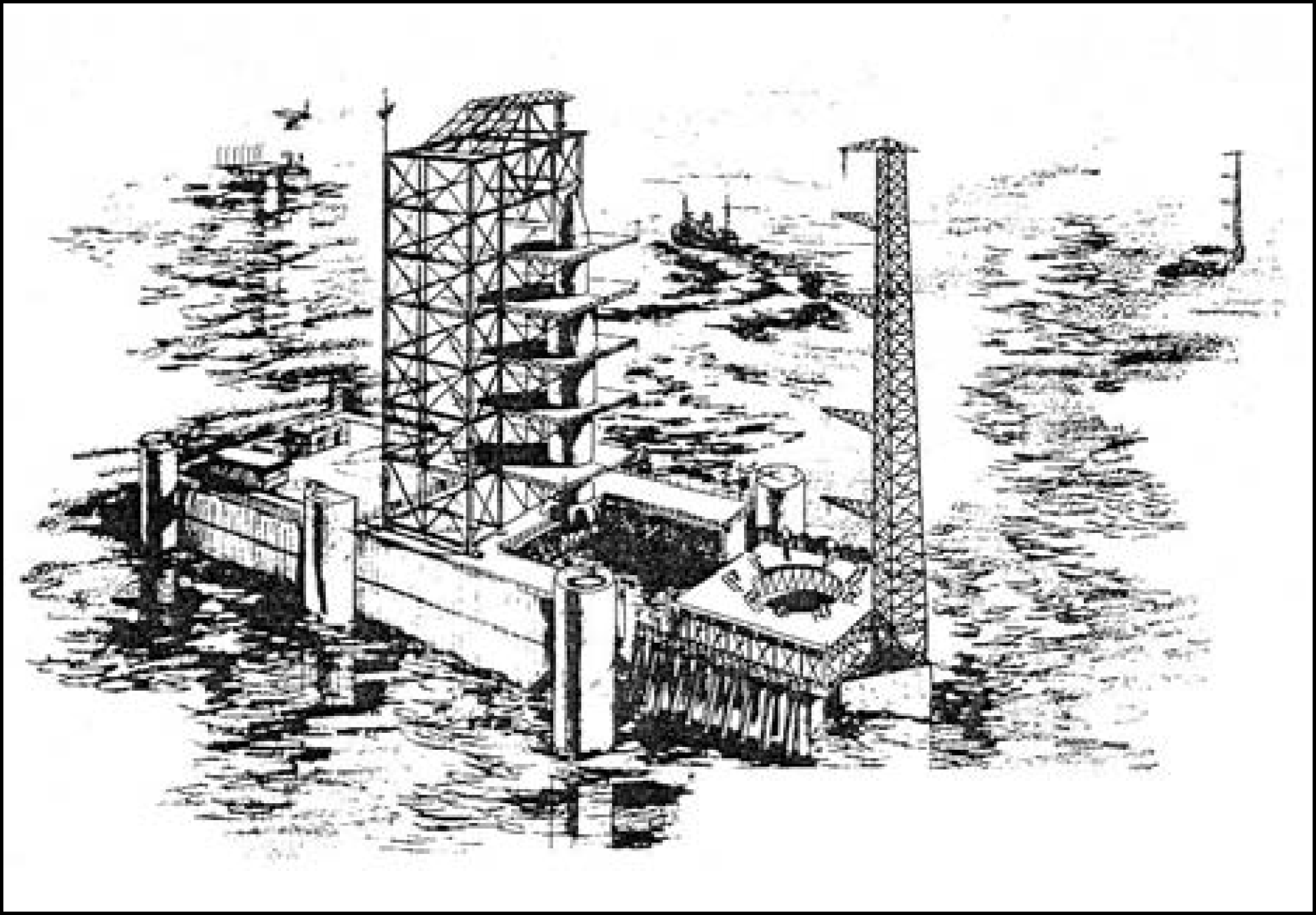
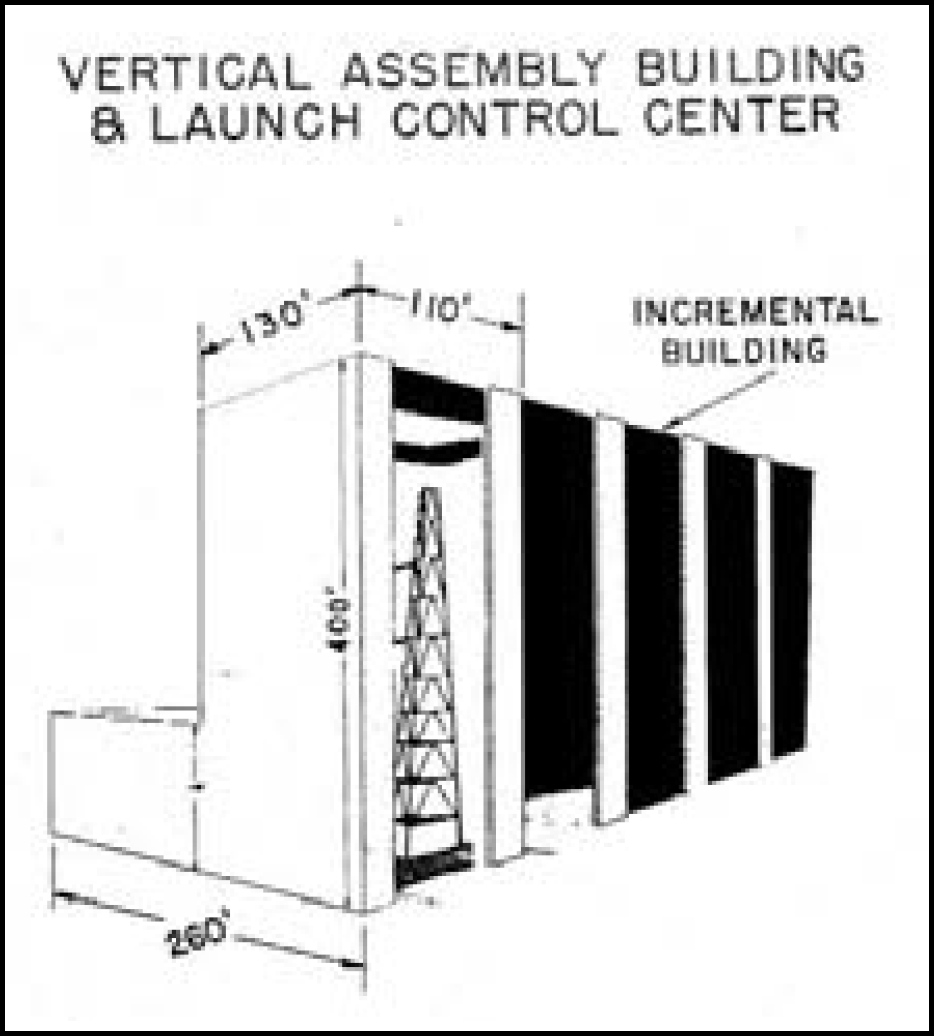
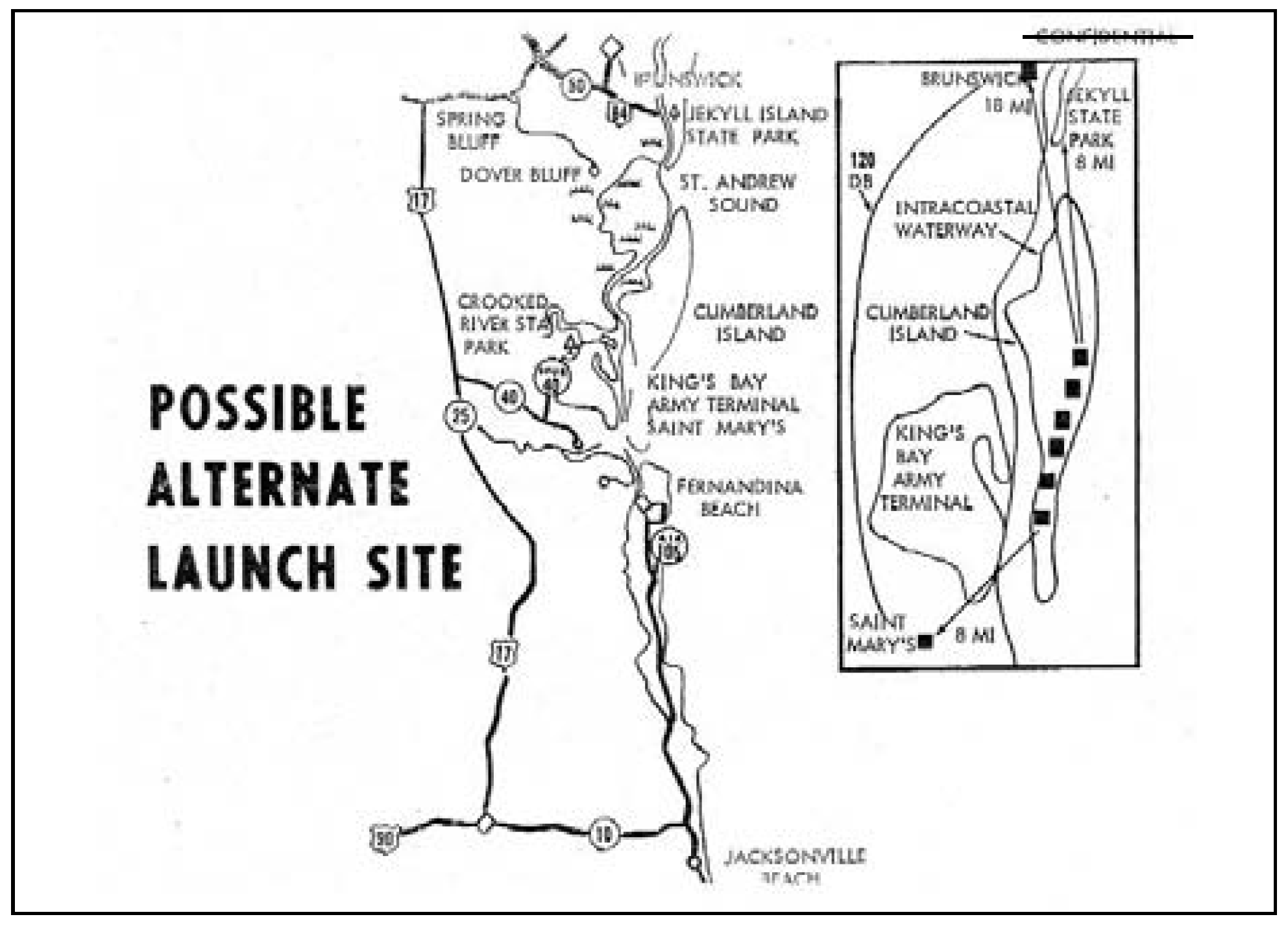
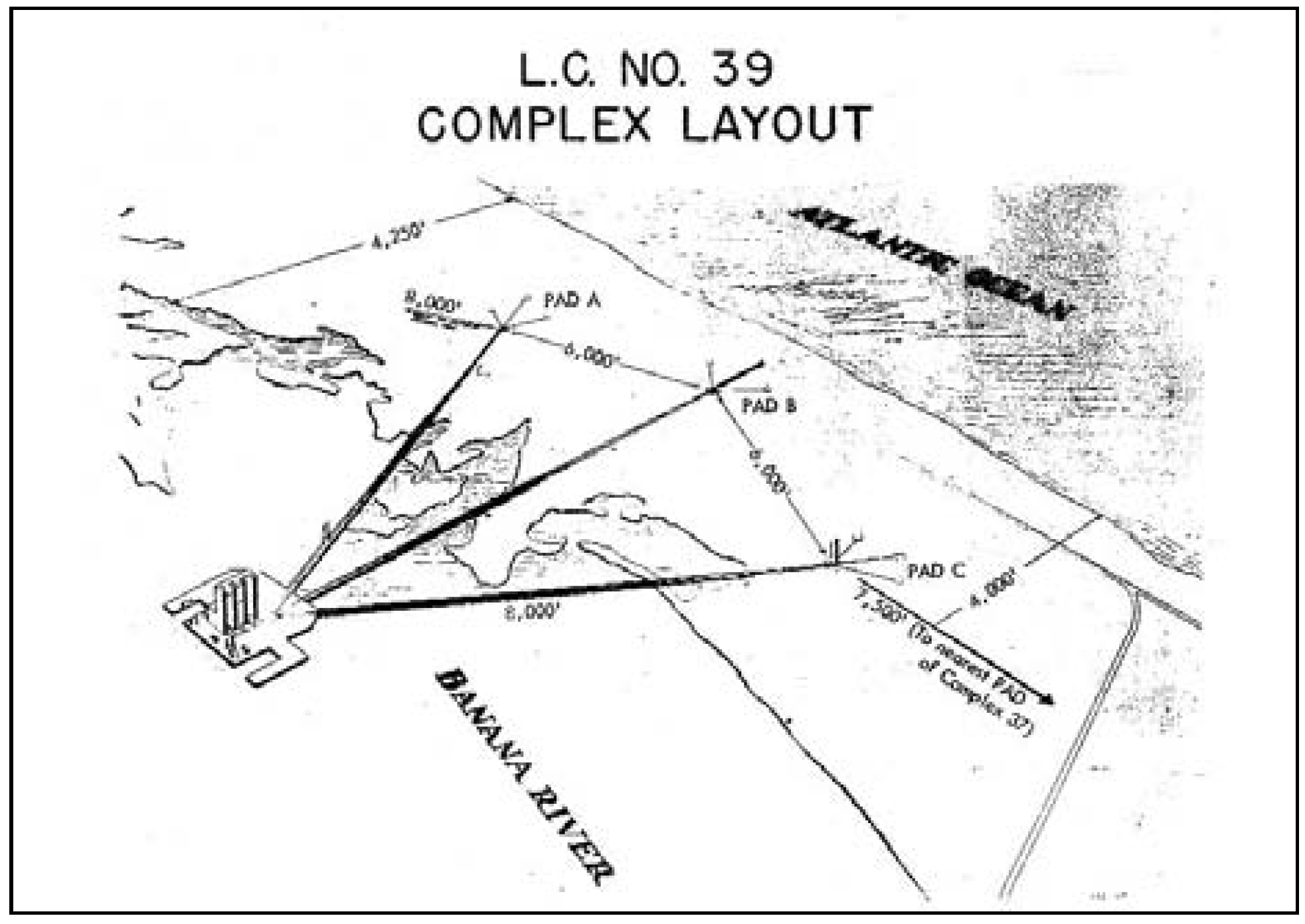
The study was based on having facilities far enough off shore to minimize noise and provide safety for those on shore; it also included a vertical assembly building with launching pads over a mile away (see figures 7 and 8). Consideration was given to noise levels in inhabited areas for both Cumberland and Merritt Islands (see figures 9 and 10).
The Fleming report listed three caveats for accomplishing this mission within a six-year period: immediate funding, no major catastrophes, and relief from labor slowdowns.
The study concluded that a manned lunar landing was feasible in the 1967 time period but that major management decisions and actions were required in the first six months. The total cost was estimated to be $12 billion. Critical data were needed on the amount of solar-radiation protection required for the astronauts and on the lunar surface’s characteristics.
Mercury Moves Ahead
During the planning and buildup for Apollo, NASA, and particularly the Space Task Group, had to keep focused on all the details of the Mercury Program. Three flights remained in 1961, one of which was manned. Gus Grissom was scheduled for a Mercury Redstone in July. This mission was followed by an unmanned single-orbit test of the Mercury Atlas in September, and a three-orbit mission was scheduled in October with the chimpanzee Enos in the driver’s seat.
Friday, 21 July 1961, MR-4, Virgil T. “Gus” Grissom
Gus Grissom and his backup, John Glenn, along with Shepard, had undergone refresher centrifuge training in April, so they were all set for the g forces to be experienced during liftoff and reentry on their next Mercury Redstone missions. Gus and John went back to work right after Alan’s flight. The astronauts exercised themselves and the Mercury systems in the simulated high-altitude chamber. Medical data were obtained as they checked the communications, practiced using the manual controls, and simulated complete missions. Each astronaut completed over 100 simulated flights before Gus’s flight on 21 July.
Egress from the capsule had required the removal of a bulkhead, followed by a climb through the antenna compartment—difficult for a healthy astronaut, but precarious for an injured one. For this reason, a side hatch was developed with 70 bolts, each with a detonating fuse. When a pin was removed in the cockpit, a fist force of 5 or 6 pounds would open the hatch. In addition, the two 10-inch side windows were replaced by a single trapezoidal window, giving the astronauts nearly 30 degrees of forward vision—up, down, and sideways. Originally, Mercury was going to have a periscope, but no windows; however, the astronauts rebelled at being “Spam in a can.” Now they truly could be Earth and sky observers.
Shepard’s flight had been overloaded with tests of manual control. Grissom’s 10 weightless minutes were to be spent with as much visual observation as possible. There were weather holds on the 18th and 19th, and even on the 21st conditions weren’t ideal, but liftoff occurred at 7:20 a.m. The flights went according to plan until Liberty Bell 7 was afloat following reentry. How it happened is still the subject of speculation, but the hatch blew off as the rescue helicopter approached. The capsule started taking on water as Gus attempted to fasten the helicopter cable. The capsule became too heavy for the helicopter to lift, and Gus started to submerge. On the third try, he was barely able to grab the collar and be pulled to safety. The valve on his suit had not been turned off, so it had filled with water, but Gus was okay. Liberty Bell 7 lay on the ocean floor for nearly 40 years until it was rescued by entrepreneurs who put it on display.16
Korolev Scores Again
Two weeks after Gus Grissom’s suborbital flight, Soviet cosmonaut Gherman S. Titov became the first space explorer to stay in orbit over 24 hours. The flight of Vostok II, four months after Gagarin’s famous first endeavor, showed us that the Soviets were in earnest and moving toward major accomplishments in space. Korolev was the master-mind of a progressive program that was pressing ahead on all fronts. At this early stage, we didn’t know his name or background, but we knew that the Soviet space program was managed skillfully and with imagination.
Wednesday, 13 September 1961, One Orbit Unmanned, MA-4
The Mercury capsule was launched by an Atlas booster, hence the mission was designated “MA”. The first launching took place on 13 September 1961. The so-called “thin skin” Atlas had a modified nose section to better carry the capsule weight. The flight proceeded through maximum dynamic pressure after 52 seconds of flight. All systems were go, and a peak velocity of 17,600 mph was reached. The maximum acceleration was 7.6 g’s. The orbit was slightly lower than planned, but acceptable, so the flight continued. During the flight, simulated crewmen placed on board the craft continued to “breathe” oxygen and produce moisture and carbon dioxide. High oxygen usage was reported early, and the tracking station in Zanzibar reported that only 30 percent of the primary supply was left. The retrorockets were fired in the vicinity of Hawaii, the drogue and main parachutes opened at the appropriate altitudes, and the destroyer Decatur made the recovery. The cause for the excessive use of oxygen was discovered. Vibration caused a flow-rate handle to become dislodged from detent. A new emergency-rate handle with positive latching was devised for later missions.The mission was judged a complete success.17
Saturday, 7 October 1961, MA-5, Three-Orbit Chimpanzee Mission
Some questioned the need for another test mission prior to manned orbital flight. By this time, the Soviets had achieved their second manned orbital success with cosmonaut Titov. Wouldn’t the United States look ridiculous with still another chimp at the controls? The Space Task Group team, headed by Bob Gilruth, was adamant: we had to stick to our plan and not be rushed. There was a fairly long list of modifications required as a result of MA-4, and the new trapezoidal window had not been tested at orbital speeds. Enos the chimpanzee would arrive with his own metal-plastic pressure coach that was connected to the suit circuit of the regular environmental control system.
The mission plans approximated as nearly as possible those of the upcoming first manned flight. Orbital insertion took place at an altitude of 100 miles, 480 miles from the Cape. The capsule would travel around the world at 17,000 miles per hour and, after 4 hours and 32 minutes, would fire its retrorockets over the Pacific. On reentry, the outside temperatures would reach 1,260° F on the capsule’s section, 2,000°F on the antenna housing, and 3,000°F on the heatshield. Enos and his chariot performed according to plan until a yaw reaction jet malfunction, and the flight was terminated success-fully after the second orbit.18
By October’s End–In Progress or Completed
Two of the major Apollo studies were complete. The study teams were composed of Headquarters and field personnel and were needed to establish goals and priorities during the interregnum before the Headquarters program directors were on hand and a new organizational structure could be erected. Other complete actions included the following:
- Initiation of contractor design studies for Mercury II (later Gemini). This spacecraft would be launched by Titan II and carry two astronauts.
- Completion in September of studies to determine the Apollo launch site. The NASA-DOD team was chaired by General L. I. Davis, commander of the Atlantic Missile Range, and Dr. Kurt Debus, director of NASA activities at Cape Canaveral. Six sites were reviewed. Cumberland Island, Georgia, and Merritt Island, across the Indian River from Cape Canaveral, were the serious contenders. The ad hoc group recommended Merritt Island because of its proximity to the Air Force facilities at Cape Canaveral.
- Initiation of a NASA-DOD large launch vehicle study. In order to conduct large launch vehicle developments of maximum benefit to both NASA and DOD, a comprehensive study was initiated on 23 June 1961. This study was co-chaired by Dr. Lawrence Kavanau from DOD and Dr. Nicholas Golovin of NASA. The ad hoc group examined solid and liquid propulsion, launch vehicles that ranged in size from the Titan series to Nova-type monsters. The group also examined rendezvous options.
- Completion in July of further rendezvous studies for manned lunar landing. These studies were conducted by the ad hoc group chaired by Colonel Donald Heaton. The report confirmed that by using rendezvous in Earth orbit, the United States could achieve lunar landing at least one year earlier than by a direct ascent to the Moon using a Nova vehicle. However, as many as three launches of the Saturn C-3 might be required, as opposed to only two with still another version of the Saturn, the C-4. The C-4 had four F-1 engines in the first stage rather than two. The report also contained a list of major management decisions and actions required during the first six months of the program.
- Launch of the first stage of Saturn I on 27 October 1961. The first Saturn SA-1 was static-tested at Huntsville, Alabama, in May 1961 and then shipped to the launch site at Cape Canaveral. The 162-foot carrier weighed nearly one million pounds. Its eight H-1 engines lifted its payload of sand on 27 October 1961 and traveled 200 miles downrange. More than 500 different measurements were recorded, and the flight was deemed flawless.
- Authorization by Congress of 425 excepted positions, raised from 290. Excepted positions didn’t come under the aegis of the civil service. Individuals in these positions were hired and fired at the pleasure of the Administration.19
It was obvious from the start that NASA’s Apollo Program would require a substantial increase in manpower, but as a matter of policy, the major increase should come from the support of other governmental agencies, industry, and universities. Industrial teams would be selected by procurement procedures, which, although somewhat standardized, would be refined for the purposes of NASA’s programs. Specifically, there would not be a source selection team, but a source evaluation team—the Triad of Webb, Dryden, and Seamans would make the final decision (see figure 2). A variety of incentive arrangements were tested as the program evolved and expanded. University participation would normally result from grants, but there were exceptions—for example, in the development of Apollo guidance and navigation, the Massachusetts Institute of Technology operated on a cost-plus contract. One key area had to be the direct responsibility of the government, namely, land acquisition and construction of facilities. NASA had minimal internal capability, and time didn’t permit the evolution of such a capability. One day, Mr. Webb came into my office unannounced and ready for travel. He wanted me to join him on an important mission. As we settled into his black limousine (actually a black Checker cab), he explained that we were headed to the office of Lieutenant General William F. Cassidy, commander of the Corps of Engineers. The Army Corps of Engineers builds all manner of dams, waterways, and buildings, and we were hoping to enlist their support for land acquisition and construction of facilities. As I remember, the meeting was relatively short; we explained our mission and its needs, and General Cassidy assured us that the Corps could satisfy our requirements and wouldn’t require approval for extra billets (manpower open-ings). Their performance was truly remarkable.
Manned Spacecraft Center
Each of the three lunar landing studies emphasized the requirement for early construction of facilities if the 1967 date was to be achieved. And, of course, the construction couldn’t commence without a decision on those facilities’ locations and requirements. The location of the launch facilities on Merritt Island had already been discussed. Also mentioned was the need for a manned spaceflight center to match the launch vehicle establishment under Wernher von Braun in Huntsville, Alabama. The Space Task Group was managing the Mercury Project and would serve as the nucleus for all manned spacecraft development, astronaut training, and space operations. NASA’s Langley Research Center had spawned the Space Task Group, but growth in the Tidewater region of Virginia was limited by several factors, such as the lack of available land, local personnel, technology base, and university support. NASA needs and political benefits led to Houston, Texas. The districts of Tiger Teague, chairman of NASA’s authorization committee, and Albert Thomas, chairman of our appropriation subcommittee, shared Houston and its environs. In addition, the land for the new center was donated to NASA as an additional come-on. Rice University would be close by, an important part of the total package.
Shipment of Launch Vehicles and Spacecraft
One of the important issues facing NASA was the means for shipping the large, heavy, and somewhat delicate stages of the boosters and spacecraft modules. The Marshall Center examined the feasibility of dirigibles lashed together with the space hardware hanging in between. They even looked into the possibility of acquiring Lakehurst, New Jersey, where dirigibles used to land before World War II. Another avenue Marshall investigated was the development of special aircraft. When these possibilities floated to Washington, they became nonstarters. Water became the way to go, but what type of vessels should be used? Roll-on, roll-off-type barges had many advantages and were selected. With relatively low draft, vessels from Marshall could reach the Gulf of Mexico by traveling on sections of the Tennessee, Ohio, and Mississippi Rivers. Similarly, Houston, with a waterway to Galveston, is nearly on the Gulf; once there, cargo can readily be shipped to Cape Canaveral.
Our next-door neighbor, Marvin Coles, was the chief lobbyist for the Maritime Industries of America. I came home one evening after testifying on issues of transportation to find him practically on my doorstep. To paraphrase, he said, “I hope you’re not going to start a U.S. trip to the Moon by using foreign shipping.” My rejoinder was, “How about helping our country find suitable shipping rather than getting in a swivet over what we might do?” He did, and our needs were satisfied. The second stage of Saturn I and the nearly identical third stage of Saturn V were manufactured by McDonnell Douglas in Santa Monica, California. Three stages could be shipped by sea, as was necessary for the second stage of the Saturn V manufactured by North American Aviation (NAA), also in California. However, an enterprising small company, Aero Spacelines, perhaps hearing of Huntsville’s efforts, modified a Boeing 377 Stratocruiser into the most unlikely vehicle imaginable. The cargo area of the fuselage was doubled in volume, giving the plane its informal name, “the pregnant guppy.” NASA was all for the use of the plane if it could be certified by the Federal Aviation Administration. One day, I was asked to approve a voucher for a small amount. The company had run out of assets and, for lack of fuel, couldn’t complete the required testing. NASA approved the funds, the license was obtained, and the “pregnant guppy” provided years of service.
First-Stage Construction Site
About that time, we selected Houston as the location for the Manned Spacecraft Center. I received a call from Wernher von Braun about a 45-acre building in the outskirts of New Orleans. The Michoud Plant was on property fronting the Mississippi River. The building had been used by Higgins for shipbuilding during World War II and by Chrysler for making tank engines during the Korean War, and it was currently idle. After further investigation by the Marshall team, along with Chrysler and Boeing, the contractors for the first stages of the Saturn I and the Saturn V, respectively, all agreed that there was room for the fabrication of both booster stages. However, there was a need for additions to the structure. The Corps of Engineers built a high bay area for static testing and constructed a partition separating the contractor manufacturing areas with one portal between them called Checkpoint Charlie. Both the engineering and manufacturing space required extensive rehabilitation. The washrooms were not only segregated between blacks and whites, but I also found, on an inspection tour, that the doorways were significantly nar-rower for blacks. Needless to say, all facilities were henceforth integrated.
Mississippi Test Facility
Just across the Pearl River from Louisiana was ideal property for static testing of all Saturn I and Saturn V stages, as well as test stands for the F-1 and J-2 engines. This large tract of land in Mississippi had about 600 inhabitants who had lived there for generations. When the Corps started acquiring the land by eminent domain, questions arose as to where the inhabitants could move and still trap muskrats, their primary livelihood. Throughout its properties, NASA attempted to preserve the native habitat. On Merritt Island, where the government acquired 55,000 acres, many of the orange groves were maintained and leased back to the former owners. Before every launching, a special whistle warned the birdlife of the upcoming earsplitting noise. Many eagles’ nests in the area are still active. Wherever possible, NASA maintained the land it acquired for both human use and natural habitat.
Kennedy’s Spaceflight Center
However, the largest structure of all was the Vertical Assembly Building (VAB), which was to be constructed on Merritt Island, close to Cape Canaveral. The building could house four Saturn V vehicles at any one time, and each could exit the building by a separate set of doors. The Saturn V stood 360 feet tall, and when it was mounted on its transportation, along with the umbilical tower, well over 400 feet of height was required. The central section of the building was 525 feet tall and covered 8 acres. It was mounted on 4,225 piles, each driven to a depth of 150 to 190 feet. A new type of vibrating pile driver was used facilitating penetration into sandy soil.20 Three architecture teams were used for the total facility, which, in addition to the main section, had a low bay area and the launch control centers.
Although the VAB was the largest building by volume in the world, there was nothing nearby to make it appear so. Also, when you stood on the roof, it didn’t appear high because the roof lines extended so far that they blended with the land and sea out to the natural horizon. But take the elevator to the 52nd floor and walk across the catwalk just under the roof, and vertigo could suddenly take hold. Visitors always remembered their trip to the 52nd floor and their view downward of large rocket structures and diminutive people.
Important program milestones had recently been achieved. Many more were pending. Brainerd Holmes arrived amidst plenty of activity. Office space for him and his staff would be required in the District of Columbia. It was already decided that the Office of Manned Spaceflight (OMSF), of necessity, had to be close to the rest of NASA Headquarters and to Congress. Accommodations for Brainerd’s office were found near George Washington University.
The development plan for Mercury II became available for Brainerd’s review in November. The primary purpose of Mercury II was to gain experience with orbital maneuvers, including the rendezvous and docking with the unmanned test vehicle, Agena. An appropriate award was offered for an appropriate name for Mercury II. “Gemini,” referring to the heavenly twins Castor and Pollux, won the special award of a bottle of Old Fitzgerald hands down.
National Headquarters Reorganization
On 1 November, NASA announced a major Headquarters reorganization with five new program offices. The new offices (see figure 20) were Manned Space Flight, under D. Brainerd Holmes; Space Sciences, under Homer Newell; Space Applications, under Morton Stoller; Advanced Research and Technology, under Ira Abbott; and Tracking and Data Acquisition, under Edmond Buckley. These program offices and their field installations reported directly to the Associate Administrator. There was one general manager for all NASA research, development, fabrication, and operations. He was called the Associate Administrator. That was my job from 1 September 1960 to 5 January 1968. With this arrangement, I was able to work directly with Bob Gilruth as he moved the Space Task Group to Houston and with Kurt Debus as he formed a new Center at the Cape. I also spent time with Wernher von Braun at Huntsville as he transformed his Army-type arsenal into a projecttype institution. Up until 1963, the Johnson Center was still dotted around Houston. At the Cape, launch and administrative buildings were under construction, and at all three Centers, major contracts were under negotiation. It was a time of flux as sound procedures were being formulated for the difficult operations ahead.
John Houbolt, Spokesman for Lunar Orbit Rendezvous
On 15 November, I received another letter from John Houbolt.21 I had received his first letter on 19 May 1961, even before Kennedy had delivered his special message to Congress. Houbolt acknowledged that contacting me was “unorthodox” and that I might feel I was “dealing with a crank.” As a matter of fact, my first impulse upon receiving his letters was to call Tommy Thompson, Director of the Langley Research Center, and ask him to get John off my back. However, I saw great merit in lunar orbit rendezvous, the mode of operation so strongly proposed by John. In his second letter, after considerable fulminating about the rocket engines and launch vehicles under development, John recommended the following steps:
- Get a manned rendezvous experiment going with Mercury MK II (soon to be called Gemini).
- Firm up the engine program suggested in his letter and attachment, converting the booster to these engines as soon as possible. (John didn’t know we were about to approve the C-5.)
- Establish the concept of using a C-3 and lunar rendezvous to accomplish the manned lunar landing as a firm program. (I was trying my best, but controversial decisions of this type cannot be made by decree. The next step was to bring this message to Brainerd in such a manner that he’d respond positively to the concept of rendezvous in orbit around the Moon.)
John not only wrote me a letter, but, with two others, he also wrote a comprehensive, 97-page report entitled “Manned Lunar Landing Through the Use of Lunar Orbit Rendezvous.” It was dated 31 December 1961 and gave a thorough outline of his rendezvous research at Langley Research Center. In addition, John had made a most favorable impression when I visited Langley five days after my swearing-in. He had explained the orbital maneuvers and noted the 50-percent savings in weight. The biggest stumbling block in people’s minds was the absolute requirement for a successful rendezvous in lunar orbit. This maneuver seemed quite manageable to me as a result of my experience at the Massachusetts Institute of Technology (MIT) and the Radio Corporation of America (RCA). At MIT, I directed projects on airborne missiles; at RCA, the DOD SAtellite INTerceptor project, SAINT. Obviously there was some risk in this portion of the mission, but the overall trip to the Moon and back was loaded with risk, and its totality had to be minimized.
Obtaining Systems Capability
As can be readily seen from John Houbolt’s concerns, the Apollo Program office had an acute need for a systems capability. This need for an ability to conceive and define quantifiably all the elements required to complete the mission was manifested early on, and we attempted to recruit an inhouse systems team within the Office of Manned Spaceflight. Fortunately, through the good services of Mervin Kelley, special consultant to Jim Webb, this effort yielded Joseph Shea (later to become the Apollo chief systems engineer) and a contract laboratory, Bellcom. Merv had been the director of AT&T’s Bell Laboratories. He helped open the door to James Fisk, the thendirector. I visited the Bell Labs, explained our needs and deficiencies to Jim, and proposed the establishment of a system laboratory in Washington, similar to but smaller than Sandia, their laboratory set up for the Atomic Energy Commission (AEC). Jim was by no means overjoyed at the thought because some of his key personnel would be required to establish the enterprise. He also recognized that Apollo might have a lifespan of little more than a decade. He said that any hires would become permanent members of the Bell Laboratories, not to be let go if Bellcom’s contract was terminated. Hence, they would hire only top-grade personnel. I agreed and said that’s what was needed, but I also recognized that Bellcom would be slow at the starting gate. When formed and manned, the Bellcom group provided top-grade analytical capability that supported system integration at both Headquarters and the Centers.
After receiving his doctorate, Joe Shea had become a member of the Bell Laboratories; more recently, Joe had been responsible for the intercontinental ballistic missile (ICBM) guidance for the Titan program at AC Spark Plug. After Joe’s swearing-in as the Apollo chief systems engineer, he and Brainerd came to my office. He claims my instructions were to “sell lunar orbit rendezvous” to the manned flight organization. This was not an easy assignment because most members of von Braun’s Marshall Center and Gilruth’s Manned Spacecraft Center (then the Space Task Group) had taken a strong stand for either Earth orbit rendezvous or direct ascent. Joe’s quest took him into the inner circles of the flight centers in Houston and Huntsville and, ultimately, the White House, and his efforts were eventually crowned with success. NASA did utilize lunar orbit rendezvous to achieve a manned lunar landing within the decade, and, in my view, that mode of operation was the only road to success. But while this key decision was in the balance, NASA achieved a manned orbital flight when John Glenn climbed aboard Friendship 7 for the second time on 20 February. He was followed several months later by Scott Carpenter.
Tuesday, 20 February 1962, MA-6, John Glenn’s Orbital Mission
Even before 20 February, John Glenn experienced the sometime vagaries of countdowns. On 27 January, the first countdown for MA-6 commenced, and after a series of holds, the flight was scrubbed. John had been lying on his couch for over 4 hours. During this time, his courageous wife Annie had been at home with her family, and members of the press corps outside were salivating while awaiting news of the flight. Was it to be a grand success with a happy wife or a fatal failure with a family in mourning? Either way, the media were there in eager anticipation.
While this act was in play, Vice President Lyndon Johnson, who was also chairman of the Space Council, was in a limousine nearby, wanting to appear on the scene and bolster Annie’s confi-dence. What might have been a touching scenario was not to be. She didn’t want counseling. As soon as John Glenn emerged from the gantry tower, he was advised of the stalemate. Would he please call Annie and tell her that she must welcome the Vice President? His reply was direct: “If Annie doesn’t want to see the Vice President, she doesn’t have to.”
On 20 February, the biosensors were installed on John at 5:00 a.m., and he was soon on the way to the launchpad. By 7:00 a.m., the hatch was bolted in place, and he commented that the weather was breaking up. At 8:05, the time was T minus 60 minutes. After a series of small holds, it became T minus 22 minutes at 8:58 a.m. By then, John Glenn and the blockhouse and Control Center crews were joined by about 50,000 “birdwatchers” on local beaches and an estimated 100 million viewers via TV sets. At 9:47, Friendship 7 was up and away and John’s pulse reached 110 beats per minute. Telemetered signals indicated that the Atlas and spacecraft were performing perfectly. At the maximum dynamic pressure, max-q, John reported, “It’s a little bumpy around here.” Five minutes after liftoff, Friendship 7 was “through the gates,” and, according to Goddard’s computers, conditions were good enough for nearly 100 orbits. Glenn found that he could move about and see well, but he quipped, “I’d like a glass capsule.” Weightlessness has its advantages: if his attention was drawn to the panel switches, he’d leave his camera suspended near his head until he could return to taking photos. Within range of the Australian tracking station, he reported feeling fine, seeing bright lights (Perth), and being excited about the “shortest day of his life” (108 minutes from sunrise to sunrise).
Then, when he was over Mexico, he notified the station that a yaw reaction jet was giving him trouble. He had to live with the problem for the rest of the mission by shifting to manual control or just allowing the capsule to drift so that he could save his fuel supplies. Later in the mission, a more serious problem appeared to a ground controller: the heatshield had become unlocked and was held in place only by the straps of the retro package. During the remainder of the flight, a debate continued over whether to jettison the retrorockets after their firing and run the risk of disengaging the heat-shield or to leave them on, thereby securing the heatshield until g forces kept it in place but running the risk of damaging the heatshield as reentry heat destroyed the rockets. Christopher Kraft and Walter Williams decided to keep the retro pack in place. (Walter Williams was the mission controller on the early Mercury flights. Christopher Kraft assumed this responsibility later in the program.)
The retros were fired as Friendship 7 approached the California coast. “Boy, it feels like I’m going halfway back to Hawaii,” Glenn exclaimed. As the capsule decelerated and the temperature outside the capsule increased, there was a real fireball outside. Was it the heatshield disintegrating? And then, after passing peak g’s, the spacecraft started oscillating wildly and the fuel in the damping control became low. However, the drogue opened at 28,000 feet, and all was well. John and Friendship 7 were retrieved by Noa, a destroyer, and later transferred to the carrier Randolph. The recovery team described John’s condition as hot; sweating profusely; fatigued; lucid, but not loquacious; thirsty, not hungry. John Glenn was safe and sound.22/p>
The President, Jim Webb, and other dignitaries welcomed John when he returned to the Cape. My wife Gene and I were happy to be in the large, welcoming crowd, although we were almost overrun by the media, who were ever straining to close in on America’s latest hero.
Thursday, 24 May 1962, MA-7, Scott Carpenter
At 3:45 a.m., Scott and his team boarded his land transportation for a slow ride to Aurora 7. The countdown was flawless, with three 15-minute holds solely to wait for ground fog to disperse. During the holds, Scott chatted with his wife, Rene, and their four children. Liftoff and orbital entry were completely nominal, leading Chris Kraft to comment that MA-7 was the most successful flight to date. Scott enjoyed his capsule maneuvers, photographing surface objects over Woomera, Australia, and airglow phenomena. On six occasions, he accidentally activated the high-thrust control jets. So by the end of two orbits, his control fuel was down to 40 percent. He was advised to use his fuel sparingly. So on the final orbit, he went through a long period of drifting. He let the capsule slowly roll until it was close to retrofire. The tracking site at Hawaii instructed Scott to start his pre-retrofire countdown. He advised ground control that he was somewhat behind, as he had spent some time testing his hypothesis about the snowflake particles that John Glenn had seen. Then, as he attempted to lock up his 34-degree nose up and 0-degree yaw, he was in trouble. The automatic control failed. He hurriedly went to fly-by-wire and felt that he was in alignment when he heard Alan Shepard’s voice from California asking whether he had bypassed the automatic retro-attitude switch. Carpenter quickly acted on this timely reminder. About 3 seconds after Shepard’s call of “Mark! Fire one,” the first rocket ignited, followed by the second and third. Actually, Aurora 7 was yawed 25 degrees to the flightpath, causing a 175-mile over-shoot of the landing. The retrorockets were fired 3 seconds late and provided excess power, which accounted for another 75 miles over target. After landing, Scott noticed some water on his tape recorder, and his capsule had a continued list. He had at least an hour’s wait, so he decided to abandon ship. Not wanting to open the hatch for fear of sinking, he wormed his way upward through the throat of the spacecraft. To keep cool, he left his suit hose attached and struggled with the life raft, survival kit, and kinked hose before getting his head outside. He was able to disembark, deploy his life raft, and enjoy the presence of the sea bass and gulls until aircraft arrived and two frogmen appeared beside him. They later reported that Scott appeared “smiling, happy, and not at all tired.” After 3 hours, Scott was picked up by an HSS-2 helicopter, which first dunked him in the water before putting him aboard the destroyer Pierce. He cut a hole in his socks and proceeded to pace around the deck as the water drained and he talked about his flight. He received the traditional congratulatory call from the President. Scott apologized to him for not aiming more precisely.23
Saturn V Defined and Approved for Development
On 25 January 1962, NASA established a standard configuration for Saturn and approved its development program, with Marshall Space Flight Center having responsibility for all three stages using the F-1 and J-2 engines. There were many potential roadblocks that might have derailed the development of the Saturn. Examples include the combustion instability of the F-1 engines and the intractable difficulty of moving the Apollo/Saturn from the Vertical Assembly Building to the launchpad.
In June 1962, NASA announced that the Advanced Saturn had shown considerable growth. The three-stage Saturn booster was originally contracted as the C-2 configuration of Saturn, with Boeing developing the first stage with two F-2 engines, North American the second stage with two J-2 engines, and Douglas the third stage with six RL-10 engines. In the final version, the number of first- and second-stage engines had grown from two to five and the third stage had given up the six RL-10 engines that produced 90,000 pounds of thrust for one 200,000-pound-thrust J-2 engine. When lifting off the pad, the five F-1 kerosene-oxy-gen engines provided 7.5 million pounds of thrust, and the second-stage burn with hydrogen-oxygen J-2 engines drove Saturn toward orbit with a 1-million-pound thrust.24 When I was reviewing this transformation with Abe Hyatt, Director of Plans and Evaluation, he asked me whether we should rebid the three contracts because such major changes had been made in the specifications. My answer was, “Not on your life.”
Assembling Indoors
The concept of assembling the Apollo/Saturn indoors had great appeal. Construction on the launchpad had been fraught with difficulty. During heavy winds or rain, tarpaulins were dropped around the vehicle for protection against sand and water. And of course, when lightning was striking, there was no assurance that the vehicle would be spared. For this reason, as early as the spring of 1961, plans were approved for a Vertical Assembly Building in which the rocket stages and the Apollo spacecraft would be mated and checked out. Before the VAB was built, launch crews performed their checkout in blockhouses of reinforced concrete adjacent to the pad because analog instruments were utilized and their readout had to be near the vehicle. In the new concept, the onboard instruments might be analog or digital, but conversion to digital would be 100 percent. The RCA computers for this purpose were located in the structure supporting the vehicle and moved with the vehicle from the VAB to the launchpad. The same monitors were used in Launch Control whether the vehicle was in assembly or preparing for launch. During the final 2 minutes before liftoff, the checkout became automatic, surveying all 70,000 instruments to be certain all parts of the vehicle and supporting equipment were within tolerance.
Transportation at a Crawl
But how was the vehicle to be transported? Clearly by rail. However, detailed work on transportation design showed that the combined weight of the vehicle and its supporting structure was too heavy for the steel wheels. Flats would develop overnight, even with all the wheels the design could muster. Next, a review with the Navy led to the conclusion that there was no way to float the assembly in a stable fashion. Our plans for a VAB were nearly scrapped when word came of crawlers used to transport huge draglines in the open pit mines of Appalachia. Although skeptical, a team from the Cape visited an installation. When they asked for a demonstration, they were told to climb the ladder and come aboard. Getting impatient, they asked when the crawler would start, only to be told that they had been moving for 5 to 10 minutes. What’s more, the crawler had automatic leveling precise enough to keep the vehicle vertical within better than a foot at the top of the capsule 380 feet from the base. Figure 11 shows my sons, Joe and Toby, inside one of the four cars. The individual treads weigh several tons. To ensure success, the roadbeds to the pads had to be excavated 6 feet and filled and rolled with appropriate gravel.25
Large Launch Vehicles
Later in 1962 (on 24 September, to be exact), Golovin and Kavanau, cochairmen of the NASA-DOD Large Launch Vehicle Planning Group, submitted the group’s final report.26 The results culminated from major efforts by elements of both organizations. The report recommended “a mini-mum modification version of the Titan II ballistic missile for the Gemini program.”27 Nearly concurrent with this recommendation was a DOD-NASA agreement recognizing Gemini as a NASA project. The agreement spelled out a Gemini Program Planning Committee to be chaired by the Associate Administrator of NASA and the Under Secretary of the Air Force.28 This relationship was most fortuitous as longitudinal vibrations of Titan (called the POGO effect, after the movement of a pogo stick) gave visibility and prominence to all hands.
The report also recommended that the Saturn I of NASA be continued but that a Titan III launch vehicle be developed in parallel, thereby providing DOD with a vehicle of similar capability to Saturn I, but with a combination of liquid storables and solids, a launch vehicle more rapidly available in times of crisis.
NASA had approved the Saturn V three months prior to this NASADOD report. The report did support NASA’s position that “this development should be pursued with the highest priority . . . lunar orbit rendezvous offers the chance of earliest accomplishment of manned lunar landing. It is quite likely that the pacing item for any rendezvous approach is the development of the launch vehicle, hence the high degree of urgency recommended.”29
The report then went on to recommend the Nova vehicle with twice the capability of the Saturn V: “Since it is by no means certain that the development of rendezvous operations will advance rapidly enough to provide earliest accomplishment of manned lunar landing, it is recommended that the direct ascent capability be developed on a concurrent basis.”30 The report recommended Nova, but lunar orbit rendezvous had been approved by NASA and, tacitly, by the White House three months earlier. Nova, the mother of all vehicles, was hard to kill. NASA believed that rendezvous could be readily achieved, and it was. Nova was no longer actively pursued. Hence, a major part of the Kavanau-Golovin report that related to very large solids and a 1.5-million-pound hydrogen-oxygen engine became irrelevant.
However, there were three other elements in the report that were most significant, two with which NASA readily agreed and one on the controversial list: 1) automatic checkout, 2) redundancy, and 3) number of flights to man-rate. The report stated that automatic checkout and countdown must be advanced for two reasons: first, to reduce the prelaunch time; and second, to enhance reliability. This observation was certainly true and will be discussed more fully later. The second was for redundancy and specifically for engine out capability. The second Saturn V launching achieved orbit even through two of its five J-2 engines flamed out during the boost phase.
However, the report recommended an excessive number of flights for man rating. Note the following quotation: “From an examination of the results of the calculation of mission success data analyzed by the large launch vehicle group, it was found that it would take two to three years of flight test and about 25 to 60 launchings to man rate a Saturn I or Saturn V using the reliability growth estimate of this study.”31 The cost alone ruled out such a prodigious number of test launch vehicles. Additionally, the tests are meaningless unless the whole system is scrutinized, as there are many interactions between the spacecraft launch vehicle and the ground environment. The resolution of this issue took place in 1963 and finally gave NASA policies, procedures, and schedules that led to the achievement of President Kennedy’s goal. However, the management of manned spaceflight changed hands before this final action was taken.
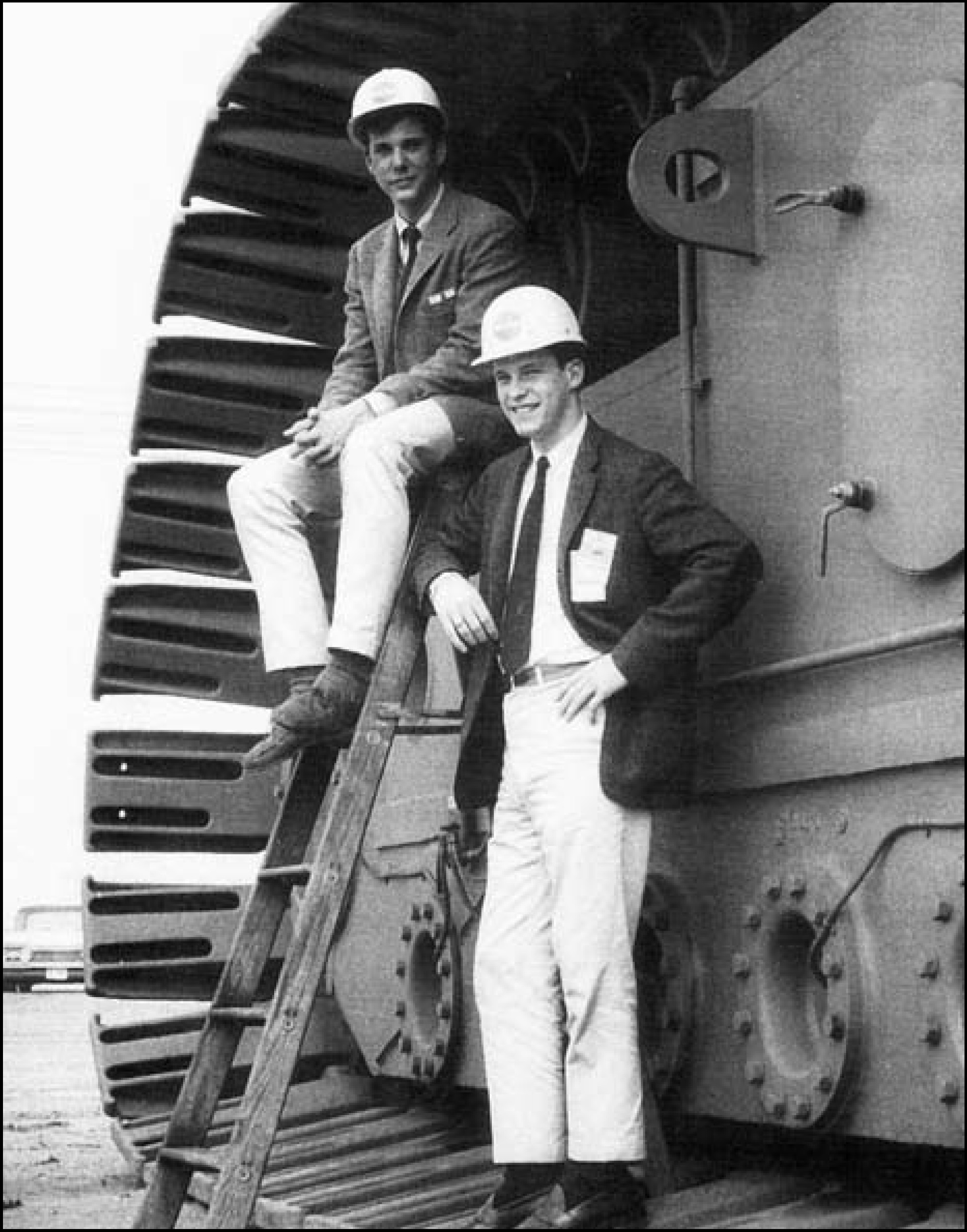
Nuclear Testing Before the Ban, September 1962
I was a sidebar participant in a meeting between the Atomic Energy Commission (AEC) chairman, Glenn Seaborg, and President Kennedy at the White House in September 1962. There was about to be a worldwide moratorium on atmospheric testing of nuclear weapons. The AEC had nine such tests that it felt were essential. The question on numbers was discussed in some detail, and the President finally agreed to five, not nine. The AEC was bounded by a completion date prior to the treaty date, but when could they start? The test could not be run while Mercury 8 (Sigma 7) was in orbit; the radiation level would be too high for communications and for Wally Schirra’s health. He was scheduled to launch on 3 October. Everyone turned to me and asked, “Can you meet the scheduled date?” My answer was, “I guess we better.” The President closed by saying, “NASA has the October 3rd date and Glenn can test five of his toys.”
Saturday and Sunday, 11–12 August 1962, Vostoks 3 and 4, Nikolayev and Popovich
By the time Wally Schirra was prepared for launch aboard Sigma 7, the Soviets had performed another key maneuver. On 11 August, Andrian Nikolayev had completed nearly four days in orbit aboard Vostok 3, but that wasn’t all. Vostok 4 was launched the next day with Andrian’s fellow cosmonaut, Pavel Popovich, at the controls. He maneuvered Vostok 4 within 4 miles of his companion.32 I can remember that Aviation Week carried the story soon after it occurred, and there was much speculation as to Soviet intentions. Were they conducting this dual maneuver to gain experience for their own exploration, or were these tests a prelude for Soviet inspection and possible interception of U.S. satellites? The United States had the unmanned project called SAINT, but orbital tests had not been initiated.
Wednesday, 3 October 1962, Sigma 7, MA-8, Walter Schirra
When Wally Schirra buckled himself into his couch and smiled as he saw an automobile ignition key hanging from a safety latch, his flight plans were much more modest than the Soviets’. If all went well, he would be approved for six orbits. The launch phase had a few surprises. Early in the flight, there was an unexpected roll, which stopped just short of the abort condition. Then the booster engine cut off several seconds early, and the escape tower soon sped away, spreading a spotty film on his window. The sustainer engine seemed to burn on and on, although in actuality, it cut off only 10 seconds late. By a small margin, Wally sped faster and higher than any other Mercury pilot.
Temperature control in both cabin and suit had proven difficult in previous missions, and now, according to Position 4 on his controls, the cabin was starting to overheat. Wally wasn’t too concerned, comparing his condition to that of mowing his lawn in Texas on a summer’s day. However, on his own, he started increasing the knob position a half mark at a time and then waiting 10 minutes to observe the result. By the time he reached Position 8, he was starting to feel cool. Ground control suggested that he go back to 3.5, but he selected 7.5, and there the setting stayed, and he felt comfortable.
The astronauts had no difficulty in using the horizon by day and the stars by night for controlling pitch above or below the horizon. The capsule had to be correctly nosed up for a good reentry. Similarly, roll could be readily brought to horizontal before reentry, but zero yaw was more difficult to achieve, as Scott Carpenter had found in Aurora 7. Wally experimented, using ground cues, star patterns, and even the Moon. Night was the most difficult. He found that the correct retrofire attitude placed the planet Jupiter on the upper right of his window, the constellation Grus in a bit from the left side, and the star Fomalhart at the top center.
As the flight continued, he relaxed by powering down and coasting along. He chatted with fellow astronauts as he traveled over various ground and ship stations, and then it was time for the checklist in preparation for his return. When he came into range of the Pacific command ship, he found he still had 78 percent of his control fuel left. Shepard asked how he stood on his checklist. Complete except for arming the rocket squibs, Wally responded. Soon thereafter, the three retrorockets fired in sequence, and he started his descent. He termed his return to the atmosphere as “thrilling.” He said that Earth’s surface really began to brighten, and most surprising, the “bear” he rode felt as stable as an airplane. Nine hours and 54 minutes after launch, he was hoisted aboard the USS Kearsarge. He received congratulatory messages from the President, the Vice President, and his wife Josephina. In the colloquial, it truly was a storybook flight.33
Winner of the Final Round—Lunar Orbit Rendezvous
Charles Murray and Catherine Cox’s Apollo: The Race to the Moon engagingly relates Joe Shea’s adventure with the two NASA Centers, MSFC and the Manned Spacecraft Center (MSC).34 Joe visited Huntsville, home of von Braun’s Marshall Space Flight Center, and came away with several good additions to his systems engineering team but a negative response to lunar orbit rendezvous (LOR).
In Houston, home of Gilruth’s Manned Spacecraft Center, Joe found kindred spirits for LOR but a negative response to helping him with the systems engineering. So he next hired Chance Vought Corporation to review Houston’s weight estimates. Then, one fateful day, after a series of meetings, the Gilruth team spent 6 hours briefing von Braun and his associates. At the end, there was silence, and John Palp, North American’s Apollo manager, was quoted as saying, “I’d like to hear what son of a bitch thinks LOR isn’t the right thing to do.”35 Actually, there was still another round of meetings, during which the von Braun team presented its recommendations for Earth Orbit Rendezvous in a 6-hour session. At the end of the day, Wernher rose, complimented his own people, and said that the Lunar Orbit Rendezvous offered the highest confidence for successful achievement within the decade. He pointed out that the separation of capsules for lunar landing and reentry into Earth’s atmosphere was bound to simplify the development of the system.
But this was not the end of the story. Brainerd Holmes and his team presented their findings to the Triad (Dryden, Webb, and Seamans), who enthusiastically concurred. A press conference was scheduled for two weeks hence. However, NASA was not to say that a decision had been reached because the President’s science advisor was adamantly opposed to LOR—in fact, Jerry Wiesner was never convinced that it was the correct method. Arguments took place at the White House and on an extended trip by the President and Vice President to various NASA manned flight centers. At Marshall, in their large vehicle assembly building, the argument blossomed in front of the nearby press, held at bay behind a rope barrier but within earshot. It wasn’t until 24 October 1962 that Jim Webb wrote Jerry that NASA was going ahead with LOR. On 7 November 1962, a press conference was held confirming the decision and announcing that the Grumman Aviation Corporation had been chosen to build the Lunar Lander.
Why Spend Billions?
There’s been much conjecture about President Kennedy’s motivation when he addressed Congress and recommended a lunar landing and safe return within the decade. Was he a true space cadet fanta-sizing about a lunar mission from Earth? Or was he impressed with the scientific importance of learning more about our universe particularly our own solar system? Some have suggested that he felt the need for a major effort so that the Soviets would agree to negotiate a joint program. My meetings with the President at the White House on 21 November 1962 and during his visit to Cape Canaveral on 16 November 1963 showed me that he had one straightforward goal, and it wasn’t any of the above. He wanted the United States to conduct a major, readily discernable mission in space prior to an equivalent Soviet Union achievement. The Soviets, thanks to Khrushchev’s opportunism and Korolev’s mastery of Soviet technology, had embarrassed the United States again and again with cleverly devised and well-conceived forays into space. Were we, as they claimed, a degenerating civilization and they the wave of the future? Kennedy wanted to prove it wasn’t so.
A meeting with President Kennedy at the White House resulted from the interesting recommendation made by Brainerd Holmes for a supplemental appropriation of $440 million for Apollo. Brainerd had first approached me, stating that a supplement of this magnitude would permit a lunar landing one year earlier, namely, in 1966. I couldn’t believe him. In 1961, we had increased Eisenhower’s budget request for FY 1962 to $1.8 billion (an increase of more than $670 million); the following year, to 3.7 billion.36 I was certain that Congress would look askance and that even if the additional funds were available, getting them wouldn’t land us on the Moon earlier. I said no but agreed to a meeting with Webb and Dryden, who both also said no. But Brainerd had jump-started the Apollo Program, had generated great esprit de corps, and was considered “good copy” by the media. Soon after we turned down Brainerd’s recommendations, an article appeared in Time magazine describing an upheaval at NASA: Brainerd and Jim Webb were locked in deadly combat, one of them might have to go, and it wasn’t necessarily Brainerd. Such articles can quickly lead to White House interest, and this one did.
The Kennedy Library recently released tapes of the 21 November meeting. David Bell, director of OMB, and Jerry Wiesner were on one side of the table, and Brainerd Holmes, Jim Webb, Hugh Dryden, and I were on the other side when the President arrived. He quickly got to the point:
. . . PRESIDENT KENNEDY: So it’s your view that with the four hundred forty million
. . . you’d probably, . . . your judgment is you won’t really save any time, is that correct?
JAMES WEBB: In the lunar landing I doubt very much if we’d save time. You can schedule it, you can go through the PERT system. Bob Seamans will say yes we . . . we will very likely save from four to six months. But from a general overall look at how these big programs run I doubt if we’d save very much time. Now Bob, I think you ought to say your own views because you are the operating head of this operation.
ROBERT SEAMANS: I think I agree with you Jim, that you can schedule six months earlier but you have to understand what these dates really are. These are dates for the internal management of the projects. They have to be dates that people believe are realistic. I mean, you have to have a fighting chance to achieve these dates but they’re by no means dates that you can absolutely guarantee at this time, because this is a development program, and you are learning as you go along and if you crank up too much of a crash program and you start running into trouble, it can take more time to unsort the difficulties than if it is a better paced program.
JAMES WEBB: A better way to state what I was trying to state. I think we can do in an orderly way what we have scheduled. I think the other will provide quite a series of crises.
. . . PRESIDENT KENNEDY: . . . Do you think this program is the top priority of the agency?
JAMES WEBB: No sir I do not. I think it is one of the top priority programs . . . .
PRESIDENT KENNEDY: Jim, I think it is the top priority, I think we ought to have that very clear. Some of these other programs can slip six months, or nine months and nothing strategic is going to happen, it’s gonna . . . . But this is important for political reasons, international political reasons. This is, whether we like it or not, in a sense a race. If we get second to the Moon its nice but its like being second any time. So that if we’re second by six months, because we didn’t give it the kind of priority, then of course that would be very serious. So I think we have to take the view that this is the top priority with us.
JAMES WEBB: But the environment of space is where you are going to operate the Apollo and where you are going to do the landing.
PRESIDENT KENNEDY: The science . . . .
Going to the moon is the top priority project now there are a lot of related scientific information and developments that will come from that which are important. But the whole thrust of the agency in my opinion is the lunar program. The rest of it can wait six or nine months . . . .
JAMES WEBB: Why can’t it be tied to preeminence in space which are your own . . . .
PRESIDENT KENNEDY: Because, by God, we keep, we’ve been telling everybody we’re preeminent in space for five years and nobody believes it because they [the Soviets] have the booster and the satellite We’re not going to settle the four hundred million this morning. I want to take a look closely at what Dave Bell but I do think we ought to get it, you know really clear that the policy ought to be that this is the top priority program of the agency, and one of the two things, except for defense, the top priority of the United States Government. I think that is the position we ought to take. Now, this may not change anything about that schedule but at least we ought to be clear, otherwise we shouldn’t be spending this kind of money because I’m not that interested in space. I think it’s good, I think we ought to know about it, we’re ready to spend reasonable amounts of money. But we’re talking about these fantastic expenditures which wreck our budget and all these other domestic programs and the only justification for it in my
opinion to do it in this time or fashion is because we hope to beat them and demonstrate that starting behind, as we did by a couple of years, by God, we passed them.
JAMES WEBB: I’d like to have more time to talk about that because there is a wide public sentiment coming along this country for preeminence in space.
PRESIDENT KENNEDY: We do have to talk about this. Because I think if this affects in any way our sort of allocation of resources and all the rest, then it is a substantive question and I think we’ve got to get it clarified. I’d like to have you tell me in a brief . . . you write me a letter, your views. I’m not sure that we’re far apart. I think all these programs which contribute to the lunar program, are, come within, or contribute significantly or really in a sense, let’s put it this way, are essential, put it that way . . . are essential to the success of the lunar program, are justified. Those that are not essential to the lunar program, that help contribute over a broad spectrum to our preeminence in space, are secondary. That’s my feeling.
. . . ROBERT SEAMANS: Could I state my view on this? I believe that we proceeded on Mercury, and we’re now proceeding on Gemini and Apollo as the number one program in NASA. It has a DX priority. Nothing else has a DX priority.
JAMES WEBB: And recommended four point seven billion funds for it for 1964!
ROBERT SEAMANS: At the same time, when you say something has top priority, in my view it doesn’t mean that you completely emasculate everything else if you run into budget problems on the Apollo and Gemini. Because you could very rapidly completely eliminate your meteorological program, your communications program and so on. If you took that to too great of an extreme . . . .
JAMES WEBB: And the advanced technology on which military power is going to be based.
HUGH DRYDEN: Mr. President, I think this is an issue. Suppose Apollo has an overrun of five hundred million dollars, to reprogram five hundred million dollars for the rest of the space program would just throw the whole thing away. And I think this is the worry in Jim’s mind about top priority.
PRESIDENT KENNEDY: Listen, I think in the letter you ought to mention how the other programs which the agency is carrying out tie into the lunar program, and what their connection is, and how essential they are to the target dates we’re talking about, and if they are only indirectly related, what their contribution is to the general and specific things in space. Thank you very much.
Kennedy gets up to leave the room.37
President Kennedy and Webb obviously had some difficulty in coming to grips with the other’s point of view. The President ultimately recognized that much of NASA’s scientific investigation was essential to Apollo. But Jim Webb never agreed with the President that “everything we do ought to really be tied into getting onto the moon ahead of the Russians.” Jim asked, “Why can’t it [our goal] be tied to preeminence in space?” The President replied that scientists may believe that the two are connected, but not the people of the world who know only that the Soviet Union has the biggest rockets. But the President’s bottom line was absolutely clear. He stated that Apollo was NASA’s top priority, important for international and political reasons. He added that except for defense, it was, along with one other, the top priority of the U.S. government.
Driving back to NASA Headquarters, I was wondering how Jim’s views and those of the President could be brought into concert. Hugh interrupted my thoughts when he said he’d like to prepare the first draft. Later, I received Hugh’s version, only a page and a half long and quite general in nature. I attempted a different version, considerably more extensive, with separate sections for manned lunar landing, space science, advanced research technology, university participation, and international activity, with extensive summary and conclusions sections.
I came right to the point in the second paragraph of my nine-page letter: “The objective of our national space program is to become pre-eminent in all important aspects of this endeavor and to conduct the program in such a manner that our emerging scientific, technological, and operational competence in space is clearly evident.”38
I then followed with paragraphs that detailed what we had to do to become preeminent in space science, advanced technology, and large-scale operations. I commented on the Apollo Program and noted that the program would commence with orbital maneuvers and culminate with the one-week trip to the lunar surface. I further stated that for the next five to six years, there would be significant events by which the world would judge the competence of the United States in space.
The summary recognized that in the views of Mr. Webb, Dr. Dryden, and myself, the manned lunar landing, although of highest national priority, would not by itself create the preeminent position we sought. It stated that our future interests in terms of having an adequate scientific and technological base for future space activities demanded that we provide a well-balanced program in all areas, including those not already related to the manned lunar landing.
When the draft was complete, I called Jim at home. He sometimes had severe migraine headaches, and it’s not surprising that one occurred at this time. We conferred in his home, with the pages of my text spread across one end of his dining room table. He made few changes until the final summary and conclusions. At that point, he started writing quickly around margins and between lines. For example, he added the following paragraph:
In aeronautical and space research, we now have a program under way that will insure that we are covering the essential areas of the unknown. Perhaps of one thing only can we be certain, that the ability to go into space and return at will, increases the likelihood of new basic knowledge, on the order of the theory that led to nuclear fission.
I felt that this statement was a bit of a stretch and wondered about Jerry Wiesner’s reaction. In addition, Jim put in a plug for the 1964 budget ($6.6 billion), and in the end, he bowed low by saying that if the President felt we should go for the supplemental in 1963, we would give our best effort to its adoption. And it was signed, “With much respect, believe me. Sincerely, James E. Webb, Administrator.” The full text of the letter is printed at the end of this book in appendix 2.
1962: Progress, 1963: Objective
I believe that the letter was an all-encompassing summary of policy and programs as viewed by NASA management in the Kennedy years. Remarkably, there was no further discussion of these issues until President Kennedy visited Cape Canaveral a year later. Whether from agreement, exhaustion, or diversion, President Kennedy gave tacit approval to NASA’s programs and policies by not engaging with us in further discussions on the questions of NASA’s top priority. Preeminence in space on all fronts was our goal; landing men on the Moon within the decade was the top (DX) pri-ority. We were riding two horses.
The year 1962 might be termed the year of the mission or perhaps the year of the spacecraft. After considerable angst between NASA and the White House, Mr. Webb announced the decision that NASA would utilize Lunar Orbit Rendezvous as a means for transporting men to the Moon and back. The development of the Apollo capsule with its supporting service module was well under way at North American Aviation, and Grumman had initiated the design of the Lunar Module for descent to and ascent from the lunar surface. Rendezvous with the Apollo capsule, with its Earthreentry capability, was obviously essential.
As NASA took stock in 1963, there were three manned Mercury orbital flights to their credit. In addition to John Glenn, Scott Carpenter and Wally Schirra had successfully orbited, and only one flight remained—or would there be two? Faith 7 (Mercury 9) was scheduled for May 1963 with Gordon Cooper at the helm. The objective of Mercury 9 was to extend the time in orbit from 6 hours to a day, a result already achieved 21 months earlier by cosmonaut Titov in Vostok 2.
Thursday, 9 May 1963, Faith 7 (MA-9), Gordon Cooper
Liftoff occurred at 8:00 a.m. Sixty seconds upward, Gordo felt the oscillation of max-q and the rate gyroscopes were giving readings from pin to pin caused by the violent oscillations of the spacecraft. The flight smoothed, and at 3 minutes, the cabin pressure was automatically sealed. Cooper reported, “Faith 7 is all go.” For the next 2 minutes, the Atlas sustainer rocket performed perfectly, and at Mission Control, Schirra reported, “Smack dab in the middle of the go plot.” “Beautiful,” Cooper replied, “working like advertised.” From Guaymas, Mexico, after one orbit, Grissom announced, “Go for seven orbits.” As Cooper raced over the launch site, Schirra complained, “You son of a gun, I’m still higher and faster, but I have an idea you’re going to go farther.” It was an auspicious start.
By the third orbit, Cooper had checked his 11 planned experiments. He prepared to eject a 6-inch sphere with a xenon strobe light. Cooper kicked the switch but couldn’t see the flashing light in the dusk or nighttime. However, he did spot the beacon on the fourth orbit at sunset, and on the fifth and sixth orbits, he also saw it flashing.
He ate some bite-sized brownies and fruitcake, kept up with his exercises, took oral temperature and blood-pressure readings, and produced urine samples periodically. The highest priority experiments were the aeromedical.
At the seventh orbit, he was pursuing radiation experiments and transferring urine samples between tanks. The hypodermic syringes were unwieldy and leaked. He placed a message on the tape, “The liquid has to be forced through the piping.”
After 10 hours, Cooper was officially informed that he was to go for 17 orbits. The flight had become routine. He spent his last orbit before a rest period having a supper of powdered roast beef mush and some water. He took pictures of India and Tibet, then prepared for a power-down so that he could drift and dream. He was advised by the telemetry command ship Rose Knot Victor near Pitcairn Island to “settle down for a long rest.” Sometime later, he did relax and fall into a sound sleep; he awoke after an hour, and for the next 6 hours, he napped, took pictures, and taped reports.
On the 16th orbit, Cooper took zodiacal light photographs for University of Minnesota scientists and snapped horizon-definition imprints around the clock for MIT researchers. This latter information was needed for the design of the Apollo guidance and navigation system. On orbits 17 and 18, he took infrared weather photographs of good quality. He resumed the Geiger counter measurements for radiation and continued his aeromedical duties.
On the 21st orbit, a short circuit occurred in a buss bar serving the 250-volt main inverter. The automatic control system was without power. Cooper noticed that the carbon dioxide level was rising in the cabin and in his suit. As he said to the ground controller, “Things are beginning to stack up a little.” He completed his checkout and prepared for a manual landing. Glenn gave him the 10second countdown, and the retrorockets were fired on the mark. Glenn reported, “Right on the old gazoo. It’s been a real fine flight. Real beautiful. Have a cool reentry.” And that he did.
Cooper landed 4 miles from the Kearsarge. As an Air Force officer, he requested permission to be hoisted aboard the Navy’s carrier. He next went through arduous medical, technical, and operational debriefings aboard ship and back at the Manned Space Center. He had lost 7 pounds, but after drinking a few gallons of water, he was fine mentally and physically. Cooper proved that man is a pretty good backup for all the equipment on the spacecraft.
My wife Gene was unavailable, so I took my 10-year-old daughter May with me to the Cape for Cooper’s triumphant return to Titusville. There was a parade in which May and I rode with Cooper and his wife in an open phaeton. However, at the press conference, all was not sweetness and light. Were we planning a Mercury 10 mission? This possibility had never been presented to me in detail, but I was dead set against it. We had jury-rigged our way with Mercury and had successfully completed our stated goals. Why risk a mission of several days on a Mercury spacecraft when Gemini was designed for missions of two weeks or more? Gemini was behind schedule and needed more focus by the Manned Spacecraft Center, so why divert attention to a questionable objective? Admittedly, Gemini flights were still several years away, but that was all the more reason to emphasize this successor effort.39
Returning to Headquarters, I found events of importance happening in rapid succession. Jim Webb asked me if I’d care to participate in a reception for Gordo following the ticker-tape parade in New York. I demurred because I had an appointment that day with George Mueller from Thompson Ramo Woldridge (TRW). I had met him before at TRW, but now I was going to explore the possibility of his assuming a senior position at NASA. It was a good meeting but without specifics. He seemed interested in joining NASA in a key position, and I thought he’d be a potential replacement for Brainerd Holmes, who had already demonstrated poor judgment in pressing the case for supplemental appropriation. However, the jury was still out on his long-term reliability.
Not long thereafter, a luncheon was held in the elegant reception facilities of the State Department. Many individuals were congratulated for their contributions to the success of NASA’s Mercury program. It was a love-fest for all but Brainerd Holmes. He called me afterward in high dudgeon because although he ran manned space flight, his name hadn’t been mentioned. Well, I thought it would have been better if he had been recognized, but I wasn’t in charge of naming honorees. I pointed out that there were individuals like Francis W. Reichelderfer, head of the Weather Bureau, whom NASA wanted to recognize, rather than always patting itself on the back. He said, “Well, I’m certainly not going to Mr. Webb’s lawn party.” (Mr. Webb had invited many of those attending the luncheon for an informal outdoor reception at his house.) I suggested that Brainerd rethink his priorities, and he did appear, but he had already stepped beyond the bounds. His ego had done him in. He had been out of line in going public on the need for a supplemental, as already discussed. I was concerned about the impact of his present actions on the organization, so I met with Hugh and Jim. We decided that we’d had enough, and Jim called Art Malcarney, Brainerd’s former boss, who immediately offered to help Brainerd if we felt his role at NASA was irretrievable. We did, and later that day, I advised Brainerd that it was time for him to resign. He didn’t question the decision and was glad Art Malcarney would help him back into the industrial world. He resigned on 12 June 1963. In his two years at NASA, Brainerd had placed NASA’s manned space program on a fast track, and he returned to a successful career in industry.
Sunday, 16 June 1963, Vostok 6, Valentina Tereshkova
On 14 June, Valeriy Bykovskiy went into orbit aboard Vostok 5 for nearly five days. Then, two days later, on Vostok 6, Valentina Tereshkova became the first woman to orbit Earth. Korolev had a way of informing us that we still had strong competition. Tereshkova is shown in figure 12, along with Yuri Gagarin and Aleksey Leonov. The United States didn’t send a woman into orbit until the Shuttle program, over 20 years later.40
George Mueller up to Bat
George Low and Joe Shea had been loyal, competent members of Brainerd’s Headquarters team. It was essential to keep them involved during the interregnum until Brainerd’s replacement was in office, and thereafter as well. I had become deeply concerned about the slow pace of the Saturn I’s development. There had been four completely satisfactory launches of the Saturn I first stage. Why hadn’t more significant missions been planned to capitalize on that success? Or, as members of the press were unkind enough to ask, why were we spending hundreds of thousands of dollars placing Canaveral sand and water into space? A review of the launch schedule was definitely in order. I worked closely with George and Joe on this and other issues.
On a personal note, my brother-in-law, Caleb Loring, and I owned a series of boats together. Since joining NASA, I had little time for sailing, but we had planned to race our yawl, Serene, from Marblehead to Halifax, Nova Scotia, early in July. The race takes two to three days, and then, after reprovisioning, the return to the Maine coast requires another four to five days. I’d wondered about leaving NASA in its somewhat perilous state, but Jim Webb had convinced me that we all need rest and relaxation (R&R), and the race had been planned with others months before. And so it happened; we left Nova Scotia in thick fog that lasted until we approached Rocque Island, off the Maine coast, on a sunny morning. We were soon spotted by the crew aboard a fleet of yachts who hailed us and said that Mr. Webb awaited my phone call. (Ship-to-ship communications could be picked up by anybody tuned to the particular frequency, and the responses were also on an open circuit.) One of the motor-sailors in the fleet had a high-powered radio telephone, so I climbed aboard and called Washington. Jim had left a phone number to call so that when we discussed George Mueller, we had, in effect, a private line. Jim told me that he and Hugh had interviewed George Mueller and felt he was qualified to manage the manned space program. I readily agreed. George Mueller was sworn in as Holmes’s successor on 23 July.
After George arrived, he soon realized that Headquarters was thinly staffed with competent senior managers. He arrived with a list of six or seven officers with whom he had previously worked. Key was Major General Samuel Phillips, who had managed the Minuteman development under General Bernard Schriever. He was extremely competent, and I wasn’t certain that the Air Force could or would spare this talent. However, assignment of military personnel to NASA was recognized by Congress as desirable and was permitted for limited numbers in congressional legislation. General Bozo McKee had been Vice Chief of Staff under General LeMay, and he was now on Jim Webb’s staff. George’s recommendation was reviewed by Bozo and Jim. They readily agreed, and thanks to Bozo, the transfers soon took place. It was a tremendously important benefit to NASA.
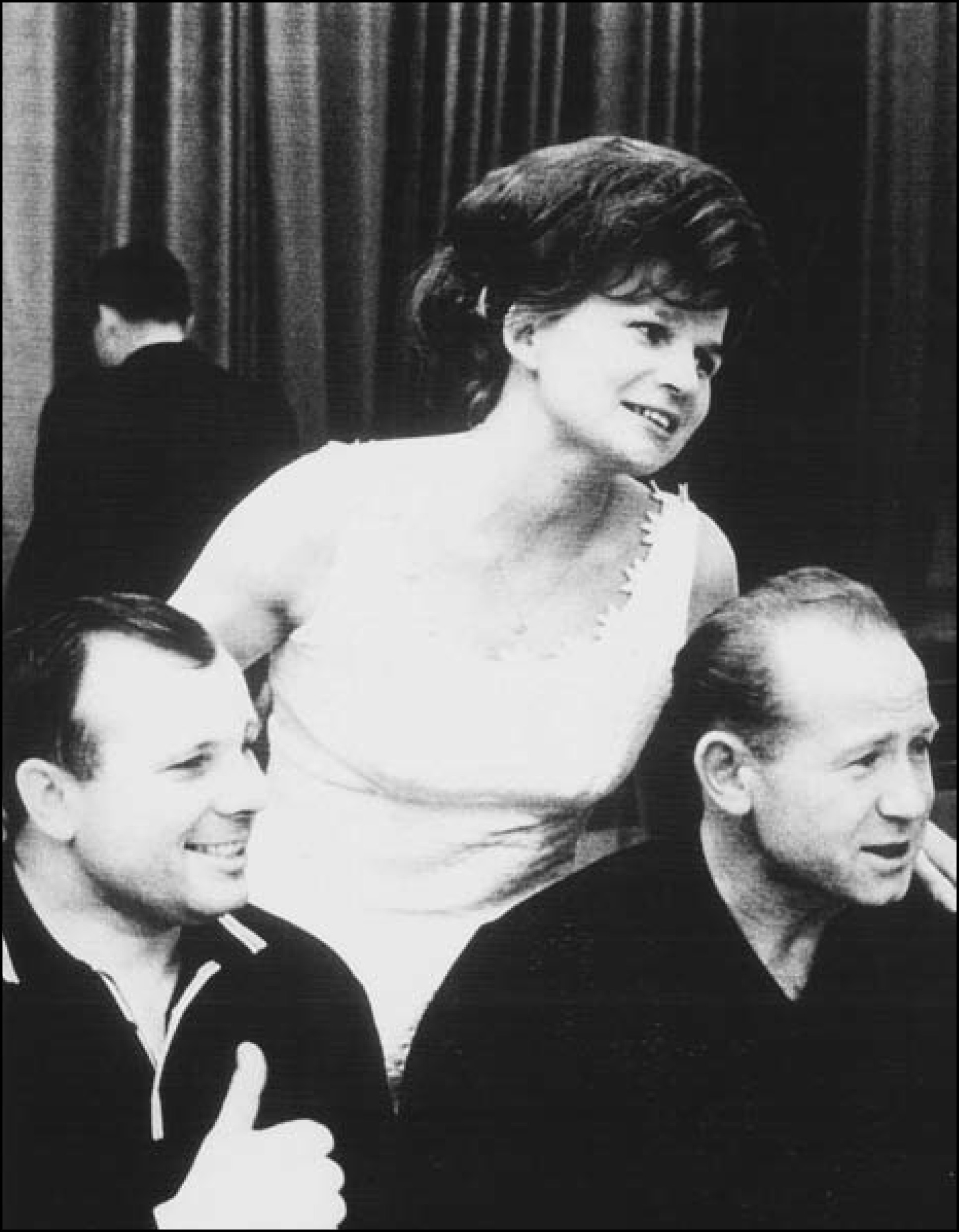
It can be said that George was not a person to accept past decisions as a given. In particular, he decide to review the flight schedule, tasking two old hands, John Disher and Del Tischler—the first knowledgeable in spacecraft, the second in rockets and launch vehicles. George wanted an unbiased, fresh look. Two weeks later, George was appalled by their findings. They estimated a late 1971 date with a launch within the decade only at unacceptable risk. They immediately came to my office for a similar briefing. When it was over, I took George aside and told him to bury the Disher-Tischler review and create a new program with an acceptable outcome. George was prepared to put forth a radical plan for this purpose. The plan was managerial as well as procedural, and it took into account Congress’s reduction of the President’s 1964 request from $5.7 billion to $5.1 billion.41
We were perilously close to losing control of the program, which placed George in the driver’s seat. First, he insisted that the three major Centers in Houston, in Huntsville, and at the Cape should report directly to him. Second, internal to this group, George was the chief executive officer and chairman of the board. The Gemini director, Chuck Mathews; Apollo director, Sam Phillips; and Apollo Application director, E. Z. Grays, all reported to him. At their management reviews, he was the board chairman, with Gilruth, von Braun, and Debus as board members. The project directors were in the Centers. For example, Joe Shea moved to Houston, where he became director of the Apollo capsule and the Lunar Module. There would be no counterparting. Sam Phillips didn’t have an Apollo capsule staff person in his office; he worked directly with Joe Shea, as can be seen in figure 30. Each program director had five staff officers, as did the project directors. These were responsible for program control, systems engineering, test, reliability and quality, and flight operations. The two staffs worked closely together. Reductions in the budget included eliminating four Saturn I manned orbital missions. And, of course, the Nova vehicle was no longer required. But these reductions alone would be insufficient to control the budget and to achieve a landing within the decade.
A step-by-step approach adding elements in sequential flights coupled with repeated flights of the final configuration would not, according to George, build reliability into the system. The best opportunity for reliability and success would come from careful design, redundancy where possible, component quality control, and systems testing. I agreed. As the stages were assembled one by one and then coupled with the spacecraft, the system would be checked out by the same instruments, monitors, and people that would be responsible for the go-ahead on launch day. Finally, on launch day, in the 2-minute period prior to ignition, all key items would be automatically checked to be certain that the readings were within prescribed tolerances. With this procedure, it is only sensible to plan on success. If the first stage is going to do its job, have the second included, and so on, until an all-up systems test is achieved on the first attempt. I was present at Launch Control when Saturn V was launched the first time. Not only did all launch systems perform flawlessly, but Apollo and the service module did also. The Lunar Lander was not yet available, but it would have been included if checked out.
Now, George created quite a stir with his revised program. Words like impossible, reckless, incredulous, harebrained, and nonsense could be heard behind the scenes. After announcing the plan to the manned spaceflight team, George followed up immediately with detailed schedules. George didn’t sell; he dictated—and without his direction, Apollo would not have succeeded.
Kennedy’s Last Visit to the Cape
One evening in mid-November 1963, just before leaving my office, I received a call telling me that President Kennedy was thinking of a trip to Cape Canaveral. The White House is always careful never to be too explicit about a presidential trip. Following this, I received a call from Major General Chester V. Clifton, military aide to the President, who gave me more details. He said that the President wanted to get a feel for how we were progressing and that he would have about 2 hours. What did we recommend?
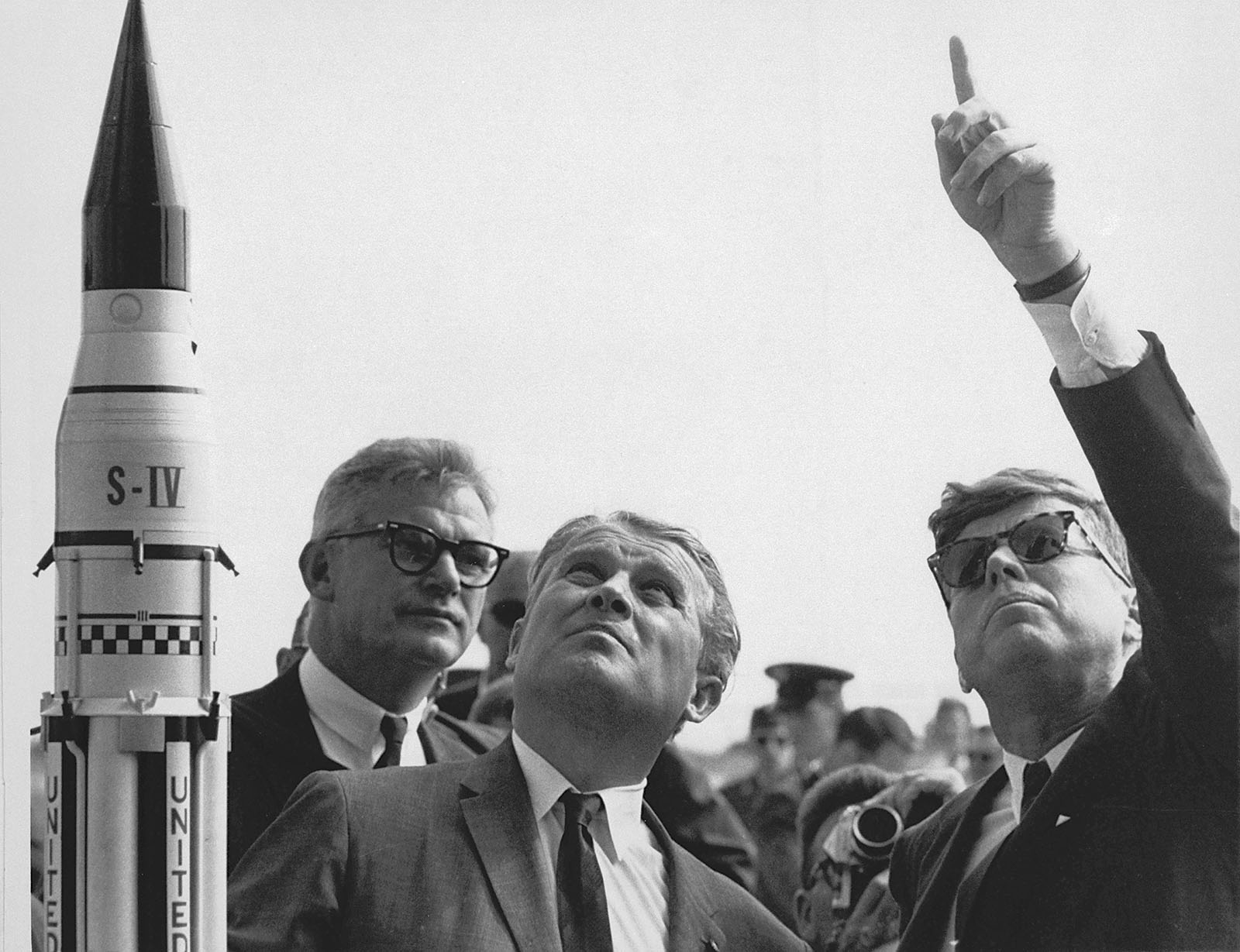
Julian Scheer, NASA’s public affairs officer, came down to my office, and several of us sketched a map on the blackboard indicating where the President might land, what he might see up close, and what he might fly over. Naturally, we kept Jim Webb informed. We felt that the President couldn’t cover it all without the use of a helicopter because a couple of bridges connecting the Cape with Merritt Island were not yet completed. I called General Clifton back, and there ensued a series of phone calls and discussions of other opportunities for the President while at the Cape, among them a review of the Navy’s Polaris missiles.
The next morning, 16 November 1963, the President flew from Palm Beach to the Cape, where he was greeted by Major General Leighton I. “Lee” Davis and Dr. Debus, the respective heads of military and NASA operations at the Cape, as well as by Jim Webb and me. He was accompanied by Senator George A. Smathers of Florida, a good friend of his. The President said, with a smile, “I’m surprised to see you all here so early on a Saturday morning.” Then he stepped into an open car with
Jim and General Davis. They drove by the various complexes rather slowly. We joined them inside the blockhouse at Complex 37, where a Saturn launch vehicle was soon to be tested. There was about a 15-minute briefing there with all kinds of models. The President seemed quite interested in what George Mueller had to say. When the briefing was over, he stood up and went over to the models. He expressed amazement that the models were all to the same scale, because the Mercury launch vehicle was completely dwarfed by the Saturn V. This may have been the first time he fully realized the dimensions of future NASA projects.
We then went out to the pad where the Saturn SA-5 (the fifth Saturn I) was undergoing tests. Figure 13 shows President Kennedy with Dr. von Braun, discussing the Saturn and its dimensions. Before leaving, President Kennedy wanted to walk over and stand right underneath the Saturn. This evidently had come up for discussion with the Secret Service the previous day. They hadn’t wanted him to get too close to the rocket. But no matter what anybody thought, President Kennedy was going to go and stand under the Saturn. “Now,” he said, “this will be the largest payload that man has ever put into orbit? Is that right?”
“Yes,” we said, “that’s right.”
He said, “That is very, very significant.”
I then climbed into the President’s helicopter, which had been flown down from Washington on a transport plane for his use. My job was to sit with him as we flew over the new construction area on Merritt Island and to point out the future locations of such things as the Vertical Assembly Building and the launchpads (Complex 39). At the time, 1,800 pilings had been driven into the sand to support the assembly building. Afterwards, we flew about 50 miles offshore to watch a live test of a Polaris missile. Admiral I. J. Gallatin, who was in charge of the Polaris program, described what the President was about to see, which led to a discussion of the whole concept of nuclear submarines, a classified matter about which the President was clearly interested and knowledgeable. We landed on the deck of a waiting ship. The President hopped out vigorously. In honor of his visit, he was presented with a Navy jacket, which, as a naval hero of World War II, he happily put on. He was obviously enjoying himself.
Then, as planned, President Kennedy gave the order to fire the missile. There was a countdown . . . then a hold! I could feel the tension in the Navy personnel there, and I also noticed a couple of Air Force and Army men winking at each other. The President stood watching with binoculars. Fortunately, another Polaris missile was on hand, and the launch was shifted to the backup. When the missile breached the water, we could see that it had “Beat Army” printed on its side. We got back in the helicopter, and the President wore his Navy jacket for the rest of the trip.
On the way back, he brought up the matter of the Saturn SA-5. “Now, I’m not sure I have the facts straight on this,” he said. “Will you tell me about it again?” I explained (among other things) that the usable payload was 19,000 pounds, but that we actually would have 38,000 pounds in orbit.
“What is the Soviet capability?” President Kennedy asked. I told him that their payload weighed less than 10,000 pounds. “That’s very important,” he said. “Now be sure that the press really understands that this vehicle has greater capability than the Soviets’. In particular . . . ,” he said, mentioning one reporter by name. Just before we landed, he called General Clifton and said, “Will you be sure that Dr. Seamans has a chance to explain to . . .” (here he mentioned the reporter’s name again).
We got off the helicopter and walked quickly over to the President’s plane. He shook hands with Jim and the others, then turned back to me and said, “Now you won’t forget to do this, will you?” I said I would be sure to talk to the reporter. “In addition,” he said, “I wish you’d get on the press plane we have down here and tell the reporters about the payload.”
“Yes, sir,” I answered. “I’ll do that.”
Six days later, on Friday, 22 November, I was holding a meeting in my office when I got a call from Nina Scrivener, Jim Webb’s secretary. She said, “Something dreadful has happened in Dallas. You’d better come on up to Jim’s office.”
“You mean the President’s been hurt?” She said, “It may be worse than that.”
I closed down the meeting very quickly, then called Gene. “Watch the news,” I said. “ I don’t think we’re going to be having that NASA gathering tonight.”
Jim Webb had three televisions in his office so that he could have all three networks going at once and flip on the sound of the one he wanted to hear. We sat there watching all three networks. Finally, Walter Cronkite came on and said that the President had died. Gene arrived at the office a little later to distribute the food we had planned to serve at dinner.
We had scheduled our regular monthly program review for the following day. I argued strenuously that we ought to go ahead with the meeting, that President Kennedy had given the Apollo Program a DX priority and that he would have wanted us to press ahead. As a result, we were probably the only federal government organization doing business that day. When the review was over, Jim turned to Hugh and said, “I’m going over to the White House. Do you and Bob want to come along?”
The three of us and our spouses stood in line in the East Room, where the President was lying in state. Everyone wore black. The casket was closed and draped with a flag, with a Marine standing at attention by its side. There was immense grief on every face, and many significant symbols, such as the Great Seal of the United States of America over the door, were draped in black. There were no flowers, no music, only the murmur of hushed voices and the shuffle of feet. It was the saddest place and the saddest time of our lives.
A year after Jacqueline Kennedy Onassis’s death in 1994, the Boston Globe carried a verba-tim transcript of the interview she gave Teddy White soon after President Kennedy’s assassination. Teddy White was a wellknown historian and author of the book series The Making of the President. Life magazine requested the interview, and Mrs. Kennedy agreed, provided that Teddy White was the interviewer. He was contacted late in the afternoon in Cambridge and was rushed to the Kennedy compound in Hyannis. Life was holding the presses for the article, and so directly after the interview, Teddy dictated the article in Mrs. Kennedy’s presence. The article featured her vision of her husband’s administration as Camelot and omitted her rather extensive discussion of the space program.
Here are excerpts from the transcript, which appeared first in the Globe on 28 May 1995:
McNamara changed the name at the Cape [Canaveral].42 Jack was so interested in the Saturn Booster. All I wanted was Jack’s name signed on the side of the nose of the booster somehow where no one would even notice. McNamara said that wasn’t dignified. But then he changed the name of the Cape itself so that everything that goes to the sky, goes from there.
But I can’t see changing the name of something like Sixth Avenue [in New York City]. I don’t want to go out on a Kennedy Driveway to a Kennedy Airport to visit a Kennedy School. And besides, I’ve got everything I want; I have that flame in Arlington
National Cemetery and I have the Cape. I don’t care what people say. I want that flame, and I wanted his name on just that one booster, the one that would put us ahead of the Russians . . . that’s all I wanted.
I’m going to bring up my son. I want him to grow up to be a good boy. I have no better dream for him. I want John-John to be a fine young man. He’s so interested in planes; maybe he’ll be an astronaut or just plain John Kennedy fixing planes on the ground.43
President Kennedy’s assassination had a profound impact on the peoples of the world, particularly on those working closely with him in the government. Those responsible for launching the Saturn SA-5, which he had observed and com-mented on during his inspection in November, wanted some way to express their gratitude for his interest and their grief for his loss. Rumors were rampant that special markings would be placed on the Saturn, which led to the implementation of special security provisions. In the aftermath of the successful launching, while still in the blockhouse, we all felt such an emotional upwelling that there was a near-unanimous request for a call to Mrs. Kennedy. I felt, perhaps wrongly, that such a call would be upsetting for her, and I suggested instead that I carry the sentiments of those involved in the launch back to her in person.
When I returned to Washington, I contacted Walter Sohier, NASA’s General Counsel and a friend of the Kennedys’. He didn’t think Mrs. Kennedy would be interested in a visit, so imagine his surprise when he and I were invited for tea the following afternoon! Mrs. Kennedy was very gracious, sat patiently as I explained the circumstances of our being there, brought in her children (both recovering from chicken pox), and sent us away exhilarated by our encounter.
My letter to her of 7 February 1964, which follows below, is self-explanatory, but her response of 14 March was unexpected and is deserving of comment. Following her husband’s death, Mrs. Kennedy had had little time in which to move out of the White House into a house on N Street, in Georgetown, loaned to her by a friend. Remarkably, she started immediately to reply to the huge number of people who had attended the funeral service or offered their condolences in other ways. My wife Gene was among the many who volunteered their assistance. Hence, Mrs. Kennedy’s personal response to my visit and letter is truly remarkable. First, my letter:
February 7, 1964
Mrs. John F. Kennedy
Washington, D.C.
Dear Mrs. Kennedy:
Thank you for the pleasant visit you afforded us Monday evening. It meant a great deal to me to be able to tell you about the recent Saturn launch from the John F. Kennedy Space Center.
The accompanying detailed engineering model of the actual Saturn launched on January 29th is presented to you with appreciation from all of us. It was utilized by Dr. Wernher von Braun and the staff of the George C. Marshall Space Flight Center which has responsibility for the Saturn development.
Having seen young John’s interest in space toys, and having barely escaped from your home with the other model that I brought, I am also sending some fairly sturdy launch vehicle models for his enjoyment.
Sincerely,
Robert C. Seamans, Jr. Assoc. Administrator44
Following is her reply:
Mrs. John F. Kennedy
March 14, 1964
Dear Dr. Seamans,
I do thank you for that most precious model of the Saturn—the one that Wernher von Braun and everyone worked on—(I could not believe my eyes when Walter Sohier brought it).
John had a fleeting happy look at it—and then I sent it to Archives—to go in Jack’s library.
Your thoughtfulness has touched me so much—that you would wish to come—and tell me about the Saturn booster—and think of calling me from the blockhouse when it was going off. All I care about is that people still remember what Jack did—and you were always thinking of him.
Then when you came and saw John—it was so kind of you to see how a little boy who had grown up so close to a father who always had exciting new plane and rocket models in his office to show him—who took him on his most cherished plane and helicopter rides—would still care so much about all those things—and feel so cut off now that they are no longer a part of his life.
Those “heavy duty” models that you sent him are his joy—taken apart and put together constantly—I do thank you more than I can say, for your thoughtfulness to him and to me—
Sincerely,
Jacqueline Kennedy45
Notes
- Loyd S. Swenson, Jr., James M. Grimwood, and Charles C. Alexander, This New Ocean: A History of Project Mercury (Washington, DC: NASA History Series, 1989), p. 310.
- Robert C. Seamans to James E. Webb, 23 March 1961, Robert Channing Seamans, Jr., papers, MC 247, Institute Archives and Special Collections, MIT Libraries, Cambridge, MA.
- Table 4.13, “Funding NASA Program in FY1962,” in NASA Historical Data Book, p. 138.
- House Committee on Science and Astronautics and Subcommittees Nos. 1, 3, and 4, Hearings, 87th Cong., 14 April 1961.
- House Committee on Science and Astronautics and Subcommittees Nos. 1, 3, and 4, Hearings, 87th Cong., 14 April 1961.
- James Webb to Ken O’Donnell, 21 April 1961, Robert Channing Seamans, Jr., papers, MC 247, Institute Archives and Special Collections, MIT Libraries, Cambridge, MA.
- President John F. Kennedy to Vice President Lyndon Johnson, 20 April 1961, Robert Channing Seamans, Jr., papers, MC 247, Institute Archives and Special Collections, MIT Libraries, Cambridge, MA.
- Swenson, Grimwood, and Alexander, This New Ocean, pp. 352–357.
- Table 4.13, NASA Historical Data Book, p. 138.
- James E. Webb and Robert McNamara, “Recommndations for Our National Space Program: Changes, Policies, Goals,” report to Vice President Lyndon B. Johnson, 8 May 1961
- Intercontinental ballistic missile.
- Webb and McNamara.
- “Special Message to Congress on Urgent National Needs,” 25 May 1961, Public Papers of the Presidents of the United States, John F. Kennedy, January 20–December 31, 1961 (Washington, DC: U.S. Government Printing Office, 1962).
- Committee chaired by Bruce Lundin, “Various Vehicle Systems for the Manned Lunar Landing Mission,” report to Robert C. Seamans, Jr., NASA Associate Administrator, 10 June 1961.
- Bill Fleming, “A Feasible Approach for an Early Manned Lunar Landing,” 16 June 1961.
- Swenson, Grimwood, and Alexander, This New Ocean, p. 367.
- Swenson, Grimwood, and Alexander, This New Ocean, p. 398.
- Ibid., p. 398.
- Arnold S. Levine, Managing NASA in the Apollo Era (Washington, DC: NASA SP-4102, 1982), pp. 318–320.
- Charles Murray and Catherine Bly Cox, Apollo: The Race to the Moon, (New York: Simon & Schuster, July 1989), p. 319.
- John Houbolt to Robert C. Seamans, 15 November 1961, Robert Channing Seamans, Jr., papers, MC 247, Institute Archives and Special Collections, MIT Libraries, Cambridge, MA.
- Swenson, Grimwood, and Alexander, This New Ocean, p. 423.
- Swenson, Grimwood, and Alexander, This New Ocean, p. 447.
- Wernher von Braun and Frederick I. Ordway III, History of Rocketry and Space Travel (New York: Thomas Y. Crowell Company, 1966), p. 170.
- Murray and Cox, Apollo, The Race to the Moon, pp. 98–99.
- Nicholas Golovin and Lawrence Kavanau, “Large Launch Vehicles Including Rendezvous,” NASA-DOD report by The Planning Group, 24 September 1962, Robert Channing Seamans, Jr., papers, MC 247, Institute Archives and Special Collections, MIT Libraries, Cambridge, MA.
- Golovin and Kavanau, chap. III, section 1.
- W. Fred Boone, NASA Office of Defense Affairs, the First Five Years (NASA, 1970), p. 84.
- Golovin and Kavanau, chap. II, section 3.
- Ibid., chap. II, section 5.
- Golovin and Kavanau, chap. III, section 3.
- House Committee on Science and Astronautics, Astronautical and Aeronautical Events of 1962: Report of the National Aeronautics and Space Administration (1963).
- Swenson, Grimwood, and Alexander, This New Ocean, p. 472.
- Murray and Cox, Apollo: The Race to the Moon, pp. 124–128, 133–143.
- Ibid, pp. 113–120.
- Table 4.4, “Requests, Authorization, Appropriations, Obligations and Disbursements,” p. 131, and table 4.13, “Funding NASA’s Program FY1962,” p. 138, both in NASA Historical Data Book.
- Transcript of “Presidential Meeting on Supplemental Appropriations for NASA, November 21, 1962,” John F. Kennedy Presidential Library, Boston, MA.
- James E. Webb to President Kennedy, 30 November 1962, Robert Channing Seamans, Jr., papers, MC 247, Institute Archives and Special Collections, MIT Libraries, Cambridge, MA.
- Swenson, Grimwood, and Alexander, This New Ocean, p. 495
- Astronautics and Aeronautics, 1963: Chronology of Science, Technology, and Policy (Washington, DC: NASA SP-4004, 1964), p. 244.
- Table 4.4, “Requests, Authorization, Appropriations, Obligations and Disbursements,” p. 131, and table 4.13, “Funding NASA’s Program FY1962,” both in NASA Historical Data Book.
- Geographic names cannot readily be changed, but Mrs. Kennedy received her wish. NASA’s launch facility at the Cape is now called the John F. Kennedy Space Center.
- Transcript of Teddy White’s interview with Jacqueline Kennedy, Boston Globe (28 May 1995).
- Robert C. Seamans to Jacqueline Kennedy, 7 February 1964, Robert Channing Seamans, Jr., papers, MC 247, Institute Archives and Special Collections, MIT Libraries, Cambridge, MA.
- Jacqueline Kennedy to Robert C. Seamans, 14 March 1964, Robert Channing Seamans, Jr., papers, MC 247, Institute Archives and Special Collections, MIT Libraries, Cambridge, MA.