Chapter 4: Johnson’s Solid Support
Communications for Mission Control
Starting with Gemini 4, NASA controlled manned orbital missions from Mission Control in the Manned Spacecraft Center in Houston, Texas. Up until then, the network had consisted of 12 ground stations and several ships. At each station, there was a full complement of communicators, doctors, and engineers to work with the capsule crew overhead. This duplication was necessitated by the fact that there was no wide-band communication back and forth through the network and, hence, to the spacecraft. President Kennedy’s first supplemental in 1961 contained $10 million for communication satellites, and $50 million was added to the second supplemental. In the fall of 1961, a sole-source contract was negotiated with Hughes Aircraft for a small, spinning, geosynchronous satellite. Keith had acquainted me with its proposal on my second day at NASA when he took me to lunch at the White House mess. Now that the funds were available, Hughes’s concept, called Syncom, would be put to the test. Incidentally, the $10 million was used for a lower altitude satellite called Relay under contract to RCA. We also had an agreement with AT&T to launch its satellite, Telstar, on a reimbursable basis. However, both Relay and Telstar would require 20 to 25 satellites to obtain world coverage. The second launch of Hughes’s small, spinning, synchronous satellite was successful and was adopted by Intellsat, an international communication agency, and Comsat, Intellsat’s agent for its first prototype. Comsat adopted the Syncom concept and contracted with Hughes Aircraft for Early Bird, the heart of the first satellite communication system to be commercialized. And Comsat’s first major contract for communication services was with NASA. With three geosynchronous Early Birds spaced around the equator, NASA was provided with continuous worldwide broadband communications throughout the Gemini and Apollo Programs.
International Business Machines’ 360-75 Computer
Bob Gilruth, the head of the Manned Space Center, came to Washington to inform Headquarters that Mission Control had insufficient computer capacity for lunar operations. The only solution, he maintained, was to buy five International Business Machines (IBM) 360-75 computers for $60 million. At least three other companies had mainframe computers—Sperry, Control Data, and RCA—and if we went sole-source to IBM, those companies would probably complain to the Government Accounting Office (GAO). This action could lead to a GAO investigation, with a delay in entering negotiations with IBM or possibly an upset with a requirement for open biding. Bob explained that IBM claimed that it had already spent $10 million of its own funds on programming efforts for NASA. We asked Bob if the computers were catalog items. He thought so and believed that the company had already sold a few, but that was insufficient rationale for a sole-source contract.
Jim Webb stepped into the breach. In the course of one week, the CEOs of all four contractors were invited to NASA Headquarters on separate days. They could bring whomever they wished. The situation was explained to each. NASA wanted a fixed-price contract for any computer that would satisfy its operational needs. The delivery date would have to be specified, with penalties for late delivery. Each contractor was free to spend whatever time they needed at the Manned Spacecraft Center to learn NASA’s requirements. Both RCA and Sperry bowed out, saying they’d like to be considered for the peripherals. Control Data spent a month at Houston before advising NASA that it was in no position to bid. So IBM received $60 million for five 360-75s, and the contract was upheld.
Gemini Shake-Up
Originally, Jim Chamberlain had directed Gemini, back in the days when it was still Mercury II. During his tenure, the configuration evolved into a two-man spacecraft with a flight capability of up to two weeks. Jim commenced the negotiations with McDonnell, but he became obsessed with the use of Gemini for the manned lunar landing mission. His actions created sufficient diversion at the Manned Spacecraft Center that he was replaced, and Chuck Mathews took charge of the project.
George Mueller inherited the Gemini Program that was to be run by NASA and McDonnell Aircraft in the same fashion as Mercury. On average, Mercury flights took place every five months. With 12 flights planned (two unmanned), it would take five years to complete the program, or stated differently, commencing in 1964, Gemini would not be complete until 1969—hardly in time to be of assistance to Apollo if flights occurred at the same pace as those of Mercury. Examination of Mercury procedures showed George that each capsule was built in St. Louis by McDonnell and tested there by NASA. The capsules were then shipped to Cape Canaveral, where another team of McDonnell and NASA employees tore them down for inspection and returned them after reassembly. The launch team didn’t want to be responsible for an unfamiliar or nonworking spacecraft. George decreed that one team would assemble and inspect the capsule in St. Louis, move with the capsule to the Cape, reinspect for shipping damage, mate the capsule with the Titan launch vehicle, and assist in the launch. There was nearly a year’s gap between Gemini 1 and 2, but after that, Gemini launches occurred about every two months. Gemini 12, the final flight, took place on 11 November 1966, well in time to provide lessons learned for the Apollo Program.
George Mueller brought a new style to NASA, but he also inherited personnel who were willing and able to follow his lead. This capability was certainly manifested in Charles “Chuck” Mathews, a former member of the research staff with whom I’d worked in days of yore. The purpose of Gemini was to gain operational experience by using Mercury-like assets. The team at McDonnell Aircraft moved smartly into the new scaled-up Gemini configuration, which had a shape and heatshield similar to those of Mercury. However, Titan II could place nearly 9,000 pounds into orbit compared to the Atlas. Mercury could weigh only 4,400 pounds. The expansion in size and weight allowed Gemini to have considerably greater capability than its predecessor Mercury.
Tuesday, 23 March 1965, Gemini 3, Virgil Grissom and John Young
On the initial flight launch, Mission Control was still in the Mercury building at Cape Canaveral, and the world tracking stations were also the same as before. With President Johnson in the White House, Vice President Hubert H. Humphrey became the Chairman of the Space Council. Just before leaving for the Gemini 3 launch, I found out that the Vice President was going to attend with one of his sons. Mr. Webb was strongly opposed to his presence. He felt that there were risks in every space mission and that the Vice President could be placed in an awkward position of major media exposure with insufficient knowledge of the subject.
However, Humphrey was an easy VIP to escort. He said he didn’t want special privileges for his son, so I arranged for him to be with my sons, Toby and Joe, at the media briefing. The Vice President and I were in Mission Control. We were seated on a balcony overlooking the professionals at their consoles. There were world charts on the wall showing different orbits and Gemini’s progress. Chris Kraft was the Mission Director. Humphrey had trained as a pharmacist in his earlier days, so he was particularly interested in the medical testing of the astronauts and the instruments they carried on their bodies.
After liftoff, I walked the Vice President onto the floor of Mission Control to meet Chris Kraft and his team. In introducing Chris, I said, “Can you imagine naming someone Christopher Columbus Kraft?”
The Vice President responded, “Can you imagine parents naming a son Hubert Horatio Humphrey?” A good time was had by all on the floor of Mission Control. Then there was a hiatus of a few hours before a scheduled press conference following the successful reentry and recovery of the two astronauts, Gus Grissom and John Young.
I escorted the Vice President to the briefing, which, after a successful three-orbit flight of 4 hours and 53 minutes, would be quite pro forma. However, the old warrior was somewhat overwhelmed at the media’s size and interest. As we approached the main tent, large, portable generators were throbbing, and as we entered, we were illuminated by many flashbulbs. I started the press conference by welcoming everyone to the successful initiation of the Gemini Program. I introduced the Vice President, who spoke briefly, and then it was on to the flight particulars. Questions were easily handled, and soon it was goodbye to the Vice President and his son.
I stayed at the Cape for the debriefing when the astronauts returned to the Cape the next morning. That morning, by sheer chance, Ranger 9 was plowing into the Moon, and the lunar photographs were displayed live on morning TV. Ranger had been such a trying project for NASA’s Jet Propulsion Laboratory (JPL). There had been a series of launch vehicle and spacecraft failures. For example, it was a glorious night in Washington, with a full Moon, when Ranger 6 approached the lunar surface with high expectations. Unfortunately, a relay failed to function, the cameras weren’t initiated, and no photographs of the Moon were taken.
The resulting publicity was most unfavorable to JPL. A thorough investigation was conducted, and a variety of equipment and procedural changes were recommended and executed. The final three Ranger missions were entirely successful, so I was most happy for JPL when I viewed Ranger’s final detailed lunar photography on a Holiday Inn TV set.
Soon thereafter, I received a phone call advising me of the awards ceremony to take place at the White House in a few days. I was to receive the NASA Distinguished Medal along with Grissom and Young. Whom did I wish to attend? I obviously suggested my wife Gene, our five children, and my mother and father, as well as Gene’s sister Romey and her husband Caleb. I heard later that I had overreached a bit, but they all were invited, and all came except for our daughter Kathy and her husband Lou. They had been at Cape Canaveral to see the Gemini launching and had stopped by my motel at 6:00 a.m., but by then I was long gone. They had left no message as to their whereabouts.
I was, of course, both surprised and pleased to be one of the three honorees at the White House ceremony. After the formal awards, the media asked for photographs of the astronauts, their families, and President and Mrs. Johnson. As the Youngs were returning to their seats, Mr. Webb stood up and said, “Don’t forget the Seamanses.” So we trooped up and had our time in the Sun with the Johnsons. Toby, Joe, and May were quite grown up, but Dan was only six and looked quite startled by the klieg lights. The photos of us all in our local papers had the small boy in the foreground, erroneously identified in the caption as the son of John Young. As Mother said when she sent the clipping, “Doesn’t he look a lot like Daniel?” And, of course, he was.
The media loved the astronauts. They were fun, skilled, adventuresome heroes, but Jim Webb thought that others also were making major contributions and should share in the glory. For that reason, Gene and I flew to New York with the astronauts, their wives, and Vice President Humphrey. Unfortunately, ticker tape gets pretty soggy on a rainy day, but we drove up Broadway in open cars for an awards ceremony at City Hall. This event was followed by a meeting with U Thant at the United Nations, a lunch with Mayor Wagner, and a gala reception at the Waldorf. I believe I shook hands with several thousand people, and my tennis elbow was none the worse. With perhaps a little armtwisting, Jim Webb got his wish to have other professionals honored alongside the astronauts, and I was the beneficiary.
Five days before the Gemini 3 mission, Aleksey Leonov had stepped outside of Voskhod 2 for the first extravehicular activity (EVA). One of the principal reasons for Gemini was to gain experience with EVA. If the Lunar Lander successfully conducted a rendezvous with the lunar orbit capsule but couldn’t dock for mechanical or other reasons, the crew who had landed on the Moon could transfer to the return capsule by EVA. The Gemini team advised me that they were prepared to conduct an extravehicular experiment and asked whether I could visit Houston to review their effort.1
Thursday, 3 June 1965, Gemini 4, James McDivitt and Edward White II
During my visit, I had an opportunity to experiment with the handheld maneuver unit, which had four small jets several feet apart and aimed in the same direction. There was no combustion; rather, gas forced from the jets provided the thrust. Aiming the jets in one direction, the astronauts would move in the opposite. The testing at Houston was done on an air-supported, friction-free platform, obviously in only two dimensions. Even a neophyte like me could maneuver about quite naturally and easily. I returned to Washington prepared to recommend the EVA test on Gemini 4. Hugh Dryden was quite opposed. He felt that the experiment was jury-rigged in fast response to the Soviets. I wrote a careful memo to Jim stating that we entailed risk every time we sent astronauts into orbit and that there should be an attempt to accomplish as much as possible on each mission. I added that I felt that the team in Houston, including the astronauts, had the necessary equipment and were well prepared for its use. The memo came back to me as “approved.”
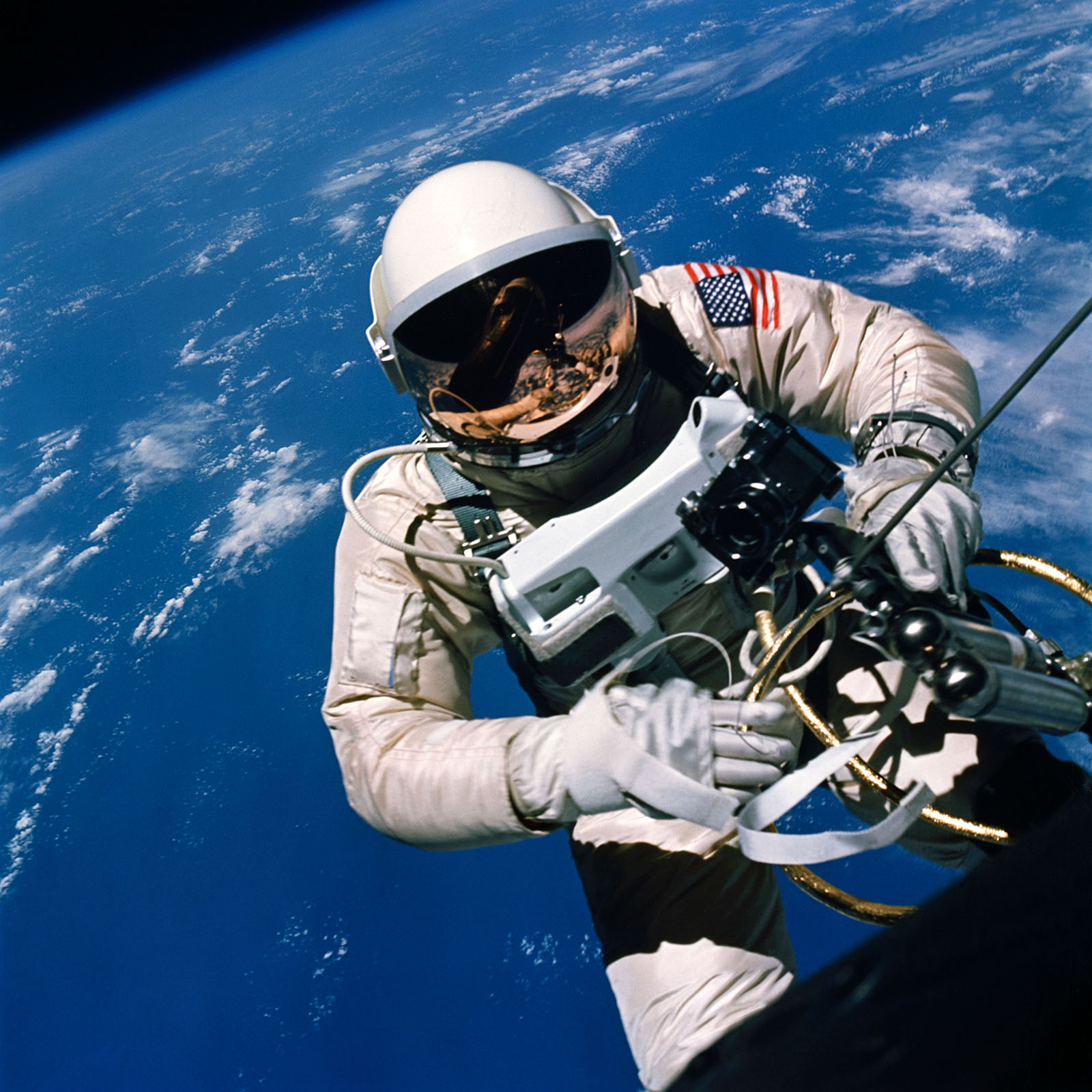
Gemini 4 was a great success, achieving all objectives and providing photos of Ed White outside the capsule. These photos can still be seen today in public displays. Ed was able to maneuver with the handheld unit to the extent of his tether (see figure 14). After 10 minutes, when asked to reenter the capsule, Ed was lollygagging a bit while expounding upon the sensational view. He then found it more difficult to move himself and his equipment into the capsule than expected, but finally the capsule was secure and repressurized. The astronauts failed to conduct stationkeeping and rendezvous activities with the second stage of the launch vehicle, but they executed prescribed in-plane and out-of-plane maneuvers, as well as 11 small experiments. Mr. Webb and I picked up Ed and Jim at the airport prior to the briefing and awards ceremony at the Manned Spacecraft Center. He invited them to sit with him in the backseat so that he could let them know that their attitude had been too carefree and undisciplined during the EVA. He was obviously displeased. However, all was forgiven at the Center briefing and, later, at the Rose Garden ceremony with the President. The mission also successfully demonstrated the new mission control capability at the Manned Spacecraft Center.2
The Oval Office and the LBJ Ranch
One day in late August, I had just played tennis and was in the shower when Gene pulled the curtain aside and said that the President was on the phone. I picked up the phone while dripping water on the carpet. The White House operator said, “Just a minute, the President.”
On he came: “Good morning, Bob, I just wondered if you would care to visit me today on my birthday?”
I answered, “Yes, sir.” I arrived at the White House for our noon meeting but didn’t enter the Oval Office until an hour later. When I entered, the President was reading the news on his ticker tape and finally turned to me.
“Seamans, sit over there.” He then proceeded to say, “Seamans, you guys at NASA are good with your science and know how to work the Hill, but for me you’re a great big zero.” As he made a large zero with his forefinger, he asked, “What do you think is most important to me?” And then he gave the emphatic answer, “It’s peace, Seamans, it’s peace!” I began to see the light. Politicians love to include astronauts in community and even world-wide events. We had Gemini 5 in orbit with Pete Conrad and Gordo Cooper aboard. But the President didn’t tip his hand. He said, “I want you to call within the hour and tell me that Jim Webb will at my ranch in Texas to go to church this Sunday morning with me and Dean [Rusk].” I told him that Jim was having a well-deserved weekend in North Carolina with his family. His response was clear: “Jim is the best damn administrator in Washington; tell me within the hour he’ll be there.” Fortunately, I reached Jim, who said he’d be there, but he wanted me to be there as well. When I called the President and told him Jim’s wish, he said, “Why, of course, Bob, come too and bring your family.” I thanked him and said that only Jim and I would be present.
Saturday, 21 August 1965, Gemini 5, Gordon Cooper and Charles “Pete” Conrad, Jr.
We arrived at Johnson’s ranch Saturday evening and had a meeting with the President and his press secretary, Bill Moyer. The President discussed his plans for the astronauts to visit Greece, Turkey, and several African countries. He then had Bill Moyer read his press release for Sunday morning and asked for comments. After some discussion, we concurred, and Sunday morning before church, the President sat outdoors with the media present and called the astronauts to congratulate them on their eight-day trip. He also advised them of their upcoming goodwill trip.
Gemini was in orbit for nearly eight days, the longest duration manned flight to date. During the flight, the astronauts completed a wide variety of medical and observational experiments. Six were for the Department of Defense. A Radar Evaluation Pad was ejected for radar checks, and for the first time, a fuel cell was used as the source of electrical power.3
Mission 76: Saturday, 4 December 1965, Gemini 7, and Wednesday, 15 December 1965, Gemini 6
The 76 mission involved two spacecraft. Gemini 7 was scheduled for 14 days in orbit, with Frank Borman and Jim Lovell as crew. Originally, Tom Stafford and Wally Schirra were to rendezvous and dock with an Agena unmanned capsule. When the Agena failed to get into orbit, the mission was scrubbed and replaced with a mission for rendezvous with Gemini 7 instead. Since Titan II had only one launchpad, only one week instead of the usual two months was available to clear the pad after Gemini 7’s liftoff and refit the facility for Gemini 6. Time had to be allowed for erecting the launch vehicle, mating it with the capsule, and checking out the assembly. The schedule for the launchpad was programmed hour by hour, night and day, for the full week. I
reviewed the plans, and they appeared tight but feasible. Frank Borman and Jim Lovell lifted off on 4 December and had been in orbit eight days when, on Sunday morning, 12 December, engine ignition commenced and, within a second, was turned off. No one understood the reason why. It turned out that a plug that was supposed to open at liftoff fell off a few seconds early due to the engine vibration. President Johnson called Jim Webb an hour later and said that he was very disturbed by the failure. When Mr. Webb called me, I said that the President should be very proud of the cool heads that didn’t panic. At ignition, all pyrotechnics are armed for separations, the umbilical arms are separated from the vehicle, and the fuel and oxidizer are flowing. An explosion might occur. The crew could have ejected. Instead, they worked with the ground crew and followed planned procedures, and there was still a chance for a successful mission.
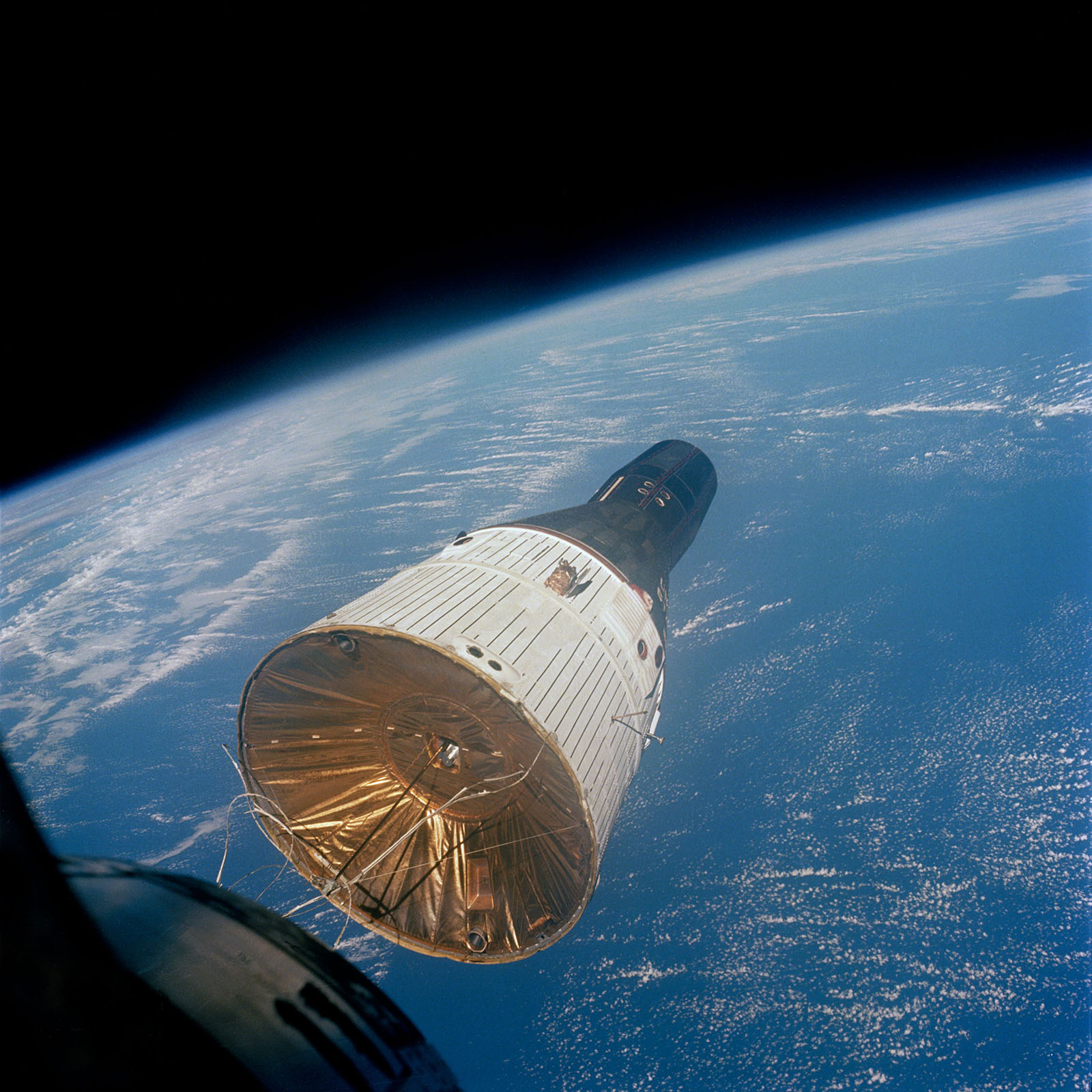
Gemini 6, with Wally Schirra in command and Tom Stafford as pilot, was successfully launched on 15 December. They conducted their orbital maneuvers step by step. After 5 hours and 15 minutes, Gemini 6 was slightly below and 37 miles behind Gemini 7. Tom Stafford flew Gemini 6 to within 2 feet of Gemini 7 and then proceeded to inspect Gemini 7 from all directions (see figure 15). Gemini 7 then did the maneuvering. All hands took turns controlling the vehicles, and then the spacecraft were parked 30 miles apart so that all could sleep. Much valuable data information came from what became known as Mission 76. Foremost were the medical information from the 14 days in flight and the orbital experience of rendezvous and formation flying. Many awards were made and were rightly deserved by the astronauts, Deke Slayton, and the facility technicians. (Deke was one of the first seven astronauts; he was grounded by a heart defect and became the astronauts’ manager.) However, actual docking was still to be achieved.4
The Loss of Hugh Dryden
On 2 December 1965, Hugh Dryden died after a protracted battle with cancer. President Johnson said, “The death of Dr. Dryden is a deep personal loss. No soldier ever performed his duty with more bravery and no statesman ever charted new courses with more dedication.” Vice President Humphrey was most prescient when he noted, “We shall miss him [Dr. Dryden] sorely as we plot our course for the decade ahead.”5 I had known Hugh since 1948, when he was the director of the NACA and I was appointed to the Subcommittee on Stability and Control. Our subcommittee had sufficient controversy that we met with Hugh on occasion. He was a master at resolving contentious issues.
At NASA, I briefed him many times and gratefully received his wise counsel, both technical and political. When the Instrumentation Laboratory obtained the contract for Apollo’s guidance and control, I received a letter from Dr. Charles Stark “Doc” Draper advising me that he always observed first-hand the performance of his developments, whether in submarines, surface ships, bombers, or fighters. So he wanted me to know that he was ready and eager for a spaceflight. Doc was for many years the head of MIT’s Department of Aeronautics and Astronautics and the director of its Instrumentation Laboratory. I knew that as much as we would appreciate his hands-on advice, the rules for flight were stringent, and he didn’t qualify. At the next meeting with Webb and Dryden, I read Doc’s letter. Jim Webb was ecstatic: “I’m going to show the President the letter this afternoon. The letter shows how some scientists truly believe in manned spaceflight.”
However, Hugh piped up, “Before you go, have you considered all the implications? One in 20 applications for astronaut duty is accepted. Many fail for medical reasons. Doc is 30 years older than most astronauts.” Jim reluctantly reined in his enthusiasm. Hugh had saved NASA from an embarrassing incident. Hugh was a wise, moderating influence on many occasions.
Soon after Hugh’s death, I received an interim appointment as Deputy Administrator, and I was sworn in on 21 December. Then, on 2 January 1966, changes in the organizational structure were announced. The Office of the Administrator would now include the Administrator, Jim Webb; the Deputy, me; the Associate, also me; the Associate Deputy, Willis Shapley; and the Executive Secretary, Colonel Lawrence Vogel. Larry Vogel became responsible for channeling and scheduling work within the office. Willis Shapley became the principal assistant to both Jim Webb and me. I became Mr. Webb’s alter ego at the same time that I continued to be the general manager of all NASA operations. Fortunately, George Mueller, Homer Newell, Mac Adams, and Edmund Buckley continued as managers of their respective programs. I was confirmed by the Senate on 29 January 1966 and was sworn in again by Jim Webb in the presence of the Vice President. Also on that date, Mr. Webb and Mr. McNamara signed a Memorandum of Understanding for a joint Manned Space Flight Policy Committee to be chaired by John Foster, Director of Research and Exploration for the Department of Defense, and me. These arrangements superseded the NASA-DOD Gemini understanding of 21 January 1963. My plate was getting fuller, and I would have less time in the future to follow individual projects actively. I truly missed Hugh Dryden.
Wednesday, 16 March 1966, Gemini 8, Neil Armstrong and David Scott
Gemini 8 was most significant, most fraught with danger, and most skillfully managed. Rendezvous and docking were, of course, key to the success of the Apollo lunar landing mission. Without a successful rendezvous, the two astronauts who landed on the Moon would not be able to return to Earth. During the preparation phase for Gemini 8, I spent time in Houston and had an opportunity to ride with Neil Armstrong in the rendezvous and docking simulator. The Gemini simulator in which we were inserted could yaw, pitch, and roll as well as translate three dimensionally. Neil negotiated the final stages of rendezvous and then successfully docked with the target. When asked to try my skills, I demurred—better not to risk damage to a key facility. I was impressed and waited for 16 March with eager anticipation.
The Agena lifted off from Cape Canaveral on schedule at 10 a.m. eastern standard time (EST), followed as planned by Neil Armstrong and Dave Scott aboard Gemini 8 at 11:41. They performed a coplanar change of half a degree and a series of apogee and perigee adjustments, finally achieving a radar lock on the Agena when the Gemini was 158 miles astern. They achieved a visual sighting at 76 miles, 4 hours and 40 minutes into the flight. The Gemini was brought within 60 to 80 feet of the Agena for a visual inspection. All appeared in good order. Neil Armstrong then prepared for final alignment and docking. He closed to within 2 feet of the docking adapter. He was over the eastern Pacific, in communication with the tracking and communication ship Rose Knot Victor below. Docking was approved, and the Gemini proceeded toward the Agena at 0.75 mph until the Agena-Gemini was latched together. The time was 6:15 p.m.6
Soon after this historic moment, I left home elated to attend the Goddard dinner where 1,500 of the aerospace fraternity would be dining and celebrating this most recent success. Imagine my surprise when, upon arriving at the hotel, I was whisked away to a private room. I was told that the Gemini had had to separate from the Agena and was spinning at an uncontrolled rate. I mistakenly decided to attend the dinner as planned. I should have returned to my office, but I did arrange for continued surreptitious updates. In the course of the dinner, I first told the crowd that the Gemini spacecraft was in a perilous state. Some thought I was joking, but then there was stunned silence. Later, I could announce that Gemini was despun and that an emergency recovery would be made in the Pacific, 500 miles east of Okinawa. The destroyer USS Mason and two C-54 aircraft were converging on the area.
It was agreed that the Vice President would deliver his speech and I would give him the high sign when the astronauts were safe. The Vice President was noted for his gift of speech, but even he was fading when I finally gave him the okay sign. The Gemini had been spotted by an aircraft. Of course, pickup remained, and Jim Webb felt that I had taken undue risk in making the announcement. But the guests left reassured after an agonizing dinner.
The Gemini landed at 10:22 EST, and Pararescue men dropped from a plane 13 minutes later. The flight crew was picked up by the Mason early the next morning at 1:28 EST, and 9 minutes later, the spacecraft was aboard. The destroyer docked in Okinawa 18 hours later. Ultimately, five aircraft were involved in the rescue.
Although the mission was nearly a disaster, there were many significant achievements:
- The first successful simultaneous countdown and launch of two vehicles on the same day at the precise minutes planned
- The successful retrieval of spacecraft and astronauts in a secondary landing area required for the first time
- The first docking and maneuvering of two vehicles in space
Tape analysis showed that the errant yaw thruster had spun the capsule after separation from the Agena at nearly one revolution per second. Neil and Dave successfully diagnosed their predicament, turned off all thrusters, and utilized the reentry control system to despin. During the emergency period, as the crew members were undocking, they had the presence of mind to leave the Agena responsive to ground command and with the tape data intact so that readout on the ground was possible—extremely important for the accident review team. In addition to the astronauts, many others deserved great credit. Special commendation was given at the postflight news conference to General Huston on behalf of the DOD recovery team; to Admiral Persons, commander of Task Force 130, to which the USS Mason was assigned; and to the three Pararescue men who attached the floating collar around the Gemini.
Friday, 3 June 1966, Gemini 9, Thomas Stafford and Eugene Cernan
Tom Stafford was in command of the Gemini 9 mission, and Gene Cernan was the pilot. Theirs was the hard-luck mission, but through no fault of their own. As in Gemini 8, the Agena was to depart an hour and a half ahead of the astronauts. Unfortunately, only 2 minutes into its flight, all contact with the target vehicle ceased. Shortly thereafter, George Mueller announced that the Augmented Target Docking Adapter (ATDA) would be used by Gemini 9 for rendezvous trials.
The ATDA liftoff on Atlas proceeded on schedule, but the guidance system update couldn’t be transferred through the ground equipment to the spacecraft. When two other attempts failed, the flight was scrubbed and rescheduled for 3 June, two days hence. On the third, all systems were go, liftoff was nominal, and the spacecraft was soon in orbit. After a series of orbital corrections, the astronauts were in sight of the adapter. To their dismay, the shroud on the nose of the ATDA had not separated. Stafford reported that both the clamshells of the nose cone were still on but were open wide. It looked like an angry alligator. After close-proximity inspection and two additional rendezvous approaches, the crew was tired and put off EVA, the second objective of the mission, until the morrow.
Gene Kranz, the Mission Control Flight Director who later became famous for controlling the return of the crippled Apollo 13 and his watch cry of “failure is not an option,” was advised by the astronauts that they were ready for depressurized action. The word was “go” from the tracking station at Carnarvon. This activity took place between Canton Island and Hawaii, culminating in an open hatch with Cernan standing and prepared to egress. He gradually worked his way to the adapter section with the “snake” (umbilical) all over him. He then reloaded the EVA camera and turned on the EVA lights for nighttime operations. Back at the adapter area, he began to plug into the Astronaut Maneuver Unit. He started noting fogging in his helmet visor. As he proceeded, Stafford commented that Cernan was finding his work four to five times more difficult than in ground test, so Stafford and Cernan evaluated the situation after sunrise and felt that the fogging constituted a flight safety hazard. The experimental maneuver unit was scrubbed. By resting, Cernan gained back 25 percent of his vision, but as he began to retrieve equipment, the fogging grew worse again. The flight plan called for photographs at sunset, but Stafford decided to bring Cernan back into the spacecraft. Cabin repressurization occurred without incident. Gemini 9 landed less than 2 miles from the USS Wasp. At the news briefing two weeks after the flight, it was noted that the liftoff and reentry were flawless. It was stressed that the Gemini Program was experimental and that on each flight, an attempt was made to advance our understanding of space operations to the maximum extent possible. Clearly, much experience was still needed before Apollo.
The Gemini Program concluded with three successful missions. The three were similar in objectives and operations, and each helped clear uncertainties, especially difficulties encountered in astronaut activities external to the capsule. The question of why EVA was so much more strenuous in space then in preflight training would ultimately be answered and the trouble corrected.7
Monday, 18 July 1966, Gemini 10, John Young and Michael Collins
The Agena was launched from Complex 14 by the Atlas booster at 3:40 p.m. EST, and John Young and Mike Collins were to follow at 5:20 p.m. within a 37-second window. Gemini 10 lifted off exactly as planned. Through a series of orbital maneuvers, the astronauts brought their spacecraft within 40 feet of the Agena and were given a “go” for docking from the Coastal Sentry tracking ship. John executed the docking maneuver with precision, and the Agena pulled the nose in to make a rigid connection between the two vehicles.
Using the primary propulsion system of the Agena, Collins conducted a series of three maneuvers. In the first, the Gemini was driven forward at one g for 1 minute and 24 seconds. This thrust increased the apogee of the orbit to 412 nautical miles, a record for manned flight and one that provided a magnificent view of the Middle East. After two more Agena burns, the orbit was a little over 200 nautical miles in altitude.
The EVA lasted for 50 minutes. After depressurization of the capsule, Mike first stood up in the cockpit and gazed with wonder as the world sped underneath him. He then used the maneuver unit to visit the Agena and collect a data package fastened there.
The astronauts returned to Earth after three days, within 3.4 miles of the intended landing point. They were retrieved by the recovery ship USS Guadalcanal. At the awards ceremony, I noted that Gemini was proving to be much more than a two-man Mercury. I said that Gemini had given us the ability to change orbits, inspect other spacecraft, rendezvous and dock, and use Agena as a switch engine in space.8
Monday, 12 September 1966, Gemini 11, Charles “Pete” Conrad, Jr., and Richard Gordon, Jr.
Gemini 11, with Pete Conrad and Dick Gordon, performed a most difficult maneuver, namely, to rendezvous and dock with the Agena on their first orbit. The Atlas-Agena had lifted off at 8:05:02 a.m. EST, and Gemini 11’s liftoff had to be at 9:42:26. Their window was only 2 seconds. Although successful, Pete said he wasted 2 or 3 percent of his fuel fussing around and getting used to seeing the bright Agena when he couldn’t see his instruments. He said he fumbled around trying to find his glasses. Later, with his sunglasses, he had no trouble reading the instru-ments and tracking the Agena.
The following day, the Gemini-Agena configuration reached an apogee of 742 nautical miles and, in the ensuing orbits, performed a series of photogenic experiments of terrain, weather, and airglow horizon. Afterward, they used the Agena to return to a nearly circular orbit at 160 nautical miles of altitude.
The astronauts achieved the greatest total time in extravehicular activity, a total of over 2.5 hours. However, Gordon experienced overheating and fatigue, as had others in previous missions. After opening the hatch, he set up a camera, received an experimental data package, and attached a tether to the Agena docking bar. This phase of EVA was terminated because of pilot fatigue and the fact that perspiration was gathering in the pilot’s right eye and impairing his vision.
However, the astronauts were able to conduct a tethered exercise with Gemini and Agena roped together and rotating at 55 degrees per minute. Although very small, this was the first artificial gravity achieved in space.
Retrofire occurred over Canton Island, and the landing point was achieved automatically for the first time. Splashdown happened within 1.5 miles of the USS Guam. At the press conference, General Davis, commander of the Atlantic Missile Range, praised the precise landing and noted that recovery was becoming an easy assignment. George Mueller had opened the press conference by listing the many major accomplishments of Gemini 11. Bob Gilruth found the results with the tether to be fascinating but closed by emphasizing the hard work that had gone into preparing for extravehicular operations—and the fact that, as yet, this effort had not yielded satisfactory solutions.9
Friday, 11 November 1966, Gemini 12, Jim Lovell and Buzz Aldrin
On 11 November 1966, with Jim Lovell and Buzz Aldrin aboard, Gemini 12 lifted off from the Cape within half a second of its prescribed time in hot pursuit of Agena. The astronauts followed a series of maneuvers in order to rendezvous on the third orbit. They achieved an early lockon at 235 miles, but as they approached the Agena, the radar failed, and the rendezvous took place using backup visual procedures. Docking and a variety of orbital maneuvers took place with and without Agena, but the primary emphasis was on Buzz Aldrin and his extravehicular performance. The first day, he spent 2 hours and 29 minutes in standup activities; on the second day, 2 hours and 8 minutes; and on the third day, 51 minutes while standing in the open cockpit. During the EVA, Buzz utilized portable handrails, foot restraints, and waist tethers. This latter system consisted of two tethers attached to the astronaut’s parachute harness. The tethers were hooked to rings, for example, on the Agena docking cone and on a telescoping handrail. Aldrin said, “With this system, I could ignore the motion of my body and devote my full effort to the task at hand.” He also found that the underwater simulation of EVA had provided his most helpful training.
On the fourth day, retrofire was initiated over Canton Island; 34.5 minutes later, the flotation collar was attached, and the two astronauts were choppered to the flight dock of the USS Wasp.
At the postrecovery news conference, there were two themes: first, a mutual exchange of congratulations among all individuals and organizations involved in the program, including the media; second, the lessons learned of value to the achievement of lunar landing. These lessons were outlined by Bob Gilruth in terms of how to maneuver with precision, to rendezvous, to dock, to work outside in a hard vacuum, and to recover with precise landings.
Deke Slayton pointed out that the transition to Apollo was already occurring. All crews had been transferred to the lunar program except the crew of Gemini 12. Chris Kraft stressed the operational skills that had been built up by both ground and flight crews and added that the Gemini flight-control teams were being phased into the ultimate lunar mission. Dr. Charles Berry, the astronauts’ many-talented flight surgeon, said that proof that man can really operate in the space environment was one of Gemini’s milestones.10
Gemini Farewell
A week later, on 23 November 1966, there was a Gemini 12 pilots’ news conference, followed by a Gemini awards ceremony. Jim Webb and I made the presentations. There were many deserving of recognition, but none more so then George Mueller, who had revitalized the mission soon after his arrival, and Chuck Mathews, the day-to-day manager. Others included the two most recent astronauts, Jim Lovell and Buzz Aldrin, as well as William Bergen, president of the Martin Company; David Lewis, president of McDonnell Aircraft Corporation; and James S. McDonnell, McDonnell Aircraft Corporation’s executive officer. Mr. McDonnell seldom missed a Mercury or Gemini launching. He would jog on the beach in the early morning, and after every flight, he would announce over the loud-speaker at one of his factories, “This is Mac calling; you’ve done it again. You’ve achieved another great success. Congratulations!” Morale at McDonnell was high because of the caliber of its employees, the great interest of Mr. Mac, and the frequent visits of the participating astronauts. Many other industry and government leaders received special awards; recipients included Major General Vincent G. Huston for his significant contribution in directing the efforts of the Eastern Test Range of USAF, in providing critical launch and operations support, and in directing the total efforts of the DOD operational support for the Gemini Program. Others recognized were the senior officers of the companies manufacturing the Agena and the Titan. It was a great day. As we listened to the Gemini accomplishments, I said, “Don’t forget that there is much hard work ahead before we achieve our national goal of preeminence in space.” Little did I know what lay ahead before a successful lunar landing and a safe return.
The rapid pace of manned test and flight missions abated somewhat following the completion of the Gemini flights and the program’s awards ceremony. Reflection on the Apollo Program at this time would have shown progress in many quarters, including the Saturn I, Saturn IB, the F-1 engine, and the unmanned Surveyor and Lunar Orbiter programs.
Saturn I
The 10 Saturn I development flights started during President Kennedy’s administration were completed in 1965. In September 1964, a boilerplate capsule, service module, and second stage elements weighing 37,000 pounds were placed in Earth orbit. The final three Saturns were used to launch Pegasus, a large spacecraft used to measure the size and number of micrometeorites in near-Earth orbit.11
Saturn IB
The second stage of Saturn I, with its six 15,000-pound RL10 engines, was replaced by the SIVb stage, which had a single J-2 liquid-hydrogen-fueled
engine with a thrust of 200,000 pounds. The Saturn IB, as it was designated, was launched successfully twice in 1966. In August of 1966, 55,000 pounds of material was placed in Earth orbit.12
The F-1 Engine
The F-1 engine development that started in the Eisenhower era was an act of faith. Its 1.5 million pounds of thrust was an order of magnitude greater than the thrust of the existing engines used in ballistic missiles. The fuel and oxidizer pumps were driven by 55,000-horsepower engines, and the engine itself produced 160 million horsepower at ignition. The F-1 was a brute, and it was nearly impossible to tame. Blowups occurred, apparently at random, during its 3.5-minute burn. Its development was more an art than a science. The work was frustrating and didn’t lend itself to mathematical analysis. In order to achieve consistency in the testing, bomblets were developed to upset the burning pattern. Then, if the engine was stable, the burning would recover in milliseconds. With this tool, holes in the injection plate for the oxidizer and fuel could be rearranged and quickly tested. Baffles of various dimensions could be introduced to determine their effectiveness. Finally, stability was achieved by moving the burn closer to the mouth of the nozzle, resulting in a loss in efficiency of only a few percent. The F-1 passed its flight-rating test on 8 March 1965.13
Saturn V
Of course, each of these giant engines had to function in close proximity to its four neighbors. A first-stage, full-duration test of the Saturn V was first achieved on a stand at Marshall Space Flight Center on 5 August 1965.
Similarly, tests were being run on the Saturn V second stage with its five J-2 liquid-oxygen, liquid-hydrogen engines. There were difficulties with the embrittlement of the hydrogen tank at its very low, cryogenically cooled temperature. In-house material scientists at Marshall resolved the issue, and the first successful full-duration firing occurred at the North American flight test stand on 9 August 1965.
The third stage of Saturn V was, by plan, similar to the second stage of the Saturn IB. However, for the lunar mission, this stage had to be ignited to complete the insertion into Earth orbit and then reignited for the extra thrust required for lunar passage. On 20 August 1965, the J-2 engine was ignited for 3 minutes, and then, after a 30-minute shutdown, it was reignited for the 4-minute burn that would later take the astronauts away from Earth and toward the Moon.14
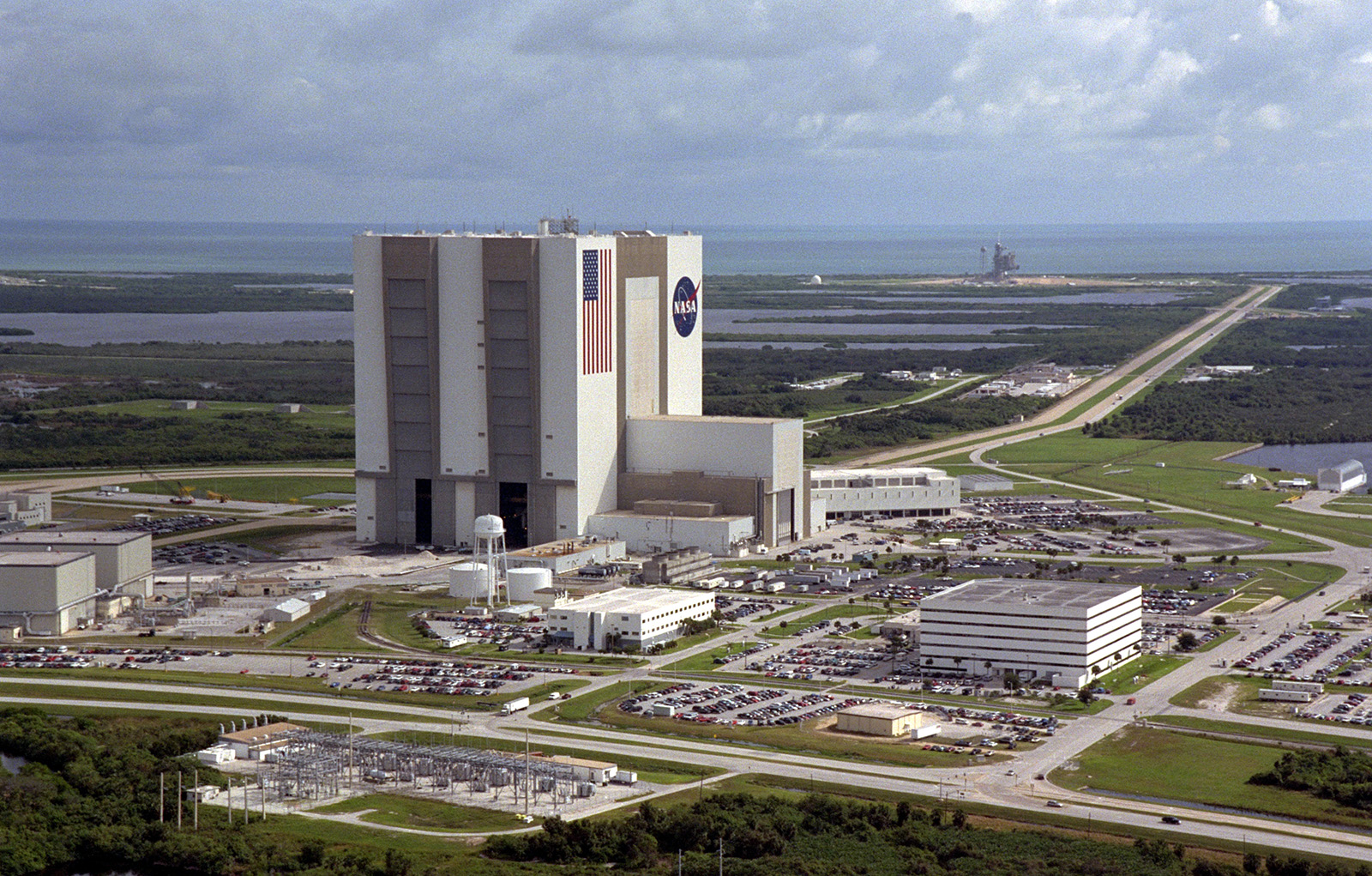
In November 1963, when President Kennedy inspected Merritt Island from his helicopter, there wasn’t much to see. The 4,800 pilings were still being driven through the sand to the bedrock below. Less than three years later, the Vertical
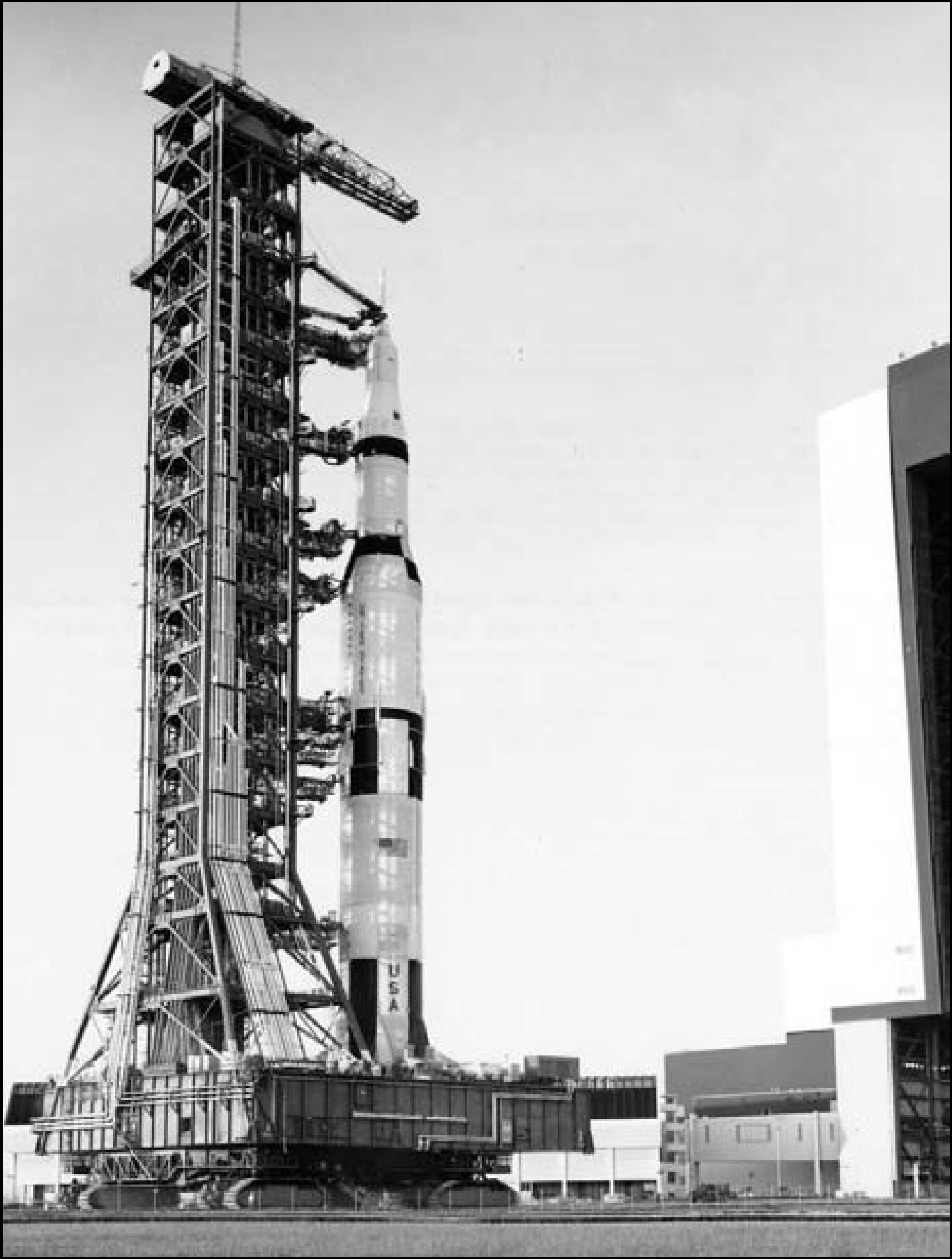
Assembly Building was complete (see figure 16) and Saturn V was being fabricated. The first roll-out of a full-fledged Saturn V mounted on the crawler transporter took place at a formal ceremony on 25 May 1966. At the appointed time, the doors opened, and the tremendous assemblage of hardware traveled forward at 5 mph. Apollo/Saturn V on the move (figure 17) was a deeply moving sight. With the 52-story VAB in the background, the crawler delivered the Saturn V to the launchpad erect, standing two-thirds the height of the Washington Monument. The congressional delegation, the guests, the press, and the NASA team were dwarfed physically and emotionally by such a majestic creation. The trip to the Moon was becoming a reality.
Surveyor—Unmanned Lunar Landing
As Jerry Wiesner said at the special meeting with President Kennedy in November 1962, “Jim [Webb] may not understand this, but we don’t know a damn thing about the surface of the Moon.” The point was well taken even though Jim did know. Tommy Gold, a professor at Cornell University, had a theory that the continuous barrage of meteors and micrometeors on the lunar surface had created not only voluminous craters, but also fine dust, into which a lunar lander might sink out of sight. If the truth be known, there was much we didn’t know—and that was a good reason for exploration. However, to land there, we had to know something about the bearing strength of the surface.
Keith Glennan’s last official act at NASA was to select Hughes Aircraft for the development of Surveyor. Initially conceived for unmanned exploration, the craft had become essential to accomplishing the lunar landing. But progress at Hughes was slow and a matter of deepening concern. It was decided that I should bait the bear and visit Pat Hyland, Hughes’ chief executive officer.
In early 1966, I invited him to breakfast at a hotel near the Los Angeles International Airport. I came armed with two alternatives. One was a contract amendment that provided an incentive fee for Hughes. If they achieved a successful lunar landing prior to a given date, there was a bonus, and if there was a delay, there was a penalty that was increasingly stiff as the weeks increased. I also had a letter that laid out, in detail, specific errors in omission and commission by Hughes in the management of the Surveyor program. After pleasantries and a plate of scrambled eggs, I showed Pat the letter and the contract amendment and asked him which he’d like to receive (or like least to receive). He said he’d be happy to sign the contract document. I was at Mission Control in Houston for the launching of Gemini 9.
When the Agena failed, Gemini 9’s launch was scrubbed because Agena would not be available for rendezvous and docking. So I headed for JPL in Pasadena, California.
In the early morning (2:00 a.m.) of 2 June 1966, I was seated on the balcony of Mission Control at the Jet Propulsion Laboratory, anticipating the landing of Surveyor. Pat Hyland was several rows behind. The atmosphere was palpable. Surveyor appeared healthy, responding correctly to instructions. Finally it made its landing, to great cheering; then it took the first photograph from the Moon, inspiring protracted cheering. And I heard Pat say over the din, “How’s that for a crippled program?” And at last, we had the answer from the returning photographs. There was dust on the lunar surface, perhaps an inch deep. It appeared that the lunar surface would support a manned lunar landing.
Surveyor’s 850-pound weight, was lifted into Earth’s orbit by an Atlas-Agena. There were two more lunar landings, each in a designated area. The data from Surveyor were essential to the design of the Apollo lander, challenging to geophysicists, and awe-inspiring to the public.15
Lunar Orbiter for Mapping the Moon
The Fleming report of 1961 called for five Surveyor A landers and a series of Surveyor B orbiters, later called Lunar Orbiters. The objective of the latter was nearly complete mapping of the Moon and the location of landing sites. JPL was responsible for unmanned lunar and planetary missions, and hence, it was assumed, this laboratory would be in charge of both Surveyors A and B. However, its plate was full, and, somewhat related, NASA was experiencing difficulty renegotiating the contract with the California Institute of Technology, Caltech for short. JPL was and is an integral arm of Caltech. Both are located in Pasadena, California. It’s not uncommon for the government to contract with a university for the management of a laboratory. The former AEC, now part of the Department of Energy, has a contract with the University of California for managing the Los Alamos and Lawrence Livermore National Laboratories, as well as one with the University of Chicago for managing Argonne. This type of arrangement provides more flexibility in personnel management than the civil service and can provide intellectual stimulus from university faculty. However, the monitoring of large contracts with the laboratory is more difficult than with a government center, and the fee paid to the university can be excessive, or appear to be, when an agency is obtaining congressional approval. JPL is a Federally Funded Research and Development Center (FFRDC). Further discussion of this type of management appears later in the book.
Since time was wasting, I reviewed the situation with Jim Webb and initiated discussions with Tommy Thompson, Director of NASA’s Langley Research Center in Virginia. I asked them to investigate the transfer of the project to that Center’s aegis. The technical team there was eager for the opportunity and appeared to have the necessary procurement and management skills. Langley then prepared a procurement plan, which I approved. The plan called for Langley to manage the project and team with a cross section of Langley and other NASA personnel. When Mr. Webb, Dr. Dryden, and I met with the evaluation team, the selection of contractors centered almost entirely on the technology, and a clear winner was not obvious. It was decided that I would hold hearings separately with each of the competitors. Hughes Aircraft proposed a rotating spacecraft similar to Syncom, its communication satellite. This design simplified the craft’s stabilization but required higher sensitivity film. Boeing provided a stable platform aligned with the lunar vertical, so photographic requirements were less stringent than they might have been. In this design, each photograph was scanned into strips, lines, and finally dots. Each dot was digitized into a number on the gray scale from 0 (white) to 60 (black). The reconstituted photograph had more than adequate resolution. Since the main thrust of the mission was photographic, Boeing received the contract. The contract for five Lunar Orbiters was incentivized, with the contractor fee based on schedule and performance. Payments for the work had to be periodical. At one point, in order to avoid causing a renegotiation, NASA increased its payment to Boeing by $10 million. The reprogramming required congressional approval. Congress assented, the program held, and all five missions were successful. Both NASA and Boeing benefited from the incentive arrangement.
On 10 August 1966, Lunar Orbiter I was launched by an Atlas-Agena and headed for the Moon, where photographs of the lunar surface were obtained for 17 days. The high-resolution photography was disappointing, but the medium-resolution camera returned good images, though not of the quality we’d anticipated. The photos would cover a 3,000-mile strip around the equator while concentrating on nine potential landing areas. On 6 November, Lunar Orbiter II was launched; it provided 20 days of consistently high-quality photographs, including pictures of 13 potential landing sites.16
Having viewed a fair number of overhead crater photos, I asked how difficult it would be to obtain a few oblique shots of the lunar surface. The answer was “No problem; what would you like?” I suggested an interesting moonscape at an angle 10 degrees below the horizon. A few days later, I couldn’t believe the result: on my desk was an image of the crater Copernicus, one of the great pictures of the 20th century. The photograph showed a pile of debris 1,000 feet tall in the center of the crater, with a flat, pockmarked surface around the debris and the 10,000-foot crater wall.
I was headed for Boston in a few hours to give a talk at the American Institute of Aeronautics and Astronautics’ (AIAA) Third Annual Meeting and Technical Display. I asked for a slide of the picture and received it as I boarded the plane. When the photograph of Copernicus appeared in the auditorium later that afternoon, there was first stunned silence and then strenuous applause. What I said made little difference. I’ve had a copy of this photograph on my study wall ever since.
There were three more Lunar Orbiters, all successful. From the images taken by these orbiters, maps covering nearly 100 percent of the lunar surface were produced. As of year’s end 1966, NASA was rapidly filling the squares on the PERT charts in the Fleming Committee’s report of 16 June 1961. The committee that Fleming chaired studied every task that could be foreseen at the start of the manned lunar landing program. Each task was represented on the chart by a square. Many of these tasks were now complete, but much lay ahead.
Organizational Issues
Toward the end of 1966, Willis Shapley and I had several command performances with Jim. He wasn’t satisfied with NASA’s organizational arrangements. It wasn’t clear to us exactly why. In part, he felt that too much hinged on himself and me. Stated another way, he wanted to establish an organization that would outlast us and would carry NASA solidly into the future. I was concerned that radical changes would take time to accommodate, just as we were reaching the end of the decade, the time when we had hoped to achieve our lunar landing goal.
Jim Webb liked to receive information from a variety of sources. He sometimes called this “self-policing.” He did rely heavily on Hugh Dryden and me, but he also surrounded himself with consultants of high caliber, and he often invited senior corporate officers for a discussion of the world scene. There was one occasion when Mervin Kelley, one of Jim’s consultants, was convinced that the Draper Laboratory could not develop the guidance and control for Apollo. He felt that the laboratory was too theoretical and could not design hardware that would withstand the rigors of lunar missions. Fortunately, I was brought into the discussion and was able to enumerate many of the Draper Lab’s successful developments.
I was not always enamored with some of Jim’s creations, such as a secretariat. Documents emanating from both the Field Centers and Headquarters were categorized by the secretariat and distributed accordingly. I didn’t believe that clerks understood the nuances of NASA’s programs sufficiently to make such distributions. Also, metaphorically speaking, the turn of a key could isolate individuals from parts of a program without their knowledge, as happened to me later in the program.
A contract with General Electric (GE) also generated questions of intent. In February of 1962, NASA announced that GE had been selected for a supporting role in Apollo to provide safety analysis of the total space vehicle and to develop and operate a checkout system for Launch Control. Jim felt that this GE assignment would provide greater visibility of NASA’s progress.
In actuality, the contract gave GE a major role in designing the hardware and software for Launch Control at the Cape, but their safety effort was secondary. GE had technical staff at Grumman, at North American, and in Houston. Their job was to look for designs and flight hardware that might create hazards for the astronauts. At North American, the GE engineers were often labeled as spies and were provided with trailers far from the Apollo effort. It was a difficult assignment for GE and not very productive.
Jim left for Princeton in December to give a series of lectures on modern management. He had a lot to say there about the Triad’s advantages, one of his favorite hallmarks. When Jim returned, I invited him to lunch for a discussion of his and my views on organization. By dessert, he said that he needed my views in writing. My draft response dated 15 December 1966 outlined in detail what I had presented at lunch. I recommended a new Office of Management for all functions related to NASA’s resources, i.e., financial operations, facilities, and manpower.
Harold B. Finger started his career at NACA’s Lewis Research Center as an aeronautical research scientist in 1944. When NASA was formed, he was transferred to NASA Headquarters to become the chief of the Nuclear Engine Program. During the late fifties and early sixties, NASA and the Atomic Energy Commission (AEC) established joint projects for both engine and electrical power development. Harry was responsible for all these activities, which necessitated his wearing several hats. He was the manager of the joint AEC-NASA Nuclear Propulsion Office formed in 1960; he also served as NASA’s Director of Nuclear Systems, and in June 1965, he became the head of a new AEC division for the development of electrical power for space vehicles. The isotope electrical power units were especially important to NASA on missions to the outer planets, at great distances from the Sun, where solar power became less effective. Harry had many constituents, and he satisfied them all. By 6 January 1961, Harry was asked to head a NASA team for the analysis of procedural revisions and functional alignments within NASA Headquarters and to review, in more depth, the specific options I had suggested in my discussions with Jim Webb. A more detailed discussion on this appears in the next chapter on NASA management.
The Apollo Fire
Instead of the glorious day that was anticipated, 27 January 1967 was a tragic day for NASA. Mr. Webb had invited the senior executives from both the Gemini Program and the Apollo Program to Washington to attend a White House ceremony, as well as a special dinner for the group.
The White House affair started formally with the signing of an international treaty. Representatives from 62 nations were involved in London, Moscow, and Washington, DC. Secretary of State Dean Rusk signed for the United States in the presence of Soviet Ambassador Anatoly Dobrynin, British Ambassador Dean, U.S. Ambassador to the United Nations (UN) Arthur Goldberg, and President Johnson. The President described the treaty as the “first firm step toward keeping outer space free for ever from the implements of war.”17 After an exchange of pleasantries with our Apollo executives, I headed for home, where I was having a small dinner in honor of my old boss from MIT, Doc Draper. As I walked in the front door, I heard my wife Gene say, “Here comes Bobby now.” It was George Low on the phone, and his first words were, “They’re all dead.” He was extremely upset, and I was having difficulty in understanding him. I asked George, “Who’s dead?” Gradually, or so it seemed, I learned that a fire had started during the testing of Apollo 204 (later known as Apollo 1) and that the three astronauts on board were dead. Those three were Gus Grissom, of Mercury and Gemini fame; Ed White, the first U.S. astronaut to experience extravehicular activities; and Roger Chaffee, gaining experience for what would have been his first spaceflight. As I absorbed the devastating news, I realized that I must immediately leave for my office, and I told George that I would call him in a half hour for a more complete report. I then asked Gene to take over as host of the dinner and tell the guests of the accident only as they were departing.
Back in my office, I soon learned that a full-scale test of the Apollo system had been under way when the fire started. Not only were the astronauts enclosed in the capsule in communication with Launch Control, but the worldwide Apollo net was also involved. Once the fire started, the pressure inside the capsule increased, so the hatch could not be opened. Ultimately, the capsule burst and the flames scorched the outside, but fortunately, the fire did not spread to the surrounding structure.
My first job was to communicate with Jim Webb and George Mueller and to ensure that all senior individuals were notified. While I was talking to Bob McNamara’s assistant, the operator cut in with an emergency call; it was Peter Hackes of the National Broadcasting Company (NBC). He asked me to come immediately to the studio to explain the fatal fire. He said that the country was in near panic. I explained that I couldn’t, that I was busy making important arrangements, and that the cause of the fire was still unknown. Jim Webb was busy gaining acceptance from the President and Congress for a NASA investigation. George Mueller was gathering detailed information about the fire and preparing a list of individuals to serve on the accident review board. Following the Gemini 8 near-accident with Armstrong and Scott aboard, I had revised the manual to be followed when accidents occurred. NASA had dealt with fatal aircraft accidents in the previous five years, but none involving space activities. I drew up and signed the instructions for the review board and caught a few hours’ sleep before proceeding to Langley Field early the next morning to pick up Tommy Thompson, Director of the Langley Research Center. We then headed for Cape Canaveral, where he was to become the chairman of the review board.
As soon as we arrived, we met with Apollo Program Manager Sam Phillips, Joe Shea, and Kurt Debus (the Director of Kennedy Space Center). I asked for a brief status report and then brought them up to date on the plans for the accident review board. I advised them that all hardware and software utilized in the Apollo 204 test had been impounded, and its release for inspection and testing was the sole responsibility of the board. I provided them with a list of the board members and told them that we were attempting to shield the board from direct inquiry by the media. While I was there, the media requested an interview directly with me. I notified the TV and press that time didn’t permit a press conference. The release made at the time of my departure stated that a board had been established to review the circumstances surrounding the accident, to establish probable cause, and to review the corrective action and recommendations being developed by the program office, Field Centers, and contractors involved. The board was required to document its findings, determinations, and recommendations and to submit a final report to the Administrator, not to be released without his approval.
All three astronauts were buried with full military honors—Gus Grissom and Roger Chaffee at Arlington Cemetery, and Ed White at West Point. The President, Jim Webb, and my wife Gene were at Arlington, along with many others; I accompanied Mrs. Johnson and the Vice President to the service in the chapel at West Point. I met Ed’s father, told him how much his son contributed to the space effort, and apologized for allowing the fire to take place.
The President, Congress, and the media wouldn’t sit still for an extended period without any information on the board’s progress. The barely acceptable solution required me to visit with the board weekly, listen to their progress report, and then draw my own conclusions. While flying back to Washington, I’d write my own findings and submit the result to Jim Webb. If acceptable to him, the report would be transmitted in sequence to the President, then to the House and Senate space committees, and, ultimately, to the media.
My Reports on the Progress of the Accident Review Board
My first report, dated 3 February 1967, stated that full advantage was being taken of the extensive taped data from the test, as well as records made prior to the accident. The report noted that the spacecraft was still mated to the unfueled launch vehicle at the pad. The report went on, “The capsule will be disassembled so that experts in many technical and scientific areas can work with the physical evidence, and an undamaged and nearly identical spacecraft will be used to establish the condition prior to the accident.”18
The report contained a timeline of the events following the crew’s detection of the fire. At 6:31:03, pilot Chaffee reported that a fire existed. One second later, the inertial navigation gave an indication of crew movement. The cabin temperature began to rise after 2 seconds, and senior pilot White reported the fire after 6 seconds. At the same time, the pressure started to increase and a large amount of astronaut motion was detected. Nine seconds after the first indication, pilot Chaffee reported a bad fire. There was no further intelligible communication. After 14 seconds, the pressure and temperature of the astronauts’ suits commenced to fluctuate and the signal was lost. Soon thereafter, the pressure in the cabin doubled and the capsule skin ruptured. The cause of death was asphyxiation due to smoke inhalation. My first report was printed verbatim in the New York Times, five days after my trip to the Cape.19
My second report, dated 14 February, commented on the board’s structure and procedures. “Approximately 5,000 scientists, engineers and technicians are involved in the investigation. 21 panels have been established to conduct the inquiry. No single element is touched or removed for analysis without full board approval to ensure there is no impact on the on-going studies. All three space suits were burned through and Gus Grissom received the greatest exposure. The cause of the fire has not been determined.20
Prior to the completion of the board’s report, the press was relatively kind to NASA. Business Week stated, “No previous frontier has ever been crossed without loss of life. It was not to be expected that space, the most perilous frontier of them all could be conquered without sacrifice.” The Washington Evening Star found that “second guessers are wondering whether we should be going to the moon at all. From any rational point of view, the only thing to do is carry on.” However, Los Angeles Times editor Marvin Miles accused NASA of “shortsightedness and trying to hide its negligence.” But Technology Week responded, “Its [sic] our impression the agency is trying valiantly to come up with just such information (why the hatch could not be opened).”21
I prepared the third and last report for Mr. Webb based on my visit to the Cape on 25 February. The board expressed the view that the experience in tests and in flights prior to the accident suggested that the probability of fire was low. Neither the crew nor the development and test personnel considered the risk of fire to be high. The board did not recommend changing the pure-oxygen system or the planned cabin pressure.22
Monday, 27 February 1967, Senate Hearing
In testimony before the Senate Committee on Aeronautical and Space Science on 27 February, George Mueller outlined an extensive program of redesign and testing, as well as a number of procedural changes. Specifics included an escape hatch that could be opened in 2 seconds, a search for new and less flammable materials for the cabin and spacesuits, and a review of emergency procedures. He guaranteed that all improvements and changes would be incorporated into an advanced version of the Block II Apollo spacecraft. During the question period, Senator Mondale asked about a report on the performance of North American Aviation. Mr. Webb referred the question to George Mueller and Sam Phillips in turn. Neither one had knowledge of such a report, although a NASA tiger team had investigated North American and had found faulty workmanship, spotty organization, and other deficiencies. Sam had reported the results to me at the previous December status review. I wondered to myself if Senator Mondale had seen the findings and recommendations of our study. So I explained that from time to time, NASA had onsite reviews of contractor progress and that the information Senator Mondale was referencing might be in this category. When the session was over, Jim Webb told me to return to Headquarters with him and our General Counsel, Paul Dembling. Jim’s “limo” was a Checker cab painted black with a window between the driver and the backseat occupants. Once aboard, Jim quickly cranked up the window and lacerated me in no uncertain terms. These hearings weren’t the love-fests we normally had had with Congress in the past. Millions of dollars could be riding on the outcome, and under no circumstances should information be volunteered. I said I believed that Senator Mondale was using a set of transparencies used by the tiger team in their presentation. Jim cut me off almost before I’d finished the sentence. The lecture continued until we left the car. As I was recovering my equilibrium, Paul came into my office holding a thick document. The first two words on the first page were “This report.” Sure enough, the report was a bound copy of all the transparencies used by the tiger team when it reported on its review of North American. The first page merely explained the circumstances for the investigation. I should have taken this document into Jim, but my instant reaction was for Paul to do the honors so that I could sit in my office, catch my breath, and review the situation.
World Travel
I’d planned an extensive NASA trip around the world prior to the Apollo fire. Was it appropriate to be traveling around the world at this time? Jim Webb felt that Gene and I should still go. So the first stop was Paris to attend the Advisory Group for Aerospace Research and Development (AGARD), a North Atlantic Treaty Organisation (NATO) scientific and technical meeting. Then it was off to Kenya, with a plane change in Rome, where we were joined by Professor Luigi Brolio, who headed the San Marco project, a joint U.S.-Italian project for launching a satellite from the Indian Ocean near the equator. The United States was providing the boosters; the Italians, everything else, including the platforms and the satellite. When we arrived at the airport in Rome, it was a mass of cables. Joseph Stalin’s daughter had just asked for asylum in the United States; she had left India and was on her way to New York. Later in the day, we changed planes in Nairobi for Mombasa on the coast. It was 11 March, and we celebrated Gene’s birthday there. The next day, an Arab drove us in a Jeep along the coast to Campa Basa, the Italian base camp. Rubber boats took us to the two Italian platforms in the Indian Ocean, where we inspected their preparation for a satellite launch and enjoyed a delicious lunch outdoors near the equator. The next stop, in Bombay, India, provided me with an opportunity to visit the Tata Research Institute, a rocket-development site, and a nuclear facility. We then had a lovely day in New Delhi with old friends Galen and Ann Stone. He was in charge of our embassy when Stalin’s daughter knocked on the door. On 17 March, we arrived at Honeysuckle Creek Tracking Station near Canberra, Australia. The then-newest member of NASA’s 16-station network for Apollo missions was dedicated by the Australian Prime Minister, Henry Holt, and me, with an assist from Ed Buckley, the NASA Associate Administrator for Tracking and Data Acquisition. Vice President Humphrey cabled his congratulations to the Prime Minister, and then the two had an animated conversation.
Saturday, 15 April 1967, Final Report on Apollo 204 Fire
The Apollo 204 review board final report was submitted to Mr. Webb on 5 April 1967. The board identified the conditions that had led to the disaster as follows:
- A sealed cabin, pressurized with a high-pressure oxygen atmosphere
- Extensive combustible material in the cabin
- Vulnerable wiring
- Inadequate provision for escape or rescue
This report provided 21 recommendations, including the following:
- Review of life-support system
- Investigation of effective ways to control and extinguish cabin fire
- Severe restrictions on combustible material
- Reduction in time required for astronauts to egress in emergency
- Continued study of two-gas cabin atmosphere
- Full-scale mock-up tests23
The accident review board, under Tommy Thompson, with astronaut Frank Borman as the spokesman, performed a wonderful service for NASA. Their conclusions and recommendations were sound and inclusive. Frank was articulate as he presented the information and answered questions. In particular, he said that if the findings were followed, he would have no problem stepping into the capsule himself.
From my own standpoint, I didn’t feel that NASA and its contractors required major surgery. Obviously management and procedures can be improved, but faulty administration didn’t cause the loss of Apollo 204. Rather, it was an error in engineering judgment, and we were all guilty. Astronauts should never have been subjected to 14.7 pounds per square inch, or psi (sea-level pressure) of pure oxygen. Once a fire starts under this condition, it cannot be suppressed. Before the fire, NASA tested all aspects of the equipment to be used in flight. There were tests for vibration, temperature, and pressure. Rocket motors were fired many times, as were each of the Saturn I and Saturn V stages. But NASA never tested a boilerplate capsule for fire. We would have been horrified by the result, the fire would have been so intense. However, at the partial pressure of oxygen as we find it in the atmosphere at sea level (3.5 psi), the burn rate is the same for a single gas as for multiple gases, as found in nature.
A single-gas system was selected for good reasons. Number one was simplicity. Only one system of tanks and controls was required to feed oxygen into the capsule and the astronauts’ pressurized suits. Also, there was no concern about rapid pressure changes of nitrogen, which can lead to physiological problems including the bends. So pure oxygen was used with great success in both Mercury and Gemini capsules, and on the basis of this experience, NASA continued the same practice in Apollo. The mistake was not in the use of pure oxygen, but in filling the capsule and astronauts with pure oxygen at sea-level pressure. If the oxygen had been maintained at 3.5 psi while the nitrogen had been bled out as the Apollo went into orbit, fire could have been contained and extinguished
North American Aviation (NAA) fell from grace as a result of the fire. In our congressional hearings, it became known that a NASA tiger team had censured them for sloppy workmanship. They countered with their early recommendation for a two-gas system. It’s true that North American had recommended a two-gas system; however, NASA maintained its single-gas position for the reasons mentioned in the previous paragraphs. NAA was selected as the contractor for the Apollo capsule and service module even though Martin Marietta was scored higher by the source evaluation board. At the meeting after the board’s presentation, Bob Gilruth met with Jim Webb and the other members of the Triad. He expressed concern that Martin hadn’t had any aircraft experience for years and Apollo was to be flown by the astronauts. We then listed recent NAA aircraft experience. There were many, with the X-15 heading the list. The X-15 had had many successful flights, both inside and outside the atmosphere, at speeds up to 7,000 mph. After Bob left the room, we examined Martin’s strengths and determined that they excelled in areas not as key to the success of Apollo as North American’s high-speed flight capability. Hugh Dryden prepared a handwritten list of all aircraft developed and produced by North American. I kept his note in my files, and it became a most useful document during our congressional hearings when the reason for our selection was coming into question. NASA was exonerated from selection complicity, but our ability to manage was still in question and had to be proven again.
Sunday, 23 April 1967, Soyuz I, Vladimir Komarov’s Fatal Flight
On 23 April, the USSR launched its Soyuz I spacecraft with a single cosmonaut, Vladimir Komarov, in control. After completing his mission, Komarov attempted to reenter the atmosphere, but failed when he was unable to control his spacecraft. On the 18th orbit, after successful braking for reentry, the parachute lines apparently became snarled and the “spacecraft descended at great speed.” Komarov was buried in the Kremlin Wall. President Johnson, Vice President Humphrey, Mr. Webb, and our astronauts all sent messages of sympathy to the Soviet Union.24
Tuesday, 9 May 1967, Senate Hearing Program and Contractual Changes
Jim Webb, George Mueller, and I appeared before the Senate Committee on Aeronautical and Space Sciences on 9 May 1967. Mr. Webb noted that arrangements for some of the prime Apollo companies were being realigned. NASA had negotiated a strong incentive contract with North American for the fabrication, testing, and delivery of Block II spacecraft and had expanded Boeing’s responsibilities to include integration of all elements in the Apollo/Saturn stack. These included the three stages of Saturn V, the instrument unit, the Lunar Lander, and the Apollo capsule and service module. I commented on the schedule, saying that landing before 1970 remained possible. George Mueller discussed in detail NASA’s response to the Apollo review board. For the time being at least, George testified that a single-gas system would continue to be utilized. All other recommendations of the board would be followed, and in addition, a new Office of Flight Safety was being established to evaluate safety provisions and monitor test operations. The officer in charge would report directly to George.
Thursday, 9 November 1967, First Flight of Saturn V
Thursday, 9 November, was the day planned to determine in dramatic fashion the validity of all-up systems testing. Four flights of Saturn I were allocated to tests of its first stage before the second stage was included. All four flights were completely successful, and the option to move Saturn I’s development ahead faster was delayed two years. How different the first Saturn V flight test was. On the launchpad were the three stages of Saturn V, the Saturn instrument package, the Apollo capsule, and its service module. There was the whole enchilada except the lunar excursion module (LEM). A press conference was held outdoors the day before the launch, with Kurt Debus and me officiating. We faced over 1,000 members of the media with the Saturn V steaming behind us. The remarkable backdrop was awesome. At the press conference, I explained that in addition to testing all three stages of the Saturn V, we were using the service module rocket engine to take the capsule to a higher altitude and drive it back into the atmosphere at near-lunar-reentry velocity. With such a large press corps, including Soviet and other foreign correspondents, there were bound to be tough questions—and there were. Weren’t we taking too big a risk with all-up testing? If the first stage exploded, could the astronauts escape? Afterwards, I apologized to Kurt Debus for the press conference ordeal. Don’t, he said; a free press is essential to democracy. He added that during World War II in Nazi Germany, he had had no information on the war’s progress except what was spoonfed by Joseph Goebbels. Kurt continued, “I really believed the news Goebbels propagated.”
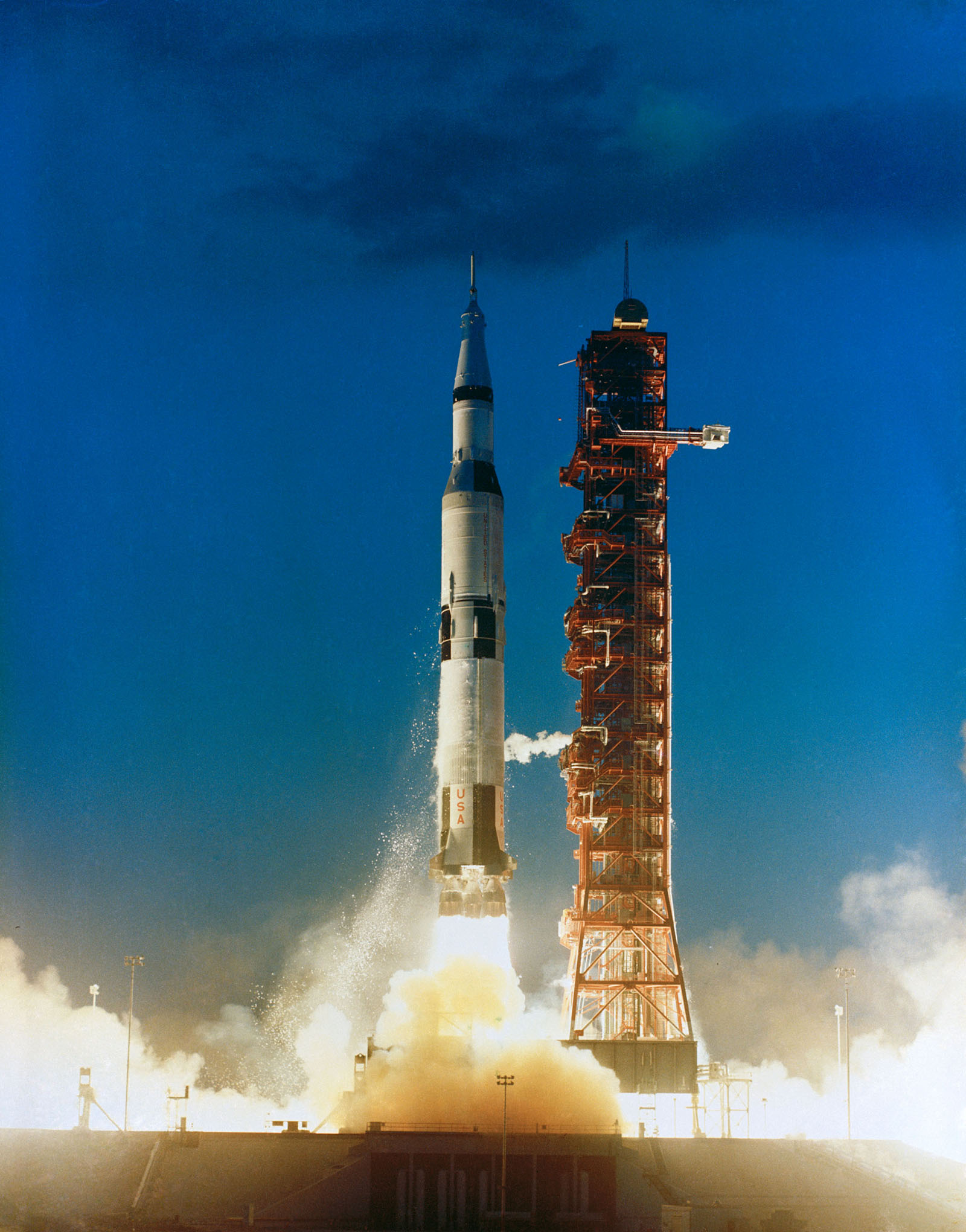
The countdown to the Saturn’s launch proceeded without a hitch; all seated in the viewing stands heard the tremendous pent-up energy suddenly being released when the Saturn V reached the position shown in figure 18. Saturn V was just nearly clearing the tower, and the sound was just reaching the viewing stand. The sight and sound were truly awesome. The sound was heard by the ear as lots of noise crackling and popping, and by the body as a rumbling vibration. Dr. William Donn of Columbia University found the Saturn V blastoff to be one of the loudest natural or manmade noises in history, excepting nuclear detonations.
Early indications from the first Saturn V flight (also called the Apollo 4 mission) were all favorable. Later, analyses of the data showed that the thrusts of all the engines were well within tolerances and that the capsule approached Earth’s atmosphere at close to the nominal 7 degrees below the horizon and at a speed of 24,900 miles per hour.25
The Command Module landed near Hawaii and was picked up successfully by the USS Bennington 2.25 hours after splashdown. The rocket motors, the structure, the controls, the instrumentation, the guidance, and the heatshield all had been completely successful. The members of NASA’s highly professional rocket team, headed by Wernher von Braun, were astounded, and George Mueller was vindicated for his bold planning and execution.
Sam Phillips was moved to say that he was tremendously impressed with the smooth teamwork exhibited. Werner von Braun said that no single event since the formation of the Marshall Space Flight Center in 1960 equaled that day’s launch in significance. Jim Webb praised the devotion and quality workmanship of the 300,000 men and women working on the Apollo Program. And President Johnson said, “The whole world could see the awesome sight of the first launch of what is now the largest rocket ever flown. This launching symbolizes the power this nation is harnessing for the peaceful exploration of space.”
As Jim Webb said, well over a quarter of a million individuals were responsible for the Apollo mission and the flights to follow. And within this team were many leaders from universities, industry, and the government. Those in NASA with major management responsibilities who deserve great credit obviously include the following:
- Keith Glennan, who formed NASA and pushed it hard
- Jim Webb, who kept an umbrella over our heads even in stormy times
- Hugh Dryden, a respected scientist who understood the machinations of government
- George Mueller, who brought new ideas and experienced personnel to NASA with steely-eyed precision
- Joe Shea, who shifted John Houbolt’s lunar orbit rendezvous onto the front burner and then managed the spacecraft development
- George Low, who started early in the program and stayed late, holding many key assignments
- Sam Phillips, former project leader of the Minuteman ICBM, whose experience in juggling many balls was essential to success
- Abe Silverstein, who helped get Apollo off to a fast start and provided assistance in his director’s role at Lewis Research Center
- Tommy Thompson, who spawned the Space Task Group and chaired the Apollo accident review board
- Eberhard Ress, the general manager who made Wernher von Braun’s visions come true
- Rocco Petrone, who was responsible for the zero stage of Apollo, the massive ground facilities at Kennedy Space Center
- Edmund Buckley, who provided the necessary world communication network for tracking and data acquisition
And the leaders of the three Apollo Centers:
- Wernher von Braun, Director of Marshall Space Flight Center
- Bob Gilruth, Director of the Manned Spacecraft Center
- Kurt Debus, Director of John F. Kennedy Space Center
All of these people had to deal with many difficult issues.
This is an important but incomplete list of those who had major management responsibilities for manned spaceflight in the 1960s. There was also a large cadre of scientists and engineers who jumped into the breach on many occasions. I especially would like to mention Max Faget and John Houbolt. Max Faget’s spacecraft designs, with their blunt bodies forward, brought our astronauts successfully through flaming reentries and back to Earth. Without John’s persistence and creativity, we would not have selected the lunar orbit rendezvous mode for the lunar landing and we would not have successfully landed on the Moon. I was extremely fortunate to work with such talented individuals. When I arrived at NASA, Mercury was front and center, and our objective, as President Eisenhower indicated at a Cabinet meeting, was to accomplish as much as possible for $1 billion. And Keith Glennan, the first Administrator, did an excellent job with these funds, laying the groundwork for what was to follow.
When the Soviets threw down the gauntlet for the fifth time with the Gagarin flight, President Kennedy accepted the challenge and NASA embarked on Apollo, a most ambitious program. As general manager of NASA for seven years, I had overall responsibility for all aspects of NASA research and project planning, development, and flight operations, both manned and unmanned. In this monograph, I have attempted to outline the steps that NASA took to advance manned space-flight during my tenure. Important though the unmanned programs for science, meteorology, and communications were, I included in this monograph only those unmanned projects directly relevant to the Apollo landing. The following chapter describes NASA’s organization and the tools that I used as general manager of NASA from 1 September 1960 to January 1968.
Notes
- Ivan D. Ertel, “Gemini 3 Flight,” in Gemini Program (Houston, TX: NASA, 1967).
- Ivan D. Ertel, “Gemini 4 Flight,” in Gemini Program (Houston, TX: NASA, 1967).
- Ivan D. Ertel, “Gemini 5 Flight,” in Gemini Program (Houston, TX: NASA, 1967).
- Ivan D. Ertel, “Gemini VII/Gemini VI-Long Duration Rendezvous Missions,” in Gemini Program (Houston, TX: NASA, 1967).
- Astronautics and Aeronautics, 1965: Chronology of Science, Technology, and Policy (Washington, DC: NASA SP-4006, 1966), pp. 534–535.
- Ivan D. Ertel, “Gemini VIII—Rendezvous and Docking Missions,” in Gemini Program (Houston, TX: NASA, 1967).
- Ivan D. Ertel, “Gemini IX-Rendezvous Missions,” in Gemini Program (Houston, TX: NASA, 1967).
- Ibid.
- Ivan D. Ertel, “Gemini XI-Mission-High Altitude, Tethered Flight,” in Gemini Program (Houston, TX: NASA, 1967).
- Ivan D. Ertel, “Gemini XII-Flight and Gemini Program Summary,” in Gemini Program (Houston, TX: NASA, 1967).
- Von Braun and Ordway, History of Rocketry and Space Travel, p. 167.
- Ibid., p. 172.
- Murray and Cox, Apollo: The Race to the Moon, pp. 144–151.
- Astronautics and Aeronautics, 1965: Chronology of Science, Technology, and Policy (Washington, DC: NASA SP-4006, 1966).
- Astronautics and Aeronautics, 1966: Chronology of Science, Technology, and Policy (Washington, DC: NASA SP-4007, 1967), pp. 203–205.
- Astronautics and Aeronautics, 1966: Chronology of Science, Technology, and Policy (Washington, DC: NASA SP-4007, 1967), pp. 262–265.
- Astronautics and Aeronautics, 1967: Chronology of Science, Technology, and Policy (Washington, DC: NASA SP-4008, 1968), p. 23.
- Robert C. Seamans, Jr., papers, MC 247, Institute Archives and Special Collections, MIT Libraries, Cambridge, MA, and New York Times (5 February 1967): B13.
- Ibid.
- Ibid.
- Astronautics and Aeronautics, 1967: Chronology of Science, Technology, and Policy (Washington, DC: NASA SP-4008, 1968), pp. 57, 64–71.
- Ibid.
- Astronautics and Aeronautics, 1967: Chronology of Science, Technology, and Policy (Washington, DC: NASA SP-4008, 1968), p. 23.
- Astronautics and Aeronautics, 1967: Chronology of Science, Technology, and Policy (Washington, DC: NASA SP-4008, 1968), pp. 101–102.
- Astronautics and Aeronautics, 1967: Chronology of Science, Technology, and Policy (Washington, DC: NASA SP-4008, 1968), pp. 339–341.