Chapter 7: The Aftermath
After the astronauts were welcomed aboard the Hornet by President Nixon and Tom Paine, they were brought to Houston aboard their biological laboratory, checked for pathogens, released, and greeted by family, friends, associates in Houston, and the world at large. An elegant testimonial was tendered to them by the President in Los Angeles. All the place settings were transported from the White House. I flew out one day and back the next with the Joint Chiefs. I played more bridge in two days then I had since college. At the dinner, the dais was quite high, but I was just able to shake hands with Neil, Buzz, and Mike and congratulate them on a job extremely well done. Of course, the mission wasn’t complete until the doctors were finished examining the astronauts. The engineers analyzed the glitches, such as the computer overload on landing. (The rendezvous radar was accidentally left on, thereby feeding excessive signals to the computer.) And scientists were provided with the sample returns and other lunar data (130 laboratories, one-third of them overseas, participated in the analysis of the lunar specimens).
Was There a Space Race?
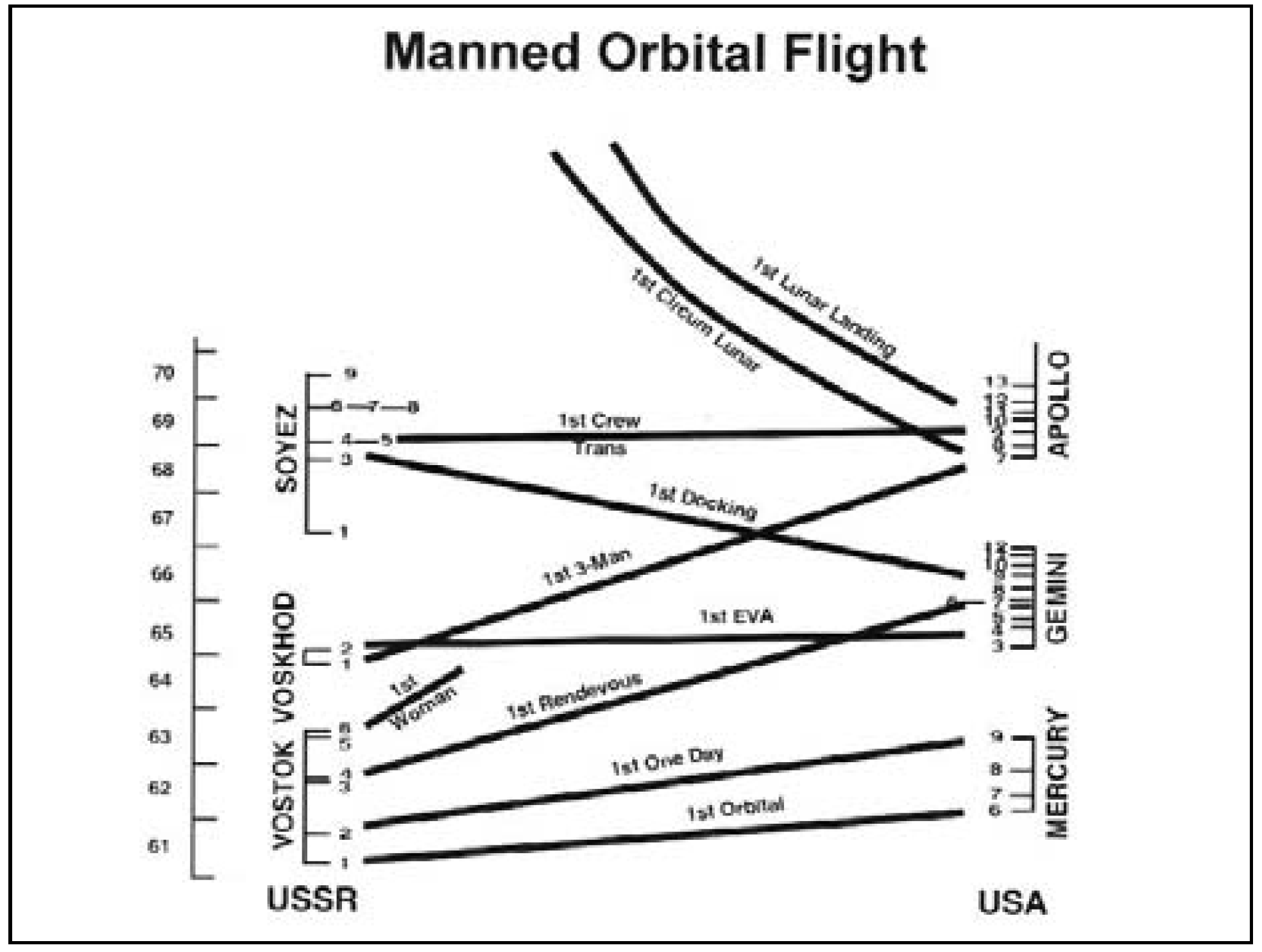
Was there truly a space competition between the Soviet Union and the United States? The accompanying chart (figure 36) shows the manned launches during the period from 1961 through 1970. The three Soviet spacecraft on the left start with Vostok, then Voskhod, and finally Soyuz, the latter still in use today. On the right side are the U.S. manned capsules, Mercury, Gemini, and Apollo. To gain a mental picture of the competition, note that the first orbital mission, for example, was flown by Vostok, followed almost a year later by Mercury. Up until the end of 1968, the Soviets were in the lead with six firsts to the United States’ one.
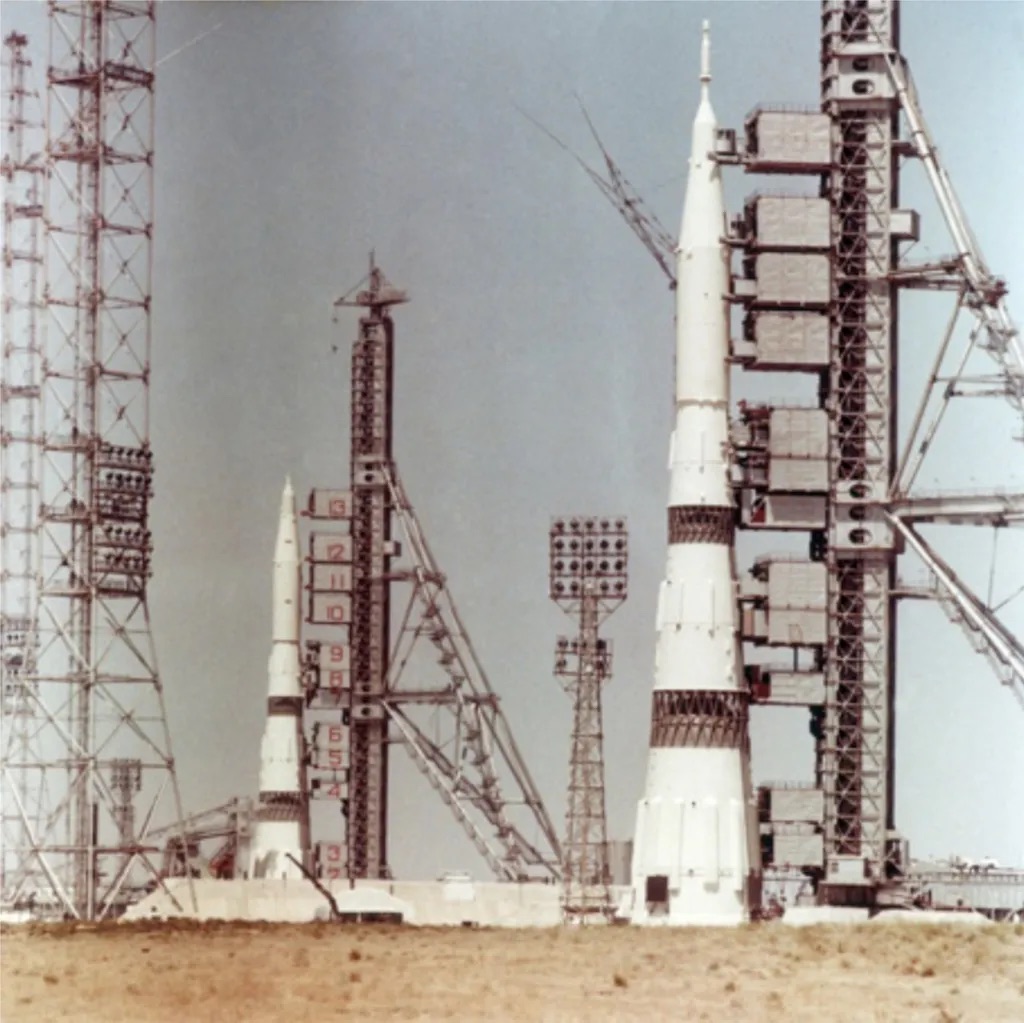
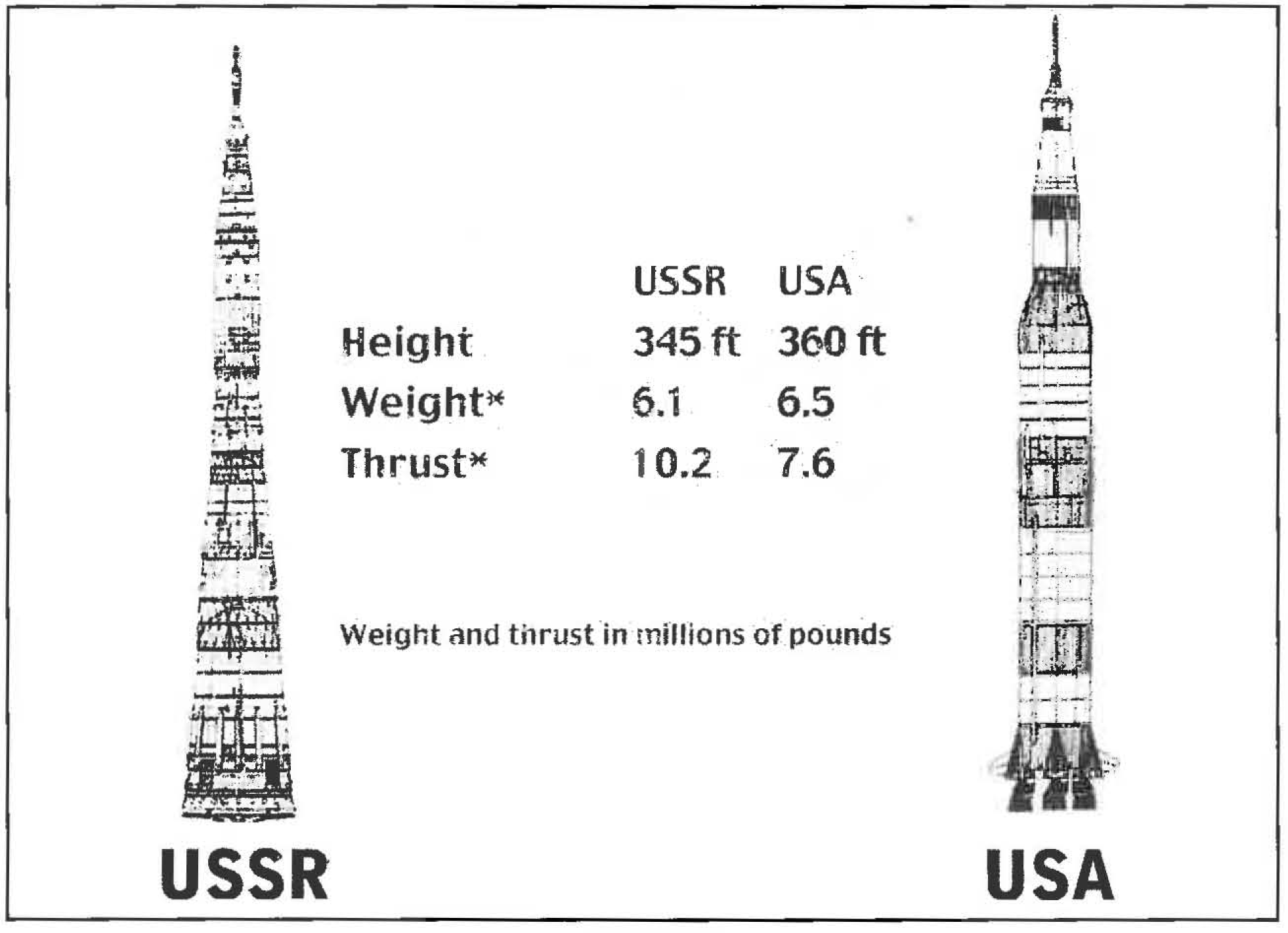
But were the Soviets planning to land on the Moon? You bet! At the time of our lunar landing, the United States had been tracking the USSR N-1 booster development with overhead satellite photography for several years. The photos first showed a large building under construction with rails in and out. The rails came from their industrial area and led to an emerging large launchpad. Sometime later, the photos caught sight of the vehicle proceeding horizontally to the launchpad. The Soviets always waited to erect their vehicles until they reached the pad. The booster was never given a name, just the designation N-1. Figure 37 shows the N-1 on the pad with its umbilical tower, along with the umbilical arms that provided ready access. The proportions of N-1 can be seen in figure 38 in comparison with those of the Saturn V. The two vehicles are of comparable height and weight. A vehicle of this size could be used to launch a space station, as the United States did in 1973 with Skylab, but the most likely purpose was for lunar exploration.
It’s my understanding that the Russians planned to explore the Moon with the lander and then rendezvous and dock with the Soyuz in a maneuver similar to the crew transfer practiced by Soyuz 3 and 4 in mid-January 1969. A rendezvous also would have occurred earlier, in Earth orbit. The N-1 would ferry the Earth-escape rockets, lunar propulsion systems, and lunar lander into orbit, followed by the cosmonauts aboard the Soyuz, who would rendezvous and dock with their lunar chariot.
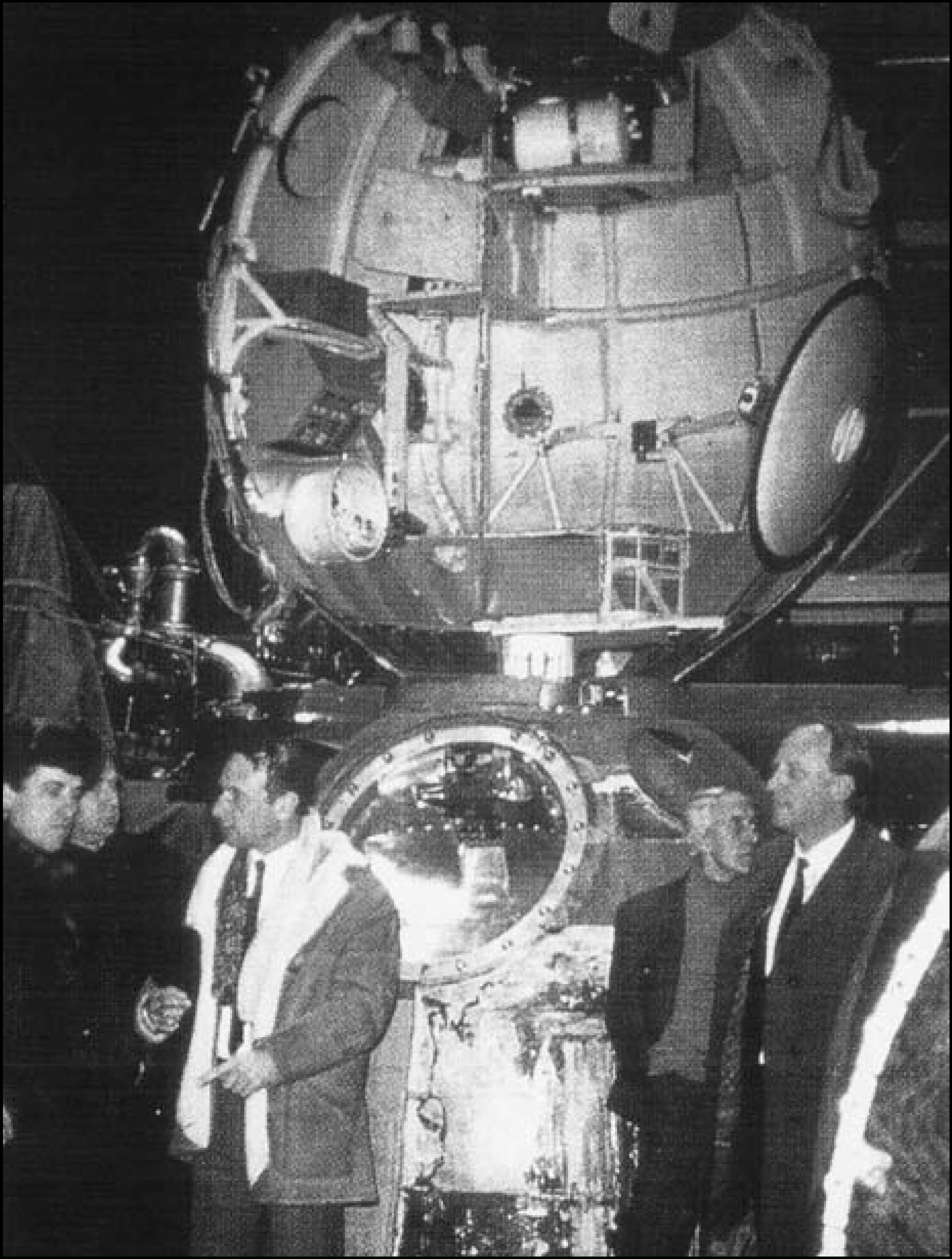
The plans for a lunar landing were denied by the Russians until the fall of the Soviet Union. During that uncertain period, three professors from MIT’s Department of Aeronautics and Astronautics were visiting aerospace facilities in Moscow in 1989. As they were passing the doorway into a laboratory, they spotted interesting hardware. “Can we go in?” they asked. There was a shrug, so in they went, and they soon spotted a capsule mounted on top of a bell-shaped configuration. A sign in Russian said “lunar lander,” which was recognized by the Americans. “Can we photograph?” Another shrug. The photo taken by Jack Kerrebrock (figure 39) shows the ascent capsule with the lander underneath, with Professor Larry Young in front, examining it and quizzing the professors’ Russian counterparts.
The Soviets played for a checkmate up until the safe return of Apollo 11 with Armstrong, Aldrin, and Collins aboard. Even with Frank Borman celebrating the Fourth of July at the U.S. embassy in Moscow, the attempt to launch the N-1 the night of 3 July was completely unknown except to a small circle of senior government officers, and key military and launch personnel at the cosmodrome. The explosion just after liftoff was devastating (figure 40). Havoc was wreaked over a wide area. A Russian student at a seminar I was conducting at MIT volunteered that his father had been in an engineering building several miles away at the time and had been thrown to the floor amidst a multitude of glass shards.
But there was still one more move on the chess-board. All systems were “go” for an unmanned sample return vehicle, Luna 15 to be launched at the same time as Apollo 11. The two vehicles actually orbited the Moon at the same time, but the Soviets were uncertain about the landing topography. The descent of Luna 15 was delayed 18 hours before it received approval to descend; then Luna 15 was to land 6 minutes after Armstrong and Aldrin left the Moon. However, with several minutes left before landing, all signals from Luna 15 abruptly terminated. Later, it was determined that the vehicle hit a mountain peak. The Soviets’ checkmate would have occurred if the U.S. astronauts had been unsuccessful and the Soviets had collected a lunar sample. How foolhardy the United States would have appeared, with the Soviets displaying their Moon rocks, if the astronauts had been killed or left forever in space. In actuality, the news release from Tass (the Soviet news agency) said, “Luna 15’s record program had been completed and the spacecraft had reached the moon in the preset area.”1
Our Knowledge of the Soviet Space Program
As was said in the report to the Vice President signed by McNamara and Webb on 8 May 1961, “Our cards are and will remain up, and theirs are facedown.” How prophetic was this statement! Our intelligence was severely limited. We knew that there was a single individual directing the Soviets’ space effort. Occasionally, our intelligence included fragmentary conversations intercepted when he called his office from his car, but to my knowledge, no substantive information was received from these intercepts. Not until after his death did his name and background become common knowledge. At that time, he was honored and buried in the Kremlin Wall. Our only solid Central Intelligence Agency (CIA) information came from the Corona satellite photography. We observed the construction of the Soviets' large launch vehicle assembly building with rails leading to an underdeveloped area. Later, a launch area materialized, and on one fortuitous occasion, a large vehicle was spotted ready for the launchpad. After the fact, photographs showed the devastation from an explosion on the pad and then a second soon after liftoff. But we had no direct evidence of their lunar program until the visit of three MIT faculty to their Moscow Aviation Institute space laboratory in December 1989 (see figure 39).
However, the Soviets publicly announced each of their flights after the fact. So we knew the names of the cosmonauts, dates, and stated results. We checked the veracity of their releases against the dares and ephemera (apogee, perigee, inclination) of space objects stored by the Air Force in Cheyenne Mountain, Colorado. The Air Force was tracking about 4,500 orbital objects.2 NASA would be informed when a new object came over the horizon, as well as if and when it left orbit and reentered the atmosphere. In this way, the existence of each Soviet mission could be verified, but the intent was a matter of speculation. The inclusion in the text of each Soviet flight in the correct chronological order provides the same understanding of Soviet plans that was available to NASA. For example, as has already been discussed, the Soviet launch of two manned spacecraft a day apart and the subsequent rendezvous could be construed as either part of a lunar or a military maneuver. However, when these things were coupled with the crew transfer in later flights and the appearance of a large booster, it became clear to NASA that the Soviets were preparing for manned lunar missions.
Why the Soviet Success and Then Disaster?
Why the Soviets failed is still a matter of speculation. I would list the following as possible reasons:
Sergei Korolev died on the operating table with a burst appendix in January 1966. His stature placed him in the Kremlin Wall with numerous honors. He was under wraps throughout his gulag years and the period when he directed the Soviet space effort. He was respected for his consummate skill and feared because of his relationship with Khrushchev and other high-ranking officials. He knew how to run their space program, and he had the chits to achieve his goals. The prevailing view of their fire drill in July 1969 after his death is that it was a desperate gamble.
The Soviets were lacking the technology available to the United States. They had started the ‘60s clearly ahead, with boilerplate ballistic missiles capable of lifting large payloads into orbit. Korolev played his cards extremely well, but by the end of the decade, the Soviets had no high-impulse rockets for their upper stages. Thanks to wise decisions by Abe Silverstein in Keith Glennan’s era, oxygen-hydrogen engines were available for Saturn I and Saturn V. To compensate, the Soviets required one-third more thrust at liftoff, and they didn’t have a large engine like the F-1. For that reason, their first stage had to harness 30 rocket motors.
Moreover, the silicon chip was just beginning to revolutionize the electronics industry in the United States. At the Draper Laboratory, for example, the question arose whether guidance and control for Apollo were to be restricted to printed circuitry. Doc Draper wanted to take advantage of Texas Instruments’ latest developments, and he did.
During the assembly of the Apollo/Saturn in the Vertical Assembly Building, the instruments on the vehicles read out to monitors in Launch Control just as they did during checkout and prior to launch. Then, in the final 2 minutes prior to liftoff, the signals were automatically sequenced. If any reading was out of tolerance, there would be a hold and the fault would be investigated. Finally, the United States would never have succeeded with Apollo if we’d plodded through 20 to 30 flights of Saturn I and Saturn V to achieve man rating. The funding wouldn’t have been available. All-up systems testing was essential, and the checkout capability was a strong contributor to NASA’s success.
What Was Next for Apollo?
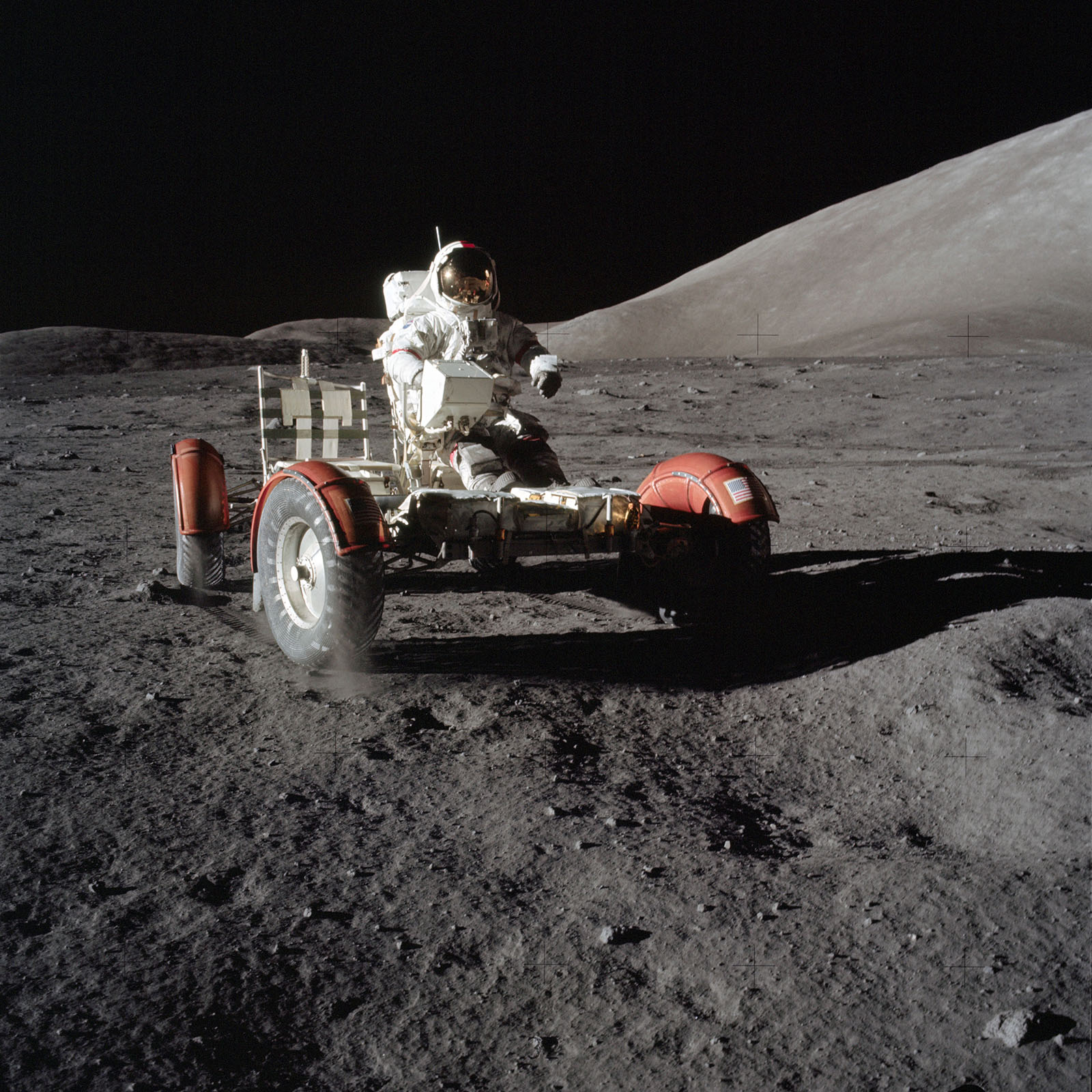
After Apollo 11, there were eight more lunar voyages planned and funded, but Apollo 13’s lunar landing was scrubbed because of a severe power loss in transit to the Moon. The crew’s return was the greatest display of heroics and skill of any NASA mission. In addition, the Nixon administration canceled two missions for cost reasons. The remaining five successful lunar landings conducted important studies aided, in the final three missions, by a lunar buggy (see figure 41) with a 15-mile roving radius. This flexibility, plus the increased precision of the landings, led to important discoveries, including the finding of material dating from near the time of the Earth-Moon marriage four billion years ago.
There were two other uses of the Apollo hardware: Skylab and Apollo-Soyuz. The third stage of Saturn V became Skylab: instead of fuel, oxidizer, and rocket engines, the stage carried a habitat, a research laboratory, and extensive solar paddles for power. Placed in orbit by the first two stages of the Saturn V, Skylab was 118 feet long and 22 feet in diameter, and it weighed about 200,000 pounds. When Skylab arrived in orbit on 14 May 1973, it required intensive care. The temperature awning was torn off, and some of the solar panels had been badly damaged; others had fallen off.3 While ground control kept changing Skylab’s attitude to minimize solar heating, the crew of Charles Conrad, Paul Weitz, and Joseph Kerwin prepared for its resuscitation. On 25 May 1973, they rendezvoused with Skylab and performed miracles. A cable was cut to permit the existing solar panels to deploy. Then, with sufficient power, they entered the extrawarm cabin and deployed a large parasol through a hole in the craft’s skin. When it was opened, necessary solar shade was provided. The crew stayed aboard for 28 days. The second crew of Alan Bean, Jack Lousma, and Owen Garriott vacationed aboard for 59.5 days, arriving on 28 July. Gerald Carr, William Pogue, and Edward Gibson had an 84-day visit from 16 November 1973 to 8 February 1974.
Inside the laboratory, 270 scientific and technical investigations covering the fields of space physics, stellar and galactic astronomy, solar physics, bioscience, and space medicine were planned. About a hundred principal investigators participated. The solar observations were conducted with the aid of seven solar telescopes. Six of these recorded on film, and the seventh relied on the transmission of photoelectric data. These telescopes made available 195,000 exposures of the Sun and its corona to land-based astronomers. By any measure, Skylab was a great success. If the Saturn I had not been canceled, Skylab could have been more permanent, perhaps serving as the focal point for the present space laboratory. Unfortunately, in 1979, approximately a year prior to the beginning of Shuttle operations, the atmosphere’s upper reaches slowed Skylab until it fell to Earth in a fiery ball.
There was still one more Apollo mission—the linking of Apollo and Soyuz 19 in July of 1975. This primarily political venture was agreed to by President Nixon and Soviet Premier Aleksei Kosygin in 1972. Planning and equipping the Apollo and Soyuz for the mission took visits to the Cosmodrome in Russia and the Manned Spacecraft Center in Houston. The United States constructed the docking module, which permitted the astronauts and cosmonauts to meet directly, without extravehicular activity. The two-man Soyuz was launched approximately 7.5 hours ahead of Tom Stafford, Deke Slayton, and Vance Brand in Apollo. Rendezvous and docking took place after the 29th orbit of Soyuz.4 When Tom Stafford greeted the cosmonauts, he did so in Russian. One of the Russians muttered, “I wish I’d thought of doing that.” (Tom had been taking Russian lessons for nearly a year.) After two days of joint activities and three to complete a list of experiments, Apollo returned to Earth, and the Apollo days were over.
Final Thoughts
Following the Apollo era, I would call Patsy Webb, Jim Webb’s wife, and ask about his health and arrange a visit, if possible, whenever I returned to Washington. He fought Parkinson’s with courage. Sometimes he would be wheeled in by an attendant; sometimes he would be on his electric scooter. Often he had a patch over one eye to avoid seeing double. Whether it was the Dopamine he took ahead of time to gain strength in his body or his interest in the conversations, I never knew—but invariably, he’d walk me to the door when I left. Sometimes he’d give me an article or a book to read, and he’d ask for my evaluation of the contents. Other times, he’d probe me with questions like, “What do you hope to accomplish before you kick the bucket?” But although he never asked me why I had resigned from NASA in 1967, I think he knew and agreed. We had become incompatible, and our mutual trust of six years had disappeared. Pages 143 to 150 of my autobiography Aiming at Targets discuss my relationship with Jim after the fire.
Often he’d ask the question, “We thought we were building a space capability for years to come. Why didn’t it happen?” Part of the answer was the cost. I once heard President Johnson’s Director of Management and Budget being interviewed on public radio. He was explaining the budget during President Johnson’s final two years in office. The country was mired in Vietnam, and the Great Society was getting in gear, both with attendant increased costs. And in addition, the President refused to increase taxes. So where did he look for relief? Obviously, the space program. At first he tried to talk the President into a cancellation of the lunar objective. Johnson said he owed it to President Kennedy to complete. But the Soviets appeared out of the race, so why not wait a few years, he argued. Johnson insisted that the lunar landing occur within the decade. There was still one moderate-size expenditure for the Office of Management and Budget, OMB, to strike, namely, Apollo Applications. Starting in the mid-sixties, considerable thought and effort went into future planning under this rubric. George Mueller had the action, and he had selected E. Z. Grey to mount the studies. The Apollo/Saturn capability could have been used separately or in tandem for a wide variety of missions including large orbiting spacecraft for geophysics and astronomy, a permanent space station, a modest base on the Moon, and large unmanned payloads to the planets.
At the same time that Congress was pressing us for our plans, the OMB was picking our pockets for the benefit of other national goals. President Nixon finally supported the concept of reusability in the form of the Shuttle. The five approved vehicles were to be the basis for 500 missions. After 20 years, missions have been flown, but only three Shuttles remain, and the International Space Station is only one-third complete. Over the years, bold new ventures have been suggested, including manned bases on the Moon and manned landing on Mars. There are many unfulfilled dreams of such missions still in the minds of those who participated in Apollo; however, the Saturn V would be extremely costly to resurrect. The Shuttle cannot carry large enough payloads for many of President George W. Bush’s initiatives. The Shuttle is currently reserved for the Space Station and will be retired from service when the Station is complete.
A National Vision for Space Exploration
During the time I was organizing my thoughts on the Apollo Program, a 40-year-old relic of the past, President Bush announced the Vision for Space Exploration, a space program 20 to 30 years into the future. His goal includes sustained and affordable human and robotic projects to explore the solar system and beyond. Human presence would start with a return to the Moon as early as 2015 but no later than 2020. The lunar missions can have immediate significance, for example, to serve as astronomical outposts, and they are also part of the preparation for human exploration of Mars and other destinations. Judging from the past, the technology and our national needs and objectives will be altered before the vision’s completion. So the project is difficult to appraise because not only is it in its infancy, but the first step hasn’t been authorized by Congress yet.
So what can be said at this time? The overall concept makes sense. The Vision is considered a journey, not a destination. The attempt will be made to develop modules such as the Crew Exploration
Vehicle, which can be used on many types of missions. Not much has been revealed about the launch vehicle for Earth escape. Is a large vehicle contemplated, or will a series of launches followed by rendezvous and docking put the mission in play? Nuclear propulsion and power are planned for the longer journeys. The high specific impulse that can be provided by nuclear propulsion is desirable for long distances. The time for long-duration travel can be halved (most important for manned flight), but will the use of nuclear fuel be acceptable to the U.S. public and the world community?
The plan wisely encompasses both manned and robotic missions. Thorough investigation of lunar and planetary pathways by robots must be a pre-requisite to manned excursions. And long-duration stay times on the lunar and Martian surfaces by robotic missions must precede man’s adventure to these distant locales.
So the concept of the Vision for Space Exploration appears sound, but what will be learned and what will be gained? And how will the Vision be managed? A competent team is now reviewing and planning the future, but will they be able to over-come the vicissitudes of changing political agendas?
At the time of Apollo, NASA had a 10-year plan that was updated annually for Congress. Perhaps President Bush’s space journey can be viewed as a 30-year plan made up of a series of defined objectives important in their own right. Then the congressional approvals could be directed toward short-term objectives in a long-term framework. Perhaps more stable budget requirements would result.
Might some new approach or technology be conceived to greatly reduce the cost? Perhaps President Bush’s initiative will trigger such an enabling concept. Certainly man can be remarkably creative, and if true needs arise, I believe man will find solutions
Notes
- Astronautics and Aeronautics, 1969: Chronology of Science, Technology, and Policy (Washington, DC: NASA SP-4014, 1970), p. 236.
- Dwayne A. Day, "The Secret at Complex," Air Force Magazine (July 2004): 72.
- Astronautics and Aeronautics, 1969: Chronology of Science, Technology, and Policy (Washington, DC: NASA SP-4018, 1975), pp. 142–152.
- Ibid., pp. 131–137.