Chapter 5: NASA Management
NASA was formed from a number of separate entities, and hence was a hybrid organization. Four of its Centers were formerly the action arms of the National Advisory Committee for Aeronautics, one was central to development at the Army’s Redstone Arsenal, one grew from a Navy research team, and one was a nonprofit organization managed by the California Institute of Technology. A diagram of their antecedents is shown in figure 5 (see chapter 3), along with the Soviet counterpart. Each of these teams had a nucleus of highly qualified leaders supported by strong scientific and technical personnel.
Langley Research Center was the original NACA laboratory formed in 1915. Its pilotless aircraft division assumed responsibility for the Mercury program in NASA’s first six months of operation. The so-called Space Task Group became 1,000 strong at Langley before transferring to Houston, Texas, to become the Manned Spacecraft Center, ultimately renamed Johnson Space Center.
Originally, flight operations were conducted at Cape Canaveral on a project-by-project basis, with the responsibilities vested in the Space Task Group for Mercury, Marshall Space Flight Center for Saturn, and JPL and Goddard Space Flight Center for the unmanned satellites and probes. The coordination of the resulting projects with the management of the Air Force Atlantic Missile Range became too unwieldy, especially when the Mercury program was joined by the addition of Gemini and then Apollo. So in 1961, the total Cape effort was integrated under a single director and became known as the Space Flight Center until later, when it became the John F. Kennedy Space Center.
NACA-Derived Centers
The four Centers derived from the NACA were the already-mentioned Langley Research Center in Hampton, Virginia, as well as Ames Research Center in Moffett Field, California; Lewis Research Center in Cleveland, Ohio (now called Glenn Research Center); and Dryden Flight Research Center in Edwards, California. Langley was more general-purpose and project-oriented, Ames concentrated on supersonic flight, Lewis concentrated on propulsion, and Dryden was for flight-testing.
At the time NASA was formed, the NACA was devoted almost entirely to aeronautics—astronautical studies were not encouraged. Its Centers were strictly for research and testing, with a wide variety of supporting wind tunnels and other test facilities. These Centers were recognized as preeminent in their fields by both the military and industry. Top-grade personnel were attracted to, and retained by, these Centers because of the importance of their research and the second-to-none tools available for aeronautical studies. Their charter was to support military and commercial aviation. The decision to conduct specific studies was entirely the responsibility of the Centers and NACA management. Suggestions to conduct the efforts on a reimbursable basis were always quashed for fear of NACA’s becoming a “job shop” and thereby losing control. However, both the military and industry provided wind tunnel models, test equipment, and, on many occasions, full-scale aircraft for research and test purposes. For example, the X-15 aircraft was financed by the Air Force in consultation with the NACA; it was designed and built by North American Aviation under contract to the Air Force; and the flight research was the responsibility of the NACA.
When NASA was formed, the role of the NACA Centers was expanded to include aerospace research and, in some cases, actual project responsibility—for example, the Mercury Space Task Group and the unmanned Lunar Orbiter, both at Langley, and the Agena launch vehicles at Lewis. The research funding for aeronautics was carried as a line item in the budget, as was some of the funding for aerospace studies. However, there was also a supporting research and technology subline item for each manned and unmanned space project. These funds were distributed throughout NASA. I remember Hugh Dryden’s admonition to me: “Don’t let them include the supporting research as a lump-sum line item, it’s much too easy for the Congress to dissect and eliminate.”
When technical problems arose in the management of major projects, it was most advantageous to have available research personnel at both the research and the flight Centers. This was the case in a major way after the Apollo fire; individuals truly knowledgeable and coming from a wide variety of fields could be immediately deployed to the accident review committee conducting this investigation. In times of crisis, a strictly project organization must reach out to other organizations, usually on contract. Then, if the investigating consulting firm’s conclusion differs from that of the contractor that experienced the accident, whom does the government believe? When conducting advanced technical efforts, it’s imperative to maintain in-house technical skills of a high order. But high-grade technical personnel cannot be stockpiled. They must be given real rabbits to chase or they will lose their cutting edge and eventually seek other employment.
The Centers for Unmanned Missions
Goddard Space Flight Center
The Goddard Space Flight Center was an off-shoot of the Vanguard Project that was managed by the Naval Research Laboratory. The Center had primary responsibility for geophysical and solar research, astronautical observatories, and applications such as meteorological and communication satellites. This Center also was responsible for the tracking and communication stations for near-Earth manned and unmanned vehicles. Harry Goett was its first Director. He and his boss, Abe Silverstein, Associate Administrator for Space Programs, attracted an excellent team that managed a wide variety of unmanned space vehicles and even, for a time, the Space Task Group at Langley.
Jet Propulsion Laboratory
The Jet Propulsion Laboratory operated under the aegis of the California Institute of Technology on contract with NASA. In the lingo of today, JPL comes under the rubric of Federally Funded Research and Development Center, or FFRDC. See chapter 4 for an earlier discussion of this type or organization.
JPL was responsible for all unmanned lunar and planetary vehicles, including the already-discussed Ranger and Surveyor programs, as well as Mariner and Voyager, in addition to the Deep Space Network. JPL had a great deal more flexibility in its personnel management than the other NASA Centers. Most other NASA employees were civil servants. However, NASA was allowed to hire a certain number of employees to fill excepted positions at the discretion of the Administrator. This permitted prompt hiring of exceptional candidates who could later be folded into government civil service positions at the appropriate level. And many of NASA’s senior personnel, such as the Associate Administrators, continued as excepted employees throughout their tenure.
Two major issues festered amongst the NASA-Caltech-JPL threesome, one internal to JPL and the other primarily with Caltech. The contract with Caltech expired in 1963. Caltech was receiving a substantial fee, and for what purpose? Caltech’s primary responsibility was selecting the JPL Director, certainly not a major budget drain. Lee Dubridge, president of Caltech, said that the fee compensated for the risk to his institution if there were major accidents. On the positive side, he said that JPL, by receiving its funds through Caltech, was given the aura of a premier institution. And, he added, hiring key personnel was facilitated by joint appointments at JPL and Caltech, although there were only a few of these. It was hard to justify the fee; as a result, Congress, and especially the chairman of our appropriation subcommittee, tried to restrain or eliminate funding for JPL. The impasse was partially resolved by transferring the responsibility for the Lunar Orbiter to Langley. This improved NASA’s negotiating leverage with Caltech and resulted in a fee reduction. Then we hardballed the subcommittee chairman, Albert Thomas, by coupling the funding for the Manned Spacecraft Center in Houston (his district) with the funding for JPL.
Difficulties in the management of JPL were much easier to address. Bill Pickering, the Director, was a talented leader, but not strong on administration. For example, when the Ranger spacecraft was undergoing final vacuum tests, new components would be introduced as flight articles without authorization. Although the components might have improved performance, other parts of the spacecraft might have been adversely affected by their inclusion. After discussion and prodding, Al Luedecke became the manager of the Laboratory. He’d had similar responsibilities in the Atomic Energy Commission. From then on, the discipline in the Laboratory was materially improved.
I’m afraid I was on JPL’s most wanted list—that is, most wanted to leave—for pressing hard for organizational changes, but thanks to all concerned, JPL has conducted outstanding scientific investigations of our planets and their moons in the last quarter century.
The Centers for Manned Spaceflight
Marshall Space Flight Center
Marshall Space Flight Center has a strong heritage that dates back to World War II. Wernher von Braun worked at Peenemünde, the center on the Baltic where the Germans developed their “vengeance” weapons, the V-1 and the V-2. The V-2 was a ballistic missile that attacked targets at supersonic speed. Means didn’t exist for defense against it, but fortunately, they weren’t available until near the war’s end. Wernher and his team managed to circumvent the Gestapo and were later captured by the United States. This group, which included many of the top leadership, fled to Bavaria, bringing with them reports and drawings. After their capture by the United States, they were whisked to the White Sands Proving Ground as prisoners of war. Over time, they became U.S. citizens, were joined by their families, and became managers of the research and development programs at the Army Redstone Arsenal. Prior to leaving White Sands, they converted captured V-2 weapons into sounding rockets. At the Redstone Arsenal, they developed newer, more advanced missiles. Their Redstone missile launched Alan Shepard and Gus Grissom into suborbital flight. Prior to that, they launched the JPL-built Explorer 1, the first U.S. satellite, into orbit. For a more detailed account of their exodus from Peenemünde, see pages 114 through 118 of History of Rocketry and Space Travel by Wernher von Braun and Frederick Ordway III.
Wernher and his team had trouble letting go of projects. Arsenal types by experience, they developed, constructed, tested, and launched vehicles with precision, but they had limited skill in contracting with industry for these capabilities. At one point, they recommended canceling the contract with General Dynamics for the Centaur booster. A Headquarters command decision immediately transferred the responsibility of Centaur to Lewis Research Center. Since then, the Centaur has become a reliable workhorse providing propulsion for many important missions.
Real progress was made when Bob Young from Aerojet Corporation joined Wernher and established a project office for each of the major projects under Marshall’s control. Bob had a project director for the F-1 and J-2 rocket engines, each of the two stages of Saturn I, the first and second stages of Saturn V, and the instrument module. The third stage of Saturn V was similar to the second stage of Saturn I, and the project management was shared. A contract was responsible for the design, fabrication, and testing of each unit. Also, as previously mentioned, Boeing was responsible not only for the first stage of Saturn V, but also for integrating all three stages of the Saturn V vehicle and, in turn, the Apollo and the Lunar Lander.
Manned Spacecraft Center
The Manned Spacecraft Center, now the Lyndon Johnson Space Center, was transported from Tidewater, Virginia, to the lowlands of Houston. Water transportation for low-draft craft was available from the Center to Galveston Bay. At the time of acquisition, this attribute was included as a requirement, but its use was never exercised. At the time of President Kennedy’s visit in December of 1962, the Center existed in rental space throughout Houston. However, by the time Gemini missions began, the Center was in full swing on acreage contributed by the city fathers.
Mission Control was the nexus of the Center. That’s where the astronauts and mission hardware came together with the worldwide tracking and communication network. There were a variety of flight simulators that could be introduced to add realism to rendezvous and lunar landing operations. In addition to running regular missions, a wide assortment of adverse situations could be introduced to educate and test the skills of all participants.
This Center was home for the astronauts. Their training started here. Their medical testing and physical fitness programs were conducted at the Center, as were a wide variety of special simulators for docking with other craft and conducting extravehicular activities. This latter type of testing and training is most accurately simulated under water. Today, the Center has a pool large enough to test major sections of the International Space Station.
Kennedy Space Center
The launch facilities at the Cape, now incorporated into the John F. Kennedy Space Center, were responsible for what was often called the zero stage. This Center interfaced in many ways with the vehicles to be launched. The vehicles had to be mounted on the launchpad, either from the start, when under assembly, or, in the case of Apollo/Saturn V, after being assembled in the VAB and transported on the crawler to the pad. There were hold-down clamps used for 3 or 4 seconds to be certain that the appropriate thrust was obtained and swingback arms disconnecting electrical and hydraulic connections. Near the pad were liquid-hydrogen and -oxygen tanks to keep topping off the vehicle tanks that were continually evaporating and emitting gas into the atmosphere.
There was much coordination required with the Air Force’s missile range. The most critical area was range safety. If a vehicle veered off toward a populated area such as Miami, it had to be immediately destroyed. But with the astronauts aboard, time was needed for their escape. With Mercury and Apollo, the escape rocket pulled the capsule clear of a potential accident, but with Gemini, there was a seat-ejection system—the capsule remained attached to the launch vehicle. In all cases, parachutes brought the astronauts back to Earth.
Lessons Learned at the Centers
NASA gained experience with two types of center organization: civil service centers and JPL, an FFRDC. In making a comparison between the two forms, it must be recognized that when government resources are used, the government is accountable for the expenditures. For this reason, functions such as procurement, launch, and flight operations should remain under direct NASA control.
As has already been mentioned, the use of excepted positions alleviated the difficulty of hiring key personnel, but many were later rolled into the civil service. However, cutbacks in civil service personnel were much more difficult. Firing an individual requires extensive liturgical-type proceedings with the individual, all under the oversight of the Civil Service Commission. A reduction in force (RIF) is more manageable, but in that instance, jobs are eliminated, not individuals. When a job is no longer required, the individual holding the job may have seniority over another individual and take over his or her billet. To defeat this difficulty, Marshall Space Flight Center is reported to have developed a special personnel computer program to release specific individuals. Their scheme may be apocryphal, but it was believable to those who have dealt with management issues in the government. The FFRDC provided much greater personnel flexibility, including the possibility of higher salaries for those carrying greater responsibility, although their salaries and total numbers do come under congressional scrutiny. However, FFRDCs have limitations. The government must take overall responsibility for procurement, including second- as well as first-tier contracts. What would be a large prime contract for a civil service center becomes a second-tier in an FFRDC. Surveyor, the lunar soft-lander, was one such contract. Hughes Aircraft held the contract with JPL. But when serious delays occurred and costs escalated, NASA didn’t have direct control of this project even though it was of great consequence to the Apollo manned lunar landing. The situation deteriorated, and ultimately, NASA’s senior management had to take strenuous action.
NASA Program Offices
NASA program offices were of necessity in Washington, DC. They had to be close to NASA’s functional and administrative offices, as well as the executive office and Congress. Much of the congressional testimony was provided by program personnel. The nature of the program offices must reflect the contemporary responsibilities of the Agency. There shouldn’t be too many program offices; their assignments shouldn’t overlap any more than necessary; and project execution should, wherever possible, be conducted by their assigned Centers.
In 1967, there were three program offices, namely, Advanced Research and Technology, Manned Space Flight, and Space Science and Applications. The application projects included meteorology and communications, which were at one time separate from space science activities, but the projects were assigned to Goddard Space Flight Center, as were many of the space science projects. Priorities between science and applications were a potential source of conflict at the Center when it reported to two different program offices.
The communication and tracking projects were combined into a program office without line responsibility. The office had no control of any Center, but it did have direct responsibility for all surface networks. The antennas ranged from small to medium for Earth orbiting, as well as manned and unmanned vehicles, to large 220-foot antennas for manned lunar missions and distant unmanned planetary probes. Both Goddard and JPL had project assignments for these activities.
Keeping the Trains on Track
As discussed earlier, an attempt was made to obtain systems capability in the Manned Space Flight program office. For a variety of reasons, NASA was unsuccessful in recruiting sufficient numbers of individuals in this highpriced and scarce field. The Bell Laboratories of AT&T established a small subsidiary, Bellcom, to assist in this area, but there was an alternative long-term solution: independent, nonprofit corporations could be established for this purpose. Examples included the Aerospace Corporation to assist the Air Force’s missile and space commands and the MITRE Corporation for support of Air Force ground capabilities. Other DOD and non-DOD agencies had similar arrangements. These Federal Contracted Research Centers (FCRCs) conducted much of the planning, engineering, and monitoring, but the contracting was handled directly by the matching government entity. In Jim Webb’s mind, the use of a for-profit entity provided highly desirable flexibility, hence the use of Bellcom, a subsidiary of AT&T’s Bell Laboratories. Although most of the technical personnel had to be hired, the internal administration was transferred in part from the Bell Laboratories, and there was always wise advice available at the Bell central headquarters. Finally, there was no NASA commitment or responsibility for the future. Of course, using a for-profit can lead to conflicts if the corporation is also bidding for hardware contracts in the same area where the company is providing systems advice. Conflicts of interest, or their appearance, can be ameliorated by exclusion clauses, but major corporations are reluctant to be so constrained. Since AT&T was not an aerospace corporation, no conflict developed, but caution was still required by both parties.
Day-to-Day Chores
During the six and a half years when I was general manager, I had a variety of chores that would have to be executed regardless of the Agency’s organizational structure. The mail alone was a huge production. An executive in my office would determine who in the organization might need to see a piece of mail before I did. By the time a letter got to my desk, it might be in a big folder attached to memos from two dozen people in the organization, all of whom had ideas about how I should respond. Then, when my draft response had been written by me or by my assistant, there might be others I would want to review the response before it went out, so it might be recirculated with an endorsement attached, and each person would initial his approval.
I’m a great believer in face-to-face communication. That is one reason why I held project status reviews once a month for all NASA activities needing attention. It’s also why I spent one quarter to one third of my time on the road, traveling to NASA Centers, contractor facilities, other government agencies, and foreign countries.
But the spoken word can be misunderstood, and sometimes all involved in an issue or project cannot be reached simultaneously. As a consequence, information systems and procedures are a necessity. Contained in this section are graphic samples of the systems and procedures used to manage NASA’s programs during the time I was general manager.
Organizational Charts
The first clues about the interrelationships between individuals in an institution are provided by organizational charts, sometimes called wiring diagrams. A chart attempts to show who works for whom. From the standpoint of any individual, it provides an answer to the question, “Whom do I have to satisfy to remain on the job, to obtain a raise, or to be promoted?” Organizational charts also provide information in the large. How are projects, programs, and functions interrelated under the warm embrace of general management? Methods for management consumed a lot of Jim Webb’s time and interest. In my first conversation with him, as I mentioned earlier, he asked me about my views on Montgomery Ward’s mode of operation versus that of Sears Roebuck. The NASA that
Jim inherited was nearly hierarchical, definitely in the Montgomery Ward mold (see figure 19). The Center Directors reported to the program directors, who in turn reported to the general manager (Associate Administrator) and, through him, to the Administrator. There were functional officers and staff, but authority flowed in a straight-downward chain of command from the general manager to the program offices to the project offices in the Centers. Incidentally, Doc Draper’s Instrumentation Laboratory, where I spent my first professional years, was purely hierarchical even with individual projects having many of their own functional units.
After extensive discussion internally and with outside advisors such as Simon Ramo, Rube Mettler, and Art Malcarney, the organization was decentralized on 1 November 1961, more along the lines of Sears Roebuck (see figure 20). Note that the nine Center Directors and the five program directors reported to the Associate Administrator. Program resource allocations were authorized by the Associate Administrator with the support of the respective program director. The management activities of the Center Directors were also supervised by the Associate Administrator, with the assistance of the Director of the Administrative Office. This structure was introduced to provide more flexibility in the assignment of projects to the Field Centers and to provide the core management (the Triad) with greater visibility and control (see figure 2 in chapter 3). Note that the Center Directors became “two-hatted”; that is, in addition to satisfying the Triad that they were running a “taut ship,” they also had to satisfy the program directors who were providing their project assignments and project resources.
I attended Keith Glennan’s last management retreat, held in October 1960. Jim Webb held a similar retreat in Luray, Virginia, soon after he became Administrator. However, he felt that the setting could be subject to congressional criticism and that the retreat kept key managers out of touch with their organizations for too long. Henceforth, retreats were held at NASA centers. This had the added virtue of providing managers with an opportunity to become more familiar with other parts of the organization. At one such meeting, held at the Langley Research Center in 1963, the manned spacecraft team of Holmes, von Braun, Gilruth, and Debus strongly objected to the organizational structure implemented in November 1961. Mr. Webb was so displeased by this confrontation that retreats were forever abandoned; however, soon thereafter, on the recommendations of many, including myself, there was a return to a more hierarchical organization (see figure 21). It should be noted, however, that the program offices and the Administrative Office continued to report to the Associate Administrator, thus maintaining their strong central role.
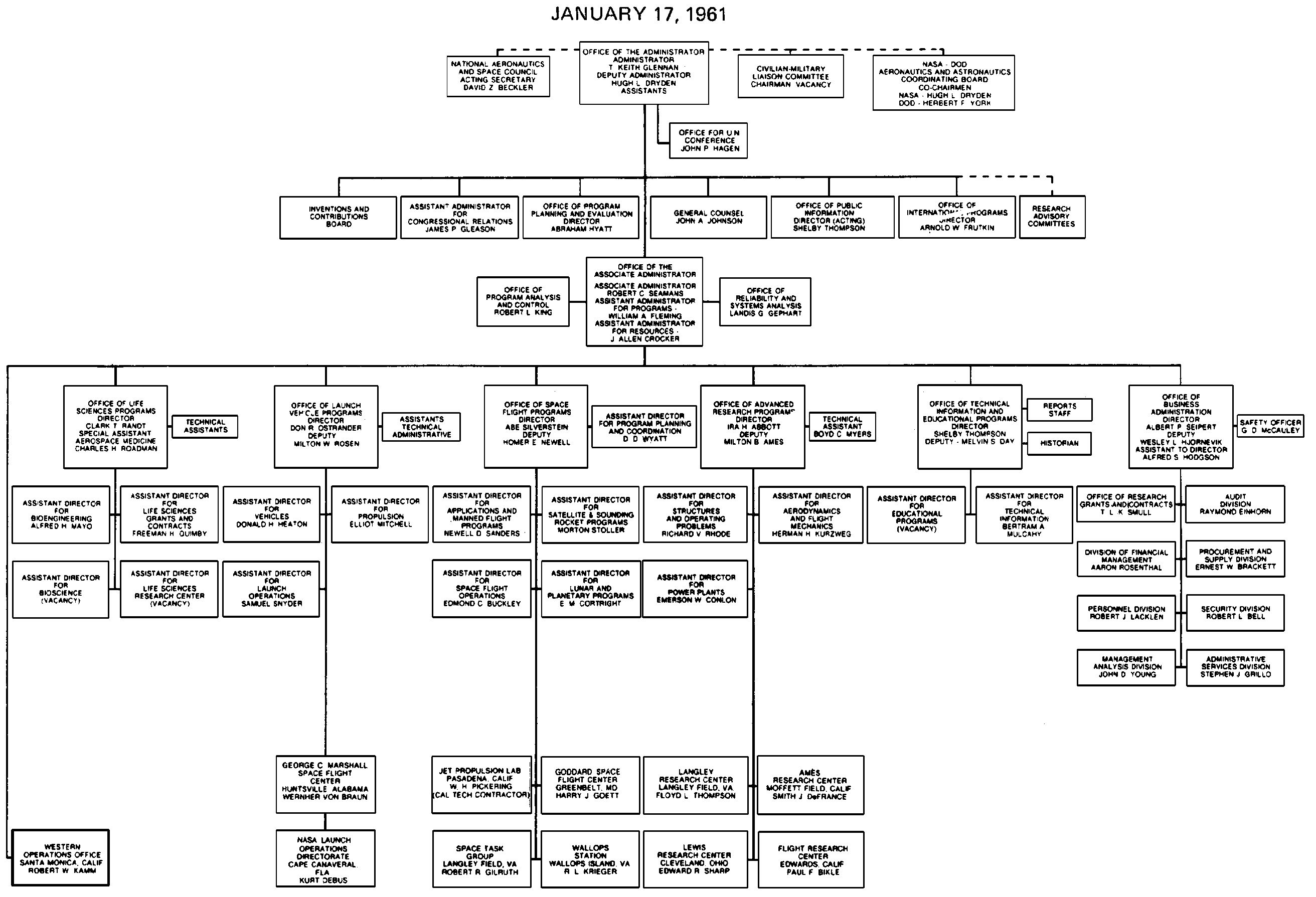
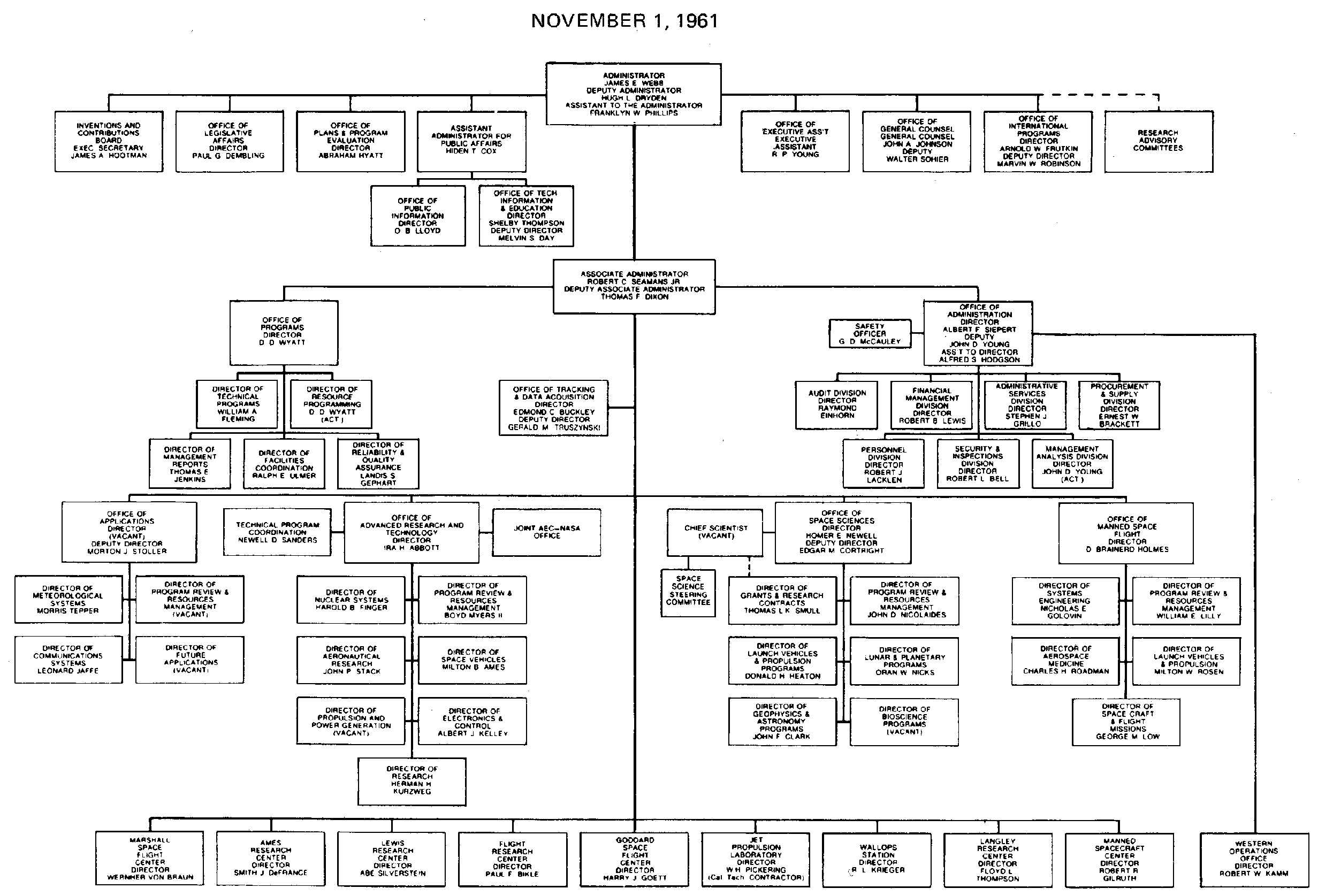
Soon after I became Deputy Administrator on 21 December 1965, NASA’s functional offices (those reporting to the Administrator and those reporting to the Associate Administrator) were folded together, and all reported to the Office of the Administrator. This arrangement was discussed rather extensively at my Senate nomination hearing on 28 January 1966. The fourth organization chart (see figure 22) shows diagrammatically the changes that were made in and around the Office of the Administrator. Jim Webb was not happy with this arrangement and continued to prod me and Willis Shapley for improvements; meanwhile, he introduced changes, such as a secretariat for the control of communications. I prepared a detailed, 18-page “eyes only” memorandum on the subject dated 16 December 1966. My recommendations apparently didn’t satisfy Jim Webb’s restless spirit, and they became less relevant to him in the wake of the Apollo 204 disaster.
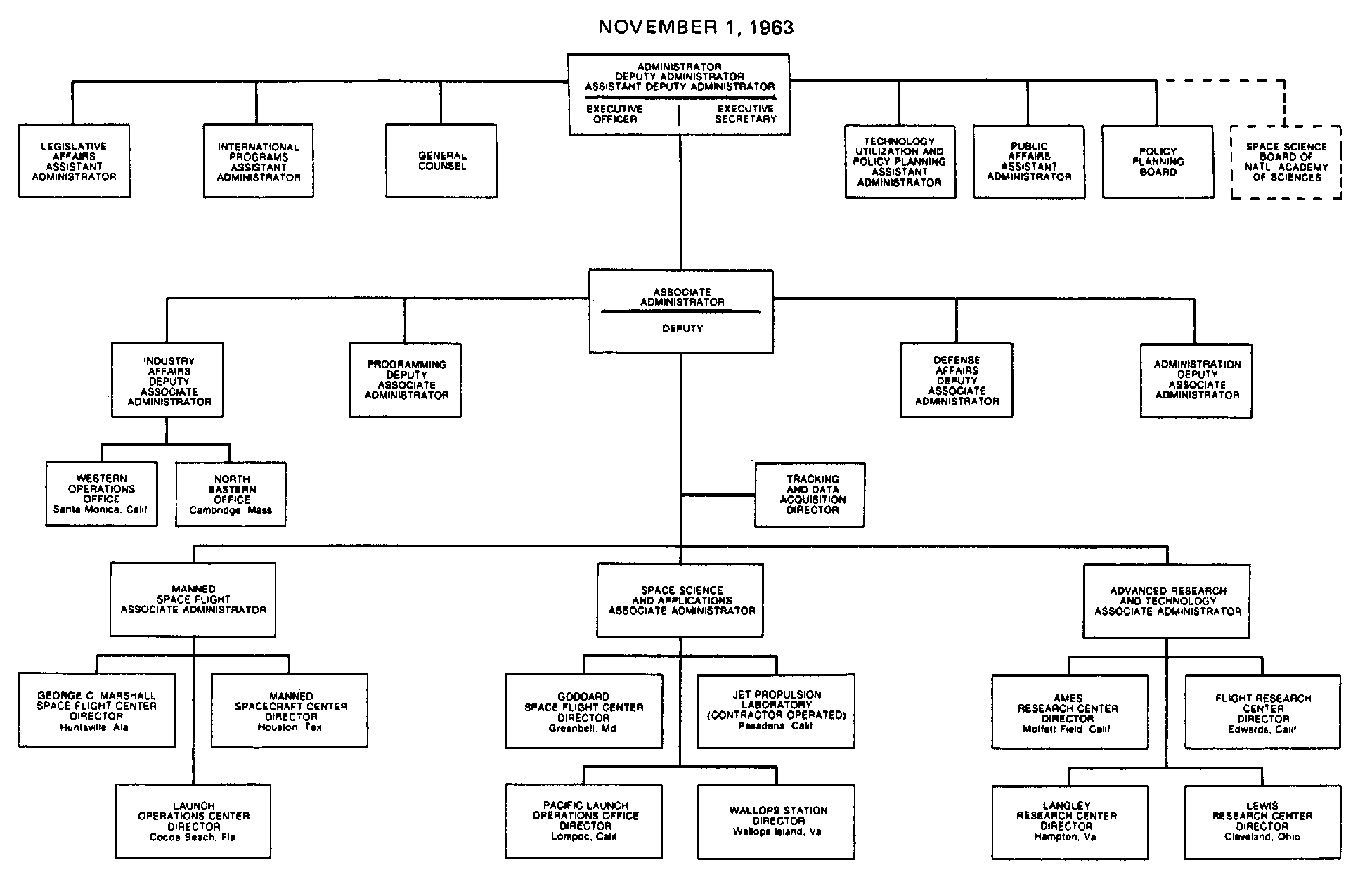
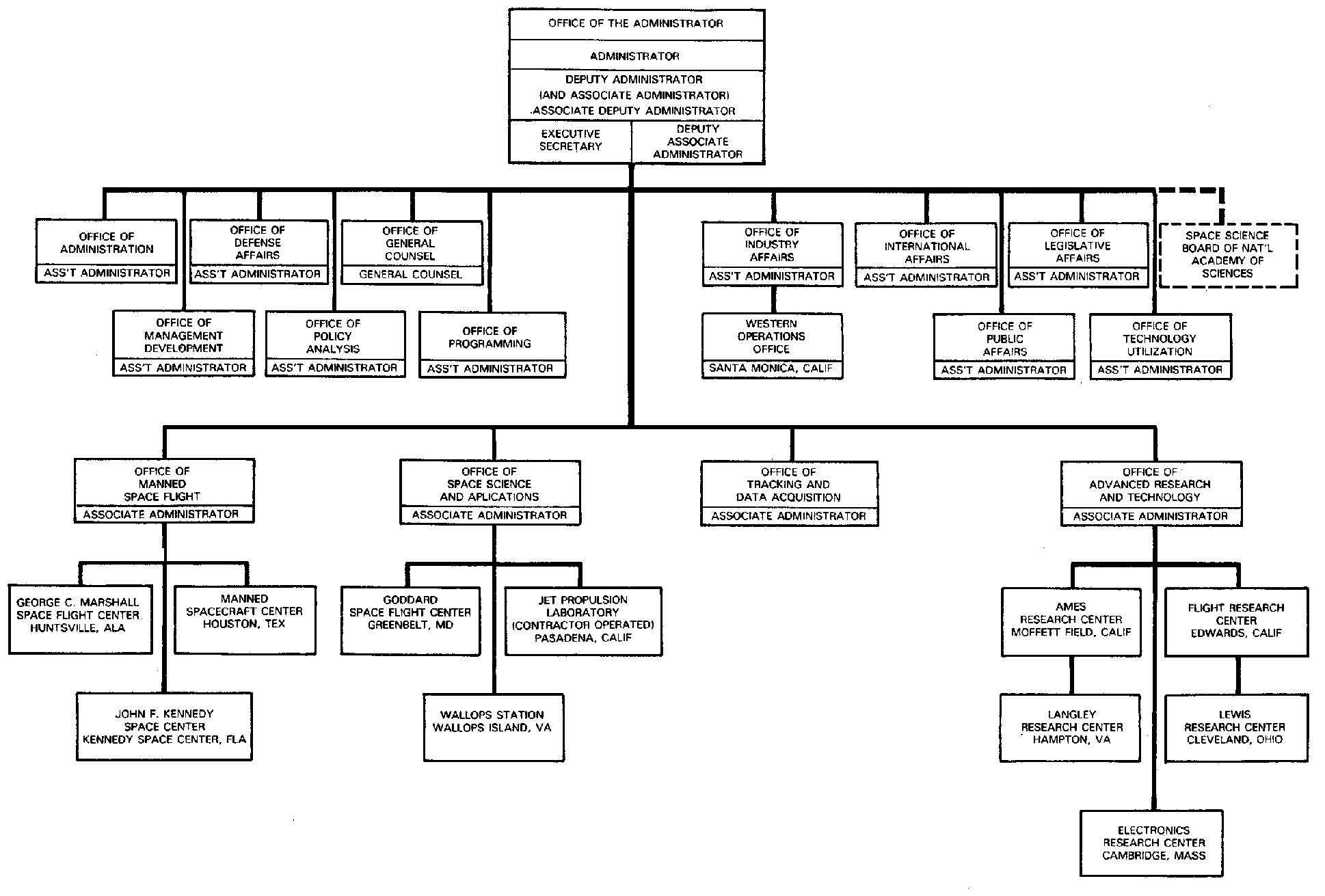
In January 1966, when Harry Finger and his committees started reviewing the functional offices reporting to the Administrator, there were 12, ranging from General Counsel to Public, Defense, Legislative, and International Affairs. Many dealt with resources, including Personnel, Programming, Budgeting, Management Systems, Industry Affairs, University Affairs, Institutional Development, and Technology Utilization. Much discussion took place before a decision was reached to consolidate most of these resource functions into the Office of Organization and Management. Recently, in conversation with Harry Finger, who took over the function in March of 1967, he told me of his many meetings on the subject with Jim Webb. Jim finally asked him if he felt comfortable taking on this broad management role. He answered that he felt somewhat uneasy. When Jim asked why, Harry answered, “Because you’re so involved in them.” Jim said, “No, I want you to handle them.”
Procurement
The preceding organization charts might imply that all decisions at NASA were made by the Administrator. Obviously, this would be an impossibility. Organization charts can only partially reveal the extent of decentralization within an organization.
In an organization, many functions must be performed—some in administration, some in programming and budgeting. Which officers are involved in establishing new top-level positions, in hiring personnel, in solving adjustments, in promotions, in disciplinary actions? How are audits conducted? How are safety and security inspected and ensured? How are grants made to universities? “Who,” “which,” and “how” can be defined by writing detailed job descriptions, and much NASA time was expended in this process.
For myself, I’ve found that flow charts (figure 23) are much easier to comprehend. NASA projects were managed primarily at the Field Centers. The project manager at the Center prepared the procurement plan, an extensive document, which then passed through the Center Director and the program director, before a review by the procurement officer at Headquarters. Prior to 1966, final approval was given by the Associate Administrator. Afterward, plans came to the Office of the Administrator.
Once a plan was approved, the project manager prepared a request for proposal (RFP), which, if approved, was released by the Headquarters procurement office. The source evaluation board named in the procurement plan had both line and staff members, picked for their individual expertise, who participated in the evaluation. Their effort started when the RFP went out to the contractors.
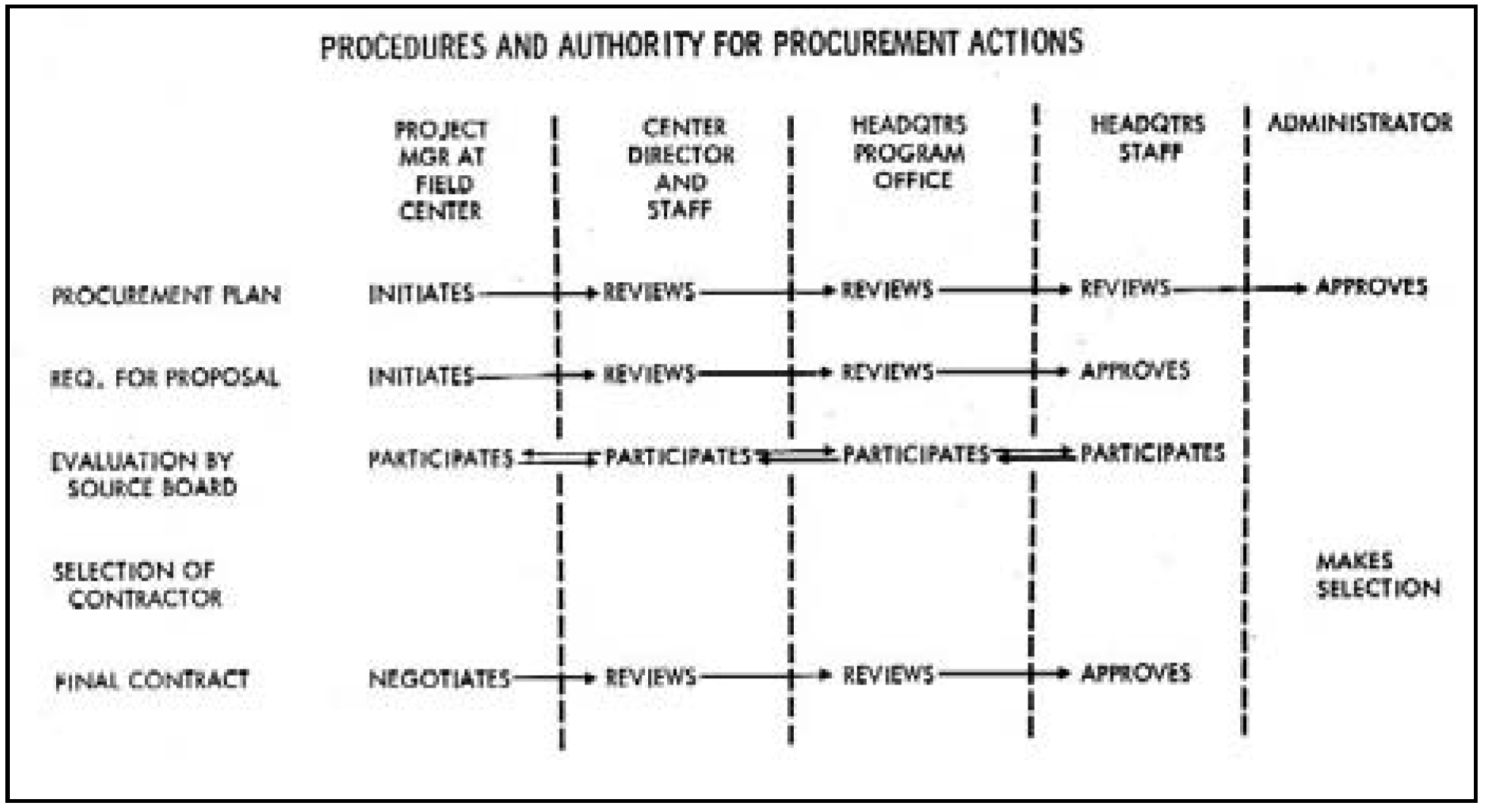
Prior to the submission of proposals, the board had to establish the basis to be used for scoring them. During the process, strict rules were enforced regarding communication with the contractors. If a contactor asked for clarification, all contractors were informed of the answer. If onsite inspection of one contractor was desired, all contractors were inspected. I fenced myself off from the evaluation so that I could remain immune from questioning by Congress or the media until the final day when the selection was made.
Once the team had prepared its findings, Webb, Dryden, and I would sit at the head of a table and the team would make its presentation. If the project was something coming out of Marshall, Wernher von Braun would be there watching, though he would have no say in the meeting. Our procurement people would be there as well. Webb used such meetings as a way of educating NASA, as well as a way of looking for hidden agendas. If anybody was trying to steer the project toward a particular contractor for whatever reason, we would try to smoke it out.
Afterward, the three of us would go into Webb’s office with our chief procurement person, Ernest W. Brackett, and with Wernher (or his counterpart from the interested Center). “Okay,” Webb would say, “we’ve heard the results of the source evaluation board, now we’d like to hear from you, Wernher. What wasn’t considered? Is there anything that was left out that you feel is important?” When he and Ernie Brackett had their say, they would leave, and the three of us were left with the decision.
As the junior person, I always went first, “Okay, Seamans, how do you look at this?” We would discuss it back, forth, and sideways, as Hugh and Jim advanced their views too. Finally Webb would say, “Okay, whom do you think we ought to pick, Bob?” I would tell him and why. Then Hugh would have his turn. If Hugh concurred with me, Jim usually agreed, and then the decision was made. Otherwise, there would be further discussion until an agreement was reached. In a few cases, more information was requested. The morning following a decision, Webb’s executive secretary would have prepared a one-page decision paper saying that the Administrator of NASA had selected, say, North American Aviation for negotiation for the second stage of Saturn and giving reasons for the selection. All three of us would sign it. The press release would be based on this document, but the document itself was kept on file at NASA in case there was ever a congressional investigation.
When an agency like NASA procures buildings and other facilities, the contractors are provided with specifications and designs in the request for quotation (RFQ), and sealed fixed-price bids must be submitted by the contractors. The low bidder is selected if deemed competent, and a fixed-price contract is signed before work commences. The Army Corps of Engineers oversaw all of NASA’s major construction on a sealed-bid basis. Most of the work for which NASA contracted directly was for research and development, where fixed-price contracts are not suitable. There must be pricing flexibility to accommodate unexpected factors. Hence, contractors were selected for negotiation. They were given a letter contract to commence work in anticipation of a definitive contract later. It was common practice to negotiate cost plus fixed fees. When there was a cost overrun, the government covered the contractor’s extra expense, but the fee from which the contractor derived profit remained constant.
NASA started experimenting with incentive and award fees soon after Jim Webb became its Administrator. When the incentive is tied to cost, the contractor shares the cost of overruns with the government (the contractor’s fee decreases). If cost savings occur, the contractor’s fee is increased in proportion. Incentives can be related to schedules and performance as well as to cost. However, it’s important not to allow the incentive arrangements to be overly complex, because then the government can lose control. The contract can so circumscribe the contractor’s actions that the government cannot make needed contractual changes without it appearing to be a “golden handshake” (to let the contractor off the hook). Award fees are preferable in such circumstances. The award is made by the government against criteria agreed upon in advance. Such arrangements place highly desirable constraints on both the government and the contractor. A large percentage of NASA’s Apollo business was conducted on either an incentive or an award-fees basis.
Budgeting
The budget is key to all government programs, and for that reason, the budget process is both important and time-consuming (see figure 24). There are periods when an agency must focus on three budgets. While using the budgetary resources provided in a given year, say fiscal year 1961 (FY61), the agency may be presenting the administration’s request to Congress for FY62 and simultaneously
negotiating the FY63 budget with the Office of Management and Budget and, ultimately, with the President. (The federal budget for any fiscal year currently runs from October 1 of the previous calendar year to September 30 of the year in question, but in the 1960s it ran from July 1 to June 30.)
On the day the new budget was released, the media attacked. All over Washington, correspondents nosed into the different agencies to find out what was important in each budget. We always had a press conference, which I conducted. As many as a hundred correspondents would be present. There might be TV reporters if the subject was sexy enough. I would run through what was novel in the budget, a process that might take 2 hours. Then there were questions.
I got a fair amount of scar tissue (figuratively speaking) from my years in government, and a fair amount of that came from the media. The intense media interest in the space program was a shock to me. I liked working with many members of the press. I understood that I could get gored, but I tried my best to have a good relationship with them. Most of them were pretty interesting people and fun to chat with, but I had to be very careful.
Bill Hines, the syndicated columnist who had called me “Moon czar,” was particularly brutal to NASA. He would stand up and fire questions at us in a nasty, incisive way. Why were we so plodding? Why weren’t we moving faster? Why weren’t we more imaginative? When I came home Thursday nights, Gene would not let me read his syndicated articles until after dinner. Or, if they were too derogatory, she served me a martini first, which helped some.
I remember asking John Finney of the New York Times, “Why can’t you do a positive, upbeat kind of story on NASA once in awhile?” His answer was, “Okay, I write a good article, and if I’m lucky it will be on page 33. If I write something controversial, I have a chance of getting it on page 1. It’s as simple as that. I’m paid by what page I get my articles on.”
History of NASA’s 1962 Fiscal Year Budget
NASA’s FY62 budget (see figure 24) was complicated by the changes that occurred starting with the Eisenhower submission, followed in March by a supplemental request to cover an expanded launch vehicle effort, and then a major budgetary expansion in May to initiate Kennedy’s goal of manned lunar landing within the decade. NASA’s total submission (budget request) is shown in the first column of figure 24. Notice that the submission covers three categories of activity. Two of these, “Research and Development” and “Construction of Facilities,” are so-called “no-year” items; that is, the moneys can be expended over several years. Money in “Salaries and Expenses” is one-year money; it doesn’t carry over to subsequent years.
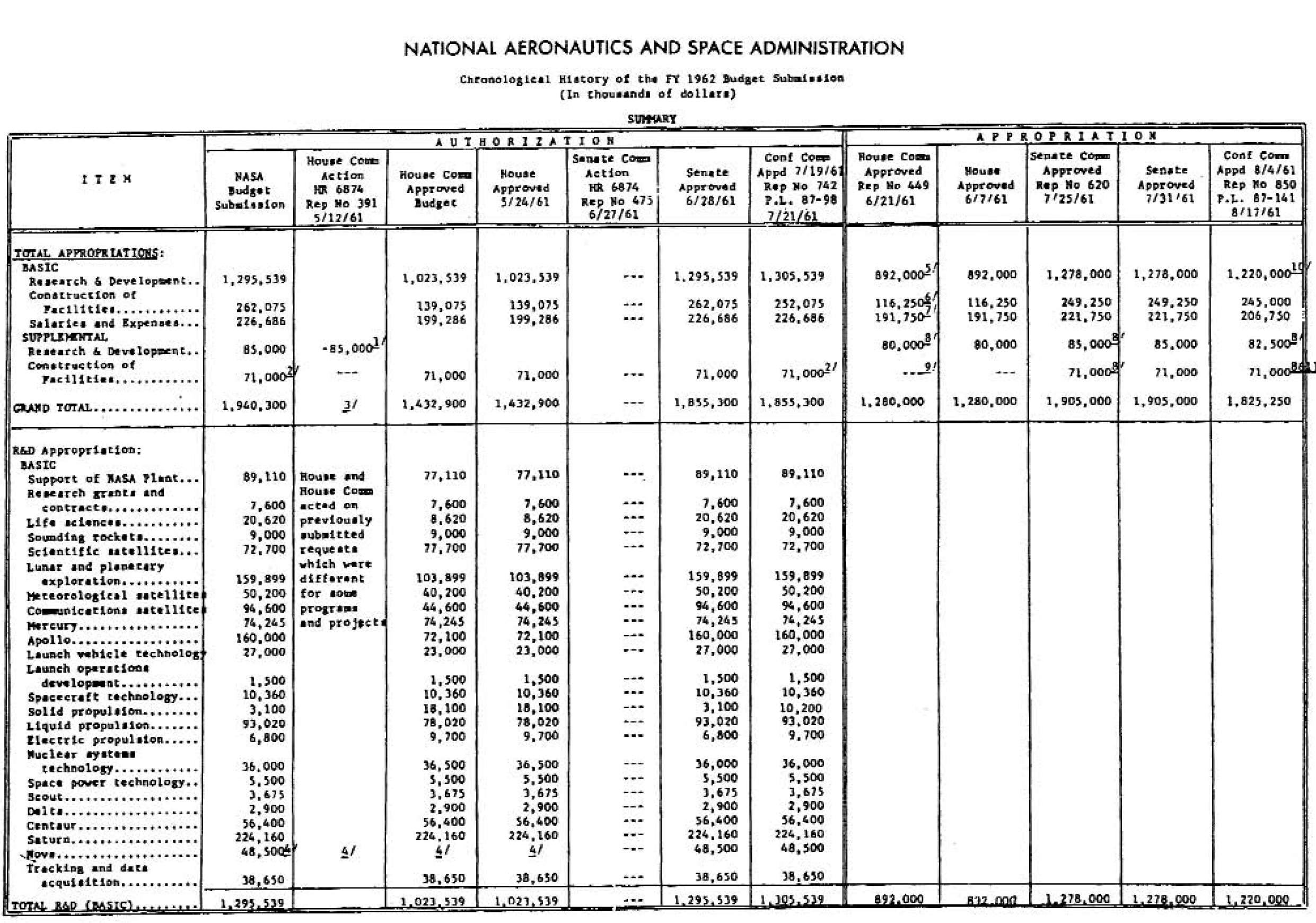
The House and Senate receive a budget request in the form of voluminous reports. They commence committee hearings once their staffs have digested the material. The House, with over five times as many members, breaks its space committee into subcommittees in order to take a finer grained view of NASA plans and estimates. The markup of a bill takes place in a closed session and is then reported out to the appropriate congressional body, where open debate takes place on the floor of the House and Senate with the committee chairmen as protagonists and the committee members in a supporting role. I have had the unusual experience of sitting on the floor of the Senate assisting Senator Kerr in such a debate. I have also spent time outside the House Chamber and in the House Gallery, making myself available for questioning. Once the House and Senate bills have been approved, negotiation between the two bodies proceeds, culminating with closed sessions of the conference committee made up of the senior members of the two authorization committees.
But even after the President has signed an authorization bill, it doesn’t provide dollars. First it must survive the appropriation process. Appropriation is similar to authorization, but its emphasis is cost. A new laboratory might be included in the cost of facilities, but if Congressman Albert Thomas, Chairman of the Independent Agencies Appropriation Subcommittee, were presiding, he might want to know why the cost covered special clean-air filters and other high-cost items. The committee might, as a result of these issues, reduce the estimated cost per square foot of the authorized building. Ultimately, an appropriation bill is negotiated and passed by both houses of Congress. However, even after a bill is signed by the President, the Office of Management and Budget holds the purse strings and may not release all funds to the agency.
There have been many instances when the appropriation bill has not been passed by the start of the fiscal year. In such cases, Congress passes a continuing resolution, which permits an agency like NASA to continue its existing programs, but not to initiate new projects. Finally, within limits prescribed in the authorization bill, the agency is given the opportunity to reprogram funds from one line item to another. The reprogramming has to be formally reported to Congress.
Scheduling
Anyone who has ever remodeled a home recognizes that the effort requires an interleaving of contractors. A delay by one has a domino effect on the others. Many separate schedules determine the final outcome.
NASA also used Level 2 and Level 3 charts, which showed in greater, and still greater, detail the sequencing of the many work packages that had to be completed in order to achieve a launch. Such charts are essential for those with hands-on responsibility, but they do not reveal whether a project is staying on track or whether, as happens most often, deadlines are “slipping” (constantly being moved toward a later date). Such slippages usually result in escalating costs.
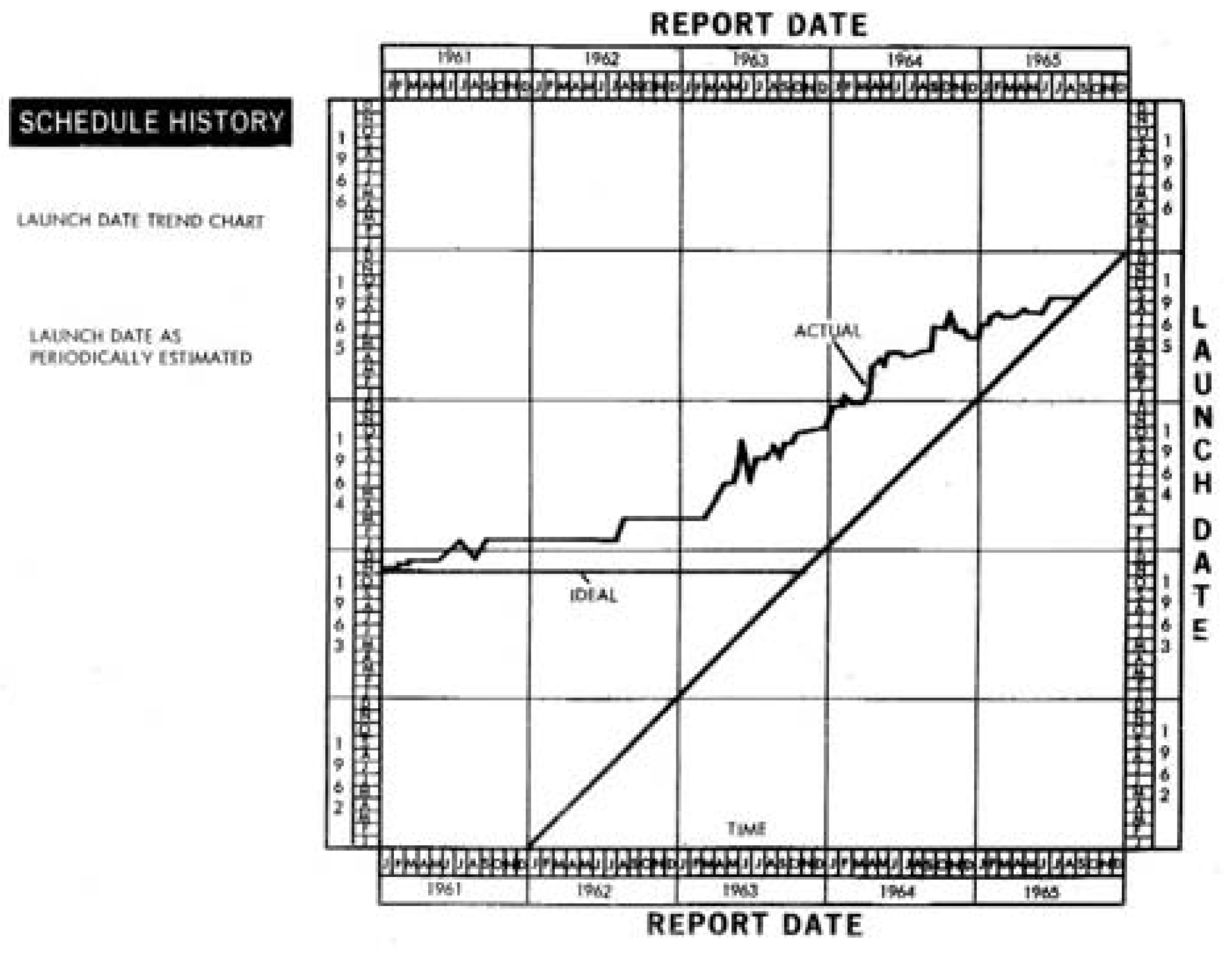
To stay alert to and (hopefully) prevent slippages, I developed and implemented “trend charts” (see figure 26) like the one drawn for a hypothetical mission. If, on 1 January 1961, a launch had been scheduled for November 1963, and if that launch had stayed on schedule throughout the reporting periods in 1962 and 1963, progress would be shown as a straight, horizontal line labeled “IDEAL.” If, instead, the project kept slipping its deadlines such that the launch did not occur until some time in 1965, its trend would have followed a jagged line like the one labeled “ACTUAL.” Note that in this hypothetical case, the schedule held pretty well until March 1963, when a nearly day-for-day slippage began to occur, ultimately delaying the launch nearly two years.
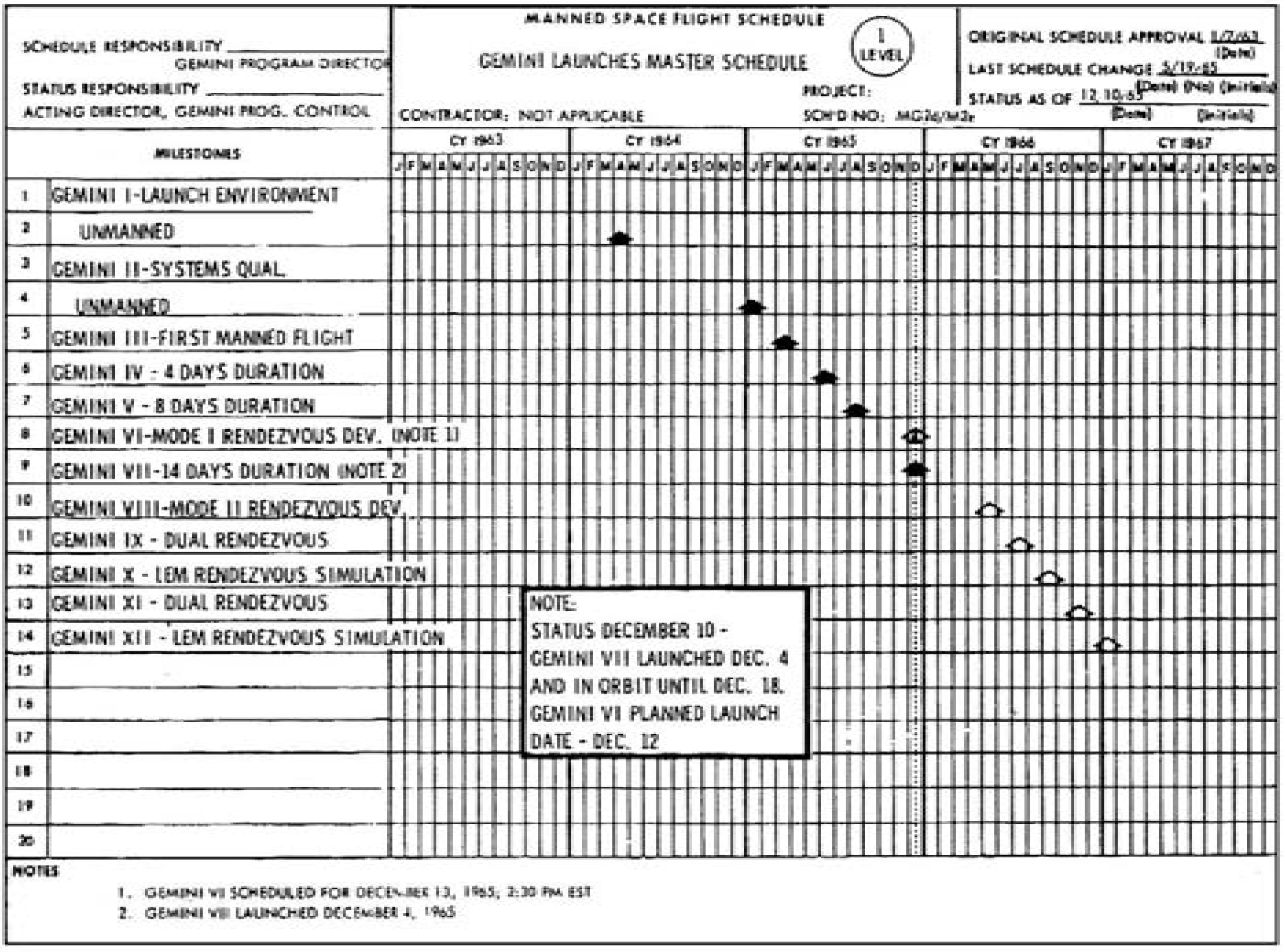
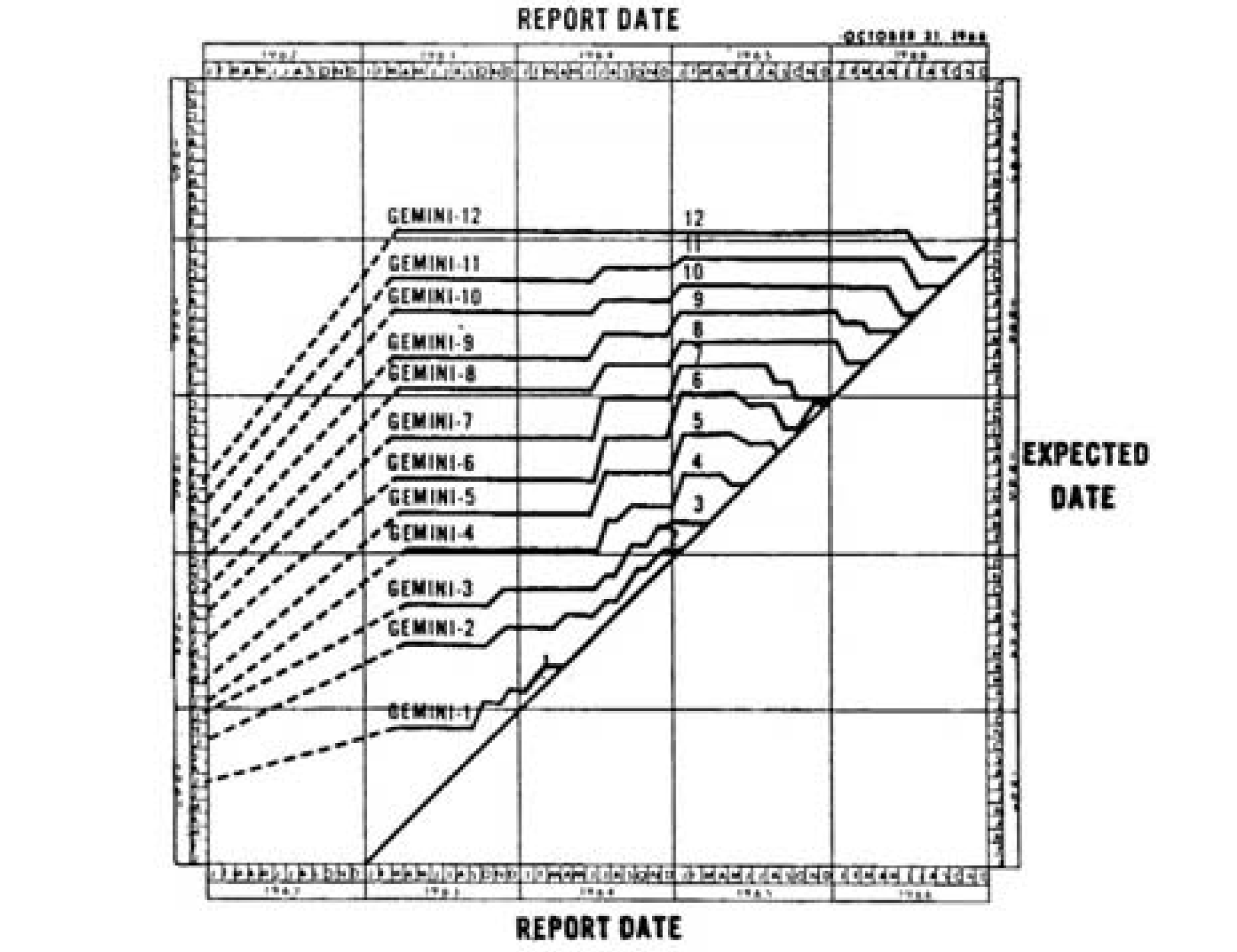
The trend chart for the complete Gemini Program of 12 launches dated 31 October 1966 is shown in figure 27. Originally, the program was to be completed by June of 1963. However, after negotiations with McDonnell Douglas were complete and the contract was definitized, the final launch was scheduled for early 1967. It is a tribute to George Mueller and the entire Gemini government-industry team that the 12 launches were completed ahead of schedule.
Project Approval
When DeMarquis “D.” Wyatt became the director of the Office of Programs at NASA, we agreed to use as simple a system as possible to release research, development, and facility funding.
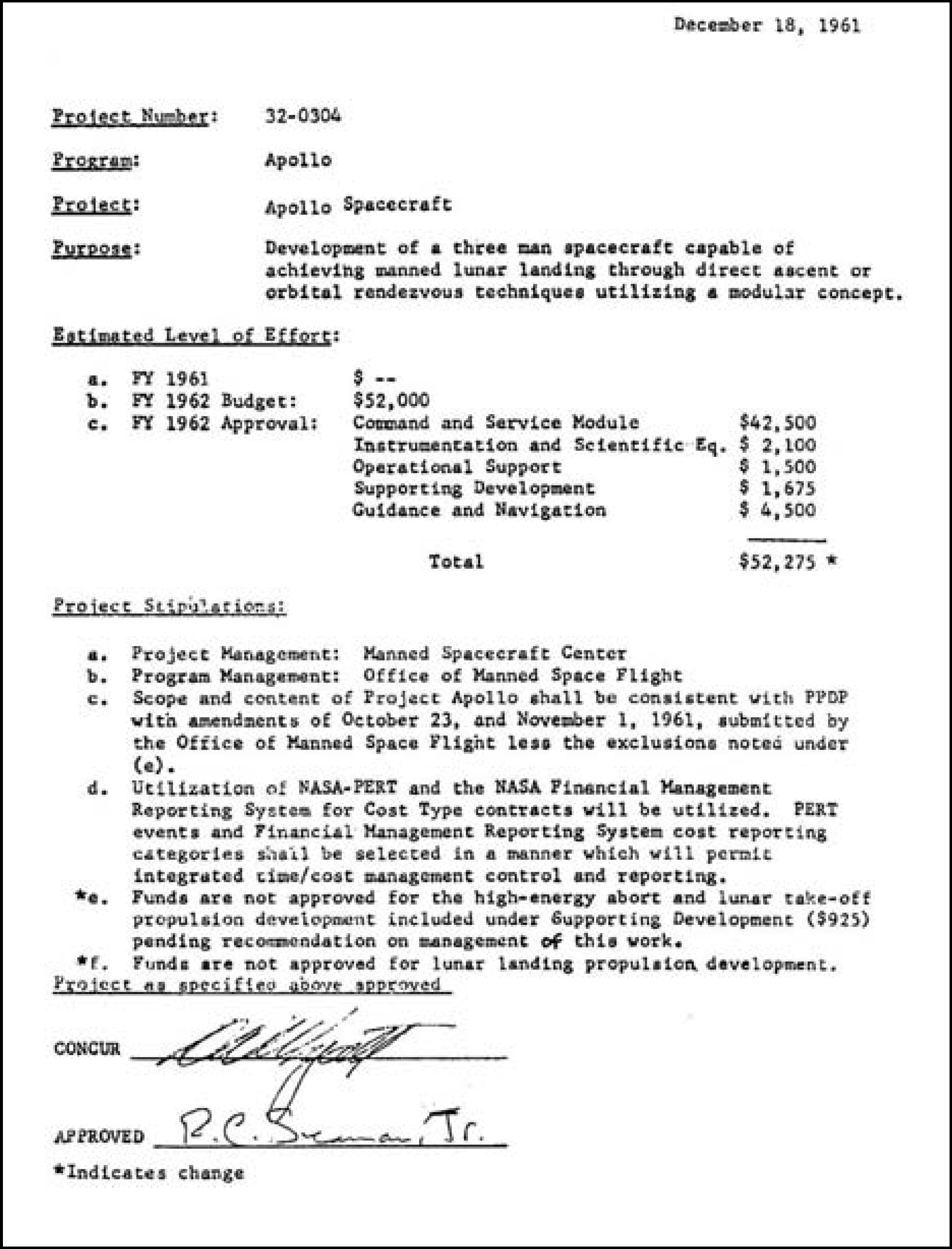
We attempted to keep each Project Approval Document (PAD) less than a page in length and to use the same format for each document, one of my pet idiosyncrasies. The PAD included the project number, program, project name, and purpose. It also included the “level of effort” (budgetary limits) in thousands of dollars. Finally, a project might have a variety of special stipulations. An example is shown in figure 28.
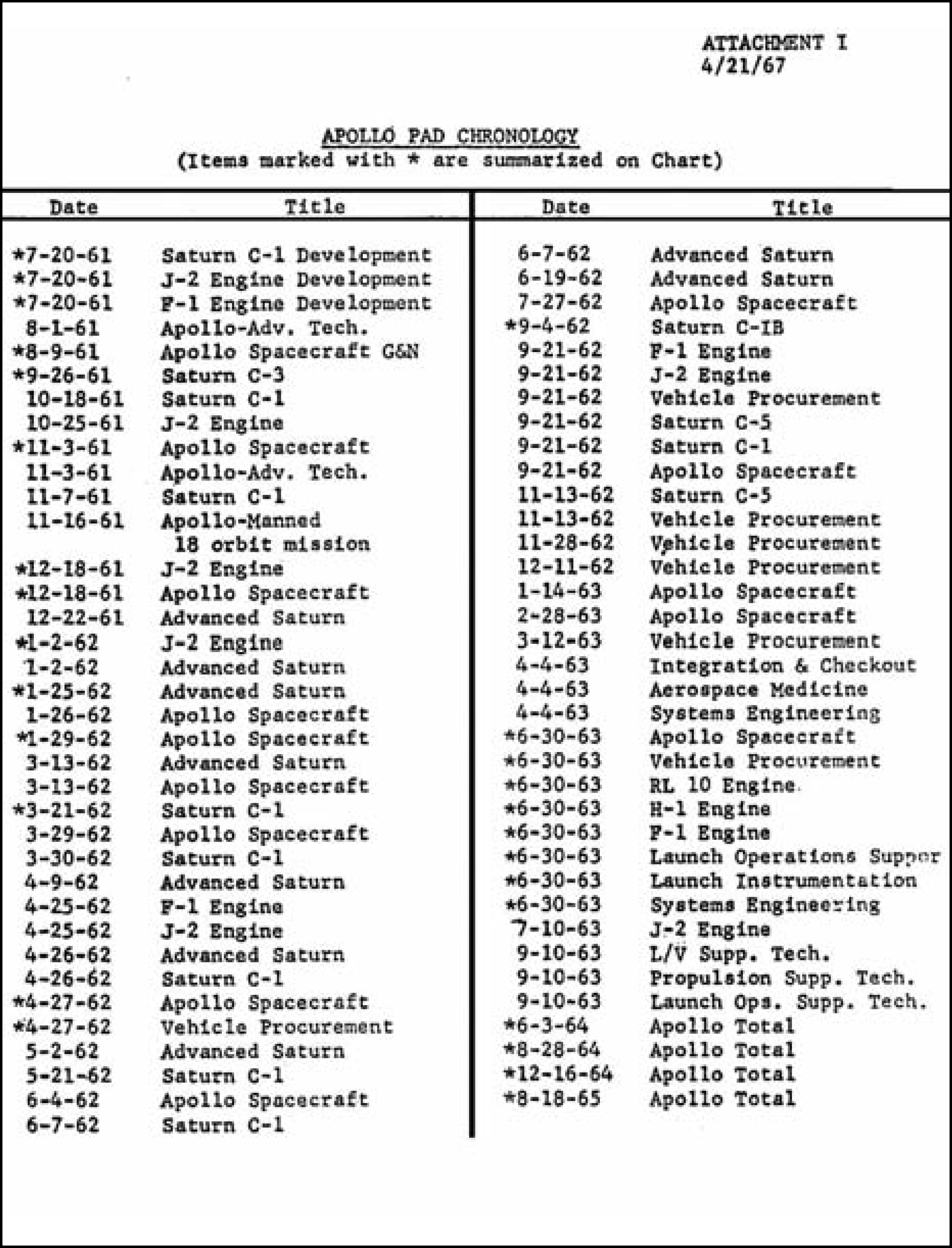
I don’t know how many hundreds of PADs D. Wyatt and I signed, but the 72 PADs related to Apollo are contained in figure 29. PADs were the basis for the monthly status reviews that I held with each of the program directors. These reviews included an updating of costs, schedules, and performance, with emphasis on areas where deficiencies existed. The approval documents and the agenda for their monthly review resulted from interaction between D. Wyatt’s office and the control group in each program office.
There were two regularly scheduled Headquarters sessions each month. I chaired the Project Status Reviews and Jim Webb the Program Review. I’m a strong believer in management oversight and correction on a monthly basis. On a quarterly time scale, details can be blurred between meetings, and it may become too late to head off impending disaster. I also believe that key line personnel must be present, as well as representation from the functional offices. When the meeting was on manned spaceflight issues, either George Mueller or the Gemini and Apollo directors, Chuck Mathews and Sam Phillips, were present. Prior to the meeting, I had a session with D. Wyatt and his program office to review the agenda and the critical areas that needed discussion. Soon after the meeting, the action items would be documented, signed by me, and sent to the appropriate managers.
The purpose of the Program Reviews was to bring Mr. Webb and NASA’s leadership up to date on NASA’s entire effort. The sessions consumed an entire Saturday and were repeated on Mondays for other government agencies. These meetings also provided Jim with an opportunity to educate NASA on his expectations, and he was voluble and not bashful. Sometimes I’d receive a call with the words, “I don’t know what he’s talking about.” I hope my response was helpful, but I would always add, “In the future, you better listen carefully.”
Apollo Management
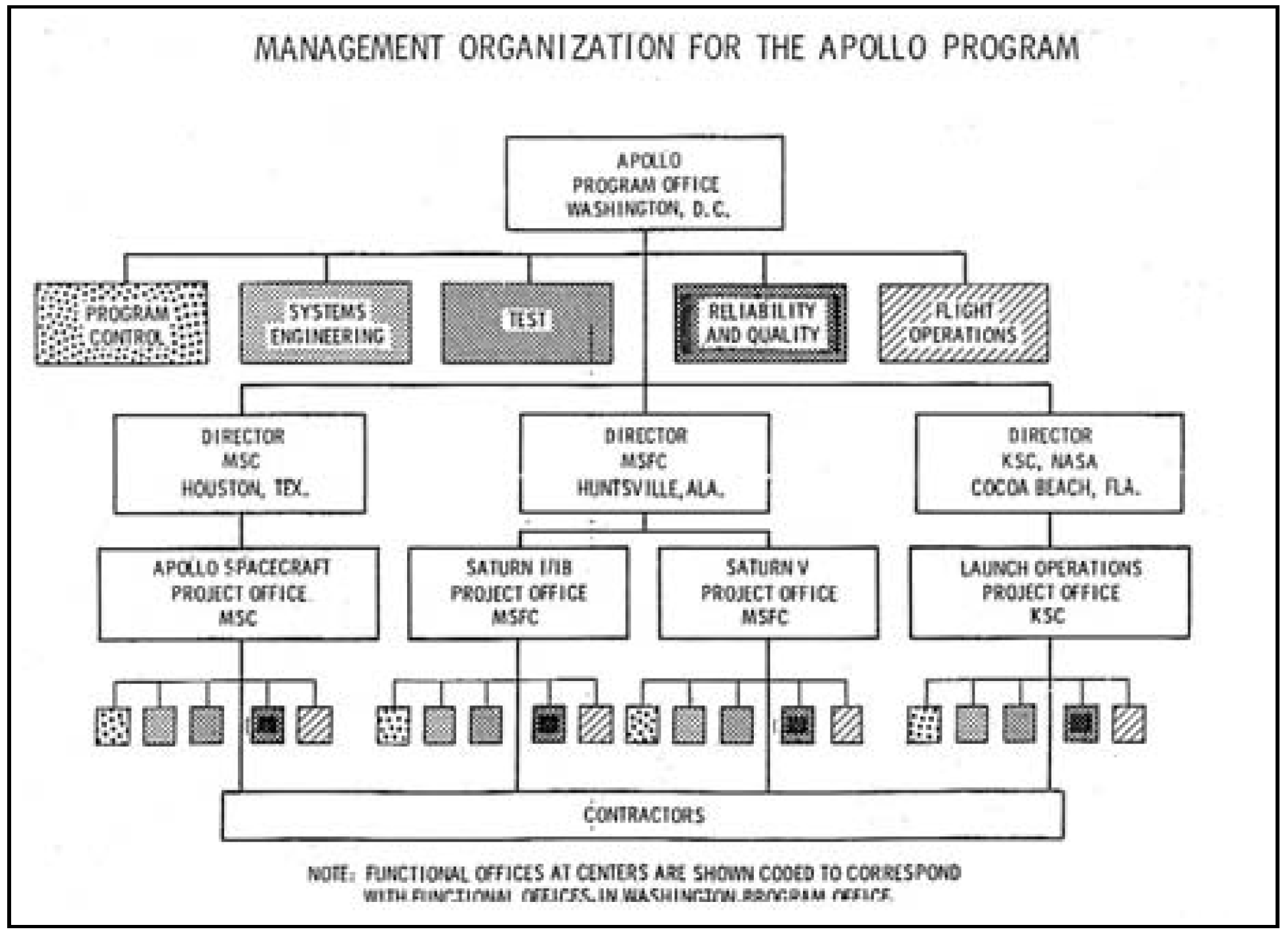
This section includes a discussion of the organizational evolution during the sixties. When George Mueller became the Associate Administrator of Manned Space Flight, the Apollo and Saturn project offices soon became two-hatted, as shown in figure 30.
Lieutenant General Samuel Phillips was assigned to NASA to serve as the director of the Apollo Program Office at the request of George Mueller, Associate Administrator for Manned Space Flight. The project directors (Apollo, Saturn I/IB, Saturn V, and Launch Operations) all reported to Sam Phillips on Apollo matters. Each had five functional offices for program control, systems engineering, test, reliability-quality, and flight operations. These functional offices communicated directly with each other, but decisions at each Center were made by the project directors. Meanwhile, it was the responsibility of the Center Directors (in Texas, Alabama, and Florida) to provide an appropriate institutional environment for the projects. Their duties included the allocation of personnel. Also, the Center Directors had Apollo Program input through George Mueller. When Sam Phillips reported to George periodically, the Center Directors were present, serving as members of his Apollo Board of Directors.
I never attended George’s Apollo reviews, just as Jim Webb never sat in on my Project Status Reviews. However, their timing and brutal detail were well known. All of his key players were hard-working, with extensive responsibilities, but George was indomitable. He didn’t believe in weekends. He often called for meetings on Sundays, and many times the material presented was nicknamed “pasteurized.” That is, the information was so extensive that late on a weekend, the participants’ ability to absorb was waning, and the charts were merely “past your eyes.” But not to George. Even at day’s end, he was direct and incisive.
It was a privilege for me to know the individual members of George’s council. They attended both Headquarters Project and Program Reviews, but in addition, I was often with them while traveling, exercising, or visiting in their homes. George lived next door and made excellent dry martinis. Joe Shea was an excellent tennis player, and we climbed many fences into locked tennis courts to play before sunrise. I nearly broke my hip skateboarding on George’s cement driveway. Bob Gilruth and I loved boats. He built his in a shed next to his house. Wernher loved the outdoors and his houseboat on the Tennessee River. His daughter went to the Cathedral School and joined us at mealtime on occasion. I often shared the podium with Kurt Debus at the Cape. Sam Phillips was quiet, conscientious, and persevering. I was fortunate to work with him, first at NASA and later when we both held critical responsibilities in the Air Force.
The five functions described previously—program control, systems engineering, testing, reliability and quality, and flight operations—permitted NASA to have centralized management at Headquarters for overall control of the Apollo Program. Sam Phillips was its arbiter, decision-maker, and spokesman. However, the information he received and the actions he disseminated were distributed among Headquarters and the Field Centers. In this way, key decision-makers at Headquarters availed themselves of the technical competence and knowledge at the Centers, and the project directors in the Centers were kept current on Headquarters activities. Aaron Cohen tells of an early assignment at the Johnson Space Center. Joe Shea, the Apollo project director, put him in charge of the Interface Control Documents (ICDs). Joe then escorted Aaron to Marshall Space Flight Center to meet Wernher von Braun. Joe advised Wernher of Aaron’s responsibilities and Wernher asked, “What are ICDs?” When informed, Wernher bought in, and Aaron estimates that he eventually negotiated over 1,000 such documents.
The management of Apollo was clearly disciplined and distributed. There was no large central authority issuing detailed instructions. Rather, there were interface documents that were continually updated to correspond with developments at the Centers. Final development cannot take place without the interfaces, and interfaces require knowledge of the developed hardware. Progress can only take place in an iterative fashion with strong Center participation.
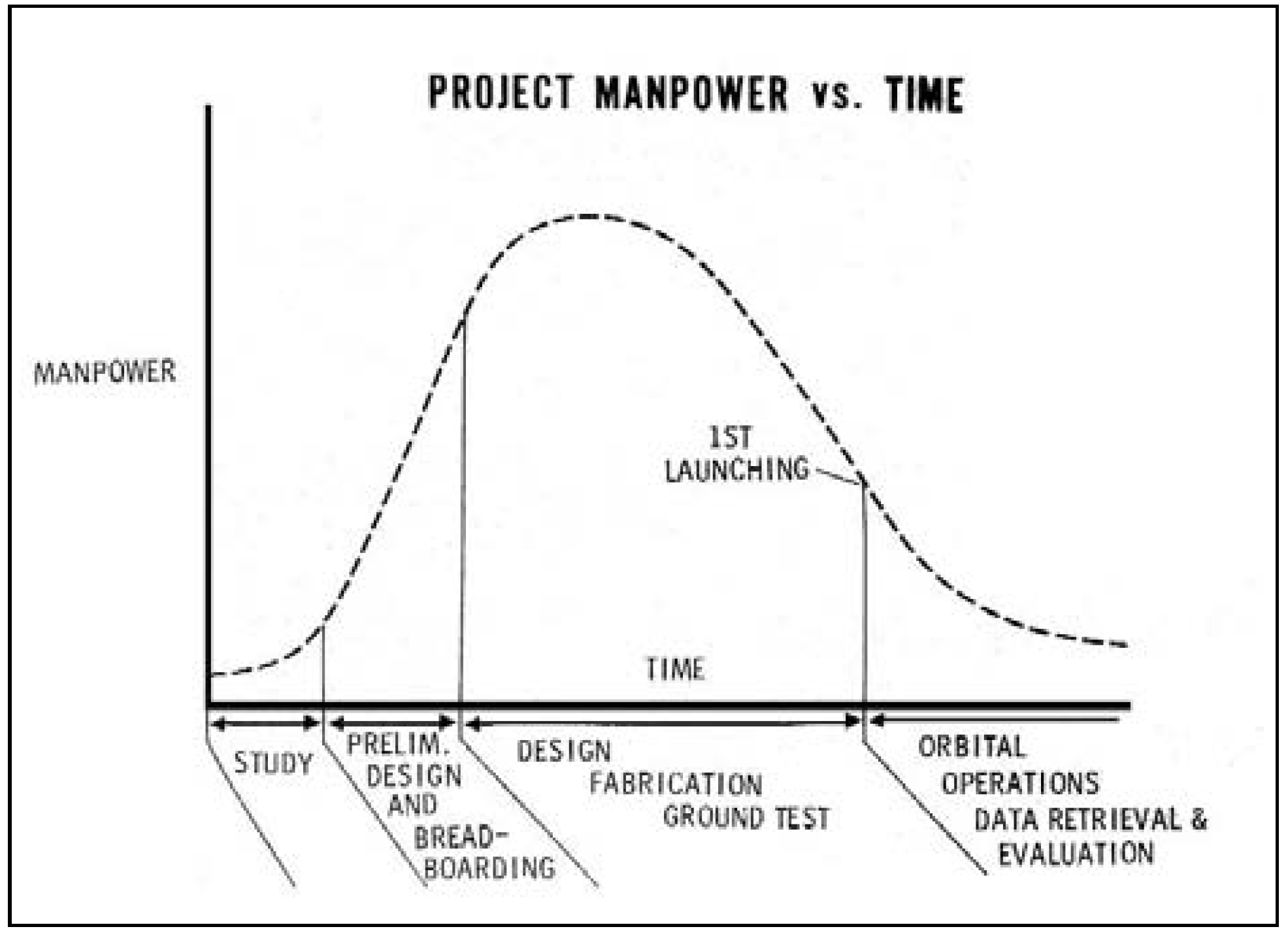
It’s also important to keep in mind the progress of Apollo in the large picture. Figure 31 is a stylized representation of the phasing experienced in such large projects. Prior to President Kennedy’s ringing endorsement, there was a series of discussions and studies internal and external to NASA. Once NASA
received its mandate for the manned lunar landing, it expanded its workforce, as did other government agencies. But the largest increase in manpower was contracted to industry. Apollo started with preliminary designs and the breadboarding of hardware. By the middle of the decade, designs were well along and the fabrication of hardware was rapidly advancing. Prototype hardware was needed for thorough testing of performance in high-stress environments. This ringing out of the hardware was coupled with the extensive planning that was required for operational testing, first on the ground and ultimately in space. Of course, Apollo had several flight missions prior to the lunar landing. The first vehicle test was followed by manned flights in Earth orbit and around the Moon before the Apollo Program achieved the ultimate goal of lunar landing. By the time the goal was reached, the total manpower on Apollo was greatly reduced, but funds were still required for wrapping up the program.
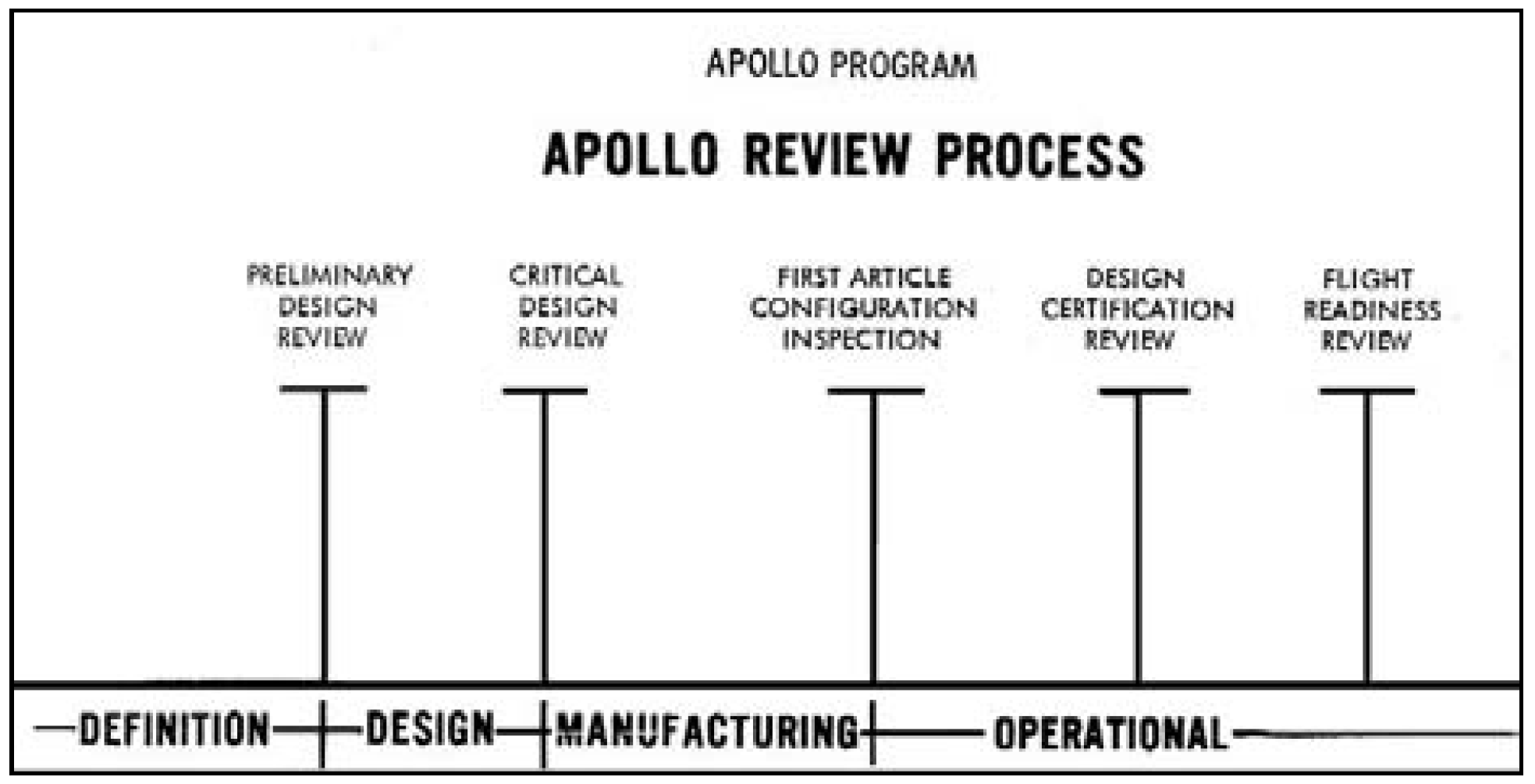
Each major Apollo project passed through a review and approval process (see figures 31 and 32), making its way progressively through definition, design, manufacture, and flight operations. The key reviews were design certification and flight-readiness. During the former, results of all major tests were described and discussed. Such tests included static-engine and stage firing, vacuum testing on spacecraft, and electrical tests of checkout equipment. The flight-readiness reviews were all-encompassing and included presentation of the results of operational tests of the ground, ship, and airborne network, along with Launch Control, Mission Control, and the flight hardware. If a few items were outstanding, they would have to be cleared before the time of the launch. Sam Phillips was the chairman of the committees overseeing all key project reviews and approvals.
Saturn I was developed in the then-normal fashion, with four flight tests of the first stage before testing of the second stage. When George Mueller became the Associate Administrator for Manned Space Flight, he introduced NASA to “all-up” system testing. When the Apollo/Saturn V was launched for the first time in December 1967, all three launch vehicle stages were operational, as were the spacecraft and service module. All worked satisfactorily. Such success could not have been achieved without the extensive testing that culminated in a completed flight-readiness review.
Soon after the first Saturn V launch, I retired from my official capacity, and I was sworn in as a NASA consultant on 5 January 1968, the day following my retirement. From then on, I used the consultant’s offices and only participated in management decisions on the few occasions when I was asked. I did review with Sam Phillips the design changes being made to the Apollo capsule to improve fire protection. I also spent time with Gene Emme, the NASA historian, on my exit interview. Finally, I participated in the UN conference on “Peaceful Uses of Space.” Jim Webb was also there and told me of the plan to circumnavigate the Moon on the first manned Saturn V mission.