Chapter 6: The Grand Finale
At the start of 1968, NASA was rapidly converging on its goal of a manned lunar landing within the decade. Actually, success was only 19 months away—from January 1968 to July 1969. Prior to the landing, there would be two unmanned spaceflights and four manned flights.
Monday, 22 January 1968, Apollo 5, Unmanned
Apollo 5 was launched on 22 January 1968 with the primary objective of testing the lunar descent propulsion; the ascent propulsion, including restarting capability; the spacecraft structure; the instrumentation and control; and the second stage of the Saturn IB. After separation from the Saturn booster, the Lunar Module was in an elliptical orbit and proceeded with a test of the descent stage. The planned 39-second burn only lasted 4 seconds due to a computer program glitch. The ground controller shifted to an alternate plan and tested the descent stage first with a 26-second burn at 10-percent thrust and, finally, a 7-second blast at maximum thrust. Later, each stage was put through its paces, ending with an ascent-stage firing of over 6 minutes.
The descent engine was throttleable, like that of an automobile—the only rocket motor with this capability, which was necessary for a soft-landing on the lunar surface. Ignition of the ascent engine was essential to recovery; there was no redundancy. For this reason, hypergolic fuel was utilized—ignition occurred without the need for a separate firing source. In an abort, this stage had to ignite and fire even while the descent stage was still providing thrust. During the test, the so-called “fire in the hole” was successful. The flight was judged satisfactory, and the Lunar Lander was declared ready for manned flight.1
Thursday, 4 April 1968, Apollo 6, Unmanned
The second and final unmanned launch of Apollo occurred on 4 April 1968. The Apollo 6 was the second launch of the Saturn V. The first stage functioned as planned, but two of the second-stage J-2 engines shut down prematurely. To compensate, the remaining three engines automatically burned longer, as did the single J-2 engine in the third stage. The compensation was nearly perfect; however, it left the Apollo in a somewhat elliptical rather than circular orbit.
The third stage failed to reignite, so the Apollo capsule and service modules separated from the staging; then, by firing the service module, an altitude of nearly 14,000 miles was achieved at apogee. From there, a reentry speed of 22,400 mph was achieved, rather than the planned 25,000 mph. Although only four of the five flight objectives were achieved, the flight demonstrated a remarkable redundancy when two of the five J-2 engines flamed out, both on the same side of the rocket. If the engines had been on opposite sides, there wouldn’t have been the imbalance that tended to topple the structure. When all the data were analyzed, the tests, coupled with the 100-percent success of the previous flights, were judged complete and the Apollo and Saturn V were judged ready for manned flight.2
In mid-August of 1968, I attended a U.N. conference on “Exploration and Peaceful Uses of Outer Space.” The conference took place in Vienna, amidst the best coffee houses and chocolate in the world. I presented a paper at a panel on management issues related to manned space exploration. I was also chairman of the full-fledged assembly where each of the 74 nations participating could have five representatives present. The night before this session, the Soviet Army entered Czechoslovakia. The staff secretary for the morning meeting was a Soviet colonel, and a Czech professor was presenting a paper. I received a message from U Thant, Secretary of the U.N., to close the session if any political shenanigans occurred. Specifically, I was to say “meeting adjourned” and slam down the gavel.
Jim Webb was also at the meeting and was concerned about the recently announced “Intersputnik” that would be established by the Soviets and other Socialist countries to compete with Intelsat, the western satellite communication network with over 100 member nations. However, he invited me to his room at the Intercontinental Hotel to tell me of his recent telephone calls from Tom Paine, NASA’s Deputy Administrator at that time. Tom proposed a circumlunar flight for the next Apollo mission. He advised Jim that there were indications of an early Soviet manned mission to the Moon, and the Lunar Module was not ready for a 1968 mission as previously planned. However, all the necessary elements were ready for manned circumlunar flight. When asked for my views, I first thought of the caveat that I wasn’t up to date on NASA readiness. Then I said that at first blush, such a mission in 1968 seemed at the edge of the envelope. But I ended my comments with a reminder of my thoughts on EVA prior to the Gemini 4 mission. NASA should go when ready and also should attempt to accomplish as much as possible on each mission.
Friday, 11 October 1968; Apollo 7; Wally Schirra, Don Eisele, and Walter Cunningham
The first manned flight of Apollo occurred in October 1968 between the 11th and the 22nd. Wally Schirra was the commander, with Don Eisele and Walter Cunningham completing the three-man crew. The Apollo 7 spacecraft weighed 36,500 pounds and was carefully redesigned for safety. The two-piece hatch was replaced with a single one that was quick-opening. Also, there were extensive material substitutions to reduce flammability. All flight objectives were achieved. The service module engine was fired eight times, including the de-orbit burn. Although the crew was kept busy with time-consuming maintenance in addition to their regular duties, there was still time for photographs of Hurricane Gladys over the Gulf of Mexico and a long plume of air pollution over the United States.
There were also five live TV broadcasts with both outside photography and in-capsule gymnastics and commentary. In one, the astronauts displayed a sign bearing greetings from “the lovely Apollo room high above everything.” The astronauts won honorary membership in the American Federation of Television and Radio Artists. The astronauts were recovered by the USS Essex after circling Earth 163 times.3
Saturday, 26 October 1968, Soyuz 3
The Soviets launched Soyuz 3 from Baikonur Cosmodrome with a “powerful rocket booster” on 26 October, four days after the landing of Apollo 7. The Soviets conducted a variety of scientific, technical, and biological experiments; transmitted TV pictures; and conducted a rendezvous with Soyuz 2. Clearly, the Soviets had recovered from Komarov’s fatal accident and were proceeding aggressively with their manned space effort.4
Saturday, 21 December 1968; Apollo 8; Frank Borman, Jim Lovell, and Bill Anders
Sometime in early December, I received an invitation to fly in a visitors’ plane from Washington, DC, to the Cape, for the launch of Apollo 8, with Frank Borman, Jim Lovell, and Bill Anders aboard.
On 19 December, two days before Apollo 8’s liftoff, I received a call from Mel Laird. President-elect Nixon had introduced his cabinet nominees, including Mel Laird as Secretary of Defense, at the Pierre Hotel in New York. From that TV program, I recognized his name, but I was surprised when he asked me for lunch the following day at the Carleton Hotel in Washington. Could I join him at noon? The answer was yes, provided that I could get to National Airport by 4:00 p.m. I was met on arrival by Bill Baroody, Mel’s assistant, who introduced me to a gigantic organizational chart of the Department of Defense. Mel arrived quite late, explaining that he had been meeting at the Pentagon with Clark Clifford, who would soon be giving Mel the key to the establishment. After much discussion and a good lunch, Mel asked me to join his team as Secretary of the Air Force. I was aghast. It wasn’t possible. Gene was in the hospital; we had just bought a new house in Cambridge, etc. However, I agreed not to say no until the following week. I headed for the airport. To my surprise and subsequent pleasure, I was seated next to Jack Benny. We had a great conversation, which centered on the space program, as well as his concern for the health of Bob Hope. Actually, Bob Hope outlasted Jack Benny by several decades.
The next morning, 21 December, Apollo 8 lifted off from Cape Canaveral. The viewing stand was over a mile from the pad. Hence, the sound from Apollo took time to reach those sitting there holding their breath. First, however, a voice blared, “Ignition,” followed, seconds later, by “Liftoff.” Just as the sound of the five engines was surrounding us, Apollo was clearing its umbilical tower, as in previous Saturn V launchings. It’s hard to describe the sound. It was overwhelming—it wasn’t just heard; it was felt overall, from the low-frequency rumbles to the high-pitched crackling. This monster passed safely through maximum g’s, where the dynamic air pressure was greatest, to first-stage shutdown and second-stage ignition, amidst much cheering. And then we watched intently until the Apollo 8 spacecraft disappeared from our view.
Nearly 3 hours after liftoff, the third-stage engine was fired, sending Apollo 8 on its translunar passage. Earth’s gravity would slow Apollo on its lunar trajectory until lunar gravity exceeded Earth’s pull; then, Apollo would accelerate as the Moon appeared to increase in size and resolution of detail. Only small corrections in speed were required en route: first, an increased speed of 24 feet per second (fps); then, a reduction of 2 fps to make the Moon’s closest approach an altitude of 60 miles.
On Christmas Eve, the service module was burned for 4 minutes and 2 seconds, giving Apollo an apolune of 194 miles and perilune of 69 miles. The orbit was later circularized at 70 miles. Back home, with Gene hospitalized, our children were preparing for Santa’s arrival both at home and near Gene’s hospital bed. There was time, however, to listen to the crew read from the first chapter of Genesis and then wish all of us “Good night, good luck, a merry Christmas, and God bless all of you—all of you on the good Earth.”
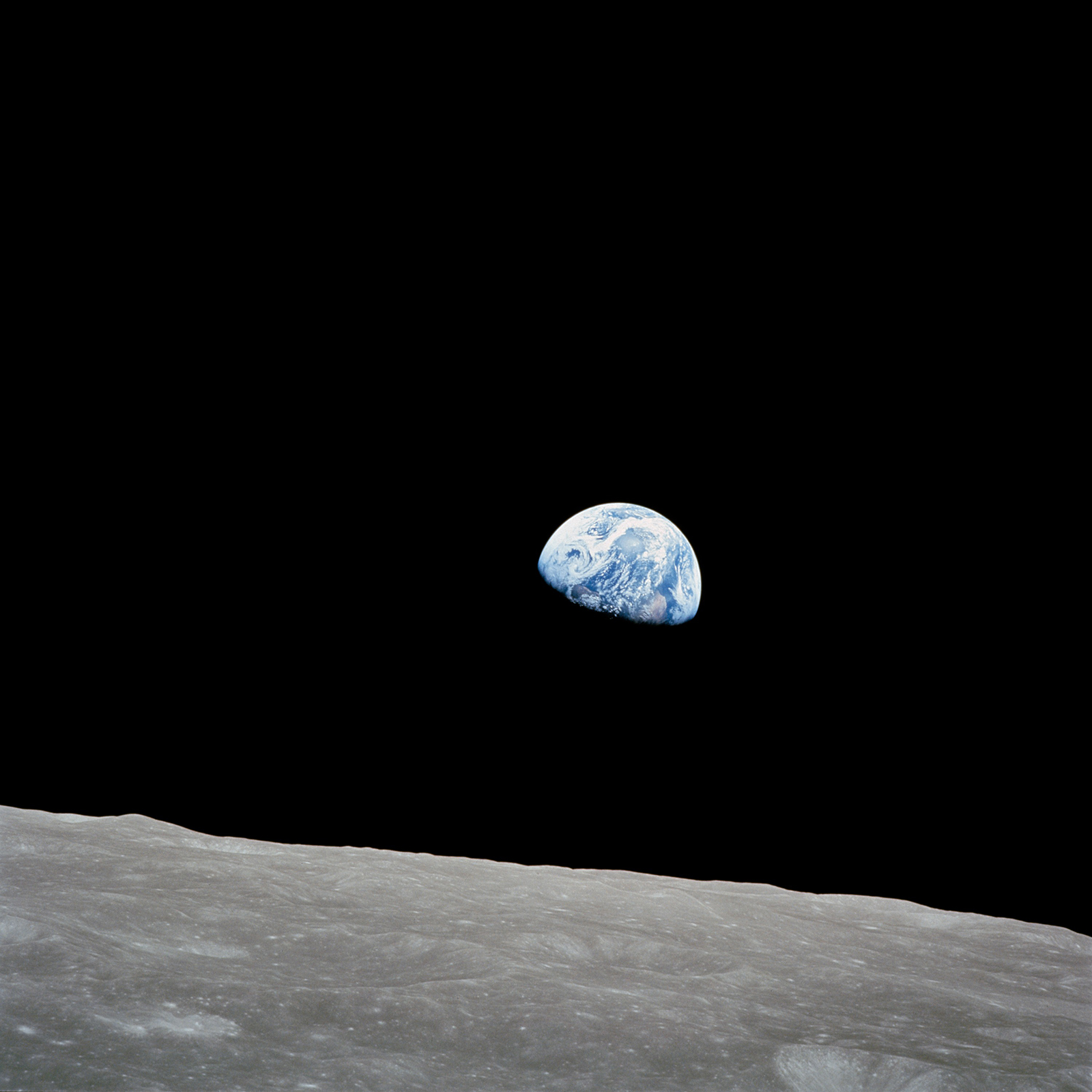
There were five TV transmissions from Apollo 8: some of Earth at 139,000 miles, some from 201,000 miles while en route to the Moon, and then some of the lunar surface “like dirty beach sand” of prospective landing sites, as well as of mountainous areas. But the most spectacular image appeared as Apollo 8 came from behind the Moon and the astronauts saw the blue Earth appearing to rise above the lunar horizon. Each astronaut grabbed for a Hasablat camera and one of them took the photograph (see figure 33) we have all seen many times. The beautiful but small spaceship, Earth, is there in its entirety, in sharp contrast to the desolate, dead lunar surface. This photograph is a graphic reminder, for all to admire, of the treasure we inhabit. If Apollo 8 inspires us to conserve our planet, it is worth many times the cost of man’s lunar travels.5
Tuesday, 14 January 1969, Soyuz 4/Wednesday, 15 January 1969, Soyuz 5
In mid-January, we had another sharp reminder that the Soviets were not just treading water. Soyuz 4 was launched on 14 January 1969 and Soyuz 5 on 15 January. After the cosmonauts conducted a variety of experiments, they performed a rendezvous and then manually docked, but with no hatch between them. Two cosmonauts in Soyuz 5 put on their “special” spacesuits with a new “regenerative life-support system,” left their spacecraft, and joined the cosmonaut in Soyuz 4. The Soviets demonstrated, in their words, “the world’s first experimental cosmic station.” Regardless of the hype, they had demonstrated the first transfer between spacecraft; they clearly weren’t backing away from space exploration and, most probably, a manned lunar mission.6
Monday, 3 March 1969; Apollo 9; Jim McDivitt, Dave Scott, and Rusty Schweickart
On 3 March 1969, Jim McDivitt, Dave Scott, and Rusty Schweickart went through a series of complex maneuvers with Apollo 9. It was the first test of the Lunar Module with astronauts in space. The astronauts first flew in the Command Module for several days, performing housekeeping and separating from the third stage to redock cheek to jowl with the Lunar Module. On the third day, Jim and Rusty entered the Lunar Module using the on-board hatches. They conducted the first test of the lunar descent stage and returned to the Command Module. Rusty then spent 37 minutes outside the capsule using selected hand- and footholds to reach the Lunar Module and return.
On the fifth day, Rusty and Jim reentered the Lunar Module. They separated from the Command Module, which backed 3 miles away from the Lunar Module using the control-system thrusters. The Lunar Module then went through a simulated Moon landing, using the ascent rocket to separate from the Command Module by over 100 miles. After 6.5 hours of “time on the Moon,” the ascent stage fired its engines, separating from the descent stage, and returned the astronauts to the Command Module for docking and return to Earth. Apollo 9 landed within sight of the USS Guadalcanal for pickup by helicopter. The first test of a manned Lunar Module was most successful, achieving all major objectives. NASA was now ready for lunar landing operations. President Nixon congratulated the crew and said that the mission showed “what man can do when they bring to any task the best of man’s mind and heart.”7
While Apollo 9 was under way, I received a telephone call from Mel Laird. By then, I was the Secretary of the Air Force. He told me the President had two candidates for the next Administrator of NASA, and one of them, a Democrat, was Tom Paine. He asked for my recommendation. I quickly answered that if the President wished to ensure a safe landing on the Moon within the decade, he’d nominate Tom as the Administrator. Tom’s nomination was announced the following day (5 March). Jim Webb’s strategy for ensuring NASA’s continuity had prevailed. Jim was so political that he couldn’t have survived in the Nixon administration for many days. By resigning in the Johnson administration, he cleared the way for Tom Paine.
Sunday, 18 May 1969; Apollo 10; Tom Stafford, John Young, and Gene Cernan
The Apollo 10 spacecraft lifted off Pad B of Complex 29 on 18 May 1969. Tom Stafford was the commander, John Young the Command Module pilot, and Gene Cernan the Lunar Module pilot. The flight went by the book, with minimal corrections required during the translunar voyage. The crew provided 72 minutes of color TV footage of Earth as it receded behind them. The first lunar orbit had an apolune of 196 miles and a perilune of 69 miles. When nearly circularized, the orbit was close to 69 miles above the lunar surface. During translunar flight to and from the Moon, as well as orbital maneuvers around the Moon and the descent and ascent to the lunar surface, the astronauts were almost completely dependent on the guidance system developed by Dr. Draper’s Instrumentation Laboratory at MIT. Velocity adjustments of a few miles per hour (mph) in the correct direction when traveling up to 25,000 mph were essential and truly remarkable.
The next phase of the Apollo 10 mission called for Tom Stafford and Gene Cernan to separate the Lunar Module, Snoopy, from the Command Module, Charlie Brown, using the control-system thrusters. The descent engines then lowered the speed so that the lander’s altitude was reduced to nearly 9 miles, its lowest point in orbit. The crew had no difficulty identifying landmarks. As Stafford said, “It looks as though all you have to do is put your test wheel down and we’re there. The craters look flat and smooth on the bottom. It should be real easy.” After separation from the descent stage, the ascent stage went into a violent oscillation, which provoked some unprintable expletives. But Tom took over manual control and achieved the proper attitude. Rendezvous and docking were achieved without incident. On the return leg, there was more live color TV footage of both Earth and the Moon. On the eighth day, Charlie Brown landed, precisely on schedule, 3 to 4 miles from the recovery ship, USS Princeton. On NBC’s Meet the Press, Tom Paine said that if the July lunar landing succeeded, there would be enough hardware for nine additional flights (this was later reduced to seven). He went on to say that it would take those flights and many more before men really began to understand Earth’s twin planet.8
Wednesday, 16 July, 1969; Apollo 11; Neil Armstrong, Buzz Aldrin, and Mike Collins
Apollo 11 was scheduled for liftoff from Cape Canaveral’s Launch Complex 39, Pad A, at 9:32 a.m. EDT. Gene, our son Joe, and I arrived at the Cape the afternoon before. Flying with us to and from the Cape was Alexander de Seversky, the noted aircraft designer. The Jetstar arrived in time for us to have dinner in Cocoa Beach with Jim Webb and President Johnson. The dinner was most cordial, with toasts for Jim Webb’s leadership and President Johnson’s unflagging support. The next day, liftoff occurred on schedule, and the flight proceeded in a sequence nearly identical to that of Apollo 10. On the quarter-million-mile journey to the Moon, there were four TV broadcasts, with the longest lasting 96 minutes. The transmission was of excellent color, resolution, and general quality. The live pictures showed the interiors of the Command Module, Columbia, and the Lunar Lander, Eagle. Viewers could observe Earth, the Moon, and the opening of the hatch between the spacecraft modules, as well as house-keeping and food preparation. The lunar orbit was circularized at 75.6 miles of altitude.
I had returned to Washington, DC, after the launch and then returned to Mission Control in Houston for the landing. The Eagle was separated from Columbia over the far side of the Moon and descended to 9.9 miles from the surface, at which point powered descent commenced. The location was 4.6 miles downrange of the planned location, so the landing point was significantly shifted. The feeling was tense in the control and also behind the glass where the handful of guests were located. It was soon noted that the Eagle was headed for the center of a crater containing boulders measuring 5 to 10 feet in length. Consequently, Neil raced beyond the crater by hand-controlling attitude and making throttle adjustments with the engine. Neil could extend the flight by 60 seconds before fuel shortage would require an abort. The clock was closing on zero when dust and shadows appeared in the foreground and suddenly Neil announced, “Houston, Tranquility Base here—the Eagle has landed.”
Mission Control replied, “Roger, Tranquility. We copy you on the ground; you got a bunch of guys about to turn blue. We’re breathing again, thanks a lot.” The time was 4:18 p.m. EDT, 20 July.
Two hours after landing, the crew requested a walk on the Moon right away rather than 4.5 hours later, as originally planned. Doc Draper, Jackie Cochran (the famous aviatrix), and I went out for a quick bite, returning just after the postlanding checks. Shortly thereafter, Neil opened the hatch and descended Eagle’s ladder. As at least one-fifth of the world watched, he reached the lunar surface while saying, “One small step for a man, one giant leap for mankind.”
Back in May 1961, Bill Fleming’s committee had this to say about what should happen when a person first stood on the Moon: “Very little study has gone into precisely what operations would take place on the Moon or how they would be executed.” In the interim, an extensive list of experiments was assembled. Neil first checked the surface and found that his foot’s indentation was only a fraction of an inch. The Lunar Lander only penetrated 3 to 4 inches, the descent engine had not formed a crater, and the engine bell was about 1 foot above the surface. Our Moon is a solid structure.
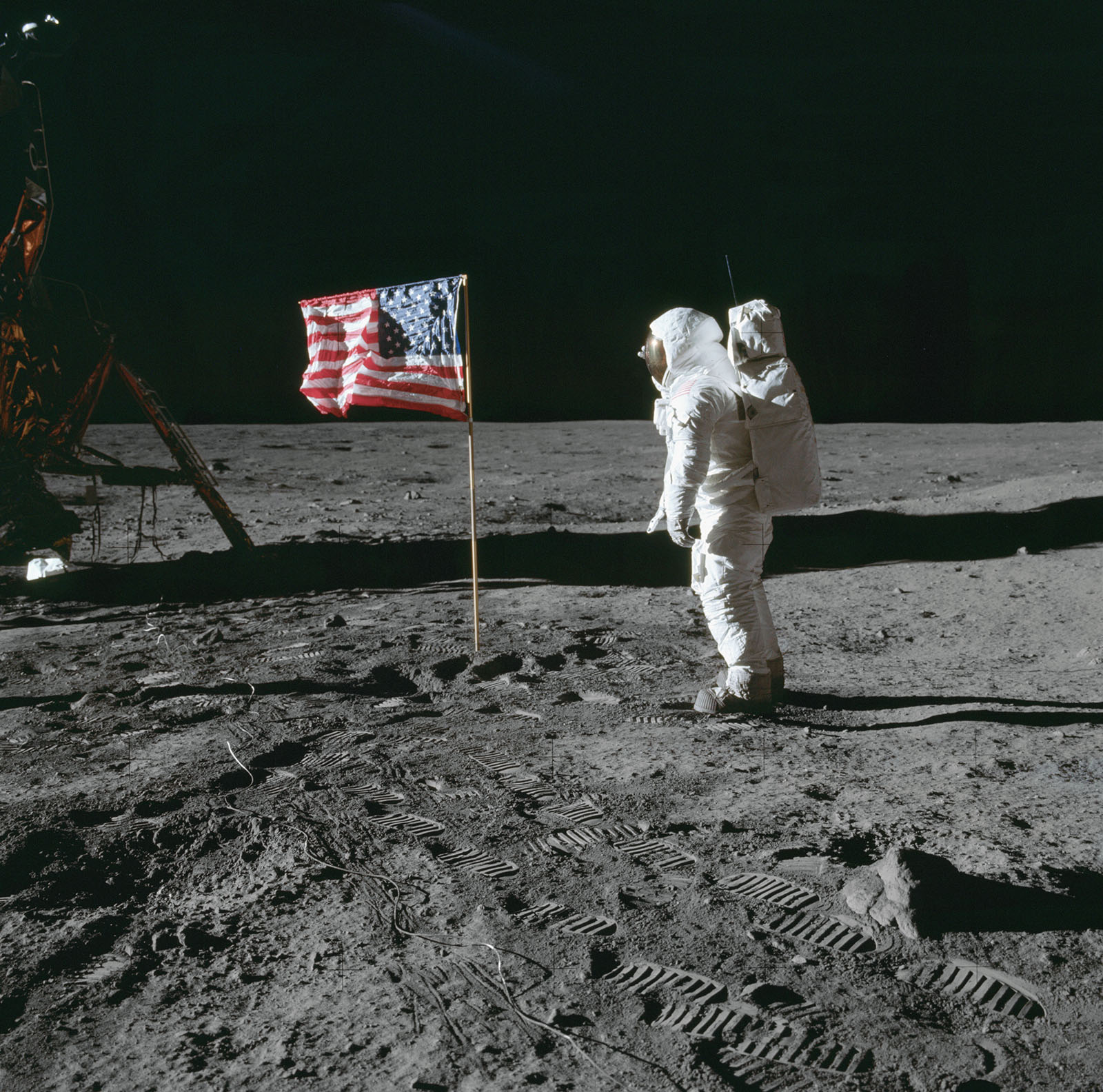
Neil next filmed Buzz’s descent onto the Moon, and the two together unveiled a plaque while reading its inscription: “Here men from planet Earth first set foot on the Moon July 1969 A.D. We came in peace for all mankind.” Neil placed a camera a distance from the lander to photograph liftoff while Buzz experimented with movement in the low gravity—walking, running, leaping, and making two-footed kangaroo hops. He said that his agility was better than expected. Next, he deployed a solar-wind composition experiment and, with Neil, planted a pole with a 3-by-5-foot American flag (see figure 34). After saluting the flag, they phoned President Nixon. The President said, “As you talk to us from the Sea of Tranquility, it inspires us to redouble our efforts to bring peace and tranquility to Earth.” The astronauts saluted the President and said it was an honor to represent the United States and the world.
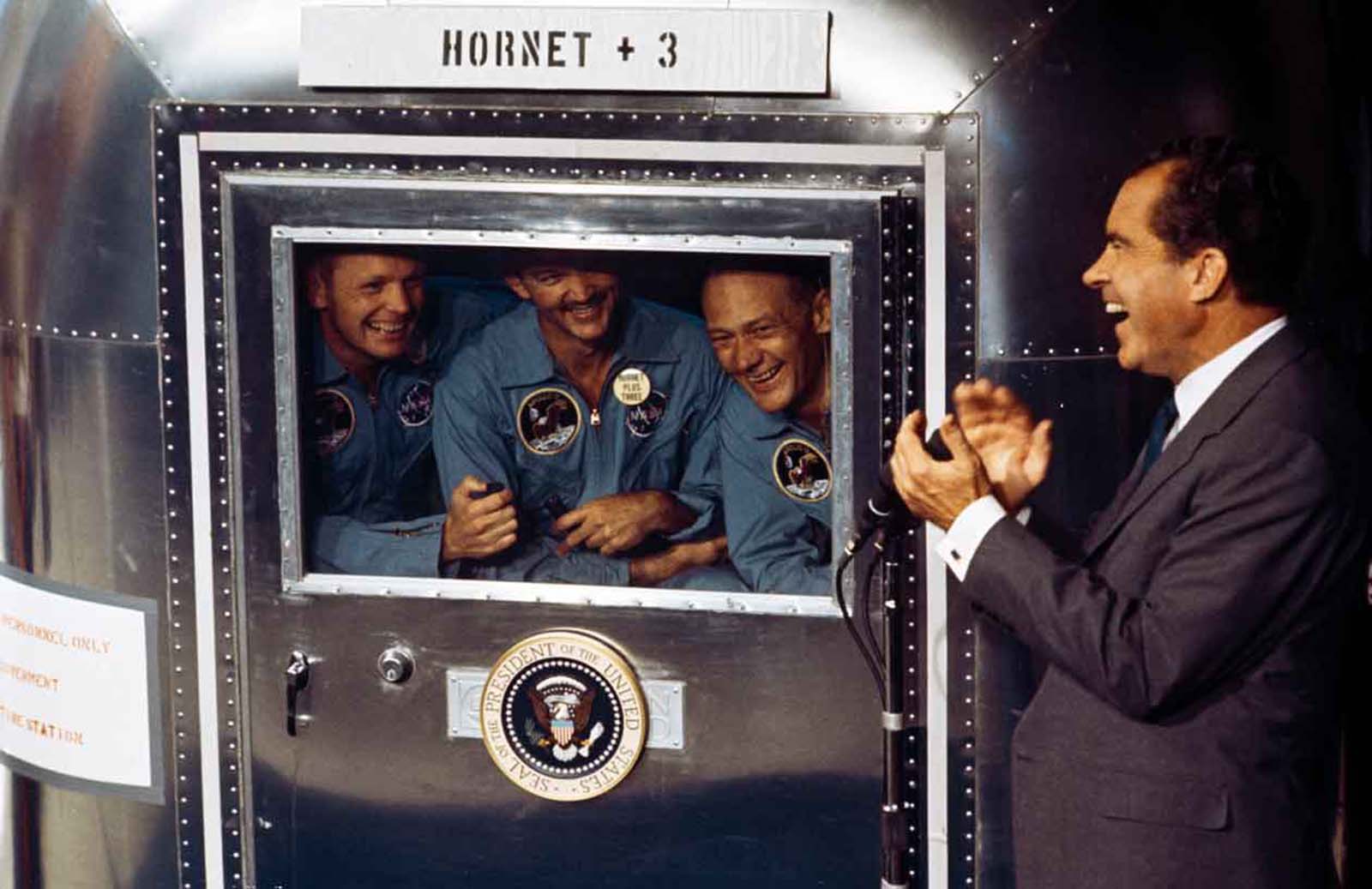
Bulk samples of the lunar surface were then collected, and seismic equipment and a laser reflector were deployed. The astronauts then took two bore samples and picked up 20 pounds of “discretely selected material.” After further photography, the EVA was completed; the astronauts returned to the lander, closed the hatch, and enjoyed 7 hours of rest. Apollo 11 returned to Earth by the same route as Apollo 10. Landing occurred in the Pacific, 15 miles from the USS Hornet, with the President and Tom Paine heading the welcoming committee (see figure 35). However, handshakes were not possible. There was concern that lunar pathogens might infect Earth and that Earth microorganisms might contaminate the lunar samples. So two-way biological barriers were created, one to protect the lunar samples and the other to protect life here on Earth. The lunar rocks then were flown immediately to the Lunar Receiving Laboratory in Houston. The three astronauts could talk and wave to the President from their “mobile quarantine facility,” but there were no pats on the back.9
An estimated one million people viewed the Apollo liftoff from the Florida coast, including over 3,000 accredited press and TV commentators, and their interest held through the lunar landing and return. Congratulatory messages were printed in newspapers around the world. Tom Wicker of the New York Times wrote about the Apollo 11 launch in a laudatory article on 17 July 1969:
One could hardly watch the magnificent spectacle of the liftoff, let alone contemplate the feats of human ingenuity that made it possible, as well as the courage and skill of the flyers, without some reflection upon the meaning of the event. The temptation is strong to fall back upon lyricism. The poetry of the thing has yet to find its expression in any of the earnest, proficient, Americans who have ventured away from the Earth; yet, the stunning beauty of man’s most marvelous creation, as it rose in its majesty toward the unknown, toward the future, could be matched only by the profound sense of having been present at an end to something and therefore necessarily at a beginning.10
Dignitaries such as Soviet Premier Kosygin and Great Britain’s Queen Elizabeth sent their warmest congratulations to the President. It was a giant, worldwide love-fest with only a few discordant voices. Historian Arnold Toynbee issued his views: “If we are going to go on behaving on Earth as we have behaved here so far, then a landing on the moon will have to be written off as one more shocking misuse of mankind’s slender surplus product.”11 Many overseas intellectuals concurred with Toynbee. Regret was expressed in Swedish newspapers that America’s feats of discovery were not matched by efforts toward the tremendous task of eliminating starvation on Earth
The lunar program was initiated by President Kennedy with no such lofty ideas and goals in mind. The United States had landed man on the Moon, and at the very same time, the unmanned Soviet Luna 15 had apparently landed in the Sea of Crises and was no longer transmitting. Presumably it had crash-landed. In 1961, in a special address before Congress, President Kennedy spoke these words: “Now it is time to take longer strides—time for a great new American enterprise—time for this nation to take a clearly leading role in space achievement.”12 There was no question in the eyes of the world. This goal was achieved in July 1969.
What happened to the ongoing manned space efforts in both the USSR and the United States is summarized in the next and final chapter.
Notes
- Astronautics and Aeronautics, 1968: Chronology of Science, Technology, and Policy (Washington, DC: NASA SP-4010, 1969), p. 13.
- Ibid., p. 77.
- Astronautics and Aeronautics, 1968: Chronology of Science, Technology, and Policy (Washington, DC: NASA SP-4010, 1969), p. 250.
- Ibid., p. 264.
- Ibid., p. 318.
- Astronautics and Aeronautics, 1968: Chronology of Science, Technology, and Policy (Washington, DC: NASA SP-4014, 1970), p. 11.
- Ibid., p. 62.
- Ibid., p. 142.
- Ibid., pp. 209–227.
- Ibid., p. 228.
- Ibid., p. 22.
- “Special Message to Congress on Urgent National Needs,” 25 May 1961, Public Papers of the Presidents of the United States, John F. Kennedy, January 20–December 31, 1961 (Washington, DC: U.S. Government Printing Office, 1962).