AMERICA STARTS FOR THE MOON: 1957-1963
When the crew of Apollo 11 splashed down in the Pacific Ocean on July 24, 1969, Americans hailed the successful completion of the most audacious and complex technological undertaking of the 20th century: landing humans on the moon and returning them safely to earth. Just over eight years before, when President John F. Kennedy proposed the manned lunar landing as the focus of the United States' space program, only one American - Lt. Comdr. Alan B. Shepard, Jr. - had been into space, on a suborbital lob shot lasting 15 minutes. At the end of the first lunar landing mission, American astronauts had logged more than 5,000 man-hours in space. To the extent that any single event could, the first successful lunar landing mission marked the National Aeronautics and Space Administration’s development of the capability to explore space by whatever means were appropriate for whatever purposes seemed to serve the national interest.
To many, Apollo 11 demonstrated that the United States had clearly won the “space race” with the Soviet Union, which had been one of the space program’s major purposes. By the time that was done, other issues dominated the scene. National interests were not the same in mid-1969 as they had been in 1961. Of the public reaction after Apollo 11, a congressional historian has written,
The high drama of the first landing on the Moon was over. The players and stagehands stood around waiting for more curtain calls, but the audience drifted away…. The bloody carnage in Vietnam, the plight of the cities, the revolt on the campuses, the monetary woes of budget deficits and inflation, plus a widespread determination to reorder priorities pushed the manned space effort lower in national support.1
Project Apollo encompassed more than simply sending men to the moon and back. It reflected a determination to show that humans had an important role to play in exploring space, as they had in exploring the unknown comers of the earth in earlier centuries. That proposition was not universally accepted. From the time the space agency determined to put humans into space, many Americans argued vigorously against manned space flight on the grounds that it was unnecessary and inordinately expensive. Space scientists had already shown how much could be done with instruments, and planners were designing spacecraft that would revolutionize communications, weather forecasting, and observation of the earth, all without requiring the presence of people in space. These arguments were difficult to refute. Only when it came to exploring other planets did humans seem superior. For all of their limitations, humans were far more flexible than the most sophisticated robot, capable - as preprogrammed instruments were not - of responding creatively to the unexpected. If people had a place in space exploration, surely it would be on the surface of the moon.
Man’s place in space exploration was decided, however, on other grounds. President Kennedy chose to send humans to the moon as a way of demonstrating the nation’s technological prowess; and Congress and the nation endorsed his choice. That demonstration made and the tools for lunar exploration developed, Americans would go back to the moon five times, to explore it for the benefit of science.
Organizing for Space Exploration
The Soviet Union’s launch of the world’s first man-made satellite (Sputnik) on October 4, 1957, concentrated America’s attention on its own fledgling space efforts. Congress, alarmed by the perceived threat to American security and technological leadership, urged immediate and strong action; the President and his advisers counseled more deliberate measures. Several months of debate produced agreement that a new federal agency was needed to conduct al nonmilitary activity in space. On July 29, 1958, President Dwight D. Eisenhower signed the National Aeronautics and Space Act of 1958 establishing the National Aeronautics and Space Administration (NASA).2
When it opened for business on October 1, 1958, NASA consisted mainly of the four laboratories and some 8,000 employees of the government’s 43-year-old research agency in aeronautics, the National Advisory Committee for Aeronautics (NACA).* Within a few months NASA acquired the Vanguard satellite project, along with its 150 researchers from the Naval Research Laboratory; plans and funding for several space and planetary probes from the Army and the Air Force; and the services of the Jet Propulsion Laboratory (JPL) outside Pasadena, California, where scientists were planning an unmanned spacecraft (Ranger) that would take close-up television pictures of the lunar surface before crashing into the moon.3
* NACA’s installations were Langley Memorial Aeronautical Laboratory, Langley Field, Va., with its subsidiary Pilotless Aircraft Research Station at Wallops Island, Va.; Ames Aeronautical Laboratory, Moffett Field, Calif.; Lewis Flight Propulsion Laboratory, Cleveland, Ohio; and the High-Speed Flight Station at Edwards Air Force Base, Calif. Langley, Ames, and Lewis became ‘Research Centers’ under NASA, and the High-Speed Flight Station was renamed the Flight Research Center, later the Hugh L. Dryden Flight Research Facility (honoring NASA’s first Deputy Administrator and long-time Director of NACA, who died in 1965).
Vanguard and JPL brought a strong scientific component into NASA’s activities. Many of the Vanguard scientists became administrative and technical leaders at NASA Headquarters and at its new space science center (Goddard Space Flight Center**) at Greenbelt, Maryland. JPL’s contributions to the space program would be strongest in instrumented spacecraft for the planetary programs. It also shared with Goddard major responsibility for development and operation of the tracking and telemetry network used in deep space operations, including Apollo.4
** Named in honor of the American pioneer of liquid-fueled rockets, Dr. Robert H. Goddard (1882-1945).
These new acquisitions were grafted onto NACA, an organization that had played a leading role in the development of aircraft technology since 1914. After World War II, new aerodynamic and control problems had to be solved as the demand for military aircraft to perform at greater speeds and higher altitudes increased. By 1957 the X-15, one of a series of rocket-propelled piloted aircraft, was on the drawing boards. It was intended to be capable of exceeding Mach 6 (six times the speed of sound) and of climbing beyond 107,000 meters (67 miles) - above nearly all the sensible atmosphere. NACA was, in fact, approaching the conditions of space flight by extension of the operational limits of manned aircraft.
Other NACA engineers were working on other space-related problems. At Langley’s Pilotless Aircraft Research Division, aerodynamicists were acquiring important data on aerodynamic heating at speeds of Mach 10, unattainable in the wind tunnels of the time, by flying models of aircraft and missiles mounted on rockets.5 When Sputnik went up, many of these engineers were already talking about the problems of putting humans in an earth-orbiting spacecraft.6
The necessity for thinking about humans in space was made apparent when, less than a month after Sputnik, the Soviets orbited Sputnik II, a 500-kilogram (1,100-pound) satellite carrying a living passenger - a dog named Laika. With this dear evidence that the Russians intended to send men into space, both the Army and the Air Force resurrected dormant schemes to follow suit. Neither could produce a credible mission for humans in space, and both lost out to the new space agency in 1958, when President Eisenhower assigned all manned space flight projects to NASA.7 Before NASA was a month old, Administrator T. Keith Glennan chartered a Space Task Group (STG) at Langley and charged it with managing the United States' first project to put man in space: Project Mercury. In 1961 STG was redesignated the Manned Spacecraft Center, a connotation of its newly expanded responsibility for all manned projects, and located on 1,660 acres (6.5 square kilometers) of flat Texas pasture land 22 miles (35 kilometers) southeast of downtown Houston.8
Crucial to any ambitious program in space was the ability to launch large payloads into earth orbit and to send instrument payloads to the planets. Rockets far exceeding the capacity of existing launch vehicles were required, but only one was being seriously pursued. At the Army’s Redstone Arsenal just outside Huntsville, Alabama, the Free World’s most experienced rocket engineers - Wernher von Braun and the team built around the hundred-odd Germans who developed the V-2 rocket during World War II - were about to undertake construction of a vehicle called Saturn I, five times as powerful as the biggest then available. By 1959, however, the Army had lost its last tenuous foothold on space flight and had no use for Saturn - nor could it provide any other pioneering work for the ambitious von Braun. On July 1, 1960, rocket development at Redstone Arsenal followed some earlier Army space programs into NASA when von Braun and 4,600 employees, along with many of the facilities at Redstone, became the George C. Marshall Space Flight Center.9 Thus by the end of 1960 NASA had the elements of a comprehensive space program in place. Marshall Space Flight Center would design, test, and launch*** the rockets and oversee their production by industry. The Manned Spacecraft Center would manage spacecraft design and testing, conduct flight operations, and train the astronauts. Goddard and JPL would be responsible for tracking, communication, and data management. At Headquarters, a triumvirate comprising the Administrator, Deputy Administrator, and Associate Administrator managed the overall program, determining policy, preparing budget requests, and defending the program and the budgets before congressional committees. Agency programs - science, manned space flight, advanced research - were managed by directors of Headquarters program offices. The field centers reported to the Associate Administrator, who coordinated the program offices and allocated resources to the centers.
*** Marshall maintained a subsidiary Launch Operations Directorate at the Air Force’s Eastern Test Range at Cape Canaveral, Fla., which was made autonomous in 1962 as the Launch Operations Center (renamed the John F. Kennedy Space Center in December 1963), responsible tor final assembly, checkout, and launching of manned space vehicles.
Project Apollo: The Decision
During NASA’s first two years, manned space flight managers struggled with the problems of organizing extremely complex and technologically demanding projects. The established space science programs continued to produce new data on the earth and its space environment. President Eisenhower, among others, favored continuing the productive (and comparatively inexpensive) unmanned science programs and withholding judgment on manned programs. In his departing budget message to Congress, the retiring president noted that more work would be needed “to establish whether there are any valid scientific [emphasis added] reasons for extending manned spaceflight beyond the Mercury program.” 10 In early 1961, a committee of scientists appointed by newly elected President John F. Kennedy recommended that “we should stop advertising Mercury as our major objective in space activities [emphasis in the original],” and instead try to “find effective means to make people appreciate the cultural, public service, and military importance of space activities other than space travel.” 11 So problem-ridden did Mercury seem that Kennedy’s advisers felt the new president should not endorse it and thereby risk being blamed for possible future failures; better, the scientists believed, to emphasize the successful science and applications programs and the tangible benefits they could be expected to produce.
In spite of Mercury’s early problems, manned space flight enthusiasts were thinking far beyond manned earth-orbital flights. NASA’s engineers were confident that they could send people to the moon and back. A moon flight was an obvious goal for the manned programs. It would be an end in itself, needing no justification in terms of its contribution to some larger goal, and it would demonstrate the nation’s superiority in space technology to all the world. Preliminary work and discussion during 1959 turned up no insurmountable obstacles, and in mid-1960 NASA announced its intention to award contracts to study the feasibility of a manned lunar mission. The project even had a name: Apollo. On October 25, study contracts were let to three aerospace firms.12
NASA might conduct studies to show that man could go to the moon, and scientists might argue that manned space flight was of doubtful value, but Congress and the president would have to make the commitment, and the decisive stimulus was still lacking. Then on April 12, 1961, the Soviets once more spurred a major advance in the American space program by sending Major Yuri A. Gagarin into space for one orbit of the earth. Congressional advocates of an all-out effort to “beat the Russians” renewed their cries; influential media organs saw a challenge to America’s world leadership, as did many high government officials. President Kennedy called on Vice-President Lyndon Johnson, chairman of the National Space Council, to survey the national space program and determine what project promised dramatic results that would show the United States' supremacy in space. Johnson immediately began consultations with NASA and Defense Department officials and with key members of Congress.13
Kennedy’s desire for “dramatic results” did not coincide with what others had in mind for the space program - especially the scientists. Neither Eisenhower’s nor Kennedy’s science advisers believed that any results from manned space flight could compare with those expected from space science and applications programs. During the debate on the creation of a space agency, the President’s Science Advisory Committee (PSAC) issued an “Introduction to Outer Space,” which asserted that “scientific questions come first” and that “it is in these [i.e., scientific] terms that we must measure the value of launching satellites and sending rockets into space.” 14 Eisenhower’s chief scientific adviser, James R. Killian, former president of Massachusetts Institute of Technology and chairman of PSAC, said after leaving his White House position in 1960 that the Soviets' space exploits were attempts “to present spectacular accomplishments in space as an index of national strength.” He deplored the tendency to design American programs to match the Soviet Union’s and urged that the United States define its own objectives and pursue them on its own schedule, not indulge in costly competition for prestige in space exploration - by which he apparently meant manned space flight. “Many thoughtful citizens,” Killian said, “are convinced that the really exciting discoveries in space can be realized better by instruments than by man.” 15 His views were shared by many scientists, including Jerome Wiesner, a member of PSAC since its formation who became principal scientific adviser to John Kennedy. What the scientists could not, or would not, recognize was that their excitement was neither understood nor shared by any substantial majority of the people.
Some scientists, however, believed the space program should include elements with strong public appeal. The Space Science Board of the National Academy of Sciences,**** NASA’s officially designated source of scientific advice, discussed the question of man in space early in 1961 and later that year adopted a position paper on “Man’s Role in the National Space Program.” The board asserted that the goal of the nation’s space program should be the scientific exploration of the moon and the planets but recognized that nontechnical factors were vital to public acceptance of a space program. Human exploration of the moon and planets would be “potentially the greatest inspirational venture of this century and one in which the world can share; inherent here are great and fundamental philosophical and spiritual values which find a response in man’s questing spirit…” Thus the space exploration program must be developed “on the premise that man will be included. Failure to adopt … this premise will inevitably prevent man’s inclusion,” presumably because of the costs involved. “From a scientific standpoint,” the paper went on, “there seems little room for dissent that man’s participation in the exploration of the Moon and planets will be essential, if and when it becomes technologically feasible to include him.” 16 This endorsement of man’s participation in space exploration was at variance with a substantial body of opinion in the American scientific community, as events of the next two years would show; and the board’s adduction of nonscientific values to justify manned space flight would later draw pontifical rebuke from an influential scientific organization.17
**** The National Academy of Sciences is a private, nongovernmental body chartered in 1863 to promote the advancement of science and to provide advice, when asked, to the government on scientific matters. Membership in the Academy is regarded as recognition of eminence in research and is the highest honor an American scientist can be awarded short of the Nobel prize. See Daniel S. Greenberg, “The National Academy of Sciences: Portrait of an Institution,” Science 156 (1967): 222-29, 360-64, and 488-93. In June 1958 the Academy created a Space Science Board to advise the government on the space science program.
On May 8, 1961, Lyndon Johnson’s survey of the space program culminated in a lengthy report drafted by NASA and Defense Department officials. The report recommended strengthening the civilian space program in all areas. Particularly pressing was the need for new and much more powerful launch vehicles. As for the best way to put the nation ahead of the Soviets, the report chose a manned lunar landing: “It is man, not mere machines, in space that captures the imagination of the world.” However small its value in military or scientific terms, such a project would not only recover the country’s lost prestige, it would stimulate advances in every phase of space technology and give the nation the means to explore space in whatever way best suited the circumstances.18
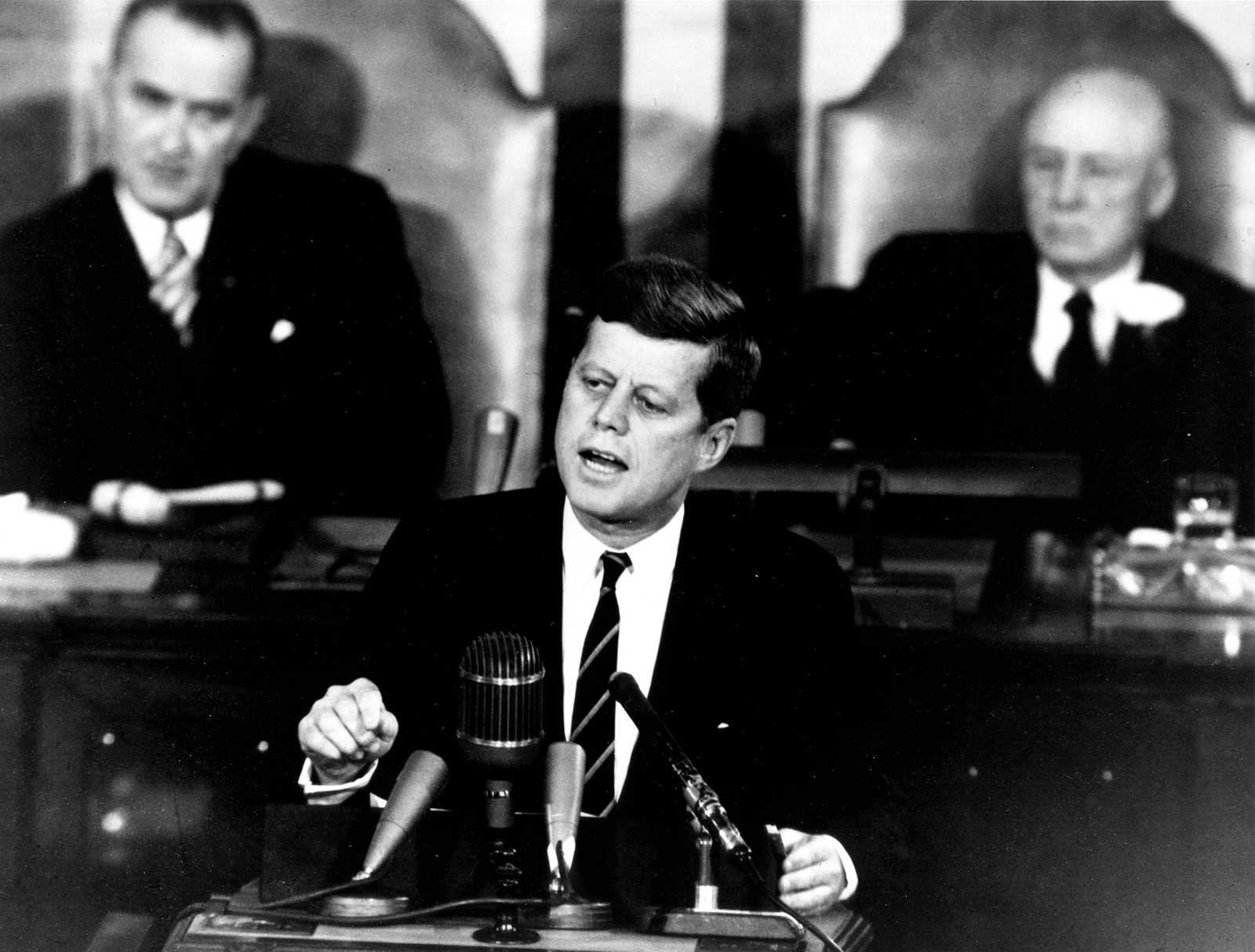
With this strong endorsement of a lunar landing project, and after Alan Shepard’s successful suborbital Mercury flight on May 5, Kennedy put together a message to Congress on “Urgent National Needs,” which he delivered in person on May 25, 1961. While the speech covered many issues, its major impact was on the space program. In it Kennedy expressed his belief that a manned lunar landing, “before this decade is out,” should be the principal goal of the American space effort. Stressing that this meant a long and costly development program to reestablish the nation’s world leadership in technology, he cautioned that “if we are to go only halfway, or reduce our sights in the face of difficulty … it would be better not to go at all.” 19 It was a call for the country to commit itself wholeheartedly to a long-term project that required sustained effort, substantial cost, and determination to see it through to a successful conclusion.
If congressional reaction was less than enthusiastic, as Kennedy is reported to have felt afterwards,20 events of the following summer proved that Congress was solidly behind the venture. The supplemental budget request to get Apollo under way - $675 million over Eisenhower’s proposed $1.1 billion - carried both houses with large majorities after little debate and suffered only minor reduction by the House Appropriations Committee.21 Congress and the nation were eager to see Apollo succeed; but NASA engineers, while confident that it could be done, better understood the magnitude of the task. Robert R. Gilruth, head of the Space Task Group, recalled later that he was simply aghast at what NASA was being asked to do.22
Project Apollo: The Debate
Support for the Apollo commitment was not unanimous, either in Congress or among the public. The public opposition most often questioned the wisdom of spending so much money on space when so many domestic problems confronted the country. Those who spoke for science often shared this concern, but their special objection was Apollo’s distortion of priorities within the space program. One unidentified astronomer was reported to have complained to Senator Paul Douglas of Illinois that the space program was becoming “an engineering binge instead of a scientific project.” 23 Petulant as that comment may sound, it epitomized what many space scientists most feared about the lunar landing project. Space science was a rapidly expanding field, offering almost limitless possibilities for exploitation by ambitious investigators. It had been generously supported by NASA for three years and had produced a rich harvest of scientific knowledge, much of it unfamiliar to the public. Manned space flight, merely because of man’s participation, drew attention that gave it prominence far out of proportion to its scientific value. The pioneers of space science were what one historian has called “sky scientists” - mainly astronomers and physicists interested in studying the sun and stars and particles, fields, and radiation in near-earth space.24 Sky scientists could well have believed that their projects would suffer as lunar and planetary science gained support. Lunar science, which stood to gain the most from Apollo, counted only a few practitioners who did not yet have the influence of the established space science programs.
American science generally was still riding a wave of public esteem and government subsidy that had begun in the early 1950s and had swelled again after Sputnik. Basing their arguments on the indisputable contributions made by scientists to the war effort during World War II, American scientists had worked long and hard after the war to convince the public and the Congress that America’s standard of living and position in world affairs depended on a strong scientific base, which in turn depended on generous funding of basic research. By the mid-1950s government support of basic research had risen to a level that prewar researchers could not have dreamed of. This new status had not been easily achieved and often had to be defended; many congressmen would have preferred to support practical projects rather than pure research, which often seemed pointless. (Indeed, congressmen and journalists frequently enjoyed making fun of research projects that had absurd-sounding titles, such as the reproductive physiology of the screwworm fly.25) But scientists had grown increasingly influential in governmental affairs. Prominent scientists found their counsel being sought more and more frequently by government at all levels, and science had enough influential friends in and out of government to ensure the continuity of a substantial level of support throughout the postwar years.26
Nonetheless, the most prominent and influential spokesmen for science seemed to feel uneasy about the viability of their favored status. Their behavior was characterized by one critical observer of the science-government interaction as “not unlike [that of] a nouveau riche in a fluctuating market.” Every threat, real or imagined, to reduce the support of science - or even to reduce its rate of growth - was regarded as a potential catastrophe.27 So the space scientists may have perceived Apollo as a threat. No one could accurately predict its ultimate cost - estimates ranged upward from $20 billion - but it would be expensive enough that Congress might trim other programs to provide its funds.
Scientists' misgivings about Apollo were expressed intramurally in the summer of 1962 at the Space Science Board’s first summer study of NASA’s science programs. Convened at the request of NASA, the six-week summer study brought together more than a hundred participants from universities and industry to evaluate NASA’s past activities and recommend future policies and programs. The final report of the study, noting that “there is considerable confusion about the Apollo mission and its proper justifications,” stated that Apollo was just what Kennedy had said it was: a program to put America first in space, with no necessary commitment to science. Until the success of the lunar landing could be clearly foreseen, Apollo was, and must be, an engineering effort, “and the engineers must be protected in their ability to do their jobs.” Scientific investigations would be phased into the program later; still later, assuming intermediate success, “scientific investigations will become the primary goals.” It was evident that these considerations were not well understood - and perhaps not accepted - by the scientific community, for the report urged NASA to work harder to make them clear.28
This section of the report was addressed primarily to the scientific community rather than to NASA, but whether it allayed any fears is debatable. If it did, events of the following fall could well have raised stronger ones. In November, manned space flight projects were severely cramped by lack of funds, and Brainerd Holmes, director of Headquarters’s Office of Manned Space Flight, wanted to ask Congress for a $400-million supplemental appropriation to cover unanticipated costs. NASA Administrator James Webb, unwilling to risk undermining congressional support, did not agree. Holmes then proposed to transfer money to Apollo from other NASA programs, including science, but again Webb refused. When the question was taken to the White House, Webb told the President he would not take responsibility for a program that subordinated all else to the lunar landing. The extra funds could wait, he said, until NASA went to Congress with its fiscal 1964 budget. President Kennedy accepted this compromise.29 Webb’s stand for a balanced program should have surprised no one, for both he and his Deputy Administrator, Dr. Hugh L. Dryden, had repeatedly stated their view that the lunar landing was not in itself the ultimate goal of the space program; it was a project which, to be successful, required the advancement of space technology and science on a broad front.30
Webb went to Capitol Hill in March 1963 asking for $5.712 billion - $2.012 billion more than the previous year’s budget request. Nearly 80 percent of the increase was for manned programs, but funding for space science was also substantially raised, by 50 percent over the previous year’s budget.31 For the first time NASA met significant resistance to its presentation. The sudden drastic increase in the total budget (54 percent in one year), the growing awareness of the probable total cost of Apollo (estimated at $20-$40 billion), and the increasing dissatisfaction in the country with the administration’s priorities all combined to raise opposition to the manned space program to a peak during the spring and summer of 1963.
As hearings on the administration’s budget proceeded, the space program drew fire from many sources. Retired President Eisenhower reiterated his conviction that Apollo was not worth the tax burden it would create.33 The Senate Republican Policy Committee published a report questioning the Democratic administration’s expenditures on space rather than on other urgent national needs.33 Two years before, Kennedy had warned that the cost would be high and that careful consideration by Congress and the public was essential. It was useless to agree that the country should bid for leadership in space, he had said, unless “we are prepared to do the work and bear the burdens to make it successful.” 34 Under the pressure of Soviet achievements, the commitment had been endorsed. When the bills began to come due, the country was not so sure.
In the debate that spring and summer, many scientists spoke from their peculiar point of view concerning the space program. On April 19 Philip H. Abelson, editor of Science,# summarized the case against Apollo in an editorial. It did not deserve the priority it had been given in the space program, Abelson believed. Its scientific value, small at best, would be even less if (as seemed likely) a trained scientist was not sent on the first landing mission. More and better data could be obtained by unmanned probes, at about one percent of the cost. In Abelson’s view, neither the military advantages nor the “technological fallout” cited by advocates could justify the cost of sending men to the moon.35
# Science, the weekly journal of the American Association for the Advancement of Science (AAAS), probably reaches more scientists in different disciplines than any other single scientific publication. (In 1963, AAAS numbered about 76,000 members.) Besides publishing technical papers, Science provides news and analysis of many subjects of interest to the scientific community. Acerbic and outspoken, Abelson characterized himself as “a damned maverick” in testimony before the Senate space committee later in the year.
After Abelson’s editorial, many other scientists expressed their reservations concerning the space program, and a general debate ensued in the press.36 Criticism focused on several points: the lunar landing program had almost no scientific value and science would be advanced much more by spending the same money on unmanned projects; the space program lured promising young talent away from other worthwhile research, creating an imbalance in the nation’s overall scientific effort; and the money spent on Apollo could be better invested in educational, social, and environmental programs. Some seemed to feel that Apollo had been promoted as a scientific program and to resent the confusion in the public mind. Hugh Dryden reminded the critics that “no one in NASA had ever said [Apollo] was decided upon solely On the basis of its scientific content.” 37 Other scientists agreed with Dryden and expressed their acceptance of the lunar landing On its own terms.38
Senator Clinton P. Anderson, chairman of the Senate Committee on Aeronautical and Space Sciences, which was then considering NASA’s authorization bill for fiscal 1964, reacted to this debate by inviting several prominent scientists to present their views to the committee. During two days of hearings, ten scientists (including Philip Abelson, who was the first to be heard) ranged over most of the ground covered in the public debate. If there was any general agreement, it was that the time limit set for Apollo was probably conducive to waste, and that many national problems deserved equal attention; but there was no agreement that American science was being skewed by so much attention to space. The strongest protest against the program was a written statement provided by Warren Weaver, vice-president of the Alfred P. Sloan Foundation, who listed many good things that could be bought with $30 billion## - a price he said was “undoubtedly an underestimate” ### of Apollo’s ultimate cost.39
## Thirty billion dollars, Weaver said, would give every teacher in the U.S. a 10 percent annual raise for 10 years; give $10 million each to 200 small colleges; provide 7-year scholarships at $4,000 per year to produce 50,000 new Ph.D. scientists and engineers; give $200 million each to 10 new medical schools; build and endow complete universities for 53 underdeveloped nations; create 3 more Rockefeller Foundations; and leave $100 million over “for a program of informing the public about science.”
### The official estimate provided to Congress in 1973 was $25.4 billion. House, Subcommittee on Manned Space Flight of the Committee on Science and Astronautics, 1974 NASA Authorization, Hearings on H.R. 4567, 93/2, Part 2, p. 1271.
Senator Anderson got what he wanted from the scientists - a variety of views that improved his perspective of the space program.40 The disapproving witnesses' doubts were echoed in Congress. NASA’s budget did not go through unscathed, but the cuts actually made were less than some in Congress would have liked. When the House approved NASA’s authorization bill on August 1, support for the space program was still strong: the majority was six to one.41 After three more months of debate and cuts totaling $612 million, NASA’s appropriation ($5.1 billion) passed both houses by large majorities.42 Many opponents of expensive manned space flight programs would express their objections over the next decade, but Apollo would go forward, carrying - as some thought - the rest of the space program with it.43
What might have been, if there had been no lunar landing project, can be (and was) long debated. Over and over, advocates of the manned programs pointed out the reality of the situation: the nation could afford whatever it valued enough to pay for. Social welfare and other desirable programs had to win support on their own merits and would not necessarily be given Apollo’s $3 billion a year if it were canceled. The politics of a technological project with a clear goal and self-evident success or failure were much simpler than any plan to conquer poverty, rebuild the cities, or clean up the environment.
No proof is possible that space science (or science generally) would have been better supported if Apollo had not been claiming such a large fraction of the space budget. In fiscal 1964, when NASA’s budget request first encountered serious resistance in Congress, space science was authorized $617.5 million; its spending authority grew to $621.6 million and then to $664.9 million in the next two fiscal years.44 (The entire Mercury project, from 1958 to 1966, cost about $400 million.45) But manned space flight budgets were three to four times those mounts, and Homer Newell, director of NASA’s science programs for the first nine years, would later recall that space scientists never hesitated “to complain about not getting their fair share of the space budget.” Newell, a space scientist himself and as active an advocate as space science had, understood and accepted the overall priorities of the space program, as the scientists apparently did not, and they sometimes tried his patience. He would later remark that “whatever complaint there might have been about either the absolute or relative level of the space science budget… , there can be little doubt that it represented a substantial program.” 46
Project Apollo: Prospects, 1963
Apollo survived the debate of 1963, as it would survive worse troubles later, but the cut in NASA’s budget request (more than 10 percent) left its mark. The following spring Administrator James Webb would not assure Congress, as he had in the past, that he was confident the lunar landing would be accomplished within the decade - only that it was possible, if everything went well.47
And much could yet go wrong. Spacecraft design and the basic mission operations plan had been settled and the major contracts had been let. Years of testing and design refinement lay ahead. An entire project, Gemini, was still to be conducted, to establish the feasibility of rendezvous - bringing two spacecraft together in orbit - on which the success of Apollo depended. In terms of technical milestones, the lunar landing was still a long way off. The science community had registered its objections to Apollo, as had other concerned citizens, and the nation had reaffirmed the commitment asked of it by its late president. Those same objections would continue to be voiced, but the lunar landing would remain the major driving force behind the national space program. One thing that could be clearly seen at the end of 1963 was that manned space flight had an important interest in reaching some kind of accommodation with science. Over the next four years NASA officials and members of the science community worked to establish a program of scientific exploration that would become the primary purpose of the later Apollo missions.
Notes
- 1. U.S., Congress, House, Toward the Endless Frontier: History of the Committee on Science and Technology, 1959-1979 (Washington: U.S. Government Printing Office, 1980), p. 269. This history was written by Ken Hechler, a Ph.D. historian and author of books on political and military history. who served on the House Committee on Science and Technology for 18 years beginning in 1959.
- Homer E. Newell, Beyond the Atmosphere: Early Years of Space Science, NASA SP-4211 (Washington, 1980), pp. 87-99. Newell joined NASA in 1958 as director of the space science program, became Associate Administrator for Space Science (later Space Science and Applications) in 1961 and Associate Administrator in 1967. He retired in 1973 and died in 1984. See also Arnold S. Levine Managing NASA in the Apollo Era, NASA SP-4102 (Washington, 1982), pp. 9-17, and Robert L. Rosholt, An Administrative History of NASA, 1958-1963, NASA SP-4101 (Washington, 1966). pp. 37-47.
- Rosholt, Administrative History, pp. 45-47. For a history of JPL’s Ranger project, see R. Cargill Hall, Lunar Impact: A History of Project Ranger, NASA SP-4210 (Washington, 1977)
- Newell, Beyond the Atmosphere, pp. 104-105.
- Loyd S. Swenson, Jr., James M. Grimwood, and Charles C. Alexander, This New Ocean: A History of Project Mercury, NASA SP-4201 (Washington, 1966), pp. 55-65. The NACA-NASA research in high-speed flight is treated in Richard Hallion’s On the Frontier: A History of the Dryden Flight Research Facility, NASA SP-4303 (Washington, 1984).
- Swenson, Grimwood, and Alexander, This New Ocean, p. 73.
- Ibid., pp. 99-102.
- Courtney G. Brooks, James M. Grimwood, and Loyd S. Swenson, Jr., Chariots for Apollo: A History of Manned Lunar Spacecraft, NASA SP-4205 (Washington, 1979), pp. 4, 52-53.
- Roger E. Bilstein, Stages to Saturn: A Technological History of the Apollo Saturn Launch Vehicles, NASA SP-4206 (Washington, 1980), pp. 26-42.
- Documents on International Aspects of the Exploration and Use of Outer Space, 1954-1962, staff report prepared for the Senate Committee on Aeronautical and Space Sciences (Washington, 1963), p. 188: the quote is from Eisenhower’s annual budget message to Congress, Jan. 18, 1961.
- “Report to the President-Elect of the Ad Hoc Committee on Space,” Jerome B. Weisner, chmn., (classified version), Jan. 12, 1961, p. 10.
- Brooks, Grimwood, and Swenson, Chariots, pp. 7-17.
- John M. Logsdon, The Decision to Go to the Moon: Project Apollo and the National Interest (Cambridge Mass.: MIT Press, 1970), pp. 108-109, 112-115.
- President’s Science Advisory Committee, Introduction to Outer Space (Washington, 1968), p. 6.
- James R. Killian, address to the M.I.T. Club of New York, Dec. 13, 1960; quoted in Logsdon, Decision, p.20.
- Space Science Board of the National Academy of Sciences-National Research Council, “ Role in the National Space Program,” reprinted in Senate, Committee on Aeronautical and Space Sciences, National Space Goals for the Post-Apollo Period, 89th Cong., 1st sess. (henceforth 89/1), 1965, pp. 242-43.
- Logsdon, Decision, p. 86.
- James E. Webb and Robert S. McNamara, memo to the President, “Recommendations for our National Space Program: Changes, Policies, Goals, “ May 8, 1961.
- Logsdon, Decision, pp. 127-28.
- Ibid., p. 129.
- Ibid.
- Brooks, Grimwood, and Swenson, Chariots, p. 31.
- Robert Colby Nelson, “Full Moon Debate,” Christian Science Monitor, June 14, 1961.
- Hall, Lunar Impact, pp. 10-12.
- House, Subcommittee on Space Sciences and Applications of the Committee on Science and Astronautics, 1965 NASA Authorization, Hearings on H.R. 9641, 88/2, part 3, pp. 1897-98. See also Hechler, Toward the Endless Frontier, pp. 541-42.
- For a study of the changing relationships between science and government before and after World War II, see Daniel S. Greenberg, The Politics of Pure Science (New York: The New American Library, Inc., 1967).
- Ibid., p. 288.
- National Academy of Sciences - National Research Council, A Review of Space Research, NAS/NRC Publication 1079 (Washington, 1962), pp. 1-21 to 1-22; see also Newell, Beyond the Atmosphere, pp. 208-209.
- Newell, Beyond the Atmosphere, p. 386.
- See, for example: Webb’s address to the Greater Hartford (Conn.) Chamber of Commerce, Oct. 1, 1962, cited in Astronautical and Aeronautical Events of 1962, NASA Report to the House Committee on Science and Astronautics, 88/1 (Washington, 1963), p. 206; Webb’s address to the Northeast Commerce and Industry Exposition, Boston, Oct. 2, 1962, ibid., p. 207; Hugh L. Dryden, letter to Sen. Robert S. Kerr, chmn., Senate Committee on Aeronautical and Space Sciences, cited in Astronautical and Aeronautical Events of 1961, NASA Report to the House Committee on Science and Astronautics, 87/2 (Washington, 1962), p. 28. While program office officials covered details of the current programs' budgets and plans with congressional subcommittees, Webb and Dryden consistently stressed the broader aims of the programs before the full committees. Consult the various House and Senate committee hearings on NASA authorization bills, fiscal years 1961-1969, for more examples.
- House, Committee on Science and Astronautics, 1964 NASA Authorization, hearings on H.R. 5466, 88/1, part 1, pp. 2-3; idem, 1963 NASA Authorization, hearings on H.R. 10100, 87/2, part 1, pp. 3-9.
- Endless Frontier, p. 171.
- “A Matter of Priority: An examination of the budget and benefits of the moon shot in relation to other problems,” report prepared by the staff of the Senate Republican Policy Committee, May 10, 1963.
- Logsdon, Decision, p. 128.
- P. H. A[belson]., “Manned Lunar Landing,” Science 140 (1963): 267.
- See, for example: Frederick D. Hibben, “NASA, Scientists Divided on Space Goals,” Aviation Week & Space Technology, Apr. 29, 1963, pp.24-25; Albert Eisele, “Nobel Winners Criticize Moon Project,” Washington Post, May 6, 1963; Robert Hotz, “Apollo and Its Critics,” Aviation Week & Space Technology, Apr. 29, 1963; William J. Perkinson, “Engineers vs. Scientists,” Baltimore Sun, Apr. 30, 1963; Howard Simons’s 3-part series in the Washington Post, “Scientists Divided on Apollo,” May 12-14, 1963.
- “U.S. Official Answers Critics of Manned Lunar Program,” Baltimore Sun, Apr. 30, 1963.
- “Man-on-Moon Project Backed by 8 Scientists,” Washington Evening Star, May 27, 1963.
- Senate Committee on Aeronautical and Space Sciences, Scientists' Testimony on Space Goals, Hearings, 88/1, June 10-11, 1963.
- Ibid., pp. 242-43.
- Endless Frontier, pp. 169-74.
- Astronautics and Aeronautics, 1963, pp. 440, 464, 474.
- Newell, Beyond the Atmosphere, p. 385.
- Ibid., p. 384.
- Swenson, Grimwood, and Alexander, This New Ocean, p. 643.
- Ibid., pp. 384-86.
- House Committee on Science and Astronautics, 1965 NASA Authorization, Hearings on H.R. 9641, 88/2, part 1, p. 10.