APOLLO ASSUMES ITS FINAL FORM: 1970-1971
As budgets tightened and public support for lunar missions faltered in 1970, NASA managers faced tough choices. On the one hand, the successful Apollo exploration missions had given lunar scientists an appetite for more and more samples - more, in fact, than even the six missions remaining on the schedule were likely to provide. Against that stood the need to get moving on post-Apollo programs, the first of which (Skylab) had reached a stage where it required substantial funds to stay on schedule. Given the unpalatable alternatives, NASA chose to cut back on lunar exploration and apply the savings to its future.1
Cutbacks and Program Changes
In February 1970 NASA took to Congress a budget proposal for fiscal 1971 for $3.333 billion, down more than $500 million from the previous fiscal year. Administrator Thomas Paine listed for the House Committee on Science and Astronautics the “hard choices” he had been forced to make to stay within that budget while still making progress: suspending production of Saturn V launch vehicles and spacecraft assigned to those vehicles, “mothballing” the Mississippi Test Facility and reducing the work force at the Michoud Assembly Facility where Saturn Vs were assembled, closing the new Electronics Research Center at Cambridge, Massachusetts, and canceling Apollo 20.2 During the following summer it appeared that Congress was in a mood to cut space funding even more. By July rumors were circulating that more Apollo missions, perhaps as many as four, were candidates for cancellation.3 The first bill containing NASA’s appropriation (vetoed in August by President Nixon, who objected to the funds provided for another agency) gave the space agency $3.269 billion - a figure that came out of weeks of debate in House and Senate and conference committee and was clearly all the space agency could expect.4
On July 28, while Congress debated the funding issue, Tom Paine submitted his resignation as NASA administrator, effective September 15, to President Nixon. He planned to return to General Electric, the company he had left in early 1968 to become deputy administrator. Paine denied that NASA’s immediate funding problems had influenced his decision.5 Probably more decisive was the fact that he saw no prospect of immediate change. From the start of his tenure as administrator, Paine’s ideas for the future of the space program were far more ambitious than those of the President and the Bureau of the Budget.
On September 2 Paine called a press conference to announce NASA’s interim operating plan for fiscal 1971. Cutbacks and stretchouts in most major programs were the order of the day, among them the cancellation of two more Apollo missions, 15 and 19. The remaining missions, redesignated Apollo 14- 17,* would be flown at six-month intervals in 1971 and 1972. After that would come the three manned Skylab missions (which under earlier schedules had interrupted the Apollo program for two years). Paine noted that he and his managers had made this decision reluctantly and in spite of the conclusions of special reviews by the Space Science Board of the National Academy of Sciences and the Lunar and Planetary Missions Board, both of which had strongly recommended that all six remaining missions be flown. Paine’s main consideration had been “how best to carry out Apollo to realize maximum benefits while preserving adequate resources for the future post-Apollo space program.” 6 For whatever consolation scientists might get from it, one of the canceled missions (Apollo 15) was the last of the limited exploration missions the three remaining after the cut would all have considerably extended capability, including a surface roving vehicle. Left unanswered was the question of what was to be done with the three Saturn V boosters that no longer had missions to fly.7
* At the time, Apollo 14 had not yet flown. New mission numbers were 15, 16, and 17, with science plans corresponding approximately to those of the old 16, 17, and 18.
Criticism of the decision to shorten Apollo was immediately forthcoming. A New York Times editorialist called the decision “penny-wise, pound-foolish,” noting that the savings would amount to less than 2 percent of NASA’s fiscal 1971 budget and less than 0.25 percent of the total investment in Apollo. “The budgetary myopia which forced this … decision can only vindicate the critics who have insisted that Apollo was motivated by purely prestige considerations, not scientific goals,” said the Times writer. While the Times had for years opposed Apollo’s high priority, “now that these huge sums have been spent the need is to obtain the maximum yield, scientifically and otherwise, from that investment.” 8
This argument was typical of the reaction voiced by many after the cutback. Particularly upset were lunar scientists. Astronomer Thomas Gold of Cornell University likened the decision to “buying a Rolls Royce and then not using it because you claim you can't afford the gas.” The grand old man of lunar science, Harold Urey, said the $40 million saved on operational costs was “chicken feed” compared to the $25 billion already spent.9 To the Washington Post he wrote,
It cost us … one half of one per cent of our gross production…. Now we wish to finish a job which has been beautifully begun. And we get stingy. Because of an additional cost of about 25 cents per year for each of us we drop two flights to the moon recommended by scientific committees composed of men who personally profit from the expenditure little or not at all. How foolish and short-sighted from the view of history can we be?10
Gerald Wasserburg, a highly respected Caltech geochemist and member of the lunar sample preliminary examination team, protested in the Los Angeles Times,
…this decision threatens our existing investment in planetary exploration during a period when we are obtaining maximum returns and makes doubtful the scientific justification of the manned space program. The total effect appears to indicate a return to the dark ages of planetary science….11
None of the protesters, however, could offer a reasonable alternative to the cutbacks. The New York Times editorial writer suggested that NASA seek participation, including financial contribution, by the Soviet Union or our European allies in long-tem lunar exploration - surely an unrealistic suggestion at best.
These complaints, well founded though they were, were far too late. By mid-1970 NASA was operating on its lowest budget since fiscal 1965, under an administration determined to reduce the federal deficit, while trying to get started on a new generation of spacecraft and programs toward which administration budget officers were less than enthusiastically committed. Complicating the problem of living within a restricted budget, NASA’s record in holding program costs to preprogram estimates was not good, a fact often brought up in congressional budget hearings. (That had very nearly cost the agency the Mars landing project, Viking, at the end of 1969.12) Public and congressional support for purely scientific missions, no matter how spectacular or important, had begun to erode before Apollo 11. Whatever the fact may say about the nation’s commitment to the space program, NASA now lived or died by the perceptions of Congress and the administration of the short-term value of its projects. Political pressure on the space program was shifting in the direction of using space to solve earth’s problems.13
In mid-September 1970, 39 scientists who had long been associated with Apollo’s science program formally protested the cutbacks in a letter to the chairman of the House Committee on Science and Astronautics, Representative George P. Miller. They pointed out that the reduction in the number of missions might cause the lunar science program to “fail in its chief purpose of reaching a new level of understanding” of the origin of the earth and moon. As best they could tell, the money saved in the “approved and scientifically most fruitful lunar program” was intended to support a post-Skylab manned earth-orbital project - “an as yet unapproved program for whose scientific value there is no consensus, and whose purpose is unclear” (i.e., the space shuttle). They concluded by expressing the hope that the decision to cancel two Apollo missions was not yet final.14
In reply, Miller called the scientists' attention to his committee’s long record of support for Apollo, pointing out that the committee had tried to get $220 million more for lunar exploration into the authorization bills for fiscal 1970 and 1971. “However, the [Nixon] Administration, in realigning national priorities, has relegated the space program to a lesser role.” Undoubtedly the two canceled flights would have provided additional scientific information, Miller said, but that had to be balanced against assuring the rational development of future space programs. In conclusion he mildly reproved the scientists: “Had your views on the Apollo program been as forcefully expressed to NASA and the Congress a year or more ago, this situation might have been prevented.” But it was too late to offer any serious hope of reinstating the two missions.15
As the launch date for the next flight approached, lunar scientists faced hard choices. Plans for Apollo 14 had reached the stage where no major changes were possible. With three missions remaining instead of five, landing sites had to be chosen to give the best hope of answering the most important scientific questions. Experimenters and flight planners had to make the best possible use of the extra payloads that the last three missions would be able to land on the moon.
To Fra Mauro, At Last
The loss of the scientific information Apollo 13 would have returned from Fra Mauro made it necessary to reevaluate objectives for later missions. At its meeting in early March the Apollo site selection board had recommended Littrow (Figure 4, site 2]) as the target for Apollo 14.16 After Apollo 13 the board’s scientific advisers almost unanimously agreed that the Fra Mauro site still rated the high priority it had been given; they recommended sending Apollo 14 there instead of Littrow, and the board agreed.17 Since a number of changes in the service module were expected as a result of the Apollo 13 investigation, Apollo 14 was rescheduled for the third time in six months. Launch readiness was targeted for no earlier that January 31, 1971.18
In the nine months between the third and fourth lunar exploration missions, the last of the year’s budget shocks hit the Apollo program. With the loss of Apollo 15 and 19, Apollo 14 became the last of the intermediate (“H”-type) missions. Its basic objectives were the same as those of Apollo 13, but several changes were made in details.
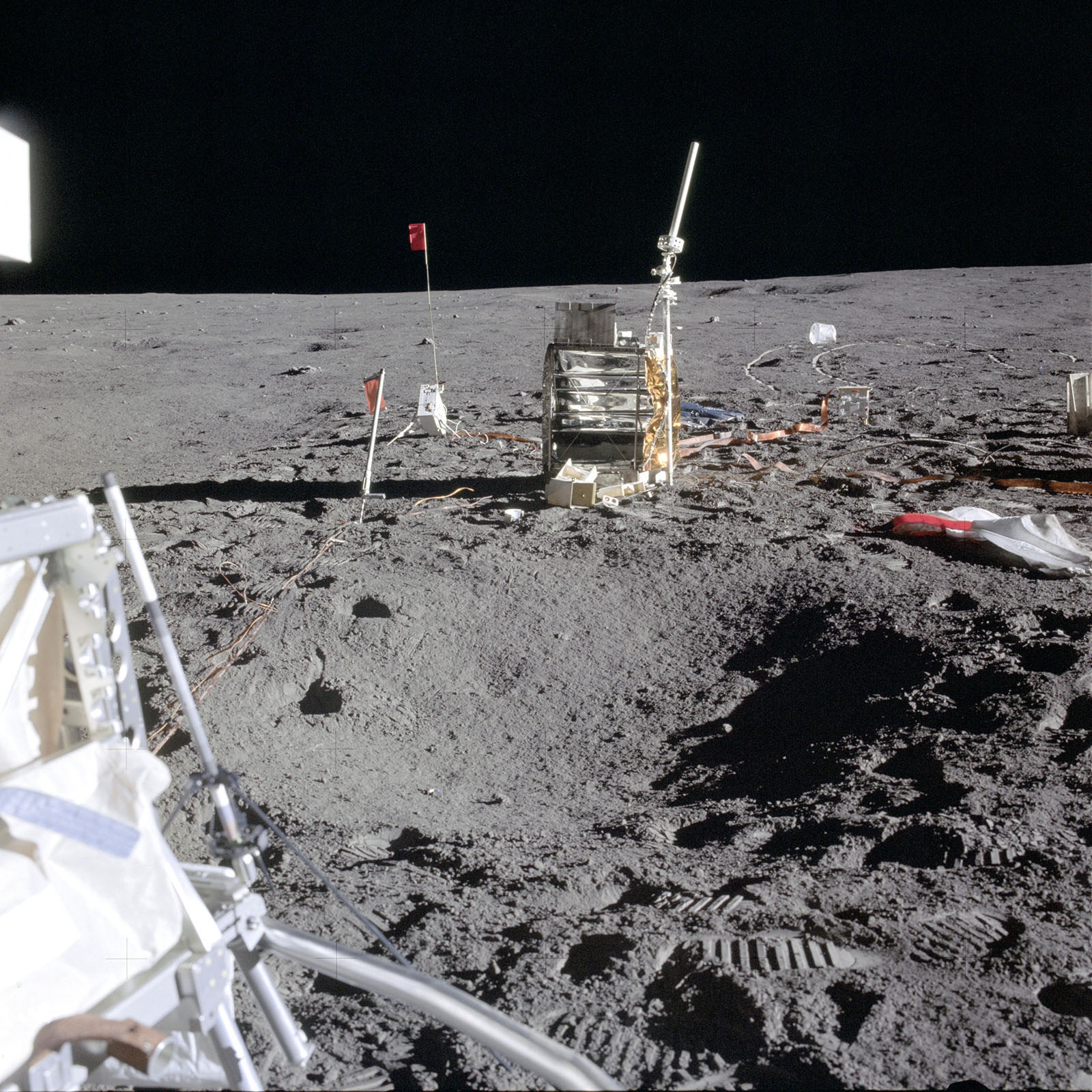
Apollo 13 had carried a surface science package consisting of a passive seismometer, an atmospheric detector and a charged-particle detector, and a heat flow instrument. Apollo 14’s package left off the heat-flow experiment and added three more: an active seismic experiment, a laser reflector like the one carried on Apollo 11, and an ionosphere detector like the one carried on Apollo 12. The active seismic experiment consisted of a set of detectors (geophones) to be laid out on the surface and two devices for producing calibrated shocks. It would aid in the interpretation of seismic data by giving seismologists a measure of the velocity of seismic waves in the near-surface layer of the moon.19
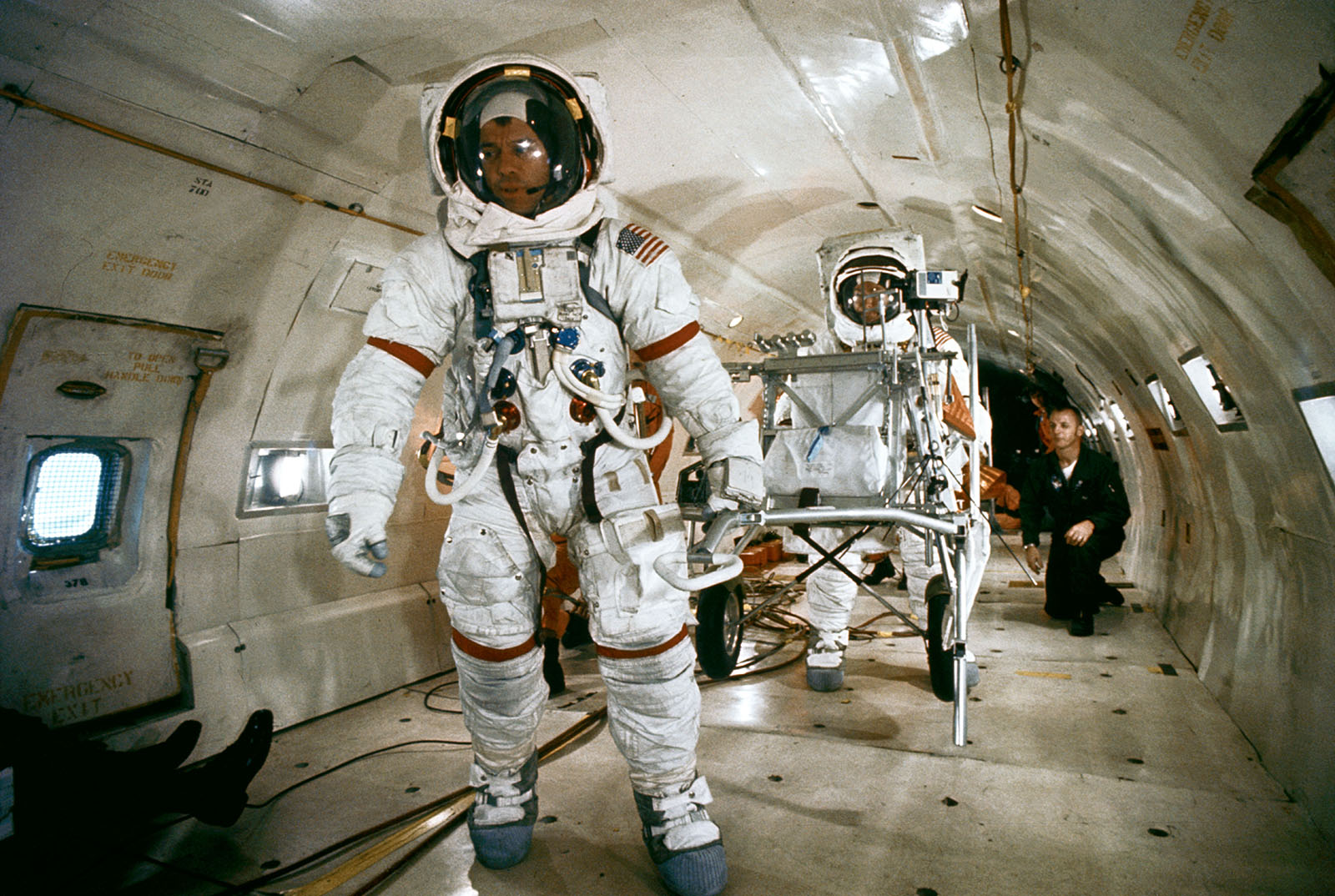
After earlier crews reported problems in carrying all the gear required for sampling on the moon, MSC’s Technical Services Division designed and built a two-wheeled modular equipment transporter for the Apollo 14 mission. The rubber-tired “rickshaw,” as it was nicknamed - actually it more resembled a golf cart - weighed only 18 pounds (8.2 kilograms) but could carry a 360-pound ( 163-kilogram) load; either astronaut could pull it with one hand. Providing storage space for core tubes, sample bags, cameras, maps, and hand tools, it folded up for storage on the lunar module at launch, alongside the experiment packages.20
Significant changes were made in pre- and postflight medical operations on Apollo 14. A prelaunch flight crew health stabilization program was established by medical officials to prevent the crew’s exposure to communicable disease, which had caused problems on Apollo 7, 8, 9, and 13. For three weeks before launch, prime and backup crewmen were isolated from close contact with everyone except their families and ground-support personnel whose duties required them to work closely with the astronauts. All these “primary contacts” were examined, tested for immunity to common diseases, and kept under medical surveillance. Crewmen were restricted to specified areas at the Cape and the air-conditioning system in their quarters was fitted with biological filters to minimize exposure to airborne disease organisms.21 Postmission quarantine arrangements were also modified to shorten the return to the lunar receiving laboratory. Since the recovery zone was some 600 miles (965 kilometers) from the U.5. air base in Samoa, plans called for the crew to be transferred by helicopter from the mobile quarantine facility aboard the recovery ship to Samoa. There they would enter a second isolation trailer, which would be flown to Houston.22
After the Apollo 13 accident, preparations for the next flight were delayed while the service module oxygen tanks were modified and tested. Meanwhile, several other minor changes to spacecraft and launch vehicle were made at the Cape.23 Thee new tanks - including a third, isolated from the other two, which would assure that the command module had enough oxygen to supply the crew - were installed and tested by January 18, and no further problems showed up as launch date approached.24
Launch day, January 31, was cloudy and rainy; eight minutes before the scheduled liftoff, the launch director stopped the countdown to wait for the heaviest clouds to move across the Cape. Forty minutes later Apollo 14 was on its way.25 The trip to the moon was uneventful until the time came to remove the lunar module from the S-IVB stage. Five attempts to dock the command module with the lunar module failed for no apparent reason - a worrisome anomaly, to say the least - but the sixth was successful.26 The spent S-IVB stage was then put on a course to crash on the moon some 100 miles southwest of the Apollo 12 landing site.27 Command module Kitty Hawk and lunar module Antares braked into lunar orbit 82 hours after liftoff. Two hours later Kitty Hawk’s main engine lowered both spacecraft to the altitude from which Antares would begin its descent.28 This maneuver was one result of the refinement of mission techniques that planners had been working on since Apollo 12, designed to conserve fuel in the lunar module and give the crew more time to hover before landing if they needed to look for a suitable site.
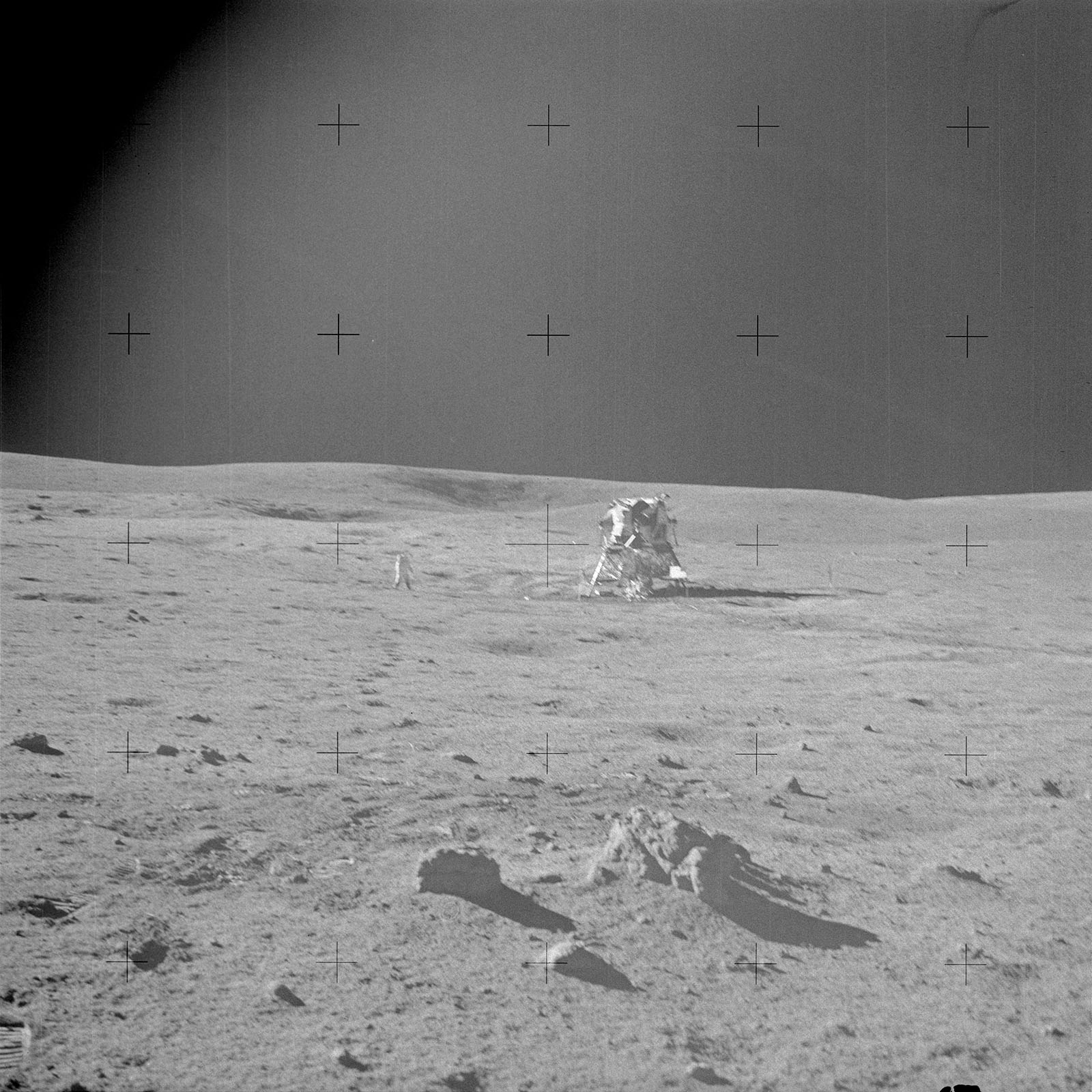
After mission commander Alan Shepard and lunar module pilot Edgar Mitchell had checked out Antares, command module pilot Stuart Roosa pulled Kitty Hawk away and Antares began its descent to the surface. Last-minute course corrections sent up from Houston were entered in the guidance computer and Shepard piloted the spacecraft to a routine landing about 350 miles (563 kilometers) west-southwest of the center of the moon’s visible side. Antares was only 175 feet (53 meters) from its targeted landing site29 Meanwhile Roosa had boosted Kitty Hawk back up into a higher, circular orbit, where he had a number of tasks to perform while his colleagues explored the Fra Mauro Formation.
The terrain on which Antaressat was gently undulating, with numerous craters but comparatively few boulders. Mitchell commented that there was “more relief [i.e., variations in elevation] than we anticipated from looking at the maps,” 30 a characteristic that would cause them some difficulty later on. Having given Houston a description of what they could see, Shepard and Mitchell put on their space suits and prepared for their first excursion.
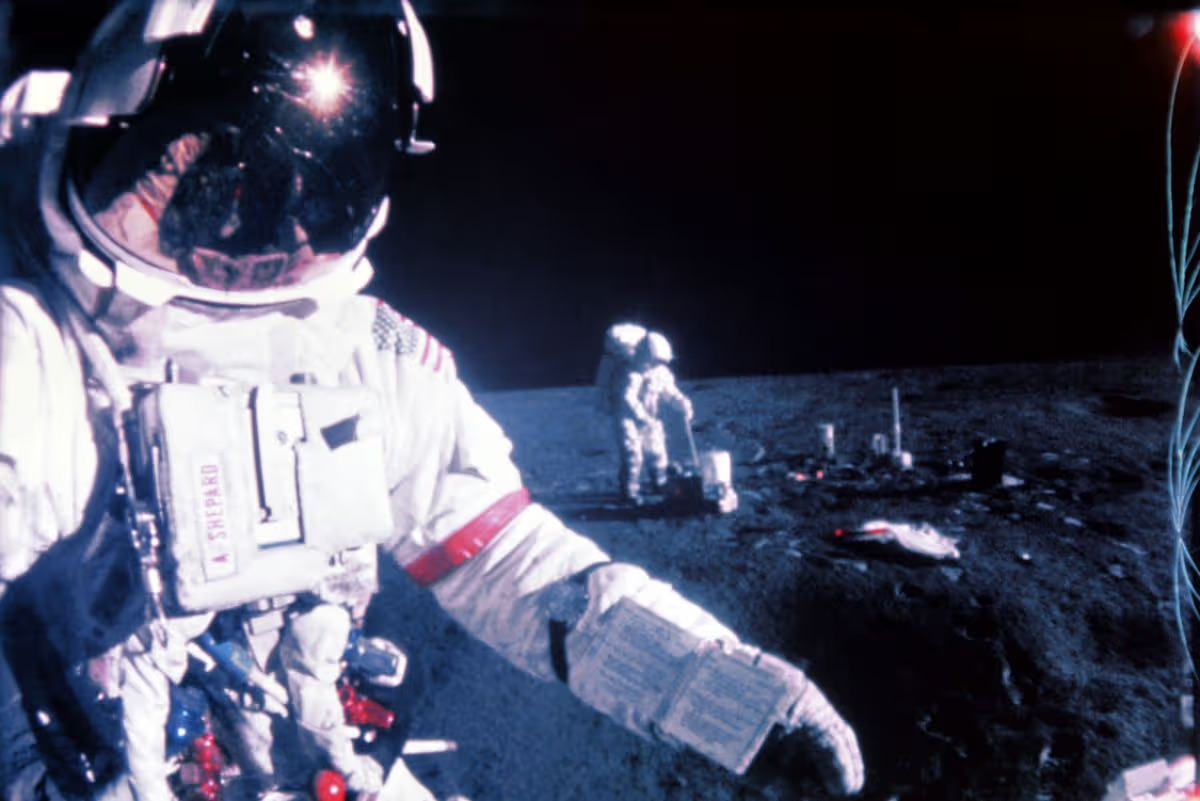
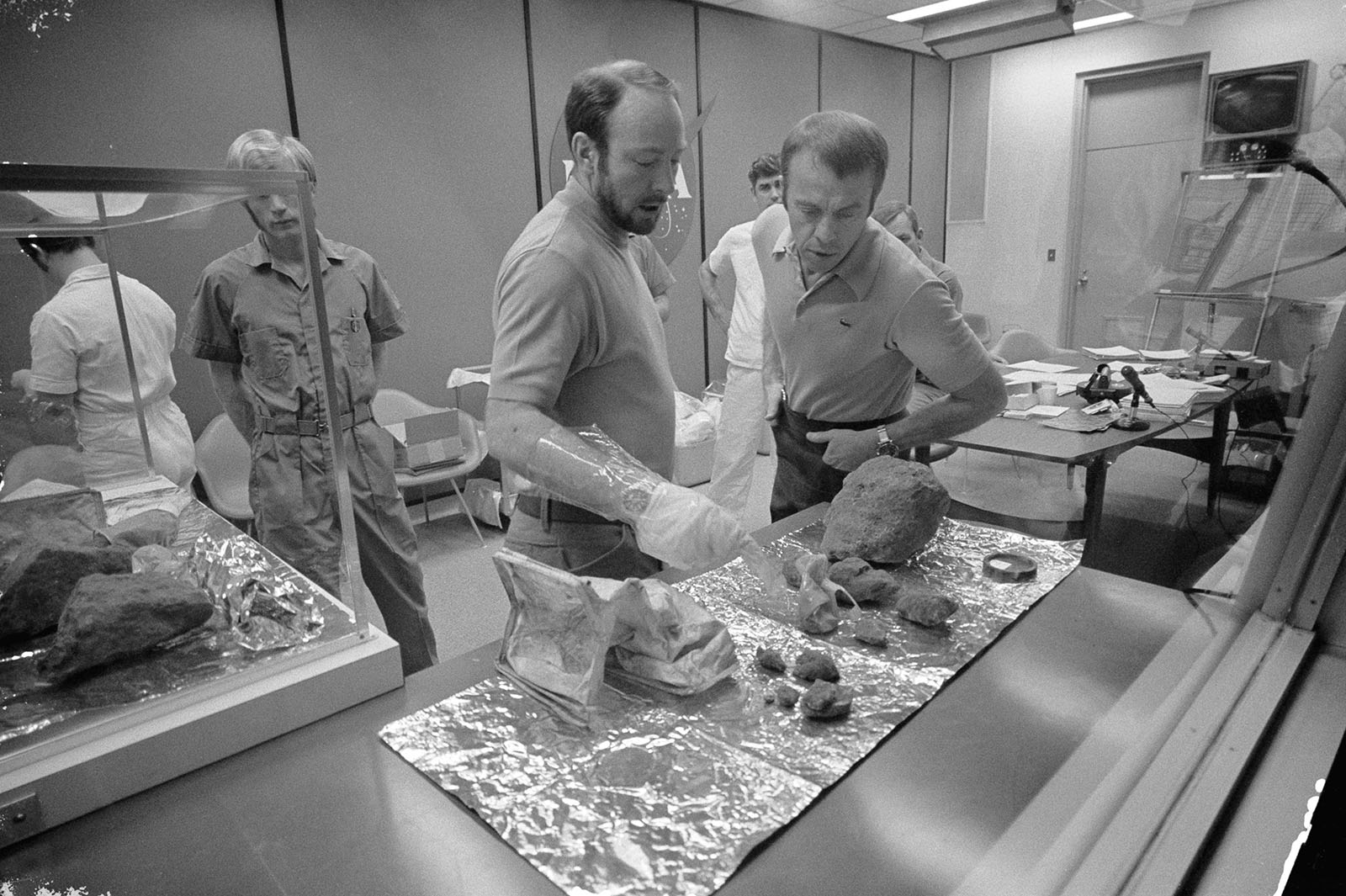
Shepard’s first words as he stepped on to the moon were inspired by his 9 years, 10 months, and 10 days of waiting from Mercury-Redstone 3, when he had been the first American in space, to the day he stepped on the moon.** “It’s been a long way,” he said, “but we're here.” 31 Mitchell joined Shepard on the lunar surface and they unloaded the rickshaw and experiments and picked a spot some 500 feet (150 meters) west of Antares for the instruments. After laying out the geophones for the active seismic experiment, Mitchell fired the explosive charges in his hand-held “thumper” as they walked back to the lunar module. On the way Shepard stopped to collect a comprehensive sample of rocks and fine surface material from a representative area, found two “football-sized” rocks, and collected some other surface samples. After more than four and a half hours they were back in the lunar module. Houston then had half an hour’s worth of questions from the scientists in the back room, and then it Was time to turn in.32
** Shepard was the only one of the “Original Seven” astronauts to make that journey, only the second to fly in the Apollo program.
Shepard and Mitchell did most of the mission’s geological field work on their second traverse. Their biggest problem was in determining their location from the landmarks shown on their map. More than once they changed their minds about where they were. At the time and later, they attributed this to the rolling terrain and the relation of their line of sight to the sun: craters might be visible in one direction but not in another. Without familiar objects for reference, they found it difficult to estimate distances. A prime objective was to sample the rim of “Cone” crater, about a thousand meters (3,300 feet) from the spacecraft. By the time they got there, however, they had spent considerable time and were not positive that they were in the right place. As it turned out, they stopped just a few meters short of the rim, but at the time they were not certain they were on the slope of Cone, and Shepard was concerned with the tasks they had yet to accomplish and the time available.33 They turned back, completed the planned traverse, and returned to Antares after another 4 ½-hour excursion. They had collected nearly a hundred pounds (45 kilograms) of samples and taken hundreds of photographs documenting many of the rocks, boulders, and sampling sites, including several panoramic views of the landing site.34 Before climbing back into the lunar module, Shepard took out of his suit pocket “a little white pellet that’s familiar to millions of Americans” - a golf ball - and dropped it on the surface. Then, using the handle for the contingency sample return container, to which was attached “a genuine six-iron,” he took a couple of one-handed swings. He missed with the first, but connected with the second. The ball, he reported, sailed for “miles and miles.” 35
During the 33 ½ hours Shepard and Mitchell were on the moon, Stuart Roosa had several important tasks to perform in Kitty Hawk. Continuing what had begun on Apollo 12, he photographed one of the remaining candidate landing areas (Descartes) and made numerous observations of prominent lunar landmarks to provide data that would improve landing accuracy on subsequent missions.36
Back in Antares, Shepard and Mitchell stowed their samples and discarded their expendable equipment. Houston then passed up questions for half an hour concerning details of their visual observations, which brought out some of the difficulties they had experienced on the traverse. Geological features had been subtle, occasionally they had had too little time to observe and comment on details, and the rolling terrain had sometimes blocked their view of features only a few meters away.37
Liftoff from the moon came at 1:48 p.m. EST on February 6. Mission planners had worked out a “direct” rendezvous scheme - that is, the ascent trajectory was programmed to meet the command module at its highest point, with necessary corrections being made during ascent - which they used for the first time. (On previous missions several maneuvers had been necessary to adjust the LM’s orbit before bringing the spacecraft together.) Two and a half hours after liftoff, Antares and Kitty Hawk docked; three hours later, having sent the lunar module crashing to the lunar surface, Kitty Hawk headed home.38
Along the way the crew performed some “inflight demonstrations” experiments exploring some zero-g techniques that might offer useful application of technology in space: electrophoresis (the migration of charged molecules in solution under the influence of an applied voltage), transfer of liquids between two containers, heat transfer, and casting of various materials from the molten state.39 Results were promising enough to warrant further investigation on Skylab and, later, on space shuttle missions. After finishing those demonstrations, Shepard, Mitchell, and Roosa had little to do for the rest of the mission. Kitty Hawk made a normal reentry and landed 0.6 miles (965 meters) from its targeted point in the South Pacific near the aircraft carrier U.S.S. New Orleans in the early morning light of February 9. Three days later the astronauts in their quarantine trailer arrived at the lunar receiving laboratory at MSC, where they spent 15 days in quarantine.40
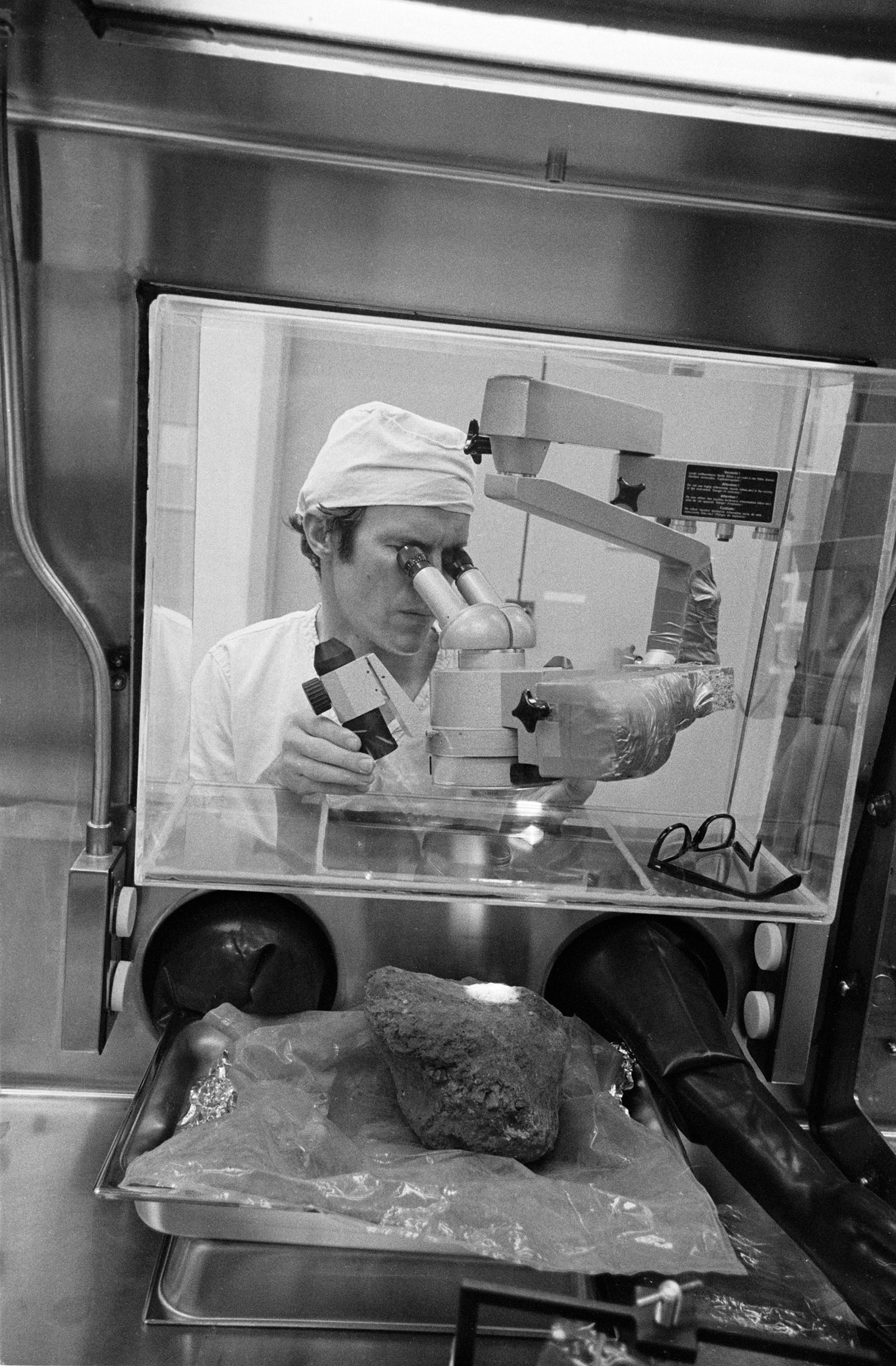
Apollo 14 successfully concluded the intermediate stage of lunar exploration, closing a period in which the progress made in mission planning and operations exceeded expectations. Armstrong had overshot his target by five miles (eight kilometers). Conrad and Shepard, aided by improved techniques, had landed within a quarter of a mile of theirs (400 meters) - an accuracy that MSC’s mission planners had expected to achieve after three or four tries, but scarcely hoped for on the second. Eagle had stayed on the moon for 21 ½ hours, Intrepid for 31 ½, Antares for 33 ½. Armstrong and Aldrin’s 2 ½ hours on the surface was more than doubled by Conrad and Bean and extended nearly ninefold by Shepard and Mitchell. Apollo 12 brought back 50 percent more lunar material than Apollo 11, and Apollo 14 returned 25 percent more than that. About the only remaining improvements to lunar exploration would come from the addition of extra supplies and a powered vehicle to save time in exploring the lunar surface.
Changes for Extended Lunar Missions
In the first half of 1969 the Office of Manned Space Flight (OMSF) had anticipated the requirements of the extended (“J”) missions, Apollo 16-20, by ordering studies on modification of the lunar module and development of a powered lunar-surface vehicle [see Chapter 10]. After studies by the lunar module contractor, Grumman Aircraft Engineering Company, were reviewed by OMSF’s Management Council, MSC authorized Grumman on June 9 to proceed with modifications on LM-10 and subsequent spacecraft. Changes to the landing module would allow it to carry additional payload (the lunar roving vehicle) to the lunar surface, return more lunar samples to earth, and provide consumables (oxygen, water, and electrical power) to support the crew on the moon for periods up to 78 hours. The first “extended” lunar module was to be delivered in time for launch in April 1971.41 Major changes included enlargement of the fuel and oxidizer tanks on both ascent and descent stages, extension of the descent engine nozzle to improve its efficiency, addition of batteries and solar cells to recharge them, and rearrangement of stowage space.42 At a critical design review in mid-September, MSC cut out some of the changes to minimize cost increases, discarding the solar cells and reducing the maximum duration of stays on the moon to 54 hours. The extended LM would weigh 36,000 pounds (16,330 kilograms), compared to 32,000 (14,515 kilograms) for earlier versions.43
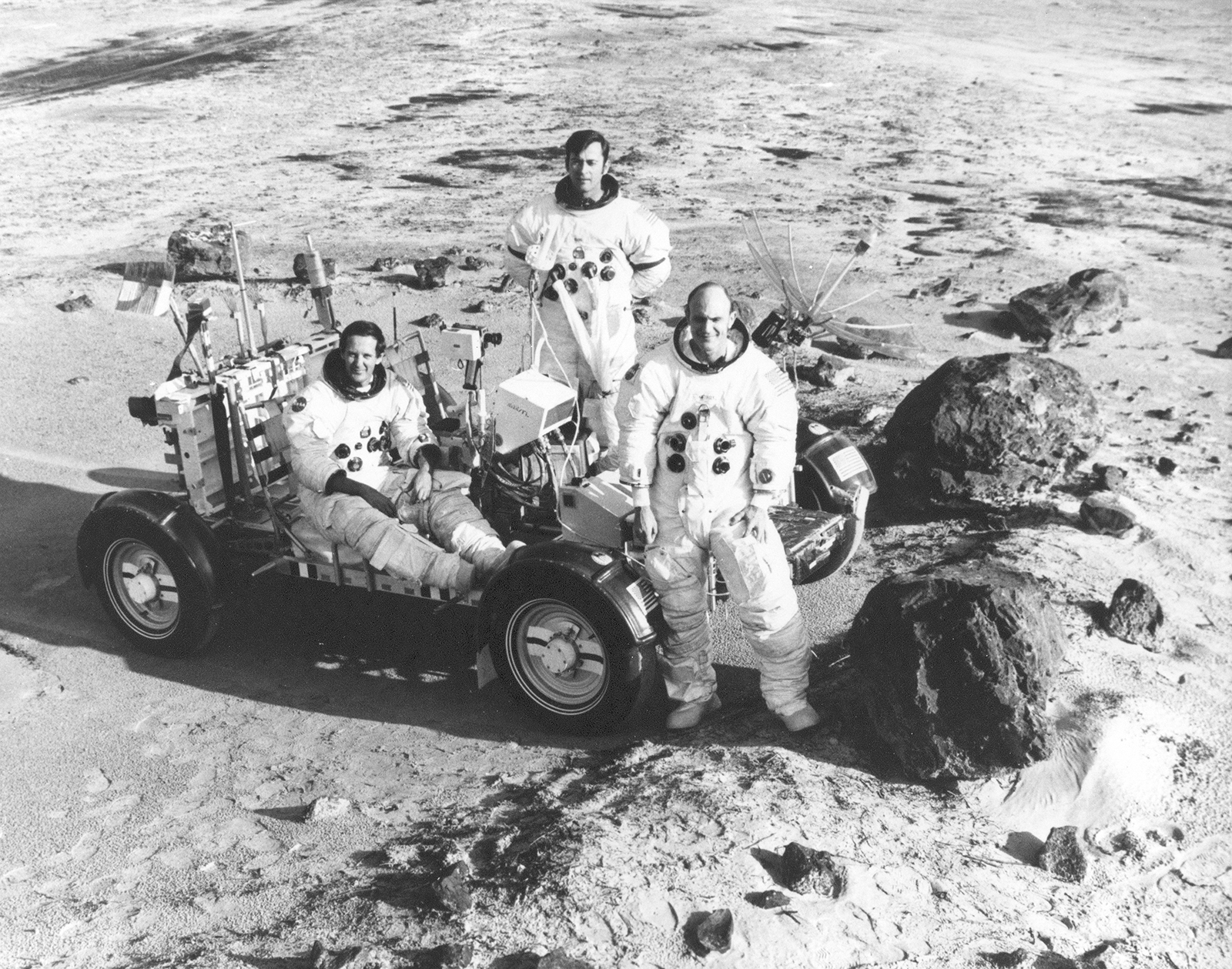
A large part of this extra payload was the lunar roving vehicle, which would extend the astronauts' range on the moon. In May 1969 a surface-traversing vehicle was chosen rather than a flying unit as the most suitable means of carrying the astronauts and their tools to sites of scientific interest, and Marshall Space Flight Center was assigned responsibility for its development.44 That fall, the Boeing Company won the contract to develop the lunar roving vehicle (LRV or “rover”). The rover was to be a battery- powered vehicle weighing 400 pounds (181 kilograms), capable of carrying a 970-pound (440-kilogram) load as far as 120 kilometers (75 miles).45 Boeing’s facility in Huntsville, Alabama, was to build the chassis and assemble the complete vehicle from components manufactured by Boeing in its Seattle plant and by AC-Delco Electronics. Development time was short: the schedule called for delivery of the first of four vehicles by April 1, 1971, for flight on Apollo 17, then scheduled for the following September.46
The weight increases necessary to extend the lunar missions forced a number of changes in the launch vehicle as well. Rocket engineers, whose experience had made them familiar with the tendency of payloads to grow, usually built their engines to a somewhat higher capacity than the design requirement, so that they could increase the thrust by making relatively minor changes. So it was with the Saturn V.47 In August 1969 MSC flight planners and Marshall engineers began discussing means of enabling the Saturn V to launch 106,500 pounds (48,310 kg).48 The F-1 engines on its first stage could be readjusted to a higher thrust level after acceptance firing. Timers could be reset to reduce the amount of unburned propellant left in the tanks at engine cutoff. These changes, plus modifications to the S-II second stage, would raise the payload by more than 700 kilograms (1,540 pounds). An equally significant change was reduction of the fuel reserves provided to make up for unpredictable variations in launch conditions and engine performance. Seven manned launches had given engineers enough performance data to indicate that these reserves could be reduced without affecting crew safety, adding another 700 kilograms of payload capacity.49
Changes in some launch constraints could increase the launch capability of the Saturn V as well. For example, lowering the earth orbit into which the spacecraft and S-IVB were initially injected (the parking orbit) by 10 nautical miles (11.5 statute miles, 18.5 kilometers) could allow another 300 kilograms (660 pounds) to be added to the spacecraft, at the cost of some slight additional heating of the spacecraft and a loss of some radar-tracking data. Finally, some 200 kilograms (440 pounds) of payload could be added by optimizing the azimuth on which the Saturn V was launched.50 After some months of analysis and discussion, several of these changes were made in preparation for Apollo 15, enabling the Saturn V to launch 107,000 pounds (48,535 kilograms).51
Landing Sites for the Last Missions
In July 1969 the Apollo Site Selection Board had compiled a list of 10 landing sites for Apollo 11-20, subject to further evaluation and revision in light of the results of early landings [see Chapter 10] [see Table 2]. In August and September, responding to a request from Headquarters and MSC program managers for detailed science mission plans, members of the Group for Lunar Exploration Planning and its Site Selection Subgroup, working with MSC operations planners and U.S. Geological Survey scientists, suggested some minor changes, based on a reevaluation of geologic features at one of the sites and the expected availability of good photography at another. These were endorsed by the Group for Lunar Exploration Planning on August 23.52
| Mission | Site |
|---|---|
| G-1 | Site 2 (Tranquility) |
| H-1 | Site 5 or 4 (Oceanus Procellarum) |
| H-2 | Fra Mauro |
| H-3 | Rima Bode II |
| H-4 | Censorinus |
| J-1 | Copernicus peaks |
| J-2 | Marius Hills |
| J-3 | Tycho |
| J-4 | Rima Prinz I |
| J-5 | Descartes |
* Recommended by the Group for Lunar Exploration Planning; minutes of Apollo Site Selection Board Meeting, July 10, 1969.
At the end of September, however, while many other complaints were being registered concerning Apollo [see Chapter 10], some members of the Science and Technology Advisory Panel and the lunar panel of the Lunar and Planetary Missions Board objected that their opinions were not receiving sufficient consideration in site selection. Harold Urey complained that he did not know who was making decisions regarding landing sites, nor what the reasons for choosing the various sites were: the correspondence he received was unintelligible, full of unexplained acronyms and couched in unreadable bureaucratic jargon. He could not take the time to attend meetings of the site selection subgroup to argue his case, however, because of academic commitments.53 Another meeting was held in mid- October in the hope of considering the advice of the objectors, but they were unable to attend. Gene Simmons, MSC’s chief scientist, was annoyed and disappointed. He wrote to the chairman of the Science and Technology Advisory Committee,
To those of us who have been intimately involved with the scientific recommendations on Apollo sites for some time, it was particularly disappointing that only one of these “senior scientists” showed up in time for the meeting…. The entire decision-making process of NASA on the landing sites for the H and J series missions was postponed in order for these individuals to meet with us and provide the kind of counsel that only they, presumably, could give…. [Nonetheless,] we as a group felt that we should proceed with the reexamination of the proposed landing sites.54
The meeting went on without the objecting members, thoroughly reviewing the sites and the scientific rationale and operational restrictions for each. After two days of intensive review, the group endorsed the proposed list of sites without alteration [see Table 3]. 55
| Mission | Prime Site | Alternate 1 | Alternate 2 | Alternate 3 |
|---|---|---|---|---|
| H-2 (13) | Fra Mauro | Alphonsus** | Alphonsus** | Fra Mauro** |
| H-3 (14) | Littrow | Littrow | Littrow | Littrow |
| H-4 (15) | Censorinus | Fra Mauro | Fra Mauro | Censorinus |
| J-1 (16) | Descartes | Censorinus | Censorinus | Descartes |
| J-2 (17) | Marius Hills | Marius Hills | Marius Hills | Marius Hills |
| J-3 (18) | Copernicus | Copernicus | Davy Rille | Davy Rille |
| J-4 (19) | Hadley | Hadley | Hadley Rille | Hadley Rille |
| J-5 (20) | Tycho | Tycho | Copernicus | Copernicus |
* Recommended by the Group for Lunar Exploration Planning, October 16-17, 1969.
** Hyginus Rille is the alternate site for the H-2 mission if operational constraints prevent landing at Fra Mauro or Alphonsus.
| Mission | Prime Site | First launch opportunity | Alternate site |
|---|---|---|---|
| H-2 (13) | Fra Mauro | Mar. 12, 1970 | Hyginus |
| H-3 (14) | Littrow | July 8, 1970 | Littrow |
| H-4 (15) | Censorinus | Oct. 30, 1970 | Fra Mauro |
| J-1 (16) | Descartes | Mar. 29, 1971 | Censorinus |
| J-2 (17) | Marius Hills | July 30, 1971 | Marius Hills |
| J-3 (18) | Copernicus | Feb. 19, 1972 | Davy Rille |
| J-4 (19) | Hadley | July 14, 1972 | Hadley |
| J-5 (20) | Tycho | Feb. 7, 1973 | Copernicus |
* Minutes, Apollo Site Selection Board Meeting, October 30, 1969.
The Site Selection Board, meeting at the end of October, discussed this list in light of the improvements (lunar roving vehicle and added payload) expected for the J missions. Marius Hills, Descartes, and Hadley appeared to present no problems of accessibility, but Copernicus and Tycho were only marginally acceptable. Marius Hills was accessible only during two summer months. Descartes, Hadley-Apennine, Davy Rille, and Censorinus were not adequately covered by available site photographs. MSC was prepared to accept the' available photographic coverage for Fra Mauro, Littrow, Marius Hills, Copernicus, and Hyginus, but planners would have to sacrifice some fidelity in terrain models for training. Tycho was discussed at some length. It was the most difficult site on the list to reach, but in many ways was scientifically attractive. Finally the board relegated Tycho to the last J mission, which would leave ample time to look for ways to overcome the operational limitations. Houston’s representative proposed yet another sequence of missions [Table 4], which the board approved as a basis for continuing evaluation.56
Assignment of sites to specific missions was tentative at this stage of the project because the necessary information was still sketchy. By the end of 1969, however, much of this information was becoming available. Apollo 12 demonstrated the ability to make precision landings, a requirement for the later H missions. As the initial scientific study of samples from Apollo 11 and 12 yielded information on chemical composition and age, the basis for choice among the remaining sites became somewhat more clear-cut. On the other hand, in January 1970 Apollo 20 was canceled, and the prospect that others might be dropped clouded the picture.
In February 1970 the Group for Lunar Exploration Planning met at Houston to reassess the fist of sites in fight of recent developments and to make new recommendations to the Site Selection Board. Tycho was reluctantly dropped from consideration because of its operational problems, although the group indicated that location was still interesting. The remaining sites on the list approved in October were endorsed, with minor changes. Fra Mauro remained the highest priority on the list because it offered the chance to sample material that originated deep within the moon. The group wanted to move Marius Hills from the second to the first J mission, interchanging it with Descartes. It specified that the target on the fourth “H” mission should be as near the highland terrain around Davy Rille as possible, to be reasonably sure of sampling highland material; otherwise Censorinus was preferred. Finally, the group recommended that the site for the landing at Hadley (J-4) be moved from the west side of Hadley Rille to the east side, to allow the astronauts to reach the Apennine Front and sample more than one type of terrain.57
MSC’s Science and Applications Directorate evaluated this list with three guiding principles in mind: information gained from previous missions should weigh heavily in selection of later sites; since only a few missions remained, sites should be chosen to answer as many scientific questions as possible and missions should have multiple objectives; and the sites of undisputed scientific interest should be scheduled as early as possible. On this basis, MSC recommended shifting Copernicus to Apollo 16 and the Marius Hills to Apollo 18. The objectives at the Marius Hills site might be satisfied at either Davy or Copernicus, and some of the instrumentation desired for a Marius Hills mission might not be developed in time to fly on Apollo 16. Should that be the case, a delay would imperil the sequence, because the useful payload for a Marius Hills mission fell off by as much as 6,000 pounds (2,720 kilograms) after midyear.*** 58
*** This was the result of the mission rule requiring daylight launches and of the annual variation in the geometric relationships of the earth, sun, and moon.
After the Apollo 13 mission had to be aborted, the Group for Lunar Exploration Planning reconsidered its recommendations and endorsed Fra Mauro (the planned Apollo 13 site) for Apollo 14. Its importance in dating the Imbrian event remained, and it offered advantages for placement of another passive seismometer, an active seismometer, and a third laser retroreflector. For Apollo 15, the Group recommended a site near the Davy crater chain, assuming adequate photography could be obtained on 14.59
As it turned out, the photos from Apollo 14 would come too late to allow certification of Davy as a site for Apollo 15, and in June the site selection subgroup convened once more to evaluate candidate sites for Apollo 15 and 16. By that time it was already clear that more missions might be canceled, which further complicated the subgroup’s deliberations. After a long discussion that reexamined 14 sites**** for which reasonably adequate photographs were available, the subgroup agreed on a recommendation that the Marius Hills be the candidate for Apollo 15. Littrow was the chosen alternate. For Apollo 16, Descartes was the landing site of choice. In the event that Apollo 15 was canceled, Marius Hills should be shifted to Apollo 16 and Descartes to 17. The remaining sites were ruled out, either because MSC had determined that they were unsuitable for landing or because they appeared to offer insufficient new scientific information to justify consideration.60 Following this meeting only Littrow, Descartes, Hadley- Apennines, and the Marius Hills remained as strong candidates for the last missions.
**** Censorinus, Littrow, Alphonsus, Hyginus Rille, Rima Bode II, Hipparchus, Mosting C, Dionysius, Sinus Medii, Flamsteed IP, Gassendi, Copernicus, Descartes, and Marius Hills [see Table 1]. At this meeting, MSC ruled out Copernicus and Censorinus as unsuitable for landing because of rough terrain. The subgroup dropped Gassendi, which appeared to present the same disadvantage.
In the next three months, MSC began to try to overcome the difficulties in getting a consensus on landing sites among the various scientific groups.# Anthony Calio decided to ask three groups of scientists to examine the question separately and make independent recommendations. After receiving their opinions, Calio summarized the criteria for selection of an Apollo 15 site. It should offer a major advance in the study of the moon and a high probability of answering essential scientific questions and satisfying the objectives of more than one scientific discipline; it should be certifiable on the basis of existing photography and not dependent on photographs to be obtained by Apollo 14; it should be operationally feasible without further analysis; and it should be appropriate for either a walking mission or a rover mission, so that it could be flown on Apollo 15 or (if 15 should be canceled) 16. Calio then described the geologic features of the Hadley-Apennine site, located on the eastern rim of Palus Putredinus, nearly 30 degrees north of the moon’s equator. Among the sites still under consideration, Hadley was unique in offering direct access, with or without a roving vehicle, to a mountainous highland, a mare surface, and a sinuous rille. Furthermore, it appeared on most of the priority lists produced by the disciplinary groups. It would offer the advantage of establishing the high-latitude arm of a well dispersed array of geophysical instruments, essential to investigating the moon’s interior (by seismology) and its orbital librations (by measurements from the laser retroreflectors).61
# According to an MSC participant, consensus among the scientists at a site selection meeting was nearly impossible to obtain. Each individual repeatedly voted for the site of his choice, and in the end, NASA (i.e., MSC) had to made the decision. Brooks, Grimwood, and Swenson, Chariots for Apollo, p.365.
After the cancellation of Apollo 15 and 19 in early September 1970, MSC presented the case for Hadley at the Apollo Site Selection Board’s meeting later that month. Arguments for Hadley and Marius Hills were fairly evenly matched, both from scientific and operational standpoints, and the debate between the two was virtually deadlocked until astronaut David Scott, recently picked to command Apollo 15 (see below), said that he preferred Hadley although he thought he could land at either site. Scott’s opinion tipped the balance. The Board recommended Hadley for a launch date between July and September 1971, Descartes for Apollo 16 between January and March 1972. The choice of a site for Apollo 17 was left open; Marius Hills and Copernicus were the leading candidates, but others (e.g., Littrow) were still in the running, and a new site might be found in future orbital photography.62
The September meeting wrapped up the Apollo Site Selection Board’s unfinished business for the time being. After Apollo 14, scheduled for the following April, it would reconvene to examine the list of sites in light of the results of that mission.
Crews for the Last Missions
In the weeks following Apollo 11, when scientists and others found fault with many aspects of the program, NASA was frequently castigated for its failure to assign a scientist to a moon mission at the earliest possible date. When crews were named for Apollo 13 and 14 in August 1969, the absence of a scientist-astronaut on either crew was pointedly noticed by the press.63 Scientists, eager to have a scientist assigned to a crew, argued that one pilot in the lunar module was enough: the second person was largely a bystander during the landing anyway. But Deke Slayton, director of flight crew operations at MSC and the person responsible for selecting crews, was adamant. At this point only one landing had been made, and it had required almost instinctive action by the pilot in the last seconds before touchdown. Slayton was not yet willing to entrust that responsibility to a less experienced astronaut. Besides, he had to be prepared for the worst case. “Both guys have to be able to fly it…. It would sure be a crime to have one guy as a passenger and the commander break a leg and then you lose two guys instead of one, plus the vehicle.” 64 Slayton had nothing but good things to say about the scientist-astronauts and admitted that one of them, geologist Harrison H. (“Jack”) Schmitt, might be about ready for a flight, but he was not going to be rushed.65 By the end of the year, however, “reliable sources” were saying that Schmitt would be named to the backup crew for Apollo 15.66
On March 26, 1970, two weeks before Apollo 14 was launched, Slayton announced the names of the crewmen selected for Apollo 15. As he had done twice before, Slayton picked a backup crew from a prior mission##: commander David R. Scott, command module pilot Alfred M. Worden, and lunar module pilot James B. Irwin, all Air Force officers. As backup crew he named Richard F. Gordon, who had piloted the command module on Apollo 12, commander; Vance D. Brand, command module pilot; and Jack Schmitt, lunar module pilot.67 Three scientist-astronauts made up the support crew: astronomers Karl G. Henize and Robert A. Parker and physicist Joseph P. Allen IV. Schmitt’s assignment signaled MSC’s intention to send a scientist to the moon before Apollo was finished: in the normal course of events he could expect to draw the assignment as lunar module pilot on Apollo 18, which at the time was the next-to-last mission on the schedule.
## While it could not always be followed, Slayton’s policy was to keep crews together. He normally assigned backup crewmen to prime crews for the third mission following their backup assignment, as was the case for Apollo 7 and Apollo 9. Neil Armstrong and Buzz Aldrin of Apollo 11 had both been on the backup crew for Apollo 8; Mike Collins, initially on the prime crew for Apollo 8, had to drop out when he developed a medical problem that required surgery. He returned to active status and six months later was assigned to Apollo 11.
As the only geologist among the scientist-astronauts, Schmitt was the logical choice to be the first scientist assigned to a lunar landing mission. Logic aside, he had developed his flying skills assiduously and taken care to make himself useful around the astronaut office. Having participated in the geology training since joining the program, he had been instrumental in reorienting the course to suit the rather specialized purposes of lunar exploration, bringing in outside experts who emphasized the larger picture rather than the minute details of field geology that could easily get in the way of astronauts interpreting what they could see. He had spent many hours with the crews of Apollo 11, 12, 13, and 14, helping them sharpen their observational and sampling skills. He had also made an effort to get acquainted with the people in flight operations, learning as much as he could about their problems and capabilities and helping to coordinate science with flight operations.68 As the one scientist-astronaut whose professional specialty was particularly suited to the objectives of Apollo, Schmitt was able to satisfy his need to stay current in his profession while carrying out the duties demanded of an astronaut. That, plus his general determination to do whatever seemed likely to get him a crew assignment, kept him from getting on the wrong side of Slayton and the test pilots.
Yet Schmitt’s reservation on a moon-bound lunar module was by no means confirmed. One mission already had been dropped, and additional cuts were a strong possibility when Schmitt was named to a backup crew; when Apollo 15 and 19 were canceled in September 1970, it appeared that the backups for Apollo 14 - Gene Cernan, Ron Evans, and Joe Engle, named in August 1969 - would be the prime crew of Apollo 17 and thus the last people to explore the moon.
Scientist-Astronauts' Dissatisfaction Surfaces
The scientist-astronauts had kept out of the public discussions of whether pilots or scientists should draw assignments to lunar missions. But in the year and a half after the first lunar landing they grew increasingly restive and their discontent became known within NASA. In January 1971, Associate Administrator Homer Newell spent a day in Houston, privately hearing two or three scientists at a time air their grievances. Practically all of them said, in effect, that they could not keep up their scientific competence under the existing organization and leadership of the Astronaut Office. Most of them expressed no animosity toward Deke Slayton; they simply thought his criteria for crew selection were wrong. He gave no consideration to the scientific activity that most of them had tried to work into their schedules. Even among the pilots, proficiency in science seemed unimportant: one nonscientist who was regarded as the best geology student on his crew was designated command module pilot and thus would never set foot on the moon. They were almost all pessimistic about prospects for science on Skylab and Shuttle unless something was done to change the way crews were selected. Yet none of them felt that resigning in protest was a good way to change the system, and none wanted to leave the astronaut corps.69
Newell jotted down a few points after the meetings that he would later incorporate into a list of recommendations to Administrator James C. Fletcher: that a change in the method of and responsibility for selecting crews should be considered; a geologist should be assigned to a lunar mission as soon as possible; and if feasible, two scientists should be assigned to each Skylab mission. In addition the training program should be restructured to allow the scientist-astronauts to give more attention to their scientific careers.70
After reporting his findings to Fletcher - calling them tentative because he had heard only one side of the question - Newell discussed the problem at some length in the following weeks with Dale D. Myers, associate administrator for manned space flight, and Robert R. Gilruth, director of MSC. Gilruth’s (and Slayton’s) view that lunar missions required the skills of experienced test pilots prevailed. Myers decided he could not "commit casually to the flight of scientist astronauts on an Apollo mission": a failure on a lunar flight could mean the end of manned space flight for a long time. On March 1 Myers advised the Chairman of the Space Science Board, Charles H. Townes, of the conclusions he and Gilruth had reached:
- NASA should, if possible, fly a geologist on Apollo;
- Dr. Harrison H. Schmitt is our geologist candidate;
- Flight crews are normally announced after they have worked together on backup crews, as Jack is now doing on Apollo 15;
- If his training continues to progress satisfactorily, … and if all other aspects of crew selection are satisfied, he will be chosen for Apollo 17;
- We will make that decision in the same time frame as for previous crew selections, which for Apollo 17 will be no earlier than August 1971 (after Apollo 15). I will review our decision with you at that time.71
This was the best Newell could get for the scientist-astronauts. He continued to work to get two scientists on each Skylab mission, but without success.72
So Schmitt’s place on a lunar landing mission was assured, barring some highly unlikely occurrence, but the announcement would be another six months in coming. Meanwhile, a month after Alan Shepard and his crew returned from Apollo 14, Slayton named the crew for Apollo 16: commander John W. Young, command module pilot Ken Mattingly, and lunar module pilot Charles M. Duke, Jr., who had trained together for Apollo 13. Young had logged more time in space than any other eligible astronaut,### having flown on Gemini III, Gemini X, and Apollo 10. Mattingly had come within three days of flying on Apollo 13 but had been taken off for medical reasons [see Chapter 11]. Duke, a member of the third class of astronauts chosen in 1966, had not yet had a flight assignment. Veterans Fred Haise, Stuart Roosa, and Edgar Mitchell made up the backup crew.73
### Jim Lovell, the record holder for time in space, was not eligible, having announced before the launch of Apollo 13 that it would be his last flight.
Second Apollo Lunar Science Conference
On January 11, 1971, the second symposium on Apollo results convened in Houston. Some 400 scientists gathered to hear further findings from the Tranquility samples and the first from Oceanus Procellarum. An added feature of the conference was the presence of Academician Aleksandr Pavlovich Vinogradov, vice-president of the Soviet Academy of Sciences and director of the Vernadsky Institute for Analytical Chemistry in Moscow, who presented the results of examination of lunar samples returned by the Soviet Union’s Luna 16 from a site almost 1,000 kilometers (625 miles) east of Tranquility Base.#### Like its predecessor of 1970, the lunar science conference of 1971 was rich in detail but poor in large-scale conclusions. This was only to be expected in view of the small number of sites sampled, the complexity of the material returned, and the short time scientists had been studying the samples.
#### The unmanned lunar probe Luna 16 landed in Mare Fecunditatis (lunar latitude 0 degrees 41' south, longitude 56 degrees 18' east, approximately 100 kilometers [63 miles] west of crater Webb) on Sept. 20, 1970. An electrically driven core drill penetrated some 35 centimeters (14 inches) into the lunar soil, collecting about 100 grams (3.5 ounces) of sample, which was dumped into an upper stage of the spacecraft and returned to earth four days later. NASA, Astronautics and Aeronautics, 1970: Chronology in Science, Technology, and Policy (NASA SP-4015) , pp. 299, 316, 325, 349. Vinogradov’s presentation at the conference was one aspect of the cooperation in space exploration that was developing at the time, which culminated in a joint American-Soviet manned mission in 1975. See Edward C. Ezell and Linda N. Ezell, The Partnership: A History of the Apollo-Soyuz Test Project, NASA SP-4209 (Washington, 1978).
Vinogradov’s report indicated nothing especially novel about the site where Luna 16 landed. It was covered with a fine soil essentially similar to the samples Apollo 11 and 12 had brought back.74 Other papers, however, presented fundamentally new information. One of the puzzling aspects of the Apollo 11 investigations had been that lunar rocks seemed to be younger than the soil (”regolith “ is the technical term) around them, by as much as a billion years, and differed in chemical composition as well. Material in some of the Apollo 12 samples appeared to offer an explanation of the differences. MSC scientists found some fragments rich in potassium (chemical symbol K), rare-earth elements, and phosphorus (leading to the acronym “KREEP”), best explained as debris from an old bedrock.75 Other investigators found a rock fragment of similar composition, which, they speculated, represented material which originally was located near the surface of an ancient lunar crust.76 These discoveries supported the idea that very early in its history, the moon had had a molten surface layer that slowly cooled to produce a primitive crust, which was then subjected to later episodes of melting. The scientists conjectured that the KREEP material, which showed evidence of having been subjected to considerable shock, was thrown onto the plain of Oceanus Procellarum by the impact of a large meteorite in the highlands.77 This view was consistent with the “chemical anomaly” of the KREEP component compared to the neighboring rocks. It was relatively low in iron and relatively high in aluminum, and the differences decreased the farther the regolith samples were from the highlands, as would be expected if the material responsible had been thrown out by impact.78
The second lunar science conference provided no ultimate key to the origin and history of the moon, any more than the first had done. Besides adding some 200-odd papers to the scientific literature on lunar science, it showed that future missions might be expected to provide more scientific surprises. Future conferences, however, would present new information in a growing context of facts about the moon, established in the first two conferences and rapidly expanding as investigators published their results elsewhere.†
†† The moratorium on publication before the conference, stipulated by NASA and agreed to by the principal investigators of the Apollo 11 samples [see Chapter 9], was lifted after the first lunar science conference. It had been imposed to avoid “a wild scramble for publication immediately after samples became available.” Philip H. Abelson, “The Moon Issue,” Science 167 (1970): 447. There was evidently a strong feeling that scientists were not immune to the temptation of the publicity that would accrue to the first publication of the results of investigating a lunar sample.
Although the results of the second lunar science conference came too late to influence the choice of a target for Apollo 14 (which was launched two weeks later), they indicated that the Fra Mauro site selected for that mission was likely to be a good choice. Its intrinsic interest as the first nonmare landing site was heightened by the discovery of KREEP, for if that material were found in substantial quantity at Fra Mauro, the tenable hypotheses about the origin and early history of the moon would be considerably restricted.
The End of Quarantine
Astronauts and lunar scientists alike had chafed under the requirement to quarantine spacecraft crews and lunar samples until it could be proved that no infectious organisms had been brought back from the moon. Early in 1970 the Interagency Committee on Back Contamination (ICBC) reviewed quarantine requirements in light of the results from the first two Apollo missions. Considering the conditions that had been found to exist on the moon-and probably had existed for billions of years - the requirement for quarantine now appeared superfluous. After lengthy discussion, the committee agreed to recommend to the NASA administrator that crew quarantine be discontinued. They believed, however, that biological examination of the lunar samples should be continued and that biological containment practices in the lunar receiving laboratory should continue, since among other things they assured the integrity of the samples. It was agreed that the Space Science Board would be advised of this recommendation.79
In February 1970 the Space Science Board discussed the matter and found no reason to discontinue quarantine for Apollo 13, which was to fly in two months, since it was targeted for a highland site that was different from the mare sites sampled by Apollo 11 and 12. Nonetheless it agreed with the ICBC that crews on future missions need not be quarantined unless anticipated differences in landing sites seemed to require it.80
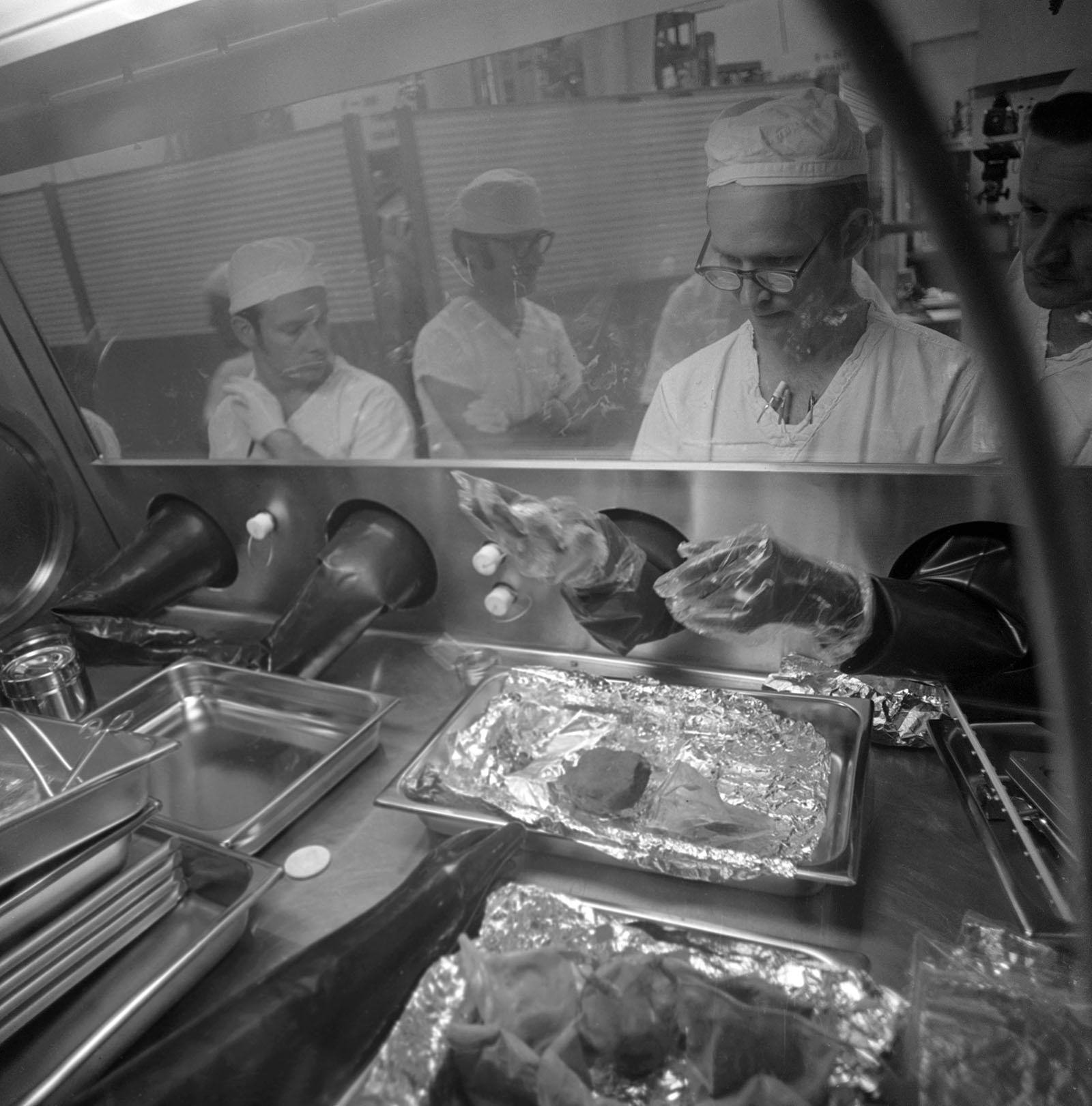
After the aborted flight of Apollo 13, the quarantine remained in force for 14, since it was scheduled to take a deep lunar core sample, which might be different from surface samples.81 So Alan Shepard, Ed Mitchell, and Stuart Roosa spent their time in the quarantine area of the Lunar Receiving Laboratory, the last lunar explorers to do so. When no further evidence of exotic diseases or organic material appeared, the requirement was finally revoked, although the ICBC would continue to function through Apollo 17.82
Notes
- U.S. Congress, House Committee on Science and Astronautics, 1971 NASA Authorization, Hearings on H.R. 15695, 91/2, Feb. 1970, vol. 1, pp. 2-38; W. David Compton and Charles D. Benson, Living and Working in Space: A History of Skylab, NASA SP-4208 (Washington, 1983), pp. 115-16.
- Idem, 1971 NASA Authorization, vol. 1, p. 7. The Electronics Research Center (ERC) in Cambridge, Mass., proposed in 1963, had provoked serious opposition from the start. Nonetheless, ERC was approved and began operation in 1965 while permanent buildings were being constructed. By late 1969, when ERC was abolished, some $80 million had been invested in buildings and equipment. The facility was transferred to the Department of Transportation in March 1970. See House Committee on Science and Technology, Toward the Endless Frontier: History of the Committee on Science and Technology, 1959-79 (Washington: U.S. Govt. Printing Office, 1980), pp. 219-31.
- Thomas O'Toole, “3 Apollo Cancellations Weighed for Big Skylab,” Washington Post, July 9, 1970.
- National Archives and Records Service, Weekly Compilation of Presidential Documents, Aug. 17, 1970, pp. 1056-57; cited in NASA, Astronautics and Aeronautics, 1970, p. 263.
- Thomas O'Toole, “NASA Head Quits, Plans to Rejoin GE,” Washington Post, July 29, 1970; Richard D. Lyons, “Paine Quits Post in Space Agency,” New York Times, July 29, 1970.
- NASA, “FY 1971 Interim Operating Plan News Conference,” Sept. 2, 1970, transcript; Thomas O'Toole, “2 Moon Landings Canceled by NASA,” Washington Post, Sept. 3, 1970.
- “FY 1971 Interim Operating Plan News Conference.” One Saturn V was earmarked for the launch of Skylab; later NASA built a backup Skylab orbital workshop and committed another Saturn V to launch it. Never used, the workshop is now in the National Air and Space Museum and its launch vehicle was put on exhibit at Kennedy Space Center. The third Saturn V is on display at the Johnson Space Center beside a Mercury-Redstone - relics of the heroic age of manned space flight; John E. Naugle to Dir., JSC, “Disposition of Residual Apollo Hardware,” June 17, 1977.
- “Retreat From the Moon,” New York Times, Sept. 4, 1970.
- Richard D. Lyons, “Scientists Decry Moon Flight Cut,” New York Times, Sept. 4, 1970, and “New Cuts For Apollo: 'No Gas for The Rolls Royce?',” ibid., Sept. 6, 1970.
- Harold C. Urey, Washington Post, Sept. 17, 1970.
- Gerald J. Wasserburg, Los Angeles Times, Sept. 15, 1970. “Return to the dark ages of planetary science” seems to overstate the consequences of canceling two lunar exploration missions, but as a veteran observer of science politics noted, scientists were insecure about financial support and inclined to rhetorical extravagance when lamenting cutbacks in funding: “they recognize no territory between paradise and hell.” Daniel S. Greenberg, “Mr. President Meets Mr. Wizard,” Washington Post, Dec. 6, 1976.
- Edward Clinton Ezell and Linda Neuman Ezell, On Mars: Exploration of the Red Planet 1958-1978, NASA SP-4212, pp. 185-92. See also House, Toward The Endless Frontier, pp. 272-76.
- Compton and Benson, Living and Working in Space, pp. 182-85.
- Letter to George P. Miller, signed by 39 lunar scientists, Sept. 10, 1970, copy included in House Committee on Science and Astronautics press release, Sept. 21, 1970.
- Miller to multiple addressees, Sept. 21, 1970, House Committee on Science and Astronautics press release, Sept. 21, 1970.
- Rocco A. Petrone to multiple addressees, “Apollo Site Selection Board Minutes of Meeting,” Mar. 16, 1970; James A. McDivitt to multiple addressees, “Apollo Site Selection Board Meeting March 6, 1970” ; Myers to Administrator, “Manned Space Flight Weekly Report - March 9, 1970,” Mar. 9, 1970.
- Calio to Mgr., Apollo Spacecraft Program, “Site Selections for Apollo Missions 14 and 15,” May 8, 1970.
- U.S. Congress, Senate, Apollo 13 Mission Review, Hearings before the Committee on Aeronautical and Space Sciences, 91/2, June 30, 1970, p. 52; “Apollo 13 Rescheduled,” NASA Release 70-5, Jan. 8, 1970; John Noble Wilford, “Apollo 14 to Use Cart on the Moon,” New York Times, Jan. 20, 1970; Richard D. Lyons, “NASA and 2 Companies Blamed for Apollo Blast,” New York Times, June 16, 1970.
- Bendix Corp., Mission Assignments, “Apollo Lunar Surface Experiments Package (ALSEP),” no date [c. Dec. 1970], box 079-51, JSC History Office files.
- “New Labor-Saving device: the MSC 'Rickshaw,'” MSC Roundup, Jan. 30, 1970.
- MSC-03465-Rev. A, “Flight Crew Health Stabilization Program,” Oct. 26, 1970; “MSC Flight Readiness Review, Apollo 14,” part IV, Dec. 11, 1970, pp. 13-14; “Crew Health Stabilization Plan Announced for Apollo 14,” MSC Roundup, Oct. 9, 1970.
- “MSC Flight Readiness Review, Apollo 14,” part IV, pp.27, 31-34; MSC-04112, “Apollo 14 Mission Report,” May 1971, pp. 10-14 to 10-15.
- Benson and Faherty, Moonport, pp. 494-96.
- Myers to Administrator, “Manned Space Flight Weekly Report - January 11, 1971,” Jan. 11, 1971.
- Benson and Faherty, Moonport, p. 499.
- MSC, “Apollo 14 Mission Report,” MSC-04112, May 1971, pp. 1-1, 9-3, 14-1 to 14-5.
- Ibid., p. 3-19.
- Ibid., p. 6-2.
- Ibid., pp. 6-2, 6-7.
- MSC, “Apollo 14 Technical Air-to-Ground Voice Transcription” (hereinafter cited as “14 Air-to-Ground”), pp. 400-401.
- 14 Air-to-Ground, p. 449.
- Ibid., pp. 449-531, 535-54, 575-85.
- Ibid., pp. 637-68; MSC, “Apollo 14 Technical Crew Debriefing,” Feb. 17, 1971, pp. 10-35 to 10-36, 10- 50 to 10-57.
- “Apollo 14 Mission Report,” p. 1-2.
- 14 Air-to-Ground, p. 723; “Moon Trip Prescribed For Golf Ills,” Washington Post, Feb. 18, 1971. Shepard’s golf club was fashioned at his request by technicians in MSC’s Technical Services Division. According to Jack Kinzler, chief of Technical Services, it was “bootlegged” through the shops because no one wanted to draw high-level managerial attention to it.
- “Apollo 14 Mission Report,” p. 4-4, 4-5.
- 14 Air-to-Ground, pp. 757-67.
- “Apollo 14 Mission Report,” pp. 6-4, 6-10.
- Ibid., pp. 5-1 to 5-6.
- Ibid., pp. 11-3 to 11-7, 10-15. It later came out that Edgar Mitchell had participated in an experiment of his own, not in the official flight plan. In cooperation with a Midwestern drafting engineer who claimed psychic powers, he attempted some telepathic communication with earth at various times during the flight. See “Apollo ESP test told,” Washington Daily News, Feb. 22, 1971.
- MSC to Grumman Aircraft Engineering Co. (GAEC), contract change authorization (CCA) no. 2002, Amendment no. 1, “LM Modifications Study for Extended Lunar Staytime,” Mar. 13, 1969: Samuel C. Phillips, TWX to MSC, May 9, 1969; MSC to GAEC, CCA no. 2333, “LM-10 and Subsequent Modification Program,” June 9, 1969.
- GAEC LMA790-2, “Lunar Module Modification Program [LMMP], Vehicle Familiarization Manual,” Aug. 28, 1969.
- Joseph N. Kotanchik to Asst. Dir. for Chemical and Mechanical Systems, MSC, “Report on Attendance at LMMP CDR at GAC, September 12, 1969,” Sept. 15, 1969; GAEC, “LMMP Critical Design Review Board Meeting Minutes, September 12, 1969,” Sept. 17, 1969.
- Lee R. Scherer to multiple addressees, TWX, May 27, 1969.
- Saverio F. Morea, MSFC, to James A. McDivitt, “LRV Weight Growth,” Nov. 6, 1969; McDivitt to Roy E. Godfrey, MSFC, Dec. 12, 1969.
- McDivitt to multiple addressees, “Lunar Roving Vehicle,” Nov. 1, 1969; George E. Mueller to Administrator, “Manned Space Flight Weekly Report - November 3, 1969,” Nov. 3, 1969.
- Roger E. Bilstein, Stages to Saturn: A Technological History of the Apollo/Saturn Launch Vehicles, NASA SP-4206 (Washington, 1980), pp. 376-77.
- Donald C. Wade to multiple addressees, “August 12 Saturn V payload improvement meeting,” Aug. 15, 1969; John D. Hodge to Phillips, “Increased Saturn V Payload Capacity,” Aug. 29, 1969.
- J. O. Cappellari, Jr., ed., “Where on the Moon? An Apollo Systems Engineering Problem,” The Bell System Technical Journal 51(5) (May-June 1972): 1028-34; Rocco A. Petrone to multiple addressees, “Saturn V Performance Capability for Apollo 16-20,” Nov. 24, 1969.
- Cappellari, “Where on the Moon?” , p. 1030.
- Richard G. Smith, MSFC, to Petrone, “Use of 510 Launch Vehicle for 107,000 Pounds Payload Mission,” July 22, 1970.
- Scherer, “Minutes of the Apollo Site Selection Board Meeting, Oct. 30, 1969” ; Farouk El-Baz and D. B. James, “Minutes of the August 12-14 Meeting of an Ad Hoc Working Group on the Science Objectives of Apollo Missions 12-20,” Bellcomm Memo for File, Aug. 18, 1969.
- Gene Simmons to Dr. Charles H. Townes and Dr. John Findlay, Oct. 21, 1969; Urey to Townes and Findlay, Oct. 27, 1969. Urey felt unable to attend more meetings because “I shall miss three classes this quarter in my thermodynamics course - one to attend the Flagstaff [site evaluation] meeting and two to collect medal awards…. I cannot serve on more committees and do my university work.”
- Simmons to Townes and Findlay, Oct. 21, 1969.
- Scherer, “Minutes of the Apollo Site Selection Board Meeting, Oct. 30, 1969.”
- Ibid.
- “Group for Lunar Exploration Planning, Minutes of Meeting, February 6-7, 1970” ; A. J. Calio to Mgr., Apollo Spacecraft Program, “Site Selections for the Remaining Apollo missions,” Mar. 24, 1970.
- Calio to Mgr., Apollo Spacecraft Program, “Site Selections for the Remaining Apollo missions,” Mar. 24, 1970.
- Idem, “Site Selections for Apollo missions 14 and 15,” May 6, 1970.
- Ronald L. Berry to Chief, Lunar Mission Analysis Branch, “Results of the Sub-GLEP Apollo Site Selection Meeting on June 5, 1970,” June 17, 1970; Hinners to multiple addressees, “Subgroup Meeting of June 5, 1970,” June 10, 1970.
- Minutes of the Apollo Site Selection Board Meeting, Sept. 24, 1970; Calio to Mgr., Apollo Spacecraft Program, “Landing Site Recommendation for Apollo 15 Mission,” Aug. 17, 1970.
- Berry to multiple addressees, “Results of the Apollo Lunar Landing Site Selection Board Meeting of September 24, 1970,” Sept. 30, 1970; Minutes of the Apollo Site Selection Board Meeting, Sept. 24, 1970.
- NASA Release 69-115, Aug. 7, 1969; Thomas O'Toole, “Veteran Astronauts Lovell, Shepard to Lead '70 Moon Flights,” Washington Post, Aug. 7, 1969; “Before We Start to Mars,” ibid., Aug. 8, 1969.
- Paul Recer (Associated Press), “They Feud Over Moon Flights,” The Miami Herald, Aug. 18, 1969.
- B. J. Richey, “Lunar Landing Teams Are Unlikely To Include Scientists Until 1971,” St. Louis Globe Democrat, Aug. 18, 1969.
- Richard Witkin, “Scientist Expected to Be Picked for Moon Trip,” New York Times, Dec. 12, 1969.
- NASA Release 70-46, “Apollo 15 Crew Selected,” Mar. 26, 1970.
- Harrison H. Schmitt interview, May 30, 1984.
- Homer E. Newell, Beyond the Atmosphere: Early Years of Space Science, NASA SP-4211 (Washington, 1980), p. 210; handwritten notes on meetings with scientist-astronauts, Houston, Jan. 12-13, 1971, in Newell’s notebook, box 28 of the Newell files stored in the Federal Records Center, Suitland, Md., accession no. 255-79-0649; Newell to Dr. Fletcher, July 21, 1971.
- Ibid.
- Dale D. Myers to Charles H. Townes, Mar. 1, 1971.
- Compton and Benson, Living and Working in Space, p. 220.
- NASA Release 71-31, "Apollo 16 Crew Selected," Mar. 3, 1971.
- A. P. Vinogradov, “Preliminary Data on Lunar Ground Brought to Earth by Automatic Probe Luna-16,'” in Proceedings of the Second Lunar Science Conference, A. A. Levinson, ed. (Cambridge: MIT Press, 1971), pp. 1-16.
- Norman J. Hubbard and Paul W. Gast, “Chemical composition and origin of nonmare lunar basalts,” ibid., pp. 999--1020; John Noble Wilford, “Exotic Fragments Found In Apollo Lunar Samples,” New York Times, Jan. 11, 1971.
- Wilford, Exotic Fragments ;Ursula B. Marvin, J. A.Wood, G. J. Taylor, J. B. Reid, Jr., B. N. Powell, J. S. Dickey, Jr., and J. F. Bower, “Relative Proportions and Probable Sources of Rock Fragments in the Apollo 12 Samples,” Proceedings of the Second Lunar Science Conference, pp. 679-99
- Arthur Hill, “Primitive Lunar Crust Is Hinted by Fragments,” Houston Chronicle, Jan. 11, 1971.
- Cappellari, “Where on the Moon?” , pp. 990-94.
- Earl H. Arnold, “Minutes, Interagency Committee on Back Contamination, January 15, 1970.”
- Space Science Board, National Academy of Sciences, “Report of Meeting on Review of Lunar Quarantine Program, February 17, 1970.”
- J. W. Humphreys, Jr., to Dir., Apollo Program, “Quarantine for Apollo 14 and Subs,” July 16, 1970.
- Humphreys, TWX to multiple addressees, “Discontinuation of Lunar Quarantine,” Apr. 28, 1971; Myers to MSC Director, “Decision to Terminate Quarantine,” May 10, 1971 with encl., “Decision to Terminate Quarantine Under NMI 1052.90 (Attachment A, Change 1, 2),” signed by George M. Low, Apr. 26, 1971.