SELECTING AND TRAINING THE CREWS
From the moment the lunar landing was proposed as the primary goal of manned space flight, NASA officials and outside scientists debated the qualifications of the people who would land on the moon. Scientists urged that at least one of the crew should be a scientist with enough experience to assess the significant features of the landing site quickly and accurately and to collect samples with discrimination. Those responsible for mission operations and crew training insisted that mission success and crew safety could be assured only if every crew member were a skilled pilot, preferably a test pilot, able to complete a mission alone if that unlikely situation should ever arise. Once the many unknowns in lunar landing operations were better understood, it might be considered safe to take along a person with different qualifications.1
Finding crew members who combined the experience of a scientist with the skills of a test pilot proved impossible. For the first five years, during the experimental and developmental phase of the Apollo program, piloting experience took precedence over scientific training as a requirement for admission to the astronaut corps. Later, as missions devoted largely to scientific operations were contemplated, scientists were admitted and trained as pilots.
Test-Pilot Astronauts
Before Project Mercury, design concepts for manned spacecraft were constrained by a lack of hard facts about the human ability to function in the space environment. Many believed that electronic systems, controlled from the ground or programmed for specific contingencies, offered the only safe and practical means of operating a spacecraft. From this point of view, the person in the spacecraft was simply a passenger, an experimental subject whose main function would be to provide the physiological data needed to define the limits of a human’s role in space. Mercury’s designers did not completely agree with this philosophy; they conceived a spacecraft in which the pilot could take control of critical systems if necessary and would have some measure of control at all times.2
Within months of the start of Project Mercury NASA selected its first group of pilots for the early earth-orbital flights. The “Original Seven,” all military test pilots* with strong engineering backgrounds, were volunteers picked from a list of more than a hundred men provided by the Pentagon [see Appendix 6].3 In view of Mercury’s experimental character, the choice of test pilots was appropriate; they were accustomed to dealing with emergencies under stressful conditions and were familiar with the physical and psychological stresses of high-speed flight in unproven aircraft.
* NASA originally intended to issue a general solicitation of applications for the position of “research astronaut-candidate,” and considered that several occupations besides test pilot might qualify. President Eisenhower, however, directed the agency to select its astronauts from the ranks of military test pilots; this would simplify selection, keep out undesirable applicants, and eliminate the need to run security checks on the candidates.
In choosing test pilots as its first astronauts, NASA came down on the side of people as active participant in spacecraft operations. It was yet to be shown how much humans could effectively participate, but the astronauts in the first group insisted on giving the pilot as much responsibility for control of the spacecraft as feasible; if the pilot did not operate the spacecraft, what was the point of a person in space (especially a test pilot)? Most of the engineers in the Space Task Group agreed with this viewpoint. In light of their long NACA experience with piloted aircraft, they too inclined toward giving pilots all the control they could safely handle.4
When the first group of astronauts entered the program in April 1959, Project Mercury and the Space Task Group were organizationally in flux. As a result, the Original Seven defined the role of the astronaut for the entire Apollo program. Administratively they reported not to any project office but directly to Robert R. Gilruth, director of the Space Task Group. For most of Gilruth’s career in NACA he had worked with pilots, and he took a special interest in this group. Shortly after the astronauts reported aboard he assured them that whenever they had serious concern with any aspect of spacecraft design or mission operations he would see that they were listened to.5
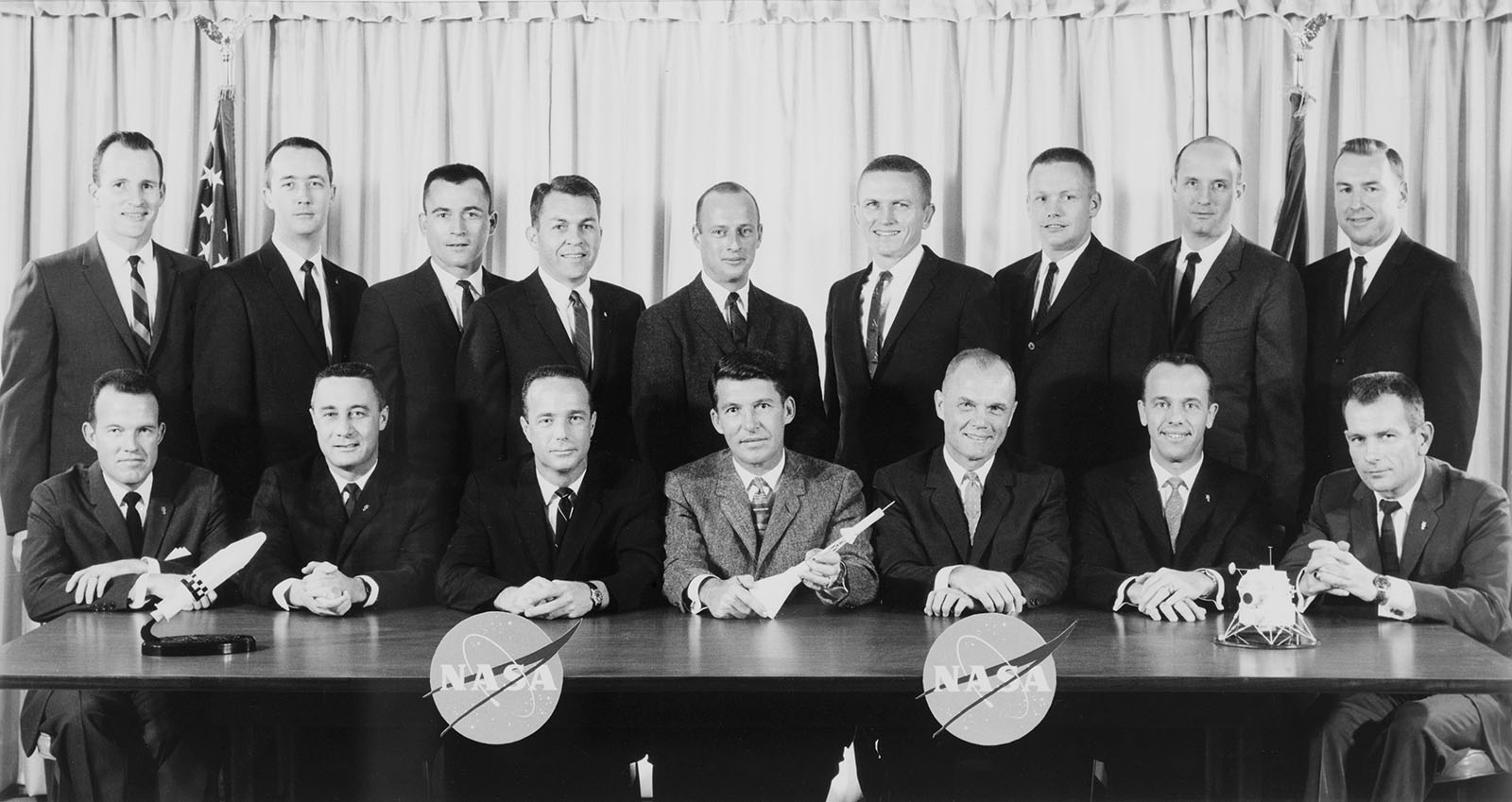
Given this kind of autonomy the astronauts were considerably more than pilots in training to operate a new vehicle. While undergoing training they also took an active part in reviews of spacecraft design and operations planning, offered suggestions from the pilot’s point of view, and contributed to the design of the flight simulators that soon became an important part of astronaut training. Each person was assigned an area of spacecraft systems or operations planning (e.g., attitude-control systems, communications, recovery operations) as a prime responsibility; in his specialty he closely followed developments and served as the point of contact between his astronaut colleagues and project engineers.6 Training was strongly engineering- and operations-oriented, a pattern that would be carried into subsequent projects.
Scientists Call for Representation on Apollo Crews
NASA’s scientific advisory community first addressed the role of the astronaut in space science at the Iowa Summer Study in 1962 [see Chapter 2 and Chapter 3]. Concerning humans on the moon, the study report stated the belief that it is extremely important for at least one crew member of each Apollo lunar mission to possess the maximum scientific ability and training consistent with his required contribution to spacecraft operations.
This person should participate “in the earliest possible lunar missions,” and, since the chosen mode of operations called for only two men on the lunar surface, “the maximum scientific return will be achieved only if the scientist himself lands on the Moon.” 7
A working group of the 1962 summer study considered in detail the role of people in space exploration, formulating the scientists' position with reference to science missions of many types, not merely lunar exploration. The group defined several combinations of scientific and astronautic skills that would be appropriate for different degrees of scientific participation in manned space missions. At the top of the scale was the “scientist-astronaut” ; fully trained both as a scientist and as an astronaut, he could operate the spacecraft as well as make valid scientific observations. For the long term, the working group recommended creating an Institute for Advanced Space Study - a graduate-level institute with a unique curriculum in which candidates holding bachelor’s degrees would be trained as scientist-astronauts [see Chapter 3]. Meanwhile, aspirants to this position should be recruited from among qualified scientists and trained to achieve comparable qualifications as astronauts.8
The working group recognized that no such scientist-astronauts could be trained in time for a lunar landing within the decade. For the short term, they acknowledged that the best course was to give qualified astronauts as much training in science as possible, so that they could be useful observers for the scientist on the ground. These “astronaut-observers” were expected to play a role in lunar exploration even after fully trained scientist-astronauts became available. Others who would be important in conducting space science missions were the “ground scientist,” a scientist thoroughly familiar with all the details of space flight operations, who would direct the activities of the astronaut-observer from the ground; and the “scientist-passenger,” ** a scientist physically qualified for space flight but not trained to operate the spacecraft.9
** Fifteen years would pass before NASA had scientist-passengers, now known as “mission specialists” and “payload specialists,” who began flying on Shuttle missions in the early 1980s.
Not surprisingly, the summer study report repeatedly emphasized the need for the scientist-astronaut to keep up with his science; the scientist who does not maintain a continuous research program falls behind his colleagues who do and loses his standing in the scientific community. At the same time, the tone of the working group’s findings implied that the techniques of operating the spacecraft could be learned by any intelligent person in a couple of years and were therefore of subsidiary importance. The level of comprehension of the astronaut’s task was indicated by the responses - summarized in the report - to a questionnaire sent by the Space Science Board to a number of scientists. On the question of whether the first scientist on the moon should also be an astronaut, the consensus of those responding was:
Of course. He should be familiar with all aspects of the spacecraft and be able to take over in an emergency. However, his qualification as a crew member would not depend so much on his ability as a space-pilot as on his scientific aptitude.
To the question of how astronaut-scientists should be developed, the scientists replied that graduate students or early postdoctoral fellows should be picked and trained
for at least four or five years. They should go through astronaut training for part of each year to become familiar with the problems of space flight. It is hoped that this would not involve too large a fraction of their time [emphasis added], since emphasis should be on their development as scientists.10
In 1962, of course, few people fully understood the demands that would be made of Apollo crews; but if these statements reflected opinions widely held in the science community concerning the training required to become a proficient astronaut, it is not surprising that misunderstandings developed when the time came to choose crews for the lunar landing missions.
Organizing the Astronaut Corps
The first group of astronauts immediately became public figures, and as Mercury shifted into flight operations in the closing days of 1961, demands on their time for interviews and personal appearances multiplied. NASA welcomed the publicity for the space program, but this aspect of the astronauts' status often made impossible demands on their heavy training schedule. And when a second program, Gemini, was established late in the year, it was clear that more astronauts would be entering the program, further complicating training and flight preparations. When Space Task Group managers decided that someone should be appointed to organize the astronauts' activities more efficiently, some of the astronauts suggested that they would prefer to have one of their own rather than an outsider in that job. As it happened, one was available.
Air Force Captain Donald K. (“Deke”) Slayton, assigned to the second Mercury orbital flight, had been grounded a few weeks before the mission when physicians discovered a minor (and, as it turned out, apparently harmless) irregularity in his heartbeat. Although no one could definitely say that Slayton’s condition would endanger him or the mission, neither would any medical expert assure NASA that no risk was involved. Prudence, a quality which NASA’s high-level managers possessed in full measure, dictated that someone without any detectable abnormality should fly the mission instead, and Slayton was grounded until the physicians could be confident he was physically qualified to fly.11
Slayton was one of the most experienced of the original seven astronauts. He had flown combat missions in Europe and the Pacific in World War II and had been a test pilot assigned to fighter operations at the Air Force Flight Test Center at Edwards Air Force Base when he was selected as an astronaut. His personal commitment to the manned space program was complete. He had vigorously defended the cause of humans in space before the Society of Experimental Test Pilots when most test pilots, unfamiliar with the actual course that the project was taking, considered that Mercury offered them no future and little valuable experience. His disqualification, especially on physical grounds, was a shock to everyone in the project as well as to the public. It was personally devastating to him; besides losing out in the competition for a space flight assignment, he was forbidden by the Air Force to fly alone in high-performance aircraft.12
In September 1962 Slayton was appointed Coordinator of Astronaut Activities, reporting to Gilruth. Without complaint, he took over the largely administrative duties of scheduling training activities, visits to contractor plants, and public appearances and interviews with the news media. But the most important responsibility he assumed was that of assigning astronauts to specific missions. This responsibility he shared with no one else; although he had plenty of help in assessing each candidate’s personal and professional qualifications and mastery of the spacecraft systems and mission plans, Slayton made the final decision. His decisions stuck: in the entire manned program, from the later Mercury flights through the Skylab missions, he could later recall only one instance in which higher authority challenged his judgment.13
When the Manned Spacecraft Center was reorganized the following year, Slayton’s position was redesignated Assistant Director for Flight Crew Operations, organizationally on a level with the assistant directors*** for engineering, flight operations, and administration.14 For some time he was also chief of the Astronaut Office, the administrative unit that coordinated training and other astronaut activities, and he continued training with the first two groups as much as he could, hoping for eventual reassignment to flying status. Under Deke Slayton the Astronaut Office was run much like a military unit - which for several years it effectively was, since almost all the astronauts were or had been Air Force, Navy, or Marine officers. He encouraged open communication between himself and the astronauts, but expected that when a decision had been made the discussion was finished. As one of the astronauts characterized Slayton’s management style, the astronaut’s job was “to do what the commanding officer says, and if you (didn't) want to…, the door was always open” 15 - the door marked “this way out.” Astronauts came into the program voluntarily and they could always leave the same way.
*** The title “Assistant Director for…,” meant “assistant to the director of MSC in charge of…“ but was applied to the heads of directorates. This confusing designation was later dropped and chiefs of directorates were called simply “directors of….”
Slayton well understood the position manned space flight occupied in the national space program as a consequence of its prominence in the public eye: any failure, especially one that endangered or killed an astronaut, could set back the lunar landing for years, and might even kill the manned space flight program. His contribution to avoiding failure was to pick the best people for the crews, and as long as manned space flight entailed any hazardous uncertainties, the best people would be experienced test pilots.
More Missions, More Astronauts
While much was learned from Mercury, much more had to be learned before a lunar mission could be planned. Even before President Kennedy’s decision to go to the moon was announced, Space Task Group engineers were planning the second phase of manned space flight. Project Gemini, approved in early December 1961, would test various techniques of rendezvous, determine whether men and systems could survive and function during long missions, investigate the radiation environment in near-earth space, and develop techniques for controlled landings. Twelve missions were planned, ten of them manned, to start in the spring of 1964 and fly at two-month intervals.16
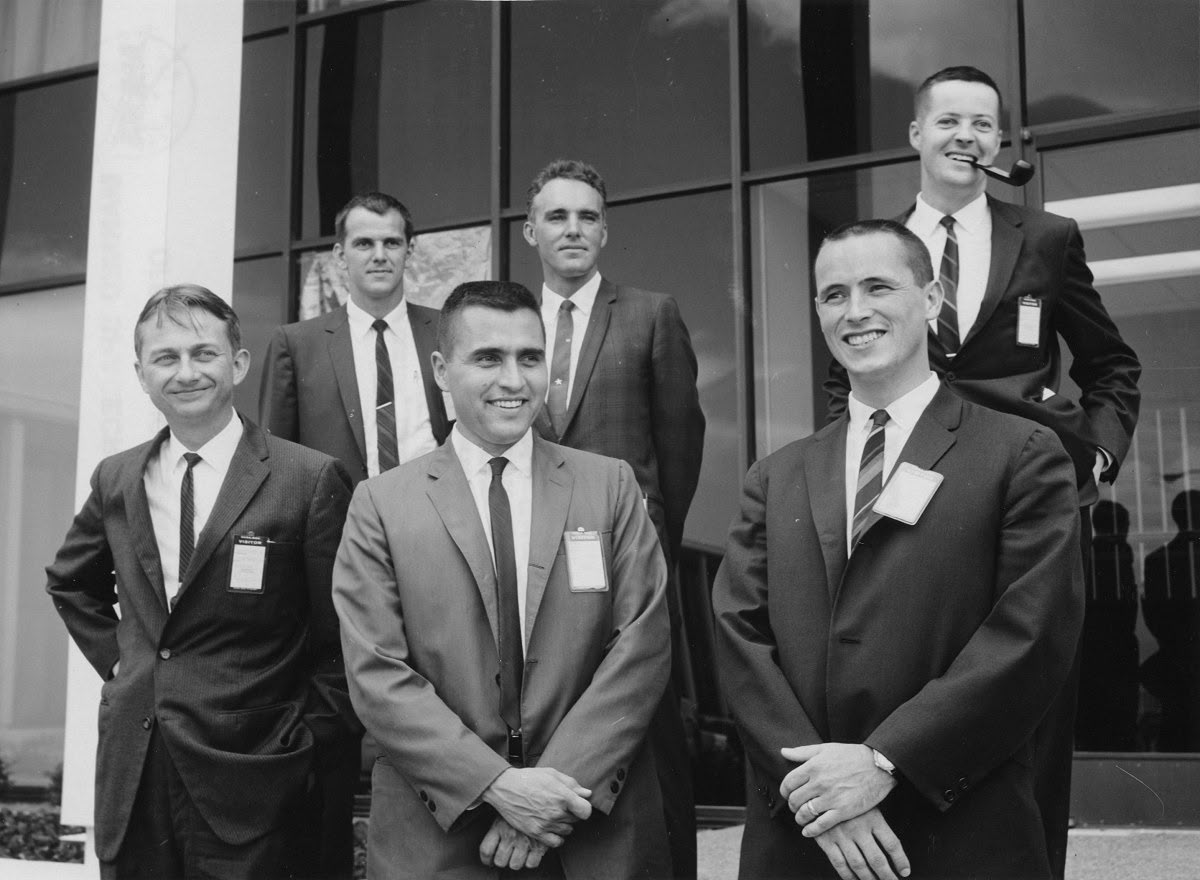
Additional missions required additional astronauts, and on April 18, 1962, NASA announced it would accept applications for trainees. Once more test pilots were given preference, but the required number of flying hours was reduced, and civilians as well as military pilots were eligible. The upper age limit was reduced from 40 to 35 and the education qualification broadened to include degrees in physical or biological sciences as well as engineering.17 A list of more than 250 applicants was cut to 32 by preliminary physical and psychological screening. After intensive evaluation in Houston, nine new astronaut trainees were chosen in September 1962: two civilians, four Air Force pilots, and three Navy officers, including some who had applied for the first group but had not been selected [see Appendix 6].18 Selection of this group virtually depleted the pool of qualified candidates from the small corps of test pilots in the country, and it was the last group for which test-pilot certification would be a requirement.19
The new trainees reported at Houston in October 1962 to begin a two-year training course. A four-day work week was normally scheduled, the fifth day being reserved for public relations duties or for travel.20 After two weeks of orientation to NASA’s organization and familiarization with the near-complete Mercury project, the second class, joined by the first group, started on a three-month “basic science” course interspersed with briefings on Gemini and Apollo projects and systems. The classroom work covered astronomy, aerodynamics, rocket propulsion, and the physics of orbital flight and re-entry; it included lectures on computers, space physics, and the medical aspects of space flight. Almost one-third of the classroom time was spent on navigation and guidance. In mid-January 1963 the class flew to Flagstaff, Arizona, for a series of geology lectures and field trips conducted by Eugene Shoemaker.21
As the Apollo program came into clearer focus in 1962, MSC officials saw that they needed still more astronauts. At the end of the year projected manned flights included four development flights of the Saturn I, four of the Saturn IB (an “uprated” version of the Saturn I), and one of the Saturn V, starting in late 1964 and flying at three-month intervals until mid 1967.22 The 16 astronauts in training would not be enough to staff the 10 Gemini missions plus the 9 scheduled for Apollo, and in April 1963 MSC announced its intention to recruit a third class of trainees.23 On June 18 the Houston center issued its formal call for applications. For this group the requirement for flight experience was relaxed still further: 1,000 hours of jet time could substitute for test-pilot certification. The selection board might consider advanced degrees in engineering or science as offsetting some lack of flight experience. Industry, professional organizations, and the armed services were asked to recommend candidates.24 Manned space flight chief Brainerd Holmes, acknowledging the Space Science Board’s Iowa summer study recommendations, indicated to Congress that scientific qualifications would be taken into account in selecting this group.25
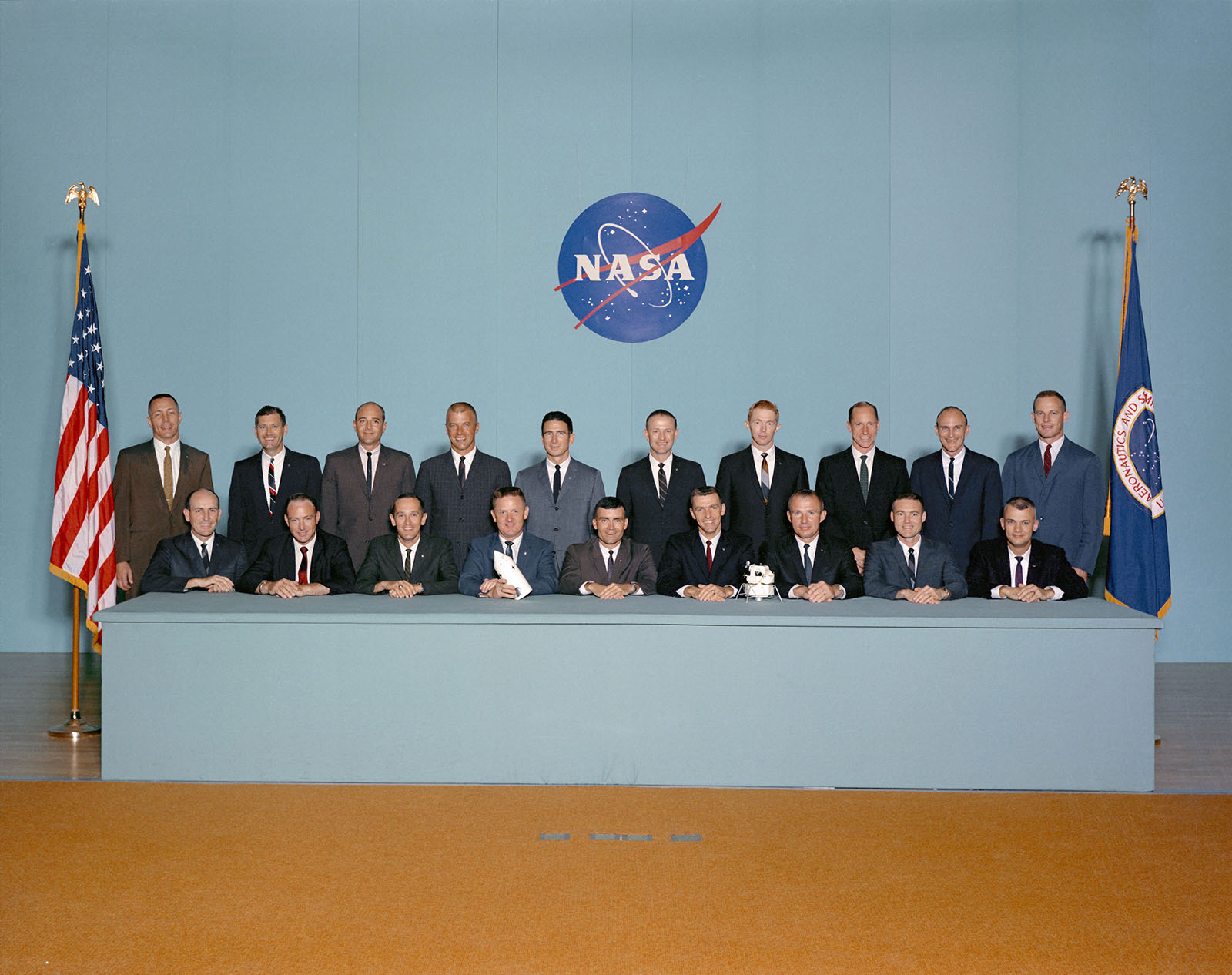
Of 271 applicants responding, 30 were selected for final screening. On October 18, 1963, MSC announced the names of the newest class of astronaut trainees [see Appendix 6]. Again military officers outnumbered civilians, by 12 to 2.26 (At the end of 1963 the astronaut corps comprised 26 military pilots and 4 civilians, all trained in military service.27) The new group was distinguished by a large number of advanced degrees: 8 of the 14 had master’s degrees and one held a doctorate in astronautics. The two civilians were scientists actively engaged in research. Most of the military officers held engineering degrees. In spite of MSC’s obvious preference for pilots, the scientific community raised no outcry about the lack of scientists in the astronaut program. Harold Urey, however, publicly reproved the agency, late in the year, for not recruiting geologists to explore the moon.28
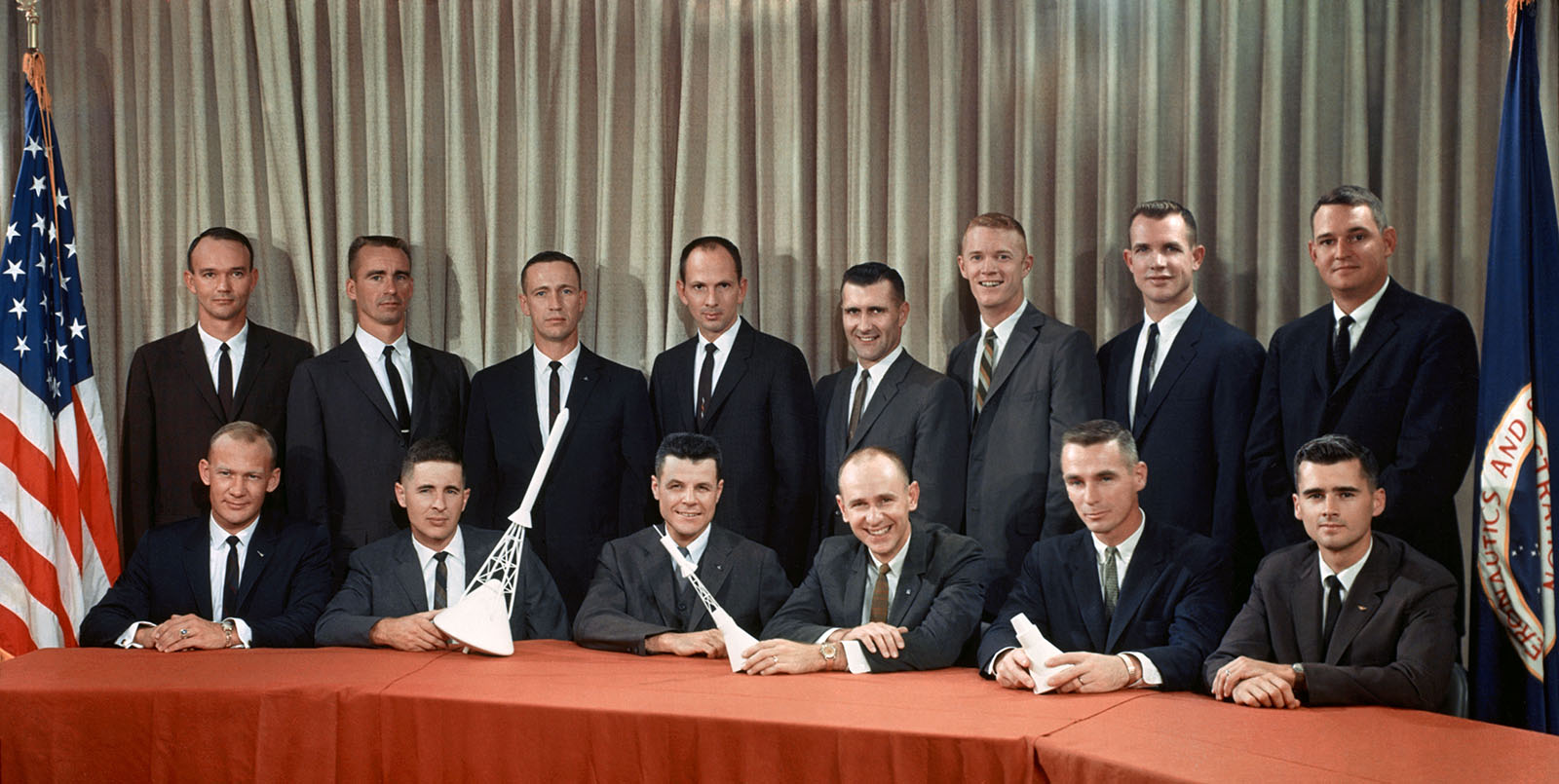
When the new group reported to Houston in January 1964, Slayton had 29 pilots to look after, including 5 Mercury veterans.**** The first four men who would walk on the moon were in training, but at the time all attention focused on Gemini, whose first manned launch was scheduled for November 1964.29
**** John Glenn resigned from the program in January 1964 to enter business (and later, politics). Another Mercury astronaut, Scott Carpenter, would soon be devoting most of his time to the Navy’s Project Sealab, an experimental underwater habitat, although he would retain formal affiliation with the astronaut program for another three and a half years.
Classroom work began in February with a new basic science program, a 20-week series of lectures, briefings, and field trips, strongly oriented toward Gemini but also including substantial chunks of time devoted to geology, which was entirely an Apollo concern. The veterans of the previous year’s training skipped parts of this course to spend time in the Gemini simulators, but the geology sessions were required of everyone. Geologists from MSC and from the Geological Survey guided them through the equivalent of a one-semester college course in land forms and land-forming geologic processes, minerals and their origin, and topographic and geologic mapping. Lectures and laboratory work were supplemented by field trips to study the Grand Canyon, the Big Bend area of west Texas, and the volcano fields near Flagstaff, Arizona, and Cimarron, New Mexico.30 No one expected the astronauts to become fully qualified field geologists as a result of this training, but they could at least learn to interpret what they would see on the moon in terms of its probable geologic history and to recognize important geological specimens if they found any. On the later field trips the geologist-instructors began simulating lunar exploration by sending their pupils into an area with a radio transmitter and instructions to note the geologic features they could see, describe what they considered important, and collect representative samples of rocks and surface material. Their commentary was recorded and the exercise was completed with a detailed critique of their performance.31
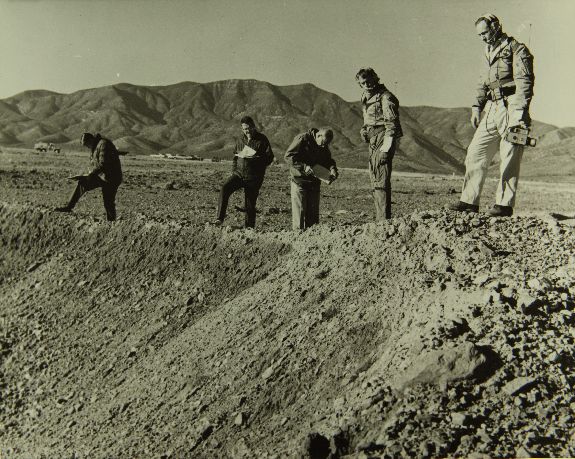
Geology was a new field for most of the engineer-astronauts, rather unlike anything in their experience. What impressed most of them was the large amount of specialized terminology they had to learn-new words having little relation to their accustomed vocabulary. Instructors found them willing enough students, for the most part, but highly variable in their response to the course. Some seemed to be born observers and quickly developed the knack of picking out the distinguishing geologic features of an area and describing them in geologist’s terms; others had more difficulty acquiring the field geologist’s eye. Apart from the problem of adjusting to a new discipline with a novel point of view, the astronauts faced the question of how heavily their performance in geology would count when the time came to select flight crews. Seniority and flying experience seemed to be of prime importance in determining who got the assignments for Apollo flights, and it was important to get picked as early as possible for a Gemini crew. Well aware that no one could completely master every aspect of training, the astronauts sought to shine in those aspects that were most likely to attract Slayton’s attention. For the short-term future at least, geology seemed fairly far down the priority list.32
Moving Into Flight Operations
After a problem-filled 1963, Project Gemini looked toward better things in 1964. The first flight test of the spacecraft and its Titan II launch vehicle went off on April 11, raising hopes of a manned flight before year’s end.33 Two days later, the Manned Spacecraft Center announced the names of the first crews for the two-man earth-orbital missions. As might have been expected, the Commander of the first Gemini mission was one of the Original Seven, Virgil I. (“Gus”) Grissom, who had ridden the second suborbital Mercury flight in July 1961. Paired with Grissom was one of the second astronaut group, John W. Young. Their backup crew likewise had a representative from each of the first two astronaut classes, Walter M. Schirra, Jr., pilot on Mercury-Atlas 8, and Thomas P. Stafford.34
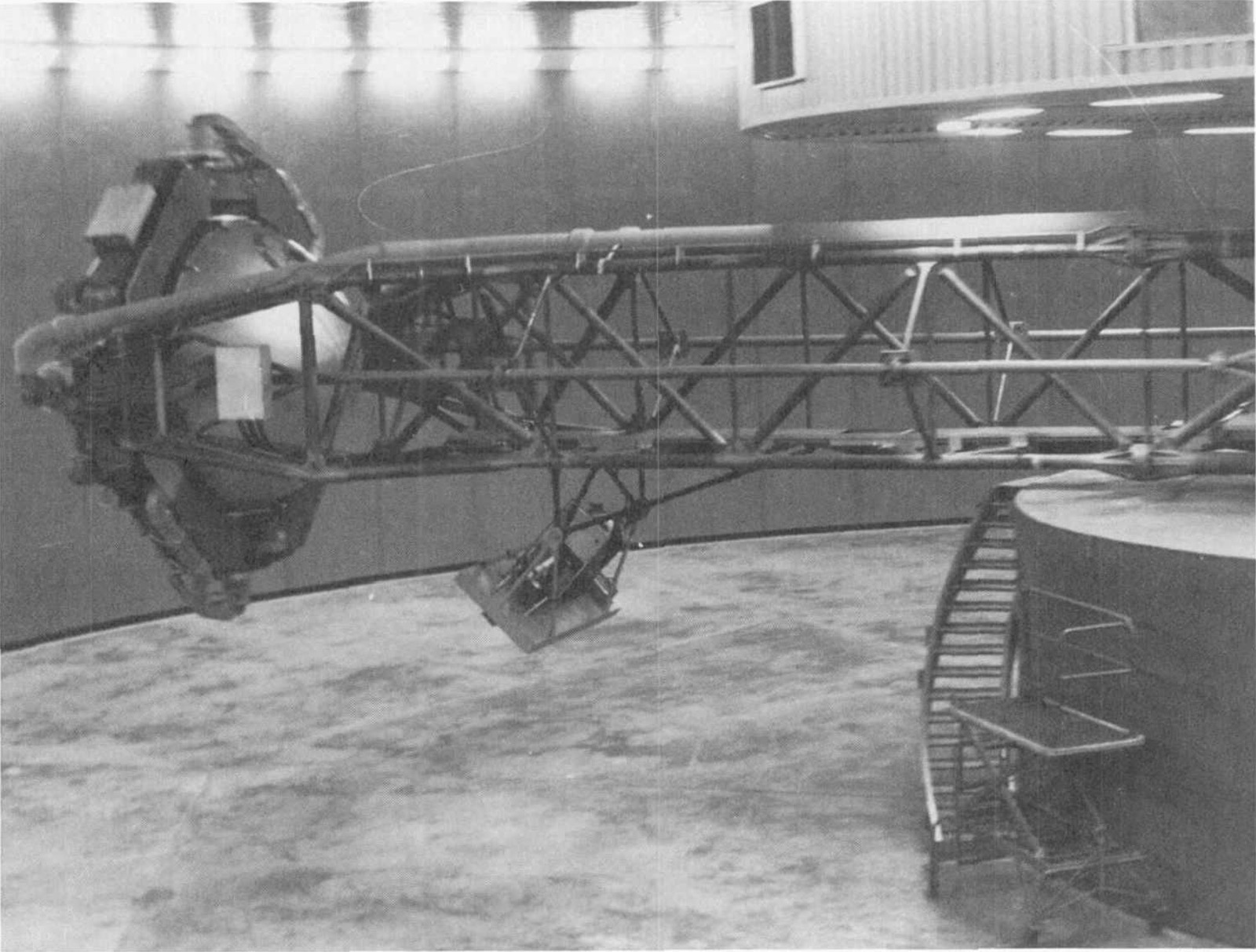
A week after the announcement, the four Gemini crewmen headed into a full mission-specific training schedule. At the spacecraft builder’s plant in St. Louis, at MSC in Houston, and at the Cape in Florida they put in long hours learning the design and function of the spacecraft systems, following the assembly and testing of their spacecraft, attending briefings on program and mission objectives, and practicing such tasks as getting out of a floating spacecraft. Simulators duplicated as closely as possible most of the conditions of launch, orbital flight, and recovery (weightlessness being a notable exception), and in these simulators the crews practiced normal operations as well as all the likely malfunctions their training officers could think of [See Appendix 7 for a summary discussion of simulation and training]. Occasional trips to the Navy’s man-rated centrifuge in Johnsville, Pennsylvania, gave them practice in enduring the acceleration forces (“g-loads”) of launch and reentry. Training stretched from a planned 7 months to 11 when their flight was delayed by problems with the second unmanned test, and by the time their flight was ready for launch on March 23, 1965, the crews would have been hard to surprise with anything that might come up.35
When crews were named on July 27, 1964, for the second Gemini mission, Slayton broke the pattern of designating an orbital veteran as commander, choosing four inexperienced men for Gemini IV even though one Mercury astronaut had not yet been assigned.# James A. McDivitt and Edward H. White II were named commander and pilot of the prime crew, backed up by Frank Borman and James A. Lovell, Jr., all members of the second astronaut class.36 Flight experience seemed clearly to be a factor in Slayton’s choice of crews, but it was just as clearly not the only factor. L. Gordon Cooper, Jr., pilot on the 34-hour, 22-orbit Mercury 9 mission, was not assigned until the Gemini V crew was named in February 1965; his pilot was Charles (“Pete”) Conrad, Jr., of the second group. Their backups, both from the second group, were Neil A. Armstrong and Elliott M. See, Jr.37
# Of the Original Seven, Glenn had resigned, Carpenter was working in Project Sealab, and Slayton was medically disqualified At the press conference naming the Gemini 3 crews it was also announced that Alan Shepard was suffering from a middle-ear inflammation that grounded him as well. (Later that year Shepard took over from Slayton as chief of the Astronaut Office.) Only Cooper remained unassigned at this time.
After Grissom and Young completed Gemini 3, Slayton announced that their backup crew, Schirra and Stafford, would be the prime crew for Gemini VI, backed up by Grissom and Young. To trainees eagerly seeking some clue to their prospects for flight assignment, this signaled that appointment to a backup crew was the key to flying a mission. The system Slayton followed, as long as circumstances permitted, was to promote each backup crew to prime crew of the next available mission after their own prime crew had flown. Each flight had different objectives, requiring different training, and the prime and backup crews had to train as a team to perform most efficiently. Almost to a man, the astronauts professed being in the dark as to exactly how Slayton chose crew members for their first assignment, but that did not matter once they perceived that when they were named to a backup crew they were, at last, in line for a flight assignment.38
Selection of the First Scientist-Astronauts
As the Office of Manned Space Flight began to consider post-Apollo possibilities in 1963-1964, science-oriented missions - lunar exploration and earth-orbital missions of many days' duration - appeared to be the most acceptable of a very few alternatives. The principal theme of George Mueller’s expositions to Congress was the continued use of Apollo’s rockets, spacecraft, and launch facilities to conduct scientific and technological investigations on the moon and in space - to produce a return on the nation’s investment in manned space flight. Mueller’s proposals were criticized as unimaginative and not conducive to the advancement of space technology, but none of NASA’s top managers was willing to advocate bolder programs under the budgetary restraints that were becoming apparent in 1964.39
For any serious scientific work the crews in the spacecraft would have to include some scientists trained as astronauts rather than astronauts trained as scientific observers; and early in 1964 selection of scientists for the astronaut program began. MSC officials and representatives of the National Academy of Sciences met in February to draft a plan for recruitment and selection. Agreement was reached that the Academy would define the scientific qualifications desirable in the candidates while MSC would specify the physical and psychological requirements. On April 16 Homer Newell formally asked Harry Hess, chairman of the Space Science Board, to draw up a statement of the scientific qualifications for a scientist-astronaut.40 In Mid-October, Headquarters announced that it would accept applications from scientists who wanted to become astronauts. The primary requirement was a doctorate in medicine, engineering, or one of the natural sciences. No applicant had to be a qualified pilot; those accepted by the Space Science Board and by NASA would be assigned to the Air Force for a year of flying training.41
Any doubt that scientists were interested in space flight was dispelled by the response: more than a thousand hopefuls sent in their applications. An ad hoc committee of the Space Science Board (chaired in Hess’s absence by Eugene Shoemaker) rigorously scrutinized about 400 of those who passed NASA’s preliminary screening, finally sending only 16 names to NASA for final evaluation.42 MSC had hoped for a larger group to choose from; Slayton’s selection board had much less information on the applicants' physical condition and psychological makeup than they had for military applicants, and the choices were consequently harder to make.43 The Space Science Board, however, was evidently determined to pick only the most promising scientists. Shoemaker later recalled that the committee had been disappointed in the overall quality of the applications that came in. Not many of the scientists who applied came up to the rather high standards they set.44 Whatever the reasons for this, NASA was able to pick only 6 scientist-astronauts instead of 10 or more, as it had initially planned.
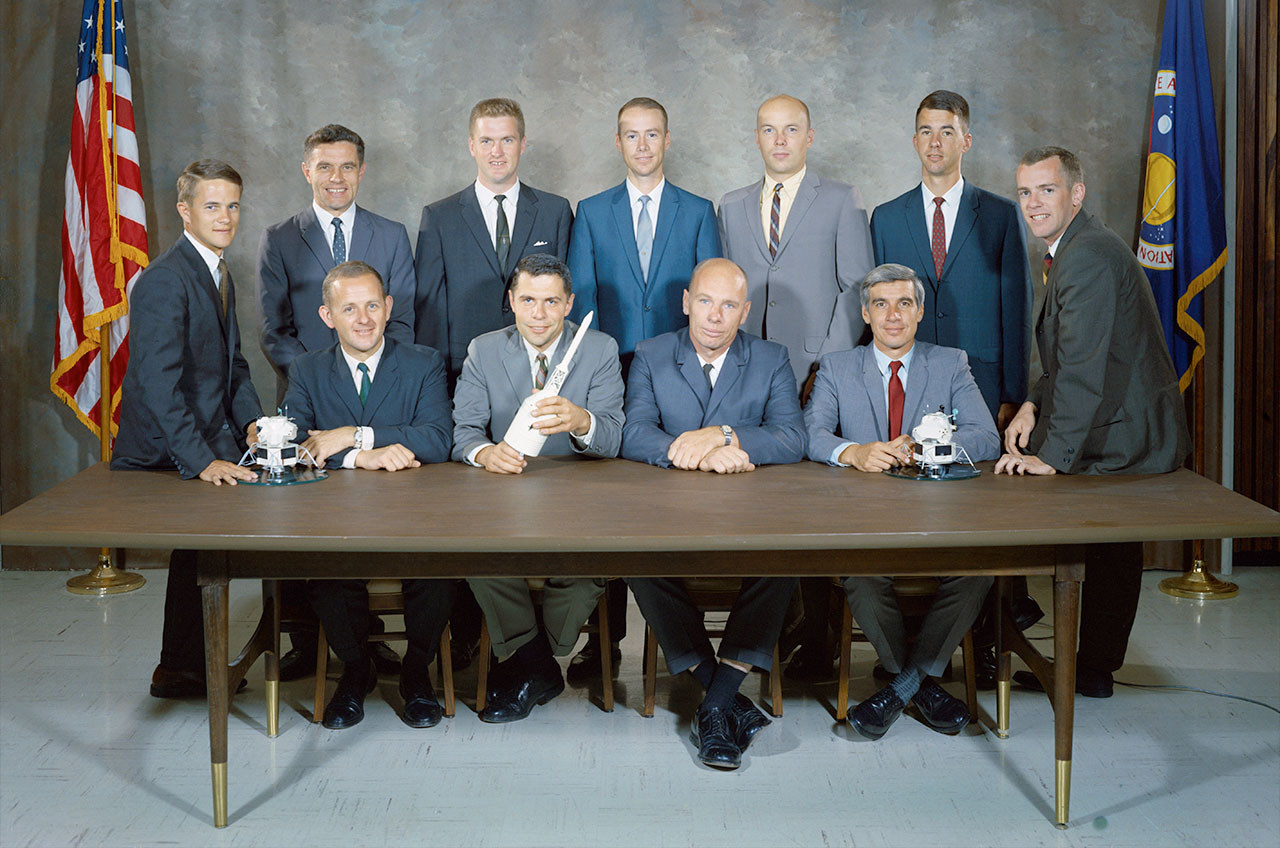
On June 27, 1965, NASA announced the names of its first scientist-astronaut candidates: two physicians, Duane M. Graveline and Lt. Cmdr. Joseph P. Kerwin, MC, USN, and four Ph.D. scientists, F. Curtis Michel, Edward G. Gibson, Owen K. Garriott, and Harrison H. Schmitt (who was generally known by his nickname, “Jack”).45 Kerwin was a flight surgeon stationed at Cecil Naval Air Station in Florida; Graveline, a former Air Force flight surgeon, was working in the medical program at MSC. Gibson, a senior research scientist at the Applied Research Laboratories of Philco’s Aeronutronics Division in San Diego, California, and Garriott, associate professor of physics at Stanford University, were both engineers engaged in research in solar and atmospheric physics. Michel was an assistant professor of physics at Rice University in Houston conducting research in the interaction of the solar wind with the earth’s atmosphere. Schmitt, the lone geologist in the group, was working with Eugene Shoemaker at the Geological Survey’s Astrogeology Branch. The only qualified pilots in the group were Michel, a former Air Force pilot, and Kerwin, a naval aviator. The other four were sent to Williams Air Force Base in Arizona to begin 55 weeks of flying training.46 Within a few weeks Graveline resigned from the program, citing “personal reasons” for his actions.47
Future Plans Require Yet More Astronauts
From 1964 through 1966 George Mueller, chief of manned space flight programs, worked hard to sell an ambitious post-Apollo program to his NASA superiors and to Congress. His Apollo Applications Program (AAP), established in August 1965, contemplated 29 lunar and earth-orbital missions between 1968 and 1971. Two-thirds of them would be manned flights, launched at the rate of eight per year. A manned program of that magnitude seemed to have little chance of becoming reality, but until circumstances forced him to back down from it, Mueller kept the pressure on the field centers to plan for big things.48
At Houston, Bob Gilruth and Deke Slayton - whatever their own views about the probability that such an ambitious schedule could be realized - had to be prepared to furnish crews for whatever emerged as the Apollo Applications Program. If the projected AAP missions should actually materialize, many crews would be needed in short order and training had to begin soon. While the recruitment of scientist-astronauts was under way, Gilruth and Slayton urged that additional pilot candidates be sought at the same time, but Mueller decided to wait until the scientist-astronauts had been chosen.49 When Only six trainees emerged from that selection process, he agreed to go ahead. On September 10, 1965, Headquarters announced it would accept applications for a new class of pilot-astronauts. Qualifications would be the same as they had been for the third group: a bachelor’s degree in science or engineering plus 1,000 hours of jet flying time or qualification as a test pilot.50
The announcement yielded 351 applicants - the largest number of pilots ever to apply - of whom 159 met the basic requirements. Final screening during the next four months produced the fifth class of astronaut candidates in April 1966: 19 pilots, 4 civilians and 15 military officers [see Appendix 6]. Eleven of the fifth group held advanced degrees, two of them doctorates.51
Headquarters Expands the Ranks of Scientist-Astronauts
In mid-1966, when the scientist-astronauts had completed their flying training and the third group of pilots had reported aboard, the astronaut corps numbered 44 pilots## and 5 scientists (or 41 and 8, depending on how Cunningham, Schweickart, and Lind were classified) - a ratio that hardly supported the contention that NASA was interested in sending scientists into space. At the Manned Spacecraft Center, Deke Slayton and Bob Gilruth considered that they had quite enough pilots to carry out the programs they could realistically envision and that pilots could be trained to conduct the scientific work that was planned for the lunar landing missions. At Headquarters, however, both Homer Newell in the Office of Space Science and Applications and George Mueller in the Office of Manned Space Flight thought otherwise. Newell, representing the science community, wanted manned space flight to give more attention to science and less to the engineering and piloting aspects of space flight. Mueller, trying hard to sell an ambitious program of post-Apollo manned missions based largely on scientific research in space, could use more scientists in the astronaut corps to give credibility to his appeals to Congress and to gain political support from scientists outside NASA.
## Three astronaut trainees had been killed in flying accidents in the previous two years. Ted Freeman’s T-38 hit a goose near MSC on Oct. 31, 1964, causing both engines to flame out; he ejected but was too low for his parachute to open. Elliott See and Charles Bassett, prime crew for Gemini IX, crashed on Feb. 28, 1966, after missing a landing approach at St. Louis Municipal Airport under marginal weather conditions.
In spite of Houston’s reluctance to take on astronaut trainees who would have little expectation of flying in space, Headquarters and the National Academy of Sciences announced on September 26, 1966, that applications would be accepted for a second group of scientists to be trained as astronauts. Selection would be made in about six months.52 By the time they came aboard, however, post-Apollo manned space flight programs were in a precarious position and the future looked much less bright [see Chapter 7]. The chances seemed good that any scientist who went to the moon would be one of the first five already in the program.
Scientists in the Astronaut Corps
During 1965 and 1966 the Manned Spacecraft Center was busier than it had ever been. Gemini flights were being launched from Cape Canaveral every other month, on average. The Apollo command and service module was progressing, not without difficulty, toward its first earth-orbital flight test. Mission planners were hard at work on lunar-mission trajectories and contingency planning. Others were studying photographs of the lunar surface from Ranger and Surveyor, looking for suitable landing sites and scrutinizing the barren surface for possible unwelcome surprises. Still to come were the extensive and detailed photographs from Lunar Orbiter.
The Astronaut Office was as busy as the rest of the Center. All of the remaining “Original Seven,” plus the “Next Nine” and 10 of “The Fourteen” (third group) were training for and flying the Gemini missions. By the end of 1966 crews for the first four Apollo earth-orbital missions had been assigned and were spending much of their time in design reviews and flight simulations. Russell Schweickart, one of the two scientists picked as a pilot, was serving as a kind of ombudsman, mediating between the astronaut office and the experimenters who had projects on Gemini.53 His compatriot Waiter Cunningham was sent to the Falmouth conference in mid-1965 to explain to scientists some of the operational factors that so strongly constrained a lunar landing mission.54 Two of the first five scientist-astronauts, Joe Kerwin and Curt Michel, did not start basic astronaut training during their first year, and so were assigned to represent the Astronaut Office in matters concerning space suits and Apollo Applications experiments, respectively.55 The other three, Owen Garriott, Ed Gibson, and Jack Schmitt, drew assignments to Apollo in-flight experiments when they returned from flight training in mid-year, as did Don Lind, the scientist who came in as a pilot with the fourth group? Before long, however, Schmitt was working with academic and Geological Survey scientists to improve MSC’s training course in field geology.56
Schmitt was fortunate in having a scientific specialty that was widely accepted as being important to Apollo. The other scientist-astronauts - except for Kerwin, whose medical training could be applied to a number of space-related questions - found themselves in an environment oriented almost exclusively to operational and engineering concerns. Independent research was all but impossible; only Curt Michel - whose academic home base was Rice University, less than an hour’s drive from MSC - made an attempt to sustain his previous research program. Owen Garriott and Ed Gibson had to redirect their scientific interests into fields more closely related to NASA’s needs and plans.57
Apart from the time they had to devote to mastering astronautic skills, the scientists had to spend long hours on chores that sometimes seemed distinctly subsidiary to the main objectives. Among the duties of the Astronaut Office were making public relations appearances, participating in design reviews, and contributing the astronaut viewpoint to engineering decisions; the scientist-astronauts were expected to shoulder their share of these burdens just as the test pilots did. Precious little time was left for keeping abreast of scientific developments, but in Slayton’s view this was a problem each astronaut had to solve for himself.58 Nobody was told what he could not do, but it was understood that the astronauts’ primary role was to become competent spacecraft operators, and whatever else they wanted to do had to be compatible with that; as long as it was, the Astronaut Office raised no objection to anyone’s supplemental activities.59 Those who made the adjustment gained the respect of their pilot colleagues; those who expressed annoyance at these ancillary duties and felt cheated out of scientific opportunities provoked some resentment.60 After all, the door was always open.
When the first scientist-astronauts joined the program in 1965, it was not to be expected that science could simply force its way into Apollo, which had yet to fly its first test mission. Nonetheless, the scientific community wanted to make it clear that scientist-astronauts were entitled to consideration of their professional scientific requirements. In the fall of 1965 Headquarters’s Manned Space Science Division commissioned a study group to look into the matter of astronaut training. After some weeks of discussion with MSC officials, the group concluded that the astronaut training program was much too short on science. More scientist-astronauts should be brought in as early as possible, to provide more scientific resources for the manned space flight program. The scientist-astronauts should be used as in-house tutors for other astronauts who wanted to improve their scientific background. The Astronaut Office should actively encourage the astronauts to develop their scientific skills by issuing a policy statement that “after engineering evaluation flights are completed and a spacecraft is considered operational, scientific proficiency shall be a prime requisite for at least one member of each flight crew.” Anything that seemed to increase their chances of flight assignment was of vital interest to every person in the corps, the group had learned. (If Slayton wanted someone on a crew who could speak Mandarin Chinese, one of the astronauts told the study group, they would all be studying Mandarin Chinese.) Therefore, if MSC made it clear that scientific proficiency was desirable for crew selection, even the pilot-astronauts could develop a passion for science.61
Perhaps the most difficult recommendation to implement was that the scientist-astronauts be encouraged to keep up their research activity by affiliating with an established research group. “The minimum amount of time required to maintain scientific proficiency,” the group concluded, “is believed to be one day per week for discussions, seminars, etc.,” plus “one full week each month in which the scientist-astronaut can become completely immersed in his research.” The group could not suggest how this could be squeezed into an already tight training schedule, but they noted that astronauts spent considerable time at seemingly trivial tasks in engineering design that might be relegated to others. Paradoxically, however, these time-consuming chores seemed an indispensable part of the program, since the astronauts were the only competent group having an overview of the whole operation, and were “the only single group that another astronaut will trust.” 62
Stressing as it did the importance of research to a scientist, the study group’s report could have been read as calling for a division of the corps into a test-pilot group and a scientist group. The scientist-astronauts' need to spend more than one-third of their time in research was received with some skepticism by the pilots, whose reaction was later summarized by one of them:
… [Some] of those guys came in figuring, “I'll write my textbooks and my thesis and teach [university courses] and I'll come by twice a week and be an astronaut.” Well, that didn't work. … We were devoting our lives to this whole thing, and you couldn't devote anything less, I don't care what your discipline was.63
The issue did not become divisive because the scientist-astronauts themselves accurately perceived the situation they were in and most of them did not try to make the system fit their unique needs. They saw the utility of the maxim, “if you want to get along, go along.”
The study group’s report was received politely but coolly at MSC.64 If Mercury and Gemini had shown anything, it was that the unexpected may turn out to be the norm, and no one knew how well a scientist, however skilled and intelligent, would react to sudden operational emergencies. On the other hand, appropriate reaction to such situations was believed to be almost instinctive to a good test pilot. Slayton and Gilruth, pondering the problem of landing an exotic spacecraft on a strange and possibly dangerous surface, naturally adopted the view that piloting skills were essential to mission success. Slayton repeatedly expressed this view in plain language: nobody would benefit from a mission that left a dead geologist (and his colleague in the lunar module) on the moon65 - implying that just such a thing might happen if the pilot of the lunar landing module could not cope quickly enough with a sudden emergency. So it was up to the scientists to prove that they could become competent astronauts, which most of them did. None would ever command an Apollo mission; none would ever pilot a lunar module to a moon landing or a command module through reentry; but they showed themselves able to tackle the training program and willing to share the less pleasant but essential duties of an astronaut. Of the first six scientists picked as astronauts, four eventually flew in space. Many of the others filled essential roles in science planning and mission operations during the later Apollo missions.
Notes
- MSC’s philosophy of astronaut selection and training was well summarized in a memo by Christopher C. Kraft, Jr., of MSC’s Flight Operations Division in late 1962. Commenting on an article in a national magazine, wherein it was speculated that future astronauts might be computer experts rather than test pilots, Kraft wrote, “It is our feeling that you must use people who are adapted to taking action should emergencies develop and who are well trained in this category. We feel that you can then take this type of individual … and give him the necessary training in the other fields such as navigation and guidance, geology, etc. The primary need is for spacecraft control, at least in the programs presently planned (Gemini and Apollo), and these people can be trained to accomplish the explorations presently envisioned [emphasis added]. When you get to the point of conducting experiments in space, such as you would do in the Space Station, … we would probably use engineers and scientists who were experts in a given field. However, the people responsible for control of the vehicle ferrying these types of experts to and from the Space Station, and the people on board the Space Station responsible for emergency action will probably still be in the same category as test pilots.” C. C. Kraft, Jr., to A. M. Chop, “Article on Astronaut Selection in November 7 issue of Time Magazine,” Nov. 8, 1962. This basic philosophy has been followed for 20 years, right down to the operational flights of the Shuttle orbiter.
- Loyd S. Swenson, Jr., James M. Grimwood, and Charles C. Alexander, This New Ocean: A History of Project Mercury, NASA SP-4201 (Washington, 1966), p. 174.
- Ibid., pp. 131, 160-63.
- Ibid., p. 174.
- Ibid., p. 235; John H. Glenn, Jr., interview with Robert B. Merrifield, Mar. 15, 1968, transcript in JSC History Office files. For a colorful account of the beginning of the manned space flight program, including the choice of test pilots as the Original Seven astronauts and their experiences through the Mercury program, see Tom Wolfe, The Right Stuff (New York: Farrar, Straus and Giroux, 1979). Wolfe’s literary style is objectionable to many, but his treatment of Mercury is (to the present author’s knowledge) well researched and is considered by many Mercury participants to accurately convey the spirit of the early days of manned space flight.
- Swenson, Grimwood, and Alexander, This New Ocean, pp. 235-37.
- National Academy of Sciences-National Research Council, A Review of Space Research, report of the summer study conducted under the auspices of the Space Science Board, NAS-NRC Publication 1079 (Washington, 1962), p. 1-22.
- Ibid., pp. 11-1 to 11-16.
- Ibid., pp. 11-8 to 11-12.
- Ibid., pp. 11-17 to 11-19.
- Swenson, Grimwood, and Alexander, This New Ocean, pp. 440-42.
- Ibid., pp. In, 442.
- Donald K. Slayton interview, Oct. 15, 1984. Slayton’s comments on this case: “There were two situations where we had a strong input from Headquarters. One was on Apollo 13, where for some reason George Mueller didn't like the crew I had assigned to fly 13 and insisted on turning them around…. We wound up switching the 13 and 14 crews around…. The other thing, … on 13, Mattingly had that medical problem [exposure to rubella]….” Alan Shepard was commander of the crew that flew Apollo 14, so the original assignment would have given him command of Apollo 13. At the time those two crews were publicly named (August 1969) Shepard had been back on flight duty less than six months after spending almost five years off the active list for medical reasons.
- Slayton interview by Robert B. Merrifield, Oct. 17, 1967, transcript in JSC History Office files; MSC Space News Roundup, Sept. 19, 1962; MSC Announcements 190, Apr. 29, 1963, and 268, Nov. 5, 1963.
- Alan L. Bean interview, Apr. 10, 1984.
- Barton C. Hacker and James M. Grimwood, On the Shoulders of Titans: A History of Project Gemini, NASA SP-4203 (Washington, 1977), pp. 49-73.
- House Committee on Science and Technology, Astronauts and Cosmonauts: Biographical and Statistical Data [Revised May 31, 1978], report prepared by the Congressional Research Service, Library of Congress, July 1978, pp. 6-7; idem, Astronautical and Aeronautical Events of 1962, report prepared by the NASA Historical Staff, June 12, 1963, p. 56.
- Astronautical and Aeronautical Events of 1962, pp. 146, 191.
- Slayton interview, Oct. 17, 1967.
- Ibid.; MSC, “Flight Crew Training Report No. 1,” Oct. 20, 1962.
- MSC, “Flight Crew Training Reports,” nos. 1-16, Oct. 15, 1962, to Feb. 9, 1963; no. 16 includes a summary of topics covered in the basic science course.
- MSC, “Apollo Spacecraft Project Status Report No. 1 for Period Ending September 31, 1962,” p. 48.
- NASA, Astronautics and Aeronautics, Chronology on Science, Technology, and Policy, 1963, NASA SP-4004, (Washington, 1964) p. 197.
- MSC Release 63-102, June 18, 1963; Slayton interview, Oct. 17, 1967; Astronauts and Cosmonauts,
- House Subcommittee on Manned Space Flight of the Committee on Science and Astronautics, 1964 NASA Authorization, hearings on H.R. 5466, 88/1, pt. 2(a), p. 235, Mar. 7, 1963.
- Astronautics and Aeronautics, 1963, pp. 322, 392.
- Astronauts and Cosmonauts, p. 7.
- Astronautics and Aeronautics, 1963, p. 495.
- Hacker and Grimwood, On the Shoulders of Titans, p. 191.
- MSC, Flight Crew Training Reports nos. 66-83, Feb. 3-June 1, 1964.
- Elbert A. King, Jr., interview by Loyd S. Swenson, Jr., May 27, 1971, tape in JSC History Office files.
- Ibid.; interviews, Alan L. Bean, Apr. 10, 1984, and Eugene A. Cernan, Apr. 6, 1984; Michael Collins, Carrying the Fire: An Astronaut’s Journeys (New York: Farrar, Straus and Giroux, 1974), pp. 72-75.
- Hacker and Grimwood, On the Shoulders of Titans, pp. 194-200.
- Ibid., 219.
- Ibid., 220-24; Donald K. Slayton, Warren J. North, and C. H. Woodling, “Flight Crew Procedures and Training,” in Gemini Midprogram Conference Including Experimental Results, NASA SP-121 (Washington, 1966), pp. 201-11.
- Hacker and Grimwood, On the Shoulders of Titans, pp. 239-40.
- Ibid., 255.
- All the astronauts this author has interviewed have stated that they never understood exactly what determined their first assignment to a crew; see author’s interviews with Alan L. Bean, Harrison H. Schmitt, Eugene A. Cernan, and Joseph P. Kerwin, Jr., transcripts in JSC History Office files; with Paul J. Weitz, transcript in Skylab files, Fondren Library, Rice Univ.; also Collins, Carrying the Fire, p. 141, and Slayton interview, Oct. 15, 1984. A special scientific committee convened at OSSA’s request by Rice University to recommend ways to provide more opportunities for scientific training of astronauts noted that criteria for crew selection were a mystery to the astronauts; see n. 61, below.
- See W. David Compton and Charles D. Benson, Living and Working in Space: A History of Skylab, NASA SP-4208 (Washington, 1983) pp. 12-14, 19-20; also House, Subcommittee on Manned Space Flight of the Committee on Science and Astronautics, 1965 NASA Authorization, hearings on H.R. 9641, 88/2, pt. 2, pp. 446-48, 587-609, and Arnold S. Levine, Managing NASA in the Apollo Era, NASA SP-4102 (Washington, 1982) , pp. 239-47.
- Homer E. Newell to W. N. Hess, Apr. 16, 1964.
- “NASA to Select Scientist-Astronauts for Future Missions,” NASA Release 64-248, Oct. 19, 1964.
- Homer E. Newell, Beyond the Atmosphere: Early Years of Space Science, NASA SP-4211 (Washington, 1980), p. 209.
- Slayton interview, Oct. 15, 1984.
- Eugene M. Shoemaker interview, Mar. 17, 1984. According to Jack Schmitt, who worked with Shoemaker before and after he was selected as an astronaut, the committee set the standards too high. He recalled telling Shoemaker that they should have picked more scientists, “because we need[ed] more visibility down here.” Shoemaker argued that the Academy did not want to risk choosing people who would not work out as astronauts, so the committee applied very strict standards. H. H. Schmitt interview, July 6, 1984.
- MSC News Release 65-63, June 29, 1965.
- “NASA Picks 6 Scientist-Astronauts To Make Field Trips to the Moon,” Washington Post, June 27, 1965.
- Associated Press, “Dr. Graveline Quits Project as Astronaut,” Chicago Tribune, Aug. 19, 1965. Graveline’s wife sued him for divorce shortly after he was selected. While no documentation has been found to confirm it, the general impression among the astronauts was that divorce was considered incompatible with the established image of the astronaut, apart from the fact that involvement in a divorce case might create psychological problems that would impair the trainee’s (or pilot’s) efficiency.
- Compton and Benson, Living and Working in Space, pp. 40-56, 83-86.
- George E. Mueller to Robert R. Gilruth, Jan. 25, 1964.
- "NASA To Select Additional Pilot-Astronauts," NASA Release 65-288, Sept. 10, 1965; "U.S. Seeking Astronauts for Apollo," Baltimore Sun, Sept. 11, 1965.
- "Nineteen Pilots Join United States Astronaut Team," NASA Release 66-77, Apr. 4, 1985; "19 Chosen as Spacemen, Some for Moon Missions," Washington Post, Apr. 5, 1966.
- “Scientists Invited to Become Astronauts, Do Research in Space,” NASA Release 66-255, Sept. 26, 1966.
- Russell L. Schweickart, interview with Peter Vorzimmer, May 1, 1967, transcript in JSC History Office files.
- NASA 1965 Summer Conference on Lunar Exploration and Science, NASA SP-88 (Washington, 1965), pp. 407-17.
- Alan B. Shepard, Jr., to multiple addressees, “Astronaut Technical Assignments,” Jan. 6, 1967.
- Harrison H. Schmitt interview, May 30, 1984.
- Slayton interview, Oct. 15, 1984.
- Ibid.; Bean interview.
- Joseph P. Kerwin, Jr., interview, Mar. 29, 1985.
- Bean interview; Cernan interview.
- “Space Science Training for Astronauts Involved in NASA Manned Space Flight Missions,” report under contract NSR 44-006-031, Nov. 1965, p. 4.
- Ibid., pp. 2-4.
- Cernan interview.
- Gilruth to Dr. A. J. Dessler, Dec. 22, 1965.
- Slayton interview, Oct. 15, 1984. When the debate over sending a scientist to the moon intensified in 1969, several wire-service stories quoted Slayton to this effect; see Paul Recer (Associated Press), “They Feud Over Moon Flights,” Miami Herald, Oct. 12, 1969. Gilruth’s position was expressed in a letter to George Mueller, Sept. 2, 1969, responding to Mueller’s concern that the science community was growing restive because no scientist-astronauts were assigned to Apollo missions.