APOLLO’s LUNAR EXPLORATION PLANS
The years from 1963 to 1966 were the busiest of the lunar landing project, no less for science planners than for the spacecraft and rocket builders. After the major decisions made in 1962 provided a basis for planning, the Office of Space Sciences called on its academic advisory bodies to define first the broad outlines of a program of lunar and planetary exploration, then more specific plans for the moon, based on the clearer definition of the Apollo project that was emerging during the period.
Scientific Interest in the Moon
In the two and a half centuries since Galileo first turned his crude telescope on the moon, astronomers have mapped its surface features, measured the height of its mountains and the depth of its craters, and calculated its size, mass, and orbital parameters with increasing accuracy over the years. Even so, the best optical telescopes, under the best observing conditions, could not show any detail smaller than about 300 meters across (1,000 feet, about the size of the capitol building in Washington); so information concerning the nature and texture of the surface was limited.
To the telescopic observer, the moon’s surface shows two distinct types of regions: 1. the maria (Latin = “seas” ; singular mare) - dark, apparently smooth, and roughly circular areas extending over hundreds of kilometers; and 2. the highlands, mostly mountainous regions much lighter in color. Among the most striking features are the craters - tens of thousands of circular depressions ranging in diameter from 180 miles (290 kilometers) down to the limit of telescopic resolution. Most large craters have high walls and a depressed floor, and many have a central peak or ridge. Some are centers from which streaks of light-colored material (rays) extend for considerable distances. Besides the craters, the lunar surface shows domes, ridges, and rilles - long, narrow channels resembling dry watercourses - that run for several kilometers.1 Measurements of reflected light indicate that the lunar surface is covered with a layer of finely pulverized material. Airless and arid, the lunar surface is subjected to temperature changes of more than 200 degrees C (360 degrees F) during the course of a lunar day.2
For decades these features fascinated astronomers and cosmologists, who have generated volumes of speculation as to the moon’s origin and history. Three hypotheses attracted adherents: one, that the moon was spun off from a molten proto-earth; a second, that the moon was formed in a separate event and later captured by the earth; and the third, that the earth and moon formed at about the same time in the same region of space (this hypothesis was considered somewhat less likely than the first two). Those who believed the moon was formed by accretion of smaller bodies generally supposed that during its evolution the moon, like the earth, went through a molten stage in which its components were chemically fractionated, with iron and nickel being separated from the rocky minerals as the moon cooled. A smaller body of opinion held that the moon never grew large enough to be completely melted by the heat generated as its component particles coalesced, and would not be chemically differentiated.3
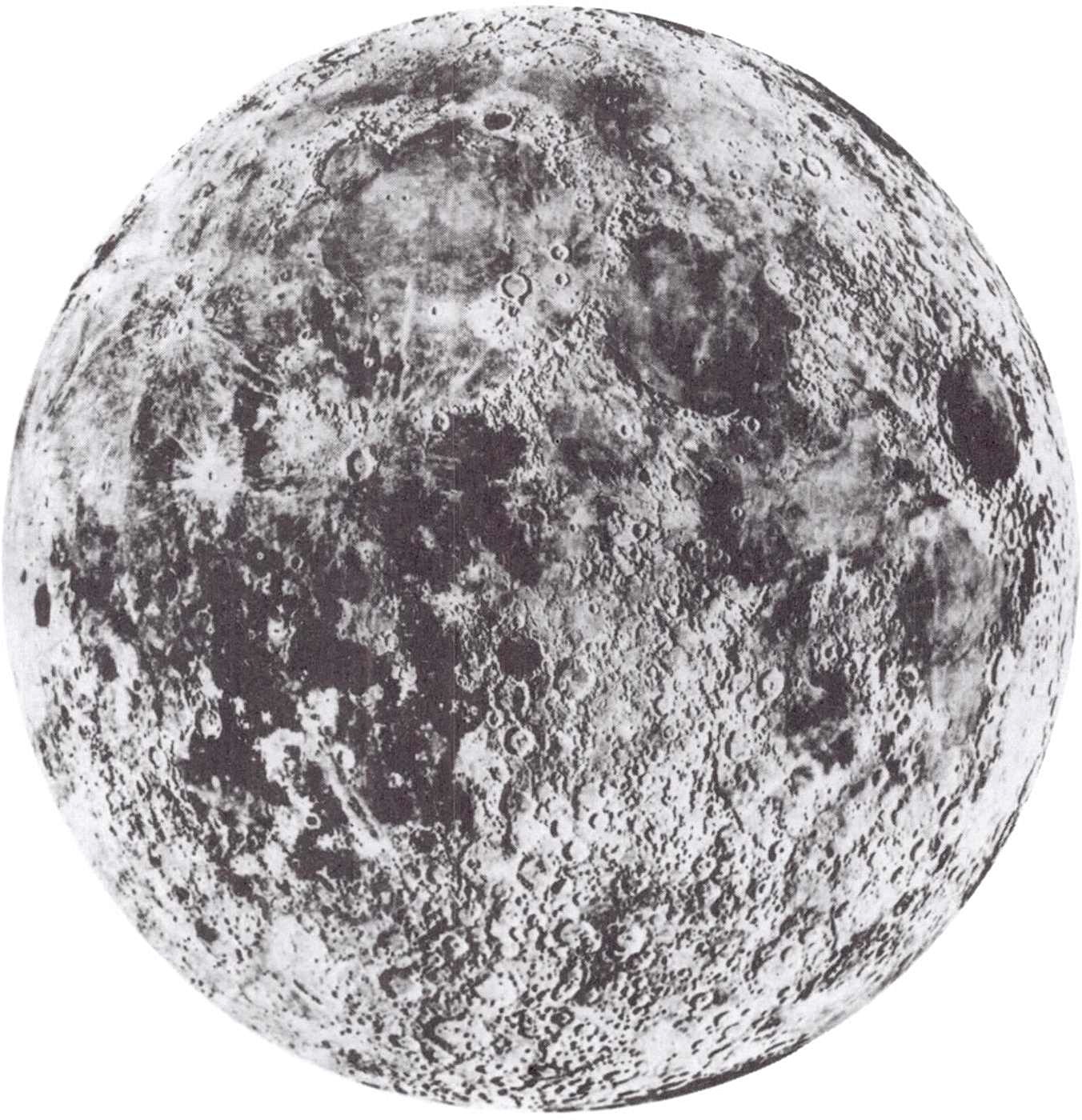
The earth-facing side of the moon, depicted in an artist's rendition based on scientific findings. North is at the top; east is to the right. Especially noticeable is the contrast between the dark, relatively smooth areas (the "seas" or "maria"), mostly in the upper half of the picture, and the lighter, heavily centered areas in the lower right. The large circular feature in the upper left quadrant is Mare Imbrium, bounded on the southeastern edge by the Apennine Range and on the southwest by the Carpathian Mountains. East of Mare Imbrium lies Mare Serenetatis, with the Taurus Mountains on its eastern edge. Mare Tranquilitatis joins Mare Serenetatis on the southeast. The near-circular area in the upper right is Mare Crisium; below it lies Mare Fecunditatis. Spreading irregularly over the area west and south of center is Oceanus Procellarum. Two smaller maria, Mare Humorum and Mare Nectaris, lie to the south and southeast.
The lighter-colored areas are marked by an abundance of craters, in contrast to the maria; this has led scientists to believe that the maria are younger features, perhaps filled with lava. Lunar craters range in size from hundreds of kilometers to less than a meter. Many of the larger ones have prominent central peaks while others have relatively flat floors. A prominent crater visible here is Copernicus, west-southwest of the center, from which streaks of light-colored material ("rays") extend into Mare Imbrium. Farther west is Kepler, a rayed crater surrounded by a light-colored blanket. In the south-west quadrant, two prominent parallel rays point toward Tycho. Relatively inconspicuous in this view, Tycho is a medium-sized crater with a central peak about one-fourth of the way from the bottom of the photograph to the center.
All of these assumptions led to difficulties when examined in light of accepted celestial mechanics. If the moon separated from the earth at some early stage in its formation, its orbital plane should lie in the plane of the earth’s equator, but it does not. If, on the other hand, the moon was formed elsewhere in the solar system, its capture by the earth would be highly improbable and its present orbit difficult to account for. Finally, if the earth and moon were formed out of the sane primordial matter by any mechanism, it is hard to explain the fact that the earth is nearly half again as dense as the moon.4
None of the hypotheses could be proved or disproved on the basis of the evidence available from visual observation alone. Both led to logical conclusions concerning the chemical composition and internal structure of the moon that could not be tested. Scientists who held that the moon was once molten regarded the mafia as massive lava flows from volcanoes or fissures in the lunar crust, similar to known examples on earth, and pointed to the domes and certain craters that are much like well known terrestrial volcanic structures. Advocates of the “cold moon” theory considered the maria to be the solidified remains of large bodies of molten rock created by collision with meteorites or asteroids, or perhaps by localized heating due to some other cause.5 The origin of lunar craters was a matter for debate. Some had undoubtedly been produced by impacts of cosmic debris, but strong arguments could be made that others were volcanic in origin. It was generally accepted that the moon’s surface, unaffected by wind and water, preserved a record of cosmic events which the earth must also have undergone; on earth, however, the effects have been obliterated by erosion.6
Crucial to the confirmation of either hypothesis, or to the creation of an alternative, was information that could be obtained only by direct examination of the moon. Analysis of samples of the lunar surface would show whether the moon was chemically similar to the earth and whether the lunar material had ever been extensively melted. Measurement of the flow of heat from the moon’s interior to the surface would show whether it was still cooling from a molten state. Other important investigations included the seismic properties of the moon, which could reveal its interior structure. Some of this information could be provided by instruments, perhaps including remotely controlled samplers capable of returning lunar material to earth. But some tasks, such as examining the moon’s surface and selecting samples on the basis of that examination, could better be done by humans. With the advent of the space age, lunar scientists could look forward to sending instruments to the lunar surface; only after the decision to land people on the moon could they hope to send a trained explorer.
Planning for Lunar Exploration
Homer Newell set lunar exploration planning in motion in 1962 with the appointment of the Sonett committee on Apollo scientific experiments and training [see Chapter 2]. After three months of consultation with leading experts in the scientific fields related to lunar exploration, the committee outlined its conception of the scope of Apollo lunar science. The primary objectives were examination of the lunar surface in the immediate area of the landed spacecraft, geologic mapping of the landing area, investigation of the moon’s interior by means of emplaced instruments, studies of the lunar atmosphere, and radio astronomy from the lunar surface.7 No specific experiments were recommended, but the criteria used in developing the objectives limited the possibilities. The experiments should be scientifically important and feasible, possible only on the lunar surface and only with a human on the mission, and likely to lead to further scientific and technological development.8
A week after the Sonett committee issued its draft report, NASA committed Apollo to lunar-orbit rendezvous. This decision, probably the most thoroughly debated of the entire program, directly affected the scope of lunar science. The mission mode determined how many men and how much equipment could be landed on the moon. Whereas the other possible modes (direct ascent and earth-orbit rendezvous) contemplated a single large spacecraft that would land with its entire three-person crew on the moon, lunar-orbit rendezvous would put down a separate specialized landing craft and a crew of two.9
With that decision made, Associate Administrator Robert C. Seamans, Jr., asked Newell to present several questions to NASA’s outside scientific advisers for discussion. What should be the preferred scientific objectives of the earliest lunar landings? Would the acquisition of scientific data require more than two persons on the moon at the same time? Were there sufficient scientific reasons to establish a semipermanent station on the moon for extended exploration? Advice on these questions would be important in establishing policy with respect to lunar science and could have direct influence on the design of the lunar landing craft.10
An appropriate forum for such a discussion was already in session that summer - the first summer study conducted by the Space Science Board, meeting on the campus of the State University of Iowa [see Chapter 2]. Manned space science programs were not the study’s primary concern, but two working groups, one on lunar and planetary exploration and one on the scientific role of humans in space, provided opportunities to examine the plans for Apollo’s experiments and put some of the scientists' concerns on record.11
At the start of the summer study the chairman of the Space Science Board, Lloyd V. Berkner, instructed the participants that their advice on the existence of a national space program and the division of effort among its projects was not sought. Nonetheless, because of mounting fears for what it would do to NASA’s space science budget, Apollo was never far below the surface, and objections to the manned programs were repeatedly voiced. Berkner, Newell, and others tried to steer the discussions into more productive channels, such as how the capability being developed for Apollo might be exploited for scientific purposes; but many of the participants could not be dissuaded from protesting the priority assigned to the lunar landing project.12
Seamans’s questions were aired, in substance at least, and the summer study’s final report contained recommendations concerning the points he had raised. The working group on the scientific role of humans in space endorsed the findings of the Sonett committee but recommended that experiments that only used the moon as a base for observation (e.g., radio astronomy) be relegated to later missions. It found that there was indeed a valid scientific requirement for a lunar surface laboratory for long-term investigations. The working group on lunar and planetary exploration reached similar conclusions and called for increased emphasis in the Ranger and Surveyor programs on providing necessary engineering information for Apollo.13
Of much more concern to the summer study participants was the scientific competence of the men who would land on the moon. Acknowledging a continuing need for astronauts whose primary skills were in spacecraft operation, the study report nonetheless urged the inclusion of a professional scientist among the crew of the first lunar landing mission. To ensure that such a person would be ready for the first landing, NASA should recruit qualified scientists at once and begin training them as astronauts. The science community insisted that these scientist-astronauts be given the means to maintain their scientific competence while acquiring piloting skills. To that end, a space institute should be established convenient to the astronaut training center, a facility "of the very highest scientific calibre [maintaining] liaison with major centers of research in the space sciences [and functioning] as a graduate school offering advanced degrees in various fields of science." It should either be operated "under contract with a major university" or administered by "that office of NASA responsible for scientific research and planning,"14 (i.e., the Office of Space Sciences). This "space university" proposal - which Newell later remarked never had the slightest chance of being accepted by NASA15 - was soon abandoned, but the demand for scientist-astronauts was reiterated by the science community right down to the end of the Apollo project.
With the modifications made by the Iowa summer study and with the imprimatur of the National Academy of Sciences, the Sonett committee’s recommendations formed the framework of Apollo’s initial lunar science planning. Shortly after its establishment in July 1963 the Manned Space Science Division promulgated the first scientific guidelines for Apollo, which reflected this preparatory work. The primary scientific activity was to be the study of the moon itself. First priority among the various lunar studies was given to geologic mapping, followed by collection of samples for return to earth and emplacement of instruments to return data by telemetry.16
Headquarters-Center Relations in Science
While working out arrangements for cooperation with the Office of Manned Space Flight, Newell and his staff also had to establish working relationships with the Manned Spacecraft Center (MSC). In early 1963 MSC’s only experience with science had been the visual and photographic experiments made on the first three Mercury orbital missions.17 These somewhat hurriedly improvised “experiments” produced some useful data, but mainly they served to show that people could conduct scientific exercises in orbit.18 They also showed that both scientists and engineers had much to learn about each other’s objectives and methods. One result was that MSC acquired a reputation among space scientists of being at best indifferent and at worst hostile toward scientific investigations.19 Eugene Shoemaker, always an enthusiastic supporter of manned space flight, was “utterly dismayed” by the attitude of the MSC representatives at the Iowa summer study: “we don't need your help; don't bother us.” This experience led Shoemaker to agree to spend a year at NASA Headquarters to try to establish a lunar science program; unless someone concentrated on that task, lunar science might never get done at all, because “there was no planning for it [and] no program for it.” 20
Some of MSC’s indifference to science was the predictable consequence of the formidable development tasks the center faced and its intense concentration in 1962 on learning to operate in space. But Newell felt that the Houston center’s engineers and managers (also engineers, for the most part) simply did not appreciate what space science and manned space flight could do for each other. Houston had no scientific research under way; the few scientists who worked there were mostly inexperienced in research and served almost entirely in support roles, providing data to the engineers. Newell spent considerable effort in 1963 trying to create a more receptive attitude toward science at MSC.21 One of Shoemaker’s first accomplishments after he came to Headquarters was to persuade MSC to expand its small Space Environment Division, a branch of the Engineering and Development Directorate that existed mainly to collect environmental data affecting the design of spacecraft and mission plans. One geologist joined the division in 1963, and a team of specialists from the U.S. Geological Survey was assigned later that same year. Their functions were to set up a research and training program in geology, develop a model of the lunar surface for use by the spacecraft designers and mission planners, assist in the evaluation of lunar scientific instruments, and develop plans for geologic field work on the moon.22
Lunar surface science, though important, was only part of the larger question of manned space science, and Newell, looking ahead to the earth-orbital flights of Gemini and Apollo, wanted to establish a place for science on those missions as well. The agreement worked out between Newell and Brainerd Holmes for developing experiments called for the appropriate manned space flight center (usually MSC) to oversee the development of experiment hardware once the basic design had been worked out by the Office of Space Sciences. As OSS saw it, this would require more scientific competence than the Houston center had. Up to mid-1963 MSC’s concern for experiments had been limited to assuring that they fit into the spacecraft and the flight plan and did not compromise a mission, a task carried out by an Experiments Coordination Office in the Flight Operations Division.23 Now, OSS saw a need to establish what would amount to a space sciences division at Houston. Discussions with MSC produced agreement that the Space Environment Division would be the nucleus of the prospective science branch.24 The Office of Space Sciences and the Manned Spacecraft Center spent the rest of 1963 defining their relationship. Newell firmly maintained his office’s responsibility for all of NASA’s science programs, while MSC occasionally displayed reluctance, to say the least, to accept direction from Headquarters.25 In the old days of NACA the field laboratories had enjoyed considerable independence in the conduct of their programs, and all of MSC’s top managers were old NACA hands. At times they seemed inclined to insist on running their programs their way, including the science. But by the end of the year MSC had agreed in principle to set up a scientific program manager on Director Robert Gilruth’s immediate staff, and Headquarters and center elements were beginning to work out a description of that person’s responsibilities.26
Lunar Surface Experiments
Early in 1964 the Office of Space Science and Applications (OSSA) began to define the Apollo lunar science project more narrowly. Rather than issue a request for experiment proposals to the scientific community at large, which was the usual procedure for soliciting experiments, Newell and his manned space flight counterpart George Mueller agreed that initially a few selected scientists should be called upon to identify the most important experiments within the areas agreed on by the Sonett committee and the Iowa summer study. A representative of Headquarters’s Manned Space Science Division and the chairman of the Space Science Board then compiled a list of experts who met on January 30 to begin the process.27 The first investigations agreed on by this planning group comprised geology (field geology, petrography and mineralogy, and sample collection), geochemistry, and geophysics (seismology, magnetic measurements, heat-flow measurements, and gravity measurements). For each area the group suggested several prominent scientists to work out detailed experiment plans.28 In April the first Apollo science planning teams, groups of experts in subdisciplines of the earth sciences, began meeting to define more specifically the lunar surface experiments and instruments. Later, teams would be established for lunar atmospheric studies and biosciences.29
At Houston, meanwhile, mission planners had started defining the lunar landing mission in detail. In late 1963 the first set of operational ground rules was established, listing mission objectives and constraints and identifying critical points where a flight might have to be aborted or diverted to an alternate mission in case of failure of some essential system. Using these ground rules and the latest available weight and performance data for the launch vehicle and spacecraft, planners then prepared the “reference trajectory,” a detailed description of the mission from liftoff to splashdown.* For planning purposes the reference trajectory listed 10 landing sites within a zone 85 miles (137 kilometers) wide and 1,480 miles (2,380 kilometers) long stretching along the equator on the moon’s visible side. It assumed that the lunar landing module would stay on the moon for 24 hours.30
* The reference trajectory was one of the most important mission planning documents. It enabled flight planners to evaluate the effect of changes in spacecraft weight, propulsion capability, mission requirements, etc., on every phase of the mission. An initial reference trajectory was often based on many assumptions, but as test data and operational experience accumulated, the trajectory was updated.
Science and mission planning came together in mid-June of 1964 when Houston hosted a lunar landing symposium to give each group a look at the other’s preliminary plans. MSC representatives presented their concepts of a lunar landing mission, described the two spacecraft and what they could be expected to carry to and from the moon, and outlined the current astronaut training course. Members of the Apollo science planning teams sketched out their tentative plans for surface activities and experiments. After four days of discussion, both groups went home to refine their concepts.31
The June symposium defined the operational bounds within which the lunar science planning teams had to work, and after five more months of deliberation the planning teams' report went to the Office of Space Science and Applications. Distributing the report for comment, Headquarters noted that its recommendations would eventually become the basis for a lunar exploration science program definition document on which final instrument and experiment designs would be based. First, however, OSSA was planning to have the report discussed at another summer study, scheduled for 1965.`32
As the planning teams saw it, the ultimate objective of the lunar science program was simply the same as that of all science: to add to human knowledge. More specifically, lunar studies could lead to a better understanding of the solar system and its origin, of primary forces that shaped the earth, and of geological processes whose effects have been obscured on earth by erosion and other secondary processes not operating on the moon. (Making the obligatory gesture toward practical results, the report mentioned that lunar studies “may have direct bearing towards more intelligent search for mineral resources on Earth,” though it did not specify how.) The larger objectives, however, could scarcely be met in the short times the early Apollo missions would stay on the lunar surface. Really productive lunar studies required more time on the moon, greater mobility for the astronauts, and logistic support.33
For the approved Apollo missions the planning teams stressed field work, sampling, and emplacement of instruments, all planned to yield the maximum information in the time available. Instruments relaying data by telemetry were preferred for measurement of gravity, magnetism, magnetic phenomena, and seismic studies. The geochemistry and bioscience planning teams emphasized the importance of bringing back the greatest possible weight of lunar material in the form of carefully selected and documented samples for laboratory study. Eugene Shoemaker’s field geology team stressed visual observation and panoramic photography from the lunar module, followed by surface traverses during which the astronauts would collect samples, emplace instruments, and describe the important geologic features of the landing area. Both the geology and geophysics teams listed the tools and instruments that should be taken along, as well as preliminary estimates of weight, volume, power, and telemetry requirements. The report included tentative operations plans for several lunar surface missions, taking into account operational constraints and certain contingencies that might require changing plans during the mission.34 With these recommendations in hand, Headquarters and MSC began making plans for managing the experiments. In mid-January 1965 Houston’s Space Environment Division appointed interim coordinators for lunar surface experiments.35 At the end of the month manned space flight director George Mueller conducted a program review at which he called for a series of studies to evaluate several program management alternatives for Apollo science, from experiment development to handling of lunar samples.36 Discussions between Headquarters and MSC continued during the spring; Newell’s Office of Space Science and Applications continued to hope for the establishment of a separate science organization at Houston.37 Progress was slowed somewhat by OSSA’s apparent difficulty in working out its internal lines of authority.38
In late February Newell and Mueller met to formulate policy for managing and funding science experiments in manned space flight. An afternoon’s discussion produced agreement on a division of responsibility only slightly different from that adopted by Newell and Brainerd Holmes two years earlier [see Chapter 2]. Newell’s Office of Space Science and Applications would publicize the science opportunities in the manned programs, solicit experiment proposals, and make the initial selection. After further evaluation, which would include constructing a “breadboard” model of the instrument to demonstrate its feasibility, OSSA would select experiments and experimenters and arrange for construction of prototype instruments. Mueller’s Office of Manned Space Flight would then develop flight-qualified instruments, integrate them into the spacecraft, work the experiments into the flight plan, and collect the data produced in flight. OSSA would arrange for distribution, analysis, and dissemination of the data. Deputies for Newell and Mueller formalized details of this agreement later in the year.39
MSC and OSSA worked for several months on a procurement plan for Apollo’s lunar surface experiments, submitting it to Mueller in May 1965. Mueller decided that a two-phase procurement was advisable, the first phase to better define the instrument package and the second to build the instruments. Several contractors would be selected to conduct the definition studies and one of them would be picked to build the instrument package.40 In June Houston sent out requests for proposals to conduct six-month definition studies for a lunar surface experiments package. Nine companies responded, and three** were selected in early August.41
** Houston Division of Bendix Corp., Ann Arbor, Mich.; Space-General Corp., El Monte, Calif.; and TRW Systems Carp., Redondo Beach, Calif.
Woods Hole and Falmouth Conferences, Summer 1965
In the summer of 1965 the Space Science Board again convened a conference to consider NASA’s plans for space research. The Iowa summer study three years before had reviewed current programs and recommended changes of emphasis; the 1965 study at Woods Hole, Massachusetts, was charged with recommending directions and priorities for the next 10 to 20 years. The major topics considered were lunar and planetary exploration, astronomy, and the role of humans in space exploration.42 The Woods Hole conference report made many detailed recommendations in individual areas of research. Space research, the study found, required the use of ground-based observations as well as satellites, sounding rockets, and balloons. Throughout, the report stressed balance: between manned and unmanned programs, between lunar and planetary exploration, and between ground-based studies and research in space. The salient conclusions of the study were easily summarized. Planetary exploration was judged to be the most rewarding scientific objective for the post-Apollo period, with Mars being the most interesting target. Concerning humans in space, the participants agreed that "The distinction between manned and unmanned programs is an artificial one; scientific objectives should be the determining factors." But before people could be dispatched on missions to the planets, "an orbiting research facility for the study of long-term effects of space flight is essential."43
The 1965 conference was somewhat more sanguine than the 1962 study concerning the role of humans in space science and somewhat more tolerant of the Apollo program. The working group on the role of man noted that
Few ... scientists would attempt to justify the entire cost of developing manned space flight solely on the basis of its "scientific value;" however, most scientists would agree that this capability, when developed, should be utilized for scientific purposes whenever it seems possible to do so.
The group did not concede that people could be replaced by instruments in every imaginable case:
Manned intervention [in an unmanned system] increases reliability through the possibility of extending the lifetime of spaceborne equipment almost indefinitely by means of repair and replacement… Man greatly increases the flexibility of the system, for he can decide [how best] to use an instrument [and] can make alterations or improvements in the instrument itself. Data transmission can … be virtually eliminated for manned experiments, and the design of an instrument can be simplified…
Not only that, but
if the presence of man in the system were already considered essential, the scientist would assign many scientific tasks to man because of the greater reliability and flexibility he would bring to the system.44
On the question of selection and training of scientists for space missions, the scientists were of much the same mind as those in 1962:
For some tasks - those requiring scientific insight - it would seem better to have a scientist possessing judgment, experience, and imagination and to train him as an astronaut to the extent required.
>Again conceding that test pilots had the edge in some areas, the working group nonetheless concluded that
the astronaut selection and training program [should] take into account progress in manned space flight. Successes so far*** may be viewed as evidence that it may be possible to relax the present high physical standards at a pace faster than has yet been contemplated.45
*** Four successful manned flights had been made in the past three years, including two of the two-man Gemini spacecraft.
Concerning the lunar exploration program, the Woods Hole study report confined itself to defining the major scientific questions in lunar exploration. Three basic problems should be explored: structure and processes of the lunar interior, the composition and structure of the moon’s surface and the processes that have modified it, and the sequence of events by which the moon has arrived at its present configuration. As guidelines for exploring these problems, the report listed 15 specific scientific questions that should direct lunar exploration, both manned and unmanned [see Appendix 3].46
One question that assumed increasing importance as planetary exploration became more realistic was the existence of life forms or their precursors on the moon or the planets. The working group on biology concluded that the evolution of organisms or prebiotic materials was most likely to have occurred on Mars. However, the group affirmed the necessity to avoid contaminating any celestial body, including the moon, with terrestrial organisms or organic materials that might invalidate later experiments attempting to detect life. As to the need for protecting earth from biological contamination by material from the moon, the group believed the hazards were small but that NASA should be safe rather than sorry: "the consequences of misjudgment are potentially catastrophic."47 Opinion on this point was not unanimous throughout the conference, however, for the working group on lunar exploration noted only a "minor possibility of finding prebiotic material, either buried or in sheltered locations."48
The Woods Hole conference was, as far as Apollo was concerned, a policy-setting meeting. When it adjourned, many of the participants stayed on at nearby Falmouth for a two-week conference dealing with details of lunar exploration and science on Apollo. The Falmouth conference elaborated on the previous year’s work of the Apollo lunar science planning teams in light of plans for manned space flight for the 10 years following the first Apollo landing. As plans then stood, the first few landings - the exact number was not certain - comprised the Apollo program; it was assumed that these landings would be minimal missions to establish confidence in the Apollo systems. They were to be followed by flights using improved spacecraft that could carry larger payloads and stay longer on the lunar surface.**** Ultimately, perhaps in the last few years of the post-Apollo period, a lunar base might be available for scientific studies. Falmouth planners structured their discussions around this idealized schedule.49
**** In 1965 plans for manned space flight after Apollo were still in the formative stage. OMSF had conducted several studies on "Apollo Extension Systems" to determine how far the propulsion, life-support, and electrical power systems on the Apollo spacecraft could be upgraded without major redesign. These "extended Apollo" components would be used in missions - earth- and lunar-orbital flights as well as lunar surface missions, lasting from 10 to 45 days - that would sustain the manned program until the next major program could be defined. See W. David Compton and Charles D. Benson, Living and Working in Space: A History of Skylab, NASA SP-4208 (Washington, 1983), Chaps. 1, 3, and 5; also George Mueller’s presentations to the House and Senate space committees in the NASA authorization hearings for fiscal 1966 and 1967.
At Falmouth, members of the lunar science planning teams collaborated with NASA and academic scientists to take the first steps in detailed scientific operations planning. As specifically as they could, disciplinary working groups laid out their requirements for procedures and equipment. For the first time, an astronaut in training described the mission’s essential constraints from the astronaut’s point of view, stressing the limitations of space suits, life-support equipment, and operational contingencies (such as an aborted landing).50 For some scientists this was the first time they had had to consider their own experiments in the context of other scientific work and operational restrictions, and one participant reported a noticeable change in attitudes as the discussions progressed.51
In its final report the Falmouth conference summarized its recommendations for the early landings, the "post-Apollo" (advanced) missions, and the more distant future when a lunar base could be contemplated [see Appendix 3]. Highest priority on the early landings was assigned to returning the greatest number and variety of samples as feasible; emplacement of long-lived surface instruments was next, followed by geologic exploration of the landing area by the astronauts. The early missions could only sample isolated areas of the lunar surface. A survey of the entire moon, plus detailed studies of the equatorial belt, should be the objective of later missions. These advanced missions, five or six landings flown at the rate of one or two per year, should be supported by an unmanned logistics system that would land additional consumable supplies and scientific equipment. Crews might stay as long as 14 days and explore as far as 15 kilometers (9 miles) from the landing site. The additional equipment should include some analytical instruments for on-the-spot discriminatory tests on lunar material, so that astronauts could select a wider variety of samples. Surface transportation should be provided - a wheeled vehicle with a range of 8 to 15 kilometers (5 to 9 miles) and a flying vehicle that could carry 135 kilograms (300 pounds) of instruments from point to point over a 15-kilometer range. With the flying unit, astronauts could secure samples from otherwise inaccessible locations, such as a crater wall.52
Falmouth provided the best scientific advice NASA could get at the time, and its recommendations formed the basis for the earliest mission planning. It was the first of several iterations of scientific planning that would take place during the rest of the Apollo program. NASA would make every effort to carry out as much of the program as could be done within a changing context of available resources. Progress often seemed intolerably slow to some scientists,53 but in the end a gratifying proportion of the Falmouth recommendations would appear in mission plans.
Site Selection: Ranger, Surveyor, Lunar Orbiter
The visible face of the moon offered scores of interesting sites for scientific exploration. As far back as 1961, Harold Urey, responding to a question from Homer Newell, listed five general regions of high scientific interest: high latitudes, to determine whether water might exist where temperature extremes were less marked; two maria, to determine whether they were of different composition; inside a large crater; near one of the great wrinkles in the maria; and in a mountainous area. Assuming that equatorial sites would draw the most attention anyway, Urey offered no suggestions concerning them.54 Eugene Shoemaker noted not long afterward that scientific objectives would be subordinate to operational requirements, at least on the early missions, and that the sites most operationally suitable for an Apollo landing - level, featureless maria, most likely - would be the least suited to determination of geologic relationships.55
Operations planning for the earliest Apollo missions was designed to assure the safe return of the astronauts. The spacecraft, still attached to the Saturn upper stage, would be inserted into an earth-circling “parking orbit” so that mission control could verify that all systems were working properly. Lunar landings were to be made in direct sunlight and at specific times of the lunar day chosen for optimum visibility; return to earth must take place in daylight; and allowance would be made for possible interference with communication caused by solar activity.56 These rules, along with constraints on the lunar orbit of the command module, defined a landing zone along the moon’s equator within which the first mission would have to land.
Equally important for selecting a landing site was the nature of the lunar surface - how much weight it could support and how many rocks and small craters were present. For this purpose, high-resolution photographs of the lunar surface were required, which were to be supplied initially by the Ranger spacecraft [see Chapter 2]. To supplement Ranger’s photographs and also to provide direct information about the surface, a second unmanned spacecraft, Surveyor, would be built. One version would soft-land on the moon and transmit scientific data and television pictures; a second version would be an orbiter that would circle the moon, photographing large portions of its surface. But when Apollo engineers specified the detail required for their purposes, the Surveyor orbiter as then defined could not meet them.57
To supply the high-resolution photographs needed to certify landing sites, both OMSF and OSSA endorsed a new lunar-orbiting spacecraft. Preliminary studies indicated that the project was feasible, and after briefly considering giving the orbiter to the Jet Propulsion Laboratory, Headquarters officials decided to assign it to Langley Research Center. By the end of August 1963 Langley had drawn up specifications for the spacecraft and camera system and called for bids. Before the year ended, project officials had selected the Boeing Company as the prime contractor. Boeing proposed a solar-powered satellite, attitude-stabilized in three axes, carrying a film camera system designed by the Eastman Kodak Company. Film was to be developed aboard the spacecraft and the images were to be transmitted to earth by an optical scanning and telemetry system. Five photographic missions were planned; the first Lunar Orbiter would be ready for flight less than three years after the contract was let.58
In Ranger and Surveyor, the two projects that contributed most to early Apollo site selection, the Manned Spacecraft Center had worked closely with the Jet Propulsion Laboratory to coordinate Apollo’s requirements with mission plans [see Chapter 6].59 As late as 1964, no single organization was responsible for collecting the data needed to evaluate Apollo landing sites and recommending the final choice for each mission.60 In mid-1965, acting on a recommendation from Bellcomm, Inc.,# George Mueller formally established an Apollo Site Selection Board to evaluate and recommend landing sites for the Apollo missions. Chaired by the Apollo program manager in the Office of Manned Space Flight, the board would weigh all available scientific and operational considerations and recommend landing sites to MueIler.61
# Bellcomm, Inc., was a systems-engineering organization created in 1962 by the American Telephone & Telegraph Co. at NASA’s request for the' purpose of conducting independent analyses of many aspects of the Apollo program. It employed about 500 people at peak strength (1969). In 1972, its work for NASA completed, Bellcomm was merged with Bell Laboratories. J. O. Cappellari, Jr., “Where on the Moon? An Apollo Systems Engineering Problem,” The Bell System Technical Journal 51 (5) (1972): 955.
As planning for lunar science progressed during the middle 1960s, three key issues emerged: management of the returned lunar samples, selecting and training astronauts for scientific exploration, and the choice of landing sites.
Notes
- See Harold C. Urey, “The Contending Moons,” Astronautics & Aeronautics, vol. 7, no. 1 (Jan. 1969), pp. 37-41, reproduced in “Lunar Science Prior to Apollo 11,” Robert Jastrow, Vivien Gornitz, Paul W. Gast, and Robert A. Phinney, eds. (NASA Goddard Space Flight Center Institute for Space Studies, 1969), pp. I-1 to I- 6. This collection, a summary of discussions at a conference on problems in lunar science held in New York on June 5, 1969, contains papers and excerpts from books by the leading researchers in lunar science. Although it includes some results from Ranger and Surveyor that are not pertinent to the present discussion, this volume is a good single source of pre-Apollo information on the moon.
- Eugene M. Shoemaker, “Exploration of the Moon’s Surface,” American Scientist 50 (1962):99- 129.
- Urey, “The Contending Moons” ; Harold C. Urey and G. J. F . MacDonald, “Origin and History of the Moon,” in “Lunar Science Prior to Apollo 11,” pp. I-14 to I-135.
- Urey, “The Contending Moons.”
- “Principal Issues in Lunar Exploration,” in “Lunar Science Prior to Apollo 11,” pp. 1-19.
- Ibid., p. 4.
- "Draft report of the Ad Hoc Working Group on Apollo Experiments and Training on the Scientific Aspects of the Apollo Program," Charles P. Sonett, chmn., July 6, 1962.
- L. D. Jaffe, "Minutes: Ad Hoc Working Group on Apollo Scientific Experiments and Training, 23 April 1962," no date.
- Brooks, Grimwood, and Swenson, Chariots, pp. 61-67, 83-86.
- Robert C. Seamans, Jr., to Homer E. Newell, July 25, 1962.
- Homer E. Newell, Beyond the Atmosphere: Early Years of Space Science, NASA SP-4211 (Washington, 1980), pp. 207-208.
- Ibid.
- National Academy of Sciences-National Research Council, A Review of Space Research, report of the summer study conducted under the auspices of the Space Science Board at the State University of Iowa, June 17-Aug. 10, 1962, NAS-NRC Publication 1079 (Washington, 1962), pp. 11-4 to 11-5, 4 to 10.
- Ibid., pp. 11-15 to 11-16.
- Newell, Beyond the Atmosphere, p. 209.
- Verne C. Fryklund, Jr., to Ernst Stuhlinger and Hans Hueter, MSFC, "Scientific Guidelines for LLS and LLV Studies," July 3, 1963; Fryklund to Dir., MSC, "Scientific Guidelines for the Apollo Project," Oct. 8, 1963.
- Loyd S. Swenson, Jr., James M. Grimwood, and Charles C. Alexander, This New Ocean: A History of Project Mercury, NASA SP-4201 (Washington, 1966) , pp. 414-15, 418, 443-45.
- For a discussion of the integration of experiments with the Mercury flights, see Lewis R. Fisher, William O. Armstrong, and Carlos S. Warren, “Special Inflight Experiments,” in Mercury Project Summary Including Results of the Fourth Manned Orbital Flight, May 15 and 16, 1963, NASA SP-45 (Washington, 1963), pp. 213-19.
- The author found this impression to be rarely if ever documented but pervasive among space scientists and others interviewed. It seemed to be most persistent in the minds of scientists who were not associated with the manned programs over long periods of time; those who worked closely with MSC engineers in developing the Apollo science program came to feel otherwise, for the most part. See author’s interviews with P. E. Purser, Mar. 10, 1983, E. M. Shoemaker, Mar. 17, 1984, and H. H. Schmitt, May 30, 1984, and Loyd S. Swenson’s interviews with A. J. Dessler, May 16, 1971, and E. H. King, Jr., May 27, 1971, tapes in JSC History Office files. Those who understood the engineers' problems and accepted the manned lunar landing program as the driving force of the entire space program tended to be more sympathetic. Scientist-astronaut H. H. Schmitt felt the scientists' expectations of the engineers were unreasonable: “look what they [the engineers] were trying to do, for crying out loud: they were trying to land on the moon! … [As late as 1968] there was not an engineer … who could prove that the lunar module was going to be able to fly to the moon [land and return].” (Schmitt interview.) During Mercury, the many foreseeable (and unforeseeable but expected) problems of developing spacecraft and operations caused engineers to be intolerant of any exercise not essential to the lunar landing that might in any way imperil the crew or the engineering and operational objectives of a flight.
- Shoemaker interview.
- Newell to Gilruth, Feb. 15, 1963; Wendell W. Mendell, interview with Swenson, Feb. 11, 1971, transcript in JSC History Office files; Newell to A/Mr. Webb, Mar. 16, 1963.
- King interview; Gilruth to Thomas B. Nolan, Mar. 29, 1963.
- MSC Circular 19, “Establishment of the Mercury Scientific Experiments Panel,” Apr. 18, 1962; MSC gen. mgt. inst. 2-3-1, “Manned Spacecraft Center In-Flight Scientific Experiments Coordination Panel,” Oct. 15, 1962; MSC tech. mgt. inst. 37-1-1, “In-flight Experimental Programs,” July 18, 1963; William O. Armstrong, interview with James M. Grimwood and Ivan D. Ertel, Jan. 24, 1967, transcript in JSC History Office files.
- Fryklund to SD/Deputy Director, “Memo from J. M. Eggleston About a Facility at MSC to House the Space Environment Division,” July 24, 1963; Newell to M/Assoc. Adm., “Facility at Manned Spacecraft Center for the Space Environment Division,” July 31, 1963.
- Newell to Gilruth, “Manned Space Science Division Supporting Research and Technology Tasks,” Nov. 21, 1963; Fryklund, “Discussions at Manned Spacecraft Center on September 19, 1963,” memo for record, Sept. 27, 1963; Fryklund to Dr. Robert Voas, Oct. 11, 1963; Paul R. Brockman to SM/Acting Director, “Manned Space Science Project Management,” Nov. 8, 1963; Brockman to SP Gutheim, “Weekly report,” Nov. 22, 1962; Willis B. Foster to Assoc. Adm. for MSF, “Apollo Scientific Guidelines,” Dec. 19, 1963; Brockman to Gutheim, “Weekly Report,” Dec. 6, 1963.
- Foster to Richard Mize, “Weekly Report for Week of December 16,” Dec. 20, 1963.
- Foster to Mize, “Weekly Activities Report,” Jan. 10, 1964; “Minutes: Manned Space Science Working Group of the Space Sciences Steering Committee,” Jan. 30, 1964; Foster to SS/Dir. of Sciences, “Weekly Activities Report,” Feb. 12, 1964.
- Fryklund to Members, Manned Space Science Working Group, Space Science Steering Committee, “First Group of Suggested Apollo Investigations and Investigators,” Feb. 3, 1964; Fryklund to chmn., Space Sciences Steering Committee, “Preliminary definition of Apollo investigations,” Feb. 13, 1964.
- Fryklund to John M. Eggleston, “Integrated Apollo Science Program,” Mar. 25, 1964; Fryklund to Assoc. Adm., SSA, “Integration of Apollo Science Program,” Mar. 26, 1964; “Minutes, Manned Space Science Working Group of the Space Sciences Steering Committee, 26 March 1964,” Apr. 9, 1964.
- E. L. Durst to Chief, Flight Operations Div., “Project Apollo, Operational Ground Rules for the Lunar Landing Mission,” Oct. 23, 1963; MSC, “The Development of an Apollo Lunar Landing Mission Reference Trajectory,” Internal Note 64-OM-12, May 1964.
- MSC, “Contributions of MSC Personnel to the Manned Lunar Exploration Symposium, June 15 and 16, 1964,” no date; D. A. Beattie, E. M. Davin, and P. D. Lowman to Dir., Manned Space Science Div. and Chief, Lunar and Planetary Science Branch, “Supplemental Recommendations and Comments on 'Apollo Scientific Investigations,'” July 6, 1964; Fryklund to Dir., MSC, “Action Items and Positive Results from the Apollo Science Meeting,” July 6, 1964.
- Davin to multiple addressees, “Request for comments on the attached lunar surface science programs definition document for the approved Apollo missions,” no date [Dec. 1964].
- OSSA, “Apollo Lunar Science Program: Report of Planning Teams,” part I, Summary (Dec. 1964), pp. 4-9.
- Ibid., part II, Appendix.
- Eggleston to Staff, “Establishment of interim coordinators for scientific equipment,” Jan. 14, 1965.
- Foster to multiple addressees, “Report of Program Plans and Status,” Feb. 1, 1965.
- Foster to Assoc. Adm., MSF, “Matters to discuss with Joe Shea in regard to science experiments,” Apr. 1, 1965.
- Maxime A. Faget to Foster, “Grants or contracts to potential principal investigators for lunar surface experiments,” May 11, 1965, with encl., “Chronology [of background information].”
- Richard J. Allenby to Mueller and Newell, “Minutes of Newell-Mueller Meeting of 23 February 1965,” Apr. 19, 1965, with encl., “Memorandum of Agreement between Office of Manned Space Flight [and] Office of Space Science and Applications, Scientific Interfaces.”
- B. A. Linn to the record, “MSF Procurement Plan for Lunar Surface Experiments Package,” June 3, 1965; Mueller to MSC, attn. Dave Lang, “Request for Approval of Procurement Plan for Lunar Surface Experiments Package,” June 7, 1965.
- NASA release 65-260, “Three Firms Selected to Design Apollo Lunar Surface Package,” Aug. 4, 1965.
- National Academy of Sciences-National Research Council, Space Research: Directions for the Future, report of a study by the Space Science Board, Woods Hole, Mass., 1965, NAS-NRC Publication 1402 (Washington, 1966), p. iii.
- Ibid.
- Ibid., pp. 623-26.
- Ibid., pp. 628-29.
- Ibid., pp. 5-34.
- Ibid., pp. 486-93.
- Ibid., p. 21.
- NASA 1965 Summer Conference on Lunar Exploration and Science, Falmouth, Massachusetts, July 19- 31, 1965, NASA SP-88 (Washington, 1965) , pp. 1, 7-19.
- Ibid., pp. 59-393, 407-17.
- Neal J. Smith to Allenby, 11 Aug. 1965.
- NASA 1965 Summer Conference, pp. 7-12, 16-19.
- Shoemaker interview.
- Harold C. Urey to Newell, June 19, 1961.
- Shoemaker, “Exploration of the Moon’s Surface,” American Scientist 50 (1962): 121.
- Ted H. Skopinski to Chief, Systems Integration Div., “Selection of Lunar Landing Site for the Early Apollo Lunar Missions,” Mar. 21, 1962.
- Bruce K. Byers, Destination Moon: A History of the Lunar Orbiter Program, NASA TM X-3487 (Washington, 1977), pp. 9-15.
- Ibid., pp. 19-47, 67-69, 75-78, 227.
- Gilruth to Mueller, Aug. 5, 1965.
- T. H. Thompson to G. E. Mueller and Gen. S. C. Phillips, Dec. 23, 1964.
- Mueller to multiple addressees, “Establishment of Apollo Site Selection Board,” July 1, 1965.