PROJECT APOLLO: THE CONCLUSION
At the start of 1973 scientists eagerly awaited the last samples from the moon. Apollo was all but forgotten, however, at NASA’s manned space flight centers, which had already shifted gears and were preparing for the next manned projects. In August 1972, when Apollo 17’s Saturn V rolled out of the Vehicle Assembly Building at Kennedy Space Center, two launch vehicles in adjacent bays were being prepared for Skylab’s first flight, nine months away. Barely a month after Apollo 17 returned, Skylab program officials completed the design certification review for modifications required at the launch complex. At Houston, Skylab crews - officially named in January 1972 - had been in training since late 1970.1 Crews for Apollo-Soyuz, the joint mission with the Soviet Union, scheduled for mid-1975, were named in early February 1973,2 the same week the first lunar samples from Apollo 17 were released.3
The Manned Spacecraft Center now had nearly 380 kilograms (836 pounds) of samples from the moon - all the lunar material the scientists could expect to get for many years. Besides the samples, there was a mass of data from the lunar-orbital experiments and a continuing flow of information from the lunar surface experiments, most of which were still functioning [see Appendix 5]. Scientists now began to concern themselves with the preservation, description, and cataloging of the samples and the provision of adequate support for a continuing program of research.4
Apollo 17 Samples
The Lunar Sample Analysis Planning Team met at MSC on January 29 to plan for allocation of Apollo 17 samples. In keeping with the custom established on the previous two missions, five key samples were released very early for age-dating, including the orange soil that had so excited Jack Schmitt. During February samples were sent to 116 of 185 principal investigators, even before the preliminary examination was completed, so that some results could be reported to the fourth Lunar Science Conference scheduled for March.5
Schmitt’s selection and documentation of samples taken from the large boulders examined at Taurus-Littrow presented a new problem for the team. Considering that issuing samples to investigators working in isolation would waste a unique opportunity to study the relationships between different rock types, the team recommended that each boulder (or set of possibly related boulders) be examined by a small interdisciplinary group working in dose collaboration. After these groups had examined the samples and extracted as much information as possible, the specimens would be cut up and distributed for study.6
Fourth Lunar Science Conference
The fourth annual lunar science conference convened on March 5, 1973, with more than 700 scientists in attendance.7 NASA’s Deputy Administrator, George Low, opened the four-day meeting by reviewing the Apollo lunar exploration program and the progress made in understanding of the moon in three and a half years. He expressed NASA’s gratification with the willingness of the scientific community to participate effectively in analyzing the data and planning the succeeding missions, citing the Group for Lunar Exploration Planning and the Science Working Panels, the support provided during the missions by the scientists in the back rooms, and the help others had given in training the crews and selecting sites. Low told the group that NASA was “firmly committed” to continue support of lunar studies based on the Apollo samples.8
Few results from Apollo 17 were presented at the conference, since so little time had elapsed since the samples were released. One of the first studies had determined that the orange soil, which consisted mostly of tiny beads of brown to reddish glass of a composition similar to lunar basalts, was probably of volcanic origin. While it could also be explained as the product of a meteorite impact, the soil was age-dated at 3.5 to 3.7 billion years, an age that could not be correlated with any major basin-forming event and therefore with any major impact.9 Other papers at the conference reported basic data on the nature, chemistry, and ages of the Apollo 17 samples that had been released.10
While analysis of lunar data continued unabated (the proceedings of the fourth lunar science conference, like those of the three before it, filled three large volumes) by early 1973 the major constraints to a model of lunar evolution were beginning to be clear. Geological, geochemical, and geophysical evidence made it clear that the moon is quite different from the earth in structure and composition and therefore probably in the process of its formation.11 A coherent picture of the moon’s history gradually emerged over the next few years (see below).
This conference marked the end of Apollo’s voyages, and perhaps that was responsible for the “notable spirit of amity between lunar scientists and NASA’s engineer-managers” that some observers perceived at the meeting. In response to George Low’s acknowledgement of their contributions to Apollo and his pledge of continuing support for lunar studies, the conferees adopted a motion that acknowledged some “awkward moments” over the years but praised the space agency for its overall execution of a project that had “already revolutionized ideas of the solar system’s evolution.” In a less formal but probably more meaningful gesture, a small group of the scientists who had been most intimately involved in planning the Apollo missions dug into their own pockets to honor selected NASA managers and engineers at a private banquet. One anonymous scientist said it was their way of saying thanks to “some of the higher people who played ball and to some of the lower echelon people - beautiful guys who would come along at the right time, stand up to their bosses, and help us get an experiment on board.” 12 It was a considerable change from the prevailing attitude only three and a half years before [see Chapter 10], but much else had changed in those years as well.
The New Moon
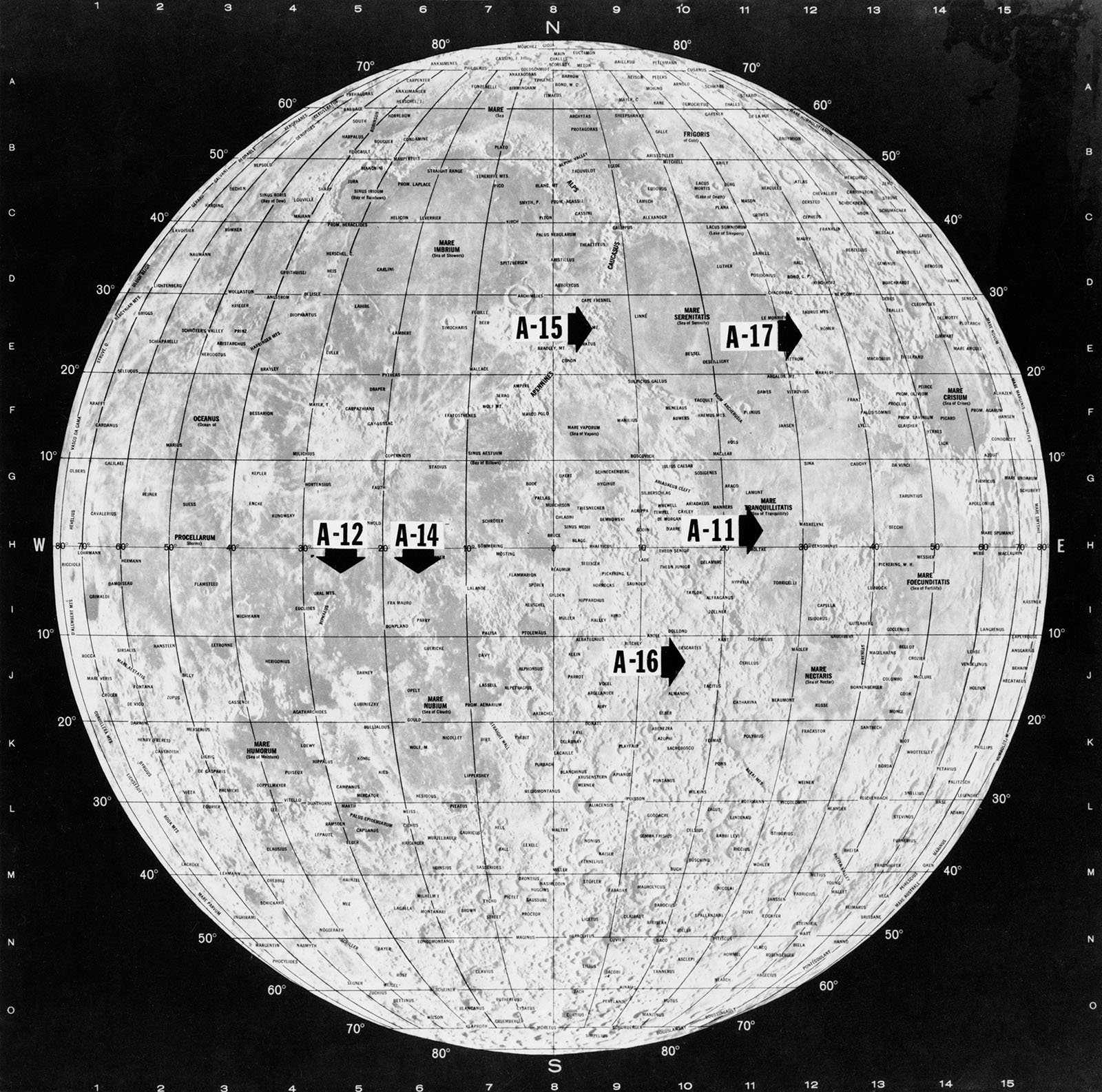
In 1974, following the fifth lunar science conference, Robert Jastrow* attempted a brief synthesis of what science had learned from the Apollo studies for the New York Times. After outlining the gross features of the moon’s evolution, he acknowledged that “Apollo has left at least one great cosmological question unanswered: Where did the moon come from?” For years before Apollo 11 landed, Jastrow said,
scientists argued the merits of various theories with great intensity, but the battle ended in a stalemate. Each theory suffered from at least one major defect. Everyone expected that the lunar landings would promptly settle the debate. It seemed obvious that as soon as we found out what the moon was made of, we would be able to tell where it came from: it would have either the same or different chemistry from that of the earth.
These hopes were not realized. Analysis of the moon rocks has shown that … the moon did not come from the earth. But it didn't suggest any alternatives.
The origin of the moon remains as much a mystery as it was before Apollo….13
* Jastrow, the first director of the Theoretical Division in the Office of Space Sciences [see Chapter 2], later headed NASA’s Goddard Institute of Space Studies in New York City.
But if the moon’s origin remained mysterious, the early stages in its evolution became clearer as the results of Apollo science accumulated.
Arriving at a model of lunar evolution was not easy, since so many different and often unrelated scientific disciplines contributed essential information. Interpretation of the data from geological studies concerning volcanic activity, for example, had to be consistent with the seismic scientists’ findings about the moon’s internal structure. Heat flow measurements had to be interpreted in light of the geochemical abundances of radioactive elements. Gerald J. Wasserburg, professor of geology and geophysics at Caltech, who participated in the lunar studies from the beginning, commented that this required most investigators to change their approach to science. For the most part, Wasserburg said, they had come to the first lunar science conference as specialists, “without any conception of the relationship of their particular observations to the global problems of a planet.” As the work proceeded, however, “specialists began to recognize the interrelationships between their own work and studies done by other individuals in completely different fields. So a broader, truer planetary science [began] to emerge.” 14
Before Apollo 11, considerable information about the moon had been available - principally its physical characteristics, but including some basic chemical facts as well.15 For many years it had been known that the moon was only 60 percent as dense as the earth (3.3 grams per cubic centimeter as against 5.5 for the earth) and that its rotational properties were almost identical with those of a homogeneous sphere. In the 1960s, space probes yielded more information. Surveyors V, VI, and VII carried instruments that measured the proportions of key chemical elements in the lunar surface. They showed that the maria were different from the highlands and that the moon was chemically different from both the earth and the (presumed) primordial material of the solar system. The terrestrial material most closely resembling the maria was basalt, an igneous rock, indicating the maria had been flooded with molten rock that had later solidified. Geochemists deduced from its density that the lunar basalt could not represent the average composition of the entire moon, which allowed the inference that the moon was not homogeneous.
Later, the Lunar Orbiters returned photographs that showed the moon’s hidden side to be topographically quite different from the visible side. Besides providing information essential to the selection of Apollo landing sites, Orbiter photographs contained a wealth of geological clues. They convinced geologists that at least some of the moon’s surface features had been produced by volcanic activity. Analysis of the spacecrafts' orbits provided evidence for anomalous concentrations of mass (“mascons”) under some of the maria, suggesting that the lunar crust was thicker and more rigid than was previously supposed. Had the crust been more plastic, the mascons would have settled deeper into it over geologic time, eliminating the gravitational anomalies that affected Lunar Orbiter V. Thus the outer layer of the moon had been cold and rigid for a very long period, yet lava flows large enough to fill the basins had occurred as well. This too implied a nonuniform structure for the moon and probably a complex evolutionary history.
To this sketchy body of knowledge about the moon Apollo contributed an overwhelming flood of new information, out of which scientists began to construct new models, some to be discarded quickly, others to be modified and retained. The geophysical data may have been the easiest to integrate into a coherent picture. Apollo’s four seismometers detected infrequent, weak tremors originating within the moon, at depths of 800 to 1,100 kilometers (500 to 700 miles), much deeper than those on earth. Forty-three moonquake zones were identified, each showing periodic activity correlated with lunar tides. Artificial seismic events (impacts of LM ascent stages and spent S-IVB stages) - plus the fortuitous collisions of a large (1,100 kilograms, 2,400 pounds) meteorite with the moon16 - produced signals that suggested a crust about 60 kilometers (37 miles) thick, overlying a different homogeneous layer extending down to about 1,000 kilometers (625 miles). Deeper still a partially molten core may exist, which, assuming it to be a silicate rock, would be at a temperature of about 1,500 degrees C (2,700 degrees F).
Results from the laser altimeters carried on Apollo 15 and 16 confirmed that the moon’s center of mass does not coincide with its geometrical center. Some scientists suggested this was due to the presence of the low-lying maria on the near side. Others suggested that the crust on the far side was thicker than that on the near side, which would make the absence of maria on the far side easier to explain: a thicker crust could have prevented the extrusion of molten material except in the very deepest craters, such as Tsiolkovsky.17
Geological and geochemical data were harder to interpret; only the broadest general conclusions could be stated after Apollo 17. The returned samples showed that the moon was chemically different from the earth, containing a smaller proportion of volatile elements (those that are driven off at low to moderate temperatures) and more radioactive elements than the cosmic average. Geochemical evidence indicated that three types of rocks predominate on the lunar surface: basalts rich in iron covering the maria; plagioclase or aluminum-rich anorthosites characteristic of the highlands; and uranium- and thorium-rich basalts that also contain high proportions of potassium, rare-earth elements, and phosphorus (“KREEP” basalts). Some scientists felt, however, that these could not represent the structure and texture of the primordial lunar rocks; it seemed likely that those characteristics had been virtually obliterated in the massive bombardment that the moon has obviously undergone.18
In spite of the difficulties, scientists - as is their habit - began to formulate models for lunar evolution as soon as the first results became available. Each successive mission brought a surprise, however, and it was only after Apollo 15 that the broad outlines of the moon’s history emerged fairly clearly.19
The oldest rocks found on the moon appear to have been chemically assembled around 4.5 billion years ago, in the late stages of formation of the solar system. How the materials of the moon came together is still an unanswered question; the evidence indicates that the moon aggregated out of the debris left over from the formation of the sun. According to a widely held view, it was never completely molten; only its outer layer, perhaps to a depth of 320 kilometers (200 miles, roughly one-fifth of its radius) was melted. This sea of molten rock, agitated by a continuing rain of fragments, lost its heat to space and began to solidify. As it did so, different minerals crystallized at different temperatures. Convection currents set up by cooling at the surface brought deeper, hotter material to the surface and at least partially remelted the surface crust. As cooling continued, crystals of different composition separated, giving rise to the chemical segregation observed in the lunar crust. Eventually, probably after some 200 million years, a rigid crust of considerable thickness formed, composed mostly of light-colored minerals rich in calcium and aluminum (plagioclase). Beneath the crust a mantle of iron- and magnesium-rich material settled, consisting predominantly of the minerals pyroxene and olivine. At the center of the moon a core of dense, partially melted material may have formed, rich in iron and sulfur. The presence of a semiliquid core is indicated by the behavior of seismic waves passing through the moon and by the presence of residual magnetism in lunar rocks: at some time in the past, it appears, the moon had a magnetic field (thought to be produced by a liquid metallic core) which has since almost entirely vanished.
For perhaps 300 million years after the crust formed, fragments of primordial material, some of them 50 to 100 kilometers (30 to 60 miles) in diameter, pelted the moon. The impacts caused local melting of the crust and chemical alteration of the original material, scattered debris over thousands of square miles of the moon’s surface, and fractured the crust to a considerable depth.
Below the solidified crust the moon’s mantle remained partially molten, owing to the insulating properties of the crust and also probably to considerable heating by disintegration of radioactive elements (uranium and thorium). Toward the end of the massive bombardment period, from around 4.1 to 3.9 billion years ago, the large basins (Imbrium, Serenitatis, Crisium) were gouged out, probably by objects almost as large as planets. This was followed by episodic flows of basaltic material into the basins, filling them to approximately their present levels. The youngest igneous (heat-formed) rock so far found on the moon is 3.16 billion years old, but major surface manifestations of internal lunar heat may not have stopped for another two billion years.
This generalized picture of the moon’s history has changed little in the years since the end of Apollo. Subsequent study has extended the onset of mare volcanism backward in time somewhat, and its duration is now thought to have been considerably longer. It has been recognized that many of the craters saturating the highlands are secondary, having been produced by large fragments thrown out by impacting objects. The need to understand lunar craters (and, in subsequent years, those on other celestial bodies, e.g., Mercury, Mars, and the satellites of Jupiter and Saturn) has stimulated interest in the mechanics of crater formation, leading to laboratory studies using high-velocity particles. Finally, the impact theory of the moon’s origin has recently been revived, with modifications. Collision of an object the size of Mars with earth has been computer modeled and found to be not unattractive. Newer thinking about the origin of the moon considers that more than one process may have contributed significantly, that is, collision followed by accretion of additional material by both bodies. As yet, the available evidence does not permit a clear-cut choice among the various postulates.20
So far as the Apollo results have shown, the moon’s surface has undergone no large-scale changes for something like 3 billion years. Continuous slow erosion of large features by the impacts of small meteoroids has added to the dust layer on its surface, now and then a substantial meteoroid has produced another crater, and occasionally a boulder, dislodged by an internal tremor or an external shock, has rolled down a slope, leaving its track in the dust. Today the moon looks very much as it looked to the first humans, and it must have changed very little since the age of the dinosaurs.
The Scientific Accomplishments of Apollo
The importance of Apollo in the advancement of planetology is self-evident. If only a single manned landing had been accomplished, the return of samples from another body in the solar system would have established Apollo as a milestone in the history of science. That the project was only a beginning goes without saying; it could hardly have been anything else. As Gerald Wasserburg wrote after Apollo 15, because the Apollo missions had all been targeted for areas that are not representative of the most widespread lunar surface features, “even on a coarse scale, we must consider the Moon as unexplored [italics in the original.]” 21 The last two missions filled important gaps without altering the basic truth of this assessment. But even if all ten missions could have been flown as originally planned, they could not have adequately sampled an area as large as the moon and as heterogeneous as it turned out to be.
The materials returned by Apollo have not fulfilled the early hopes of the most optimistic scientists: that they would yield an understanding of the origin and evolution of the moon, the earth, and the solar system. This is no reflection on Apollo; those hopes - unrealistic, as it turned out - were based on excessive optimism and inadequate firm knowledge about the moon. “As is natural,” Wasserburg commented, “the paucity of data did not inhibit the scientific community from either serious thought or rampant speculation on the origin of the Moon. The Apollo missions proved most of the speculation wrong.” 22 It was apparent after Apollo 12 that the moon’s surface was far more complex than most cosmologists had suspected, and hopes for an explanation of the moon’s origin rapidly waned. Whether the origin of the moon can ever be deduced from the Apollo samples is still an open question.
But whatever its shortcomings with respect to some hypothetical ideal, Apollo produced a store of scientific treasure whose value, although recognized, has only begun to be exploited by the scientific community. The lunar samples were, in Wasserburg’s words, “the crown jewels of the scientific return of the Apollo missions.” Before 1969 the only samples of extraterrestrial material known on earth were meteorites, which, as Wasserburg wrote, were less than satisfactory: they “come from unknown sources [and] were often terribly abused. [Yet] A large fraction of all human knowledge about the origin and age of the solar system … has been derived from the study of these objects.” 23 The Apollo samples changed all that. It seems probable that nothing like them will be available for many years to come.
No other effort to explore the moon compares with Apollo, although all added to the scientific knowledge of the moon. Ranger, which produced photographs showing craters and rocks as small as 1 meter (3 feet) in size, clarified some of the uncertainty about the nature of the lunar surface.24 The five Surveyor spacecraft, which landed in different types of terrain, carried instruments that demonstrated differences in the chemical makeup of lunar soil and identified the soil as “basaltic.” Results from Surveyor allowed scientists to infer that the moon’s interior was different from its surface.25
That unmanned samplers could be useful in lunar exploration was proved by Soviet space scientists, who sent two unmanned explorers (Luna 16, landed September 20, 1970, and returned to earth September 24, and Luna 20, landed February 22, 1972, returned February 25). Each returned approximately 100 grams (3 ounces) Of lunar soil from the eastern edge Of Mare Fecunditatis.** 26 In bringing back selected and documented samples from six locations on the moon, however, Apollo far surpassed all other efforts in whatever terms are used for comparison. Furthermore, the Apollo samples now stored on earth allow lunar research to continue, based on new concepts and using improved techniques and instruments. New concepts of the moon will be restricted only by the limited number of sites from which samples were taken.
** In 1976 one more Luna (Luna 24) returned a much larger sample from the southern edge of Mare Crisium in the moon’s northeastern quadrant. Astronautics and Aeronautics, 1976, A Chronology, NASA SP-4021 (Washington, 1984) pp. 182-83.
Major Issues in Apollo
Science in the Project
Most of the issues over which NASA and the external science community wrangled grew out of the necessity to define, virtually from scratch, the scientific content of lunar exploration. One lunar scientist pinpointed the difficulty in midprogram:
… Apollo 11 marked the beginning of a new generation of lunar science... born in the hot arc of one of the greatest technical achievements in the history of society. Full recognition of, and attention to, the scientific aspects of the mission w[ere] for some time lost in the management and excitement of the larger enterprise both by NASA and an insufficiently involved and unprepared scientific community [emphasis added].27
To appreciate why attention to the scientific potential of Apollo was neglected for so long, it is necessary only to recall where the nation’s manned space flight program stood at the time President Kennedy issued his challenge:
When lunar landing became the Apollo objective in May 1961, the United States had only 15 minutes of manned flight experience in space and a tentative plan for a spacecraft that might be able to circumnavigate the moon. No rocket launch vehicle was available for a lunar voyage and no route (mode) agreed on for placing any kind of spacecraft safely on the lunar surface and getting it back to earth. Nor was there agreement within NASA itself on how it should be done.28
>Given those circumstances, it is easy to understand the reaction of one on whom much of the responsibility would fall.
Acutely aware that NASA’s total manned space flight experience was limited to one ballistic flight and that he was being asked to commit men to a 14-day trip to the moon and back, [MSC Director] Robert Gilruth said he was simply aghast.29
It can hardly be doubted that Gilruth’s reaction was shared by his fine engineers at the Manned Spacecraft Center - and by managers in the Office of Manned Space Flight as well. The 8- or 9-year time limit given them by Kennedy*** would have daunted even the most optimistic engineer who was familiar with the state of the art in aerospace engineering and the complexities of a moon landing. Charged with that responsibility, they had to put first things first, and their single-minded concentration on essentials left science with a low priority. No evidence has been found that Bob Gilruth and his engineers actively opposed the incorporation of science into Apollo. They knew that it would have been absurd to land men on the moon if they did not at least leave their spacecraft to explore the surface - and, if possible, collect samples and emplace scientific instruments.
*** The phrase, “before this decade is out,” was deliberately chosen by the President to allow for some flexibility of interpretation. It could without serious equivocation be construed as meaning either 1969 or 1970. See Theodore C. Sorenson, Kennedy (New York: Harper & Row, 1965), p. 525.
Still, the feeling developed among some scientists that MSC was obstructive toward science, and as much as anything else, the Houston center’s narrow focus on nonscientific aspects of the program was responsible. Homer Newell, associate administrator for space science, knew well that MSC could be difficult to deal with, but he could at least perceive a reason for it:
[MSC’s] need to be meticulously careful in the development and operation of hardware for manned spaceflight, plus [the center’s] general disinterest in the objectives of space science as the scientists saw them, led to extreme difficulties in working with the scientific community.30
Not that other branches of NASA found the scientific community easy to work with. In its early days the space agency skirmished more than once with the National Academy of Sciences and its Space Science Board over the question of who should decide the content of the space programs, The executive director of the Space Science Board went so far as to urge that NASA rely exclusively on the outside scientific community for its science program, which would effectively have reduced NASA’s role to providing launch vehicles and operational support for science (besides, of course, financing the experimenters). Newell later recalled that gradually a working arrangement evolved putting NASA “in the driver’s seat, [with] the scientific community serving as navigator, so to speak, … with a mixture of tension and cooperation that is best described as a love-hate relationship.” 31
Science would eventually become the navigator for lunar exploration as well, but only after the primary objective had been attained. During the early years the Manned Spacecraft Center at least made some significant gestures toward eventual accommodation of science, establishing an office to coordinate experiments, providing space in the lunar module to carry scientific equipment,32 and starting to train astronauts in the principles of field geology. It was less concerned with developing a full program of lunar exploration. MSC, in fact, could do little in that regard, because strategic planning for lunar exploration was the responsibility of the Office of Space Sciences and Applications (OSSA) at Headquarters.
For a considerable time following the establishment of Apollo, no organized lunar and planetary science lobby existed. So in formulating a program of lunar science, OSSA first sought statements of broad objectives from ad hoc groups, such as the Sonett committee, which established the basic criteria for science on the Apollo missions in 1962 and the training required for astronauts to execute the science program [see Chapter 2]. Considered and endorsed in principle at the 1962 Summer Study at the State University of Iowa, these criteria were then used by discipline-oriented planning teams to define specific scientific investigations. By mid-1964 these teams had listed the experiments expected to be the most productive - some to be conducted on the moon, some to be done on returned samples, and some to be carried out by instruments left on the lunar surface [see Chapter 3].
In 1965, the Summer Study at Woods Hole, Massachusetts, sharpened the focus by formulating 15 key questions about the moon that lunar science studies should be designed to answer. Following the Woods Hole sessions, a study group met at nearby Falmouth to make the first attempt to explicitly define an evolutionary program of lunar science for the next 10 to 15 years [see Chapter 3] [see Appendix 3]. The Falmouth report became the basis for much of the planning that followed.33
Thus while the Manned Spacecraft Center was working toward its primary aim of landing people on the moon, OSSA was preparing the ground for the scientific work to be done when they got there. In 1966, after years of encouragement from Headquarters, MSC established a Science and Applications Directorate, which assumed much of the responsibility for Apollo science and, more important to the science community, put a research scientist into the management structure at MSC [see Chapter 6]. The new office had no significant effect on Apollo plans immediately, but its influence was to become stronger as the project went on.
One of the first actions taken by Wilmot N. Hess, MSC’s first Director of Science and Applications, was to convoke a summer study to translate the plans devised at Falmouth into scientific requirements for Apollo exploration: mission duration, lunar surface mobility, and scientific use of the command module in lunar orbit. Participants did their job well: in the preface to their report Homer Newell noted that “the plans are optimistic and exceed the capability of the agency to execute.” 34 Even so, the most important recommendations that came out of the 1967 study at Santa Cruz [see Appendix 3] were carried out on the Apollo missions as soon as the required engineering and operational changes could be incorporated into the system.
Few questions were as important in the ultimate success of Apollo as making certain that the external science community had a voice in the planning of the missions. In the summer of 1967 Wilmot Hess created three science teams that would operate throughout the duration of the project: the Group for Lunar Exploration Planning (superseded in 1970 by the Science Working Panel), the Lunar Sample Analysis Planning Team and the Lunar Sample Preliminary Examination Team. The specific responsibilities of these groups were probably not more significant than their role in promoting cooperation between MSC and the science community. Establishment of the two teams concerned with lunar samples placed responsibility for sample distribution in the hands of scientists; the Group for Lunar Exploration Planning was intended to reassure scientists that their concerns were at least being considered in developing plans for later missions.
Yet when the first lunar landing mission succeeded in bringing back nearly 50 pounds (21 kilograms) of lunar samples for study, some scientists once more went public with the complaints that NASA was “not responsive to the needs of science” [see Chapter 10]. It is not easy to determine exactly what was meant by this charge, expressed as it was in such general terms. Nor is it easy to grant it much validity, considering that NASA began, immediately after Apollo 11, to incorporate some of the high- priority improvements in the Apollo system suggested by the Santa Cruz conference - the lunar roving vehicle, the extended lunar module, and modifications of mission plans to accommodate larger payloads - all of which would improve the scientific return. Trajectory designers at MSC set out to improve the landing accuracy of the second mission, explicitly if not solely for the benefit of science. What more NASA could have done for science in Apollo, short of turning the program over to scientists, is difficult to imagine.
The complaining scientists overlooked or ignored the fact that manned space flight officials could not be certain that the first attempt at a lunar landing would succeed. (Michael Collins, command module pilot on Apollo 11, confessed that on launch day he would not have given better than even odds that the whole complex mission would be carried out without a failure.35) That being true, it was not prudent to begin modifying the spacecraft before the first landing was accomplished.**** If Neil Armstrong had been forced to abort his landing, George Mueller, chief of manned space flight, was prepared to send missions to the moon at the shortest intervals launch teams could manage until someone landed on the moon and returned safely to earth before the decade of the 1960s was out. As soon as that was done, Mueller urged MSC Director Bob Gilruth to do his best to accommodate science. Gilruth’s response, following the first lunar science conference in January 1970, was to bring his principal lieutenants and a group of leading scientists to the table to work out their major differences, with the result that scientists' input to the later missions was effective and satisfying to the scientists [see Chapter 11].
**** MSC’s refusal to anticipate scientific requirements and modify the spacecraft to accommodate them was one of the scientists' most serious complaints. The head of the Experimental Planetology Branch, Solar System Exploration Division, at Johnson Space Center pointed out in criticizing the draft of this book that “It require[d] at least a year of lead time for even the simplest of new ideas to be introduced into a program as complicated as Apollo. Therefore, waiting until after the first one or two successful landings to begin accommodating the scientists' wishes was guaranteed to delay any implementation for a long time.” He also cited Gilruth’s waiting until early 1970 to work out MSC’s differences with the scientific community as a similar source of irritation for scientists. Wm. C. Phinney to William Waldrip, “Review of Apollo History,” Mar. 31, 1987. The point is certainly valid, but it presumes, as scientists typically did, that science should have taken precedence as early as Apollo 12. The present author does not agree. The last 2 ½ years before Apollo 11 were spent recovering from the AS-204 fire, which totally occupied spacecraft engineers and program managers. Problems with the lunar module lingered through 1968. To have begun modifying the untried lunar module to suit the purposes of science a year or more before the first lunar flight would have been to invite trouble.
Scientists as Astronauts; Astronauts as Scientists
An issue that sharply divided the scientists and manned space flight officials from first to last was the question of whether a scientist should go to the moon. Even before they knew what the lunar surface was like, scientists took it for granted that only one of their fraternity could properly conduct a scientific survey while on the moon. Analogously, Deke Slayton, Director of Flight Crew Operations at MSC and the man most responsible for assigning crews to missions, was confident that only an experienced test pilot thoroughly familiar with spacecraft systems could be depended upon to react correctly in whatever emergency might develop during a landing. The scientists seem to have felt that piloting a spacecraft was a skill much like driving a car and could be learned by any reasonably intelligent person in a comparatively short time.36 Slayton considered it easier to teach an astronaut a few basic scientific tasks than to make a pilot out of a scientist37—hence if either skill took precedence, it should be piloting.
Both were right and both were wrong. If lunar explorers had only a little time on the moon, science would be best served if one of the crew was a scientist of considerable experience who could make the most of what little he could see and do. On the other hand, an emergency in a lunar mission might leave no time for conscious thought. The ability to take the proper action instinctively would be expected of an experienced test pilot but might be difficult to instill into a person having little experience of acting decisively in emergencies.
As long as spacecraft were regarded as experimental rather than operational, Slayton’s view - shared by Bob Gilruth - prevailed, modified by the addition of some basic instruction in geology to the astronaut training program. Eventually MSC yielded on the point of accepting scientists for astronaut training, but did so with the stipulation that they must also qualify as jet pilots, if necessary by taking flying training before starting in the astronaut program.
Fortunately, an astronaut’s ability to react appropriately in a time-critical emergency was never really tested in Apollo.# No lunar module pilot ever had to take over from a disabled commander during a lunar landing or had to bring back a lunar module from the moon alone. Whether a scientist, properly trained, could have performed as well as a test pilot was never determined. For what it is worth, Jack Schmitt was sure that he could have done it, and his commander, Gene Cernan, was satisfied to have Schmitt along.
# Apollo 13 was indeed an emergency, but the responsibility for saving the mission was in the hands of experts on the ground. The success of the rescue did not depend on the crew’s ability to act swiftly in a critical situation.
On the other hand, 11 of the 12 men who walked the moon were pilots who did have to play the role of scientist, at least to a limited degree, in selecting lunar samples. As might be expected, their performance varied, but at least publicly none of the scientists ever seriously faulted the results. Jack Schmitt, who took an active interest in geology training before he was assigned to Apollo 17, later rated the performance of the crews as generally good:
We got excellent sampling, we got excellent photography, … but until Apollo 17 we did not get very much good, solid descriptive work, with one exception - that exception being Neil Armstrong…. He was probably the best observer we sent to the moon, in spite of very limited training; he just had a knack for it.38
The best-prepared crew, in terms of time spent in preparation for exploration, was that of Apollo 15. Scott, Irwin, and Worden put in more training sessions on lunar surface operations than any crew [see Appendix 7], and, with Jack Schmitt on their backup crew, they had more tutoring than the others as well. Dave Scott took a special interest in the lunar science,39 and it paid off; Apollo 15 was acclaimed at the the as the most productive mission yet flown [see Chapter 13] and, except for Schmitt’s descriptive work on Apollo 17, was not surpassed by the last two missions. The scientists' delight with the results of Apollo 15 may have been influenced by the fact that it was the first of the extended missions, with all the extra work that allowed, but that does not detract from the performance of Scott and Irwin.
Whether all the missions would have benefited from the presence of a geologist was not settled in Apollo. By the time Jack Schmitt flew on Apollo 17 it had become clear that geological clues were not as obvious on the lunar surface as they are on earth. Possibly an experienced field geologist could have found more than the astronauts did. Still, the conditions of working on the moon (i.e., limited time and the restrictions on mobility and dexterity imposed by the space suit) suggest that the advantage would not have been as great as some believed. A longer program might have provided more time for that kind of work, but by the time the missions began to fly, scientific emphasis had shifted away from the field and into the laboratory.
Apollo experience provided no final answer to the question of the relative capabilities of scientists and astronauts in space exploration. Manned space flight programs later evolved to the point where specialists of both kinds could go into space, so the debate has lost some of the relevance it had before Apollo.
Lunar Sample Management and Quarantine
The most troublesome requirement imposed on the management of lunar samples, however, was biological containment. From the construction of the LRL to the conduct of mission operations, the requirement to prevent contact between the earth’s biosphere and the objects and persons who had been to the moon made Apollo more costly and more complex.
The added cost and complexity were unavoidable after a conference sponsored by the Space Science Board issued a formal statement in 1965 that the earth must be protected from back-contamination by any organisms that might be brought back from the moon [see Chapter 4]. The cult of extraterrestrial life, although lacking the smallest shred of positive scientific evidence to support it, had many followers among scientists and the public.40 NASA could not refute such a warning, nor could it afford to ignore it. What if the believers were right? Granted the infinitesimal probability that living organisms existed on the moon, and the real question of whether they might survive on earth and be dangerous, the consequences of releasing them on earth were so potentially enormous that the chance could not be taken.
So, without enthusiasm but at considerable expense, MSC built the Lunar Receiving Laboratory with provisions for two-way biological containment (preventing biological contamination of the samples and the escape of contaminants from the samples into the laboratory) and modified recovery procedures to isolate spacecraft and astronauts from the earth’s biosphere. As the system was finally implemented, one serious gap remained: the crew would leave the command module by opening the hatch and clambering into the recovery raft. MSC refused to consider hoisting the returned spacecraft aboard ship with the astronauts inside or to add a biological filter to the post-landing ventilation system. The Interagency Committee on Back Contamination objected, but MSC held firm, on the grounds that crew safety would be imperiled. The committee settled for biological isolation garments and application of a biocide to the spacecraft.
In the event, the precautions proved unnecessary and quarantine was abandoned after the third lunar landing. Apart from the expense, quarantine was irksome to engineers and scientists alike, for it impeded postflight debriefings and delayed the release of samples to principal investigators. In any case, quarantine was not intended to be absolute: the second guideline governing procedures stated, “the preservation of human life should take precedence over the maintenance of quarantine.” If a command module had begun to sink during recovery operations, or if a major fire had broken out in the crew quarters of the receiving laboratory, or if a quarantined astronaut had suffered a medical emergency that could not be handled within the LRL, quarantine would have been broken.41
The results of biological and chemical examination of the returned lunar samples indicated that life never has existed on the moon - or at least that it left no traces at the sites examined. As did the data returned from Mars by the Viking landers a few years later, the Apollo results showed that the only conclusion that can be reached at present concerning the existence of life elsewhere in our solar system is, “not proven.”
Project Apollo: Stunt or Portent?
A decade and a half after Eugene Cernan left the last human footprint on the moon, the value and the wisdom of the Apollo project can still be debated. As an engineering accomplishment it is unparalleled in history. As a scientific project it enabled researchers on earth to study documented specimens from another body in the solar system, perhaps the only such specimens that will be available in this century. As an exercise in the management of an unprecedentedly large and complex effort it stands alone in human experience.
Yet all these achievements can be read two ways. Magnificent as they were, the launch vehicles that carried men to the moon turned out to be too expensive for other missions. The choice of lunar-orbit rendezvous as the mission mode - largely dictated by the end-of-the-decade challenge - produced two spacecraft ideally adapted to their function but without sufficient margin for growth to advance the exploration of the moon as far as scientists wanted. Apollo’s scientific results were of vital interest to only a very small fraction of the scientific community and did not authoritatively answer the questions scientists hoped they would answer before the first landing. (As one critic caustically commented, the scientists were able to obtain “a neater fix, so to speak, on the number of angels who can dance on the point of a pin.” 42) The methods devised for managing Apollo were impressive; yet the question remains,
Has the whole operation represented but another highly successful one-shot exercise in crisis management, or has it represented incorporation into American society of a new way to organize, systematically and purposefully, the development and use of scientific and technological resources to the furtherance of national goals?43
>James Webb, under whose direction NASA developed those methods, believed them to be the lasting contribution of Apollo, but in the 18 years since the first lunar landing they have not been applied to any undertaking of comparable size.
It was unfortunate, in a sense, for the United States’s space program that Kennedy’s challenge called for NASA to proceed directly to the most difficult goal that seemed achievable in 1961, for it doomed whatever followed to be an anticlimax:
The first Apollo landing was, in one sense, a triumph that failed, not because the achievement was anything short of magnificent but because of misdirected expectations and a general misinterpretation of its real meaning. The public was encouraged to view it only as the grand climax of the space program, a geopolitical horse race and extraterrestrial entertainment - not as a dramatic means to the greater end of developing a far-ranging spacefaring capability [italics in the original].44
Americans had plenty to occupy their attention in 1969 - civil rights, the plight of the poor, an increasingly unpopular war in southeast Asia, rising federal deficits, and growing concern for the preservation of a livable environment - and plenty of advocates for every cause clamoring for action. If the nation had not set its space goals as high as possible at the outset, the concerns of the late 1960s could easily have stopped a more measured approach well short of the moon.
Future generations may look back on Apollo as a costly technological stunt or the portent of man’s destiny in the universe. Scientists studying the origin and evolution of the solar system may devise other means of acquiring data from the moon and the planets, but they will surely be thankful for the samples gathered by the twelve men who made the first lunar voyages.
Notes
- W. David Compton and Charles D. Benson, Living and Working in Space: A History of Skylab, NASA SP-4208 (Washington, 1983), p. 231, 247, 220.
- Edward C. Ezell and Linda N. Ezell, The Partnership: A History of the Apollo-Soyuz Test Project, NASA SP-4209 (Washington, 1978), p. 247; “ASTP Crew Named,” MSC Roundup, Feb. 2, 1973.
- “Moon Rocks Issued,” ibid.
- “Post-Apollo Lunar Science,” Report of a study by the Lunar Science Institute, July 1972.
- Minutes, Apollo Lunar Sample Analysis Planning Team meeting, Jan. 29-Feb. 2, 1973.
- Ibid.
- John Noble Wilford, “Expert Describes Lunar Cataclysm,” New York Times, Mar. 6, 1973.
- Robert Gillette and Allen L. Hammond, “Lunar Science: Letting Bygones be Bygones,” Science 179 (1973): 1309; Noel W. Hinners, TWX to A. J. Calio, “Outline of Dr. Low’s Talk for 4th Lunar Science Conference,” Mar. 2, 1973.
- Wilford, “Expert Describes Cataclysm” ; Boyce Rensberger, “Moon Dead for 3 Billion Years, Experts Say,” New York Times, Feb. 16, 1973; J. C. Huneke, E. K. Jessberger, F. A. Podosek, and G. J. Wasserburg, “40Ar/39Ar Measurements in Apollo 16 and 17 Samples and the Chronology of Metamorphic and Volcanic Activity in the Taurus-Littrow Region,” Proceedings of the Fourth Lunar Science Conference (New York: Pergamon Press, 1973), pp. 1724-56.
- Minutes, Lunar Sample Analysis Planning Team meeting.
- Hammond, “Lunar Science: Analyzing the Apollo Legacy,” Science 179 (1973):1313-15.
- Gillette and Hammond, “Lunar Science: Letting Bygones be Bygones.”
- Robert Jastrow, “Moon Still Is A Generally Silent Witness,” New York Times, Mar. 24, 1974.
- G. J. Wasserburg, “The Moon and Sixpence of Science,” Astronautics and Aeronautics 10(4) (Apr. 1972):16-21.
- Material in this and the next paragraph is a synthesis of information from several sources: “Planetology,” L. S. Walter, B. M. French, and P. D. Lowman, eds., in Significant Achievements in Space Science, 1967, NASA SP-167 (Washington, 1968), pp. 326-52; Harold Urey, “The Contending Moons,” Astronautics and Aeronautics 7(1) (Jan. 1969):37-41; A. L. Turkevich, W. A. Anderson, T. E. Economou, E. J. Franzgrote, H. E. Griffin, S. L. Grotch, J. H. Patterson, and K. P. Sowinski, “The Alpha-Scattering Chemical Analysis Experiment on the Surveyor Lunar Missions,” in Surveyor Program Results, NASA SP-184 (Washington, 1969), pp. 271-350; Wasserburg, “The Moon and Sixpence of Science.”
- Gary V. Latham, Maurice Ewing, Frank Press, George Sutton, James Dorman, Yosio Nakamura, Nafi Toksoz, David Lammlein, and Fred Duennebier, Passive Seismic Experiment, in Apollo 16 Preliminary Science Report, NASA SP-315 (Washington, 1972), p. 9-1. This massive chunk of rock struck approximately 145 kilometers (90 miles) north of the Apollo 14 station on May 13, 1972.
- Hammond, “Lunar Science: Analyzing the Apollo Legacy.”
- Ibid.; Wasserburg, “The Moon and Sixpence of Science.”
- Material in the following paragraphs is based primarily on Harrison H. Schmitt’s summary, “Evolution of the Moon: The 1974 Model,” in The Soviet-American Conference on Cosmochemistry of the Moon and Planets, John H. Pomero and Norman J. Hubbard, eds., NASA SP-370 (Washington, 1977), pp. 63-80, and S. Ross Taylor’s Lunar Science: A Post-Apollo View (New York: Pergamon Press, 1975).
- The Lunar Geoscience Working Group, Status and Future of Lunar Geoscience, NASA SP-484 (Washington, 1986), pp. 3-32. Members of this working group were: P. D. Spudis, U.S. Geological Survey, chairman; B. R. Hawke, Univ. of Hawaii; L. L. Hood, Univ. of Arizona; P. H. Schultz, Brown Univ.; G. J. Taylor, Univ. of New Mexico; and D. E. Wilhelms, U.S. Geological Survey. This 54-page booklet provides a brief summary of the current understanding of the moon and a prospectus for future lunar exploration (manned and unmanned). It also contains a 5-page scientific bibliography covering recent work in lunar science.
- Wasserburg, “The Moon and Sixpence of Science.”
- Ibid.
- Ibid.
- R. Cargill Hall, Lunar Impact: A History of Project Ranger, NASA SP-4210 (Washington, 1977), pp. 308-309.
- L. D. Jaffe and others, “Principal Scientific Results From the Surveyor Program,” in Surveyor Program Results, NASA SP-184 (Washington, 1969), pp. 13-17. Wasserburg remarks (“The Moon and Sixpence of Science”) that with hindsight, the clues from Surveyor provided broad answers to the question of the moon’s internal structure.
- Astronautics and Aeronautics, 1970: Chronology on Science, Technology, and Policy, NASA SP-4015 (Washington, 1972), pp. 52-53; ibid., 1972, NASA SP-4017 (Washington, 1974), pp. 52-53.
- Wasserburg, “The Moon and Sixpence of Science.”
- Courtney G. Brooks, James M. Grimwood, and Loyd S. Swenson, Jr., Chariots for Apollo: A History of Manned Lunar Spacecraft, NASA SP-4205 (Washington, 1979), p. xv.
- Ibid., p. 31.
- Homer E. Newell, Beyond the Atmosphere: Early Years of Space Science, NASA SP-4211 (Washington, 1980), p. 246. Newell also commented that the Houston center “developed an arrogance born of unbounded self-confidence and possession of a leading role in the nation’s number-one space project, Apollo.”
- Ibid., pp. 204-205.
- Brooks, Grimwood, and Swenson, Chariots, p. 127.
- NASA 1965 Summer Conference on Lunar Exploration and Science, NASA SP-88 (Washington, 1965),
- 1967 Summer Study of Lunar Science and Exploration, NASA SP-157 (Washington, 1967), p. iii.
- Michael Collins, Carrying the Fire: An Astronaut’s Journeys (New York: Farrar, Straus and Giroux, 1974), p. 360.
- A Review of Space Research, report of the Summer Study conducted under the auspices of the Space Science Board of the National Academy of Sciences at the State University of Iowa, June 17-August 10, 1962, National Academy of Sciences-National Research Council Publication 1079 (Washington, 1962), p. 11-19. A questionnaire sent to several prominent scientists before the study sought opinions on the place of scientists in manned space flight. To the question, “How do we develop our astro-scientists?” the consensus of replies included the statement that qualified scientists “should go through astronaut training for part of each year to become familiar with problems of space flight. It is hoped that this would not involve too large a fraction of their time, since emphasis should be on their development as scientists.”
- An unnamed Marshall Space Flight Center engineer paraphrased Slayton’s attitude as, “it is easier to teach an astronaut to pick up rocks than to teach a geologist to land on the moon.” Minutes of the combined MSFC staff and board meeting, Nov. 10, 1969. This statement should be read alongside the scientists' estimate of the difficulties of space flight training cited in 36.
- Harrison H. Schmitt interview, May 30, 1984. Elbert King, who was involved with crew training for the earlier missions, confirmed Schmitt’s evaluation of Armstrong’s ability as an observer: “Armstrong … never said much, was kind of quiet on field trips, and we really didn't know how much of this he was soaking up…. It turned out that he had really picked up a lot of it and was doing very well with it.” Elbert H. King, Jr., interview with Loyd S. Swenson, Jr., May 27, 1971, tape in JSC History Office files.
- Schmitt interview.
- See, for example, the report of a series of science workshops sponsored by NASA’s Ames Research Center, The Search for Extraterrestrial Intelligence: SETI, NASA SP-419 (Washington, 1977). One group stated the central proposition this way: “The conclusion that the origin and evolution of life is inextricably interwoven with the origin and evolution of the cosmos seems inescapable” (p. 41). The question arose again in the Viking mission to Mars, which carried experiments designed to detect life. Some scientists, it seems, desperately wanted to detect life on Mars. See Edward Clinton Ezell and Linda Neuman Ezell, On Mars: Exploration of the Red Planet 1958-1978, NASA SP-4212 (Washington, 1984), pp. 409-14.
- Richard S. Johnston, Lawrence F. Dietlein, M.D., and Charles A. Berry, M.D., eds., Biomedical Results of Apollo, NASA SP-368 (Washington, 1975), pp. 410-11, 418.
- William Hines, “End of a Crazy Business,” Chicago Sun-Times, Dec. 21, 1972.
- Fov D. Kohler and Dodd L. Harvey, “Administering and Managing the U.S. and Soviet Space Programs,” Science 169 (1970):1049-55.
- John Noble Wilford, “A Spacefaring People: Keynote Address,” in Alex Roland, ed., A Spacefaring People: Perspectives on Early Spaceflight, NASA SP-4405 (Washington, 1985), proceedings of a conference on the history of space activity held at Yale University, Feb. 6-7, 1981.