LUNAR EXPLORATION BEGINS
For a while during the summer of 1969, NASA basked in the afterglow of two major successes. Within a few days of the return of the first men from the moon, two unmanned spacecraft, Mariner 6 and 7, flew by Mars and transmitted hundreds of closeup photographs - the first since Mariner 4 in 1965 and the most detailed ever.1 Some continuity in manned space flight was assured when several years of difficult planning culminated in the decision - made while Apollo 11 was on its way back to earth - on a configuration and mission plans for the first post-Apollo project, Skylab.2
Successes notwithstanding, the future of manned space flight was far from settled. The Nixon administration, just eight months in office, had not adopted a policy on space and was waiting far recommendations from a special Space Task Group appointed in January 1969. Early indications were that the new administration was more strongly committed to reductions in government spending than to ambitious space programs.3
The national enthusiasm generated by Apollo 11 was soon spent. In the words of a journalist who had followed the program from its early days,
The people who in 1961 said, 'yessir, let’s go to the moon and beat the Russians' had become a different people by 1969…. There was the feeling: 'we won the war, now bring the boys home.' … no one wanted a big space program any more. * 4
* “Bring the boys home” was a cry raised throughout the country as soon as World War II ended in August 1945. As a result, the U.S. hastily - some thought unwisely - discharged millions of draftees from the armed services and dismantled its military forces around the world.
“No one” is an exaggeration - there were many who believed in continuing manned space flight at an ambitious pace, particularly NASA Administrator Thomas O. Paine - but certainly the public’s enthusiasm for space flight waned rapidly after Apollo 11. Apollo would not suffer the full effects of this change in public opinion, but neither would it escape them entirely.
Until the first lunar landing was accomplished, George Mueller intended to launch missions as frequently as possible. At the end of June 1969 three Saturn/Apollo vehicles were in preparation at Kennedy Space Center: Apollo 11 on the launch pad, Apollo 12 in the Vehicle Assembly Building, and Apollo 13 components being readied for stacking. Headquarters' launch forecast issued in June projected flights only two months apart, in July, September, and November - essentially the same schedule that had existed for more than a year.5 After the first successful landing the interval between missions was extended to four months: Apollo 12 was rescheduled for November 14 and Apollo 13 was targeted for earliest launch readiness by March 9, 1970.6
On With Lunar Exploration
Pleased by the results of Apollo 11, scientists called for scientific goals to take priority on subsequent missions. Those goals, stated by the Santa Cruz summer study in 1967, included extending the Apollo landing zone to cover more of the moon’s surface, increasing the time the astronauts could remain on the lunar surface, and providing mobility aids to enable the astronauts to cover more ground in the time available. [see Chapter 7 and Appendix 3] The scientists also noted the desirability of gathering data from lunar orbit, either by deploying an independent lunar satellite from the command and service module or by using sensors mounted in the CSM. Four working groups had found good reasons to use the moon-orbiting CSM for scientific purposes.** 7
** This option had been available since 1964, when engineers defining the Block II service module had arranged its systems so that one sector was left empty to accommodate scientific instruments. Courtney G. Brooks, James M. Grimwood, and Loyd S. Swenson, Jr., Chariots for Apollo: A History of Manned Lunar Spacecraft, NASA SP-4205 (Washington, 1979), p. 140. The Santa Cruz planners had envisioned one or two lunar-orbit missions devoted entirely to photography and remote sensing, as then-current plans for Apollo Applications provided.
As soon as Apollo 11 was safely down in the Pacific, Mueller directed the manned space flight centers to shift their efforts to lunar exploration. The manned space flight organization had long agreed in a general way that the scientists' goals were the primary justification for continuing the lunar landing program and had, in fact, begun studying the changes implied in those goals as soon as the Santa Cruz conference was over. Improved mobility was the most urgent need for the scientific missions. The conferees at Santa Cruz had called for both a lunar flying unit and a surface-traversing vehicle. Since both vehicles were likely to require extensive development, the Manned Spacecraft Center’s Lunar Exploration Project Office had begun technical discussions with several contractors in the fall of 1967.8 After a year spent in defining requirements, MSC awarded two seven-month preliminary definition contracts for a flying unit in January 1969. Marshall Space Flight Center let study contracts in April for a dual-mode surface vehicle, which could be remotely controlled from earth after the astronauts left the moon.9
Equally high on the priority list for exploration missions was extending the time astronauts could stay on the moon. Grumman Aircraft Engineering Company, the lunar module contractor, had made some preliminary studies on modification of the lander for that purpose in 1967.10 Life-support systems and electrical power were enough for only 36 hours on the surface; longer stays would require hardware changes. Propulsion systems would have to be upgraded to carry the scientific equipment and mobility module to be taken on exploration missions. In March 1969, MSC directed Grumman to define the changes necessary to allow the lunar module to stay three to six days on the moon, with their cost and schedule impacts.11
Planning for lunar-orbital science began in May of 1968, when Wilmot Hess, acting on a request from the Lunar Exploration Office in Headquarters, asked the Apollo spacecraft program office to look into the question of placing a scientific payload in the service module.12 MSC commissioned North American Rockwell, the spacecraft contractor, to study the effects on cost and schedule of adding scientific instrumentation to the spacecraft as early as Apollo 14.13 As that study drew toward a dose without discovering any major difficulties, MSC established a panel to review the operational implications of making scientific observations in lunar orbit and to identify the scientific activities that could be conducted during a lunar exploration mission.14
By early 1969 MSC had concluded that a package could be developed in time to fly on Apollo 14 in the last half of 1970 and had compiled a tentative list of instruments for evaluation by the Space Science and Applications Steering Committee. Director Robert Gilruth sent Headquarters the center’s procurement plan, which provided for MSC to procure the instruments and deliver them as government-furnished equipment to North American to be integrated into the service module. Early approval and provision of the necessary funds by Headquarters were essential to meeting the projected schedule.15
In early April the Office of Space Science and Applications approved a group of experiments for the first phase of the lunar-orbit science project.16 Apollo Program Manager Sam Phillips wanted more specific information before granting final approval and releasing funds, however.17 The proposal was discussed in detail by Mueller’s Management Council on May 7, after which Mueller gave MSC the authority to proceed - but on Apollo 16 rather than Apollo 14. Details of integrating the experiments into the service module remained to be settled, as did the exact mode of operation of each experiment, and this would take time.18
On June 30 Headquarters sent Houston a list of lunar-orbital experiments for Apollo 16 through 20, with authority to continue North American’s integration effort and begin procurement of experiments. Assignment of experiments to specific flights could not yet be made, because the list was subject to revision during the summer. Total cost of the project was not to exceed $55 million.19
The manned space flight organization worked steadily from 1967 onward to lay the foundations for scientific exploitation of the Apollo systems, but the effort was often overshadowed by preparations for the first lunar landing. With NASA’s encouragement, the Santa Cruz conference that summer had called for a maximum effort. The scientists' recommendations had been carefully considered, and by mid-1969 many of the most important ones were on their way to realization. It seems clear that if manned space flight had enjoyed the assurance of a high level of support, the lunar scientists would have gotten more. As it was, lunar exploration had to proceed with little more than had been projected by mid-1969: limited extension of the duration of exploration missions, a limited increase in the range of operations on the lunar surface, and a few lunar-orbital sensors.
Selecting Sites for Exploration
Since its primary objective was to land on the moon and return, Apollo 11 had been targeted for the least hazardous site. When the emphasis shifted to exploration, however, scientific considerations carried much greater weight in the choice of a landing site.20 Even so, every landing was as risky as the first, and if MSC vetoed a site or expressed strong reservations about its feasibility on operational grounds, Headquarters and the Apollo Site Selection Board were reluctant to override the center’s recommendations for the sake of enhanced scientific return.21
During 1968 and early 1969 the Apollo Site Selection Board necessarily concentrated on choosing landing areas for the first two missions. Five prime candidates had been chosen by December 1967, from which three - an eastern, a central, and a western, to allow for possible delays in the launch - were picked for the first landing. [see Chapter 8] It was more or less taken for granted that if the first landing mission should succeed, then the second would be sent to another of those five sites, since much of the necessary planning would already have been done. If the first mission landed in an eastern mare, the second would be sent to a western one, and vice versa.
The Board’s advisory groups continued to evaluate Lunar Orbiter photographs and by June of 1969 had produced a list of 22 sites for lunar exploration missions.[Table 1] These were chosen for their apparent value in contributing to answers to one or more of the 15 questions in lunar exploration. [Appendix 3] For most of these sites, changes in operational philosophy would be required. Only one site, not three, would be available at each launch opportunity; point landings (within 1 kilometer, 0.62 miles) would be necessary, to place the landing module as near the features of interest as possible; approach paths might be rough or undulating rather than smooth; free-return trajectories could not be used; and the high-resolution photography required to certify a site was generally not available.22
With more than twice as many interesting locations to visit as there were missions planned, site selection would be a complex process at best. Scientists' priorities might change as the results of early missions became known and as NASA developed more precise landing techniques and extended the area where the spacecraft could land. Reconciling the goals of science with the constraints of mission operations required an early start and continuing tradeoffs as the project progressed.
At the June 3 meeting of the Apollo Site Selection Board, chairman Sam Phillips, anticipating heavy work loads if the board was to accomplish its task within tight schedules, requested that the board meet monthly if possible. He directed Lee Scherer to prepare a thorough briefing on the scientific objectives of lunar exploration and suggested that the Group for Lunar Exploration Planning propose a sequence of missions that would accomplish those objectives. Board members agreed a that to make sensible choices between sites they needed a better understanding of the rationale of lunar exploration and the operational improvements being planned.23
The meeting then turned to the question of a site for the second mission. Scientists reiterated their preference for a western (younger) mare if the first mission landed safely at an eastern (older) site. Two western sites were on the short list of preferred sites compiled in 1968: one just below the equator some 450 kilometers (280 miles) south and slightly east of crater Kepler and the other about 250 kilometers (155 miles) northwest of the first. Benjamin Milwitzky of the Lunar Exploration Office then suggested that Apollo 12 land near a Surveyor spacecraft. As early as January 1969 Milwitzky, formerly the Headquarters program manager for Surveyor, had suggested visiting a landed Surveyor and returning some spacecraft parts and nearby surface samples to earth for study. This could yield valuable engineering information on the effects of the space environment on materials, besides allowing postmission verification of Surveyor’s scientific results.24
MSC representatives then presented a rationale for considering two other western sites. Although these had been eliminated in selecting the final five sites, they met MSC’s criteria for operational suitability and offered certain advantages over the first two. Both sites were near Surveyor spacecraft.25 The Board reacted unfavorably to these suggestions, pointing out that the site where Surveyor III was located was in a younger mare that was not much different from those in the eastern sites, whereas the scientists' first two choices were in typical older regions. Examining the Surveyor would detract from the other objectives of the mission. Furthermore, if returning Surveyor parts were set as a goal for the mission, failure to accomplish the necessary precision in landing could be interpreted as failure - which would not, in fact, be the case. Chairman Sam Phillips was reluctant to add any more sites to the list for the second mission. He did not favor either of MSC’s choices and instead directed Houston to examine two sites considered highly desirable by the scientists, Hipparchus and Fra Mauro, and report On their suitability.26
MSC analyzed the data available for these two sites and found them unacceptable for the second landing mission. Hipparchus had only about half as much good landing area as the average Apollo 11 site and Fra Mauro was worse. Photographic coverage in both cases was marginal. Houston recommended that the site selection board give no further consideration to these two locations, but that it reexamine the Surveyor III site, which met all the criteria for the first landing and was in some respects better than the two western sites under consideration.27 Phillips concurred and directed the Group for Lunar Exploration Planning to assess the scientific merit of the site.28
On June 17 the Site Selection Subgroup of the Group for Lunar Exploration Planning met at Houston to try to reduce the complexity of lunar exploration planning. MSC’s operations planners needed definite recommendations as to scientific objectives and priorities rather than the unstructured group of sites currently being considered. A short list of high-priority sites was desired, which would not subsequently be changed except through formal change procedures. MSC engineers briefed the subgroup on the increased capabilities that might be expected for the exploration missions. After Apollo 11, four “H” missions were planned, each of which would be able to carry a complete Apollo lunar surface experiments package (ALSEP), could support two periods of surface activity by the astronauts, and would be targeted for a smaller landing zone than the first mission.*** On the later “H” missions engineers expected to be able to land within a 1-kilometer (0.62-mile) circle. After the “H” missions, six “J” missions would be flown. These could land with considerably improved accuracy, stay on the surface for three days and allow four excursions to the surface, and carry scientific equipment in the service module for lunar- orbital experiments. Starting with the second or third “J” mission, a powered surface vehicle would extend the astronauts' radius of operations to about 5 kilometers (3 miles).29
*** The landing zone for Apollo 11 was about 19 kilometers long and 5 kilometers wide (12 by 3 miles) as a result of uncertainties in the determination of the spacecraft’s position and velocity in lunar orbit before landing.
With these developments in mind, the subgroup reduced the list of candidate sites to 10, ordering them in a sequence that would produce the best scientific return, and added five more representing lunar features of scientific interest not covered by the existing fist. It recommended systematic photography from the orbiting command and service module to provide the necessary planning data for later missions. Finally, the subgroup recommended that Surveyor III be deleted from further consideration for the second landing because its location was not expected to yield data significantly different from the two eastern sites already picked for Apollo 11.30
The Site Selection Board met again on July 10 for a briefing on the aims of lunar exploration. Donald Wise of the Lunar Exploration Office discussed the types of information the scientists hoped to get from the lunar exploration program: the ages of lunar materials, their chemical composition, clues to the processes that have created lunar landforms, the interior structure of the moon, and the rate of flow of heat from its interior. Farouk El-Baz of Bellcomm described the general areas that should be sampled in the first phase (10 missions) of lunar exploration: two types of mare material (“older” or “eastern” and “younger” or “western”); regional stratigraphic units such as deposits around mare basins; impact craters in both maria and highlands; morphological manifestations of volcanic activity in both mafia and highlands; and areas that might give clues as to the nature and extent of processes other than impact and volcanism which may have acted on the lunar surface. He then enumerated the characteristics of each of the 10 landing sites proposed by the Group for Lunar Exploration Planning, relating each to the scientific goals of the program and tying the sequence to expected improvements in spacecraft capabilities and flight operations planning.
Chairman Phillips remarked that the list seemed well thought out and that a short list of desirable science sites must soon be stabilized. After considerable discussion, the Board approved the 10 candidate sites for planning purposes. Phillips directed MSC to study these sites and report on their suitability.
Houston had already taken a quick look at the sites and determined that all would require additional photographs before they could be certified under existing criteria. Photography from the Apollo 10 command module - conducted specifically to evaluate its usefulness for filling gaps in Lunar Orbiter coverage - had proved adequate for site analysis, and MSC’s data indicated that by proper choice of sites for early missions, photographs of many of the later ones could be obtained. According to MSC’s studies, the Surveyor III site offered better opportunities for this “bootstrap” photography than the other western locations on the list.31
Two months' work by the Apollo Site Selection Board did not finally determine where each Apollo exploration mission would go. It reduced the scope of the debate somewhat, established the principle that changes were to be made only for good scientific reasons, and provided the means for accommodating changes as the program developed. The list of 10 sites approved in July provided specific targets for mission planners; it would change as operational problems arose and as improved equipment and techniques became available.
| Site | Latitude | Longitude |
|---|---|---|
| Censorinus | 0°17' S | 32°39' E |
| Rima Littrow | 21°25' N | 28º56' E |
| Abulfeda | 14°50' S | 14°00' E |
| Rima Hyginus | 7°52' N | 6° 7' E |
| Tycho | 41° 8' S | 11°35' W |
| Copernicus Peak | 9°36' N | 19º53' W |
| Copernicus Wall | 10°22' N | 19º59' W |
| Schröter's Valley | 24°36' N | 49° 3' W |
| Marius F | 15°10' N | 56°31' W |
| Fra Mauro | 3°45' S | 17°36' W |
| Mösting C | 1°55' S | 8° 3' W |
| Hipparchus | 4°36' S | 3°40' E |
| Prinz | 25°57' N | 43°40' W |
| Gassendi | 17°50' S | 40°20' W |
| Dionysius | 2°31' N | 17°49' E |
| Alexander | 37°46' N | 14° 6' E |
| Alphonsus | 13°35' S | 4°11' W |
| Rima Bode II | 12°47' N | 3°49' W |
| Copernicus CD | 6°32' N | 14°58' W |
| Tobias Mayer P | 13°18' N | 31°11' W |
| Aristarchus | 24°24' N | 47°50' W |
**** From minutes of the Apollo Site Selection Board meeting, June 3, 1969.
Preparations for the Second Mission:
On April 10, 1969, following the success of Apollo 9, MSC announced the names of the crews for Apollo 12. The prime crew was commanded by Charles (“Pete”) Conrad, Jr., astronaut since 1962 and veteran of two missions, Gemini V and Gemini XI. His lunar module pilot was Alan L. Bean, who joined the program with the third group but had yet to fly a mission. Rounding out the crew as command module pilot was Richard F. Gordon, Jr., a member of the third class of astronauts, who had flown with Conrad on Gemini XI. The three, all Navy aviators, had trained together as backup crew on Apollo 9. Named to the backup crew were commander David R. Scott, who had flown with Neil Armstrong on the prematurely terminated Gemini VIII mission, and two astronauts from the fourth group of pilots, lunar module pilot James B. Irwin and command module pilot Alfred M. Worden.32 Irwin’s and Worden’s only prior experience had been on support crews, Irwin on Apollo 10 and Worden on Apollo 9. As support crew for Apollo 12, Deke Slayton picked Gerald P. Carr and Paul J. Weitz, two pilots from the fourth astronaut class, and Edward G. Gibson, the first scientist-astronaut named to any Apollo crew position.33 For Gibson and his colleagues this was recognition of a sort. No one yet knew how support crews would fare in later competition for prime crew slots# - so far, only one had gotten as far as a backup crew - but his appointment was a sign that they had at least not been completely forgotten.
# As it turned out, 8 of the first 13 astronauts named to support crews eventually made lunar flights.
In April 1969 no one could be certain that Apollo 11 would make the first lunar landing, so training for Conrad, Bean, and Gordon was very much like that for Armstrong, Aldrin, and Collins. Nominally both crews were preparing to land at any of three sites; actually, their site-specific training concentrated on only one, simply because there was not time to prepare adequately for three.34 Apollo 11’s primary target was site 2, in the Sea of Tranquility; 12 focused on site 5, in Oceanus Procellarum.
As was normal when two crews were in training simultaneously, the crew assigned to the earlier mission had priority in use of the command module and lunar module simulators until just before launch. Conrad and his group spent their training time on other phases: briefings on systems, thermal-vacuum tests, design reviews, geology classes and field trips, and the thousand and one other details that went into preparation for a lunar mission.35 When Apollo 11 returned successful in late July, the launch date for Apollo 12 was moved to November and two months were gained for preparation.
Target: Surveyor III
Some of that preparation time would be needed, for after Apollo 11 the objectives for Apollo 12 began to change. Shortly after the site selection board had settled on its fist of 10 landing sites for lunar exploration, Sam Phillips selected the Surveyor III site as the target for the next mission.36 Even though the scientists had unanimously rejected its location as unsuitable, the inert Surveyor offered some opportunities that could not be passed up. A demonstration of point landing (i.e., within 1 kilometer [0.62 mile] of a preselected spot) needed to be made as soon as feasible. For that purpose, something like a Surveyor was more appealing to mission planners than picking some specific crater. Scientists might have good reasons for landing next to one crater rather than another, but to nonscientists (including the public) all craters were pretty much alike.37 Besides, valuable engineering and scientific information could come out of examination of a spacecraft that had spent more than two years in the space environment,## as Milwitzky had pointed out to the site selection board (see above). Houston had already determined that certain components could be removed from a Surveyor with no special difficulty and was working with Hughes Aircraft Company, builder of the Surveyors, on procedures the astronauts could use.38
## Surveyor III landed on April 20, 1967, and transmitted 6,326 television pictures and large amounts of scientific data for 14 days.
As soon as that decision was made, changes in mission techniques became a major effort for Apollo 12 planners. Howard W. Tindall, Jr., MSC’s chief of Apollo data priority coordination, wrote as the planning began, “It is clear that lunar point landing capability is absolutely necessary if we are to support the exploration program the scientists want [emphasis added]. That is, mission success intrinsically depends upon it.” 39 A preliminary look at the problems of accomplishing it, however, showed that it could not be done as early as Apollo 12. Too many procedural changes were involved, and there was not enough time to incorporate them and prove their suitability. Accordingly, mission planning teams at MSC set out to refine existing techniques, in the hope that they could reduce the unavoidable errors to the point of landing within a mile (1,600 meters) of a preselected spot.40
Trajectory planners first needed to know the precise location of Surveyor III, which, they discovered, had been determined not long after the spacecraft had touched down.### Geologists had located the spacecraft inside and just below the eastern rim of a subdued crater about 200 meters (650 feet) across and 15 meters (50 feet) deep, some 480 miles (775 kilometers) west-southwest of the moon’s center, at lunar latitude 2 degrees 57 minutes south, longitude 23 degrees 20 minutes west.41
### Prominent features appearing in Surveyor III’s television photographs had also been located in high- resolution pictures of the same area taken by Lunar Orbiter III.
Given the precise location of their target, trajectory planners next went to work improving mission techniques. The fundamental difficulty in making a precision landing was determining the lunar module’s orbital position and velocity in lunar orbit (its “state vector”) with sufficient accuracy. Earth-based radar acquired this information and the communications network transmitted it to the lunar module’s primary guidance computer just before the landing craft began its powered descent. No further change was made until the spacecraft reached low altitude and the landing point was in sight. Then the mission commander could assume manual control and adjust the landing point to avoid hazards, as Neil Armstrong had done on Apollo 11, or land at a desired spot.
After the state vector was determined and before descent began, the spacecraft’s actual path could deviate from its predicted path for several reasons. Perturbations caused by the irregular shape and gravity field of the moon, unwanted changes in velocity during required spacecraft maneuvers, and the guidance system’s tendency to drift slightly from its inertial alignment, all contributed to inaccuracy in the state vector.#### 42
#### These random (indeterminate) errors led engineers to use statistical methods in predicting landing points. The most commonly used designation was the “3-sigma ellipse,” centered on the desired landing point, within which there was 99 percent confidence that the' spacecraft would land. For Apollo 11 the 3- sigma ellipse was roughly 11.7 miles long by 3 miles wide (18.8 by 4.8 kilometers); for Apollo 12, planners were aiming for 2.6 by 1.6 miles (4.2 by 2.6 kilometers).
A month of considering the sources of these errors and ways of minimizing them boosted MSC’s confidence considerably. Still, after a “three-day mission techniques free-for-all” at the end of July, Tindall concluded that “if we land within walking distance, it is my feeling we have to give most of the credit to 'lady luck.'” 43 Four weeks later, numerous productive suggestions had been explored. Among the more significant changes were separating the lunar module from the command module earlier in the mission and eliminating several attitude changes normally made in the following two orbits. These changes gave more accurate tracking of the LM, could significantly reduce unwanted velocity changes, and might enable Mission Control’s computers to measure drift in the inertial navigation system and compensate for it. Another proposed refinement was to give the spacecraft computer a revised landing point, based on radar tracking just before the lunar module started down, while the lander was making its descent, thus taking out all the error accumulated to that point in one step.44 All these changes got careful study in the next two months, with encouraging results. Two weeks before launch Tindall was more sanguine. “For whatever it’s worth,” he reported, “my feeling now is that as long as the systems work as well as they have in the past, we have a pretty good chance of landing near the Surveyor.” Beyond that he would not make any predictions about the accuracy of the landing.45
Firming Up Plans for Apollo 12
On July 18, 1969, MSC issued the mission requirements document for Apollo 12, listing the primary purposes of the mission as investigating the lunar surface environment, emplacing the first Apollo lunar surface experiments package (ALSEP), obtaining samples from a second lunar mare, and enhancing the capability for manned lunar exploration. Major changes from Apollo 11 included the possible use of a hybrid trajectory† rather than a free-return trajectory and scheduling two periods of lunar surface exploration by both crewmen. Five possible landing sites were specified, including site 5 (the western mare site preferred by the scientists) and Surveyor III.46
† Hybrid trajectories were fuel-saving flight paths which, unlike free-return trajectories, would not return the spacecraft to earth if the service module’s main propulsion system failed to put it into lunar orbit. They were designed so that in case of such a failure the lunar module’s descent engine could correct the resulting flight path (which might put the spacecraft with its three occupants into solar orbit) for return to earth.
After Sam Phillips designated the Surveyor as the spot for Apollo 12 to land, mission planning focused on the problems of precision landing (see above), deployment of the ALSEP, geological observations and sample collection, and examination of the Surveyor and its surroundings.47 Although some at MSC believed that returning some components of the Surveyor was of considerable importance, other surface activities were given higher priority48 - probably in deference to the scientists. (The site had been unanimously rejected by the Group for Lunar Exploration Planning, who considered the inert spacecraft to be an “attractive nuisance” that would likely divert the astronauts from more important work.49) Deployment of the first ALSEP was high on the priority list, since scientists had been disgruntled by the decision to fly a simplified package of surface instruments on Apollo 11. [see Chapter 8] Geologists wanted the Apollo 12 astronauts to be somewhat more selective than their predecessors in collecting samples and stressed the importance of documenting (photographing and describing) them. They also preferred more rocks and less dust, if possible. To determine what the astronauts should do on and around Surveyor III, MSC had already begun discussions with Hughes Aircraft Company.
Interlude:
The samples returned by Apollo 11 were just becoming available to experimenters when Apollo 12 was launched, and while those scientists eagerly awaited them, many in the scientific community expressed discontent with NASA’s management of the lunar exploration program. Some of their dissatisfaction stemmed from specific actions of the manned space flight organization and the scientists' perception of their significance, some of it from disagreement with the priorities of the program. Much of it, however, seems to have had a much more elusive origin.
Scientists had for years bewailed the priority given to test pilots in selecting crews for lunar exploration. Their distress was temporarily alleviated by the selection of two groups of scientists for training as astronauts, but flight assignments remained a sore point. Those scientists most closely associated with planning the missions understood that the capability to land on the moon and return had to be developed first and accepted MSC’s contention that test pilots were best suited by experience to deal with the uncertainties of developmental flights. Even they, however, expected that scientists would be assigned to missions very soon after the first successful lunar landing.
Crews for the first two landing missions had been named in January and April of 1969 without producing an outcry from the scientists. Early in August, however, the announcement of selection of the next two crews for lunar exploration did provoke a response. The Apollo 13 crew included James A. Lovell, Jr., commander, Fred W. Haise, Jr., lunar module pilot, and Thomas Mattingly II, command module pilot. Their backups were John W. Young, John L. Swigert, Jr., and Charles M. Duke. For Apollo 14, Alan B. Shepard, Jr., was named commander, Edgar D. Mitchell, lunar module pilot, and Stuart A. Roosa, command module pilot, backed up by Eugene A. Cernan, Ronald E. Evans, and Joe H. Engle.50 Not one of the 13 scientist-astronauts was included.†† Worse yet from the scientists' point of view, seniority - which hitherto had seemed to be one of Deke Slayton’s primary criteria for crew appointments - appeared to count for nothing when the first class of scientist-astronauts acquired it: of the 12 crewmen named, only Lovell, Young, Shepard, and Cernan had been in the program longer than they.†††
†† Mitchell held a Ph.D., but it was in engineering (astronautics and aeronautics), not one of the Natural sciences.
††† However, three of the scientists had spent a year learning to fly, and all five had begun their astronaut training after the next class of pilots, which included all the rest of the Apollo 13 and 14 crews, had been selected.
This alone might not have been cause for alarm on the part of scientists had it not been followed shortly by the resignation of several men occupying positions of some prominence in NASA’s science program. At Headquarters, Dr. Donald U. Wise, Lee Scherer’s deputy in the Lunar Exploration Office, left to take an academic appointment. Dr. Elbert A. King, Jr., a prime mover in establishing the lunar receiving laboratory at Houston and first curator of lunar samples, announced he would resign to become head of the geology department at the University of Houston. The astronaut corps lost one of its scientist members when F. Curtis Michel resigned to return to teaching and research at Rice University. Finally, Wilmot Hess, first director of Science and Applications at MSC, left to become director of research at the Environmental Science Services Administration laboratories at Boulder, Colorado.
Each man had his own reasons for leaving NASA, and their near-simultaneous departure seems to have been only coincidental. (King, for example, had made a commitment to the University of Houston more than a year earlier.51) Still, all but Hess - who declined to discuss his resignation with the press - expressed some dissatisfaction with the status of science in manned space flight programs. Michel’s main reason was to return to research, but he stated his disappointment that NASA had shown “no serious intent to fly scientist-astronauts.” King likewise professed a desire to spend more time in research, which he found very difficult to do in an administrative position, and warned that NASA had not yet convinced the scientific community that it “will put together a program that will truly emphasize science.” Wise discussed his choice somewhat reluctantly, expressing concern that criticism from the scientific community would intensify science’s problems: “With enough screams [from scientists],” he feared “we will fly only five missions instead of ten - this would be the real tragedy.” He too pointed out (among other problems) “a lack of understanding of scientific goals at the management level in NASA.” 52
Hess’s resignation was perhaps the most serious of all in the eyes of outside scientists, because he had been brought to MSC specifically to give the Houston center some scientific respectability. [see Chapter 6] He had, however, found little support from center management and no understanding of the proper role of science. His plans to establish a credible research program at MSC, which included a substantial increase in the number of research scientists, had been thwarted by agency - wide cuts in civil-service positions - the result of budget cuts which had not been anticipated when he came to Houston. Apparently seeing little hope of improvement, he had opted for a more promising environment.53
Yet one more scientist was to separate himself from Apollo. Eugene Shoemaker, who from the very early days had been a vigorous advocate of science on Apollo [see Chapter 2], had actively participated not only in program planning but also in developing geologic methods for the astronauts to use on the moon. Now he excoriated the program. Speaking to a Pasadena luncheon group in early October, he expressed his strong opposition to the post-Apollo plans recently presented by the President’s Space Task Force - specifically the proposal to send humans to Mars. The only justification of that mission, he said, was “to build big, new systems in space.” Apollo was that kind of system, built “primarily for the sake of building a big system,” and it had turned out to be hopelessly inadequate for scientific purposes. The spacecraft and the mission mode were designed to engineering and operational requirements, and the system was all but useless for any other purpose. As a result, now that it was possible to send humans to the moon, the system could be used for practically nothing else, because the engineers had not considered any purpose for Apollo except to demonstrate that people could go to the moon and return safely. Everything the Apollo 11 astronauts had done, Shoemaker said, including sample collection, could have been done sooner and more cheaply by unmanned spacecraft. It was time to redesign the spacecraft and the space suits, provide surface mobility, and adapt the missions to the tactics of field geology - the only activity that would make the most of humans' inherent superiority to machines.54
Shoemaker’s criticisms were not entirely without merit, although it was far too late to make the changes he called for, and they were reported in a local paper and then widely circulated by the wire services.55 Still, it was easy to discount them as the complaints of a discontented participant whose ideas had not been allowed to determine the course of the program. Over the years, Shoemaker’s early influence on Apollo science had been gradually preempted by laboratory-oriented scientists (geochemists, geophysicists, petrologists, mineralogists) many of whom would scarcely classify field geology (Shoemaker’s own specialty) as a science at all.56
Defections by these highly visible scientists in the space agency were - as no doubt some of them had intended - critically noticed by science’s advocates in the press. A New York Times editorial quoted Elbert King’s contention that “there’s not enough sympathy with, or understanding of, scientific objectives at the higher levels of NASA.” The Times editorialist noted that “everything man has learned in this last eventful month about both the moon and Mars makes it plain that scientific objectives must enjoy much higher priorities in NASA’s future efforts.” 57 The Washington Post went further, asserting that Hess’s resignation was likely to signal the scientific community that the goal of Apollo was simply “to improve on the techniques of space flight instead of setting the mission of each flight primarily to maximize the yield of basic scientific data…. It makes only a little sense to go back to the moon again and again simply to improve our method of getting there…. The scientists of space … have been forced into the back seat of the manned space program. It is time now to make them the navigators. The choice of missions ... should be largely in their hands.” 58
Whether these editorials reflected a bias in favor of the intellectual elegance of pure science or merely gross ignorance, they overlooked some basic facts about Apollo’s limited capabilities. Maximizing the yield of scientific data required improving the techniques of manned space flight. Apollo 11 overshot its aiming point by five miles (eight kilometers), and even the Washington Post would likely have agreed that it made no sense to commit scientific missions if they could not reach their targets. Nonetheless, progress toward scientific exploration was too slow to suit some critics, and they evidently felt that their only recourse was to take their case to the public.
The more subjective concerns of scientists were equally important but considerably less easy to understand and more difficult still to implement. King’s charge that NASA management did not sufficiently understand or sympathize with scientific objectives (whatever that meant) was seconded by others. Fred L. Whipple, one of the country’s foremost astronomers and a member of George Mueller’s Science and Technology Advisory Committee, put it to Mueller in early August 1969 in a letter calling attention to the lamentable situation at Houston. “I have yet to talk to a scientist connected with the Apollo project,” he wrote, “who feels that he is really welcome there by the engineers. The atmosphere … is not hostile but it certainly is negative.” In 26 years of working with engineers, Whipple said, he had often had disagreements but had “never encountered the negative type of attitude that persists at the MSC.” He had personally heard an astronaut say, in effect, that if only they could put all the scientists in a cage, then the engineers and astronauts could get on with the program. Clearly this was not a milieu in which a scientist could work effectively.59
Later in the year, but in response to the same events, Alex J. Dessler, head of the Space Physics and Astronomy department at Rice University, commented on the discontent of the space scientists. In spite of the fact that American space science was recognized as the most productive in the world, and space science was relatively better supported than many other fields of science, the discontent of space scientists was widespread and growing more intense. Dessler noted that their attitude, though in some sense incongruous, was important, because Congress was sure to listen if a number of prominent space scientists began to condemn the Apollo program. Scientists evidently felt that they had no effective advocate at a high level in NASA - in contrast to the engineers, who were quite well represented by George Mueller at the head of a program office. Even when the scientists got what they wanted, Dessler said, they felt frustrated at “the appearance of condescension on the part of the engineers … the scientists sometimes feel they are being thrown a bone to shut them up.” 60
Both Whipple and Dessler suggested similar solutions to the problem. Whipple thought that much of the misunderstanding arose from NASA’s desire to justify Apollo on scientific grounds, something he believed could not be done. Manned space flight, which he supported, had its own reasons for being, but they were not necessarily scientific. He suggested that the only way MSC could gain the support of scientists was to put a scientist of high repute, acceptable to both outside critics and the engineers and astronauts with whom he worked, in a position “in which [he] has a major role in all of the decisions made with regard to the operation of the Center.” Dessler saw a need for a similar scientific heavyweight at Headquarters; scientists had had no such advocate since Hugh Dryden.†††† For the manned space flight program to be acceptable to the scientific community, apparently, scientists had to be in undisputed command.
†††† Hugh L. Dryden, director of the National Advisory Committee for Aeronautics (NACA) from 1947 to 1958, achieved his reputation through basic research in aerodynamics conducted at the National Bureau of Standards. His election to the National Academy of Sciences in 1944 attested to his stature among his peers. Although he was not active in research after taking over NACA, Dryden’s skills as a research administrator during difficult times earned widespread respect in the agency. He was appointed deputy administrator of NASA in 1958, remaining in that post until his death in 1965. Some pioneer space scientists remember him with something approaching hero worship.
This attitude was not new; even in the unmanned space science program, scientists contended for influence in shaping NASA’s programs and felt they did not have enough. Homer Newell, as associate administrator for the Office of Space Science and Applications from 1963 to 1967, had dealt with them time and again. In retrospect he wrote, “Scientists are a contentious lot, … and the tremendous opportunities of the space program inspired them to more intense dispute than usual.” Much of the tension in the space program, Newell said, “stemmed from the scientists' presumption of special privilege, which at times Congress found irritating.” 61 That presumption, sometimes verging on arrogance, was unmistakable in the complaints aired during the summer of 1969, and, like Congress, Apollo’s engineers could hardly help finding it imitating. By their own lights, the engineers were doing their best to facilitate scientific exploration of the moon within the limitations of a very complex technology that offered many chances for catastrophic failure. They were reluctant to take extreme risks - as by landing at a site for which they had inadequate data simply because it looked more interesting to the scientists.
The general malaise of the times may also have contributed to this somewhat vague but strongly felt sense of impotence on the part of scientists. For the first time in some years the value of pure research, long extolled by spokesmen for science, was in question. The college generation of young Americans, including many science students, grew concerned for the earth’s environment. They often indiscriminately attributed its deterioration to both inhumane science and mindless technology. They also disparaged the academics' devotion to research - most particularly research subsidized by the military - as the major function of the university, demanding more attention to teaching. A small group of radical students forcibly brought these concerns to the attention of scientists late in 1969 at the national meeting of the American Association for the Advancement of Science in Boston. The normally sedate proceedings were disrupted by hecklers, organized demonstrations, and rump sessions, to the considerable distress of the Scientific community.62
Whatever the origins of the space scientists' unhappiness, their public clamor for more science on Apollo did not go unheeded. George Mueller wrote to MSC Director Robert Gilruth in early September 1969, urging him to give this problem his personal attention. After listing the steps already taken to support the science program within a steadily declining personnel ceiling, Mueller cautioned that
we will certainly detract measurably from the success of Apollo 11, and the missions yet to be flown, unless we meet the challenge [of providing] the support required in the science area.
Noting that “some members of the scientific community are impatient and as you know, are willing to air their views without necessarily relating those views to what is practicable and possible,” he stated that
it is our policy to do the maximum science possible in each Apollo mission and to provide adequate science support…. we must assure ourselves and the world of science that we are making those adjustments which will provide steadily increasing and effective support for the science area.63
It remained to be seen whether the impatient scientists would be mollified by the “adjustments” Mueller promised.
Preparations for the Next Mission
Scientists had been reasonably well satisfied with the way the Apollo 11 samples were processed, although there was considerable waste motion and some confusion attributable to inexperience in the first real exercise of the lunar receiving laboratory. The most serious complaint concerned the long delay in releasing samples to principal investigators. However, many deficiencies in equipment and procedures had shown up during the first mission that required correction before Apollo 12, scheduled for mid-November. So, while completing their tasks following Apollo 11, scientists in the Lunar Receiving Laboratory were also preparing to incorporate necessary changes.
In early September the Lunar Sample Analysis Planning Team forwarded to Anthony J. Calio, MSC’s new Director of Science and Applications, a fist of recommended changes concerning matters such as weighing of samples, procedures for transferring samples during quarantine, and photography. They also suggested improving the display of information on sample history, status, and location, since it had proved difficult during Apollo 11 to keep everyone informed of where the individual samples were and what had been done to them.64
Also in need of improvement was the vacuum system into which the returned sample containers were first admitted to the laboratory. Problems had been foreseen in handling the samples under high vacuum, and indeed problems had developed during simulations and during the first mission. [see Chapter 9] Members of the analysis planning team now felt it was mandatory to open the lunar sample container in an atmosphere of dry nitrogen rather than in vacuum. If two containers were returned, one could be opened in the vacuum system; but rather than conduct the preliminary examination there, the contents should immediately be canned and stored under vacuum for the few investigators who required vacuum-preserved specimens. The vacuum facility posed too many problems, such as rupture of the gloves and contamination by organic materials from the vacuum pumps, to allow continuation of its use for all the lunar samples.65
Others who had been involved in handling the Apollo 11 samples offered suggestions for reducing the number of people in the laboratory, separating the functions of the preliminary examination team and the analysis planning team, and eliminating the preparation of two samples for quarantine testing. All these changes would speed up the release of samples to outside investigators.66
A meeting in late September settled many of these questions, deciding that a single “biopool” sample would be prepared for the biological tests rather than the two that had been used on Apollo 11 and that the two sample return containers would be processed simultaneously: one in the vacuum system in the physical chemistry laboratory and the other under sterile nitrogen in the biological preparation laboratory. Among other procedural changes adopted at this meeting was a provision that the analysis planning team would begin work only after the preliminary examination team had completed its tasks.67
The Interagency Committee on Back Contamination continued to press for the installation of a bacterial filter on the command module postlanding ventilation system. MSC was unyielding although engineers continued to evaluate solutions to the problem.68 Agreement was reached to discontinue using the biological isolation garments, provided no crew member was ill on return. Recovery teams would provide clean flight suits and respiratory masks for the astronauts to put on before they left the command module.69
For the crews, August, September, and October were packed with simulations, briefings, and field trips. In mid-August they got their first briefing on the Surveyor at the Jet Propulsion Laboratory. A month later they spent a day with the geologists in the lunar receiving laboratory, examining the Apollo 11 rocks and discussing plans for collecting samples.70
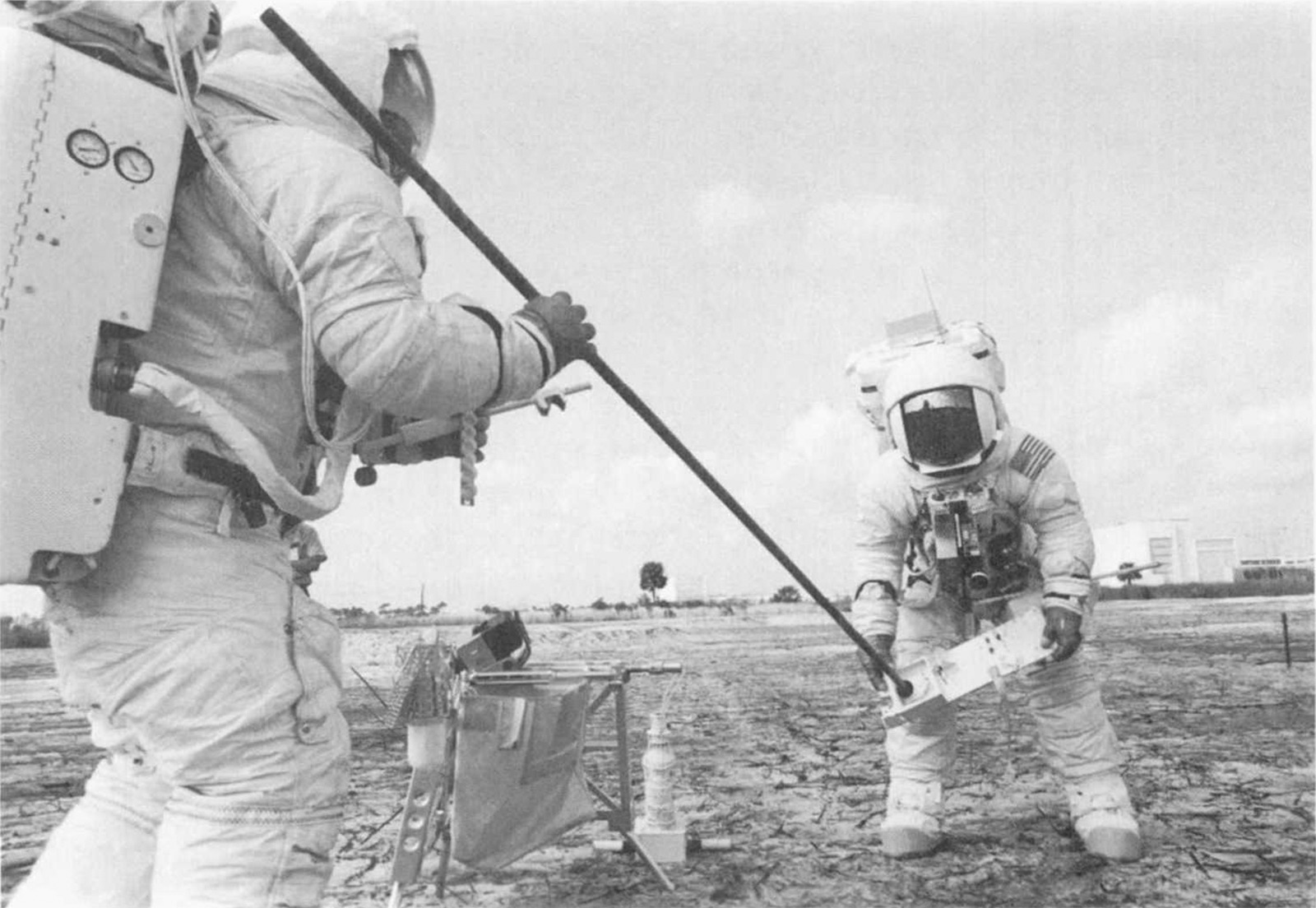
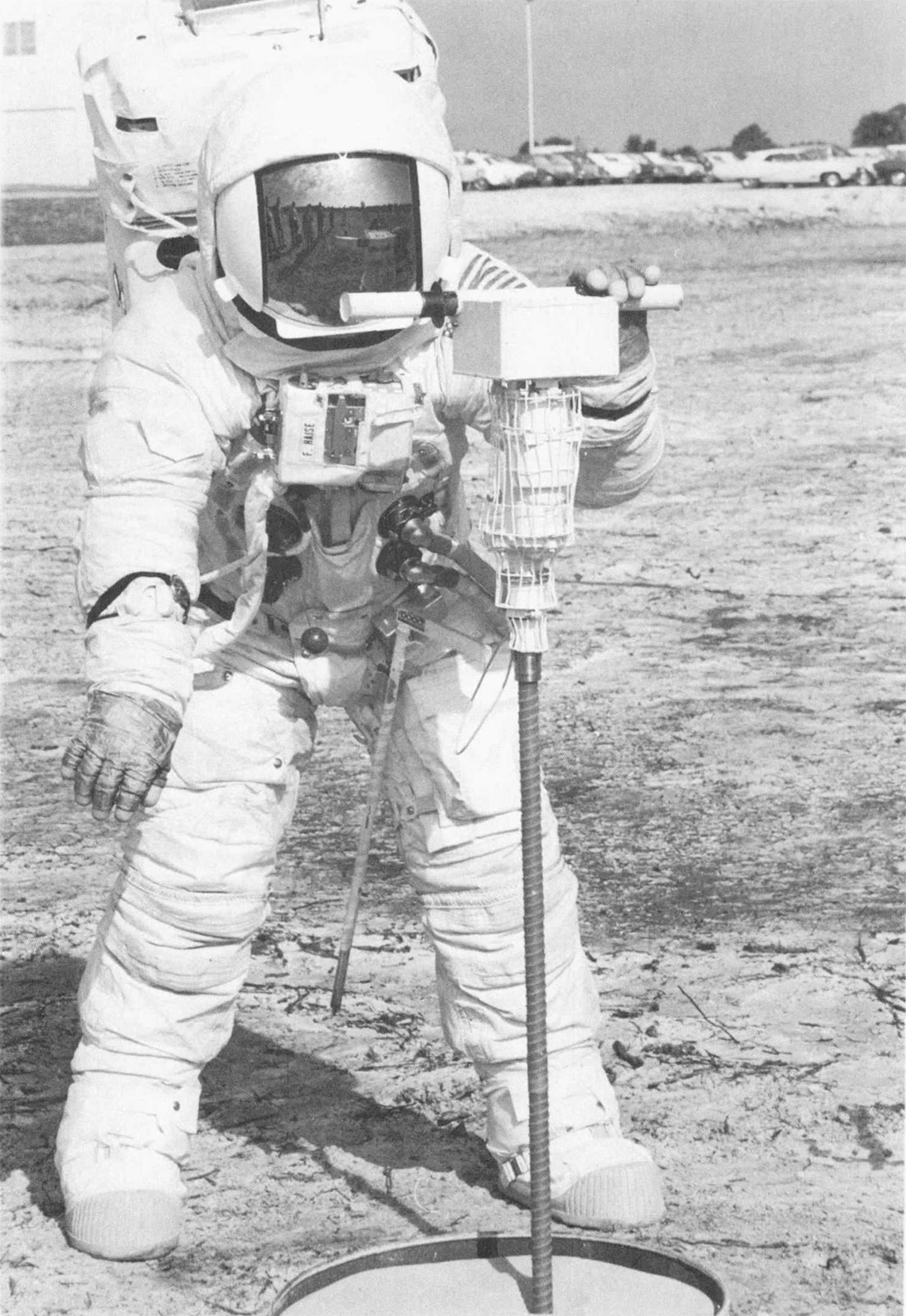
Geologists had high hopes for the Apollo 12 crew. They had been the first to go through a revised geology training program that stressed basic principles of site exploration rather than minutiae such as identification of rocks. By the time they were ready for launch, Pete Conrad and Alan Bean and their backups had well over 200 hours of field work under their belts. Their last field trip, to the volcanic fields of Hawaii, was extremely satisfying to their training officers. They handled every problem put to them, their descriptions and photographs were excellent, and their sampling of the terrain was first-rate. Everyone looked forward to superior results from the first real lunar scientific expedition.71
At Kennedy Space Center, preparations for the launch of Apollo 12 went smoothly. The first complete lunar surface experiments package arrived at KSC in late March. Spacecraft and Saturn V were mated on July 1, and the vehicle was moved to launch complex 39A on September 8. A week before launch the recovery quarantine equipment and mobile quarantine facility were ready for shipment to the recovery ship, U.S.S. Hornet. From then on, the only hitch in launch preparations occurred two days before launch, when discovery of faulty insulation on a liquid hydrogen tank in the service module required exchanging the tank for one on the Apollo 13 spacecraft. As launch day dawned, the only portent of possible delay was a cold front approaching the Cape from the north.72
Notes
- Stuart Auerbach, “Mariner 6 Relays 33 Pictures of Mars,” Washington Post, July 30, 1969; idem, “Mariner 7 Photographs Mysterious Mars Canals,” ibid., Aug. 5, 1969; Edward Clinton Ezell and Linda Neuman Ezell, On Mars: Exploration of the Red Planet 1958-1978, NASA SP-42l2 (Washington, 1984), pp. 74-80, 175-80.
- W. David Compton and Charles D. Benson, Living and Working in Space: A History of Skylab, NASA SP-4208 (Washington, 1983), pp. 104-11.
- Ibid., pp. 115-18; Homer E. Newell, Beyond the Atmosphere: Early Years of Space Science, NASA SP-4211 (Washington, 1980), pp. 286-89.
- John Noble Wilford, “A Spacefaring People: Keynote Address,” in A Spacefaring People: Perspectives on Early Spaceflight, Alex Roland, ed., NASA SP-4405 (Washington, 1985), p. 72. Wilford, a veteran reporter and one of the best on space, covered the space program for the New York Times for many years. He was the keynote speaker at this conference on manned space flight history at Yale University, Feb. 6-7, 1981. Wilford asserted (p. 71) as one of the major themes of space history that ” The first Apollo landing was, in one sense, a triumph that failed, not because the achievement was anything short of magnificent but because of misdirected expectations and a general misperception of its real meaning. The public was encouraged to view it only as the grand climax of the space program, a geopolitical horse race; and extraterrestrial entertainment - not as a dramatic means to the greater end of developing a far-ranging spacefaring capability. This led to the space program’s post-Apollo slump [emphasis in the original].”
- John D . Stevenson, TWX to MSF centers and support elements, “MSF Mission Operations Forecast for June 1969,” June 5, 1969; Courtney G. Brooks, James M. Grimwood, and Loyd S. Swenson, Jr., Chariots for Apollo: A History of Manned Lunar Spacecraft, NASA SP-4205 (Washington, 1979), p. 285; Mueller, “Manned Space Flight Weekly Report - July 1, 1969.”
- Stevenson to multiple addressees, TWX, “MSF mission operations forecast for August 1969,” July 27, 1969; Mueller, “Manned Space Flight Weekly Report - July 29, 1969.”
- 1967 Summer Study of Lunar Science and Exploration, NASA SP-157 (Washington, 1967), pp. 163-73, 229-33, 324, 358-59.
- Andre J. Meyer, handwritten notebooks III-VI (late 1967 to early 1969), in JSC History Office files. Besides being involved in other advanced project planning, Meyer headed the Apollo Explorations Project Office at MSC.
- Mueller, “Manned Space Flight Weekly Report - January 6, 1969,” “Manned Space Flight Weekly Report - April 21, 1969.”
- Wilmot N. Hess to AA/Director, “Summary OSSA Senior Council Meeting,” Apr. 30, 1968; John D. Hodge to PA/Office of Program Manager, MSC, “Lunar Exploration Support,” June 4, 1968, with encl., “ELM [extended lunar module] - Development.”
- MSC, draft statement of work, “LM Modification Study for Extended Lunar Staytime,” rev. 28, Feb. 1969; Mueller, “Manned Space Flight Weekly Report - March 4, 1969.”
- Lee R. Scherer to MSC, attn. Wilmot N. Hess, “Subsatellite on Apollo Lunar Missions,” May 3, 1968; Hess to Mgr., Apollo Spacecraft Program Off., “CSM Lunar Orbiting Science Study,” May 10, 1968.
- J. J. Eslinger to Apollo CSM Engineering Supervision, North American Rockwell Corp., Project Memorandum #3, “Apollo Scientific Experiments Program (ASEP),” Feb. 27, 1969.
- MSC, “Weekly Activities Report, Science and Applications Directorate, January 20-27, 1969.”
- Robert R. Gilruth to Mueller, “Lunar Exploration CSM Orbital Science, Phase I,” Mar. 27, 1969.
- John A. Naugle to Gilruth, TWX, Apr. 4, 1969.
- S. C. Phillips to Gilruth, TWX, subj.: CSM Phase I Orbital Science, Apr. 21, 1969.
- William E. Stoney, Jr., to MSC, attn.: J. P. Loftus, “CSM Orbital Science Missions,” May 15, 1969.
- Phillips to MSC, attn.: R. Gilruth, TWX, subj.: Authority to proceed with SM orbital experiments for Apollo 16 through 20, June 27, 1969.
- J. O. Cappelari, Jr., ed., “Where on the Moon? An Apollo Systems Engineering Problem,” The Bell System Technical Journal 51 (1972): 976-84.
- John R. Sevier interview, Apr. 24, 1986.
- MA/Apollo Program Dir. to multiple addressees, “Minutes of the Apollo Site Selection Board Meeting of June 3, 1969.”
- Ibid.
- Ibid.; Benjamin Milwitzky to Dir., Apollo Lunar Exploration Office, “Biasing Apollo Missions to Land Near Surveyor Spacecraft on the Moon,” Jan. 10, 1969.
- Minutes of the Apollo Site Selection Board Meeting, June 3, 1969; Owen E. Maynard to Mgr., Apollo Spacecraft Program, “Apollo Site Selection Board trip report - June 3, 1969,” with encl., “Lunar Landing Site Recommendations for Apollo 12 as Presented to Apollo Site Selection Board June 3, 1969,” June 10, 1969.
- Minutes of the Apollo Site Selection Board Meeting, June 3, 1969.
- George M. Low to NASA Hqs., attn.: S. C. Phillips, TWX, “Lunar Landing Sites for H-1 Mission,” June 12, 1969.
- Phillips to MSC, attn.: G. Low, TWX, “Lunar Landing Sites for H-1 Mission,” June 16, 1969.
- N. W. Hinners to Captain L. R. Scherer, “Second Mission Landing Sites,” June 18, 1969; Hinners to Group for Lunar Exploration Planning and Site Selection Subgroup, “Fourth GLEP Site Selection Subgroup Meeting - June 17, 1969,” June 23, 1969; Hinners to file, “GLEP Site Selection Subgroup, Fourth Meeting, June 17, 1969,” Aug. 4, 1969.
- Hinners, “Fourth GLEP Site Selection Subgroup Meeting - June 17, 1969.”
- Minutes of the Apollo Site Selection Board Meeting, July 10, 1969.
- NASA Release 69-53, Apr. 10, 1969; “Crew to Make 2d Landing On Moon Set,” Washington Post, Apr. 11, 1969.
- Ivan D. Ertel and Roland W. Newkirk, with Courtney G. Brooks, The Apollo Spacecraft: A Chronology, vol. IV, NASA SP-4009 (Washington, 1978), pp. 408-9.
- Sevier interview.
- “Apollo 12 Crew Training Summaries (Mar. 28-Nov. 14, 1969),” folder in box 081-14, JSC History Office files.
- MSC News Release, “Apollo 12 Landing Sites,” July 25, 1969; John G. Zarcaro to multiple addressees, “Apollo 12 Mission H-1 planning,” July 28, 1969.
- Sevier interview.
- B. E. Oldfield (Hughes Aircraft Co.) to John Hodge, July 10, 1969; Hodge to mgr., Apollo spacecraft program, “Science and Technological Items Available Upon Landing at a Surveyor Site,” July 31, 1969.
- Howard W. Tindall, Jr., “A Lengthy Status Report on Lunar Point Landing Including Some Remarks about CSM DOI [Descent Orbit Insertion],” Aug. 29, 1969. Tindall’s clear and breezy style in writing memos (“Tindallgrams,” as they came to be called), usually prefaced with an attention - grabbing title, gained him a well-deserved local reputation. He had the gift, rare among engineers and still rarer among managers, of compacting large amounts of information into a few clear and understandable paragraphs, leavened with considerable humor.
- Tindall, “How to Land Next to a Surveyor - a Short Novel for Do-lt-Yourselfers,” Aug. 1, 1969.
- Surveyor III: A Preliminary Report, NASA SP-146 (Washington, 1967), pp. 12-16; Walter Sullivan, “Surveyor Tracked Down By a Photographic Sleuth,” New York Times, Nov. 19, 1969.
- John P. Mayer, “The Search for Surveyor III,” MSC Internal Note 69-FM-329, Jan. 16, 1970. Its language shows that the report was written before the launch of Apollo 12, although it is dated two months later.
- Tindall, “How to Land next to a Surveyor,” Aug. 1, 1969.
- Tindall, “A Lengthy Status Report,” Aug. 29, 1969.
- Tindall to multiple addressees, “Apollo 12 Descent - Final Comments,” Nov. 4, 1969.
- MSC, “Mission Requirements, SA-507/CSM-l08/LM-6, H-1 Type Mission, Lunar Landing,” MSC SPD9-R-051, July 18, 1969, pp. 2-1 to 2-3.
- MSC, Apollo 12 Mission Reviews, Aug. 15 and Oct. 2, 1969.
- Andre J. Meyer to PA/Mgr., Apollo Spacecraft Program, “Surveyor 3 Activities on Apollo 12 Mission,” Aug.28, 1969.
- Hinners to L. R. Scherer, “Second Mission Landing Sites,” June 18, 1969; James H. Sasser to multiple addressees, “Highlights of GLEP Site Selection Subgroup Meeting in the Mapping Sciences Laboratory on June 17, 1969,” June 22, 1969.
- Thomas O'Toole, “Veteran Astronauts Lovell, Shepard to Lead '70 Moon Flights,” Washington Post, Aug. 7, 1969. A month earlier a Houston paper had run an unconfirmed story that Shepard, Roosa, and Mitchell would be the crew for Apollo 13, with Lovell, Mattingly, and Haise manning 14 (Arthur Hill, “Alan Shepard Will Command 3rd Moon Team,” Houston Chronicle, July 3, 1969). This may have been the cause for George Mueller’s overriding Slayton’s choice for these crews - the only instance in which Headquarters reversed Slayton’s selections [see note 13, Chap. 5]. Shepard had been off the active list until May 1969, serving meanwhile as head of the Astronaut Office (“Mercury’s Shepard rejoins flight group,” MSC Roundup, May 16, 1969). The report that he had been named to the first mission scheduled after he returned to active status would have considerably upset the scientist astronauts. In the course of an interview unrelated to this book, one of them commented off the record to the present author, “the test pilots ran the astronaut office and flew their friends.” True or not, such a perception would have been hard to refute after this crew selection.
- Marti Mueller, “Trouble at NASA: Space Scientists Resign,” Science 165 (1969):776-79.
- Ibid.
- Wilmot N. Hess, interview with Robert Merrifield, Nov. 7, 1968, transcript in JSC History Office files; John Noble Wilford, “Moon Scientists Seek Place in the Sun,” New York Times, Aug. 10, 1969; Gilruth to Mueller, Sept. 2, 1969.
- Eugene Shoemaker, “Space - Where Now, and Why?” Engineering and Science 33(1) (1969): 9-12.
- “Geologist to Quit Apollo Project; Weak Scientific Effort Charged,” New York Times (UPl), Oct. 9, 1969.
- Harold Urey, who during this period continually criticized NASA’s choice of lunar landing sites, wrote off geologists as “mostly … a second-rate lot…. [Geology] is descriptive, and very often [geologists] do not learn more than the most elementary things about chemistry and physics.” Urey to Mueller, Oct. 7, 1969. Of Shoemaker, Urey said, “Gene is one of the few capable people who has had a prominent part in advising NASA, though he has had a very rigid geological point-of-view…. I do not agree with him in some ways, but his general criticism of the lack of good scientific advice is correct.” Urey to Paine, Oct. 9, 1969. Urey and Shoemaker had both worked on Project Ranger.
Shoemaker’s criticism deeply affronted some in NASA, who felt it could only do the program harm; see Homer E. Newell, Beyond the Atmosphere: Early Days of Space Science, NASA SP-4211 (Washington, 1980), pp. 292-93. To this day Shoemaker insists that his intent was grossly mis-understood: “What I was trying to do,” he told the author, “was to get people to focus on something they were losing on this thing, but I never got the point across.” He and a few others thought the point was, “let’s make the astronaut himself an instrument of scientific discovery,” which could not be done by slavishly following preplanned operations. “The sample scientists didn't give a damn, frankly, whether the astronauts discovered something or not; they were going to discover something with the samples that came back, you see. * * * As far as I'm concerned, the kinds of things you could discover, by human observer, under the constraints of Apollo, … [have not] been touched. If you could get me a spacecraft tomorrow, I've got the whole program … in my head, … and it’s still there [on the moon]. All you need to get me is a hand lens and a shovel…. There’s three and a half billion years of history in three meters [10 feet] of dirt … on the lunar surface, and … we haven't even touched it yet.” Shoemaker interview, Mar. 17, 1984. Since Shoemaker did not make this point central to his public remarks, it is not surprising that his former colleagues in NASA were affronted.
- “Scientists vs. NASA,” unsigned editorial in the New York Times, Aug. 12, 1969.
- “Before We Start to Mars,” unsigned editorial in the Washington Post, Aug. 8, 1969.
- Fred L. Whipple to George E. Mueller, Aug. 1, 1969.
- Alex J. Dessler, “Discontent of Space-Science Community,” Oct. 30, 1969, paper written for unknown purpose, copy in box 075-36, JSC History Office files.
- Newell, Beyond the Atmosphere, pp. 213, 221-22. The fact was that no eminent research scientist was willing to give up research for a career (or even a year’s tenure) as a research administrator; yet Whipple, Dessler, and other scientists continued to urge NASA to find such a person to manage the science programs. See Newell, chap. 12 (“Who Decides?”). A similar problem arose in the life sciences program; see John A. Pitts, The Human Factor: Biomedicine in the Manned Space Program to 1980, NASA SP-4213 (Washington, 1985), passim.
- John Lannan, “Money, Space, Environment Dominate Scientists' Parley,” Washington Evening Star, Dec. 27, 1969; “Scientists Hit Threat to Cut 4 Apollo Flights,” Boston Sunday Globe, Dec. 28, 1969; “Technology Misused, Radicals Charge,” Washington Post, Dec. 29, 1969. An expression of the plight of science in 1969 and the evil effects of military-sponsored research is found in “Support of Science on the University’s Own Terms,” by Gerard Piel (publisher of Scientific American), Science 166 (1969): 1101.
- Mueller to Gilruth, Sept. 3, 1969.
- James R. Arnold to A. J. Calio, “Apollo 12 Recommendations,” Sept. 5, 1969; Arnold to Calio, “Display of Sample Information in the LRL,” Sept. 6, 1969.
- Paul W. Gast to Calio, “Dry N2 Facility as a primary ALSRC Receiving and Handling System,” Sept. 8, 1969; LSAPT to W. N. Hess, “Minutes of LSAPT dated March 13, 1969,” Mar. 21, 1969; Gast to LRL Management and Mission Review Board, no subject, Aug. 8, 1969.
- E. C. T. Chao and R. L. Smith to Hess, “Recommendations and Suggestions for Preliminary Examination of Apollo 12 Returned Lunar Samples,” Sept. 8, 1969.
- R. S. Johnston to P. R. Bell and W. W. Kemmerer, Jr., “Apollo 12 Sterile Nitrogen Processing,” Sept. 22, 1969.
- Johnston to NASA Hqs., attn.: Maj. Gen. J. W. Humphreys, “Apollo 12 Back Contamination Program Plan,” Oct. 7, 1969; Johnston to Mgr., Command and Service Modules, Apollo Spacecraft Program, “Requirement for Installation of a Postlanding Vent Valve Back Contamination Filter on CM’s 108 and Subsequent,” Sept. 18, 1969.
- Johnston to the record, “Apollo 12 Back Contamination Program,” Sept. 17, 1969.
- Apollo 12 Crew Training Summaries, Aug. 15, Sept. 15, Nov. 14, 1969, folder in box 081-14, JSC History Office.
- Harrison H. Schmitt interview, May 30, 1984.
- Manned Space Flight Weekly Reports, Apr. 1, July 1, Sept. 15, Nov. 10, 1969; Charles D. Benson and William Barnaby Faherty,Moonport: A History of Apollo Launch Facilities and Operations, NASA SP-4204 (Washington, 1978), pp. 480-81.