FINAL PREPARATIONS: 1968
Apollo took longer strides in 1968, perhaps, than in any previous year. In April, fifteen months after the fire, a Saturn V carried an unmanned command module into earth orbit to test launch vehicle and spacecraft systems and to simulate reentry from a lunar voyage. Only months before Apollo 7 tested the redesigned command module with a crew in October, officials at the Manned Spacecraft Center began to think about a much more ambitious flight. After selling their proposal to Headquarters, they began making plans to send a crew to the vicinity of the moon. For Christmas 1968 NASA gave the world a present to remember: live television pictures and oral commentary from the crew of the Apollo 8 spacecraft in lunar orbit.
On the science side, progress was less spectacular. Technical problems with the lunar surface experiments were largely overcome, but doubts about the astronauts' ability to unload and deploy the instruments in the time available eventually caused program officials to substitute a smaller science package on the first lunar mission. Several of the systems for handling lunar samples in the lunar receiving laboratory caused major delays, but when the year ended the staff was gearing up for a full-scale simulation.
Spacecraft and Mission Progress
Most of MSC’s activity during 1967 and early 1968 was directed toward reducing the fire hazard in the command module. The spacecraft hatch was redesigned so that the crew could open it unaided in five seconds. Electrical systems and the plumbing that carried oxygen and combustible coolants were thoroughly examined and modified. New materials to replace flammable nylon were investigated. The advantages and disadvantages of atmospheres other than pure oxygen were weighed. Repeated testing gathered data to support recommended changes. A Senior Flammability Board, a Materials Selection Review Board, and a Crew Safety Review Board were established to oversee specific parts of the process, and a tough Configuration Control Board was set up to pass on all proposed changes in the command module. The spacecraft builder, North American Aviation, was prodded to supervise its subcontractors and vendors more closely to ensure on-time delivery of critical subsystems.1 The lunar landing module was less affected by the fire, but it had its own problems. As had happened two years earlier, its weight continued to creep upward, putting a squeeze on the scientific payload that could be landed on the moon. Stress corrosion - cracks in aluminum structural members - and fragile wiring caused delays and concern for reliability. Perhaps the most serious problem was combustion instability in the lander’s ascent engine, which would blast the astronauts in the upper section back into lunar orbit after they had completed their lunar exploration. These were worrisome problems at this late stage, but concentrated effort by the lunar module contractor and two engine contractors produced enough progress by mid-1968 to give NASA managers reason for guarded optimism.2
Late in January 1968 flight tests resumed when MSC put an unmanned lunar lander through its paces in earth orbit. Designated Apollo 5 and launched on a Saturn I-B, this flight verified operation of the lunar module’s propulsion and attitude-control systems and checked out the performance of the instrument unit on the launch vehicle’s uppermost stage, the S-IVB. The success of this mission was more encouraging than the one that followed. On April 4 Apollo 6, the second “all-up” unmanned test of the Saturn V, tested launch- vehicle systems and the emergency detection system and allowed launch crews and vehicle engineers to rehearse their tasks once more. Along for the ride, more or less, was a Block I command module with some Block II* modifications; no mission objectives were to be satisfied by this spacecraft except verification of its performance during reentry from a lunar mission. Apollo 6 was trouble from the start. The first-stage burn produced intolerable “pogo” effects (longitudinal oscillations due to irregular fuel feed), and a section of the adapter that mated the spacecraft to the booster blew off during ascent. Two of the five engines on the second stage (S-II) shut down prematurely. Perhaps the most troublesome fault was the failure of the third stage (the S-IVB) to reignite in orbit - the maneuver that, on a lunar mission, would send the Apollo craft on its way to the moon. Marshall Space Flight Center immediately got to work on the problems; yet another unmanned Saturn V test might be needed unless Marshall’s engineers could correct them.3
* The two versions of the command module were designed respectively for earth-orbit and lunar-landing missions. They differed chiefly in onboard systems (guidance and navigation, docking, life-support, etc.).
In spite of the difficulties with Saturn V and the lunar module, in mid-1968 it still seemed possible that manned flights could resume before the end of the year. Command and service module number 101, delivered to the Cape at the end of May, had fewer discrepancies on arrival than any previous spacecraft. It would fly on Apollo 7, the first manned earth-orbital test of the second-generation spacecraft, scheduled for the last quarter of the year. Since that mission would use a Saturn 1-B rather than a Saturn V and would not carry a lunar module, its prospects seemed good.4
While spacecraft and operations engineers worked toward getting Apollo flying again, their counterparts in the science programs were equally busy preparing for the first lunar landing. Of all the science-related efforts, the lunar surface experiments were in the best shape in early 1968. The lunar receiving laboratory with its complex scientific equipment, and the elaborate procedures for back-contamination control, had much farther to go before they would be ready to handle their part of the program.
Lunar Surface Experiments
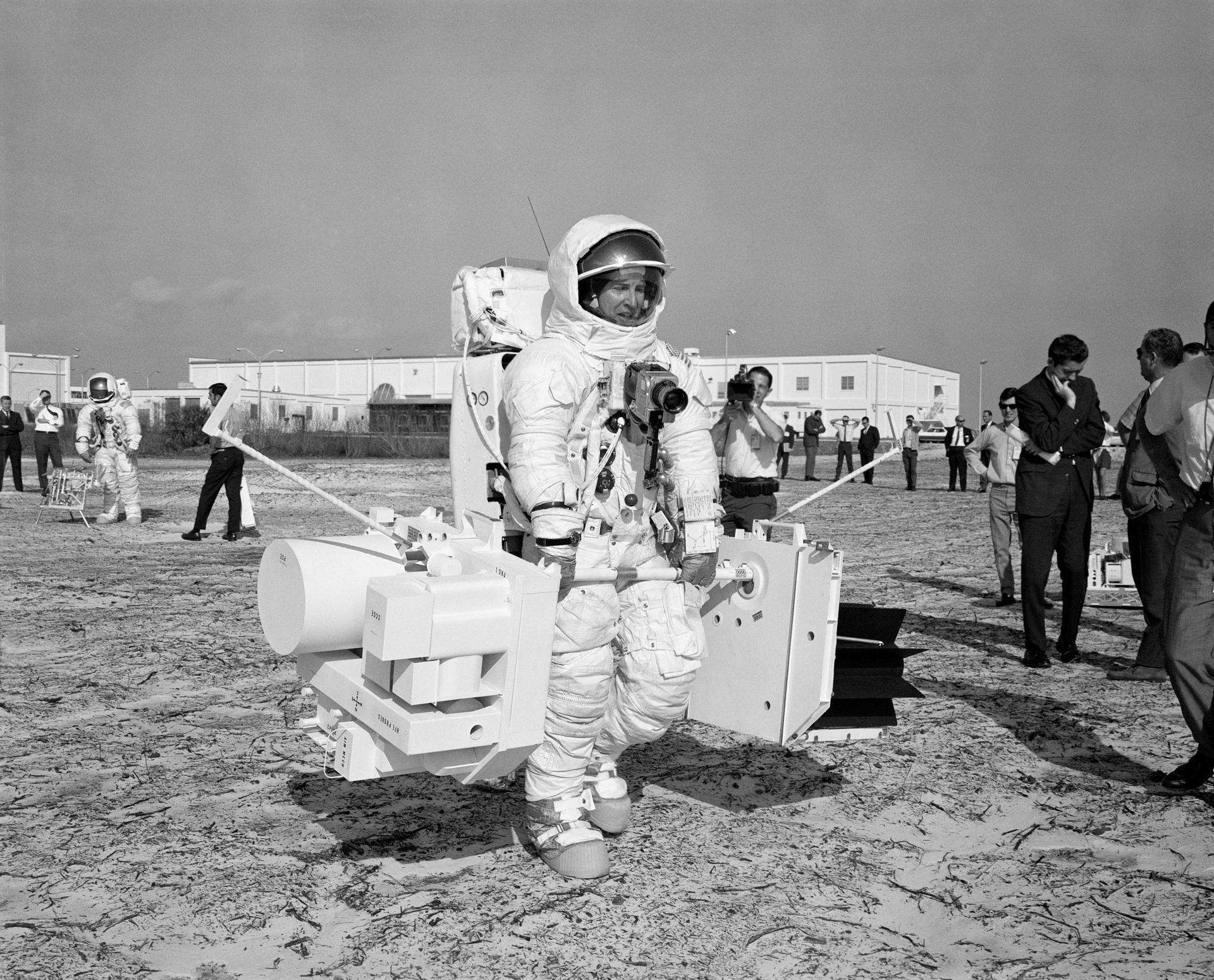
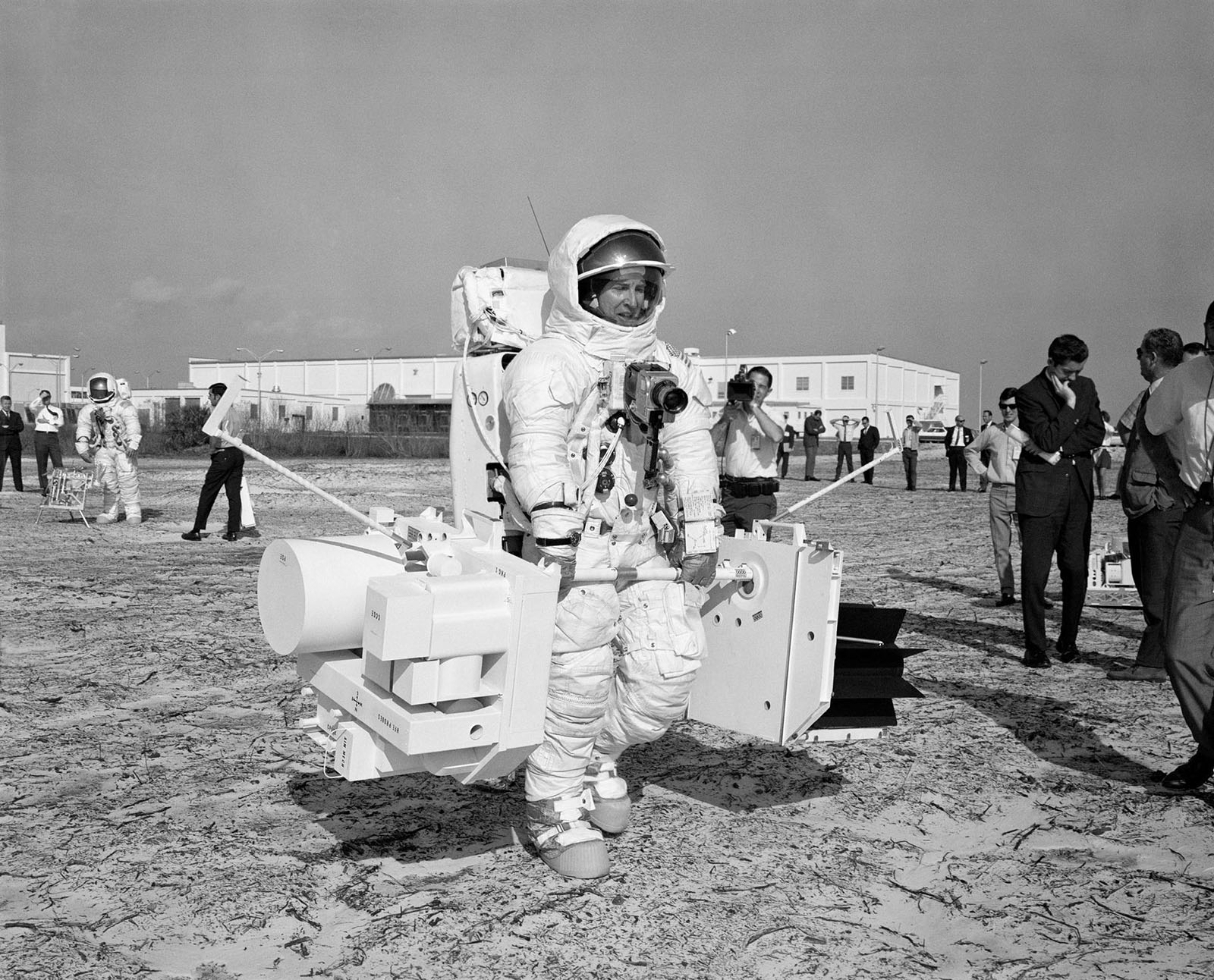
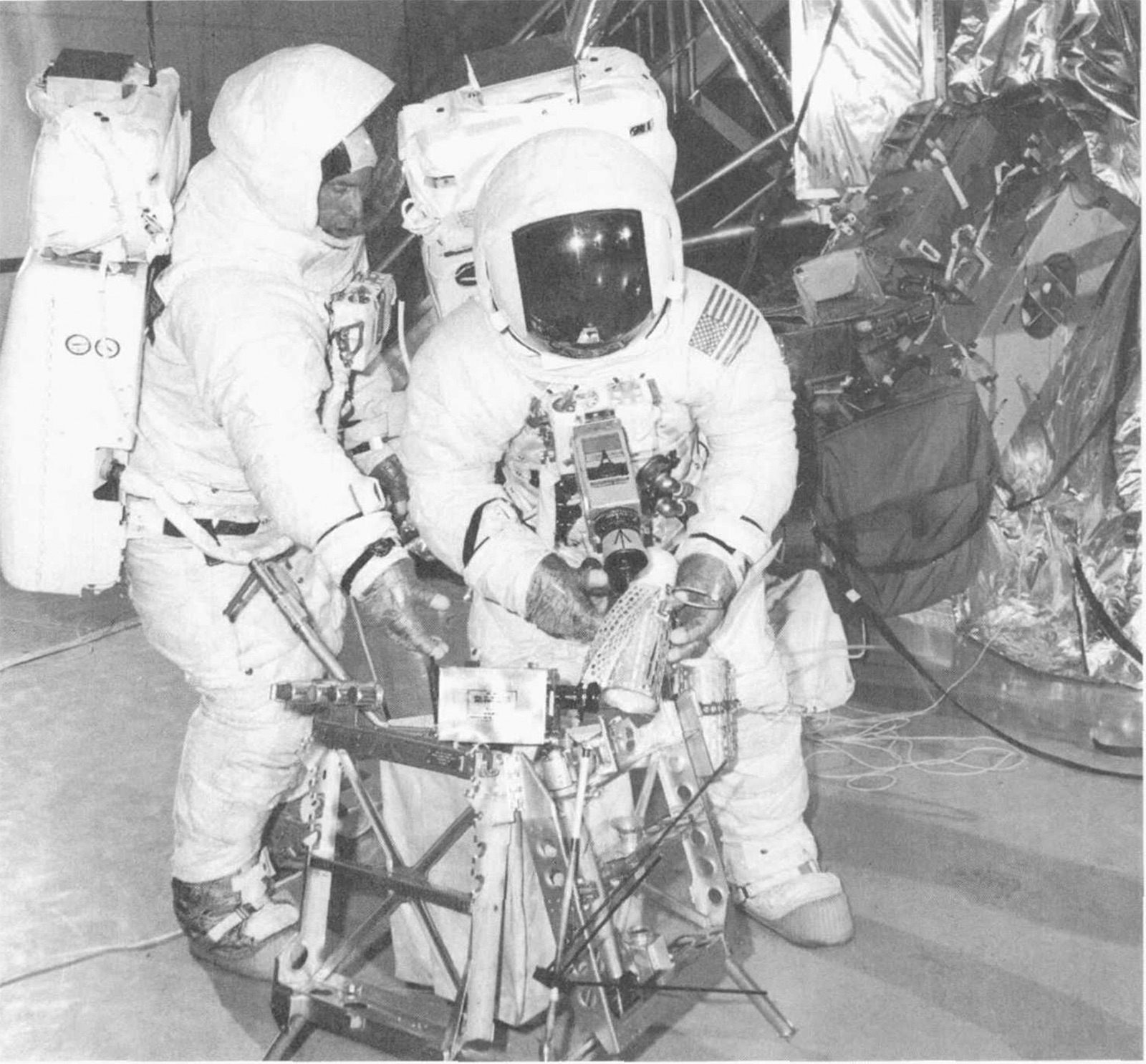
During 1967 the Bendix Corporation and MSC ironed out the development problem of the Apollo lunar surface experiments package (ALSEP), and the project was on schedule for the first lunar landing mission. [see Chapter 6] But as the year wore on, doubts about the ability of the astronauts to set up the instruments in the time available,** expressed in July by a Headquarters official,5 [see Chapter 7] arose in other quarters as well. Planning for lunar surface operations called for one period of activity in which the astronauts would collect a contingency sample, inspect the lunar module, and familiarize themselves with the low-gravity environment. During this excursion - whose length was limited by the capacity of the portable life-support systems - they would scoop up 10 kilograms (22 pounds) of surface material and load it into the sample- return container. No one was sure how much time these activities would require. MSC tended to be very conservative in estimating how much work astronauts could do under lunar surface conditions, and since it was certain that setting up the experiments would take a good deal of time and effort, deployment was not scheduled during the first extravehicular period. “For planning purposes,” preliminary plans called for a second moon walk during which the crew would unload, lay out, and connect the science instruments.6
** An additional question, raised by MSC’s Flight Operations Directorate, was whether any lunar module systems should be turned off during the lunar stay. FOD favored keeping critical systems running so that the astronauts could depart immediately in case an emergency developed; this would require additional consumables which would cut into LM weight margins. Minutes, Lunar Missions Planning Board, May 19, 1967.
As planning went on, however, and the limitations of time and life-support systems became clearer, the flight of the planned group of instruments on the first lunar landing mission became more doubtful. Simulations showed that a suited astronaut had serious difficulty in unloading the package from the lunar module. To complicate the situation further, weight was a growing problem with the lunar module and difficulties were developing with the radioisotope thermoelectric generator that provided power for the experiments. By mid-1968 planners were already discussing the need to develop a smaller, less complex package for that flight, so that some minimum scientific return would be realized.7
MSC’s normal conservatism in matters of crew safety and mission success grew even stronger during the summer. The more engineers and mission planners looked at alternatives the more attractive a simplified plan for lunar surface operations became. The first lunar landing would, after all, be the most hazardous (potentially catastrophic) space mission yet, and it would be done with a spacecraft that had not been (and could not be) tested under conditions exactly duplicating the mission. Houston’s concern had its effect in Washington. In June George Mueller asked Gilruth to schedule a simulation of instrument deployment so that he could make his own evaluation.8 After this was completed in mid-August 1968, Sam Phillips, Apollo program director at Headquarters, conferred with the chairman of the Science and Technology Advisory Committee*** on proposed changes in plans for the first lunar landing. When they reached agreement, Phillips notified committee members of the new plans. Instead of a 26-hour stay on the moon and two-person excursions, he said, “it now seems prudent to limit the lunar surface staytime to about 20 hours and the EVA [extravehicular activity] to a single one-person excursion of 2 to 2 ½ hours duration.” This decision was based on experience in Gemini, where MSC had been unpleasantly surprised by the difficulty of working in null gravity. Whereas previous plans had called for the astronauts to set up a high-gain (strongly directional) antenna for television transmission, conduct preliminary geological exploration, collect samples, and emplace the lunar surface experiments package, mission planners now proposed to curtail the geological exploration, to depend on the 64-meter antenna at Goldstone, California, to pick up TV signals from a less directional antenna that did not have to be deployed by the astronauts, and to carry no scientific instruments at all. Phillips regretfully acknowledged that much scientific information would be lost but noted that subsequent missions would make up for it. Offsetting that loss would be operational advantages that looked extremely attractive: an increase in the safety margins for the lunar module’s propulsion systems; maintenance of the lunar module in a state of readiness for quick departure in an emergency; and simplification of the training program, which was becoming undesirably complex.9
*** Principal external advisory group to the Office of Manned Space Flight, established by George Mueller in 1964.
Phillips’s action was welcomed by most of the MSC officials directly involved, but not by Wilmot Hess, director of science and applications. Hess, who had been fighting the battle for Apollo science on many fronts for the past two years, was dismayed by Phillips’s proposals. In a vigorous remonstrance he deplored the severe loss to lunar science and the loss of credibility among the scientists that MSC would suffer if the proposed changes were adopted:
What can I answer to the critics of the manned program?… People in NASA and outside… have repeatedly told me that no useful science had been done on Gemini and that none would be done on Apollo. My answer has been that it… would start with the lunar landings. This is not the case now. A person who says now that the scientific program of Apollo could be carried out as well using the Surveyor Block III spacecraft has a very good story. I don't know how to answer him.
Hess strongly urged that the proposed single EVA be open-ended, lasting up to three hours if all should go well, and carrying all the scientific instruments:
…if there is a 50-50 chance of getting one experiment deployed… it would be better to carry ALSEP and take the chance of not deploying it rather than not carry [it] and … lose any chance to do this important experiment.
He closed with a strong recommendation to carry several small, easily deployed experiments on the first landing and to make a firm announcement that the second lunar landing would include a 35-hour stay, three EVAs, and the conduct of the entire science program: collection of samples, deployment of the full package of surface experiments, and carrying out the field geology program.10
In response to Hess’s plea Phillips asked MSC to propose a contingency science program for the first landing; this was prepared and reviewed at MSC early in October. In discussions with Phillips and George Low, MSC Apollo spacecraft program manager, Hess, won back some important points for science. The new experiments package would contain three simple instruments: a laser retroreflector, requiring no electrical power, with which variations in the earth-moon distance could be measured with great accuracy; a passive seismometer powered by solar panels; and a solar-wind composition experiment, also passive and requiring very little astronaut attention to set up. The astronaut on the lunar surface would not spend time simply testing his mobility and agility, but would carry out some productive scientific tasks while acclimating himself, such as collecting and packaging samples and taking documentary photographs of samples as they were collected. Hess forwarded his proposals to Robert Gilruth and prepared a procurement plan for the new set of experiments.11
On November 5, Headquarters approved the new package and authorized MSC to modify Bendix’s contract to build it. Manufacture could start before the final terms were negotiated, as time was critical. Some difficulty was expected in fabricating the laser reflector (an array of a hundred individual “corner reflectors,” internal corners of cubes made of silica, polished to fine tolerances and precisely aligned) and MSC was authorized to pursue parallel approaches with the University of Maryland and the Air Force Cambridge Research Laboratory, both of which were working on similar projects.12 The new package would be called the “early Apollo scientific experiments package,” or “EASEP.” 13 Total funding for the package was $5.3 million, and delivery was to be scheduled for May 15, 1969.14 Formal assignment of EASEP to the first landing mission was made by direction of the Apollo configuration control board on December 5.15
Hess’s vigorous advocacy saved a minimal scientific return for the first lunar landing mission, and the original group of experiments - with some changes - would be flown on all subsequent missions. Whether the dire consequences he anticipated in the event of complete cancellation would have materialized is debatable. As early as May 1968 the Planetology Subcommittee of the Space Science and Applications Steering Committee had been warned of such a possibility and had not objected; it merely urged that a set of backup experiments be developed in parallel, to be ready in case the complete package could not be flown.16 The scientists who were to conduct the experiments agreed - after the fact - that the changes were acceptable under the circumstances, but expressed understandable vexation because they were not consulted before the decision.17 Still, the mood of many scientists outside NASA was such that removing the lunar surface experiments from the first mission might well have provoked a new storm of criticism of the Apollo program.
Lunar Receiving Laboratory
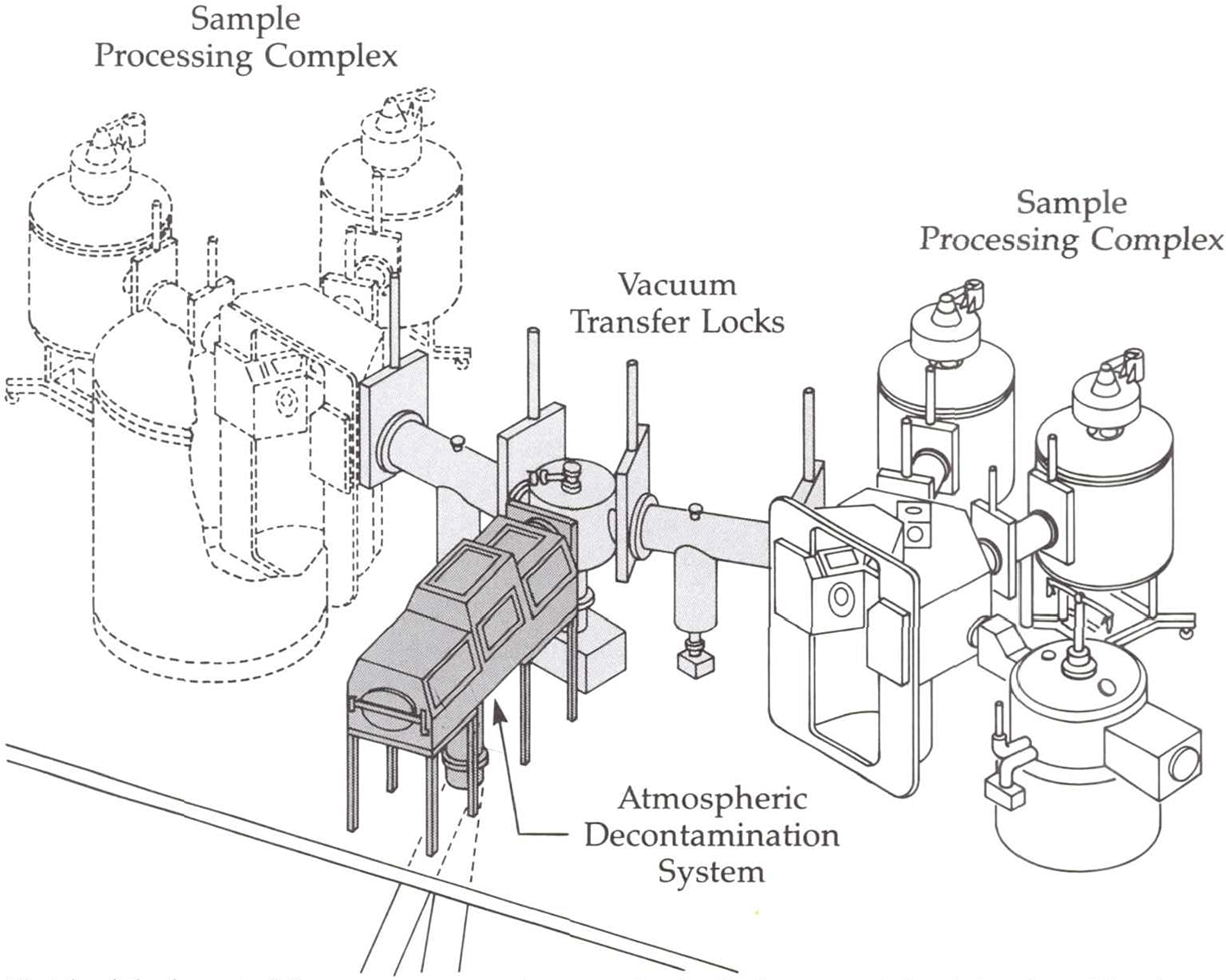
Construction of the lunar receiving laboratory was virtually complete by the middle of 1967; Hess held a press conference to open the new facility on June 29.18 For the rest of the year and much of 1968, NASA and Brown & Root-Northrop, support contractor responsible for operating the laboratory, were occupied with installation and testing of the specialized equipment required for quarantine testing and sample handling. Brown & Root-Northrop set up training programs for the technicians who would do much of the work in the laboratory. In April 1968, to assure coordination of effort between quarantine studies and scientific investigations, the two MSC directorates principally involved - medical research and operations and science and applications - began holding monthly meetings on the status and problems of the receiving laboratory.19 MSC officials planned an operational readiness inspection for the last quarter of 1968, and contemplated partial and complete simulations as soon as they could begin, to exercise the laboratory’s functions and uncover flaws in equipment and procedures.20
As could be expected for a facility of such complexity, many technical problems arose in the lunar receiving laboratory during the installation and testing of its equipment. Both in the sample-handling area and in the biological laboratories, difficulties slowed progress until late summer.21 By mid- September, however, problems with autoclaves (pressure vessels for sterilizing items to be transferred out of the biological containment area) were the only serious concern. Laboratory managers prepared and sent to the MSC director a request to appoint an Operational Readiness Inspection Board for the receiving laboratory.22
While awaiting completion of the laboratory, scientists on the preliminary examination team and the lunar sample analysis planning team were busy defining their procedures and preparing for simulations.23 Both teams met at Houston frequently during 1968 to discuss issues of importance in operation of the laboratory and to maintain liaison with the principal investigators. For the outside members of these teams, many of whom were university researchers, preparations for the laboratory work to follow the first lunar landing entailed a considerable sacrifice of time from their normal duties.24 Simulations would require from 10 to 30 consecutive days of work in the laboratory.
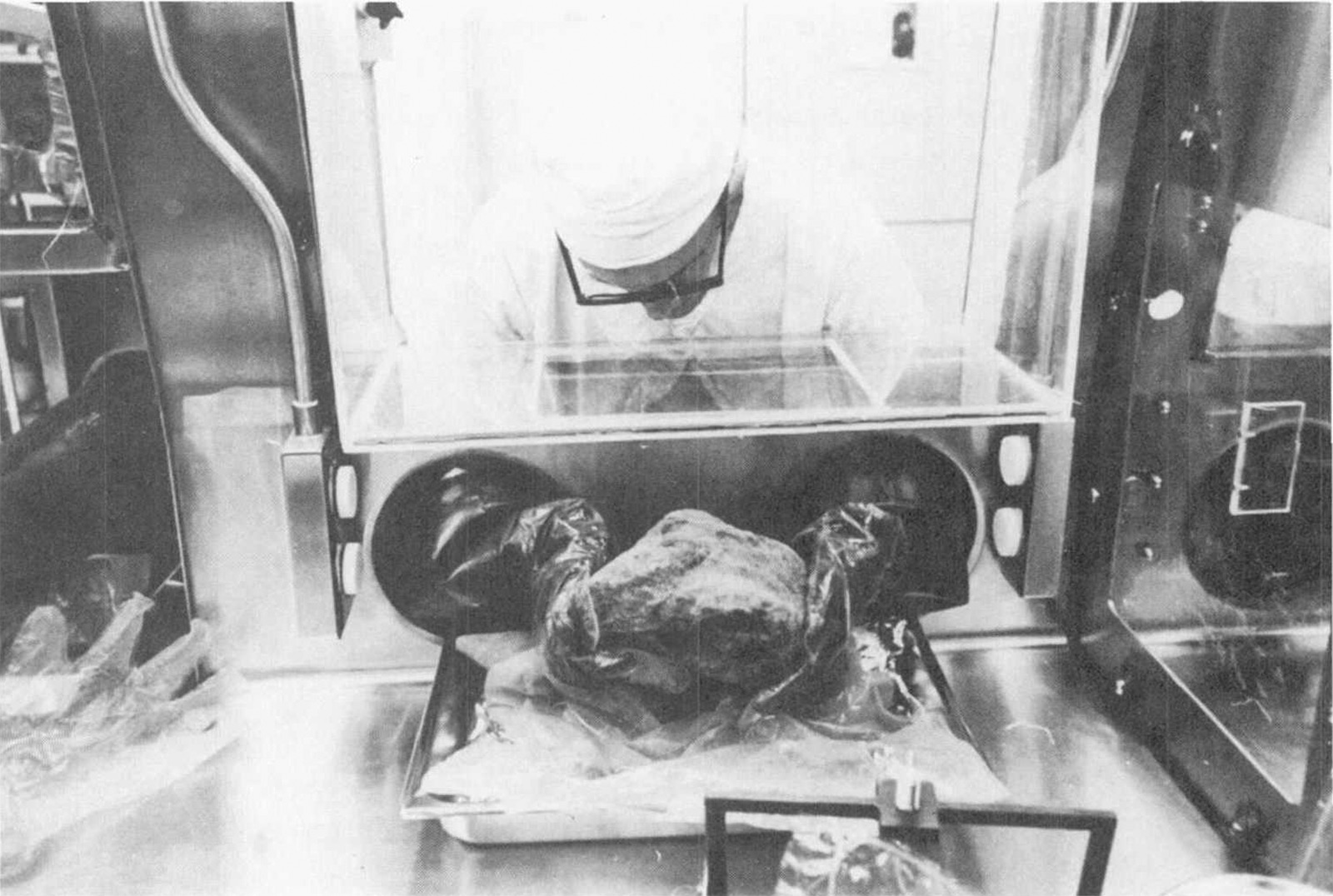
Late in October the science teams gathered in Houston to conduct a training session and simulation of operations in the sample-receiving and -processing sections of the receiving laboratory.25 The 10-day exercise uncovered 82 major and minor faults in equipment. A substantial number of these impaired effective operation of the vacuum system in which the sample return containers were opened. The vacuum chamber, like most of the other cabinets that comprised the primary biological barrier, was a “glove box,” designed so that various tools, stored inside, could be manually manipulated through a pair of impermeable gloves built into the chamber wall. The gloves had to withstand a pressure difference of around 100 kilopascals (15 pounds per square inch - a high vacuum inside and normal atmospheric pressure outside); consequently they were stiff, making it difficult for the operator to use the small hand tools with any dexterity and sensitivity. The simulation also revealed that the viewing ports left blind spots for the operator in some corners of the chamber. These and other problems necessitated more than 80 major and minor changes to the system and procedures before a full mission simulation could be conducted some time in early 1969.26 MSC established a configuration control board for the receiving laboratory to pass on proposed changes and keep nonessential ones from proliferating.27
By October 1968 sufficient progress had been made to conduct an operational readiness inspection - a mandatory procedure for all MSC facilities. MSC Director Robert R. Gilruth appointed a 10-person committee to review the facilities, staffing, and operational plans.28 After an initial meeting in early November and a complete briefing two weeks later, committee members spent a month scrutinizing physical facilities, staffing and personnel training, and operational procedures.29 The committee’s recommendations, submitted in mid-December, included 72 mandatory and 91 desirable changes necessary to render the laboratory acceptable for operation.30
Preparations for a 30-day simulation of receiving laboratory operations, scheduled for March and April, occupied most of the early months of 1969. In the interim between the operational readiness inspection and the simulation, laboratory staff and contractor employees worked to iron out the remaining problems.
Problems with Back-Contamination Control
The receiving laboratory was only part of the scheme for preventing contamination of the earth by alien organisms. Between the spacecraft floating on the Pacific Ocean and the laboratory in Houston was a long chain of events that offered several chances to contaminate the environment. Early in 1968, spumed by expressions of concern by scientists outside the government, the Interagency Committee on Back Contamination (ICBC) revived the question of whether lunar contaminants could be completely prevented from escaping into the biosphere during recovery operations, particularly between the floating command module and the mobile quarantine facility aboard the recovery ship. For two years the committee had been uneasy about this problem, and at its February meeting the chairman opened the discussion once more. The committee asked MSC’s landing and recovery division to provide
a detailed discussion on the return lunar mission [focusing on] containment countermeasures on the lunar surface, in the Lunar Module (LM) ascent stage, during LM-CM transfer, during CM earth return, splashdown, retrieval, operations onboard the recovery vessel, transfer into the mobile isolation unit, and delivery and transfer into the LRL.
Committee members also wanted details of MSC’s contingency plans for biological containment in case the spacecraft came down outside the primary recovery zone.31
These requests surprised Apollo officials at Houston, who thought those questions had long been settled. Nonetheless, MSC engineers reviewed the subject again at the June meeting of the ICBC, and the committee kept the containment question on its agenda for further study.32 At its October meeting the ICBC reiterated its considered opinion that the recovery crew should attach some type of biological filter to the spacecraft’s post-landing ventilation valve, which circulated air through the command module and exhausted it to the outside. When this question had been raised two years before, MSC had demurred, warning that an effective filter would reduce the efficiency of the ventilation system to an unacceptable level and that attaching it to a floating spacecraft was too hazardous to the recovery crew, especially in a rough sea. The committee insisted, however, that development of a filter attachment with a supplemental fan should be “energetically pursued to avoid what could be compromised and untoward decisions.” 33
When these discussions came to the attention of MSC Director Robert R. Gilruth, he asked for a detailed briefing on the situation and ordered another review of the question.34 Further discussions at MSC reaffirmed the center’s basic position that biological isolation garments for the crew [see Chapter 7] constituted the best available containment in view of the difficulties presented by more secure measures. MSC officials did, however, propose to take more stringent precautions against bringing lunar dust into the command module.35 Preliminary discussions of these procedures with an ad hoc committee of the ICBC produced tentative agreement.36
At the full committee meeting, however, agreement could not be reached. MSC presented its plans for minimizing the transfer of lunar dust into the lunar module and thence into the command module, which apparently mollified the ICBC somewhat. But after reviewing the results of a simulation of Apollo 9, which had included the use of the biological isolation garments and other phases of recovery, the committee was convinced that recovery procedures allowed a breach of containment that must be corrected.37 Dr. David Sencer, the ICBC chairman, then wrote a strongly worded letter to Thomas O. Paine, newly appointed NASA administrator,**** expressing dismay over MSC’s apparent failure to appreciate the problem and make serious efforts to correct it. He pointed out that if recovery procedures allowed lunar organisms to contaminate the earth, the rest of the elaborate (and expensive) chain of quarantine was rendered useless and the space agency would lay itself open to severe criticism by the public and the scientific community. Sencer told Paine that the ICBC had considered recommending that the first mission be delayed so the situation could be corrected, but had decided instead to recommend that a filtration system for the command module be positively required on all future lunar missions - on the first, if possible, but only if it would not delay the mission. The risk of contamination was acceptable only if strict housekeeping procedures were enforced to minimize the amount of lunar dust brought into the command module and if recovery teams were thoroughly trained and required to observe contamination-control measures.38
**** Paine had been deputy administrator under James Webb since early 1968. When Webb retired in October, Paine became acting administrator; he was appointed and confirmed as administrator in March 1969.
Sencer’s letter produced immediate results. The questions were aired at a Manned Space Flight Management Council meeting on April 9, after which Sam Phillips directed Houston’s spacecraft project manager, George Low, to begin immediate action on the ICBC’s concerns.39 Low assigned a variety of tasks to various MSC offices: reexamination of the feasibility of adding a biological filter to the postlanding ventilation system, a look at the possibility of maintaining air flow from the command module to the lunar module during crew transfer in lunar orbit, and a study of reinforcing the command module’s hoisting ring to allow the spacecraft to be safely lifted onto the recovery ship with the crew still inside.40 Houston reported the early results of its studies to Headquarters two weeks later, then continued to work the problems with a view to submitting concrete proposals to the next interagency committee meeting in early May.41
But time was running short. Plans called for the first lunar landing mission to be launched in July; back-contamination procedures were still not approved, and the receiving laboratory, critical to the program, was still far from ready. Bob Gilruth became uneasy. In early April he put his special assistant, Richard S. Johnston, in charge of all management activities relating to the receiving laboratory and back-contamination procedures, with the full authority of the director’s office.42 Johnston had been chief of the Crew Systems Division at MSC for many years before moving up to the post of Special Assistant to the Director, and had built a reputation as a forceful administrator who could get things done.
Johnston’s first task was to present a summary of MSC’s position on back-contamination problems at the May meeting of the ICBC. Stressing that in MSC’s opinion the questions of controlling back-contamination during recovery had been settled earlier, Johnston went ahead to outline MSC’s plans in detail. Flight plans called for the astronauts to contain as much lunar dust as possible in the lunar module by vacuuming it off their space suits, then doffing the suits and sealing them in storage bags before returning to the command module.# During the transfer the LM pressure relief valve would be opened and the oxygen flow in the command module would be increased, to maintain a current of gas flowing from the command module to the lunar module, thus minimizing the amount of dust carried into the command module. Tests convinced spacecraft engineers that the command module’s environmental control system - specifically the canisters of solid lithium hydroxide that absorbed carbon dioxide - would effectively filter particles (including microorganisms) out of the spacecraft atmosphere during the 63-hour trip back from the moon. Thus only the astronauts would be a potential source of biological contamination, and they could be isolated from the environment by donning the special garments provided for the purpose. Johnston reiterated that adding a biological filter to the command module ventilation system was not necessary and was undesirable. However, MSC would continue to study the implications of adding such a filter to later missions. As for modifying recovery procedures to minimize possible contamination, MSC was unwilling to compromise safety. Hoisting the closed spacecraft to the deck of the recovery ship, as the committee preferred, was not acceptable because of the many hazards involved. Houston officials preferred to leave recovery operations unchanged and to indoctrinate the recovery crews in techniques for minimizing contact between the spacecraft interior and the earth’s atmosphere.43
# The crew of Apollo 10, after testing the lunar module in lunar orbit, recommended against this procedure. They believed it was unacceptably hazardous because in the cramped lunar module the body movements involved could too easily result in contact with fragile areas, such as the windows. Their recommendation was later accepted by the ICBC. Donald K. Slayton to Special Asst. to the Dir. and Mgr., Apollo Spacecraft Program, “Suit Doffing in LM,” June 2, 1969; Richard S. Johnston to Dir., Flight [Crew] Operations, same subj., June 11, 1969.
The interagency committee found MSC’s proposed procedures generally acceptable, at least for the first mission, but wanted to see the results of more tests before certifying them as effective. Members still felt a need to add the post-landing ventilation filter for the second and subsequent flights. They also thought MSC should pay more attention to contingency recovery procedures, since there was more chance of contamination escaping if the spacecraft had to be picked up by a ship other than the primary recovery vessel.44 But they seemed satisfied that under Johnston’s direction the Manned Spacecraft Center was making a stronger effort than before to comply with their recommendations.
Final Simulations and Certification
The successful flight of Apollo 8 into lunar orbit during the Christmas season of 1968 emphasized the fact that a lunar landing was fast approaching and that preparations for back-contamination control were becoming critical. Headquarters began to take a more active interest in the receiving laboratory and related operations as 1969 began. Apollo program director Sam Phillips came to Houston in early February for a thorough review of containment from splashdown to release from quarantine.45 Ten days later George Mueller, whose Office of Manned Space Flight had just been given full responsibility within NASA for back-contamination control, brought a group of advisers from the regulatory agencies to scrutinize Houston’s preparations.46 These advisers found the receiving lab far from ready to handle a mission: equipment problems, a shortage of technicians, incompletely trained personnel, and deficient protocols for biological testing all required work.47
These and other deficiencies were expected to surface during a month-long dress rehearsal of laboratory operations scheduled to start March 3. This exercise could not exactly simulate every detail of operations because of equipment limitations, but it would come as close as possible. During the second week a simulation of recovery operations would be run in connection with the flight of Apollo 9, to evaluate the transfer of astronauts from the recovery ship to the mobile quarantine facility and then to the crew reception area of the lunar receiving laboratory.48
Expectations were borne out by the results of the simulation. Scores of faults, most of them minor but some of them critical, emerged in both equipment and procedures.49 Among the more serious problems was contamination of the first work station - the vacuum chamber in which the lunar sample containers were opened. Somehow minute traces of organic matter had found their way into the system, threatening to vitiate the search for indigenous organic material in the samples. Worse yet, the level of contamination was not constant, so the investigators could not correct their findings for it. When it appeared that the contamination came from the vacuum pumping system, investigators began to consider alternatives to opening the sample containers under vacuum to keep the lunar material in pristine condition. The best choice seemed to be to fill the chamber with a gas (sterile nitrogen) that would not interfere with subsequent analyses.50
The receiving laboratory staff continued to work on the many details of laboratory operation throughout the spring. Progress continued toward certification of the quarantine facilities and back-contamination procedures.51 By the time the interagency committee met on June 5, MSC had completed action on most of the outstanding questions and the committee granted certification of the lunar receiving laboratory as a biological containment facility.52 The launch of Apollo 11 was only five weeks away when another mission simulation got under way in the laboratory, with only minor technical problems remaining to be worked out.53
Considering the technical sophistication of the receiving laboratory and the rigorous procedures for handling the lunar samples, it is hardly surprising that problems persisted as long as they did. Management arrangements contributed as well; the outside scientists who were intimately involved in examination and distribution of the samples could not spend full time at MSC, making continuity of activity more difficult. Wilmot Hess was sensitive to the need for close cooperation between MSC and the outside scientific community, and the relationships established in the two years before the first landing went a long way toward alleviating the problem.
Quarantine and back-contamination control added to the overall complexity. Without a doubt, most engineers and lunar scientists at MSC took the back-contamination problem much less seriously than did the interagency committee - which, unfortunately for the engineers, had the authority to impose its requirements on the program. The reemergence in early 1969 of concern with back-contamination during recovery operations can be attributed to the committee’s perception that MSC was not cooperating to solve the problem because the engineers considered it unimportant.54 In the end, the committee yielded at least as much as the engineers on the question of biological containment, but it required considerable effort and tactful interaction with the committee to produce that result.
The start of operations in the receiving laboratory coincided with a period of retrenchment in NASA, and technical difficulties were compounded by personnel problems. Rising budget deficits in the last two years of Lyndon Johnson’s administration had alarmed Congress and put a real squeeze on federal programs, not excepting NASA’s. Apollo suffered less than other programs,55 but it was not completely immune to economy measures. Ever since authorization hearings began in early 1968 the field centers had been under pressure to reduce expenditures and cut staff.56 MSC’s inability to add professional staff in the receiving laboratory affected more than just the science. Four months before Apollo 11 flew, the Office of Manned Space Flight’s operations forecast for 1969 showed lunar landing missions being launched at two- to three-month intervals after the first. Gilruth took exception, however, advising Headquarters that, with its current complement of professionals, the lunar receiving laboratory could support a lunar mission only once every four months and that only if all went well during each quarantine period.57 The laboratory had enough professional staff to operate only two fully productive shifts a day; a third “holding shift” was manned principally by technicians, who maintained the laboratory but did not continue processing the samples.58
Nonetheless, on June 4, 1969, mission operating conditions were established in the laboratory,59 and a Task Group was formed to direct operations during the Apollo 11 mission.60 With the launch date for Apollo 11 inexorably approaching, the laboratory staff continued to refine sample-handling procedures and work on the last remaining technical problems.
Picking Landing Sites
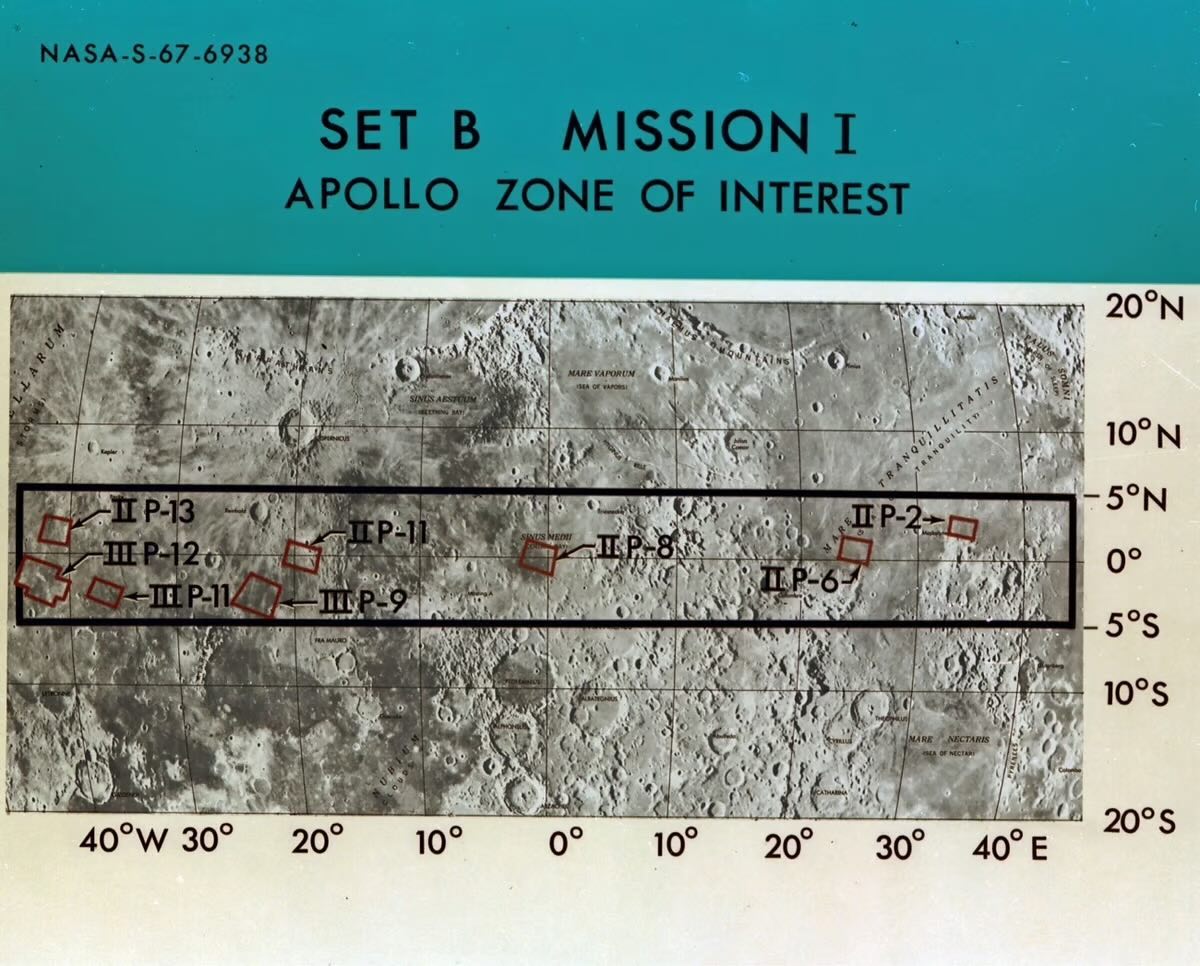
Landing site evaluation had begun as soon as photographs from the first Lunar Orbiters became available. [see Chapter 6] By March 1967 MSC’s Lunar and Earth Sciences Division had prepared a short list of candidate sites,## which it presented to the Apollo Site Selection Board. Operational considerations predominated at this stage of planning; the sites were all within the “Apollo zone of interest” (5 degrees north to 5 degrees south latitude, 45 degrees east to 45 degrees west longitude) and appeared from the Orbiter photographs to be comparatively level and smooth. MSC recommended that sites for the first landing be chosen from that list by August 1. The board accepted that recommendation.61 For the rest of the year the Apollo Site Selection Board worked steadily, with input from Bellcomm, the Jet Propulsion Laboratory, the U.S. Geological Survey, and the Group for Lunar Exploration Planning, evaluating additional photographs from Lunar Orbiters as they became available.### Meanwhile MSC continued to study the operational constraints of its chosen sites; planners were mainly concerned with slopes and irregularities in the terrain along the approaches to the sites, which could interfere with the lunar module’s landing radar. The data necessary to make the final choice of sites (principally topographic maps) were slow in coming, however, and MSC could not meet the August 1 date it had proposed.62 Instead the site selection board met at Houston on December 15 to decide on sites for the first two missions and to lay out a schedule for future activities.
## “Landing sites,” as somewhat loosely used in the following discussion, corresponds more nearly to the “landing areas” previously mentioned. [Chapter. 6] However, within the larger areas studied, MSC evaluators did examine several specific landing ellipses - “sites,” in the sense that term was used before.
### Lunar Orbiters III, IV, and V, launched on Feb. 4, May 4, and Aug. 1, 1967, all returned photographs used in Apollo landing site selection. Four more Surveyors were landed by early 1968 as well; although they were mainly equipped for scientific studies, they also provided Apollo with useful data on properties of lunar soil.
MSC presented the results of its studies on approach paths, which showed that all the “Set B” sites were acceptable. Simulations showed that the lunar module’s landing radar could guide the spacecraft to a landing at any of the eight sites. A considerable part of the discussion dealt with the number of sites to be retained in planning for each mission. At this stage no one could be sure that every mission would be launched on time. If a technical malfunction caused a countdown to be stopped, up to 66 hours' delay in launching might be necessary, in which case a more westerly landing site would have to be substituted for the original. This entailed complications in other aspects of mission preparation - it required the astronauts to become familiar with three different landing approaches and geologic areas, for example, and increased the requirements for maps and other data - but the alternative was to postpone the launch for at least a month.63
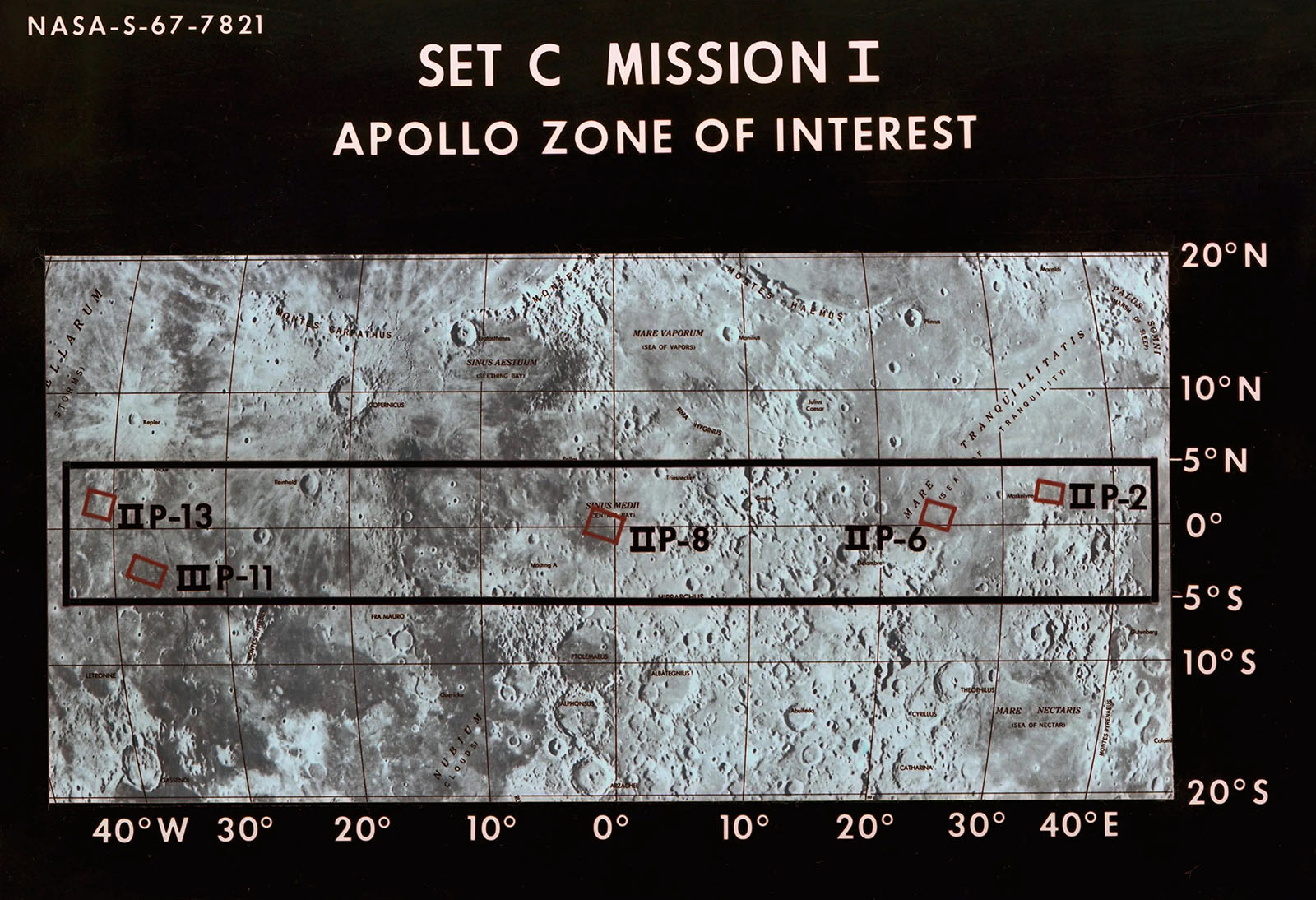
After summing up the detailed evaluations, John E. Eggleston, chief of MSC’s Lunar and Earth Sciences Division, recommended five of the best sites (“Set C”) for the first landing mission and another six for the second, which the board approved.64 Eggleston and Wilmot Hess, chief of MSC’s Science and Applications Directorate, then directed the board’s attention to the need to begin evaluating sites for the third and subsequent missions. Landing areas topographically different from those already chosen should be examined. Evaluation of highland sites in or near the Apollo zone should be started. Board chairman Sam Phillips agreed in principle that the third mission could be more ambitious, but he advised planners to stay on the conservative side for the time being and look for science targets in the areas covered by the Set B sites. A U.S. Geologic Survey representative suggested that in some cases shifting the landing point only a few kilometers within a selected area would bring the astronaut-explorers within walking distance of some scientifically interesting features. He also pointed out that if the first landing was made in an eastern mare the second should be targeted to a western one, since maria showed different characteristics in the two regions.65
From early 1968 onward the site selection teams would get only limited additional lunar photography, since after the fifth#### no more Orbiters would be flown. Orbiter photographic coverage, however, was not comprehensive; it did not cover every interesting site with sufficient resolution to permit detailed evaluation. Until the middle of 1967 the Office of Manned Space Flight was planning to fly an advanced lunar mapping and survey system that would furnish more detailed coverage of a greater portion of the lunar surface; but in August its potential value to Apollo was judged to be marginal and its further development was canceled to save money.66 The following March, however, Sam Phillips noted a continuing need for lunar photography and asked MSC to consider how it might be provided by astronauts in lunar orbit on scheduled Apollo flights.67 Houston enumerated several types of cameras and film that could be useful in site selection and in lunar cartography, and scientific interpretation as well.68 Planning was started for a considerable amount of lunar surface photography, including candidate sites for future landings, to be conducted on every manned lunar mission.
#### Launched Aug. I, 1967, Lunar Orbiter V completed its photographic mission on Aug. 18 and crashed into the moon Jan 31, 1968.
Looking Beyond the First Landings
As 1967 ended, the short list of sites for the first manned lunar landing had been approved and a longer list for the second mission had been tentatively selected. The site selection board would continue to work with flight planners and scientists to narrow down the choices. Meanwhile, as evidenced by the comments of Eggleston and Hess at the December meeting of the site selection board, attention was shifting to planning for the later missions.
As early as April 1967, the Manned Spacecraft Center’s Science and Applications Directorate had put together a plan for lunar scientific exploration, to identify the scientific observations essential to basic understanding of the moon. As guidelines, the review used the fifteen scientific questions about the moon formulated by the Woods Hole summer study of 1965. [see Appendix 3] The plan envisioned eight manned lunar missions, including one orbital mission which would take photographs and gather data with remote sensors, arranged in a logical geological sequence and spaced to allow scientists to digest the results of each mission before executing the next. No more than three landings in the “Apollo zone” were contemplated, and a highland area rather than a mare might be considered as early as the third landing. Both geological exploration by the astronauts and emplacement of instruments for long-term data collection were contemplated. The plan concluded that each mission should stay long enough to accomplish the scientific tasks planned for it; there was no point in staying 14 days unless the extra time could be put to good use. Short-range mobility aids for the astronauts, such as a one-man flying vehicle, would be necessary for later missions, but there was no real need for a vehicle that could cover hundreds of kilometers.69
The MSC plan was partly an effort to focus local attention on hardware and mission planning requirements for the later scientific flights, partly a contribution to higher-level agency planning. Throughout 1967 a joint study team from the Offices of Manned Space Flight and Space Science and Applications in Headquarters had been working on the same question, in collaboration with Wilmot Hess and the Group for Lunar Exploration Planning (formed after the 1967 Santa Cruz conference; [see Chapter 7]). 70 In February 1968 Headquarters issued its own lunar exploration plan through the new Apollo Lunar Exploration Office. This plan, more comprehensive than MSC’s, outlined a strategy for lunar exploration including and extending beyond currently planned Apollo missions.
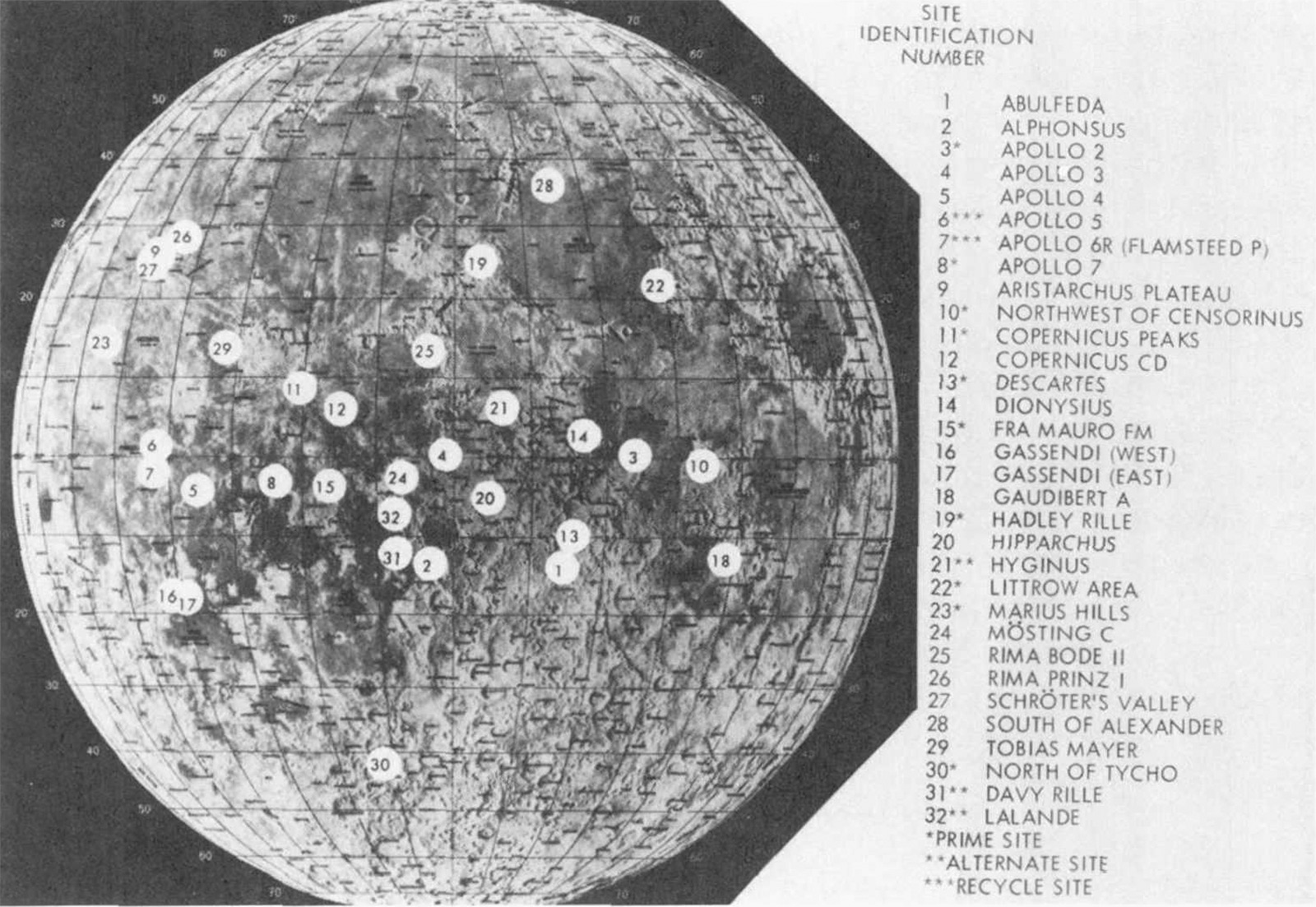
Headquarters' strategy called for a combination of orbital and surface missions to photograph and map structural features of interest and collect representative samples, emplace a network of geophysical instruments for long-term monitoring of the moon, and carry out long-range traverses to link local and regional studies together. The lunar exploration program would be evolutionary, stressing initial use of existing equipment, extending its useful life, and introducing new developments as required. Desirable modifications included upgrading the Saturn V to increase its lunar payload by 12 to 15 percent; extending power and life-support systems on the lunar module to support astronauts for three days on the moon; and reducing the lander’s conservative propulsion allocations, as experience warranted, to increase scientific payload.71
The plan projected several new developments to extend the range of exploration and increase the amount of useful work the astronauts could perform: one-man flying units, a small roving vehicle, a local scientific survey module with longer range that could be operated remotely, and a dual-launch system using two Saturn Vs. The second (unmanned) booster of a dual-launch mission could carry either a lunar payload module providing extra scientific equipment or an extended lunar module with additional expendables for life support, to be landed at the selected exploration site. The proposed schedule called for introducing the extended lunar module, which could support three-day stays on the moon and would carry short-range mobility aids, by mid-1971. Thereafter no more than two missions per year should be flown, new capabilities being added as early as possible within budgetary limitations. Sites for nine missions of special scientific interest requiring systematic increases in mission capability were described in an appendix.† 72
† The sites, identified by the names of nearby craters or other physical features, were: Censorinus, Littrow, Abulfeda, Hyginus, Appenine front-Hadley Rille, Tycho, Schroeter’s Valley, Marius Hills, and Copernicus. Hadley Rille and a site near Littrow were visited by 3-day Apollo missions.
Estimates of what such a program would cost were necessarily tentative, but the report calculated upper and lower limits based on current assumptions about production of Saturn Vs and spacecraft. Over the next eight fiscal years, new payloads and additional spacecraft and launch vehicles would cost from $4.20 billion to $5.54 billion, depending on which Apollo mission made the first landing. Funding was expected to peak in fiscal 1972 at $1 billion to $1.3 billion.73
Lee Scherer, head of the Lunar Exploration Program Office, toured NASA installations in March to brief center officials of the plan. His first stop was in Houston, and afterwards MSC Director Robert Gilruth offered his center’s comments to George Mueller, calling the plan “thoughtfully developed, well integrated, [and] unified.” His sole reservation was that the funds provided for the next year seemed inadequate to make a real start immediately:
I believe the FY 1969 budget requested should be increased to the amount that can be spent wisely to initiate procurement activities to support the program. Without additional monies early, the proposed flight dates will be very difficult to achieve. More serious, however, the impression may be created that the program can wait another year to really get started.74
A month later Gilruth again urged that Mueller start development for the advanced Apollo missions. Reminding Mueller of the President’s Science Advisory Committee’s public statement†† that only two or three lunar landing missions with the basic Apollo systems could be justified, Gilruth emphasized that
†† In its report, The Space Program in the Post-Apollo Period, published in February 1967; [see Chapter 7]
additional stay time, mobility, and scientific payload are considered essential for later missions to produce adequate scientific payload to justify the mission…. In order to obtain the increased capabilities… a small but significant amount of funds must be committed in FY 1969.
Both the lunar flying unit and the extended lunar module could benefit from additional funds in the current fiscal year. Acknowledging a general reluctance in Headquarters to propose “new starts” (projects not already approved by Congress for Apollo), Gilruth nonetheless urged Mueller to start on an unmanned logistic support system.††† Should development be postponed, he said,
††† In 1962 Joseph Shea, Deputy Director for Systems in the Office of Manned Space Flight, had helped to secure Wernher von Braun’s support for lunar orbit rendezvous by suggesting that Marshall Space Flight Center develop a logistic support system and a lunar roving vehicle; see Courtney G. Brooks, James M. Grimwood, and Loyd S. Swenson, Jr., Chariots for Apollo, NASA SP-4205 (Washington, 1979), pp. 80-81.
it appears to us that the alternatives to significantly more money for lunar exploration… in FY 1969 will all be very embarrassing to NASA in 1971.
If the longer, more productive missions could not be conducted because the systems had not yet been developed, the choices might all be unattractive: dual missions of standard Apollo equipment at excessive expense, single Apollo missions of limited productivity - certain to draw criticism from the scientists-or intervals of a year or more between launches, which would make it difficult to maintain launch capability at the Cape.75
Mueller had presented the basic lunar exploration plan to the House Manned Space Flight subcommittee earlier in February, but with no details of schedule or budget. It had provoked little discussion. About a logistic support system, he said only that it continued to be an objective and that studies would continue to determine the best way to carry larger scientific payloads and support longer stays On the lunar surface.76
If anyone had reason to be pleased with the lunar exploration plan, the lunar scientists did. To provide scientific advice to Scherer’s planners, the Group for Lunar Exploration Planning had met for two days in January 1968 to create a list of recommendations based on the conclusions of the Santa Cruz conference the previous summer. The plan issued in February incorporated every every major recommendation they made - the extended lunar module, the lunar flying unit, and the logistic support system - and included the most favored science sites.77
Extended lunar exploration would not be delayed by lack of cooperation at the Manned Spacecraft Center. Gilruth’s recorded reaction to the plan seems to show that Houston was ready to participate fully in conducting it. But at Headquarters George Mueller seemed less eager to move rapidly. Mueller had many other problems in 1968; the Saturn V had not yet been fully qualified, and both the command module and lunar module had problems yet to be solved.78 Against that background, Mueller was not in a hurry to seek approval of plans to modify the lunar spacecraft before the principal objective had been achieved. At the same time he was working hard to establish a post-Apollo program that Congress would support.79
Mission Planning and Operations, 1968
Site evaluation continued throughout 1968, with considerable attention given to reducing the number of potential landing sites being considered. Keeping five sites as alternatives created problems in providing the necessary maps, photographs, and terrain models for the simulators. On the other hand, until the team at the Cape could be sure of on-time launches, alternate sites had to be kept in the plans to avoid a month’s delay in launching a mission.80
Experience alone would answer many of the critical questions, and in the last half of 1968 some very important experience was gained. By early fall the reworked command and service module was ready for an earth-orbital test. The 11-day flight of Apollo 7 (October 11-22) was successful in all respects, demonstrating the performance of spacecraft, crew, and mission support facilities in extended earth-orbital flight. Among other critical activities, the crew simulated rendezvous with the S-IVB stage (which would carry the lunar module on a lunar landing mission) and fired the service module engine eight times without failure. That was especially gratifying, because if that engine failed the spacecraft could neither enter lunar orbit for a lunar landing nor return from lunar orbit after completing a landing mission.81
Even before Apollo 7 flew, project officials made one of the more daring decisions of the entire program: to send a crew to orbit the moon on the first manned flight of the Saturn V. Planners had long felt the need for such a mission to verify communications and navigation at lunar distances. In the alphabetical scheme of flights. [see Chapter 7] the “E” (fifth) mission was to approximate these conditions in high earth orbit. In August, MSC Apollo manager George Low set his people to work plans to extend the flight to lunar orbit. In a week of intensive discussions no “show-stoppers” emerged, and neither Marshall nor Kennedy Space Center officials expressed any reservations about it. By mid-month, Houston had clearance from Headquarters to prepare for a “C-prime” mission, contingent on successful qualification of the spacecraft on Apollo 7. The lunar flight, to be designated Apollo 8, would take a manned command and service module into orbit around the moon, check out critical systems at lunar distances, and return.82
It had to be done sooner or later, and as more than one official mentioned during the planning discussions, it was essential to assuring a successful lunar landing by the end of 1969. Yet the decision to send men to the moon on the Saturn V’s third flight seems almost breathtaking. The flight record of the big booster at the time (two flights, one completely successful, the other plagued by malfunctions) was enough to give managers pause; and the risks to be taken on a lunar mission were far more serious than those of an earth-orbital mission. Still, among NASA officials and Apollo contractor executives, no serious doubts were raised about sending Apollo 8 to the moon at the end of 1968.83
The first men ever to see the moon at close range, Frank Borman, James A. Lovell, Jr., and William A. Anders, left Launch Complex 39A at Kennedy Space Center early in the morning of December 21, 1968, aboard Apollo command module 103. Four days later they fired their main propulsion engine and the spacecraft became a captive of the moon’s gravity, in an elliptical orbit which they later changed to a near-circular orbit 60 nautical miles (111 kilometers) above the surface. For the next 20 hours they took photographs, relayed their visual observations and descriptions of the topography back to Mission Control, and gave viewers on Earth spectacular television views of the moon and of their home planet. On Christmas day in the early morning, at the end of the 10th trip around the moon, they fired the service module engine once more to return to Earth. The success of this maneuver prompted Lovell to notify Houston, “Please be informed there is a Santa Claus.” 84 Had it failed, he and his crewmates would have remained where they were, circling the moon until their oxygen ran out.
The space program was spared that grisly possibility, however, and the propulsion burn was so accurate that only one of three planned course-correction maneuvers had to be conducted on the way back - an adjustment of 4.8 feet per second (1.5 meters per second). After an uneventful return trip, they splashed down before dawn on December 27 in the Pacific Ocean, less than three miles (4.8 kilometers) from the recovery ship.85
As the climax of nearly two years of painful recovery from the tragedy of AS-204, Apollo 8 was a triumph the American space program badly needed. It not only restored the prestige of NASA and boosted the morale of the entire Apollo work force, it provided the confidence in spacecraft and ground-support systems that no other, less daring, mission could have provided. About all that remained before the first landing was to prove that the lunar module could carry out its part of the mission; two flights in 1969 would test that last important link in the system.
Besides its operational tasks, Apollo 8 had some photographic assignments that would give flight planners additional information about potential landing sites and settle important questions about the use of landmarks to determine the spacecraft’s position. Overlapping vertical and oblique photographs were taken to determine the elevation and geographical position of features on the far side, information needed for accurate determination of the lunar module’s position before it descended for a landing. [see Chapter 6] The crew was also given a list of photographic targets of opportunity, selected from sites of scientific interest, to supplement the imagery from Lunar Orbiter IV. Although the photographic objectives were not completely fulfilled, the pictures returned by Apollo 8 added considerably to the store of knowledge about lunar surface features.86
Equally valuable were the crew’s visual observations of landmarks and potential landing sites. Their reports on the sharpness of landmarks, the ease of locating them, and the topographic details that could be seen from 60 nautical miles, reduced many of the uncertainties about what a lunar landing crew might be able to do by eye. Among other things, Borman’s crew determined that lighting constraints (the allowable sun angle for optimum visibility) were on the conservative side; they found no difficulty in observing surface details at sun angles of 2 to 3 degrees, considerably less than the 6 degrees adopted as a lower limit. They reported that the maps and photographs they carried, together with last-minute instructions from the ground, were adequate for locating surface features.87
The Apollo Decade Draws to a Close
The Apollo 8 crew was still debriefing when 1969 came around, the last year of the decade set by John Kennedy for accomplishing the manned lunar landing and return. Early projections of the 1969 launch schedule called for five missions, spaced just over two months apart.88 The progress made in 1968 suggested that most preparations for the first landing could be made sometime during the year. Of the major components of the Apollo system, only the lunar module remained to be checked out.
For the most part, science had yielded to operations during the year. To provide some leeway for increases in the weight of the lunar module, and to avoid overtaxing the astronauts on a mission that still contained many unknowns, the lunar surface experiments had been simplified. The original “ALSEP” (Apollo lunar surface experiments package) had been reduced to an “EASEP” (early Apollo scientific experiments package). Enough suitable landing sites had been picked to provide alternatives in case of launch delays, increasing the chances of launching a mission during a given month’s opportunity in spite of any technical problems that might halt the countdown before liftoff. But the sites were chosen for maximum probability of successful landing, not for their immediate scientific interest. Even so, no one would argue that whatever samples of lunar material the first astronauts were able to return would not be of extraordinary interest to scientists.
But if science yielded to operational considerations, it received in return the assurance that missions after the second - perhaps after the first - would include as much science as the system could accommodate. The organizational mechanism was in place and functioning to assure that mission plans encompassed scientific objectives as far as possible. If the first landing attempt should be successful, enough launch vehicles and spacecraft were in the pipeline to conduct nine more landings. Project officials at the Manned Spacecraft Center were ready to extend the duration of missions as much as the hardware would allow without major redesign and were urging Headquarters to start work on mobility aids, to extend the range an astronaut could cover on the moon. As soon as they had the operational experience to justify it, MSC managers were willing to do more than merely land a human on the moon and return him safely to earth.
Notes
- Courtney G. Brooks, James M. Grimwood, and Loyd S. Swenson, Jr., Chariots for Apollo: A History of Manned Lunar Spacecraft, NASA SP-4205 (Washington, 1979), pp. 228-29, 237 41.
- Ibid., pp. 244-47.
- Ibid., pp. 241-53; Roger E. Bilstein, Stages to Saturn: A Technological History of the Apollo/Saturn Launch Vehicles, NASA SP-4206 (Washington, 1980), pp. 360-63.
- Brooks, Grimwood, and Swenson,Chariots, p. 253.
- Leonard Reiffel to Gen. S. C. Phillips, “Flight Schedule for ALSEP and Related Matters,” June 10, 1967.
- Donald K. Slayton to Dir., Science and Applications (MSC), “Apollo Lunar Surface Operations Planning,” Feb. 28, 1968.
- Verl R. Wilmarth, “Summary Minutes, Planetology Subcommittee of the Space Science and Applications Steering Committee (Meeting No. 3-FY68), May 15, 16, 17, 1968” ; Edward M. Davin to Mgr., Apollo Surface Expts. Program, “Contingency Science Payloads,” July 3, 1968; Richard J. Green to MSC, attn.: John W. Small, “Science Payload Options,” July 3, 1968.
- George E. Mueller to Robert R. Gilruth, June 5, 1968; Gilruth to Mueller, June 27, 1968.
- Phillips to Dr. Charles H. Townes, Aug. 31, 1968, with encl., letter to members of OMSF Science and Technology Advisory Committee, same date.
- George M. Low to G. W. S. Abbey, “Lunar Mission Planning,” Sept. 3, 1968; Wilmot N. Hess to Mgr., Apollo Spacecraft Program (MSC), “Changes in Mission G Plans,” Sept. 4, 1968.
- Hess to Dir. (MSC), “Contingency Apollo Science Program,” Sept. 30, 1968, with encl., “Contingency Apollo Science Program Implementation Plan” (preliminary), Sept. 27, 1968; idem, “Plans for Alternate Science Program on First Apollo Lunar Landing,” Oct. 4, 1968.
- Mueller, TWX to MSC attn.: Robert R. Gilruth, Nov. 5, 1968.
- A. E. Morse, Jr., to Mgr., Apollo program, “KSC support for the LM-5 Early Apollo Scientific Experiment Payload (EASEP),” Nov. 12, 1968; Phillips to Gilruth, Nov. 15, 1968.
- Phillips to Gilruth, Nov. 15, 1968.
- Phillips, TWX to MSC attn.: G. M. Low, W. N. Hess, “Experiment Assignments to Lunar Missions,” Dec. 5, 1968.
- Wilmarth, “Summary Minutes.”
- Gilruth to Hqs., attn.: E. Taylor, TWX, “OSSA Activities-Weekly Report,” Oct. 24, 1968.
- MSC, “Lunar Receiving Laboratory Briefing,” transcript of presentation, June 29, 1967; MSC, “Annual Report for Calendar Year 1967, The Directorate of Medical Research and Operations, Manned Spacecraft Center,” n.d. [Dec. 1967].
- Edgar M. Cortright to Gilruth, Mar. 27, 1968; Hess to Dir., Medical Research & Operations, “Initiation of monthly review meetings on LRL,” Mar. 29, 1968.
- Hess to multiple addressees, “Preliminary Examination Team Simulation Tests and Full Scale LRL Simulation,” Aug. 20, 1968.
- Gilruth to Charles W. Mathews, May 17, 1968; Minutes, Monthly LRL Reviews, June 10, July 1, Aug. 12, 1968.
- MSC, “Minutes of Monthly LRL Review,” Sept. 16, 1968; John E. Pickering, “Trip Report [to LRL monthly manager’s review],” Sept. 18, 1968.
- P. R. Bell to Martin Favero, June 18, 1968; “[Minutes,] Lunar Science Analysis Planning Team, July 26 [1968]” ; Hess to multiple addressees, “Preliminary Examination Team Simulation Tests and Full Scale LRL Simulation,” Aug. 20, 1968.
- Gilruth to Edward H. Levi (Univ. of Chicago), Feb. 25, 1969.
- Bell to Members of Preliminary Examination Team, “The Preliminary Examination Team simulation and training session, October 22 through November 1, 1968,” Oct. 16, 1968.
- Test dir., vacuum laboratory, “Report on PET Simulation, October 25-30, 1968,” Oct. 31, 1968; Bell to Dir., Science and Applications, “LRL Equipment and System Problems,” Nov. 7, 1968.
- Hess to L. R. Scherer, “Changes in the Lunar Receiving Laboratory,” Dec. 6, 1968; Hess to LRL Staff, “Configuration Control Board (CCB),” Dec. 6, 1968.
- Gilruth to multiple addressees, “Operational Readiness Inspection of the Lunar Receiving Laboratory,” Oct. 21, 1968.
- Peter J. Armitage to multiple addressees: “Minutes of the First ORI Committee Meeting for the Lunar Receiving Laboratory,” Nov. 5, 1968; “Minutes of the Second ORI Committee Meeting for the Lunar Receiving Laboratory,” Nov. 22, 1968; “Minutes of the Third ORI Committee Meeting for the Lunar Receiving Laboratory,” Dec. 4, 1968; “Minutes of the Fourth ORI Committee Meeting for the Lunar Receiving Laboratory,” Dec. 4, 1968; “Status of the Operational Readiness Inspection on the Lunar Receiving Laboratory and the Recovery Quarantine Equipment,” Dec. 19, 1968; “Minutes of the Fifth ORI Committee Meeting for the Lunar Receiving Laboratory,” Dec. 23, 1968.
- Armitage, “Final Report, Operational Readiness Inspection of the Lunar Receiving Laboratory and Recovery Quarantine Equipment,” May 7, 1969.
- John E. Pickering, “Minutes, Interagency Committee on Back Contamination, 8-9 Feb. 1968.”
- Idem, “Minutes, Interagency Committee on Back Contamination, 11 June 1968.”
- Idem, “Minutes, Interagency Committee on Back Contamination, 17-18 Oct. 1968.”
- Richard S. Johnston to C. C. Kraft, M. A. Faget, and C. A. Berry, “Apollo Back Contamination,” Nov. 8, 1968.
- Johnston to multiple addressees, “Back-Contamination program review,” Jan. 16, 1969; “ICBC Meeting at MSC on March 28 and 19,” Mar. 18, 1969.
- Gilruth to Maj. Gen. J. W. Humphreys, Jr., Mar. 19, 1969.
- Pickering, “Minutes, Interagency Committee on Back Contamination, 28-29 March 1969.”
- David J. Sencer to Thomas O. Paine, Apr. 7, 1969.
- S. C. Phillips, TWX to MSC, attn.: G. M. Low, “Biological containment on 'G' mission prior to entry into MQF,” Apr. 10, 1969.
- Ibid.; Low to multiple addressees, “Apollo Back Contamination Action Items,” Apr. 14, 1969; Low to Phillips, “Apollo Back Contamination Action Status,” Apr. 15, 1969.
- Low to Phillips, “Transmittal of Summary Report and Actions from Back Contamination LDX Conference Held April 21, 1969,” Apr. 24, 1969, with encl., Low to Multiple Addressees, “Back Contamination LDX Conference held April 21, 1969, Between MSC/NASA Headquarters; minutes and action items,” Apr. 24, 1969.
- MSC Announcement 69-60, “Lunar Receiving Laboratory Operations,” May 1, 1969.
- Johnston, draft of MSC position paper on Apollo back contamination program, Apr. 25, 1969.
- Pickering, “Minutes, Interagency Committee on Back Contamination, 2 May 1969.”
- Phillips to Gilruth, “Lunar Receiving Laboratory Readiness Review,” Jan. 16, 1969; Gilruth to Phillips, Jan. 29, 1969, with tentative agenda for proposed review.
- Mueller to Gilruth, Jan. 13, 1969; Gilruth to Mueller, Feb. 8, 1969.
- A. B. Park to Pickering, Mar. 7, 1969, with encl., “Report by U.S. Department of Agriculture Team on Lunar Receiving Laboratory Evaluation for Quarantine Requirements,” n.d.; Howard H. Eckels to Pickering, Mar. 11, 1969, with encl., “Department of Interior Observations on the Lunar Receiving Laboratory Procedures Relative to Invertebrate and Fish Species, February 12, 13, and 14, 1969” ; idem, Feb. 27, 1969, with encl., Kenneth E. Wolf to Eckles, “Technical Review of Lunar Receiving Laboratory,” Feb. 25, 1969; Pickering to Dir., Apollo Program, “LRL Bioprotocol Readiness Review and Certification Procedures,” Feb. 24, 1969.
- MSC, “Lunar Receiving Laboratory Simulation Plan, March 3-April 16, 1969,” n.d., pp. 1-2.
- Rudy Trabanino to LTD’s [Laboratory Test Directors], “Debriefing of Laboratory Personnel,” Mar. 16, 1969; D. White to LTD’s, “Critique of 3-13 March Simulation in Vacuum Laboratory - Shift I,” Mar. 16, 1969; T. McPherson to LTD’s, “Vacuum Laboratory Critique - Second Shift,” Mar. 16, 1969; Trabanino to LTD’s, “Critical Vacuum Laboratory Problems,” Mar. 21, 1969; O. A. Schaeffer and J. G. Funkhauser to Bryan Erb, “Leak Checking of RCL Containers with Gas Analysis System,” Mar. 24, 1969; Bell to Deputy Mgr., LRL, “Problems Identified in February and March LRL simulations,” Mar. 27, 1969; H. C. Sweet and Charles H. Walkinsbau, Jr., “Summary of Simulation of Botanical Protocol - March 1969,” n.d. [Mar. 1969]; “Minutes, Interagency Committee on Back Contamination, 28-29 March 1969-Manned Spacecraft Center - Houston, Texas,” Mar. 29, 1969; Trabanino, “Critical Vacuum Laboratory Problems,” Apr. 3, 1969.
- Hess to Bell, “Organic Contamination of F201,” Apr. 8, 1969.
- Johnston to multiple addressees, “Action items from Interagency Committee on Back Contamination (ICBC) Meeting,” May 5, 1969; Gilruth to multiple addressees, “Establishment of Apollo Back Contamination Control Panel,” May 8, 1969; Johnston to Chief, Crew Systems Div., and Chief, Flight Crew Support Div., “Lunar Module Back Contamination Simulation,” May 12, 1969; Johnston to Col. John E. Pickering, May 14, 1969; Johnston to multiple addressees, “Action Items from Interagency Committee on Back Contamination (ICBC) Meeting, May 2, 1969,” May 15, 1969; idem, “ICBC Telephone Conference Summary and Action Items,” May 21, 1969; MSC, “Back Contamination Mission Rules (Recovery to Receiving Lab),” MSC 00005, May 21, 1969; Low to multiple addressees, “Back Contamination Procedures,” May 20, 1969; Robert E. Smylie to Mgr., Apollo Spacecraft Program, “Back Contamination Procedures,” May 22, 1969; Johnston to multiple addressees, “Apollo Back Contamination Simulation Meeting Summary,” May 23, 1969; idem, “Back Contamination Action Items,” May 28, 1969.
- Mueller to Administrator, “Manned Space Flight Weekly Report,” June 9, 1969.
- Johnston to multiple addressees, “Apollo Back Contamination Simulation Meeting Summary,” May 23, 1969.
- Sencer to Paine, Apr. 7, 1969.
- W. David Compton and Charles D. Benson, Living and Working in Space: A History of Skylab, NASA SP-4208 (Washington, 1983) , pp. 99-102.
- Hess to MSC Dir., “Summary OSSA Senior Council Meeting,” Apr. 30, 1968; Hess to John E. Naugle, “Staffing of the LRL,” June 6, 1968; Naugle to Hess, same sub., July 9, 1968; M. L. Raines to Assoc. Dir., “Systems and Support Contractor Reduction,” July 12, 1968; MSC, “Minutes of Monthly LRL Review, September 16, 1968” ; Earle B. Young to LRL ORI Committee, “Proposed LRL Staffing,” Nov. 26, 1968; P. R. Bell to Dir., Science and Applications, “Staffing Plan for the Lunar and Receiving Laboratory,” Jan. 17, 1969; Wesley L. Hjornevik to Lt. Gen. Frank A. Bogart, “Lunar Receiving Laboratory Staffing,” Jan.27, 1969; MSC, “LRL Staffing Plan Status, April 8, 1969, Science & Applications Directorate and Medical Research & Operations Directorate.”
- John D. Stevenson, TWX to multiple addressees, “MSF mission operations forecast for January 1969,” Jan. 3, 1969; Gilruth to Stevenson, “Ability to support launch schedule for CY 1969,” Mar. 4, 1969.
- Bell to Dir., Science and Applications, “Staffing plan for the Lunar and Receiving Laboratory,” Jan. 17, 1969.
- W. W. Kemmerer, Jr., to all LRL personnel, “Initiation of mission operating conditions for the Sample Laboratory secondary biological barrier,” June 3, 1969.
- Johnston to all NASA LRL personnel, “Lunar Receiving Laboratory Apollo 11 Task Group,” June 4, 1969.
- MSC, “Lunar Landing Site Selection Briefing, Compilation of Presentation Material,” Mar. 8, 1967; John E. Eggleston to Dir., Science and Applications, “Trip report - Apollo Site Selection Board Meeting; Surveyor/Orbiter Utilization Committee Meeting,” Apr. 3, 1967; Owen E. Maynard to Mgr., Apollo Spacecraft Program Office, “Trip report - Apollo Site Selection Board and Surveyor/Orbiter Utilization Committee Meetings,” Apr. 20, 1967.
- Low to Hqs., attn. Dr. James A. Turnock, “Selection of Lunar Landing Sites for First Lunar Landing Mission,” Sept. 3, 1967.
- Phillips to multiple addressees, “Minutes of the Apollo Site Selection Board meeting of December 15, 1967,” Jan. 29, 1968; MSC, “Apollo Site Selection Board Briefing, Compilation of Presentation Material,” Dec. 15, 1967.
- Ibid.
- Ibid.
- Compton and Benson, Living and Working in Space, p. 87; Robert C. Seamans, Jr., to Mueller, “Termination of the Lunar Mapping and Survey System,” July 25, 1967; U.S., Congress, House, Subcommittee on Manned Space Flight of the Committee on Science and Astronautics, 1968 NASA Authorization, Hearings on H.R. 4450, H.R. 6470, 90/1, pt. 2, pp. 127-28, 568-69; idem, 1969 NASA Authorization, Hearings on H.R. 15086, 90/2, pt. 2, p. 64.
- Phillips to Gilruth, “Lunar Photography from the CSM,” Mar. 29, 1968.
- John R. Brinkmann to Chief, Syst. Eng. Div., “Lunar photography from the CSM,” May 13, 1968; Warren J. North to Chief, Syst. Eng. Div., same subj., May 15, 1968.
- MSC, “MSC Lunar Scientific Exploration Plan,” Apr. 14, 1967.
- Hess to multiple addressees, “Pre-GLEP meeting January 10 in Washington, D.C.,” Jan. 3, 1968.
- NASA Hqs., “The Plan or Lunar Exploration,” Feb. 1968.
- Ibid.
- Ibid.
- Gilruth to Mueller, Mar. 4, 1968.
- Gilruth to Mueller, Apr. 1, 1968.
- House, Subcommittee on Manned Space Flight of the Committee on Science and Astronautics, 1969 NASA, Authorization, Hearings on H.R. 15086, 90/2, pt. 2, pp. 26-35. The same plan was presented by John E. Naugle to the subcommittee on science and applications, also without stimulating discussion; see idem, Subcommittee on Space Science and Applications of the Committee on Science and Astronautics, 1969 NASA Authorization, Hearings on H.R. 15086, 90/2, pt. 3, pp. 146-58.
- Andre J. Meyer, Jr., “Minutes of the Lunar Mission Planning Board,” Feb. 13, 1968.
- Brooks, Grimwood, and Swenson,Chariots, pp. 237-53.
- Compton and Benson, Living and Working in Space, pp. 99-104.
- Phillips, “Minutes of the Apollo Site Selection Board Meeting of March 26, 1968,” May 6, 1968.
- Brooks, Grimwood, and Swenson,Chariots, pp. 265-72.
- Ibid., pp. 256-60, 272-74.
- Ibid.
- Ibid., pp. 274-84.
- MSC PA-R-69-1, “Apollo 8 Mission Report,” Feb. 1969, p. 3-2.
- Ibid., pp. 4-1 to 4-9.
- Ibid., pp. 4-8 to 4-9, 7-19 to 7-20.
- John D. Stevenson, TWX, “MSF Mission Operations Forecast for January 1969,” Jan. 3, 1969.