SETBACK AND RECOVERY: 1967
Early in 1967 Project Apollo suffered its worst setback when all three members of the first crew to fly in an Apollo spacecraft died in a fire. The tragedy forced a reexamination of the project, especially NASA’s supervision of its prime contractors, and delayed the first lunar landing by some unknown length of time.
The fire had no direct effect on the lunar science program other than to provide vitally needed time to catch up to the launch schedule. The experiments package, the selection of landing sites, and the lunar-surface geology program all put the time to good use.
Death at the Cape
On the afternoon of January 27, 1967, Virgil I. Grissom, Edward H. White II, and Roger B. Chaffee, prime crew of Apollo mission AS-204,* were reclining in spacecraft 012 atop their Saturn IB launch vehicle at Kennedy Space Center’s launch complex 34. Flight and launch crews were conducting a “plugs-out” simulation to determine that the spacecraft would function properly on internal power. The test had been frequently delayed by problems with communications and the environmental- control system; these were exasperating but not abnormal and certainly not a portent of the day’s climactic event. Just after 6:31 p.m. horrified ground crews heard a cry of alarm over the communications circuits and saw a bright glow through the spacecraft window. Seconds later the command module ruptured, filling the “white room” at the end of the access arm on the service structure with thick clouds of smoke. Technicians worked frantically to pry open the hatch but were repeatedly driven back by the smoke and heat. By the time they got the hatch open Grissom, White, and Chaffee were dead. A few minutes later medical help arrived, only to find that nothing could be done.** Officials quickly secured the launch pad and began the grim task of removing the bodies. NASA Administrator James Webb immediately appointed Floyd L. Thompson, director of Langley Research Center, chairman of an investigating board*** to determine the cause of the tragedy.1
* Unofficially called “Apollo 1,” the flight was more commonly referred to as “AS-204” - the fourth flight of a Saturn IB vehicle (Saturn IB flights were numbered in the 200s, Saturn V missions in the 500s). When flights were resumed, mission numbers started with Apollo 4, for reasons that were never completely clear.
** Postmortem examination disclosed that the crew had died of asphyxiation by toxic fumes produced by incomplete combustion of the synthetic materials in the spacecraft. All had been burned, but not severely enough to cause death.
*** Other members were astronaut Frank Borman, MSC; Maxime A. Faget, MSC; E. Barton Geer Langley; Col. Charles F. Strang, USAF; Robert W. Van Dolah, U.S. Bureau of Mines (replacing Franklin A. Long of Cornell University, who had represented the President’s Science Advisory Committee); George C. White, Jr., NASA Headquarters; John J. Williams, Kennedy Space Center; and George T. Malley, Langley, counsel. George W. Jeffs of North American Aviation was asked to serve as a consultant.
Manned space flight unquestionably entailed hazards, and it can be argued that much of the public’s fascination with the early manned space flight programs grew out of the perception that it was an exceptionally dangerous business.2 This perception somewhat exaggerated the true situation. Space flight was dangerous, but NASA engineers at every level clearly realized the hazards and went to considerable lengths to minimize them. All the astronauts were aware of the risks and considered them acceptable. Not a man among them would have stayed in the program if he had believed his life was being wilfully risked for the sake of an ephemeral propaganda triumph. Emphasis on producing safe, reliable hardware permeated the program. The astronauts were active participants in design and development; frequent astronaut visits to contractor plants helped to ensure a workable design. Crewmen who had been assigned to flights followed their own spacecraft through assembly and testing. Not less important, the visits impressed on contractor employees the fact that the lives of real people - not anonymous consumers, but people they knew - depended on every component of the system.
One result was that in 5 years 19 Americans had flown 16 earth-orbital missions without serious mishap. Although disaster had flirted with both Mercury and Gemini,**** flying in space seemed to be no more dangerous than piloting high-performance aircraft - perhaps less so, for the only astronauts to die before the fire were killed in airplane accidents.
**** Grissom’s Mercury capsule flooded and sank when its hatch accidentally blew off as he awaited recovery from the second suborbital Mercury flight. On Mercury’s second earth-orbital mission Scott Carpenter overshot his landing area by nearly 300 kilometers, and for a while his fate was in question. Gemini had produced two incidents: Gemini VI’s Titan vehicle shut down immediately after ignition, leading to a few anxious minutes, and a malfunctioning thruster set the Gemini VIII spacecraft spinning wildly, requiring premature termination of the mission.
Not surprisingly, most attention had been focused on the dangers in space. Immediately after the fire, Administrator James Webb expressed a widely held view when he said, “Although everyone realized that some day space pilots would die, who would have thought the first tragedy would be on the ground [emphasis added]?” 3 Perhaps the AS-204 fire was more traumatic because it did occur on the ground. Whatever the reason, public reaction was vigorous. After a brief period of shock, the nation’s press began to ask questions, not only about the cause of the fire but about the wisdom of the manned lunar exploration program.4 While Thompson’s investigating board probed the charred spacecraft and traced its history from California to the Cape, NASA clamped a tight lid on speculation as to possible causes, issuing only brief interim reports. In spite of calls for an independent congressional investigation, both the Senate and House space committee chairmen agreed to defer public hearings until NASA could complete its own probe.5
In early April the investigating board submitted its report concluding that the precise point of origin of the fire could not be positively identified. Investigators had found physical evidence of electric arcing from wires with damaged insulation. Sometime during manufacture or testing, apparently, an unnoticed incidental contact had scraped the insulation from a wire, thus providing the path for a spark-exactly where, the investigators could not say, but the evidence pointed to a spot near Grissom’s couch where components of the environmental control system had repeatedly been removed and replaced during testing.6 The arc had ignited flammable material and in the pure oxygen atmosphere# the resulting fire had spread with astonishing rapidity.
# During the simulation, as it would be at launch on a real mission, the command module atmosphere was pure oxygen at 16.4 pounds per square inch (113 kilonewtons per square meter) pressure - 10 percent above normal atmospheric pressure.
Contributing to the disaster were an appalling number of factors that could only be called oversights, to put the best possible face on it. The simulation had not been considered hazardous because neither the launch vehicle nor the spacecraft contained any fuel, nor were the Saturn’s pyrotechnics installed; consequently no emergency equipment or personnel were at the launch pad. Wiring carrying electrical power was not properly protected against accidental impact. Far too much flammable material - some 70 pounds (32 kilograms) of nylon netting, polyurethane foam, and Velcro fastening - had been haphazardly spread around the command module, creating unobstructed paths for flames. No provision had been made for the crew to get out of the spacecraft quickly in case of emergency. The hatch could not be opened in less than 90 seconds. Neither the board’s report nor the congressional hearings that followed could explain why so many technical experts had failed to notice that spacecraft 012, as it sat on the launch pad on January 27, was simply a bomb that needed only a trigger to set it off. Confident in Apollo’s design approach, which emphasized eliminating the possibility of ignition by electrical components, and unaware of the intensity and speed of fires fed by pure oxygen, both NASA and contractor engineers had grossly underestimated the consequences of a flaw in their hardware or procedures. Many other problems had demanded attention throughout the fabrication of this prototype command module, and - perhaps lulled by success in past programs - everyone had overlooked the hazards that were accumulating in the spacecraft.
In the months following NASA’s investigation, responsibility for these conditions was liberally distributed among contractors and NASA managers alike. Charges of sloppy workmanship and poor quality control by the spacecraft contractor - which NASA should have corrected - seemed justified. Critics asked again whether the “end-of-the-decade” goal was, for no good reason, pushing Apollo out of control and whether there really was a “space race” that justified such haste. James Webb and George Mueller, who took most of the heat of Congress’s investigation, doggedly and successfully defended the program’s objectives as well as its schedule, aided by generally sympathetic congressional committees.7
The Apollo project survived the fire shaken but undeterred. NASA continued to aim for a lunar landing before 1970, but management (especially contractor supervision) would be tightened, procedures (especially safety precautions) would be thoroughly investigated, combustible materials in the spacecraft would be rigorously controlled, and new and less flammable materials (particularly fabrics) would be sought.8
Perhaps the greatest damage was to NASA’s standing with Congress. The space agency no longer seemed larger than life, especially to members who had never been strongly committed to either side of the manned space flight debate.9 Webb left an atypically bad impression in his appearances before the Congressional committees. He responded testily to suggestions that the Thompson board, made up of NASA’s own people, was unlikely to get to the bottom of the accident, and was not cooperative when committee members asked for a report on the performance of the spacecraft contractor.10
The Thompson board pointed out numerous deficiencies in the design of the spacecraft and recommended changes in management and quality control throughout the program. Even while the board was preparing its report NASA was hard at work evaluating changes. Obviously the command and service module needed the most attention, but the lunar module was equally rigorously scrutinized, and no aspect of the Apollo program was spared detailed examination for hazards.11
How much the lunar landing would be set back no one knew.## Throughout 1966 the Office of Manned Space Flight had been working toward two unmanned test flights of the Saturn V starting in 1967, to be followed by three manned flights to check out the launch vehicle, both spacecraft, and the complex support system for the lunar landing. NASA’s public position was that “lunar flights,” orbital or landing, would begin before the end of 1969. Planning schedules showed several “simulated” lunar missions - which might orbit the moon but not land - the first of which might be flown as early as October 1967 on AS-503 or as late as August 1968 on AS-506. The initial landing might be assigned to AS- 506, but the earliest mission unambiguously categorized in OMSF’s master schedules as a “lunar mission” and not a “simulation” was AS-507, scheduled for November 1968.12
## Two years later Mueller told a congressional subcommittee that the fire had delayed the first manned flight by 18 months, but in the interim progress was made in areas other than the command and service module.
The fire wrecked that timetable, and for four months afterward all monthly OMSF launch schedules were stamped “UNDER REVIEW.” At the end of May 1967, a new master schedule showed only four Saturn V flights preceding the first lunar landing: two unmanned, to check out the launch vehicle; one earth-orbital flight to gain experience in simultaneous operation of the command and service module and the lunar module; and one lunar mission simulation. The Saturn V flights were interspersed among eight Saturn IB missions; as many of these would be flown as necessary to discover and correct flaws in the spacecraft and operations. The May schedule still showed the first landing in the last quarter of 1968, but no one was authorized to mention any date more specific than “before the end of 1968” in public.13
The Fire and the Science Program
In March 1966, when NASA contracted with the Bendix Corporation to build the Apollo lunar surface experiments package (ALSEP), delivery of the first flight-qualified set of instruments was scheduled for July 1967, seven months before AS-504, the first Saturn V mission to which an experiment package was assigned.14 It was an optimistic schedule, even though preliminary design work for several of the experiments had already been funded by NASA grants.15 By late fall the package was in schedule trouble. Two instruments were experiencing minor difficulties, the central data- collecting station was in a critical state, and the magnetometer was having serious development problems.16 In late December 1966 Headquarters was considering shifting certain instruments from the second mission to the first on account of the lagging magnetometer. Scientists were particularly anxious about this, because the data from the magnetometer were essential to interpreting the results of two other experiments. Experimenters urged that a search be started for a simpler magnetometer in case Ames’s sophisticated instrument could not be made ready in time.17
Besides the experiments themselves, the radioisotope thermoelectric generator (RTG) required work. The RTG consisted of a large “fuel cask,” packed with plutonium-238, supplying heat to an array of thermocouples that produced electricity for the instruments. Project engineers were having difficulty assuring that the radioactive fuel would not be dispersed into the atmosphere in case of an abort during launch.18 At the critical design review the astronauts discovered several hazards to the crew member who had to remove the hot (500 degrees C, 932 degrees F) fuel capsule from its storage space in the LM and insert it into the thermocouple assembly while setting up the instruments. Redesign of the package or revision of procedures was necessary.19
As the status of Apollo cleared in the months following the fire, a degree of optimism returned to the experiments schedule. In July 1967 the first lunar mission was AS-506, set for late November 1968, and the experiments for the first four lunar missions were no longer lagging.20 Even so, problems remained. In late June 1967 Leonard Reiffel of Apollo Program Director Sam Phillips’s scientific staff wrote Phillips suggesting that “we do not schedule the ALSEP for the first lunar landing.” Reiffel cited the problems of the magnetometer, the many unknowns that could affect the deployment and function of the experiments, and the weight problems that were hindering production of the lunar module. He offered his personal opinion that, except for the seismometer, the scientific experiments would not yield fundamental information about the moon that would be of immediate importance. All in all, Reiffel thought, the program might be better served in the long run by waiting until the second mission to fly the full complement of surface instruments: “An uncrowded time line on the lunar surface for the first mission would seem to me to be more contributory to the advance of science than trying to do so much on the first mission that we do nothing well [emphasis in the original].” 21
Reiffel’s misgivings about the astronauts' work load and the time available for surface activities were not off target. Early in development, Jack Schmitt, one of the astronauts providing crew advice to the lunar surface experiments designers, discovered an undesirable legacy from earlier conceptual work on the instruments:
… In the early days, the crews… were worried about having enough to do on the moon…. In the early design stages they [the ALSEP designers] took to heart the crew input to “give us something to do,” and it was a monster… The way they had that thing put together it was going to take forever to deploy.
This design philosophy was intended to give substance to the argument that men were essential in lunar exploration, but to Schmitt it was the wrong approach. Precious time on the moon should not be wasted in the purely mechanical activity of deploying the instrument package. He and other astronauts worked hard to improve the design of the package so that deploying it did not take so much time, but it was slow going.22
Even before Reiffel’s pessimistic evaluation of the science prospects for early flight, Phillips had been worried about the progress of the first instrument package. In early June he appointed a review team to look into the development of the magnetometer and another to examine the safety problems with the RTG.23 The magnetometer investigation team found that the technically sophisticated project had encountered severe schedule delays and cost overruns, but concluded that Ames and its contractor had arrested the project’s negative trends. Still, the magnetometer clearly could not be ready for the first scheduled lunar landing. A simpler instrument proposed by investigators at Goddard Space Flight Center was briefly considered, but it could not meet the schedule either and was dropped. At the end of August 1967, Phillips recommended to Deputy Administrator Robert Seamans that the magnetometer be taken off the first ALSEP and replaced by a laser reflector, a completely passive experiment which was under development. The prospects seemed good that a complete ALSEP package as originally planned could be flown On the second lunar landing mission.24 Ames’s magnetometer remained in the schedule for the first landing throughout 1968, however.25
Without doubt the delay in the first lunar landing caused by the Apollo fire relieved some of the pressure on the ALSEP experimenters and developers. For all its human and economic cost, the 204 accident forced a pause that was put to good use by those segments of the program (such as the science projects) that were less vitally affected by the fire than the spacecraft. The command module was suffering from many problems in early 1967, and it can be argued that sooner or later something as serious as the fire would have halted progress. The tragedy was that the price of straightening out the program was three lives.
PSAC Examines Post-Apollo Science Plans
During 1966, while the lunar landing program still seemed on track for successful completion within the decade, the question of a manned program to follow Apollo### took on considerable importance. Administrator James Webb was not inclined to propose another ambitious project, apparently preferring to build a strong, versatile organization and wait for the country to tell NASA what to do with it. George Mueller, Associate Administrator for Manned Space Flight, could not wait. Whatever his office was going to do after the first few lunar missions had to be started very soon or the expensive infrastructure built for Apollo would begin to deteriorate. But Lyndon Johnson’s administration had begun to feel the fiscal pinch of an expanding war in Southeast Asia, the president’s Great Society programs, and congressional concern for the foreseeable budget deficits. As a result, Mueller’s post-Apollo plans were not approved by the White House in fiscal 1967. Though nothing better seemed in prospect and the president was reluctant to let manned space flight wither away, a decision on AAP was postponed.26
### At the time no milestone clearly marking the end of Apollo had been defined. It could be argued that the first lunar landing would represent completion of Apollo and that subsequent missions would be part of Apollo Applications. Most officials seemed to think of Apollo as comprising the first two or three lunar landings and AAP as including all lunar exploration more extensive than those landings could accomplish.
As part of the efforts to define suitable goals for the nation’s space program after Apollo was accomplished, the President’s Science Advisory Committee (PSAC) undertook to evaluate NASA’s post-Apollo plans. Its report, completed in 1966, concentrated on agency-wide plans and the decades following 1970; but it had some advice concerning later Apollo missions as well. About lunar exploration, PSAC warned that
the repetition of Apollo flights for more than two or three missions will be unjustifiable in terms of anticipated scientific return without the modification of the system to provide for additional mobility on the Moon’s surface and the capacity to remain on the surface for a longer period of time.
After a few initial flights, NASA should adapt the remaining spacecraft and launch vehicles to those ends - for example, by converting the lunar module to an unmanned supply vehicle that could be stocked with expendables, scientific equipment, and mobility aids to support explorations of 7 to 14 days. Manned lunar missions following the first few should be conducted at the rate of not more than one or two per year, carefully coordinated with an expanded program of unmanned exploration to reduce the overall cost of lunar scientific exploration and to investigate areas that Apollo could not safely reach.27
PSAC’s report, published in February 1967, attracted little public notice in the aftermath of the fire. Its recommendations on Apollo exploration, though brief, were not overlooked by officials at the Manned Spacecraft Center, however. In spite of its preoccupation with the first lunar landing, MSC turned attention to the later lunar missions as soon as it could.28 Shortly after taking over his duties as Director of Science and Applications at MSC, Wilmot Hess sought the help of lunar scientists in planning scientific exploration of the moon.
Lunar Science and Exploration: Santa Cruz, 1967
Following the pattern set by OSSA and the Space Science Board, Hess organized a summer study in 1967 to discuss lunar exploration. On July 31 more than 150 scientists and NASA officials met on the campus of the University of California at Santa Cruz to provide the expert advice NASA would need to conduct an effective lunar exploration program. The stated objectives of the conference were to prepare detailed science plans, establish an order of priority for lunar investigations, and recommend major programs to develop instrumental and technological support for the advancement or lunar exploration. Eight disciplinary working groups#### were organized, each focusing on a different field within the range of scientific interest in the moon.
#### The working groups and their chair persons were: Astronomy, L. W. Frederick, Univ. of Virginia; Bioscience, Melvin B. Calvin, Univ. of California, Berkeley; Geochemistry, Paul W. Gast, Columbia Univ.; Geodesy and Cartography, Charles Lundquist, Smithsonian Astrophysical Observatory; Geology, Alfred H. Chidester, U.S. Geological Survey; Geophysics, Frank Press, Mass. Institute of Technology; Lunar Atmospheres, Francis Johnson, Southwest Center for Advanced Studies; Particles and Fields, D. J. Williams, Goddard Space Flight Center.
Unlike the Woods Hole and Falmouth conferences of 1965, which dealt with broader questions of lunar science, [see Chapter 3] the Santa Cruz conference concentrated on specifics. Hess tasked the working groups to prepare working papers on particular aspects of lunar exploration: the scientific requirements for lunar surface mobility and mission duration; the scientific use of lunar orbital flights; the scientific utility of planned major hardware items; and mission profiles for trips to the craters Alphonsus, Aristarchus, and Copernicus. Working groups were to study both manned and automated systems and to combine both modes of exploration to optimize the scientific return. They were to consider how to use current spacecraft and systems with minimal modification, or major hardware items already under consideration, not devise new systems that would require substantial development.29
Hess opened the conference by summarizing the results of the past two years' work. By way of assessing its own progress in attaining the goals laid out by the Falmouth conference, MSC had tabulated the recommendations made at Falmouth and the extent to which they had been implemented in a document called “Falmouth Plus Two Years, or How Much Nearer is the Whale to the Water?” † According to this tabulation, which Hess used in his summary, only 9 percent of the Falmouth recommendations for Apollo had been rejected (after consideration); 55 percent had been implemented and 8 percent tentatively accepted. Only 6 percent had not yet been acted on. The rest were in various stages of planning or implementation. For post-Apollo recommendations, no action had been taken on 29 percent, 9 percent had been implemented, and 62 percent were in various stages of study.30
† A footnote to the title identified the whale as “Neobalaena shoemakerensis.” At Falmouth Eugene Shoemaker, impatient with the lack of progress toward defining Apollo’s scientific goals, had compared efforts “to make something happen, like getting some science on Apollo,” to trying to push a beached whale back into the ocean. “If you push very hard you make a dent in the whale, but as soon 'is you stop pushing, [the dent] comes right back out again,” leaving the whale right where it was. E. M. Shoemaker interview, Mar. 17, 1984. When the laughter had died down, an unidentified Headquarters participant topped the joke with the comment, “Gene, you ought to try pushing that whale off the the beach from the inside.” H. H. Schmitt interview, May 30, 1984.
After two weeks of discussion the working groups made individual reports and produced a consolidated set of recommendations. [see Appendix 3] On several points all the groups substantially agreed. For manned exploration the most immediate need was to extend the 500-meter (0.3-mile) range of an astronaut on foot to more than 10 kilometers (6.2 miles) by means of some kind of surface mobility aid. Some favored a wheeled vehicle; others preferred a one- or two-man rocket-propelled flying vehicle, which would enable the astronauts to take samples over a wider area and to explore peaks and valleys that a wheeled vehicle could not reach. All the working groups agreed on the need for long unmanned traverses on the lunar surface, for which a dual-mode “local scientific survey module” was necessary. Besides carrying the lunar explorers from place to place, this module would be capable of unmanned operation directed from earth, traveling across the surface from one Apollo landing site to another. Along the way it would deploy several small geophysical instruments and collect samples for return by the next manned mission. An unmanned vehicle somewhat like this was being considered, but the Santa Cruz conferees favored their own version, which was more sophisticated.31
To support longer stays on the moon, the scientists recommended that NASA develop the capability to launch two Saturn Vs per mission: one to carry the crew, the other, unmanned, to transport a modified lunar module carrying additional expendable supplies and scientific instruments†† To supplement the more flexible manned missions they proposed, the working groups recommended that a network of geophysical stations be established on the moon using improved Surveyor spacecraft or similar instrumented modules. Other recommendations for improving Apollo’s scientific return included increasing the quantity of lunar samples returned to 250 pounds (110 kilograms), modularizing the experiment package so that instruments could be more easily interchanged to meet the scientific requirements of each mission, and developing the capability to deploy instrumented satellites in close orbit around the moon.32
†† A logistic support system based on the Saturn V had been in NASA’s plans ever since the lunar-orbit rendezvous decision in 1962, It was part of the price OMSF paid von Braun for his support of lunar-orbit rendezvous, and was to be designed and built by Marshall Space Flight Center, which had no major development responsibilities after Saturn V. See Brooks, Grimwood, and Swenson, Chariots for Apollo, p. 81.
In spite of MSC’s efforts to be responsive to experimenters' needs, the scientists at Santa Cruz evidently felt that communication between investigators and engineers still left much to be desired. They recommended that a project scientist, preferably someone involved in the experiment, be assigned to each experiment to make sure that scientists and engineers understood each others' needs and limitations.33
Turning to the question of astronaut participation in lunar exploration, the Santa Cruz conference conceded the primacy of piloting skills in the choice of Apollo crews, but strongly recommended that the second criterion for crew selection be ability in field geology. On the later, more complicated scientific missions, the conference considered that “the knowledge and experience of an astronaut who is also a professional field geologist is essential.” As far as astronaut training was concerned, the conferees insisted that” in the interest of maintaining career proficiency, astronauts should be provided time to engage in some form of research activity within their professional fields [emphasis in the original in both cases].” 34 The latter point was particularly important. NASA was about to announce the names of a second group of scientist-astronauts and the conference was sending a message to MSC that this group should, from the start, be scientists first and pilots second.
Rounding out the summary recommendations of the conference, the working groups outlined in some detail a sequence of missions to follow the first few Apollo landings: (1) manned orbital flights around the moon to obtain better photographs of proposed landing sites and study the surface with remote sensors, (2) single-launch manned missions, and (3) dual-launch manned missions. Three exploration missions were sketched out. One would send two men to the crater Copernicus for three days, exploring and sampling the crater floor and its central peaks with the lunar flying unit. The second, a six-day voyage to the Aristarchus region, required a dual Saturn V launch carrying an unmanned lunar-traversing vehicle. This mission would explore the “Cobra’s Head,” a curious crater lying at the head of the sinuous rille known as Schroeter’s Valley. Finally, plans were outlined for a seven-day mission to crater Alphonsus employing most of the exploration aids recommended by the working groups. Scientific objectives were spelled out in some detail for each site, and the conference report recommended that all these mission proposals be given immediate detailed analysis to test their practicability.35
As important as its scientific recommendations was the mechanism the conference set up for effecting them. Near the end of the second week Hess established a Group for Lunar Exploration Planning (GLEP)††† to work continuously with NASA mission planners to incorporate as many of the Santa Cruz recommendations as possible into the remaining Apollo and Apollo Applications missions.36 For the next few years GLEP and MSC planners would meet periodically to examine and refine mission plans.
††† Members were chairman Wilmot N. Hess, Maxime A. Faget, Harold Gartrell, Elbert A. King, Jr., Harrison H. Schmitt, and William T. Stoney, all of MSC; Richard J. Allenby, OSSA; James R. Arnold, Univ. of California, San Diego; Melvin B. Calvin, Univ. of California, Berkeley; Philip E. Culbertson, OMSF; Paul W. Gast, Columbia Univ.; Richard Jahns, Stanford Univ.; Francis Johnson, Southwest Center for Advanced Studies; Charles Lundquist, Smithsonian Geophysical Observatory; Frank Press, Mass. Institute of Technology; Nancy Roman, OSSA; Eugene M. Shoemaker, U.S. Geological Survey; and Donald J. Williams, Goddard Space Flight Center.
Santa Cruz gave the Manned Spacecraft Center as much material for study as it could have wanted, and Houston’s planning groups began studying its recommendations within weeks of its conclusion. Toward the end of September Elbert King summarized the Santa Cruz proceedings for MSC’s lunar missions planning board. The board’s reaction to the conference’s primary recommendations was not especially sanguine. Neither the lunar flying unit - considered vital by the scientists - nor the local science survey module was much more than a concept at the time, and both would take considerable time to reach operational maturity. Max Faget, MSC’s director of Engineering and Development, agreed that both vehicles were desirable but was not optimistic about either cost or schedule. Since the Santa Cruz conferees had suggested that lunar exploration be deferred until the flying unit was developed, the whole program could be held up if it ran into difficulty . In the discussion it was pointed out that Marshall Space Flight Center had studied similar mobility aids and was not convinced that a remotely controlled surface vehicle was feasible. Marshall was currently exploring a smaller lunar roving vehicle that could carry little more than the two astronauts and some scientific equipment. The lunar missions planning board did not settle the question of surface mobility at this meeting. Although it agreed on the necessity to extend the range of the astronauts' exploration, the board was not too keen on starting to work on either of the vehicles suggested at Santa Cruz. Faget guessed that the long-range vehicle could cost as much as $250 million to develop.37
On November 16 and 17 OSSA’s Lunar and Planetary Missions Board, which was responsible for advising NASA management on the overall balance between lunar and planetary programs, met at Houston to review lunar exploration plans. Hess presented the status of MSC’s plan, the elements it should contain, and how it was to evolve. Board members were clearly uneasy, for they asked Hess to review the plan again before submitting it to Headquarters for approval.38 Three days after the Houston meeting, on request of the Lunar and Planetary Missions Board, Associate Administrator‡ Homer Newell sent Robert Gilruth a motion passed by the board to guide MSC’s discussions with the Group for Lunar Exploration Planning. While the board found most of the Santa Cruz report acceptable in principle, it requested that the Group for Lunar Exploration Planning review that report “in light of the severe fiscal constraints currently in effect.” The board suggested that to reduce the cost of lunar exploration, some of the manned landings could be replaced by unmanned, automated, and mobile exploration systems launched by Saturn Vs, and asked GLEP to submit a few examples of programs at different budget levels.39
‡ In August Newell had been appointed Associate Administrator, NASA’s third-ranking officer, succeeding Robert C. Seamans, Jr., who had moved up to the post of Deputy Administrator after the death of Hugh L. Dryden in December 1965. John E. Naugle succeeded Newell as Associate Administrator for Space Science and Applications.
The Purse Strings Draw Tighter
The “severe fiscal constraints” cited by the Lunar and Planetary Missions Board had been building throughout 1967, and for the unmanned space programs, at least a year before that. NASA’s appropriations peaked in fiscal 1965 at $5.25 billion and declined by $75 million and then $207 million in the following two fiscal years. In 1966 Lyndon Johnson had concentrated on establishing his Great Society programs; in 1967 the American military presence in southeast Asia grew substantially. Apollo suffered little by comparison with some other programs, but post-Apollo programs, including George Mueller’s grandiose Apollo Applications Program, had been postponed.40 In the spring of 1967 NASA submitted a request for fiscal 1968 of $5.1 billion, which Congress cut by $517 million. On signing the space agency’s authorization bill in August, the President indicated that he would not oppose the reductions, noting that the federal deficit might run as high as $29 billion instead of the $8.1 billion forecast early in the year. The country faced hard choices, he said, and would have “to distinguish between the necessary and the desirable.” 41
Three months later Administrator James Webb presented NASA’s proposed operating plan for fiscal 1968 to the Senate space committee. His figures showed that Congress had cut only $50.5 million (2 percent) out of the $2,546.5 million request for Apollo. Apollo Applications had been slashed by 31 percent, and advanced mission studies had been completely eliminated. The Office of Space Science and Applications had been hit relatively much harder. Congress had cut $146.6 million (22 percent) out of its total request of $674.6 million for all space science programs. OSSA’s lunar and planetary missions were reduced by 12 percent and Voyager, a major planetary program, was eliminated entirely.42 Such were the “severe fiscal constraints” that motivated the Lunar and Planetary Missions Board to ask for reexamination of MSC’s lunar exploration plans.
The fiscal crunch of 1967 was the beginning of a long period of comparative austerity for the American space program. Domestic programs and the nation’s growing participation in the Vietnam war created severe pressure on all government programs, and space was no exception. At first Apollo suffered less than other space projects, but eventually it too would shrink as a result of changing national priorities.
Lunar Exploration Program Office Established
As long as Apollo was a goal yet to be attained, the nation and the Congress seemed willing to support it at substantially the level NASA considered essential. Less exciting programs and less tangible space objectives fared less well when the federal deficit grew. This trend in congressional support of space programs from 1965 was not lost on NASA’s managers, least of all on George Mueller. In 1963 he had begun looking for a viable post-Apollo program; since 1965 he had worked for a specific (though ill-defined, in the opinion of some) program to use the Apollo spacecraft and organization to produce useful results. His proposals, deferred in fiscal 1966 and again in fiscal 1967, only achieved concrete status as the Apollo Applications Program (AAP) in the fiscal 1968 budget - and then with pitifully small financial support.
In early 1967, Apollo Applications still included (at least on paper) all manned programs after the first few lunar landings - specifically, extended lunar exploration using improved Apollo spacecraft. From mid-1966 onward, however, Mueller’s concept of Apollo Applications seemed to be narrowing. Congressional committees had not warmed to his plans for a wide-ranging, multifunctional program whose major goal seemed to be to use up the hardware already developed and exercise the organization. Debate within his own manned space flight organization and discussions with aerospace executives led Mueller to the conclusion that AAP should serve more specifically as a bridge to the next major manned space program - whatever that might be.43
Thus as 1967 wore on and the consequences of the AS-204 fire were dealt with, Mueller saw merit in separating lunar exploration from unrelated activities in AAP. Lack of enthusiasm for AAP outside his own office - particularly at higher levels of NASA management - undoubtedly contributed to this changing view. In May, management discussions led to a number of decisions that subordinated AAP to the main objectives of Apollo: the lunar landing had priority over AAP; no hardware would be modified (a key feature of AAP) unless authorized by the deputy administrator; and all AAP launch schedules and hardware assignments would remain tentative until progress in Apollo could be assessed and AAP payloads could be better defined.44 Under these conditions, continued exploration of the moon stood a better chance of support under the Apollo banner. Since planning for manned lunar exploration was more or less independent of which program office actually oversaw it, site selection, experiment development, and mission planning continued without regard to organizational lines.
In December 1967 Mueller established an Apollo Lunar Exploration Office under the Apollo Program Office in Headquarters. As director of the new office he named Lee R. Scherer, a retired Navy captain who had directed the successful Lunar Orbiter program (completed four months previously). Scherer’s office would assume responsibility at Headquarters for directing all activities connected with lunar exploration. Two divisions, Flight Systems Development and Lunar Science, would oversee spacecraft modifications and science plans, respectively. The Lunar Science Division would look to the Office of Space Science and Applications for all science planning.45 The major functions of the old Manned Space Science Division were distributed between the Lunar Exploration Office and the Apollo Applications Program Office, and its director, Willis Foster, became assistant to the associate administrator of OSSA in charge of manned space flight experiments.
Lunar Receiving Laboratory:
At the end of 1966 construction of the Lunar Receiving Laboratory (LRL ) at MSC was well under way. On January 11, 1967, Gilruth advised Homer Newell that the laboratory’s design was essentially fixed and that any new requirements arising out of proposals by scientific investigators could only be accommodated by design changes, which would cost money and time.46 Construction proceeded without significant delay throughout the spring, and in mid-April program manager Joseph V. Piland reported to Gilruth that he expected to close down his office by June 30 and turn the laboratory over to its operating staff.47
The principal unsettled question in early 1967 was that of a laboratory staff. For several months the LRL Working Group, appointed by the Planetology Subcommittee of OSSA’s Space Sciences Steering Committee, had insisted that the laboratory must be a permanent scientific research organization headed by a nationally respected scientist who would report to the director of MSC. [see Chapter 4] MSC’s announcement creating the new Science and Applications Directorate did not mention the Lunar Receiving Laboratory, confirming the “worst fears” (as the group’s chairman, Clark Goodman, put it) of the working group, which was informed of the action only after the fact. Headquarters and MSC officials spent considerable time convincing Goodman that those fears were groundless: the laboratory would be a part of MSC’s science directorate and MSC was working closely with OSSA in selecting an outstanding scientist to direct it; the director would be appointed only with the concurrence of the associate administrator for space science and applications; and he would be given a free hand in revising the organization of the laboratory and selecting its staff.48 Three days after announcing the new science directorate, MSC issued an interim plan for the management and operation of the Lunar Receiving Laboratory, placing it in the Lunar and Earth Sciences Division, whose head would report to the Director of Science and Applications.49
In the weeks following the establishment of the science directorate at MSC, it seemed that every group having a claim on the functions of the receiving laboratory wanted immediate action on its primary problems. After the LRL Working Group it was the Planetary Biology Subcommittee of the Space Sciences Steering Committee, which met in Houston in mid-January to look after the life sciences' interests in lunar samples and the biological training of astronauts. Some investigators suspected that MSC intended to enlarge the receiving laboratory’s activities to the point of usurping some of the responsibilities of outside scientists; but Houston’s presentation to the subcommittee evidently laid that fear to rest.50 The following week it was the Public Health Service, which was concerned with back-contamination and quarantine. MSC Deputy Director George Low and PHS officials met at Atlanta and agreed that the chief of the Biomedical Branch, one of five branches under the Lunar and Earth Sciences Division of the receiving laboratory, would oversee quarantine. When the lab was completed and a formal organization was in place, MSC would recommend appointment of Dr. G. Briggs Phillips, the PHS’s liaison officer at MSC since mid-1965, to that post.51
Scientific activity in the receiving laboratory came to the fore in the spring of 1967 when the scientists who would investigate the first material returned to earth from the moon were named. On March 16, Headquarters announced that 110 scientists, including 27 working in laboratories outside the United States, had been selected to receive lunar samples.52 The Manned Spacecraft Center then faced the task of allocating the lunar material to these investigators, considering the type and quantity of sample each one wanted. Before the selection was announced, MSC had asked Headquarters for a list of each experimenter’s special requirements. OSSA returned the question to Houston to be settled in face-to- face discussions between MSC and the scientists. Newell suggested that the principal investigators be called together to consider these problems and that they themselves should take much of the responsibility for allocating samples. Headquarters would cooperate in every possible way, but basically it was leaving the management of the lunar investigations to MSC.53
In September MSC convened a three-day meeting of the investigators to allow them to update their proposals, revise their budget estimates, and devise an equitable plan for sample allocation. Wilmot Hess and his staff briefed the scientists on the general guidelines expected to govern the distribution of samples and the publication of results, and reviewed the general requirements for managing contracts and grants. In revising their proposals and funding requests, the scientists were not allowed to make any major changes in experiment plans but were encouraged to make small ones if that would significantly improve their investigations. In November MSC forwarded to Headquarters its revised budget estimates for support of lunar investigations: $3.556 million for fiscal 1968, down from the previously estimated $4.135 million, and $3.759 million for fiscal 1969, reduced from $4.592 million.54
From the scientists' point of view an equally important result of the September conference was the creation of two teams of scientists to participate in the early phases of sample examination. With the help of the investigators, Hess organized a lunar sample analysis planning team‡‡ to assist him in formulating detailed guidelines for the selection and allocation of samples and the necessary scientific functions in the receiving laboratory. A second group, the lunar sample preliminary examination team,‡‡‡ would participate in the initial examination of samples in the LRL. Besides investigators approved to perform experiments in the laboratory during quarantine, the latter group included a mineralogy-petrology team who would help obtain information that would be used in allocating samples to other investigators. These appointments did much to increase the confidence of the scientists in MSC’s plans for management of the samples.55
‡‡ Members initially appointed were Wilmot N. Hess, MSC, chairman; Elbert A. King, MSC, secretary; Edward Anders, Univ. of Chicago; James R. Arnold, Univ. of California, San Diego; P. R. Bell, LRL manager, MSC; Clifford Frondel, Harvard Univ.; Paul W. Gast, Lamont Geol. Observatory, Columbia Univ.; Harry H. Hess, Princeton Univ.; J. Hoover Mackin, Univ. of Texas; Eugene M. Shoemaker, U.S. Geological Survey; M. Gene Simmons, Mass. Inst. of Technology; Brian J. Skinner, Yale Univ.; Wolf Vishniac, Univ. of Rochester; and Gerald J. Wasserburg, Calif. Inst. of Technology.
‡‡‡ Members initially appointed were Wilmot N. Hess, MSC, chairman; Klaus Biemann, Mass. Inst. of Technology; Almo L. Burlingame, Univ. of California, Berkeley; Edward C. T. Chao, U.S. Geological Survey; Clifford Frondel, Harvard Univ.; Elbert A. King, MSC; J. Hoover Mackin, Univ. of Texas; G. Davis O'Kelley, Oak Ridge National Laboratory; Oliver A. Schaeffer, State Univ. of New York, Stony Brook; and M. Gene Simmons, Mass. Inst. of Technology.
The last gap in LRL management was closed with the appointment of a director for the laboratory. On August 1, 1967, P. R. Bell, senior physicist at the Oak Ridge National Laboratory, assumed duties as Chief of MSC’s Lunar and Earth Sciences Division and director of the LRL. Bell’s career extended from pre-World War II work with the National Defense Research Committee at the University of Chicago through wartime research at MIT’s Radiation Laboratory to postwar work at Oak Ridge. An expert in instrumentation, he had conceived the vacuum system that was being built by Union Carbide at Oak Ridge to be installed in the receiving laboratory.56
Complexities of Quarantine
Quarantine took up much of the time to the LRL during 1967. An Interagency Committee on Back Contamination (ICBC), established in 1966, [see Chapter 4] served as the policy-making board on questions of quarantine.‡‡‡‡ As the receiving lab moved toward operational readiness, some possible complexities of operations became apparent. Theoretically the approval of all the concerned regulatory agencies would have to be secured before the samples could be released to lunar scientists. In January 1967, Robert Gilruth sent his deputy, George Low, to Atlanta to discuss matters with ICBC chairman David Sencer. Low and Sencer readily agreed that a single official at MSC should be given the authority of the ICBC to approve the quarantine protocol and to release the lunar samples when the protocol had been satisfied. (NASA Headquarters had already indicated that NASA’s authority to release the samples could be delegated to Gilruth.) The ICBC would develop quarantine procedures, its representative in Houston would certify to Gilruth that those procedures had been satisfied, and Gilruth would order quarantine terminated.57 If a long chain of approvals - from each of the regulatory agencies through Headquarters to MSC - could be avoided, the academic investigators could have their lunar material much sooner.
‡‡‡‡ Original members of the ICBC in 1966 were David J. Sencer, USPHS, chairman; John R. Bagby, Jr., USPHS; Charles A. Berry, MSC; Aleck C. Bond, MSC; John Buckley, Dept. of Interior; Harold P. Klein, Ames Research Center; G. Briggs Phillips, USPHS; John E. Pickering, OMSF; Leonard Reiffel, OMSF; Ernest Saulmon, Dept. of Agriculture; and Wolf Vishniac, Univ. of Rochester, National Academy of Sciences representative. In January 1967 Robert O. Piland of MSC replaced Bond; later in the year Wilmot N. Hess replaced Piland, James H. Turnock, Jr., OMSF, replaced Reiffel, George L. Mehren, Dept. of Agriculture, replaced Saulmon, and an OSSA member, Lawrence B. Hall, was added.
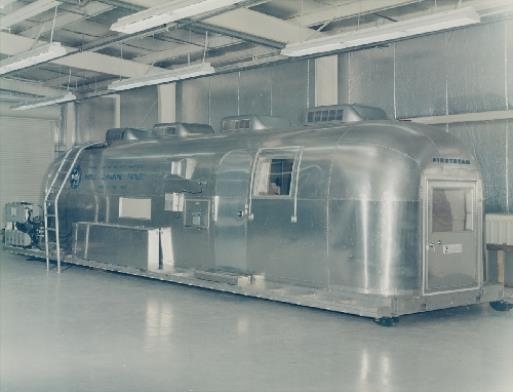
Once in the lunar receiving laboratory, crews and lunar samples were safely sealed off from the earth, but between the command module floating on the Pacific Ocean and the crew quarters in Houston was a gap in the containment of extraterrestrial material. By late August 1966 it had been agreed that a “mobile quarantine facility” would be used to transport the lunar explorers from the recovery ship to the receiving lab. Essentially a travel trailer that could accommodate six people for four days, the isolation van would be modified to prevent the escape of infectious agents. It would be sealed aboard the recovery ship, carried from the splashdown point to Hawaii, flown in a C-141 cargo aircraft to Ellington Air Force Base near MSC, and hauled by truck to the LRL, where the astronauts would enter quarantine through a plastic tunnel extending from the van to the LRL door.58
A similar method might be used aboard ship to transfer the astronauts from the spacecraft to the mobile quarantine facility. If the command module was assumed to be contaminated it should not be opened; hence the sealed spacecraft with its human contents should be hoisted onto the deck of the recovery ship, where the astronauts could pass through a plastic tunnel from spacecraft to isolation van. Landing operations managers were unwilling to risk this, however, because of the possibility of injuring the crewmen if the spacecraft were dropped. Yet there seemed no feasible way to open the command module while it floated on the ocean and still keep it isolated from the earth’s biosphere. After examining the spacecraft’s environmental control system, the ICBC was satisfied that it would effectively filter out airborne bacteria during the long return trip from the moon.59 Thus only the astronauts - not the atmosphere of the command module - were likely to harbor biological contaminants, and some means had to be devised to keep them from infecting the world on their short trip from the spacecraft to the isolation van. The solution was to bag them in plastic: a “biological isolation garment,” a zippered plastic coverall equipped with a respirator. The recovery crew would toss these into the spacecraft; the astronauts would don them before entering the recovery raft and remove them after they were sealed in their temporary quarters aboard ship.60
Another key problem was the selection of biological tests - the “protocol” -that would give maximum assurance that the samples harbored no dangerous organisms while requiring minimum time and facilities in the receiving lab. Early in 1966 MSC had contracted with Baylor College of Medicine in Houston to develop the test protocol, which the ICBC reviewed at its December meeting.61 The objective of the protocol was to permit a biomedical assessment of lunar material so that samples could be released within 30 days of their arrival at the LRL, unless some evidence of extraterrestrial organisms appeared. The samples would be examined microscopically for evidence of living organisms, and then a variety of plants and animals would be exposed to lunar material to determine whether they were affected by it. After some discussion at the meeting, committee members were asked to review the plan, considering the limitations of time, facilities, and laboratory personnel, and recommend a collection of tests that would provide the best statistical validity for the protocol.62
After looking over the proposed quarantine protocol, Wolf Vishniac, biologist at the University of Rochester representing the National Academy of Sciences, raised a question that the committee would discuss for the rest of the year. Baylor’s proposed battery of biological tests was quite comprehensive; as a result, Vishniac noted, it would require a very large sample. He then asked what would be done if, as “an extreme case, … no samples of lunar material [were] collected and brought back [other than] dust brought from the lunar surface into the space capsule and inhaled by the astronauts.” Between this and the several kilograms of lunar soil that was the nominal sample lay a range of possibilities in which only grams or fractions of grams of material might be available. If the crew should have to leave the moon with only a small sample, how could a satisfactory quarantine examination be carried out and still leave material for other scientists to work with? Vishniac took the position that if extraterrestrial organisms existed they were bound to be introduced into the earth’s biosphere eventually, no matter how rigorous the precautions, if planetary exploration continued. Therefore the Apollo quarantine protocol should search not for living organisms in general but only for infectious organisms that constituted a clear danger to the earth. Thus the quarantine protocol could be considerably simplified.63 Vishniac’s suggestion was privately welcomed at MSC, where some project managers felt that quarantine procedures were on the verge of becoming unworkable.64
Evidently other members of the committee were coming to a similar conclusion, because at the next ICBC meeting they agreed to keep the quarantine protocol under continuing review. They also agreed that samples would be tested on a few well understood living systems rather than a larger number of less common ones. Systems of greatest sensitivity would be selected so that results could be quickly assessed, minimizing the amount of sample required and the time needed to certify the lunar material as harmless.65
At its June meeting the ICBC reviewed the revised quarantine protocol and considered a statistical approach to determining the size of sample required to give the desired reliability. It appeared that 1.2 kilograms (about 2.5 pounds) of material would be needed to conduct an acceptable quarantine protocol. If, as the Santa Cruz conference had recommended, no more than 5 percent of the total lunar material were used for quarantine testing, 24 kilograms (53 pounds) - roughly the nominal lunar sample - would be enough to provide a sample for quarantine testing. The committee would continue to work toward a minimum test protocol in case less than 24 kilograms were returned.66
By the end of the summer the Interagency Committee had agreed on an outline of the procedures for releasing lunar material and astronauts from quarantine. If, as expected, the biological tests showed no exotic organisms and the astronauts developed no symptoms of infection within 21 days, the ICBC would review the data and certify that the crewmen could be released. Any change in the astronauts' general health would call for diagnosis. If the change was noninfectious or could be attributed to familiar terrestrial organisms, quarantine could be ended. But if no cause for the change was readily apparent, the question of release would be passed to a NASA medical team. A similar plan was prescribed for testing and releasing the lunar samples. If there were any doubt about living organisms being in the lunar material, release might be conditional, requiring sterilization or stipulation that the sample could be examined only behind a biological barrier. In all cases, doubtful results could lead to retention of the samples in the receiving laboratory until further testing satisfied all concerned agencies that no hazard existed.67
While the ICBC worked toward a final quarantine protocol, others were looking ahead to premission testing of the receiving laboratory and its facilities. Early in the summer George Mueller sketched out for MSC Director Robert Gilruth a tentative timeline for LRL tests and simulations. According to Mueller’s concept, laboratory personnel could be trained in the operation of the equipment and conduct of the quarantine tests before the laboratory was actually occupied. By the end of 1967 some partial simulations should be conducted to confirm the suitability of the lab’s systems and the ability of the technical support team to handle the anticipated work load. In the following three months some actual sample-handling simulations should be conducted. By mid-1968, Mueller said, a full-scale dress rehearsal of a mission should be conducted, from splashdown through the end of quarantine. Samples and test subjects would be treated exactly as they would be during an actual mission, with data being accumulated, handled, and reduced in “real time,” to iron out any deficiencies remaining in procedures and equipment.68 Houston estimated that preparation for an end-to-end simulation of a lunar mission would require 11 months.69
1967: A Critical Year
The six months after the Apollo fire were probably the busiest of the entire moon-landing program. At the Manned Spacecraft Center and its spacecraft contractor, North American Aviation, procedures were tightened up to give managers a better grip on details of the program. Both MSC and NAA brought in new managers for the spacecraft project. George Low, picked by James Webb to run Houston’s spacecraft program, appointed a tough configuration control board at MSC which met every week to review proposed design changes. Every system and subsystem in the command module was examined for hazards. New materials and test procedures assured that the risk of fire was reduced to the absolute minimum.70
The fire bought time for the Saturn project as well. While the first and third stages had few major problems, the second (S-II) stage - also a North American project - had been having serious problems since 1965. S-II was the largest rocket stage ever built to use liquid oxygen and liquid hydrogen, and its builders ran into unique technological problems and needed all the help they could get to meet launch schedules. At one point, in fact, S-II was the single most troublesome part of the Saturn program.71
The toil, tears, and sweat expended by NASA and contractors during the post-fire months produced striking results before the year ended. On November 9, 1967, the first complete Saturn V to be flight-tested, AS-501, lifted off from the brand new launch complex 39 at Kennedy Space Center, carrying a boilerplate command and service module and a mock-up of the lunar module into earth orbit. Apollo 4, as the flight was designated, was certainly the most complex mission launched up to that time. Its long list of “firsts” included checking out all systems of the Saturn V, including the first in-orbit restarting of the S-IVB third stage. As far as the spacecraft was concerned, Apollo 4 proved the soundness of the command module’s heat shield and redesigned hatch during simulated reentry from a lunar mission. George Mueller’s 1963 decision to test the Saturn V “all-up” was apparently vindicated when AS-501 was officially evaluated as a success in all respects.72
With that success it was easy to feel that Apollo was “on its way to the moon,” as Program Director Sam Phillips put it in a postlaunch press conference. Apollo 4 was the first of six steps that MSC mission planners had set down as essential precursors to the lunar landing. These flights, lettered “A” through “F,” would progressively test the systems of the command and service module and the lunar module and verify flight operations procedures, first in earth orbit and then in deep space (lunar orbit), before mission “G” landed on the moon. Four Saturn Vs and two Saturn IBs (or three and three, depending on how the Saturn V and the spacecraft systems performed) would be used for the prelanding missions. This classification of missions, though unofficial, was the framework on which subsequent planning was built.73
The year also saw a considerable evolution of scientific activity at the Manned Spacecraft Center. Much of the cause of scientists' complaints about the Houston center was removed by the creation of the Science and Applications Directorate and the appointment of a research scientist of recognized stature as its head. When that directorate became operational, Headquarters’s Office of Space Science and Applications delegated to MSC most of the responsibility for management of the lunar samples, including direct contacts with the participating scientists. The lunar receiving laboratory, although it was not accorded the bureaucratic stature at MSC that the lunar scientists had insisted on, was placed sufficiently high to assure adequate autonomy, and its first manager was a research scientist who had been a major contributor to the design of the LRL’s sample-handling equipment.
NASA Administrator James Webb spent considerable time in 1967 exploring a more prominent role in planetary science for the lunar receiving laboratory. In view of the historic significance of the lunar samples and the possibility that probes might eventually return samples from the planets, Webb wanted the LRL to become the world’s premier site for scientific research on the moon and the planets. In discussions with the National Academy of Sciences during 1967, Webb worked for an arrangement to bring this prospective “Lunar Science Institute” under academic management, which would be essential if the institute was to achieve the stature Webb wanted for it. By the end of the year NASA and the Academy had defined the role of the institute and were working to form a consortium of universities to manage it, but ideas had not yet crystallized and quite a bit of negotiating was still to be done.74
As 1968 began, Apollo program officials could look back on a year of accomplishment and ahead to more hard work. It would be a busy year at the Cape: the official manned space flight schedule projected six developmental missions for 1968. Three were Saturn IB missions, two of them unmanned tests of the lunar module, and the third a manned test of the much-reworked command and service module in earth orbit. Three Saturn V flights - two unmanned, verifying spacecraft development, and one manned - would precede five manned Saturn V missions in 1969. “The first lunar landing,” the schedule stated for public consumption, “is possible in [the] last half of 1969.” 75 Manned space flight operations were about to go into high gear.
When mission G was ready to fly, lunar scientists could expect the facilities for handling its history-making cargo to be ready. During 1967 the lunar receiving laboratory had been completed and much of its specialized equipment installed. Perhaps more important, MSC and the community of lunar investigators had set up the administrative mechanism by which the lunar material would be parceled out for scientific examination. Within the constraints of quarantine and of MSC’s responsibility to safeguard and account for the samples, the scientists, through their chosen representatives, would allot the lunar rocks and soil to the approved investigators. As far as the official records reveal it, MSC and the academic science community were developing a cooperative relationship along lines that the scientists found acceptable, if not ideal.
Notes
- Courtney G. Brooks, James M. Grimwood, and Loyd S. Swenson, Jr., Chariots for Apollo: A History of Manned Lunar Spacecraft, NASA SP-4205 (Washington, 1979), pp.214-17; Charles D. Benson and William Barnaby Faherty, Moonport: A History of Apollo Launch Facilities and Operations, NASA SP-4204 (Washington, 1978), pp. 390-94.
- One author has characterized the media coverage of the early period as based on the unspoken view (based on several widely publicized failures) that “our boys always botch it and our rockets always blow up,” and suggests that journalists uncritically emphasized the risks of manned space flight. Tom Wolfe, The Right Stuff (New York: Farrar, Straus and Giroux, 1979). Wolfe’s conclusion - supported by the (admittedly subjective) recollections of the present author, who watched many of the launches, from Mercury through Apollo, on television - gains credibility after viewing a television documentary entitled “Spaceflight,” broadcast on the Public Broadcasting System in May 1985. In an interview on that program Walter Cronkite, who was a principal figure in the Columbia Broadcasting System’s coverage of manned space flight, recalled that the history of failure in rocket tests up to 1961 heightened his perception of the danger to the astronaut. The astronauts did not share this apprehension; their day-to-day participation in hardware development gave them an informed estimate of the danger they faced.
- “Entire Crew of Mission Set for Feb. 21 Is Lost; Grissom, White, Chaffee,” Washington Post, Jan. 18, 1967.
- “Is Moon Travel Worth the Cost?” Chicago Tribune, Jan.29, 1967; “The Space ’success Schedule,'” Philadelphia Inquirer, Jan. 30, 1967; “A Time for Deliberation,” Washington Evening Star, Feb. 1, 1967; “Haste in Space,” Wall Street Journal, Feb. 20, 1967; “The Legacy of Counterfeit Crisis,” ibid., Apr. 13, 1967; Jerry E. Bishop, “Moon Race: Can't Machines Do It?” ibid., Apr. 16, 1967.
- Brooks, Grimwood, and Swenson,Chariots, pp. 219-21.
- Ibid.; Report of Apollo 204 Review Board to the Administrator, National Aeronautics and Space Administration (Washington, 1967), Floyd L. Thompson, chmn., Apr. 5, 1967. See also House Subcommittee on NASA Oversight of the Committee on Science and Astronautics, Investigation into Apollo 204 Accident, hearings, 90/1, Apr. 10 to May 10, 1967; Senate Committee on Aeronautical and Space Sciences, Apollo Accident, hearings, 901 and 902, pts. 1-8, 1967-68; idem, Apollo 204 Accident: Report, 5. Rept. 956, 90/2, Jan. 30, 1968.
- Brooks, Grimwood, and Swenson,Chariots, pp. 222-27; House, Investigation, passim.
- Brooks, Grimwood, and Swenson,Chariots, p. 225.
- Oscar Griffin, “Rep. Rumsfeld Criticizes NASA For Lack of Reports Before Fire,” Houston Chronicle, July 19, 1967; “NASA Losing Its Support, Casey Says,” ibid.; W. David Compton and Charles D. Benson, Living and Working in Space; A History of Skylab, NASA SP-4208 (Washington, 1983), p. 84-91.
- House, Investigation, pp. 10-11; J. V. Reistrup, “Webb Defends Judgment on Apollo,” Washington Post, Apr. 11, 1967. Considerable misunderstanding was generated when members of the committees demanded to see the “Phillips Report,” which both NASA officials and North American executives professed not to recognize by that name. The members of Congress were referring to a hard-hitting critique of NAA’s management, which Gen. Sam Phillips had submitted to NASA and to the contractor in late 1965 [see Chap. 6], but because it took the form of notes enclosed with a letter it was not called a “report.” When the document was finally identified, however, Webb, Mueller, and Phillips provoked charges of a cover-up by refusing to furnish it to the committees on the grounds that public disclosure could undermine NASA-contractor relations; William Hines, “Ryan Says NASA Knew of Apollo 'Incompetence,'” Washington Evening Star, Apr. 26, 1967; Thomas O'Toole, “NASA Accused of Covering Up Troubles,” Washington Post, May 11, 1967. On this point S. Rept. 956 [see note 6, above] stresses the effect of NASA officials' behavior on the legislators' confidence in the agency; see “Additional Views of Mr. Brooke and Mr. Percy,” pp. 12-14, and “Additional Views of Mr. Mondale,” pp. 15-16. For more extensive discussion of the fire and its aftermath, see Brooks, Grimwood, and Swenson,Chariots; Benson and Faherty Moonport; and the records of the Senate and House committee investigations cited earlier. As the investigations proceeded, the press raised allegations of questionable political deals that gave North American the contract for the command and service module; see Harry Schwartz, “Unanswered Questions on the Apollo Tragedy,” New York Times, Apr. 15, 1967 ; William Hines, “Apollo: A Shining Vision in Trouble,” Washington Star, May 21, 1967. These allegations were never put in the committee records and remained unsubstantiated. Three years later, however, they were revived in Journey to Tranquility (Garden City, N.Y.: Doubleday and Co., 1970), by three English journalists, Hugo Young. Bryan Silcock, and Peter Dunn.
- Brooks, Grimwood, and Swenson,Chariots, pp. 225-32; Benson and Faherty, Moonport, pp. 401-402.
- OMSF, “Manned Space Flight Schedules, vol. I, Level 1 Schedules and Resources Summary,” Dec. 1966; House Subcommittee on Manned Space Flight of the Committee on Science and Astronautics, 1967 NASA Authorization, hearings on H.R. 12718, 89/2, pt. 2, pp. 72-76.
- OMSF, “Manned Space Flight Schedules, vol. I, Level 1 Schedules and Resources Summary,” May 1967.
- Ibid., February 1966.
- John T. Holloway to Dir., MSC, “Development of Experiments for the Apollo Lunar Surface Experiments Package (ALSEP),” Apr. 14, 1966.
- OMSF, “Manned Space Flight Schedules, vol. I, Level 1 Schedules and Resources Summary,” Nov. 1966.
- William T. O'Bryant to MSC, attn. Robert O. Piland, “Guidelines for Possible Substitution of Other Instruments for the Lunar Surface Magnetometer in ALSEP,” Dec. 23, 1966.; D.,K. Slayton to Mgr., Experiments Program Off., “Possible Replacement of the Lunar Surface Magnetometer on ALSEP,” Dec. 22, 1966.
- Anon., “ALSEP OSSA Review, October 3, 1966.”
- Slayton to Director, Engineering and Development, “Comments on the ALSEP Delta Preliminary Design Review,” Dec. 15, 1966.
- OMSF, “Manned Space Flight Schedules, vol. I, Level 1 Schedules and Resources Summary,” July 1967, pp. 49, 33.
- Leonard Reiffel to Gen. S. C. Phillips, “Flight Schedule for ALSEP and Related Matters,” June 20, 1967.
- Harrison H. Schmitt interview, May 30, 1984.
- Phillips to Administrator, “Lunar Surface Magnetometer,” June 6, 1967; Piland to Mgr., Apollo Spacecraft Program Office, “ALSEP Program Review with General Phillips, June 1, 1967,” June 7, 1967.
- Phillips to Dep. Adm., “Lunar Surface Magnetometer,” July 5, 1967, with end., preliminary report of review team; Phillips to Dep. Adm., same subj., Aug. 30, 1967; John F. Parsons (Ames Res. Ctr.) to NASA Hqs., attn. Dr. James H. Turnock, “Lunar Surface Magnetometer Program,” Aug. 31, 1967.
- OMSF, “Manned Space Flight Schedules, vol. I, Level 1 Schedules and Resources Summary,” monthly issues, Jan. 9 through Oct. 8, 1968.
- Arnold S. Levine, Managing NASA in the Apollo Era, NASA SP-4102 (Washington, 1982), pp. 239-53; Compton and Benson, Living and Working in Space, pp. 40-44, 46-48, 79-82.
- President’s Science Advisory Committee, The Space Program in the Post-Apollo Period (The White House, February 1967), pp. 13-16.
- Brooks, Grimwood, and Swenson,Chariots, pp. 362-63.
- 1967 Summer Study of Lunar Science and Exploration, NASA SP-157 (Washington, 1967), pp. 3-6.
- Anon., “Falmouth plus two years or how much nearer is the whale to the water?” no date [c. Aug. 1966].
- 1967 Summer Study of Lunar Science and Exploration, pp. 9-11.
- Ibid., pp. 12-13.
- Ibid., pp. 18-19.
- Ibid., p. 19.
- Ibid., pp. 19-29.
- Ibid., p. 4.
- Minutes of the Lunar Mission Planning Board, Sept. 28, 1967.
- Robert R. Gilruth, TWX to Hqs., subj. “OSSA Activities - Weekly Report,” Nov. 30, 1967.
- Homer E. Newell to Gilruth, Nov. 20, 1967.
- Compton and Benson, Living and Working in Space, pp. 83-102.
- Weekly Compilation of Presidential Documents, vol. 3, no. 34, p. 1193.
- Senate, Committee on Aeronautical and Space Sciences, NASA’s Proposed Operating Plan for Fiscal Year 1968, hearing, 90/1, Nov. 8, 1967. For the tribulations and demise of Voyager, see Edward Clinton Ezell and Linda Neuman Ezell, On Mars: Exploration of the Red Planet 1958-1978, NASA SP-4212 (Washington, 1984), pp. 85-1 19; for a general discussion of NASA’s budget process and the “phasing down of the space program” in the middle to late 1960s, see Arnold S. Levine, Managing NASA in the Apollo Era, NASA SP-4102 (Washington, 1982), pp. 179-209.
- Compton and Benson, Living and Working in Space, chapters 3 and 5, deal with AAP’s fluctuating plans and fortunes during the period before Apollo 11.
- Robert C. Seamans, Jr., memorandum for the record, subj.: “Apollo Program Decisions - Manned Apollo Flights and Apollo Applications Program Plans,” May 17, 1967.
- “Unified Lunar Exploration Office,” NASA Release 68-5, Jan. 4, 1968; Philip E. Culbertson to Wilmot N. Hess, Jan. 3, 1968.
- Gilruth to Newell, “Principal Investigator requirements for the Lunar Receiving Laboratory (LRL),” Jan. 11, 1967.
- Joseph V. Piland, “Lunar Receiving Laboratory Bi-weekly Status Reports,” Jan. 9, Jan. 23, Feb. 6, Feb. 20, Mar. 6, Mar. 20, Apr. 3, Apr. 17, 1967; Piland to Dir., MSC, “Phase-out of Lunar Receiving Laboratory Program Office,” Apr. 14, 1967.
- Clark Goodman to members of LRL Working Group, “Science and Applications Directorate at MSC,” no date [c. Jan. 14, 1967].
- MSC Announcements no. 67-7, “Organization and Personnel Assignments for the Science and Applications Directorate,” Jan. 10, 1967, and 67-4, “Interim Plan for the Management and Operation of the Lunar Receiving Laboratory,” Jan. 13, 1967.
- Melvin Calvin to Newell, Dec. 29, 1966; Paul E. Purser to Deputy Dir., MSC, “Planetary Biology Subcommittee Meeting at MSC on January 10-11, 1967,” Jan. 17, 1967.
- George M. Low, “Resume of Meeting of January 16, 1967, at the Communicable Disease Center, Atlanta, Georgia,” Jan. 16, 1967.
- “First Lunar Samples Set for Experiment by 110 Scientists,” Hqs. Release 67-55, Mar. 16, 1967.
- Low to John E. Naugle, Mar. 9, 1967; Newell to MSC, “Lunar Sample Analysis Planning,” June 16, 1967.
- Gilruth to John E. Naugle, “Lunar Sample Analysis Planning,” Nov. 15, 1967.
- Ibid.
- MSC Announcement 67-140, “Designation of Chief, Lunar and Earth Sciences Division,” Oct. 11, 1967.
- Low to Earle Young, “Various documents concerning back-contamination and lunar sample release,” Jan. 23, 1967.
- Robert L. Tweedie, memo for record, “NASA/DOD Interface Conference, Recovery Quarantine Equipment,” Aug. 25, 1966; James C. McLane, Jr., to C. R. Haines, “Lunar Receiving Laboratory (LRL) functional interfaces with the Apollo Command Module and returned astronauts,” Aug. 24, 1966.
- John E. Pickering, “Minutes, Interagency Committee on Back Contamination,” Oct. 3, 1966.
- Collection of related documents, “Interagency Committee on Back Contamination,” no date [approx. Aug. 1966], box 076-12, JSC History Office files.
- Aleck C. Bond to record, “Interagency Committee Meeting, October 3, 1966,” Oct. 6, 1966.
- W. W. Kemmerer, “Lunar Receiving Laboratory Sample Protocol Briefing December 16, 1966,” Dec. 16, 1966; Minutes, Interagency Committee on Back Contamination, Dec. 16, 1985.
- Wolf Vishniac to Dr. Harry S. Lipscomb (Baylor Coll. of Med.), Feb. 2, 1967.
- Bond to Deputy Dir., MSC, “Biological protocol for LRL,” Feb. 9. 1967.
- Pickering, “Minutes, Interagency Committee on Back Contamination,” Mar. 2, 1967.
- Pickering, “Minutes, Interagency Committee on Back Contamination,” June 7, 1967.
- Interagency Committee on Back Contamination. “Quarantine Schemes for Manned Lunar Missions,” no date [Aug. 1967].
- George E. Mueller to Gilruth, June 2, 1967.
- Joseph V. Piland to Dir., Science and Applications, “Simulated handling of astronauts and returned equipment for Apollo missions,” Aug. 9, 1967.
- Brooks, Grimwood, and Swenson,Chariots, pp. 228-35.
- Bilstein, Stages to Saturn, pp. 211-33.
- Ibid., pp. 355-60; Brooks, Grimwood, and Swenson,Chariots, pp. 232-34; Benson and Faherty, Moonport, pp. 403-29; MSC, “Apollo 4 Mission Report,” MSC-PA-R-68-1, Jan., 1968, pp. 1-1 through 1-4; MSFC, “Saturn V AS-501 Flight Evaluation,” MPR-SAT-FE-68-1, Jan. 15, 1968, pp. xxxviii-xlii.
- Brooks, Grimwood, and Swenson,Chariots, pp. 234-35.
- James E. Webb to Frank B. Smith, Jan. 7, 1967; Webb to Frederick Seitz, NAS, Feb. 2, 1967 ; Philip H. Whitbeck to Deputy Dir., Administration, MSC, “Operation of the Lunar Receiving Laboratory,” Feb. 14, 1967, with encl., “Report on meeting with Mr. Webb on organizational location and operation of the lunar receiving laboratory” ; Newell, draft memo to Seamans, “Manned Spacecraft Center Science and Applications Directorate and the National Lunar Research Laboratory,” Mar. 2, 1967; Smith, “Comments Made at MSC at 3/16/67 Meeting with Dr. Seitz, George Low, et al., Relative to Management of the LRL,” Mar. 27, 1967; anon., viewgraph for presentations on functions of Center for Lunar and Earth Sciences, Dec. 20, 1967, JSC History Office files, box 076-41.
- OMSF, “Manned Space Flight Schedules, vol. I, Level 1 Schedules and Resources Summary,” Jan. 9, 1968, pp. ii, 27-29.