MISSION AND SCIENCE PLANNING
Apollo’s scientific objectives were always acknowledged, but scientists as well as engineers understood that the primary goal was, in John Kennedy’s words, “landing a man on the moon and returning him safely to earth.” As long as that remained to be done, what the man (or men) would do on the lunar surface was of secondary importance. The choice of a landing site, the time allowed for the astronauts to explore the landing area, the instruments to be taken to the moon, and the amount of lunar material to be brought back to earth, all were governed by operational factors: what the engineers considered prudent in light of the overriding necessity to return the lunar explorers safely to earth.
Some scientists might object to the goal itself, but no one disputed the need to achieve it safely. So while the engineers worked out their operations plans, scientists concentrated on what they wanted done on the missions, on the understanding that their plans would have to yield to operational constraints until NASA had accumulated some flight experience. By the time flight planners felt able to relax some of those constraints, scientists would have prepared a long shopping list of landing sites and scientific activities to answer some of their questions.
Input from the scientists in the early days was minimal. In 1961 Harold Urey, responding to a request from Homer Newell, listed the general areas he would like to see explored on the moon: high latitudes, where low temperatures might allow water to exist; inside a large crater; in two maria of different types; near one of the great wrinkles in the maria; and in a mountainous region. 1 Probably many lunar scientists would have agreed with Urey’s choices; but as Eugene Shoemaker recognized in a paper not long afterward, operational necessities would certainly militate against many of those choices, especially for the early missions.2
Operational Constraints on Landing Sites
Picking a spot where a lunar module could land was a complex exercise requiring tradeoffs among dozens of factors. Predominant among these were the topography and texture of the lunar surface and the requirements of the lunar module’s guidance and navigation system. Other restrictions included the elevation of the sun at the landing site; the temperature of the lunar surface; the radiation environment in space and on the moon; and the earth lighting conditions desired for launch and recovery.3 The most restrictive mission rule, so far as landing sites for the earliest lunar landing missions were concerned, was the requirement to place the spacecraft on a “free-return” trajectory - a flight path that allowed for failure of the service module’s main engine. If the service module engine should fail to put the spacecraft into lunar orbit, the joined CSM and LM would loop around the moon under the influence of lunar gravity alone and head back to earth. This free-return trajectory required the spacecraft to leave earth orbit on a path that would bring it to the moon within five degrees of latitude of the lunar equator. As early as mid-1963 MSC’s Space Environment Division selected four sites from a list compiled by various lunar scientists, balancing scientific interest against this mission rule. A few months later five more sites were picked for preliminary trajectory studies.4
The choice of lunar longitude for a landing site depended mainly on two considerations. To land at a predetermined site it was essential to determine the position and the flight path of the lunar landing craft as accurately as possible before beginning the final descent to the surface. Navigational sightings taken from the spacecraft on stars or on lunar surface landmarks provided the data from which ground-based computers determined the spacecraft’s orbit and calculated the necessary course corrections. Accurate calculation of the orbit required the astronauts to take sightings on five prominent lunar landmarks some distance east of the landing site, and since the spacecraft went behind the moon on the west and was out of radio and radar contact with earth until it emerged around the eastern edge, those sightings could only be taken after earth contact was reestablished. The position of the navigational landmarks had to be known with an error of no more than 1,500 feet (450 meters). In mid-1963 this was not possible; at the eastern and western edges of the visible face, surface features might actually be as much as 6,000 feet (1,800 meters) from where the best lunar maps showed them. In light of these navigation requirements, early planning assumed that a landing could be plotted no farther east than 40 degrees east longitude. The “Apollo landing zone” thus defined extended to 40 degrees west longitude; other operational considerations made a more westerly landing undesirable.5
The second limitation on the longitude of the landing site was the elevation of the sun at the time of landing, which was the major factor considered in choosing the time of launch. To the pilot looking for a safe spot to land within the time the lunar module could hover, it was vital that the sun be high enough in the lunar sky to highlight the surface topography without casting long, confusing shadows, but not so high that all surface detail was washed out. After landing, the lunar explorers would also be hindered by a low or high sun. The moon has no atmosphere to scatter light and therefore shadows are completely black; at either low or high sun angles, visual observations can be difficult. Furthermore, solar heating of the lunar surface varies with sun angle, complicating the problem of protecting the astronauts and the spacecraft against extreme temperatures. Conditions would be best when the sun was 15 to 45 degrees above the horizon. Mission planners could choose a launch time so that the lunar module would land at a time when solar illumination was near optimum. Launch time was subject to the further constraint, however, that lunar missions had to leave the launch pad well before last light in case an aborted launch required emergency recovery operations.6
Two potential hazards to the lunar mission were more difficult to take into account: meteoroids and radiation. In 1963 no one knew how dangerous meteoroids were. It seemed prudent to avoid the predictable (and dense) swarms that recur annually, but the earth-moon system constantly encounters a smaller number of randomly distributed meteoroids. The last three test flights of the Saturn I launch vehicle carried meteoroid-detecting satellites into earth orbit to determine how serious this hazard might be. Radiation (subatomic particles, x-rays, and gamma rays) was more worrisome. Of special concern were the high-energy protons shot out from the sun during major solar flares, which could subject astronauts on the lunar surface to lethal doses of radiation.7 Solar flares were more troublesome because they are completely unpredictable. Protection was extremely difficult and warning all but impossible: by the time a flare could be detected on earth and its magnitude assessed, the most energetic (and dangerous) particles would already have reached the moon.
Within the zone defined by all these constraints - roughly 185 miles (300 kilometers) wide, stretching l,500 miles (2,400 kilometers) along the moon’s equator - geologic factors would determine the choice of a landing site. Surface topography could not be known in any detail until Ranger and Surveyor provided information; but from lunar maps available in 1963, several landing areas* about 400 square miles (900 square kilometers) in size could be picked out where slopes apparently were not too great and craters not too numerous. Balancing the need to pick landing areas near the center of the moon (where lunar maps were most accurate) against the requirement to spread the areas as far as possible along the equator (which allowed maximum flexibility in launch dates), MSC’s Space Environment Division found 10 landing areas that seemed promising enough to warrant reconnoitering by unmanned spacecraft and close scrutiny by mission planners. The areas were spotted in a zone extending from the southeastern edge of Mare Tranquillitatis (not far from where Apollo 11 would eventually land) to a point northeast of Flamsteed crater in Oceanus Procellarum (some 375 miles [600 kilometers] west of Apollo 12’s touchdown point). Even among these, however, none was completely satisfactory with respect to all the known constraints.8
* A landing area was a fairly large segment of the lunar surface which appeared sufficiently level and smooth to permit landing; a landing site was an ellipse a few hundred meters in size within which the lunar module would actually touch down. A site would be picked for exact targeting after the hazards of the landing area had been assessed.
The effect of all these restrictions on the landing site was to reduce drastically the number of consecutive days per month on which a lunar mission could be launched. Considering only the two most important factors - sun angle and surface temperature - a given site could be reached only if the spacecraft were launched during a 2.3-day period each month. Experience to 1963 indicated that launch operations stood a good chance of being interrupted and launches postponed because of systems problems, and no one was willing to count on launching an Apollo mission within 2.3 days. But if flight planners could be prepared to land at more than one site for each launch - changing to a more westerly target if launch delays prevented reaching the first site - the number of consecutive days on which a launch was possible could be substantially increased. A Bellcomm study in early 1964 pointed out that choosing multiple sites for each launch would make the program considerably more flexible, though it would require certifying more sites through the Surveyor and Lunar Orbiter programs. That, however, might cost no more than postponing a few launches by a month each.9
The greatest uncertainty in the program at that time, pointed up by all these early studies, was the physical nature of the moon’s surface. Astronomers held widely different views of what a lunar module would encounter when it touched down. Gerald Kuiper of the University of Arizona, one of the principal investigators in the Ranger project, was convinced that the surface was firm, though it might be unconsolidated and might be covered by a thin layer of dust. Cornell University astronomer Thomas Gold asserted, however, that the apparently smooth areas on the moon were likely to be covered with a layer of fine dust several meters thick, raising the prospect that the lunar module might sink out of sight with only a short-lived dust cloud to mark its disappearance.10 There was the further possibility that the surface might be so cluttered with boulders and pitted with small craters that the lander would find no level spot large enough to land - or if it tried to land, would turn over or come to rest tilted at an angle that made return to orbit difficult.
NASA had been hoping that Ranger’s television photographs would shed light on these questions, but by the end of 1963 Ranger had experienced its fifth failure in as many attempts and was undergoing a critical reappraisal. [see Chapter 2] 11 Spacecraft engineers at Houston’s Manned Spacecraft Center, meanwhile, in spite of their real need for this information in designing the lunar landing module, had to go ahead without it.12 Lunar Orbiter, still in the early stages, would have to provide the information that mission planners needed for site selection. The spacecraft builders could only hope that data from Surveyor, when they got it, would not force them to revise their design too drastically.
Scientific Input to Site Selection
Early consideration of lunar exploration missions by the scientific community focused more sharply on what should be done on the moon than on where it would be done. The 1962 Iowa summer study paid particular attention to the scientific qualifications and training of the astronauts; the 1965 Woods Hole study formulated a list of 15 important scientific questions to be addressed by lunar exploration, which would define the experiments to be conducted. [see Chapter 3] [see Appendix 3] Neither conference expressed any preference for landing sites, although both pointed out the need to study highlands as well as maria. The Woods Hole study report concluded that really effective geophysical and geochemical studies would require investigations at several locations up to 1,000 kilometers (620 miles) apart.13
NASA had apparently made it quite clear to its outside scientific advisors that science would have to take its results from wherever it could get them - at least on the first few missions. The point was implicitly acknowledged at the Falmouth conference on lunar exploration immediately following the 1965 Woods Hole study. All of the earth-science study groups at Falmouth stressed the need to supplement manned exploration with detailed study by unmanned lunar-orbiting satellites to secure comprehensive scientific coverage of the lunar surface.14 To a considerable degree this emphasis on unmanned studies was simply a recognition of the relative cost-effectiveness of the two modes of exploration, but it was also a recognition of the operational limitations of Apollo and the resultant restrictions on landing sites. Even looking ahead to longer stays on the moon, the groups urged development of surface vehicles and flying vehicles to increase the effective range of exploration but did not mention any need to extend the limited Apollo landing zone. It was assumed that operations could eventually be extended to higher latitudes and more difficult sites, such as highlands and craters - possibilities included in NASA’s plans for extending Apollo,15 which the Falmouth participants used as the basis for their recommendations.
The fact was that in mid-1965 it was simply too early for scientific priorities to be included in the selection of Apollo landing sites. Better information on the lunar surface was needed, and better understanding of the operational constraints on landing sites, before the scientific merit of any particular site could have any effect on the choice.
Site Selection:
Throughout 1965, site selection was one of Apollo’s biggest concerns. Early in the year the ill-starred Ranger project flew its second consecutive successful mission (in seven tries). Its photographs had enabled the Manned Spacecraft Center to draw some generally encouraging conclusions about lunar topography, but MSC’s Space Environment Division concluded that Ranger photographs would never enable them to certify lunar landing sites. They would, perhaps, allow Apollo planners to rule out unsuitable areas, but picking a suitable landing site by eliminating the unsuitable ones could take years.16 Besides, Ranger provided no information about the physical characteristics of the surface, which designers of the lunar landing craft needed.17 Surveyor was expected to soft-land on the moon within a few months, and MSC was offering advice to Surveyor mission planners at the Jet Propulsion Laboratory as to where the missions should land to be of maximum use to Apollo. The Houston center was also working closely with Langley’s Lunar Orbiter program office in planning for optimum use of its high-resolution cameras to locate sites for the lunar landing mission.
In efforts to satisfy the sometimes conflicting aims of lunar science and Apollo, the Ranger project had been subjected to a great deal of pulling and hauling. [see Chapter 2] The result was that neither side was completely satisfied, and the lunar scientists were particularly upset when Apollo preempted their experiments. Intending to forestall similar problems with Surveyor and Lunar Orbiter, Homer Newell established an ad hoc Surveyor/Orbiter Utilization Committee in the spring of 1965, after the last Ranger mission (Ranger 9) successfully concluded that project. Newell appointed his deputy, Edgar M. Cortright, chairman of the committee, whose other members were chosen from Headquarters and center project Offices.** 18
** Other members were: Everett E. Christensen, mission operations dir., OMSF; Victor C. Clarke, Surveyor project office, JPL; Willis B. Foster, dir., Manned Space Science Div., OSSA; William A. Lee, asst. mgr., Apollo spacecraft program office, MSC; Urner Liddell, chmn., Planetology Subcommittee of the Space Sciences Steering Committee, OSSA; Benjamin Milwitzky, Surveyor project dir., OSSA; Oran W. Nicks, lunar and planetary programs dir., OSSA; Samuel C. Phillips, Apollo program dir., OMSF; Lee R. Scherer, Lunar Orbiter project dir., OSSA; and William E. Stoney, Space Environment Div., MSC; and Israel Taback, Lunar Orbiter project office, Langley Research Center.
Mueller, meanwhile, had discovered that no single organization was responsible for coordinating lunar data and evaluating candidate landing sites. Shortly after Newell created the Surveyor/Orbiter Utilization Committee, Mueller established an Apollo Site Selection Board in the Office of Manned Space Flight. Its primary responsibility was to select and recommend candidate sites after considering all data required to ensure the success of the lunar landing. If the board could not unanimously agree on a site, majority rule did not apply; Mueller wanted all dissenting opinions recorded, and as he had done when he created the Manned Space Flight Experiments Board, [see Chapter 2] he reserved for himself the authority to make the final choice. Chaired by OMSF’s Apollo program director, Air Force Major General Samuel C. Phillips, the board included members from the Office of Space Science and Applications and the three manned space flight field centers. *** 19
*** Other members were: Cortright, Lee, Stoney, and Christensen, all members of the Surveyor/Orbiter Utilization Committee; Ernst Stuhlinger, Research Projects Office dir., MSFC; and John P. Claybourne, Future Studies Office, Design Engineering Branch, KSC.
The overlapping membership of these two boards was yet another way of making sure that all interested parties were sufficiently involved in decisions when scientific concerns and manned space flight objectives converged (and sometimes conflicted) in a single program - which, some felt, had not been the case during Ranger. MSC Director Bob Gilruth expressed satisfaction with this arrangement and selected two of his engineers to serve on both boards.20
Since Surveyor and Lunar Orbiter were expected to fly their first missions within a year, the Surveyor/ Orbiter Utilization Committee began work early. From late August 1965 until the first launches in mid-1966 the committee met as frequently as necessary to evaluate sites and set priorities. Lunar Orbiter project officials initially outlined four types of missions, from a general survey of the moon to photography of specific sites within the Apollo zone. Surveyor representatives presented 40 possible landing sites for their first spacecraft, chosen on the basis of independent evaluations by the Jet Propulsion Laboratory and the Geological Survey based on the best available geologic maps and telescopic observations. With little discussion the committee recommended that Lunar Orbiter’s first mission give priority to Apollo site photographs. Surveyor, like Lunar Orbiter, had objectives independent of its usefulness to Apollo, but its project managers seemed less willing to allow their science goals to be subordinated to those of the lunar landing program. After some discussion, the committee agreed on a set of ground rules for selecting Surveyor landing sites. It was more important to have well-lit photographs of some part of the lunar surface as soon as possible than to have photographs within the Apollo zone; however, if a daylight landing was possible within that zone as well as outside it, the committee gave priority to an Apollo site. If the first Surveyor could not land in sunlight at all, it should be put down within the Apollo zone. The committee approved 14 of the 40 sites proposed for the first Surveyor mission, then sent its recommendations to the project offices, which would plan specific missions in more detail for review by the committee and by OSSA’s Space Sciences Steering Committee.21
Lunar Orbiter project officials set about making detailed plans for the first mission that would satisfy Apollo’s requirements. Surveyor managers, however, were reluctant to comply with the committee’s recommendations. They pointed out that the ground rules required landing at a less-suitable site even though a better one was available - a significant threat to mission success, JPL believed. They would target the first Surveyor in compliance with the committee’s ground rules, but if the spacecraft had any trouble at an inferior site, JPL intended to recommend strongly that the next mission be sent to a better one.22
America’s first unmanned lunar explorer,**** Surveyor I, launched on May 30, 1966, landed 63 hours later approximately 90 kilometers north of the crater Flamsteed in Oceanus Procellarum, at the extreme western fringe of the Apollo landing zone.23 Its first television pictures were encouraging to Apollo engineers: the surface was firm enough to support a lunar landing module and the surrounding area was reasonably level. But beyond the immediate landing area the TV images showed more than a few large boulders and craters. The pictures served to demolish some hypotheses about the lunar surface, notably Gold’s idea that the maria were covered with deep layers of dust. The surface was composed of fine particles, firmly packed and cohesive.24
**** But not the world’s first; on Feb. 3, 1966, the Soviet Union, apparently intent on establishing space “firsts,” had logged another by landing Luna IX on the moon several hundred kilometers northwest of Surveyor I’s landing site. Similarly the Russian Luna X became the first moon-orbiting satellite on Apt. 3, 1966, four months before the U.S.’s Lunar Orbiter I. Luna X did not relay photographs to earth, however.
Less than three months later, on August 10, Lunar Orbiter I roared off the pad at Cape Canaveral; four days later the spacecraft was in orbit around the moon, and by the end of the month it had photographed all nine of its assigned sites in the Apollo landing zone. After completing its photography, Orbiter remained in orbit, transmitting electronic data on gravity, meteoroids, and radiation around the moon - another aspect of its service to Apollo and to lunar science.25
Malfunctions of the spacecraft and photographic system resulted in fewer good photographs than project officials would have liked; but preliminary photographic analysis began in late August and produced recommendations for the second Surveyor and Lunar Orbiter missions by the end of September. On the basis of crater density and regional slopes, 10 of 23 areas selected for detailed study seemed satisfactory; 8 potential sites were recommended for detailed analysis.26 On September 29 the Surveyor/Orbiter Utilization Committee reviewed these results and outlined the requirements for the second Orbiter mission.# Again Apollo sites were stressed, particularly those types of terrain shown by Orbiter I to be the most promising - landing areas smooth enough to land on, having little enough slope in the approach path to avoid confusing the lunar module’s landing radar system. Lighting conditions for photography would be chosen so that slopes of 7 degrees, and surface protuberances 6 feet (2 meters) in diameter and 1.5 feet (0.5 meter) high, could be detected in an area 20 feet (7 meters) square.27
# A small thruster failed on Surveyor II (launched on Sept. 20, 1966) after its midcourse correction maneuver, causing the spacecraft to spin at one revolution per second. All attempts to correct the malfunction failed and the lander crashed 250-300 km southeast of crater Copernicus.
Lunar Orbiter II, modified to correct the problems encountered by its predecessor, was launched November 6, 1966, and its results far surpassed those of the first mission. All of the 30 preplanned sites were photographed at medium and high resolution, giving geologists and cartographers excellent material with which to work.## 28 The mapmakers believed that with more stereo photographs of the quality returned by Lunar Orbiter II they could produce terrain-maps with two- to three- meter contours. MSC’s Apollo project office representatives were pleased with the second mission’s results and believed that one more flight would satisfy their requirements for the first one or two lunar landings. Apart from some additional site photography, Apollo wanted one or more Orbiter spacecraft to stay in lunar orbit long enough to allow precision tracking by earth-based radar. All navigational calculations for the lunar module were to be made by ground-based computers using data from the Manned Space Flight Network, Apollo’s communication and tracking system, and early certification of this system was essential.29
## A famous by-product of the Lunar Orbiter II mission resulted from the need to advance film periodically even if no picture was taken. To avoid wasting that film, mission controllers were given a limited choice of targets for these exposures. One was used to take an oblique picture of crater Copernicus under almost ideal lighting conditions, showing hitherto invisible surface details. News media called this “one of the greatest pictures of the century.”
In mid-December 1966 the Apollo Site Selection Board met to review the status of site selection. In general the process was going well. Geologic interpretation of the Orbiter photographs had already yielded some general conclusions about the nature of the lunar surface and where the best landing sites were likely to be found. Cartographers could not accurately determine slopes in the landing area without stereoscopic photography, but MSC gave higher priority to finding a landing site with a minimum of rocks and craters; the slope of the terrain leading to a suitable site could be evaluated some other way. No serious problems in site selection were apparent, and the board could only await the results of Lunar Orbiter III and more detailed analysis of the available data.30
As 1967 began Apollo planners did not want much more from the unmanned lunar investigation projects. They would use whatever additional data became available, but priorities were changing. Three more Lunar Orbiters and four Surveyors would be sent to the moon during the next 13 months, but after the third orbiter they would do more for lunar science generally than for Apollo specifically.31
Apollo Lunar Surface Experiments
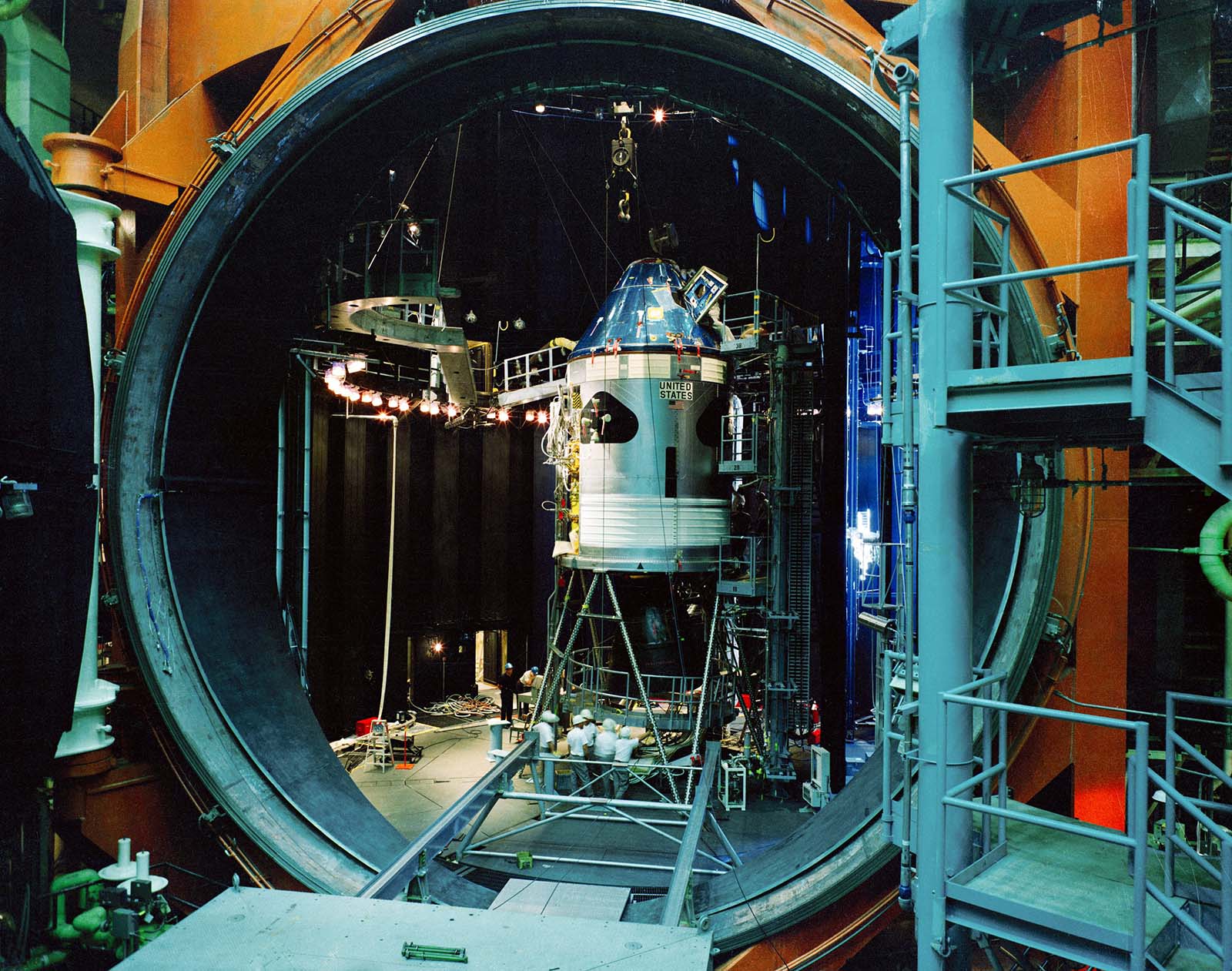
Technicians prepare a test version of the Apollo command and service module in the space environment simulation chamber at MSC. The lights, mounted at left, simulate solar irradiation. The chamber walls can be cooled by liquid nitrogen to -193 degrees C, simulating the radiation-absorbing void of space. After the huge door is closed, the entire chamber, 55 feet in diameter and 90 feet high, can be pumped down to less than one ten-millionth of atmospheric pressure.
MSC’s original specifications for the lunar landing module included a generalized “scientific instrumentation system” to provide for selenological research. Specific experiments could not be listed in 1962, but investigations of the lunar atmosphere, surface, and interior were contemplated. The contractor would include weight, volume, and power allowances for the instruments in the module design; specific instruments would be defined later.32
After the lunar module contractor, Grumman Aircraft Engineering Corporation, was selected in later 1962, MSC forged ahead with spacecraft design. Definition of the lunar surface experiments, which was the responsibility of the Office of Space Sciences and Applications, proceeded at a much more deliberate pace, however. [see Chapter 3] In early 1963 Houston expected that the first experiments would be selected by the end of the year;33 but months went by with little progress. By September, spacecraft engineers urgently needed data on the experiments - weight, volume, and power requirements - to feed into lunar module design, but since nothing was available, MSC awarded a 10-month study contract to Texas Instruments to investigate instrumentation requirements for manned lunar exploration.34 Headquarters was somewhat unhappy with this unilateral action, but lunar module designers had to have the information and the scientific community seemed to be in no hurry to supply it.35 The study provided an indication of the type of instrumentation likely to be useful, and in the next few months the spacecraft office worked out preliminary weight and volume allotments for the experiments: 250 pounds (113 kilograms) and 15 cubic feet (0.42 cubic meters) in the descent stage, which would be left on the moon; 80 pounds (36 kilograms) and 3 cubic feet (0.085 cubic meters) in the ascent stage and in the command module for a sample-return container and film. Requirements for electrical power and a source to supply it were yet to be determined.36
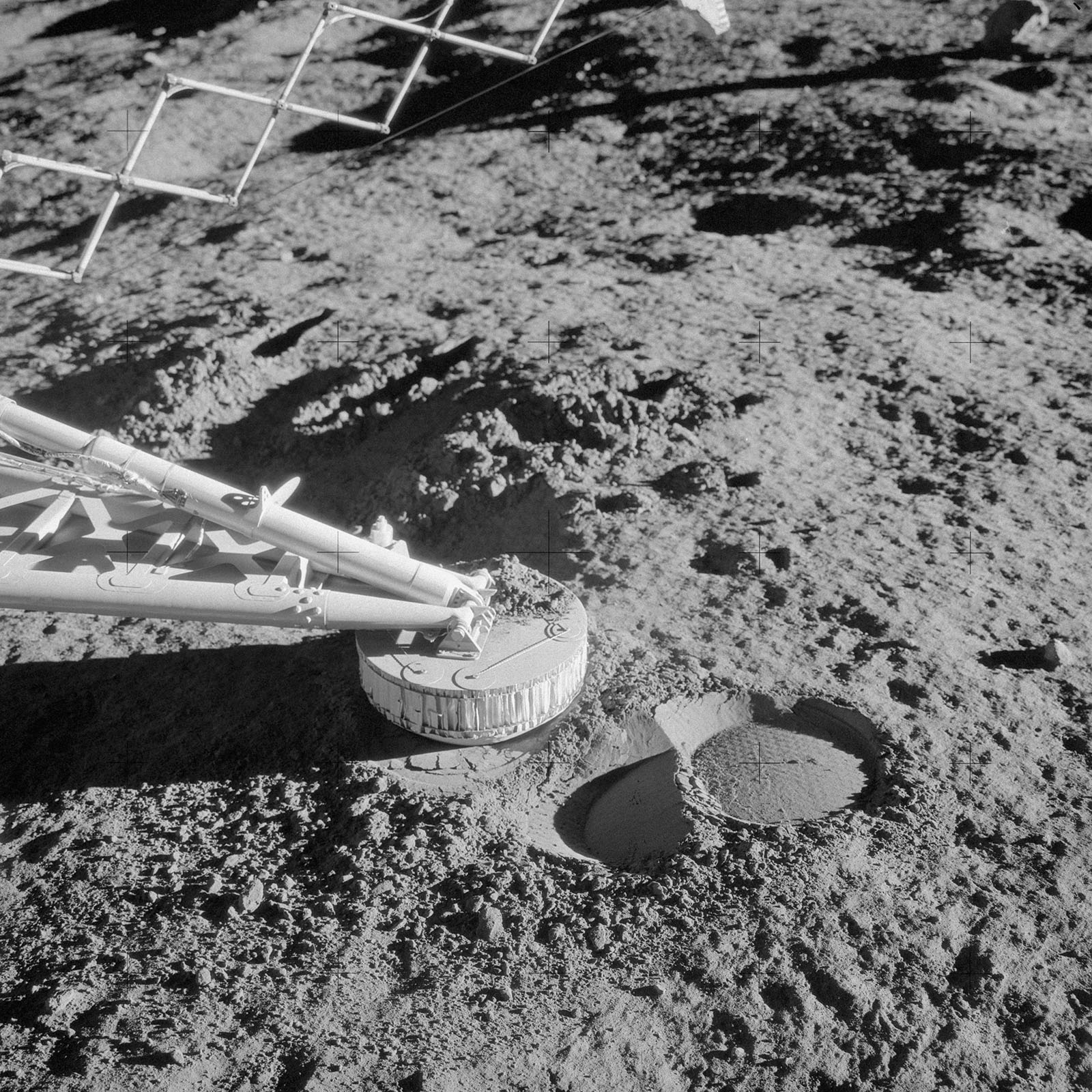
Throughout 1964 and the early part of 1965, Headquarters was busy studying the requirements for lunar surface instruments and experiments, working with outside scientific planning groups and with MSC. [see Chapter 3] By May 1965 a tentative list of experiments had been devised and MSC had prepared a procurement plan for a “Lunar Surface Experiments Package” (LSEP). On George Mueller’s instructions MSC divided the procurement into two phases, a program definition phase to be conducted by several contractors and an implementation phase in which one of the contractors would build the experiments.37 The request for proposals was sent out in June and three contractors for Phase I were picked in August.38
As defined in Houston’s request for proposals, the LSEP would be a self-powered scientific station capable of collecting data for a year, returning information to earth by telemetry. It comprised a passive seismometer to record natural seismic events (“moonquakes”); an active seismic experiment, which would record the effects of small explosive charges detonated on the lunar surface; a lunar gravimeter, which was expected to show tidal effects useful in deducing the internal structure of the moon; an instrument to measure heat flow from the moon’s interior; radiation and meteoroid detectors; and a lunar atmospheric analyzer. A 70-watt power module converted heat from a radioisotope fuel capsule into electricity by means of thermocouples. The instruments, their power supply, and their data-transmitting equipment were limited to 150 pounds (68 kilograms) and 12 cubic feet (0.34 cubic meters) and were to be housed in the lunar module’s descent stage. The specifications called for three units which could function on the moon at the same time without interfering with each other.39 The program directive assigning management responsibility to MSC specified three packages, one to be flown on each of the first three lunar landing missions, plus a flight-qualified spare. The first was to be delivered by July 1, 1967.40
Newell’s office, meanwhile, had been evaluating proposals for the lunar surface experiments, and on October 1 transmitted authority to Houston to begin negotiations with principal investigators for the lunar gravimeter and the active seismic experiment.41 A third experiment, investigation of the lunar magnetic field, was tentatively approved on December 15.42 The science complement for the first few missions was completed early in 1966 with the public announcement of seven instruments and investigator teams.### Newell noted that the experiments fulfilled the basic recommendations made the previous summer by the science teams at the Falmouth conference and had been approved for flight by the Space Sciences Steering Committee. Since the design of the instruments was not yet fixed it was not certain what combination would be flown on each mission, but modular design would allow each package to carry a group of instruments tailored to the constraints of its mission. The instrument collection was christened “Apollo Lunar Surface Experiments Package,” or “ALSEP.” 43
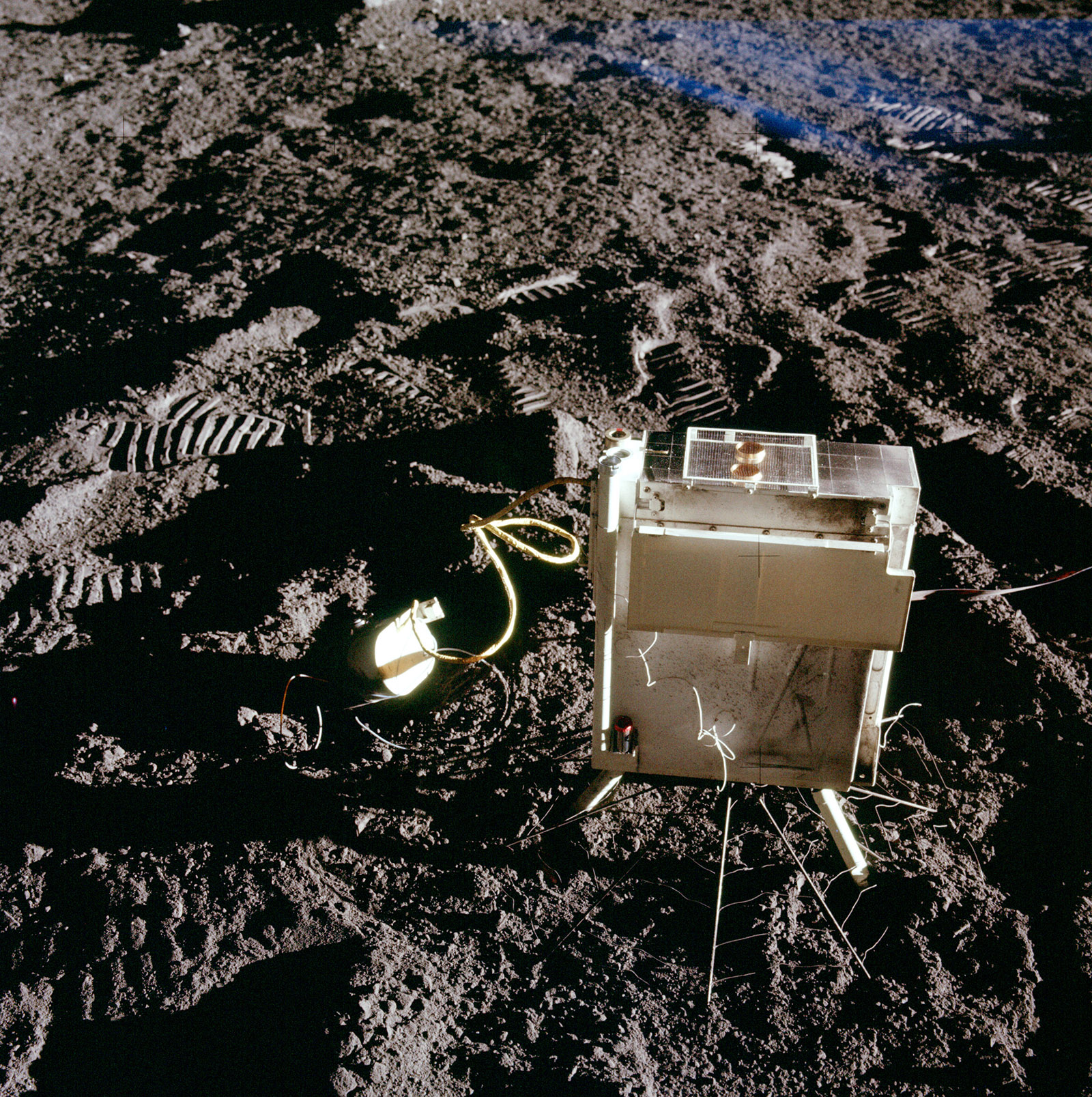
### Passive lunar seismic experiment, Dr. Frank Press (MIT) and Dr. George Sutton (Lamont Geological Observatory); lunar triaxis magnetometer, Dr. C. P. Sonett (NASA Ames Research Center) and Jerry Modisette (MSC); medium energy solar wind experiment, Dr. C. W. Snyder and Dr. M. N. Neugebauer (JPL); suprathermal ion detector, Dr. J. W. Freeman, Jr, (Rice Univ.) and Dr. F. Curtis Michel (MSC scientist-astronaut); lunar heat flow measurements, Dr. Marcus G. Langseth (Lamont Observatory) and Dr. Sydney Clark (Yale); low-energy solar wind, Dr. Brian J. O'Brien (Rice); and active lunar seismic experiment, Dr. Robert L. Kovach (Stanford Univ.) and Dr. Joel S. Watkins (USGS).
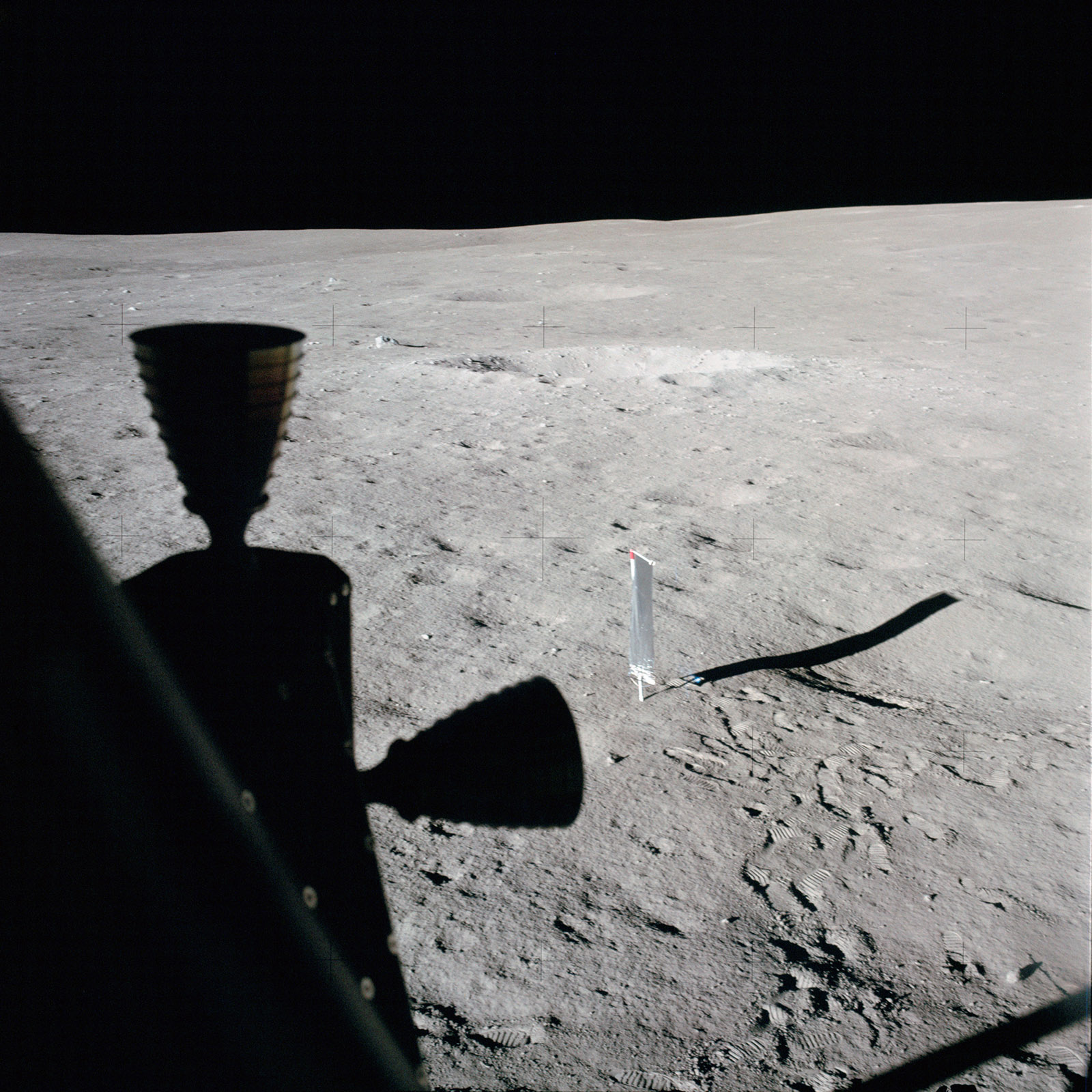
In authorizing MSC to develop the lunar surface science package, Newell assigned specific experiment combinations to each of the first four lunar landing missions and classified each as primary or backup. The first two lunar landers would carry the magnetometer, the passive seismic experiment, the suprathermal ion detector, the medium-energy solar wind experiment, and the heat flow instrument. Subsequent missions might carry different combinations, subject to Newell’s approval of any changes. MSC was authorized to spend $5.1 million to develop flight-qualified prototype instruments and provide for operational and support software and data analysis.44
All that remained to get instrument development under way was to select a contractor. This was accomplished a month later when Headquarters picked the Bendix Systems Division of Bendix Corporation, Ann Arbor, Michigan, for negotiation of a contract to build four ALSEP packages. Under a cost-plus- incentive-fee contract NASA anticipated a total cost of about $17 million.45 Bendix was not inexperienced in lunar surface exploration, having worked with JPL from 1963 to 1965, and had made a major corporate commitment to that phase of the space program.46 Bendix’s activity was actually twofold: it would build the “central station” that transmitted data to earth, and integrate the entire experiment package. Some of the instruments were to be built by Bendix’s subcontractors to principal investigators' specifications; other principal investigators chose to build their own.
MSC Develops a Science Organization
Mercury project engineers at MSC had reluctantly allowed a few scientific exercises to ride their spacecraft, but this patched-on effort was of small importance. To pave the way for worthwhile experiments in manned space flight, Homer Newell persisted in urging scientists to devise experiments that would take advantage of man’s presence. By the time Gemini was fully operational in early 1965 a fair number of scientific exercises had been proposed and accepted for flight.47 After Mercury, the Manned Spacecraft Center established an Experiments Coordinating Office to ensure that science plans were compatible with the spacecraft and the operational constraints of the mission.48 Within the Gemini Program Office a Gemini Experiments Office supervised the science exercises undertaken in Gemini.
As the Apollo science program evolved in 1964-65, the horizon of manned space science expanded to include lunar surface experiments as well as in-flight (earth-and lunar-orbital) science. In view of its new responsibility to oversee the development and integration of the Apollo experiments as well as integrating the Gemini science, the Houston center decided to centralize the management of all manned space flight experiments in a single office. In June 1965 MSC Director Robert R. Gilruth appointed Robert O. Piland to head a new Experiments Program Office within the Engineering and Development Directorate.49 Piland, formerly a research scientist at Langley, had served briefly on the staff of James R. Killian, President Eisenhower’s science advisor, before joining the Manned Spacecraft Center in 1959. After contributing to the early planning and study efforts that led to the Apollo spacecraft program, he was appointed deputy manager of MSC’s Apollo Spacecraft Program Office in 1962. His new office absorbed the staff and functions of both the Gemini Experiments Office and the Experiments Coordination Office and immediately took over work on the ALSEP contracts.
Piland’s job was to keep track of the complex requirements of the Apollo spacecraft and mission plans and see that the experimenters understood those requirements and adhered to them. His responsibilities extended from the conception of the experiment to the management and distribution of data. The Experiments Program Office worked with spacecraft engineers, flight planners, scientific investigators, and contractors in developing, testing, and integrating the experiments into the missions.50
The in-flight experiments were an important part of Apollo lunar science, but MSC’s involvement with science was growing in other phases of the program as well. During 1965 the Houston center was developing the concept of the lunar receiving laboratory, which went into NASA’s budget proposal for fiscal 1966. [see Chapter 4] When Apollo began to return samples of lunar material to the earth, MSC’s relations with the outside scientific community would expand considerably. Those samples were of incalculable scientific value, and scientists would assuredly demand a say in how they were handled from the time they were collected on the moon to the time they were parceled out to investigators. Apollo was about to create a relationship between MSC and the scientific world that was new to both groups and would require careful handling.
There is not much room for doubt that MSC considered itself perfectly competent to manage the lunar samples with minimal help from the outside; the science community could simply lay out its requirements and MSC, if it concurred, would do the rest. Scientists, however, would never agree to stand in line at MSC’s dispensing window to receive their designated allotments of lunar material. The deliberations of the various advisory groups and ad hoc committees convened to define the lunar receiving laboratory make it plain that scientists saw the proper staffing of the LRL as one of the most important questions of the entire project. At the very least they would insist that a scientist of considerable repute be appointed to head the laboratory and take charge of the sample analysis program, with the advice and consent of the scientific community.
Besides the anticipated lunar science program, MSC had to recognize George Mueller’s increasing interest in a science-oriented post-Apollo program. Having established an Apollo Applications Program (AAP) office in August 1965, Mueller went to Congress the following spring to seek funding for it.51 If he should get what he was asking for, AAP would bring science to the forefront of manned space flight; although MSC lacked the staff to support it (concurrently with its Gemini and Apollo commitments) at the time, science clearly had to have a place in Houston - otherwise MSC might find itself playing a support role to some other center. At the end of March Faget announced the establishment of a Space Science Office within his Engineering and Development Directorate, described as an “interim arrangement pending development of a permanent scientific organization.” For this purpose MSC regrouped a number of scattered center activities around Piland’s Experiments Program Office and under his direction. While most of those activities were conducted in support of manned space flight operations and lunar exploration, the Space Science Office was also charged with developing, monitoring, and coordinating experiments for all manned space missions involving science.52
The following week Gilruth sent MSC’s plan for a more extensive reorganization to George Mueller. A new Space Medicine Directorate would consolidate all center medical activities in a single organization. For science, a new Space Science Division was to be established - not a science directorate on the same level as Space Medicine or Engineering and Development, but an upgraded version of the Space Science Office just established, still under Faget’s jurisdiction. The proposal more specifically included management of the lunar receiving laboratory, providing MSC’s point of contact with the external scientific community, and giving MSC scientists the opportunity to generate their own experiments. Some 76 people from other offices would comprise the new division, and a scientist would be recruited to head it as soon as possible. Agreeing with Newell’s view that the division should concentrate primarily on one scientific field, Gilruth suggested that lunar and earth sciences would be its most appropriate disciplines.53 For the next several months Headquarters and MSC discussed the proposed reorganization and the question of a director for science at MSC.54
While those discussions were going on, Headquarters was working to clarify agency-wide management responsibilities for future manned flight activities. Apollo Applications, emerging as the most likely successor to Apollo, embraced a much greater variety of scientific projects than Apollo and appeared to require more interlocking of effort among the field centers (chiefly MSC and Marshall Space Flight Center) as well as Headquarters program offices. Accordingly, on July 26 Deputy Administrator Robert C. Seamans divided responsibility for prospective programs among the various entities - in effect ratifying the arrangement Homer Newell and George Mueller had been working under since 1963. [see Chapter 3] Mueller’s Office of Manned Space Flight was to be responsible for the conduct of Apollo and AAP missions, developing and funding the experiments that were selected by Newell’s Office of Space Science and Applications. Seamans went one step further, assigning to each center primary responsibility for specific areas: Marshall to develop the Apollo telescope mount (a major component of Apollo Applications), Goddard to handle atmospheric science, meteorology, and astronomical experiments, and MSC to manage the Apollo lunar surface experiments package, lunar science, earth resources, and life-support systems. Future assignments would depend on center capabilities and NASA’s long-range plans.55
In November, “in response to the growing significance and responsibilities of the Center in the area of science and applications,” Houston informed Headquarters that it proposed to create a Science and Applications Directorate, on the same organizational level as those for Engineering and Development and Medical Research and Operations. (At long last Homer Newell’s view of the importance of science at MSC prevailed.) It would subsume the functions of Space Science Division and would collect all space- and lunar-science-related functions of the center, along with the many people scattered throughout the center who were then engaged in scientific work in support of Apollo. The directorate would be responsible for planning and conducting all MSC programs in space science and applications and would be the center’s point of contact with the scientific world outside. Pending appointment of a permanent director, Bob Piland, named as deputy director, would run the operation.56 Administrator James Webb approved the new MSC organization on December 23, 1966.57
After several months of searching, Gilruth announced on February 17, 1967, selection of a director of science and applications: Wilmot N. Hess, chief of the Laboratory for Theoretical Studies at Goddard Space Flight Center. Hess was a nationally recognized scientist whose major scientific interest was high-energy nuclear physics and space radiation studies.58 A space physicist seemed a curious choice in view of the scientific responsibilities foreseen for the center, but Hess was considered to be a competent administrator, and he had the scientific stature to give credibility to Houston’s scientific efforts.
Apollo at the End of 1966
By the time 1966 drew to a close the Apollo spacecraft and Saturn launch vehicle projects had been through some rough times. The lunar landing craft, under contract to Grumman Aircraft Engineering Company of Bethpage, New York, was slow to reach design maturity and Grumman had considerable difficulty with the main propulsion engines, landing gear, and radar systems. Across the country in southern California, North American Aviation’s Space & Information Division had its own set of problems with the command and service module.59
North American had other problems as well, notably with the S-II second stage of the mammoth Saturn V launch vehicle. The S-II was similar to Saturn V’s third stage (the S-IVB) in that it used cryogenic propellants (liquid hydrogen and liquid oxygen at extremely low temperatures), but it was much larger and presented more difficult manufacturing problems.60 Besides, North American lacked the experience that the S-IVB stage contractor, Douglas Aircraft Company, could draw on from its prior development of the smaller S-IV stage of Saturn I. In 1965 North American’s troubles in managing its two programs - especially the S-II - were the most serious obstacle to achieving the end-of-the-decade goal for Apollo. During 1965 the company’s handling of its Apollo and Saturn contracts drew extraordinary attention from Headquarters and from Marshall Space Flight Center, culminating in a top-to-bottom evaluation of NAA’s program by teams of NASA experts. In December Maj. Gen. Samuel C. Phillips, Apollo program manager at Headquarters, sent a devastating critique of NAA’s program management to his bosses and to the company’s executives.61
The overall picture for manned space flight was not bleak, however. During 1965-66 the Gemini program had built a solid foundation for operations, sending missions into earth orbit at an average of one every two months. Important questions about the human ability to function in zero gravity were settled. Rendezvous was demonstrated in so many ways it seemed strange that anyone had ever doubted it was feasible. Saturn and Apollo enjoyed some successes as well. Marshall Space Flight Center proved out the Saturn I and IB launch vehicles - important junior partners to Saturn V - and put up earth-orbiting satellites to dispel worries about the hazard from micrometeoroids in space. By the end of 1965 all three stages of the Saturn V had been successfully (but separately) test-fired, and the Manned Spacecraft Center had proved that the Apollo launch escape system worked, easing some concerns about aborts on the launch pad.62
Since the status of science in the Apollo program had been nebulous in 1963, the next three years saw substantial progress. Widespread debate over the goals of manned space flight and the validity of the Apollo commitment during the summer of 1963 had given the Office of Manned Space Flight the incentive to accommodate science to some degree in its programs. The Office of Space Science and Applications took the lead in creating an office to coordinate the efforts of the two program offices. The major decisions concerning mission mode and spacecraft had been made when OMSF’s new director, George Mueller, took over in late 1963; he could therefore direct a good deal of his attention to other matters. Mueller, unlike his predecessor, was not perceived as hostile to scientific investigations in manned space flight, although it took some time for the scientists to decide that he was basically supportive of their efforts.63
Advice from the scientific community was brought to a clearer focus between 1962, when the Iowa summer study said little about manned lunar exploration, and 1965, when the Woods Hole and Falmouth conferences defined the objectives of lunar science in more specific terms. After the Woods Hole study posed 15 scientific questions about the moon that bounded Apollo science, study teams defined the essential experimental measurements and the instruments with which they would be made. Additional refinements to these preliminary definitions led to specific studies for the lunar surface experiments package, which was put under contract in 1966.
Houston’s Manned Spacecraft Center was finally brought around to at least an acceptance of science by the end of 1966. In the Gemini program it demonstrated a willingness to incorporate scientific exercises into its operational missions and worked out a system for assessing the compatibility of experiments with manned programs. Whether or not these exercises were scientifically important, they brought the scientists and the flight planners together so that they might better understand each other’s problems. On its own initiative the Houston center proposed and undertook to develop a laboratory in which to receive, catalog, and conduct preliminary scientific examination of the returned lunar samples. After getting its two spacecraft projects more or less in hand, MSC assumed the responsibility for directing development of the lunar surface experiments and then created a directorate in which (it might be hoped) the center could ultimately develop its own science program. And finally it yielded to the clamor of the scientific community in picking its first class of astronauts from the ranks of promising young scientists. By the end of 1966, in fact, MSC was preparing to select a second group.
On another front, MSC was cooperating with Headquarters in selecting the sites where the lunar missions would land. MSC worked with the Apollo Site Selection Board and Langley’s Lunar Orbiter project, supplying its criteria for landing sites and evaluating the information gleaned from Surveyor and Lunar Orbiter. As 1966 ended, the list of candidate sites for the last Lunar Orbiter missions had been considerably narrowed.
At the beginning of 1967 those who wanted to see science become an integral part of manned space flight could feel that some progress had been made in three years. Spacecraft engineers and mission planners could feel that many of their big problems were behind them. In spite of many problems with the command module, the first manned earth-orbital mission was only weeks away from launch. On August 26, 1966, spacecraft 012 arrived at Kennedy Space Center to begin a first-article checkout that would last through the end of the year.64
Notes
- Harold C. Urey to Homer E. Newell, June 19, 1961.
- Eugene M. Shoemaker, “Exploration of the Moon’s Surface,” American Scientist 50 (1962):99-130.
- MSC, “Environmental Factors Involved in the Choice of Lunar Operational Dates and the Choice of Lunar Landing Sites,” NASA Project Apollo Working Paper (AWP) No. 1100, Nov. 22, 1963. In 1972 an entire number of The Bell System Technical Journal (vol. 51, no. 5, pp. 955-1127) was devoted to a single article, “Where on the Moon? An Apollo Systems Engineering Problem,” J. O. Cappellari, Jr., ed. This is a narrative description of the many factors that entered into the choice of an Apollo landing site, how the factors were weighted, and how the interaction of those factors changed as experience with Apollo systems accumulated. It is not so technical as to be incomprehensible to most readers. Not surprisingly, it lays considerable emphasis on the role of Bellcomm, Inc., in the site selection process.
- AWP 1100, p. 23.
- Ibid., p. 32.
- Ibid., pp. 7-13.
- Ibid., pp. 6-7.
- Ibid., p. 33.
- W. E. Thompson (Bellcomm, Inc.), “Lunar Landing Site Constraints: The Arguments for and Against One Preselected Site Versus Several Sites,” Jan. 31, 1964.
- Benjamine J. Garland, memo for Apollo proj. off., “Characteristics of the Lunar Surface,” Aug. 14, 1961; Thomas Gold, “Structure of the Moon’s Surface,” in J. W. Salisbury and P. E. Glaser, eds., The Lunar Surface Layer (London: Academic Press, 1964), pp. 345-53. Gold interpreted radar, optical, and thermal properties of the lunar surface as indicating a layer of fine particles up to several meters thick whose mechanical properties would be difficult to predict. He suggested that at the very least a lunar landing would be compromised by blinding clouds of dust raised by the exhaust from the descent engine. In the popular press, Gold’s hypothesis was taken to mean that a lunar module could sink out of sight. The pictures returned by Ranger 7 (July 1964) gave Gold no reason to change his thinking; see R. Cargill Hall, Lunar Impact: A History of Project Ranger, NASA SP-4210 (Washington, 1977), p.285; also Gold, “Ranger Moon Pictures; Implications,” Science 145 (1964): 1046-48. Most Ranger scientists agreed that the TV pictures from Ranger 7 gave no basis for drawing conclusions about the load-bearing characteristics of the surface. They did give some useful information about the distribution and size of craters and the slopes of lunar terrain on a smaller scale than had been possible. Gold remarked after the conclusion of Ranger that its pictures were like mirrors: “everyone sees his own theories reflected in them.” Hall, Lunar Impact, p. 309. For a bibliography of studies on the lunar surface up to the first successful Ranger mission, see J. W. Salisbury, ed., Bibliography of Lunar and Planetary Research - 1960-1964, AFCRL-66-52, U.S. Air Force Office of Aerospace Research, Cambridge Research Laboratories, Jan. 1966.
- Hall, Lunar Impact, pp. 156-82.
- Courtney G. Brooks, James M. Grimwood, and Loyd S. Swenson, Jr., Chariots for Apollo: A History of Manned Lunar Spacecraft, NASA SP-4205 (Washington, 1979), pp. 150-54.
- National Academy of Sciences-National Research Council, A Review of Space Research, report of the summer study conducted under the auspices of the Space Science Board at the State University of Iowa, June 17-Aug. 10, 1962, NAS-NRC Publication 1079 (Washington, 1962); idem, Space Research: Directions for the Future, report of a study by the Space Science Board, Woods Hole, Mass., 1965, NAS-NRC Publication 1402 (Washington, 1966).
- NASA 1965 Summer Conference on Lunar Exploration and Science, Falmouth, Massachusetts, July 19- 31, 1965, NASA SP-88 (Washington, 1965), passim.
- House, Subcommittee on Manned Space Flight of the Committee on Science and Astronautics, 1966 NASA Authorization, hearings on H.R. 3730, 89/1, pt. 2, pp. 278-85.
- John M. Eggleston to Dr. W. A. Lee, “Target Selection for Future Ranger Flights,” Feb. 4, 1965.
- C. J. Byrne, “Ranger VII Photo Analysis - Preliminary Measurements of Apollo Landing Hazards,” Bellcomm, Inc., Tech. Memo. TM-65-1012-2, Mar. 17, 1965.
- Newel] to multiple addressees, “Establishment of Ad Hoc Surveyor/Orbiter Utilization Committee,” June 22, 1965.
- George E. Mueller to multiple addressees, “Establishment of Apollo Site Selection Board,” Management Instruction (NMI) 1152.20, Aug. 6, 1965.
- John P. Mayer to Chief, Mission Planning and Analysis Div., MSC, “Lunar landing site selection,” Oct. 6, 1964; Robert R. Gilruth to Mueller, “Establishment of Apollo Site Selection Board,” July 29, 1965; Gilruth to Newell, “Members of Ad Hoc Surveyor/Orbiter Utilization Committee,” July 29, 1965.
- OSSA, “Ad Hoc Surveyor/Orbiter Utilization Committee, Minutes First Meeting, Washington, D.C., August 20, 1965,” Sept. 16, 1965; I. M. Ross (Bellcomm, Inc.) to Maj. Gen. S. C. Phillips, “MSF Position for Surveyor/Orbiter Utilization Committee Meeting August 20, 1965,” Aug. 20, 1965. For a more detailed description of Lunar Orbiter mission planning, especially in support of Apollo, see Bruce K. Byers, Destination Moon: A History of the Lunar Orbiter Program, NASA TM X-3487 (Washington, 1977), pp. 177-99, 248-53, 261; Orbiter’s contributions to Apollo site selection are summarized on pp. 308-14. No useful single source for Surveyor mission planning and its relation to Apollo is available; the project’s results (almost entirely scientific) are summarized in Surveyor Program Results, NASA SP-184 (Washington, 1969).
- Willis E. Foster, “Draft Minutes of Second Meeting of Ad Hoc Surveyor/Orbiter Utilization Committee,” Oct. 1, 1965, with encl., ltr., R. J. Parks to Benjamin Milwitzky, subj.: Surveyor Mission A Landing Site Selection, Sept. 28, 1965.
- Albert Sehlstedt, Jr., “Surveyor Makes Soft Landing On Moon,” Baltimore Sun, June 2, 1966.
- William Hines, “Man Could Explore the Moon on Foot,” Washington Evening Star, June 17, 1966; Evert Clark, “Surveyor Found 'Gritty' Moon That Can Support a Spacecraft,” New York Times, June 17, 1966.
- Byers, Destination Moon, pp. 228-45.
- Lunar Orbiter Photo Data Screening Group, “Preliminary Terrain Evaluation and Apollo Landing Site Analysis Based on Lunar Orbiter I Photography,” Langley Working Paper LWP-323, Nov. 1966.
- Foster, “Minutes of the Surveyor/Orbiter Utilization Committee, Washington, D.C., September 29, 1966” ; Byers, Destination Moon, p. 251.
- Byers, Destination Moon, p. 258. See L. J. Kosofsky and Farouk El-Baz, The Moon as Viewed by Lunar Orbiter, NASA SP-200 (Washington, 1970), for an annotated collection of many of the best photographs from the Lunar Orbiter missions, along with brief descriptions of the spacecraft and its systems and a complete listing of the sites photographed on each of the five missions. The detail in these photographs, even in halftone reproduction, must be seen to be believed. Much of the geologic interpretation of the moon has been accomplished using Lunar Orbiter photographs and the information they contain is far from exhausted, according to Eugene Shoemaker (interview, Mar. 17, 1984).
- Foster, “Minutes of the Surveyor/Orbiter Utilization Committee, Washington, D.C., January 5, 1967.”
- S. C. Phillips to multiple addressees, “Minutes of the Apollo Site Selection Board Meeting, December 15, 1966,” Mar. 3, 1967.
- John M. Eggleston to Dir., MSC, “Utilization of Orbiter and Surveyor in Support of Apollo and Apollo Applications Program Objectives,” Jan. 18, 1967; Byers, Destination Moon, pp. 312-26, 329-30.
- MSC, “Project Apollo Lunar Excursion Module Development Statement of Work,” July 24, 1962, pp. 2, A-107-109.
- MSC, “Project Apollo Quarterly Status Report No. 3 for Period Ending March 31, 1963,” p. 30.
- MSC, “Project Apollo Quarterly Status Report No. 6 for Period Ending December 31, 1963,” p. 34; contract NAS9-2115, “Survey of Lunar Surface Measurements, Experiments, and Geologic Studies,” Sept. 30, 1963.
- John M. Eggleston to Wayne Young (JSC), letter with comments on draft of Apollo explorations history, Sept. 12, 1984.
- MSC, “Project Apollo Quarterly Status Report No. 8 for Period Ending June 30, 1964,” p. 47.
- Mueller to MSC, “Request for Approval of Procurement Plan for Lunar Surface Experiments Package,” June 7, 1965.
- “Three Firms Selected to Design Apollo Lunar Surface Package,” Hqs. Release 65-260, Aug. 4, 1965.
- MSC, “Lunar Surface Experiments Package Request for Proposal,” May 27, 1965, pp. b-1 to b-29.
- S. C. Phillips to multiple addressees, Apollo Program Directive No. 3, subj.: Management Assignment for the Lunar Surface Experiments Package (LSEP) Project, M-D 8030.003, June 15, 1965.
- Newell to Dir., MSC, “Selection of Scientific Investigations for Early Apollo Lunar Landing Missions,” Oct. 1, 1965.
- Newell to Dir., MSC, “Selection of Apollo Lunar Science Magnetic Field Investigations,” Dec. 15, 1965.
- William J. O'Donnell to Ames Res. Ctr.; MSC, and JPL, TWX, “Moon Surface Experiments Chosen for Apollo,” (NASA Hqs. Release 66-17), Jan. 27, 1966.
- Newell to Dir., MSC, “Authorization to Procure Space Science and Applications Investigations for Apollo Lunar Missions,” Feb. 14, 1966.
- “Bendix Named to Manufacture Lunar Package,” NASA Hqs. release 66-63, Mar. 17, 1966.
- A. P. Fontaine (Bendix Corp.) to Gilruth, Feb. 18, 1966.
- Barton C. Hacker and James M. Grimwood, On The Shoulders of Titans: A History of Project Gemini, NASA SP-4203 (Washington, 1977), pp. 229-31; see Gemini Midprogram Conference Including Experimental Results, NASA SP-121 (Washington, 1966), pp.305-436, and Gemini Summary Conference, NASA SP-138 (Washington, 1967), pp. 221-317, for summaries of the Gemini experiments program and its results.
- See W. David Compton and Charles D. Benson, Living and Working in Space: A History of Skylab, NASA SP-4208 (Washington, 1983), pp. 59-63, for pre-Apollo experience with scientific experiments.
- MSC Announcement 65-81, “Designation of Manager, Experiments, in E&D, and Establishment of the Experiments Program Office,” June 21, 1965.
- Ibid.
- Compton and Benson, Living and Working in Space, pp. 40-52.
- Maxime A. Faget to multiple addressees, “Establishment of a Space Science Office within E&D,” Mar. 31, 1966.
- Gilruth to Mueller, “Change in the basic MSC organization,” Apr. 4, 1966.
- D. M. Allison, “Summary Minutes: Planetology Subcommittee of the Space Science Steering Committee (Meeting No. 1-67), 26, 27, 28 July 1966,” no date.
- Robert C. Seamans to Hqs. Assoc. Administrators, “Management Responsibilities for Future Manned Flight Activities,” July 26, 1966; see also Compton and Benson, Living and Working in Space, pp. 48-52.
- George M. Low to multiple addressees, “Pending MSC Organizational Change,” Nov. 17, 1966.
- Mueller to Gilruth, Jan. 17, 1967, with encls., MSC Organization Chart approved by Webb and functional statement for MSC Director of Science and Applications.
- MSC Announcement 67-27, “Director, Science and Applications Directorate,” Feb. 17, 1967.
- Brooks, Grimwood, and Swenson, Chariots, pp. 131-201.
- Roger E. Bilstein, Stages to Saturn: A Technological History of the Apollo/Saturn Launch Vehicles, NASA SP-4206, (Washington, 1980), pp. 209-32.
- Ibid., pp. 225-32; Brooks, Grimwood, and Swenson, Chariots, pp. 194-96; Maj. Gen. Samuel C. Phillips to J. Leland Atwood, NAA, Dec. 19, 1965, with encls.
- Brooks, Grimwood, and Swenson, Chariots, pp. 183-85, 208.
- Eugene M. Shoemaker interview, Mar. 17, 1984.
- Charles D. Benson and William Barnaby Faherty, Moonport: A History of Apollo Launch Facilities and Operations, NASA SP-4204 (Washington, 1978), pp. 384-87.