LUNAR EXPLORATION CONCLUDED
When the spacecraft Kitty Hawk returned from Fra Mauro on February 9, 1971, the preliminary stage of lunar exploration ended. Project Apollo, severely truncated in the budget cuts of 1970, entered its last phase as NASA prepared to exploit the potential of earth-orbital manned flight. Skylab, an earth-orbiting laboratory scheduled for three long-duration missions between 1973 and 1974, would lay the groundwork. Shuttle, the new reusable spacecraft that carried NASA’s hopes for a continuing manned program, had yet to receive the blessing of the Nixon administration’s budget officials and appeared to be facing stiff opposition in Congress. After that, it would face a long period of development that seemed likely to push the next set of manned missions into the late 1970s or early 1980s.
Apollo’s mission planners, looking ahead to only three more lunar missions, intended to make them as scientifically productive as the limitations of the system allowed. Modifications to the lunar module were under way and the first flight model of the lunar rover was undergoing tests. Landing sites for the next two missions had been selected and a group of sensors for remote sensing of the moon from lunar orbit was under development [see Chapter 12].
Apollo 15: Great Expectations
Apollo 15, the first of the “J” missions, was the most complex mission yet attempted, one of which much was expected. Its landing site, 26 degrees north of the lunar equator, was the first outside the original “ Apollo zone.” Commander David R. Scott would bring the lunar module to the surface along a steeper approach path (25 degrees) than had been used previously, coming in over the Apennine front north of the 3,500-meter (11,500-foot) ridge of Hadley Delta. His landing site was about 5 kilometers (3 miles) northwest of Hadley Delta, 11 kilometers (7 miles) southwest of the foot of 5,500-meter (18,000-foot) Mount Hadley, and about a kilometer (half a mile) east of the edge of Hadley Rille.1
Apollo 15 was the first mission to fly the extended lunar module with the increased payload it could carry: expendable supplies sufficient to support the astronauts for 67 hours, a complete lunar surface experiments package [see Appendix 5], and the first lunar roving vehicle. Excursions were planned to the foot of the Apennine Front and along Hadley Rille. In addition to the usual geological investigations, the crew would take core samples to a depth of 2.5 meters (8 feet), using an electrically powered drill. Temperature sensors inserted into the drill holes would enable scientists to record the rate at which heat flowed from the moon’s interior to the surface.2
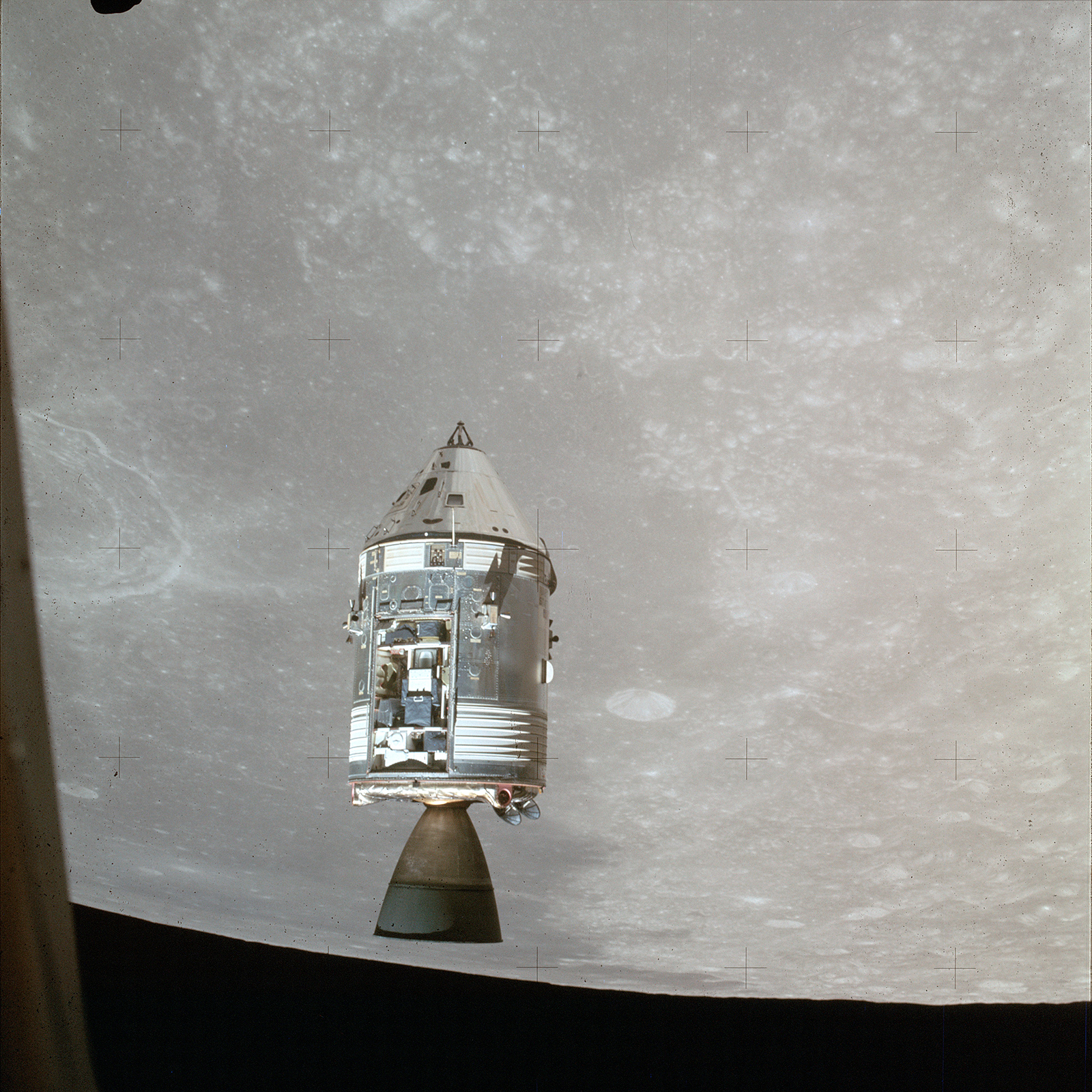
Starting with Apollo 15, the orbiting command and service module had a much larger role to play in the lunar science program. While Scott and LM pilot James Irwin were on the moon, command module pilot Alfred Worden’s flight plan called for him to operate a group of instruments carried in the scientific instrument module (SIM) in the service module. Two cameras would collect high-quality photographs of the lunar surface. A laser altimeter was provided to give a precise profile of the lunar surface and to allow photogrammetrists to correct the data from the cameras, from which accurate maps of the moon could be produced. Besides cameras, the SIM bay housed instruments for remote sensing of the lunar surface and a scientific subsatellite to be released in lunar orbit for long-term measurement of particles and magnetic fields. On the trip back to earth Worden would make the first extravehicular sortie in cislunar space to bring film from the cameras back into the command module.3
The Lunar Rover and New Experiments
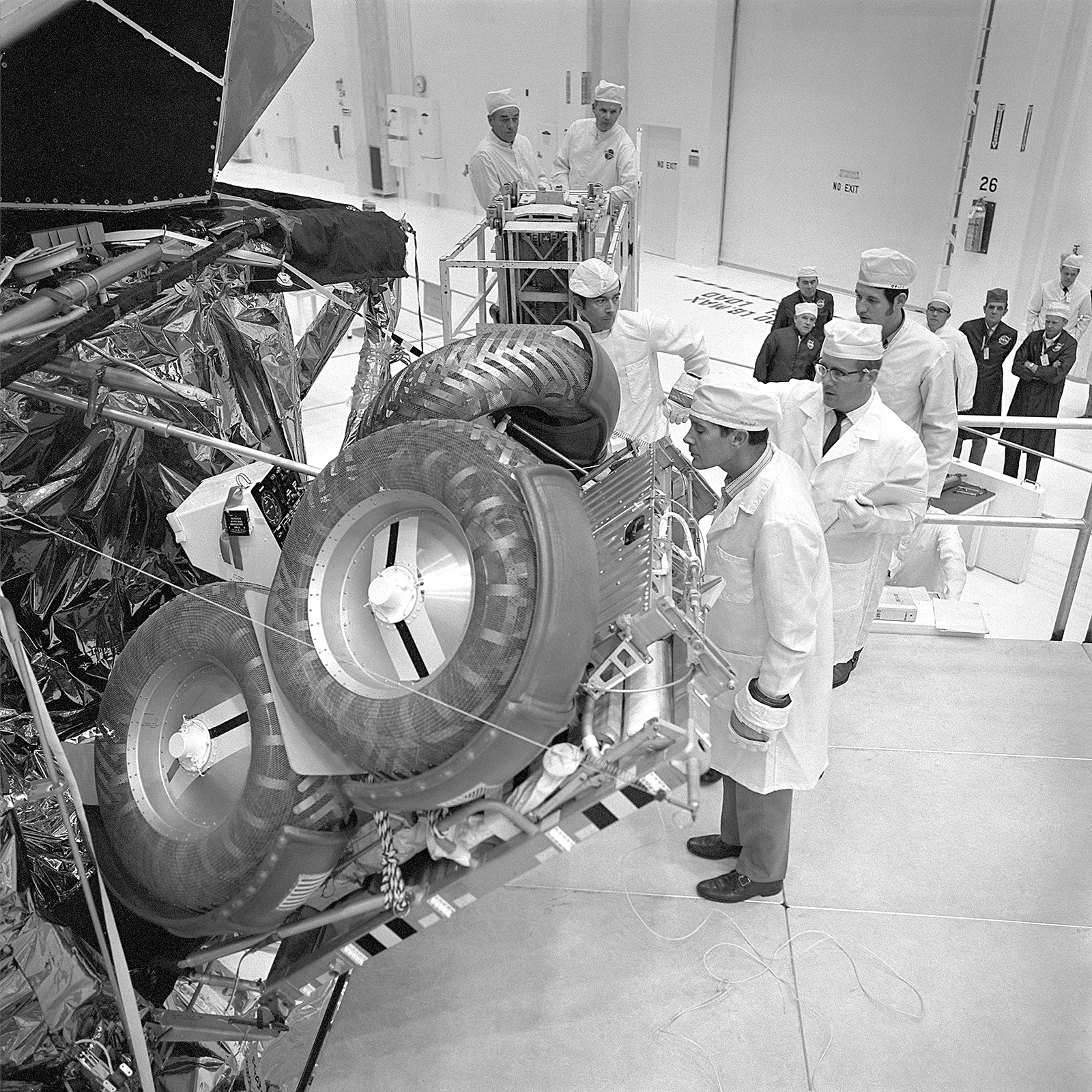
The lunar roving vehicle was among the more important new developments for the extended Apollo missions, since it would allow the astronauts to sample a much larger area around the landing site. When Boeing won the rover contract in November 1969, it had little time to produce the novel vehicle: at the time the schedule called for flight of the first rover on Apollo 16 in April 1971.4 Many details of design were still to be settled, and much of 1970 was spent in ironing them out.
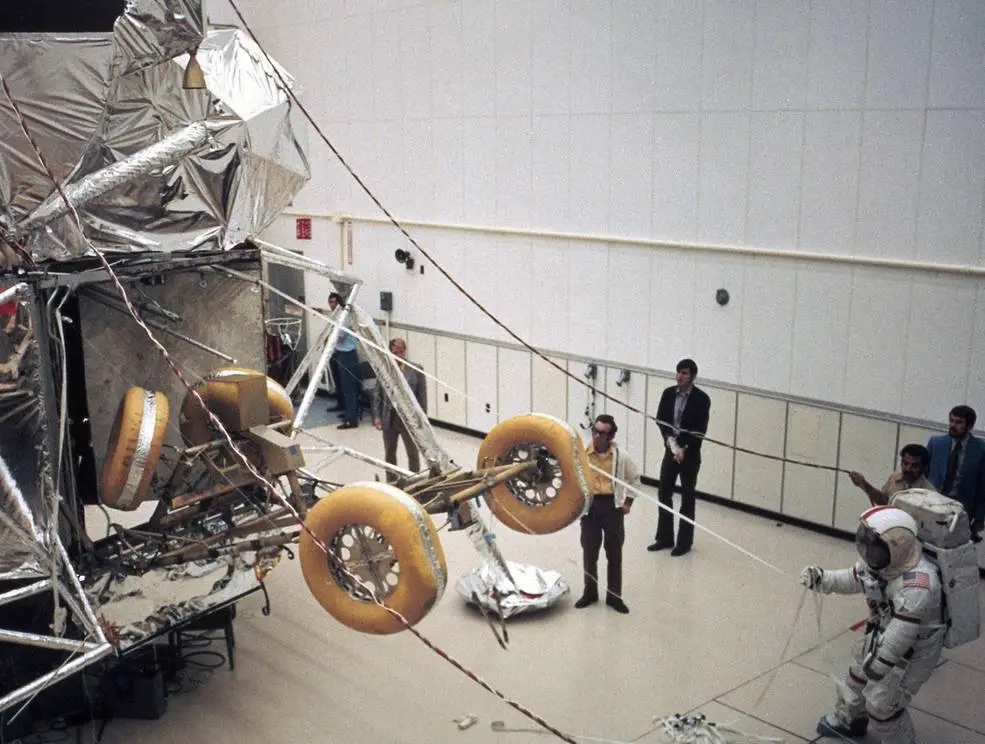
What evolved from the program was a unique four-wheeled vehicle remarkable for its versatility and compactness. Smaller than a subcompact car, the rover had a 2.3-meter (7.5-foot) wheelbase and measured 3.1 meters long, 1.8 meters wide, and 1.14 meters high (10 x 6 x 3.75 feet). For its trip to the moon, all four wheels folded inward and the rover folded double for stowage in the descent stage of the lunar module. It was powered by two 36-volt silver-zinc batteries with sufficient power for a range of 65 kilometers (40 miles) at speeds up to 17 kilometers per hour (11 miles per hour). If either battery failed the other could carry the entire load. Four separate motors, one at each wheel, drove the vehicle; any wheel could be cut out of the circuit and allowed to “free-wheel” if its drive mechanism developed problems. Tires of spring-steel wire mesh carried treads of titanium-alloy chevrons for traction; “bump stops” inside the wire mesh prevented collapse of a tire in case of severe shock. Two collapsible seats were mounted on the chassis, along with racks for equipment, tools, and sample bags.
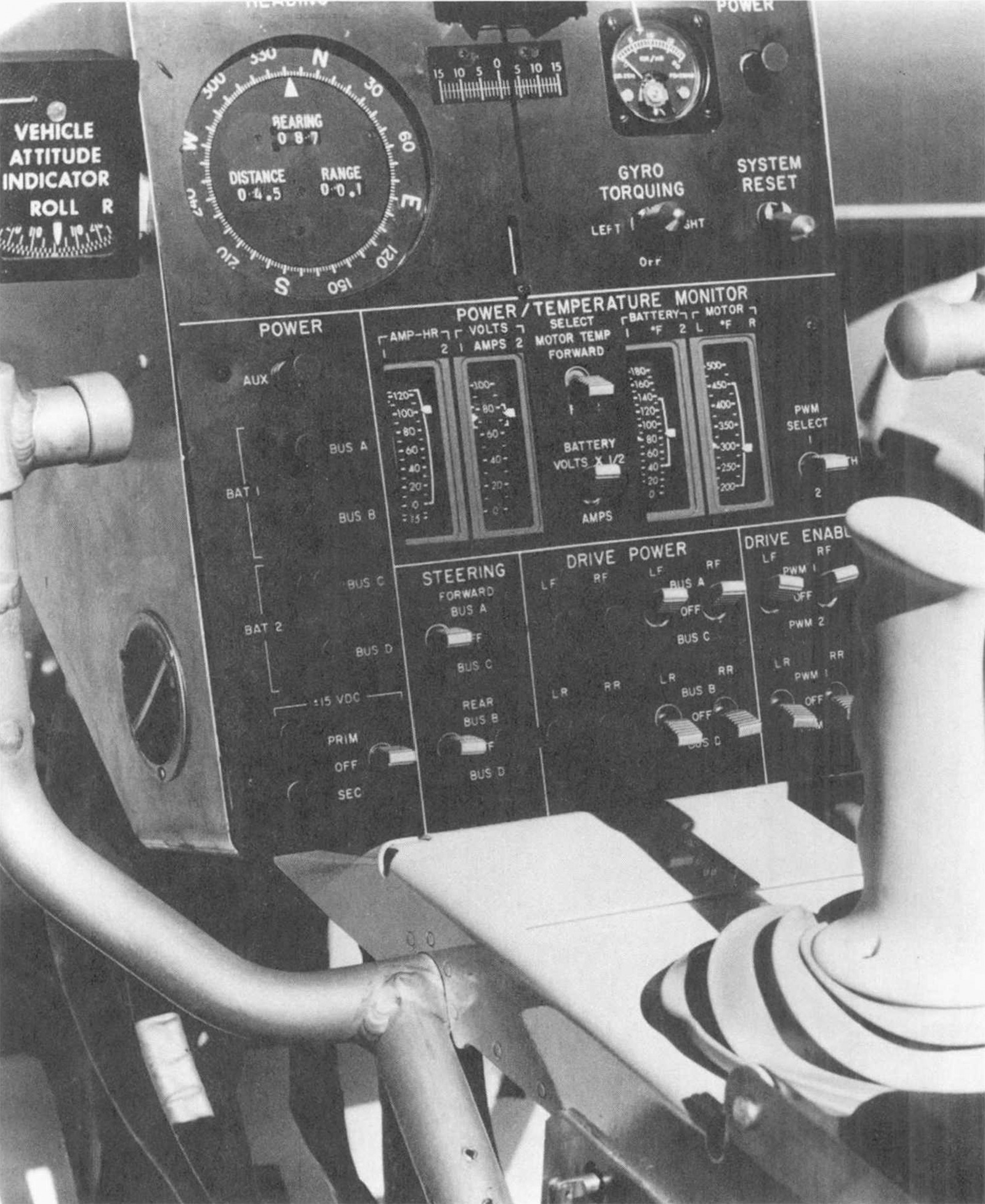
All the rover’s driving functions - forward and reverse speed, braking, and steering - were controlled by a T-handle mounted between the seats. Besides fourwheel drive, the rover featured redundant four-wheel steering. Either front or rear wheels could be turned while the other pair was locked straight, or both could be used simultaneously, allowing the rover to turn completely around within its own length. It could clamber over obstacles 30 centimeters (1 foot) high, climb and descend slopes of 25 degrees, and park on slopes as steep as 35 degrees.
The rover navigated by a dead-reckoning system. At the start of a traverse the astronauts oriented the system’s navigational gyroscope with reference to the sun. During the trip, odometers recorded the distance traveled and the system continuously computed and displayed the direction and distance to the lunar module.
Communications from the rover were relayed to earth through the lunar module, but could be sent directly to earth when the lunar terrain blocked the line of sight between the two vehicles. Mounted on the front of the rover were a television camera and a high-gain antenna. At each stop the astronauts would activate the camera and orient its antenna toward earth. For the first time, scientists at Mission Control would be able to look over the astronauts' shoulders during surface exploration. Unlike the rover itself, the camera could be controlled from earth, allowing scientists to direct the lunar activity, if necessary, on the basis of what they could see. Alternatively, they could use the camera to survey the area for interesting features while the astronauts carried out their preplanned activities.
Fully equipped and ready for flight, the lunar rover weighed just over 200 kilograms (440 pounds) and could carry about 490 kilograms (1,080 pounds), including the astronauts, their life-support systems, their tools and equipment, and 27 kilograms (60 pounds) of lunar samples that could be brought back to the lunar module on each trip. Models to be flown on missions were designed to support this weight on the moon; in all prelaunch tests they had to be supported on special racks, since if anyone inadvertently sat down on one it could collapse.5
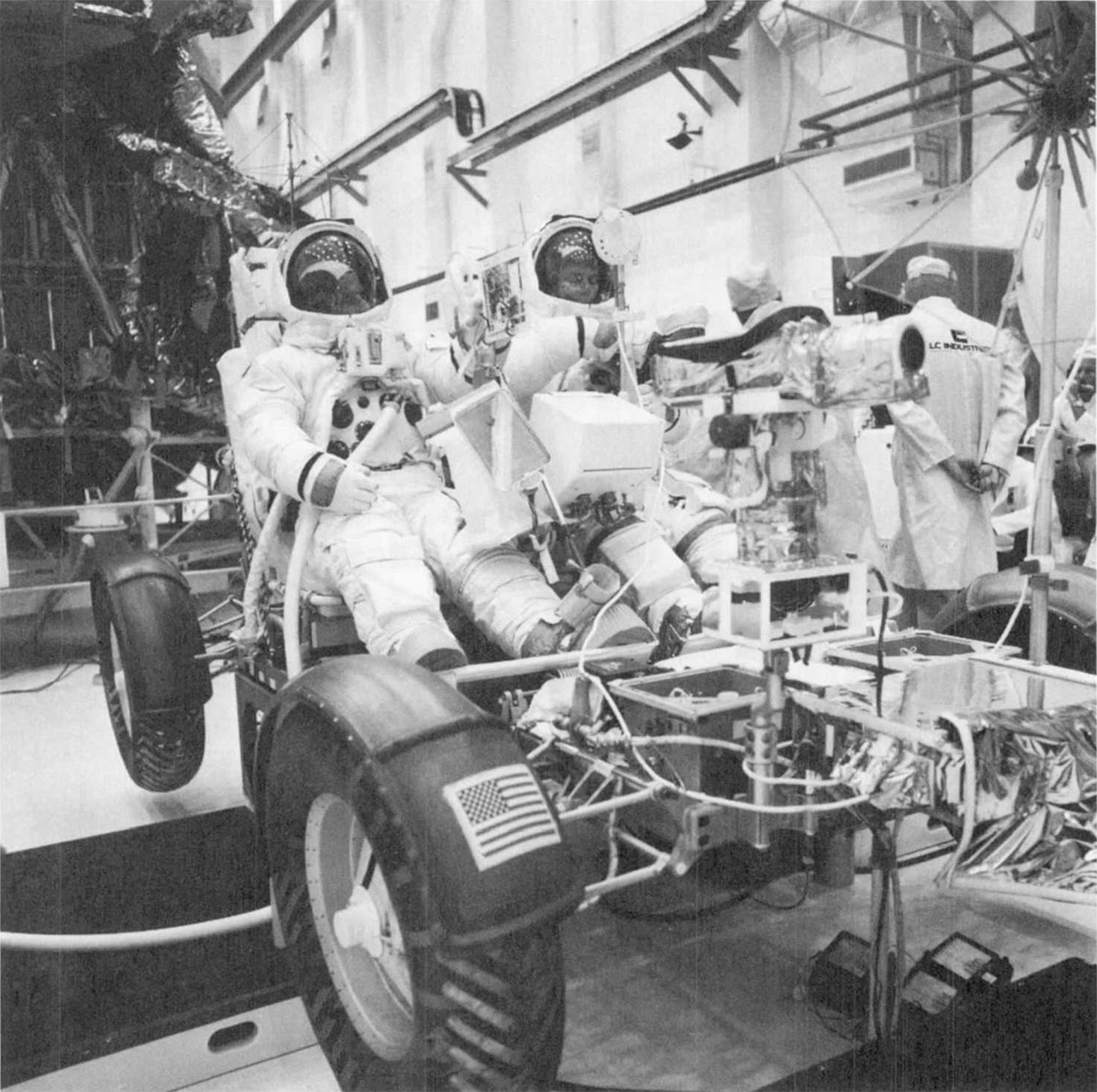
Development of the rover was not without its problems. Although the project got some schedule relief with the postponement of the first flight from April to July 1971, at one point it was estimated to be two months behind schedule.6 The deficit was soon made up, however. The one-g training vehicle, a structurally strengthened version equipped with conventional fires for use on earth, was delivered on November 18, 1970, and crews immediately began training with it.7 The first vehicle to be flown to the moon was delivered to Kennedy Space Center the following March for prelaunch testing. Eight weeks later the rover was stowed in the lunar module and both were loaded into the Saturn V stack.8
In January 1971 Apollo 15’s scientific instruments began arriving at Kennedy Space Center, where they were subjected to two months of extensive preflight testing. KSC engineers had more than a few problems with the instruments, as they usually did when a new component was added to the spacecraft. Some arrived late; principal investigators or contractor representatives often wanted to make small changes or conduct last-minute tests. Mechanical problems complicated the process as well. Two of the instruments had to be extended from the service module on long booms to avoid interference from spacecraft systems. The booms, designed for zero-g operation, would not support the instruments in earth gravity, so on-the-spot fixes had to be improvised, with less than completely satisfactory results. But calibrations were finally completed and the SIM was returned to North American’s California plant for rework. When retesting was completed in late April, the package was installed in the service module. The lunar subsatellite arrived in May and after checkout was loaded into the space craft on June 9.9
To the Mountains of the Moon
Thunderstorms visited launch complex 39A during the month preceding Apollo 15’s launch. Four lightning strikes damaged some ground support equipment but the spacecraft and launch vehicle were undamaged.10 Otherwise the countdown for Apollo 15 was, as launch director Walter Kapryan described it, “the most nominal countdown that we have ever had.” 11 At 9:34 a.m. on July 26, just 187 milliseconds behind schedule, the Saturn V carrying command module Endeavour* and its crew blasted off. Twelve minutes later Scott, Irwin, and Worden were in orbit some 92 nautical miles above the earth, and after two revolutions their S-IVB stage reignited to send them on their way to the plain at Hadley. After extracting the lunar module Falcon (named for the Air Force Academy’s mascot by the all-Air-Force crew) from its stowage atop the S-IVB, they settled down for an uneventful 3-day trip to the moon. Only two small midcourse corrections were required along the way.12
* Conscious of the importance of science on their mission, the crew named their spacecraft for the ship commanded by Lieut. James Cook, who had sailed from England to Tahiti in 1768 to observe the transit (passage between the earth and the sun) of the planet Venus in August 1769. Apollo Prime Crew Press Conference, June 18, 1971, transcript.
Four hours before settling into lunar orbit, the crew jettisoned the cover of the scientific instrument module in preparation for the lunar-orbital science to be conducted later. Endeavourwent smoothly into lunar orbit. Scott and Irwin entered Falcon about 40 minutes early, checked out its systems, and had ample time to eat lunch before beginning powered descent. After they undocked, Worden put Endeavour into a circular orbit suitable for gathering scientific data.13
Ten hours into their fourth day, Scott powered up Falcon for the approach to Hadley. As had been the case throughout the mission so far, everything went well during the landing approach. At about 9,000 feet (2,750 meters) above the surface Scott noted the peak of Hadley Delta to his left; until he reached 5,000 feet (1,500 meters) the only other landmark he could spot was Hadley Rille. The terrain was less sharply defined than he had expected from simulations. After entering several redesignations of the landing site into his control computer, Scott brought Falcon down through blinding dust and touched down at 6:16 p.m. Eastern Daylight Time on July 29. Not sure of his exact location, Scott was sure he was well within the boundaries of his designated landing zone. The lunar module came to rest tilted back and to its left; two of its landing pads were just over the edge of a small crater that Scott had not been able to see as he approached the surface.14
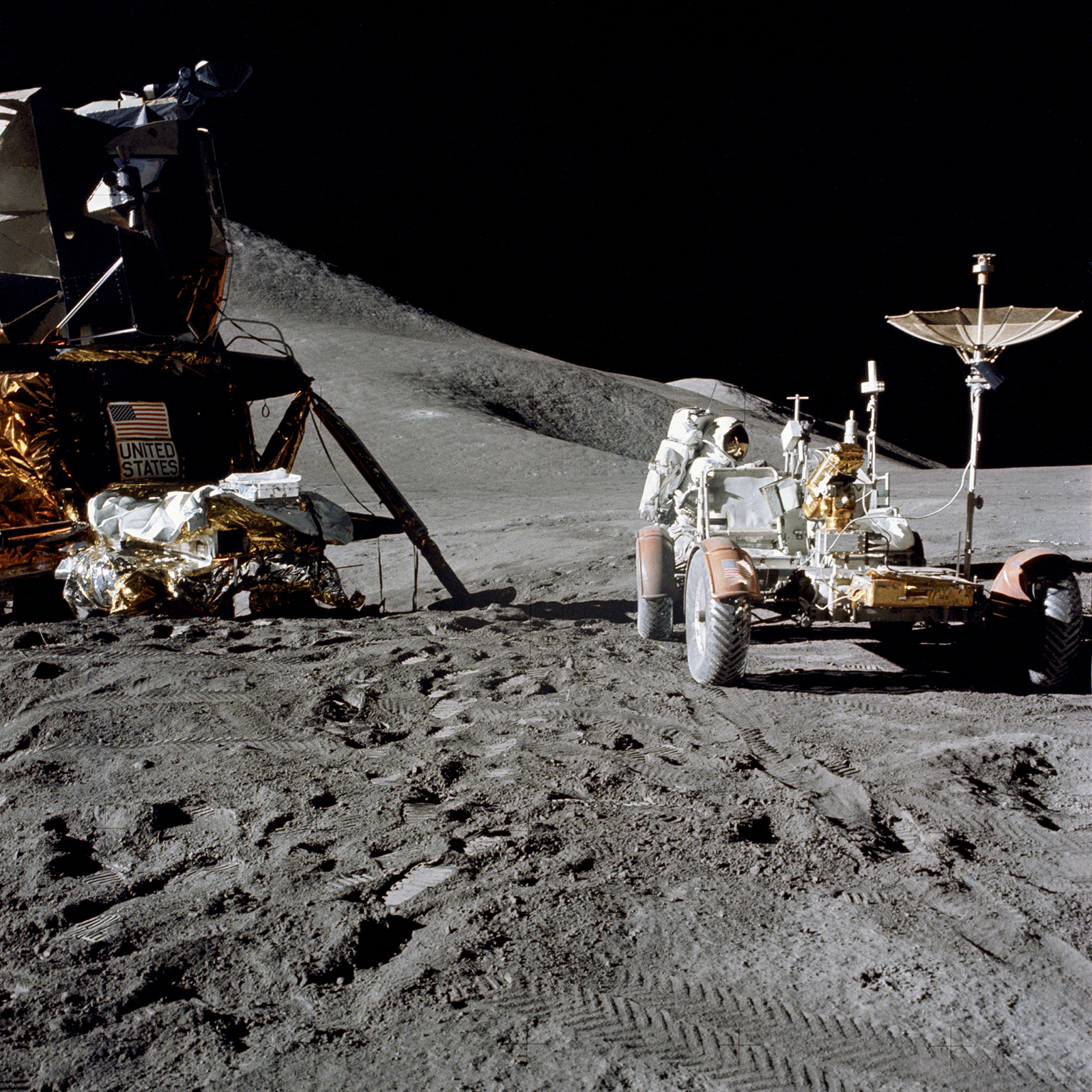
During the next 67 hours Scott and Irwin were to ride and walk over more of the lunar surface than any of their predecessors. The first chore was a “standup EVA,” to survey the landing area for the benefit of the scientists in Houston. Scott removed the upper hatch of the lunar module and stood on the engine cover, describing what he could see and taking photographs that would allow construction of a panorama of the landing area. One remarkable photograph showed clear evidence of stratigraphy in a prominent landmark (“Silver Spur”) to the east of Hadley Delta - a feature the explorers were unable to see later because of unfavorable lighting. While Scott and Irwin carried out their assignments on the surface, Al Worden, orbiting above in Endeavour, had activated the scientific instruments and cameras and was busy gathering data. On his 15th revolution he spotted Falcon on the surface and relayed its position to Houston.15
The next morning Scott and Irwin were up early and out on the surface. They unloaded their roving vehicle without difficulty, climbed on and buckled their seat belts, and set out on the first traverse. Scott soon discovered that the rover’s front wheels could not be steered. He could not correct the anomaly, but went ahead, relying on the rear-wheel steering alone.16
Their first goal was “Station 1,” a spot on the rim of a medium-sized crater (“Elbow”) located on the edge of Hadley Rille at the point where it makes a sharp bend. On the way Scott had to get the feel of driving the rover, which he found to be an excellent vehicle. Driving it on the moon, however, was not quite like driving the 1-g trainer, and among other things he had to keep his eyes on the surface ahead, especially when heading toward the sun, because surface features were not always readily visible. The rover’s maneuverability was good, but at 8 to 10 kilometers per hour (5 to 6 miles per hour) the ride was a bit bouncy. Driving took all of Scott’s attention, so Irwin provided most of the descriptions for Houston’s scientists.17
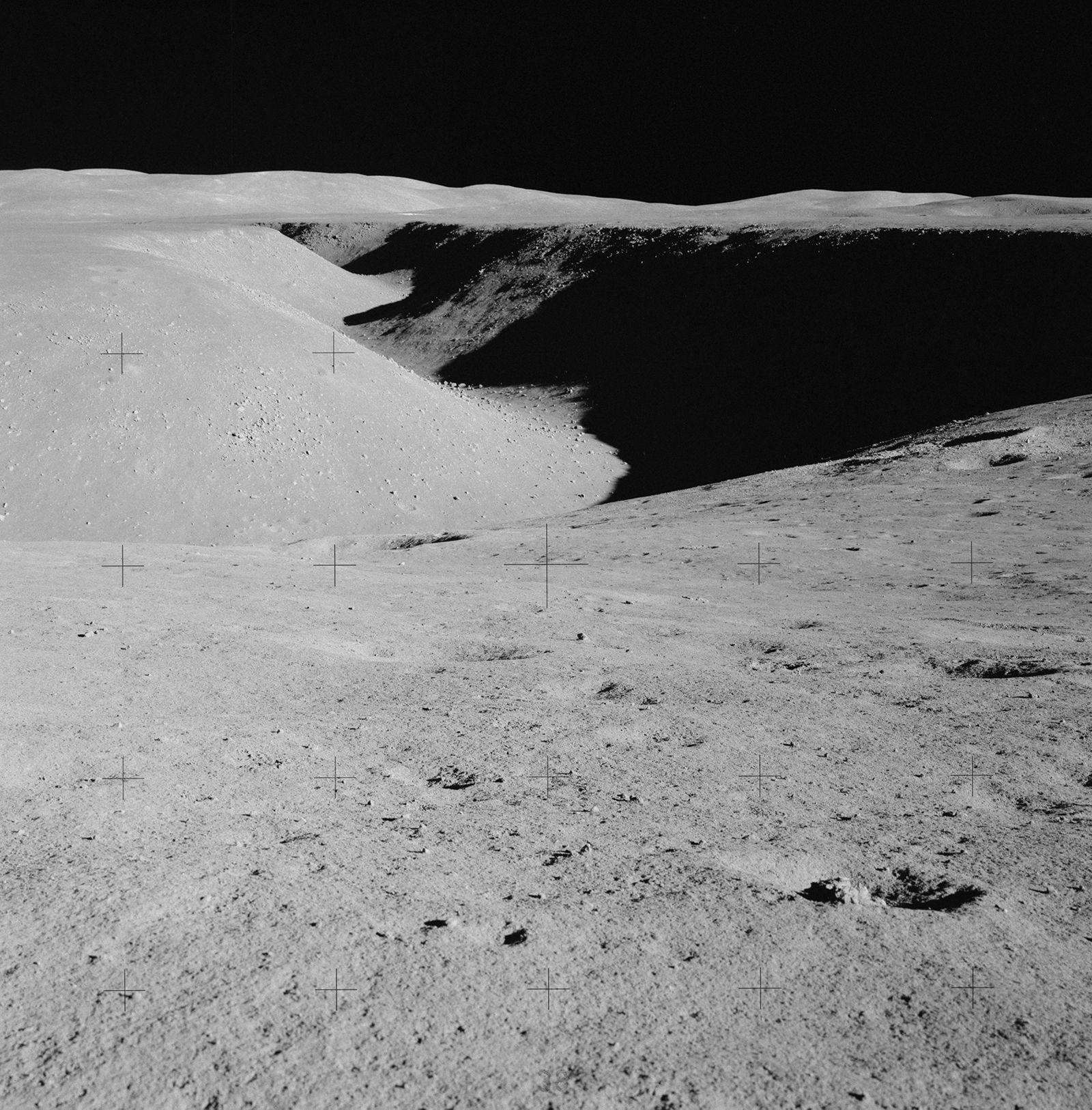
Proceeding along the edge of Hadley Rille, the explorers had an excellent view of the entire width of the canyon (about 1.5 kilometers or almost 1 mile) and down its length to the sharp bend by “Elbow” crater. Landmarks along the route were not always easy to identify, but their course was laid out by range and bearing and they were never as uncertain about their position as Shepard and Mitchell had been on Apollo 14. Less than half an hour after leaving the LM, and having traveled something over 3 kilometers (about 2 miles) they reached their first stop, dismounted, and turned on the television camera to give Houston a view of the area. Using a telephoto lens, Scott photographed the far side of Hadley Rille where layering was obvious in outcrops not far below the rim. Panoramic photography and sample collection completed their work at Site 1.18
Remounting their vehicle, Irwin and Scott drove around “Elbow” crater to Site 2, about 500 meters (1,600 feet) farther down at a point where ejecta from St. George crater encroached on the edge of the rille. Here they began to encounter large blocks lying on the surface. One that excited Irwin particularly was a meter or so (3 to 4 feet) across, its downslope edge buried in the loose soil and its upslope edge free of the surface. He photographed and sampled it; then once again they took panoramic photographs and soil samples and drove a double core tube into the edge of a crater.19
With no more stops scheduled, Scott now turned the rover on to the heading prescribed by his navigation system to return to the LM. On the way he cautiously tried some maneuvers with the rover. Attempting a turn on a downslope, he discovered that “you can't go fast downhill in this thing, because if you try and turn with the front wheels locked up like that, they dig in and the rear end breaks away, and around you go; and we just did a 180 [degree turn].” 20 Near Elbow crater Scott noted that there was a “neat place to go down into the rille,” but Capcom reminded him that “we'd rather that you don't take that option.” 21
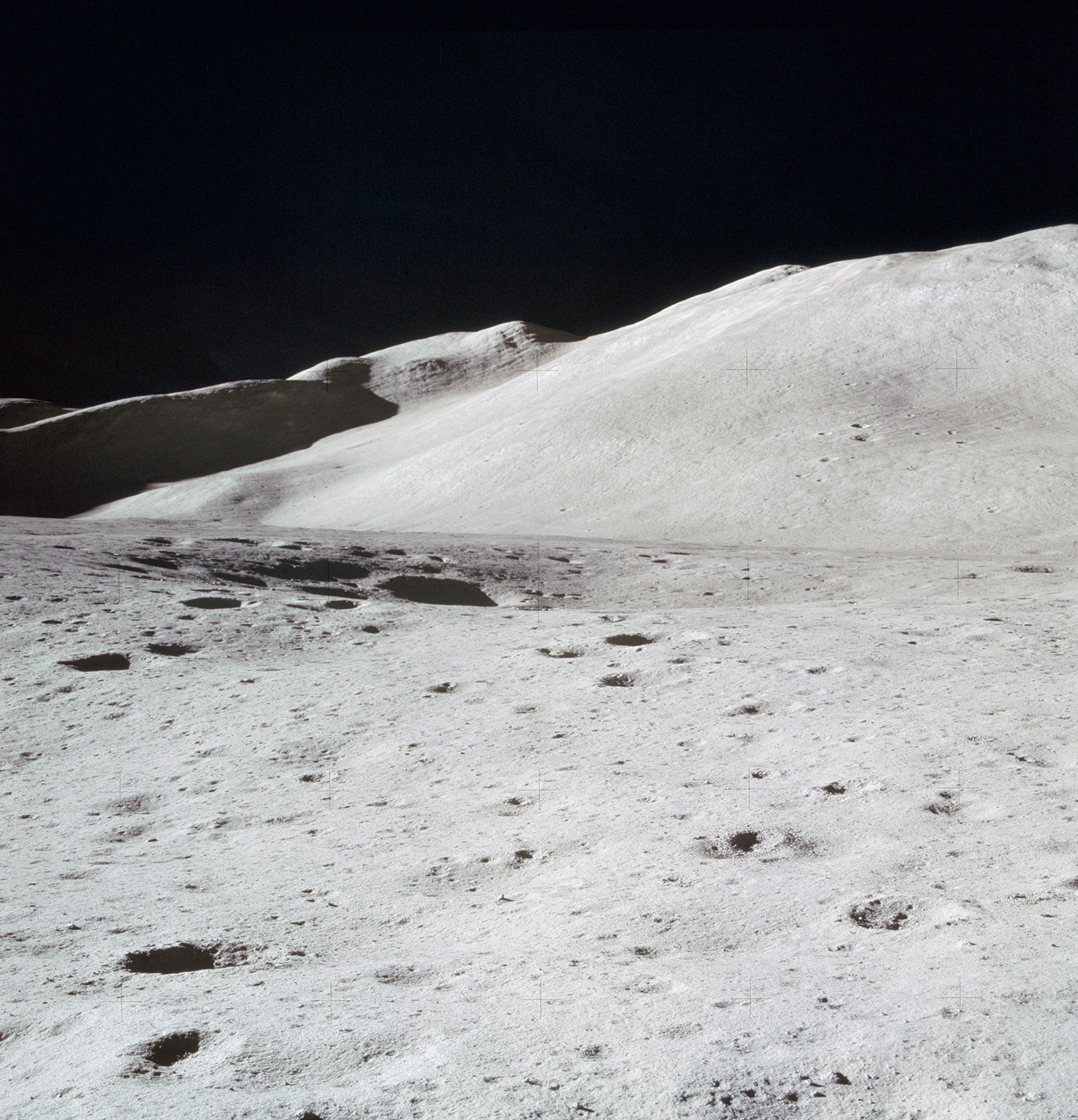
Riding back toward Falcon, Scott and Irwin frequently saw features they would have liked to stop and examine, but they had no time, so they briefly described them to Houston and continued.22 When they first caught sight of the LM they estimated its bearing from the rover at 15 degrees, but the navigation system showed 34, indicating some drift in the system. They reached the lunar module 2 hours and 15 minutes after they had left, parked the rover, and unloaded the surface experiments package. Scott had picked a spot about 110 meters (360 feet) west-northwest of the Falcon to deploy the instruments. Apollo 15’s experiments package included a new heat flow experiment, which required drilling two holes in which temperature sensors would be placed. The experiments were deployed without difficulty, but the second heat-flow drill hole caused problems when the drill stuck and proved difficult to remove. By this time the astronauts were approaching the limit of their life-support systems, so Mission Control directed Scott to leave the drill in the hole and get on to other tasks. After deploying the laser reflector and the solar-wind collector he and Irwin returned to Falcon and closed the hatch. They had been out for six and a half hours and covered 10.3 kilometers (5.6 miles) on the lunar surface - more than twice as far as the Apollo 14 astronauts had traversed (on foot) during their entire mission.23 A 40-minute debriefing with Houston completed their first day of lunar exploration.24
In the press briefing immediately following the first day’s surface activity, flight director Gerald Griffin expressed satisfaction with the astronauts' performance. Apart from the failure of the rover’s front-wheel steering, which had not significantly impaired the planned activity, everything had gone well. Scott had shown a somewhat higher metabolic rate than anticipated, resulting in faster consumption of oxygen than had been allowed for. This was not a serious concern, but it would have to be taken into account in planning the remaining excursions. About the only changes anticipated for the next day’s activity were to attempt to solve the rover’s steering problem and to try to extract the drill core for the heat-flow experiment.25 However, the science planning team still had to review the day’s results; plans for the second traverse could well be changed in light of what had been accomplished.
Next morning, after Scott and Irwin had finished breakfast and attended to some chores in the LM, Capcom Joe Alien briefed them on the upcoming day’s work. Science planners had decided to shorten the traverse somewhat to provide more exploration with less travel time. A low-priority sampling stop had been tentatively deleted and the route at the foot of Hadley Delta curtailed. The scientists were giving the astronauts considerable freedom on this traverse, as Allen’s instructions showed:
We're going to depend very much on the observations from the two of you, and it’s going to be … your choice on exactly where you'd like to range and where you'd like to carry out your major sampling tasks.... We're looking now, primarily, for a wide variety of rock samples from the [Apennine] Front. You've seen the breccias already. We think there may very well be some large crystal[line] igneous [rocks], and we'd like samples of those and whatever variety of rocks which you’re able to find for us - but primarily, a large number of documented samples and fragment samples…. I'll [stop] now and ask for any more questions.26
>Scott replied, “No, no questions, Joe. You're really talking our language today.” 27 During their extensive geological training, Scott had come to enjoy field geology and considered himself a serious amateur,28 and this was the kind of freedom he wanted. It was the kind of exploration the geologists had wanted as well, and although they would have preferred to have one of their own on the moon, apparently they were confident enough of Scott’s and Irwin’s training to give them a much freer hand than any previous team of lunar explorers.
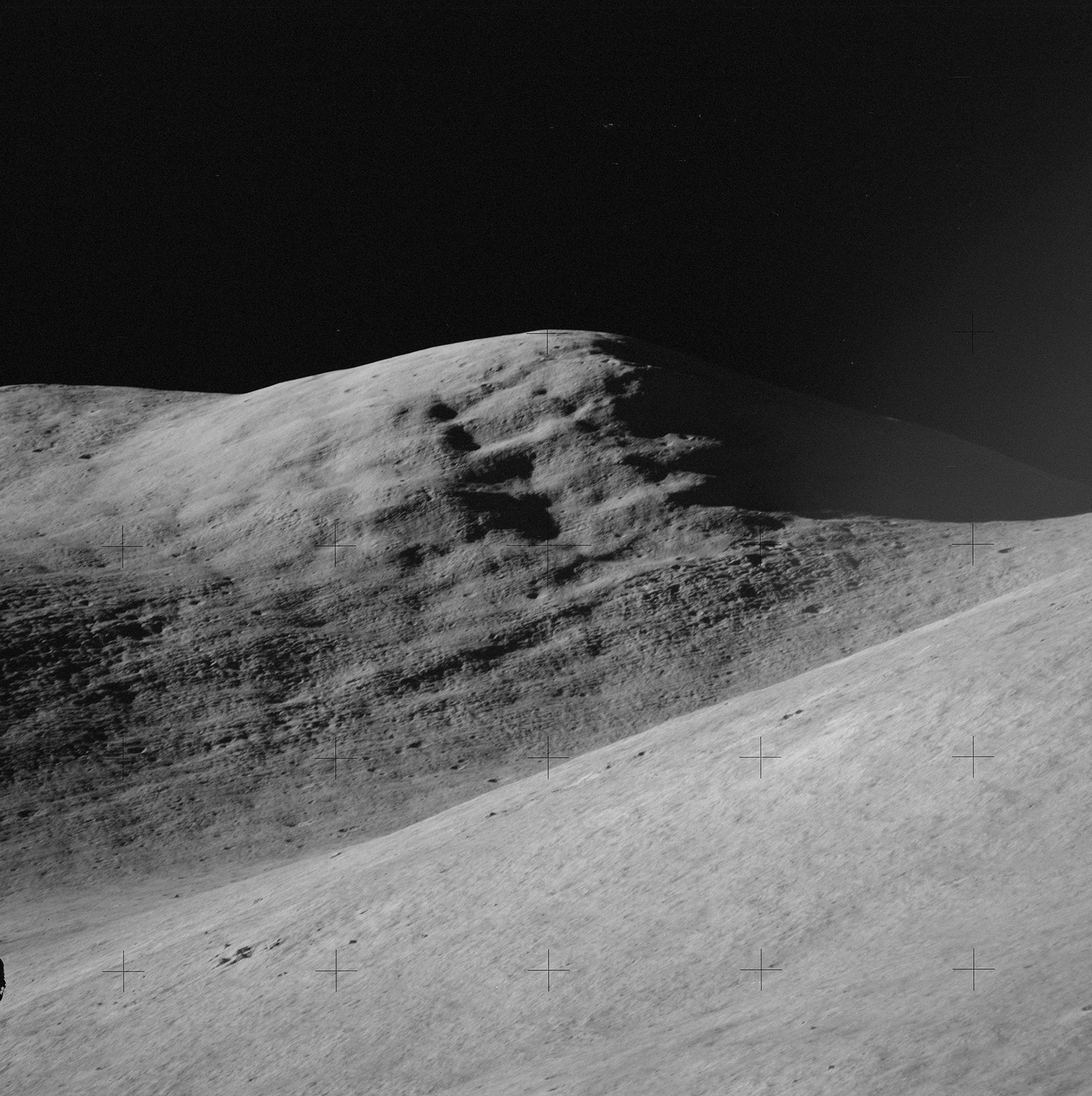
Suited up and out on the surface, Scott and Irwin got aboard the rover and belted in, pausing before they started to flip the circuit breaker for the front steering open and then closed again. When Scott moved the hand controller the front wheels moved. Nobody knew why, but he now had full four-wheel steering.29 Then they set out, on a southerly heading, for the sloping terrain at the foot of Hadley Delta. Rolling along at 8 to 9 kilometers per hour (5 to 6 miles per hour), they described the craters and rocks along the route. In about 40 minutes they were in the vicinity of “Spur” crater, one of their sampling stops, and they parked the rover to reconnoiter and collect specimens.30 With continuous commentary for Houston, the astronauts roamed the area for the next hour, taking pictures and bagging samples. Then, as they examined a boulder that had attracted their attention, Scott remarked, “Guess what we just found.” Then Irwin came over for a look:
Irwin: I think we just found what we came for.
Scott: Look at the plage [plagioclase] in there…. I think we might [have found] ourselves something close to anorthosite, because it’s crystalline, and … it’s just almost all plage. What a beaut!
Irwin: That really is a beauty. And … there’s another one down there.31
“What we came for” was a specimen of the primitive lunar crust - anorthosite, the rock that some scientists believed was the first material that solidified from the molten outer layer of the moon. The possibility of finding this material was one reason the Hadley-Apennines site had been chosen; scientists thought that if anorthosite was to be found on the moon, a highland site (and one adjacent to a large collisional mare) would be the best place to look for it. Scott put the sample into a bag by itself; back on earth it was dubbed the “Genesis rock.” 32
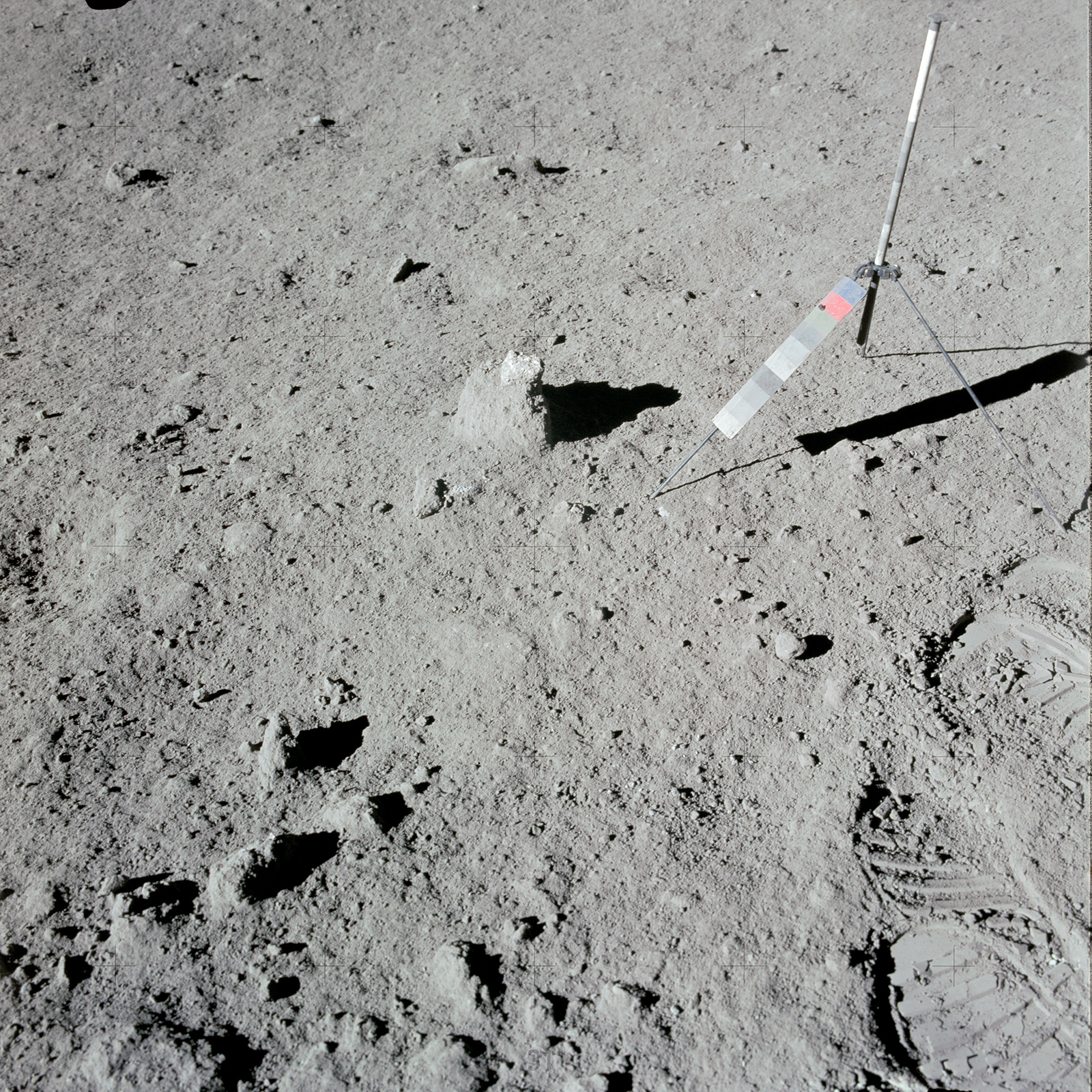
After a few more minutes of sampling and photographing the site, they climbed back on the rover and started back to the lunar module. Since there was time available, Houston directed them to stop at site 4 (the one that had been deleted before the traverse started) where they took more samples. Then it was back to Falcon to unload their cargo and return to the surface experiments site. Scott made another attempt to remove the core drill he had left in the ground the day before, but succeeded only when Irwin helped him pull it out. The second hole for the heat-flow experiment was drilled and the temperature sensors were emplaced in both holes. After performing a few more experiments in soil mechanics, Scott and Irwin drove back to the lunar module, where they had one more task to perform: planting the American flag at the landing site. That done, they transferred the samples to the LM, and closed the hatch, having completed the most productive lunar science traverse of the program so far.33
Flight director Gerald Griffin expressed that evaluation more strongly at the change-of-shift press briefing: in his opinion, “we probably have just witnessed the greatest day of scientific exploration … in the space program that we've ever seen.” 34 Allowing for his understandable enthusiasm, Griffin’s statement had solid foundation in fact. Lunar missions had made advances in two years' time that few would have expected. The equipment had functioned virtually without flaw, with margins of expendables to spare. Scientists and network audiences on earth had received live color television pictures far surpassing the crude black-and-white images transmitted by Apollo 11. The astronauts had wasted no time, they had provided excellent descriptions of what they could see, they had exercised their judgment in collaboration with the ground-based scientists, and had documented and collected more than 100 pounds (45 kilograms) of rocks, soil, and core samples. Observers in Mission Control thought they could tell that Scott and Irwin adapted to lunar gravity on the first traverse and as a result were more sure-footed and confident on the second.35 One more traverse remained, a trip to the edge of Hadley Rille, but 15 would have been rated a success without it. Capcom Joe Alien passed the word from scientists to the crew just after they returned to the LM:
I'm told that we checked off the 100 percent science completion square some time during EVA-1 or maybe even shortly into EVA-2. From here on out, it’s gravy all the way, and we're just going to play it cool, take it easy, and see some interesting geology. It should be a most enjoyable day.
“Okay, Joe,” Scott replied, “Thank you. We're looking forward to it.” 36
Their work was not the mission’s only contribution to lunar science. While they had been dashing around the surface, Al Worden in Endeavour had been circling the moon operating the cameras and instruments. In Endeavour’s highly inclined orbit he was able to see features that no previous observers had laid eyes on, and he provided detailed descriptions each time he crossed the earth-facing side of the moon.37
Early the next morning Irwin and Scott left the lunar module on a west-northwesterly heading to get a good look at Hadley Rille. After describing, photographing, and televising the features of the broad canyon, including evident layering in the walls, they completed their third traverse in just under 5 hours.38
Back at their base, they collected the solar-wind experiment, after which Irwin produced a postal cover carrying a new stamp commemorating “a decade of achievement” in space, and applied a first-day cancellation provided by the Postal Service.39 A few minutes later Scott stood before the rover’s TV camera to conduct a scientific demonstration:
…In my left hand, I have a feather. In my right hand, a hammer…. One of the reasons we got here today was because of a gentleman named Galileo a long time ago who made a rather significant discovery about falling objects in gravity fields…. The feather happens to be, appropriately, a falcon feather, for our Falcon, and I'll drop the two of them here and hopefully they'll hit the ground at the same time. [They did.] … This proves that Mr. Galileo was correct in his findings.40
Scott then drove the rover about 300 feet (90 meters) away, where he parked it with the television camera pointed at Falcon, aligned the antenna with earth, and walked back to help Irwin load sample bags into the lunar module.
For the next three hours the crew of the Falcon were occupied with stowing equipment and sample containers and configuring the LM for takeoff. Then, while the television camera watched, Falcon’s ascent stage shot up from the surface in a shower of fragments of insulation, visible for only a second or two. Flight controllers had intended to follow Falcon with the camera, but decided against it when problems developed in the camera’s control system.41 The result contrasted sharply with the majestic rise of a Saturn V; with a “quick pop” and “a shower of sparks [that] looked more like something left over from the Fourth of July,” as one columnist put it, Falcon quickly disappeared from the TV screen.42
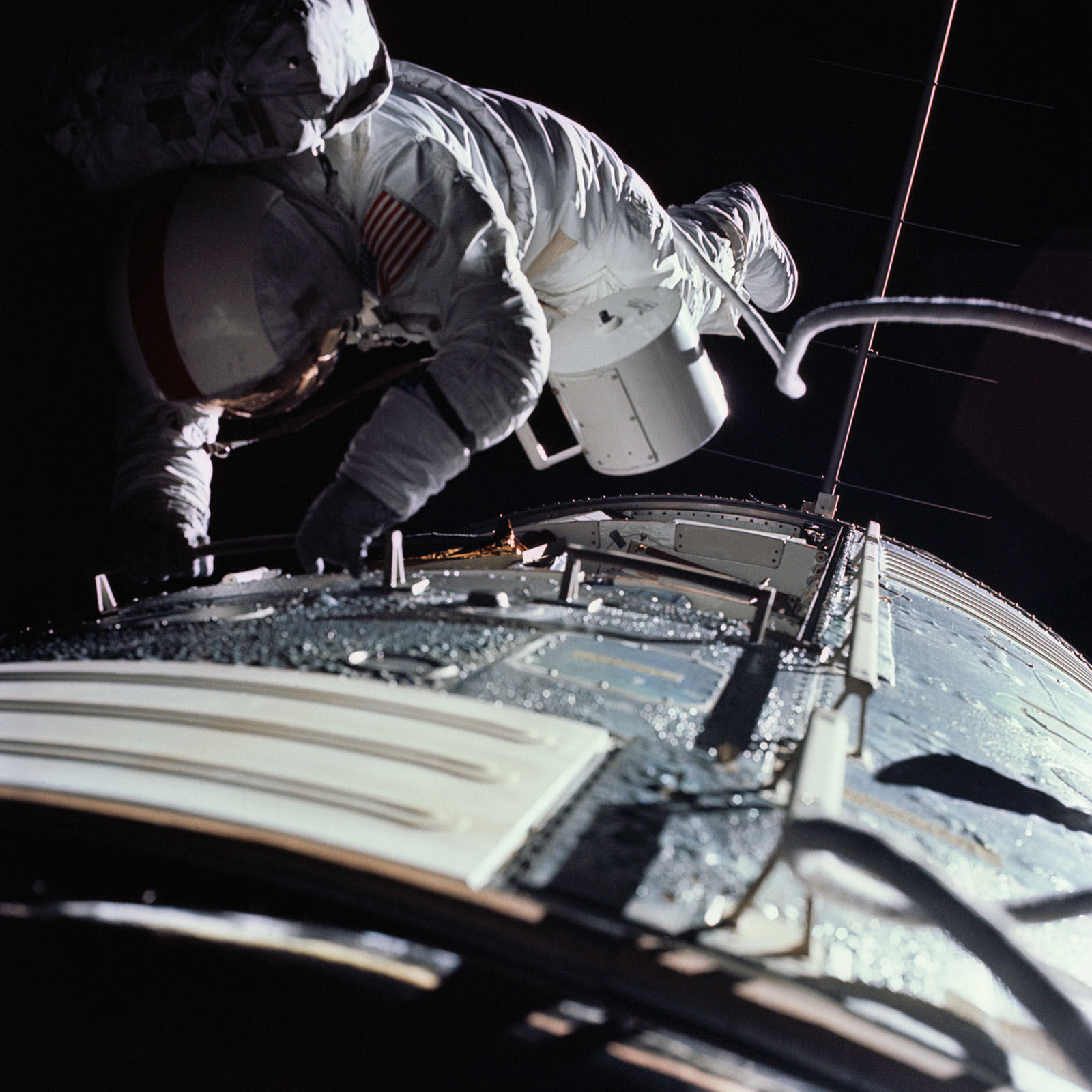
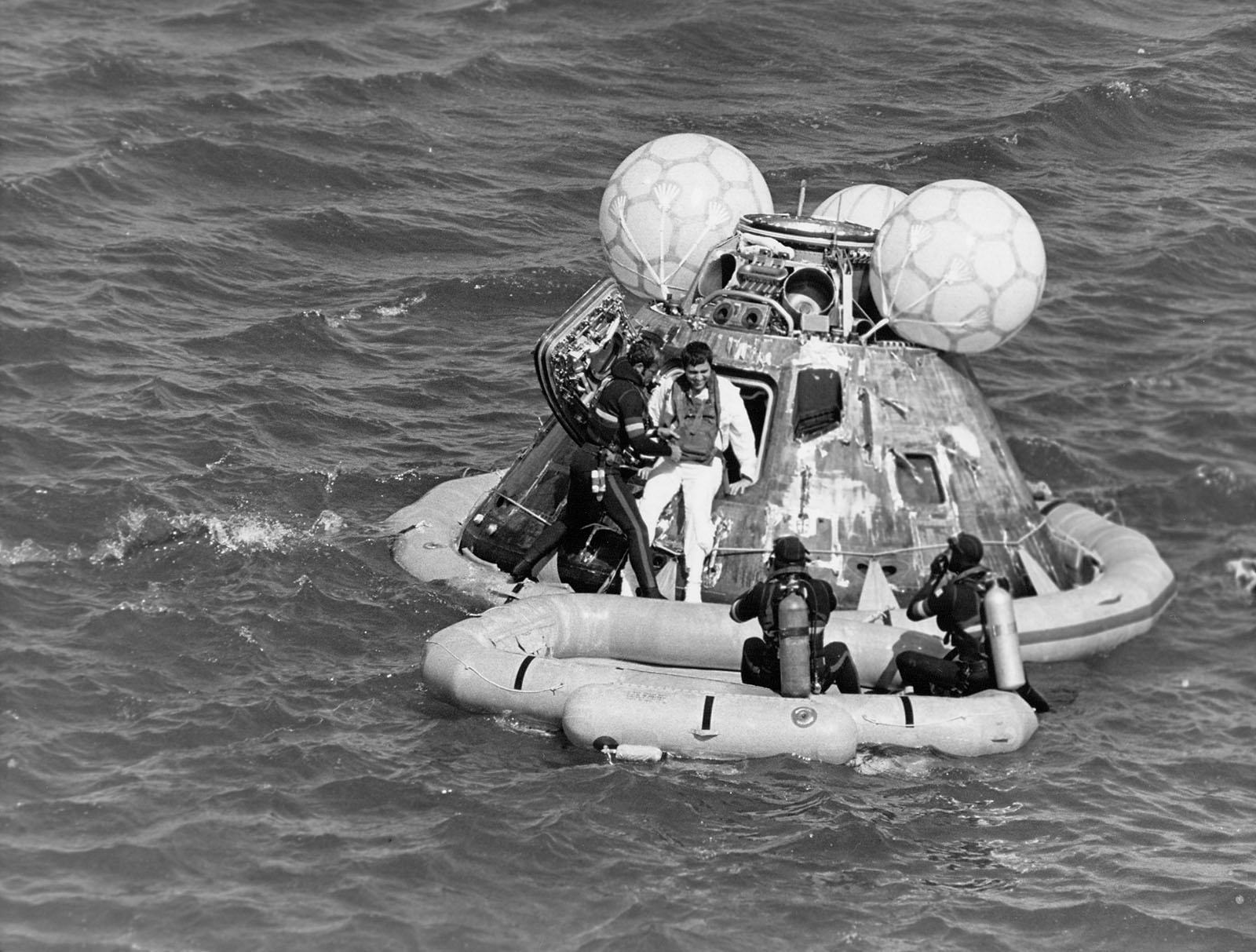
Falcon and Endeavour linked up an hour and 34 minutes later, and after jettisoning the lunar module the three astronauts settled in for two days of additional lunar-orbital data-gathering.43 On their last orbit they released the scientific subsatellite, then headed for home. While the spacecraft was still nearly 200,000 miles (320,000 kilometers) from earth, Al Worden carried out the last extravehicular excursion of the mission, a 38-minute “space walk” to remove film cassettes from the cameras in the scientific instrument module.44 The long voyage home ended on August 7, when Endeavour dropped into the Pacific Ocean about 320 miles (515 kilometers) north of Hawaii. The landing was a little harder than normal because one of the three parachutes failed to open fully, but no damage or injury resulted.45
Apollo 15’s Science Dividend
It was clear even before Scott and his crew returned that Apollo 15 had surpassed all prior missions in both the quantity and variety of information it returned. More than 350 individual soil and rock samples aggregating 77 kilograms (170 pounds), ranging in size from 1 or 2 grams (0.03 to 0.06 ounce) to more than 9.5 kilograms (21 pounds) and taken from two distinct selenological regions (the mare plain and the foot of Hadley Delta), were the richest geological haul of the program.46 The seismometer and the heat flow probes emplaced with the surface experiments package were important in obtaining data on the moon’s interior, while the instruments Al Worden had operated in lunar orbit gathered information on the chemical composition of large areas on the front and back sides of the moon.
If the scientists had been unhappy with MSC’s cooperation in the early missions, they were overjoyed with the way Apollo 15 was conducted, and several graciously congratulated MSC on it. Gerald Wasserburg of Caltech wrote to Robert R. Gilruth to offer his congratulations “on one of the most brilliant missions in space science ever flown.” He particularly praised the fairness and wisdom of the decisions made during the astronauts' explorations, even though he had not always got what he wanted.47 Larry A. Haskin, vice chairman of the lunar sample analysis planning team, told Gilruth that
Scott and Irwin had not been on the surface very long before … we felt comfortable and confident that the scientific aspects of the mission were in competent hands…. We always felt that the decisions made in real time … were fair with respect to priorities given to various activities and that the mission was wen balanced.
Haskin stressed that the inclusion of scientists in planning before the mission and decision-making during the mission (through the science working group) was a breakthrough in MSC’s relations with the scientific community.48
Preliminary examination of the samples began as soon as the containers were returned. Documentation of these samples was unusually complete, except for some taken on the last traverse when time ran short. Taking advantage of the fact that the astronauts were not quarantined after this mission, the preliminary examination team asked Scott and Irwin to be present while the containers were opened, to provide whatever information they could remember about some of the less well-documented specimens while the circumstances were still fresh in their minds.49
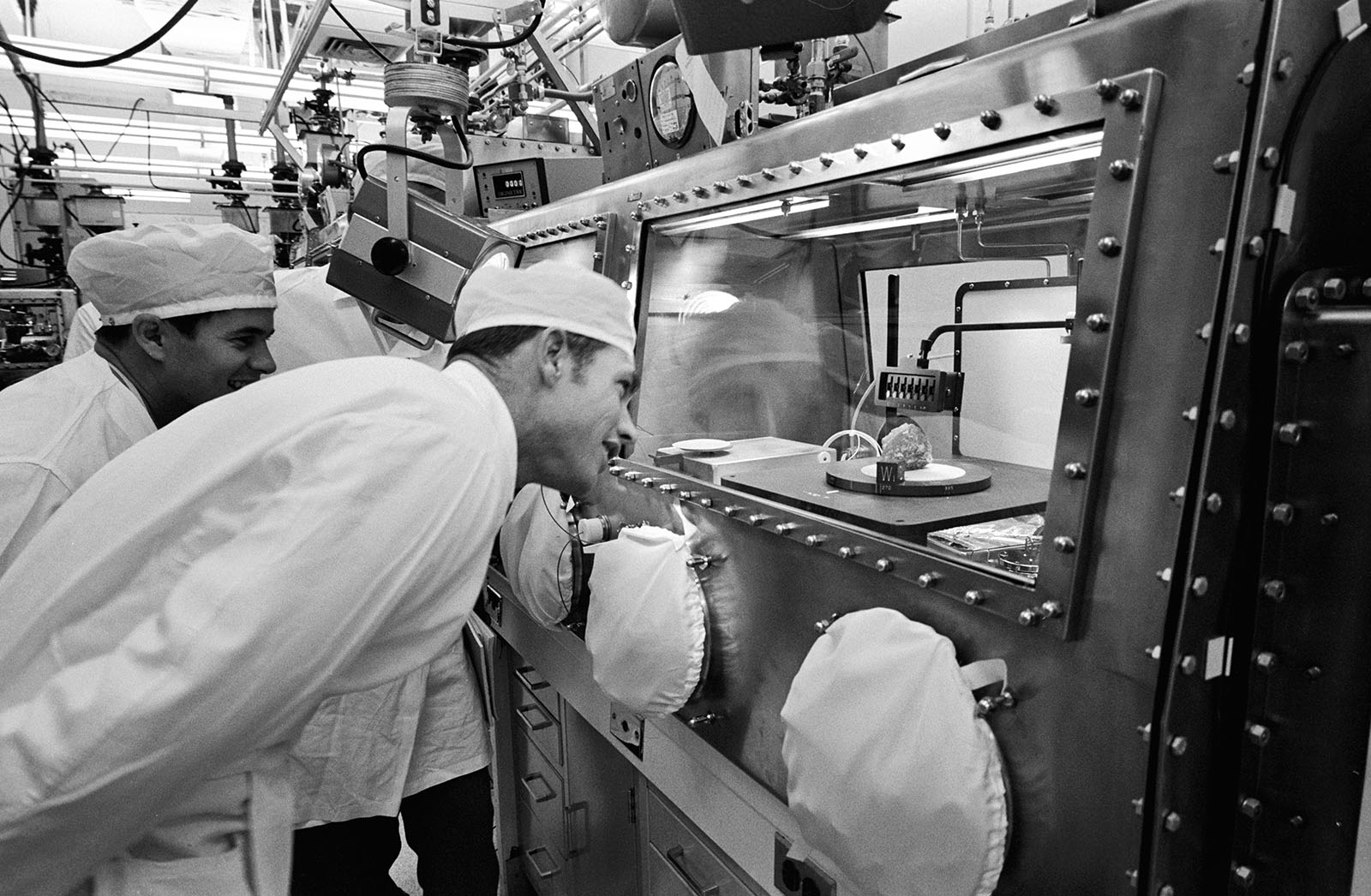
The preliminary examination team concluded that three distinct types of structures had been sampled at Hadley: the Apennine Front, which had been produced by collision of an asteroid-sized object with the moon; a series of horizontal lava flows that filled part of the impact basin; and a ray of ejecta from a large young crater produced after the basin was filled. Samples from the mountain front were very diverse, including both breccias and igneous rocks. Those from the mare plain, where Falcon landed, were of two basic types: basaltic rocks and glass-coated breccias. The “Genesis Rock,” so designated by the press, did turn out to be an extremely pure anorthosite substantially altered by shock, which suggested that it was involved in a severe impact after it crystallized. Its age was determined to be 4.15 billion years, with a possible error of 0.2 billion either way, making it the oldest whole rock so far returned from the moon.50
The core tubes, one containing a 2.4-meter (almost 8-foot) section of the soil, were not opened during the preliminary examination, but x-ray examination indicated 58 individual layers, from 0.5 to 21 centimeters (0.2 to 8.25 inches) thick, showing that the soil contained a substantial stratigraphic record.51
Instruments in the service module provided information about the large-scale chemical variations across the lunar surface. The x-ray fluorescence experiment measured the x-rays emitted by light elements (magnesium, aluminum, and silicon particularly) when struck by x-rays from the sun. From these data scientists could determine the ratio of aluminum to silicon over large areas under the orbit of the command and service module. Initial examination of the results found distinct chemical differences between the maria and the highlands. The highlands showed an aluminum/silicon ratio characteristic of anorthosite, which, according to some theories, was formed in the first major event of the moon’s geologic evolution. The maria, on the other hand, were chemically different; sample analysis showed them to be basalts formed by lava flows, and the x-ray fluorescence results were consistent with this interpretation.52
The preliminary examination team completed the first stage of its work with descriptions of more than 50 rocks larger than 50 grams (1.7 ounces) correlated with the astronauts' descriptions and photographs at the end of August. MSC recommended release of samples to 20 research teams as soon as possible, since their results would be useful in planning future lunar surface activity.'53 The rest of the samples were less time-critical and were released to principal investigators two months later.54
A Geologist for Apollo 17
As was his custom, Slayton waited until Apollo 15 had returned from its flight to announce his choice of crewmen for the last lunar mission. On August 13, 1971, he named Eugene Cernan, Ronald Evans, and Jack Schmitt as the prime crew for Apollo 17, backed up by Dave Scott, Al Worden, and Jim Irwin, just returned from Apollo 15.55 The decision to put Schmitt on the crew instead of Joe Engle - who had trained as lunar module pilot with Cernan and Evans on the backup crew for Apollo 14 - was, like all those before it, Slayton’s, and no one in the NASA organization put pressure on him to make it.** He noted later, however, that “we might have gotten some [pressure], I suppose, if we hadn't made the right decision down here. [But] there wasn't any doubt … that we were going to have to do that when they canceled [Apollo 15 and 19] , and we did it.” 56
** But see Chapter 12. Earlier in the year, Dale Myers, chief of manned space flight, and Robert Gilruth, MSC director, had agreed to Schmitt’s appointment to the Apollo 17 crew, subject to his satisfactory completion of training, and Slayton was undoubtedly a party to that decision. The decision was evidently a well kept secret, however, for as late as August 3, Schmitt was quoted as admitting that it seemed unlikely he would get the chance to explore the moon. Stuart Auerbach, “Apollo 15 Leaves Moon Orbit At End of Historic Mission,” Washington Post, Aug. 5, 1971.
Engle, who had been out of town during Apollo 15 on personal business, learned that his plans had been changed on August 10, when he called in to the Astronaut Office to see if he had any messages. It was a tremendous disappointment; he had made the hard decision to leave the X-15 program in 1966 because he thought that going to the moon was the only way he could surpass his past accomplishments. But, he said, “when something like this happens, you can do one of two things. You can lay on the bed and cry about it … , or you can get behind the mission and make it the best in the world.” Engle’s choice was to support the mission. He would try to help Schmitt fit into the crew that he himself had trained with for so long. After that, he hoped to test-fly the space shuttle.57
At the customary news conference the week after the announcement, the first question challenged Schmitt’s assignment to the crew instead of Engle. Schmitt said, “There’s no question that Joe Engle is one of the most outstandingly qualified test pilots in the business,” but he was confident of his own abilities: “as far as my qualifications to fly the spacecraft are concerned, I will attempt to compete with anybody in the program.” Cernan agreed: “Jack isn't sitting here as part of this crew for any other reason than that he has rowed hard, he’s earned it, and he deserved it.” He noted that Engle and Dick Gordon (command module pilot on Apollo 12) had been assigned to the new space shuttle project and commented (perhaps with a trace of envy), “Those guys moving into shuttle right now are probably going to contribute … a lot more than maybe even we can contribute by a lunar mission.” 58
On its final flight to explore the moon, then, Apollo would send a scientist - the one astronaut indisputably qualified to make the observations scientists had long wanted to make. It remained to be seen whether, under the constraints that limited lunar exploration, he could apply his experience to enhance the quality of the results.
To the Lunar Highlands: Descartes
Two landing sites had been seriously considered for Apollo 16, the crater Alphonsus, 300 miles (480 kilometers) south of the moon’s center, and the region some 340 miles (550 kilometers) east-southeast of the moon’s center, north of the ancient crater Descartes. In both places geologists thought they would find highland material differing in composition from the Fra Mauro samples and the basalts filling the maria. The wall of Alphonsus was, some argued, pre-Imbrian highlands material, while dark craters on its floor were thought to consist of relatively young volcanic material that might have originated at great depths. North of Descartes, two formations (Cayley and Descartes) were of major interest. Evidence indicated that both were volcanic but of different types and ages. The area is the highest topographic region in the highlands on the visible face of the moon, indicating that the Descartes volcanics represent remobilized highlands. Analysis of these materials was expected to clarify the basic processes that formed the highlands.59
Preliminary discussions among interested scientists considered both sites but did not entirely agree on either.60 Alphonsus remained a strong candidate, but in view of the fact that it would be preferable to have more results from Apollo 14 and 15 before landing there, Descartes was preferred for Apollo 16. With one more mission left, Alphonsus could still be visited. The Apollo Site Selection Board approved Descartes as the landing site for Apollo 16 at its meeting on June 3, 1971.61
Science plans for the Descartes mission were much the same as they had been for Hadley Rille: to inspect, survey, and sample materials and surface features in the landing area; emplace and activate the lunar surface experiments; and conduct photography and remote sensing of the moon from lunar orbit. The surface package included two new instruments: a magnetometer and, in place of Apollo 15’s suprathermal ion detector, an active seismometer that would be excited by several explosive charges after the astronauts left. Another new experiment was an automatic far-ultraviolet camera and spectrograph to photograph several galaxies from the moon’s surface. Its objective was to study the distribution of interplanetary and intergalactic hydrogen.62
Apollo 16 blasted off from Kennedy Space Center at 12:54 p.m. Eastern Standard Time on April 16, 1972. Command module Casper and lunar module Orion arrived in lunar orbit three days later. All systems functioned well until Orion separated from the command module; a malfunctioning component in the main propulsion system caused Houston to delay the lunar module’s descent for nearly six hours while it was checked out. When Mission Control was satisfied, Orion fired its descent engine and landed easily on the plain at Descartes at 9:33 p.m. EST on April 20.63
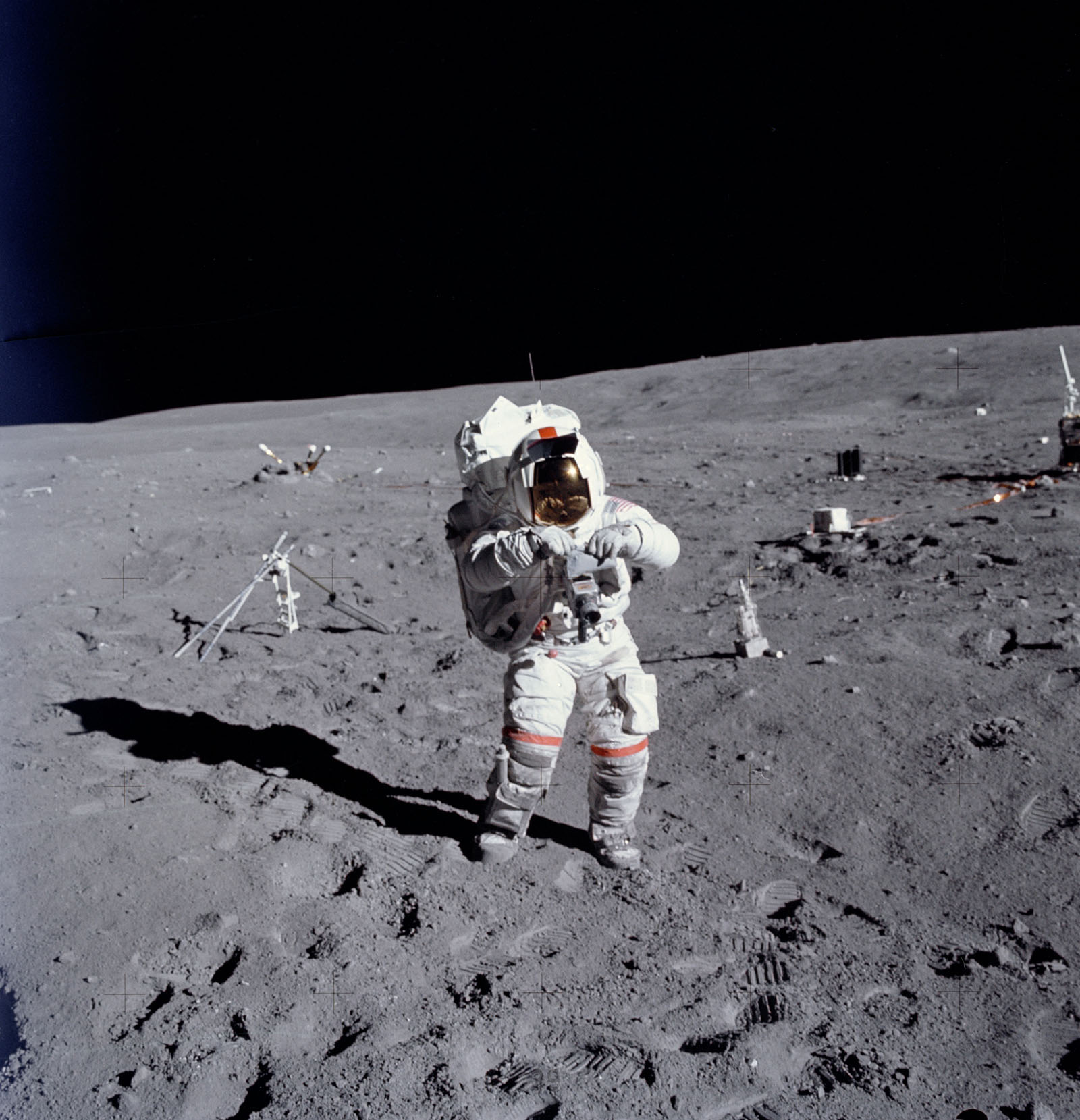
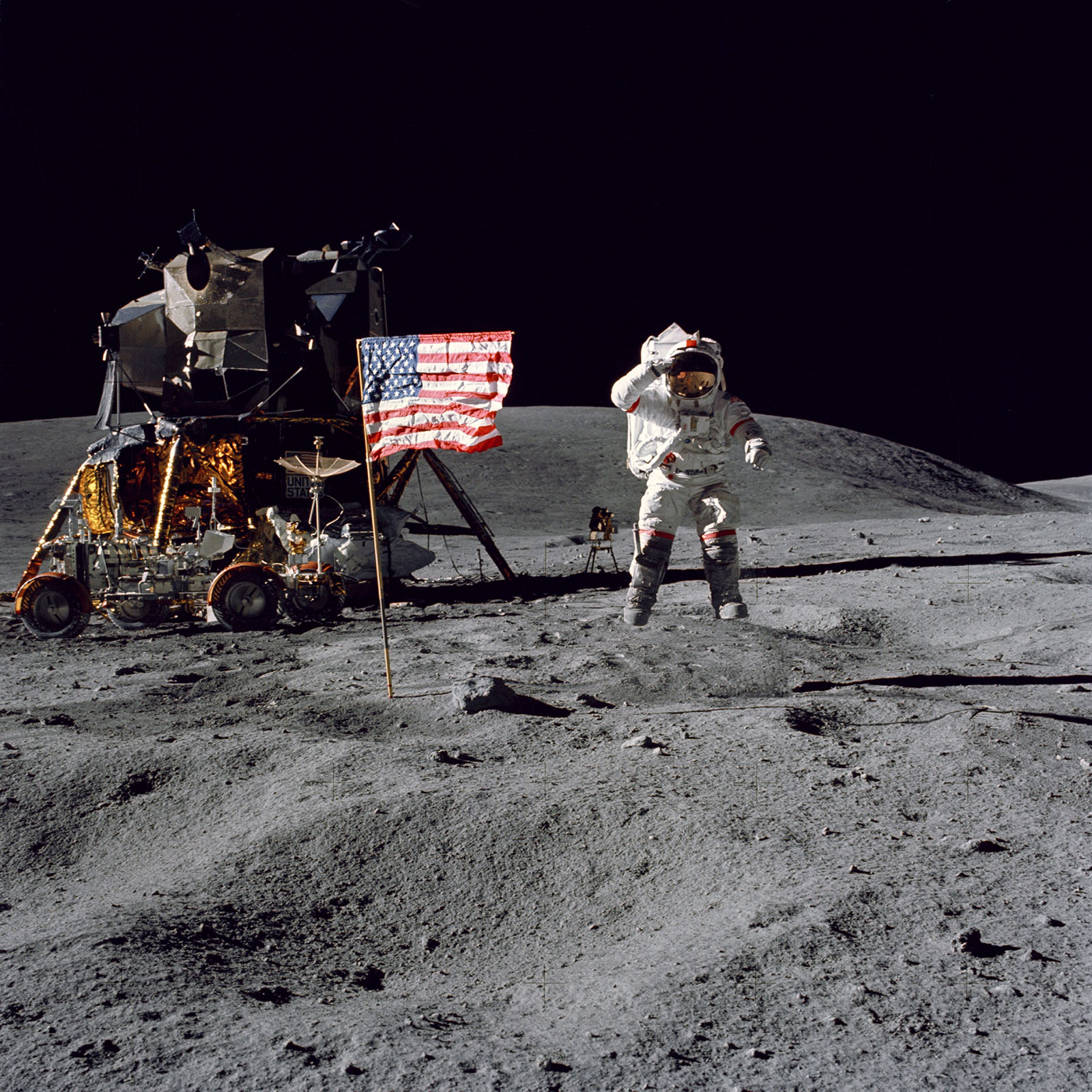
In the next 71 hours mission commander John Young and lunar module pilot Charles Duke laid out the surface instruments and conducted three traverses in their lunar rover, covering in all some 27 kilometers (nearly 17 miles). While they were busy on the surface, Ken Mattingly in Casper was occupied with operating the instruments in the service module. The only serious mishap on the surface occurred when Young tripped over the cable to the heat-flow sensors, pulling it loose from the central station and incapacitating the experiment.64
Young and Duke finished their exploration, loaded the 96 kilograms (210 pounds) of samples they had collected into Orion, and rejoined Mattingly in lunar orbit on April 23. They released the moon-orbiting subsatellite, but because of recurring problems with the service propulsion system, the spacecraft was not in the optimum orbit for the satellite. As a result, the satellite crashed into the moon after only five weeks.65 During the four-day return flight they conducted additional experiments with electrophoresis, a technique that offered advantages for separating certain biological preparations that could not be efficiently done in a gravity field. A normal landing in the Pacific, north of Christmas Island, completed the mission On April 27.66
Even before the Apollo 16 rock samples had been returned to Houston it was apparent that premission interpretations of the Descartes site had not been accurate. The service module instruments showed abnormally low radioactivity and high aluminum-silicon ratios in the area - both characteristic of typical lunar highlands. Furthermore, the laser altimeter found that the extensive plateau on which the site lay was almost four miles higher than the surrounding terrain, an elevation that seemed impossible to achieve by buildup of volcanic material.67 Preliminary examination of the samples confirmed what scientists had suspected as soon as Young and Duke began to explore: the site was not volcanic. Most of them appeared to be impact breccias rather than basalts.68 This result, confirmed by later analyses, “forced a reevaluation of the process of photogeology and site selection,” because the majority opinion before the mission had affirmed that the site was volcanic in origin.69
The more samples returned from the moon the less clear the picture of its origin and evolution became to scientists. At the third lunar science conference, which included presentations of information from Apollo 15 and the Soviets’ Luna 16, a more comprehensive picture of the moon was evident, but fewer investigators would claim to understand its evolution. The best summary at the time seemed to be that the moon is now relatively cold and inactive but that it has gone through a complex sequence of melting and resolidifying by internal or external heating.70 Toward the end of 1972 one baffled scientist, Gerald Wasserburg, summarized the frustrations of the lunar scientists: “we've got answers but not the questions,” he said. “I’m not sure we're asking the questions in exactly the right way.” 71
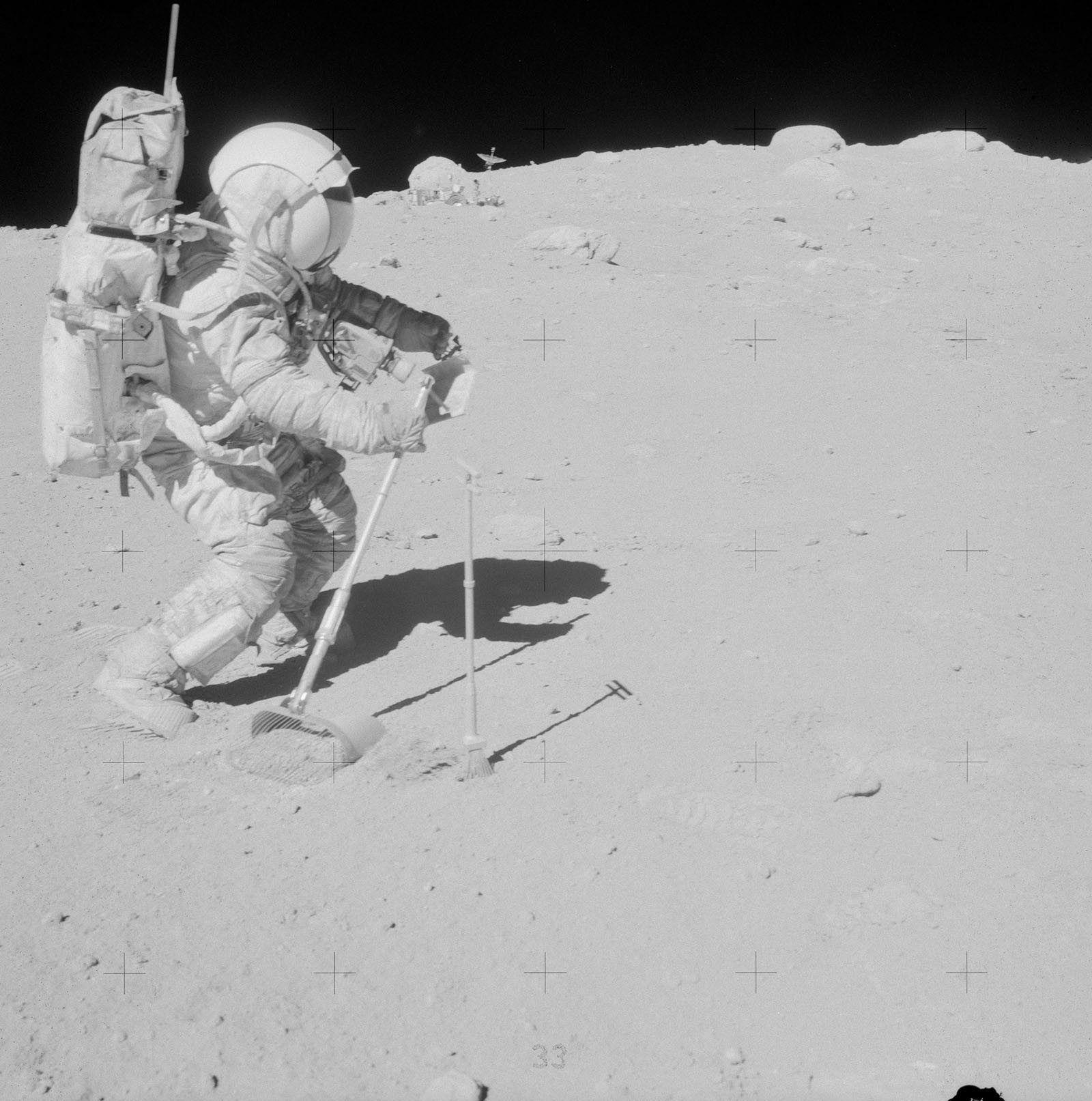
Apollo 17: The Close of an Era
Following completion of Apollo 15, with 16 in the planning stages and only one mission remaining after that, one scientist expected that the process of choosing a site for the last flight would be “a dilly of an affair.” 72 Perhaps with that thought in mind, Rocco Petrone, Apollo program director at NASA Headquarters, started the procedure early, in October of 1971. After a site evaluation document had been circulated among selected interested scientists for their critique and response, an ad hoc site evaluation committee would meet no later than December 30 to consider site proposals and make recommendations to the Apollo Site Selection Board in early 1972.73
Actually, site selection for Apollo 17 was not as difficult as might have been expected, considering that it was the last chance for many years to obtain material and data from the moon. Preliminary review of possible sites produced a clear consensus of objectives for Apollo 17: to investigate the pre-Imbrian highlands as far as possible from the Imbrium basin; to sample “young” volcanics; to obtain photographic and remote-sensor coverage of areas not previously investigated; and to provide the best coverage for the new traverse geophysics experiments that were to go along. Application of all these considerations reduced the interesting sites to three: Taurus-Littrow, a region on the southeastern rim of Mare Serenitatis; Gassendi, a large crater on the northern rim of Mare Humorum; and (ranking a distant third) Alphonsus, previously considered as an alternative to the Descartes site. Of these three, the ad hoc site evaluation committee concluded that Taurus-Littrow was the best. It was a two-objective site (highlands and young volcanic material); it offered a reasonable contingency for a walking mission in case the lunar rover should fail; and it would provide the greatest amount of new information from the orbital sensors in the service module.74
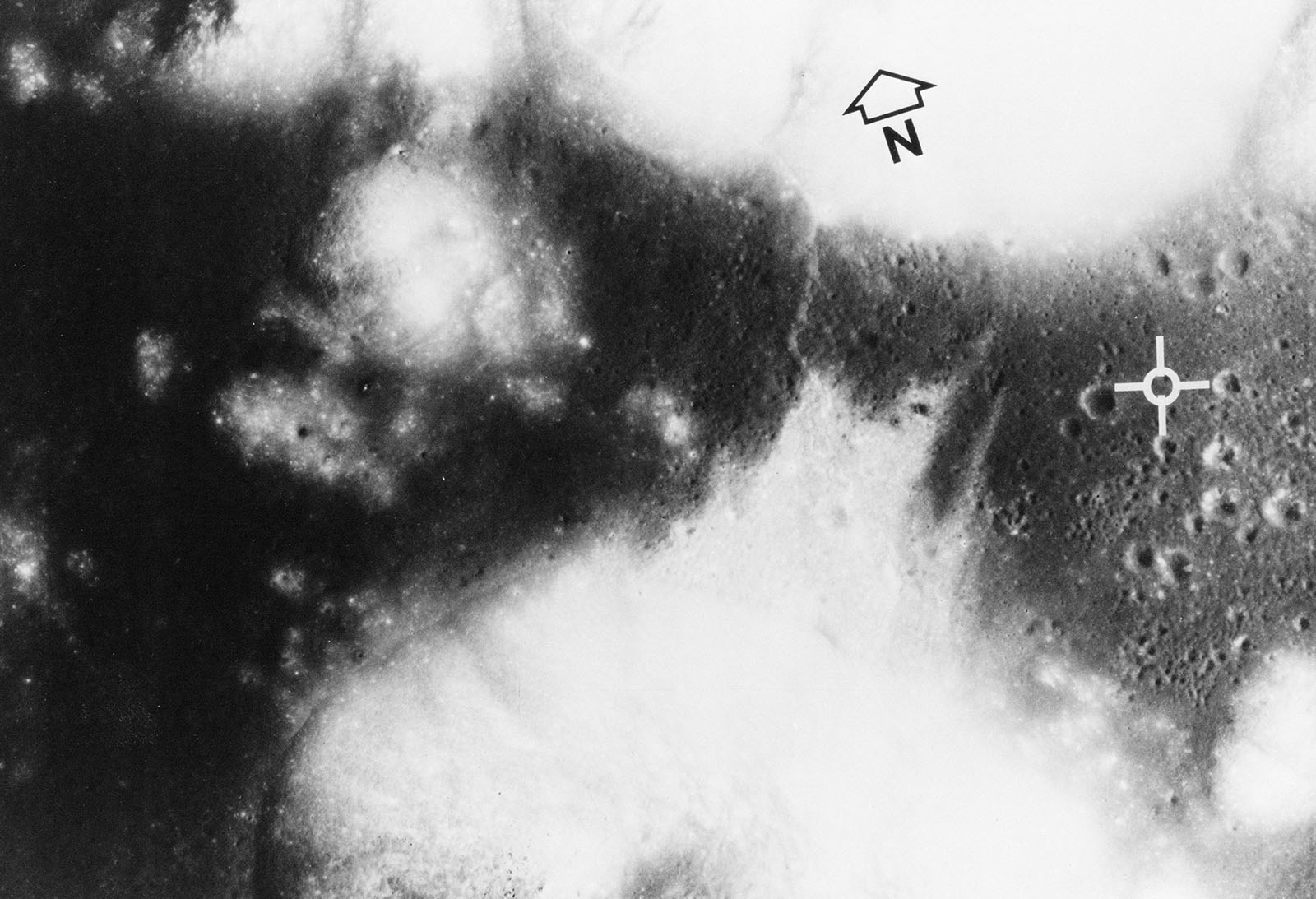
Operational considerations, taken up at the February meeting of the site selection board, gave no site a clear advantage. Problems existed at all three, although Alphonsus, already well studied, was acceptable. At Gassendi there was a good chance that the astronauts would not be able to get to their prime objective if they had to land beyond the nominal 3-sigma ellipse. For Taurus-Littrow, detailed studies at first indicated that under “worst-case” conditions the site was unsuitable; the 3-sigma ellipse could not be fitted into it. When trajectory designers were urged to reconsider their calculations in light of the results of Apollo 15, however, they produced some less conservative numbers and the site was acceptable. With operational considerations out of the way, the board picked Taurus-Littrow because of its greater scientific potential.75
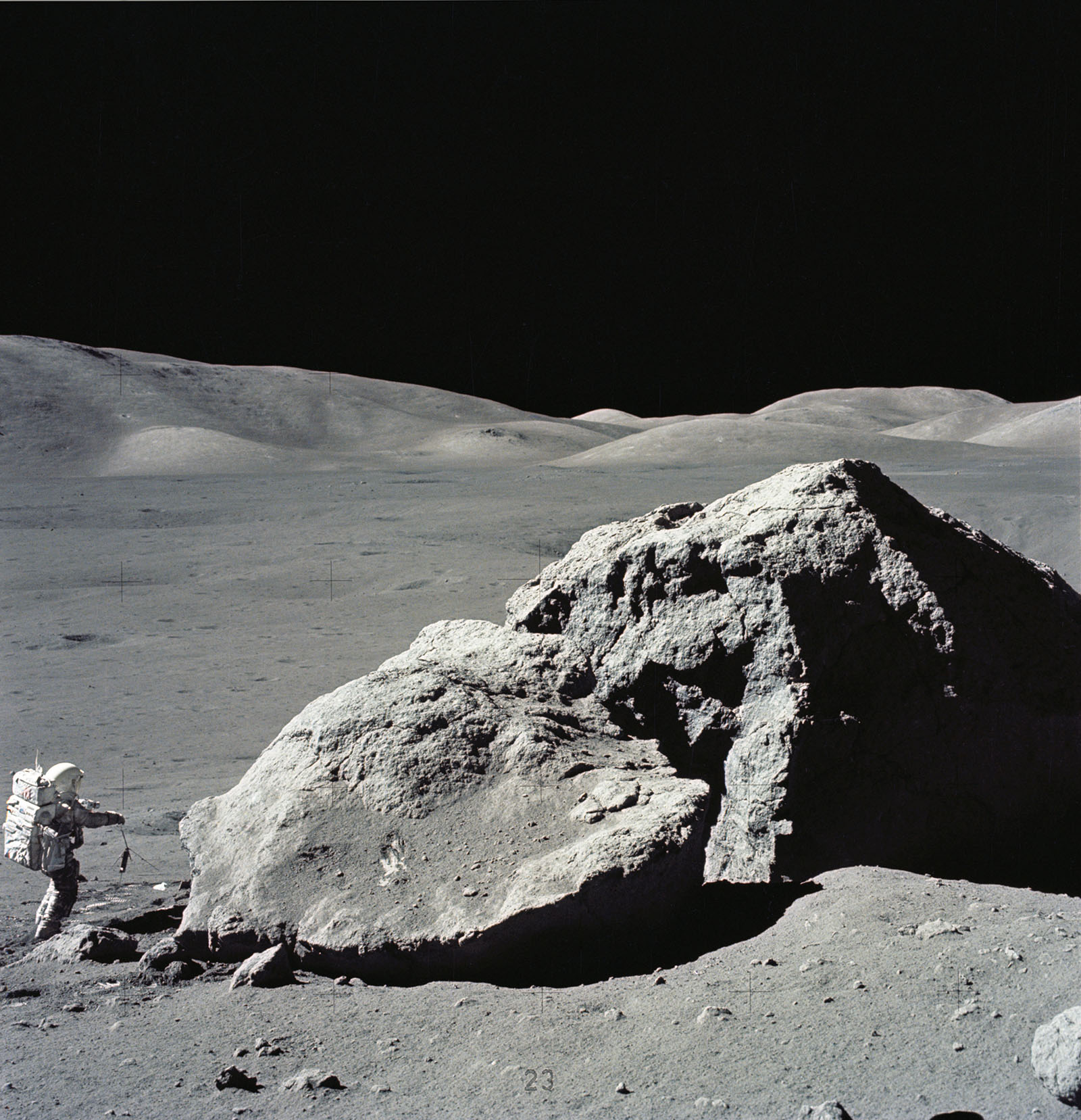
The Taurus-Littrow site was a flat-floored valley some 7 kilometers (4.3 miles) wide, a dark, bay-like indentation in the broken mountain chain on the eastern edge of Mare Serenitatis, at 20 degrees 10 minutes north latitude, 30 degrees 46 minutes east longitude. Bounded on three sides by high mountain massifs, the valley contained numerous craters of possible volcanic origin, as Al Worden had noted from orbit on Apollo 15.76
Premission data from the landing site indicated it to be geologically complex. Rock types appeared to vary in age, composition, and probable origin, and the mountains displayed structural features that might be correlated with several major landforming events. The valley floor on which Apollo 17 was to land appeared to be volcanic and thus might have originated deep within the moon. A landslide intruded on one side of the valley floor, and boulder tracks down the mountainsides added to scientists' interest in the site.77
Until early 1971 Apollo 17 had been scheduled for June 1972; in February the launch schedule was revised and both Apollo 16 and 17 were moved forward, to March and December 1972, respectively.78 The new launch date for Apollo 17 required one more launch constraint to be lifted, because Taurus-Littrow was not accessible by translunar injection (departure of the spacecraft and S-IVB from the earth parking orbit) over the Pacific Ocean. Early in the program Pacific injection was adopted as the rule, since the alternative - injection over the Atlantic - required a night launch at some times of the year. Although Atlantic injection offered an economy in fuel and thus an increase in allowable payload, the potential problems incident to a night launch (see Chapter 6) tipped the scales.79 By the time the site selection board met in February 1972, however, “the bullet had been bitten on night launches” 80; experience had made those problems much less worrisome.
So it was that Apollo 17 was scheduled to leave the Cape at 9:38 p.m. EST on December 6, 1972.81 From August 8, when the launch vehicle was moved to the pad, preparations went well. Some minor hardware problems cropped up but were handled without delaying the schedule. Launch day was bright and warm; the temperature was in the mid-80s at midafternoon. All looked well for the last Apollo mission until 30 seconds before launch, when the automatic sequencer - the oldest and most reliable piece of automation at the launch complex - shut the system down. The first launch delay in the Apollo program caused by failure of equipment amounted to 2 hours and 40 minutes while Cape and Marshall Space Flight Center engineers worked around the malfunction. At 12:33 a.m. Eastern Standard Time on December 7, command module Americaand lunar module Challenger were off for Taurus-Littrow.82 Flight controllers made up the lost time during the translunar coast.83
America and Challenger entered lunar orbit on schedule and all preparations for landing went smoothly. After the two spacecraft separated, Cernan and Schmitt took a spectacular photograph of their landing site. Three hours later Cernan powered up Challenger for its descent. It touched down within 200 meters (650 feet) of its targeted landing point amid a field of craters at 3: 15 p.m. EST on December 11.84
For the next 75 hours Cernan and Schmitt conducted the longest, and in many ways the most productive, lunar exploration of the Apollo program. During three trips from their base they laid out the surface experiments, drove the lunar rover about 36 kilometers (22 miles) in all, ranging as far as 7.37 kilometers (4.5 miles) from Challenger, and collected roughly 243 pounds (110 kilograms), of soil and rock samples along with more than 2,000 documentation photographs.85
Like their predecessors, Cernan and Schmitt were somewhat constrained by the preplanned sequence of activity. Still, before they left the lunar module and while unloading the Rover and the surface experiments, Schmitt found time to give Houston’s back-room scientists both large- and small-scale descriptions of the landing area and the surface under his feet.86 Schmitt found the environment in the landing area “superb” for observation: the lighting was excellent and the rock surfaces generally clean, and he found little difficulty in distinguishing mineralogical and textural differences. For the most part he based his decisions on taking samples on visually detectable differences or similarities.87
Besides collecting and documenting samples, on their traverses the explorers laid out explosive charges for a seismic profiling experiment (the charges would be set off after they left), took readings on a portable gravity meter at various points along the route, and set up an instrument to measure electrical properties of the lunar surface. At the site for the surface experiments package they drilled two 2.54-meter (8.3-foot) holes for heat-flow sensors, took a deep core sample, and set up the geophones (detectors) for the seismic profiling experiment.88 The first excursion was largely taken up by these chores.
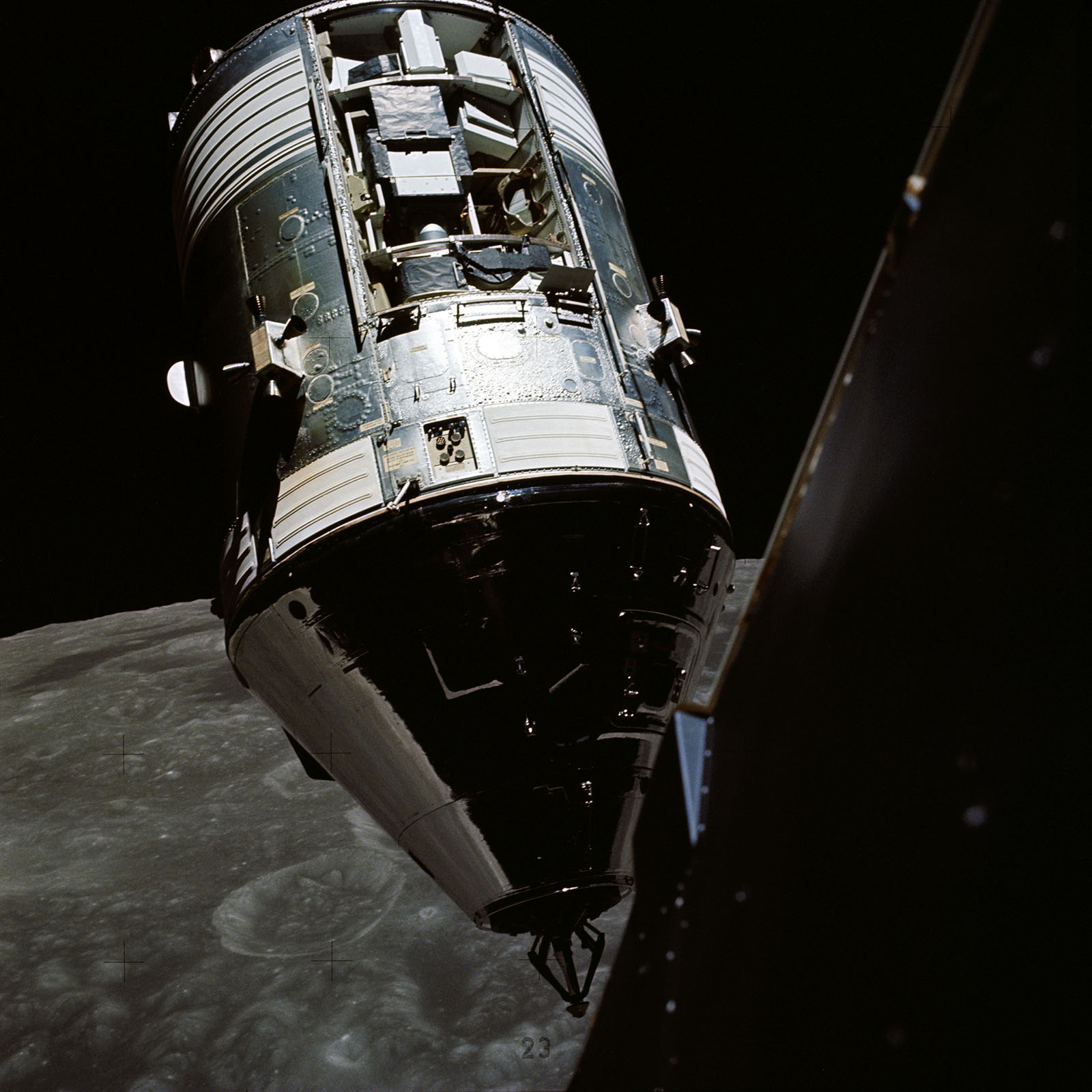
After an overnight rest and a discussion with Houston concerning plans for sampling, Cernan and Schmitt set out on their second trip to collect specimens from boulders along the lower slopes of the South Massif and to sample the lighter-colored soil that overlay the western part of the valley. It was a long trip - an hour by rover to the first major sampling stop - and would stretch their life-support systems almost to the limit. The last couple of kilometers up the slope taxed the rover, too, but it brought them to their objective in fine style. Schmitt took samples from three boulders which, as best he could tell, had come from layers visible farther up the South Massif.89
The obviously interesting features of their first site prompted Houston to lengthen their stay there and cut some time from later stops. On their way back they stopped to take an unscheduled reading on the traverse gravimeter and sampled soil at a couple of crater rims, one of which drew considerable attention. During routine examination of the surface around the crater called “Shorty,” Schmitt suddenly called out, “Oh, hey - wait a minute - … There is orange soil!” Cernan confirmed it. “He’s not going out of his mind. It really is.” While looking for the limits of the orange deposit, Schmitt remarked, “if there ever was something that looked like fumarole alteration, this is it.” 90 He was excited because orange soil (characteristic of oxidized iron, at least on earth) indicated volcanic activity, probably recent, a feature not previously discovered on the moon. While Houston kept reminding them they were almost at the limits of their walk-back capability - time was running out - they dug a trench, took a core sample and several scoop samples, and took photographs. Then they mounted the rover to head back to Challenger. Schmitt talked about his discovery all the way back.91
The last sampling trip of the Apollo program was a traverse to the foot of the North Massif, where they found two large boulders that had obviously rolled down from outcrops higher on the mountain; their tracks were visible in the soft soil. After covering 12 kilometers (7.5 miles) and picking up 63 samples (137 pounds, 62 kilograms), Cernan and Schmitt returned to the lunar module.92 Schmitt picked up a symbolic rock sample in honor of a group of foreign students touring the United States; it would be divided up to provide samples for each country represented. Then Ceman unveiled a plaque on Challenger’s landing strut, which commemorated the completion of the first exploration of the moon by humans. Then he made some final dedicatory remarks:
This is our commemoration that will be here until someone like us, until some of you who are out there, who are the promise of the future, come back to read it again and to further the exploration and the meaning of Apollo.
He then parked the rover at a spot where its television camera could watch their takeoff, and Apollo’s last two explorers finished their last tasks on the moon. Cernan closed out the surface activity with the comment that “I believe history will record that America’s challenge of today has forged man’s destiny of tomorrow.” 93 Then they packed up their samples, discarded the tools they would no longer need, and climbed back into Challenger.94
Next day, December 14, they blasted off to join America in lunar orbit. As television audiences on earth watched, the rover TV camera, directed from Houston, followed their ascent stage until it was out of sight, then slowly scanned the now-deserted lunar surface.95 The awareness that no living person was around made the scene all the more impressive. It was almost possible to hear the silence.
After hooking up with the moon-circling command module, Schmitt and Cernan transferred their samples and data. Americastill had a day’s work to do, completing the photographic and remote-sensing work that Ron Evans had been doing while his crewmates were on the surface. Their work completed, the crew of Apollo 17 left the moon with a blast from their service propulsion engine at 8:42 p.m. EST on December 16. A routine transearth coast brought them back to a landing about 300 kilometers (200 miles) east of Pago Pago at 2:25 p.m. EST on December 19, 1972.96 Apollo’s exploration of the moon, “one of the most ambitious and successful endeavors of man,” 97 was over.
While scientists awaited the samples from Taurus-Littrow, editorial writers offered varying evaluations of the lunar exploration project. Perhaps the bitterest farewell to Apollo was expressed by William Hines, syndicated Chicago Sun-Times columnist, who had opposed the project from the start: “And now, thank God, the whole crazy business is over.” 98 The Christian Science Monitor cautioned that “Such technological feats as going to the moon do not absolve people of responsibilities on earth.” 99 The New York Times decided that “Man’s entire perspective on the universe and on his place in it has been radically changed. Man evolved on the earth, but he is no longer chained to it.” 100 Time magazine noted that after the magnificent effort to develop the machines and the techniques to go to the moon, Americans lost the will and the vision to press on. Apollo’s detractors, said Time, were
prisoners of limited vision who cannot comprehend, or do not care, that Neil Armstrong’s step in the lunar dust will be well remembered when most of today’s burning issues have become mere footnotes to history.101
Notes
- Rocco A. Petrone to Administrator, “Apollo 15 Mission (AS-510),” Prelaunch Mission Operation Report M-933-71-15, July 17, 1971.
- Ibid.
- MSC, “Apollo 15, To the Mountains on the Moon,” NASA Fact Sheet MSC-04065, n. d. [c. June 1971].
- OMSF, “Manned Space Flight Management Council, October 15, 1969, Status Highlights.”
- MSC, “Apollo 15 Press Kit,” July 15, 1971; S. F . Morea, “Lunar Rover Briefing, Kennedy Space Center, July 23, 1971,” transcript.
- Morea, “Lunar Rover Briefing” ; Dale D. Myers to Administrator, “Manned Space Flight Weekly Report,” Feb. 2, 1970; ibid., Sept. 8, 1970.
- Myers to Adm., “Manned Space Flight Weekly Report, Nov. 23, 1970.
- Charles D. Benson and William Barnaby Faherty, Moonport: A History of Apollo Launch Facilities and Operations , NASA SP-4204 (Washington, 1978), pp. 508-14.
- Ibid., pp. 507-508.
- Ibid., pp. 517-18.
- MSC Public Affairs Office, “Apollo 15 Postlaunch Briefing,” July 26, 1971.
- MSC-05161, “Apollo 15 Mission Report,” Dec. 1971, pp. 1-1, 3-2.
- Ibid., pp. 3-1 to 3-7, 9-1 to 9-6.
- Ibid., pp. 9-7 to 9-8.
- MSC-04558, “Apollo 15 Technical Air-to-Ground Voice Transcription” (hereinafter cited as “15 Air-to-Ground”), pp. 337-66; Apollo 15 Mission Report, p. 9-9.
- Apollo 15 Mission Report, pp. 9-14 to 9-15; 15 Air-to-Ground, p. 453.
- 15 Air-to-Ground, 485-89.
- Ibid., pp. 490-506.
- Ibid., pp. 536-39.
- Ibid., p. 546.
- Ibid., p. 544.
- Ibid., pp. 547-48, 550, 554, 556, 560-61.
- Ibid., pp. 568-610; Apollo 15 Mission Report, p. 4-1; JSC-09423, “Apollo Program Summary Report,” Apr. 1975, p. A-7.
- 15 Air-to-Ground, pp. 635-77.
- MSC, Change of Shift Briefing, July 31, 1971, 6:20 p.m. CDT, transcript.
- 15 Air-to-Ground, pp. 675-76.
- Ibid., p. 676.
- David R. Scott, “Finding the Golden Easter Egg,” New York Times, Aug. 13, 1971.
- 15 Air-to-Ground, p. 732; Apollo 15 Mission Report, p. 14-86.
- 15 Air-to-Ground, pp. 734-824.
- Ibid., p. 827.
- William K. Stevens, “Astronauts Fly to Texas Bearing Moon Rock Cargo,” New York Times, Aug. 9, 1971.
- Apollo 15 Mission Report, pp. 4-1 to 4-3, 14-62 to 14-68; 15 Air-to-Ground, pp. 832-952.
- MSC, “Change of Shift Briefing, August 1, 1971, 2:40 p.m. (CDT),” transcript.
- Ibid.
- 15 Air-to-Ground, p. 994.
- Ibid., pp. 366-70, 460-67, 512-14, and elsewhere; Apollo 15 Mission Report, p. 5-14; Abigail Brett, “Worden Discovers 'Hot Spot' Of Radioactive Deposits,” Washington Post, Aug. 3, 1971.
- Apollo 15 Mission Report, p. 4-3.
- 15 Air-to-Ground, p. 1140. Another batch of stamps caused acute embarrassment to NASA and resulted in disciplinary action for the three Apollo 15 astronauts. After a stamp dealer in West Germany advertised philatelic covers that had been to the moon on Apollo 15, it came to light that the crew had taken 400 covers with them. Before the flight the covers, which bore 10-cent Apollo 11 commemorative stamps, were canceled at KSC; on return, the astronauts affixed two 8-cent “decade of achievement” commemoratives (the same as the one canceled on the moon for the U.S. Postal Service) and had them canceled aboard ship. These covers were later autographed by the three astronauts and a notarized statement intended to authenticate them was typed on each. One hundred of these covers were given to the German dealer, who reportedly sold them for 4,850 deutschmarks (about $1,500) each. Belmont Faries, “A Lunar Bonanza,” Washington Star, June 18, 1972.
Investigation revealed that the astronauts had been authorized to carry a smaller number of souvenir covers in their personal preference kits - normal practice for manned space flights, it being understood that such souvenirs would not be exploited for personal profit. When the reports became the subject of inquiries to Deke Slayton and John P. Donnelly, assistant administrator for public affairs at Headquarters, NASA impounded the remaining covers and began an official investigation. William Hines, “NASA Probing Moon Stamp Caper,” Washington Star, July 2, 1972.
It developed that the astronauts had given the flown covers to an intermediary in Florida, who passed them on to the German dealer. It was understood that the proceeds from sale of the covers would be put into a trust fund for the astronauts' children; but they later had second thoughts and refused the offer. Nonetheless, after the basic facts were made known, NASA officially reprimanded Scott, Worden, and Irwin with the statement that they had used “poor judgment” and “their actions will be given due consideration in their selection for future assignments.” Harold M. Schmeck, Jr., “Apollo 15 Crew Is Reprimanded,” New York Times, July 12, 1972; “Apollo 15 'Postmen' Officially Reprimanded,” Houston Post, July 12, 1972; “Postmark: The Moon,” Newsweek, July 24, 1972; Thomas O'Toole, “Ex-Astronauts Disregarded Warning Against ’souvenirs',” Washington Post, Aug. 1, 1972. The Senate space committee looked into the matter, concluded that no laws had been violated, and took no action. They discovered that unauthorized items had been taken on other lunar landing missions as well. Richard D. Lyons, “Astronauts and Space Officials Heard At Inquiry on Exploitation of Souvenirs,” New York Times, Aug. 4, 1972. The results of NASA’s own investigation were publicized in an 18-page press release, NASA Release 72-189, “Articles Carried on Manned Space Flights,” Sept. 15, 1972, which stated that the astronauts' “official Efficiency Reports as military officers reflect a formal finding of lack of judgment,” and also noted changes in NASA Regulations that were promulgated to prevent recurrence of such embarrassing incidents.
The incident caused an uproar among American philatelists. The journal of the American Philatelic Society carried two reports of an investigation intended to make known exactly what happened, so that collectors would be aware of the possibilities of fraud. Lester E. Winick, “Report on Apollo 15 Covers - Smuggled and Authorized,” The American Philatelist 86(10) (1972):887-95, and “‘Lookalike’ Apollo 15 Covers Prompt Philatelists’ Caution,” ibid., 86(11) (Nov. 1972):992-98.
- 15 Air-to-Ground, p. 1142. Scott correctly credited Galileo Galilei (1564-1642), Italian astronomer and physicist, with the deduction that bodies of different weight should fall with the same velocity in the absence of air resistance. He would have been more accurate to assign the credit for getting him to the moon to Sir Isaac Newton (1642-1727), who first formulated the laws that govern the motion of a body moving in a gravitational field and provided a mathematical basis for Galileo’s hypothesis. Only with the development of high-speed electronic computers, however, was it possible to solve the equations for the motion of a spacecraft with sufficient accuracy to allow Scott to land at a specific spot on the plain at Hadley. The only notice taken of Scott’s demonstration, other than press reports, was in the preliminary science report. Joe Allen, concluding a paper summarizing the scientific results, noted that the result was “predicted by well- established theory, but [was] nonetheless reassuring considering … that the homeward journey was based critically on the validity of the particular theory being tested.” Apollo 15 Preliminary Science Report, NASA SP-289 (Washington, 1972), p. 2-11.
- Fred Farrar, “Astronauts Leave Moon, Link Up with Mother Ship,” Chicago Tribune, Aug. 3, 1971; Apollo 15 Mission Report, pp. 14-71 to 14-72.
- Tom Wicker, “Man and the Moon,” New York Times, Aug. 3, 1971.
- Apollo 15 Mission Report, p. 1-3.
- Ibid., p. 1 4; John Noble Wilford, “Worden Ventures Outside the Cabin of Apollo Craft,” New York Times, Aug. 6, 1971.
- O'Toole, “Apollo 15 Lands Hard but Safely,” Washington Post, Aug. 8, 1971; Apollo 15 Mission Report, pp. 1-4, 14-17 to 14-21.
- Apollo 15 Preliminary Examination Team; “The Apollo 15 Lunar Samples: A Preliminary Description,” Science 175 (1972):363-75.
- Gerald Wasserburg to Robert R. Gilruth, Aug. 9, 1971.
- Larry A. Haskin to Gilruth, Aug. 5, 1971.
- “Apollo 15 Science Briefing, Manned Spacecraft Center, August 11, 1971, 3:30 PM (CDT).”
- “The Apollo 15 Lunar Samples” ; Petrone to multiple addressees, “Report of Preliminary Scientific Results of Apollo 15,” Sept. 28, 1971, with encl., “Preliminary Scientific Results of Apollo 15 (As of September 24, 1971).”
- “The Apollo 15 Lunar Samples.”
- I. Adler, J. Trombka, J. Gerard, R. Schmadebeck, P. Lowman, H. Blodgett, L. Yin, E. Eller, R. Lamothe, P. Gorenstein, and P. Bjorkholm, “X-Ray Fluorescence Experiment, Preliminary Report,” Goddard Space Flight Center X-641-71-421, October 1971.
- Gilruth to Myers, TWX, Aug. 31, 1971.
- “Distribution of Apollo 15 Lunar Samples,” NASA Release 71-223, Nov. 9, 1971.
- NASA Release 71-149, “Apollo 17 Crew Named,” Aug. 13, 1971.
- Donald K. Slayton interview, Oct. 15, 1984.
- Jim Maloney, “A new goal for dropped astronaut,” Houston Post, Sept. 8, 1971.
- MSC, “Apollo 17 Crew Press Conference, Manned Spacecraft Center, August 19, 1971, 10:00 AM (CDT),” transcript; Reuters, “Geologist Defends Selection of Him for Moon Flight,” New York Times, Aug. 20, 1971.
- N. W. Hinners, “Apollo 16 Site Selection,” in Apollo 16 Preliminary Science Report, prepared by NASA MSC, NASA SP-315 (Washington, 1972).
- Petrone to Mgr., Apollo Spacecraft Program, MSC, “Selection of Landing Sites for Apollo 16 and 17,” Mar. 11, 1971; Lee R. Scherer to multiple addressees, “Apollo 16 and 17 Site Selection Discussions,” May 5, 1971, with encl., “Minutes of the Ad Hoc Site Selection Committee Meeting on Preliminary Apollo 16 and 17 Site Selection Discussions,” Apr. 14, 1971; Harold C. Urey to Hinners, May 11, 1971; James R. Arnold to Scherer, May 13, 1971; Paul W. Gast to Dir., Apollo Lunar Exploration, “Site for Apollo 16,” May 14, 1971; John A. O'Keefe to Hinners, May 14, 1971.
- Petrone, TWX to multiple addressees, subject: Apollo 16 Landing Site, June 10, 1971; James A. McDivitt to multiple addressees, “Apollo 16 Landing Site,” June 11, 1971.
- MSC, “Apollo 16 Mission Report,” MSC-07230, Aug. 1972, pp. 12-1, A-7 to A-22; Richard R. Baldwin, “Mission Description,” in Apollo 16 Preliminary Science Report.
- Apollo 16 Mission Report, pp. 3-1, 3-2.
- Baldwin, “Mission Description.” The cable incident was the first to knock out an experiment, but every mission had experienced similar problems with cables that would not lie flat on the lunar surface. Furthermore, the space suits did not permit astronauts to see their own feet. Nonetheless, it caused one columnist to splutter, “ … what we have been watching [is not] science. Those two klutzes up there on the moon, bumping into each other, unable to repair what their clumsiness has damaged, didn't look like scientists or lab technicians even. They looked like … a couple of miscast wahoo military officers. Nicholas von Hoffman, Two Klutzes On the Moon,” Washington Post, Apr. 24, 1972. Von Hoffman was rather hyperbolically protesting the continuation of Apollo and the amount of time devoted to coverage of the missions by the television networks.
- Apollo 16 Mission Report, p. 1-3; O'Toole, “90-Lb. Scientific Satellite Crashes On Moon, Ends Study 47 Weeks Early,” Washington Post, May 31, 1972.
- Apollo 16 Mission Report, pp. 5-20 to 5-21, 3-9; Baldwin, "Mission Description."
- O'Toole, “Scientists Think Apollo 16 Rocks Most Important Haul Yet,” Washington Post, Apr. 30, 1972.
- Idem, “Metallic Iron in Rocks Baffles Moon Scientists,” ibid., May 17, 1972; “Moon Theory Upset By Study of Rocks Astronauts Gathered,” Wall Street Journal, May 17, 1972.
- Hinners, “Apollo 16 Site Selection.”
- Allen L. Hammond, “Lunar Research: No Agreement on Evolutionary Models,” Science 175 (1972):868-70.
- Wilford, “Apollo 17 Crew to Seek Questions for Answers Found by Previous Moon Flights,” New York Times, Nov. 12, 1972.
- Bruce R. Doe to Homer E. NewelL, Oct. 18, 1971.
- Petrone to multiple addressees, “Apollo 17 Site Selection,” Oct. 28, 1971.
- N. W. Hinners to Capt. W. T. O'Bryant, “A.S.S.B. Minutes,” March 23, 1972; O'Toole, “Moon Landing Site Chosen For the Last Apollo Flight,” Washington Post, Feb. 17, 1972.
- Hinners to O'Bryant, “A.S.S.B. Minutes” ; idem, “Apollo 17 Site Selection,” in Apollo 17 Preliminary Science Report, NASA SP-330 (Washington, 1973), pp. 1-1 to 1-5; John R. Sevier, interview, Apr. 24, 1986.
- T. McGetchin and J. W. Head, “Lunar Cinder Cones,” Bellcomm paper, Aug. 4, 1972; Apollo 15 Preliminary Science Report, p. 25-17.
- OMSF, “Mission Operation Report, Apollo 17 Mission,” report no. M-933-72-17, Nov. 8, 1972; “Apollo 17 Site Selection,” NASA Release 72-44, Feb. 16, 1972; Harrison H. Schmitt, “Apollo 17 Report on the Valley of Taurus-Littrow,” Science 182 (1972):681-90; Apollo 17 Preliminary Examination Team, “Apollo 17 Lunar Samples: Chemical and Petrographic Description,” ibid. pp. 659-72.
- McDivitt to multiple addressees, “Apollo launch dates,” Feb. 22, 1971.
- John O. Cappellari, ed., “Where on the Moon? An Apollo Systems Engineering Problem,” Bell System Technical Journal 51(5) (May-June 1972): 1033-45.
- Hinners to O'Bryant, “A.S.S.B. Minutes,” Feb. 11, 1972; Petrone, TWX to McDivitt, subject: “Apollo 13 March Launch Window,” Dec. 4, 1969; Gilruth, TWX to Petrone, subject: “Night Launches,” Jan. 28, 1970.
- McDivitt to multiple addressees, “Apollo 17 Landing Site,” Feb. 23, 1972.
- JSC, “Apollo 17 Mission Report,” JSC-07904, March 1973, p. 14-1; Benson and Faherty, Moonport, pp. 522-26.
- Apollo 17 Mission Report, p. 1-1.
- Ibid., p. 3-2.
- Ibid., pp. 1-1 to 1-2; Schmitt, “Apollo 17 Report on the Valley of Taurus-Littrow.”
- MSC, “Apollo 17 Technical Air-to-Ground Voice Transcription,” Dec. 1972 (hereinafter cited as “17 Air-to-Ground”), tape 76A, pp. 4-8, tape 77A, p. 34, 39-41. This transcript is paginated by tape number; tape numbers run sequentially in three series, A, B, and undesignated, corresponding to communication with the lunar module (A) and the command module (B) when the two were separated, and with the command module when all three crewmen were aboard before and after separation (undesignated).
- Schmitt, “Apollo 17 Report,” p. 682.
- Apollo 17 Mission Report, pp. 4-5 to 4-11.
- 17 Air-to-Ground, pp. 91A/1-94A/25; Apollo 17 Mission Report, pp. 10-15 to 10-16; Apollo Field Geology Investigation Team, “Geologic Exploration of Taurus-Littrow: Apollo 17 Landing Site,” Science 182 (1973):672-80.
- 17 Air-to-Ground, pp. 96A/8-96A/10.
- Ibid., pp. 96A/11-96A/55.
- Apollo 17 Mission Report, pp. 10-16 to 10-17.
- Ibid.; 17 Air-to-Ground, pp. 112A/20-113A/1.
- 17 Air-to-Ground, pp. 113A/1-3.
- “Apollo 17 at Taurus-Littrow,” NASA EP-102, p. 30.
- Apollo 17 Mission Report, pp. 3-2, 12-4, 12-5.
- Ibid., p. 1-3.
- William Hines, “End of a crazy business,” Chicago Sun-Times, Dec. 21, 1972. Hines went on to castigate the Apollo project from concept to execution, and concluded by quoting Max Born, Nobel laureate in physics, who had said in 1958 as the “space race” began, “Intellect distinguishes the possible from the impossible; reason distinguishes the sensible from the senseless. Spaceflight is a triumph of intellect and a tragic failure of reason.”
- Christian Science Monitor, Dec. 21, 1972, cited in Astronautics and Aeronautics, 1972: Chronology of Science, Technology and Policy, NASA SP-4017 (Washington, 1974), p. 440.
- New York Times, Dec. 14, 1972, cited in Astronautics and Aeronautics, 1972, p. 429.
- Time, Dec. 11, 1972, cited in Astronautics and Aeronautics, 1972, p. 424.