PRIMARY MISSION ACCOMPLISHED: 1969
Crew Activities, 1968-1969
Crews for the early Apollo manned missions were named in 1966, but their assignments were canceled after the spacecraft fire in January 1967. Mission-specific training languished for a while, but in early May 1967 the crew of Apollo 7 was selected and began preparing for their earth-orbital mission. Deke Slayton, director of flight crew operations at MSC, expedited training by assigning a third group of astronauts (a support crew) to each flight. [see Appendix 6] The support crew assisted the prime and backup crews in training, doing a great deal of necessary but time-consuming work: maintaining the flight data file (flight plan, check lists, and mission ground rules); keeping the prime and backup crews advised of all changes; helping training officers to work out procedures on the simulators before the prime crews used them; and generally taking a load of details off the prime and backup crews.1 Experience and seniority appeared to be the major factors in Slayton’s choice of crews. For the first three missions, prime and backup crews were chosen from the first three groups of pilots selected; all commanders had flight experience in Gemini. Support crewmen were all from the fourth group of pilots.2 The scientist-astronauts, who ranked fourth in seniority but last in experience, had varied assignments, participating in design reviews and preflight tests and working on plans for Apollo Applications experiments; geologist Jack Schmitt spent much of his time working on site selection.3
A Second Group of Scientist-Astronauts
George Mueller was making ambitious projections for the Apollo Applications Program in 1966, and if they developed, more scientists would be needed for its crews. In September 1966 the National Academy of Sciences and NASA announced that applications for a second group of scientist-astronauts would be accepted. [see Chapter 5] Nearly a thousand hopefuls applied; the Academy’s selection committee forwarded 69 names to NASA in March 1967, and five months later 11 new astronaut trainees, 9 Ph.D.s and 2 M.D.s, were named. [see Appendix 6] The group contained not a single qualified pilot; after six months of orientation and basic “ground school” training at MSC, they would all be sent to Air Force flight training.4
Addition of this class of candidates brought the astronaut corps to a strength of 56 - more than Apollo seemed to need, since no more than 10 lunar missions were contemplated.* The qualifications of the new group - who were mostly physicists, astronomers, or physicians, not earth scientists - suggests that MSC was preparing for Apollo Applications missions rather than lunar exploration. When they were chosen in mid-1967, however, even that prospect was growing dim and would be dimmer yet by the time they had finished flight training. Headquarters program officials continued to talk of frequent Apollo Applications missions,5 and Slayton had to be prepared to supply crews for whatever missions should be assigned and to anticipate some degree of attrition. On the other hand, if the program did not materialize as planned, the astronaut corps would be overstaffed and many aspiring space explorers would have small chance of flying in space. That could be an especially touchy point with scientists, who risked their careers by enlisting as astronauts.** In interviews with the scientist applicants, Slayton tried not to raise their expectations about the availability of flight assignments, to the point of frankly admitting that the astronaut corps had no urgent need for them at the moment. With that understanding, however, they were welcome in Houston, because the astronaut corps needed all kinds of talent to support MSC’s missions.6 Members of the new group soon dubbed themselves “The Excess Eleven,” or “XSXI.”
* Given Slayton’s system of promoting a backup crew to prime crew three missions later, and assuming that no crewman would be assigned to more than one mission in any capacity, 10 lunar missions would have required 55 astronauts (if support crews later became backup and prime crews). Slayton’s preference for flight experience in crew members, however, makes that assumption questionable; hence fewer astronauts could have filled the positions on prime, backup, and support crews. On the 7 lunar landing missions flown, 39 astronauts filled 63 available crew positions.
** So did the pilot-astronauts, for that matter, but provision was made for them to keep their professional skills (flying) well honed as part of the program. The scientists enjoyed no such concession, as was repeatedly pointed out by NASA’s outside scientific consultants.
Crew Training and Flight Operations
Crews for both Apollo 9 and Apollo 10 were in training as 1969 began; on January 9 a third was named, for Apollo 11. Since November 1967 the prime crew of Apollo 9 - James A. McDivitt, David R. Scott, and Russell L. Schweickart - had been following their spacecraft through assembly and rehearsing the complex procedures of orbital rendezvous. Both McDivitt (who came in with the second group of astronauts) and Scott were veterans, each having flown a Gemini mission that had paved the way for rendezvous and docking operations. Schweickart, like Scott, was a “Fourteen” (third group); he had not yet flown a mission but had participated extensively in the development testing of the space suit. The crew of Apollo 10, named on November 12, 1968, was the first in the entire manned space flight program composed entirely of experienced astronauts: Thomas P. Stafford, John W. Young, and Eugene A. Cernan. Stafford, the first of his class to fly two orbital missions, and Young, who had also flown twice, were from the second astronaut class; Cernan, from the third group, had a single flight. They were also the first crew to be promoted as a unit, having served as backup crew on Apollo 7. The crew for Apollo 11, also all veterans, consisted of Neil A. Armstrong from the second group and Edwin E. (“Buzz”) Aldrin, Jr., and Michael Collins from the third. Armstrong and Aldrin had been on the backup crew for Apollo 8; the third member of that crew, Fred W. Haise, was replaced by Collins on the flight crew because Deke Slayton wanted an experienced pilot in the command module for Apollo 11, which, if all went well, would most likely be the first mission to attempt a lunar landing.7
The success of Apollo 8 left only the qualification of the lunar module to be accomplished before a lunar landing could be attempted. In the alphabetical sequence of missions adopted a year before, [see Chapter 7] the next mission (“D”) was to fly both the command/service module and the lunar module, to check out all LM systems and rendezvous techniques in earth orbit. This, according to 1967 plans, would be followed by missions “E” (combined CSM/LM operations in high earth orbit, later discarded in favor of the “C-prime” mission, Apollo 8, which did not carry a lunar module) and “F” (all operational procedures of a landing mission except the actual landing). On the “F” mission the crew would take the lunar module down to 50,000 feet (15,240 meters) above the moon, get as good a look as possible at the proposed landing site for the first mission, and return to lunar orbit for rendezvous with the command module.8
Mission “D” (Apollo 9) would be the most complex yet flown, involving the checkout of two spacecraft at the Cape and simultaneous operations with two vehicles in orbit. An additional objective was operational checkout of the extra-vehicular space suit and the portable life-support system that lunar explorers would use on the moon’s surface.9
Apollo 9 was launched on March 3, 1969, for 10 busy days of operations. After extracting their lunar module from the S-IVB stage, McDivitt and his crewmates performed numerous tests of the engines on both modules, assessing the dynamic behavior of the linked spacecraft as well as the performance of the propulsion systems. On the third day they separated the vehicles and began independent operations, testing the LM systems, and carrying out a complete docking maneuver, all successfully. Schweickart’s tests of the extravehicular space suit and lifesupport system were equally gratifying. The most serious anomaly on the flight was the appearance of motion sickness, which had also affected Apollo 8’s crew. Schweickart vomited twice and Scott reported being on the verge of nausea for considerable time after reaching orbit. Some tasks had to be cut short on this account, but even so, all the primary mission objectives were satisfied. The Apollo 9 command module came down on March 13 within three miles (4.8 kilometers) of the target point in the western Atlantic.10
Two months later, launch operations crews at Kennedy Space Center were getting ready for the final countdown for Saturn no. 505, the launch vehicle for Apollo 10. This mission was to “confirm all aspects of the lunar landing mission exactly as it would be performed, except for the actual descent, landing, lunar stay, and ascent from the lunar surface.” Besides giving the entire mission support team one more workout, it would also allow the manned space flight network to track the spacecraft as it orbited the moon, to provide a more accurate description of the irregular lunar gravitational field.*** 11On May 18, the big booster sent CSM 106 and lunar module LM4, with Tom Stafford and his crew aboard, toward the moon on a near-perfect trajectory - one designed to duplicate the path to be taken by the first landing mission. Indicative of the pace of the program in early 1969, even before Apollo 10 reached the moon, Cape crews trundled out Saturn 506, the Apollo 11 launch vehicle, to Launch Complex 39A and began preparing it for its epoch-making flight.12
*** Analysis of irregularities in the orbits of Lunar Orbiter IV had revealed gravity anomalies attributed to concentrations of mass (“mascons”) at certain locations on the moon; they were sufficiently large to deflect the path of a lunar module. Results from Apollo 10 would be helpful in developing the capability to land precisely at a targeted spot, which mission planners considered essential for the later missions.
Stafford, Cernan, and Young carried out their pathfinding mission with remarkably few problems, On the fifth day the lunar module separated from the command module to photograph the approach path, verify the operation of the landing radar, and survey the first landing site**** from low altitude. They reported that the landing radar worked as advertised and that the first astronauts to attempt a lunar landing should have no problems finding a smooth level spot in the eastern end of the site; farther west, however, they might have to maneuver to find a boulder- and crater-free area to touch down. That evaluation completed, Stafford and Cernan took their lunar module back into orbit, checking out the abort guidance system as they left low orbit. After rejoining John Young in the command module they headed back to earth, splashing down on May 26 in the Pacific Ocean some 400 miles (650 kilometers) east of Pago Pago.13
**** Site II P-6, [see Chapter 8] just north of the equator in the southwestern part of Mare Tranquillitatis.
Apollo 11 Crew Makes Ready
As backup crew for Apollo 8 since late 1968, the prime crew of Apollo 11 had already rehearsed many of the procedures for a lunar mission; but as the first crew that would attempt a lunar landing, they had to prepare for much more. From January 9, when they were named, until launch day their days were filled with activity: briefings on all the spacecraft systems, fitting of spacesuits, lessons in geology and astronavigation, rehearsal of procedures for rendezvous, practicing unloading the lunar surface experiments, and whatever else the training officers could squeeze into their schedule. For some time they had little access to their primary training devices, the lunar module and command module simulators. Until March, when Apollo 9 flew, they were third in line for those simulators, and only after Apollo 10 was launched in May did they have first priority.14
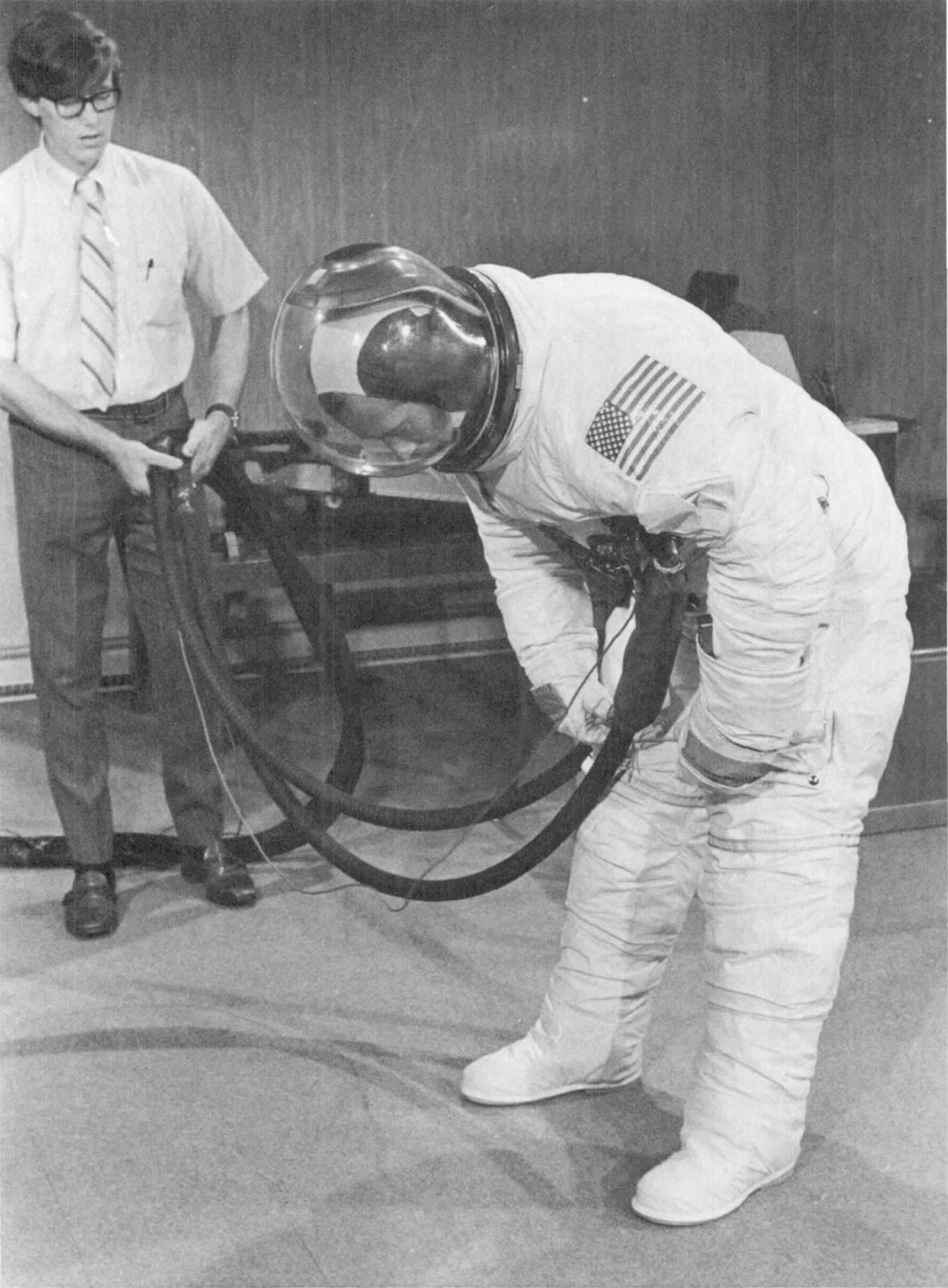
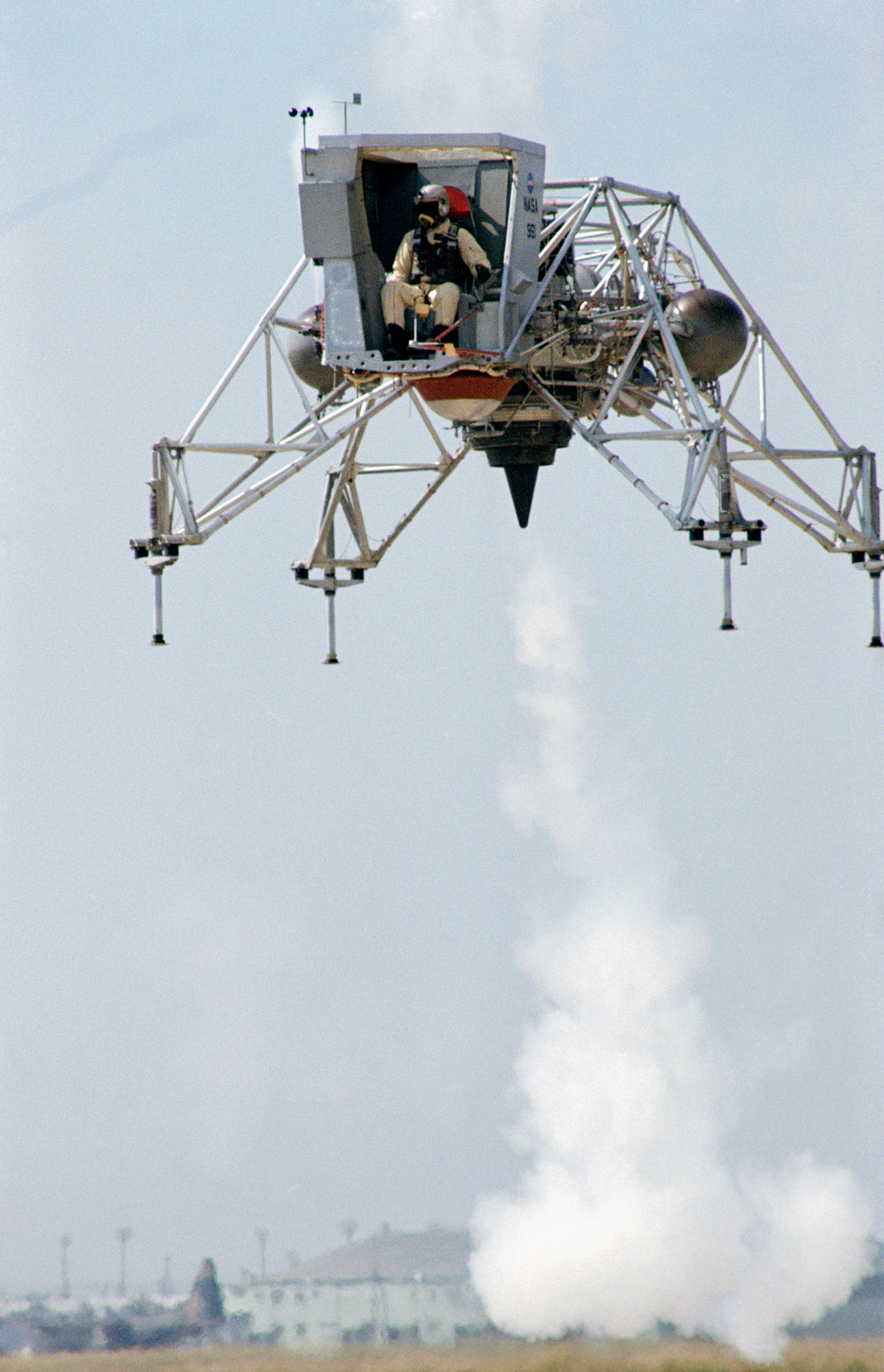
For Neil Armstrong and Buzz Aldrin and their counterparts in the backup crew, practicing the lunar landing itself was among the most important parts of training. The lunar module pilots used a simulator built for the purpose by engineers at Langley Research Center in Virginia. It consisted of a mockup of the lunar module, suspended by cables from a long overhead trestle so that all but one-sixth of its weight was neutralized. Since it did not provide complete freedom of movement in all three directions, the Langley device was inferior as a lunar-module simulator to the vehicle on which the mission commanders trained.15 This free-flying lunar landing training vehicle (LLTV), developed at the Flight Research Center in California and built by Bell Aerosystems, was a skeleton framework of tubing supporting a control station, fitted in the center with a downward-thrusting jet engine to offset five-sixths of its weight and on the periphery of the structure with a group of small thrusters to provide attitude and directional control. It was a skittish and somewhat unstable vehicle; on two occasions in 1968 pilots had to eject from it.16 Nonetheless, it was the only device that could accurately simulate the last few hundred feet of the lunar landing approach and commanders of lunar landing missions and their backups were required to perform as many landings in the LLTV as time permitted.17
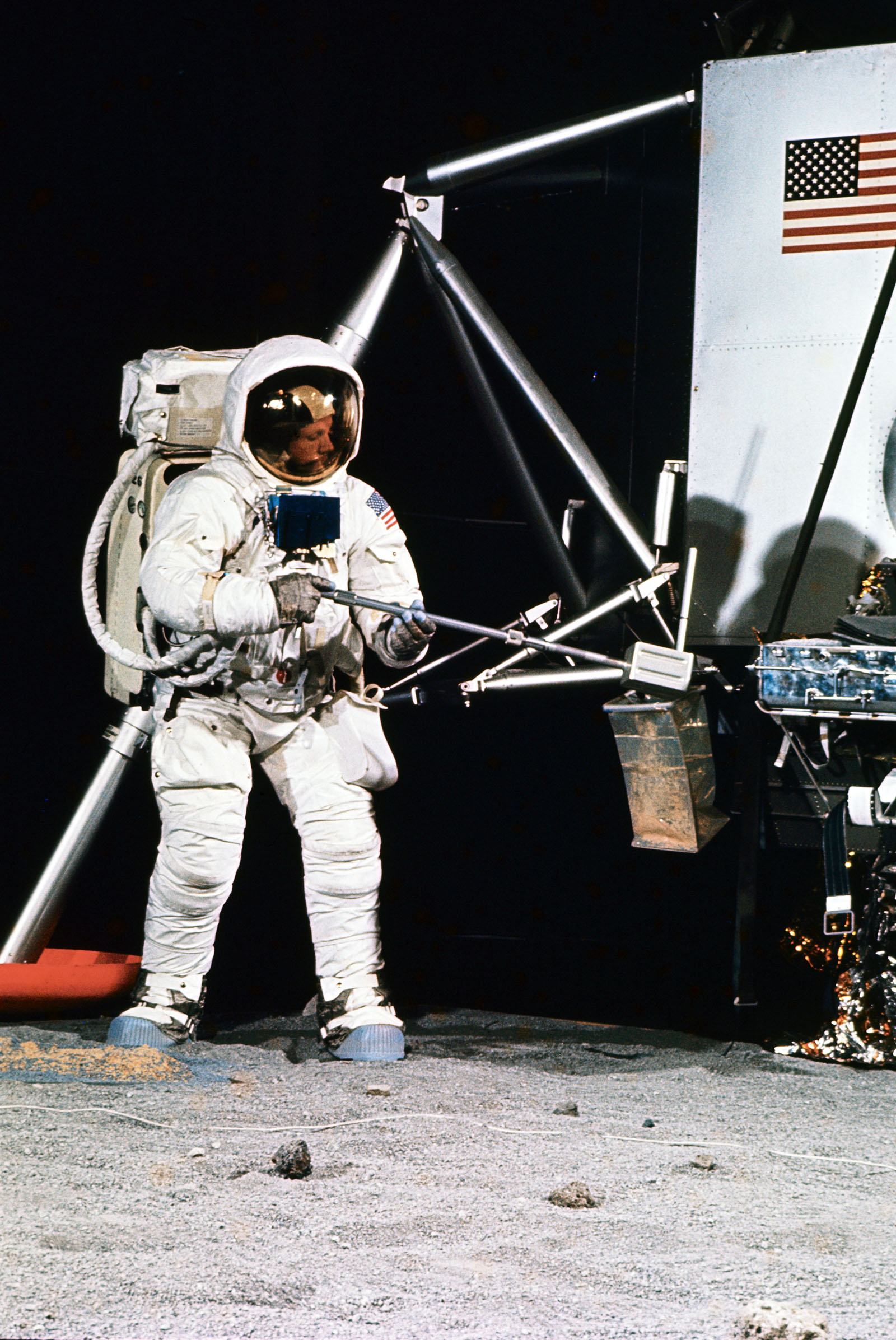
The crews went through many rehearsals of the lunar surface activity - deploying the experiments and collecting surface samples - during the last few months of training, but they were given comparatively little refresher work in field geology. The last formal geology briefings for the Apollo 11 crew came in mid-April.18 As launch came closer, Armstrong became concerned about collecting samples and making scientific observations. When he expressed his fear that he might do something wrong, MSC geologist Elbert King emphasized that everything he said and every specimen he collected would be valuable, simply because he would be the first man ever to make scientific observations on the lunar surface. King’s advice was not to worry about making mistakes. If he talked as much as possible about what he saw and collected all the samples he could, no reasonable scientist could fault his efforts.19
By the time the Apollo 10 crew left on their mission and the crew of Apollo 11 could get first priority on the simulators, training had become the “pacing item” in the launch schedule.20 Throughout May and June the spacecraft and its launch vehicle went through preflight preparations with no major problems, staying on schedule for a July 16 launch, while crews spent long hours in the simulators.21 When the White House proffered an invitation for the Apollo 10 and Apollo 11 crews to dine with the President, Deke Slayton was obliged to notify Headquarters that taking one day out of the training regimen was likely to cost a month’s delay in launch.22 On June 9 the photomosaics of their landing site were delivered to the Cape so that Armstrong and Aldrin could practice the approach to their touchdown point in the lunar module simulator.23 Armstrong completed his required flights in the lunar landing training vehicle on June 16.24
The final days wound down without major interruption, however. The Lunar Receiving Laboratory was certified by the Interagency Committee on Back Contamination, two mobile quarantine facilities - including a spare, just in case - were delivered to the recovery ship, and it appeared that humans would indeed attempt a lunar landing as scheduled.25
The First Lunar Explorers
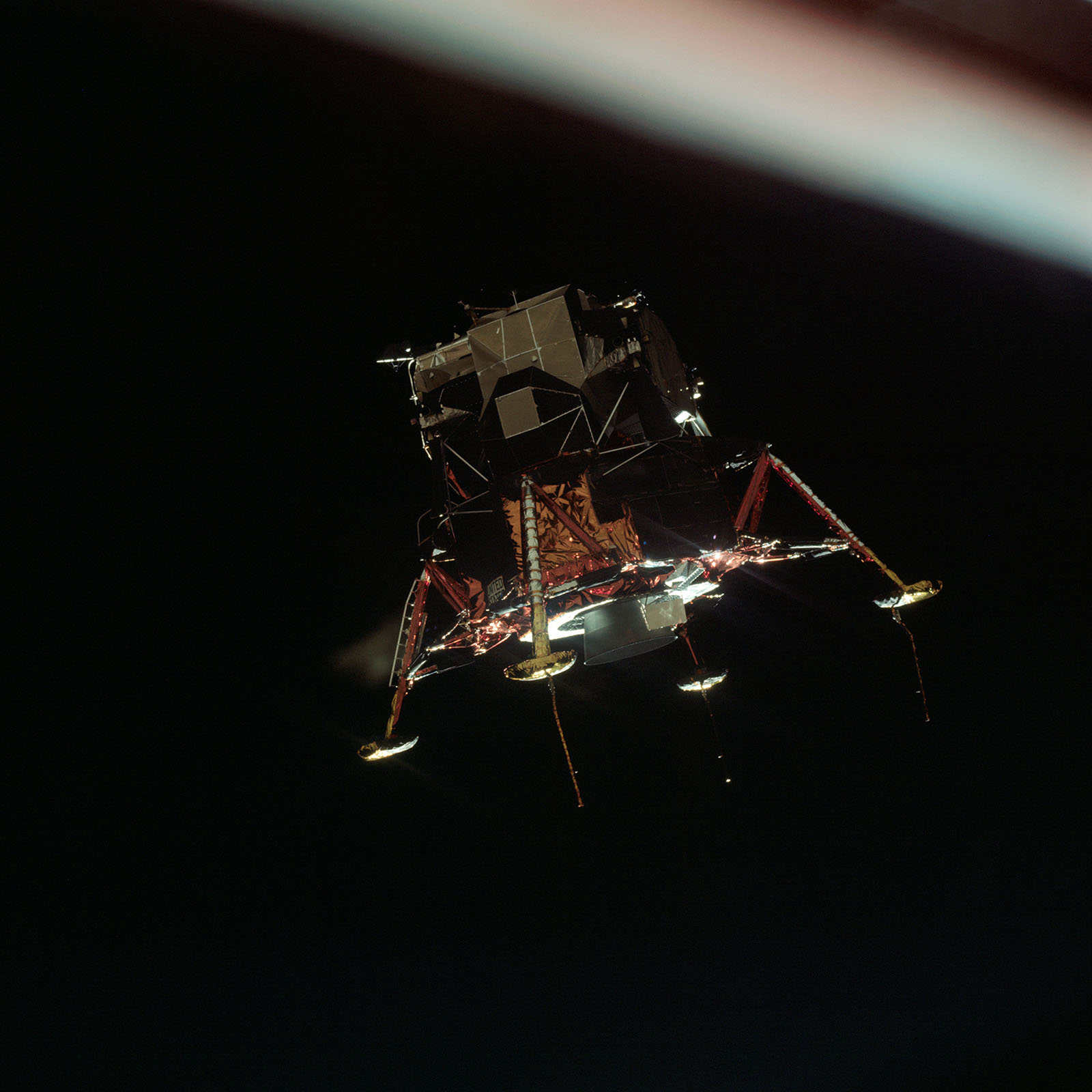
At 9:32 a.m. Eastern daylight time on July 16, 1969, Apollo 11 left Launch Complex 39A at Kennedy Space Center, bound for the moon. Four days later, at 4:18 p.m. EDT on July 20, Neil Armstrong skilfully set the lunar module Eagle down in the Sea of Tranquility and reported, "Houston, Tranquility Base here. The Eagle has landed."26 For the next 10 minutes Armstrong and Aldrin were occupied with several post-landing procedures, reconfiguring switches and systems. Armstrong found time to report to Mission Control what he had been too busy to tell them during the landing: that he had manually flown the lunar module over the rockstrewn crater where the automatic landing system was taking it. Then he made his first quick-look science report:
We'll get to the details of what’s around here, but it looks like a collection of just about every variety of shape, angularity, granularity, about every variety of rock you could find…. There doesn't appear to be too much of a general color at all. However, it looks as though some of the rocks and boulders, of which there are quite a few in the near area, it looks as though they're going to have some interesting colors to them….27
After giving Houston as many clues as he could to the location of their module, he added some more description:
The area out the left-hand window is a relatively level plain cratered with a fairly large number of craters of the 5- to 50-foot variety, and some ridges - small, 20, 30 feet high, I would guess, and literally thousands of little 1- and 2-foot craters around the area. We see some angular blocks out several hundred feet in front of us that are probably 2 feet in size and have angular edges. There is a hill in view, just about on the ground track ahead of us. Difficult to estimate, but might be half a mile or a mile.28
Armstrong and Aldrin then started preparing their spacecraft for takeoff, setting up critical systems to be ready in case something happened and they had to leave the lunar surface quickly. A short break in this activity gave Armstrong a chance to pass along more information about the landing site:
…The local surface is very comparable to that we observed from orbit at this sun angle, about 10 degrees sun angle, or that nature. It’s pretty much without color. It’s … a very white, chalky gray, as you look into the zero-phase line [directly toward the sun]; and it’s considerably darker gray, more like … ashen gray as you look out 90 degrees to the sun. Some of the surface rocks in close here that have been fractured or disturbed by the rocket engine plume are coated with this light gray on the outside; but where they've been broken, they display a dark, very dark gray interior; and it looks like it could be country basalt.29
Setting up the spacecraft systems took another hour and a half to complete; then they were ready to get out and explore. The flight plan called for them to eat and then rest for four hours, but Aldrin called Mission Control to recommend starting their surface exploration in about three hours' time. Houston concurred.30 Although they had been awake almost 11 hours and had gone through some stressful moments during the landing,# it seemed too much to expect the first men on the moon to take a nap before they made history.
# While Armstrong was maneuvering to avoid a boulder field, alarms sounded in the lunar module indicating that the computer was overloaded. Mission Control quickly told the crew to proceed. Then, as fuel was running low, a dust cloud obscured the surface and Armstrong had to touch down without a good view of his landing spot.
While Armstrong and Aldrin tended to their postlanding chores, Mike Collins, orbiting 60 nautical miles (112 kilometers) overhead in the command module Columbia, had little to do. Houston enlisted his aid in an attempt to locate Eagle, giving him the best map coordinates they could derive from the sketchy information available. With his navigational sextant Collins scanned several spots, without success; Columbia passed over the landing site too rapidly to allow him to search the area thoroughly and he never found the lunar module.31 Determination of its exact location had to wait for postmission analysis of Armstrong’s descriptions of the area and examination of the spacecraft’s landing trajectory.
Getting ready to leave the lunar module took longer than the crew had anticipated. It was after 9:30 p.m. in Houston, an hour and a half later than they had hoped, when they opened the hatch. Armstrong carefully worked his way out onto the "porch," then climbed down the ladder, pausing on the lowest rung to comment on the texture of the surface and the depth to which the footpads had penetrated. At 9:56 p.m. he stepped onto the moon’s surface, proclaiming, "That’s one small step for man, one giant leap for mankind" - inadvertently omitting an "a" before "man" and slightly changing the meaning he intended to convey.32
Armstrong made a cursory inspection of the lunar module and reported his reactions to the new environment. Aldrin then lowered a camera on the lunar equipment carrier - a clothesline and pulley arrangement that seemed out of place in the high-technology environment of Apollo - which Armstrong immediately began using. Mission Control reminded him to scoop up the contingency sample, which he did. "I'll try to get a rock in here. Just a couple." He noted that the collecting tool met resistance after penetrating a short distance into the surface material. He then stowed the sample in a bag that he tucked into a pocket of his suit. To the scientists on earth he remarked, "Be advised that a lot of the rock samples out here, the hard rock samples, have what appear to be vesicles in the surface. Also, I am looking at one now that appears to have some sort of phenocryst."## 33
## That is, the rocks had surface pits resembling those caused by the escape of gases from molten material (which could indicate a volcanic origin), and one seemed to have a prominent embedded crystal.
Aldrin then joined Armstrong on the surface, and they spent the next several minutes inspecting the landing craft and reporting on its condition, adjusting to the low lunar gravity and trying various ways of getting around on the surface. After a brief commemorative ceremony (reading the plaque attached to the lunar module) and a short conversation with President Richard Nixon, they began unloading and emplacing the scientific instruments and collecting samples. They supplemented earth’s limited television view of their activities with descriptions of what they were seeing and doing. On a couple of occasions they acted like field geologists. Aldrin reported that he saw a rock that sparkled "like some kind of biotite," but he "would leave that to further analysis."### After closely examining some rounded boulders near the spacecraft, Armstrong said they looked "like basalt, and they have probably two percent white minerals in them…. And the thing that I reported as vesicular before, I don't believe that any more…. they look like little impact craters where BB shot has hit the surface."34
### This comment drew criticism from some scientists on the ground that biotite (a mica-like mineral) could not have formed on the moon. The criticism was unwarranted, because Aldrin had not said that it was biotite, but that it looked like biotite he had seen on field trips; the criticism was mildly detrimental, because it made the next crew more reluctant to use technical terminology, with which some of the astronauts felt uncomfortable anyway, in describing what they saw. H. H. Schmitt interview, May 30, 1984.
The geologists in Houston watching this surface activity on television were quite pleased with the astronauts' performance. At one point Armstrong disappeared from the field of view of the TV camera, causing some momentary anxiety at his apparent departure from the plan. It turned out that some unusual rocks had attracted his attention and he had gone off a few meters to collect them. That was exactly the kind of thing the geologists had hoped people on the moon would do.35 By the time the crew had taken two core samples, again experiencing difficulty in driving a sampling tool into the surface, and filled their sample return containers, Houston notified them that it was time to wind up their activity. Just before midnight CapCom#### Bruce McCandless told Aldrin to "head on up the ladder," and at 12:11 a.m. Houston time both men and their samples were back in the lunar module and the hatch was sealed.36 Humanity’s first excursion on the surface of another celestial body had lasted 2 hours, 31 minutes, and 40 seconds.
#### The "Capsule Communicator" - a term left over from the Mercury days when spacecraft were called "capsules" - normally was the only person who talked to crews in space over the radio circuit. All CapComs were astronauts, most often astronauts who had not yet flown. Appendix 6 lists CapCom assignments for all Apollo flights.
Back inside the lunar module, Armstrong and Aldrin removed their lunar surface suits and portable life-support systems and used up their remaining film. Houston passed up some more instructions in preparation for liftoff and tentatively signed off for the night, but before long CapCom Owen Garriott, who had relieved McCandless, came on the line with some questions from the scientists about the nature of the surface and the problems in driving sampling tools into the surface. Three hours after they returned to the lunar module, the lunar explorers finally were able to turn in for a few hours of fitful sleep.37
Next morning Armstrong, Aldrin, and Collins spent most of their time setting up Eagle and Columbia for liftoff and rendezvous. Before the lunar module left the moon, however, Armstrong gave Mission Control a detailed description of the landing approach path and landing area, in the hope of helping scientists locate their exact landing spot, and summarized the characteristics of the soil and rocks around the area.38
Liftoff and rendezvous went smoothly. When the two spacecraft were locked together Collins cracked Columbia’s oxygen supply valve and Aldrin opened the lunar module’s vent valve, to create a gas flow into the LM when the hatches were opened - part of the procedure to minimize back-contamination-while Aldrin and Armstrong vacuumed the lunar dust from their suits as best they could. Their vacuum cleaner, a brush attached to the exhaust hose of the LM suit system, was not very powerful and the tenacious dust came off only with difficulty. There was not nearly as much loose dust in the lunar module as they had expected when they returned from the surface; evidently it stuck tightly to whatever it touched.39 They passed the rock boxes and other items over to Collins and then clambered into the command module, where they removed their suits and stowed them in the bags provided. After jettisoning the lunar module and straightening up the command module, the three astronauts settled in for an uneventful trip back to earth.40
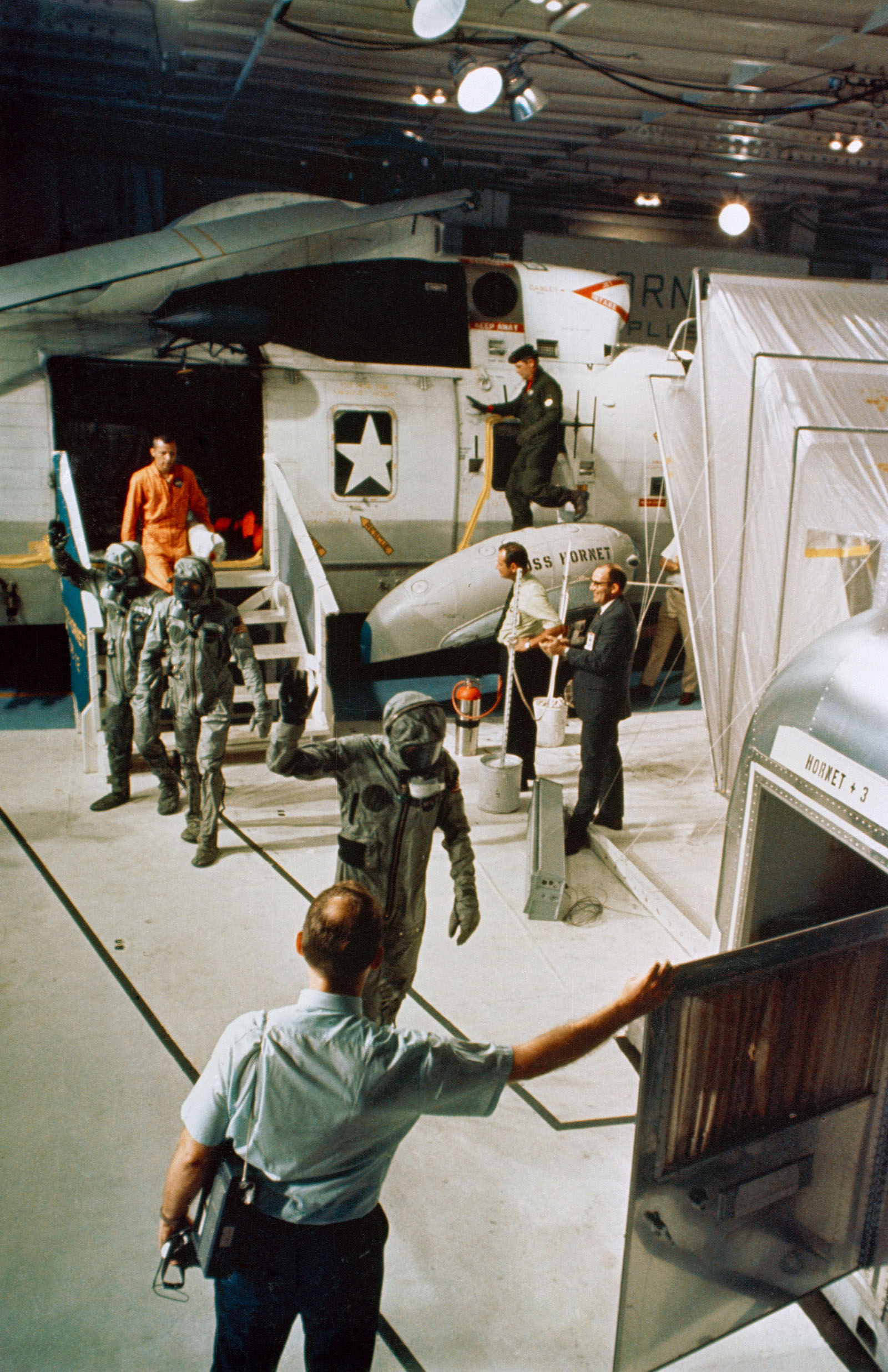
In the early morning hours of July 24, 8 days, 3 hours, 18 minutes, and 18 seconds after leaving Kennedy Space Center, Columbia plopped down into the Pacific Ocean about 200 nautical miles (370 kilometers) south of Johnston Island. Recovery crews from the U.S.S. Hornet arrived quickly and tossed the biological isolation garments into the spacecraft. After the cocooned astronauts emerged from the spacecraft the swimmers swabbed the hatch down with Betadine (an organic iodine solution); then astronauts and recovery personnel decontaminated each other’s protective garments with sodium hypochlorite solution. The biological isolation garments were not uncomfortable in the recovery raft, but aboard the helicopter they began accumulating heat. Both Collins and Armstrong felt that they were approaching the limit of their tolerance by the time they reached the ship.41 An hour after splashdown they were inside the mobile quarantine facility. As soon as they had changed into clean flight suits, the astronauts went to the large window at the rear end of the mobile quarantine facility to accept the nation’s congratulations from President Nixon, who had flown out to the Hornet to meet them.42
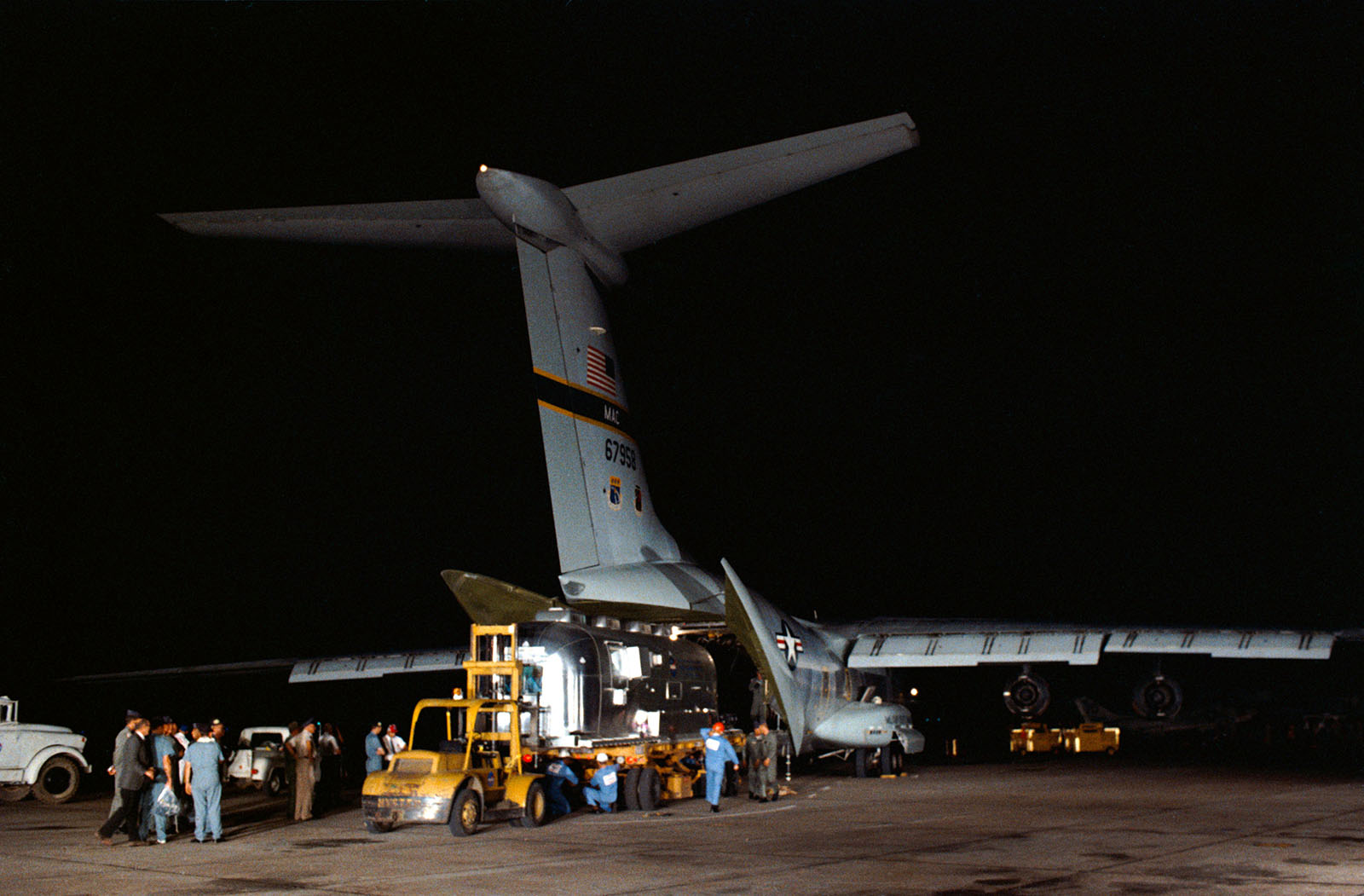
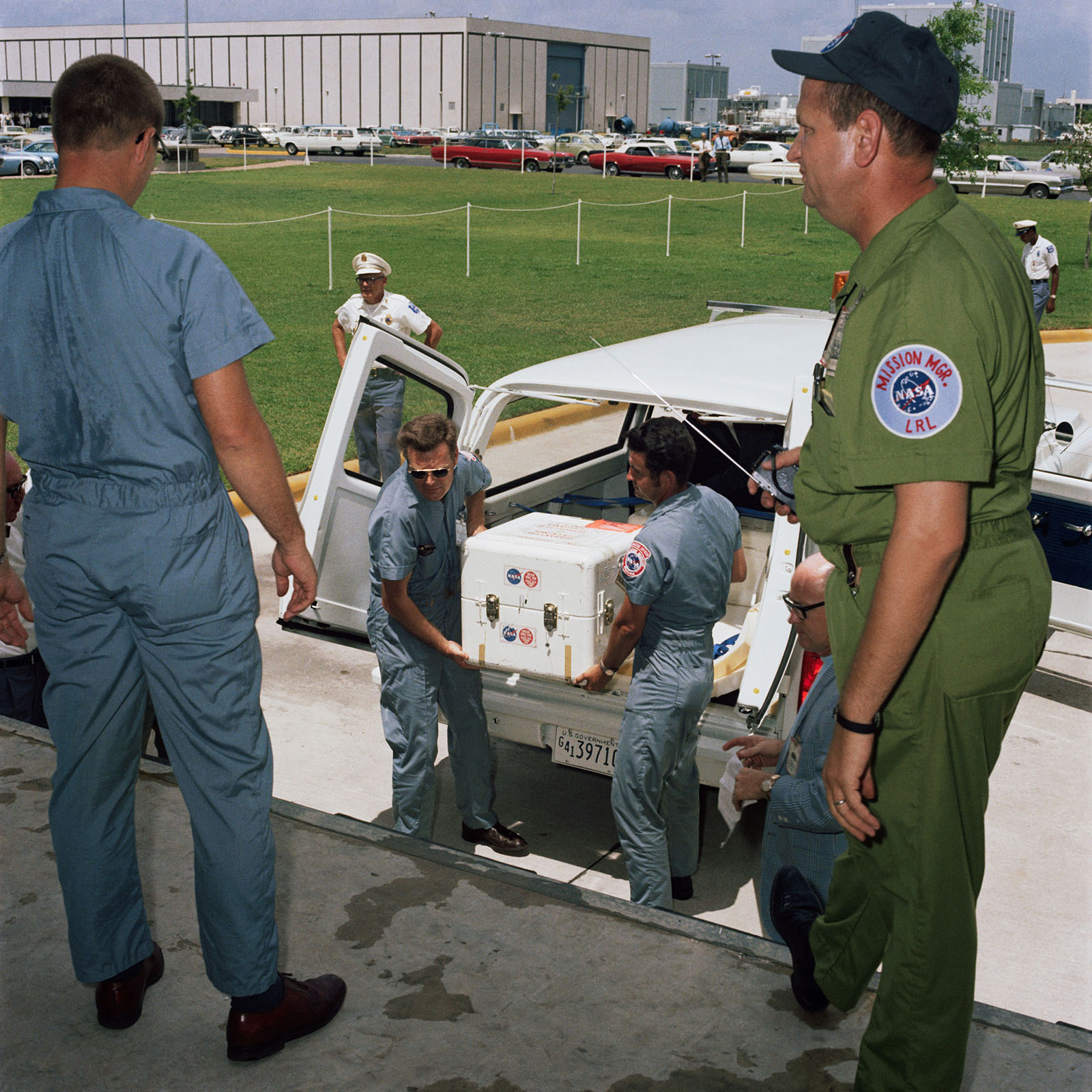
Meanwhile, recovery crews brought Columbia on board and connected it to the astronauts' temporary home by means of a plastic tunnel. Through this, the film magazines and sample return containers were taken into the quarantine trailer, then passed out through a decontamination lock. Sample return container no. 2, holding the documented sample, was packed in a shipping container along with film magazines and tape recorders and flown to Johnston Island, where it was immediately loaded aboard a C-141 aircraft and dispatched to Ellington Air Force Base near MSC. Six and a half hours later the other sample return container was flown to Hickam Air Force Base, Hawaii, and thence to Houston.43
Scientific Work Begins
The first sample container arrived in Houston late in the morning on July 25 and was delivered to the receiving laboratory shortly before noon.44 The second arrived from Hawaii that afternoon.45 For the next few weeks the laboratory was the center of more public attention, probably, than had been focused on any scientific installation in this century. As they had done since the Ranger project and would continue to do throughout the space science program, reporters pressed the scientists for interpretations of their preliminary observations. Obviously any scientific conclusions would have to await detailed study; nonetheless, the scientists answered the journalists as best they could. One was reported to have characterized the result as “instant science,” noting that “We have to look at the stuff and then walk into a news conference, where we should be fairly conservative and reserved … and we talk off the top of our heads, and we're bound to goof some.” 46
After initial inspection the sealed sample return container was transferred to the vacuum laboratory and weighed (33 pounds, 6 ounces; 15.14 kilograms). Film magazines were placed in an autoclave, to be exposed to a gaseous sterilant for several hours before being sent to the photographic laboratory for processing.47
Technicians in the vacuum laboratory then started the container through the process of preliminary examination. Before admitting it to the vacuum system, they passed it through a two-step sterilization, first with ultraviolet light, then with peracetic acid (a liquid biocide), after which it was rinsed with sterile water and dried under nitrogen. Next it was passed through a vacuum lock into the main vacuum chamber. Opening the box was delayed for some hours when the pressure in the vacuum system could not be stabilized. Operators suspected a leak in one of the gloves through which the samples were handled, which was torn in several places.48
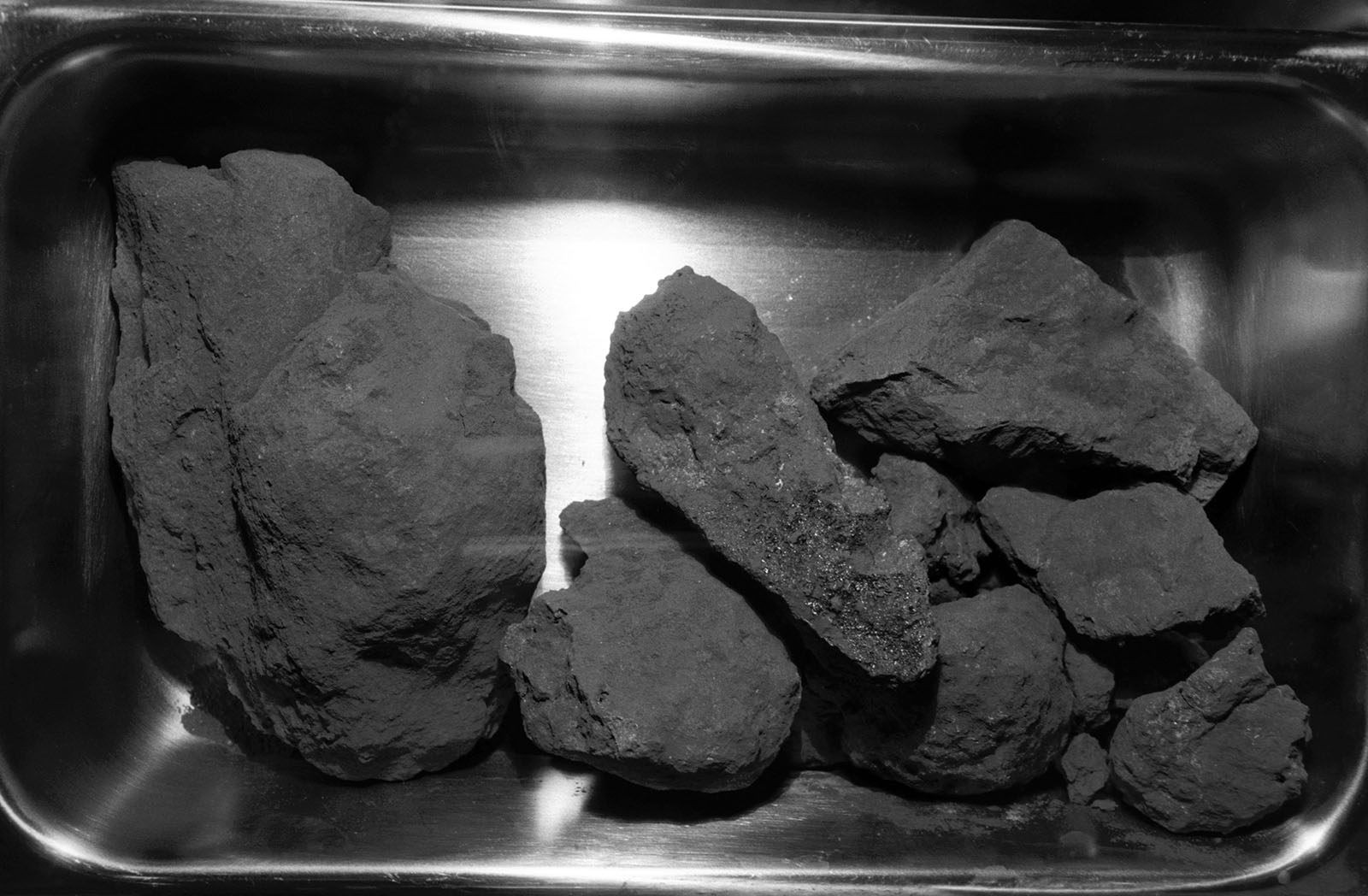
By midafternoon the next day, however, the leak had not worsened and the scientists decided to proceed. At 3:45 p.m. on July 26, as geologists crowded around the observation port at the work station, the cover was removed from the sample return container.49 The first glimpse of moon rocks was frustrating because they were covered with fine dust that obscured their surface characteristics. About all that visual observation revealed was that they were irregular in shape and angular, with slightly rounded edges.50 In addition to the rocks and dust, the sample return container held a solar-wind collector† and two core tubes, with which Aldrin had obtained subsurface samples. These had been least exposed to contaminants from earth and would provide the “bioprime” sample, a 100-gram (3.5-ounce) portion of lunar soil that would be tested for its effects on a variety of living organisms. Core tubes and solar-wind collector were sealed in stainless-steel cans, sterilized, and transferred out of the vacuum laboratory.51
† This was a sheet of aluminum foil that was set out at the start of the astronauts' lunar surface activity to trap particles of the solar wind. Dr. Johannes Geiss of the University of Berne, Switzerland, devised the experiment, which went on every mission; crews called it “the Swiss flag” because it was unfurled along with the Stars and Stripes.
The following week more preliminary data trickled out of the receiving laboratory as two teams of scientists (the lunar sample preliminary examination team, or “LSPET,” and the lunar sample analysis planning team, or “LSAPT”) got down to work. These groups would examine, characterize, photograph, and catalog the specimens and allocate samples to the 142 principal investigators. Working two shifts a day for a while, they determined how the larger rocks would be divided and which ones should be sectioned, basing their judgment on the requirements of the investigators and the availability of the different types of samples. While many members of these teams were later involved in specific investigations, their purpose at this stage was to match samples with research projects to make most effective use of the samples.52
On July 27 technicians removed a rock from the box for low-level radiation counting, dislodging much of the dust from its surface. Geologists immediately classified the specimen as igneous (formed by melting).53 It might be a fragment of lava from a lunar volcanic flow or a rock produced by localized melting, such as might result from a large meteorite crashing into the moon. Careful visual examination disclosed numerous small pits on the surface, as Armstrong had noted during his excursion. The scientists tentatively identified three common minerals, feldspar, pyroxene, and olivine, as the major constituents of the samp1e.54
Spectrographic analysis of a pinch of lunar dust indicated that the surface material from Tranquility Base was much like that analyzed two years earlier by Surveyor V.†† Noteworthy characteristics of the sample included an abnormally high proportion of titanium and relatively small quantities of some volatile elements, which would be depleted in materials aggregated at high temperatures. Microscopic examination of the powdery material (“fines”) showed that more than half of it was composed of tiny particles of glass - shiny spheres, rare dumbbell-shaped beads, and sharp, angular needles and fragments.55
†† The inactive Surveyor V sat some 25 kilometers (15.5 miles) north-northwest of Tranquility Base. The last three Surveyors (V, VI, VII) carried instruments capable of identifying the major chemical elements making up the surface material,; see Surveyor: Program Results, NASA SP-184 (Washington, 1969), pp. v- vi, 7, 271-350.
A few more tidbits emerged from the early work in the receiving laboratory, among them the facts that the samples contained very little carbon (no more than 12 parts per million) and that some of the rocks had lain undisturbed on the lunar surface for a million years or more.56
Preliminary examination of samples and preparation of material for the investigators continued throughout August, aiming at distribution of experimental material as soon as the quarantine protocols were completed. For the first few days work in the laboratory went on as planned; some minor malfunctions in the waste disposal system briefly threatened to break the biological containment but were corrected without incident.57 About the only potential equipment problem was the torn glove in the vacuum chamber. Since replacement was a time-consuming process, technicians jury-rigged a repair by slipping another glove over the damaged one and taping the two together.58 But before the first week was out the gloves ruptured, exposing most of the samples in the system to the atmosphere and sending two technicians into quarantine.59 Work in the vacuum laboratory was suspended while scientists and laboratory managers decided what to do. Problems with the vacuum system had been experienced during premission simulations [see Chapter 8] and provision had been made to fill the chamber with sterile nitrogen gas; that alternative was now adopted.60
The Astronauts in Quarantine
After the President and other celebrities departed, the U.S.S. Hornet continued steaming back to Hawaii, arriving at Pearl Harbor on the afternoon of July 26. The mobile quarantine facility with its five passengers††† was hoisted off the ship onto a truck for transfer to Hickam Air Force Base a few miles away, pausing briefly to acknowledge the greetings of the mayor and several thousand citizens of Honolulu. At Hickam the trailer was loaded into a C-141 cargo aircraft, which departed immediately for Houston.61 Just after midnight the big plane touched down at Ellington Air Force Base, where a large crowd awaited a glimpse of the astronauts. Three hours later the crew and their companions entered their living quarters at the lunar receiving laboratory, which would be their home for at least the next three weeks.62 On hand to greet them were the support personnel who had entered the living quarters the week before: a clinical pathologist, five laboratory technicians, three stewards, photography specialist, Brown & Root-Northrop’s logistic operations officer, and a representative of MSC’s public affairs office.63
††† A physician, Dr. William R. Carpentier, and a technician, John Hirasaki, joined the crew in the quarantine trailer aboard the recovery ship and remained in quarantine with them.
After a day off to recuperate from the stresses of the preceding two weeks - since July 16 they had been cooped up in very close quarters - the crew began a week of intensive technical and medical debriefings. Periodic examinations and blood tests monitored the physiological effects of their flight and recovery, while the doctors kept a close watch for any signs of exotic infection. The living quarters were equipped for routine clinical tests, or even minor surgery; but if a life-threatening medical emergency arose, whether from recognizable or unfamiliar causes, the victim would be transferred out to a hospital regardless of any concern for back-contamination.64
Although all three astronauts were veterans of prior missions, none had ever spent so much time in space, and post-mission activities had never been conducted under strict confinement. Thus quarantine quickly became oppressive, the more so because only meager provision had been made for recreation. An exercise room was available, as well as a Ping-Pong table, and they could read or watch television or talk by telephone to their families, but it was not like being at home. At the conclusion of the technical debriefing sessions, less than a week after they returned, they were called upon to comment on operations in the receiving laboratory. Armstrong was noncommittal, saying that so far it had been going “about as well as you can expect.” Collins’s less tolerant response was, “I want out.” 65
Since no press conference with the astronauts was scheduled before quarantine was lifted, reporters' only source of information was a daily briefing by John McLeaish, the public affairs officer confined in the crew quarters. Once or twice a day McLeaish briefed the press pool through a glass wall in the conference room where the crew debriefings took place. Most of the time he had little to report: everyone inside was healthy, the astronauts were busy with debriefings or writing their pilot’s reports, and otherwise nothing much was going on.66 And so it remained for the duration of the three-week quarantine.
Public Interest in Lunar Samples
While the laboratory teams worked two shifts a day to prepare the sample: for outside researchers, project managers were considering how to deal with a growing public curiosity about the first rocks returned from the moon. Even before Apollo 11 left the launch pad, requests for lunar specimens for display had begun to arrive at the Manned Spacecraft Center. When MSC scientists expressed concern at what these requests might lead to, Apollo project manager George Low asked Headquarters for help in developing a policy to deal with them. Low’s principal concern was that NASA “would arouse the animosity of the scientists in this program by wholesale or capricious distribution of valuable lunar material for nonscientific purposes.” Low considered it appropriate to prepare a few lunar specimens for touring exhibits at major museums in the United States and abroad, provided they were eventually returned to the lunar receiving laboratory for scientific use. He also expected to be asked for samples to be presented to various VIPs; this MSC was willing to do, provided the number and size of such samples could be kept quite small. MSC scientists were alarmed, however, by a White House proposal to present lunar samples to the heads of state of 120 countries.67
Apollo program director Sam Phillips replied that his office was accountable for the spacecraft and all hardware items that had gone to the moon; presumably that responsibility extended to the lunar samples as well (although it appears that this point had not been explicitly settled), and Phillips asked Houston for suggestions as to procedures. Concerning the lending of samples to museums and presentation of souvenirs to VIPs, however, he noted that “The Administrator will make the final determination of the overall allocation of lunar material for scientific and other purposes.” 68 A mid-August general management review at Headquarters reaffirmed this position, stating that the Public Affairs Office had primary responsibility for arranging exhibition, presentation, or other uses of the samples, and it was directed to develop plans for presentation, “if possible, of small amounts of lunar material to Chiefs of State as desired by the President.” The Offices of Manned Space Flight and Space Science and Applications were asked to indicate how much material, if any, and what kind (i.e., rocks or dust) could be made available for such purposes.69
When Headquarters called for that information, MSC’s response reflected the view of lunar scientists. They were not inclined to be liberal in giving away lunar rocks, which they rightly regarded as a priceless scientific resource. Director Robert R. Gilruth replied that he could make available 150 to 200 presentation samples, each consisting of 100 milligrams (less than the volume of an aspirin tablet) of fines from the bulk or contingency samples. Concerning VIP souvenirs, Gilruth said that “we could make available if required about 10 samples of 1 gm each... to be given away if needed [emphasis in the original],” but the Center would prefer not to part with samples that big. For museums, ten 50-gram (1.75-ounce) rock specimens might be made available on loan, provided they could be recalled on one month’s notice by Houston’s curator of lunar samples.70
Not surprisingly, public interest in the lunar samples was tremendous, and in September the first of several displays of moon rocks was opened in the Smithsonian Institution in Washington. Thousands queued up to get a glimpse of a moon rock; many found it disappointingly ordinary.71 Presentation samples - tiny portions of lunar dust, packaged in plastic vials and attractively mounted in plaques - were prepared for the world’s heads of state and presented by astronauts or government officials on world tours. So far as can be determined, no lunar rocks were cut and polished as paperweights for the desks of VIPs.
Astronauts Given Clean Bill of Health
Premission plans called for the astronauts to be kept in isolation for 21 days after their exposure to lunar material. If one of them had developed signs of infection by an exotic organism, or if some adverse effects had appeared in the living systems being tested, their confinement could have been extended. Samples were to be kept until results were in from all the biological protocols, which would be completed within 50 to 80 days after the samples entered the receiving laboratory, depending on test results.72
From the medical standpoint the quarantine of the astronauts was absolutely uneventful. Not the slightest sign of ill effects appeared in any of the astronauts, the support personnel, or the technicians who were quarantined after two breaches of containment in the vacuum laboratory.†††† So, after reviewing the results of initial biological testing and finding no evidence of infectious agents, the Interagency Committee on Back Contamination agreed to release the astronauts and their companions in confinement at 1 a.m. on August 11, one day earlier than originally planned. The committee recommended, however, that they be kept under medical surveillance until biological testing was complete and the samples were released.73
†††† The first, a rupture of a glove in the vacuum system on Aug. 1 (see above), sent two technicians into quarantine; on Aug. 5 a leak in an autoclave exposed four more to lunar materials. The most direct exposure to lunar soil occurred on July 25 when a photo technician picked up a film magazine that Buzz Aldrin had dropped on the lunar surface and found his hand covered with the tenacious black dust. He was already in quarantine but had to decontaminate himself by showering for five minutes. K. L. Suit, “Apollo 11 LRL Daily Summary Report, 1200 July 25 to 1200 July 26.”
The early morning hour for release was quite likely chosen in the hope of avoiding a wild scramble with the news media at the door of the crew quarters. But after a month of close confinement Armstrong, Aldrin, and Collins were not inclined to stay an hour longer than necessary; so at 9 p.m. on August 10, after the last medical examinations had been completed, they walked out of the living quarters, made some brief remarks to the few reporters present, and were whisked away to their homes.74 After a press conference on the morning of the 12th, the astronauts were scheduled to leave on a worldwide personal appearance tour.
Releasing the Samples
Activity in the receiving laboratory remained at a high level.during August, aimed at releasing the samples in mid-September. Two batches of material were prepared for biological examination. A “bioprime” sample, taken from the two core tubes, went to the biological section on July 27, to be examined for evidence of living organisms or their relics. A “biopool” sample, comprising several hundred grams of the “fines” plus chips taken from the lunar rocks in the bulk sample container, provided the material that would be tested in numerous living systems to determine its toxicity or pathogenicity.75 The pooled sample was prepared the following week, and the extensive biological test protocols got under way.76
Throughout August the daily LRL summary reports indicated no observable effects in the biological tests. Lunar material was injected into germ-free mice, cultured to detect growth of microorganisms and viruses, and otherwise introduced into both plant and animal species. In no case was any effect noted that indicated a hazard for earth organisms. Gross and microscopic investigation of exposed systems showed only minor and localized abnormalities, if any. No exotic microorganisms appeared in the cultures. One interesting observation was that the lunar samples stimulated growth in some of the plants tested.77
The Interagency Committee on Back Contamination reviewed the evidence from the biological tests and concluded that the material returned by Apollo 11 was biologically harmless. The committee notified MSC Director Robert Gilruth that he could release the samples at noon on September 12.78 Principal investigators began picking up their allotted samples in person at the lunar receiving laboratory, as required by their contracts, and the detailed investigation of lunar material began.79 Many investigators, however, needed specimens (such as thin sections of rock) that required time to prepare, and sample distribution was only completed several weeks after initial release.80
Scientific Side Issues: Security and Publication
With the return of the unique, expensive, and widely ballyhooed moon rocks, NASA and its scientific advisory bodies anticipated some potential problems that could embarrass both the space agency and the community of lunar scientists. One was the theft or unauthorized use of the samples; another was an unseemly scramble to publish results. To minimize the chances of such undesirable events, the contracts covering the scientific investigation of lunar material stipulated that the contracting institution would establish strict security and accounting procedures for the samples, and that the investigator would reserve initial presentation of all results for a symposium to be held as soon as possible after each mission.81 Both provisions violated established scientific practice to some extent, particularly the agreement to withhold publication; but in view of the unique significance of the lunar samples and the benefits to be gained by discussion at a lunar science symposium, scientists agreed to them.
Not surprisingly, since the samples were released before any of the samples were publicly displayed, requests for permission to display the research samples came in as soon as they were received.82 These were considered case by case at Headquarters and usually were approved.83 This undoubtedly contributed to the public-relations dividends NASA was accumulating from the first lunar landing.
To disseminate the results of the initial lunar investigations to the widest possible audience, NASA took the unusual step of entering into a contract with a single journal84: Science, published weekly by the American Association for the Advancement of Science and circulated in 120 countries. Science undertook to devote a single issue to the preliminary results of the Apollo 11 research and to conduct all the normal work of reviewing and editing the manuscripts on an unusually tight schedule; NASA would cover any excess costs entailed by this accelerated process.85
A week after the samples were released, the lunar sample preliminary examination team published the results of its work - the only results of the first lunar landing to appear in the scientific literature before the symposium scheduled for early January 1970. Inasmuch as preliminary examination was not intended to produce answers to the important scientific questions about the moon, the paper was mostly confined to descriptions of the lunar material and the procedures followed in the lunar receiving laboratory.86
Nonetheless, this early work had produced data that permitted drawing some tentative conclusions. Two generic groups of samples could be distinguished: fine- and medium-grained crystalline rocks of igneous origin, which were probably originally deposited as lava flows, and breccias (heterogeneous crystalline rocks compacted from smaller particles without extensive alteration) of complex history. There was no water at the Tranquility site and probably never had been any since the samples were exposed. Neither was there any significant amount of organic material (considerably less than one part per million), which might have indicated something about life on the moon. The rocks and dust were chemically similar to each other and contained the same chemical elements as igneous rocks on earth. But in their mineral content the igneous rocks were different from terrestrial rocks and meteorites. Evidence was found that the lunar material had been chemically fractionated, some volatile elements being depleted and some refractory (high-melting) elements enriched. One of the more striking conclusions of the preliminary examination was that the igneous rocks on the moon had crystallized between three and four billion years ago - as old as any found on earth, perhaps even older, given the uncertainty in the measurements. Furthermore, the samples collected at Tranquility Base had been within 1 meter (39 inches) of the surface for 20 to 160 million years. Many of the rocks and fines showed signs of having been subjected to severe shock, such as might result from the impact of meteorites. The rounded, eroded surfaces found on many of the rocks suggested continuous bombardment by micrometeorites. Glass-lined surface pits suggested the same thing.87
Interest in the moon rocks tended to overshadow the results of the surface experiments that the astronauts had left behind. The passive seismometer had recorded the footsteps of the lunar explorers as soon as it was activated, and ground-based scientists noted a response when Armstrong and Aldrin tossed out excess equipment before departing. Two fairly large seismic events in the first week of operation excited geophysicists at first, but when they were not repeated the scientists concluded that they could have been false signals originating in the instrument itself. Even so, the very lack of seismic activity was indicative that the moon’s interior was not like the earth’s.88 The other instrument, the laser retroreflector, was difficult to locate from earth because it was in strong sunlight, which made detection of the reflected light pulse difficult. Only after lunar sunset would astronomers be able to use the instrument in the manner for which it had been designed.89
Sketchy as these results were, they clearly showed that Apollo would revolutionize scientific thought about the moon and its relation to the earth. The detailed studies would show how extensive this revolution might be. [see Chapter 14] 90
The End of the Beginning
While editorial writers and columnists pondered the significance of Apollo 11 and where the space program should go, NASA managers and engineers were preparing for the next lunar flight. In the same manned space flight weekly report that documented the lunar landing, George Mueller noted that Apollo 12 was scheduled for launch on November 14 and Apollo 13 would follow on March 9, 1970. For Administrator Thomas O. Paine’s information, Mueller listed the landing sites tentatively assigned to the nine remaining missions. They included one western mare, several sites in the lunar highlands, and two large craters, Tycho and Copernicus - all selected for their scientific interest, some presenting real operational challenges. Missions were scheduled at four- to five-month intervals through December 1972.91
After Apollo 11 such a schedule seemed reasonable. The necessary launch vehicles and spacecraft were either completed or on order. Having finally worked through all phases of a lunar landing mission, operations officers were satisfied that it could be done safely. Mission planners could see many ways to improve operations. Both lunar scientists and NASA engineers would have been happier with longer intervals between launches, but Mueller felt that a tight schedule would keep the skills of the launch teams well honed - and that it would keep costs down.
Cost was important, for NASA’s appropriations had been steadily declining since fiscal 1965, when they peaked at just over $5 billion. For fiscal 1969, Congress had given the space agency just less than $4 billion. To some degree the reductions resulted from declining expenditures in Apollo; but they also reflected a change in the nation’s attitudes during the decade. Heightened public sensitivity to the condition of the cities, the plight of the poor, and the deterioration of the environment put the space program in a different light. When Apollo was proposed, it seemed a way to get the country moving again; in the summer of its achievement, the space program seemed to many an unwelcome drain on resources needed for other purposes.
But it was post-Apollo programs that were most affected by the changing climate of public opinion. The lunar landing project, although it had accomplished its major objective, still offered enough promise for adding to the store of knowledge to retain a constituency and preserve its momentum. After Apollo 11, engineers and scientists alike looked ahead to improving their ability to uncover more of the secrets that lay under the barely scratched surface.
Notes
- Courtney G. Brooks, James M. Grimwood, and Loyd S. Swenson, Jr., Chariots for Apollo: A History of Manned Lunar Spacecraft, NASA SP-4205 (Washington, 1979), p. 261.
- Ibid., pp. 261-62.
- Interview with Joseph P. Kerwin, Jr., Mar. 29, 1985; interview with John R. Sevier, Apr. 24, 1986.
- NASA Release 67-211, Aug. 4, 1967.
- W. David Compton and Charles D. Benson, Living and Working in Space: A History of Skylab, NASA SP-4208 (Washington, 1983), pp. 84-86.
- Interview with Donald K. Slayton, Oct. 15, 1984.
- Brooks, Grimwood, and Swenson, Chariots, pp. 373-77.
- Ibid., pp. 234-35.
- Ibid., pp. 290-91.
- Ibid., pp. 292-99; “Apollo 9 Mission Report,” MSC PA-R-69-2, May 1969, pp. 1-1 to 1-2.
- “Apollo 10 Mission Report,” MSC-00126, Aug. 1969, p. 3-1.
- Charles D. Benson and William Barnaby Faherty, Moonport: A History of Apollo Launch Facilities and Operations, NASA SP-4204 (Washington, 1978), p. 474.
- Brooks, Grimwood, and Swenson, Chariots, pp. 303-12.
- Ibid., pp. 318-26; MSC, “Apollo 11 Crew Training Summaries (Jan. 31-July 15, 1969),” folder in box 081-13, JSC History Office Apollo files.
- Brooks, Grimwood, and Swenson, Chariots, pp. 322-25; Langley Research Center, “Lunar Landing Research Facility and Landing Loads Track,” presentation at Field Inspection of Advanced Research and Technology, Hampton, Va., May 18-22, 1964, copy in box 081-45, JSC History Office Apollo files; George E. Mueller to Robert R. Gilruth, Feb. 19, 1969; Gilruth to Mueller, Apr. 1, 1969.
- Bell Aerosystems Co. release, Jan. 20, 1967, in box 081-45, JSC History Office Apollo files; several good photographs of the LLTV in flight are found in “Series of Lunar Landings Simulated,” Aviation Week & Space Technology, June 30, 1969. See also David F. Gebhard, “Factors in the Choice of LEM Piloting and Testing Techniques,” SAE Preprint 866F, April 1964; Gene J. Matringa, Donald L. Mallick, and Emil E. Kleuver, “An Assessment of Ground and Flight Simulators for the Examination of Manned Lunar Landing,” AIAA Paper 67-238, presented at AIAA Flight Test, Simulation and Support Conference, Cocoa Beach, Fla., Feb. 6-8, 1967; and James P . Bigham, Jr., “The lunar landing training vehicle,” Simulation, July 1970, pp. 17-18, copies in box 08l-46, JSC History Office Apollo files; Richard H. Holzapfel, TWX to NASA, attn.: B. P. Helgeson, May 7, 1968; T. O. Paine to LLRV-1 Review Board, “Investigation and Review of Crash of Lunar Landing Training Vehicle #1,” Dec. 11, 1968; idem, “Investigation and Review of Crash of Lunar Landing Research Vehicle #1,” Dec. 31, 1968.
- Bigham, “The Lunar Landing Training Vehicle.”
- “Apollo 11 Crew Training Summary.”
- Elbert A. King, Jr., interview with Loyd S. Swenson, Jr., May 17, 1971, tape in JSC History Office Apollo files.
- Mueller to Administrator, “Manned Space Flight Report - May 26, 1969.”
- Idem, Manned Space Flight Reports: May 26, June 2, 9, 16, 23, 30, 1969; “Apollo 11 Crew Training Summary” ; Slayton, Flight Crew Operations Directorate Weekly Activity Reports: May 30, June 6, 13, 20, July 3, 11, 18, 1969.
- Julian Scheer to Slayton, June 3, 1969; Slayton to Scheer, “Attendance of Apollo 10 and 11 crews at White House dinner,” June 9, 1969.
- Mueller to Administrator, “Manned Space Flight Weekly Report - July 7, 1969.”
- Slayton, “Weekly Activity Report - June 14-20, 1969, Flight Crew Operations Directorate.”
- Mueller to Administrator, “Manned Space Flight Weekly Report - June 23, 1969” ; ibid., June 9, 1969; Brooks, Grimwood, and Swenson, Chariots, pp. 318-26, 332-34.
- Brooks, Grimwood, and Swenson, Chariots, pp. 337-44; MSC, "Apollo 11 Technical Air-to-Ground Voice Transcription (GOSS Net 1)," July 1969 (hereinafter cited as "Air-to-Ground"), p. 317.
- Air-to-Ground, p. 319.
- Ibid., p. 321.
- Ibid., p. 324.
- Ibid., p. 335.
- Ibid., pp. 322, 332-33, 336, 343-46, 349-50, 412-15.
- Air-to-Ground, p. 377; Brooks, Grimwood, and Swenson, Chariots, p. 346. After the crew returned to Houston, press representatives repeatedly asked what Armstrong had actually said. The Apollo news center at MSC issued the following release (copy in box 078-56, JSC History Office files) on July 30, 1969: "Armstrong said that his words when he first stepped onto the moon were: "That’s one small step for a man, one giant leap for mankind" not "That’s one small step for man, one giant leap for mankind" as originally transcribed."
- Air-to-Ground, pp. 377-79.
- Ibid., pp. 379-400.
- King interview.
- Air-to-Ground, pp. 400-406.
- Ibid., pp. 407-30.
- Ibid., pp. 434-5-l.
- Ibid., pp. 460-88; MSC, "Apollo 11 Technical Crew Debriefing, July 31, 1969," pp. 12-41 to 12-43.
- Air-to-Ground, pp. 488-505.
- Brooks, Grimwood, and Swenson, Chariots, pp. 355-57; "Technical Crew Debriefing," pp. 16-7 to 16- 12; Neil A. Armstrong, Michael Collins, and Edwin E. Aldrin, Jr., to Dir., Flight Crew Operations, "Suitability of the Biological Isolation Garments," Oct. 2, 1969.
- Brooks, Grimwood, and Swenson, Chariots, p. 357.
- “Apollo 11 Mission Report,” MSC-00171, pp. 13-3 to 13-5.
- “Apollo 11 Mission Report,” pp. 13-3 to 13-5; Kenneth L. Suit, “LRL Apollo 11 Daily Summary Report (1200 July 24 to 1200 July 25),” July 25, 1969.
- Suit, “Apollo 11 LRL Daily Summary Report, 1200 July 25 to 1200 July 26.”
- Victor Cohn, “Old Moon Game Taunts Players,” Washington Post, Sept. 21, 1969.
- MSC, “LRL Daily Summary Report No. 3,” July 26, 1969.
- Suit, “Apollo 11 LRL Daily Summary Report, 1200 July 25 to 1200 July 26.”
- [Suit], “Apollo 11 LTD Daily Summary Report, 1200 July 26 to 1200 July 27” ; Richard S. Johnston, “LRL Daily Summary Report No. 4,” July 27, 1969.
- Cohn, “Old Moon Game” ; “Scientists Get First Look at Moon Rocks,” Washington Sunday Star, July 27, 1969.
- Johnston, “LRL Daily Summary Report No. 4.”
- Lunar Sample Preliminary Examination Team, “Preliminary Examination of Lunar Samples from Apollo 11,” Science 165 (1969): 1211-17 (19 Sept. 1969).
- Johnston, “LRL Daily Summary Report No. 4” ; Cohn, “Old Moon Game.”
- Lunar Sample Analysis Planning Team, “Sample Information Summary #1,” July 29, 1969, “Sample Information Summary #2,” July 31, 1969.
- “Sample Information Summary #1.”
- “LRL Summary Report No. 7,” July 31, 1969.
- “LRL Summary Report No. 8,” Aug. 1, 1969.
- Ibid.
- “LRL Summary Report No. 9,” Aug. 2, 1969; “Sample Information Summary #3,” Aug. 2, 1969.
- Ibid.; Johnston, “Lunar Receiving Laboratory Sample Flow Directive, Revision A,” MSC-00002, July 1, 1969, p. 6.
- “Apollo 11 Mission Report,” p. 13-4.
- Ibid.
- MSC Public Affairs Office, “Lunar Receiving Laboratory - Status Report No. 1,” July 21, 1969.
- Idem, “Status Report, John McLeaish Comments on Crew, 7/28/69, CDT 08:05 AM,” July 28, 1969; Richard S. Johnston, Lawrence F. Dietlein, M.D., and Charles A. Berry, M.D., eds., Biomedical Results of Apollo, NASA SP-368 (Washington, 1975), p. 418. If indeed there was a serious risk of contaminating the earth with alien organisms, the decision to breach quarantine in the event of a life-threatening emergency would have meant taking that risk rather than sacrificing an astronaut. No one seems to have contested that decision; perhaps this indicates the real perception of risk from “moon bugs.”
- MSC, “Lunar Receiving Laboratory, MSC Building 37, Facility Description,” September 1968, pp. 8- 19; “Apollo 11 Technical Crew Debriefing,” vol. II, p. 26-4.
- MSC Public Affairs Office, Crew Status Reports, July 28-Aug. 10, 1969.
- George M. Low to NASA Hqs., attn.: Lt. Gen. S. C. Phillips, “Special Lunar Samples for Museum Display or Presentation to VIPs,” July 7, 1969.
- Phillips to Low, “Lunar Sample Accounting,” Aug. 5, 1969.
- Willis H. Shapley to multiple addressees, “Lunar Sample Material,” Aug. 19, 1969. It was reported that Nixon offered the President of Indonesia and other chiefs of state “a piece of the moon as a souvenir” ; New York Times, July 28, 1969, cited in Astronautics and Aeronautics, 1969: Chronology on Science, Technology, and Policy, NASA SP-4014 (Washington, 1970), p. 249.
- Phillips, TWX to Low, Aug. 15, 1969; Robert R. Gilruth to Rocco A. Petrone, “Non-Scientific Use of Lunar Samples,” Sept. 5, 1969.
Forwarding the latter memo to George Low, Wilmot Hess (whose deputy, Anthony Calio, had drafted it for Gilruth’s signature) stressed his own distaste for the plan to present large samples to VIPs - a distaste that was shared by the lunar scientists. Elbert King, who had been appointed first curator of lunar samples, did everything he could to prevent distribution of any lunar samples as souvenirs. When he first heard of the plan to present souvenirs to VIPs, his impression was that “they were talking about big polished pieces of rock for paperweights…. Here was priceless scientific material that was going to be cut up as political trophies.” The White House proposal was even more offensive to King, and when a Washington paper called him to ask for his reaction, he commented that it would be unthinkable - a reaction which, he recalled later, “caused much unhappiness within the center, because here was someone [at MSC] disagreeing with the President, and that’s very poor form.” Elbert A. King, Jr., interview with L. S. Swenson, Jr., May 27, 1971, tape in JSC History Office files; Marti Mueller, “Trouble at NASA: Space Scientists Resign,” Science 165 (1969): 776-79.
Nixon had already drawn considerable adverse criticism from some newspapers, which accused him of trying to turn Apollo to his own political advantage in spite of his negligible record of supporting the space program. His telephone call to the astronauts on the moon, the addition of his signature to those of the astronauts on the commemorative plaque on the lunar module Eagle, and his visit to the Hornet (on his way to a tour of Asia), were all cited as attempts to get unmerited credit for the Apollo accomplishment. See the editorial in the Washington Post, “Our Mark on the Moon,” July 3, 1969; Herblock’s cartoon “Lunar Hitchhiker,” Washington Post, July 6, 1969; “Plaque Pique,” Washington Evening Star, July 9, 1969; Marianne Means, “President Nixon and the Astronauts,” Los Angeles Herald-Examiner, July 13, 1969; “Hate the President,” Richmond (Va.) News Leader, July 15, 1969; William Hines, “Nixon Skims Off the Cream,” Washington Sunday Star, July 27, 1969.
- “8,200 View Moon Rock,” Washington Evening Star, Sept. 18, 1969, “'It looks like any rock,'” Washington Daily News, Sept. 18, 1969.
- Johnston et al., Biomedical Results of Apollo, p. 419.
- “Minutes, Interagency Committee on Back Contamination,” Aug. 10, 1969.
- Don Kirkman, “Germ-Free Apollos Sent Home,” Washington Daily News, Aug. 11, 1969; Albert Sehlstedt, Jr., “Astronauts Brace For Celebrations,” Baltimore Sun, Aug. 12, 1969.
- “Apollo 11 LTD Daily Summary Report, 1200 July 26 to 1200 July 27” ; Wilmot N. Hess, “LRL Summary Report No. 7,” July 31, 1969.
- A summary of the investigations is found in Johnston et al., Biomedical Results of Apollo, pp. 425-34.
- MSC, “Sample Information Summary #5 Final,” Aug. 27, 1969, p. 13; see also LRL Summary Reports for Aug. 1 through Aug. 31.
- J. W. Humphreys, Jr., to Dir., MSC, “Release of all lunar material and lunar exposed material in Building 37, Manned Spacecraft Center, Houston, Texas,” Sept. 11, 1969.
- Rocco A. Petrone, TWX to Gilruth, “Approval of MSC proposed allocation of Apollo 11 lunar sample material for distribution to approved principal investigators for scientific analysis,” Sept. 9, 1969; Petrone, TWX to Gilruth, “Release of lunar samples,” Sept. 12, 1969; NASA Hqs., “Moon Surface Samples Distributed,” Release No. 69-130, Sept. 12, 1969.
- Richard A. Wright, “Lunar and Earth Sciences weekly activity report,” Oct. 17, 1969.
- Paine to Gilruth, Sept. 8, 1969. Some investigators did not conform to the ban. In November, a scientist at the U.S. Geological Survey wrote indignantly to MSC’s director of science and applications, enclosing clippings that indicated some findings had been released prematurely and outside of normal scientific channels. According to one, Harold Urey had stated in a talk in San Diego that the Apollo 11 samples had been found to be 4.6 billion years old, which supported his theory of the moon’s origin. G. Brent Dalrymple to Anthony J. Calio, Nov. 13, 1969, with encl., copy of article, “Moon Rocks' Age Is Now Firmly Fixed,” San Francisco Chronicle, Nov. 8, 1969.
- E. F. Bartell (Cornell Univ.), TWX to Space Sciences Procurement Branch, MSC, Sept. 16, 1969.
- William L. Green, TWX to MSC, attn. Brian Duff, Oct. 3, 1969.
- Donald U. Wise, TWX to MSC, attn. Dr. W. Hess, Aug. 11, 1969.
- Philip H. Abelson, “The Moon Issue,” Science 167 (1969):447.
- The Lunar Sample Preliminary Examination Team, “Preliminary Examination of Lunar Samples from Apollo 11,” Science 165 (1969):1211-27.
- Ibid., p. 1226.
- Cohn, “Seismometer on Moon Registers Disturbance,” Washington Post, July 23, 1969, “Moon Tremor Recorded by Apollo Device,” ibid., July 24, 1969.
- Idem, “Moon Tremor Recorded.”
- Idem, “Old Moon Game Taunts Players.”
- Mueller, “Manned Space Flight Weekly Report - July 28, 1969.”