FIRST PHASE OF LUNAR EXPLORATION COMPLETED: 1969-1970
Lunar exploration began in earnest with the launch of the first “H” mission, Apollo 12. Successful in all respects, Apollo 12 crowned the accomplishments of 1969 by establishing the ability to put the lunar module down on the moon within walking distance of a desired spot. That done, the next mission was planned for a landing on the Fra Mauro Formation, the site highest on the scientists' priority list. Apollo 13 was targeted to land there, but an equipment failure forestalled a lunar landing and came close to costing three lives. Real-time improvisation saved NASA from calamity and demonstrated the versatility of the Manned Spacecraft Center’s mission planning and mission control teams. [see Appendix 8] After a thorough investigation that delayed subsequent missions by almost a year, Apollo 14 was assigned to land at the same site.
Not long after Apollo 12 returned, scientists gathered in Houston to present the results of their investigations of the first lunar samples. In what was surely one of the most exciting scientific conclaves of the century, practically all existing theories of the moon’s origin were thrown into doubt in one respect or another, and scientists were more eager than ever for data. Shortly after that conference, management at MSC sat down with lunar investigators and worked out ways of increasing the amount and quality of the data to be returned by future Apollo missions.
Their expectations, however, were soon reduced when the pressures of a tightening federal budget forced cancellation of one of the planned Apollo missions. Faced with drastic reductions in funding, NASA managers chose to allot more of the available money to post-Apollo programs on which continuation of the manned space flight program depended. Apollo 11 had ushered in an era of hard choices, not expanding horizons.
Intrepid Seeks Out Surveyor III
The morning of November 14, 1969, was cold, cloudy, and wet at Kennedy Space Center. Weather radar showed rain showers marking a cold front 80 miles (130 kilometers) north of the Cape and moving south. With launch only hours away, rain, broken low clouds, and overcast at 3,000 meters (9,800 feet) caused launch officials to consider their options. Reports indicated no thunderstorms or severe turbulence in the area, however, and conditions were better than the minimums specified by launch rules. An hour and 22 minutes before liftoff, a pump replenishing liquid oxygen in the launch vehicle tanks failed. With success depending on a backup pump, launch director Walter Kapryan chose to proceed.1 The crew had trained intensively for the specific features of the planned landing site, and if the day’s launch window closed, that site would not be accessible for another month.
At 11:22 a.m. Eastern Standard Time, President Richard M. Nixon - the only incumbent chief executive ever to witness an Apollo launch - along with 3,000 invited guests and a large crowd of tourists, watched as the Saturn V rose from the pad and accelerated toward the clouds. Just before the vehicle disappeared into the overcast, two streaks of lightning flashed toward the launch complex. In the command module Yankee Clipper, mission commander Pete Conrad heard the master alarm. He looked at the caution and warning panel, and “it was a sight to behold.” Sixteen seconds later another bolt discharged, and Conrad told Houston, “We just lost the platform [in the inertial guidance system], gang: I don't know what happened here; we had everything in the world drop out.” 2 The fuel cells had automatically disconnected and several panel gauges were temporarily disturbed, but otherwise everything seemed normal. After the crew reset the fuel cells, the flight continued while Mission Control tried to figure out what had happened and what the consequences might be. The best guess seemed to be that the launch vehicle, trailing its plume of ionized (and electrically conductive) exhaust gas, had triggered a lightning discharge that otherwise would not have occurred. Except for nine telemetry sensors not essential to the flight, all systems were normal.3
Apollo 12 flew smoothly into a normal earth orbit, and after the inertial guidance system was realigned and all systems checked out, Houston gave the signal to fire the S-IVB stage for translunar insertion. Three and a half hours into the flight, command pilot Richard F. Gordon turned command module Yankee Clipper around, extracted the lunar module Intrepid from its stowage site atop the third stage, and Apollo 12 continued on its way to the moon.4
The only midcourse correction maneuver of the outbound flight was performed the next day, a 9.2-second burn that put the spacecraft on a fuel - saving hybrid trajectory.5 For the rest of the uneventful three-and-a-half-day trip to lunar orbit, the crew spent their time housekeeping, tending to spacecraft systems, and observing the earth and the moon.6
Arriving at the moon 83 ½ hours after liftoff, Conrad fired the main propulsion engine for almost 6 minutes to go into an elliptical lunar orbit. Five hours later a second burn put the spacecraft into a circular orbit at 60 nautical miles (111 kilometers) altitude, where Yankee Clipper would stay until it was time to return to earth. The spacecraft passed over and photographed Apollo 13’s landing area in the Fra Mauro formation, and on the tenth revolution Conrad notified Capcom Gerald Carr that “you can tell good Captain Shaky [Jim Lovell, commander of Apollo 13] that he can relax. We've got his pictures.” 7
Six hours into the fourth day, Conrad and Bean prepared to enter and activate the lunar module. Both were having trouble with their biomedical sensors; Conrad’s were blistering his skin and Bean’s were producing erratic signals. Both men cleaned and reattached their electrodes, then finished donning their space suits and began preparing Intrepid for departure.8
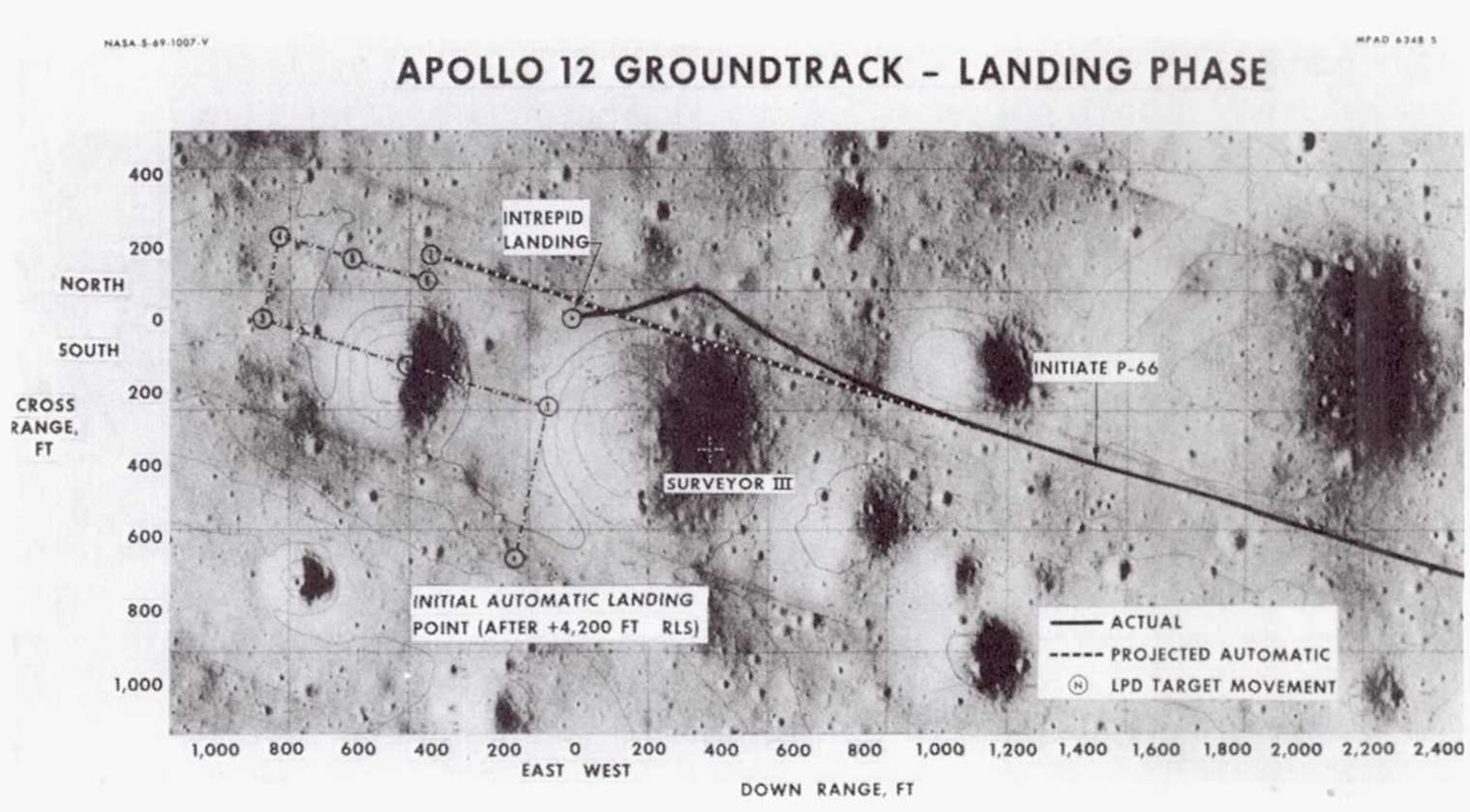
For the next several hours Conrad and Bean in Intrepid and Gordon in Yankee Clipper were busy setting up their guidance and navigation computers and exchanging data with the ground. When all was ready, Gordon turned the spacecraft so that the long axis of the command and service module was perpendicular to the flight path with the lunar module outward from the moon, retracted the docking latches, and fired his attitude-control thrusters to move Yankee Clipper away from Intrepid.9 The landing craft was 5 miles (8 kilometers) north of its intended ground track - largely as a result of an error in the landing site location and the inability to adequately correct for the moon’s irregular gravity field. This and other errors would be removed by the instructions transmitted to the guidance computer after the lunar module headed down for its landing.10
On the back side of the moon in the 13th revolution, the computer triggered a 29-second firing of the descent engine, bringing the low point of Intrepid’s orbit to 8.1 nautical miles (15 kilometers). As the lander passed north of Mare Nectaris, Conrad turned it on its back with the descent engine pointed along the flight path and switched the engine on to begin the final approach. Everything went exactly as expected, and after two minutes Conrad commented that it “feels good to be standing up in a g-field again.” Three minutes later the module’s attitude-control thrusters began firing busily - more than Conrad thought they should - but Houston assured him that all was well.11
After seven minutes Intrepid nosed over into a near-upright position and for the first time Conrad could see the lunar surface. The principal landmark identifying his landing point was a pattern of craters the astronauts called “Snowman”; Surveyor III lay halfway up the eastern wall of the crater that was the Snowman’s torso, and Intrepid was targeted for the center of the crater. As soon as he could see out the window, Conrad cried delightedly, “Hey, there it is [Snowman]! There it is! Son of a gun! Right down the middle of the road!” Then, as Bean called out altitude, velocity, and quantity of fuel remaining; Conrad maneuvered the craft with his hand controller to pick a smooth spot to land on. The engine exhaust began kicking up dust about a hundred feet (30 meters) above the surface and by the time Intrepid reached 50 feet ( 15 meters) the cloud obscured the surface completely. At 1:54:36 a.m. EST on November 20, Pete Conrad made a blind landing - exactly where, he could not tell, but certainly close to the intended spot.12
Conrad was naturally anxious to determine where he had set Intrepid down, and while he and Bean went through the post-landing check list they occasionally looked out the windows for landmarks that would allow Houston to pinpoint their location, but without success. After changing his mind a time or two, Conrad finally concluded, “I'm not sure that I'm not sitting fight smack on the other side of the Surveyor crater, just a little bit past it.” Two hours later, Dick Gordon in Yankee Clipper confirmed Conrad’s guess when he sighted both Intrepid and Surveyor III through his sextant as he passed over the site. He told Houston that the lunar module was “on the left shoulder of the Snowman… , about a third of the way from the Surveyor crater to the head.13 Postmission calculations placed Intrepid on the northwest rim of the Surveyor crater, 535 feet (163 meters) from the inert spacecraft.14 Had there been windows in the back of the lunar module, Conrad could have spotted the Surveyor as soon as the dust settled.
After postlanding checks of systems, Conrad and Bean described what they could see from their spacecraft. Intrepid had landed in undulating terrain pocked with craters ranging from a few feet to several hundred feet across, the larger ones rimmed by large blocks of rock. Numerous boulders, up to 20 feet (6 meters) in size, were scattered around the site, most of them angular rather than rounded, many showing fillets of dust around the base. Immediately in front of the landing craft Bean saw an area of “patterned ground” - parallel cracks in the surface soil perhaps an eighth of an inch (3 millimeters) deep. From the lunar module the crew could distinguish no color differences in the rocks or soil; everything seemed the same bright white.15
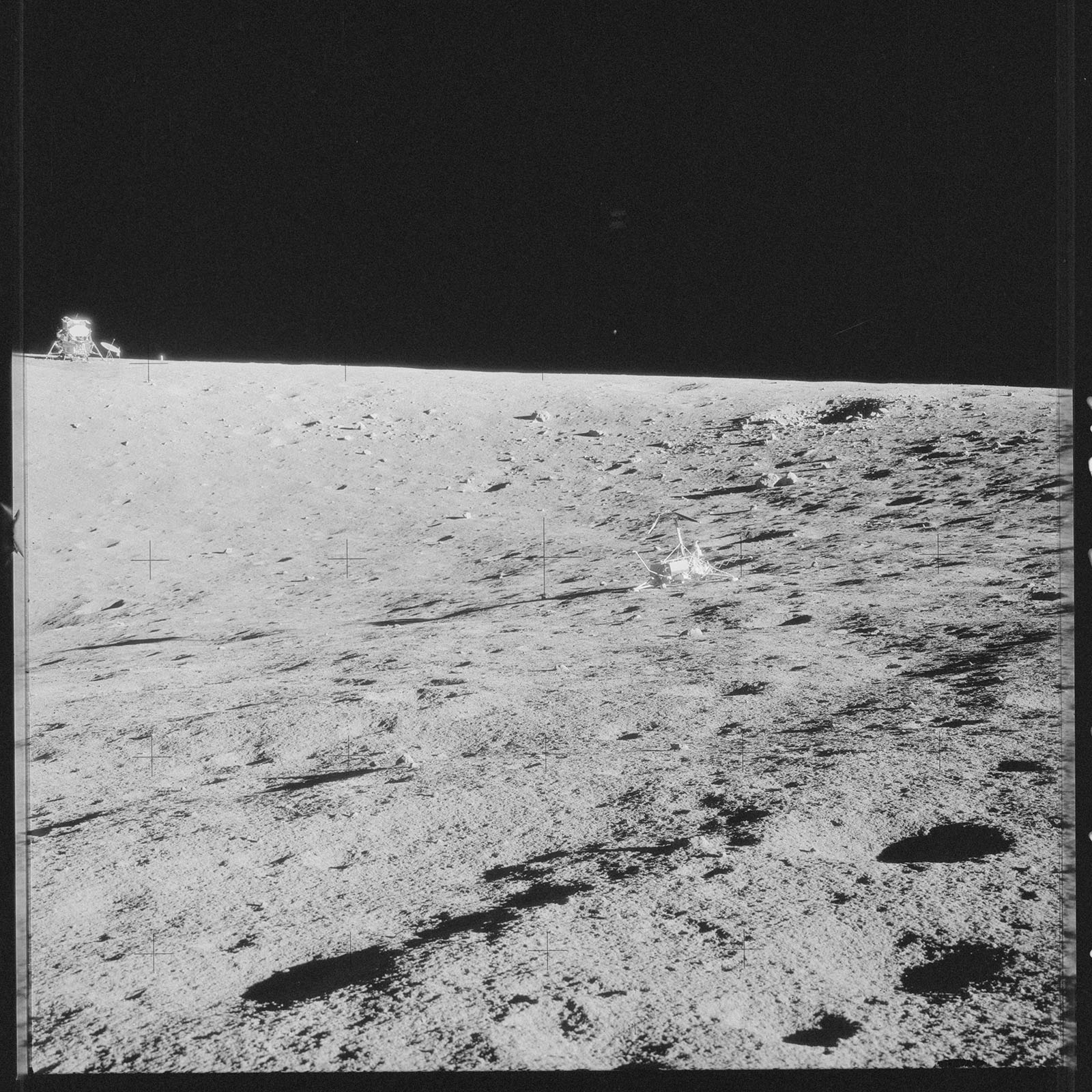
Five and a half hours after landing, Conrad squeezed out the hatch, then clambered down the ladder to the bottom rung. As he stepped off onto the landing pad Conrad remarked, “Man, that [step] may have been a small one for Neil, but that’s a long one for me.” *** Looking around, he spotted the Surveyor halfway up the opposite wall of the crater. One of the first things Conrad noticed was that he was going to get extremely dirty: the surface dust was finer and deeper than he had expected.16
*** At 5 feet 6 inches (168 centimeters), Conrad was one of the shorter astronauts; Armstrong was just under 6 feet (183 centimeters). The lowest rung of the ladder was about 2.5 feet (75 centimeters) above the landing pad.
After Conrad had collected the contingency sample Bean joined him on the surface, bringing the television camera with him. A few minutes later Houston reported that the camera was not working. Cursory attempts at trouble-shooting were fruitless, and television coverage for the mission - desirable but not essential - had to be written off.**** 17 The explorers pressed on with their other chores, apparently enjoying themselves immensely; Conrad chuckled and hummed to himself as he went about examining the lunar module, collecting and photographing samples, and describing the landscape.18
**** After examination determined that the image-tube target in the camera had been damaged by exposure to intense light. Apparently Bean had inadvertently pointed the camera at the sun or a reflection off the lunar module while helping Conrad set up a directional antenna. MSC-01855, "Apollo 12 Mission Report," March 1970, p. 14-50.
The primary objective of their first excursion was to deploy the scientific experiments. Conrad and Bean unloaded the package easily, picked a spot 130 meters (425 feet) northwest of the lander, and laid out the instruments without any serious difficulty.19 On their way back to Intrepid they picked up more documented samples and Bean took a soil sample with the core tube. After nearly four hours on the surface, the astronauts returned to the lunar module, dusted each other off as best they could without brush or vacuum cleaner, and climbed back inside. After a brief evaluation of the day’s work and some discussion of the next day’s plans, Houston signed off and the two astronauts strung up their hammocks and turned in.20
Overnight the geologists in Houston, working from several scenarios prepared before the mission, formulated detailed plans for the geology exercise the astronauts would carry out on their second outing. Next morning, when Bean and Conrad were awake and ready to talk, CapCom Paul Weitz read through the plans with them, discussing the scientists' recommendations for sampling and photography, while the astronauts offered comments based on the previous day’s experience. Then they domed and checked over their space suits, recharged with oxygen their portable life-support systems, vented the cabin, and set out to collect samples.21
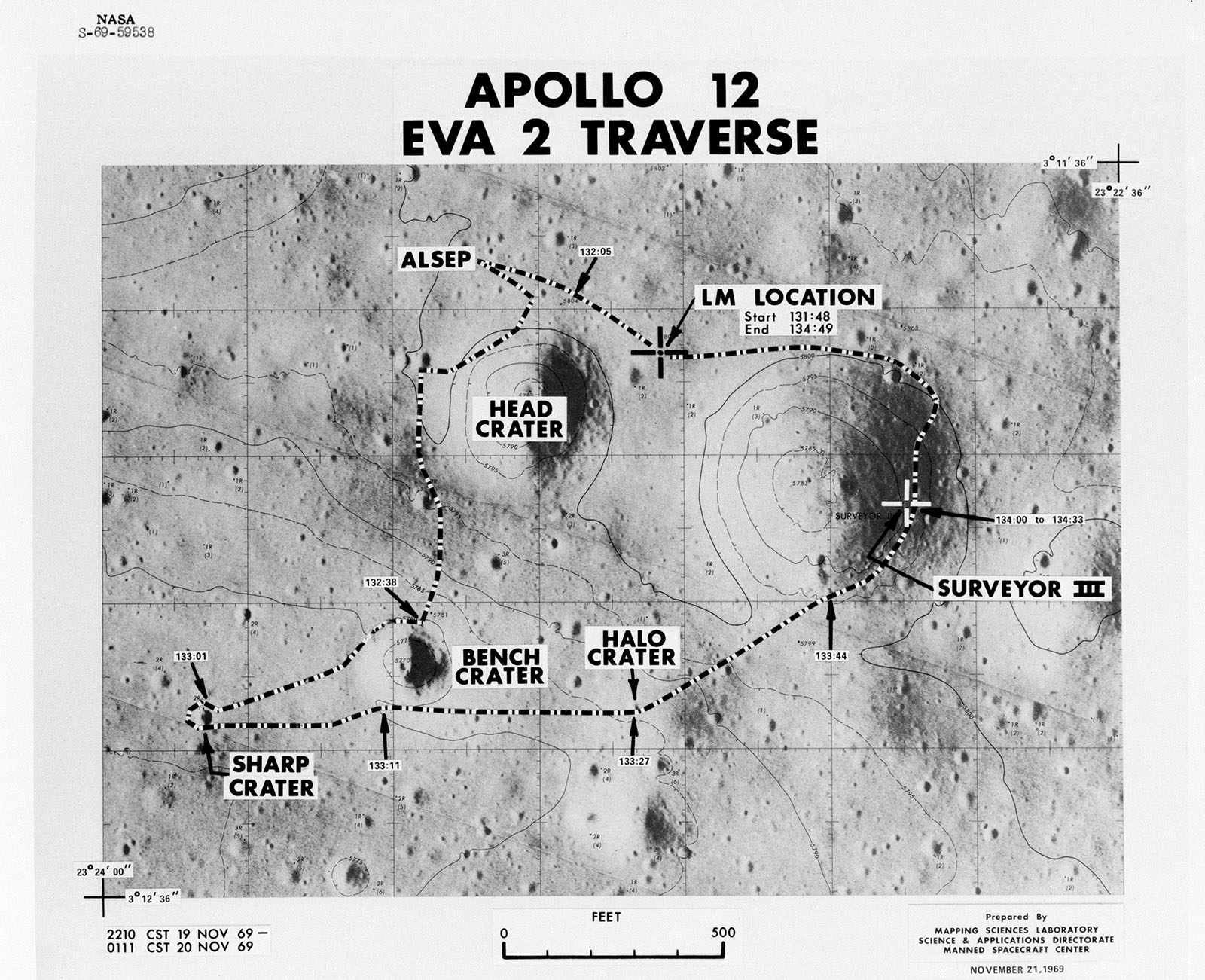
During the next four hours Bean and Conrad covered something more than one kilometer (3,300 feet), following a large-scale photographic map prepared for the traverse and chatting constantly with each other and with Houston.22 Scientists in Houston followed their progress from their references to the maps they carried. The extensive conversation was intended to substitute for a geologist’s field notes.23 On the nearly featureless lunar surface, sampling proved somewhat difficult; except for size, most of the rocks showed few distinguishing features. Colors and textures were not always easy to determine, and when they were, the astronauts tended to use nonscientific terms in describing them - probably a symptom of their sensitivity to possible misuse of geological terminology. At one point Conrad noted a rock containing a “ginger-ale-bottle green” crystal (which was probably olivine), and a few minutes later Bean spotted a rock he said “looks almost like a granite,” but immediately added, “of course it probably isn't, but it has the same sort of texture.” Bean and Conrad documented their samples carefully, photographing many of them and describing the location and bag number for later reference. At “Head” crater, following instructions from Houston, Conrad dislodged a medium-sized rock and allowed it to roll down the slope to determine whether the seismometer some 70 meters (230 feet) away could detect it (it did). Then it was on to “Bench” and “Sharp” craters, where they sampled several large rocks on the surface that might be bedrock thrown out when the craters were formed.24
Two hours into the traverse the astronauts were on the edge of the Surveyor crater. The slope of the crater wall was much less than it had appeared the day before, when the low sun cast long, deceptive shadows. Pausing to reload a camera and survey the situation, they decided it would be easier to walk across the slope of the crater wall rather than come down from the rim. Approaching from the side, they could take photographs of the landing-pad imprints and the trenches dug by Surveyor’s remotely controlled arm without disturbing the surface. These would be compared with television pictures transmitted from the spacecraft immediately after its landing.25
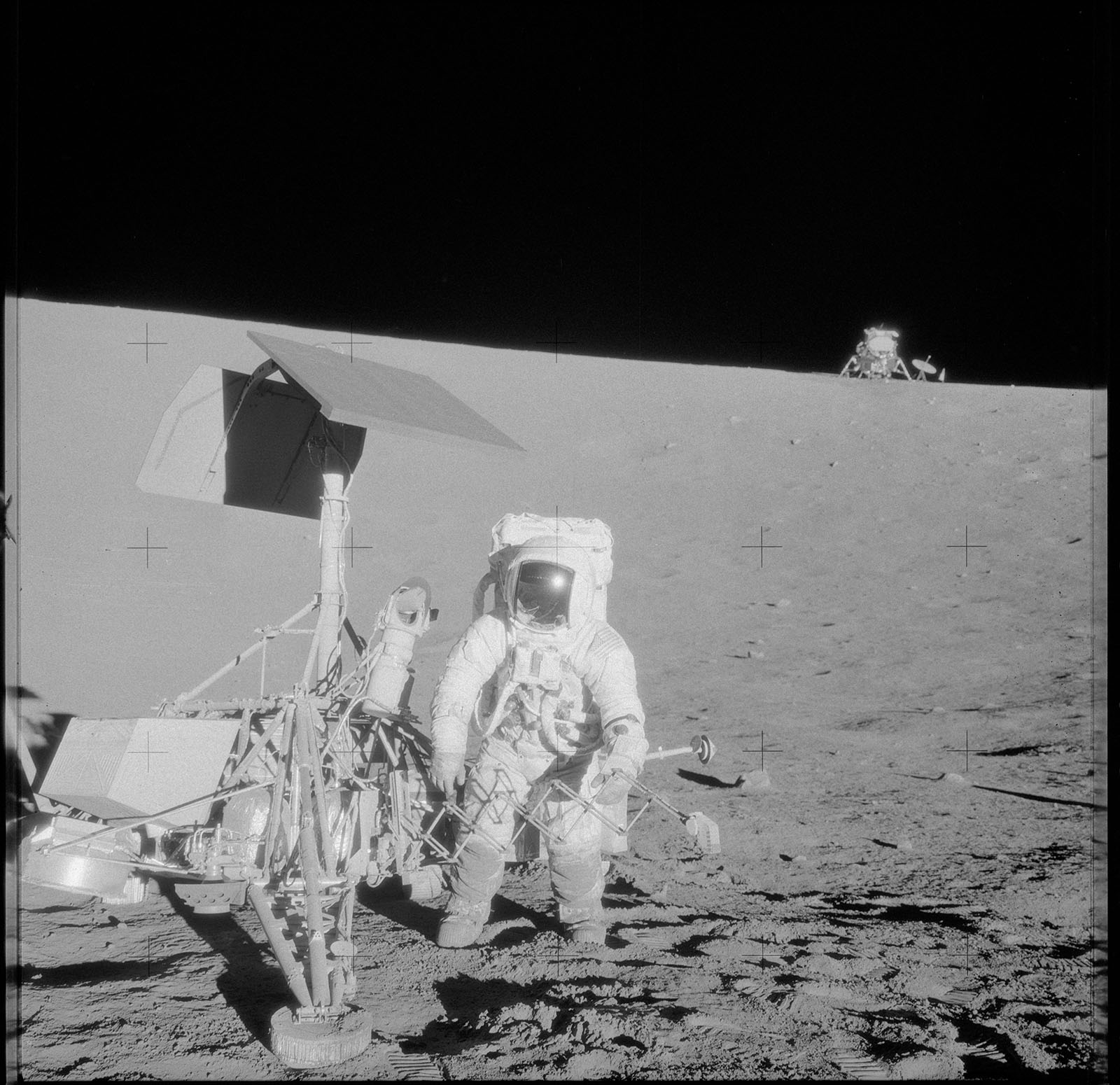
Examination of the Surveyor, the only human artifact ever encountered in lunar exploration, was among the more interesting parts of the mission for Conrad and Bean. What they noticed first was that much of its originally white surface had turned brown - a change they attributed to a deposit of dust when they found it could be wiped off. After photographing the surrounding surface and examining the spacecraft, they removed the Surveyor’s television camera and cut off pieces of electrical cable and structural tubing for study by scientists at the Jet Propulsion Laboratory. They decided to remove the trenching scoop as well; then, after collecting soil samples, they headed for another small crater to take a few more samples on their way back to the lunar module.26
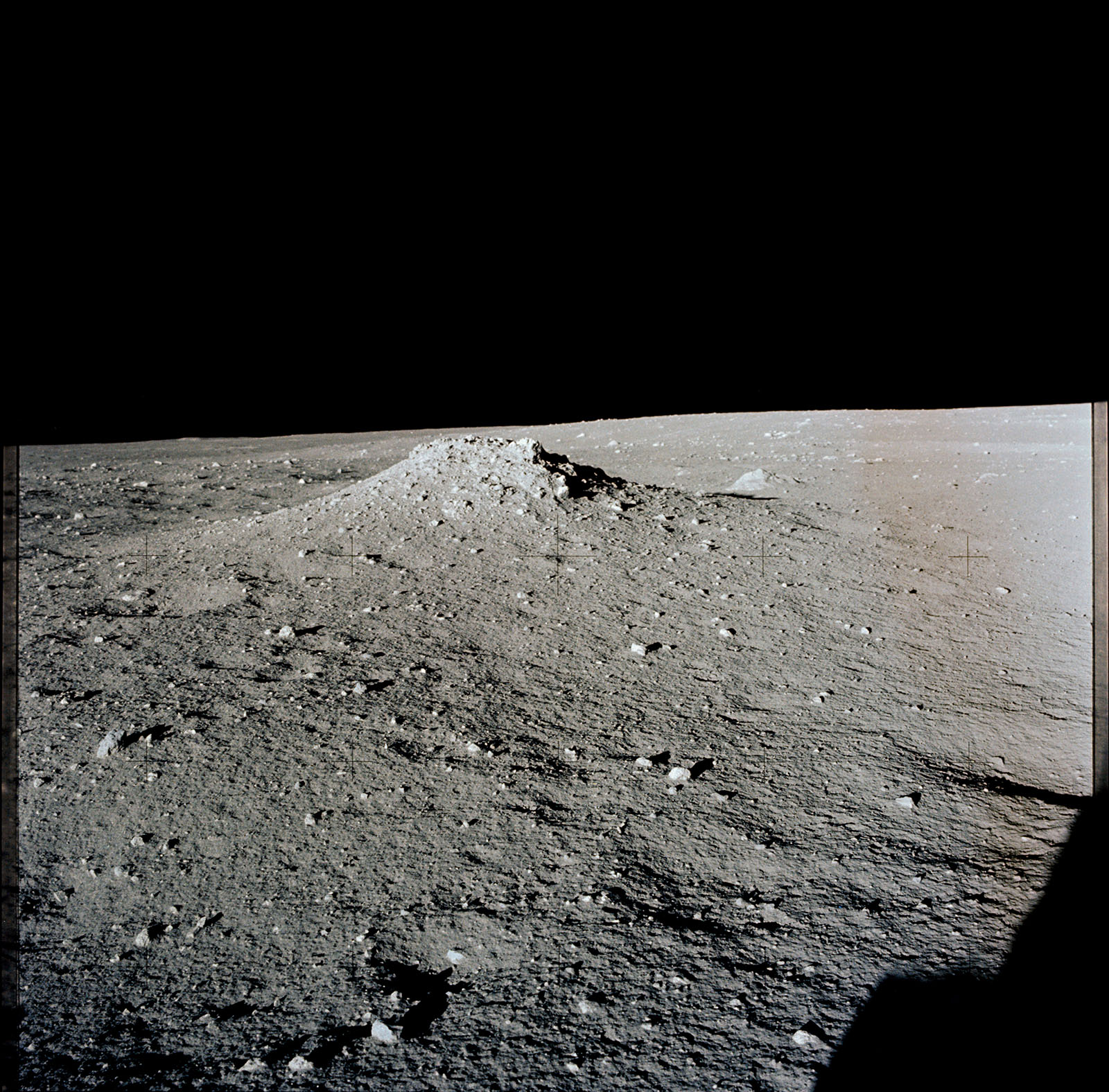
Back in their spacecraft, Conrad and Bean had almost six hours before lifting off to rendezvous with Yankee Clipper. After throwing out their portable life-support systems they straightened up the cabin, stowing the rock boxes and improvising stowage for the television camera, which Houston wanted to examine. They had carried in considerably more lunar dust than Armstrong and Aldrin had reported; Conrad told Houston they looked like “a couple of bituminous coal miners right at the moment, but we're happy.” 27
Despite the fact that they had trebled the existing record for lunar surface activity, Bean and Conrad were not exhausted and had expended about 10 percent less energy than anticipated. Both returned to the lunar module with almost 40 percent of their oxygen supply remaining on both excursions.28 Bean suggested to the medical officers that he would have enjoyed an occasional drink of water while working on the surface; not that he felt dehydrated, but he would have been more comfortable if he had been able to relieve the dryness in his mouth.29
Intrepid’s ascent stage lifted off the moon on time, and an hour and a half later Conrad had Yankee Clipper in sight. Back in lunar orbit the dust the lunar explorers had brought in with them began to float, thick enough to be visible in the cabin. After the two spacecraft had docked they attempted to vacuum up the dust, with little success, so they removed and packaged their suits in the lunar module, hoping to minimize contamination of the command module. In spite of their efforts, considerable dust clung to everything they brought back and remained suspended in the atmosphere; the environmental control system seemed not to filter it out as completely as had been expected.30
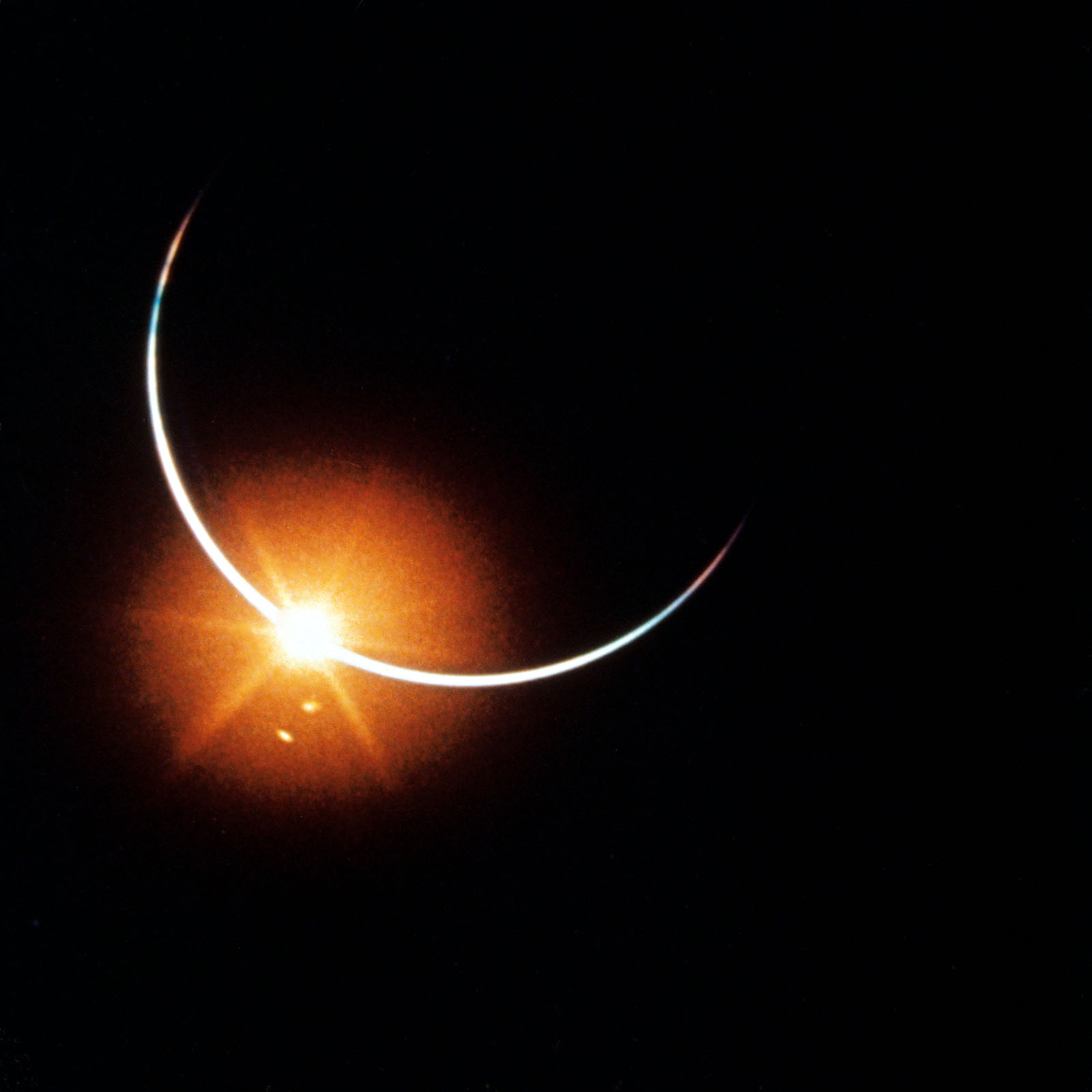
Intrepid, now a useless hulk, still had one more contribution to make to the scientific objectives of the mission. For the benefit of seismologists wanting to calibrate the instrument that Bean and Conrad had just left on the moon, Mission Control now burned the empty spacecraft’s remaining fuel to take it out of orbit. At a speed of 1.67 kilometers per second (3,735 miles per hour) the ascent stage plowed into the moon 76 kilometers (47 miles) east-southeast of the instrument package, producing a bizarre response: the seismometer recorded vibrations that persisted almost undiminished for nearly an hour. It was so completely unlike anything ever seen on earth that seismologists had no immediate explanation. One scientist compared the result to striking a church bell and hearing the reverberations for 30 minutes.31
Yankee Clipper stayed in lunar orbit for 11 more revolutions, finishing up the “bootstrap” photography and landmark tracking, looking at sites being considered for Apollo 14 and 15. Then the crew boosted their spacecraft out of lunar orbit and settled in for the three-day voyage home. Now and then they chatted with the duty CapCom about something that crossed their minds concerning their exploration. Once in a while scientists wanted to debrief them concerning details of their lunar surface activity. For most of the time, however, they relaxed.32
At one point both Conrad and Bean passed along some reservations they had about the field geology exercise. They had found the lunar surface a particularly difficult one for classical field-geological techniques. Bean commented,
…we talked with [the geologists], before we went, about [the fact that] the main objectives of the geology wasn't to go out and grab a few rocks and take some pictures, but to try to understand the morphology and the stratigraphy… of the vicinity you were in. Look around and try to use your head along those lines. Well, I'll tell you, there [were] less than ten times I stood in spots … and said, “Okay now, Bean, … is it possible to look out there and try to determine … which is first, which is second, and all that?” … That whole area has been acted on by these meteoroids or something else so that all these features that are normally neat clues to you on earth are not available for observation.
Conrad concurred: “I think even a trained geologist would have trouble doing a whole lot of field geology that way on the moon.” 33 Long afterward, Bean still felt that astronauts could be most effective on the lunar surface by selecting and documenting as many apparently different kinds of samples as possible rather than attempting on-the-spot geologizing.34 During a press conference on the last day out, Conrad was asked whether he thought it would be desirable to have a geologist as a member of the crew. He did indeed think so, but pointed out that landing Intrepid had required all the piloting skill he had35 - implicitly echoing Deke Slayton’s contention that landing on the moon was not yet a job for a novice.
Early on the morning of November 24 Apollo 12 splashed down some 600 kilometers (375 miles) east of Pago Pago, 3.5 kilometers (2 miles) from the recovery ship U.S.S. Hornet. The landing was rough - apparently Yankee Clipper hit a rising wave as it swung on its parachutes - hard enough to dislodge a 16-mm movie camera from its bracket and slant it into Alan Bean’s forehead, momentarily stunning him and opening a 1-inch (2.5-centimeter) cut, which Conrad bandaged.36
The recovery swimmers soon arrived, tossed respirators and coveralls - replacing the biological isolation garments that the Apollo 11 crew had found so objectionable - into the command module, then assisted the astronauts into the raft. Half an how later recovery helicopters set the crew down aboard the Hornet and they went straight to their mobile quarantine facility. Lunar sample containers and film magazines were removed and flown to Pago Pago and thence to Houston. The astronauts had a longer journey: four days aboard ship to Hawaii, then a nine-hour flight to Houston. On the morning of November 29, Conrad, Bean, and Gordon entered the Lunar Receiving Laboratory for their 11-day stay in quarantine.37
That Apollo 12 was a success was apparent even on preliminary evaluation. The procedural changes incorporated to improve landing accuracy had allowed Conrad to put Intrepid down within sight of Surveyor III, exactly as intended. Lunar exploration had been easy; neither Bean nor Conrad encountered any unexpected difficulties and both had oxygen to spare when they returned. And while they had found it hard to apply their field - geology training on the unrevealing surface of Oceanus Procellarum, they had collected nearly 75 pounds (34 kilograms) of samples, most of them documented. The surface experiments they had set up were returning streams of data, and scientists agreed the astronauts had done a remarkable job. Communication between scientists in Houston and the astronauts on the moon had been well handled by Mission Control.38 If Apollo 12 was a reliable indicator, the scientific return from the remaining eight missions should be gratifying.
Lunar Receiving Laboratory Operations
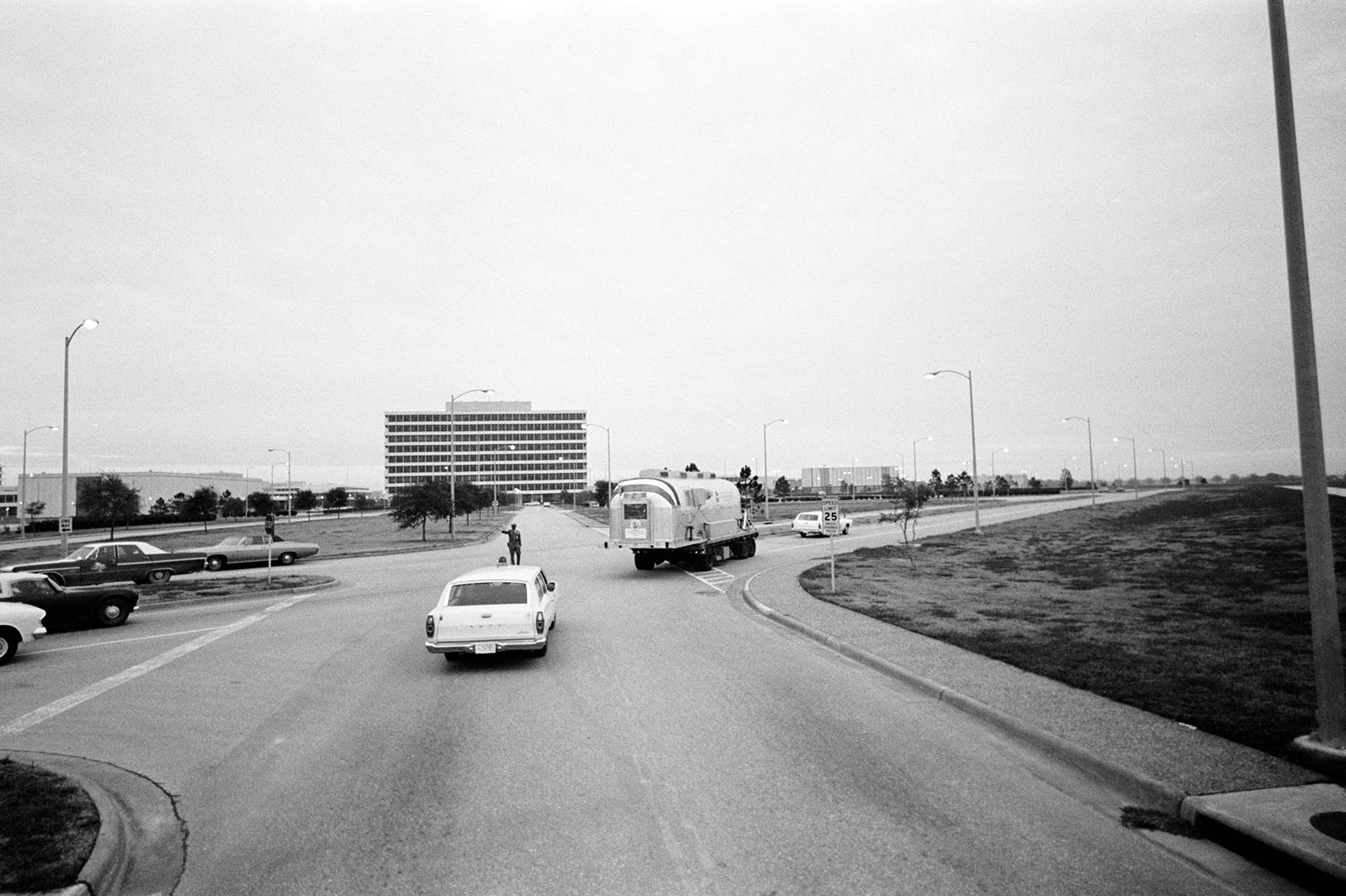
The modifications to equipment and procedures [see Chapter 10] necessitated by experience with Apollo 11 were completed and the Lunar Receiving Laboratory was ready for operations before Apollo 12 left the launch pad.39 When the sample containers arrived in Houston, the one containing the documented samples was transferred to the biological laboratory to be opened under sterile nitrogen, while the bulk sample container was opened in the vacuum system. The first quick look showed that Conrad and Bean had selected larger rocks than Armstrong and Aldrin did, and that there were noticeable differences: the Apollo 12 samples were almost entirely igneous, whereas the earlier specimens had contained about 75 percent breccia (rocks formed by compaction without alteration).40 Still more samples arrived with the astronauts on November 29. Lacking room in the sample return containers, Conrad had brought back several large rocks as well as the Surveyor parts in the command module.41
After samples were taken for biological testing,42 the Preliminary Examination Team began its work. This time they concentrated on description and photographic documentation of the contents of the rock boxes, saving detailed examination until later, so that the Lunar Sample Analysis Planning Team could begin its work earlier. During this preliminary examination a small cut appeared in one of the chamber gloves. The incident was treated as a “spill” of lunar material that contaminated the laboratory and sent 11 people into quarantine, including several scientists from the Preliminary Examination Team.43 Providing quarters for that many additional people presented a problem, but by putting extra beds in the available rooms and using the Mobile Quarantine Facility (which could be connected with the Crew Reception Area), all were accommodated. The scientists were disappointed in being cut off from work with the samples, but preliminary examination continued Without them.44
Other than the fault in the chamber glove, operations in the receiving laboratory went smoothly. A week after the samples were returned, all had been inventoried and given preliminary examination, the sample for biological testing had been prepared, and two samples had been delivered to the radiation counting laboratory for assay of low-level radioactivity.45
By mid-December scientists in the Lunar Receiving Laboratory had determined some of the' basic characteristics of the Apollo 12 samples. Some members of the site selection board had objected to the Apollo 12 site on the grounds that it was too much like Apollo 11’s [see Chapter 10], but these analyses showed otherwise. Chemically, the rocks from both sites were similar, containing the same elements but in somewhat different proportions. Only two rocks from Apollo 12 were breccias, however, which predominated in the Apollo 11 samples. Many of the igneous rocks returned by Apollo 12 were very coarse grained, suggesting that they might have crystallized slowly, probably at considerable depth. While the Apollo 11 samples had been notably rich in titanium, those from Apollo 12 were not. Both types were deficient in volatile elements. Olivine comprised only about 10 percent of the first samples but was abundant in the second set.46 Petrological examination indicated that the Apollo 12 rocks had crystallized at a high temperature.47 Preliminary potassium-argon dating suggested that the samples from Oceanus Procellarum had solidified some 2.2 to 2.6 billion years ago, compared to about 4 billion years for those from the Tranquility site.48 Detailed results from the work of principal investigators would not be available for some months, but these preliminary findings provoked considerable discussion at the first Lunar Science Conference the following month.
Elsewhere in the Lunar Receiving Laboratory, the crew and their companions in confinement had an uneventful three weeks. Debriefings by engineers and scientists took up several hours a day for the first week; preparing the pilot’s report required much of the next, and they were grateful to have the uninterrupted time to complete this chore. Visits by their families - through the glass wall in the conference room - plus television and movies and the occasional game of pool or Ping-Pong, provided some diversion. Conrad worked on assembling an FM receiver kit but did not complete it. The scientists managed to get some samples passed in to them in the crew reception area and were able to continue work on the samples to a limited extent. They also got the chance to discuss the lunar traverses with Conrad and Bean, using photographs as they became available.49
Periodic medical evaluations showed no change in the condition of either the crews or the quarantined scientists, and on December 10, 36 hours before the quarantine officially ended, they were released, to be kept under medical surveillance until biological tests on the samples showed them to be no threat to life on earth.50
Throughout December those tests continued as the Apollo 12 samples were exposed to dozens of plant and animal species. Meanwhile the examination and characterization of the lunar rocks and soil continued, and the Lunar Sample Analysis Planning Team began the task of matching investigators' requirements with the samples. Release of material to outside researchers was scheduled as soon as the biological tests were completed, expected in early January 1970.
The First Lunar Science Conference
The decade of Apollo ended with investigators of the lunar samples preparing to present their first findings to the scientific world. On January 5, 1970, several hundred scientists, including all 142 principal investigators for the Apollo 11 samples, met in Houston for the first of many annual Lunar Science Conferences. For four days they discussed the chemistry, mineralogy, and petrology of the lunar samples, described the search for carbon compounds and evidence of living material, the results of age determinations, and what had been learned from the data returned from the surface instruments.
The flood of information presented at the conference precluded any large generalizations. Some of the rocks brought back by Apollo 11 were basalts, formed by melting, but the samples contained a high percentage of breccias. Most of the rock fragments were similar to the larger rocks; a small number, however, were entirely unlike the rest and may have come from the nearby lunar highlands. The properties of most of the material were consistent with formation at high temperature in the absence of oxygen or water. More than 20 minerals known on earth had been identified, suggesting a similarity of origin for the two planets, but at least three new ones unique to the moon had been discovered. The ages of the lunar rocks and soil seemed to differ: the basalts from Tranquility Base were found to be between 3 and 4 billion years old, while the soil contained particles believed to have been formed 4.6 billion years ago.51 In light of the recently determined age of the Apollo 12 samples, which were roughly a billion years younger, these numbers indicated that more than one cataclysmic event had shaped the lunar surface.
Other studies showed that some lunar material dug up from below the surface had once been on the surface, indicating that the lunar soil was undergoing constant “gardening.” Studies of isotopes produced by cosmic-ray bombardment indicated that some lunar rocks had been on or just below the surface for at least 10 million years.52
The search for carbon compounds - possible relics of life forms in the moon rocks - was inconclusive, in part because the methods of detection were extremely sensitive. Carbon and some carbon compounds were detected, but no molecules that could clearly be identified as derived from living organisms. The intensive search for living organisms conducted in the Lunar Receiving Laboratory was negative, as were efforts to identify fossil microorganisms.53
On the whole the early work on the Apollo 11 samples was more intriguing than revealing. A few scientists were willing, on the basis of the results presented at the Houston conference, to discard one or more theories of lunar origin, but most were not. One commented, “some still like the moon hot; some like it cold.” Many called attention to the limitations of the data and the futility of drawing sweeping conclusions with information from such a small area. One of them put it in perspective with the comment, “what I looked at was an area equal to the size of three postage stamps and a thimbleful of material” ; another remarked facetiously, “our results are based on the wanton destruction of two grams [about the weight of a dime] of lunar material.” 54
After four days of discussion, a panel of prominent scientists attempted a summary at a news conference. Robert Jastrow, director of NASA’s Goddard Institute for Space Studies, said that “old descriptions in terms of a hot or cold moon are an oversimplification.” To Edward Anders of the University of Chicago it was clear that the moon “has been a geologically active body with several episodes of melting and lava flows.” For the last two or three billion years, however, it has been almost dead. Jastrow and others doubted that the moon was thrown off from the earth or that it was formed elsewhere and captured later. Gene Simmons, newly appointed chief scientist at MSC, summed up the state of lunar science at the end of the conference. “There is a large amount of undigested data and very little interpretation,” he said. “You'll see in the next six months many revisions of statements as to what it all means.” 55
The Lunar Sample Analysis Planning Team best characterized the significance of the Tranquility samples:
The Apollo 11 samples were collected from a very tiny fraction of the moon’s surface. Nevertheless, they have given a vast new insight into the processes that have shaped this surface and have established some significant limits on the rates and mechanisms by which it evolved. The results reported do not resolve the problem of the origin of the moon. However, the number of constraints that must be met by any theory have been greatly increased. For example, if the moon formed from the earth, it can now be stated with some confidence that this separation took place prior to 4.3 x 10E9 [4.3 billion] years ago. Furthermore, such a hypothesis must now take account of certain definite differences in chemical composition [between the moon and the earth]…. There is clear evidence … that the surface of the moon is variable in both composition and age. It is therefore of great scientific importance to obtain materials from a variety of terrains and sites [emphasis added].56
After the conference ended on January 8 the scientists returned to their labs to continue probing the lunar samples, while NASA focused on sampling the variety of terrains and sites they deemed so important. The next mission, Apollo 13, was already targeted for the Fra Mauro Formation,57 a geologic unit that covered large portions of the lunar surface around Mare Imbrium. The landing site was just north of the crater Fra Mauro, about 180 kilometers (112 miles) due east of the spot where Pete Conrad had landed Intrepid.
MSC Increases Emphasis on Science in Apollo
Early in 1970 MSC set about to improve its relations with the lunar science community. As the first lunar science conference was meeting in Houston, Jim McDivitt, manager of MSC’s Apollo spacecraft program office, took note of scientists' frequent complaints that MSC was unable or unwilling to accommodate changes in the experiment program. “I would like to take steps to change this impression and to attempt to generate a 'can-do' attitude toward science changes consistent with operational and other constraints,” McDivitt said. He intended to establish a schedule for each mission, “to provide information to the science world which will discipline their inputs to our schedule needs,” and to establish an Experiments Review Group, which was to consider new or late experiments for the missions to recommend MSC policy on experiment changes. McDivitt himself would chair the group, which included Anthony J. Calio, director of science and applications, Deke Slayton, director of flight crew operations, and Richard S. Johnston, former special assistant to the center director now assigned to McDivitt’s office.58
The first lunar science conference apparently brought the question of MSC’s handling of science to a head, for Director Robert R. Gilruth moved to change his center’s antiscientific image at the same time. On February 5, 1970, he and 11 of MSC’s highest-ranking managers met with 9 prominent scientists involved in the Apollo program to discuss issues between the two groups.# Several specific problems were discussed and resolved. One major flaw the scientists found in the conduct of Apollo science involved contact between astronauts, principal investigators, and operations planners. Since there was not time to make nonscientists astronauts over into scientists, the investigators insisted on giving experimenters more time to discuss the objectives of the experiment with the astronauts, thus improving the astronauts' understanding of what they could do to enhance the results. Geologists had enjoyed an advantage in this respect, but the experimenters pointed out that other disciplines were involved in lunar investigations and should get more attention in training. Another point involved communication between scientists on the ground and astronauts on the moon; this ought to be made easier, the scientists said, so that surprises could be dealt with when encountered and procedures altered in real time if necessary. When it was pointed out that this would require the principal investigators to learn how to use the existing systems to best advantage, including participation in simulations, the scientists agreed to take on that responsibility.59
# MSC was represented by Gilruth; Deputy Director Christopher C. Kraft, Jr.; George Abbey, technical assistant to Gilruth; Anthony J. Calio, director of Science and Applications; M. Gene Simmons, chief scientist; Donald K. Slayton, director of Flight Crew Operations; Thomas P. Stafford, chief of the Astronaut Office; Harrison H. Schmitt, astronaut; John Zarcaro, chief of the Lunar Missions Office; Ted H. Foss, Geology and Geochemistry Branch; Glynn S. Lunney, Flight Control Division; and Richard S. Johnston, Apollo Spacecraft Program Office. Scientists attending - most of them principal investigators on Apollo were James R. Arnold, Univ. of California at San Diego; Paul W. Gast, Columbia Univ.; Marcus G. Langseth, Jr., Lamont-Doherty Geophysical Observatory; Frank Press, Mass. Inst. of Technology; Robert Rex, Univ. of California at Riverside; Gordon A. Swann, U.S. Geological Survey; Robert Walker, Washington Univ., St. Louis; and Gerald J. Wasserburg, Calif. Inst. of Technology. Homer E. Newell, NASA Associate Administrator, attended as an observer.
Finally, participants agreed to clarify relations between outside scientists and MSC offices. In general experimenters should be more forthcoming with explanations of the scientific rationale for experiments and MSC should simplify and expedite reviews of proposed experiments and changes in existing plans. A general improvement in communication between MSC, the scientists, and Headquarters was necessary.60
Associate Administrator Homer E. Newell, who attended the meeting, later commented approvingly to Gilruth that “the entire discussion was in a constructive vein,” and that “some very complimentary remarks were made … about MSC’s current approach to handling science.” As associate administrator for science and applications, Newell had for years tried to mediate between the scientists and manned space flight officials, and he found the new attitudes gratifying on both sides.61
MSC immediately followed up on the February meeting by establishing a Science Working Panel to be the single forum in which science requirements and operational restrictions would be reconciled and adjusted. The working panel would be advised by principal investigators and scientists representing the entire spectrum of science. A science mission manager and a mission scientist (usually a scientist-astronaut) would be assigned for each flight.62 When scientists briefed astronauts on the conduct of their experiments, a representative of MSC’s Flight Control Division would sit in as well, to ensure complete understanding all around.63
The February meeting and its consequences were a considerable relief to scientists involved in Apollo. Newell later commented that “the experimenters' feeling of effectiveness increased steadily with each new Apollo mission until with Apollo 17 … the scientists were positively ecstatic.” 64
Personnel and Program Changes
The last months of 1969 brought changes in several key offices in NASA Headquarters and the centers. Thomas O. Paine, who had succeeded James Webb as NASA administrator less than a year earlier, called George M. Low to Headquarters to become deputy administrator, the agency’s second-ranking official.## After guiding Apollo through its most difficult years and at long last establishing the first post-Apollo project (Skylab), George Mueller announced his intent to resign as Associate Administrator for Manned Space Flight at the end of the year. The Air Force reassigned Lt. Gen. Sam Phillips, longtime manager of the Apollo Program Office under Mueller, to command its Space and Missile Systems Organization. As Mueller’s replacement Paine named Dale D . Myers, Apollo spacecraft manager at North American Rockwell for many years; Phillips’s place was filled by Rocco A. Petrone, director of launch operations at Kennedy Space Center. At Houston, Gilruth appointed Col. James A. McDivitt, command pilot on Gemini IV and commander of Apollo 9, to head the Apollo spacecraft project office and Christopher C. Kraft, Jr., MSC’s director of flight operations, to be deputy center director.65 MSC also had a new Director of Science and Applications, Anthony J. Calio, who succeeded Wilmot Hess after Hess’s resignation in the fall [see Chapter 10].
## At the time Low, who took over as manager of MSC’s Apollo spacecraft project office after the AS-204 fire in April 1967, was serving as special assistant to MSC Director Robert R. Gilruth.
New managers faced new problems in the year following Apollo 11’s resounding success. Public enthusiasm for lunar missions waned when, with Apollo 12, they began to seem routine. Funding prospects were also bleak. Lyndon Johnson’s last budget submittal (in January 1969) requested $3.878 billion for NASA,66 nearly 25 percent lower than the budget for the peak year, fiscal 1965. When Richard Nixon’s first budget was submitted in April, that figure was reduced to $3.833 billion. Paine put the best face he could on the situation; the reductions would require “difficult program adjustments,” but in the context of the administration’s determination to reduce government spending, “the nation can continue a scientifically effective program of manned lunar exploration” and the capability to produce Saturn V boosters would not lapse beyond recovery.67 When the space agency’s appropriation bill was signed in November, it provided only $3.697 billion, and the adjustments became even more difficult.68
Besides being economy minded, the new administration was in no hurry to establish a position on space. Early in 1969 the new President appointed a Space Task Group### to study the space program, calling for a report in six months on alternatives for the post-Apollo period. Predictably, the group’s report, submitted on September 15, recommended a balanced program of manned and unmanned space activity. Its most radical suggestion was that NASA should adopt a new long-range goal, comparable to the Apollo goal that had sustained space exploration for eight years, to provide the impetus for new developments. For that goal they suggested manned exploration of the planets, specifically a manned landing on Mars by the end of the 20th century. Three options were proposed: an all-out effort, including a 50-man earth-orbiting space station and a lunar base, culminating with the Mars landing in the mid-1980s; a less ambitious program providing for evaluation of an unmanned Mars landing before setting a date for the manned mission; and a minimum program that would develop a space station and a shuttle vehicle but would defer the Mars landing to some unspecified time before the end of the century. Costs were estimated at between $8 billion and $10 billion per year by 1980 for the most ambitious option and from $4 billion to $5.7 billion annually by 1976 for the least.69
### Chaired by Vice-President Spiro T. Agnew, the group included Robert C. Seamans, Secretary of the Air Force and former deputy administrator of NASA; Thomas O. Paine, NASA Administrator; and Lee A. Dubridge, Science Adviser to the President. Observers were U. Alexis Johnson, Undersecretary of State for Political Affairs; Glenn T. Seaborg, chairman of the Atomic Energy Commission; and Robert P. Mayo, director of the Bureau of the Budget.
Nixon’s reaction to the Space Task Group report was not immediately forthcoming. His press secretary declined to predict when the President would make a decision, but said that competing domestic programs and the constraints imposed by inflation would certainly have to be considered in funding any new space ventures.70
Public reaction to the proposal of a manned flight to Mars was generally negative. The Washington Post suggested that such a trip should be weighed carefully in terms of its potential scientific value: “It is knowledge we seek, not spectaculars…. “71 A point of view shared by many scientists was expressed at the annual meeting of the American Association for the Advancement of Science (AAAS) in December by Gordon J. F. MacDonald, who characterized it as “the utmost folly.” Retiring AAAS president Waiter Orr Roberts said that the United States should not set a goal of sending men to Mars “now or ever.” 72 Even congressional supporters of manned space flight found the proposal unacceptable. The chairman of the House Science and Astronautics Committee told the House that he was unwilling to commit the nation to any specific timetable for sending men to Mars, and the chairman of the Manned Space Flight subcommittee likewise shied away from an endorsement.73
Perhaps the thumbs-down reaction to a Mars flight was to be expected, given the projected cost of such a program, which the Space Task Group estimated at $54:1 billion to $78.2 billion during the 1970-1980 decade. Somewhat surprising was that even Apollo, hitherto all but inviolable, was not to escape the effects of NASA’s straitening circumstances. On January 4, 1970, following dedication of the Lunar Science Institute at Houston, deputy administrator George Low announced that Apollo 20 had been canceled and the schedule for the seven remaining flights would be stretched out into 1974. Four would be flown in 1970-1971 at intervals depending on the choice of sites. Lunar exploration would then be interrupted while the three-mission Apollo Applications Program (a rudimentary space station in earth orbit, soon to be renamed “Skylab”) was conducted. The last three missions to the moon would be flown in 1973 and 1974. Low denied reports that NASA planned to cancel four Apollo flights, saying that such action would “do away with most of our scientific return and waste the investment we have made.” Lunar scientists were reported to have been pleased by Low’s announcement;74 they had evidently feared that even more missions would be deleted.
Ten days later, after preliminary discussions on the fiscal 1971 budget, administrator Thomas O. Paine revealed more changes in space exploration. Saturn V launch vehicle production was to be suspended indefinitely after the fifteenth booster was completed, leaving NASA with no means of putting really large payloads into earth orbit or continuing lunar exploration. The last Saturn V was reassigned from Apollo 20 to Skylab. Unmanned explorations of Mercury and Mars were reduced or deferred. Some 50,000 of the estimated 190,000 employees of NASA and its contractors would have to be laid off, and many university scientists would find their projects without funds. Though the new plans imposed real austerity, Paine noted that they did provide for a start on the next project, development of a reusable spacecraft to shuttle crews and payloads between earth and a space station in earth orbit.75
Apollo still had supporters in Congress, however, and they tried their best to add $130.5 million to the administration’s budget for lunar exploration in fiscal 1971. But the Senate would not go along, and after a vigorous debate, the conference committee reported an authorization bill containing an increase of only $38 million for Apollo.76 After the first two lunar landings, Congress and the nation were ready to get on to other things - but nothing so expensive as a flight to Mars. A congressional historian who served on the House space committee described the dawn of the 1970s as “the worst of times for the space program,” and then summarized the budget debates:
By hindsight, it seems unlikely that even the strongest and most adept mobilization of the supporters of more manned flights to the Moon could have successfully overcome the adverse feeling in the country in the early 1970’s. Congress and the Nation could be persuaded to support Skylab, the Space Shuttle, and a modest level of activity by NASA in many other areas. But … Von Braun’s dream of a manned flight to Mars was not in the cards for the 20th century, at least.77
Mission to Fra Mauro
Whether any Americans were going to Mars in this century or not, the crew of Apollo 13 - Jim Lovell, Ken Mattingly, and Fred Haise - were going to the moon, and they were too busy preparing for that mission to worry about anything more spectacular. Their Saturn V was trundled out to launch complex 39A on December 15, 1969, anticipating launch on March 12, 1970.78 On January 8, however, Headquarters announced that Apollo 13 had been rescheduled for April 11 to allow more detailed analysis of specific plans.79
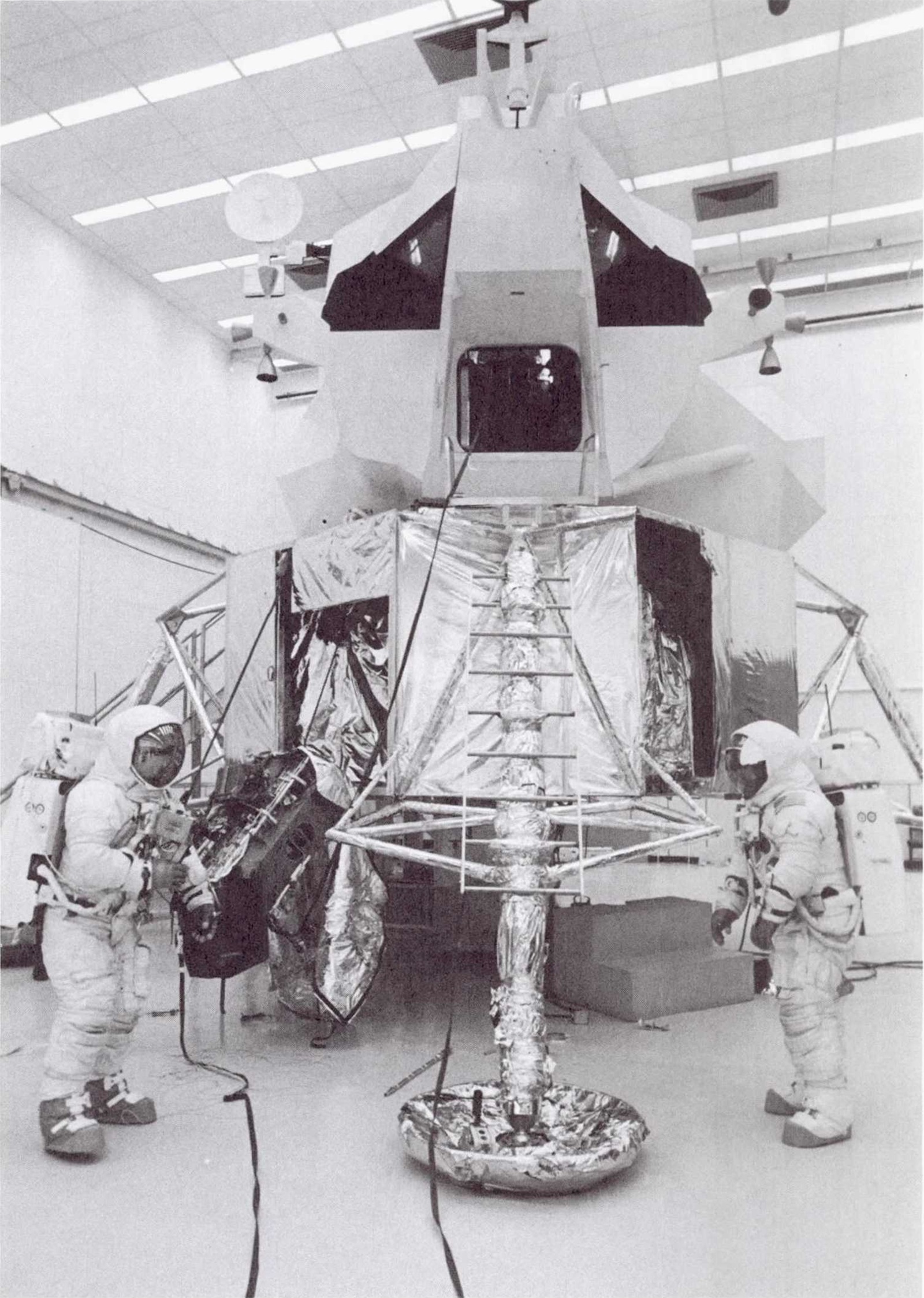
The target for Apollo 13 was a spot some 180 kilometers (112 miles) east of Apollo 12’s landing site, just north of the crater Fra Mauro. The mission’s primary task was to sample the geologic unit called the Fra Mauro Formation, which covers a large area around the Imbrium basin. The Fra Mauro Formation was generally believed to consist of material ejected when Imbrium, one of the largest impact basins on the moon, was formed. Scientists hoped that samples would allow them to date the “Imbrian event,” which would establish the time relationships of related and adjacent features. Finally, they expected that the Fra Mauro site would provide samples that came from deep within the moon, excavated by the Imbrian event.80 The mission would also emplace a second set of lunar surface instruments, differing from those flown on Apollo 12; a heat-flow experiment and a charged-particle environment detector were substituted for the solar wind spectrometer, the magnetometer, and the suprathermal ion detector. A second calibration of the lunar seismometers was to be accomplished by crashing the Saturn V’s third stage at a preselected location on the moon.81
Preparations for the launch proceeded without major problems through February and March. Three days before launch, Jack Swigert took Ken Mattingly’s place as command module pilot, after the prime crew had been exposed to German measles and Mattingly was found to have no immunity. Apollo 13 lifted off on schedule at 2:13 p.m. Eastern Standard Time on April 11, and for two days operations were routine; Capcom remarked at one point that flight controllers were bored to tears. A few hours later, however, an oxygen tank in the service module ruptured, depriving the spacecraft of most of its electrical power and oxygen, and the mission had to be aborted. Only a heroic effort of real-time improvisation by mission operations teams saved the crew.82
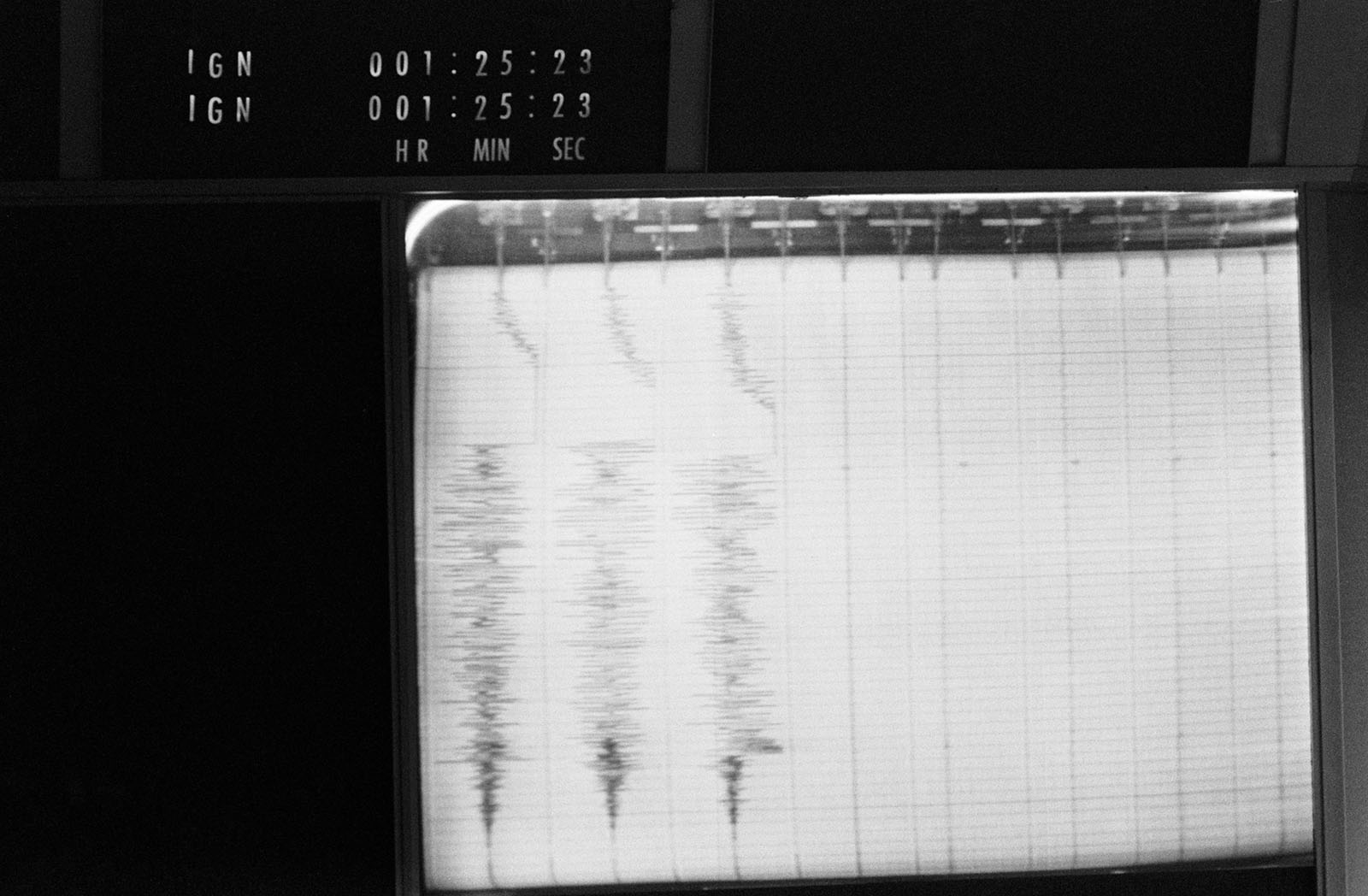
Almost lost in the drama of the mission was the one piece of scientific information that Apollo 13 was able to provide. Shortly after command module pilot Jack Swigert had extracted the lunar module from atop the S-IVB stage, ground controllers fired the auxiliary propulsion system on the big rocket, putting it on a course to crash into the moon. Three days later the 30,700-pound (13,925 kilogram) hulk struck the lunar surface at 5,600 miles per hour (2.5 kilometers per second) some 74 miles (119 kilometers) west-northwest of the Apollo 12 landing site, releasing energy estimated as equivalent to the explosion of 7.7 tons (7,000 kilograms) of TNT. Half a minute later the passive seismometer left by Apollo 12 recorded the onset of vibrations that persisted for more than four hours. Another instrument, the lunar ionosphere detector, sensed a gas cloud that arrived a few seconds before the seismic signal and lasted for more than a minute. Seismologists were baffled by the moon’s response to shock, but welcomed the new means of generating data.83
In the year that it took to discover and correct the cause of the Apollo 13 failure, the scope of the remaining missions was altered. Apollo 14 would visit the site intended for exploration by Apollo 13, but it would go there as the last of the intermediate exploration missions. The flights that remained would stretch the capabilities of the Apollo systems virtually to their limits, providing longer visits to the lunar surface and increased mobility for the astronauts. Unfortunately for lunar science, two missions were to be cut from an already minimal program.
Notes
- Charles D. Benson and William Barnaby Faherty, Moonport: A History of Apollo Launch Facilities and Operations, NASA SP-4204 (Washington, 1978), pp. 481-82.
- Ibid.
- MSC, “Apollo 12 Technical Air-to-Ground Voice Transcription,” prepared for Data Logistics Office, Test Div., Apollo Spacecraft Program Office, Nov. 1969 (cited hereinafter as “12 Air-to-Ground”), p. 17; MSC, “Apollo 12 Mission Report,” MSC-01855, March 1970, pp. 14-2 to 14-4.
Postflight analysis of available data supported the first tentative conclusion. Electric-field measurements at the launch site indicated that the clouds were charged, but not enough to produce lightning. The passage of a conductor (such as the launch vehicle) is known to produce lightning under such conditions. Witnesses disagreed on the question of lightning strikes, but photographs showed two bolts from cloud to ground 36.5 seconds after launch, neither of which produced damage. The second discharge, 52 seconds after launch, was probably between clouds. See MSC-01540, “Analysis of Apollo 12 Lightning Incident,” Feb. 1970. Damage to the launch vehicle was negligible (several telemetry sensors on the service module were knocked out), but launch rules were subsequently tightened to forbid launch under weather conditions favorable to lightning strikes.
- 12 Air-to-Ground, p. 24.
- Apollo 12 Mission Report, p. 5-4.
- Ibid., p. 5-5.
- 12 Air-to-Ground, p. 292.
- Ibid., pp. 281-92.
- Ibid., pp. 292-322.
- Apollo 12 Mission Report, pp. 5-7 to 5-8.
- 12 Air-to-Ground, pp. 335-45; Apollo 12 Mission Report, p. 5-9.
- 12 Air-to-Ground, pp. 346-68; Apollo 12 Mission Report, p. 6-3.
- 12 Air-to-Ground, pp. 348-68.
- Apollo 12 Mission Report, pp. 4-25 to 4-27.
- 12 Air-to-Ground, pp. 370-73.
- Ibid., pp. 406-ll.
- Ibid., pp. 418-26; Apollo 12 Mission Report, p. 14-50.
- 12 Air-to-Ground, pp. 429-60.
- Apollo 12 Mission Report, p. 3-26; 12 Air-to-Ground, pp. 438-73.
- 12 Air-to-Ground, pp. 473-521. Neil Armstrong and Buzz Aldrin had difficulty finding a way to sleep comfortably in the cramped LM. Hammocks were added on Apollo 12 and Bean and Conrad found them quite comfortable in lunar gravity.
- 12 Air-to-Ground, pp. 553-89.
- Ibid., pp. 597-716.
- The Lunar and Planetary Missions Board recommended in early 1968 that astronauts should talk as much as possible (“almost incessant talking,” as the Board put it) while on the lunar surface, describing what they were doing, what they could see and how they interpreted it, and what they intended to do next and why, to provide a complete record of their surface activity, Homer E. Newell to Robert R. Gilruth, Feb. 5, 1968. MSC agreed in principle only, suggesting that the astronauts observe the tried and proven rules of aircraft communications, transmitting only necessary information while at the same time making an effort to provide “a running commentary of significant events and actions so preplanned that normal communications discipline is not violated but yet is complete enough to assure a maximum of scientific return from the exercise.” That kind of commentary would be “comparable to the usual field notes of the practicing geologist on a field trip.” Gilruth to Newell, Feb. 20, 1968; W. N. Hess to Special Asst. to the Dir., “Astronaut Activity on Lunar Surface,” Feb. 19, 1968.
- 12 Air-to-Ground, pp. 602, 603, 614-52. After Buzz Aldrin drew criticism from scientists for his misidentification of biotite (see footnote, chap. 9, p. 282), Bean and Conrad may have been more sensitive to what they were saying. Geologist-astronaut Jack Schmitt noted that in postmission discussions Conrad admitted he was fairly sure the sample was olivine, but “he wasn't about to say so,” for fear of making a mistake. H. H. Schmitt interview, May 30, 1984.
- 12 Air-to-Ground, pp. 661, 666, 670.
- Ibid., pp. 671-95.
- Ibid., p. 731.
- Apollo 12 Mission Report, pp. 10-7, 8-20.
- Ibid., p. 9-10; 12 Air-to-Ground, p. 740.
- 12 Air-to-Ground, pp. 757-770; MSC, “Apollo 12 Technical Crew Debriefing,” Dec. 1, 1969, pp. 12-21 to 12-23; Apollo 12 Mission Report, pp. 6-5 to 6-6.
- Apollo 12 Mission Report, pp. 3-10 to 3-11, 9-39 to 9-40; Victor Cohn, “Moon Quake Caused by Lem Called 'Unlike Any' on Earth,” Washington Post, Nov. 21, 1969; Gary V . Latham, Maurice Ewing, Frank Press, George Sutton, James Dorman, Hosio Nakamura, Nafi Toksoz, Ralph Wiggins, and Robert Kovach, “Passive Seismic Experiment,” in Apollo 12 Preliminary Science Report, NASA SP-235 (Washington, 1970) , pp. 39-53.
- 12 Air-to-Ground, pp. 863-1066, 944-57; Apollo 12 Mission Report, p. 9-28.
- 12 Air-to-Ground, pp. 924-25.
- Alan L. Bean interview, Apr. 10, 1984.
- 12 Air-to-Ground, p. 1018.
- Apollo 12 Technical Crew Debriefing, pp.16-1, 16-4.
- Apollo 12 Mission Report, pp. 11-6 to 11-7.
- Cohn, “Moon Quake Caused by Lem.”
- Leo T. Zbanek, “Weekly Activity Report, Engineering Division, November 13, 1969” ; Richard A. Wright to TA/Special Asst., “Weekly Activity Report,” Nov. 14, 1969.
- Wright to TA/Dir., Science and Applications, “Weekly Activities Report,” Nov. 27, 1969.
- “Lunar Receiving Laboratory Daily Report, 1400 hours 11-28-69 to 1400 hours 11-29-69,” Nov. 29, 1969; J. L. Warner, “Apollo 12 Sample Inventory,” Dec. 5, 1969.
- Bryan Erb to DC/Chief, Preventive Medicine Div., “Selection of lunar samples for biological testing,” Nov. 29, 1969.
- “Lunar Receiving Laboratory Daily Report, 1400 hours 12-1-60 to 1400 hours 12-2-69,” Dec. 2, 1969; Charles A. Berry, “Findings and Determinations of Extraterrestrial Exposure and Quarantine of Particular Person(s), Property, Animal(s), or Other Form(s) of Life or Matter,” Dec. 1, 1969.
- MSC, “Containment Fault Press Conference,” Dec. 1, 1969, transcript; “Apollo 12 Ward Status Report,” transcript of press conf., Dec. 2, 1969.
- MSC, “LRL Operational Summary, Apollo 12, November 24 to December 6, 1969,” Dec. 6, 1969.
- Ross Taylor, “Comparison Between Apollo 11 Samples from Mare Tranquillitatis and Apollo 12 Samples from Oceanus Procellarum,” Dec. 8, 1969; MSC, “Lunar Receiving Laboratory Daily Report, 1400 hours 12-10-69 to 1400 hours 12-11-69,” Dec. 11, 1969.
- MSC, “LRL Operational Summary, Apollo 12, Dec. 6 to Dec. 13, 1969,” Dec. 13, 1969.
- MSC, “Lunar Receiving Laboratory Daily [sic] Report, 1400 hours 12-12-69 to 1400 hours, 12-18-69,” Dec. 18, 1969; John Noble Wilford, “Apollo 12 Samples Appear to Be Younger,” New York Times, Dec. 13, 1969.
- MSC, “Lunar Receiving Laboratory Reports,” transcripts of press briefings, Nov. 25-Dec. 10, 1969, box 079-16, JSC History Office Apollo files.
- Berry to Maj. Gen. J. W. Humphreys, Jr., TWX, Dec 8, 1969; Berry to Chairman, Interagency Committee on Back Contamination, “Recommendation for Release of Apollo XII Crew and Crew Reception Area from Personnel Quarantine,” Dec. 9, 1969; Humphreys, TWX to MSC, Dec. 9, 1969; W. Garter Alexander, “Quarantine Release Report No. 3,” n.d. [Dec. 8, 1969]; Humphreys to MSC, attn.: Director and Dir. of Medical Research and Operations, “Release of Personnel from CRA/LRL,” Dec. 10, 1969.
- Victor Cohn, “Same Chemical Origin Seen for Earth, Moon,” Washington Post, Jan. 7, 1970; “Summary of Apollo 11 Lunar Science Conference” (prepared by the Lunar Sample Preliminary Examination Team), Science 167 (1970): 449-51. The entire January 30 issue of Science was given over to the papers resulting from studies on the Apollo 11 samples (see Chap. 9), requiring some extraordinary effort in reviewing and editing. Manuscripts were received the first week in January, refereed and revised during the next two weeks, and the issue was printed three weeks later. See Philip H. Abelson, “The Moon Issue,” ibid. , p. 447, and “Acknowledgements,” ibid., p 781. Revised and expanded versions of the papers presented at the conference were published in Proceedings of the Apollo 11 Lunar Science Conference (3 vols.), A. A. Levinson, ed. (New York and London: Pergamon Press, 1970).
- “Summary of Apollo 11 Lunar Science Conference” ; Wilford, “Lunar Churning Surmised From Samples of Rock,” New York Times, Jan. 7, 1970.
- “Summary of Apollo 11 Lunar Science Conference.”
- James C. Tanner, “Moon Rocks' Age Put at 4.6 Billion Years, Much Older Than Any Found on the Earth,” Wall Street Journal, Jan. 6, 1970.
- Wilford, “Apollo Conference Ends With a Wealth of Data but an Unclear Picture of Lunar Origin,” New York Times, Jan. 9, 1970; Tanner, “Moon Scientists End Their Session Today, But Many Questions Remain Unanswered,” Wall Street Journal, Jan. 8, 1970.
- “Summary of Apollo 11 Lunar Science Conference.”
- George E. Mueller to Administrator, “Manned Space Flight Weekly Report,” Dec. 15, 1969.
- James A. McDivitt to multiple addressees, “Apollo Experiments Review Group,” Jan. 6, 1970.
- Homer E. Newell, “Conference Report, February 5, 1970, Lunar Science Institute, Houston, Texas, Subject: Critique of Apollo Lunar Missions and the Maximization of Scientific Returns for the Remaining Apollo Flights,” Feb. 6, 1970.
- Ibid.
- Newell to Gilruth, Feb. 6, 1970.
- Calio to PA/Mgr., Apollo Spacecraft Program, “Lunar Surface Science Requirements,” Mar. 27, 1970; Calio to multiple addressees, “Science Mission Manager and Mission Scientist Assignments for Apollo 13 and 14,” Apr. 6, 1970; Calio to TJ/James H. Sasser [and others], “Science Working Panel,” June 4, 1970.
- Eugene F. Kranz to TM/Acting Mgr., Lunar Missions Office, “Science Briefings for Flight Crews,” Apr. 23, 1970.
- Newell, Beyond the Atmosphere: Early Years of Space Science, NASA SP-4211 (Washington, 1980), p. 293.
- National Archives and Records Service, Weekly Compilation of Presidential Documents, Nov. 17, 1969, p. 1597; NASA Releases 69-151, Nov. 10, 1969, and 70-4, Jan. 8, 1970; NASA Announcement, Aug. 31, 1969; MSC Releases 69-66, Sept. 25, 1969, and 69-70, Nov. 26, 1969; Thomas O'Toole, “Petrone, Launch Director at Cape, Promoted to Head Apollo Project,” Washington Post, Aug. 23, 1969; “Mueller Leaves NASA Dec. 10; Paine Lauds His Apollo Role,” ibid., Nov. 11, 1969.
- NASA Release, Jan. 15, 1969.
- Presidential Documents, Mar. 21, 1969; NASA Budget Briefing, Apr. 15, 1969, transcript.
- Presidential Documents, Dec. 1, 1969.
- Space Task Group, The Post-Apollo Space Program: Directions for the Future, report to the President, Sept. 15, 1969.
- “Nixon Backs Mars Flight but Rejects All-Out Drive,” New York Times, Sept. 16, 1969.
- “Before We Start to Mars,” unsigned editorial in the Washington Post, Aug. 8, 1969.
- Victor K. McElheny, “NASA Adviser: Sending Men to Mars 'Utmost Folly',” Boston Globe, Dec. 19, 1969; Cohn, “Cut in Space Program Urged,” Washington Post, Dec. 29, 1969.
- U.S., Congress, House, Toward the Endless Frontier: History of the Committee on Science and Technology, 1959-79 [by Ken Hechler] (Washington: U.S. Govt. Printing Office, 1980), p. 269.
- “Apollo Missions Extended to '74,” New York Times, Jan. 5, 1970; “Experts Hail Schedule for Moon Trips,” Washington Post, Jan. 6, 1970. Rumors that four Apollo missions might be canceled circulated in late 1969; see O'Toole, “Nixon to Give Space Goals; Modest Program Expected,” Washington Post, Dec. 22, 1969; “Scientists hit threat to cut 4 Apollo flights,” Boston Sunday Globe, Dec. 28, 1969. For the effects of budget cuts on Skylab, see W. David Compton and Charles D. Benson, Living and Working in Space: A History of Skylab, NASA SP-4208 (Washington, 1983), Chap. 4.
- Richard D. Lyons, “50,000 NASA Jobs to Be Eliminated,” New York Times, Jan. 14, 1970; O'Toole, “Cutbacks Planned by NASA,” Washington Post, Jan. 14, 1970.
- Astronauts and Aeronautics, 1970: Chronology on Science, Technology, and Policy, NASA SP-4015 (Washington, 1972) p. 203.
- Toward the Endless Frontier, pp. 313-14.
- Mueller to Administrator, “Manned Space Flight Weekly Report,” Dec. 15, 1969; Dale D. Myers to Administrator, “Manned Space Flight Weekly Report,” Jan. 19, 1970.
- NASA Release 70-5, Jan. 8, 1970.
- Calio to Mgr., Apollo Spacecraft Program, “Recommendations for Science Sites for Apollo Missions 13- 20,” Oct. 20, 1969.
- MSC, “Apollo 13 Mission Report,” MSC-02680, Sept. 1970, p. 12-2 and App. A, p. A-2.
- The best account of Apollo 13 is that of Henry S. F. Cooper, 13: The Flight That Failed (New York: Dial Press, 1973), a taut narrative that captures the flavor of the entire mission. For a first-person account by a participant, see mission commander James A. Lovell’s chapter, “Houston, We've Had A Problem,” in Apollo Expeditions to the Moon, Edgar M. Cortright, ed., NASA SP-350 (Washington, 1975). A brief summary of the mission and the investigation is given in Benson and Faherty, Moonport, pp. 489-94. Headquarters' Public Affairs Office prepared a 25-page booklet on the flight, “Houston, we've got a problem,” NASA EP- 76 (Washington, 1970). A concise summary of the constraints faced by flight controllers and the rationale for the real-time decisions made during Apollo 13 was presented by Glynn S. Lunney, one of 13’s flight directors, as AIAA Paper No. 70-1260, “Discussion of Several Problem Areas During the Apollo 13 Operation,” at the AIAA 7th Annual Meeting and Technical Display, Houston, Oct. 19-22, 1970. The Report of the Apollo 13 Review Board, a summary volume and eight technical appendices, was released two months after the accident. It contains full technical details of the causes of the accident as deduced from inflight telemetry, the history of the faulty tank, and tests performed to support the investigation. Board chairman Edgar M. Cortright presented the board’s findings to the House space committee on June 16, 1970; see House, The Apollo 13 Accident, hearings before the Committee on Science and Astronautics, 91/2, June 16, 1970.
- Apollo 13 Mission Report, pp. 11-9 to 11-10.