Appendix E
ASTP Scientific Experiments
Since the joint flight with the Soviets grew in part from studies on how to utilize excess Apollo hardware, the mission planners in Houston naturally gave considerable attention to the scientific experiments that would be flown. As early as mid-1971, René Berglund received a proposal from Paul R. Penrod, who was working with the Advanced Programs Office representing the Science and Applications Directorate, suggesting scientific activities for an International Rendezvous and Docking Mission (IRDM). Penrod stressed maximum use of existing hardware, maximum crew involvement, use of the docking module (DM) as an experiment station, minimum use of extravehicular activity (EVA), and a schedule leading to either a mid-1974 or mid-1975 launch. While none of the actual experiments proposed by Penrod at this time were flown on ASTP, his suggestions became leading criteria in choosing experiments for the joint flight.1
In mid-October 1971, Penrod recommended to Berglund that one of the exciting aspects of an American-Soviet mission was the possiblitv of conducting joint experiments during the docked phase of the operation. Such exercises would not affect the feasibility of an international mission, and certainly it would provide meaningful activities for the docked portion of the venture.? In December 1971, a letter from Penrod was sent to selected potential experimenters informing them of NASA’s “interest in directly involving the user community in the payload planning for the International Rendezvous and Docking Mission.”’ Implicit in this early work were some basic assumptions that would shape subsequent efforts to select ASTP experiments. There would be two categories of scientific investigations-NASA (unilateral) and joint (bilateral). Crewmembers would be active participants in the experiments, which would fall into three groups-stellar phenomena, materials processing, and earth observations. Another key feature of these early discussions was the “austere funding climate” that dictated the use of CSM 111, which did not have the scientific instrument module bay, plus a $10-million ceiling on the cost of the total experiment package.4
Formalization of the experiment effort came in the fall of 1972. On 4 October, an initial meeting was held in Washington, during which Houston personnel explained to NASA Headquarters staff the engineering and operational constraints on the planning effort. To simplify the experiment planning, a NASA Working Group was given internal responsibility for overseeing this work. Further, to prevent confusion in the negotiations with the Soviets, M. Pete Frank’s Working Group 1 was given sole responsibility for coordinating efforts on bilateral experiments. Through the first six months of 1973, NASA examined candidate experiments.
As this work progressed, Representative Olin Teague urged the agency to make alternative plans for the mission in the event that the Soviets failed for either political or technical reasons to rendezvous with Apollo. Teague believed that it was “essential that the NASA portion of the mission be capable of making a justifiable, independent, scientific and technological contribution without reliance on a Soviet rendezvous.? As indicated in chapter VII (“Creating a Test Project”), George Low and the Headquarters staff decided to rely upon the Soviets and not exceed the $10-million budget for experiments.
On 29 June 1973, Administrator Fletcher issued in letter form an “Announcement of Flight Opportunity” for the ASTP mission. Fletcher said, “In addition to developing mutual space rescue capability, the U.S spacecraft will be able to carry about 400 pounds [181 kg] to conduct other space experiments of high importance.” He also emphasized that “investi-gations that capitalize on the unique nature of this flight and are of common interest to both the U.S. and the U.S.S.R. are, of course, of interest,” Enclosed with the letter was a schedule for experiment planning, development, and implementation:
| 1. Proposals Due at NASA (If appropriate, a prior proposal with a memo updating it will be acceptable.) |
July 23, 1973 |
| 2. Experiment Selection | Week of July 30, 1973 |
| 3. Selected Experimenter Notification | August 20, 1973 |
| 4. Interface Control Documentation Complete | October 1, 1973 |
| 5. Mockup Complete | March 1, 1974 |
| 6. Training Simulator (Plus thermal model, if required) | April 1, 1974 |
| 7. Definitive Training Unit | August 1, 1974 |
| 8. Qual[ification] Test Complete | October 15, 1974 |
| 9. Flight Unit Delivery: Experiments requiring installation in docking module or require penetration of docking module wall |
August 1, 1974 |
| CSM Installation: | |
| Complex type | December 1, 1974 |
| Stowage type | April 15, 1975 |
| 10. Roll Out to Launch Pad (Only limited access to experiments after this date) | March 1, 1975 |
| 11. Launch 8 | July 15, 1975 |
NASA sponsored a seminar “with outstanding experts in space science and in the conduct of applications programs in space” at Woods Hole, Massachusetts, on 7 July 1973. “The seminar members were asked to debate possible investigations and guidelines for the final selection of investigations.” At the seminar, Homer E. Newell, NASA’s Associate Administrator, explained that the Announcement of Flight Opportunity had been issued because of outside dissatisfaction with the earlier efforts within the agency to select experiments for ASTP. NASA’s preliminary payload proposal “had been presented to the Space Science Board [of the National Academy of Sciences] and the Physical Sciences Committee [of NASA] and it was received less than enthusiastically. Consequently, it was decided to issue a general Announcement... and to convene a special panel to aid in the evaluation process.”10 Following this seminar, Newell, in a letter to Fletcher, reported that a special ad hoc committee would be created, consisting of all but one of the Woods Hole attendees and five other specialists from the scientific and technical community.
During the week of 30 July, a formally chartered, closed to the public, Ad Hoc Evaluation Committee will assemble at the Johnson Space Center to evaluate all proposals including those evaluated as unacceptable for technical and merit reasons in the preliminary review... and to categorize them according to suitability for the mission. The proposers will be asked to make presentations and otherwise explain and expand upon their proposals as an expedient to the evaluation process....
Following the activities of the ASTP Program Office, the Ad Hoc Evaluation Committee and costing studies, the Manned Space Flight Experiments Board will review the categorized list developed by the Ad Hoc Committee. This list will include the life science experiments which will have undergone a separate review by the American Institute of Biological Sciences and specific members of the Space Medicine and Biology Committee, Space Science Board of the NAS [National Academy of Sciences]. The MSFEB reviews will be attended by Science, Applications, Technology, and Life Sciences personnel...
We then plan that a presentation will be made to you and Dr. Low on the results of the evaluation and on the integration and cost aspects of the proposed experiments.11
On 16 August 1973, Fletcher approved an experiments payload, as presented by Chet Lee, the Program Director. This payload had been approved by the Manned Space Flight Experiments Board (MSFEB) on 10 August from a recommended list provided by the Science, Applications and Technology Ad Hoc Committee, the Life Sciences Ad Hoc Panel, and the American Institute of Biological Sciences Ad Hoc Panel. A total of 146 proposals were received: 24 in the life sciences, 75 in applications and technology, and 47 in the physical sciences. The 18 experiments approved on 16 August were the following: 12
| MA no. | Experiment | Principal investigator | Institution |
|---|---|---|---|
| 083 | Extreme ultraviolet survey | Bowyer | University of California |
| 088 | Helium glow | Bowyer | University of California |
| 059 | Ultraviolet atmospheric absorption | Donahue | University of Pittsburgh |
| 048 | Soft X-ray | Friedman | Naval Research Laboratory |
| 089 | Doppler tracking | Weiffenbach | Smithsonian Institution |
| 010 | Furnace | Boese | Marshall Space Flight Center |
| 060 | Interface marking in crystals | Gatos | Massachusetts Institute of Technology |
| 070 | Zero-g processing of magnets | Larson | Grumman Aerospace Corporation |
| 085 | Crystal growth from the vapor phase | Wiedemeier | Rensselaer Polytechnic Institute |
| 041 | Surface-tension-induced convection | Reed | Oak Ridge National Laboratory |
| 131 | Sodium chloride/lithium eutectic | Yue | University of California |
| 044 | Monotectic and synthetic alloys | Cho-Yi Ang | Northrop Corporation |
| 014 | Electrophoresis | Hannig | Max Planck Institut für Biochemie |
| 107 | Biostack III | Bücker | University of Frankfurt |
| 031 | Cellular immune response | Criswell | Baylor College of Medicine |
| 032 | Polymorphonuclear leukocyte response | Martin | Baylor College of Medicine |
| AR-002 | Microbial exchange | Taylor | Johnson Space Center |
| 106 | Light flash | Tobias | University of California |
Glynn Lunney kept the Soviets informed of the status of experiment proposals through his regular telephone conferences with Professor Bushuyev. During their conversation of 23 August, Lunney advised the Professor that the following bilateral experiments had been approved by Administrator Fletcher: artificial solar eclipse, microbial exchange, multipurpose furnace, ultraviolet absorption, and doppler tracking. 13
As work on the experiments progressed, Chet Lee’s office became concerned over their rising costs. Since this increase was largely caused by the amount of documentation required to qualify them for the flight, Lee recommended a relaxation of the procedures:
The latest cost estimates for experiments hardware indicate that a substantial part of the cost growth we have seen is attributable to implementation of the necessary tasks and effort to meet the Apollo quality and reliability standards which were established to provide the highest assurance that hardware was reliable and safe. The application of these standards to the Apollo and Skylab experiment package was a major factor in their success. The high costs, resulting from the implementation of these standards for high reliability, was warranted because of the high initial investment in the lunar flights, whose primary objective became science following the initial lunar landing. Since science is a secondary objective for ASTP, the capital investment in experiments should be much lower. Therefore, in order to reduce costs we should not require the same degree of documentation, formal reviews, etc. that provided the highest assurance that the reliability and quality standards are being met. Therefore, it is necessary that for the ASTP experiment hardware, the Apollo reliability and quality guidelines be relaxed except where safety of the crew is involved. 14
Lunney agreed with this evaluation and advised Lee that his office had reviewed the situation and had selected an approach that would minimize costs but still provide high quality hardware. A cost reduction effort was initiated in December 1973 to reduce the cost of the ASTP experiments and to serve as a pilot project for evaluating experiment cost reduction in future programs. 15
As the Johnson Space Center (JSC) prepared for the flight, new experiments were added and others were deleted or altered. At an MSFEB meeting on 7 January 1974, six more experiments were approved for ASTP subject to the availability of funds and payload capability. Concurrently, the experiment cost ceiling was raised to $16 million. Earth observations and photography (MA-136) was expanded and given full experiment status. Stratospheric aerosol measurement (MA-007) and crystal growth (MA-028) were conditionally approved pending a review by the Ad Hoc Committees. Gas release (MA-043) was also approved tentatively, contingent upon low impact on the docking module design and on the spectrometer used for ultraviolet absorption (MA-059). The other three new experiments were electrophoresis technology (MA-011), geodynamics (MA-128), and barium cloud (MA-017). The barium cloud and gas release investigations were dropped from consideration during the summer of 1974 because of technical and expense difficulties. 16
During the next year, the experimenters were busy with preparations for the flight.”? On 26 June 1974, while the principal investigators and contractors worked on their hardware, NASA officially appointed R. Thomas Giuli, of the JSC Science and Applications Directorate, to be the ASTP Program Scientist. His responsibilities included coordinating all scientific aspects of the mission.l8 Subsequently, Giuli summarized in the Apollo-Soyuz Test Project Preliminary Science Report* the programmatic aspects of the experiments performed unilaterally by the U.S. and jointly with the U.S.S.R.:
The Apollo-Soyuz Test Project ... experiments package comprised 28 separate experiments. Twenty-one were unilateral U.S. experiments, five were joint U.S.-U.S.S.R. experiments ... and two were unilateral West German experiments (i.e., funded by the Federal Republic of Germany). Together, these experiments formed a well-integrated program of complementary scientific objectives. In several cases, related experiments used different techniques in pursuit the same or similar scientific objectives. A comparison of the scientific results from these experiments may be useful in defining the best technique to pursue in future space missions.
The individual experiments are grouped in this report according to category and topic. The space sciences experiments are presented in order of the distance away from the center of the Earth that the objectives of study lie. The soft X-ray objects lie deep in our galaxy and even beyond our galaxy. The extreme ultraviolet (EUV) objects lie within a few hundred light-years from the solar system, whereas the portion of the interstellar medium frostine solar tys ten, m here expertilies the interelar monium units. The corona photographed during the artificial solar eclipse lay within approximately 50 solar radii from the Sun. Two crystal detectors that have potential application for future gamma-ray astronomy payloads were carried onboard the Apollo spacecraft to measure their susceptibility to radioactivation by cosmic particle bombardment. The tenuous Earth atmosphere at the spacecraft altitude was investigated by ultraviolet absorption, and the aerosol component of the atmosphere below the spacecraft was investigated by stratospheric measurements. Features of the Earth surface were observed and photographed by the Apollo crew, and the structure of the Earth below the surface was investigated by two spacecraft-spacecraft doppler techniques.
The life sciences experiment addressed three primary topics. One was the effects of cosmic particle bombardment on live cells: the human eye retina (light flash), dormant eggs and seeds (biostack), and growing fungi (zone-forming fungi). (The fungi experiment also studied the effects of space-flight factors on biorhythm.) The second topic was the effects of space flight on the human immune system from the aspect of microbial transfer and ability to cause infection and from the aspect of the ability of the immune system to resist infection. The third topic was the effects of reduced gravity on the calcium metabolism of the killifish vestibular system. The purpose was to assess the feasibility of using the killifish vestibular system as a model for future investigation of space-flight effects on human calcium metabolism.
The materials processing effort addressed two topics: the separation of live cells and the improvement of physical properties of solid materials. The live cell separation was performed by each of two electrophoresis methods in which an electric field was applied through a buffer solution containing a mixture of cells with different biological functions (and hence with different negative surface charges). The cells separated into groups of cells with like biological function, each group being characterized by a unique value of cell surface charge. Each group thus acquired a unique speed through the buffer solution. The solid materials were processed by a high-temperature (melting) technique and an ambient-temperature (crystal growth from solution) technique.
The subsequent sections in this report describe in detail the conceptual, instrumental, and operational aspects of each experiment and include a preliminary assessment of scientific results. This section describes the major preliminary results of a few of the experiments (astronomy, Earth atmosphere, Earth observations, biological materials processing, and solid materials processing) as known in December 1975.19
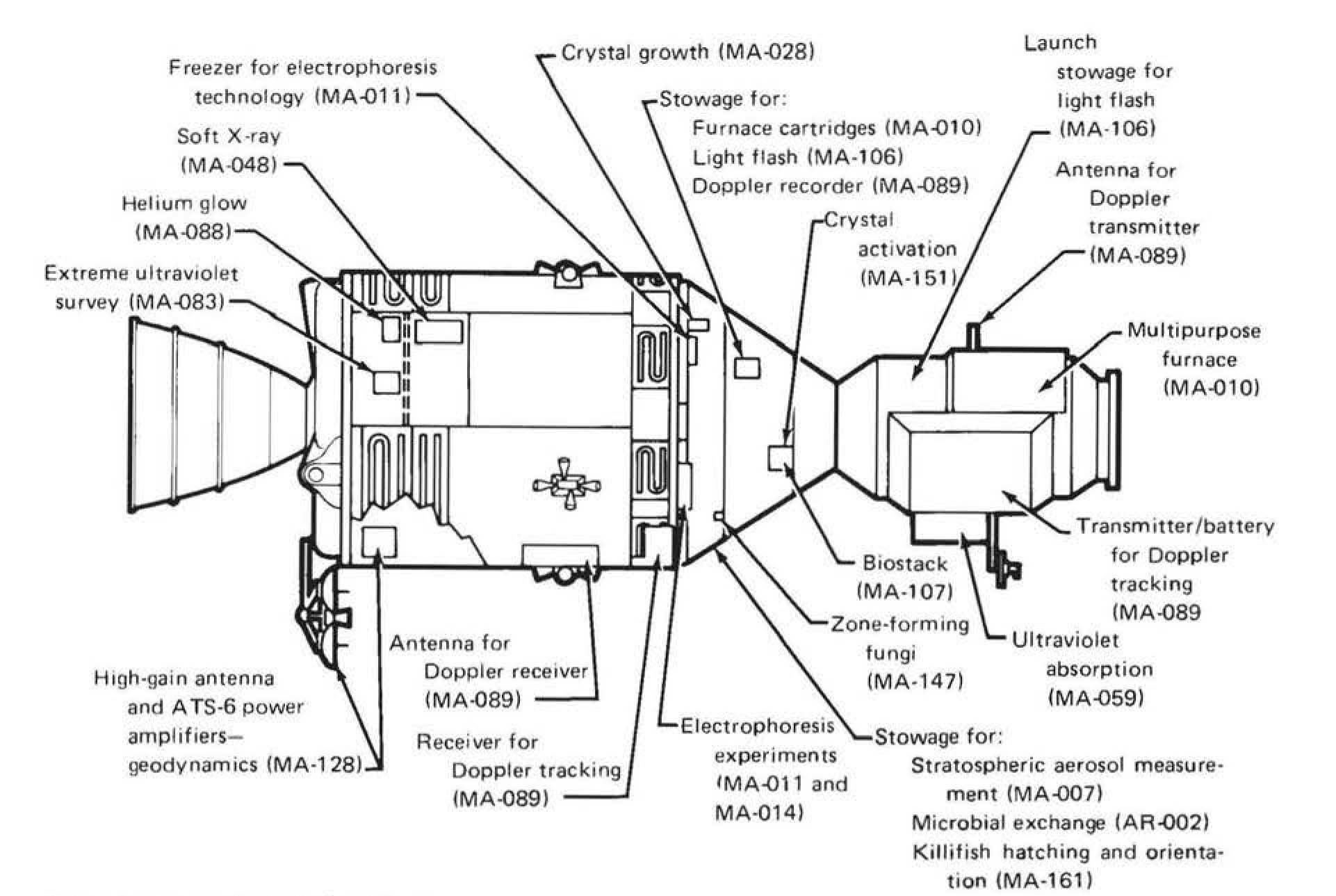
ASTRONOMY
MA-048: Soft X-Ray Observation
Objectives
The objectives of this experiment were to study the spectra of a large number of known celestial X-ray sources in the range from 0.1 to 10 kiloelectron volts, search for periodicities and other variability in these sources, and more precisely map the soft X-ray diffuse background.
Principal Investigator
H. Friedman
Naval Research Laboratory
Results
Data were obtained on approximately twelve sources. Unexpectedly, the instrument developed an intermittent high-voltage discharge problem that resulted in the loss of about 75 percent of the anticipated data. Among the results that were obtained was the discovery of the first known pulsar (star whose radiation pulsates very rapidly) outside our galaxy.
MA-083: Extreme Ultraviolet Survey
Objective
The objective of this experiment was to conduct the first sensitive search for extreme ultraviolet (EUV) radiation from non-solar sources.
Principal Investigator
S. Bowyer
University of California at Berkeley
Results
The EUV telescope functioned perfectly during the entire mission. All the primary goals of the experiment were achieved. EUV radiation was detected from four of the thirty stars investigated, which were selected from a variety of classes of stars. Extensive data on the EUV background radiation were also acquired.
MA-088: Interstellar Helium Glow
Objective
The objective of this experiment was to study the motion of helium in the local intestellar medium, as that medium passes through the solar system, to determine several poorly known properties of the local interstellar gas.
Principal Investigator
S. Bowyer
University of California at Berkeley
Results
The instrument used was a photometer sensitive to two solar extreme ultraviolet spectral lines that are resonantly scattered by helium gas. The instrument surveyed the entire celestial sphere during a series of slow rolling maneuvers by the Apollo spacecraft. The equipment operated properly; usable data were obtained and are being evaluated.
MA-148: Artificial Solar Eclipse (Joint U.S.S.R.-U.S. Experiment)
Objective
In this U.S.S.R.-proposed exercise, one of five joint experiments, the Apollo crew was responsible for performing the required spacecraft amanenes and fe photosphing the clips sading the solas cons vehicle,
Principal Investigator
G. M. Nikolsky
Institute of Terrestrial Magnetism Ionosphere and Radio Wave Propagation
U.S. Point of Contact
R. T. Giuili
Johnson Space Center
Results
The U.S.S.R. investigator responsible for the scientific analysis of the experiment reports detection of the solar corona. The results were published in the ASTP Summary Science Report, a special publication by NASA.
MA-151: Crystal Activation
Objective
The objective of this experiment was to fly two gamma ray detectors in the command module for post-flight analysis of the radioactivity induced in them by cosmic rays during the flight. The purpose was to measure the instrument background caused by detector activation that interferes with detection of gamma radiation in the 0.02- to 10-megaelectron-volt range from earth orbit. These measurements will be used to estimate this background and thus assist in the development of gamma ray instrumentation and detectors for future experiments in this relatively new field of gamma ray astronomy.
Principal Investigator
J. I. Trombka
Goddard Space Flight Center
Results
Good data were obtained, which also could be correlated with results of a similar experiment carried on Apollo 17.
EARTH ENVIRONMENT
MA-059: Ultraviolet Absorption (Joint U.S.-U.S.S.R. Experiment)
Objectives
The objective of this experiment was to apply optical absorption spectroscopy to the investigation of neutral atomic oxygen and nitrogen (as low as 2 million atoms per cubic centimeter) and their temperatures in the earth’s atmosphere at the spacecraft altitude (220 kilometers). The technique was to send monochromatic light beams, the wavelengths of which correspond to neutral atomic oxygen and nitrogen resonance lines (1304 and 1200 A, respectively), from the Apollo to the Soyuz. The beams were bounced back to the spectrometer aboard the Apollo by a Soyuz-mounted retroreflector.
U.S. Co-Principal Investigators
T. M. Donahue
University of Michigan
R. D. Hudson
Johnson Space Center
Soviet Principal Investigator
V. G. Kurt
Institute of Space Research
Results
The O and N densities obtained with this experiment were consistent with the best previous determinations from space experiments employing different techniques and from theoretical models, thus opening the way for a broader application of this technique for atmospheric research.
MA-007: Stratospheric Aerosol Measurement
Objective
This experiment was designed to demonstrate the feasibility of long-term remote sensing of aerosols in the stratosphere from a manned or unmanned spacecraft. Increasing interest in the stratosphere has led to the investigation of methods for remote sensing from earth-orbiting satellites.
Data gained from this experiment will be housed in the design of subsequent
Principal Investigator
T. J. Pepin
University of Wyoming
Results
Excellent aerosol data were obtained in the stratosphere; pollution
measurements were obtained down into the troposphere.
MA-136: Earth Observations and Photography
Objective
Astronaut visual observations and photography of surface features (of the moon with Apollo, of earth with Skylab) have demonstrated the usefulness of the large scale view as an aid to interpretation of surface features and phenomena. The human eye’s large dynamic range and sensitivity to color and texture have enhanced the perspective of photographic results. This experiment (a combination of investigations) was designed to permit the crew to perform a number of observations which, based upon Skylab experience, would yield the greatest return of information. The topics of interest were geology, deserts, oceanography, hydrology, and meteorology. A large team of outside scientists constituted the investigator team for this experiment.
Principal Investigator
F. El-Baz
Smithsonian Institution
Results
The data returned were discussed in the Preliminary Science Report (p. 10-16). “The astronauts are enthusiastic about their contributions, and the participating scientists have a considerable amount of new data to be interpreted and analyzed. This analysis will further our vistas in numerous fields of Earth science.”
MA-089: Doppler Tracking
Objective
experiment was designed to test the feasibility of improved mapping of earth gravity field anomalies by means of the low-low satellite-to-satellite tracking method. In this case, the low satellites were the command and service module (CSM) and the DM, which were separated to a of about 300 kilometers. The CSM received radio signals transmitted from the DM. Such investigations of the earth’s gravity field are expected to provide new information on the structure of the earth, with application to continental drift theories.
Principal Investigator
G. C. Weiffenbach
Smithsonian Astrophysical Observatory
Results
When the data are fully analyzed, the investigators anticipate that mass anomalies of approximately 200 to 350 kilometers in size affecting the gravity field will be resolved.
MA-128: Geodynamics
Objective
This experiment was designed to test the feasibility of improved mapping of earth gravity field anomalies by means of the low-high satellite-to-satellite tracking method. In this case, the low satellite was the CSM, and ATS 6 was the high satellite.
Principal Investigator
F. O. Vonbun
Goddard Space Flight Center
Results
Early results indicate this method of satellite-satellite tracking yields high quality data for investigations of the gravity field.
LIFE SCIENCES-RADIATION EFFECTS
Interest has developed in studying the effect of high charge and high energy (HZE) particles on human tissue during prolonged space flight. Of particular interest are the effects on non-generative cells, such as the tissue composing the central nervous system. The HZE particles (generally the heavier and energetic cosmic rays) may have destructive effects on human as under ot inest hose rays to 06, 1.107, and MA. 47
MA-106: Quantitative Observation of Light Flashing Sensations
Objective
Light flashes caused by the interaction of cosmic particles and the eyes have been observed by astronauts on all space missions since Apollo 11. This experiment compared measurements of the observer’s visual sensitivity with measurements of the radiation environment.
Principal Investigator
T. F. Budinger
Lawrence Berkeley Laboratory
University of California at Berkeley
Results
The light flash sensations recorded by the astronauts were well correlated to the detection of HZE particles and protons by onboard electronic and emulsion detectors. The sensations were 25 times more numerous when the spacecraft traveled in the high latitude regions than when it traveled the latitudes between 30° N and 30° S. Ground-based experiments are proceeding to verify the conclusions drawn from the flight data concerning the efficiency of the eye as a detector for various types of particles.
MA-107: Biostack III (German Experiment)
Objective
The objective of this experiment was to continue and extend the research carried out in Apollos 16 and 17 (Biostacks I and II) to study the biological effects of individual heavy cosmic particles of high-energy loss not available on earth, to study additional space-flight factors, to obtain knowledge on the mechanism by which HZE particles damage biological materials, to get information on the spectrum of charge and energy of the cosmic ions in the spacecraft, and to estimate the radiation hazards to man in space.
Principal Investigator
H. Bücker
University of Frankfurt
Results
Very high resolution impact data were obtained. The consequent effects on the biological specimens are being studied by growing specimens and observing the associated mutations.
MA-147: Zone-Forming Fungi (Joint U.S.S.R.-U.S. Experiment)
Objective
Where MA-107 involved dormant cells that were later cultured or nurtured into growing systems (e.g., seeds of plants and eggs of brine shrimp), this experiment employed growing cells to determine the effect of HZE upon them. Mutations of both types of cells were the objective in both cases to determine the possible effects on humans. Both experiments were planned to examine long-term effects by growing second generation systems from the mutated systems, which would be compared to cells that were not impacted by the HZE particles. Effects of zero gravity were to be analyzed by comparison of flight materials with similar organisms that were not flown.
Soviet Principal Investigator
I. G. Akoyev
Institute of Biological Physics
U.S. Principal Investigator
G. R. Taylor
Johnson Space Center
Results
Differences were detected in growth rates and spore formation between hier as lies une grund sondol samples. The factors causing these differences are currently under study.
LIFE SCIENCES-IMMUNE SYSTEM
Experiments performed by the U.S.S.R. and the U.S. on their space flights have shown that (1) microbes transfer between crewmembers and from crewmembers to the spacecraft; (2) numbers of types of microbes reduce significantly, whereas numbers of microbes of a given (surviving) type increase significantly; and (3) immunological resistance of crewmembers may change during flight. AR-002, complemented by laboratory analysis of blood samples to be performed by MA-031 and MA-032, investigated separately questions of how space flight alters the ability of microbes to infect humans and how space flight alters the ability of humans to resist infection.
AR-002: Microbial Exchange (Joint U.S.-U.S.S.R. Experiment)
Objective
Monitoring two separate crews, which differed microbiologically and immunologically, provided an opportunity to study in-flight cross-contamination patterns. Microbe investigation was accomplished by analyzing spacecraft and crewmember skin swab samples before, during, and after flight.
U.S. Principal Investigator
G. R. Taylor
Johnson Space Center
Soviet Principal Investigator
Instil oyomedical Problems
Ministry of Public Health
Results
The major portion of the planned post-flight laboratory analysis continues. Analysis of the specimen collection and distribution activities indicates that most of the experiment objectives will be satisfied. Analyses of the medically important micro-organisms from U.S. crewmen have shown in-flight inter-crew transfer of potential pathogens but no other changes of medical significance.
MA-031: Cellular Immune Response
Objective
The cellular immune response of the three astronauts was studied before and after the nine days of flight.
Principal Investigator
B. S. Criswell
Baylor College of Medicine
Results
Significant changes in the phytohemagglutinin (PHA) lymphocytic responsiveness occurred in the cellular immune response of the astronauts. Parameters studied were white blood cell concentrations, lymphocyte numbers, B- and T-lymphocyte distributions in peripheral blood, and lymphocyte responsiveness of PHA, pokeweed mitogen, Concanaval in A, and influenza virus antigen.
MA-032: Effects of Space Flight on Polymorphonuclear Leukocyte Response
Objective
A series of blood samples taken from the astronauts at intervals from thirty days before flight to thirty days after recovery was used to determine the effects of space flight on polymorphonuclear leukocytes (PMN).
Principal Investigator
R. R. Martin
Baylor College of Medicine
Results
Analysis continues but this experiment successfully documented that no consistent, potentially serious abnormalities in the PMN function were produced in the ASTP crewmembers. A broader experience, including similar studies on future space-flight missions, will be required before definite conclusions can be drawn.
LIFE SCIENCES-VESTIBULAR SYSTEM
MA-161: Killifish Hatching and Orientation
Objective
The objective of this experiment was to determine the effect of the zero gravity environment on the sense of balance in living organisms. The killifish Fundulus heteroclitus was used to study embryonic development and vestibular adaptation in orbital flight. A series of staged embryos in five individual compartments of a polyethylene bag and a series of preconditioned juvenile fish in a similar bag were mounted on the wall of the service module (SM) and photographed periodically during the mission to record the swimming activity of the fish and the condition of the eggs. At splashdown, vestibular sensitivity of the juvenile fish and of the hatchlings from the eggs was tested in a rotating, striped drum. Subsequently, additional vestibular orientation tests during parabolic trajectory flight, light orientation tests, and geotaxis tests were performed.
Principal Investigator
H. W. Scheld
Baylor College of Medicine
Results
Juvenile fish in a null-gravity environment exhibited looping swimming activity similar to that observed during Skylab 3. Hatchlings from the 336-hour egg stage were also observed to loop. At splashdown, both juveniles and hatchlings exhibited a typical diving response suggesting relatively normal vestibular function. Juveniles exhibited swimming patterns suggestive of abnormal swim bladders. Rotating drum tests confirmed that no radical changes in vestibular function had occurred, but more subtle changes may be apparent after analysis of motion pictures. Other analyses continue.
APPLICATIONS
Biological Materials
For various types of biological research and medical application, it is necessary to separate pure samples of live cells from a mixture of different types of live cells. The separation process is often not amenable to centrifuge or filter techniques because the different types of cells are not sufficiently dissimilar in size, shape, or mass. Electrophoresis is a separation method that utilizes the fact that live cells have a negative surface charge, and the quantity of this charge is as unique to each type of cell as the cell’s biological function. Thus, if a mixture of different types of cells is placed in an electrolytic buffer solution (the composition of which is chosen to preserve the biological vitality of the cells), and if an electrical field is applied, the different types of cells should separate into individual zones according to their individual electrophoretic mobilities. In ground-based laboratories, the performance of this process is limited by effects that are the result of the 1-g environment; for example, the density difference between sample zones and buffer solution causes sedimentation, and heating of the electrophoretic column by the electric field causes destabilizing currents. Both effects are counterproductive. On ASTP, two methods of electrophoresis were tested to determine if better results could be obtained from processing materials in zero gravity.
MA-011: Electrophoresis Technology
Objective
Using the static column of buffer solution with the electrical field aligned along the column, a given amount of sample mixture was introduced at one end and the developing sample zones traveled individually (at different rates) down the column. This was a complete experiment in that it addressed both the major issues for future application: how to process the samples and how to preserve the samples.
Principal Investigator
R. E. Allen
Marshall Space Flight Center
Results
The hardware functioned as planned. Frozen live cells were successfully transported into space; electrophoretic processing was performed; and viable cells were returned to earth. This experiment provided a significant step forward in the development of a biological processing facility in space.
MA-014: Electrophoresis Experiment (German Experiment)
Objective
Using the free-flow method in which a buffer solution flows along a tube with the electrical field aligned perpendicularly to the tube, the sample mixture was inserted continuously at one end and the individual substances separated laterally from each other into multiple streams, which were collected continuously at the other end of the tube. This method is conceptually capable of producing larger quantities, whereas the static column method is most applicable for producing “starter” quantities, which then can be cultured into larger quantities in the laboratory. This experiment addressed only the problem of sample processing and did not involve sample preservation.
Principal Investigator
K. Hannig
Max Planck Institut für Biochemie
Munich
Results
The feasibility of separating living cells under zero gravity conditions was demonstrated.
MA-010: Multipurpose Electric Furnace
Objectives
Based upon a similar furnace (M-518) flown on Skylab, this furnace was used to heat and cool material samples in space, thereby taking advantage of the lack of thermal convection and sedimentation during the liquid or gaseous phase of the material being processed. Seven experiments were performed. The guiding design requirement for the multipurpose electric furnace system was to produce an apparatus that provided the widest possible flexibility in applying predetermined temperature distributions and temperature/time sequences within the constraints imposed by existing interfaces. Although the Skylab multipurpose furnace met all expectations of performance and reliability, it was apparent that improvement in function could be obtained with some specific modifications for ASTP. The system consisted of three essential parts: the furnace, a programmable electronic temperature controller that provided the desired temperatures, and a helium rapid cooldown system.
Principal Investigator
A. Boese
Marshall Space Flight Center
Results
The entire multipurpose furnace system performed perfectly. Final results on all the experiments are pending.
MA-041: Surface-Tension-Induced Convection
Principal Investigator
R. E. Reed
Oak Ridge National Laboratory
MA-044: Monotectic and Synthetic Alloys
Principal Investigators
C. Y. Ang and L. L. Lacey
Marshall Space Flight Center
MA-060: Interface Markings in Crystals
Principal Investigator
H. C. Gatos
Massachusetts Institute of Technology
MA-070: Zerog Processing of Magnets
Principal Investigator
D. J. Larson, Jr.
Grumman Aerospace Corporation
Bethpage, New York
MA-085: Crystal Growth from the Vapor Phase
Principal Investigator
H. Wiedemeier
Rensselaer Polytechnic Institute
MA-131: Halide Eutectic Growth
Principal Investigator
A. S. Yue
University of California
MA-150: Multiple Material Melting (Joint U.S.S.R.-U.S. Experiment)
Soviet Principal Investigator
I. Ivanov
Institute of Metallurgy
MA-028: Crystal Growth
Objective
The objective of this experiment was to assess a novel process for growing single crystals of insoluble substances by allowing two or more reactant solutions to diffuse toward each other through a region of pure solvent in zero gravity. This experiment was designed to produce superior crystals and to improve our understanding of the theory of crystal growth.
Principal Investigator
M. D. Lind
Rockwell International Science Center
Results
The experiment was entirely successful and yielded crystals of about expected size, quality, and growth.
NOTES
- 1. Paul R. Penrod to René A. Berglund, memo, “International Rendezvous and Docking Mission (IRDM) Experiment Requirements,” 17 Sept. 1971.
- 2. Penrod to Berglund, memo, “Joint USA-USSR Experiments during the Docked Phase of IRDM,” 15 Oct. 1972.
- 3. For example, Penrod to William O. Davis, 22 Dec. 1971. See “Post Skylab Missions Familiarization Briefing,” 28 Dec. 1971.
- 4. William O. Armstrong to Berglund, memo, “Payload Planning for Post Skylab CSM Missions,” 10 Mar. 1972.
- 5. Richard J. Allenby to distribution, memo, “ASTP Investigations,” 20 Oct. 1972.
- 6. John E. Naugle to Dale D. Myers, memo, “Joint NASA/USSR Experiments,” 2 Nov. 1972; and Myers to distribution, memo, “Joint NASA/ USSR Experiments,” 19 Dec. 1972.
- 7. Olin E. Teague to James C. Fletcher, 1 May 1973. Fletcher to distribution, 29 June 1973, with enclosure.
- 8. Fletcher to distribution, 29 June 1973, with enclosure.
- 9. Homer E. Newell to Fletcher, 27 July 1973.
- 10. “Summary Minutes Apollo-Soyuz Test Project (ASTP) Seminar,” Houston House, Woods Hole, Mass., 7 July 1973.
- 11. Newell to Fletcher, 27 July 1973.
- 12. Chester M. Lee to Glynn S. Lunney, memo, “ASTP Experiment Payload,” 27 Aug. 1973.
- 13. Lunney to Konstantin Davydovich Bushuyev [28 Aug. 1973].
- 14. Lee to Lunney, Ellery B. May, and William H. Rock, memo, “ASTP Experiments Payload,” 30 Nov. 1973.
- 15. Lunney to Lee, memo, “ASTP Experiments Payload,” 14 Dec. 1973; and Lawrence G. Williams, “ASTP Experiment Development Evaluation Report,” 21 Aug. 1975.
- 16. Lee to Lunney, memo, “ASTP Experiments Payload Addition,” 1 Feb. 1974; William C. Schneider to Lee, memo, “Approval of Experiments MA-007, Stratosphere Aerosol Measurement and MA-028, Crystal Growth for Apollo/ Soyuz Test Project,” 19 Mar. 1974; Lee to Naugle, memo, “ASTP Barium Cloud Experiment-MA-017,” 9 Apr. 1974; TWX, Lee to Lunney et al., “ASTP Barium Cloud Experiment--MA-017,” 24 Apr. 1974; Lee to Lunney, memo, “ASTP Barium Cloud Experiment-MA-017,” 24 Apr. 1974; Lee to Armstrong, memo, “ASTP Barium Cloud Experiment-MA-017,” 25 Apr. 1974; and Lee to John F. Yardley, memo, “ASTP Barium Cloud Experiment, MA-017,” 10
- July 1974.
- 17. Robert O. Aller to attendees, memo, “ASTP Joint Experiments Meeting, NASA Headquarters on June 26, 1974,” 1 July 1974.
- 18. JSC Announcement, “Key Personnel Assignment,” 26 June 1974.
- 19. NASA, Apollo-Soyuz Test Project Preliminary Science Report, TM X-58173 (Springfield, Va., 1976), pp. 1-1 and 1-2.
*Published in Feb. 1976 as NASA TM X-58173, this 529-page report provided a detailed synopsis of scientific results as analyzed through 1975. This document is available through the National Technical Information Service, Springfield, Va. 22161. Vol. I of a Summary Science Report was published in 1977 as NASA SP412 and vol. II is in preparation.