Routes to Space Flight
By the mid-1950s, the idea of manned space flight emerged from the realm of fantasy to become a topic of serious technical discussion. Frederick C. Durant III, President of the International Astronautical Federation (IAF), told the delegates gathered in 1954 at Innsbruck, Austria, that “the feasibility of space flight is no longer a topic for academic debate, but a matter of time, money and a program.”1 To illustrate his point, Durant showed the Walt Disney Productions motion picture Man in Space during the August 1955 Sixth Congress of the IAF in Copenhagen.
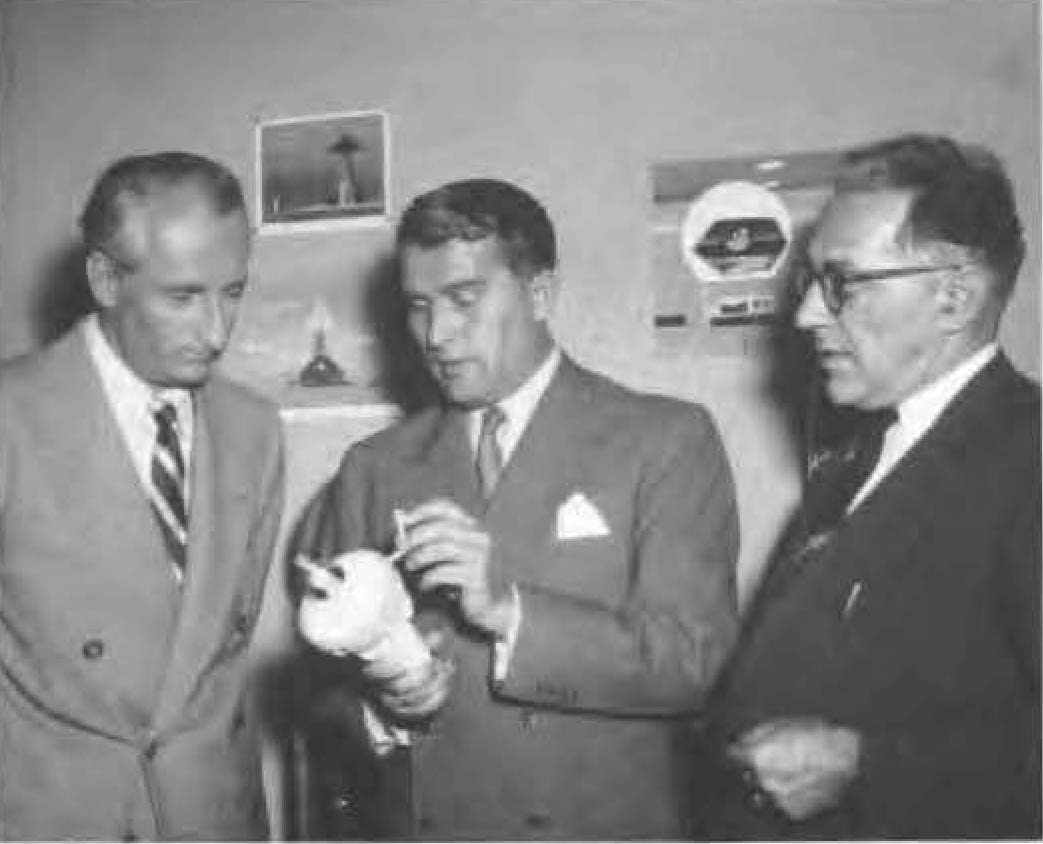
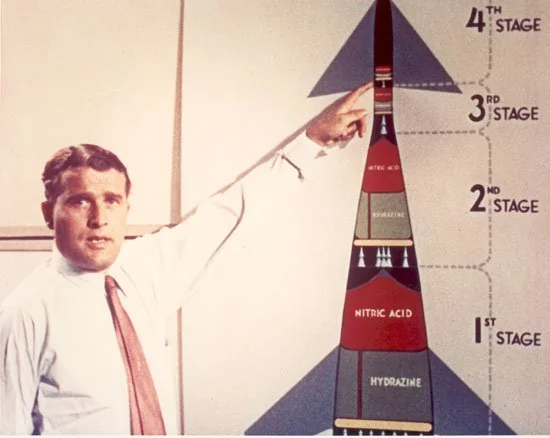
After an introductory discussion on the evolution of rockets, three American proponents of “man in space” addressed different aspects of manned space flight. Willy Ley described the prospects for utilizing rockets in space travel and the steps required to build a space station that could orbit 1730 kilometers above the earth. Through the medium of an animated cartoon character, “Homo Sapiens Extra-Terrestrialis,” Heinz Haber explained some of the questions raised by “space medicine,” illustrating the physiological hazards-acceleration loads, weightlessness, cosmic radiation, meteorites -that the first space travelers would encounter. Finally, Wernher von Braun closed the film with a discussion of his conceptual design for a 55-meter tall, 1280-metric ton, four-stage interplanetary rocket that could carry a crew of six into the cosmos.* 2 The IAF delegates were enthusiastic about this 33-minute movie, especially in the light of President Eisenhower’s earlier announcement that the United States would launch artificial satellites during the International Geophysical Year.
* In 1955, Ley was a writer of factual science publications centering on rocketry and space exploration; Haber was a member of the physics department at UCLA, after having worked five years as a research scientist with the Air Force School of Aviation Medicine; and von Braun was Chief of the Guided Missile Development Division at the Army’s Redstone Arsenal.
Among the viewers of Man in Space were Leonid Ivanovich Sedov and Kyril Feodorovich Ogorodnikov, the first Soviets to attend an IAF Congress. They spoke with Durant about borrowing the film for use in the Soviet Union, saying it would be “very good to have here a copy of Walt Disney’s excellent film for private demonstration.”3 It is likely that the Soviets viewed Man in Space as proof of growing American interest in solving the basic problems associated with manned space flight. Sedov and Ogorodnikov wanted to use the Disney picture to promote their own nation’s efforts in rocketry and space research. To Soviet space enthusiasts, the movie was at once an encouragement and a warning.
Seven years after that Copenhagen meeting, both the U.S.S.R. and the U.S. orbited and returned their first space pilots. Vostok and Mercury were possible within such a short span of time because engineers and scientists had amassed a wealth of basic engineering and scientific data directly applicable to the questions posed by manned space flight. In those early years, much of the work was duplicative, as security restrictions forced Soviet and American researchers to repeat the same fundamental investigations; but if the competitive environment was wasteful, it also spurred the development of space flight technology. Seemingly, man would have crossed the barriers of the space frontier without the element of international competition, but it was precisely that element that did give rise to the space program-and made funds available. Fantasy yielded to reality; and that reality was the orbiting hardware.
THE CHALLENGE OF SPACE FLIGHT
Vostok and Mercury were first steps, designed to explore the concept of manned space flight. Maxime A. Faget, chief designer of the Mercury spacecraft, summarized their importance:
Since these flights were initial efforts, the purpose of the flights was limited to the basic experience of launching the spacecraft and crew into orbit, having them remain there for a period of time, and then having them return safely to earth. These flights were made at low altitude with the spacecraft barely high enough to avoid appreciable drag from the upper fringes of the atmos-phere.... the amount of energy required for launching was minimized, and the flight was made safer, since the difficulty of making a reentry maneuver was also minimized.... these flights ... proved that it was practical for man to fly in space.4
While providing valuable lessons in the design and operation of spacecraft, Vostok and Mercury also demonstrated two different approaches to accomplishing the same tasks.
The rapid onset of multi-gravity forces accompanying the rocket launch was one of the primary concerns that faced the two technical teams. During the powered ascent from earth, crewmembers had to be protected from the increased “g-loads,” vibration, and noise. It was known, from aircraft and centrifuge experiments, that human tolerance to increased gravity forces varied with the duration of exposure and the attitude of the body with reference to the force. Soviets and Americans agreed that the reclining position permitted a pilot to absorb heavy acceleration loads more comfortably than in any other posture.* In the U.S., Faget, William M. Bland, Jr., Jack C. Heberlig, and their engineering colleagues decided in favor of a couch contoured to the form of each individual astronaut to protect him from g-loads. Soviet designers also used the form fitting couch, and all Mercury and Vostok pilots rode semi-supine in their own tailor-made seats.5
* Experiments with rocket sleds and the centrifuge indicated that pilots could endure forces 20 times that of the earth’s gravity, a load well in excess of those anticipated in normal flights and above those expected under emergency conditions.
Once a pilot overcame the initial acceleration forces of flight, he would encounter the phenomenon of gravity balanced by centrifugal force, generally called weightlessness or zero g. Flight physicians contended that the absence of gravity might affect man’s physical and mental performance, but in the face of limited information, the effect of zero g was mainly a topic of speculation. Some medical doctors wondered if the human organism, tailored to earth’s gravity, would continue to function normally when suddenly deprived of that force. Other physicians worried about the reaction of particular internal organs to the succession of changes imposed by acceleration, weightlessness, and deceleration. Heinz Haber and Otto Gauer, who had studied the question of weightlessness in Germany, had concluded that more experimental data were needed to permit a better analysis of the role of zero g in manned space flight.6
Since it was impossible to duplicate weightlessness on earth, scientists conducted tests with animals borne aloft by rockets. In the U.S. in 1947, experimenters began launching live organisms with V-2 rockets. On 20 September 1951, the monkey Yorick and 11 mice were recovered after an Aerobee flight to 72 kilometers. From this and two subsequent Aerobee monkey launches, James P. Henry and David G. Simon concluded that weightlessness and acceleration forces did not adversely affect the animals.* 7
* Both physicians played subsequent roles in aerospace medicine. Henry became director of the animal program in Project Mercury. Simon went on to pilot a Project Man High balloon to 31 kilometers for a 32-hour study of man’s performance in near space in Aug. 1957.
Soviet rocket engineers and physicians also sent animals to high altitudes, and their canine experiments led them to the same conclusions that the Americans had reached with primates and rodents. At first, the Soviet tests were conducted using pressurized capsules; then they experimented with dogs wearing special space suits and traveling in unpressurized cabins. In one case, Albina and Tsyganka were ejected from the descending launch vehicle at an altitude of 85 kilometers; both dogs rode safely back to earth in their space suits and ejection seats.* These experiments convinced the Soviets that acceleration and weightlessness did not pose impossible barriers to manned flight. The significance of this conclusion was made clear to the rest of the world when the Soviets sent Laika into orbit with Sputnik II on 23 November 1957. Although she was not returned to earth, Laika ate, barked, and moved about in her space cabin for seven days without apparent ill effects.8
* Albina and Tsyganka were veteran travelers and members of the first group of nine canine cosmonauts. Subsequently, the Soviet scientists trained eight more dogs for experimental flight and landing by parachute.
LIFE SUPPORT SYSTEMS
But there were other questions raised by the unknowns of space environment. Man in space would be absolutely dependent upon an artificial environment. One Soviet author described the life support system as “a set of engineering, physical-chemical and medical-biological resources” that will “satisfy the needs of man for oxygen, food and water” in order to create “normal living conditions for man in a flight vehicle.”9 The atmosphere on earth is a mixture of 80 percent nitrogen and 20 percent oxygen, with small quantities of water vapor and carbon dioxide, plus traces of other gases. Since the astronaut would continually breathe oxygen and generate carbon dioxide and water vapor, the spacecraft needed devices to replenish oxygen and to eliminate excess carbon dioxide. While both the Soviet and American engineers removed carbon dioxide and humidity by using lithium hydroxide canisters, they approached the problem of oxygen supply differently.
The Soviets decided upon a cabin pressure equal to about one atmosphere (760 millimeters of mercury [mm Hg]) and an 80/20 nitrogen-oxygen composition, which would be essentially the same as on earth. The Americans adopted a cabin pressure of 258 mm Hg, or the equivalent of approximately 1/3 atmosphere, and elected to use a pure oxygen environment. While the Soviet system had the advantage of simplicity and minimal danger from fire (always present with oxygen), it had the disadvantage of exposing the cosmonaut to potential decompression should he have to switch to his space suit life support system in an emergency. American cabin and suit pressures were similar, so that a switch from cabin to suit system oxygen would not subject the crew to the “bends.” Astronauts were required to prebreathe oxygen prior to launch to remove the nitrogen from their blood streams, reducing the possibility of decompression sickness, or aeroembolism. This absence of nitrogen in the atmosphere also generated the requirement for flameproofing all materials used in the cabin.* 10
* Since life has evolved in the 80/20 nitrogen-oxygen atmosphere, over long periods of time breathing undiluted oxygen at sea level pressure (760 mm Hg) can be toxic. Toxicity diminishes as the pressure is reduced, and when pure oxygen is breathed at a pressure approximating the partial pressure of oxygen at sea level (181 mm Hg), there are no detectable adverse effects. For this reason, American engineers chose 258-mm-Hg pressure for use in Mercury, Gemini, and Apollo spacecraft.
Soviet and American technicians also differed in the manner by which they replenished spacecraft oxygen. There are three ways to store oxygen-as a high-pressure gas; as a cryogenic fluid; or as a solid, chemically combined with other elements. Storage as a gas requires strong, high-pressure tanks, which are heavier than the oxygen with which they are filled. Liquid oxygen can be stored in lighter and smaller tanks than those required for gaseous oxygen, but it must be kept very cold, below 90 kelvins (-297 F); this would require special thermal insulation. Chemical systems that release oxygen upon contact with carbon dioxide and water vapor have three drawbacks-weight; volume; and variable performance, based upon a number of factors, such as the crewman’s metabolic rate, cabin temperature, and humidity.11
To replenish cabin oxygen, Soviet environmental control system designers selected a “chemical bed” system based upon alkali metal superoxides, which liberate oxygen as they absorb moisture and form more alkali, which in turn absorbs carbon dioxide. Despite the lack of precision control and the amount of space required for the apparatus, the Soviets favored the chemical bed because it eliminated the problems encountered with high-pressure bottles for gas and the precise temperature controls required for liquid oxygen. In the U.S., John F. Yardley, John R. Barton, Richard S. Johnston, and Faget were successful in arguing for pure oxygen atmosphere at a pressure of 258 mm Hg, since it met the weight and volumetric requirements imposed by the design limitations of the Mercury spacecraft. Although the development of spherical pressure bottles for gaseous oxygen was a challenge, the American designers felt that the effort was justified by reliability.12 A key goal of Project Mercury engineering was reliability, to be established through use of proven concepts, redundant systems, and extensive testing. Soviet and American engineers selected an environmental control system that satisfied their respective design goals and criteria for reliability.
REENTRY VEHICLES: SPHERES VS. BLUNT BODIES
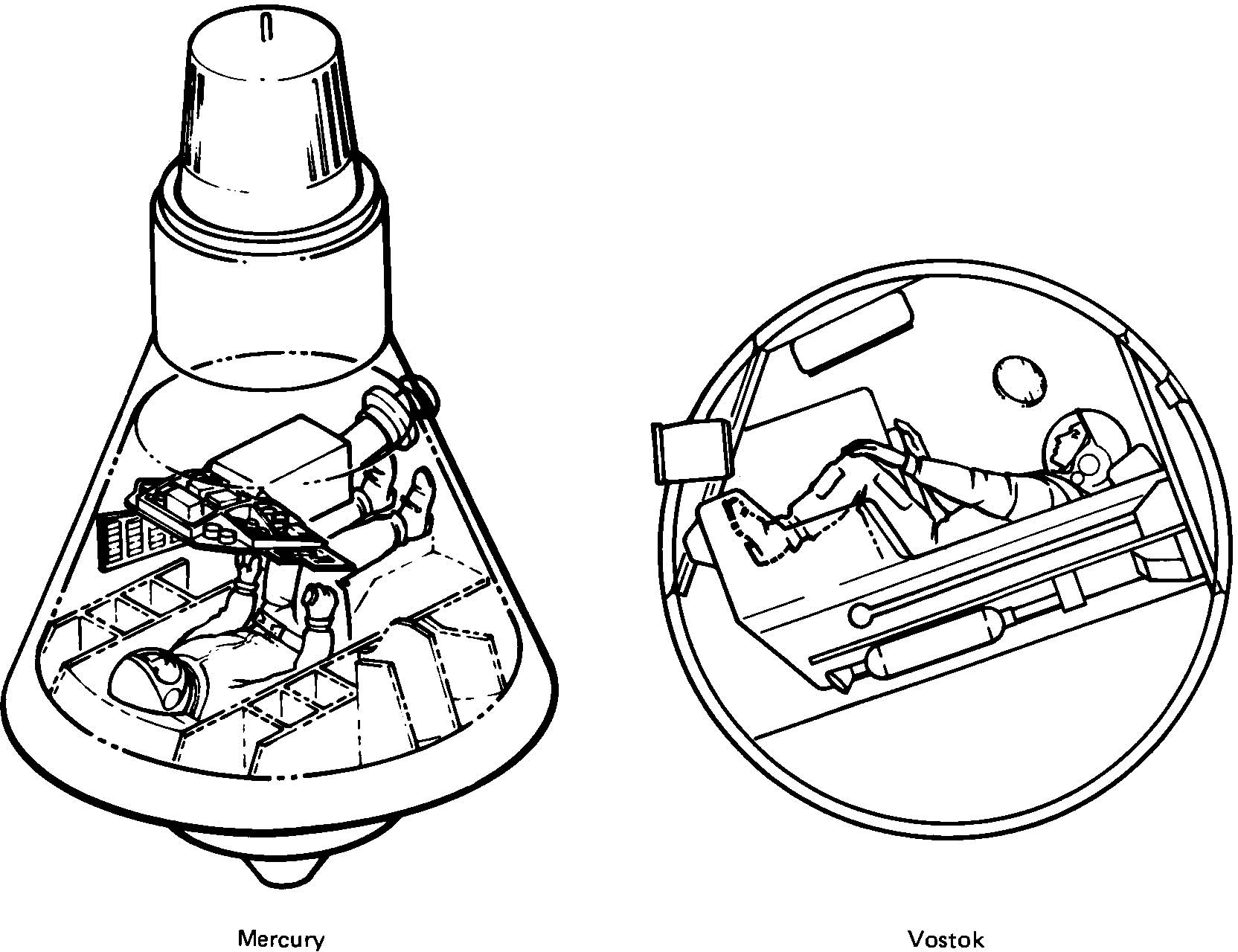
The choice of reentry vehicle configuration reflected additional differences in approach. The central and most visible difference between the Vostok and Mercury spacecraft was their external configuration. Beneath the streamlined launch shroud, the orbital/reentry portion of Vostok was spherical, while the basic shape of Mercury was a truncated cone. The spacecraft designers studied the alternative shapes for reentry vehicles and made their choices based upon standards established within their own programs.
The Soviets, under the leadership of Sergei Pavlovich Korolev, chief designer of spacecraft, reviewed the different possibilities and chose the sphere for their reentry configuration. According to Korolev, among non-lifting shapes the spherical reentry body alone possessed an inherent dynamic stability as it plunged back into the earth’s atmosphere. He rejected the conical craft, because its tendency to pitch and yaw would have required an elaborate attitude control system, plus greater reliance upon man as pilot rather than man as passenger.*
* The role of man in space flight has been one of the basic and continuing philosophical differences between the Soviet and American space programs. Americans have sought to make the astronaut a central figure in the operation of the spacecraft, especially in his ability to veto automatic systems. The Soviets have preferred to rely upon automated systems on the ground and in the air, with the cosmonaut playing a secondary and more limited role.
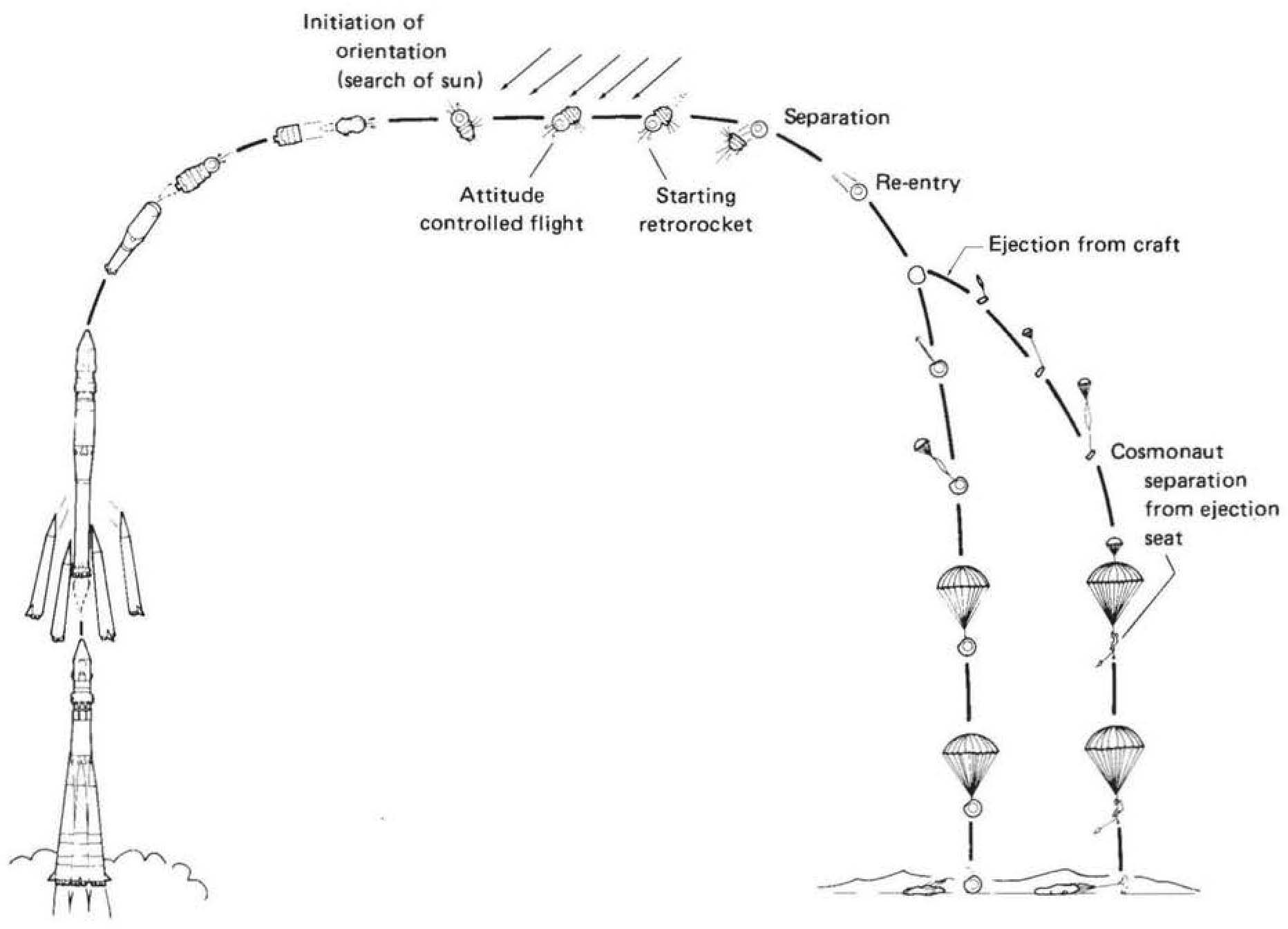
The orbital configuration of Vostok consisted of a spherical cabin with an attached equipment cluster.* 13 Prior to descent, the spacecraft was oriented for reentry by means of a solar sensor located in the equipment com-partment. This maneuver aimed the retrorockets so that they fired along the line of flight, slowing the craft as it entered its descent trajectory. Upon termination of retrofire, the cabin separated from the instrument section, which subsequently burned up as it entered the atmosphere. Vostok was then a simple sphere, descending along a ballistic trajectory, protected from the intense reentry temperatures by an ablative coating that shielded the entire craft.† 14
* K.P. Feoktistov, who had prime responsibility for design details of Vostok, described the two sections as “a recoverable capsule (accommodating the spaceman and his life-support equipment, flight controls, communication, on-board systems controls and landing controls) and an instrument compartment (housing various instruments and units of spaceship systems controlling orbital flights, communications, telemetering measurements, orbit parameters, power supply, etc.); that is, all that contributed to orbital flight alone.”
† Hartley A. Soulé recalls that in American circles the spherical “shape was specifically criticized because the weight of the material to completely shield the surface from reentry heat would [have precluded] launching with programmed ICBM boosters.” The Soviets had the launch vehicle capability that kept this extra weight from being such a serious concern. Some American designers favored the spherical shape to reduce the problems associated with attitude control, but others feared that “the lack of orientation might result in harm to the occupant during the deceleration period.”
Vostok reentered like a bullet, following the path dictated by the retrorocket impulse; there was no attitude control. By placing the sphere’s center of gravity behind and below the cosmonaut, the spacecraft designers assured Vostok pilots from Gagarin to Bykovskiy and Tereshkova the proper orientation for ejection from the “lander” when it reached 7000 meters. At that altitude, the bolts securing the pilot’s hatch were severed explosively, and the hatch was blown away. Two seconds later the cosmonaut and his couch were ejected from the craft to begin a parachuted descent to 4000 meters.‡ At that height, the cosmonaut continued his return by means of his own parachute. Also at 4000 meters, a parachute opened to slow the final descent of the spacecraft.15
‡ According to one source, this delay was incorporated after the loss of a pilot who was testing the ejection seat system during a drop test of the Vostok.
In their study of reentry, the Americans evolved their own theories regarding optimum spacecraft configuration. In June 1952, H. Julian Allen of the NACA Ames Aeronautical Laboratory addressed the problem of structural heating during atmospheric reentry. His research led to the formulation of the “blunt-body principle,” a radical departure from the streamlined aircraft of the early fifties. Allen’s work indicated that a blunt shape would be most suitable for a body reentering the earth’s atmosphere, since 90 percent of the friction heat would be dissipated through the bow shock wave. Tests five years later, in 1957, with a scale model Jupiter-C nosecone demonstrated that the remaining heat could be dissipated through use of an ablative coating on a heatshield. Although his studies were directed toward resolving the nosecone reentry problem of the ballistic missile, they were later applicable to the Mercury spacecraft. During the ensuing years, heat-resistant materials of the ablative and heat sink types were perfected by government and industry.
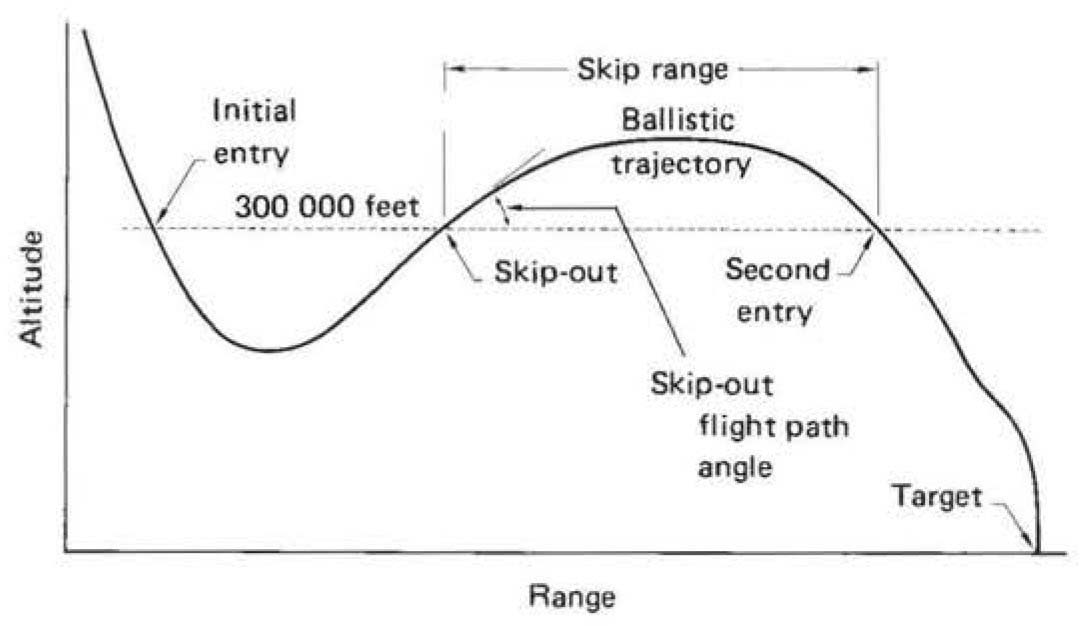
Beginning in 1954 and continuing through 1958, Allen and two associates, Alfred J. Eggers, Jr., and Stanford E. Neice, examined the relative merits of three types of hypersonic spacecraft-ballistic, skip, and glide. They prepared in early 1954 a theoretical discussion of the alternative configurations that could be used for manned spacecraft, “A Comparative Analysis of the Performance of Long-Range Hypervelocity Vehicles.” For manned satellite missions, any of the three craft could be boosted to orbital velocity by a rocket and then be separated from the launch vehicle for either free flight or earth orbit. The skip vehicle, which would reenter the atmosphere by an intricate series of dips and skips, would require the greatest boost capacity, and would encounter excessive aerodynamic heating during reentry. The glider-type craft, although heavy, would require a smaller boost capacity and would have a greater degree of pilot control during the reentry phase of the mission; the glider was a promising concept, but it would also be a long term project, since it would require extensive engineering and development. The third option was the ballistic shape, which was simply a blunt, non-lifting, high-drag projectile. Although without aerodynamic controls, its blunt configuration would provide superior thermal protection to the pilot, and its lighter weight would permit longer range missions. Moreover, the deceleration forces would be minimized if the vehicle reentered at the correct angle. The Ames researchers concluded that “the ballistic vehicle appears to be a practical man-carrying machine, provided extreme care is exercised in supporting the man during atmospheric entry.”16
As time passed, Eggers became convinced of the superiority of the manned satellite glider over the ballistic satellite, but he also knew that the rockets then on the American drawing boards could not put the glider into orbit. He had two concerns when he thought of using the ballistic vehicle-the deceleration loads and the absence of control once the craft entered the atmos-phere. The latter problem dictated a large landing area, perhaps as much as several thousand square kilometers. By late 1957 Eggers was proposing a semi-ballistic vehicle in which the best elements of the glider and the ballistic shapes were combined. Further progress on manned spacecraft was influenced by the Air Force and by research in progress at the Langley Memorial Aeronautical Laboratory.17
On 29-31 January 1958, the Air Research and Development Command held a closed conference at Wright-Patterson Air Force Base, during which 11 aircraft and missile firms outlined for Air Force and NACA representatives their classified proposals for manned satellites. These variations on the three basic configurations discussed previously ranged in projected weight from 454 to 8165 kilograms and involved mainly the use of multistage launch vehicles. Since there was such a difference in technology among the various proposals, the estimated development time ranged from one to five years. Looking back on this period, Robert R. Gilruth recalls:*
Because of its great simplicity, the non-lifting, ballistic-type of vehicle was the front runner of all proposed manned satellites, in my judgment. There were many variations of this and other concepts under study by both government and industry groups at that time. The choice involved considerations of weight, launch vehicle, reentry body design, and to be honest, gut feelings. Some people felt that man-in-space was only a stunt. The ballistic approach, in particular, was under fire since it was such a radical departure from the airplane. It was called by its opponents “the man in the can,” and the pilot was termed only a “medical specimen.” Others thought it was just too undignified a way to fly.18
* Robert R. Gilruth had been Assistant Director of the Langley Aeronautical Laboratory since 1952 and was named Manager of the Space Task Group, which was assigned responsibility for Project Mercury on 5 Nov. 1958.
While subject to considerable criticism, the concept of a simple ballistic manned satellite gained important support from a group of NACA engineers who started work on just such a spacecraft, borrowing on the experience and technology available in recent research on nosecones for intercontinental ballistic missiles. Max Faget was one of the key members of the NACA group interested in this effort. In January 1958, he had identified himself as a supporter of the ballistic reentry vehicle when he proposed to NACA Headquarters that a non-lifting spherical capsule be considered for orbital flight. NACA expressed little interest in the idea, but Faget continued his studies of ballistic vehicles and spoke out for adoption of this concept when occasions arose. Less than a week after an Air Force man-in-space conference in March 1958,* Gilruth called Faget and a group of top Langley engineers together to discuss a NACA conference on high speed aerodynamics, scheduled to begin at the Ames laboratory on 18 March. The “Langley position” that emerged from the conference reflected the thinking of Faget and his colleagues on a ballistic spacecraft launched by a ballistic missile booster.19
* The Air Force held a working conference on 10-12 Mar. at the Air Force Ballistic Missile Division, Los Angeles, in support of its program “Man in Space Soonest” (MISS). At that time, the Air Force concept consisted of three stages-a high-drag, no-lift, blunt-shaped spacecraft to get man in space soonest, with landing to be by parachute; a more sophisticated approach by possibly employing a lifting vehicle or one with a modified drag; and a long-range program that might end in a space station or a trip to the moon.
The Ames conference was the last in a series of formal symposia; as such it attracted nearly 500 people from NACA, the military, and the aircraft and missile industry. The 46 papers presented during the three-day meeting summarized the most advanced aerodynamic thinking within the Advisory Committee’s laboratories on hypersonic, orbital, and interplanetary flight. Faget presented the first paper, Preliminary Studies of Manned Satellites-Wingless Configuration: Non-lifting,” in which he and his co-authors pointed out the inherent advantages of the ballistic approach. First, ballistic missile research, development, and production experience was directly applicable to this type of spacecraft. Equally significant, the choice of a ballistic flight trajectory minimized the amount of automatic stabilization, guidance, and control equipment required on board the craft, thus saving critical weight and reducing the chance of equipment malfunction. Faget and his associates also demonstrated that their proposed craft could be returned from orbit by a modest-power retrorocket system. The Langley engineers went so far as to propose a specific ballistic configuration-a cone, 3.4 meters long and 2.1 meters in diameter, protected on the blunt end by a heat-shield. He concluded that “as far as reentry and recovery is concerned, the state of the art is sufficiently advanced so that it is possible to proceed confidently with a manned satellite project based upon the ballistic reentry type of vehicle.”20
The Mercury spacecraft grew out of this 1958 conceptual study prepared at Langley. After an additional two months of design studies, preliminary specifications for a manned satellite were drafted during June by Langley personnel under the supervision of Faget and Charles W. Mathews. Following a number of revisions and additions, these specifications were used for the Project Mercury spacecraft contract with McDonnell Aircraft Corporation. All this work occurred during the months in which the National Aeronautics and Space Act was being drafted and enacted by Congress. Gilruth remembered working out of the old NACA building in Washington during the summer of 1958; it had been hot, humid, and busy.21
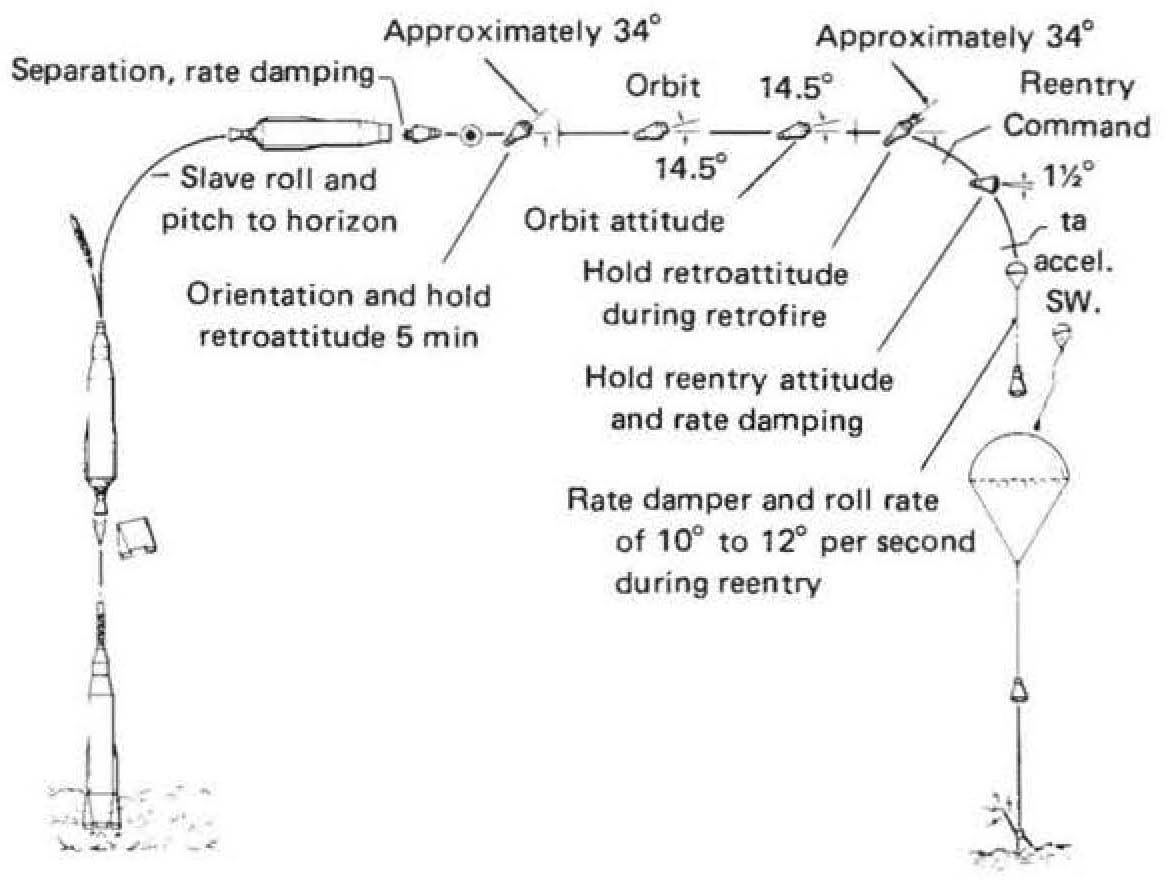
In designing the Mercury spacecraft, the key word was simplicity. The goal was a spacecraft that represented “the simplest and most reliable a-proach-one with a minimum of new developments and using a progressive buildup of tests.” Employing these criteria, “It was implicit... that we use the drag-type reentry vehicle; an existing ICBM booster; a retrorocket to initiate descent from orbit; a parachute system for final approach and landing; and an escape system to permit the capsule to get away from a malfunctioning launch rocket.”22 Although Vostok and Mercury emerged from the design process with different external configurations, their designers had met the same problems and had made some remarkably similar decisions. Undoubtedly, the key decision was to keep the first step into space a simple one. While the Mercury space vehicle would become more complex and sophisticated during the developmental process, the emphasis on reliability and relative simplicity remained.
VOSTOK AND MERCURY: FIRST FLIGHTS INTO SPACE
The years 1958-1961 were busy ones in both the United States and the Soviet Union for the development of manned space vehicles.* According to Konstantin Petrovich Feoktistov, the details for mockups and breadboard models of Vostok were worked out and then built during 1959. Final developmental work on the “carrier rocket” was being conducted simultaneously at the launch site.23 By 15 May 1960, the Soviets had progressed sufficiently with the development of their spacecraft and the adaptation of their ICBM boosters as launch vehicles to commence a series of five unmanned test flights. These Vostok precursor flights, Korabl Sputnik I through V, were designed to collect additional data on the effects of space environment (especially solar radiation) on biological specimens and to test the spacecraft systems. The flights included no unforeseen physiological problems associated with manned space missions, but the first and third spaceships did encounter trouble upon reentry. The problem centered on the proper orientation for retroengine firing, a difficulty that was worked out by the time the fourth and fifth test missions were flown in March 1961. Feoktistov indicated that a round of technical discussions led to major changes in the spacecraft during September-December 1960. “In late 1960-early 1961 the revised technical documentation was used for the manufacture of the spaceships.” The Soviets were ready to begin manned space flight operations.24
* Appendix B lists the major Soviet and American developmental (unmanned) and manned flights.
The rationale of the six Vostok flights has been summarized by design engineer and cosmonaut Feoktistov. Yuri Gagarin’s flight on 12 April 1961 was a single-orbit checkout of the spacecraft systems. Rather than the ballistic shots used at first by the Americans, the Soviets preferred an orbital mission to collect additional data on weightlessness, a topic of considerable concern to Soviet flight surgeons. Indeed, for the second mission, flown by Gherman Titov on 6 August 1961, the medical specialists had urged that the duration be held to just two or three orbits so they could judge the effects of zero gravity, but the designers and Titov wanted to go for a day-long mis-sion, a goal that coincided with political considerations as well. Feoktistov later hinted that the one year hiatus in manned flight following Vostok II may have been related to the motion sickness experienced by Titov. Andriyan Grigoryevich Nikolayev and Pavel Romanovich Popovich in Vostok III and IV completed their dual mission in August 1962. Though they did not actually rendezvous, they appear to have been within 5 kilometers of each other, thus giving the Soviet trajectory specialists an opportunity to study the problem of rendezvous and to track two spacecraft simultaneously. In June 1963, Valeriy Fedorovich Bykovskiy’s flight aboard Vostok V lasted nearly five days, and during the last three days he was accompanied in orbit by Vostok VI, piloted by Valentina Vladimorovna Tereshkova, the only woman to fly in space to date. Vostok was the “necessary foundation for ... further development of manned space vehicles in the Soviet Union.”25
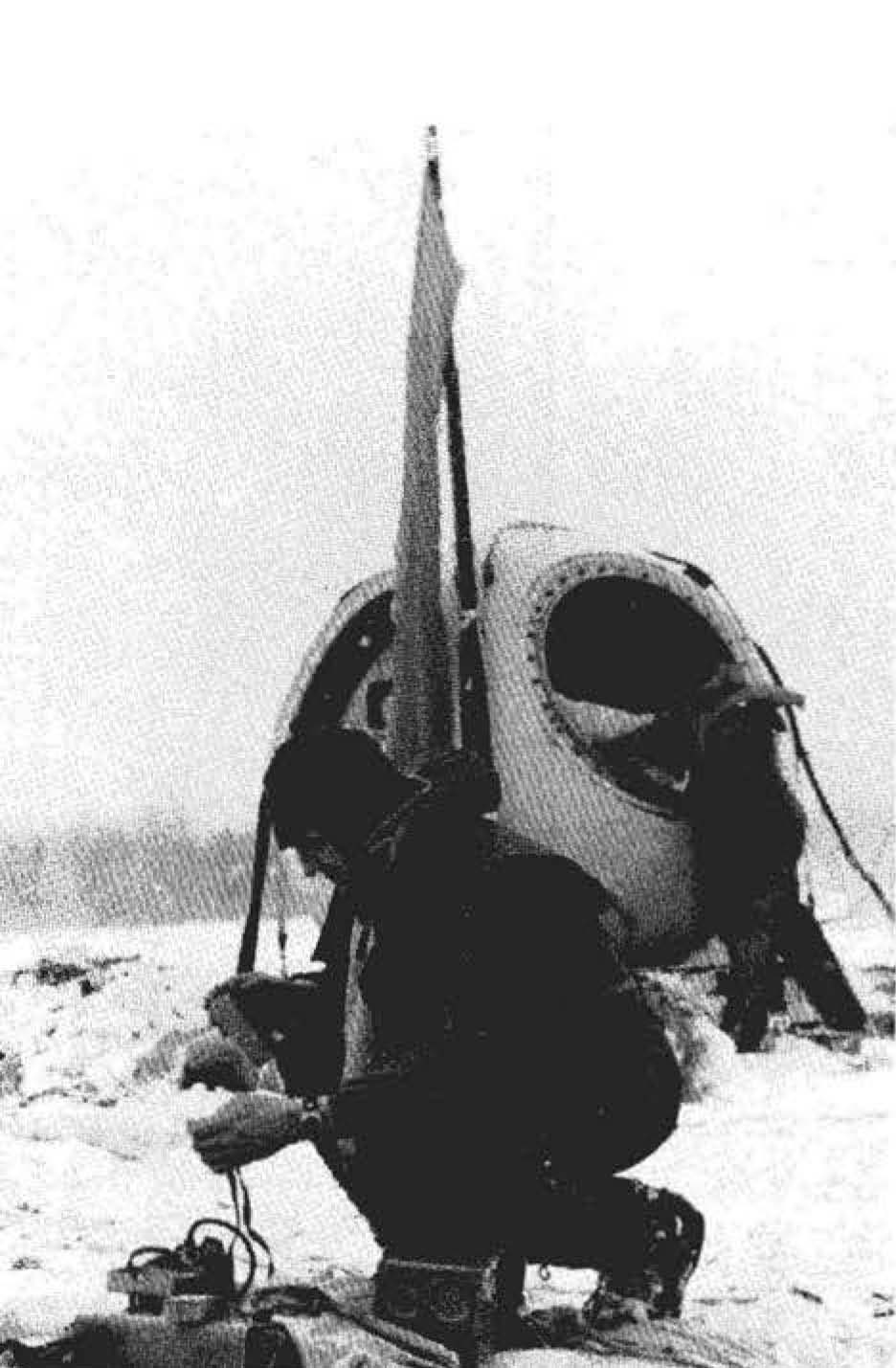

While the Soviet cosmonauts were monopolizing world headlines, work on Project Mercury continued. NASA had embarked upon a step-by-step program of spacecraft and booster qualification trials in 1959. The test pro-gram, divided into two parts, sought first to qualify the Redstone and Atlas missiles as launch vehicles for manned spacecraft, and second to “man rate” the Mercury spacecraft itself. The Mercury-Redstone phase of the program covered a 31-month period, during which six missions were flown. The results were mixed. On the very first launch attempt (MR-1), early separation of an electrical ground line to the booster aborted the mission. On the second flight (MR-1A), all systems worked satisfactorily, but problems again appeared in the primate “Ham” mission (MR-2), when over-acceleration caused a higher trajectory and longer downrange travel than had been anticipated. As a consequence, an extra flight was scheduled before a manned launch was attempted. Then on 5 May 1961, less than a month after the Gagarin mission, Alan Shepard became the first American in space, flying a suborbital trajectory in his spacecraft Freedom 7. Gus Grissom in Liberty Bell 7 made the second suborbital flight on 21 July. The data gathered from these two successful missions justified canceling the remaining Mercury-Redstone flights.

Then came the step to orbital flight for which the Atlas missile had been selected as the launch vehicle. When the program was approved in October 1958, no other booster could have been chosen if the objectives of the program were to be accomplished in a reasonable length of time. So, as had the Soviets, the Americans decided to “man rate” an intercontinental ballistic missile. The 57-month flight phase for Atlas began with the launch of the Big Joe Atlas with a boilerplate model of the Mercury spacecraft on 9 September 1959. The first production spacecraft mounted on an Atlas launch vehicle (MA-1) was launched on 29 July 1960. After about 60 sec-onds, launch vehicle and adapter failed structurally. Because no spacecraft escape system was used, the spacecraft was destroyed upon impact. Following an intensive seven-month investigation, modifications were introduced to stiffen the adapter between the launch vehicle and the spacecraft and to otherwise improve the structural integrity of the entire upper part of the Atlas. An interim version of the alteration was used without difficulty on the flight of MA-2, while the final version was not tested until the unmanned orbital flight of MA-4 on 13 September 1961. More than two months later on 29 November, Enos, a trained chimpanzee, was launched on a planned three-orbit mission. During the flight of MA-5, the attitude control system performed abnormally, and ground control brought the spacecraft down after two orbits. The problem, as demonstrated on later flights, could have been corrected by an astronaut, thus confirming the American judgment favoring manual overrides of automatic control systems.
After a series of frustrating delays caused by unfavorable weather and fuel leaks, John Glenn became the first American to orbit the earth. His flight was followed by a three-orbit mission flown by M. Scott Carpenter, in which the only problem was an attitude misalignment at the time of retro-fire, causing a 402-kilometer landing overshoot. As the next step toward a day-long mission, Walter M. Schirra piloted a six-orbit mission on 3 October 1962. By drifting in flight, he conserved critical fuel and demonstrated the feasibility of longer duration missions. The 34-plus-hour mission of L. Gordon Cooper on 15-16 May 1963 was Project Mercury’s last flight.26
Mercury and Vostok demonstrated the feasibility of placing a human being in orbit, observing his reactions to the space environment, and returning him safely to earth at a known point. While the Soviet designers assigned limited tasks to their cosmonauts, NASA went one step beyond to demonstrate that man could function as “an invaluable part of the space flight systems as pilot, engineer and experimenter.” The next stage was the development of more flexible and multi-place spacecraft for the conduct of more intricate missions-the era of Gemini and Voskhod.
VOSKHOD AND GEMINI: INTERMEDIATE STEP
Even as the Vostok and Mercury programs were entering their operational phases, engineers in the U.S. and the U.S.S.R. were undertaking the design of a second generation manned spacecraft. The Americans began with an effort to extend the capabilities of the Mercury craft, the so-called Mark II version, and ended up designing an essentially new two-man vehicle capable of greater maneuverability, rendezvous and docking, and flights of a duration that would equal the period anticipated for the lunar mission of Project Apollo. The Soviets, apparently spurred by the goals set for Project Gemini, decided to modify their Vostok spacecraft for multi-man flights. Where Voskhod was an attempt to exploit more fully a tested design, Gemini became geared to the creation of new systems and to the testing of unproven flight concepts that would be applied to even bolder missions in the future.
By December 1961, Project Gemini received formal approval from Washington as the second major project in NASA’s manned space program; however, much of the design work had been done and many of the major decisions had already been made.27 The character of the new effort was shaped by two converging lines of thought. The most influential consideration was President Kennedy’s decision in May that committed the U.S. to a manned lunar expedition before the end of the 1960s. NASA advance planners had been thinking about a mission to the moon, but in the time frame of the 1970s, dependent upon the development of a new, larger launch vehicle called Nova. This rocket would be capable of lifting a spacecraft that could fly directly to the moon, land, and then return to earth. This method of reaching the moon-called direct ascent-was readily accepted because it would almost certainly work. However, within NASA there was a group of engineers who supported the development of an alternative route involving the orbital rendezvous of two or more spacecraft.
John C. Houbolt of Langley and a group of his associates felt that orbital rendezvous promised significant savings in fuel, weight, and time, especially if it were done in lunar orbit rather than earth orbit. A lunar expedition based upon the rendezvous concept might be assembled with much smaller rockets than a direct mission would need, launch vehicles that could be available well before Nova. Orbital rendezvous had the disadvantage, how-ever, of being a new and untested idea. No one could predict how difficult or hazardous a rendezvous and linkup in space might be. As long as there was no pressing deadline for a lunar mission, direct ascent offered the easier and safer approach, but with the Presidential creation of a specific timetable, the supporters of rendezvous could press their case for a quicker and cheaper path to the moon. The idea still had to be tried to determine its feasibility, and “Gemini was first and foremost a project to develop and prove equipment and techniques for rendezvous.”28
Project Gemini was also influenced by a second important consideration, the desire to make a major jump in the state of spacecraft technology. The engineers who had worked on Mercury had seen a number of possible improvements that could have been used if they had not been held back by a combination of considerations-weight, time, and the desire to keep the first spacecraft simple. While the Mercury designers had justifiably been preoccupied with solving the basic problems of manned space flight, it had taken too long to build and check out the handcrafted spaceship. James A. Chamberlin, chief designer of Gemini, described the difficulties in Mercury brought about by numerous design constraints:
Most system components were in the pilot’s cabin; and often, to pack them in this very confined space, they had to be stacked like a layer cake and components of one system had to be scattered about the craft to use all available space. This arrangement generated a maze of interconnecting wires, tubing, and mechanical linkages. To replace one malfunctioning system, other systems had to be disturbed; and then, after the trouble had been corrected, the systems had to be checked out again.29
Chamberlin saw an opportunity to make Mercury Mark II, which became Gemini, a more easily assembled and serviced vehicle. He began by modularizing all systems and assembling the components of each system into compact packages, which were so placed that any system could be removed without tampering with another. Simultaneously, he sought to arrange most of the packages on the outside walls of the pressurized cabin for easy access; this would also permit several technicians to work on different systems at the same time.
In an effort to eliminate some of the trouble spots identified in Mercury, Chamberlin simplified his systems wherever possible. He reduced the complexity of the relays that controlled the automatic systems on board the craft. The new design relied upon pilot control with automatic backup flight systems. The result was a much simpler machine. Another change was the elimination of the rocket-powered escape tower used in Mercury, cutting hundreds of kilograms of extra weight, numerous relays, and much complex wiring. This in part was made possible by the change from the liquid-fueled Atlas rocket to the less explosive, hypergolic-fueled Titan II.* Whereas safety required an automatic abort system to propel the pilot away from the highly explosive Atlas in a launch emergency, Chamberlin could equip the new spacecraft with pilot-actuated ejection seats.
* Hypergolic fuel ignites spontaneously upon contact with its oxidizer, thereby eliminating the need for an ignition system, as well as being less dangerous in some emergency situations.
The year 1961 was a creative one for Gemini. It began with discussions at Langley in January and continued with the March Wallops Island talks regarding post-Mercury possibilities for manned space flight.* By mid-1961, the desire for an advanced technology spacecraft and the Presidential decision to press forward with the Apollo lunar program had led to a concrete proposal for a new spacecraft.
Project Gemini owed its origins to its predecessor-it built on the technology and experience of Project Mercury-and to its successor-it derived its chief justification from Project Apollo’s concerns. The new project acquired other objectives as well: testing of the concept of controlled landing, determining the effects of lengthy stays in space, and training ground and flight crews.30
With the creation of a Gemini Project Office at the Manned Spacecraft Center in Houston, the program moved into its development phase.
* In attendance were Abe Silverstein, Robert Gilruth, George Low, James Chamberlin, Walter Williams, Paul Purser, Maxime Faget, Charles Mathews, and Charles Donlan.
Throughout the development period, 1962-1963, Gemini engineers and managers worked to solve technical problems and to meet a tight budget. “Within NASA and without, Apollo and the trip to the moon always held center stage.”31 Toward the end of 1963, the first Gemini launch vehicle and spacecraft were being prepared for qualifying trials. Early April 1964 saw the first of Gemini’s 12 flights, an unmanned test of the spacecraft and booster which produced excellent results. Further test flights were postponed as hurricane season arrived on the Florida coast. Meanwhile, the Soviets had launched their first multi-place spacecraft.
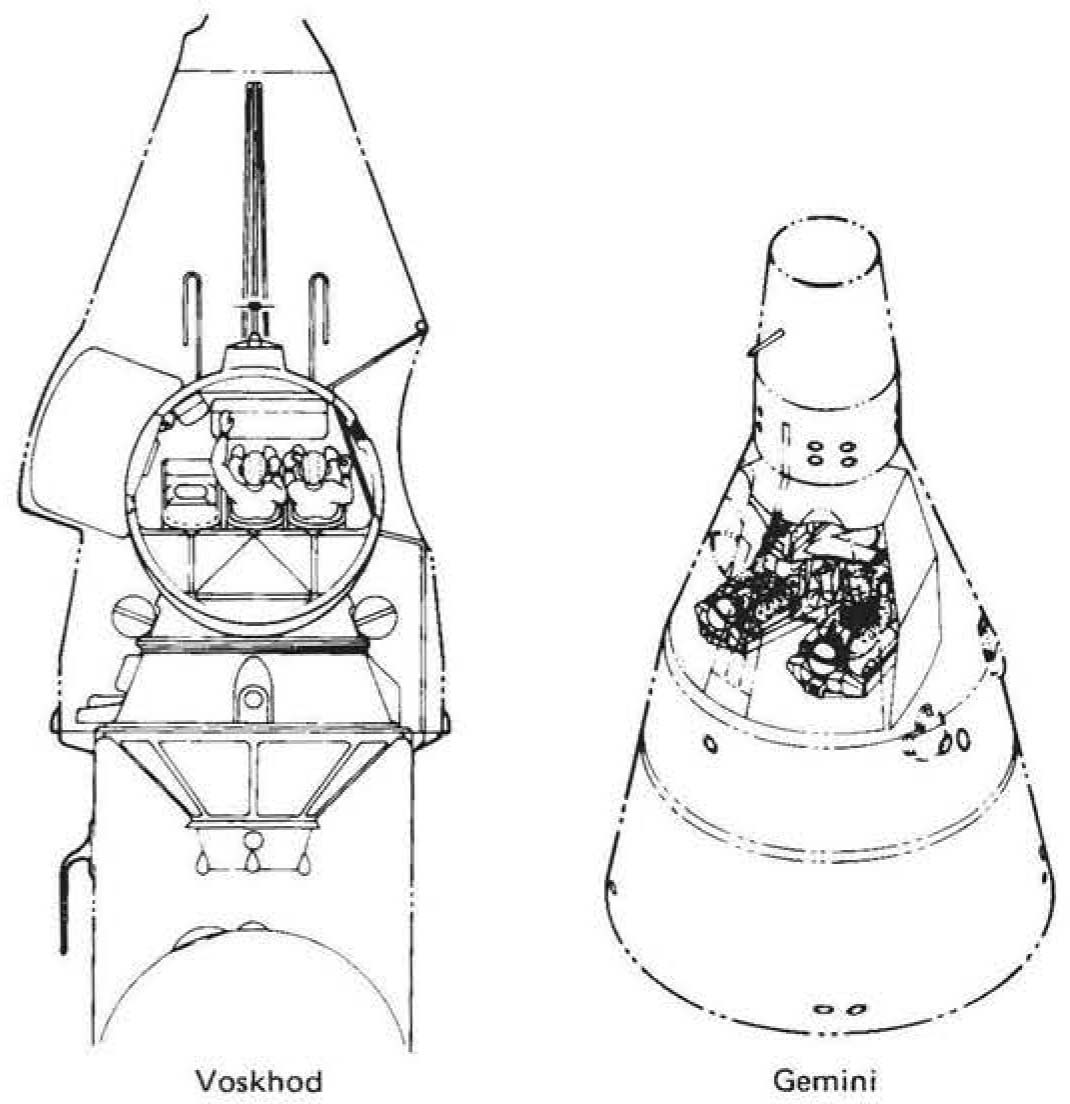
When given the assignment to place three cosmonauts into orbit in the same spaceship, designer Korolev set about to redesign Vostok.32 Apparently, the most important consideration in his decision to modify an existing design rather than to create a new one was the boost capacity of the launch vehicles at his disposal. From the fragmentary details available, it appears that by 1963 Korolev and his colleague Leonid Aleksandrovich Voskresensky were already well along in the design work of an advanced spacecraft capable of long-duration earth orbital missions. This vehicle, which would later publicly emerge as Soyuz, was much heavier than Vostok, and the Soviets planned to launch it with the standard Vostok launch vehicle, plus a new and still untested upper stage that would provide the necessary additional thrust.33 The evidence suggests that as this design work progressed, the Soviet political leadership grew concerned over the possibility that the U.S. would launch a two-man vehicle before the Soviets could.* In particular, Khrushchev wanted the Soviet multi-man space mission to come first to maintain the Soviet lead in space accomplishments.34 Since Korolev could not hope to perfect his advanced spacecraft and improved launch vehicle in the time remaining before the first Gemini flight, he turned to the task of modifying Vostok to carry a three-man crew.
* According to the U.S. public announcement of Project Gemini made on 8 Dec. 1961, the first manned flight would occur in 1963-1964. At NASA, Deputy Administrator Dryden had “long expected the U.S.S.R. to make every effort to modify a Vostok, which is large enough to carry more than one man, to obtain an earlier flight” than those scheduled with Gemini.
As he approached the task of altering the Vostok interior, Korolev had two problems of equal magnitude-how to make room for three persons, and how to keep the weight of the completed vehicle as close to that of the original as possible. He first eliminated the ejection seat. This change saved weight and made it possible to accommodate three form-fitting couches. To make room for the crew, Korolev planned to have the Voskhod cosmonauts fly in a “shirt sleeve environment.” The Soviet designer could risk eliminating space suits since he and his staff had created a virtually leakproof spaceship.† Removal of the ejection apparatus would force the crew to ride to earth in the spacecraft, thus necessitating the development of a “soft-landing” system. Korolev attacked this problem by adding two pieces of equipment, a second parachute to supplement the one previously used to slow the Vostok reentry sphere and a rocket-powered landing apparatus in the parachute shroud lines that would reduce the craft’s velocity to less than one meter per second at touchdown.35
† The design of the life support system had required a very tightly sealed spacecraft, because the 760-mm-Hg pressure represented the total volume of gas on board. The chemical replenishment system changed only the composition of the gases, not the volume. In the absence of a capacity to repressur-ize the cabin, the Soviets built and tested their craft to ensure that they were leak free.
There appears to have been a number of unsuccessful trials with the soft landing system, including some tests in which monkeys were killed. According to an official Soviet publication, “At Korolev’s instructions, a series of Voskhod-type spacecraft were launched, until he was convinced that the soft-landing system worked impeccably.”36 This series included Cosmos 47, launched on 6 October 1964 and identified subsequently as an unmanned precursor to Voskhod I, which flew six days later.37
The flight of Voskhod I was another space spectacular for the U.S.S.R. On board were Command Pilot Vladimir Mikhaylovich Komarov; Dr. Boris Borisovich Yegorov, a medical doctor serving as flight physiologist; and the spacecraft engineer Feoktistov, who acted as an onboard technical scientist. The day-long mission, equivalent to three man-days for the life support system, was completed without reported difficulty. Toward the end of the flight, Komarov expressed the crew’s eagerness to continue the flight for another day, but Korolev, quoting Shakespeare, replied, “There are more things in heaven and earth, Horatio,” vetoing the request. Longer missions would come, but for the present it was best to adhere to the flight plan. On 13 October, the retrorockets fired, and the craft began its reentry.
As on the Vostok flights, the spacecraft’s parachutes opened at an altitude of 7 kilometers. When it came close to the ground, the soft-landing system automatically went into operation. Streams of gases, expelled from nozzles in the direction of the ground, reduced the touchdown velocity to virtually zero.
The cosmonauts did not feel the impact.38
With the success of this first flight, Korolev and his associates were ready to fly again. Meanwhile, NASA was preparing for a second unmanned Gemini-Titan flight.
Both space teams were fully occupied during 1965. The second Gemini mission was launched from the Kennedy Space Center on 19 January. This suborbital qualification test of the spacecraft’s structure, onboard systems, and reentry heat protection was a success, and the spacecraft was recovered two hours after splashdown. Just over a month later on 22 February, the Soviet launch crews sent aloft Cosmos 57, a rehearsal for Voskhod II, which flew on 18 March.39 The two-man crew, Command Pilot Pavel Ivanovich Belyayev and Copilot Alexei Arkhipovich Leonov, completed a 26-hour mission, during which Leonov took the first extravehicular steps into space. The Soviets equipped Voskhod II with a special inflatable airlock, and Leonov, prior to entering it, prebreathed pure oxygen for over an hour to reduce the amount of nitrogen in his bloodstream and body tissues. After entry, he pressurized his space suit, checked it for leaks, adjusted his helmet, and tested the closed oxygen life support system; Belyayev then closed the hatch between the main cabin and the airlock. Following the gradual depressurization of his narrow compartment, Leonov stepped out into space.40 This airlock arrangement resulted in a minimum reduction of the original cabin pressure, apparently necessitated by the lack of an onboard repressurization system. The Soviets continued to rely upon a chemical bed for generating oxygen, modified only to the extent required to support a second or third crewman.
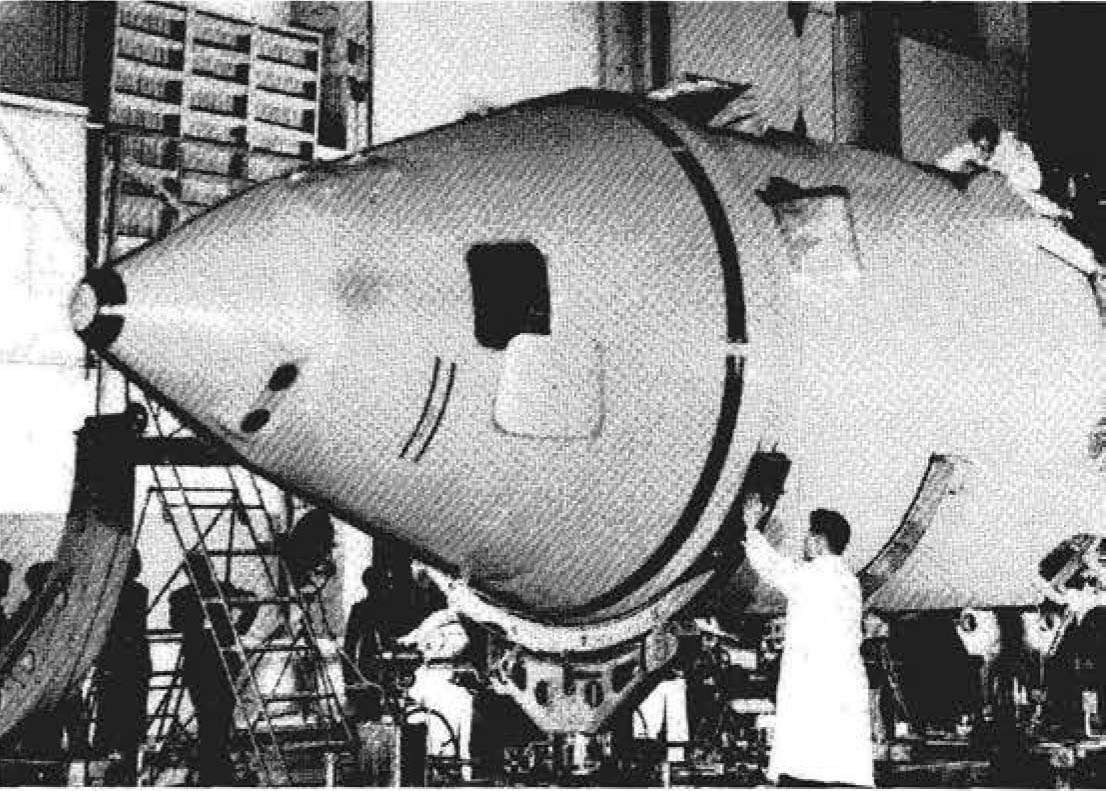
Belayayev and Leonov had to land their spacecraft manually when the solar-orientation system malfunctioned. Reentry by means of the auto-matic-descent sequence and solar-orientation system, the technique used in all previous Soviet manned space flights, had been planned for the 17th or-bit. When trouble was discovered, Belyayev asked permission to undertake a manual reentry on the 18th orbit. Korolev counted off the seconds until ret-rofire, and the command pilot fired the retrograde rockets high over Africa. Voskhod II overshot the recovery area and landed in a dense forest on the snow-covered slopes of the Ural Mountains. After hours of searching, helicopters dropped supplies to Belyayev and Leonov, who had to spend that night in the snow. Another day passed before the cosmonauts and their rescuers could be airlifted to safety.41 While the U.S.S.R. celebrated the rescue of the crew and Leonov’s 12-minute sortie into the void of space, the American team was preparing for the first manned Gemini flight.
On 23 March, Gus Grissom and John W. Young flew their spacecraft “Molly Brown” in a four-hour evaluation flight of the craft and launch vehicle.* Grissom and Young established a space-flight first by maneuvering in orbit. They employed the orbit attitude and maneuver system 90 minutes after launch for a precisely timed 75-second burn, which cut the spacecraft speed by 15 meters per second and dropped it into a nearly circular orbit.
Three quarters of an hour later, during the second revolution, Grissom fired the system again, this time to test the ship’s translational capability and shift the plane of its orbit by one-fiftieth of a degree. During the third pass, the pilot completed the fail-safe plan with a two and a half minute burn that dropped the spacecraft’s perigee to 72 kilometers (45 miles) and ensured re-entry even if the retrorockets failed to work.42
* “Molly Brown,” the “unsinkable” heroine of a Broadway stage hit, had seemed a logical choice for Grissom’s second ship, as his Mercury Liberty Bell 7 had sunk shortly after splashdown.
The retroengines did work, but there were still some surprises. At first all went well, but then “Molly Brown” seemed to be off course. The Gemini spacecraft produced far less lift than predicted, and as a consequence Gemini 3 was about 84 kilometers short of its intended splashdown point. After a few nervous minutes, Navy swimmers arrived on the scene via helicopter to attach a flotation collar.
With the basic success of the first Gemini flight, the project gained momentum, permitting a routine launch nearly every other month throughout 1965 and 1966. There were difficulties, to be sure, but the simplified manufacture and checkout procedure permitted holding to this busy schedule. Beginning on 3 June 1965, James A. McDivitt and Edward H. White II conducted a four-day mission aboard Gemini IV.* This was the first long-duration flight, best remembered for White’s 20-minute space walk, which added a new abbreviation to the public vocabulary-EVA (extravehicular activity). Gemini IV’s difficulties with a practice rendezvous meant that the next Gemini crew would be concerned with practicing that capability before the full-dress rendezvous experiment planned for the sixth mission. Andre J. Meyer, Jr., of the Gemini Project Office commented, “There is a good explanation on what went wrong with rendezvous....” The crew and some of the flight planners “just didn’t understand or reason out the orbital mechanics involved...”
Catching a target in orbit is a game played in a different ball park than chasing something down on Earth’s essentially two-dimensional surface. Speed and motion in orbit do not conform to Earth-based habit, except at very close ranges. To catch something on the ground, one simply moves as quickly as possible in a straight line to the place where the object will be at the right time. As Gemini IV showed, that will not work in orbit. Adding speed also raises altitude, moving the spacecraft into higher orbit than its target. The paradoxical result is that the faster moving spacecraft has actually slowed relative to the target, since its orbital period, which is a direct function of its distance from the center of gravity, has also increased. As the Gemini IV crew observed, the target seemed to gradually pull in front of and away from the spacecraft. The proper technique is for the spacecraft to reduce its speed, dropping to a lower and thus shorter orbit, which will allow it to gain on the target. At the correct moment, a burst of speed lifts the spacecraft to the target’s orbit close enough to the target to eliminate virtually all relative motion between them. Now on station, the paradoxical effects vanish, and the spacecraft can approach the target directly.43
* After Gus Grissom had given the quasi-official name of “Molly Brown” to his spacecraft, NASA’s top triumvirate, James Webb, Hugh Dryden, and Robert Seamans, Jr., decided that “all Gemini flights should use as official spacecraft nomenclature a single easily remembered and pronounced name. Consequently, the next mission will be called ‘Gemini IV’ and the code name will be ‘Gemini.’ “
Gemini V’s first day in space was a worrisome one, during which a wire to a heater that pressurized the fuel cells was found to be faulty. The lowest pressure at which the fuel cell would function was determined after Gordon Cooper powered down the craft and consulted with the ground. But the rendezvous evaluation pod with which Gemini V was to maneuver had already been released and had drifted away, so the Gemini crew had to practice its rendezvous with coordinates radioed to them by Houston. Charles “Pete” Conrad, Jr., and Cooper would rendezvous with a phantom vehicle. The success of each “phantom rendezvous” made the Gemini flight planners more confident about the feasibility of bringing two manned spacecraft together. The next step was a rendezvous of Gemini with an Agena target vehicle.
But plans went awry when the Agena target vehicle exploded before going into orbit on 25 October 1965. The flight of Gemini VI, ready for launch with Walter M. Schirra, Jr., and Thomas P. Stafford, was postponed. Walter F. Burke and John F. Yardley of McDonnell Aircraft Corporation began to discuss a Gemini-to-Gemini rendezvous within minutes of the Agena failure. Three days of intensive deliberation led to a decision for a Gemini VII/VIA rendezvous mission. The two-shot mission was inspired by the concern that the Soviets might be planning similar flights, as well as by the desire to turn a minor defeat into a major accomplishment.
That a plan of such scope could be suggested, thought about, decided upon, and announced in scarcely three days was a sign of the managerial and technical trust that Gemini had already come to inspire. William D. Moyers, the President’s Press Secretary, told the news media about the plan and answered questions from reporters. Moyers said the mission was targeted for January but gave no specific date. Back at MSC, however, everyone from Gilruth on down was working toward an early December flight.44
After 38 days of extensive crew training and spacecraft preparation, the dual Gemini mission began on the afternoon of 4 December 1965. For 11 days, Frank Borman and James A. Lovell, Jr., aboard Gemini VII carried out their tests on the effects of long duration in space, especially the problems associated with personal hygiene and comfort. On the morning of 15 December, Schirra and Stafford were launched on the fifth manned Gemini flight and the first genuine rendezvous mission.* Their third launch attempt was a success, and Gemini VIA was on her way to meet VII. During the ensuing six hours, Schirra and Stafford executed a series of maneuvers that brought them closer to the Borman-Lovell spacecraft. After 3 hours and 15 minutes into the mission, the VIA crew locked onto VII’s radar transponder, 434 kilometers distant. There followed a series of precise maneuvers that led to the first sighting of the target vehicle at five hours and four minutes into the mission. At 05:56:00 ground elapsed time, the two vehicles met in space with only 37 meters separating them; the first manned rendezvous was a fact.
* An earlier scheduled launch on 12 Dec. did not take place because an electrical umbilical connector separated prematurely; the crew did not eject but waited removal by the ground crew, something that would have been impossible in Mercury. See Hacker and Grimwood, On the Shoulders of Titans, pp. 514-517.
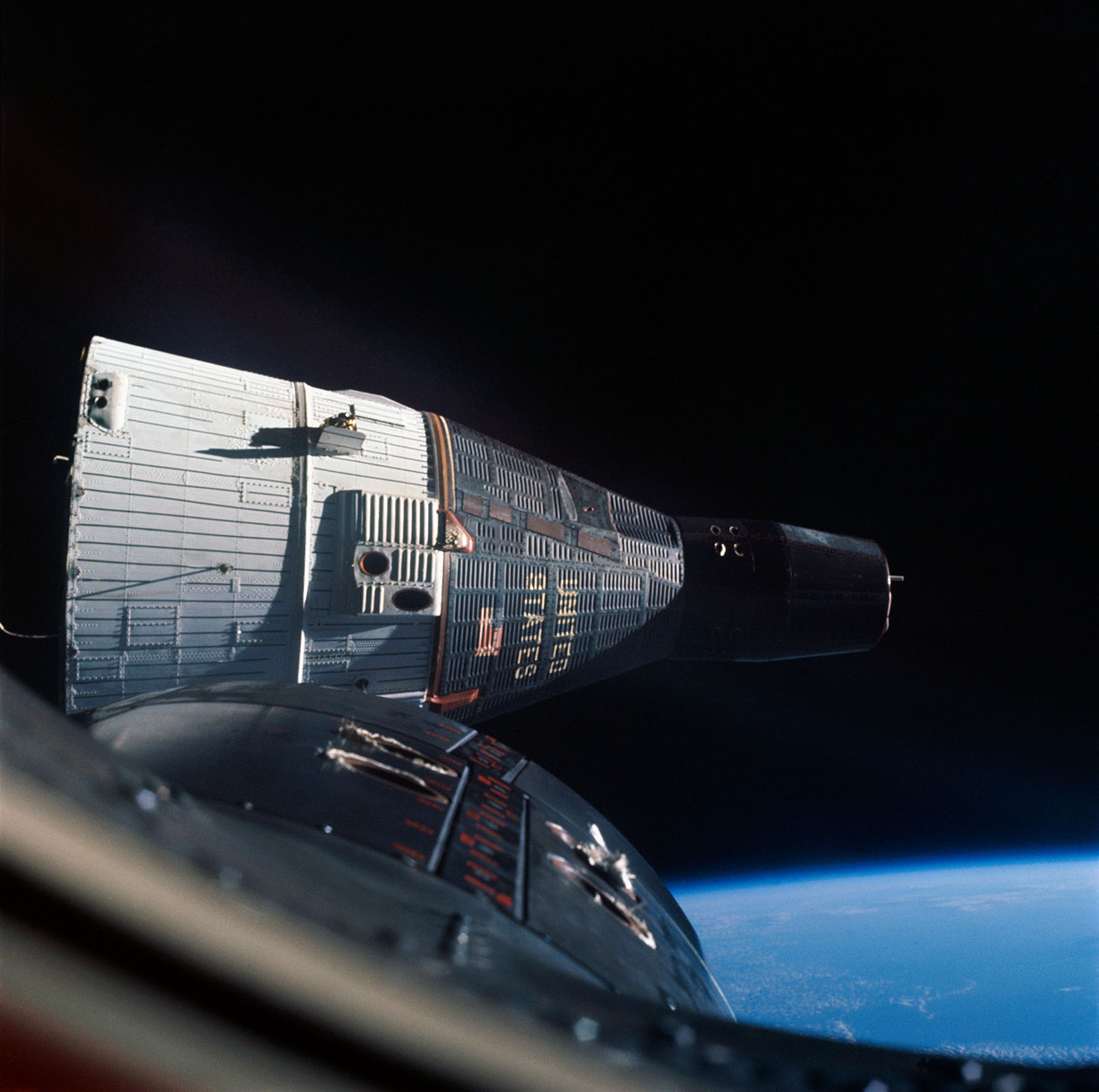
There was some controversy over the claim by the Americans that they had been the first to rendezvous in space. Nikolayev and Popovich had been given credit for the same feat by Pravda when they flew together in Vostok III and IV. When Popovich was asked by an Izvestiya correspondent if it were possible to compare his formation flight with Nikolayev to that of Gemini VII and VIA, Popovich said:
I think it is possible. The first formation flight in cosmonautics history at an orbit near earth was made in August, 1962 by Andrian Nikolayev and myself flying the space ships Vostok-3 and Vostok-4. As you remember, at that time our ships came to within five kilometers distance in space. Thus, in principle, the American experiment of an orbit rendezvous repeats in some degree what we did. But of course there are differences too. During the three years which elapsed since our flight the cosmonautical techniques advanced a great deal. This allowed the Gemini-6 Command Pilot, Walter Schirra, to accomplish with exactitude a series of maneuvers to approach Gemini-7. Of course, the skill of Walter Schirra played a great part in it.45
Wally Schirra saw more to rendezvous than Popovich claimed:
Somebody said ... when you come to within three miles [five km], you’ve rendezvoused. If anybody thinks they’ve pulled a rendezvous off at three miles, have fun! This is when we started doing our work. I don’t think rendezvous is over until you are stopped- completely stopped-with no relative motion between the two vehicles, at a range of approximately 120 feet [37 m]. That’s rendezvous! From there on, it’s stationkeeping. That’s when you can go back and play the game of driving a car or driving an airplane or pushing a skateboard-it’s about that simple.46
For more than three revolutions of the earth, the two NASA spacecraft flew together, separated by ranges of 0.3 meter to 91 meters, while the crew of VIA tested stationkeeping* and flyaround techniques. After a five-hour sleep period during which they had “parked” 16 kilometers away from the other craft, Schirra and Stafford prepared to go home. With a brief transmission, “Really a good job, Frank and Jim,” Schirra flipped VIA around, blunt-end forward, jettisoned the equipment section, and waited for the automatic retrofire.47 As the Gemini VIA crew went through the process of reentry, recovery, and return to the U.S., Borman and Lovell worked with Mission Control to ensure that the remaining time of their scheduled 14-day mission did not hold any surprises. Two days later, after some anxious moments over the fuel cell, Gemini VII returned safely to earth, proving that man could work and survive in space for the length of time that it would take him to travel to the moon and back.
* A definition of stationkeeping is "remaining in a particular, precise orbit with a constant velocity, usually at a given distance from a companion body or another vehicle.”
Each of the five remaining Gemini flights strengthened the conviction and technical certainty that an American could land on the lunar surface and return before 1970. On 16 March 1966, Neil A. Armstrong and David R. Scott conducted the first manned docking when they nosed Gemini VIII into the docking adapter of an Agena target vehicle. But shortly after the two vehicles had locked together, a spacecraft thruster stuck open, sending the two astronauts into a dizzying ride through space. They undocked from the Agena, but Gemini VIII only spun faster. They were forced to use their reentry control thrusters to restore stability, so ground control told the crew to prepare for immediate reentry. While the early termination of the mission at 10 hours and 41 minutes was most exasperating, the crew did return safely. And they had proved that docking two spacecraft in orbit was possible.
Tom Stafford and Eugene A. Cernan rode Gemini IXA into orbit on 3June 1966 to work further on orbital maneuvers, but when they completed their first rendezvous with the target vehicle, the crew discovered a problem with the docking adapter that precluded the docking phase of the flight. They did continue rendezvous exercises, however, simulating the meeting of an Apollo command module with a lunar module in lunar orbit. Gemini IXA also provided an important lesson on the difficulties of working outside a spacecraft in zero gravity, as Cernan left the spacecraft to perform some experiments to get the feel of this new environment.48
The final three Gemini missions in 1966 built upon the experiences of the earlier flights. They were complex missions with multiple maneuvers; they were designed to test rendezvous and docking, to explore more fully the problems of working outside the spacecraft, and to conduct other experiments that would yield valuable information for Project Apollo. Gemini X and XI reduced the worry about radiation, demonstrating that it could be avoided during trips into deep space. Gemini XI’s first-revolution rendezvous with an Agena target vehicle simulated the meeting of an Apollo command module and lunar module. The automatic reentry of these last two flights gave additional proof that man could return from long missions in space with both manual and automatic control over the final approaches to the landing site. Gemini, in accumulating 1940 man-hours in space flight as opposed to 55 in Mercury, had seasoned flight and ground crews for Apollo; had developed the techniques for rendezvous, docking, and EVA; and shown that astronauts could stay in space as long as two weeks without physical damage.
SOYUZ-DEVELOPMENT OF THE SPACE STATION; APOLLO-VOYAGE TO THE MOON
Less than two weeks after the splashdown of Gemini XII, on 28 November 1966, the Soviets launched Cosmos 133, an unmanned test of their new manned spacecraft-Soyuz. In the 18 months between the last flight of Voskhod and the first unmanned test of Soyuz, the Soviet space program had lost three important advocates. Premier Khrushchev had stepped down from his post on 14 October 1964, the day following the return of Voskhod I; L.A. Voskresensky, Korolev’s top assistant, had died on 15 December 1965 after preparing Voskhod II for flight; and a month later the Chief Designer himself was dead. 49 While the new Soviet leaders reviewed the competitive space program they had inherited from Khrushchev, the space design group continued the development of Soyuz.
Two elements appear to have slowed the initial pace of the Soyuz project. Soviet engineers needed time to perfect a new upper stage for their basic launch vehicle to provide sufficient power to boost the heavier Soyuz into orbit, and the political requirements to launch a multi-manned Voskhod after Vostok had diverted them. By the end of 1966, the Soviets resolved their various design questions and launched a series of four Cosmos precursor flights that led to the 23 April 1967 launch of Soyuz 1.* That new spacecraft was designed to exploit knowledge gained in earlier flights, permitting extended missions that would allow Soviet specialists to gather additional data on man in space and to investigate the problems of rendezvous and docking. According to the Soviets, the basic purpose of these Soyuz missions was the development of an earth-orbiting space station; others speculated that Soyuz was their entry into the competition to reach the moon.50
* The unmanned Cosmos flights are summarized in appendix B.
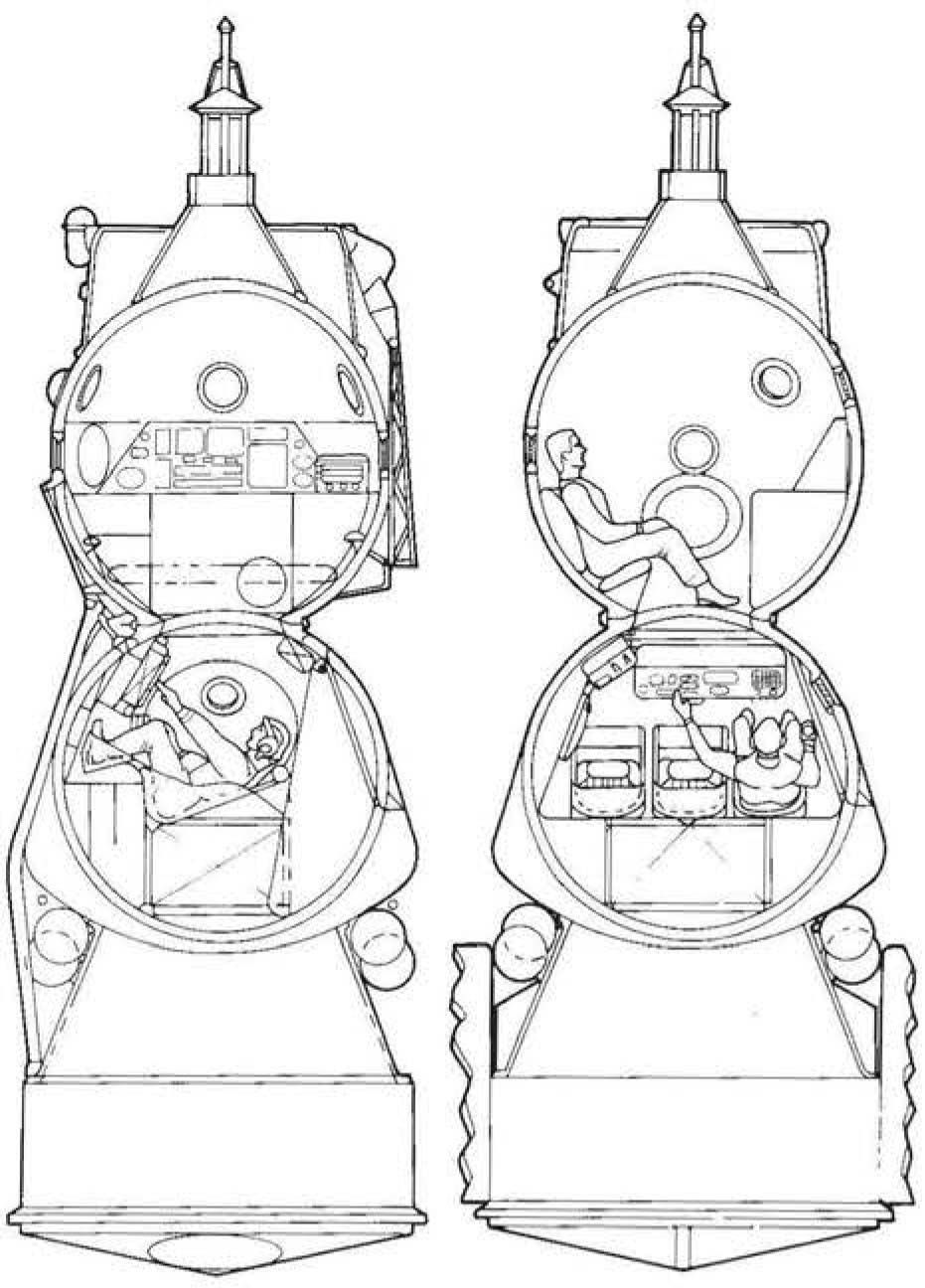
Work on Soyuz combined elements both old and new. The spacecraft consisted of three major components-the cosmonauts’ cabin (descent vehicle), occupied during the launch and reentry phases of the flight; an orbital module, partitioned from the descent vehicle by an airtight hatch; and an instrument assembly module. The descent vehicle had evolved from the earlier Vostok and Voskhod spheres but was fitted with a new heatshield which gave the cabin a bell-shaped external appearance. Unlike its predecessors, Soyuz was designed to have stabilized and controlled reentry.
Various equipment and apparatus for spacecraft control, communication and life support systems are installed in the cosmonauts’ cabin. The main and reserve parachute systems are located in special containers. The spacecraft control console, on which are mounted the instruments for monitoring the operation of systems and assemblies, navigation equipment, a television screen and switches for controlling the onboard systems are installed directly in front of him. Lateral auxiliary consoles, for example, the console for medical monitoring of the state of the cosmonauts... are arranged alongside the center console. An optical sighting device—a navigation device-is installed in a special porthole.51
The Soviet design team retained the form-fitting couches and equipped the descent vehicle with landing rockets located beneath the heatshield, which was jettisoned shortly before touchdown.
Nearly spherical in shape, the orbital module was designed to house equipment for scientific experiments and serve as an airlock for extravehicular activity. The crew would eat, rest, and sleep here. Television, movie, and still photography cameras, along with food, medicine, and personal hygiene gear were stowed in the orbital compartment, which also had an oxygen generation system typical of those used in earlier Soviet spacecraft.52
The cylindrical instrument module housed the two 3.9-kilonewton (880-pound-of-thrust) spacecraft engines, the attitude control thrusters, and onboard equipment that otherwise would have cluttered the interior of the spacecraft. In the pressurized portion of this compartment were the temperature controls for the cabins, the radio and telemetry transmitters, and the attitude control system. A set of solar panels attached to the instrument/ equipment section provided electrical power during the mission. Protected by a shroud at launch, these panels unfolded once the craft reached orbit. The radio and radar antennas, also folded at launch, deployed subsequently.53
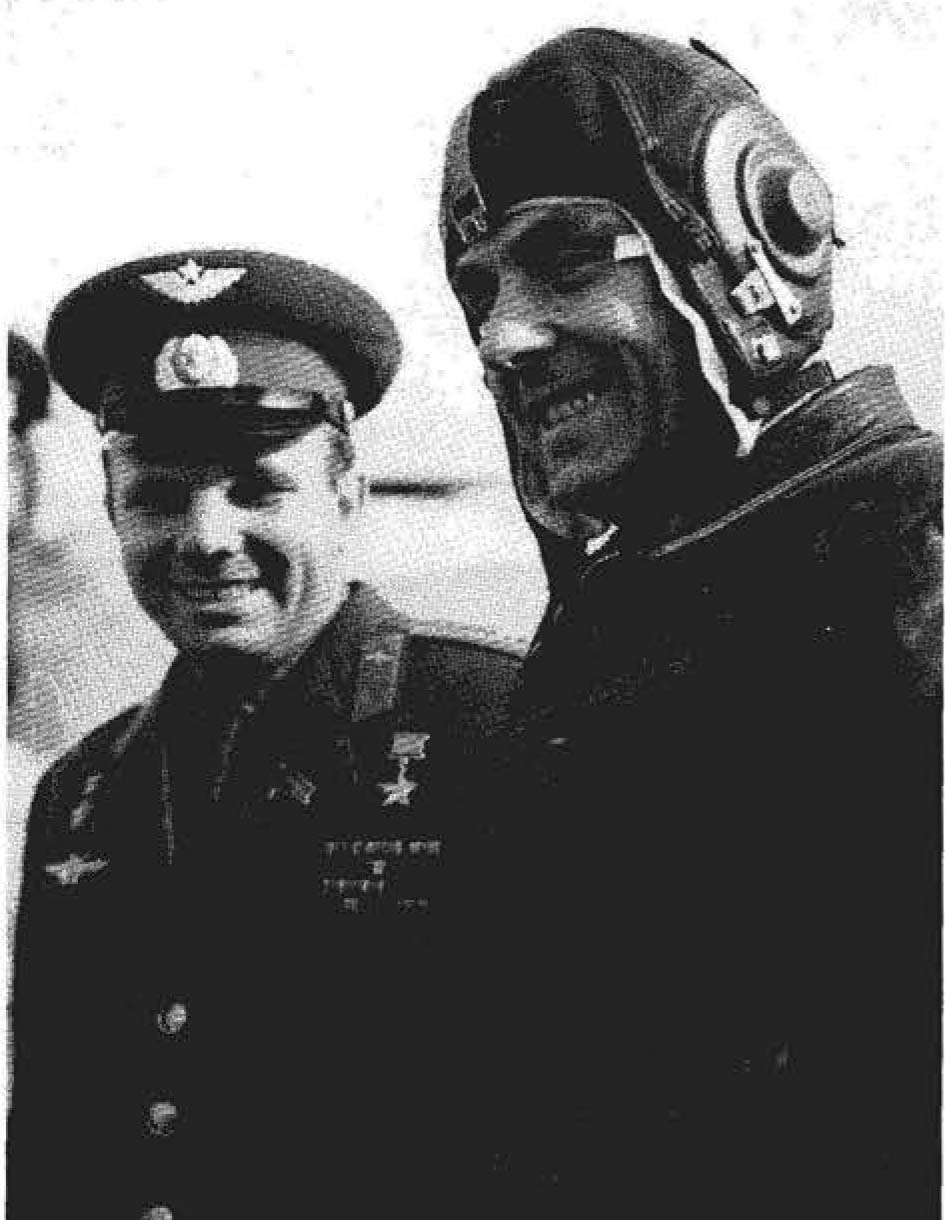
Soyuz I, a test mission, was flown with a crew of one, Vladimir Komarov. This initial mission was fraught with trouble and ended in disaster. The first indication of problems came on the second day of flight, 24 April 1967, when the spacecraft began to tumble during the 15th and 16th revolutions. Komarov experienced difficulty in bringing his ship under control and found that he was expending far more control fuel than was desirable. As with Voskhod II, the automatic orientation system did not function properly, and after communicating with ground control, a process that was impaired by the tumbling, Komarov decided to attempt a manual landing during the 17th orbit. He was unable to obtain the proper orientation for retro-fire and went into the next orbit, where he succeeded in bringing his craft under control. He jettisoned the orbital and instrument assembly modules and fired the retroengines at the proper moment, but the Soyuz reentry vehicle continued to revolve about its axis. This motion caused the shroud lines to become entangled when he attempted to deploy the parachute at 70 000 meters. With no parachute, the descent vehicle crashed to earth at a velocity of 450 kilometers per hour. At 6:15 a.m. Vladimir Mikhailovich Komarov was dead.54
The loss of a cosmonaut on his return from space struck sorrow in hearts around the globe. President Johnson and Vice President Humphrey expressed their sadness at the loss of “this distinguished space pioneer.” Just three months earlier on 27 January 1967, American astronauts Gus Grissom, Edward White, and Roger B. Chaffe had perished when fire swept through their Apollo spacecraft (Apollo 204) as it underwent tests at KSC. NASA Administrator Webb, in voicing his regret at the Soviet loss, suggested that Komarov’s death and those of the Apollo astronauts indicated the need for closer cooperation between the two space programs. “Could the lives already lost have been saved if we had known each other’s hopes, aspirations and plans? Or could they have been saved if full cooperation had been the order of the day?”55 But the competitive motivation behind manned space flight still outweighed the desire to cooperate. While a Special State Commission investigated the Soyuz mishap, NASA and American aerospace industries were implementing the recommendations and changes contained in the report of the Apollo 204 Review Board.56
Apollo design and development had progressed with reasonable speed since the first consideration of that project in 1959. After 16 months of preliminary study and work, Robert Gilruth on 1 September 1960 called for the creation of an Apollo Projects Office which would have the responsibility of defining the spacecraft configuration. This office became a subordinate part of Max Faget’s Flight Systems Division and was headed by Robert O. Piland. Building upon earlier discussions, the initial work began. The command-center module became the crew quarters for all phases of the mission, and the propulsion module held all redundant and orbital maneuvering systems. Willard M. Taub, working for Caldwell Johnson, took all these ground rules and prepared a set of rough sketches of the command module, and by the end of October he had evolved a fairly detailed layout of the crew quarters.57 All of this work preceded the first manned flights of Project Mercury and the conception of Project Gemini.
Concurrent with in-house design efforts, NASA awarded contracts to three aerospace companies to conduct independent feasibility studies for an advanced manned spacecraft, but it was the work conducted by Taub for Johnson which survived. The General Electric D-2 reentry vehicle proposal bears remarkable external similarity to the Soyuz descent module.
As NASA and industry specialists worked to define the Apollo space-craft, President Kennedy on 25 May 1961 established manned lunar landing as the primary American goal in space. NASA had not yet issued spacecraft specifications, selected a spacecraft contractor, chosen a family of launch vehicles, or settled the question of direct ascent versus a form of orbital rendezvous for the moon voyage. During the next 18 months, several key decisions gave Apollo more form and direction. On 9 August 1961, NASA selected the Instrument Laboratory of the Massachusetts Institute of Technology to develop the guidance and navigation equipment. At the end of November, following formal presentations by potential spacecraft contractors, North American Aviation, Inc., was selected as prime contractor for the command and service modules. In January 1962, the Saturn C-5 was chosen as the Apollo launch vehicle. Then on 11 July 1962, NASA announced at a press conference in Washington that lunar orbit rendezvous had been approved as the mission mode.* Grumman Aircraft Engineering Corporation had already begun development of the third Apollo craft-the lunar excursion module.58
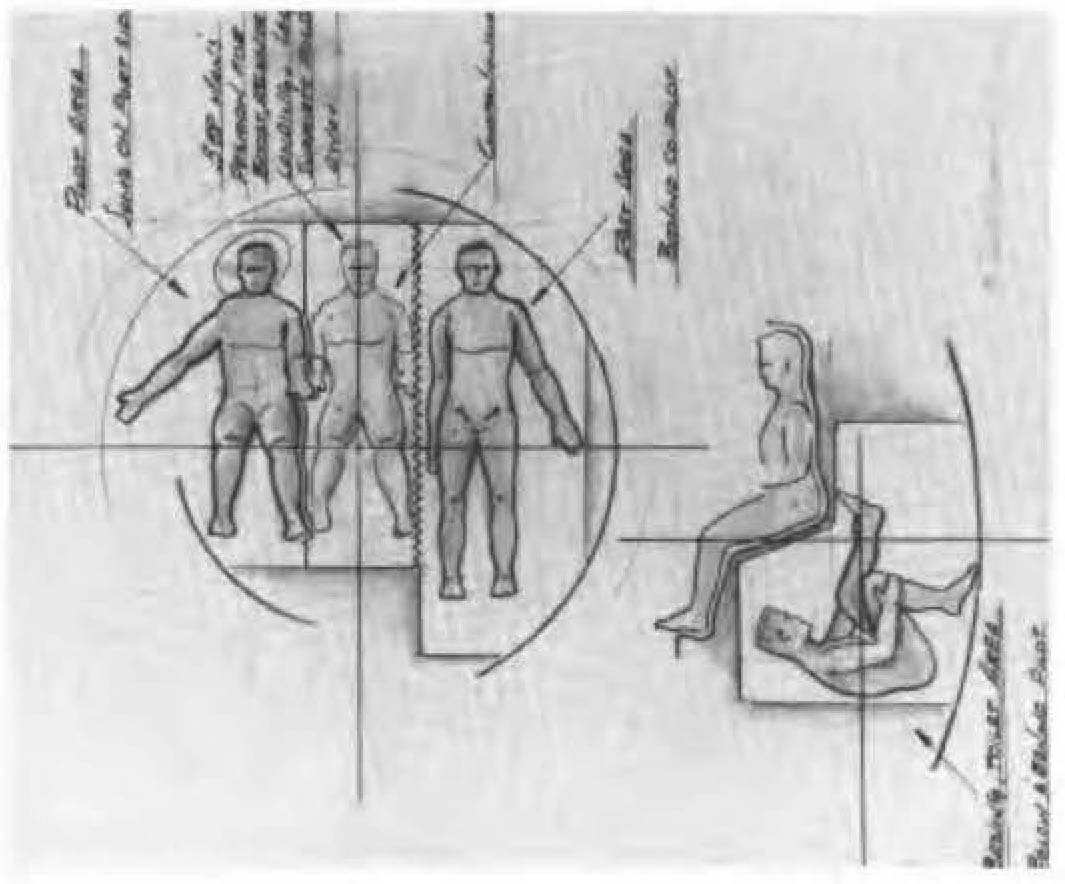
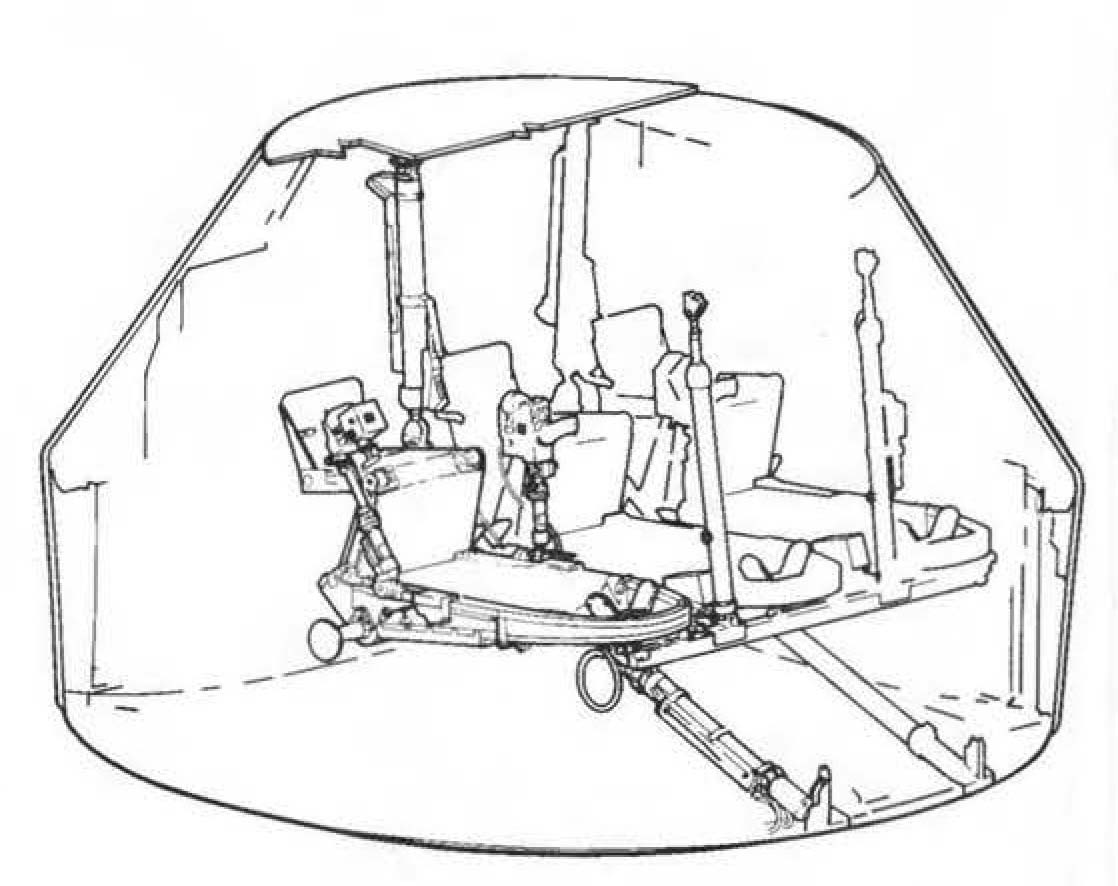
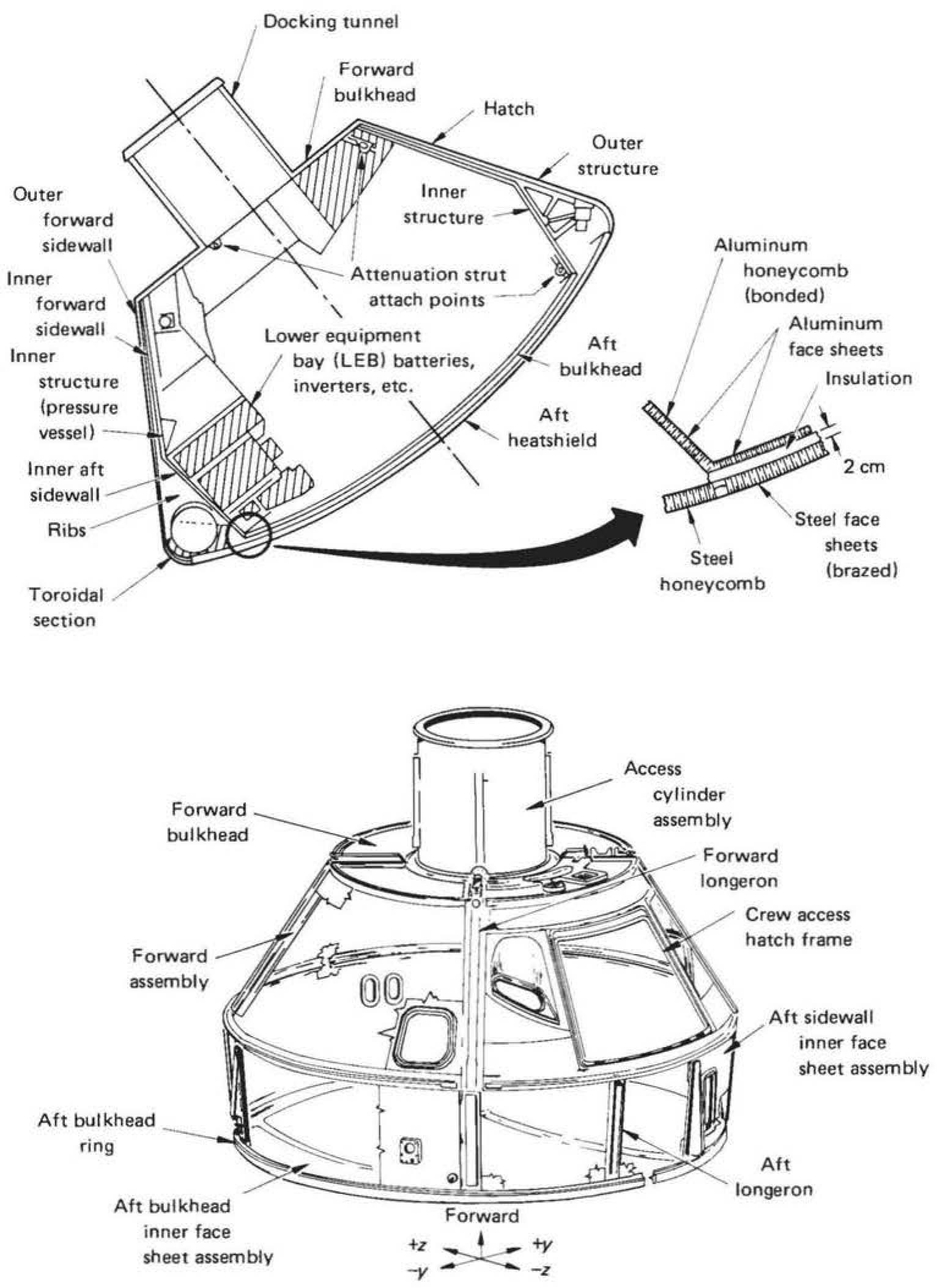
* This decision climaxed one of the most extensive and intensive studies ever conducted by NASA. The final decision was based on the conclusion that lunar orbit rendezvous was more desirable from the standpoint of meeting the proposed schedule, budget, and mission goals.
As it evolved through the processes of conceptualization, design, and development, the Apollo spacecraft was composed of two parts, the command and service modules. Called CM for short, the command module was a multipurpose space cabin internally organized to function as a combined cockpit, office, laboratory, communications center, galley, sleeping quarters, and personal hygiene center. It was constructed with an inner pressure shell to provide structural and environmental integrity and an outer wrap-around heat-shield for thermal and radiation protection during flight and reentry. This form of construction yielded maximum strength for minimum weight (5450 kilograms). Conical in shape, the CM was 3.23 meters high and 3.91 meters at the base. The service module (SM), which had an overall length of 7.54 meters and a launch weight of 23 950 kilograms, contained the main spacecraft propulsion system, reaction control system, and most of the spacecraft consumables (oxygen, water, propellants, and hydrogen). Work on both the spacecraft and the launch vehicle during the years 1962-1966 progressed at a pace that permitted the first manned Apollo flight to be scheduled for 21 February 1967. These plans were altered, however, when the flash fire occurred that year.
THE END OF THE SPACE RACE?
Both the Soviet and American space programs went through a period of appraisal and re-examination before they next sent a man into space. After the Apollo fire, manned flight was delayed for 21 months while NASA and North American Rockwell* completely reworked the command module. Unmanned flights were flown on 9 November 1967 (Apollo 4), 22 January 1968 (Apollo 5), and 4 April 1968 (Apollo 6) to check out the modified spacecraft. The Soviets carried out five unmanned launches prior to the joint Soyuz 2 and 3 mission. On 27 October 1967, the U.S.S.R. sent Cosmos 186 into a low circular orbit, and three days later it performed an automatic rendezvous and docking mission with Cosmos 188. Once 188, launched for a direct, one-revolution rendezvous, came within 24 kilometers of 186, the two spacecraft began an automated, preprogrammed closure and docking on the far side of the earth from the U.S.S.R. so that they would pass over Soviet territory in a docked configuration. The two spacecraft remained docked for 3.5 hours, after which they returned to earth, reentry commands having been given to each one day apart. A second automatic rendezvous and docking mission was conducted with Cosmos 212 and 213, launched on 14 and 15 April 1968. The five-day missions were successful, and the rigid docking was televised to ground control by onboard cameras. After an apparent final check-flight with Cosmos 238 on 28 August, the Soviets launched Soyuz 2, which was to act as an unmanned target for Georgiy Timofeyevich Beregovoy, the pilot of Soyuz 3, who rode into orbit the following day, 26 October.59
* In Mar. 1967, North American Aviation, Inc., and Rockwell-Standard Corporation merged to form the North American Rockwell Corporation.
Beregovoy’s mission remains unclear. After making an automatically controlled rendezvous, the cosmonaut took control of his craft and guided it from a distance of 200 meters to within only a few meters of Soyuz 2, but he did not dock. While Western observers speculated over this non-event, the Soviets were preparing for a second flight in which rendezvous, docking, and crew exchange would take place.60 Meanwhile, in the wake of the successful ten-day manned flight of Apollo 7, NASA was planning to launch the first circumlunar mission.
The December 1968 launch from Florida was a major step to realizing man’s dream of traveling to the moon. Apollo 8 demonstrated that the distance between the earth and the moon could be safely traversed. On Christmas Eve as they orbited the moon, Frank Borman, Jim Lovell, and William A. Anders shared their impressions of the stark lunar landscape, read a few verses from the first chapter of Genesis, and wished their earth-bound viewers a Merry Christmas. A New York Times article suggested that the space frontier was so vast that “there is no need here for wasteful rivalry deriving from earthbound nationalistic and political ambitions.” But the Washington Post viewed the Christmas mission with a cynical eye; NASA was still racing to get to the moon before the Soviets preempted the feat. Columnist Joseph Kraft suggested a reappraisal of America’s space goals now that the country was clearly ahead of the U.S.S.R. “There is no need for the United States to race Russia to every new milestone in space.” He felt that the country needed a “program closely connected to explicit American requirements-a program of exploration for its own sake, not for the sake of beating the Russians.”61
In Houston, Apollo 8 was viewed as the pivotal flight in the Apollo Program. Christopher C. Kraft, Jr., Director of Flight Operations, later stated:
It proved so many things that had a bearing on the progress of the program-things that might have been disproved. The navigation to and from the moon, the ability of the spacecraft systems to survive the deep space environment, all hinged on the Apollo 8 mission.
He also believed that the flight changed the competitive position of the United States and the Soviet Union in space. He had thought that “the Russians planned to fly a circumlunar mission, sending a manned spacecraft looping around and returning without orbiting the moon. That way they could say they sent the first man to the vicinity of the moon.” Once Apollo 8 made her voyage, “there was nothing left for them to do.”62
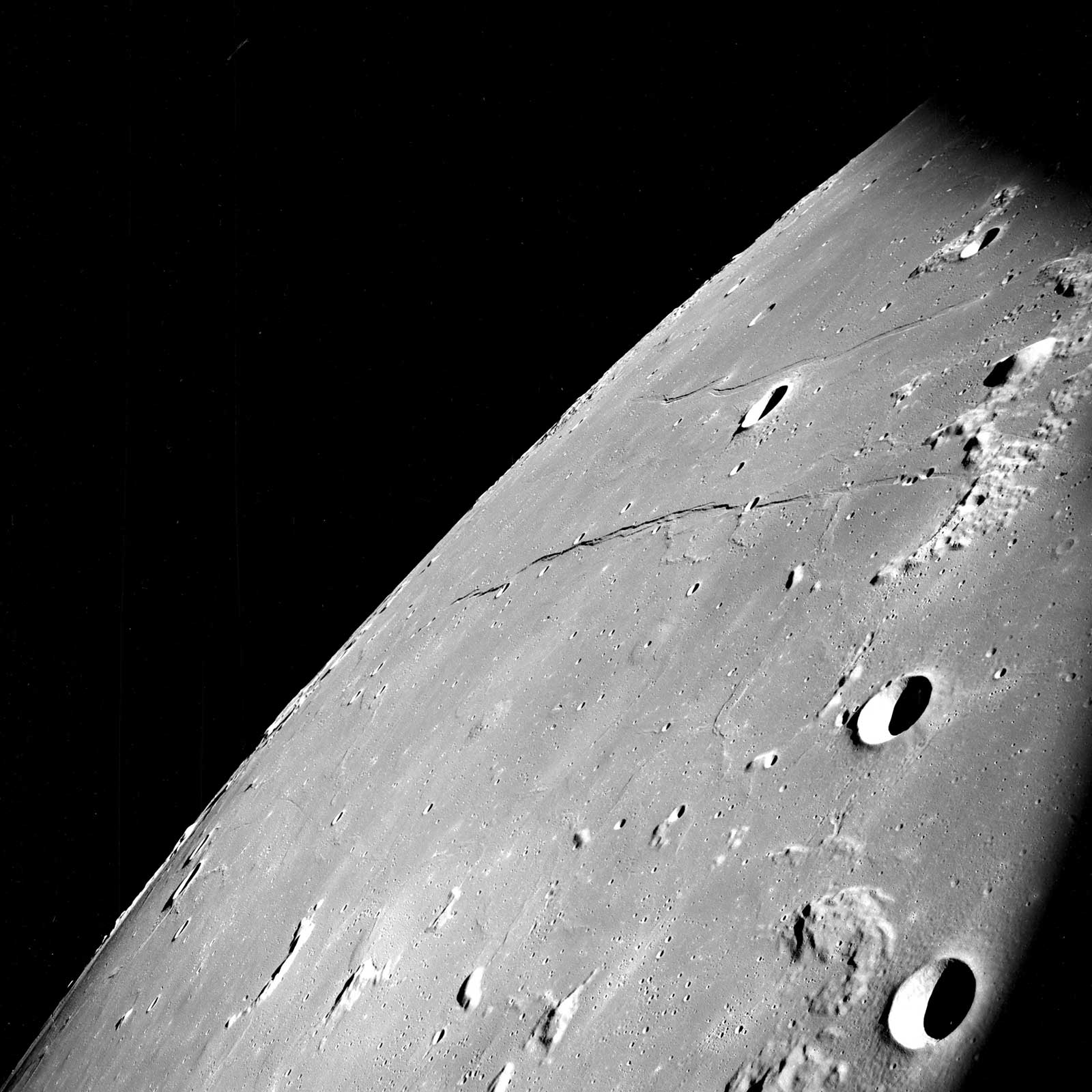
But from the Soviet Union came another perspective. Boris Nikolaevich Petrov, Chairman of the Council for International Cooperation in Investigation and Utilization of Outer Space (Intercosmos) of the Soviet Academy of Sciences, called the Apollo 8 flight an “outstanding achievement of American space sciences and technology” and praised the “courage of its three astronauts.” Academician Petrov also indicated that the Soviet Union would continue to explore the moon, but with unmanned automatic spacecraft. “The major tasks still ahead in the study of the moon will ... be carried out by automatic means, although that does not exclude the possiblity of manned flight.”63 Petrov’s words would remain a puzzle. Had Apollo 8 won the space race? Had the Soviets ever really been in the race to send a man to the moon? Surely Administrator Paine still had these questions in mind seven months later when he sought to renew NASA’s search for a cooperative route to negotiations with the Soviets.
By 1969 Thomas Paine hoped that a change in Soviet-American space relations might be possible. Since the U.S. was clearly ahead in any race to the moon, an offer to cooperate would not jeopardize the lunar prize. And now the Soviet Union had more to gain from cooperation. By working with the nation that had led the way to the moon, the Soviets could create the image of technological parity. Paine perceived this period as an opportunity for new beginnings and began again the effort to discuss cooperation with Soviet space officials. Twelve years of bitter rivalry, during which each side had cooperated only in limited ways, could give way to closer relations if the Soviets were willing.
- Frederick C. Durant, III, "Space Flight Needs Only Money, Time," Aviation Week, 27 Sept. 1954, p. 46. On 14 July 1952, the executive committee of the National Advisory Committee for Aeronautics passed a resolution that "NACA devote modest efforts to problems of unmanned and manned flights at altitudes from 50 miles to infinity and at speeds from Mach 10 to escape from the earth's gravity." NACA to High Speed Flight Research Station, "Discussion of Report on Problems of High Speed, High Altitude Flight, and Consideration of Possible Changes to the X-2 Airplane to Extend Its Speed and Altitude Range," 30 July 1953, which contains the NACA directive.X
- Joe Reddy, memos for record, " 'Man in Space': Production Story," and "#20 Disneyland-TV 'Man in Space'," Walt Disney Productions synopsis and background, 1955. Von Braun, Haber, and Ley had long been advocates of space flight, and as early as 1952 they had contributed articles to a Collier's symposium entitled "Man will conquer space soon." The articles included Werner von Braun, "Crossing the Last Frontier," pp. 24-29 and 72-74; Willy Ley, "A Station in Space," pp. 30-31; Fred L. Whipple, "The Heavens Open," pp. 32-33; Joseph Kaplan, "This Side of Infinity," ' p. 34; Heinz Haber, "Can We Survive in Space," pp. 35 and 65-67; and Oscar Schachter, "Who Owns the Universe?" pp. 36 and 70-71, Collier's, 22 Mar. 1952.X
- Kyril Feodorovich Ogorodnikov to Durant, 23 Sept. 1955; Leonid Ivanovich Sedov to Durant, 24 Sept. 1955; Durant, "Impressions of the Sixth Astronuatical Congress," Jet Propulsion 25 (Dec. 1955): 738; and interview (via telephone), Durant-Ezell, 13 Dec. 1974. Based upon his conversations with the two Soviet scientists, Durant conjectured that the then anonymous Soviet "Chief Designer of Spacecraft," S. P. Korolev, was to be the intermediary who would present Man in Space to the Soviet political and technical leadership.X
- Maxime A. Faget, Manned Space Flight (New York, 1965), p. 8.X
- Loyd S. Swenson, Jr., James M. Grimwood, and Charles C. Alexander, This New Ocean: A History of Project Mercury, NASA SP-4201 (Washington, 1966), pp. 39-46, summarize the studies of multiple g loads as they relate to Project Mercury; and S. P. Umansky, Chelovek na kosmicheskoy orbite (Moscow, 1974), pp. 31-32 (available in translation as Man in Space Orbit, NASA Technical Translation F-15973).X
- Swenson, Grimwood, and Alexander, This New Ocean, pp. 36-39, summarize the American studies relating to weightlessness; "Problemy nevesomosti" [The problems of weightlessness], Nauka i Zhizn' 22 (Dec. 1955): 17-20; translated in F. J. Krieger, Behind the Sputniks: A Survey of Soviet Space Science (Washington, 1958), pp. 127-133.X
- David G. Simons, "Use of V-2 Rocket to Convey Primate to Upper Atmosphere," Air Force Technical Report 5821, Air Material Command, Wright-Patterson AFB, Ohio, May 1949; J. P. Henry, E. R. Ballinger, P. J. Maher, and D. G. Simons, "Animal Studies of the Subgravity State during Rocket Flight," The Journal of Aviation Medicine 23 (Oct. 1952): 421-432; D. G. Simons, "Review of Biological Effects of Subgravity and Weightlessness," Jet Propulsion 25 (May 1955): 209-211; and Don Bailer, " Alas, Poor Yorick'," MSC Space News Roundup (reprint, courtesy of Aerojet-General), 22 Aug. 1959, p. 6.X
- Evgeny Riabchikov, Russians in Space, Nikolai P. Kamanin, ed., Guy Daniels, trans. (Garden City, N.Y., 1971), pp. 140-142 and 149-151; A. V. Pokrovskii, "Comment se comportent les animaux a 100 km d'altitude" [How animals behave at an altitude of 100 km], Etudes Sovietiques, no. 106 (Jan. 1957): 65-70; translated in Krieger, Behind the Sputniks, pp. 156-163. Umansky, Chelovek na kosmicheskoy orbite, pp. 33-40, cites six articles on weightlessness that appeared in Soviet journals between 1970 and 1972. Based on Riabchikov's comments (p. 141), Pokrovskii appears to have been in charge of canine experimentation in the Soviet space program. A general view of the Soviet use of animals is presented in the Novosti Press Agency pamphlet, Animals, Pioneers of Outer Space, Physiological Experiments with Animals Flying in Geophysical Rockets; Biological Studies during Space Flights (Moscow, n.d.).X
- Umansky, Chelovek na kosmicheskoy orbite, p. 49.X
- Ibid., pp. 50-54; Faget, Manned Space Flight, pp. 98-100; Swenson, Grimwood, and Alexander, This New Ocean, pp. 231 and 558, note 21; and Eugene B. Konecci, "Soviet Bioastronautics-1964," paper, National Space Club, Washington, 15 Dec. 1964, pp. 4-7. Konecci summarizes the comparative advantages and disadvantages of sealevel and 258-mm-Hg cabin atmospheres.X
- Umansky, Chelovek na kosmicheskoy orbite, pp. 50-51; and Faget, Manned Space Flight, pp. 100-102.X
- Swenson, Grimwood, and Alexander, This New Ocean, pp. 225-233, discuss development of the Mercury environmental control system; Frank H. Samonski, Jr., Technical History of the Environmental Control System for Project Mercury, NASA Technical Note D-4126 (Langley, Va., 1967); and interview (via telephone) Samonski-Ezell, 21 Jan. 1975.X
- P. T. Astashenkov, Akademik S. P. Korolev (Moscow, 1969) (available in translation as Academician S. P. Korolev, Biography, Foreign Technology Division edited translation HC-23-542-70, pp. 185-186); and Konstantin Petrovich Feoktistov, "Razvitie sovetskikh pilo-truemuikh kosmicheskikh korablei," Aviatsiya i Kosmonavtika, no. 11 (1971): 36-37 (available in translation as "Development of Soviet Manned Spacecraft," National Lending Library for Science and Technology, Boston Spa, Yorkshire, England, and available from NASA as N73-15876). Feoktistov stated the following reasoning for adoption of the sphere: "The aerodynamic characteristics of the sphere, the drag coefficient and the position of the centre of masses were well known for the entire velocity range (from the first cosmic [i.e., orbital velocity] down to subcosmic velocity). In addition, the problem of maintaining stability of movement of a spherical vehicle in the atmosphere could be easily solved by just shifting the gravity centre of the vehicle off the centre of the sphere. This provides for the static stability and, as revealed by computations, for good dynamics of vehicle movements around the centre of masses even in the case of arbitrary orientation of the vehicle prior to reentry and in descent when controls are no longer available."X
- Astashenkov, Academician S. P. Korolev, Biography, pp. 185-186; Hartley A. Soul to James M. Grimwood, 29 Aug. 1965; Swenson, Grimwood, and Alexander, This New Ocean, pp. 71-72; and Ames Aeronautical Laboratory, "Preliminary Investigation of a New Airplane for Exploring the Problems of Efficient Hypersonic Flight," 18 Jan. 1957. In appendix B of the Ames report, there is a description of a proposed 1.5-meter spherical ballistic spacecraft, pp. 30-31.X
- U.S.S.R. Academy of Sciences, comp., Kosmicheskiy korabl' Vostok (Moscow, 1969); available in translation as The Spaceship "Vostok, " Foreign Technology Division edited translation HT-23-705-70, pp. 5-6; and Leonid Vladimitov, The Russian Space Bluff, David Floyd, trans. (London, 1971), pp. 89-91. Vladimirov indicates that a Peter Dolgov was killed when his space suit was ripped during a test of the ejection system. "Korolyov's [Korolev's] reaction to Dolgov's death was to take a number of urgent and clever measures. First he had the exit hatch made larger. Secondly, he increased to two seconds the interval between shooting off the hatch and the operation of the ejector mechanism,X
- H. Julian Allen, "Hypersonic Flight and the Reentry Problem," Journal of the Aeronautical Sciences 25 (Apr. 1958): 217-230; Alfred J. Eggers, Jr., "Performance of Long Range Hyper-velocity Vehicles," Jet Propulsion27 (Nov. 1957): 1147-1151; and Swenson, Grimwood, and Alexander, This New Ocean, pp. 55-82. The authors of This New Ocean describe the background of NACA and Air Force research into the problem of reentry vehicle design; also see William M. Bland, Jr., "Project Mercury," in The History of Rocket Technology Essays on Research, Development, and Utility, Eugene M. Emme, ed. (Detroit, 1964), pp. 214-215.X
- Swenson, Grimwood, and Alexander, This New Ocean, pp. 68-69.X
- Robert R. Gilruth, "Memoir: From Wallops Island to Mercury; 1945-1958," paper, Sixth International History of Astronautics Symposium, Vienna, Austria, 13 Oct. 1972, pp. 31-32.X
- Swenson, Grimwood, and Alexander, This New Ocean, p. 86; Grimwood, Project Mercury: A Chronology, NASA SP-4001 (Washington, 1963), p. 17; "How Mercury Capsule Design Evolved," Aviation Week, 21 Sept. 1959, pp. 52-53, 55, and 57; and David A. Anderton, "How Mercury Capsule Design Evolved," Aviation Week, 22 May 1961, pp. 50-71 passim.X
- Faget, Benjamin J. Garland, and James J. Buglia, "Preliminary Studies of Manned Satellites-Wingless Configuration: Nonlifting." in "NACA Conference on High-Speed Aerodynamies, Ames Aeronautical Laboratory, Moffett Field, Calif., Mar. 18, 19, and 20, 1958: A Compilation of Papers Presented," pp. 9-34, reissued as NASA Technical Note D-1254 (Langley, Va., 1962).X
- Grimwood, Project Mercury: A Chronology, pp. 19-24; Gilruth, "Memoir: From Wallops Island to Mercury," pp. 34-37.X
- Gilruth, "Memoir: From Wallops Island to Mercury," p. 37.X
- Feoktistov, "Razvitie sovetskikh pilotruemuikh kosmicheskikh korablei," p. 37; Astashenkov, Academician S. P. Korolev, Biography, pp. 187-190; Riabchikov, Russians in Space, p. 155; and Vladimirov, The Russian Space Bluff, p. 89. Vladimirov indicates that one of the more serious problems encountered by the Soviet team was the heart attack suffered by Korolev on 3 Dec. 1960.X
- Feoktistov, "Razvitie sovetskikh pilotruemuikh kosmicheskikh korablei," p. 37.X
- Ibid.X
- Swenson, Grimwood, and Alexander, This New Ocean, pp. 341-511, summarize the operational phase of Project Mercury.X
- Barton C. Hacker and Grimwood, On the Shoulders of Titans: A History of Project Gemini, NASA SP-4203 (Washington, 1977), p. XVi.X
- Ibid.; Hacker, "The Idea of Rendezvous: From Space Station to Orbital Operations in Space-Travel Thought, 1895-1951," Technology and Culture 15 (July 1974): 373-388; and John M. Logsdon, "Selecting the Way to the Moon: The Choice of the Lunar Orbital Rendezvous Mode," Aerospace Historian 18 (June 1971): 63-70.X
- James A. Chamberlin, "Project Gemini Design Integration," Lecture 36 in a series on engineering design and operation of manned spacecraft, presented during summer, 1963, at the Manned Spacecraft Center and to graduate classes at Louisiana State University, the University of Houston, and Rice University. The series was later edited and published as chapter 35 in Paul E. Purser, Faget, and Norman F. Smith, eds., Manned Spacecraft: Engineering Design and Operations (New York, 1964), pp. 365-374.X
- Hacker and Grimwood, On the Shoulders of Titans, p. xvi.X
- Ibid., p. xvii.X
- The Soviets are relatively vague in their descriptions of Voskhod and its development. See Astashenkov, Academician S. P. Korolev, Biography, pp. 226-230; and Riabchikov, Russians in Space, pp. 207-211. Vladimirov, The Russian Space Bluff, pp. 123-127, argues that Khrushchev wanted a space mission that would surpass the accomplishments promised by Gemini. Equally questioning of the design merits of Voskhod are James E. Oberg, "The Voskhod Program: Khrushchev's Folly!" Spaceflight 16 (Apr. 1974): 145-149; and Peter Sullivan, "The Voskhod Spacecraft." Spaceflight 16 (Nov. 1974): 405-409.X
- Apparently, the Soviets employed the Venus upper stage to launch the Voskhod. Sullivan, "The Voskhod Spacecraft." PP. 407-408, speculates that Korole and his colleagues had to extemporize because of the tight schedule imposed upon them:
The information submitted to the FAI (Federation Aeronautique Internationale) stated that the launch vehicle for Voskhod I consisted of a seven engine launcher compared with a six engine launch vehicle for Vostok. From photographs we know that in each case five of the engines refer to the bottom central sustainer surrounded by four boosters (the 1½ stage booster) and the term "engine" means an independent unit. . .. above the basic 1½ stage booster was a long stage, followed by the standard short final stage as used on the Vostok. The reason for this inefficient set up resulted from the speed with which the Voskhod programme was conceived and had to be executed to be effective. At the time the only trustworthy extra stage that could be man-rated was too powerful and the Vostok launch vehicle had been stretched to its limit and was not capable of launching heavier assembly. ... Instead of replacing the final stage by simply the longer, more powerful stage, the final stage was retained as dead weight to lower the altitude that was attained. Even so, it still resulted in a much higher altitude than any of the Vostok or forthcoming Soyuz missions.
X - Vladimirov, The Russian Space Bluff, pp. 125-126; and statement, Hugh L. Dryden to PAO (dictated over telephone), 12 Oct. 1964.X
- Sullivan, "The Voskhod Spacecraft," pp. 405-406; and interview, Willard M. Taub-Ezell, 28 Feb. 1975.X
- Riabchikov, Russians in Space, p. 208; and Astashenkov, Academician S. P. Korolev, Biography, pp. 227-228.X
- U.S. Congress, Senate, Committee on Aeronautical and Space Sciences, Soviet Space Programs, 1966-1970; Goals and Purposes, Organizations, Resources, Facilities and Hardware, Manned and Unmanned Flight Programs. Bioastronautics, Civil and Military Applications, Projections of Future Plans, Attitudes Toward International Cooperation and Space Law; Staff Report, 92d Cong., 1st sess., 1971, p. 186.X
- Riabchikov, Russians in Space, pp. 210-211. Also see memo, M. Scott Carpenter to Gilruth et al., "Cosmonaut Training," 24 Nov. 1964.X
- There has been considerable speculation as to the cause of Cosmos 57's disintegration; e.g., William J. Normyle, "Cosmos 57 Believed Destroyed by Soviets," Aviation Week and Space Technology, 12 Apr. 1965, p. 34.X
- U.S. Congress, Senate, Committee on Aeronautical and Space Sciences, Soviet Space Programs, 1962-1965; Goals and Purposes, Achievements, Plans, and International Implications; Staff Report, 89th Cong., 2d sess., 1966, pp. 206-208. Vladimirov, The Russian Space Bluff, p. 140, states that it was L. A. Voskresensky's idea not to pressurize the Voskhod cabin, but to use instead "a light tube ... attached to the hatch of the spacecraft to form an exit chamber..X
- Committee on Aeronautical and Space Sciences, Soviet Space Programs, 1962-65, p. 207; and Peter L. Smolders, Soviets in Space: The Story of the Salyut and the Soviet Approach to Present and Future Space Travel (London, 1973), pp. 144-145.X
- Hacker and Grimwood, On the Shoulders of Titans, p. 235.X
- Ibid., p. 248.X
- Ibid., p. 275.X
- TWX, Rhett Turnipseed to NASA, Houston, "Text of an Interview by an Izvesti[y]a Correspondent with the Soviet Cosmonaut Pavel Romanovich Popovich [21 Dec. 1965],"* 29 Dec. 1965.X
- "Gemini 7/6 Astronaut Post Flight Press Conference," 30 Dec. tape 8, p. 2; and Grimwood and Ivan D. Ertel, "Project Gemini," Southwestern Historical Quarterly 81 (Jan. 1968): 407.X
- Hacker and Grimwood, On the Shoulders of Titans, p. 289.X
- Ibid., pp. 338-339.X
- Vladimirov, The Russian Space Bluff, pp. 136-137, 140-141, and 145.X
- The "moon" or "space race" has been a topic of continuing debate and a subject of considerable speculation. A sample of views are included here in the absence of a definitive Soviet statement. The Novosti Press book by Riabchikov, Russians in Space (1971), does not address the space race question but indicates that the Soviets were concentrating on earth-orbital missions that would lead to the development of a space station. This thesis is reemphasized in the 1973 edition of Smolders, Soviets in Space. The Soviet emigre Vladimirov wrote The Russian Space Bluff to argue that the limited technical capability of the Soviet space program could not have possibly sent men to the moon and that the whole program was inspired by Khrushchev's desire to gain a propaganda advantage over the U.S. Nicholas Danilo in The Kremlin and the Cosmos (New York, 1972) suggests that after Khrushchev's ouster there was a retreat from the competitive posture and that the Soviet leadership opted instead for a two-part space program-automatic spacecraft for lunar and planetary exploration (Luna and Venera probes) and manned earth orbital missions (Soyuz and Salyut).X
- A. Yu. Dmitriyev et al., Ot komicheskikh korableyk orbital 'nymn stantsiyam, 2d ed. (Moscow, 1961), pp. 24-25, (available in translation as From Spaceships to Orbiting Stations, NASA Technical Translation F-812); and interview, Faget-Ertel and Grimwood, 15 Dec. 1969. Faget commented that:
One of the things we kind of set as a policy in all our design studies was adequate amount of volume inside the command mod. ule. About this time one of the other things that was being studied was the possibility of a two compartment vehicle. ... Now in order to have enough volume, of course, they had to make the thing bigger which meant we had to carry along a lot of extra heat protection systems, so it seemed a very attractive thing to do to divide that volume in two pieces and we had for a long while a command module and a mission module, the mission module being where everybody was supposed to do their business. This started off to be a very attractive idea but as we went through their studies it became clear that less and less things were going on in that mission module, and every thing that was vital for one reason or another ... also was vital during entry so you either did it twice, once in the mission module and again in the command module, or you did it once in the command module. So it seems that the mission module was turning out to provide nothing but extra room. There were no systems and no particular activity that anyone really wanted to carry out in the mission module other than to stretch out and perhaps get a little sleep. The consequence of this was that it didn't look like it was worthwhile to have a mission module. So in the final analvsis we ended up with a single cabin version. You might have noticed that the Russians ended up going into something very close to our two compartment vehicle that we were considering at that time. I don't know where they got their ideas, but it might have been from us because we made no secret of these considerations.
X - Dmitriyev et al., Ot komicheskikh, p. 26.X
- Ibid., pp. 26-28; and Smolders, Soviets in Space, pp. 151 and 154-155.X
- Smolders, Soviets in Space, pp. 157-159.X
- Memo, Julian Scheer to HQ Program and Staff Offices, 24 Apr. 1967; and NASA News Release, HQ [unnumbered], "Russian Accident Statement," 24 Apr. 1967.X
- Smolders, Soviets in Space, p. 160: and NASA, Apollo 204 Review Board, "Report of Apollo 204 Review Board to the Administrator, National Aeronautics and Space Administration," 5 Apr. 1967. Uri Marinin, "Where Does Danger Lurk?" Space World D-5-41 (May 1967): 43-44, presents a Soviet commentary on the Apollo 204 fire and the dangers inherent in a 100-percent oxygen system.X
- The details of the Apollo spacecraft story will be documented in Courtney G. Brooks, Grimwood, and Swenson, "Chariots for Apollo: A History of the Lunar Spacecraft," in process. Until that official history is available, there are four very useful chronologies: Ertel and Mary Louise Morse, The Apollo Spacecraft: A Chronology, Volume 1, through November 7, 1962, NASA SP-4009 (Washington, 1969); Morse and Jean Kernahan Bays, The Apollo Spacecraft: 1 Chronology, Volume II, November 8, 1962-September 30, 1964, NASA SP-4009 (Washington, 1973); Ertel and Brooks, The Apollo Spacecraft: A Chronology, Volume III, October 1, 1964-January 20, 1966, NASA SP-4009; and Ertel and Roland W. Newkirk, with Brooks, The Apollo Spacecraft: A Chronology, Volume IV, January 21, 1966-March 4, 1974, NASA SP-4009.X
- Ertel and Morse, Apollo Chronology, Vol. I, pp. 106, 128, 135, and 168; and Morse and Bays, Apollo Chronology, Vol. II, p. 5.X
- Viktor P. Legostayev and B. V. Raushenbakh, "Avtomaticheskaya sborka v kosmose," paper, 19th Congress of the IAF, New York, Dec. 1968 (available in translation as "Automatic Assembly in Space," NASA Technical Translation F 12, 113). Legostayer and Raushenbakh presented an analysis of an automatic rendezvous system of the type used on Cosmos 186, 188, 212, and 213. Committee on Aeronautical and Space Sciences, Soviet Space Programs, 1966-70, pp. 230-234; Smolders, Soviets in Space, pp. 162-168; and Georgy Ivanovich Petrov, ed., Osvoenie kosmicheskogo prostranstva v SSSR; ofitsian'nye soobsh cheniya TASS i materialy tsentrol'noi pechati oktyabr', 1967-1970 gg (Moscow 1971) (available in translation as Conquest of Outer Space in the USSR; Official Announcements by Tass and Material Published in the National Press from October 1967 to 1970, NASA Technical Translation F-725 [New Delhi, 1973], pp. 15-70).X
- The difference in views as to the goals of the Beregovoy mission is illustrated by Smolders, Soviets in Space, pp. 163-164; and Committee on Aeronautical and Space Sciences, Soviet Space Programs, 1966-1970, p. 233.X
- "Columbuses of Space," New York Times, 22 Dec. 1968; "The Christmas Journey," Washington Post, 22 Dec. 1968; NASA Astronautics and Aeronautics, 1968, NASA SP-4010 (Washington, 1969), p. 325.X
- "Apollo 8 Called Key Flight Space Program," Baltimore Sun, 24 Nov. 1972.X
- "Soviet Scientist Hails Apollo 'Courage' and Skill," New York Times, 31 Dec. 1968; "Soviet Cautious on Moon Flights," Baltimore Sun, 31 Dec. 1968; and Boris Nikolaevich Petrov,"O polete Apollona-8" [On the flight of Apollo-8], Pravda, 30 Dec. 1968.X