Proposal for a Test Flight
In October 1970, Academician Keldysh responded to a September 1969 letter from Administrator Paine, agreeing that the “limited character” of Soviet-American cooperation in space science and applications could be broadened.1 After the two sides had decided on a January 1971 meeting in Moscow to discuss this subject, NASA Acting Administrator Low set about choosing a delegation and determining the agency’s position on those topics proposed for the agenda.2 Acting on the advice of Arnold Frutkin, Low opted for a small delegation composed of individuals able to discuss a broad range of subjects rather than specialists.* Low and Frutkin thought it best to draft beforehand the agreements as they would like to see them signed, so that the Acting Administrator would always have in front of him the goals they wished to achieve. When he left Washington, he had a complete set of proposed agreements and a draft press release, as well.3
* Low was accompanied by Frutkin; John D. Naugle, Associate Administrator for Space Science and Applications; Arthur W. Johnson, Deputy Director, National Environmental Satellite Service; William Anders, Executive Secretary, National Aeronautics and Space Council; and Robert F. Packard, Director, Office of Space-Atmospheric and Marine Science Affairs, Department of State.
Before departing, Low was briefed by Under Secretary of State Alexis Johnson on the heightening diplomatic tension between the Soviet Union and the United States. The Soviets had just concluded a trial viewed in the U.S. as having anti-Semitic overtones, involving a group of accused airplane hijackers. Even as two of the Soviet Jews charged with the crime appealed their death sentences, the first ever levied for hijacking in the U.S.S.R., the Jewish Defense League had undertaken a campaign of bombing Soviet installations and intimidating Soviet personnel in New York and Washington. On 4 January, Soviet Ambassador Dobrynin delivered a note to the State Department accusing the American Government of “connivance” in these hostile acts and warned that the Soviet Government could not guarantee the safety of American officials and businessmen in Moscow.4 Although Johnson told Low that he did not anticipate any difficulties for an official delegation, he did voice his concern about public statements that Low might make at the end of the negotiations and cautioned him to check with the Embassy in Moscow before making a favorable release to the press if the diplomatic situation were to worsen.5
As preparations in Washington progressed for George Low’s visit to the U.S.S.R., the manned spacecraft team in Houston was working on a set of alternative proposals for a flight using Apollo and Soyuz hardware. Shortly after returning from the Soviet capital in October, Bob Gilruth had suggested to Low that subsequent discussions with the Soviet Academy would be more productive if the two sides began talking about specific missions using existing spacecraft.6 Gilruth and Caldwell Johnson had conducted an intensive feasibility study at the Manned Spacecraft Center (MSC) and presented their findings to Low on 5 January.
Based upon the rapid exchange of technical data and the tone of his recent correspondence with Keldysh, Low decided that it might be worthwhile to raise the possibility of a joint flight.7 He was willing to increase the tempo of the compatibility talks with the Soviets, for both he and Frutkin believed that the whole approach of the U.S.S.R. toward cooperation had changed. Reflecting on the October 1970 meeting, Frutkin later said “that meeting was clearly different from anything we had ever had before with them.” In the Dryden-Blagonravov era, meetings involved only the very senior personalities in the Academy of Sciences; “you didn’t feel that you were dealing with people who got grease on their hands.” October had been different. “The protocol was minimal, and business was clearly foremost,” Frutkin added. He had been impressed by Suslennikov, Syromyatnikov, and especially Feoktistov, whom Frutkin had found “extremely able and very efficient... with no nonsense.”8 NASA’s interest in obtaining more immediate results with the Soviets was boosted by this new working relationship.9
On 12 January 1971, a week before leaving for Moscow, Low and Frutkin flew to San Clemente, California, to discuss NASA’s negotiating plans with the President’s Foreign Policy Adviser, Henry Kissinger. Low briefly outlined the events leading to Keldysh’s invitation and summarized his strategy for the meeting on space science and applications. In response to Low’s request for the Administration’s position on an actual test mission using Apollo and Soyuz spacecraft, Kissinger replied that as far as the White House was concerned Low had a completely free hand to negotiate in any area that was within NASA’s overall responsibility. The President, Kissinger said, was in full support of these meetings and personally wanted Low to express to the Soviets his desire for cooperative efforts in space research and technology. Kissinger had only one request of the Acting Administrator; he would prefer that NASA personnel not contribute to the false notion that if they could reach technical agreements they could also solve political problems if given the opportunity. Kissinger felt that in the past some of the astronauts had tried to suggest that since it was easy to negotiate with the Soviets on space topics it should be equally simple in other areas. Such naivete on the part of highly publicized individuals only hampered the work of diplomats on both sides. In parting, Kissinger told Low: “As long as you stick to space, do anything you want to do. You are free to commit-in fact, I want you to tell your counterparts in Moscow that the President has sent you on this mission.”10
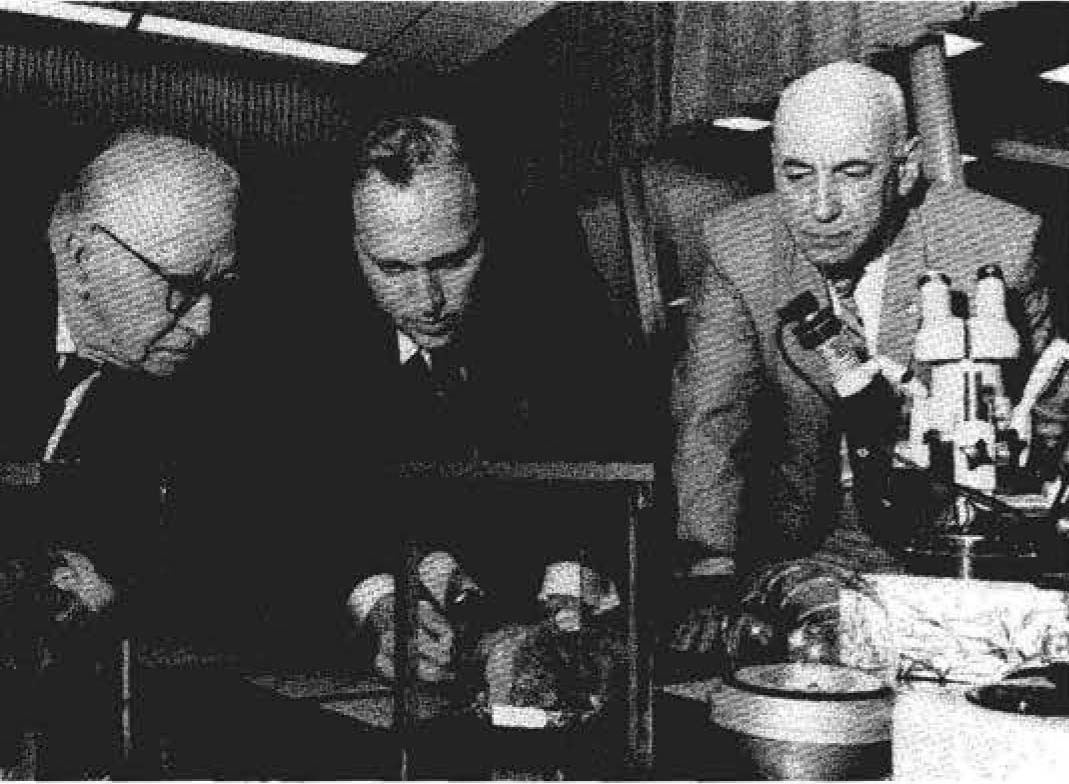
Low and his party arrived in Moscow late Saturday afternoon, the 16th of January. Their reception at the airport was warm, and Keldysh was there to greet them. While the Americans waited for customs formalities to be completed, Low chatted with Keldysh and the Vice President of the Academy, Aleksandr Pavlovich Vinogradov, who had just returned to Moscow from Houston. They talked about the upcoming Apollo 14 mission, Luna 16-the topic of Vinogradov’s presentation at MSC*-and Lunokhod, the unmanned moon rover that was still ranging widely over the lunar surface. There was no sign of any coolness or hostility, and once again it appeared that the desire to cooperate in space exploration outweighed any extraneous political events.11
* Vinogradov presented a paper, ‘Preliminary Data on Lunar Ground Brought to Earth by Automatic Probe ‘Luna-16’,” at the Second Lunar Science Conference sponsored by the Lunar Science Institute, held in Houston, 11-14 Jan. 1971.
Although Low asked for a reprieve from extensive sightseeing that night, he and his colleagues had a pleasant dinner with Keldysh, Blagonravov, and several other Soviets. Low and Keldysh talked about manned versus unmanned flights and the importance of space programs to the support of science and technology. Manned flights, they agreed, were essential “to lift the human spirit.” They both felt that the United States and the Soviet Union must compete and cooperate in space-compete because they needed the contest to spur the nations on and cooperate because of the vastness of the universe and the number of problems that needed to be solved.12
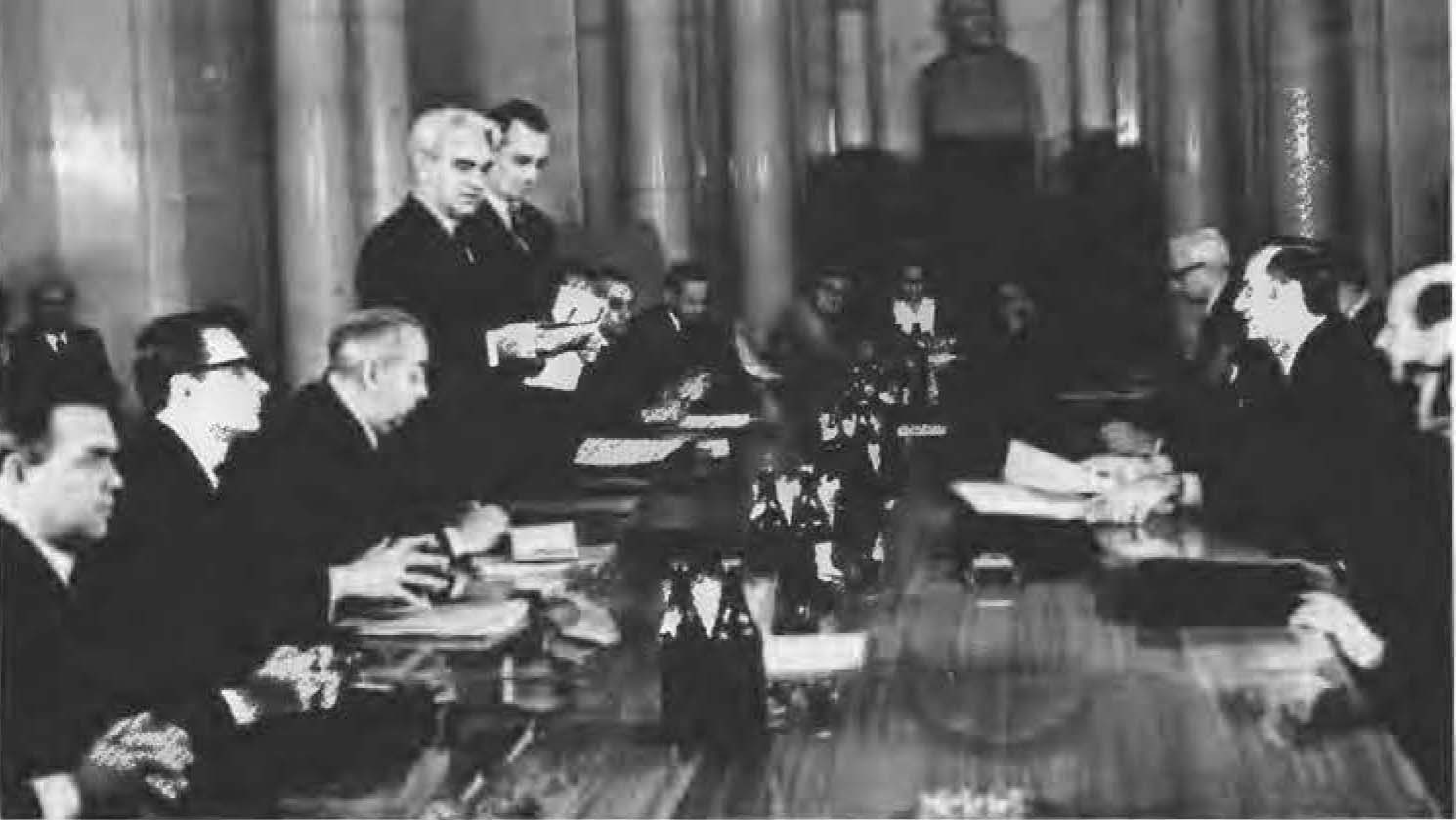
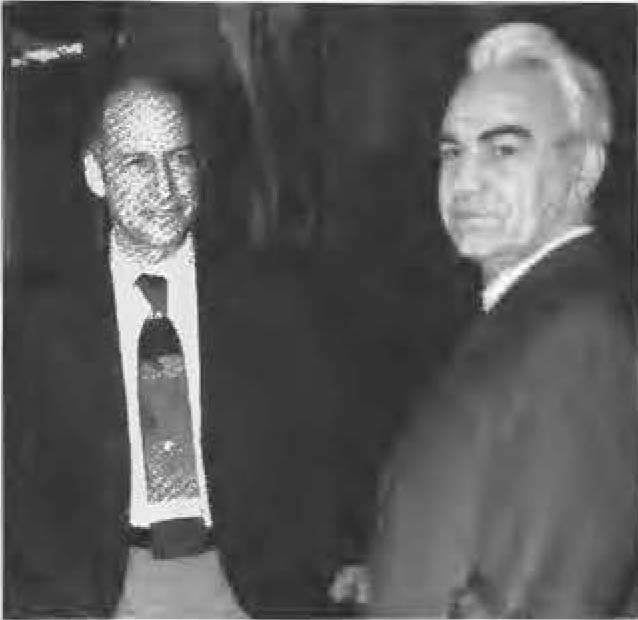
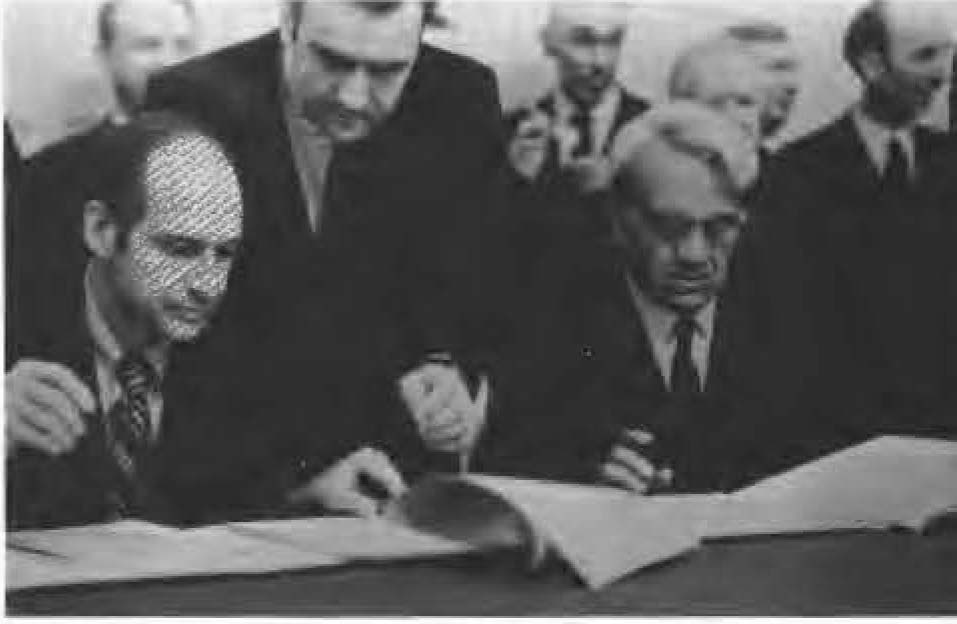
After four days of detailed and physically exhausting negotiations,* Keldysh and Low initialed an agreement calling for fuller cooperation in five specific areas:
- to improve the current exchange of data from meteorological satellites and consider alternative possibilities for coordinating systems;
- to formulate cooperative provisions for a program of meteorological rocket soundings;
- to study the possibility of conducting natural environment research by coordinated surface, air, and space measurements over international waters and specific ground sites;
- to define and exchange information on the objectives of space, lunar and planetary exploration, to consider the possibility of coordinated lunar exploration, and to exchange lunar surface samples already obtained; and develop procedures whereby detailed space biology and space medicine data could be more regularly exchanged.13
* The Soviet delegation consisted of M. V. Keldysh; A. P. Vinogradov; B. N. Petrov; G. I. Petrov, Director, Institute for Space Research; I. P. Rumyantsev, V. S. Vereshchetin, I. V. Meshcheryakov, and A. I. Tsarev, Intercosmos; M. Ya. Marov, Institute of Applied Mathematics; Ye. K. Federov, Chief, and L. A. Aleksandrov, Deputy Chief, Main Administration Hydrometeorological Service; N. N. Gurovskiy, Chief, Directorate, Ministry of Health; O. G. Gazenko, Director, Institute of Medical-Biological Problems, Ministry of Health; Yu. A. Mozzhorin, Professor, Moscow Physics-Technical Institute; V. P. Minashin, Chief, Main Administration of Space Communication, and I. Ya. Petrov, Deputy Chief, Main Administration of Space Communication, Ministry of Communications; and K. G. Fedoseyev, Deputy Chairman of the USA Section, Ministry of Foreign Affairs.
Although the Soviets would have preferred to sign a more general set of statements, Low and the other Americans stressed the need for specific agreements. The U.S. delegation felt that the Soviets were surprisingly cooperative and open in their approach, aside from some routine haggling over wording. From the start, Keldysh had understood Low’s concern for specificity and practicality in the agreements and had seen to it that a compromise was reached.14 While the news media reported favorably on the proposal to exchange lunar samples, Low and Keldysh met privately to discuss an even bolder plan.15
A NEW PROPOSAL
Early on Wednesday, the 20th, while the negotiations were still in progress, Low and Frutkin met with Keldysh to talk about rendezvous and docking. Having been advised of the subject, Keldysh had asked Feoktistov to join them. Low said that NASA would like to propose the development of compatible systems for use with Apollo and Soyuz rather than with future spacecraft. He explained this idea in some detail, pointing out to Keldysh that the Americans did not yet want to make this a formal proposal but instead only wished to present it for the Soviets’ consideration. Low remarked that Gilruth favored focusing on the development of equipment and systems for existing spacecraft to give the specialists in the two countries something much firmer with which to work.
Both Keldysh and Feoktistov were intrigued, and they said that although they were not free to commit their government to such a project they wanted to pursue this subject further and hear more details. Then they could advise their superiors and obtain a decision. Low agreed to send with the exchange of technical requirements scheduled for February a fuller description of the type of project he was proposing. Keldysh asked Low to refrain from mentioning this conversation publicly until there had been consultations internally. The two sides would subsequently make a public announcement if this developed into a formal topic for negotiation. Low agreed to this arrangement.* 16
* At this meeting in Moscow, Low had also presented to the cosmonauts a plaque designed by Gilruth to be placed in the Gagarin museum. As Low said to Gilruth in a 27 Jan. 1971 letter, “It was an emotional moment, and it was obvious that they were pleased at the recognition by us of their being first in space.”
Low based his discussions with Keldysh concerning a joint rendezvous and docking mission on the “USSR/US Docking Studies” prepared at MSC in late December 1970. In Houston, Clarke Covington had prepared materials on the two aspects of possible docking activities-the near and far term. For the former, he and his colleagues proposed feasibility studies of specific docking missions and specific hardware systems that could be flown between 1972 and 1975. For the far term, the specialists suggested that the Joint Working Groups develop technical requirements and general concepts for the docking of future systems “as a continuing show of good faith.”17
In effect, the MSC proposal inserted a new activity into the scheme of things as they had been agreed to earlier in Moscow. The primary focus of the October agreement had been work on compatible systems for future spacecraft. Now Caldwell Johnson, Covington, and their associates were pushing for a real mission using existing hardware. MSC specialists had listed several important guidelines. Such a joint mission should provide a public demonstration of a viable joint activity and as such should allow both countries to exhibit equal skill and effort. But above all, it should be an open, non-military enterprise that would continue NASA’s philosophy of peaceful exploration in space.
To define the hardware needed for a rendezvous and docking mission, Will Taub had drawn a series of sketches showing variations on Apollo-Soyuz mission. Covington used these in December 1970 when he briefed MSC management on five mission possibilities:
- Concept 1
- CSM and Soyuz dock without a crew transfer.
- Concept 2
- CSM and Soyuz dock with an extravehicular transfer.
- Concept 3
- CSM and Soyuz dock with an internal transfer, possibly without prebreathing; i.e., a “shirtsleeve transfer.”
- Concept 4
- CSM and Soyuz dock to an adapter module that would permit shirtsleeve transfer.
- Concept 5
- CSM and Soyuz dock to a more elaborate “experiment module” that would permit extended scientific activities.18
Gilruth and his deputy, Chris Kraft, quickly decided that the fifth concept was too elaborate; they argued for keeping the system simple. They believed that in the absence of a political commitment from the Nixon Administration and because this was an unsolicited proposal, it would be best to suggest a “minimum meaningful” activity to the Soviets and then await their reaction. Thus, when Covington later briefed Headquarters before Low’s trip, he dropped concepts 1 and 5 and replaced them with a new suggestion that called for both spacecraft, flying without structural modification, to rendezvous and stationkeep, but to make no attempt to dock. In addition, he described a possible rendezvous-with and without docking-of Soyuz with Skylab.19
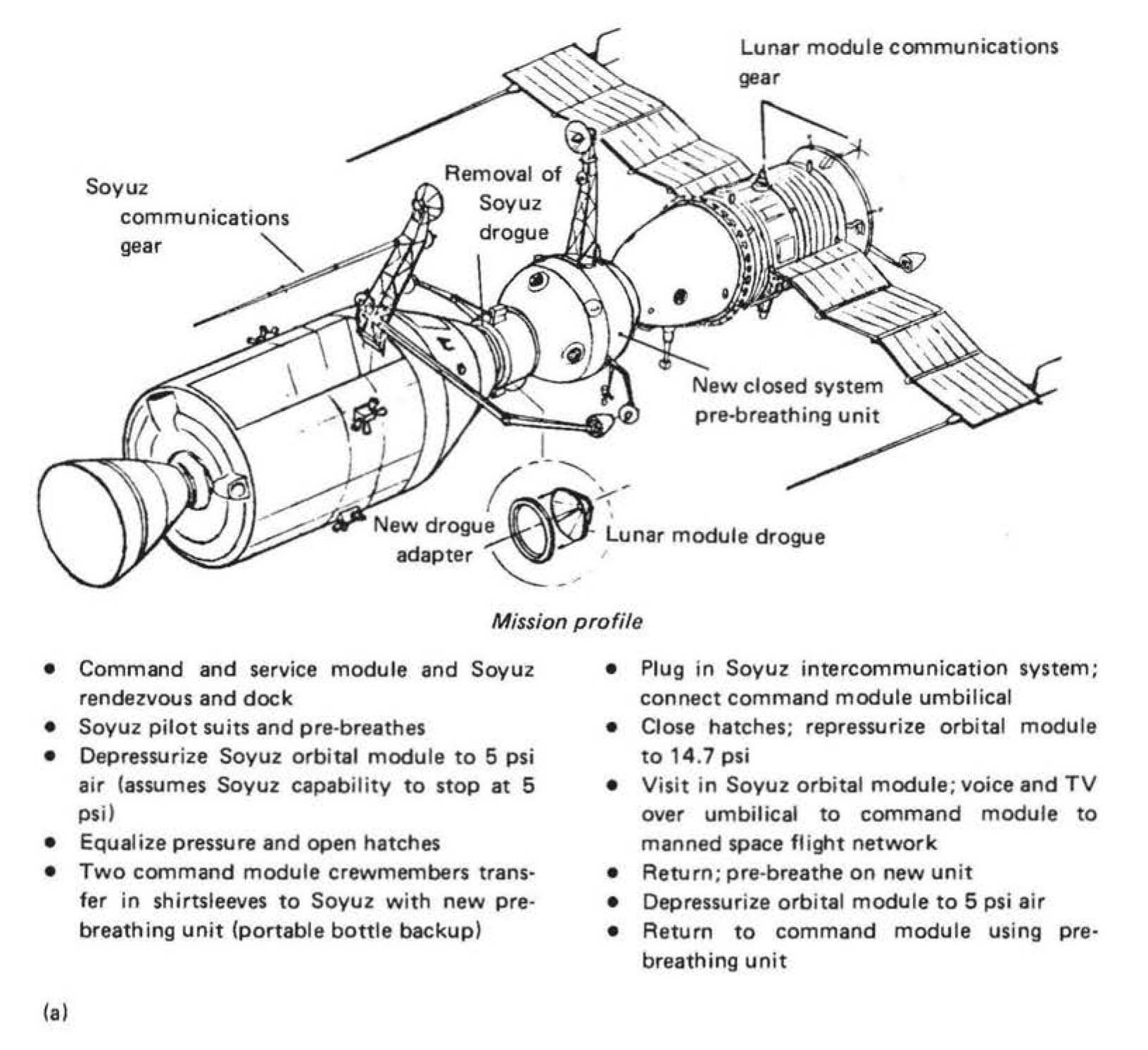
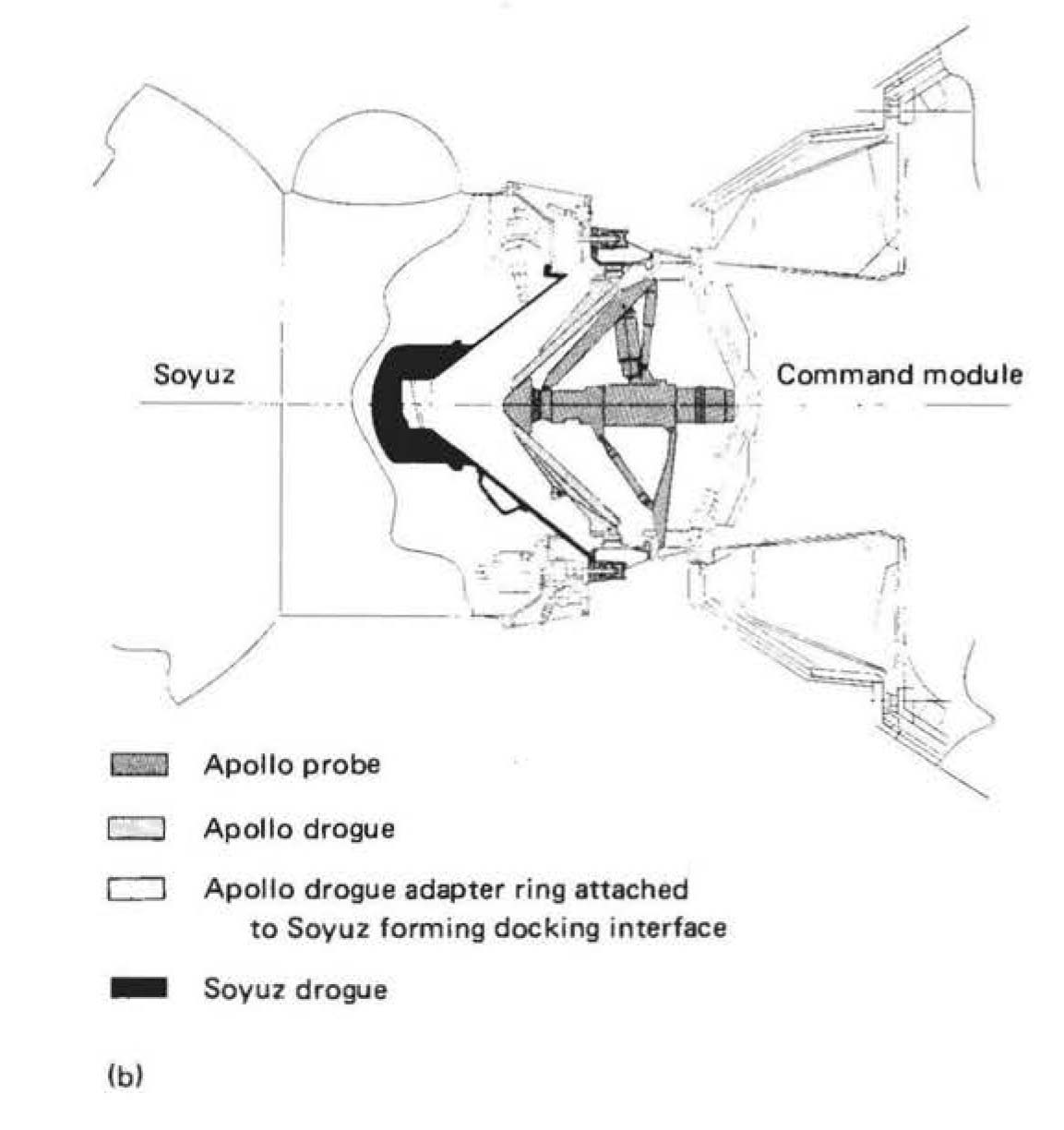
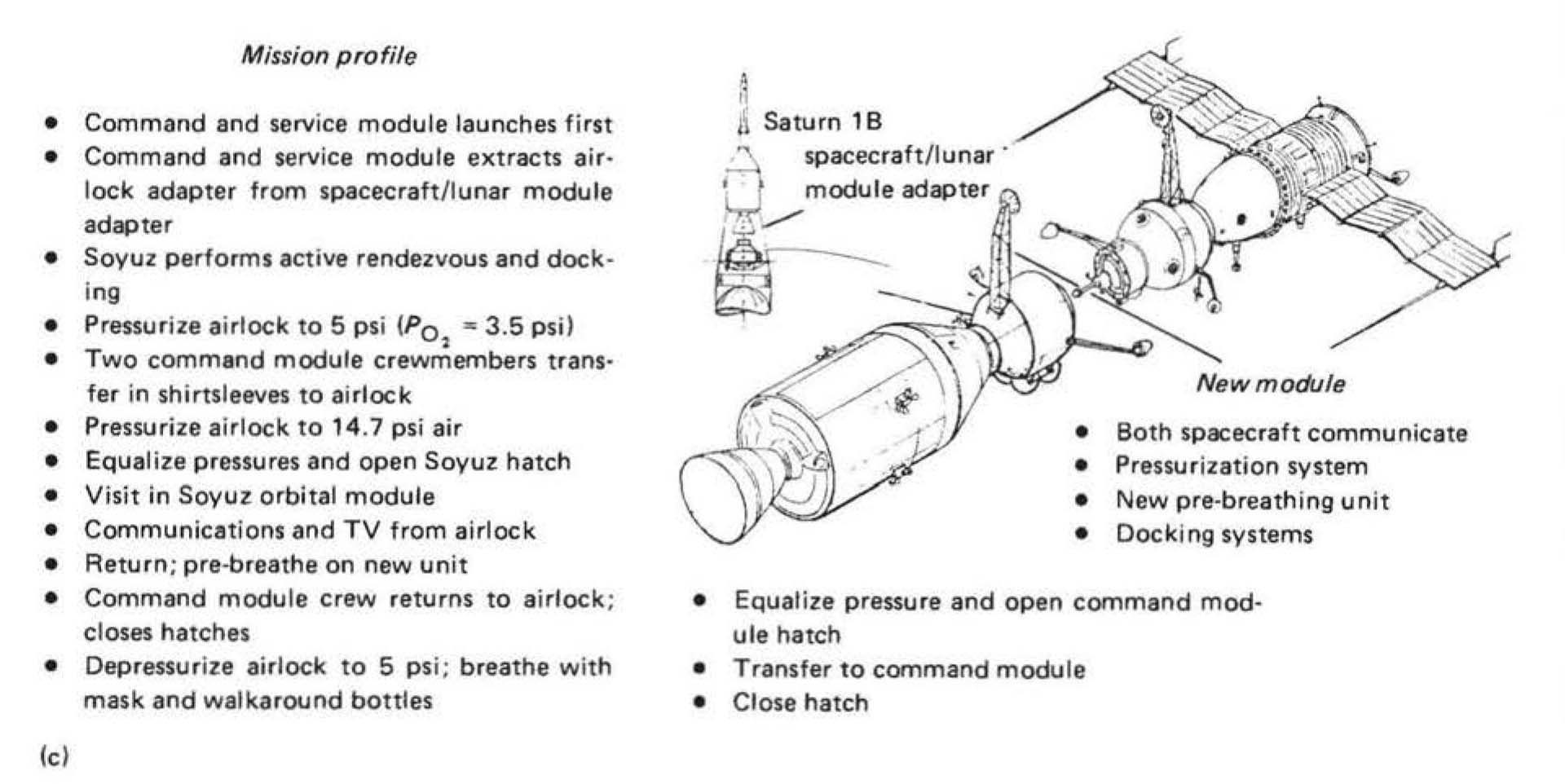
Two important points had to be considered for any of the docking missions-the docking gear to be used and the impact of cabin atmosphere on crew transfers. For an Apollo-Soyuz linkup, the hardware proposals ranged from a simple adaptation of the existing gear to the creation of a special docking module with Apollo gear on one end and Soyuz gear on the other. The minimal changes to the docking equipment called for building an adapter that would permit the installation of a lunar-module-type drogue into the cone of the Soyuz. Then the Apollo could dock and latch its probe into this adapted Soyuz. This particular modification could be varied for use with either the solid face or the swing-away Soyuz docking mechanisms. A more elaborate alternative called for building an “airlock docking adapter,” a mini-spacecraft that would be carried into orbit in the spacecraft/lunar module adapter (SLA) behind the command and service module (CSM).* Following the CSM’s docking and removal maneuver with the airlock module, the Soyuz could dock with it, employing the standard Soyuz probe. While crew transfer in the simple system would be either internal or external depending upon the type of Soyuz docking interface, the airlock module concept assumed the use of the swing-away hatch on Soyuz.
* The SLA, an 8.5-meter truncated cone between the service module and the launch vehicle instrument unit, enclosed the lunar module (LM) during launch and on its way to the moon.
Docking was only half the story; the differences between spacecraft environments had to be considered in any plans to transfer crews. Based on the rather limited information available about the Soyuz life support system,† NASA specialists assumed that crew transfer would likely occur at the normal operating pressures for both spacecraft, requiring the men moving from the higher to the lower pressure to pre-breathe. The cabin pressure of Apollo could not be raised above 414 millimeters of mercury (8 psi) because of structural limitations in the CSM, and the Soyuz cabin pressure could not be lowered much below that without significantly increasing the risk of fire, as the percentage of oxygen increased in the total volume of the remaining gases. While the obvious solution would have been compromise on cabin pressure at about 414 millimeters, this would have required substantial modifications, which at the time seemed to be contrary to the desire to make the fewest possible changes to the basic spacecraft. If the two spacecraft were flown with their standard atmospheres, oxygen would have to be pre-breathed prior to entering Apollo to prevent the bends. In an effort to provide for crewmember oxygen without adding additional oxygen to the Soyuz atmosphere, the MSC environmental control specialists fully expected to develop a new closed system portable life support mechanism to provide oxygen and recycle carbon dioxide for the Americans. Work had begun on such a unit in an effort to eliminate the problem of oxygen enrichment and any increased danger of fire during the pre-breathing period. And as always, the risk of fire was the primary worry of the American environmental control systems designers.20
† The information available to NASA included materials that had appeared in the American press over the years, those obtained during the October 1970 trip, and the report sent to Houston in the first technical exchange.
Developing an airlock module would have solved some of the problems involved in changing the pressure in either spacecraft. If the astronauts wanted to transfer to Soyuz, they would enter the airlock, close the hatch behind them, raise the pressure to 760 millimeters, and then enter the Soviet spacecraft. Going the other direction, they would enter the airlock after pre-breathing oxygen aboard Soyuz (or alternatively in the airlock itself) and when it was safe lower the pressure to 258 millimeters. Throughout this process, the pressure in each craft would remain virtually unchanged.
At this point, complexities of design seemed to abound. If the crewmen pre-breathed in the airlock module, then a full life support system would have to be included in that mini-spacecraft. If the pre-breathing occurred in Soyuz, a simpler life support system could be used in the airlock module, but the Americans would have to transfer in their suits, requiring provision for suit cooling circuits aboard Soyuz. Walter W. Guy of the Crew Systems Division urged the specialists to find a simpler way to conduct the transfers. Otherwise, life was going to be too complex for the crews.
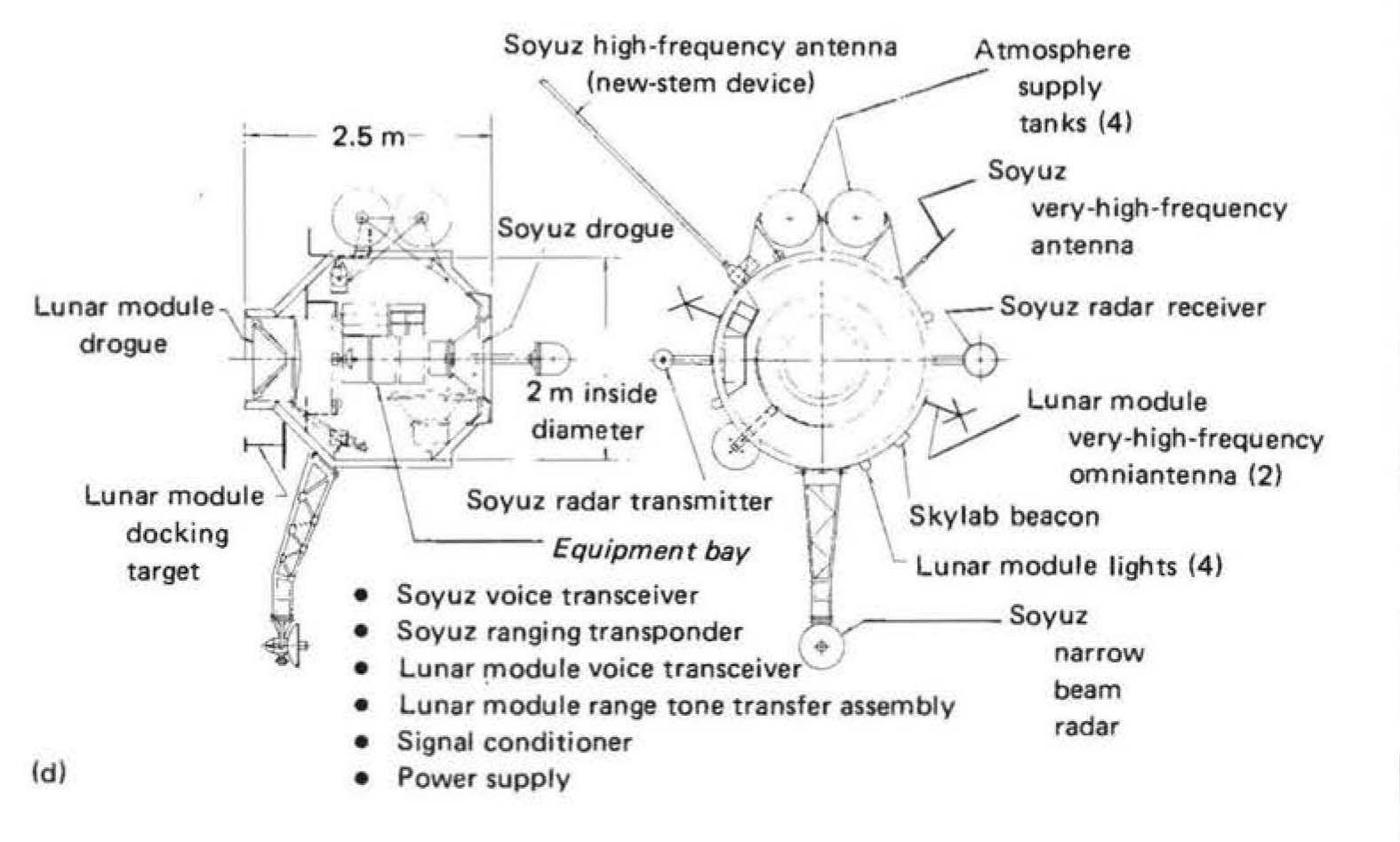
In addition to making the transfer process somewhat easier and reducing further the possibility of oxygen enrichment to the Soviet craft, the airlock had several good features from a designer’s point of view. In the first instance, all Soyuz docking aids could be secured on the exterior of the module, thus eliminating major changes to the CSM. Second, the interior surfaces of the airlock module would provide places for mounting various communication and power units that would otherwise have to be added to the CSM or to the Soyuz. But the airlock module was a new piece of hardware that would have to be designed, built, and tested. This was the major objection raised by both MSC and Headquarters.21
George Low, Wernher von Braun,* and others at Headquarters were interested in pursuing the simpler drogue-in-cone adaptation, and it was this type of system that Low had considered in January when he had talked to Keldysh in Moscow. So in February 1971, NASA transmitted two documents to the Academy of Sciences, the first fulfilling the 1970 agreement to exchange “technical requirements for rendezvous and docking.” “Preliminary Rendezvous and Docking System Requirements for United States Spacecraft” was generated to provide the Soviets with only an “overview of NASA... requirements and systems,” not specific solutions to compatibility issues. From this general paper, the planners hoped to move on to more detailed discussions.22
* Von Braun had been appointed Deputy Associate Administrator for Planning in Mar. 1970.
The second paper-“A Concept for a Union of Soviet Socialist Republics/United States of America Rendezvous and Docking Mission”-was prepared by MSC personnel under the direction of René Berglund. Although drawn up in a relatively short time and based upon a still limited understanding of the Soyuz docking system, the document drafted by William K. Creasy and Thomas O. Ross, among others, was a rather detailed study of the docking interface for Apollo and Soyuz, presented as an illustration. Similar details were given for the necessary docking targets, communications equipment, and pre-breathing apparatus. These studies were designed to outline the way NASA would create compatibility and conduct a joint mission.23
In his letter of 17 February transmitting the two documents to Petrov, Gilruth explained why he sent the paper proposing a joint Apollo-Soyuz flight. Since this topic had been discussed by Low, Keldysh, Frutkin, and Feoktistov during January, the MSC staff had looked into the whole question of compatible systems. “In the process of our deliberation on this subject,” Gilruth noted, “we have found the postulation of a specific docking mission and spacecraft configuration useful in understanding potential problem areas.” He also told Petrov that analysis of such a typical mission concept-Apollo and Soyuz-should “be a beneficial way of assessing compatibility during the March/April Working Group Meetings.’24
Gilruth then addressed the agenda for that spring gathering. “With regards to these detailed Working Group activities, I believe that a preliminary meeting... should be held to establish the types of spacecraft to be considered by the Working Groups.” Not everyone need be present, Gilruth suggested, but he did “feel that the participation of the chairmen of our respective Working Groups would be most beneficial.” For such discussions, Gilruth had appointed Glynn Lunney, Donald C. Cheatham, and Donald C. Wade to chair groups one through three respectively, and they would be joined by Arnold Frutkin, George Hardy, Caldwell Johnson, and René Berglund. “Should this suggestion meet with your approval,” Gilruth continued, “I would like to invite you and your delegation ... to the Manned Spacecraft Center, Houston, Texas, in March to conduct these discussions.” Afterwards the full Working Groups could meet and begin their efforts.25
During the six months following the October meeting, MSC had begun to find some minor problems that would have to be worked out as they continued to expand the scope of their joint work-language and communications being two examples. Preliminary studies conducted at Houston, based on available Soviet data, opened as many questions as they answered. These new questions confirmed the necessity for additional information exchanges. There was also evidence that both sides would have to come to agreement on technical translation, so that each side could be assured that the other understood precisely what had been meant by specific words, phrases, and documents.26
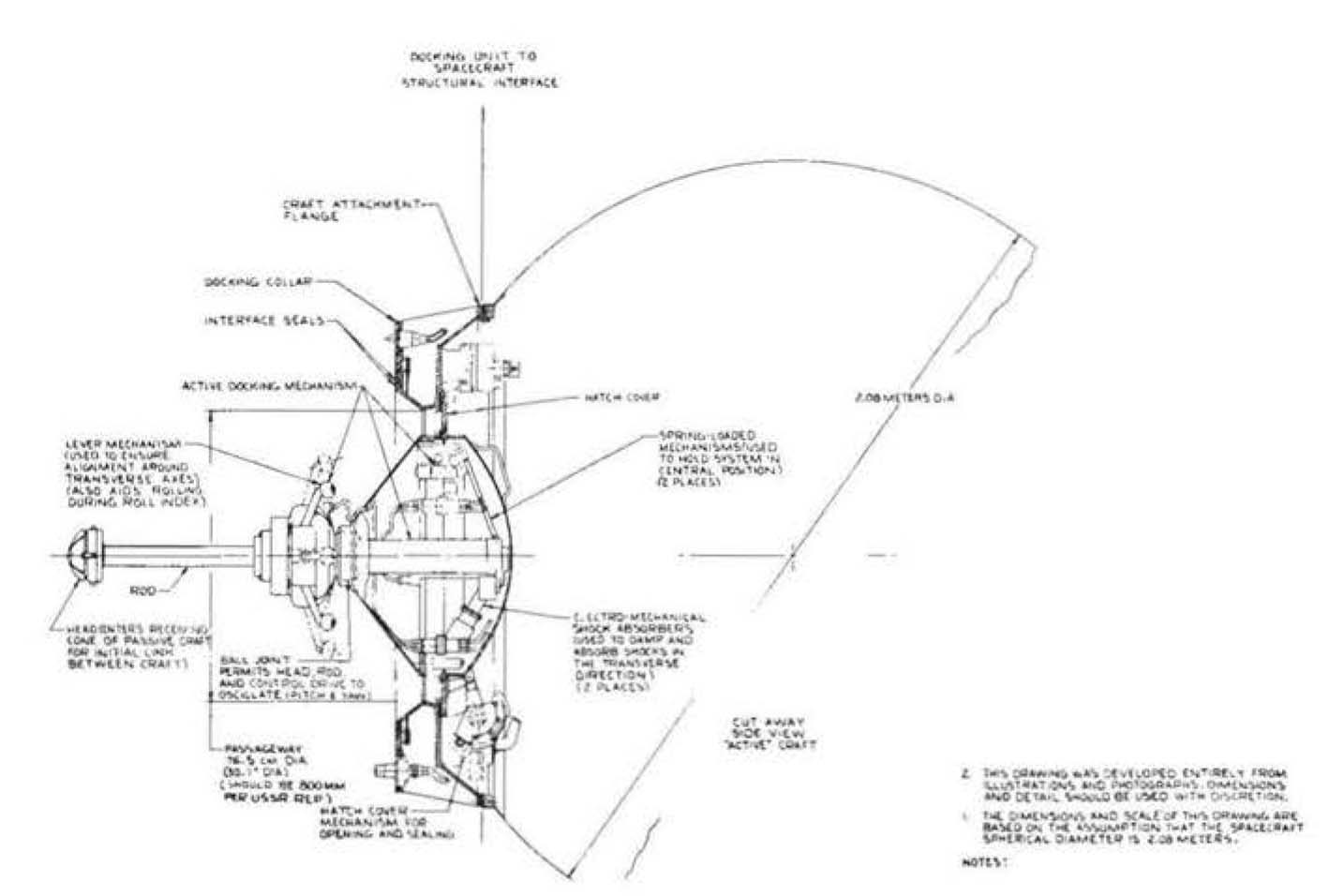
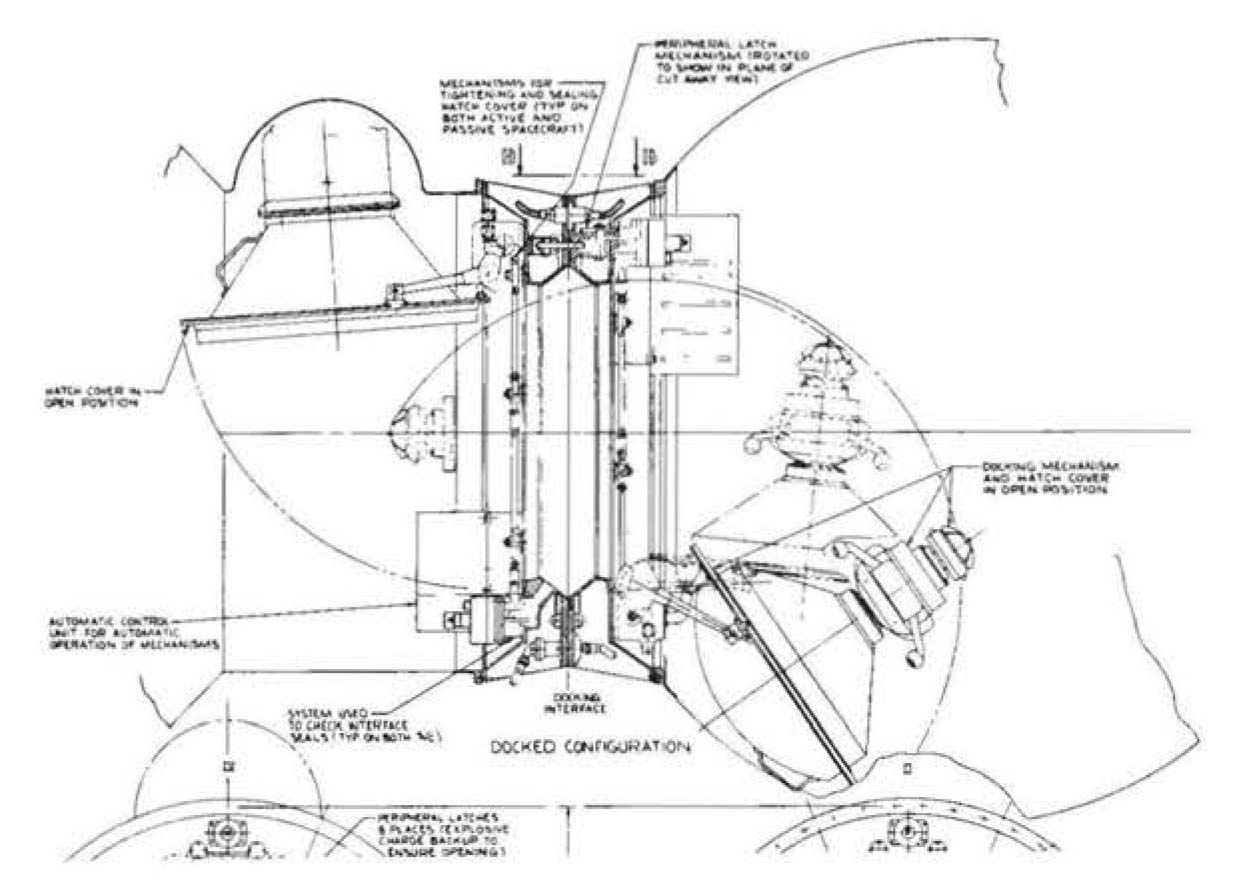
Then there was the time-gap problem in coordinating these communications. For instance, when Gilruth sent a draft of his letter to Petrov to Washington for approval on 12 February, Houston was still thinking about a meeting scheduled for March/April. But these plans were to be altered several times before the meetings finally took place. Academician Petrov sent his response on 15 March to Gilruth’s letter dated 17 February. Petrov’s response, along with seven documents that constituted the Soviet technical requirements for compatibility, was sent via diplomatic pouch from the American Embassy in Moscow to the State Department in Washington. That agency passed the material over to NASA Headquarters, where Frutkin’s office received them on the 24th. The documents were next sent out for translation, and MSC finally received them at the end of the month. Gilruth got a preliminary briefing of their contents on 1 April and dispatched his reply on the 9th. For both the February letter from Gilruth and the March letter from Petrov, the turn-around time had been almost a month. Much faster communications would be essential to any joint enterprise.27
In his letter, Petrov approached the question of an actual test flight: “As far as your new proposal... of an actual example of docking of the ‘Soyuz’ and ‘Apollo’ type spacecraft, it requires further study which our specialists are now engaged in.” Noting that this was apparently “an intermediate solution” toward the development of compatible systems, Petrov felt that the two sides should stick to the schedule as agreed upon in the Moscow “Summary of Results.” He did agree to the preliminary discussions suggested by Gilruth for planning the agenda more fully, and he proposed that they be held immediately before the Working Groups met. After asking Gilruth to select a date for the meetings, Petrov added, “From our point of view, the meeting of the Working Groups could be... conducted in the middle of May.”28 Gilruth in turn suggested the period 17-21 May for their meeting and provided a summary of the agenda and the activities planned for the Soviets’ stay in Houston.29
While his staff prepared for the Working Group meetings, Gilruth tried for an even earlier discussion with Petrov. The American Ambassador to Moscow, Jacob D. Beam, had reported to NASA via the State Department that one of Petrov’s deputies had said that the installation of a compatible rendezvous and docking system on Soyuz and Apollo would be “difficult.” Nevertheless, the deputy had indicated that this might be a proper topic for discussion during an upcoming visit by Petrov to the U.S. for an international symposium. Donald Morris, Frutkin’s deputy, attempted to find a suitable time for Petrov and Gilruth to meet during this visit, but he was unsuccessful. Any consideration of the American proposal would have to wait until May.30
Hearing nothing to the contrary from the Soviets, MSC assumed that the May dates were acceptable and continued planning for the meetings. Late on the afternoon of 7 May, they received word that there was going to be a change. Leonard S. Nicholson, Berglund’s assistant, remembered sitting in a briefing session in which Gilruth and Frutkin were being given a report on the preparations for the visit, when Frutkin received a call from his office. The U.S.S.R. delegation would not be coming.31 The full text of the cable from Petrov, received the following morning in Houston, read: “To my regret I have to ask you to postpone meetings of our working groups [until] June due to engagements of our specialists. I shall let you know names of Soviet participants and desirable date of meeting in the near future.”32 The men gathered that Saturday morning were perplexed; Gilruth asked them to study the implications of slipping the meeting date to June and then report back to him by the following Friday.
Unknown to the Americans, the Soviets were planning another significant manned launch for early June. But the Americans also had a flight in the final stages of preparation. René Berglund reported to Gilruth on 14 May that “the unanimous conclusion of the working group chairmen and myself is that a meeting in June would be very inconvenient.” Glynn Lunney was particularly concerned since Apollo 15 was scheduled to be launched on 26 July. As he was deeply involved with the mission as Chief of Flight Operations, any meeting within the last 30-45 days prior to launch would pose serious scheduling difficulties. Berglund told the Director that he and the chairmen were proposing that the meeting be delayed until early September, and they had drafted a letter to that effect. He continued, “There is some question as whether we should bother to reply at all until such time as Petrov proposes a date.” Clearly there was some unhappiness, but Gilruth’s calm and measured approach prevailed. NASA, he decided, should await the Soviets’ next move.33
SPACE STATION I: PROMISES AND PROBLEMS
The Soviets, in fact, did have their hands full. They were preparing a second manned rendezvous with Salyut I, which they had placed in orbit on 19 April. Billed as the first “space station,” Salyut was designed for long-term flights of approximately one month. As early as March 1971, the Soviets had begun to hint that they were preparing for a flight that would exceed the 18-day record mission of Soyuz 9. The unidentified “Chief Designer of Spaceships”* said that such a flight would be the prelude to creating a permanent space laboratory. The interview in Sotsialisticheskaya Industriya indicated that the Soyuz had “undergone necessary modifications to insure fulfillment of a long and extensive program” and suggested that the spacecraft, which were in “serial production, would remain the standard spaceship for some time.34
* Although the “Chief Designer” was tentatively identified by the New York Times as being M. K. Yangel, it was more likely that K. P. Feoktistov was speaking to the Soviet press.
On 23 April 1971, the Soviets had placed Soyuz 10 into orbit. Following an early morning launch, Soyuz began its rendezvous maneuvers and docked with Salyut I on the afternoon of the 24th. The final docking took place in two stages. The automatic systems brought the manned craft within 180 meters of the target vehicle, and then spacecraft commander Vladimir Alexandrovish Shatalov took over. After ninety minutes, he guided the Soyuz to a successful docking. The two vehicles remained joined for five hours and thirty minutes while a series of experiments were conducted with the flight systems of both Soyuz and Salyut. Much to the surprise of most observers, there was no attempt to transfer either Alexei Stanislavovich Yeliseyev or Nikolai Nikolayevich Rukavishnikov into the space station. After separation from Salyut, the crew of Soyuz 10 conducted circular maneuvers around the station, taking photographs and transmitting live television pictures of it to the ground.35
Even as the three-man crew returned safely to earth, there was considerable speculation over the success of the mission. The Soviets had themselves given rise to the questions. After the mission, designer Feoktistov indicated that there had been some difficulties in the rendezvous and docking aspects of the flight. First, there had been a number of orbit changes during rendezvous. “In the course of this experiment ‘Soyuz 10’ changed its orbit three times and ‘Salyut’ station four times on commands from the earth.” With respect to the docking, Feoktistov said:
In servicing orbital stations... it will become necessary in the future to learn to dock a relatively small transport spaceship with a huge flying multipurpose laboratory.... The docking of this type is a more difficult task as compared with the docking of two “Soyuz” or “Cosmos” spaceships-craft of roughly the same mass.36
While second guessing continued over the “problems” encountered by Soyuz 10, the Soviets launched Soyuz 11 on 6 June 1971. As the preparations advanced for the second rendezvous with Salyut I, Petrov cabled Gilruth on 24 May, proposing a 20 June arrival date in Houston for the Working Group members. Gilruth, wishing not to lose the momentum of the joint talks, accepted that date and requested information on the size and arrival time of the delegation.37
WELCOME TO HOUSTON
A 19-man delegation arrived at Houston’s Intercontinental Airport at 8:30 on Sunday evening, the 20th, in very good spirits, basking in the reflected glory of their space station, which the Soyuz 11 crew had manned on 7 June. A NASA party led by Gilruth met the Soviets and accompanied them on their hour-long ride south to the Kings Inn near MSC. Leroy Roberts, who was representing the Office of Manned Space Flight, recorded at the time that it was evident from the beginning that the Soviets had come with the intention of “getting down to business and getting as much accomplished as possible.” They were particularly eager to get NASA’s comments on the technical materials that they had transmitted to the U.S. in March.38
Monday morning was set aside for general introductory remarks by Gilruth and Petrov and for planning the week’s activities. The MSC team had prepared a booklet in English and Russian that outlined the tentative schedule-both business and social-for the five-day visit. The Soviets requested only one minor change, to switch the summary presentations from Tuesday morning to that afternoon. That change would give them the morning to review the comments on their technical materials and to read the additional papers given them by the Americans.39
Monday afternoon was spent touring the center, with the press in tow taking pictures and watching the Soviets. Astronauts Fred W. Haise, Jr., Thomas K. Mattingly, and John W. Young assisted with the tour, which included the Visitor Orientation Center, the Mission Simulation and Training Facility, the Space Environment Simulation Laboratory, Mission Control, and the Flight Acceleration Facility. The Soviet visitors spent much of the afternoon at the Apollo simulator facility asking questions and taking turns performing simulated docking operations. They were also very interested in the display of Apollo docking hardware, and the Americans gave their guests an explanation of the equipment and its operation. Likewise, at Mission Control all of the Soviet questions concerning the staffing and operation of the center during missions were answered. A full day of activities was topped by a seafood dinner at Jimmie Walker’s Restaurant on the Galveston Bay waterfront.
Since private consultations were scheduled for Tuesday morning, the U.S.S.R. delegation stayed at the Inn, studying the documentation NASA had prepared for its members. Meanwhile, the American Working Group members met with Gilruth to discuss for one final time the summary presentation that they were going to deliver to the entire Soviet delegation. Gilruth urged his chairmen to be flexible in their negotiating stance without yielding unnecessarily on essential points. The Americans and Soviets gathered in Room 966 of the Project Management Building shortly after lunch.40
Soviets visit Houston, 21-25 June 1971
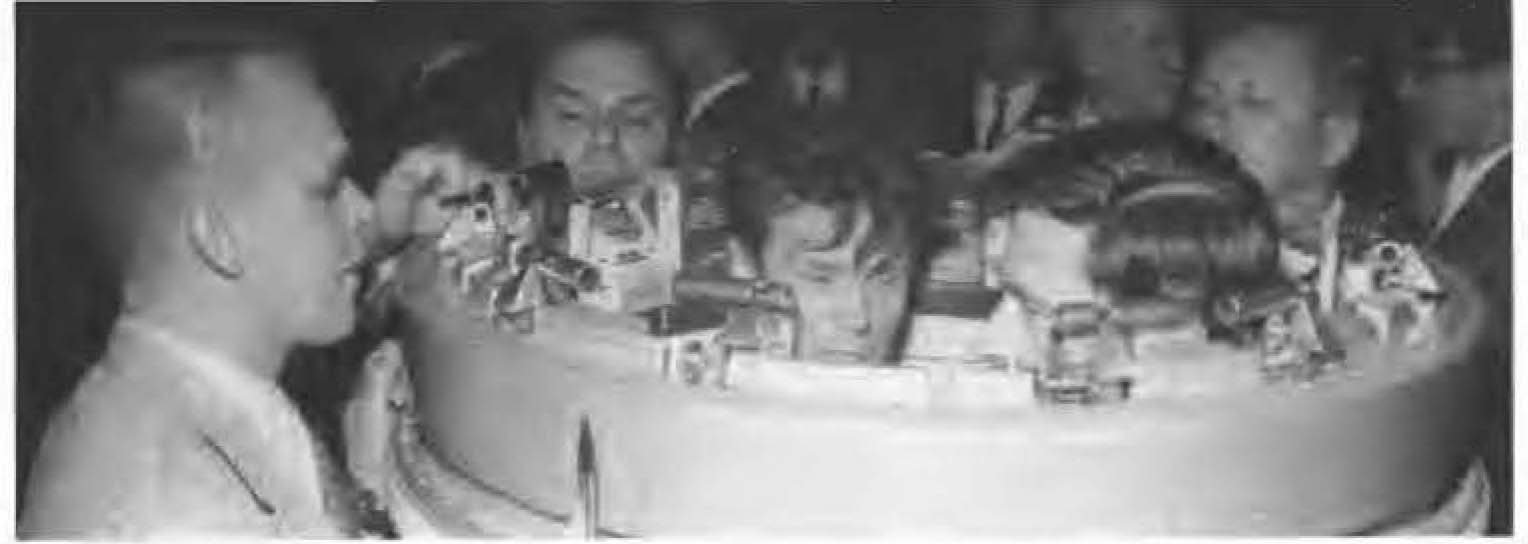
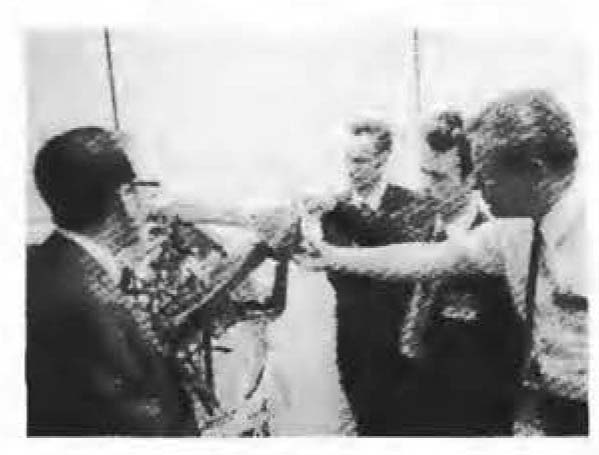
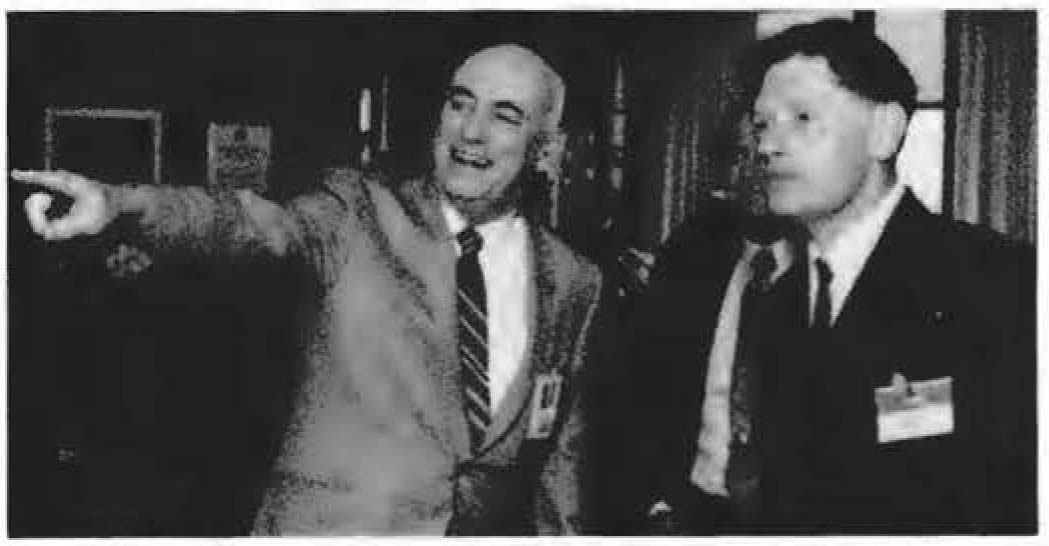
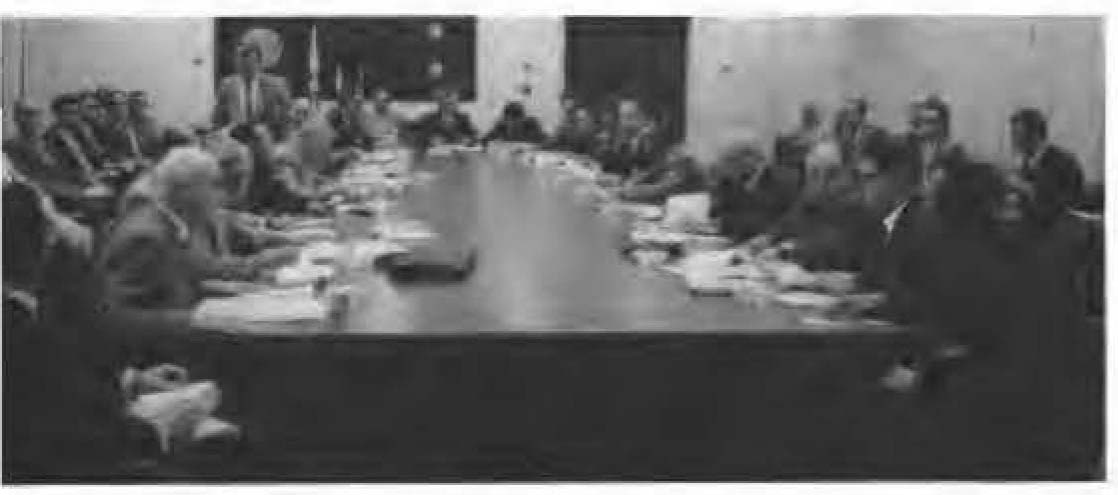
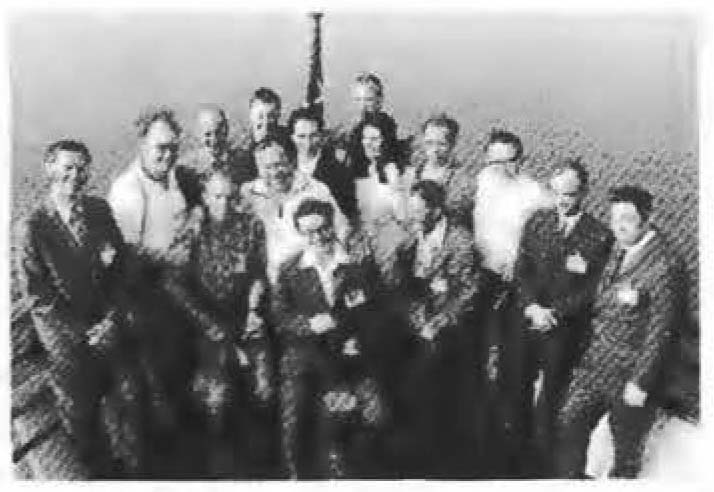
Caldwell Johnson spoke for the American side and outlined the minimum requirements necessary for rendezvousing and docking U.S. space vehicles-for example, the ability of one spacecraft to locate another in orbit, the status of control systems at the time of docking, and internal and external crew transfer. These requirements were, in other words, the ground rules for conducting manned rendezvous and docking, and the ever-present key element was crew safety. After talking about the design features of the American docking system and environmental control systems, Johnson listed a number of features that would have to be standardized before a joint mission could be undertaken.41
Petrov then spoke for the Soviets. He said that his specialists had read the documents given to them upon their arrival, and while they had some specific questions, he felt that both sides were in basic agreement on how to approach a joint mission. He then turned to his Working Group leaders, who discussed the topics related to their specialty. Valentin Nikolayevich Bobkov of Working Group 1 (responsible for rendezvous methods and overall compatibility) saw only two major topics that would require further discussion-the size of the hatch opening and the question of pre-breathing. Of these two, he expected that the hatch question was the one that would take some lengthy negotiation.42
The issue over the diameter of the transfer tunnel and hatch was indicative of the minor problems that could develop when the two sides failed to understand each other’s thinking fully. NASA, in discussing future systems, had proposed the adoption of a 1.5-meter diameter for hatches and tunnels, which would permit easier transfer between spacecraft than had been experienced with the 0.8-meter tunnel used in Apollo. The Soviets, for reasons unknown to the MSC group, wanted to retain the 0.8-meter size. Only with the passage of time and many conversations would the question be resolved. For the June meeting, this would remain an unclear and unanswered problem.
Speaking for the Soviet guidance specialists assigned to the second Working Group, Viktor Pavlovich Legostayev said that there were virtually no differences in the two groups’ approaches. Indeed, they expected to reach an early agreement in writing. The only difficulties came from the different terminology the two countries used, and they hoped to resolve that with relative ease. Legostayev suggested that this Working Group be divided into three subgroups to work on radio, optical, and target systems.
Syromyatnikov, the Soviet leader for Working Group 3, was equally optimistic in his predictions. Docking hardware terminology seemed to pose few problems, and Syromyatnikov and Caldwell Johnson seemed to agree on the approach to be taken in studying the technical considerations posed by mating two spacecraft.
These comments were followed by another statement by Academician Petrov, who said that considerable thought had been given to the Apollo-Soyuz test flight that the United States had proposed. However, the Soviet Academy thought that the simple drogue-in-cone approach was not very productive. Clarke Covington remembered Petrov’s reasoning-it was a dead end, with no application to future spacecraft. Petrov felt that such a flight would be considered a “space stunt”; instead, he suggested a test mission with a universal docking mechanism. The alternatives were Apollo docking with Salyut/Soyuz or Soyuz with Skylab/Apollo. Caldwell Johnson was surprised that the Soviets wanted to go ahead immediately and study the development of a universal docking mechanism. But he was pleased by the Soviets’ apparent desire to attempt in the near future a joint mission that would create hardware with long-term utility.43
With opening remarks out of the way and agreement reached on Working Group agendas, the three teams assembled in their respective conference rooms to begin their deliberations. Leroy Roberts jotted down his impressions of the Tuesday afternoon sessions: “... got off to fast start-more agreements-good working relationship-no language problem-eagerness to find solutions....”44
After the working sessions that day, the Soviets were given an opportunity to visit a suburban shopping mall, where they could make purchases and fill the requests of friends and family. In addition to space and Texas souvenirs, the Soviets made a number of specific purchases. High on their lists were children’s clothes. To everyone’s pleasant surprise, Penney’s was having a sale, in which large quantities of children’s garments were priced at two dollars each. Of the 19-member delegation, 15 bought something at this bargain table. A number of requests intrigued the Americans who accompanied the Soviets on their shopping trip. One man said that he had a little house in the country and wanted to change some things. Therefore, he needed something that would drill into concrete; the solution to his problem was a five-dollar star drill. One fellow purchased several pairs of tennis shoes with steel arch supports. And yet another shopper who needed a saw was quite pleased with his purchase of one with five interchangeable blades. Thus it went for several hours. Many things about the American consumer scene amazed, amused, or perplexed the Soviets. Free shopping bags were a surprise, as was being able to open packages to examine goods before paying for them. The use of credit cards by Americans disturbed the visitors, who reported that credit sales of major items-cars and appliances-were increasing in the U.S.S.R. but that credit purchasing often led to financial troubles. Finally, sales tax perplexed the Soviets and was never fully understood.
If the Soviets had a good time partaking of the Texas consumer economy, the Americans who waited on them and met them appeared to enjoy themselves equally. At one point during the evening, Academician Petrov was shopping by himself in Woolworth’s when three grade school children, a girl and two boys, approached him and asked him if he were from the Soviet Union. In English, Petrov replied that he was. The girl then gave an impromptu speech of welcome, saying that she was happy that they had come to the U.S. and hoped that their work would be successful. Petrov was moved to tears by this spontaneous greeting.45
The remainder of the June meeting followed this pattern of working during the day but sightseeing and socializing during the evening. The Working Groups began to concentrate on technical detail. Documentation of the technical agreements that the groups reached took a large part of the members’ time, but it was very necessary to ensure the compatibility of hardware and systems. Not only did the two sides speak different languages, but also they had evolved different engineering styles and terminology. Once the negotiators reached agreement on a topic of discussion, a document had to be prepared in both English and Russian, verified as to meaning and technical content, and then signed by the engineers and interpreters. This could be a slow and tedious process, but it was an integral aspect of creating compatibility.
Working Group 1 members reached early agreement on the coordinate systems that govern a joint mission. A coordinate system is the mathematical method for exactly defining the position of a craft in space relative to a particular celestial body, and of the several possible alternatives, the Working Group chose an earth-centered system. The American representatives agreed to prepare a single document reflecting their negotiated understanding and mail a draft to the Soviets within two months. After review and assurance that the document was acceptable, it would be signed off by both sides and thereby become the standard reference document for the subject.
In turn, the Soviets were to prepare a single technical requirements document treating the combined subject of spacecraft atmospheres, hatches, and crew transfer. That paper, based upon exchanges in February and the deliberations in June, would be reviewed, exchanged, and verified after the fashion of the coordinate systems paper.46 Other life support considerations that would have to be documented included cabin pressure limits, trace gas concentrations, carbon dioxide pressure limits, portable pre-breathing sys-tems, drinking water quality, and color coding of equipment. In addition, after Working Group 1 members talked about communications between ground centers and locations for various types of equipment, they agreed that these topics also required further discussion. Next, they turned to consider real test missions.
After agreeing that they should jointly prepare models for different missions that might be flown, the delegates decided to base their planning on an experimental flight in which Apollo would dock with “a manned orbital scientific station of the Salyut-type.” They also suggested that a subsequent experimental flight might be conducted with Soyuz and Skylab. Looking at such a test mission, the Working Group I signatories stated:
In principle the technical feasibility to do this exists. For the purpose of a concrete study thereof, the parties have agreed to do some additional work on these problems with primary attention given to the following problems:
- Location and design of docking assemblies
- Atmospheric parameters
- The need to provide airlocks
- Location of equipment, apparatus, and components of the rendezvous and docking system.47
Working Groups 2 and 3 discussed, negotiated, and drew up agreements in their areas of responsibility in a similar fashion. Group 2 members concentrated on such subjects as requirements for light beacons, radio guidance and communications systems, and spacecraft attitude control systems. Working Group 3 reached agreement on the basic functions and design features of a universal docking system, as well as on the design approach to obtain necessary compatibility. They also agreed to discuss details about hatches, docking ring seals, and electrical connectors with Group 1. Likewise, they would hold a joint session with Group 2 to discuss questions associated with the conditions for initial physical contact between spacecraft. As in the case of the first Working Group, the other two divided among the Soviet and American teams the responsibilities for drafting and exchanging the necessary documentation.48
Gilruth and Petrov reported that the deliberations had been successful, and they stressed the possibility of a test mission. Such an experimental flight was technically feasible, and both parties agreed “that the technical and economic aspects of these possibilities should be additionally studied and discussed...” To expedite their work in the months before the next joint meeting, which was tentatively scheduled for the end of November in Moscow, Glynn Lunney and Konstantin Davydovich Bushuyev were appointed Project Directors for their respective sides. They would act as focal points for all communications and technical exchanges. In a joint statement, Petrov and Gilruth reported that the meetings had been conducted in a businesslike atmosphere, and both men expressed their “gratification at the very rapid and substantive progress of their specialist working groups toward a comprehensive set of agreed requirements.” While the reporters puzzled over the nature of the progress and fussed about not having an opportunity to grill Gilruth and Petrov, the American and Soviet delegations bid farewell.49
MEETING THE PRESS
Later, on Monday, 28 June, six Americans who had worked with the Soviets held a news conference in Houston. Until that time, there had been some speculation in the press concerning the nature and tenor of the joint deliberations. In fact, during the negotiations, the Soviet side had asked that the discussions as a general rule be kept confidential. Gilruth and Frutkin flatly declined to agree to such an embargo of information, and Frutkin stated that NASA could not and would not proceed with the talks on that basis. Only in the area of agreements pending official ratification, such as the June Summary, of Results, did the agency reserve the right to remain silent. Once signed, however, those documents would become part of the public record.50
Characterizing the preceding week’s activities as friendly, Gilruth commented to the press:
It was a period of intense hard work covering very difficult technical areas. As you all know, rendezvous and docking is not simple for one country or one organization to conduct, and so I think everyone could imagine some of the complexity of trying to work out the arrangements between two different countries, particularly countries that speak such different languages.51
When Nick Chriss of the Los Angeles Times asked about the language barrier, Gilruth said that he would not be leveling if he did not admit that it was a formidable one. None of the American technical people spoke Russian and therefore had to rely upon interpreters. While they had been able to work around the language problem, it had been fortunate that several of the Soviets could speak and write English. Gilruth noted that there would be a need for additional simultaneous interpreters in the future, but English-Russian interpreters were not the most plentiful people in the world.
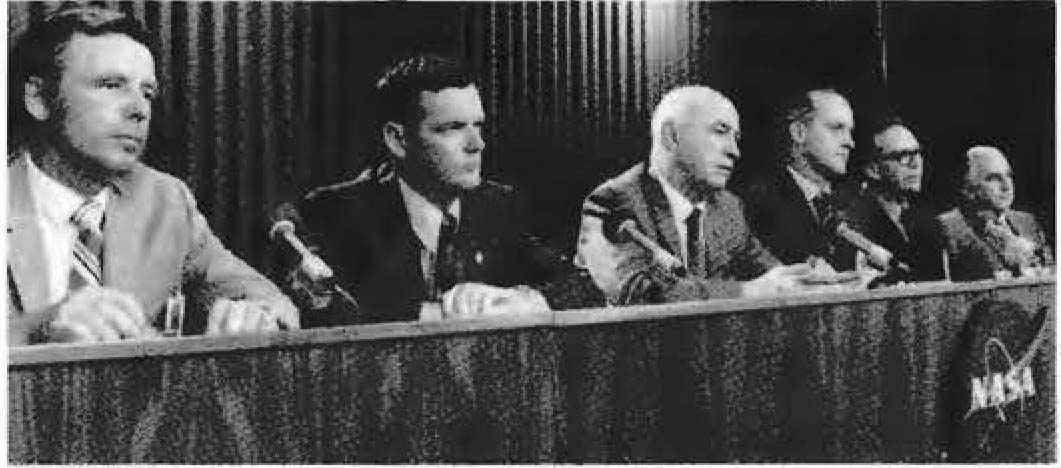
While careful not to give the impression that a joint mission was a sure thing, Gilruth answered a question raised by Paul Reiser of the Associated Press about timing. He said, “the mid-70s would be a reasonable time frame to think about. Certainly I don’t believe it would be any sooner than that, and of course even that is contingent on the rate of progress we are able to make.” Gilruth was quick to add that there had been no decision to conduct a joint flight, only discussions on the merits of such an experimental mission. The desirability of an actual flight would be a topic for continued discussion.
To inquiries about the candidness of the discussions, the Americans reported that there was indeed a high degree of openness. Don Wade, chairman of Working Group 3, said that their candor had surprised him, but he added that this was relative to the pre-agreed list of discussion items, which they “stuck pretty close to.” In those areas “they were very, very open with us,” he said. Both publicly and privately, Wade’s colleagues agreed with his appraisal.52
One of the recurring questions raised by the newspeople centered on the “give away” issue-giving away to the Russians hardware or technical know-how. Jim Maloney of the Houston Post asked about this first in the context of rendezvous and docking. He suggested that NASA was going to “donate” knowledge in this area, since the U.S. had much more experience than the Soviets. Peter Mosely of the Reuters news service asked if Gilruth would characterize the efforts so far as an exchange of technology. Gilruth answered that NASA may have had more rendezvous and docking experience but that the Soviets had had their share as well and clearly understood the flight mechanics involved. In response to the question of transferring technological knowledge, the MSC Director pointed out that the present talks were simply exchanges of views on how two nations might fly together. He did not anticipate any major changes in either nation’s spacecraft as a result of the compatibility meetings. All that was really required, he said, was an agreement on the docking interface-the docking gear, and the like-and assurance that the interface requirements are adequate.
There were also questions about the wider implications of the negotiations. Jay C. Russell of KTRH radio of Houston asked Gilruth, aside from being able to sit down and work at making equipment that would fly together, “what does all this mean to the world?” Gilruth responded:
Well, I think you’d have to decide that for yourselves. None of us here are politicians or politically inclined people. I think we all are impressed with the fact however, that we have been able to meet with the delegation from the Soviet Union in an area of great technical difficulty, work together, and with a friendly atmosphere come to a number of important general agreements and I think that it’s always good when people can meet and work together in harmony.53
SOYUZ 11: TRIUMPH AND TRAGEDY
As the Soviets departed from Houston, Soyuz 11 was completing its 20th day in orbit docked with Salyut I. This record breaking flight had been heralded by Keldysh as beginning a new era in space exploration. On 9 June, Blagonravo had declared in an article prepared for Krasnaya Zvezda that:
In the opinion of Soviet scientists, such stations with replacement crews constitute mankind’s main highway into space. They can become unique launching pads for flights to other planets. Large scientific laboratories will spring up for research into space technology and biology, geophysics and medicine, astronomy and astrophysics.... In time, such stations will be linked with earth not only by radio but by a regular space mail. By periodically putting small supplies of fuel aboard, it is possible to insure the station’s long-term existence by switching on the engines and reestablishing the velocity lost as a result of braking in the upper layers of the atmosphere.54
The three-man crew of Soyuz 11 (call signal “Yantar”), Georgi Timofeyevich Dobrovolskiy, Vladislav Nikolayevich Volkov, and Viktor Ivanovich Patsayev, had entered the space station on 7 June. The joined configuration of Soyuz and Salyut was 21.4 meters long with a total living space of 100 cubic meters, which gave the cosmonauts a place to conduct scientific experiments, relax, and sleep. For the next 23 days, each crewmember performed his scheduled experiments, which emphasized the study of human performance under, and reaction to, prolonged weightlessness. On the 29th, after completing their flight plan, the space dwellers transferred their scientific records, film, and log books to Soyuz in preparation for their return home.
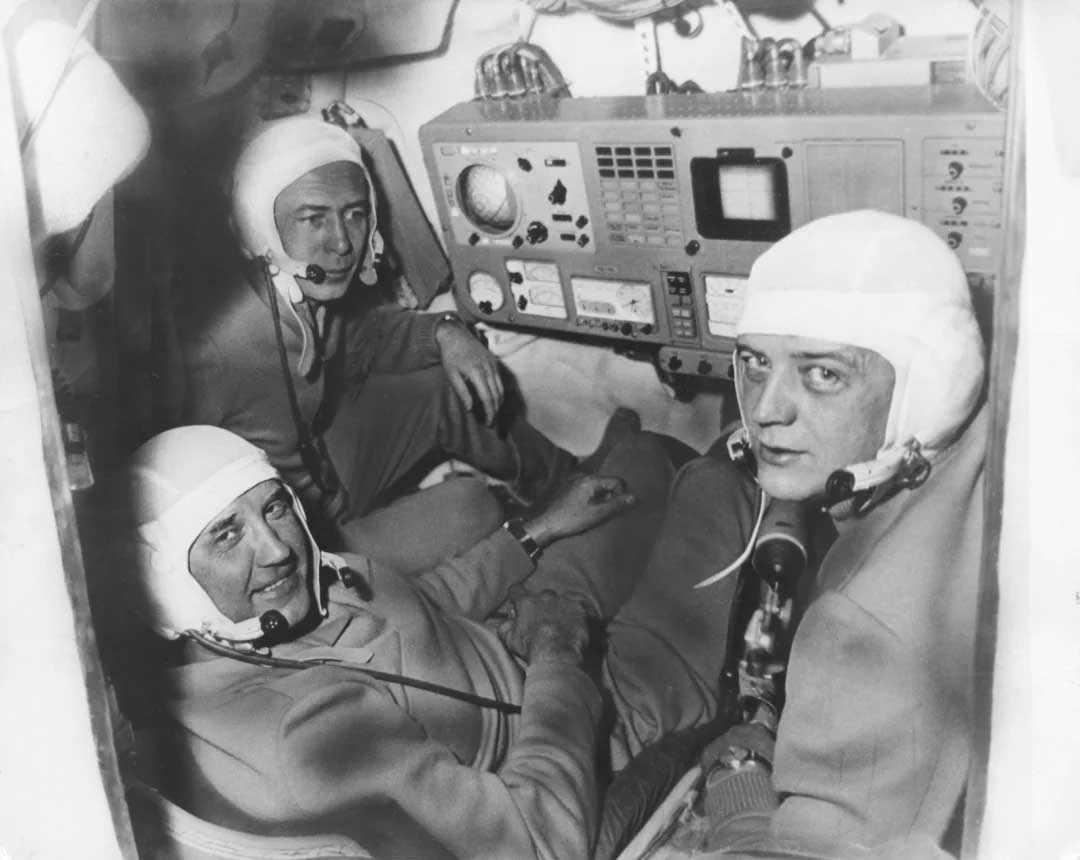
At 9:28 in the evening, Dobrovolskiy undocked the ship and drifted free from the space station. After three additional orbits, the Soyuz 11 crew notified ground control that they were beginning their descent. Mission Control radioed: “Good bye, Yantar, till we see you soon on mother earth.” Dobrovolskiy replied: “Thank you, be seeing you. I am starting orienta-tion.”55 At 1:35 a.m. the retrorockets were fired automatically for a seven-minute burn, and the parachutes were deployed on schedule. Mission Control tried repeatedly to contact the crew at this time, but to no avail. When the recovery crews reached the descent vehicle and opened the access hatch, Dobrovolskiy, Volkov, and Patsayev were dead in their contoured couches.56
The accident was a stunning blow to both the Soviet Union and the international aerospace community. Once again, the experimental and risky nature of man’s venture into space had been made clear. While the three bodies lay in state and a Special Commission investigated the cause of the multiple deaths, wide speculation spread in the West over the significance of the tragedy for the continuation of manned space flight.
One of the prevailing theories was that man might not be able to survive long periods of weightlessness. For several years, there had been a serious debate among scientists about the effects of prolonged weightlessness. During Project Gemini, there had been “signs” that the human heart grew lazy after an extended time in zero gravity. Then in July 1969, the monkey Bonny aboard the U.S. Biosatellite 3 died of heart failure after recovery from a 9-day flight.
However, there were other theories regarding the Soviet disaster. George Low discounted the heart failure story, and Dr. Walton Jones, Deputy Director of Life Sciences in the Office of Manned Space Flight suggested that the men had died as the result of their cabin decompressing rapidly. The crew was found strapped in their seats with no apparent indication of any struggle. (The crew did not rely on space suits.) Dr. Jones said that this is how they would have appeared if a valve had leaked or the shell of the cabin had ruptured. In Houston, Dr. Charles Berry, flight surgeon to the astronauts, thought that the accident might have been caused by the release of a toxic substance. MSC Director Gilruth favored the decompression theory. Whatever the cause, both Soviet and American aerospace leaders realized the seriousness of the problem and its implications for manned flight in general and for the compatibility discussions in particular.57
As thousands of Muscovites filed by the funeral bier of the three cosmonauts on 1 July, Soviet President Nikolai V. Podgorny, Premier Kosygin, and Party General Secretary Leonid I. Brezhnev took turns standing watch as part of the honor guard. President Nixon on behalf of the United States told the Soviet leaders:
The American people join in expressing to you and the Soviet people our deepest sympathy on the tragic deaths of the three Soviet cosmonauts. Thewhole world followed the exploits of these courageous explorers of the unknown and shares the anguish of their tragedy. But the achievements of cosmonauts Dobrovolsky, Volkov and Patsayev remain. It will, I am sure, prove to have contributed greatly to the further achievements of the Soviet program for the exploration of space and thus to the widening of man’s horizons.58
In addition, the President sent U.S. astronaut Thomas P. Stafford to Moscow as his official representative for the funeral ceremonies held in Red Square.59
Soviet space leaders were quick to reaffirm their plans to continue manned space flight. Writing for Pravda on 4 July, Petrov spoke of the conquest of space as a “difficult path,” but he repeated Brezhnev’s earlier statement-“Soviet science considers the creation of orbital stations with replacement crews to be man’s highway to space.” The scientist argued that man could play his most important exploratory role in the study of the earth and in astronomy from platforms positioned in “near-earth space. Furthermore, such earth orbital investigation is only valuable when it is conducted for extended periods on a regular schedule. Petrov said that “the seventies will be the epoch of development and broad application of long-term manned orbital stations with replacement crews, which will make it possible to switch from episodical experiments in space to a regular watch by scientists and specialists in space laboratories.”
Summarizing the work conducted on board Salyut by the crew of Soyuz 11, Petrov restated the value of their contributions to science. In addition to the medical and biological experiments, they had carried out a number of studies related to weather and earth resources. According to the Soviet spokesman, the data returned in Soyuz would be used by students of agriculture, land reclamation, geodesy, and cartography, as well as by meteorologists to improve their forecasts. With words apparently aimed at domestic critics of the Soviet manned space program, Petrov reported:
The experience of the cosmonauts’ work has shown that the Salyut manned station is a space laboratory well adapted for experiments in orbital flight conditions. Such stations are opening broad prospects for the continuation and development of the research carried out by the first Salyut crew....Ahead lie new flights into space and the creation of new inhabited orbital stations of the Salyut type. Undoubtedly, even larger and more complex manned multipurpose and specialized space stations will be built. But the significance of the work carried out by the first crew of the first manned orbital station ... will never fade.60
The Special State Commission investigating the Soyuz 11 deaths released a public statement on 12 July. After reporting that the flight had proceeded normally up to the beginning of reentry, the Commission stated:
On the ship’s descent trajectory, 30 minutes before landing, there occurred a rapid drop of pressure within the descent vehicle which led to the sudden deaths of the cosmonauts.... The drop in pressure resulted from a loss of the ship’s sealing. An inspection of the descent vehicle... showed that there are no failures in its structure.61
The reasons for the “seal” failure were still under investigation, this terse statement continued.
While the official report apparently eliminated weightlessness and physical deconditioning as causes for the accident, the seal failure statement raised a new question. Americans preparing for Apollo 15 wondered if the Soyuz problem was of the type that might be experienced with an Apollo spacecraft. MSC Director Gilruth wrote Petrov shortly after the accident and asked him that question. Petrov reassured the Americans that “the drop in pressure resulted from a concrete failure of one of the elements of the descent vehicle system. Since it is a matter of specific and particular defect we are sure that it cannot be related to ‘Apollo’ spacecraft.”62 Soyuz 11’s misfortune did not affect NASA’s plans for the launch of Apollo 15, but it did lead to some discussions outside the space agency on the safety of Soviet hardware.63
AFTER APOLLO: WHAT?
As the Soviets recovered from their tragedy and evaluated their manned space flight plans, NASA continued its preparations for Apollo 15. The agency’s leadership was also looking with uncertainty to the future of its man-in-space efforts. Prior to his departure from NASA the previous autumn, Tom Paine had announced a reshuffling of the remaining Apollo missions. In a press conference on 2 September 1970, the Administrator had discussed these decisions, which reflected a husbanding of NASA’s dwindling share of the national budget. The agency wanted to accomplish many goals, but these had to be attained with a limited number of dollars. As the 1969 Space Task Group studies had suggested, NASA would have to balance its present wants against future budgets. A shifting of current project monies would have to take place if NASA wanted not to jeopardize its plans for the future.64
Paine and his colleagues realized that during the 1980s there would be no manned missions to Mars, no other bold ventures equivalent to the lunar goal of the 1960s. Paine said that the principal decision facing the agency was “how best to carry out the Apollo and other existing programs to realize the maximum benefits ... while preserving adequate resources for the future.” NASA had decided to concentrate its manned efforts on three earth-orbit programs-Skylab in 1973 and Space Shuttle and Space Station in the 1980s. The earth-oriented unmanned program would include early development of the Earth Resources Technology Satellites and the Applications Technology Satellites. An unmanned planetary program would involve the Grand Tour flights to distant planets, the Viking Mars orbiters and landers, and the Pioneer missions to Venus, Mercury, and Jupiter. Add “a healthy aeronautical research program” to that list, and the demands on a shrinking budget were obvious.
One immediate way to conserve money was to reduce the number of Apollo moon landings. To pare $42.1 million from the fiscal year 1971 budget, two missions were canceled, and manpower levels at the manned space centers were scaled down accordingly. These decisions were taken not only reluctantly, but also against the advice of scientific agencies external to NASA. Apollo’s remaining missions were redesignated 14 through 17, and the so-called “residual” hardware would be made available for Skylab, Space Station, and other programs that might follow the final lunar landing in 1972.
With astronauts Alan B. Shepard, Stuart A. Roosa, and Edgar D. Mitchell aboard, Apollo 14 conducted a successful lunar exploratory trip in 1971. The 31 January-9 February mission was slightly marred by the failure of the probe assembly to operate smoothly as Commander Shepard tried to dock the CSM with the LM. Shepard and Mitchell spent their 9 hours and 24 minutes on the lunar surface exploring the terrain, but NASA hoped to increase considerably time spent on the moon during the next flight.65
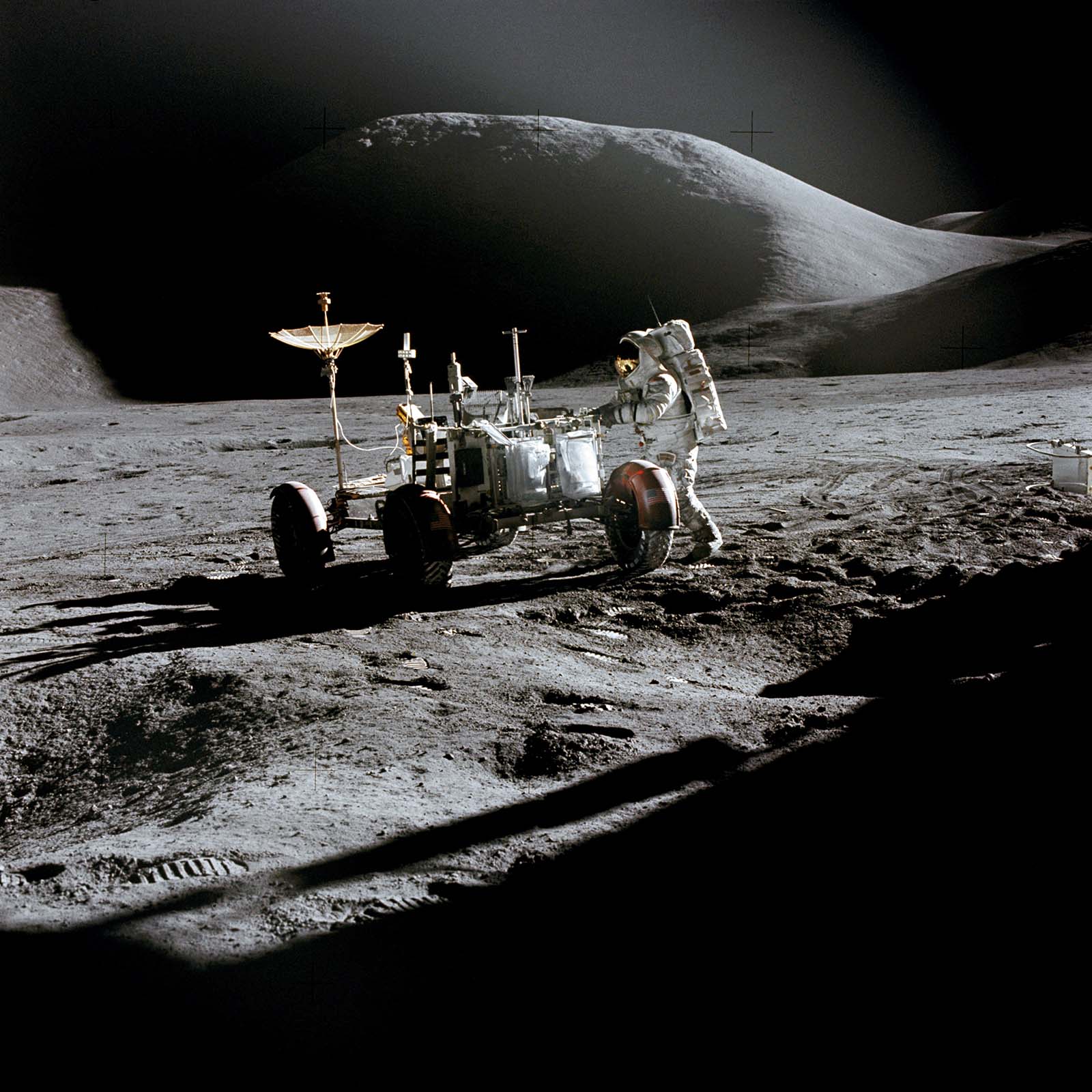
Apollo 15 stressed longer EVA periods and use of the lunar roving vehicle. One hundred hours after a 26 July launch, David R. Scott and James B. Irwin separated their lunar module Falcon from the CSM Endeavor piloted by Alfred M. Wordon and headed for a touchdown in the mountainous Hadley-Appenine region near Salyut Crater. The results of their exploratory work were excellent, and Scott and Irwin set several records in the process. They had spent over 63 hours on the moon’s surface, conducted a total of 18 hours and 35 minutes in extravehicular activity and traveled 28 kilometers in their moon buggy. But for all its success, Apollo 15 did not bring much joy to the NASA people in Washington, Houston, and Huntsville, for only two more lunar missions remained.66
When James Chipman Fletcher was sworn in as the fourth Administrator of NASA on 27 April 1971, he became the head of an agency that was entering a new era. Fletcher, a physicist by professional training and a university president during the turbulent 1960s, had a personal background in the aerospace world and understood some of the problems that NASA would be facing in the years ahead. Reflecting the spirit of both the adventurer and the realist, he commented to the press after the announcement of his appointment that an important goal faced the agency -“to achieve ... balance between manned and unmanned programs. It would be very exciting for man to go beyond the moon but that... is a little beyond the nation’s budget right now.” Such a statement might at first appear to have been somewhat flippant, but it could be taken as a manner of saying to the NASA team, “Do not despair; there is still important and exciting work to be done.”67
Dr. Fletcher also announced very early that he supported closer cooperation with the Soviets. On 10 March, during a one-hour hearing before the Senate Committee on Aeronautical and Space Sciences, Fletcher told the Committee that the U.S. had made “some small steps” toward cooperation with the U.S.S.R.; now “we can make even larger steps.” But the possibility of reducing the long hiatus between the Skylab missions in 1974 and the first Shuttle flights in the 1980s was another reason why Fletcher was interested in talks about a joint mission with the Soviets.68
At a pre-launch press briefing for Apollo 15, Dale Myers, Associate Administrator for Manned Space Flight, had spoken about the post-Skylab studies under way. He pointed out that there would be four Apollo CSM’s left over, three from the canceled moon flights and one that had been set aside as a backup for Skylab. Studies conducted in Houston indicated that these spacecraft could be flown in earth-orbital missions for about $75 to $150 million each. One possible use for these CSMs would be to launch one a year, beginning in 1975, for earth resources surveying missions lasting from 16 to 30 days each. Of these four spacecraft, one could be set aside for a rendezvous and docking mission with the Soviets. Still another possibility would be orbiting a second Skylab, using the backup CSM for the flight planned for 1973, but that would be very expensive and would require developing new mission goals for Skylab B.69
An interim manned program of some kind was highly desirable. In the first place, it would permit NASA to hold together its launch and flight control teams. Keeping these people together was as much a question of morale as it was money. The men working at Houston and Cape Canaveral were action-oriented; they needed the challenge of actual flights. And second, the crewmembers who trained for the last Apollo flights would still be eligible to fly in the Shuttle period, but they too might grow restless and disinterested if there were a four- or five-year break in flights. Availability of funds would determine the feasibility of an interim project for the space agency.
Myers said that there would probably not be money enough for both a full-scale Shuttle program and interim Apollo flights. If NASA decided to develop the Shuttle booster and orbital stages simultaneously, then there was little likelihood of any flights between the last Skylab visit and the first Shuttle launch. He pointed out, however, that a second approach might be taken. NASA could develop the Shuttle orbital spacecraft first, and while glide tests were being conducted with the early prototypes continue development on the reusable launch boosters. Under such a “phased approach,” it might be possible to finance some other missions. But the key guideline was to undertake only those efforts that could be carried out without draining resources from the major effort - Shuttle.70
A STUDY TASK TEAM
As work progressed in Houston during the summer of 1971, two teams emerged. Most visible was the one under the direction of Glynn Lunney, comprised of the Working Groups that were organized to establish ground rules for working effectively with the Soviets. At the same time there existed a less organization, headed by René Berglund, charged with coordinating work within NASA and dealing with contractors after outside studies had been ordered. Membership in these two groups overlapped somewhat.
Shortly after the 21-25 June meeting with the Soviets, Berglund’s team presented to Gilruth and his senior staff a paper outlining the basic hardware needed for a Soviet-American flight. Berglund proposed-for purposes of discussion-planning toward a mid- to late-1974 launch; everyone agreed that “with all that has to go on to make it work, this was an extremely tight schedule.” Chris Kraft directed Berglund and Lunney to generate by September a realistic schedule and a cost figure for one CSM-Salyut flight. The earlier talk of four Apollo earth orbital missions was dropped.
Caldwell Johnson’s spacecraft designers were given an equally challenging assignment. Director Gilruth wanted the docking adapter design pushed ahead rapidly, with a working model prepared for the November meeting with the Soviets. Johnson quickly pointed out several tasks that would require further investigation. The first, called project engineering, was assigned to Clarke Covington, who had the overall responsibility for integrating the engineering done by the other designers and technical specialists. In addition, Covington was serving as a systems engineer to Lunney’s Working Group 1 and to Berglund’s Study Task Team. Covington became one of several engineers who found himself putting in 12- and 13-hour days.
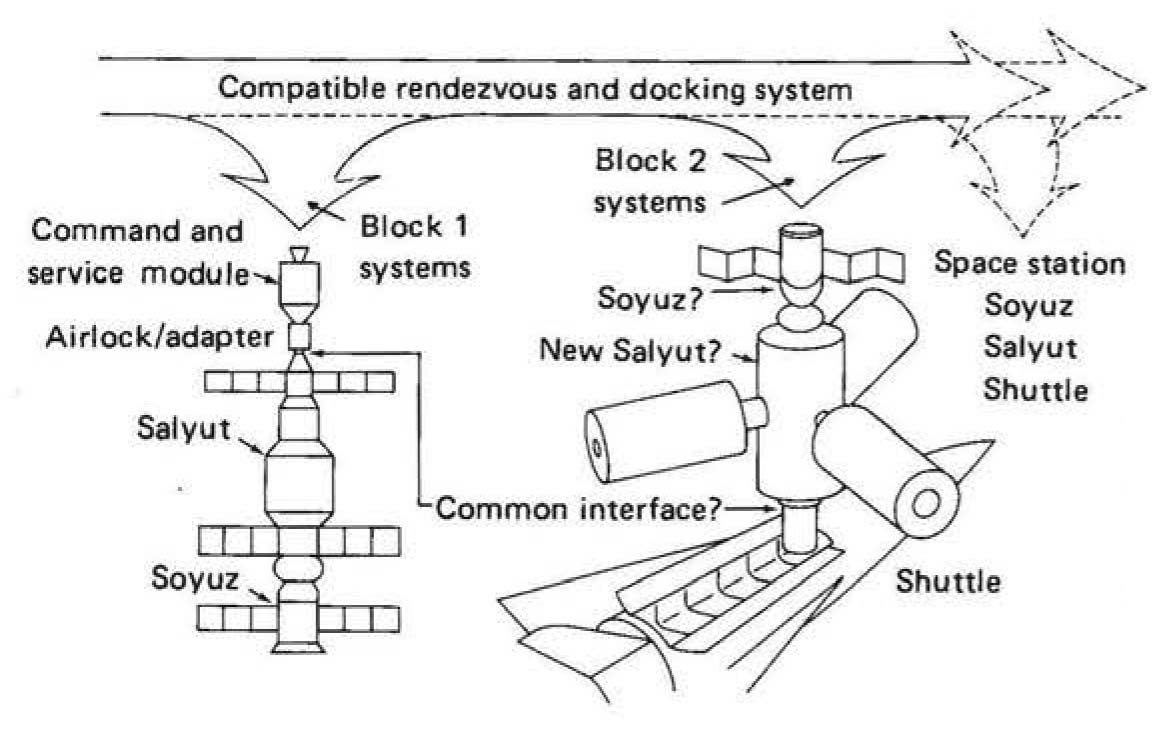
Bill Creasy and his fellow mechanical engineers were working to a similar schedule on the design of a compatible docking system. Johnson, who believed that it would be most difficult to reach an agreement on the docking gear, wanted to proceed with a variation of that same ring and cone system he had illustrated for the Soviets the preceding October in Moscow. Since Petrov had rejected the simple adaptation of Apollo and Soyuz as a “space stunt” and since the Soviet space expert had proposed developing a universal docking mechanism, Johnson suggested that MSC draw up a “design specifically adequate to requirements of a particular CSM/Salyut mission, the design being representative only of the fundamental form and function of docking gear satisfying the requirements for compatible docking system for future spacecraft.” Creasy was asked to conduct a preliminary design study to determine the nature, weight, and characteristic dimensions of the functional components of an androgynous docking mechanism. This study was to be of sufficient depth to allow a demonstration system to be built that would permit further engineering and development. While the preliminary design was to be adapted to a CSM-Salyut mission, it should be adaptable to future spacecraft as well.71
Responsibility for designing the airlock module was given to James C. Jones. Rejected earlier in favor of the simpler Apollo-Soyuz drogue-in-cone concept, this adapter had revived engineering interest, and preliminary designs were directed toward CSM-Salyut. These studies for the docking nodule (DM) were to be so detailed that the concepts could be engineered and developed by outside contractors. Jones was also assigned responsibility for the preliminary integration of the environmental control system into the DM and the first cut at designing a mounting for the airlock module inside the launch adapter.72
Building on these early design efforts, Berglund’s team drew up a “Statement of Work,” issued on 29 July 1971 to North American Rockwell, for a detailed study of all the elements required for an International Rendezvous and Docking Mission (IRDM). This four-month study was intended to expand upon the basic concepts and provide a fuller description of the hardware as it could be used in a rendezvous and docking mission and independent CSM earth survey. North American would consider which of the remaining CSM’s (111, 115, 115A, or 119) would be best suited for modification and completion as the prime and backup spacecraft for a mission with the Soviets.73
In essence, the MSC Statement of Work and subsequent Document Change Requests told North American what NASA wanted; then the contractor was to carry out the engineering and development. For example, the agency documents proposed that the mission be 14 days long, with a joint docked phase of one to two days, after which Apollo would conduct earth survey experiments. The sequence of events during the mission was outlined:
- Saturn IB stage boost
- CSM separation, transposition and docking with extraction of the DM CSM transport of DM to a Salyut-type vehicle
- Rendezvous and docking of CSM-DM with Salyut-type vehicle (CSM active)
- Docked orbital operations (solar inertial attitude)
- Separation of CSM-DM from Salyut-type vehicle
- CSM maneuver to earth resources survey orbit condition
- Conduct earth resources survey activities
- EVA retrieval of experiment data
- CSM deorbit and entry74
With these guidelines, North American was to plot out the details of a joint flight and define all the hardware considerations involved in preparing a CSM and a DM for such a mission.
While the contractor personnel began their work, Gilruth created a formal Study Task Team at MSC to direct the IRDM study. René Berglund, appointed manager of this group, convened its first meeting on 4 August 1971 to discuss the general status of the IRDM work and the management philosophy to be used during North American’s effort. At this meeting, the schedule for the next four months was mapped out so that the proper pace of activities could be ensured.75 During August and September, work progressed on several fronts in preparation for the winter meeting with the Soviets.
DEFINING THE DOCKING MODULE
At the time the IRDM Statement of Work was issued, the docking module was still only partially defined. The initial ground rules for such a design were presented by Clarke Covington at an IRDM Study Team staff meeting on 16 August. First and foremost, the docking module should be built to accommodate (externally or internally) any additional equipment required by a joint mission so that the modifications to the basic CSM design could be kept to a minimum. There were a number of other fundamental considerations, too. Where possible, the DM should draw on the CSM for its power needs, the major exception being the DM life support system. The designers, James R. Jaax and Gerald P. Mills, agreed that normal crew transfers should not depend upon Salyut life support systems; the DM should have its own environmental control system. Covington and the Crew Systems Division engineers favored an independent system that provided the American crew with a sanctuary to withdraw to if there were difficulties during transfer.76
Since the Americans returning to the CSM would have to pre-breathe for four hours before reentering the command module, he “liked the idea of knowing that we were just minutes away from a U.S.-designed piece of equipment that you could jump back into...” Even though the crew was a couple of hours away from stepping into the CSM, they would still be “in a piece of equipment that we understood ... and which had been through our qualification program and our safety program.”* 77 Further, the DM would have to be able to withstand the 760-mm-Hg pressure used in Salyut and accommodate the equipment required to communicate on the Soviet frequency. During August and September, several MSC teams worked further to define the preliminary design of the docking module, and Covington then took these materials and drew them together into a single document that could be passed on to the contractor.78
* The length of time required for pre-breathing was the subject of considerable discussion between the environmental control system engineers and the medical staff at MSC. The engineers wanted to reduce the time, but the doctors called for a conservative period of three to four hours.
The “Docking Module Design Study” presented by Covington to MSC and North American representatives on 29 September was a full-scale outline of the design elements to be incorporated into the DM. In fact, the 110-page document really was quite specific on details, more so than might ordinarily have been expected. MSC was telling the contractor precisely what it wanted.79 The DM was to serve five functions:
Primary Functions
- Serve as structural adapter between CM docking mechanism and new docking mechanism
- Serve as atmosphere adapter between CM and Salyut
- Provide habitable environment for crew while occupied
- House communications gear operating on the Soviet frequency
Additional Function
- Provide additional volume for 3-man CSM ERS [Earth Resources Survey] phase.80
This study also spelled out the basic dimensions for that new piece of hardware. The length of the DM from the CSM docking interface to the point at which the international docking mechanism would be attached was to be 2.54 meters,* with an additional 0.254 meter allowed for the new docking gear. The interior diameter was to be 1.42 meters with a hatch diameter at the CSM end of 0.84 meter, or the same as that used previously on the lunar module. At the Salyut end, MSC was proposing a 0.9-meter hatch.81
* This is the space required to house two average size men in space suits, allowing for the inward swing of the hatches. The diameter of the hatch was defined by the minimum size that would accommodate a suited man and his portable life support system.
Hatch size was still a topic of considerable discussion in Houston. At the end of August, Glynn Lunney had written to Gilruth suggesting that a distinction be made between the hatch sizes used in an Apollo-Salyut mission and the diameters suggested for future systems. The planners looking forward to Shuttle and Space Station wanted a 1.5-meter hatch, but Lunney doubted that it was reasonable to impose that dimension on the designers preparing for Apollo-Salyut. He thought it was “fair to question whether this is the correct answer for the present and ... foreseeable future since the schedule for the large space station will remain unclear, but it must be at least 10 or 15 years away.” Since the hatches on the docking module could be made to a smaller dimension without serious design impact on future efforts, NASA would propose a 0.9-meter hatch diameter to the Soviets at the next joint talks.82
While work on defining the docking module progressed at MSC, North American at Downey, California, moved ahead with their IRDM study. The Downey engineers had made an initial presentation in Houston on 24 August, containing materials that were being generated almost daily at MSC and North American. This process of evolving a document or presentation was called “iteration.” Draft after draft was prepared, into which the latest findings or ideas were incorporated. Only after several iterations was a final report submitted.83 The second status review made by the contractor on 29 September reflected the joint effort with MSC to that date.84 Contractor personnel who came to the space center for this review also received a full presentation on the progress of MSC’s Docking Module Study. They took this study home to California to use in preparing their final iteration of the IRDM study, due on 16 November.85
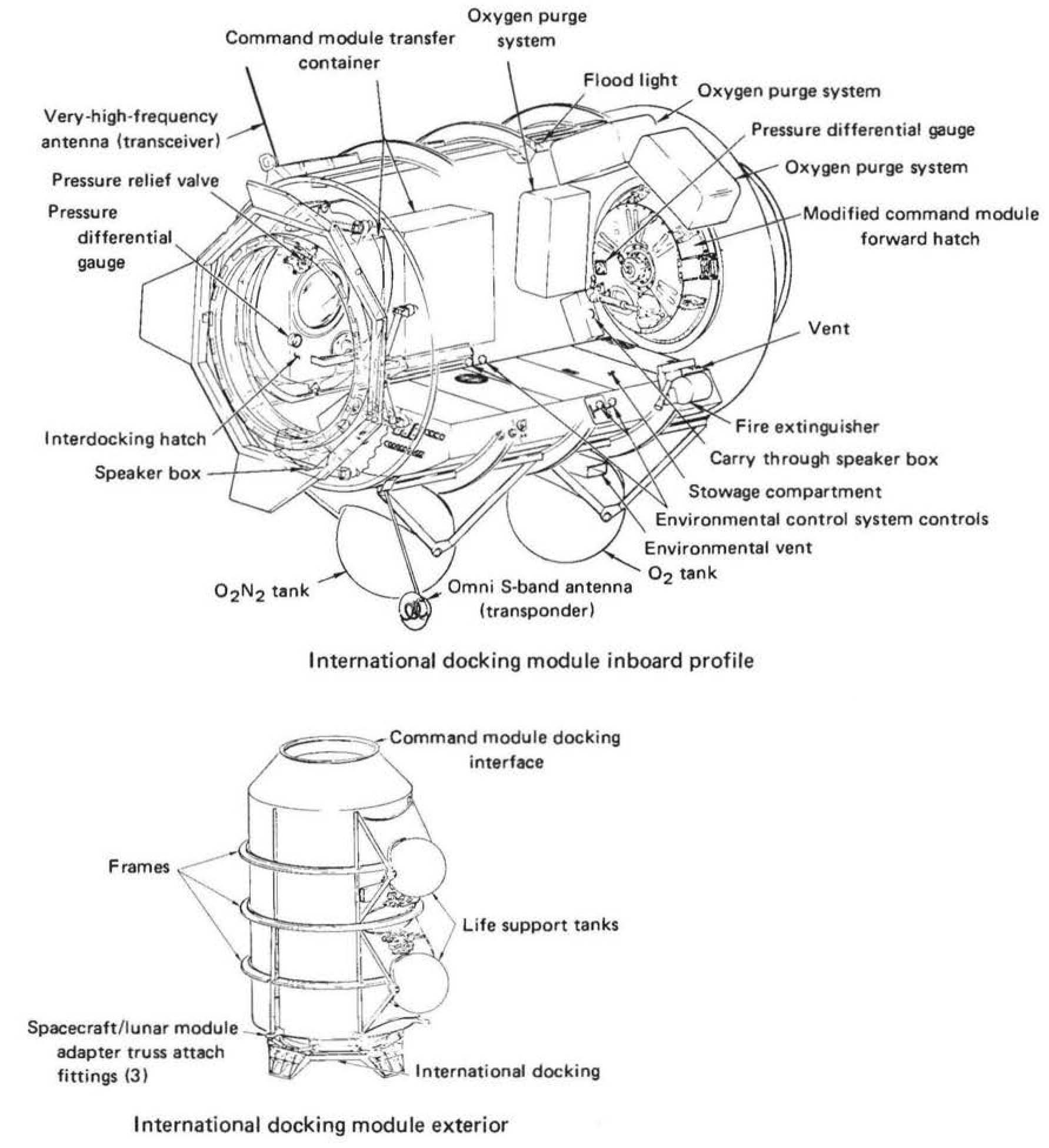
In five months, the combined NASA-contractor teams had drawn together a detailed outline of the multitude of considerations involved in the American half of a mission with the Soviets. Called “International Rendezvous and Docking Mission Final Briefing,” this document began with a restatement of the basic objectives of such a flight. North American then reported that a “meaningful” dual mission could be performed. The modifications necessary on the CSM were reasonable, in terms of both expense and time. Looking at the docking module, the contractor reported the design to be straightforward, well within current engineering abilities, and the basic subsystems had been previously qualified in Apollo. Communications equipment that operated on the Soviet frequency was one new element that would have to be designed, manufactured, and qualified. While the DM could likely be ready to go in time for a 1974 launch, the Downey personnel responded that work on an international docking gear would have to be very carefully orchestrated to get it completed in time. The North American staff felt that a 1975 launch date would give them more flexibility and leeway but that they could have a spacecraft ready a year earlier if NASA so wished.86
The bulk of the final briefing was devoted to describing mission details, describing changes to the CSM, outlining the design and manufacture of the DM and its subsystems, and listing current Apollo hardware that could be used. Many highly technical orbital mechanics questions were addressed, not only to explain the launch time considerations for a joint docking but also to delineate such problems as the effect of lift-off schedules on the lighting available for the earth resources part of the proposed mission. The report looked into questions like the amount of reaction control system propellant that would be required, with equal attention being given to electrical power and other onboard consumables. The contractor also discussed possible areas for scientific experiments, describing some of the hardware that was available. Materials dealing with the docking module and its fabrication were equally detailed. A 249-page briefing, entitled “IRDM Programmatic Considerations Summary,” and eight other sets of documents illustrated the technical feasibility of a rendezvous in earth orbit with the Soviets and testified to the ability of the NASA-industry team to work a problem in a short time.87 René Berglund’s Study Task Team had done its job, and Glynn Lunney’s people were getting ready for a November departure to Moscow to talk turkey with the Soviets.
- Mstislav Vsevolodovich Keldysh to George M. Low, 19 Oct. 1970; and Thomas O. Paine to Keldysh, 15 Sept. 1970.X
- Low to Keldysh, 24 Nov. 1970; Keldysh to Low, 4 Dec. 1970; and TWX, Keldysh to Low, 30 Dec. 1970.X
- Low, "Notes on Trip to the Soviet Union," 15-22 Jan. 1971.X
- Harry Schwartz, "Threats and Bombs-A Nasty Phase for the Two Nations," New York Times, 10 Jan. 1970; David A. Andelman, "Dangerous Campaign to Harass Russians," New York Times, 17 Jan. 1971; "Soviet Union-Limited Leniency," Time, 11 Jan. 1971, pp. 19-21; "'Lapel Diplomacy," Time, 18 Jan. 1971, p. 27; and "The Private Jewish War on Russia," Time, 25 Jan. 1971, pp. 18 and 21.X
- Low, "Notes on Trip to the Soviet Union," 15-22 Jan. 1971.X
- Interview, Low-Edward C. Ezell, 30 Apr. 1975.X
- Robert R. Gilruth to Boris Nikolaevich Petrov, 23 Nov. 1970, with enclosures ("Operations and Functions of the Apollo Guidance Computer During Rendezvous"; "A Summary Description of the Apollo Command and Service Module Telecommunications System"; "A Summary Description of the Apollo Docking System"; "The Apollo Radar Systems"; and "A Summary Description of the Apollo Command Module Environmental Control System"); Gilruth to Dale D. Myers, 23 Nov. 1970; Petrov to Gilruth, 16 Dec. 1970, with enclosures (*Kratkoye opisaniye radioapparatury sblizheniya kosmicheskikh korabley tipa "Soyuz'" [A brief description of the radio equipment used for rendezvous by Soyuz type spacecraft]; "Radiotelefonnaya svaz' mezhu pilotiruyemymi korablyami tipa 'Soyuz' " [Radio-telephone communications between manned spacecraft of the Soyuz type], and "Spravochnyye dannyye po parametram atmosfery zhilykh otsekov korabley tipa 'Soyuz' " [Reference data on the parameters of the atmosphere in the living compartments of Soyuz type spacecraft]); and Keldysh to Low, 4 Dec. 1970.X
- Interview, Arnold W. Frutkin-Ezell, 5 May 1975.X
- Low to Henry A. Kissinger, 29 Oct. 1970; and Low to U. Alexis Johnson, 30 Oct. 1970.X
- Interview, Low-Ezell, 30 Apr. 1975; and Low, "Notes on Trip to the Soviet Union," 15-22 Jan. 1971.X
- Low, "Notes on Trip to the Soviet Union," 15-22 Jan. 1971; Peter Reich, "Lunokhod Revives Debate on Manned vs. Robot Explorers," Chicago Today, 28 Dec. 1970; John Noble Wilford, "Exotic Fragments Found in Apollo Lunar Sample, New York Times, 11 Jan. 1971; Thomas O'Toole, "Soviet Scientist Details Plans for Lunar Robots," Washington Post, 15 Jan. 1971; and Alexandr Pavlovich Vinogradov, "Preliminary Data on Lunar Ground Brought to Earth by Automatic Probe 'Luna-16'," paper presented at the Second Lunar Science Conference, Houston, Tex., 11-14 Jan. 1971.X
- Low, "Notes on Trip to the Soviet Union," 15-22 Jan. 1971; and Low, "Speech Delivered before the National Space Club," Washington, 26 Jan. 1971.X
- NASA News Release, HQ, 71-57, "U.S.-Soviet Agreement," 31 Mar. 1971; and NASA News Release, HQ, 71-9, "U.S.-USSR Space Meeting," 21 Jan. 1971.X
- Low, "Notes on Trip to the Soviet Union," 15-22 Jan. 1971.X
- Don Kirkman, "Soviet Invites Space Talks," Washington Daily News, 6 Jan. 1971; and Bernard Gwertzman, "U.S. and Russians Reach Moon Pact," New York Times, 22 Jan. 1971.X
- Low, "Notes on Trip to the Soviet Union," 15-22 Jan. 1971; and interview, Low-Ezell, 30 Apr. 1975.X
- NASA, MSC, Clarke Covington, "USSR/ US Docking Studies," 5 Jan. 1971; René A. Berglund to Gilruth, memo, "Status of USSR/ USA Docking System Activities," 17 Dec. 1970; NASA, MSC, Covington, "USSR/US Docking. Study Review," 21 Dec. 1970 (draft of 5 Jan. presentation); and interview, Covington-Ezell, 3 Apr. 1975.X
- Covington, "USSR/US Docking Study Review."X
- Interview, Covington-Ezell, 3 Apr. 1975.X
- Ibid.; interview, Walter W. Guy and James R. Jaax-Ezell, 17 May 1974; and interview, Guy and Jaax-Ezell, 7 July 1974. See also NASA, MSC, NASA Technical Brief, B72-10690, "An Efficient Prebreathing Apparatus for Humans during Decompression," Dec. 1972.X
- Interview, Covington-Ezell, 3 Apr. 1975; and Covington, "USSR/US Docking Study Review."X
- NASA, MSC, "Preliminary Rendezvous and Docking Requirements for United States Spacecraft," 2 Feb. 1971. This document was compiled with the help of many people at MSC under the editorial supervision of Leonard S. Nicholson.X
- NASA, MSC, "A Concept for a Union of Soviet Socialists Republics/United States of America Rendezvous and Docking Mission," 2 Feb. 1971.X
- Gilruth to Petrov, 17 Feb. 1971.X
- Ibid.; and Gilruth to Myers, 12 Feb. 1971.X
- NASA, MSC, "A Synopsis of the Russian/American Docking Systems Activities," 8 Feb. 1971.X
- Briefing Vu-graphs from "Planning for USA/USSR Preliminary Mating" [n.d.I; Eldon W. Hall to Philip Culbertson, memo, "Weekly Activities Report," 25 Mar. 1971; NASA, MSC, "E&D Weekly Activity Report," 6-12 Mar. 1971, 20-26 Mar. 1971, and 3-9 Apr. 1971; and James L. Roberts to Glynn S. Lunney, memo, "International Rendezvous and Docking Activity," 20 Aug. 1971.X
- Petrov to Gilruth, 15 Mar. 1971. The seven papers that constituted the Soviet technical requirements were as follows: "Tekhnicheskiye trebovaniya k sistemam i oborudovaniyu kosmicheskikh korabley i stantsiy obespechivayushchim ikh sblizheniye i stykovku" [Specifications for rendezvous and docking systems and equipment for spacecraft and space stations], "Predlozheniya po sistemam doordinat dlya razrobotki metodov i sredstv sblizheniya i stykovki kosmicheskikh korabley i stantsiy" (Proposed coordinate systems for developing methods and equipment for use in the rendezvous and docking of spacecraft and space stations), "Tekhnicheskiye trebovaniya a razrabotku stykovochnogo ustroystva dlya kosmicheskikh korabley i stantsiy, obespechivayushchego ikh stykovku" [Specifications for the development of a docking mechanism for docking spacecraft and space stations], "Tekhnicheskiye trebovaniya k atmosfere obitayemykh otsekov, sposobam otkrytiya vkhodnykh lyukov, pnevmogidroelcktroraz'yeman mezhdu skafandrami kosmonavtov i bortom kosmicheskikh korabley ili stantsiy" (Technical requirements for cabin atmospheres, means of opening entry hatches, pneumo-hydro-electrical connections between cosmonauts' suits and equipment aboard space vehicles and stations), "Technicheskiye trebovaniya k radio-apparatus dlya svyazi mezhdu ekipazhami kosmicheskikh korabley i stantsiy" (Technical requirements for radio equipment for communications between crews of space vehicles and stations), "Ogranicheniya po raspolozheniyu elementov konstruktsil i oborudovaniva pri sblizhenii i stykovke kosmicheskikh korabley i stantsiy" [Restrictions on the placement of structural elements and equipment in rendezvous and docking of space vehicles and stations], and "Technicheskiye po dinamike stykovki kosmicheskikh korabley i stantsiy" (Technical requirements in regard to the docking of space vehicles and stations).X
- Gilruth to Petrov, 9 Apr. 1971; and Lunney to Caldwell C. Johnson, memo, "Preparations for Mid-May Soviet Talks," 9 Apr. 1971.X
- TWX, Jacob D. Beam, Ambassador, to Secretary of State, "Space Cooperation: Local Expenses for Exchanges," 19 Mar. 1971.X
- Vu-graph briefing charts from "Dr. Gilruth/Mr. Frutkin Meeting, May 7, 1971, USSR Visit" [n.d.]; and TWX, Beam to Secretary of State, "Space Docking Meeting." 7 May 1971: "Vereshchetin informed science officer that dele. gation must postpone until sometime in mid-June. Letter from Keldysh on whole range of cooperation to Low to be delivered to science officer Monday."X
- TWX, Petrov to Gilruth, 8 May 1971; interview, Nicholson-Ezell, 16 July 1974; and interview, Nicholson-Ezell, 6 June 1975,X
- Berglund to Gilruth, note, 14 May 1971; Gilruth to Petrov (not sent); "Soviet-U.S. Parley on Space Cancelled," New York Times, 23 May 1971; and Jack Hartsfield, "Apollo-Soyuz Linkup Proposal Gets Nowhere," Huntsville Times, 4 May 1971.X
- Theodore Shabad, "A Long Manned Orbital Flight Is Predicted by Soviet Official," New York Times, 15 Apr. 1971; and Shabad, "A Decade after Man's First Space Flight; Soviet Sets New Goals," New York Times, 13 Apr. 1971.X
- "Polet "Soyuza 10'" [Flight of " Soyuz 10*], Priroda [Nature], No. 6 (1971), pp. 2-3 (available as NASA Technical Translation F 13, 931).X
- Tass International Service radio broadcast transcript in English, "Soviet Union FBIS," 26 Apr. 1971, p. IS. For a fuller description of the docking process, see T. Borisov, "A Meeting in Space," Trud, 25 Apr. 1971. For American news media comments, see "Salyut Boosts Self to Higher Orbit," Aviation Week and Space Technology, 3 May 1971, pp. 14-15, which claims the mission was "aborted." Also see "Soyuz Review Leaves Puzzles Unresolved," Aviation Week and Space Technology, 10 May 1971, p. 19.X
- TWX, Petrov to Gilruth, 21 May 1971; TWX, Gilruth to Petrov, 1 June 1971; and TWX, Secretary of State to American Embassy, Moscow, "Meeting of Compatible Docking Working Group," 1 June 1971.X
- Roberts, "Minutes of Working Group Meeting on US/USSR Compatible Docking Mechanisms Conducted at MSC on June 21-25, 1971" n.d.; handwritten notes].X
- Ibid.; and NASA, MSC, "Orientation Meeting," 21 June 1971.X
- Roberts, "Minutes of Working Group Meeting on US/USSR Compatible Docking Mechanism"; "Russians 'Fly' Moonship Simulators at Texas Center," New York Times, 22 June 1971; and Jim Maloney, "Space Docking Talks Progress," Houston Post, 23 June 1971.X
- NASA, MSC, "United States Summary Presentation," 21 June 1971 (with English and Russian texts); and "Data Provided to Soviet Delegation" [n.d.]. That data included the following: NASA, MSC, Bedford F. Cockrell, "Proposed Coordinate Systems for International Rendezvous and Docking of Spacecraft," 5 May 1971 (MSC-04245 and MSC Internal Note No. 71-FM-157); Jaax, "A Description of Cabin Atmosphere, Environmental Control and Life Support, Crew Transfer and Airlock Systems for Future Space Vehicles," 2 June 1971; "U.S. Proposed Items for Discussion; Working Group #1," June 1971; and MSC comments on the Soviet papers "Specifications for Rendezvous and Docking Systems and Equipment for Spacecraft and Space Stations," "Technical Requirements for Radio Equipment for Communication between Crews of Space Vehicles and Stations," and "Specifications for the Development of a Docking Mechanism for Docking Spacecraft and Space Stations."X
- Roberts, "Notes from Summary Presentation by USSR, " 22 June 1971.X
- Ibid.; and Roberts, "Minutes of Working Group Meeting on US/USSR Compatible Docking Mechanism"; and interview, Johnson-Ezell, 27 Mar. 1975.X
- Interview, Covington-Ezell, 3 Apr. 1975; interview, Nicholson-Ezell, 16 July 1974; Roberts, "Minutes of Working Group Meeting on Compatible Docking Mechanism"; and Roberts, "Notes from Summary Presentation by USSR," 22 June 1971.X
- Jack C. Waite to Gilruth, memo, "Comments Regarding Soviet Delegation Visit to MSC," 7 July 1971.X
- MSC environmental control system specialists gave the Soviets a copy of NASA, MSC, Jaax, "A Description of Cabin Atmosphere, Environmental Control and Life Support, Crew Transfer and Airlock Systems for Future Space Vehicles," 2 June 1971, which expanded upon the materials presented by the Soviets earlier that March.X
- "Summary of Results, Attachment A, Working Group No. I, Minutes of Meetings," 22-23 June 1971.X
- "Summary of Results, Attachment B, Minutes of the Meeting of Working Group No. 2." 22-25 June 1971; and "Summary of Results, Attachment C, Minutes of Meeting of Working Group No. 3," 22-25 June 1971.X
- "Summary of Results," 22-25 June 1971, pp. 1-3; NASA News Release, MSC, 71-43, 25 June 1971; Petrov to Gilruth, 29 June 1971; "Russia, U.S. Exchange Space-Tragedy Notes," Baltimore Sun, 20 July 1971; Jim Maloney, "U.S., Russia Pass up Joint Press Talks," Houston Post, 25 June 1971; and Thomas O'Toole, " '74 Linkup by Soviets, U.S. Hinted," Washington Post, 26 June 1971.X
- Interview, Frutkin-Ezell, 5 May 1975; and Frutkin to Ezell, memo, 12 Feb. 1976.X
- NASA Press Conference, MSC, "Summary of U.S. & U.S.S.R. Joint Docking Space Systems Discussions," 28 June 1971.X
- Ibid.; note, George B. Hardy to Berglund, 30 June 1971; and Waite to Gilruth, memo, "USSR Delegation Visit," 30 June 1971.X
- NASA Press Conference, MSC, "Summary of U.S. & U.S.S.R. Joint Docking Space Systems Discussions," 28 June 1971; Jim Maloney, "Joint Space Effort Forecast for 70s," Houston Post, 29 June 1971; Bruce Hicks, "Soviet Talks on Linkups in Space Landed," Houston Chronicle, 29 June 1971; and Robert C. Cowen, "NASA Finds Soviets Sincere in Space-docking Talks," Christian Science Monitor, 29 June 1971.X
- Library of Congress, Federal Research Division, "Soyuz-11 Triumph and Tragedy," S & T News Feature, Item No. 454 [n.d.].X
- V. Golobacher and T. Borisov, "Duty Carried Out to the End," Trud, 2 July 1971.X
- "Cause Sought in Soyuz Tragedy," Aviation Week and Space Technology, 5 July 1971, pp. 12-15; and Peter Smolders, Soviets in Space (Guildford and London, 1973), pp. 246-247.X
- "3 Cosmonauts in Space Lab Found Dead after Recovery," Washington Pos, 30 June 1971; Arthur J. Snider, "Has Man Reached His Space Limit," Washington Evening Star, 30 June 1971; Don Kirkman, "Soyuz Air Leak Blamed," Washington Daily News, 1 July 1971; Robert C. Cowen, "Soviet Loss Underscores Space Dangers," Christian Science Monitor, 1 July 1971; Thomas O'Toole, " Soyuz 11 Deaths Assessed, Washington Post, 1 July 1971; Jonathan Spivak, "Deaths of Cosmonauts Are Unlikely To Delay U.S. Space Program," Wall Street Journal, 1 July 1971; Charlotte Saikowski, "Space Tragedy Probed," Christian Science Monitor, 1 July 1971; and interview, Charles A. Berry-W. David Comp. ton, 10 Apr. 1975. See also NASA Press Conference, MSC, "Statement on the Soyuz 11 Flight," 30 June 1971.X
- TWX, George G. Coletto to all Station Directors, MSEN, 30 June 1971.X
- Stuart Auerbach, "Cosmonaut Deaths Laid to Faulty Hatch," Washington Post, 3 July 1971. Low offered the following statement on 30 June: The death of the three Soviet Cosmonauts is a terrible tragedy. They were pioneers in their achievements in space--in establishing the first manned space station. Our hearts go out to their families and to their colleagues."X
- Petrov, "On the Threshold of New Achievements," Pravda, 4 July 1971; "Salute Missions to Go On." Washington Post, 5 July 1971; Walter Sullivan, "Tragedy: When the Hatch Was Opened the Men Were Dead," New York Times, 4 July 1971; and Bernard Gwertzman, "Soviet Space Scientist States Salyut Program Will Continue," New York Times, 5 July 1971.X
- TWX, Goddard Network Operations Control Center to all Station Directors, 13 July 1971; Bernard Gwertzman, "Cause Confirmed in 3 Soyuz Deaths," New York Times, 12 July 1971; and Dean Mills, "Russia Blames the Soyuz Deaths on Failure of Seal," Baltimore Sun, 12 July 1971.X
- Petrov to Gilruth [n.d.; with enclosure, letter, Yu. P. Khomenko to Gilruth, 17 July 1971]; and "Russia, U.S. Exchange Space-Tragedy Notes," Baltimore Sun, 20 July 1971.X
- "Apollo's Safeguards Are Emphasized by U.S. Space Experts," Chicago Tribune, 20 July 1971; and Thomas O'Toole, " Apollo 15 Crewmen To Suit Up To Avert Soyuz 11 Disaster, Washington Post, 20 July 1971.X
- NASA News Release [unnumbered], "FY 1971 Interim Operating Plan News Conference." 2 Sept. 1970; and "New Year Prospects Glum in Aerospace Industry," San Diego Union, 3 Jan. 1971.X
- NASA, MSC, " Apollo 14 Mission Report" MSC-04112, May 1971; and NASA, MSC, " Apollo 14 Mission Anomaly Report No. 1; Failure to Achieve Docking Probe Capture Latch Engagement," MSC-05101, Oct. 1971.X
- Ronald Kotulak, "Manned Moon Flight Program Nears End," Chicago Tribune, 14 Feb. 1971; NASA, MSC, " Apollo 15 Mission Report," MSC-05161, Dec. 1971; "America's Future in Space," Washington Post, 16 Aug, 1971; Walter Sullivan, " Apollo 15: New Clues from the Men on the Moon," New York Times, 8 Aug. 1971; and Thomas O'Toole, "Our Surprising Moon," Washington Post, 8 Aug. 1971.X
- "New Director of Space Agency: James Chipman Fletcher," New York Times, 2 Mar. 1971.X
- Thomas O'Toole, "NASA Nominee Favors Cooperation with Russia" Washington Post, 11 Mar. 1971; and U.S. Congress, Senate, Committee on Aeronautical and Space Sciences, Nomination of Dr. James C. Fletcher to be Administrator of National Aeronautics and Space Administration, 92d Cong., 1st sess., 1971, p. 14.X
- John Noble Wilford, "U.S., Soviet Weigh Space Linkup," New York Times, 18 July 1971; NASA, MSC, , "Post Skylab Mission: Summary Report," 17 Mar. 1971 (enclosure to letter, Gilruth to Myers, 25 Mar. 1971); Maxime A. Faget to distribution, memo, "Post-Skylab Mission Study," 30 Apr. 1971; Berglund to distribution, memo, "Post-Skylab Mission Study," 14 May 1971; Gilruth to Myers, 25 Aug. 1971; NASA News Release Apollo 15 PC22, "Space Shuttle Briefing, Kennedy Space Center," 24 July 1971; and interview, Christopher C. Kraft-Ezell, 29 Mar. 1976.X
- John Noble Wilford, "U.S., Soviet Weigh Space Linkup," New York Times, 18 July 1971; and interview, Kraft-Ezell, 29 Mar. 1976.X
- "Informal Notes for Glynn Lunney, Subject: Results of the Briefing to MSC Management on Common Docking," draft, 13 July 1971; NASA, MSC, *CSM/Salyut Program Briefing," 12 July 1971; NASA, MSC, "E&D Weekly Activity Report," 3-9 July 1971; and Caldwell C. Johnson to Covington et al., memo, "CSM/Salyut Mission," 15 July 1971.X
- Johnson to Covington et al., memo, "CSM/Salyut Mission," 15 July 1971.X
- D. A. Nebrig to R. C. Lashbrook, "Contract NAS 9-150, Statement of Work for International Rendezvous and Docking Mission," 29 July 1971; and Berglund to distribution, memo, "International Rendezvous and Docking Missions Statement of Work," 28 July 1971. The "Statement of Work" was attached to both documents. The CCA #4162;500-300, dated 29 July 1971, was a change to contract NAS 9-150, 21 Dec. 1961.X
- NASA, MSC, "Statement of Work: International Rendezvous and Docking Mission," 28 July 1971, pp. 2-3.X
- Berglund to distribution, memo, "International Rendezvous and Docking Mission Study Team Staff Meeting of August 4, 1971," 4 Aug. 1971; and MSC Announcement 71-123, "Establishment of a Study Task Team," 23 Aug. 1971.X
- Berglund to distribution, memo, "International Rendezvous and Docking Mission Study Team Staff Meeting of August 16, 1971," 18 Aug. 1971, together with enclosure, "Docking Module Study Plan," 14 Aug. 1971.X
- Interview, Covington-Ezell, 3 Apr. 1975.X
- "Minutes of International Rendezvous and Docking Mission, ECS Meeting," 24 Aug. 1971; and R. T. Everline to Berglund, memo, "IRDM Docking Module Meeting," 26 Aug. 1971. At this latter meeting, held on 24 Aug., Covington presented his briefing of the 16th again, this time for North American.X
- Interview, Covington-Ezell, 3 Apr. 1975; NASA, MSC, "Docking Module Design Study, 29 Sept. 1971 (revised 5 Oct. 1971).X
- NASA, MSC. "Docking Module Design Study," 29 Sept. 1971.X
- Ibid.X
- Lunney to Gilruth, memo, "Status Report," 30 Aug. 1971.X
- Berglund to distribution, memo, "Minutes of the NR International Rendezvous and Docking Mission Study Status Review," 25 Aug. 1971; Vu-graphs from "International Rendezvous and Docking Mission Status Review," Aug. 24, 1971; North American Rockwell, Space Division, "International Rendezvous and Docking Mission First Status Review," AP71-19, 24 Aug. 1971; NASA, MSC, "E&D Weekly Activity Report," 21-27 Aug. 1971; and Lunney to Gilruth, memo, "Status Report." 30 Aug. 1971.X
- A standard method of including new data in a contracted study was the issuance of Document Change Requests (DCRs). Between 5 Aug. and 9 Nov., 60 DCRs were made to the document, NASA, MSC, "International Rendezvous and Docking Mission Study Guidelines and Constraints Document," MSC-04750, 5 Aug. 1971, which outlined the scope of the missions and concepts to be considered in the IRDM study. For example, see letter, D. A. Nebrig to R. C. Lashbrook, "Contract NAS 9-150, Guidelines and Constraints Approved for Inclusion in MSC-04750 (International Rendezvous and Docking Mission Study)," 9 Nov. 1971, which enclosed DCRs 48-60.X
- Berglund to distribution, memo, "International Rendezvous and Docking Mission Study Team Staff Meeting of August 30, 1971," 31 Aug. 1971; Berglund to distribution, memo, "International Rendezvous and Docking Mission Staff Meeting of September 13, 1971," 15 Sept. 1971; and North American Rockwell, Space Division, "International Rendezvous and Docking Mission, Second Status Review," AP71-21, 29 Sept. 1971.X
- North American Rockwell, Space Division, "International Rendezvous and Docking Mission Final Briefing," AP71-23, 16 Nov. 1971.X
- Ibid.; also sent with North American's briefing were the following: "IRDM Programmatic Considerations Summary (Briefing)"; "Layouts of DM, SLA Truss"; "IRDM Science Supplement (Briefing)," AP71-23-2, 16 Nov. 1971; "Total Stowage Plan/List (Briefing/List)' "Devel/Cert Test/Anal Requirements (Write up)" "MU/Trainer Requirements (Write Up)"; Manufacturing Engineering Producibility Study on International Docking Module," MPA 35005, 10 Nov. 1971; and "International Docking Systems Development Plan," SID 71-684, 5 Nov. 1971. North American Rockwell subsequently submitted a formal report entitled "International Rendezvous and Docking Mission," SD71-700, with Addendum, Dec. 1971. Also see Lashbrook to A. H. Atkinson, "Transmittal of International Rendezvous and Docking Mission (IRDM) Report," 14 Dec. 1971; and Berglund to distribution, memo, "North American Rockwell (NR) International Rendezvous and Docking Mission (I DM) Final Report," 17 Dec. 1971.X