Come Fly with Us
15 JULY 1975-LAUNCH
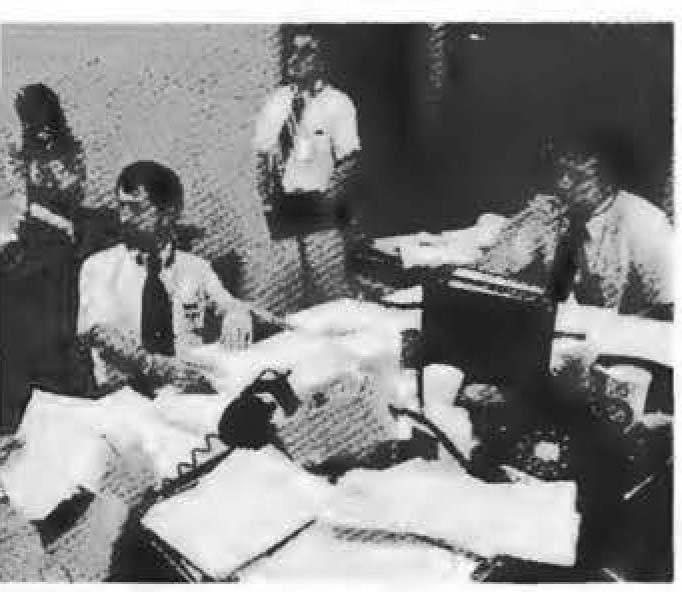
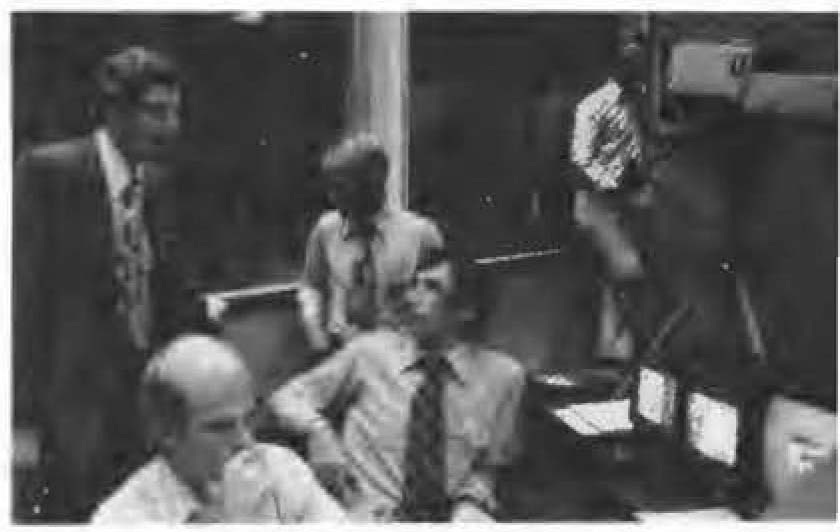
At 5:50 a.m.,* Glynn Lunney entered the second floor Mission Operations Control Room (MOCR), located in the Mission Control Center-Houston (MCC-H). All smiles, with just traces of sleepiness in his eyes, he spoke to several of the men who were already on duty at their flight consoles. As he fitted his headset, Lunney nodded a good morning to R Terry White, who for this shift was the “Voice of Apollo Control.” Alex Tatistcheff, Lunney’s interpreter, arrived at five past six, just as the Soviet launch complex was first shown on the television monitors and on the large eidophor picture screen in the MOCR. By 6:55 when the first televised public information release was transmitted from Moscow Mission Control Center (MCC-M), George Low and Chris Kraft had joined the growing number of people in the Houston control room.1
* Unless otherwise indicated, all times given are central daylight (CDT) or Soyuz ground elapsed time (SGET). For Moscow time add 8 hours to CDT; for Greenwich mean time (GMT) add 5 hours to CDT
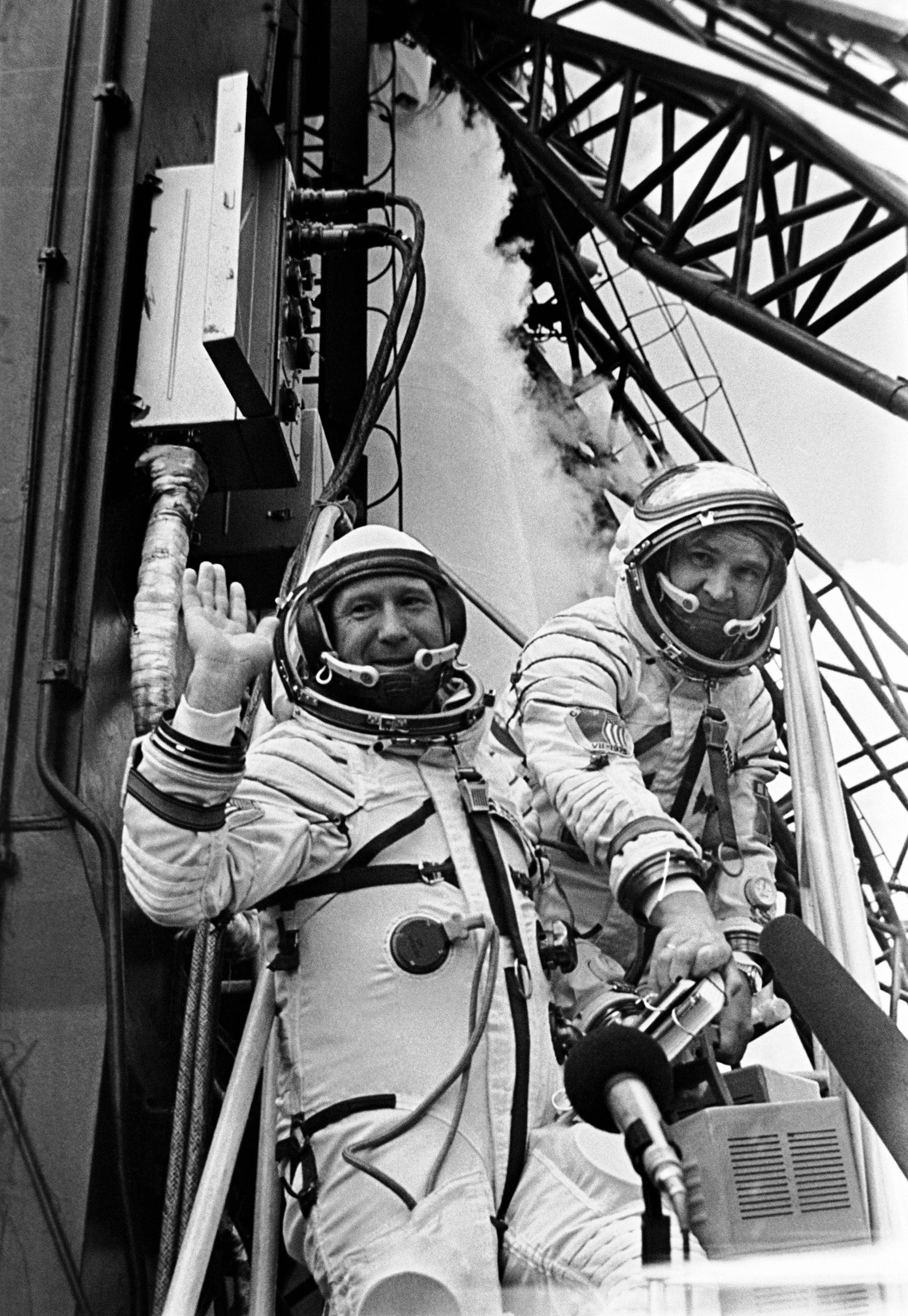
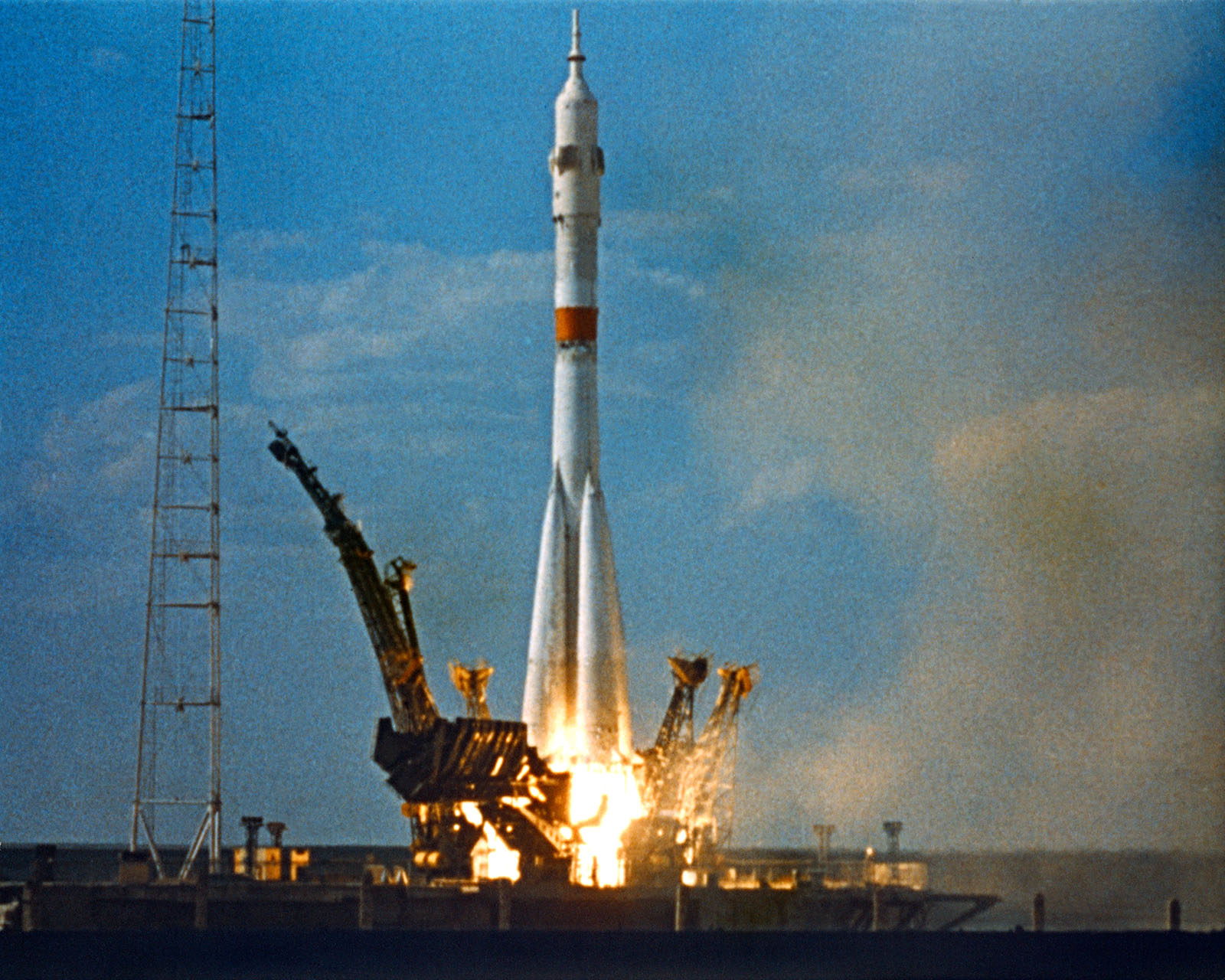
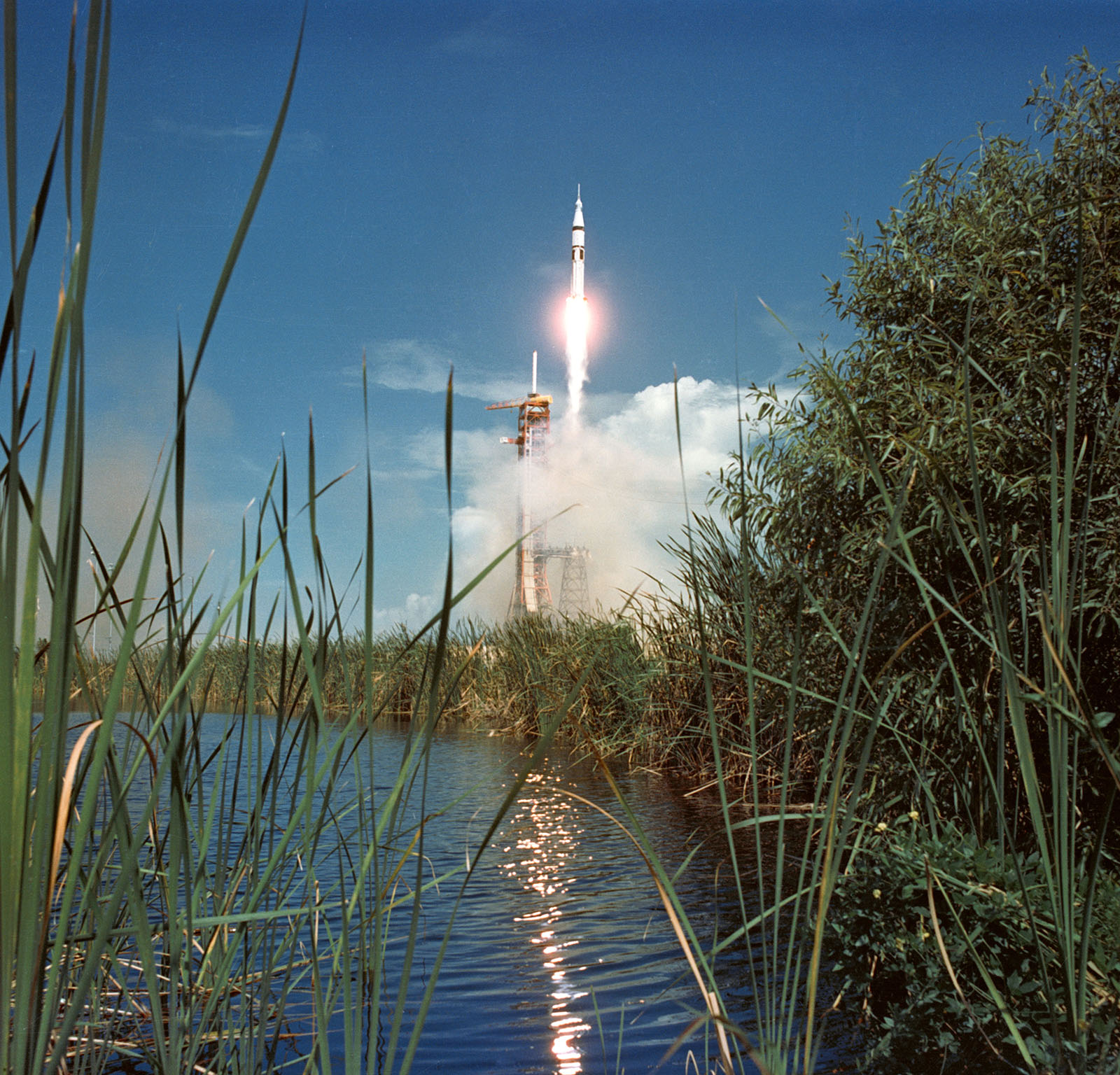
Reports from Baykonur indicated that the weather was perfect for the launch-clear skies, light winds, and hot July sunshine. With the crew on board and 45 minutes remaining until lift-off, the ground team removed the semicircular halves of the service structure. Soyuz 19 sat poised for the launch. In Houston, Ross Lavroff interpreted the commentary as it was broadcast from MCC-M in Kaliningrad:
This is the Soviet Mission Control Center. Moscow time is 15 hours, 15 minutes. Everything is ready at the Cosmodrome for the launch of the Soviet spacecraft Soyuz. Five minutes remaining for launch. Onboard systems are now under onboard control. The right control board ... opposite the commander’s couch is now turned on. The cosmonauts have strapped themselves in and reported that they are ready. They have lowered their face plates. The key for launch has been inserted.... The crew is ready for launch.2
Five minutes later, the fueling tower was removed, and the command was given for launch. “Ignition. The engines are powered up. The launch; the booster is off. Moscow time 15 hours, 20 minutes, 10 seconds. The flight is proceeding normally.” At 120 seconds into the flight, the strap-on booster units of the first stage were separated. Then at 160 seconds, the emergency abort system was jettisoned, followed by the separation of the launch shroud and the firing of the second-stage engines. Third-stage ignition took place at 270 seconds, orbital insertion at 530 seconds. The third stage was shut down, and the antennas and solar panels were extended. Kubasov asked the ground, “How do you read?” MCC-M responded that they heard them well. The initial orbital parameters were 220.8 by 185.07 kilometers, at the desired inclination of 51.80°, while the period of the first orbit was 88.6 minutes. There were smiles in Moscow and in Houston. 3
Max Faget, who was seated in the viewing room overlooking the MOCR, expressed the feeling of most of the American flight team. “It’s our turn to hit the ball. Now we’ve got to get into orbit.” Early evening at Baykonur was mid-afternoon in Moscow and early morning in Florida and Texas. While the American crew slept, Chet Lee, Launch Director Walt Kapryan, and Kennedy Space Center (KSC) Director Lee Scherer monitored the continuing preparation of SA-210. At the time of the Soyuz lift-off, liquid oxygen was flowing into the tanks of the Apollo launch vehicle at a fast fill rate of 4543 liters per minute. After the U.S.S.R. launch, Lee, Kapryan, and Scherer got a briefing on the predicted weather conditions for the afternoon-there were thunderstorms in the vicinity of the Cape, but they were not expected to affect the American lift-off. In Houston, Lunney called Professor Bushuyev to congratulate him on the success of the Soyuz launch and to advise him that the countdown was proceeding on schedule with the best weather forecast in months. Bushuyev reported in turn that the orbit of Soyuz was within 2 or 3 kilometers of the desired figures.4
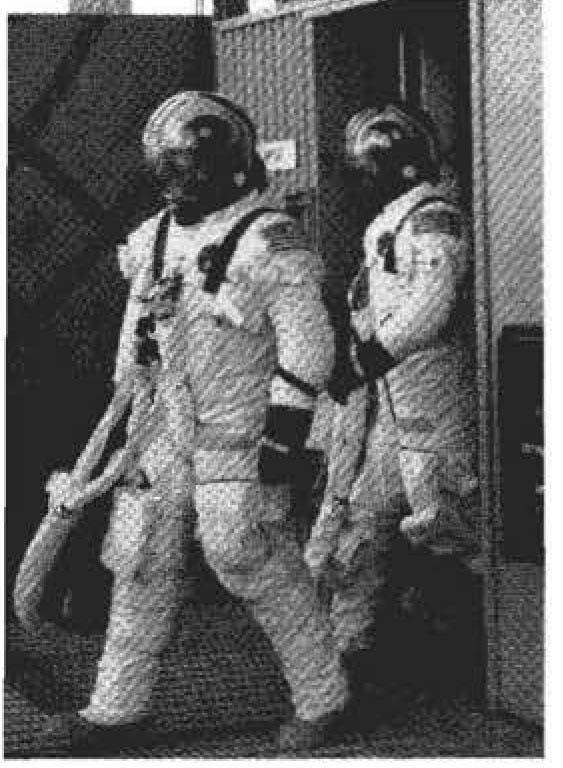
Stafford, Slayton, and Brand were awakened at 9:10. While they were having their final medical examination, the team that assists the crew at the launch site set out for the spacecraft. Following their visit with the doctors, the astronauts sat down to the traditional pre-flight breakfast of steak and scrambled eggs. As they ate, they watched a video replay of the Soyuz launch. Robert Crippen, the Backup Command Module Pilot, meanwhile began the final preparation of the command and service module (CSM) cockpit in anticipation of the crew’s arrival. Once they completed their breakfast, the three men went to the suit room in the Manned Spacecraft Operations Building and donned their space suits. At 11:37, accompanied by John Young, Chief of the Astronaut Office, they rode down the elevator and boarded their van for the 25-minute ride to the launch pad.5
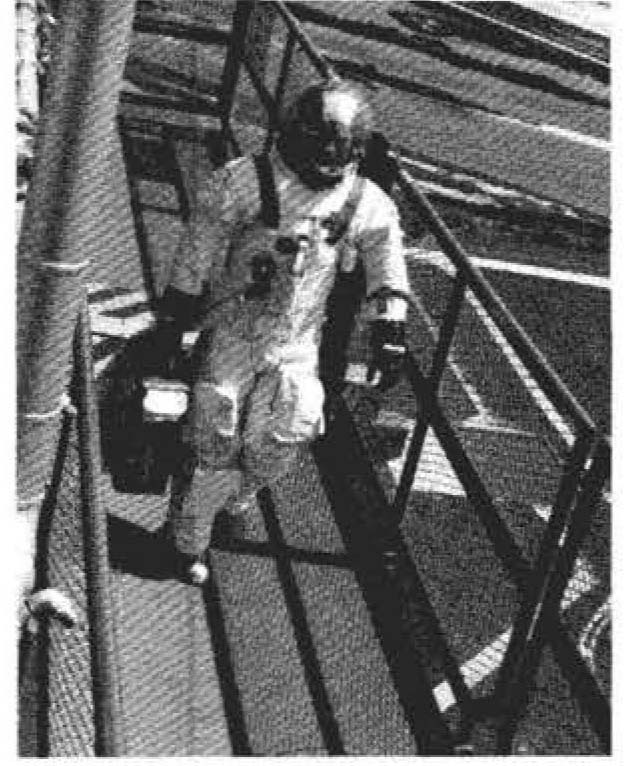
With the assistance of their suit technicians, the crew arrived at Pad 39B, where they made their way by elevator to the 100-meter level of the mobile launch tower. Once there, they crossed over swing arm number 9 and entered the White Room surrounding the spacecraft. Stafford was the first into the cockpit, where he moved into the left couch, assisted from the inside by Crippen, who also connected Stafford’s electrical, oxygen, and communications umbilicals. Slayton was next, and Crippen went through the same procedures after he was seated in the right-hand couch. Brand was last. When Crippen completed his check of Brand’s fittings, he removed the protective covering from the crewman’s helmet, as he had for the other two. At 12:02, Stafford called to the test conductor Clarence Chauvin, “Looks like it’s a good day to fly.”6
Crippen slid down under the center couch and crawled out the hatch above Brand’s head. After some additional checks, the CSM hatch was closed at approximately 12:22. As the first live launch pad color television pictures of the interior of the CSM were broadcast to the world, the crew began to run through the final checklist. Stafford asked Karol “Bo” Bobko, the Spacecraft Communicator (CapCom) at 1.10, “Are you giving us the countdown in English or Russian today?” Bobko responded, “Oh, I figured I’d give it in English.” In Moscow, the Soviet flight director was reminding Leonov and Kubasov that the Apollo lift-off was set for 10:50 Moscow time (2:50 CDT). At T minus 7 minutes, 52 seconds, the Apollo crewmembers finished their checkout of some 556 switches, 40 event indicators, and 71 lights on the console. Stafford told Bobko to tell Soyuz to get ready for them. “We’ll be up there shortly.”7
After the final minutes of waiting, at 2:49:50, the now famous count backwards from 10 began. “10, 9, 8, 7, 6, 5, 4, 3, 2, engine sequence start, 1, 0, launch.... We have liftoff. Moving out, clear the tower.” Above the roar of the first-stage engines, Stafford reported that the ride had been a little shaky at lift-off, but now it was “smooth as silk.” Fifty seconds into the flight, the acceleration force equaled 2 gs, twice the gravitational force normally experienced on earth. At 124 seconds, the crewmen were experiencing 4 gs as they dropped off the first stage and continued their journey under the power of the S-IVB stage. Fifty-two seconds later, they jettisoned the launch escape tower, and Stafford remarked, “Tower jett. There she goes! ... Adios. ... At 4:40, back to one g acceleration and looking good.”
- Dick Truly, CapCom:
- Apollo, Houston. At 5 minutes you’re GO.
- Stafford:
- Roger. 5 minutes. Looks good onboard, Dick. And we’ve got a beautiful sight.
- Truly:
- Roger. Wish I could see it.
- Stafford:
- Roger.
- Slayton:
- Man, I tell you, this is worth waiting 16 years for.
- Brand:
- Got a beautiful ocean out ... here, Dick.
- Truly:
- Roger, I believe all that.
- Stafford:
- Okay, at 5:30, onboard trajectory looks beautiful.
- Truly:
- Roger. Concur, Tom. You’re right on the money.8
On the ground, Ed Smith and R. H. Dietz with grins on their faces echoed the same thoughts when they said, “We’ve got a ball game!” The rendezvous chase was on. Apollo had achieved orbital insertion at 2:59:55.5 central daylight time. Brand exclaimed, “Miy nakhoditsya na orbite!”*
* “We are in orbit!”
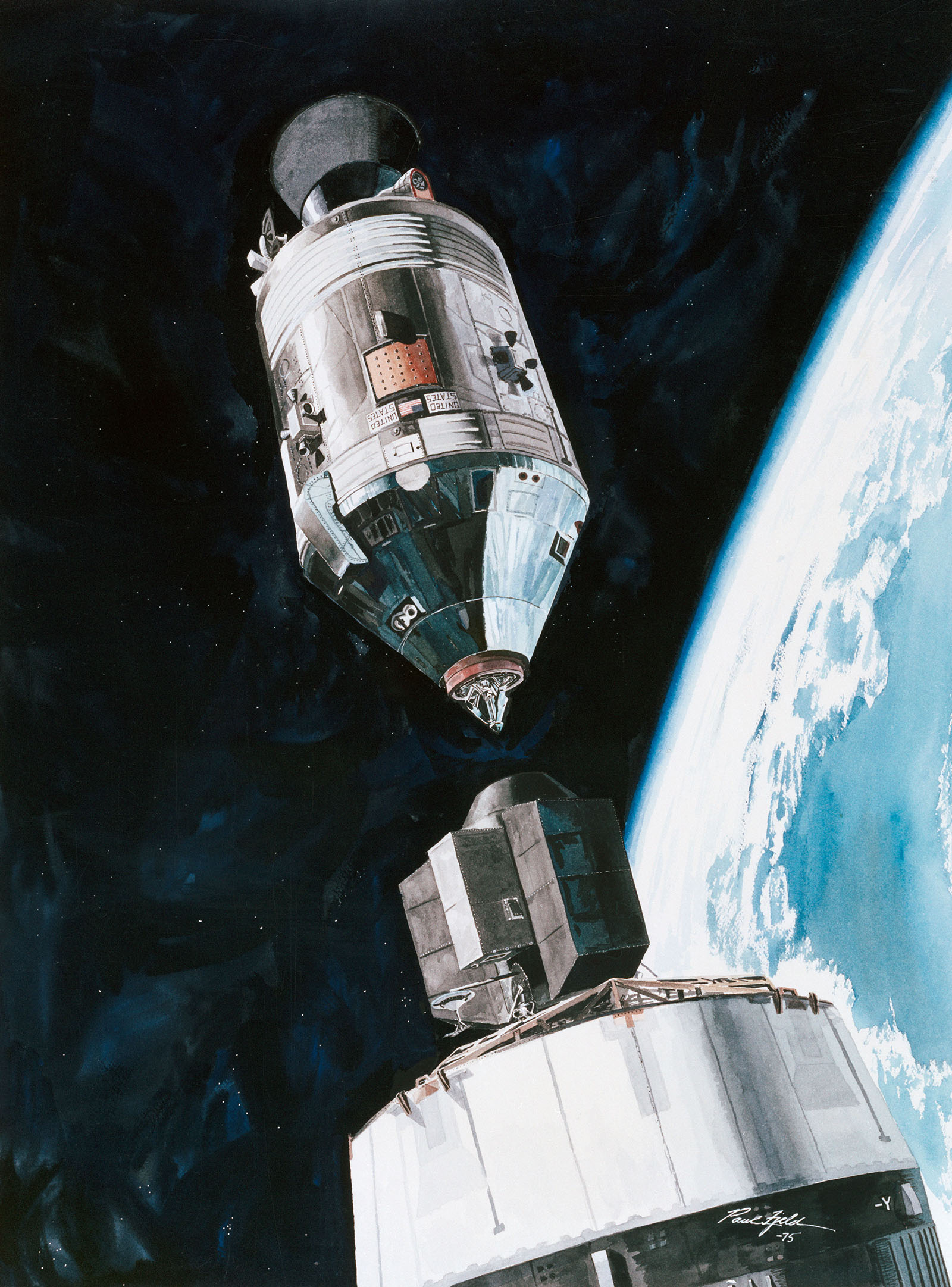
Stafford notified Houston at 3:55 p.m. that the crew was preparing to execute the transposition, docking, and extraction maneuver in 2 minutes. As a preliminary to removing the docking module (DM) from the spacecraft lunar module adapter (SLA) truss assembly, the CSM was separated from the S-IVB stage, and as the CSM moved away from the adapter section, the panels of the SLA were explosively jettisoned. In bringing the spacecraft about to face the docking module, the crew encountered its first minor problem of the flight. When Stafford looked through his alignment sight (COAS) at the Saturn IVB and docking module, the attitude was such that all he could see was the glare from the sunlit earth. At first he thought that the light illuminating the cross hairs in his sight had burned out. But when he put his hand in front of the COAS, Stafford reported that he could see the green reticle. Swearing under his breath, he knew that he would just have to wait until the two craft were positioned differently. Stafford moved the CSM toward the S-IVB and docking module until about only 10 meters separated them. Watching the stand-off cross on the docking module truss in the S-IVB stage, the Apollo crew assumed a stationkeeping status. Slowly the target vehicle appeared to move toward the earth’s horizon. Stafford squinted and leaned his head to one side so he could see the reticle. “Finally when I got it in line,” he later recounted, “I could just tell my general attitude and moved in.” Despite the problems, Stafford’s docking was perfect. He had aligned the two spacecraft to within a hundredth of a degree, the best alignment ever achieved with the Apollo docking system. By the time he had lined up his target, Apollo had passed out of radio contact with the ground.9
When Apollo re-established communications over Rosman, North Carolina, Stafford told Truly that they had achieved a real hard docking with the DM; all hatches were locked. The commander was happy to have this first docking completed. He later recalled that given the past problems with the Apollo probe and drogue, he had really been “sweating out” this exercise. Once it was over, he looked forward to meeting Soyuz. The new docking mechanism was a pilot’s dream, and he knew that he could fly it in for a smooth docking.10
During a subsequent S-minute pass over the tracking ship USNS Vanguard, the crewmembers advised Houston that they had completed the extraction of the docking module. The spacecraft, configured as it would be for the meeting with the Soviet craft, was now in an orbit 173.3 by 154.7 kilometers with an orbital period of 87 minutes, 39 seconds, and an orbital velocity of 7820 meters per second. Additional maneuvers would bring Apollo and Soyuz into the proper orbital relationship for rendezvous. Apollo’s orbit was circularized at 167.4 by 164.7 kilometers at 6:35. From this orbit, the first Apollo phasing maneuver was executed at 8:28 to provide the proper catch-up rate, so that docking with Soyuz could occur on the 36th Soviet revolution. This 20.5-meter-per-second change placed Apollo in a 233- by 169-kilometer path. The next phase and plane correction maneuver of 2.7 meters per second was scheduled for the l6th revolution.11
In the midst of this precision flying, there were some lighter moments. At 6:10, Brand asked Truly to tell the launch crew at the Cape that they permitted a stowaway to board the spacecraft. “We found a super Florida mosquito flying around here a few minutes ago.” Slayton said that he planned to feed it to the fish that they were carrying onboard if he could catch it, and Brand wanted to bring it back and give it astronaut wings.* These transmissions were conducted through the ATS 6 satellite. While that particular communications satellite had been an unknown quantity throughout much of the mission planning, it was working very satisfactorily.
* After flying about for several hours, the mosquito was never seen again. Apparently, it died in the reduced pressure pure oxygen of the CSM.
Placed in a geosynchronous orbit at 42 596 kilometers on 30 May 1974, ATS 6 had remained at a fixed point over the Galapagos Islands, permitting educational television transmissions to remote areas at relatively low costs. Following transmission experiments to Appalachia, the Rocky Mountains, and Alaska, the satellite on command from the ground moved to a new position over Africa, where it was to be used for a year-long educational experiment in India. It reached its present location, 35° east longitude on the equator, on 2 July, in time for the ASTP team to borrow its communications channels for the joint flight. Broadcasting through the spacecraft tracking and data network station at Buitrago, Spain, the Apollo crew and the team in Houston were able to talk and transmit data for 55 minutes of each 87-minute revolution. This three-fold increase in communications, impossible without ATS 6, made all the hard work and worry about its success worthwhile.12
Later in the evening, after a cabin overheating problem had been solved, Brand asked Karol Bobko, who had relieved Truly as CapCom, about the status of Soyuz. Bobo reported that Leonov and Kubasov were asleep and that to this point in the flight their only problem was a television camera that refused to work. He told Vance that they had tried without success to repair it but they planned to work on it some more after their sleep period. Apollo meal time arrived at 10:06, and Slayton coined a new space phrase for eating when he indicated to Houston that he and his crewmates were in the “food intake mode.”13
15 July 1975 Baykonur, U.S.S.R.
Kennedy Space Center, U.S.
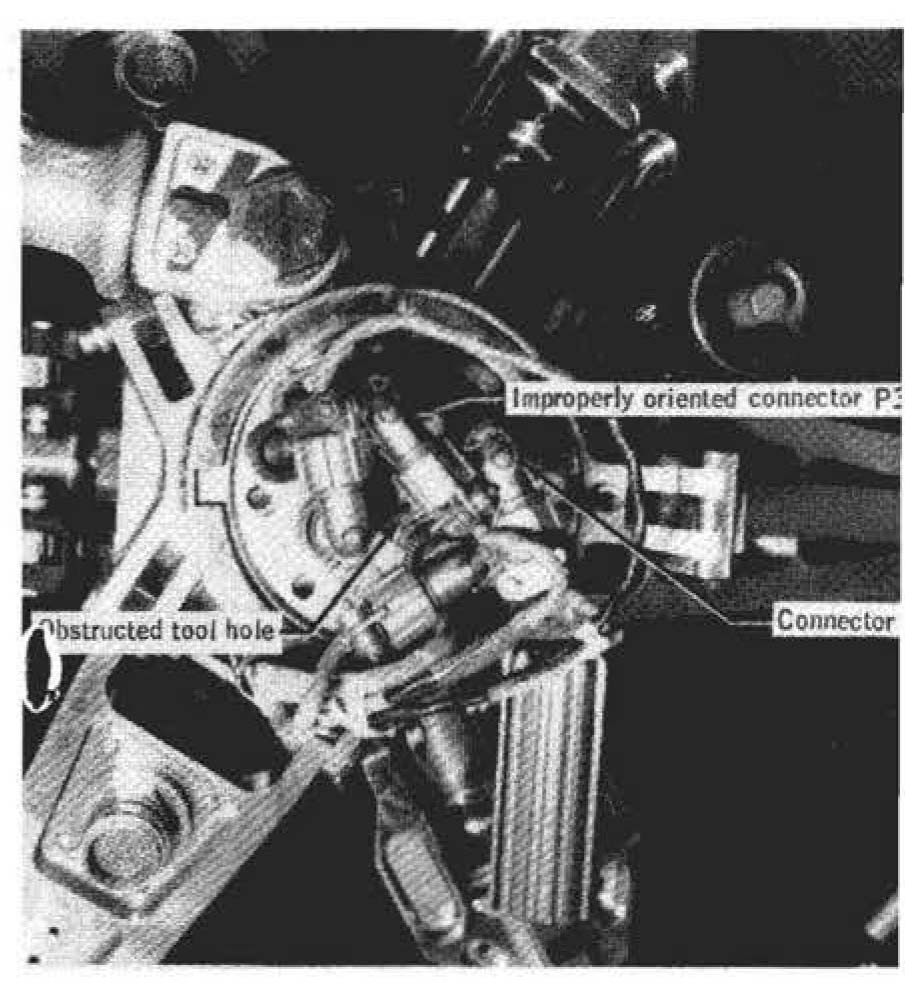
A problem later that night, however, caused some concern both on the ground and in the spacecraft. Bobko had wished the crew good night in Russian, and they were supposed to be bedding down for a rest period, when at 22 minutes past midnight Stafford called to the ground. Brand had attempted to remove the probe assembly from the tunnel between the CSM and the DM so that he could open the hatch and store overnight a freezer* in the passageway, but he found that he could not insert the tool that unlocked and collapsed the probe. Brand went on to explain the difficulty:
- Brand:
- Okay, Bo. Everything in the probe removal checklist on the cue card ... has been going great up through step 11. Step 12 is “Capture latch release, tool 7.” You insert it in the pyro cover. You turn it 180 degrees clockwise to release the capture latches. Well, here’s where the problem is, and let me explain it to you.... do you have somebody there that knows the probe that can listen?
- Bobko:
- Roger. Go ahead.
- Brand:
- Okay, as I look in the back of the ... pyro cover, I’m looking with my flashlight through the hole where I insert this tool, and there’s something behind the pyro cover that’s preventing me from putting this tool all the way in.... it’s actually one of the pyro connectors.... this tool has to go down through the pyro cover in between ... some pyro con-nectors. But one of these pyro connectors has rotated such that it’s in the way....14
* The cryogenic freezer for the electrophoresis experiment was cooled by liquid nitrogen. Since it released nitrogen into the cabin, the flight plan called for it to be stored in the DM-CSM tunnel overnight.
Neil B. Hutchinson, flight director at the time the probe problem was discovered, later told press representatives that the ground team and the crew had discussed the difficulty for about 18 minutes. Their first decision had been to forget transferring the freezer into the tunnel and just have the crew close the hatch and go to sleep. But when Brand tried to close the hatch, he discovered that the partially removed probe assembly prevented him from doing so. Since the three men were already past their sleep time and the open hatch did not pose a hazard, the two teams-ground and space-agreed to postpone any further work on the probe until morning. As a precaution, the crew raised by a very slight amount the cabin pressure, which provided additional oxygen to compensate for the nitrogen that was boiling off the freezer. The crew went to sleep, and Hutchinson went to a 3:15 a.m. news briefing.15
In his explanation, the flight director indicated that the problem was not serious, just an annoyance. In the morning, the crew would have to run back through the 11 steps to re-engage the probe in its fully locked position. Then one of the men would have to remove the pyro cover, straighten out the misaligned pyro cap, go through the 11 disassembly steps, and on the 12th insert the key and unlock the capture latches. Afterwards the removal of the probe would follow according to the original plan. When asked if this was the same type of problem encountered in Apollo 14, Hutchinson answered that although this was the same probe assembly as that used in Apollo 14, the difficulty was an entirely different one.16 Everyone had to wait until morning to determine if the solution would be as simple as anticipated.
16 JULY-CHASE
While the Apollo crew slept, Leonov and Kubasov were awakened in the early morning hours of the 16th and were advised by Moscow control of the Apollo probe difficulty. The American ground team was still refining its solution to the problem. Besides exchanging greetings with the Soviet crew aboard Salvut 4 through the Moscow center, the ASTP cosmonauts continued to attempt repairs on their troublesome black and white television system. Following instructions from the ground, the Soyuz crew went as far as to attempt a repair involving cutting away some of the lining of the spacecraft so they could gain access to a television wiring junction box. This unorthodox in-flight repair procedure failed, and the black and white system never did work. This failure upset some Americans, notably Bob Shafer, because this system’s absence meant that there would be no pictures of Apollo during the flight. While some of the NASA team groused about this turn of events, the Soyuz crewmembers prepared for the circularization manuever that would bring their spacecraft into a 225- by 225-kilometer orbit.17 As they were executing that maneuver, the Apollo crew was awakened to the rock sounds of Chicago’s “Good Morning Sunshine.”
Medical reports and breakfast filled the first minutes of the Apollo crew’s morning activities. With the exception of some minor frustrations like the slow functioning urine dump system and some spilled strawberry juice, everything was proceeding satisfactorily. CapCom Crippen advised the crew that Soyuz had completed its circularization maneuver and was “in orbit waiting for you.” Truly replaced Crippen and gave Brand the latest information on how to remove the probe. As they were disassembling the back end of the probe, Stafford commented, “Dick, it wouldn’t be a normal flight if we didn’t have our little probe problems.”18
Stafford came back on the air-to-ground communications loop at 9:55 a.m. to tell Houston that the probe was out. With that “glitch” solved, the crewmembers could return their attention to the flight plan. Preparation for televising pictures from the cabin and checking out the docking module were the next activities on the list. As they worked through their schedule, the Soviet crewmembers were transmitting their first television pictures with their color camera. Talking to the Soviet flight director, V. A. Dzanibekov, Leonov gave the folks at home a commentary on their first 28 hours in space and then conversed with Klimuk and Sevastyanov, who had been aboard the space station Salyut since 24 May. Sevastyanov commented that the ASTP crews had a very responsible task and that a large portion of the world’s population was watching and listening to their progress. Referring to the seven men now in space, two aboard Salyut and the five involved in ASTP, Klimuk said, “these are the magnificent seven.” With pleasantries concluded, the Soviet crews returned to their respective duties. Leonov and Kubasov began lowering the pressure of their ship to 500 mm of Hg in preparation for the docking.19
Aboard Apollo, Stafford, Slayton, and Brand were settling into the routine of flight. Their day was filled with independent experiments (electrophoresis, helium glow, and earth observation)* and collecting biomedical data. During the earth observation pass, Stafford told Bobko to inform Farouk El-Baz, the principal investigator for that experiment, that at ASTP altitude one could see far more detail than in Project Gemini, where Stafford and Cernan had flown at a higher altitude (+60 kilometers). The ground reported to the crew that the medical information received from the exercise period was very good. To round out its other activities, the crew made another course change at 3:18 p.m. In anticipation of their big day on the 17th, the Apollo team bedded down a few minutes after eight, and the Soviet crew had been resting since about 2:50 that afternoon. Throughout their “night,” the spacecraft were coming closer together as Apollo closed the gap between them by about 255 kilometers per revolution.20
* Details concerning the experiments are summarized in appendix E.
17 JULY-RENDEZVOUS
Roused at 3:07 a.m. by an alarm and warning signal from the guidance system, the crewmembers decided to stay awake after determining that the warning was a false alarm. That morning Slayton observed a grass fire in Africa, and Stafford saw a forest fire atop a mountain in the U.S.S.R Slayton commented that things looked just the same as in an airplane at 12 000 meters. At 7:56, 5 minutes after completing another maneuver to bring the craft into better attitude for rendezvous, the Apollo crew attempted radio contact with Soyuz. Brand reported at 8:00 that he had sighted Soyuz in his sextant. “He’s just a speck right now.”21
Voice contact between the two ships was established 5 minutes later. Speaking in Russian, Slayton called, “Soyuz, Apollo. How do you read me?” Kubasov answered in English, “Very well. Hello everybody.”
- Slayton:
- Hello, Valeriy. How are you. Good day, Valeriy.
- Kubasov:
- How are you? Good day.
- Slayton:
- Excellent.... I’m very happy. Good morning.
- Leonov:
- Apollo, Soyuz. How do you read me?
- Slayton:
- Alexey, I hear you excellently. How do you read me?
- Leonov:
- I read you loud and clear.
- Slayton:
- Good.22
Thirty-two minutes later at Slayton’s signal, Kubasov turned on the range tone transfer assembly to establish ranging between the ships. The gap had been reduced to 222 kilometers. At 9:12, Apollo had changed its path again when the crew executed a coelliptic maneuver that sent the craft into a 210-by 209-kilometer orbit. Apollo was spiraling outward relative to the earth to overtake the Soviet ship.
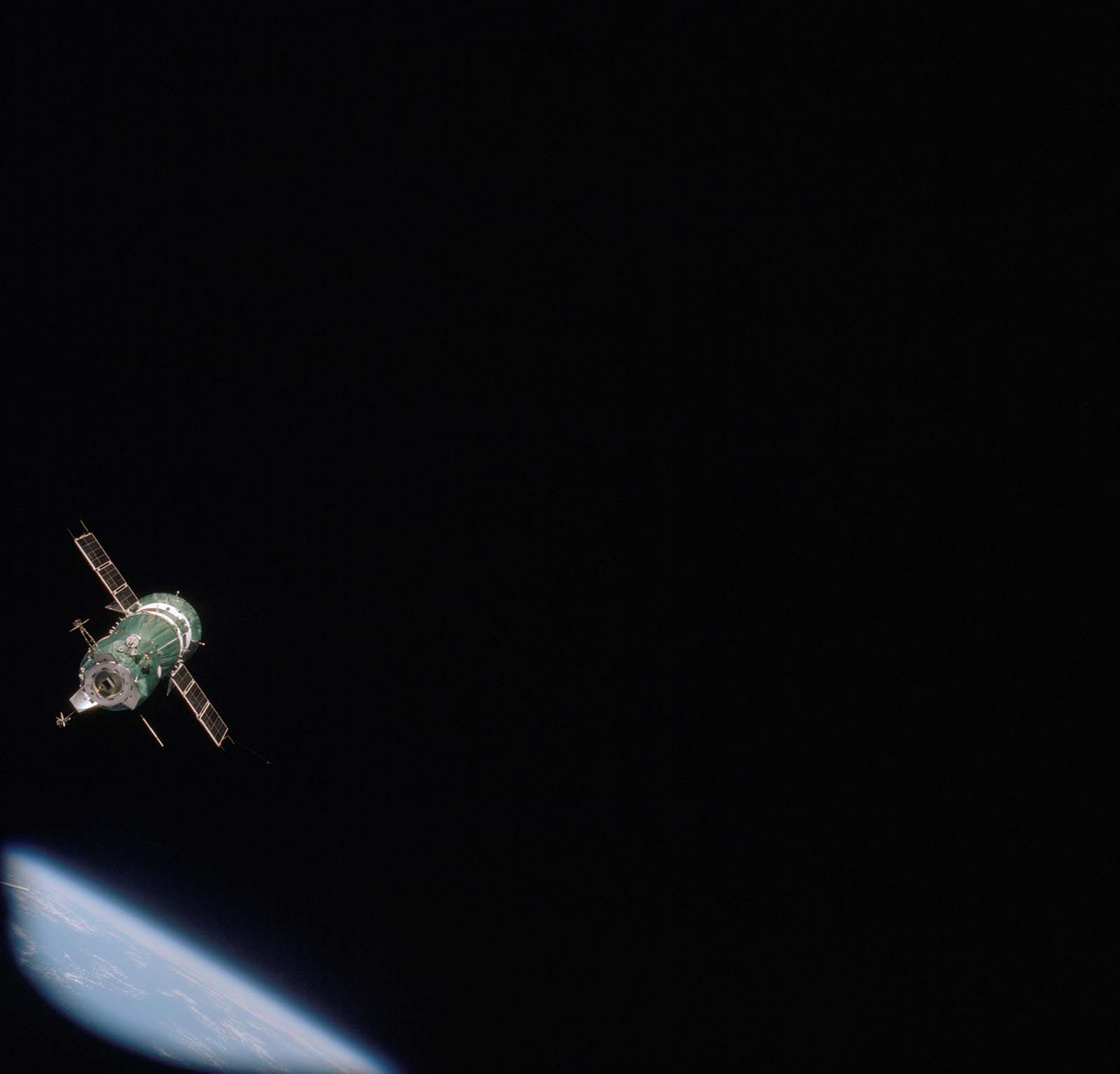
A 0.9-second terminal phase engine burn at 10:17 brought Apollo within 35 kilometers, and the crew began to slow the spacecraft as it continued on the circular orbit that would intersect that of the Soyuz. CapCom Truly advised Stafford at 10:46, “I’ve got two messages for you: Moscow is go for docking; Houston is go for docking, it’s up to you guys. Have fun.” Immediately, Stafford called out to Leonov, “Half a mile, Alexey.” Leonov replied. “Roger, 800 meters.”23 In accordance with the flight plan, the Soyuz crew had moved back into the descent vehicle and closed the hatch between them and the orbital module. Inside Apollo, the men had closed the CSM and DM hatches preparatory to docking. At a command from Stafford, Leonov performed a 60° roll maneuver to give Soyuz the proper orientation relative to Apollo for the final approach. On the television monitors in Houston and Moscow, Soyuz was seen as a brilliant green against the deep black of space as the onboard camera recorded the final approach.
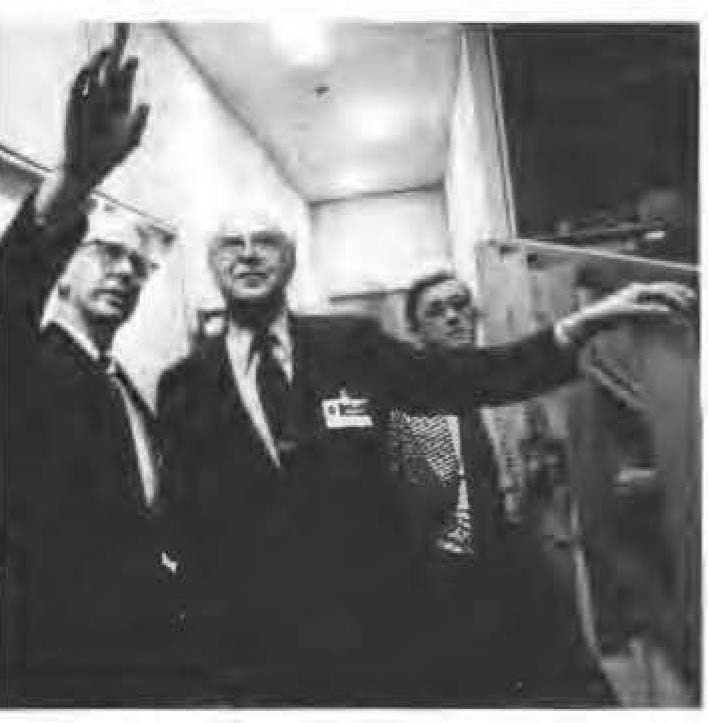
Visitors had begun to gather in the MOCR viewing room about 2 hours before the docking. Among the early arrivals were General Samuel C Phillips, former Apollo Program Director; Astronauts Scott, Allen, Garriott, McCandless, Musgrave, and Schweickart; and Captain Jacques Cousteau. Just before 10:00, Dr. and Mrs. Fletcher, accompanied by John Young, escorted Ambassador Anatoliy Fedorovich Dobrynin and his wife into the viewing room. Other guests included Elmer S. Groo, Associate Administrator for Center Operations, and his wife; the Gilruths; D. C. Cheatham; D. C. Wade; and C. C. Johnson. As Apollo silently closed the remaining gap, the MOCR and viewing area grew quiet. Only the air-to-air and air-to-ground transmissions broke the spell.
Leonov called out as the two ships came together. “Tom, please don’t forget about your engine.” This reference to the -X thrusters made Stafford and many of those on the ground who knew the story chuckle (see chap. IX). Stafford called out the range, “less than five meters distance. Three meters. One meter. Contact.” The hydraulic attenuators absorbed the force of the impact, and Leonov called out, “We have capture,... okay, Soyuz and Apollo are shaking hands now.” It was 11:10 in Houston. Stafford retracted the guide ring, actuated the structural latches, and compressed the seals. In Russian he said, “Tell Professor Bushuyev it was a soft docking. “Well done, Tom,” congratulated Leonov, “It was a good show. We’re looking forward now to shaking hands with you on ... board Soyuz.”24
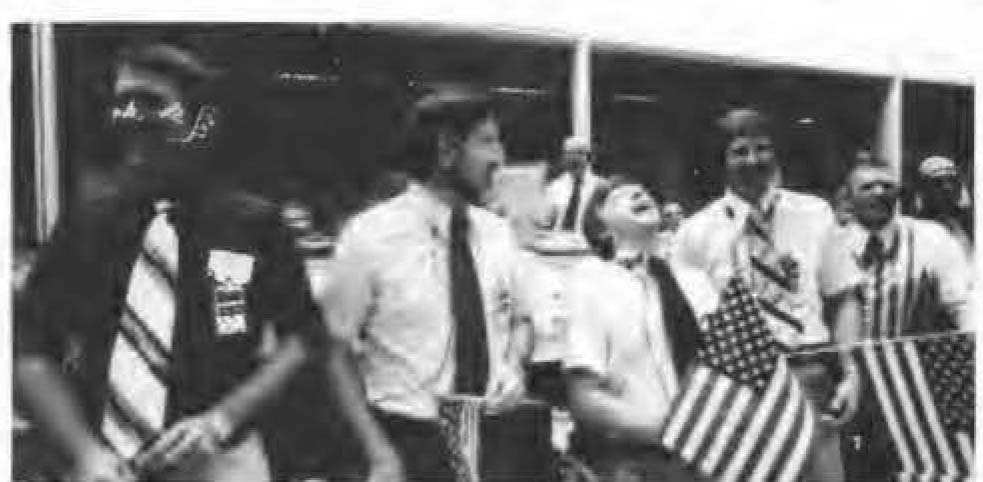
The chase of Soyuz by Apollo had ended in a flawless docking. Stafford later recalled, “Later that night, we checked the alignment and noticed that the center of the COAS was sitting right on the center of a bolt that held the center of the target in for Soyuz.” That is dead center. A feeling of relief and exultation swept the control center in Houston. Lunney with a cigar in hand called Professor Bushuyev. Watching each other on their television monitors, the Technical Directors smiled as they exchanged congratulations, while both crews went through pressure integrity checks on their craft. When Slayton opened the hatch into the docking module, he caught the strong scent of burned glue. This news dampened spirits on the ground for a short time. As a precaution, Vance Brand donned his oxygen mask, and Stafford advised Leonov: “Soyuz, this is Apollo. Now we have ... a little problem. I think we have somewhat of a bad atmosphere here. I think soon that we will no longer have any problems.”25 While his Russian might not have won any prizes, the Soviet commander got Stafford’s message. Once the odor dissipated and the ground crews decided that they could not discover any danger in this unexpected development, the crews continued the procedures leading to the opening of the hatches between the spacecraft.
Prior to that first handshake in space, Viktor Balashov, a noted Soviet television announcer, read a message from Leonid Ilyich Brezhnev over the air-to-ground link:
To the cosmonauts Alexey Leonov, Valeriy Kubasov, Thomas Stafford, Vance Brand, Donald Slayton. Speaking on behalf of the Soviet people, and for myself, I congratulate you on this memorable event.... The whole world is watching with rapt attention and admiration your joint activities in fulfillment of the complicated program of scientific experiments. The successful docking had confirmed the correctness of the technical decisions developed and realized by means of cooperative friendship between the Soviet and American scientists, designers and cosmonauts. One can say that the Soyuz Apollo is a forerunner of future international orbital stations.
Brezhnev’s remarks continued, noting that “the detente and positive changes in the Soviet-American relations have made possible the first international spaceflight.” He saw new possibilities for cooperation in the future and gave his best wishes to the crews.26
Stafford and Slayton meanwhile had entered the docking module and closed behind them the hatch (no. 2) leading to the CSM. They raised the pressure from 255 to 490 millimeters by adding nitrogen to the previously 78 percent oxygen atmosphere. In Soyuz, the crew had reduced the cabin pressure to 500 millimeters before the docking. The pressure in the tunnel between the docking module hatch (no. 3) and the Soyuz hatch (no. 4) had been raised from zero to equal that of the docking module. Leonov and Kubasov were the first to open the hatch leading to the international greeting. During the transfer that was to follow, the pressure in the DM and Soyuz would be the same-510 millimeters.
Then at 2:17:26 p.m. on the 17th of July, Stafford opened hatch number no. 3, which led into the Soyuz orbital module. With applause from the control centers in the background, Stafford looked into the Soviet craft and, seeing all their umbilicals and communications cables floating about, said, “Looks like they[’ve] got a few snakes in there, too.” Then he called out, “Alexey. Our viewers are here. Come over here, please.” High above the French city of Metz, the two commanders shook hands.* Their dialogue was broken-part personal, part technical. They appeared to accept their amazing technical accomplishment with the same nonchalance that had characterized their practice sessions in the ground simulators. There were no grand speeches, just a friendly greeting from men who seemed to have done this every day of their lives. In the background was a handlettered sign in English-“Welcome aboard Soyuz.”27
*5°47'37" E and 49° 10'12" N.
When they talked later with President Ford, however, the crews appeared somewhat less at ease. Ford had watched the Soyuz launch two days earlier in the State Department auditorium with Ambassador Dobrynin and Administrator Fletcher, while Mrs. Dobrynin interpreted for them. Keenly interested in the ASTP flight, Ford had wanted an opportunity to speak with the crews. Dennis Williams, the information officer attached to the International Affairs Office at NASA, had drafted a series of possible questions for the White House that could be asked of each crewman. Neither Williams nor the mission control team in Houston expected Ford to use all the questions, but that is exactly what he did. The crew, who had been advised the night before of the conversation, were taken by surprise when the President, watching the men on a television monitor in the Oval Office, talked for 9 minutes instead of the scheduled 5. He asked a barrage of questions that sent the crews scrambling to trade off their three flight helmets to they could respond to him. But despite the confusion, Ford and the five space men seemed to enjoy the chat. Ford began:
Gentlemen, let me call you to express my very great admiration for your hard work, your total dedication in preparing for this first joint flight. All of us here in ... the United States send to you our very warmest congratulations for your successful rendezvous and for your docking and we wish you the very best for a successful completion of the remainder of your mission.
Stressing the same themes of cooperation as had Brezhnev, Ford pointed out that it had “taken us many years to open this door to useful cooperation in space between our two countries.” When he asked Stafford whether he thought the new docking system would be suitable for use in future international manned space flights, the Apollo commander responded, “Yes, sir, Mr. President, I sure do. Out of the three docking systems I’ve used, this was the smoothest one so far. It worked beautifully.” Ford spoke in turn to Leonov, Slayton, Brand, and Kubasov. The President asked Slayton, “as the world’s oldest space rookie, do you have any advice for young people who hope to fly on future space missions?” Slayton responded that the best advice he could give was “decide what you want to do and then ... never give up until you’ve done it.” To Ford’s question about space food, Kubasov noted that the meals were different than the one the crews had shared with the President, especially since there was neither seafood nor beer available during the flight. In signing off, the President wished the men a “soft landing.”28
Next Stafford, Slayton, Leonov, and Kubasov made a symbolic exchange of gifts, while Brand remained in the command module monitoring the American craft and waiting for his turn to visit Soyuz. Stafford speaking first, said:
Alexey, Valeriy. Permit me, in the name of my government and the American people, to present you with 5 flags for your government and the people of the Soviet Union. May our joint work in space serve for the benefit of all countries and peoples on the Earth.29
Leonov thanked Stafford for “these very valuable presents” and in return gave Soviet flags to the Americans. During succeeding transfers, other symbolic items would be exchanged. Apollo would return a United Nations flag launched in Soyuz, and the two crews would sign the Fédération Aeronautique Internationale certificates for the official record books.30
The four men settled down to their first joint space banquet. On the ground, too, some people went in search of a snack. John Young escorted the Fletchers, the Dobrynins, and the Groos to a third floor snack bar in the Houston control center. Over ice cream bars and coffee, they discussed the events of the day. The Ambassador asked Fletcher why the ships had docked a little early, and the NASA Administrator indicated that they were so well lined up that there was no reason not to complete the docking. Fletcher told Dobrynin that the crews had not known until late the preceding night that they would be speaking directly with Mr. Ford. After a few good-hearted comments about the President’s tendency toward long-windedness, the Americans bid farewell to the Dobrynins, who left for Washington.
Glynn Lunney and Chet Lee met with representatives from the press late on the afternoon of the 17th to comment on the status of the meeting in space. Lunney said that those who had seen him in similar “change of shift briefings” in the past had seen a busy flight director with a dozen or so pages of notes. On this particular day, he had not taken many notes; he had mainly sat in the control center “watching the Flight Directors and the rest of the team work.” He continued:
I would like to say that I’ve enjoyed today one hell of a lot. I have talked a number of times to the man on the other side of the ocean, Professor Konstantin Bushuyev, who’s my counterpart and Director of the ASTP program for the Soviet Union and I could tell from the sound of his voice that he’s enjoying the day as much as I am....31
With his characteristic good humor, Lunney fielded a number of questions from the media representatives-the glue smell had not posed a problem; the crews had not talked much during their meal because “their mothers told them not to”; and there had been a scramble for headsets because no one had anticipated the President’s desire to ask questions of all five men. Technically, diplomatically, and socially, the 17th had been a good day.
Stafford and Slayton said good-bye to Leonov and Kubasov at 5:47 and floated back through the tunnel into the docking module. Stafford returned to the command module, while Slayton closed the DM hatch. In Soyuz, the Soviets were securing their hatch, also. During the ensuing pressure integrity check, a possible leak through hatch nos. 3 or 4 was detected by the Soyuz monitoring equipment. This apparent flow of gas between the two hatches, while not serious, caused the crews to get to sleep a little later than planned. Finally, by 7:36, the Apollo crewmen had bid the ground good night and were beginning to settle down.32
18 JULY-TRANSFERS
Awakened by “Midnight in Moscow,” the Americans began their fourth work day in orbit at 2:00 a.m. Houston time. While the crews had slept, the two ground teams-in Houston led by Walt Guy and V. K. Novikov-had been watching the pressure levels of both ships and had conferred about the leak between the hatches. They had concluded that after the two hatches were closed and the pressure had been reduced to 260 millimeters the gases trapped between them heated up. The pressure sensing devices could not distinguish between the expanding gases and a leak. Neil Hutchinson commented on working with Soviet Flight Director Vadim Kravets, whom he had never met:
the hatch integrity check... involved me getting on the loop and talking to my counterpart who happened to be Kravets ... the answers were all forthcoming in a timely fashion and very professionally done.... I think the one thing, as I sit back and look at it now that makes me wonder; I wish there was another one of these flights. We’ve gone to all this trouble to learn how to work with those people. It’s like going to the moon once and never going back. 90 per cent of the battle is over with ... getting all the firsts done.... I could run another Apollo Soyuz or another joint anything with a heck of a lot less fuss than it took to get this one going.33
Though some of the worry in both Houston and Moscow had been in vain, the two teams had confirmed that they could work together in analyzing an unforeseen problem.
With breakfast behind them and their early morning activities completed, Kubasov and Brand conducted a broadcast session “your Soviet/American TV center in space,” as Kubasov called it. In giving his tour of Soyuz, the Soviet flight engineer pointed out what various instruments were for and televised a picture of Brand in “the kitchen” (the food preparation station) warming up lunch. Stafford reciprocated by giving Leonov and the Soviet viewers a Russian language tour of the command module. Despite some problems with communications to the ground, the space television production was just one more unique aspect of the joint mission. Appearing casually simple from the perspective of the home viewer, these broadcasts had required hours of negotiation and planning, just as all other aspects of the flight had. Soviet viewers were particularly enthralled by the live coverage of the mission, but many Americans seemed to accept shows from 225 kilometers up as commonplace.34
Kubasov later gave an English language travelogue as the two craft passed over the U.S.S.R. “Dear American TV people,” he began. “It would be wrong to ask which country’s more beautiful. It would be right to say there is nothing more beautiful than our blue planet.” After explaining that he would be giving a description of “what flows below the spacecraft,” Kubasov continued:
Our spacecraft, Soyuz, is approaching the USSR territory. Our country occupies one-sixth of the Earth’s surface. Its population is over 250 million people. It consists of 15 Union Republics. The biggest is the Russian Federal Republic with the population of 135 million people.... At the moment we are flying over the place where Volgograd city is. It was called Stalingrad before. In winter 1942-43, German fascist troops were defeated by the Soviet Army here. ...
With the television camera still trained out the port of the orbital module, Leonov continued to describe the panorama. In the command module with Stafford and Slayton, the Soviet commander spoke of the Ural Mountains, and he pointed out the area below in Kazakhstan from which they had been launched three days before. Toward the end of the 10-minute commentary, Brand added some remarks about the countryside he could see from his vantage point and concluded, “as you can tell, Soviets very much remember the war 30 years ago. Fortunately, we’ve come a long way since then....* 35
Fifteen minutes later at about 8:20, Brand and Kubasov began filming some science demonstrations that could later be used in science classrooms back on earth to demonstrate the effects of zero gravity on various items. Originally proposed by Marshall Space Flight Center, Kubasov became very enthusiastic about the idea of such demonstrations, which were similar in concept to those filmed during Skylab. As a result, he suggested simple illustrations of basic principles of physics, such as the gyroscope, to be recorded during the flight. Brand narrated the film in English, and Kubasov gave the Russian commentary. Literally nowhere on earth could a classroom instructor duplicate the experiments, not to mention having such celebrities give the explanations.
17-19 July 1975, Soyuz and Apollo Meet in Space
During this second transfer, Brand had lunched in Soyuz and Leonov in Apollo. At 10:43, Brand returned to Apollo, and Stafford and Leonov moved into Soyuz. Kubasov then transferred into the command module in this exacting cosmic ballet. With each movement of the crewmembers, the atmospheric composition of Soyuz had to be checked to make certain that not too much nitrogen had been removed. Once everyone was in place, the hatches between the orbital and docking modules were closed as a further step toward maintaining the proper cabin atmospheres. The highlight of the third transfer-the space-to-ground press conference-was about to begin.
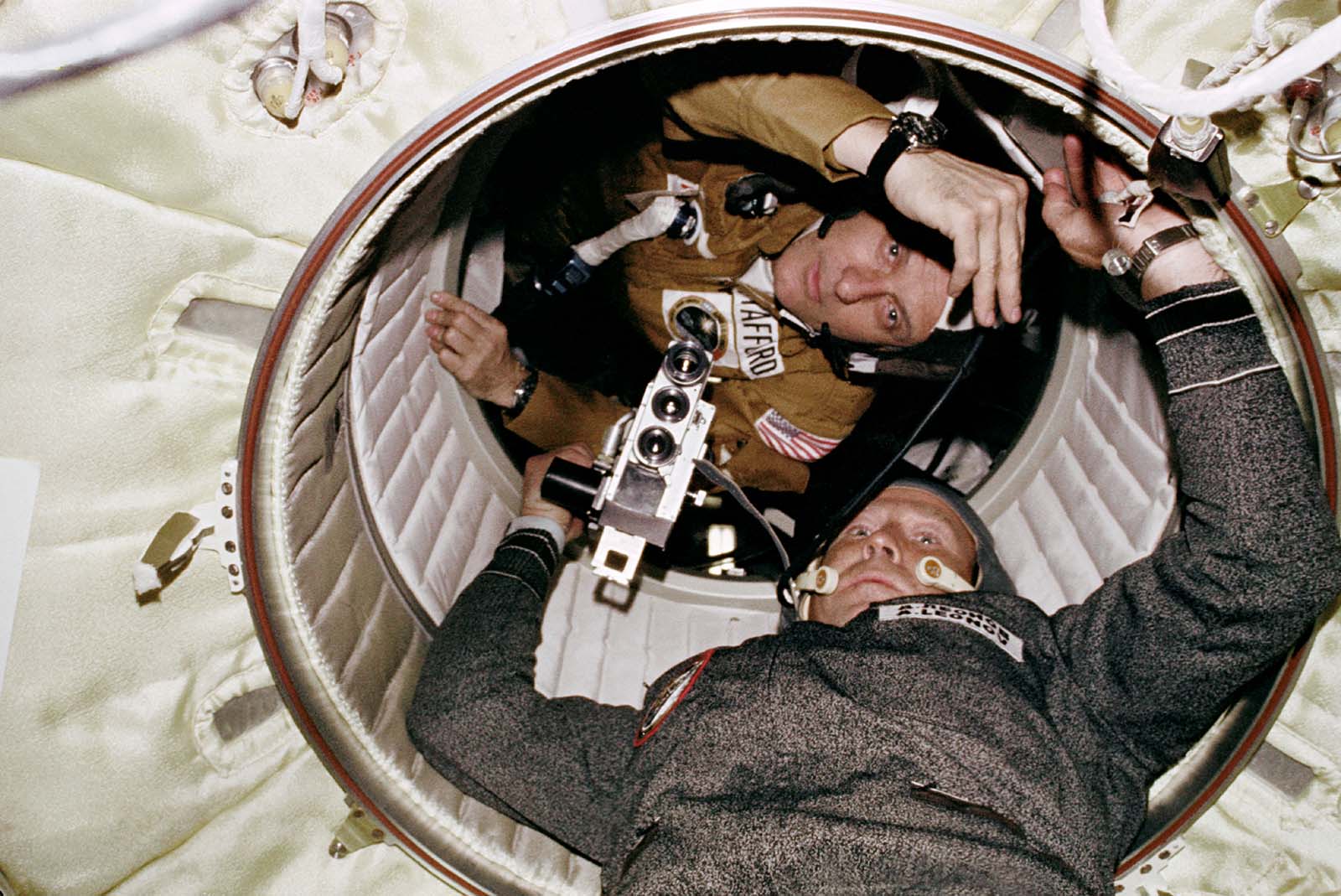
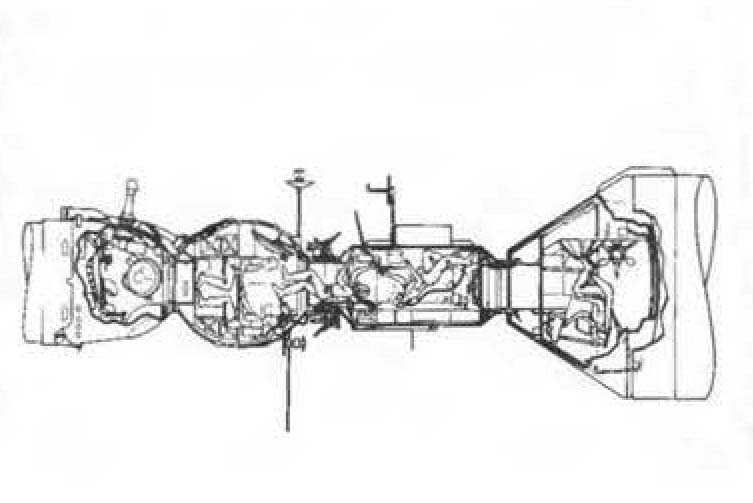
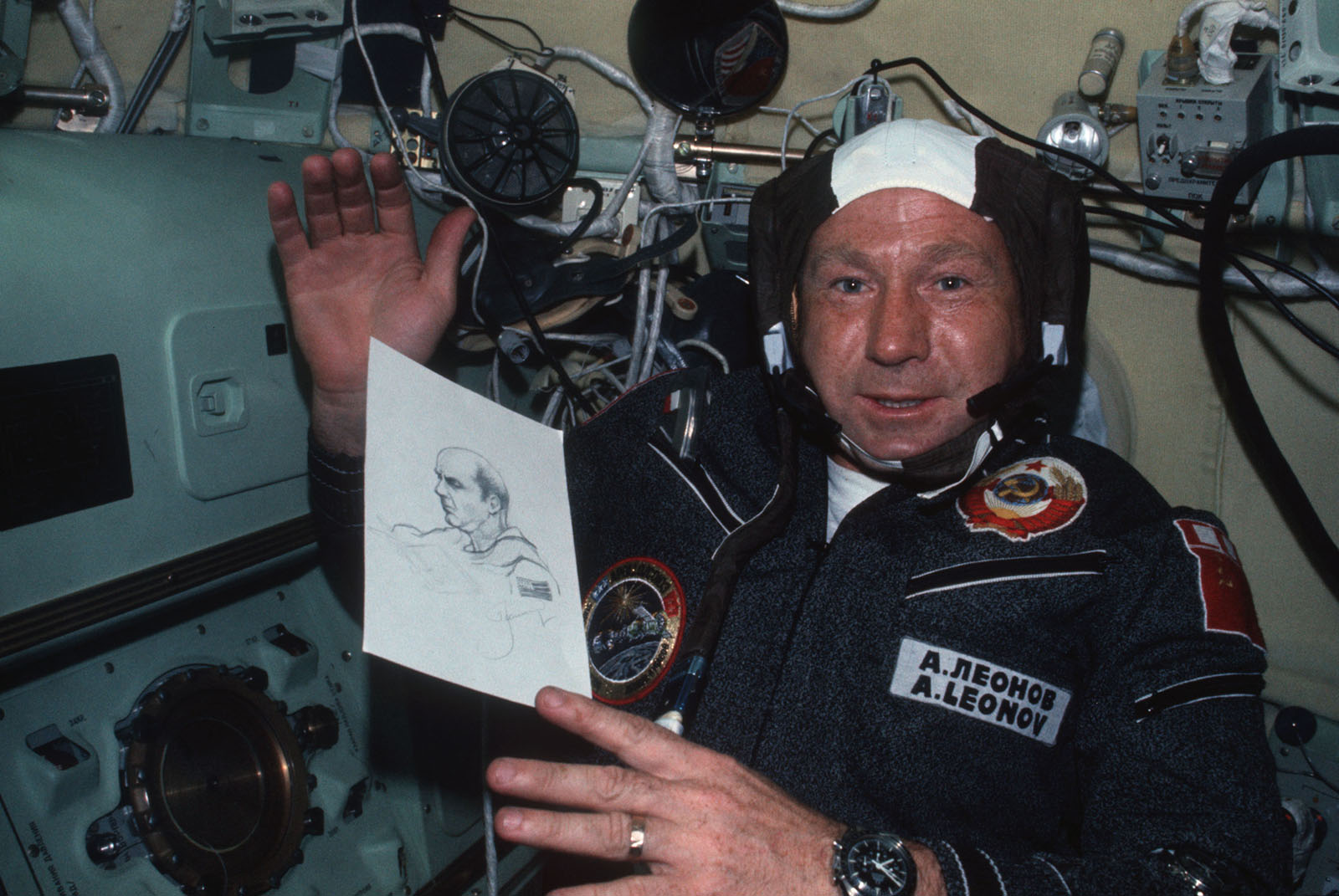
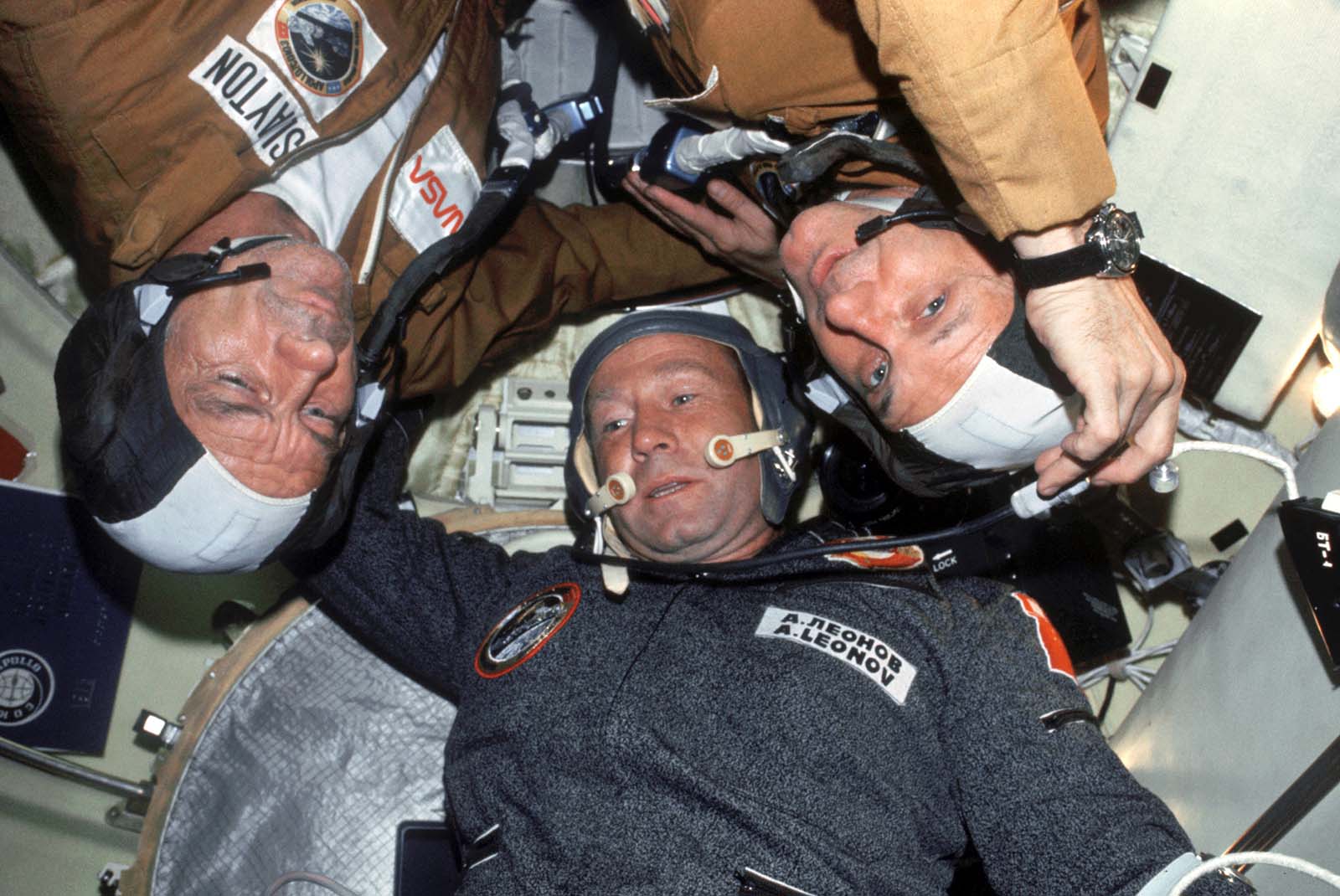
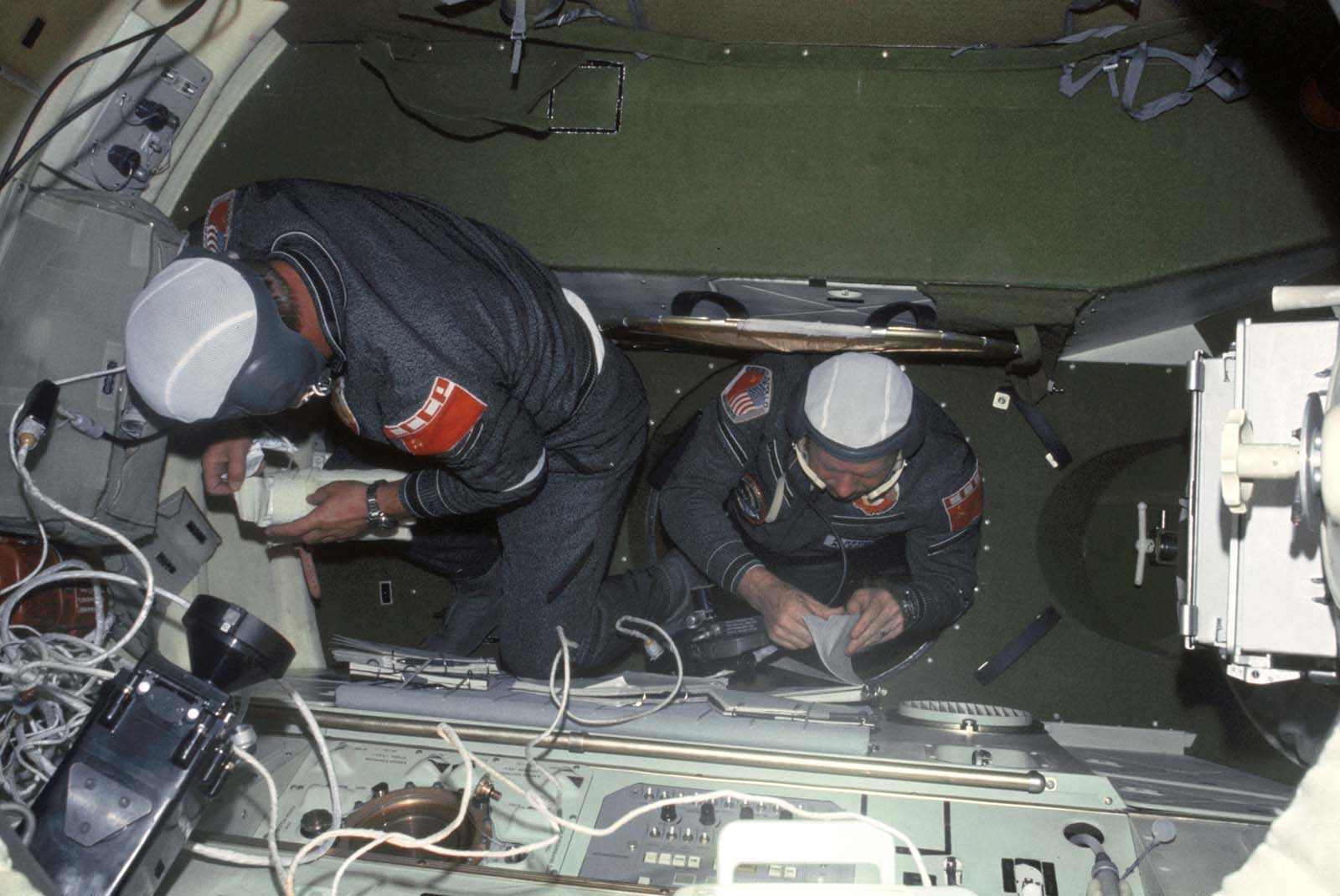
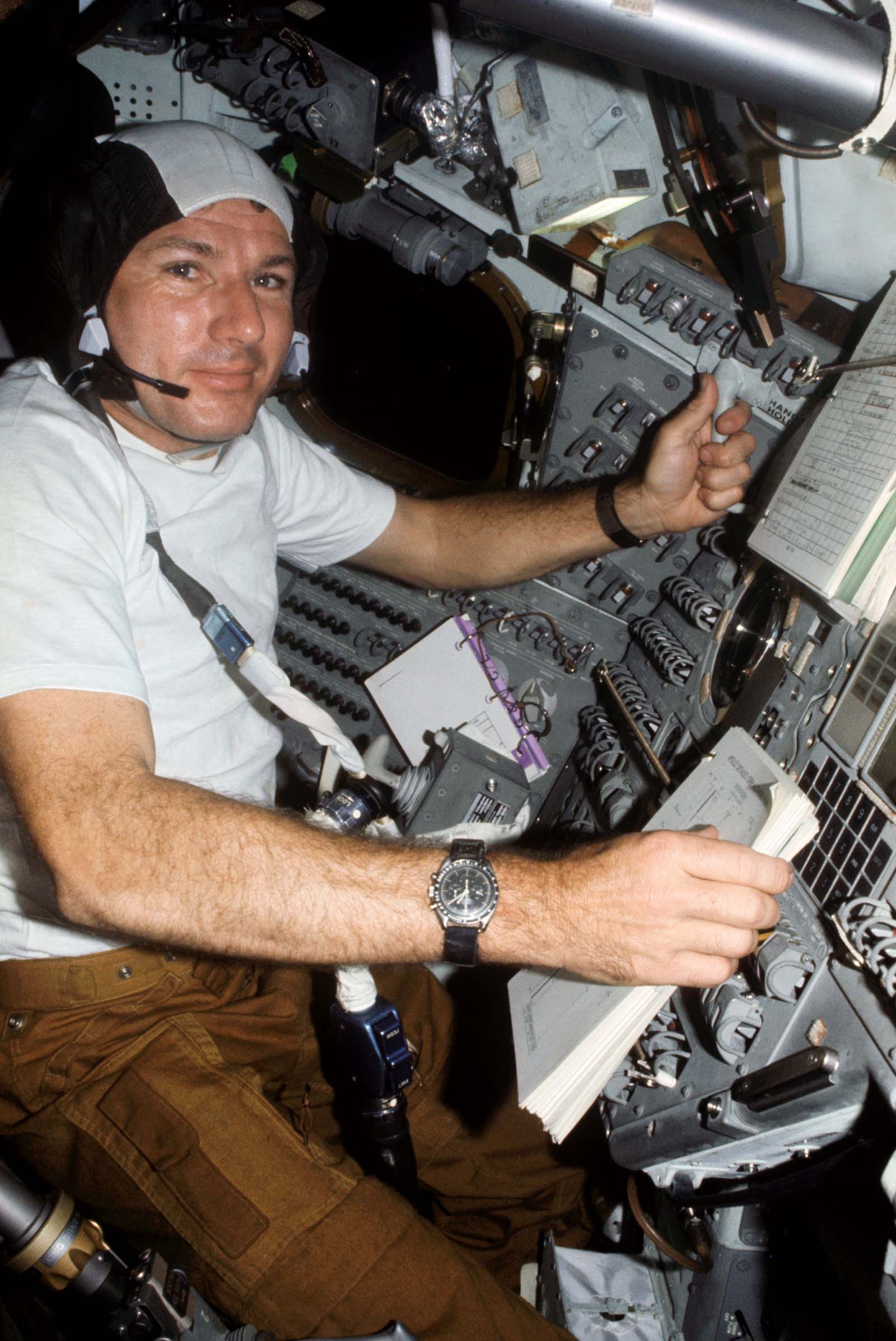

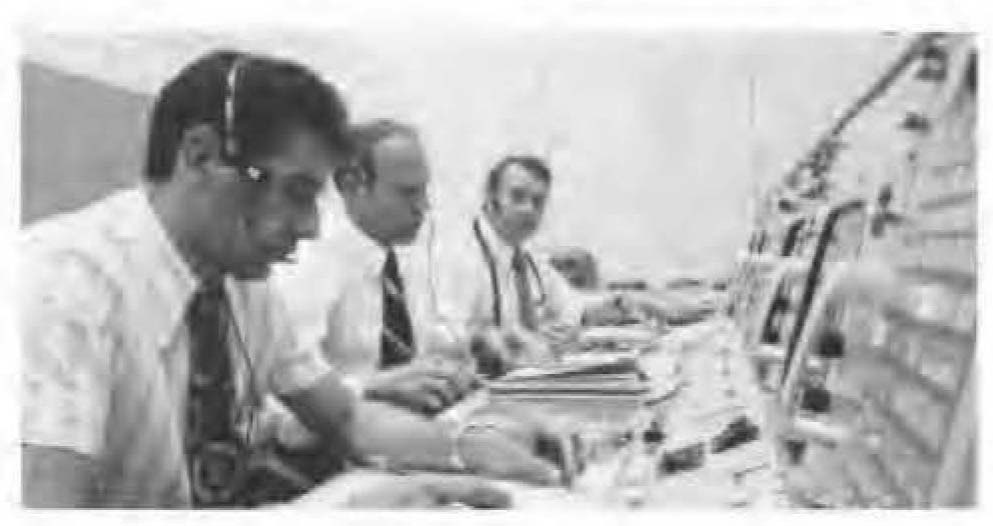
Having collected questions in advance from news people in Moscow and Houston, Valeriy Vasilyevich Illarionov of the visiting specialists team and Karol Bobko read the questions to the crews from Houston. The queries and the responses were friendly, in the spirit of the mission. Stafford began by saying that it had been a very rewarding two days in space. He felt that the success of the mission was the result of “the determination, the cooperation, and the efforts by the governments of the two countries, by the managers, engineers, and all the workers involved.” When he first opened the hatch to greet Leonov and Kubasov, he had a couple of thoughts that he was unable to express at the time. He believed that when they opened those hatches in space, they were opening the possibility of a new era on earth. “I would have said,” in Russian, “we were opening back on Earth a new era in the history of man.” He noted that just how far that new era would go would depend upon “the determination, the commitments, and the faith of both countries and of the world.” The “climate of detente and a developing cooperation between our countries” has made this mission possible, Leonov added.
Because of his participation in the first space welding in 1969, Kubasov was asked about materials processing in space. Kubasov believed that one of the future benefits of space programs would be the development of better and different alloys resulting from space processing. “It seems to me that the time will come when space will have whole plants, factories, for the production of new materials and new substances with new qualities, which could be ... made only in space.” Linked to that question was one from Moscow addressed to Stafford about the justification of spending money on space programs when there were so many problems in the world that needed solving.
Stafford noted that this was not a new question. He certainly believed that the costs would be repaid by the long term benefits. Science and applications were the likely areas of payoff, but the uplift to the human spirit was also implicit in his words and those of his colleagues. All the men agreed that they preferred news of peace and tranquility, and Kubasov especially hoped that all children would have a future filled with peace, so that they would never have to know what it was like to lose parents or loved ones in a war. On a lighter note, when a Soviet reporter asked Leonov to transmit a sketch “that would depict the meaning, the essence of the joint mission,” Leonov and Stafford held up two flags, one from the United States and one from the Soviet Union-although backwards, the message was clear enough. Leonov then went on to show the television audience a number of sketches that he had drawn-“Here’s a whole cosmic portrait gallery.”
The best lines of the press conference came later. When asked how he liked the American food, Leonov diplomatically answered, “I liked the way it was prepared, its freshness.”
But as an old philospher says, the best part of a good dinner is not what you eat, but with whom you eat. Today I have dinner together with my very good friends Tom Stafford and Deke Slayton because it was the best part of my dinner.
Slayton was asked how the experience of space flight compared to all the stories he had been told over the years. He said that he did not think he had discovered anything new.
We’ve had the same kind of problems up here that people have complained about since MR-3.... Not enough space, and a little congestion to the time line, difficulty in keeping up with things. It’s a lot slower getting things done up here than you realize when you’re down there in one g.... In some respects, it’s easier because weighty things are easier to move around, but, on the other hand, everything just tends to take off if you let go of it.... it’s been a great experience. I don’t think there’s any way anybody can express how beautiful it is up here.
Looking to the future, Leonov was convinced that mankind was just at “the beginning of a great journey into outer space.” As with the other ASTP crewmen, he hoped to have a chance to fly again. Stafford agreed and said that he would like to fly on one of the early Shuttle missions. “And I would hope that if Alexey would have a vehicle developed by [his] country that we could fly ... in a joint mission.” Not to be outdone, Leonov added, “I would always like to fly with friends... whom one trusts and with whom it is not dull to work...”36
The crews returned to other items on their flight plan. Slayton, as part of the earth observation experiment (MA-136), took photos of ocean currents off the Yucatan Peninsula and in the Florida straits. He also tried to observe the red tide phenomena-marine micro-organisms that cause the water to appear red-off the coast of Tampa and in the vicinity of Cape Cod. But this visual exercise was not completed because of cloud cover. Brand’s travelogue of the East Coast of the U.S. was likewise hindered by the clouds, but he gave the narration anyway, describing the climate and flora of Florida, North Carolina, Virginia, Washington, the Middle Atlantic states, and New England. As the ships passed over Massachusetts, Brand noted that Robert H. Goddard had launched the world’s first liquid fueled rocket from that state on 16 March 1926.37
Leonov narrated the events of the fourth transfer as he saw them. He stressed the large amount of work they had to accomplish during the joint phase of the mission, including five bilateral experiments. Although this “saturated program” seemed at times to be more than the five men could handle, they managed to complete all their tasks. Slayton, Brand, and Kubasov assembled the two halves of a medallion commemorating the flight, and then they exchanged tree seeds. As Slayton juggled television equipment, Stafford and Leonov bid their final farewell. All these exercises climaxed one of the most complex television scenarios ever conceived and executed.
Tom Stafford shook hands with Leonov and Kubasov, bidding them farewell at about 3:49 in the afternoon. He then moved back into the docking module, and the space men closed the hatches for the last time at 4:00. Once the checklist for securing the hatches and executing the pressure integrity check of the seals was completed, the crews set about routine housekeeping chores-stowing equipment and making certain that all was in readiness for their next meal. For the statistically minded, the records indicate that Stafford spent 7 hours, 10 minutes aboard Soyuz, Brand 6:30, and Slayton 1:35. Leonov was on the American side for 5 hours, 43 minutes, while Kubasov spent 4:57 in the command and docking modules. To those at work in space and on the ground, it seemed longer.
Before finishing all the items on their pre-sleep checklist, the Americans paused to listen to the news and sports as read by CapCom Truly. Included in his report was mention of an American home exhibit that had just opened to enthusiastic crowds in Moscow. Called “Technology in the American Home,” the display was designed to give Soviet citizens an idea of the gadgetry available to the American homemaker. While no one commented on the fact, it was just such an exhibit that had sparked the Nixon-Khrushchev debate in 1959. In 16 years’ time, the international scene seemed to have changed dramatically.
Although the crew signed off for the evening on schedule at 7:20, they spent an uneasy first few hours. In addition to being very tired from the activities of their fourth day in space, they were jangled awake an hour later by a master alarm that reported a reduction in docking module oxygen pressure. This problem was no real hazard, and it was quickly solved by an increased flow of oxygen into the DM, but it kept the crew from getting all the sleep for which they had been scheduled. When wake-up time came at 3:13 on the morning of the 19th, the crew failed to hear the musical strains of “Tenderness” as sung by the Soviet female artist Maya Kristalinskaya, with which the ground team had hoped to gently waken them. But 15 minutes later, they were awake and ready to begin their fifth day. Next door, beyond hatches three and four, Leonov and Kubasov were getting prepared, too.
19 JULY-EXERCISES
During day five of the flight, the crews concentrated on docking exercises and experiments that involved the two ships in the undocked mode. During the interval between the first undocking and the second docking, the Apollo crew placed its craft between Soyuz and the sun so that the diameter of the service module formed a disk which blocked out the sun. This artificial solar eclipse, as viewed from Soyuz, permitted Leonov and Kubasov to photograph the solar corona. Ground-based observations were conducted simultaneously, so that the Soviet astronomer G. M. Nikolsky could compare views of the solar phenomena with and without the interference of the earth’s atmosphere. Skylab had provided a long term look at the corona, and the ASTP data would give scientists an opportunity to compare findings made a year and a half later. This “artificial solar eclipse” (MA-148) experiment would be the last American chance for such information gathering until the Shuttle era.
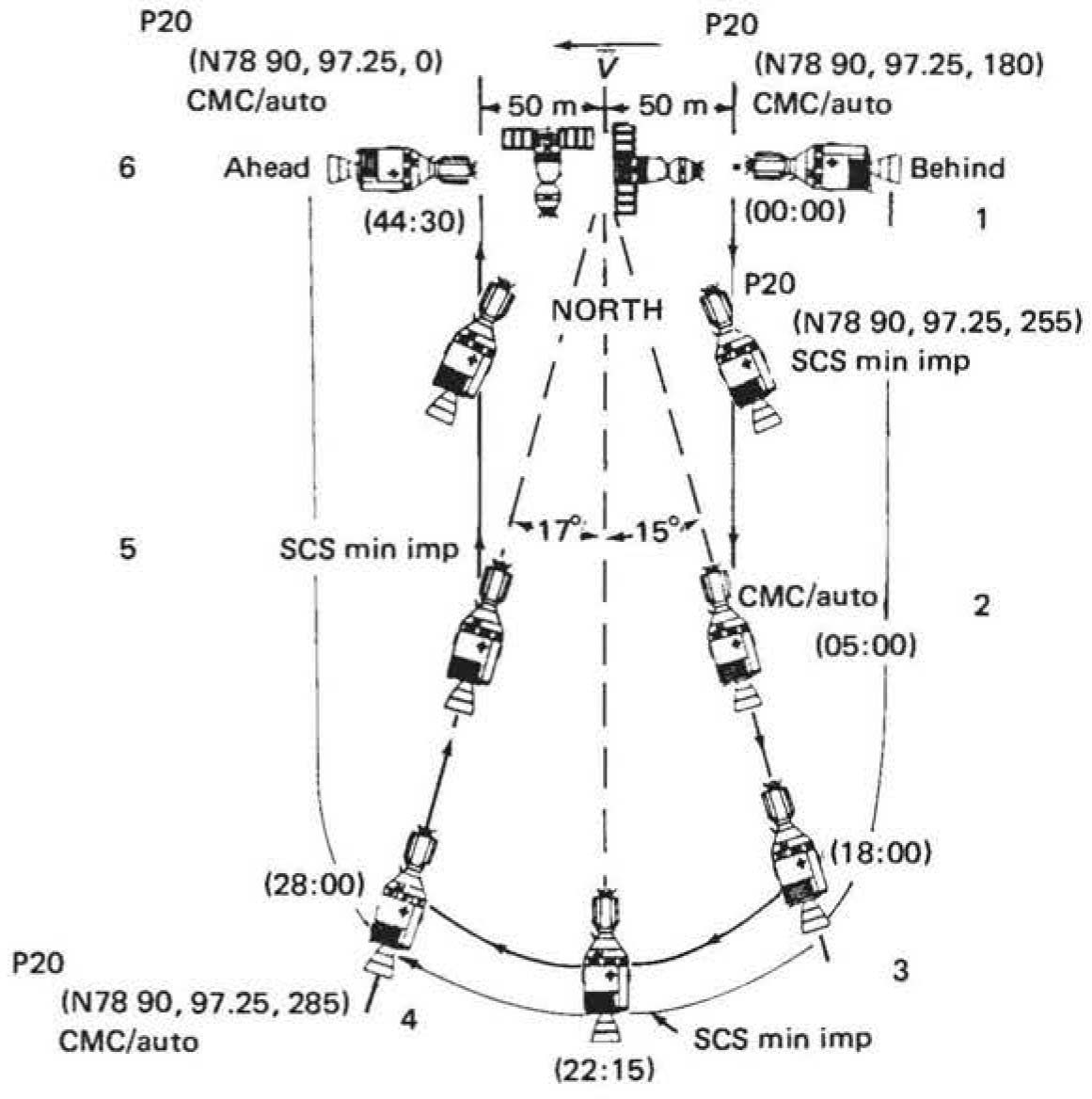
Another major experiment, “ultraviolet absorption” (MA-059), was an effort to more precisely determine the quantities of atomic oxygen and atomic nitrogen existing at such altitudes as the one in which Apollo and Soyuz were orbiting. Again this information could not readily be obtained from ground-based observations because of the intervening layers of atmosphere. Apollo, flying out of plane around Soyuz, first at 150 meters, then at 500 meters, and finally in plane at 1000 meters, projected monochromatic laserlike beams of light to retroreflectors mounted Soyuz. When the beams were reflected back to Apollo, they were received by a spectrometer, which recorded the wavelength of the light. Subsequent analysis of these data would yield information on the quantities of oxygen and nitrogen. Some very precise flying was called for in these experiments.
After being docked for nearly 44 hours, Apollo and Soyuz had parted for the first time at 7:12 a.m. while out of contact with the ground. Slayton advised Bobo after radio contact was re-established that they had undocked without incident and were stationkeeping at a range of 50 meters. Meanwhile, Soyuz had extended the guide ring on its docking system in order to test the Soviet mechanism in the active configuration. Once they completed the solar eclipse experiment, with Slayton at the controls, Apollo moved towards Soyuz for the second docking. As he did, Stafford called out to the ground, “Okay, Houston, Deke’s having the same problem with the COAS washout that I had.” As Slayton explained it, he could see Soyuz and the target initially when they were against the dark sky, but at “about 100 meters or so, it went against the earth background and zap. Man, I didn’t have anything.” Although worried that he might run over Soyuz, he pressed on with the docking “by the seat of the pants and I guess I got a little closer than they or the ground anticipated.”38 There was too much light flowing into the optical alignment sight for Slayton to get a good view of the docking target. Contact with Soyuz came at 7:33:39, and Leonov advised the Americans that he was beginning to retract his side of the docking assembly.
As viewed via Apollo television, this docking looked as if it had been harder than the first, and the two ships continued to sway after capture had been completed. Slayton, speaking in a debriefing, later said:
The docking was normal, you guys gave me contact as usual and then I gave it thrusting. The only thing that happened then was they seemed to torque off. I was surprised at the angle they banged off there after we had contact.39
Despite this oscillation, the Soyuz system aligned the two craft and a proper retraction was completed. Subsequently, there was some discussion of this docking, and the Soviet docking specialist Syromyatnikov was at first worried that an unnecessary strain might have been placed on the Soyuz gear. Bob White said that analysis of the telemetry data indicated that Slayton had inadvertently fired the roll thrusters for approximately 3 seconds after contact, and that this sideways force caused the craft to oscillate after the docking systems were locked and rigid.
But even with the extra thrusting, the second docking was within the limits of safety established for the docking system. Slayton’s docking took place at a forward velocity of 0.18 meter per second versus 0.25 meter per second for Stafford’s docking, but the difference lay in the inadvertent thrusting. Momentarily an issue, the extra motion of Slayton’s try was not a serious concern after all the data had been evaluated. Even Syromyatnikov had to concede that “the mechanism functioned well under unfavorable conditions.” It was a case of things looking worse than they really were. In the end, the incident only demonstrated the reliability and hardiness of the new docking system.40
It was 10:27 when Apollo and Soyuz undocked for the second and final time. This 4-minute exercise was conducted by Leonov, since it was a Soyuz active undocking. Slayton then moved his ship to a stationkeeping distance, about 40 meters away. As he did, Leonov opened the retroreflector covers so that the ultraviolet absorption (UVA) experiment could be performed. A difficult series of maneuvers were called for in this test. As Soyuz continued its circular orbit, Slayton took Apollo out of plane with Soyuz and oriented his craft so that its nose was pointed at the reflector on the side of the other ship. Orbiting sideways in this configuration, Slayton flew Apollo in a small are from the front of Soyuz to the rear of that ship while the spectrometer gathered the reflected beams. On the 150-meter phase of the experiment, light from a Soyuz port led to a misalignment of the spectrometer, but on the 500-meter pass excellent data were received; on the 1000-meter pass satisfactory results were also obtained.
After nearly 3 hours of tough flying, Bobko congratulated the crew. “You people flew it fine.” Slayton responded:
Okay. Great, Bo. And you can thank ol’ Roger Burke, Steve Grega, and Bob Anderson, down there, that everything came off right. ‘Cause they sure did all the work to make it go.41
The three men Slayton mentioned had spent hours in the simulators working out the procedures to fly this complicated maneuver. Burke, who had worked with developing flight procedures for years, felt that this was one of the hardest experiments a crew had ever been called on to do, especially since the flight plan for it had continued to evolve until a couple of days before launch.42 Slayton later noted that it had taken all three Apollo crewmen to complete the ultraviolet absorption experiment. “I was doing the flying, Vance was running the computer and we had Tom down in the equipment bay opening and closing doors, turning on sensors and so forth. So, it was a busy time for all of us.” He indicated that the maneuvers were difficult because orbital mechanics came into play as they tried to fly around Soyuz. When the Apollo crew changed the velocity of their craft, they also affected its orbit. They would have no difficulties if they had had unlimited fuel resources, but being out of plane and playing orbital mechanics with “a very limited fuel budget... made it a great challenge.”43 Stafford added that the thruster firings had to be timed because the onboard accelerometers could not measure the changes in velocity.44
Apollo performed a separation maneuver at 1:42 to prevent re-contact with Soyuz, placing the American craft in a 217- by 219-kilometer orbit. With all the joint flight activities completed, the ships were going their separate ways. Soyuz was below and moving ahead of Apollo at a rate of 6 to 8 kilometers per orbit. Leonov and Kubasov prepared to go to sleep, but the American crew had several hours of work scheduled in their crowded flight plan after their mid-afternoon meal before they could settle down for a rest period. The fifth day of ASTP-the second of joint activities-had been a success, and everyone in the Moscow and Houston control centers was pleased that all had gone so well.
20 JULY-INDEPENDENT ACTIVITIES
Kubasov and Leonov began their sixth day in space at 1:10 a.m. while their American friends slept. They had breakfast and carried out a series of activities that included earth and solar photography and recording data photographically on the joint zone-forming fungi experiment and other unilateral experiments. Leonov also ran through a simulation of the deorbit procedures orientation, retrofire, and the deployment of the parachutes. At mid-afternoon Moscow time (sunup in Houston), the Soviet space travelers gave a television broadcast to their viewers at home. Afterwards, they latetinued their experiments and preparations for their rentry 24 hours.45
Houston control tried for a second morning to wake the crew with “Tenderness” in Russian. This time they succeeded, and the men began their sixth day at 1:54 a.m. In addition to a day-long earth observation, which they started before breakfast, they concentrated on experiments during their first independent day in orbit. Included in the flight plan were experiments in the multipurpose furnace (MA-010), extreme ultraviolet surveying (MA-083), crystal growth (MA-085), and helium glow (MA-088). In the midst of their work during an ATS 6 communication session, CapCom Crippen gave them a news report.
Crippen included a special item in his report. “Six years ago today at 3:17:40 central daylight time we landed on the Moon. At 9:56, that’s when Neil said his famous words about small step for man, giant leap for mankind.’” Stafford responded, “Roger. Remember it well.”
- Slayton:
- Say, what day of the week is this, incidentally?
- Crippen:
- This happens to be Sunday.
- Brand:
- (garbled) ... our day off.
- Crippen:
- Oh, yeah. We’ll get them off after you guys get back. Y’all ... are certainly not getting a day off today.
- Brand:
- We’re not complaining.46
While there was still much to do, the pressure of the first days of the mission was gone, and the crew was settling down to the routine. The sixth day of the ASTP flight was noticeably void of the drama that had been associated with the joint activity.
21 JULY-FAREWELL
Leonov and Kubasov had signed off the air shortly after 1:37 (9:37 in Moscow) on the afternoon of the 20th, after stowing all of the returnable items in the descent module. Following a rest period of nearly 10 hours, the Soyuz crewmen advised the ground that they were awake and that all systems were normal. After exchanging flight data and receiving a weather report, they ate breakfast and donned their space suits. Their pressure integrity check, conducted at about 3:30 a.m. indicated that their suits were functioning normally. Leonov and Kubasov ran through their re-entry checklist. Moscow Mission Control gave the following announcement
The Mission Control Center’s calculated the descent-orbit data. This data has been entered into the program computer... the crew is monitoring the orientation and also the transmission of information. The deorbit data ... is the following ... the braking pulse to shift the spacecraft from Earth to a descent trajectory will be 120 meters per second. This braking pulse ... will operate for 194.9 seconds at the altitude of 214 kilometers and 13 hours and 9 minutes.47
Throughout the Soviet Union, crowds gathered in homes and in stores with televisions to watch the rare treat of a live broadcast of a Soyuz recovery. At Houston, a few hardy souls, in addition to the ground control team, were up to witness this early morning event.
The deorbit burn came exactly on time (5:09 in Houston), and the Soyuz crew notified Moscow that the retro-engine had fired for the calculated period and had been turned off at 5:13:38. Separation of the orbital and descent modules came 9 minutes later. Leonov advised the ground that the gravitational forces had built up, passed, and were less than he had anticipated. A task force of Soviet helicopters and ground-based personnel moved into the landing area. All in all, this formidable armada of trucks and aircraft was about equal in number to the size of the sea-based team that would later greet Apollo.
Soviet air rescue pilots began receiving radio signals from the spacecraft at approximately 5:40, and almost simultaneously helicopter-borne television cameras began transmitting pictures of the descent. As Soyuz floated downward, Walter Cronkite, in search of commentary on the event, noted for his viewers that the color quality of the pictures was not very good. But good or bad, they were extraordinary! Within a few feet of the ground, the automatically fired landing rockets slowed the “thumpdown” of the descent vehicle. A cloud of dust caused by the braking rockets of Soyuz engulfed the craft and caused momentary anxiety for those viewers who did not understand its meaning. Three minutes after landing, at 5:51, a slightly shaky Kubasov was the first to exit. Leonov and his flight engineer smiled broadly and waved to photographers on the scene. Houston Mission Control reported: “We’re just looking at the TV here and see that Soyuz has landed safely, and Alexey and Valeriy were outside of the spacecraft and seem to be in good health.”48 Stafford asked Houston to give the Soviets their best and to say that he was glad to hear that everything went well. For the remaining three and a half days, Stafford, Slayton, and Brand would concentrate on their experiments, but in many respects the saga of Apollo and Soyuz had come to an end.
22-23 JULY-EXPERIMENTS
Some minor experiment hardware problems developed during the final days of the mission, but for the most part the crewmembers worked through their flight plan-which included 23 independent experiments-with few difficulties. CSM 111 was truly the best-as well as being the last-Apollo to fly. After a relatively quiet day of work on the 22d, the major part of the next day was devoted to preparing for and conducting the doppler tracking experiment (MA-089). Paired with the geodynamics experiment (MA-128), these investigations were designed to verify which of two techniques would be best suited for studying plate tectonics (movements of the earth’s substrata) from earth orbit. Where the geodynamics experiment utilized Apollo and ATS 6 in an attempt to measure these movements (the so-called low-high approach), the doppler tracking experiment involved the use of two satellites in low earth orbit (the low-low approach) to measure the existence of “mass anomalies” greater than 200 kilometers in size. When the jettisoned docking module and the CSM were separated by 300 kilometers, they would theoretically have their orbits affected by the greater gravitational forces exerted by these mass anomalies. As their orbits were perturbed, the radio signals transmitted from one to another would correspondingly be affected.
Prior to releasing the docking module on its separate journey, the crew had participated in a second press conference from space. During that 32-minute session, the crewmen were asked to philosophize about the future of manned space flight in general and upon such diverse topics as trips to Mars and their own participation in the Shuttle program. Their answers were filled with optimism and good humor. Deke Slayton’s statement that he had done nothing in space that his 91-year old aunt could not have done sent reporters scrambling to find out her name (Mrs. Sadie Link) so they could meet their deadlines. Following the press period, CapCom Crippen told the crew, “you guys did a great job there. Professional as always.” He also gave them the news that Leonov had been promoted from colonel to major general.
With congratulations over, Stafford told the ground, “Now, back to work.” After donning their space suits, the crew vented the command module tunnel and at 2:41 jettisoned the docking module. Filled with all their trash and used equipment that need not be returned, the DM tumbled into space at exactly the proper rate. Stafford and his team then executed their separation maneuver so that they could take the necessary doppler measurements. The docking module would continue on its way until it re-entered the earth’s atmosphere and burned up in August 1975.49
24 JULY-LAST SPLASH
Approximately 24 hours after they parted from the docking module, Stafford, Slayton, and Brand began their journey homeward. On the ground, the flight control team played Jerry Jeff Walker’s “Redneck Mother” to wake the crew. With a cheery “Good morning, gents. Party’s over. Time to come home,” CapCom Crippen told them to rise and shine. At half past seven, the crew started preparing for its mid-afternoon deorbit. As the men rubbed the sleep from their eyes, ate breakfast, and gathered data for the medical doctors on the ground, Crippen read them the news for the last time, news most of which the Apollo crew was making. The newspapers said that Slayton would fly again and that Stafford was still undecided about the future. Would it be NASA, the Air Force, industry, or politics? “That last option is sure out. I’ll clue you, ol’ buddy,” was the General’s response. Crippen gave a favorable weather forecast for the prime recovery area-visibility 16 kilometers, winds at 17 knots, scattered cloud cover at 600 meters, and wave height 1.1 meters.50
CSM deorbit came at 3:37:47, or about 13 seconds ahead of schedule. Six and a half minutes later, the command module was separated from the service module. As the reentry vehicle descended, Slayton and Brand commented on the buildup of gravity forces and the fireball that flared up as the heatshield pressed against the earth’s atmosphere. At 4:18:24, Apollo splashed down about 7300 meters from the recovery ship New Orleans. Houston control was filled with smiling faces and cigar smoke. Unknown at that time to the celebrants was the fact that the crew had inhaled nitrogen tetroxide fumes during the descent.
The descent phase had gone without incident until about 15 000 meters. In the days that followed the recovery, the story of the failure to actuate the Earth landing system (ELS) was told and retold several times by Glynn Lunney, John Young, and others. Vance Brand presented his version during the crew technical debriefing. When the CM reached an altitude of 9144 meters, two earth landing switches that permitted the apex cover to be jettisoned at 7310 meters were normally armed. The drogue parachutes would then be released, followed by the main chutes. Commenting on the descent, Brand said that as Stafford read steps from the Entry Checklist he threw the proper switches. There was quite a bit of noise in the cabin from the command module’s thrusters and the passage of the craft through the atmosphere.
At 30K [9144 meters], normally we arm the ELS AUTO, ELS LOGIC, that didn’t get done. Probably due to a combination of circumstances. I didn’t hear it called out, maybe it wasn’t called out. Any case 30K to 24K (9144-7315 meters) we passed through that regime very quickly. I looked at the altimeter at 24K, and didn’t see the expected apex cover come off. Didn’t see the drogues come out. So, I think at about 23K, I hit the two manual switches. One for the apex cover and also, the one for drogues. They came out. That same instant the cabin seemed to flood with a noxious gas, very high concentration it seemed to us. Tom said he could see it. I don’t remember for sure now, if I was seeing it, but I certainly knew it was there. I was feeling it and smelling it. It irritated the skin a little bit, and the eyes a little bit, and, of course, you could smell it. We started coughing. About that time, we armed the automatic system, the ELS....51
The manual deployment of the drogue chutes caused the CM to sway, and the reaction control system thrusters worked vigorously to counteract that motion. When the crew finally armed the automatic ELS 30 seconds later, the thruster action terminated.
During that 30 seconds, the cabin was flooded with a mixture of unignited propellant and oxidizers from the thrusters. Prior to drogue deployment, the cabin pressure relief valve had opened automatically, and in addition to drawing in fresh air it also brought in unwanted gases being expelled from the roll thrusters located about 0.6 meter from the relief valve. Brand manually deployed the main parachutes at about 2700 meters, and despite the gas fumes in the cabin, the crewmembers continued to work through their checklist as best they could. Due to severe coughing and intercom noise, they had difficulty talking to one another and to the ground.
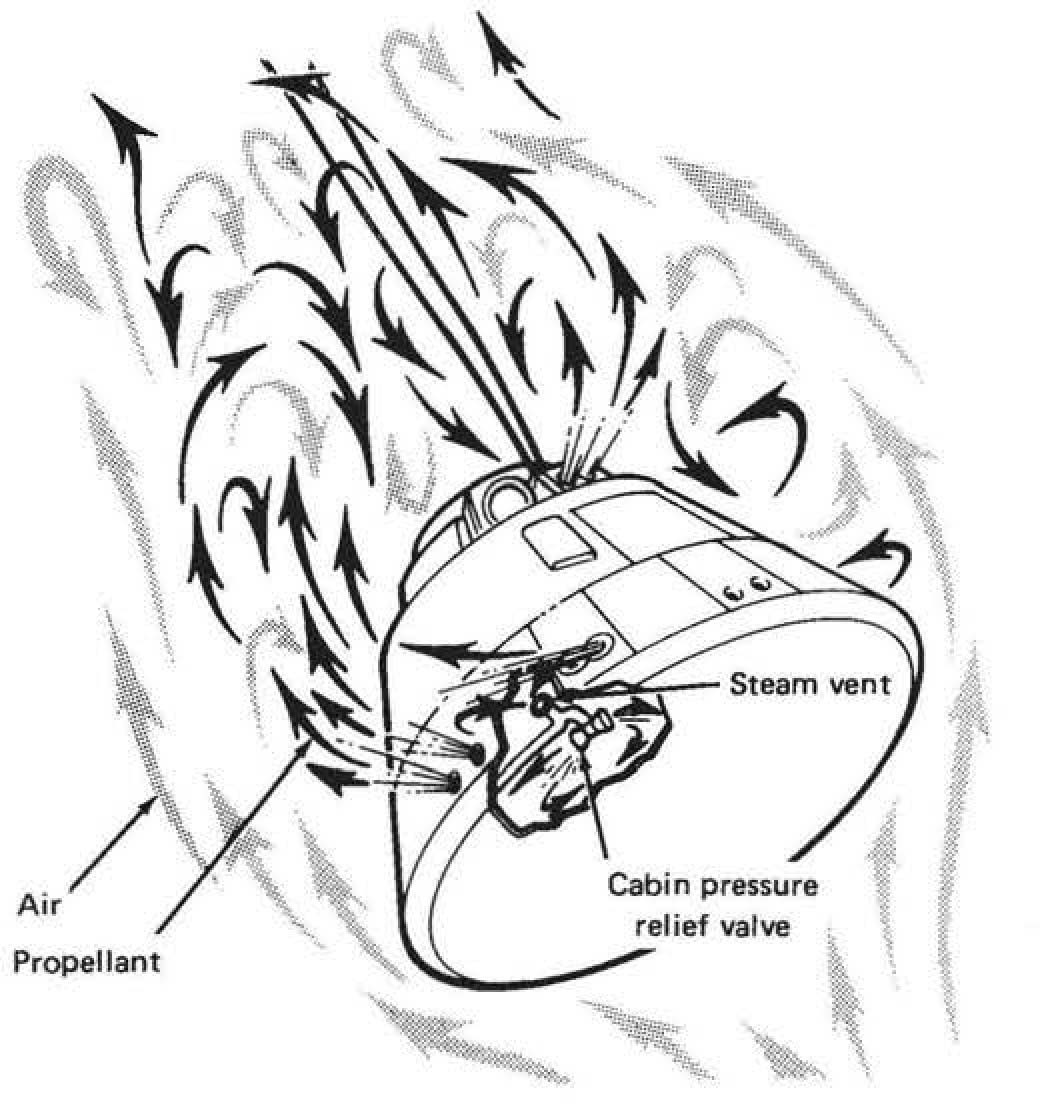
Following a normal but hard splashdown, the command module flipped over, leaving the three men hanging upside down in their couches from harnesses. Brand, who was coughing the most because he was closest to the steam duct opening, saw that Slayton was feeling nauseous and reminded Stafford to get their oxygen masks. The commander recalled:
For some reason, I was more tolerant to [the bad atmosphere], and I just thought get those damn masks. I said don’t fall down into the tunnel. I came ... had to crawl ... and bend over to get the masks.... I knew that I had a toxic hypoxia ... and I started to grunt-breathe to make sure I got pressure in my lungs to keep my head clear. I looked over at Vance and he was just hanging in his straps. He was unconscious.52
After Stafford secured the oxygen mask over Brand’s face and held it there, he began to come around. Once the entire crew was breathing pure oxygen, Brand actuated the uprighting system. When the command module was upright in the water, Stafford opened the vent valve, and with the in-rush of air the remaining fumes disappeared.53
Failure to throw the ELS switches led to an unanticipated two-week hospital stay for the crew in Honolulu. For Slayton, it also meant the discovery of a small lesion on his left lung and an exploratory operation that indicated it was a non-malignant tumor. After a short convalescence, Slayton joined the other four ASTP flyers for two tours, one of the Soviet Union and one of the United States. Despite a grueling month on the road, neither Slayton nor his team mates seemed any the worse for wear, and the warm public reception wherever they went seemed to indicate that the unfortunate accident at the end of the flight had not detracted from the basic success of the Apollo-Soyuz Test Project.54 Rivalry had produced the first manned space flights in the early 1960s. But that sense of conflict had been overcome with the creation of an international test project. Ironically, this first joint flight also marked the end of an era. NASA’s manned space program had seen its last splashdown. Apollo would fly no more.
- Except where indicated, the account of the flight is based upon notes taken by Edward C. Ezell and Linda N. Ezell during the mission.X
- ASTP mission commentary transcript, MC 8/2 [mission commentary tape #8, p. 2], 15 July 1975.X
- ASTP mission commentary transcript, MC 9/1-2 and MC 10/1, 15 July 1975.X
- ASTP mission commentary transcript, MC 12/1-2, 15 July 1975.X
- ASTP mission commentary transcript, MC 26/1 and MC 33/1, 15 July 1975.X
- ASTP mission commentary transcript, MC 34/1, MC 32/1, MC 36/1, and MC 37/1-3, 15 July 1975.X
- ASTP mission commentary transcript, MC 42/1, SR 6/1 [Soviet mission commentary tape #, p. 1] and MC 51/1, 15 July 1975.X
- NASA, JSC, Test Division, Program Operations Office, "ASTP Technical Air-to-Ground Voice Transcription," JSC-09815, July 1975, pp. 3-4. In NASA, JSC, Crew Training and Procedures Division Training Office, "ASTP Technical Crew Debriefing," JSC-09823, 8 Aug. 1975, pp. 3-1 through 3-2, the crew noted once again considerable longitudinal oscillation during the operation of the first stage.X
- Program Operation Office, "ASTP Technical Air-to-Ground Voice Transcription," р. 10; interview, Thomas P. Stafford-Ezell, 6 Apr. 1976; and NASA, JSC, "Apollo Soyuz Mission Evaluation Report," JSC-1067, Dec. 1975, pp. 10-1 and 10-2.X
- Interview, Stafford-Ezell, 6 Apr. 1976.X
- NASA, JSC, "Apollo Soyuz Mission Evaluation Report," JSC-10607, Oct. 1975, p. 3-1.X
- Program Operations Office, "AST Technical Air-to-Ground Voice Transcription," pp. 18-19; and [NASA News Release], Apollo News Center, JSC, "ASTP Change-of-Shift Debriefing," 15 July 1975. For further information on ATS 6, see NASA, Applications Technology Satellite-6 (ATS-6) [NASA Facts Series] (Washington, 1975); NASA News Release, HQ, 75-194, "ATS-6 Now on Station in View of India-Anomaly Being Studied," 2 July 1975; "ATS-6: Extra Special Satellite," Rendezvous [Textron/Bell, Aerospace Division] (Summer, 1974), pp. 8-11; and NASA, JSC, "Apollo Soyuz Mission Evaluation Report," JSC-10607, Oct. 1975, pp. 11-2 through 11-6.X
- Program Operations Office, "ASTP Technical Air-to-Ground Voice Transcription," pp. 46-47.X
- Ibid., p. 59.X
- Ibid,. pp. 60-63; and [NASA News Release], Apollo News Center, JSC, "ASTP Change-of-Shift Debriefing," 16 July 1975.X
- [NASA News Release], Apollo News Center, JSC, "ASTP Change-of-Shift Debriefing," 16 July 1975; and NASA, MSC, Mission Evaluation Team, " Apollo 14 Mission Anomaly Report No. 1, Failure to Achieve Docking Probe Capture Latch Engagement," MSC 05101, Oct. 1971.X
- Interview, John P. Donnelly and Robert J. Shafer-Ezell, 26 and 28 Jan. 1976; and ASTP mission commentary transcript, SR 13/1 and 13/2, 15 July 1975.X
- Program Operations Office, "ASTP Technical Air-to-Ground Voice Transcription," pp. 69-84; and Crew Training and Procedures Division Training Office, "ASTP Technical Crew Debriefing," p. 4-4. See also interview, Robert D. White-Ezell, 19 Aug. 1975:
The technicians who had installed the pyros for the gas bottles which actuate the structural latches had misaligned one of the pyro caps so it blocked the hole into which the release handle shaft was to be inserted. That release handle and shaft had been redesigned after Apollo 14. Formerly the release handle was attached at all times, after Apollo 14 it was stowed away from the shaft. This change was made to permit the discharge of the gas bottles when the capture latches had failed to engage. When the handle was in place, the gas bottles could not be fired, because the release shaft would bend upon retraction. The handle would jam against the hatch and bend the shaft. This alteration opened the way for the type of pyro misalignment which occurred in the ASTP mission. That misalignment showed up in the pre-mission buy-off photographs. Both the NASA and Rockwell inspectors missed this misalignment. . .. The crew had to remove the pro cover and realign the pyro (which incidentally was the one fired for the structural latching) so the handle and shaft could be installed.
X - Program Operations Office, "ASTP Technical Air-to-Ground Voice Transcription," p. 85; and ASTP mission commentary transcript, MC 121/1, SR 31/1-3 and SR 32/1-3, 16 July 1975.X
- Program Operations Office, "ASTP Technical Ait-to-Ground Voice Transcription," pp. 138-148; and ASTP mission commentary tran-script, MC 158/1 and SR 38/1-2, 16 July 1975.X
- Program Operations Office, "ASTP Technical Air-to-Ground Voice Transcription," pp. 176, 191, and 198.X
- Ibid., pp. 199-200.X
- Ibid., p. 219.X
- Ibid., pp. 222-223.X
- Ibid., p. 231; and Crew Training and Procedures Division Training Office, "ASTP Technical Crew Debriefing," pp. 4-13 and 4-14.X
- ASTP mission commentary transcript, SR 72/1-2, 17 July 1975.X
- Program Operations Office, "ASTP Technical Air-to-Ground Voice Transcription," p. 257.X
- Ibid., pp. 261-264.X
- Ibid., p. 265.X
- Ibid., p. 267; and F. Dennis Williams to Arnold W. Frutkin, memo, "ASTP Symbolic Activities: Items Carried on the First International Flight" [n.d.]. The items included the FAI certificate of docking, U.S. and U.S.S.R. flags, one U.N. flag, commemorative placques, a commemorative medallion, six copies of the May 1972 Nixon-Kosygin Space Agreement in English and Russian, American and Russian tree seeds, silver medallions for presentation to Leonov and Kubasov, and copies of papers authored by K. E. Tsiolkovsky and Robert H. Goddard.X
- [NASA News Release], Apollo News Center, JSC, "Change-of-Shift Debriefing #7," 17 July 1975.X
- Program Operations Office, "ASTP Technical Air-to-Ground Voice Transcription," pp. 287, 294-301, and 303.X
- [NASA News Release], Apollo News Center, JSC, "Change-of-Shift Debriefing #10," 18 July 1975.X
- Program Operations Office, "ASTP Technical Air-to-Ground Voice Transcription," pp. 340-355; Hal Piper, "Moscow Shops Filled for Space Launchings," Baltimore Sun, 16 July 1975; Bill Anderson, "It's Just Another (yawn) Space Flight," Chicago Tribune, 17 July 1975; Gregg Kilday, "Hyping the Space Show," Los Angeles Times, 17 July 1975; "Millions Watch Awestruck; Soviet Leaders Hail Mission." Christian Science Monitor, 22 July 1975; and Lee Whinfrey, "Platitudes Dull in Space, Too," Philadephia Inquirer, 22 July 1975.X
- Program Operations Office, "ASTP Technical Air-to-Ground Voice Transcription," pp. 364-367.X
- Ibid., pp. 405-415; Thomas O'Toole, "Apollo Soyuz Crews Make Final Visit," Washington Post, 19 July 1975; Albert Sehlstedt, Jr., "Space Visit Ends," Baltimore Sun, 19 July 1975; and Peter Reich and James Pearre, "Apollo, Soyuz Crews End First Space Visit," Chicago Tribune, 19 July 1975.X
- Program Operations Office, "ASTP Technical Air-to-Ground Voice Transcription," pp. 419-420.X
- Crew Training and Procedures Division Training Office. "ASTP Technical Crew Debriefing," p. 4-27.X
- Program Operations Office, "ASTP Technical Air-to-Ground Voice Transcription," pp. 494-497; and Crew Training and Procedures Division Training Office, "ASTP Technical Crew Debriefing," p. 4-27.X
- Interview, White-Ezell, 19 Aug. 1975; Roscoe Lee to Task ASTP E-101 File, TRW memo, "Control System Post-flight Analysis for the Initial Mission Report," 30 July 1975; James O'Kackson, "Russ Bare Soyuz Strain in Linkup," Chicago Tribune, 21 July 1975; and Robert C. Toth, "Russians Upset by Hard Space Docking," Los Angeles Times, 21 July 1975.X
- Program Operations Office, "ASTP Technical Air-to-Ground Voice Transcription," pp. 539-540.X
- Interview, Roger A. Burke-Ezell, 14 Aug. 1975.X
- Interview, Donald K. Slayton-Ezell, 2 Mar. 1976.X
- Interview, Stafford-Ezell, 6 Apr. 1976.X
- AST mission commentary transcript, SR 132/1-2, 19 July 1975, SR 134/1-2, SR 143/1-2, SR 144/1, and SR 145/1-2, 20 July 1975.X
- Program Operations Office, "ASTP Technical Air-to-Ground Voice Transcription," p.619.X
- ASTP mission commentary transcript, SR 156/1 and SR 159/1-2, 20 July 1975, and SR 171/2, 21 July 1975; "2 Cosmonauts, Soyuz Spacecraft Back in the USSR," Washington Star, 21 July 1975; Robert C. Toth, "Soyuz Touches Down Perfectly in Soviet Desert," Los Angeles Times, 22 July 1975; Hal Piper, "Soyuz Ends Its Half of Joint Flight," Baltimore Sun, 22 July 1975; and "Crowds Flock to Watch Rare Public Landing," Washington Post, 22 July 1975.X
- Program Operations Office, "ASTP Technical Air-to-Ground Voice Transcription," p. 679.X
- Ibid., pp. 925-940 and 989-990; and "Astronauts Look Forward to the Space Shuttle Era," Washington Star, 23 July 1975.X
- Program Operations Office, "ASTP Technical Air-to-Ground Voice Transcription," p. 1037.X
- Crew Training and Procedures Division Training Office, "ASTP Technical Crew Debrief-ing," • pp. 5-4 and 5-5; NASA News Release PC-56, "ASTP Crew Status Briefing," 25 July 1975; NASA News Release PC-57, "ASTP Crew Medical Status Briefing," 26 July 1975; NASA News Release PC-58, "ASTP Crew Medical Status Briefing," 26 July 1975; NASA News Release PC-59, "ASTP Crew Status Briefing," 27 July 1975; NASA News Release PC-60, "ASTP Post Flight Systems Review," 28 July 1975; NASA, JSC, "Apollo Soyuz Mission Evaluation Report," JSC-10607, Oct. 1975, pp. 14-4 through 14-13; and Richard Saltus, "Apollo Leak: Crew Failed to Trip Switches," Washington Post, 29 July 1975.X
- Crew Training and Procedures Division Training Office, "ASTP Technical Crew Debriefing," p. 5-5.X
- Interview, Stafford-Ezell, 6 Apr. 1976; and NASA, JSC, "Apollo Soyuz Mission Anomaly Report No. 1, Toxic Gas Entered Cabin during Earth Landing Sequence," JSC-10638, Dec. 1975.X
- NASA News Release, JSC, 75-69 "Astro-naut Slayton to Undergo Surgery," 19 Aug. 1975; NASA News Release PC-63, "D. K. Slayton Medical Briefing," 20 Aug. 1975; press release, M. D. Anderson Hospital, Houston, Tex., "D. K. Slayton," 26 Aug. 1975; and R. Z. Sagdeyev and V. A. Olshevskiy, "Sovmestnymi usiliyami" (Through joint efforts), in Soyuz i Apollon, rasskazivayut sovetskie uchenie inzheneri i kosmonavti--ychastniki sovmestnikh rabot s amerikanskimi spetsialistami [Soyuz and Apollo, related by Soviet scientists, engineers, and cosmonauts-participants of the joint work with American specialists], Konstantin D. Bushuyev, ed. (Moscow, 1976), pp. 180-198.X