Preparing for the Mission
With a 30 January 1973 announcement, the U.S. was first to make public their AST crew assignments. Brigadier General Thomas P. Stafford, a veteran of three flights and Deputy Director of Flight Crew Operations since 1971, would lead the prime crew. The Command Module Pilot, Vance D. Brand, had been backup Command Module Pilot for Apollo 15, and at the time of his appointment to the ASTP crew was backup commander for the second and third manned Skylab missions. Donald K.”Deke” Slayton would fill the position of Docking Module Pilot. Since a heartbeat irregularity had deprived him of a flight on Project Mercury, Slayton as Director of Flight Crew Operations had played a key role in the management of crew selection and training at NASA. In March 1972, following a comprehensive series of medical examinations, Slayton was restored to full flight status. At 48, Deke was six vears older than his crew mates and the oldest man yet to be selected for a space trip.1
Stafford’s crew was backed by Alan L. Bean, Ronald E. Evans, and Jack R. Lousma. Bean, the fourth man to walk on the moon, had been in the space program since October 1963. This exacting, hard working naval officer was scheduled to command the second Skylab crew, which was preparing for a July 1973 launch. Evans, a Navy captain, had been Command Module Pilot for Apollo 17, and Lousma, a Marine Corps major, was preparing to accompany Bean on the flight to Skylab.2
Richard H. Truly, Robert F. Overmyer, Robert L. Crippen, and Karol J. Bobko would assist the flight crews in their training. These four support crewmen had transferred to NASA in 1969 following the cancellation of the Manned Orbiting Laboratory, a Department of Defense program. During the preparations for AST, they would stand-in for the prime crews in a number a time-consuming but critical activities, such as mission planning and lengthy manned tests of the flight hardware. During the flight, Truly, Crippen, and Bobko would act as spacecraft communicators from the mission control center in Houston. Overmyer, who was to work extensively with the Soviets in mission planning and crew training, would be one of the technical advisers at the mission control center in Kaliningrad during the flight. Together these ten men would work as a team for the American half of the joint flight.3
On 1 February, Glynn Lunney introduced the American ASTP astronauts to the press. “The naming of the crew ... is always an exciting time for us in the manned space business and I think especially in this project ... [since] it indicates the progress that has been made on the planning for this activity,” Lunney said. He turned the microphone over to Stafford, who indicated that it was great to have been named to a crew and that he was looking forward to getting away “from some of the paper work for a while and get[ting] back to simulation and training.” For those critics who saw ASTP as simply an easy orbital flight, Stafford had a few words of caution.
The mission ... is probably going to be one of the most] difficult the manned space flight team has ever undertaken because it involves a different country, a different language, different operating techniques, and it’s just ... slow and painstaking . . . to work out all these [details].4
Stafford saw AST as a great challenge and a means of opening doors to a better future. Brand, who was fully occupied with training for Skylab, told the reporters that he agreed with Stafford’s evaluation of the mission. He hoped that his Skylab training in the command module simulators would help him in preparations for ASTP. Once the last two flights to the space station were completed, he would turn his full attention to the joint mission, concentrating especially on learning Russian.
Since his restoration to flying status, Slayton had been working for a place on the ASTP crew. During the summer of 1972, Slayton, Bobko, and Crippen had been studying the Russian language. Bobko and Crippen spent their spare time on the language during a 56-day Skylab Medical Experiment Altitude Test, and Slayton had thought that some knowledge of the language might improve his chances for selection, as well. In his remarks to the press, Slayton began by thanking all those who had over the years tried to get him certified once again for flying and especially Dr. William K. Douglas and Robert R. Gilruth, who had worked to keep him flying 12 years earlier. “If I had no other reason to fly this mission,” Slayton added, “I’d want to vindicate their good judgment.” He also thanked Dr. Charles A. Berry of NASA and Dr. Hal Mankin of the Mayo Clinic for their efforts that led to his being available for this crew.
And third, of course, and not least, ... on behalf of all the crew I’d like to thank Chris Kraft for putting us on the flight. I think Chris had a tougher decision in getting the crew [for] this flight than I ever had picking flight crews, because we’ve got 39 guys ... who would have like to flown it.5
Reflecting on the twelve years that he had sat behind a desk and watched other men fly, Slayton said that all in all he had been “pretty fortunate” in working for NASA. He had missed out on a lot of the adventure of space flight but he had also missed the tragedy -the snow goose that had wrecked Theodore Freeman’s T-38 jet trainer, C. C. Williams’ “bum aircraft,” and the fire that had gutted Apollo 204. He told his audience that he had staved with the space program because he was there to fly. He had expected to be returned to flight status all along; it had just taken longer than he had anticipated. For the “last 20 or 30 years I’ve been paid to fly, which is the thing I love most.” Now, Deke Slayton was looking forward to his first space flight as a “mature rookie; he hoped “to fly a couple of more after this one.”6
Soviet crew announcements for the 1975 flight came on 24 May to coincide with the opening of the 1973 Paris Air Show. Alexei Arkhipovich Leonov and Valeriv Nikolavevich Kubasov were chosen as the prime crew. Leonov was a veteran of the Voskhod I flight, during which he had performed the first extravehicular excursion. Kubasov had been the backup technical scientist for Soyuz 5 and flight engineer on Soyuz 6. He would fill that role again in the ASTP mission, while Leonov would command their craft.
Prime crew members for the second Soyuz were Anatoly Vasilyevich Filipchenko and Nikolay Nikolayevich Rukavishnikov. Filipchenko, who had become a cosmonaut in 1963, was the backup command pilot for Soyuz 4 and command pilot on Soyuz 7. Rukavishnikov joined the cosmonaut team in 1967 and became the test engineer for Soyuz 10. Backup crewmen were Vladimir Aleksandrovich Dzhanibekov, Boris Dmitriyevich Andreyev, Yuri Viktorovich Romanenko, and Aleksandr Sergeyevich Ivanchenko -all rookies who had joined the cosmonaut corps in 1970. This public announcement of crew assignments was a first for the Soviets, who in the past had never identified cosmonauts until they had actually flown.7
THE 1973 PARIS AIR SHOW
According to Aviation Week and Space Technology, a full-scale representation of the Apollo command and service module (CSM and docking module) joined with a Soyuz spacecraft formed the “focal point for the 30th Paris Air Show” held on 25 May to 3 June 1973.8 The Soviets and Americans, represented by Igor Gregoryevich Pochitalin and Charles A. Biggs, had decided at the December 1972 Moscow negotiations to prepare an exhibit that would show the aerospace world the progress made toward the joint flight.9 Although plans for the displav came too late for the show management to provide space in one of the permanent pavilions, they agreed to set aside some land usually reserved for parking on which the two teams could erect a temporary fabric dome suspended from a geodesic frame. Inside the 930 square meters, NASA planned to display a refurbished CSM that had been used in vibration tests, and the Soviets would assemble a Soyuz from leftover test hardware.10
Soviet and American workers took five days to put together the dome and mate the spacecraft. American co-director Biggs quipped to an Aviation Week writer that he hoped the AST crews would get the job done a lot faster when they met in orbit. Pochitalin estimated that 2000 to 3000 people a day would visit the exhibit to see the mockups and the captioned photographs explaining the project in English, French, and Russian.11 To help publicize the presentation, cosmonauts Leonov, Kubasov, Filipchenko, and Yeliseyev met with the Apollo 17 crew-Cernan, Evans, and Schmitt-and their AST crewmate Tom Stafford. Brand and Slayton were unable to leave Houston because they were involved in the first manned visit to Skylab. Stafford and Leonov managed to fill in for the missing astronauts, posing for photographers and answering questions from the media and visiting dignitaries.
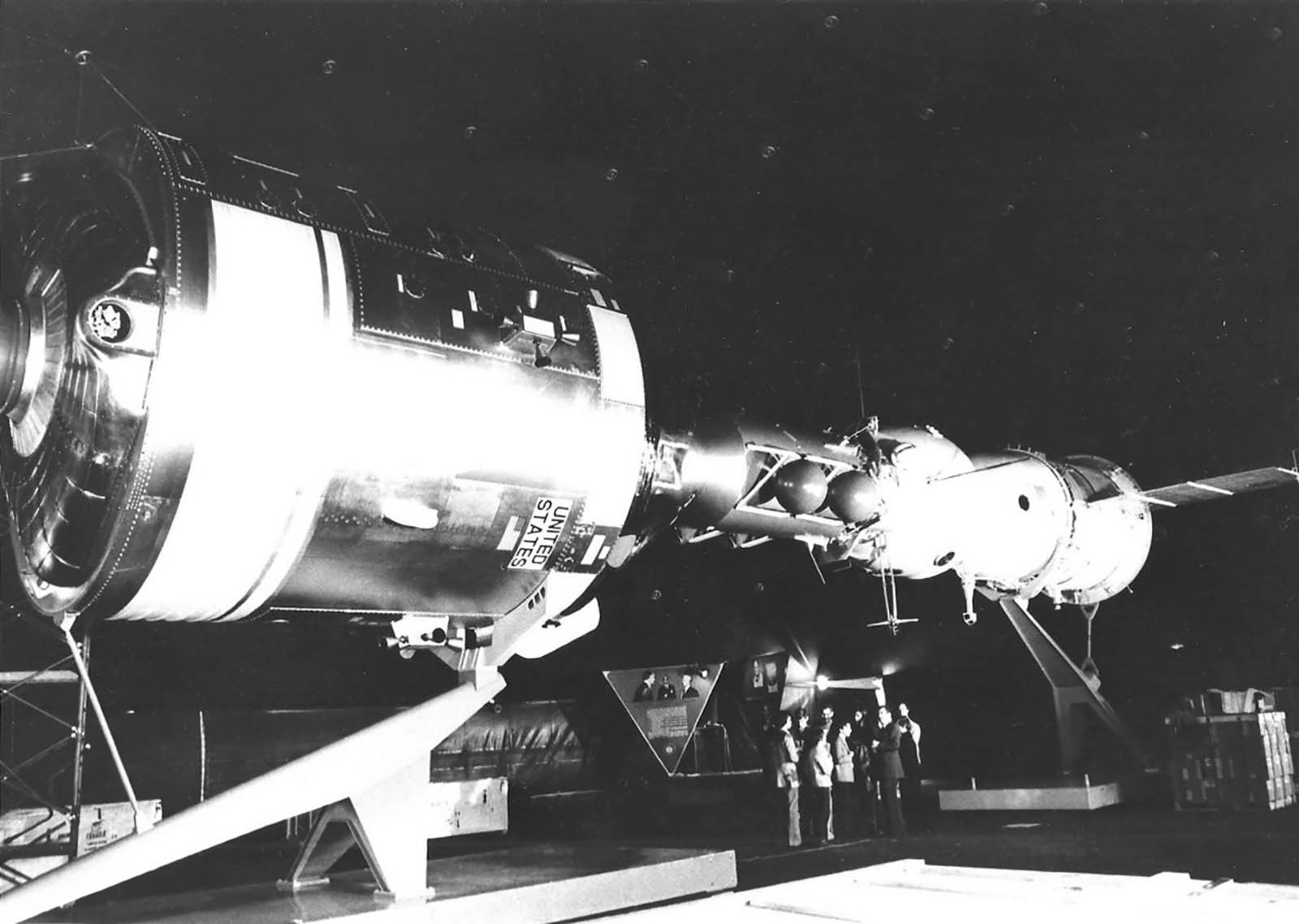
The ASTP exhibit in France was well received by the public until the very last hours it was open. The joint pavilion, the first exhibit to be seen upon entering the show grounds, stood in stark contrast to the military and commercial rivalry involved in other displays. In an editorial, Aviation Week’s Robert Hot indicated that the dramatic Apollo-Soyuz “docking display” was a svmbolic expression of growing cooperation in space. A happy and friendly event, the Paris presentation attracted 400 000 visitors, surpassing the unexpected attendance thirteen times. The camaraderie displayed by the cosmonauts and astronauts was a welcome sign; they had not always been so close.12
RIVALS AND FRIENDS
In the dozen years that had followed Yuri Gagarin’s flight, the astronauts and cosmonauts had met a number of times. But these first meetings had been shadowed by the cold war. John Glenn and German Titov had been the first rival spacemen to meet and exchange views, at the May 1962 COSPAR gathering in Washington. After the two men and their wives toured the capital and made a social call on President Kennedy at the White House, the space travelers held a news conference. Tito was circumspect in answering questions about his Vostok craft and would discuss space cooperation only in the context of disarmament.13
Three years passed before the next meeting. In June 1965, a very cool handshake was exchanged by three Americans- Vice President Hubert H. Humphrey, astronauts James A. McDivitt, and Edward H. White- and Yuri Gagarin. This encounter at a Paris Air Show luncheon took place after a formal meeting between these men had failed to materialize.14 In September of the same year, Gordon Cooper and Pete Conrad had a much warmer conversation with Leonov and Belyayev at an international meeting in Athens. As they exchanged lapel pins, the men agreed that they would have to meet again and compare notes about space flight.15
As the years passed, the cosmonauts and astronauts began to socialize more freely. At the 1967 Paris Air Show, Mike Collins and Dave Scott drank a vodka toast with cosmonauts Belyayev and Feoktistov, and Scott called for “greater cooperation between the United States and the Soviet Union.” To which, Belyayev replied, “Yes, in space.”16 In 1969, McDivitt, Scott, and Schweickart gave a tour of the Apollo 8 command module to cosmonauts Shatalov and Yeliseyev, who in turn treated the Americans to vodka and caviar served aboard a Yak-40 airliner being displayed at the Soviets’ Paris Air Show pavilion.17
A month later, in July 1969, Apollo 8 commander Frank Borman and his family were given an extensive sightseeing trip in the Soviet Union. Titov, Feoktistov, and Beregovoy escorted the Bormans around Star City and other space facilities. During their visit, Borman renewed the subject of cooperation, mentioning the possibility of joint missions in very general terms.18 American astronauts hosted a reciprocal goodwill trip for Beregovoy and Feoktistov at the end of October. During their two weeks of crisscrossing the United States, they visited an American Institute of Aeronautics and Astronautics conference at Anaheim, California, had a brief chat with President Nixon, and were guests of honor at a dinner in Houston thrown by 30 astronauts.19
By the time NASA and the Soviet Academy of Sciences began talking about a rendezvous and docking mission, meetings between astronauts and cosmonauts were almost commonplace. During 1970-1971, a half dozen meetings took place, in addition to Stafford’s trip to Moscow for the funeral of the Soyuz 11 crew and his subsequent visit to Star City in October. The atmosphere was considerably more friendly than in the Mercury-Vostok days. For example, when V. A. Shatalov was in Houston in 1972, he visited with Dave Scott and his family in their home, where they compared notes on such topics as child rearing and education. And when Scott led a delegation to Moscow in June 1973 as Lunney’s Technical Assistant, Shatalov and seven other cosmonauts gave the astronaut and two members of his team a complete tour of the facilities at Star City, including an opportunity to examine the Salyut trainer.20 Though from different social, economic, and political worlds, the astronauts and cosmonauts had much in common, both as professionals and human beings.
SPACECRAFT FAMILIARIZATION
At the March 1973 Working Group meetings, Shatalov, in charge of cosmonaut training, and Bob Overmyer worked to pull together a “Crew and Ground Personnel Training Plan,” ASTP 40 700, which defined the study and practice sessions that would be held for crews, flight controllers, and other control center staff. They agreed that there would be three training sessions in the U.S.S.R. and three in the United States. Instead of trying to second-guess the curricula for the second and third meetings, they planned to let the host country advise its guest team a month or so in advance of the training agenda. Any updated material should be added to the training plan by a document change notice. The length of the meetings would be kept flexible in an effort to provide an adequate stay for the orientations but not waste time. Cosmonauts would visit Houston in July, and the astronauts hoped to travel to Star City in the fall.21
In anticipation of the familiarization visits, the Soviets lowered another barrier in their space program during June 1973- they invited a delegation of American aerospace writers to visit Zvezdny Gorodok (Star City). Donald Winston and Robert Hotz of Aviation Week and John Shaw and Jerry Hannafin of Time were among those who toured the facilities. The correspondents were impressed by the vitality of the Soviet space program. Shaw reported: “Unlike the Johnson Space Center[*] in Houston, where major retrench-ments are underway, Star City is rapidly expanding--a sure sign of the Soviet Union’s continued dedication to the exploration of space.”22 Aviation Week agreed: The building activity underscores Russia’s determination to retain capability in manned space missions despite a series of set backs that has forced an unscheduled two-year hiatus in manned orbital flights by that country.23 From their conversations with General Shatalov, the reporters learned that the cosmonauts were making special preparations for work with their American counterparts.
* The Manned Spacecraft Center had been renamed in honor of Lyndon B. Johnson in a congressional act signed by President Nixon on 17 Feb. 1973.
Ten cosmonauts-the AST crews, Yeliseyev, and Shatalov-and four Soviet training specialists arrived in Houston with the rest of the Working Groups on 8 July 1973. At the request of the Soviets, a large block of time was set aside for them to listen to taped recordings of actual Apollo air-to-ground conversations. While getting a better idea of what they would be hearing during the mission, they also reviewed the “Glossary of Conversational Expressions between Cosmonauts and Astronauts during ASTP,” which was a step toward standardizing the mission language. This work was followed by a series of video taped presentations on the command and docking modules that had been prepared by Rockwell International and narrated by Alex Sementovsky, one of Rockwell’s Russian-speaking engineers.
Each of the video lectures was followed by a question and answer period. By presenting the basic material in Russian the first time, considerable training time was saved. These tapes, covering the design and operation of the Apollo spacecraft systems, were supplemented by handouts with the same material and illustrations, and both were taken home so the cosmonauts could spend as much time with the topics as they felt was necessary. After participating in a discussion with other Working Group I members on the “Joint Crew Activities Plan,” ASTP 40 301, each cosmonaut was given a ride in the command module simulator, so he could get a better understanding of how some of the command module systems worked and observe the simulator’s capabilities. Following that exercise, the Soviets had an opportunity to examine the docking module mockup and study its systems.24
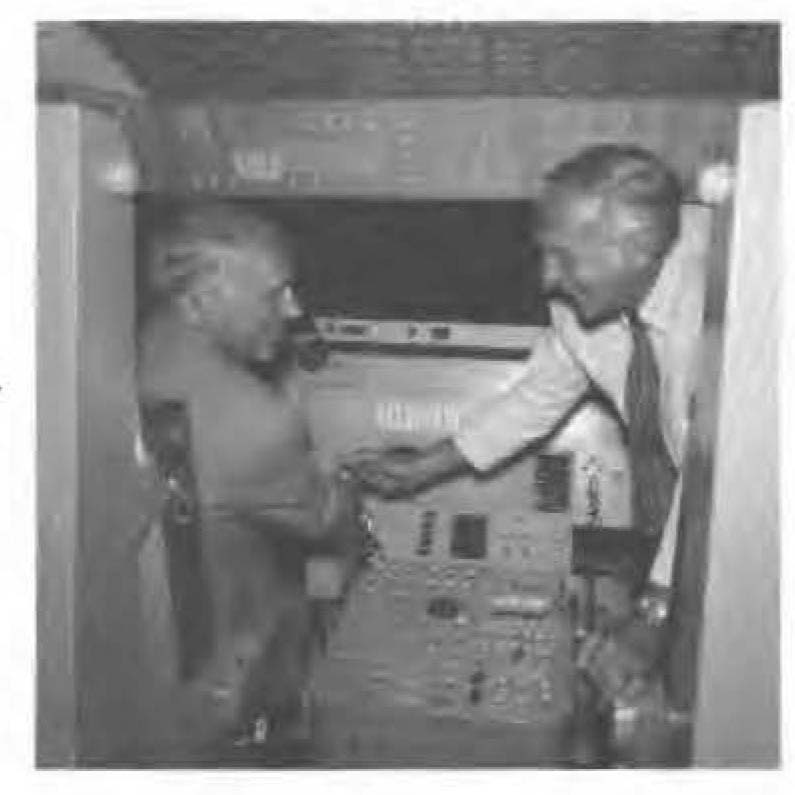
On 14 July, Lunney and Bushuyev accompanied the cosmonauts to Rockwell International’s factory at Downey. Once there, the Professor and his comrades were able to observe work being done on CSM 111, examine a high fidelity mockup of the docking module, and study the effects of reentry on several command modules stored at Downey. Their factory tour ended with a demonstration of the Apollo docking and entry simulators. The Soviets returned to Houston for another week of activities before departing for Moscow on 21 July.25
Visit to Rockwell Command and Service Module Production Facility at Downey, California, 14 July 1973
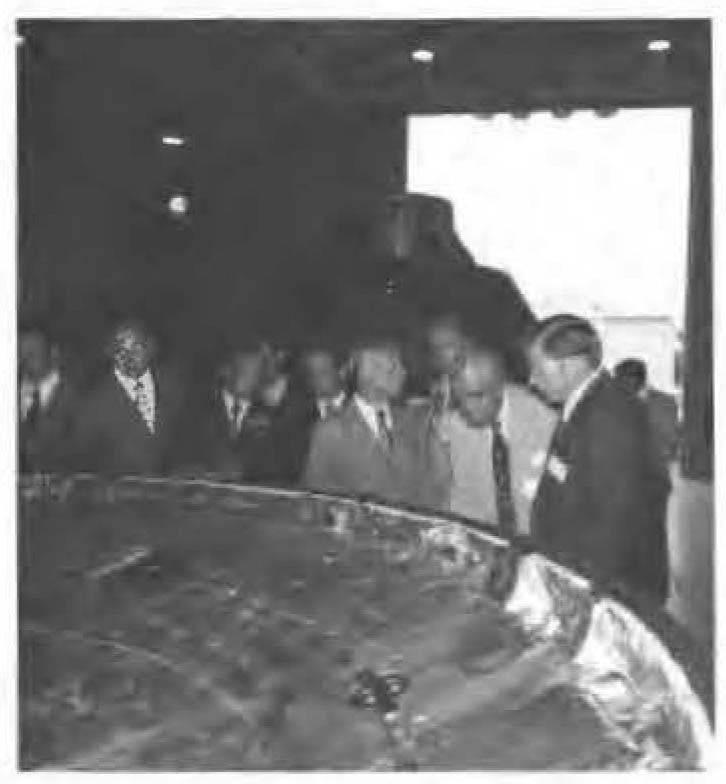
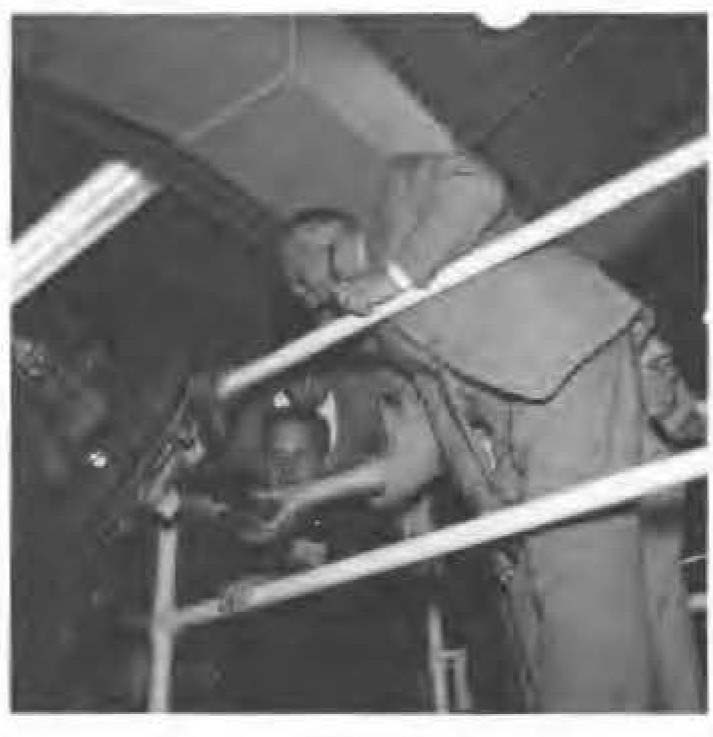
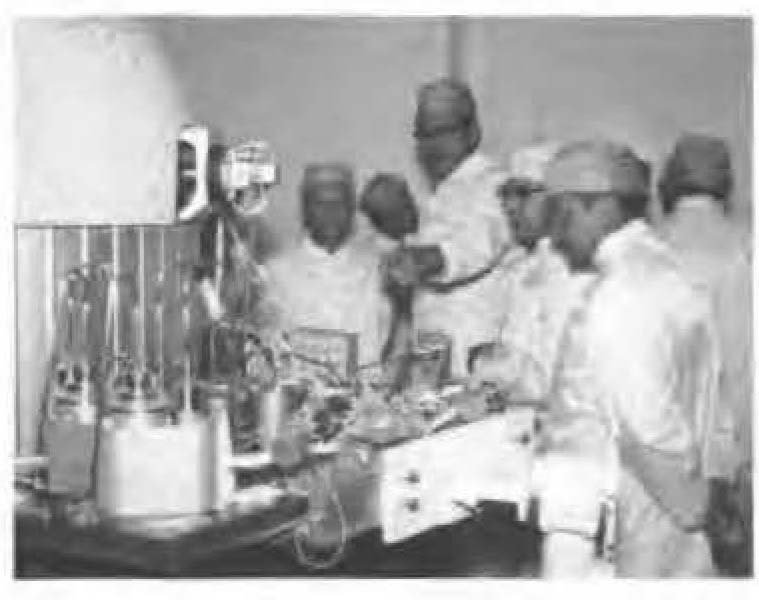
Reporters speculated that the Soviets had left when they did to avoid having to accept Glynn Lunney’s invitation to watch the 28 July launch of the second Skylab crew. Bushuyev, when questioned at the press conference closing the two-week stay, said that they had accomplished all of their objectives and that remaining for a third week would have presented “difficulties for some of [our] side because some of the participants in our delegation have duties at home which cannot be postponed.”26 Whether the Soviet spokesman was making excuses or whether some members of his team were going home to prepare for the launch of Soyuz 12 is unclear. Nevertheless, the termination of the meetings was completely in line with the agreement not to waste time. The cosmonauts had completed their work, and they and the astronauts would begin readying themselves for their Moscow session.
DO YOU SPEAK RUSSIAN?
During the winter of 1972 the Manned Spacecraft Center (MSC) created the civil service position of Russian Language Officer, and Nicholas Timacheff filled that slot on 2 January 1973. His duties were varied and included supervising the interpreters who worked during the joint missions, the contractor who provided translators who in turn worked on the documentation and the Russian language training for the American flight crews. In addition, Timacheff and his assistant, Donalyn Epstein, filled in as interpreters at meetings and telecons, reviewed movie scripts, and oversaw the compilation of a commonly accepted English-Russian/ Russian-English glossary for ASTP.
Language training was a major challenge for the crews, despite Tom Stafford’s comments to the press during the July meeting that Russian was nyet problém.27 During the fall of 1972, language training had been discussed in Washington and Houston, and all parties agreed that a formal program of instruction was needed to supplement the personal studies in which some of the astronauts were engaged. There appeared to be three possible approaches enroll the astronauts in a formal course such as those offered by the State Department Foreign Service Institute or the Department of Defense language schools; contract with a university to provide instruction; or bring instructors to the space center to work with the crewmembers. The language schools required a full year of residential study, and the crew obviously could not leave their other activities for that length of time. Johnson Spacecraft Center (JSC) management also preferred to keep the work within government circles in an effort to keep costs down; that ruled out universities. Early in 1973, Lunney, Timacheff, and the others finally agreed to try having instructors from the Foreign Service Institute work at JSC with Slayton and Stafford for short stretches to see if this approach would be satisfactory. Vance Brand and the backup crewmen would begin language studies once their commitments to Skylab were completed.28
By the time the Soviets arrived for the July training sessions, Slayton had received nearly 140 hours of Russian instruction, and Stafford 115. Between August and the November trip to Star City, Slayton raised his total to 245, and Stafford to 225. A year earlier, Deke had noted in a memo that he hoped “all will consider adequate” 300 hours of language training.29 But having nearly reached that point, Slayton and Stafford realized that many, many more hours of studying Russian would have to precede the flight.
STUDYING IN STAR CITY
The American AST crews visited the U.S.S.R. in mid-November 1973 for eleven days of spacecraft familiarization. In addition to the Soviet crews and training specialists, the U.S. prime and backup crews, two support crewmen (Overmyer and Bobko), Gene Cernan,* Nick Timacheff, and John E. Riley, a Public Affairs Officer from JSC, were present at the Yu. A. Gagarin Cosmonaut Training Center in Star City. Following the pattern set by the JSC crew training staff in July, the Soviets presented nine videotaped lectures to the visiting astronauts. Starting with a description of the Soyuz flight from launch to rendezvous, undocking to landing, the television tapes covered a number of significant aspects of the Soviet craft. This set of lectures and their subsequent study of the mockups and trainers gave the astronauts a better feel for the Soyuz flight control systems and onboard displays and the environmental controls for oxygen generation, temperature levels, and food, water, and waste management. Details of radio and television communications equipment closed the presentations.30
* Cernan had replaced Dave Scott as Lunney’s special assistant after Scott left in Aug. 1973 to become Director of NASA’s Flight Research Center, Edwards, Calif.
During the course of their stay, the astronauts had ample opportunity to become acquainted with the Soyuz general purpose and docking simulators and the Soyuz and Salyut mockups. They listened to recordings of air-to-ground conversations from an earlier Soyuz mission and discussed an even longer list of common terms that would be used during the flight. Finally, they went over with their hosts the “Joint Crew Activities Plan” and the “On Board Joint Operations Instructions.” The Soviets gave them copies of the video tapes, hardbound copies of the scripts, which were illustrated with line drawings, and tape recordings of the air-to-ground communications.31
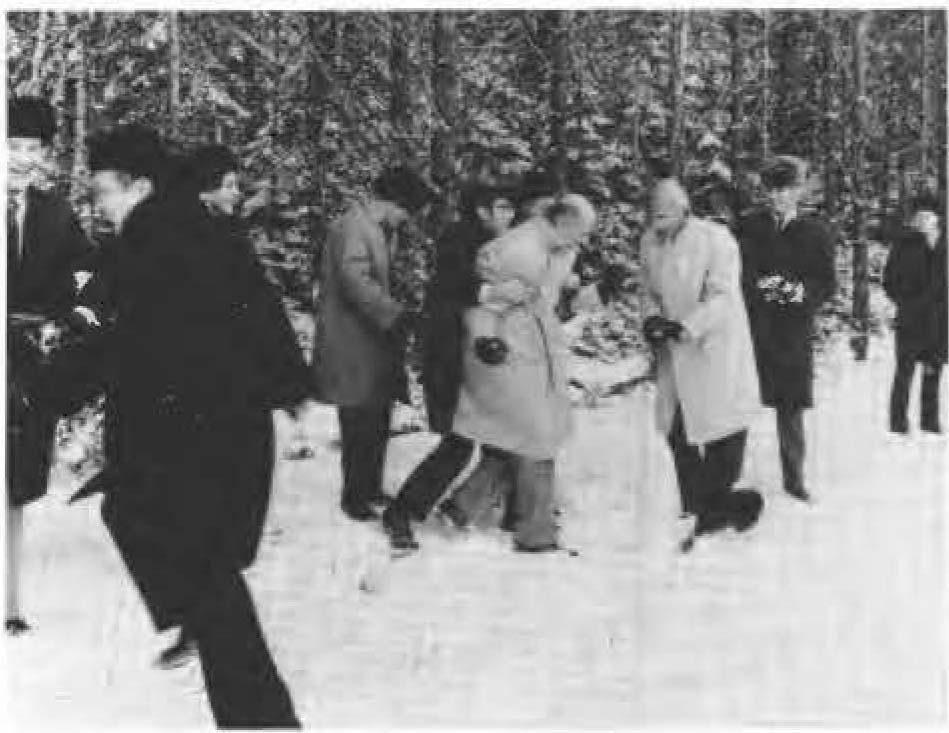
In addition to the classroom instruction, the astronauts participated in cosmonaut physical training activities and social events. During non-working hours, the two space teams jogged, swam, and shared steam baths. At one point during a rest stop on their journey between Star City and Moscow, they engaged in a snowball fight, a rare treat for the men from semitropical Houston. Their crowded agenda also included a trip to the ballet, where the astronauts were literally showered with bouquets of roses by young ballerinas. But the snow covered fields of Russia were quickly followed by the mild winter of Gulf Coast Texas. And with the return to Houston came more detailed preparations and training for the flight.
TESTING HARDWARE
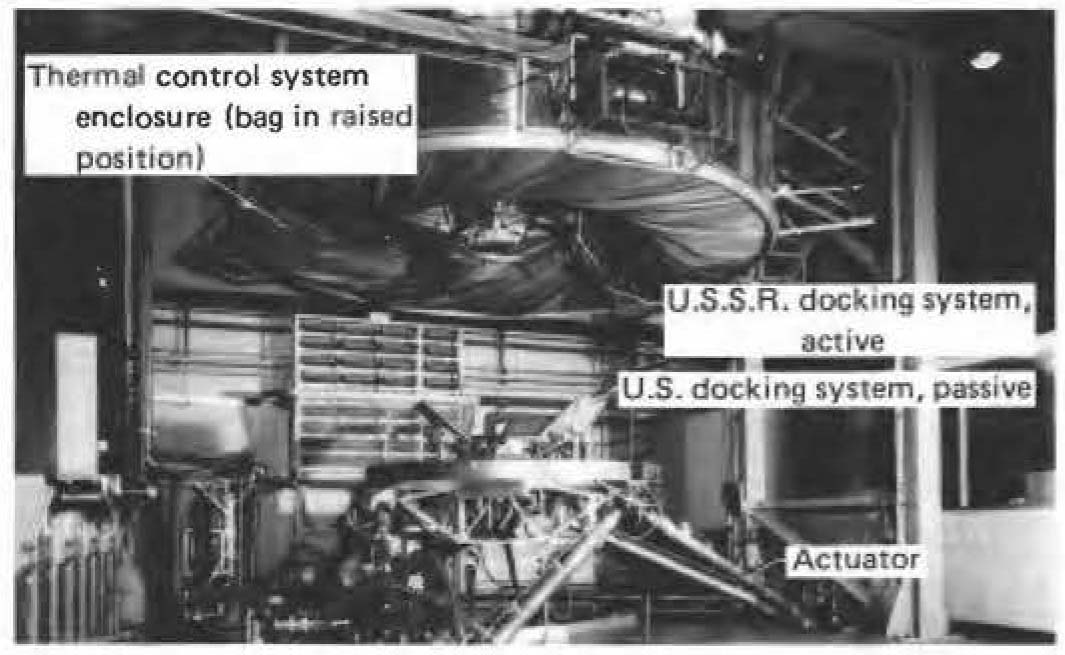
While the crews were beginning to study spacecraft systems related to the mission, progress continued in readying the hardware they would ultimately fly. From 16 September to 24 December, Working Group 3 conducted tests with the developmental version of the docking system. This first piece of full scale equipment had been built from the engineering drawings as they had been perfected to that point, and while it was still far from being a flight-ready item, this version of the docking system was subjected to careful analytical and operational scrutiny on the computer-driven Dynamic Docking System Simulator (DDTS). Housed in the JSC Structures and Mechanics Laboratory, the DDTS was capable of duplicating the most severe impacts and thermal conditions that could be anticipated when the docking systems were brought together in space. The test program consisted of 236 test runs, which subjected the American and Soviet gear to temperature ranges of - 50° to 70° centigrade and to the active and passive modes.
A team of eight Soviet specialists, led by V. S. Syromyatnikov and Ye. G. Bobrov, worked with the regulars of Group 3, plus the test personnel in George E. Griffith’s Structural Test Branch, computer people from the Spacecraft Systems Laboratory, and contractor employees who operated the DDTS. The extremely complex facility had been completed just before the Soviet team arrived, and some initial problems were encountered with the simulator, taking time away from the scheduled testing. According to Bob White, who had overall responsibility for the tests, “this caused team members from both countries to dedicate many extra hours at night and on weekends for make-up testing. Everyone worked admirably without complaining and a strong sense of mutual respect became discernible.” Although the schedule was very demanding, one weekend was set aside for a private tour of the State Capitol and the Governor’s office in Austin, as well as the engineering college and the Lyndon B. Johnson Library at the University of Texas.
During this fourteen-week evaluation process, a number of minor changes were incorporated into the design. But since there were no failures or major problems with either the U.S. or U.S.S.R. docking system, manufacture of the flight hardware could proceed on schedule. While the flight and backup systems would be subjected to a much more rigorous quality assurance program while being manufactured, the dynamic docking tests of the prototype system had been an essential step in defining the characteristics of that production equipment. With all the extra work completed, the Soviets departed on Christmas day, and many of the Americans, accompanied by their families, traveled to the Houston Intercontinental Airport to wish their friends a safe journey.32
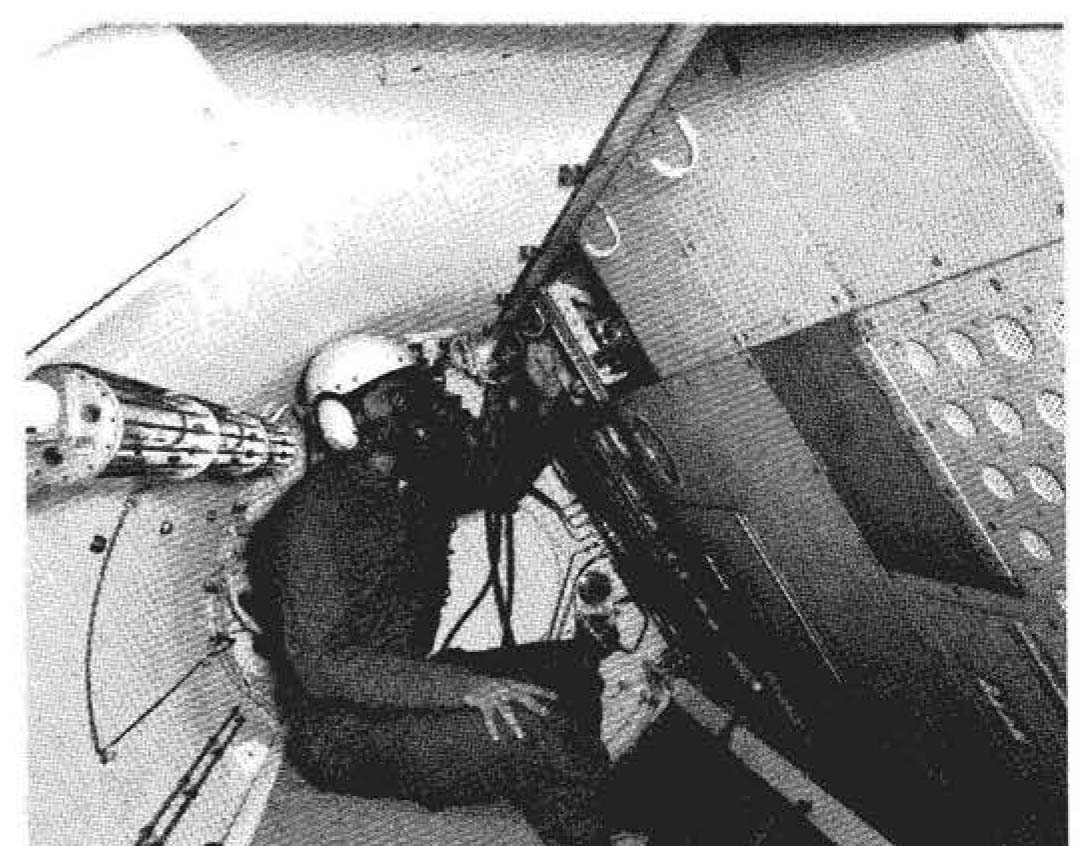
During mid January joint meetings held in Houston, the Soviets participated in tests of the docking module environmental control systems (ECS). As in the case of the development of the docking system, the breadboard version of the docking module ECS was designed to check out the operational and functional characteristics of the prototype equipment prior to fabrication of flight hardware. Although the test hardware was different in appearance from the final docking module and although the Apollo and Soyuz transfer tunnels were simulated by two pressure vessels, the ECS test hardware functioned like the real thing. The ECS breadboard was placed in the Life Systems Laboratory vacuum chamber, a horizontal cylinder 2.44 meters in diameter and 5.8 meters long. The chamber, divided by a bulkhead into two compartments, consisted of a manlock passageway and a test chamber to house the test article. Like most test facilities at JSC, the vacuum chamber was equipped with a closed circuit television system, which permitted remote viewing of the manlock compartment, the breadboard ECS, and the test chamber interior, and also equipped with a multi-channel intercommunications system, which linked all test personnel.
The joint tests, which ran from 16-23 January, were divided into two major categories--manned simulated mission tests and unmanned functional performance tests. During the manned tests conducted on 16 January, the performance of the system was demonstrated by simulating three transfers, during which the docking module environment reflected extreme situations that were not likely to occur during flight. By testing extreme cases, the suitability of the systems was scrutinized and the acceptability of manned operation under low or high oxygen pressures was determined. Later, unmanned functional performance testing was conducted to establish the leakage rates for the test chamber and to verify the major failure protection systems included in the docking module ECS. Results from these exercises indicated that the environmental control system met all the design specifications and that the transfer procedures were adequate in both normal and emergency situations. In addition, all of the safety equipment, such as the overpressure valve, performed successfully. 33
Next came familiarization training for the American AST crews with this hardware. After the completion of the last Skylab visit on 8 February, all of the crewmembers were given briefings on the docking module systems. On 25 February, they participated in a two-hour walk-through of the ECS breadboard and test setup. The following day, after a four-hour Skylab debriefing in which all ten AST crewmen were involved, Brand and Evans took the first turn in the vacuum chamber to learn the ECS equipment and to practice transfer. Stafford and Slayton went through the same four-hour experience the next day, as did Bean and Lousma on 5 March. The crews were also increasing the number of training hours spent in the command module procedures simulator and command module simulator. And if that were not enough, they had met on the 4th with their new Russian instructors and had begun a new series of intensive lessons.34
Slayton and Stafford had not resumed their language studies after their last return from Star City, and the other crewmembers needed to begin learning Russian. During the November 1973 training sessions in the Soviet Union, the U.S. astronauts had discovered that the cosmonauts had made significant progress in their English studies. When Stafford asked Leonov how they had made such advances, he told the Americans that each member of the Soviet prime crew had his own individual instructors. They were studying language six to eight hours a day. Stafford cabled Washington through the American Embassy in Moscow and requested that the State Department’s Foreign Service Institute provide the astronauts with two full-time Russian instructors starting early January. Stafford later told Chris Kraft that the American crew was going to look bad if its members were unable to communicate satisfactorily with their Soviet counterparts. They must get some full-time language training.35
Given the need for additional instruction and the desire to keep abreast of the progress being made by the Soviets, Nick Timacheff was authorized to locate professional teachers who could work with the astronauts. Timacheff screened a number of applicants during the post-Christmas convention of Slavic language professionals in Chicago. Four teachers were selected for their knowledge of contemporary vernacular Russian as opposed to the language as spoken by diplomats. Anatole A. Forostenko, Vasil Kiostun, James D. Flannery, and Nina N. Horner would learn as they taught, since they would have to teach their students the Russian equivalents of NASA’s aerospace jargon. While Nina Horner concentrated on lengthy hours of classroom instruction, Forostenko, Kostun, and Flannery accompanied the astronauts on many trips and worked out with them in the gym in an effort to keep them thinking Russian-even when they were playing handball or lifting weights. Starting on 4 March, the prime and backup crewmembers received 3 or more hours of language instruction daily, five days a week. In their spare time, if they were not flying T-38s to keep their reactions sharp, they had cassette tape recorders by their sides to keep their ears sharp.
While the crewmembers studied, Working Group 5 specialists led by Walt Guy went to Moscow to observe testing of the modified Soyuz life support system. American technicians visited a Red Air Force base about 6 kilometers from Star City where the Soviets had their vacuum test chambers. The main test chamber used for the Soyuz tests was composed of a horizontal manlock and a vertical cylinder that was sufficiently large to hold a stacked descent vehicle, orbital module, and docking module simulator. Guy noted the similarities and differences between this test facility and the one in Houston, a major difference being the lack of communications headsets among the test personnel. He commended, “The close proximity of the test crew to each other and the exceptionally quiet test environment . . made the public address system quite acceptable.”
Among the systems evaluated during the tests were those for lowering and raising the Soyuz cabin pressure to determine the effect that transferring men from one spacecraft to another had on the gas composition under normal and abnormal conditions. Guy, Group 5’s American chairman, reported later that he came away from the tests with no doubts that the Soviet ECS would work satisfactorily. He had been somewhat concerned about the basic uncontrollability of the chemical bed oygen system, but after prolonged simulated transfers into the docking module mockup followed by flushing all the docking module gases into Soyuz, the Soviet ECS proved capable of removing the carbon dioxide and other effluents from the atmosphere. At the Americans’ request, the trial runs involving four men were longer than the transfers planned for the actual mission; therefore, this was an excellent evaluation of its capabilities. After working with the Soviets in their laboratory, the U.S. team grew confident that there would be no problems with the U.S.S.R. equipment. This was exactly why Glynn Lunney had wanted his men to participate in such activities.36
DEVELOPING FLIGHT PROCEDURES
At the next meeting of all the Working Groups in April 1974, V. F. Bykovskiy joined Leonov and Kubasov as their instructor in developing flight procedures that would be practiced at the sessions scheduled for mid-summer in Star City and September in Houston. Their work began on the afternoon of 15 April, when the prime crews and Bob Overmyer spent an hour discussing the training that remained before the flight. Then after meeting briefly with the press on the morning of the 16th, they got down to work. Astronauts Bean and Evans worked with the Soviets in the command module simulator until lunch, and Overmeyer and the American prime crew spent that afternoon with them, evaluating docking procedures. The remaining eight work days were just as busy. Wednesday was spent with survival training and a review of the Russian-English glossary. On Thursday, the Soviets and Vance Brand received a briefing on the 16-millimeter movie camera, after which they worked out in the gym. They went over the flight plan with the other astronauts and training personnel that afternoon. The entire team met for briefings on the docking module and trainer on Friday.
Nearly all the second week was devoted to learning to operate the docking module equipment during transfers, using the high fidelity mockup to verify the in-orbit transfer activities. They worked through the hundreds of necessary procedural instructions, like those required to establish the integrity of the seals and latches connecting the module to the spacecraft. Besides the 12 hours spent in the docking module trainer, the cosmonauts worked some more on the flight plan, practiced with the communications equipment, received an Apollo television camera briefing, and spent 3 hours in the command module simulator with Brand and Bean, working on the final stage of Apollo’s rendezvous and approach to Soyuz.37 Stafford, speaking to the media on 26 April, said that the training session had been a “rewarding experience.” In the case of crew transfers, considerable progress had been made.”For example,” Stafford indicated, “the second day we tried it, we did it in about one-third the time that we did the first day.” The reporters, it seemed, were also interested in the language question.
Bruce E. Hicks of United Press International asked Tom Stafford how the Americans were handling Russian. The general responded in Russian, and Leonov translated for him, replying that Stafford said that he understands the Soviet crew. Leonov added, “We’ve no problem in language.” He went on to say that during the transfer training they had worked out the communication format that they planned to use during flight.”Our work is considerably better when the American crew speaks Russian and our crew speaks English,” the Soviet commander said.”This forces us to maintain a considerable amount of discipline, to be attentive to each other, and to speak ... much more clearly.”38
Each of the subsequent meetings between the astronauts and cosmonauts stressed language exercises. At the 24 June to 11 July training session in Star City, every crewman received 10 hours of communications practice, which generally involved speaking over an intercom to a counterpart in a different office. Reading from a script, they could simulate the conversations that would pass between Apollo and Soyuz. This experience not only gave them an opportunity to improve their pronunciation but also introduced Leonov and Kubasov to Russian spoken with a Weatherford, Oklahoma, accent.”Soyuz, ehto Apollon. Stuikovka na pyat minut....” This is what Stafford might say as his spacecraft closed the gap between the two ships. Leonov would reply, “Apollo, this is Soyuz. I understand; docking is in five minutes.”
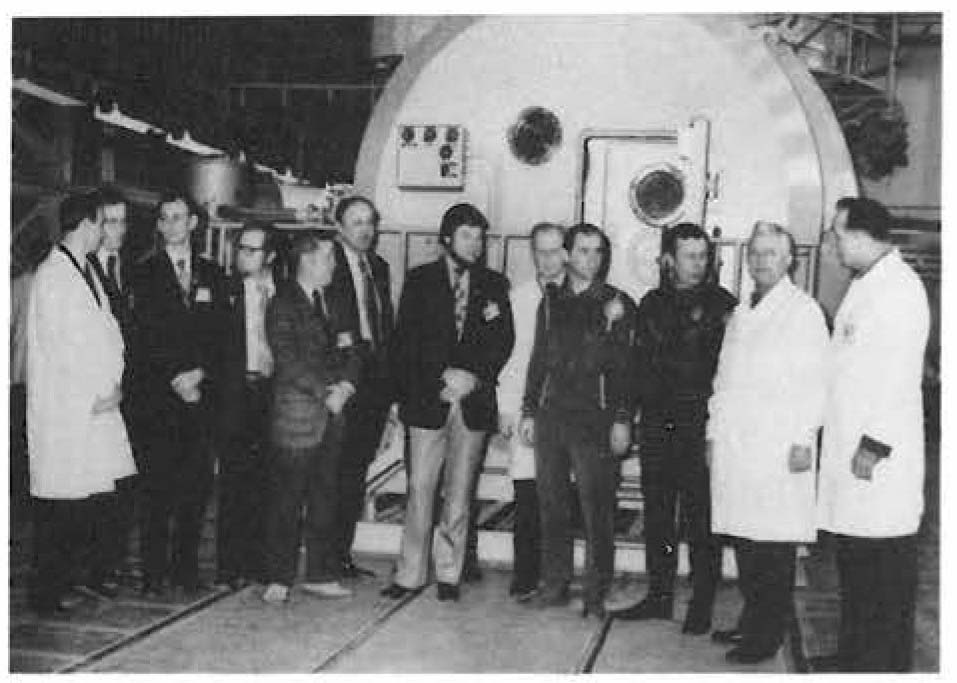
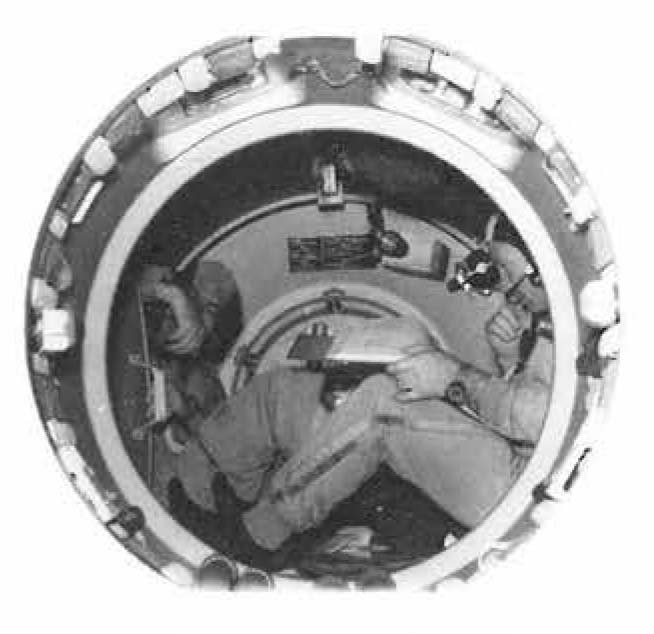
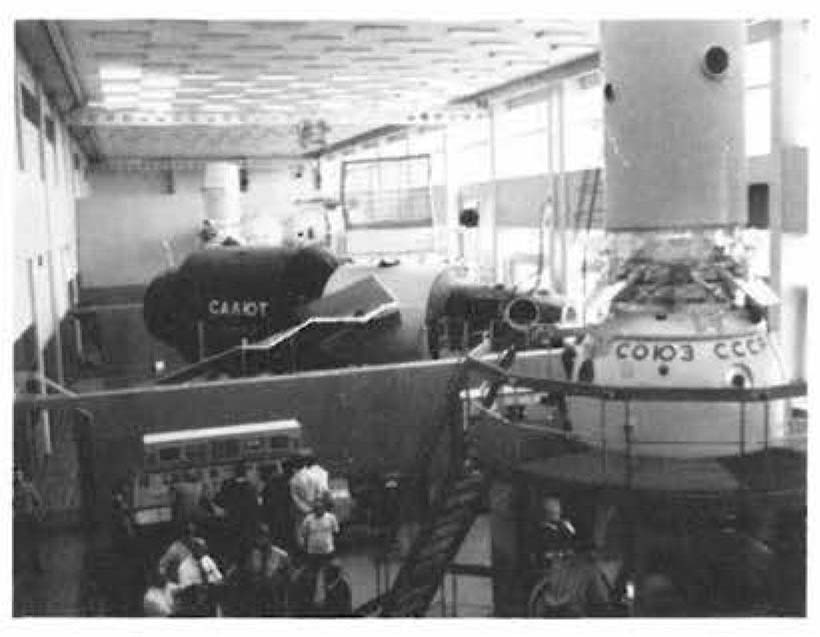
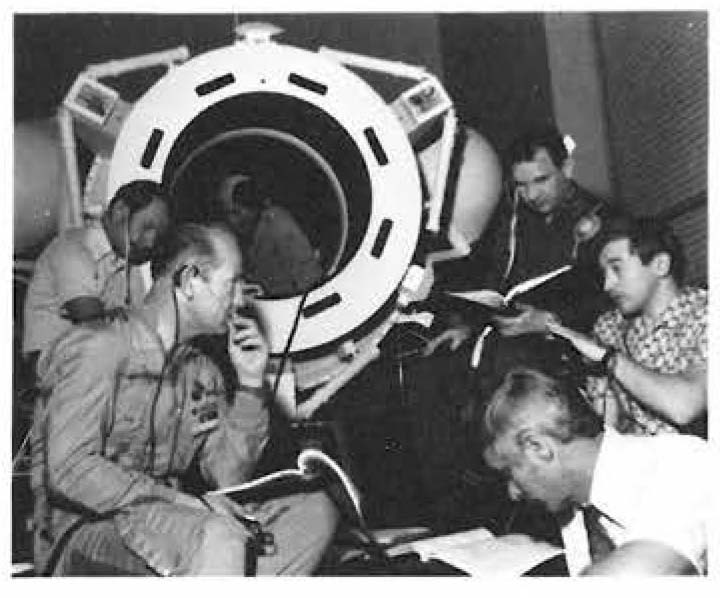
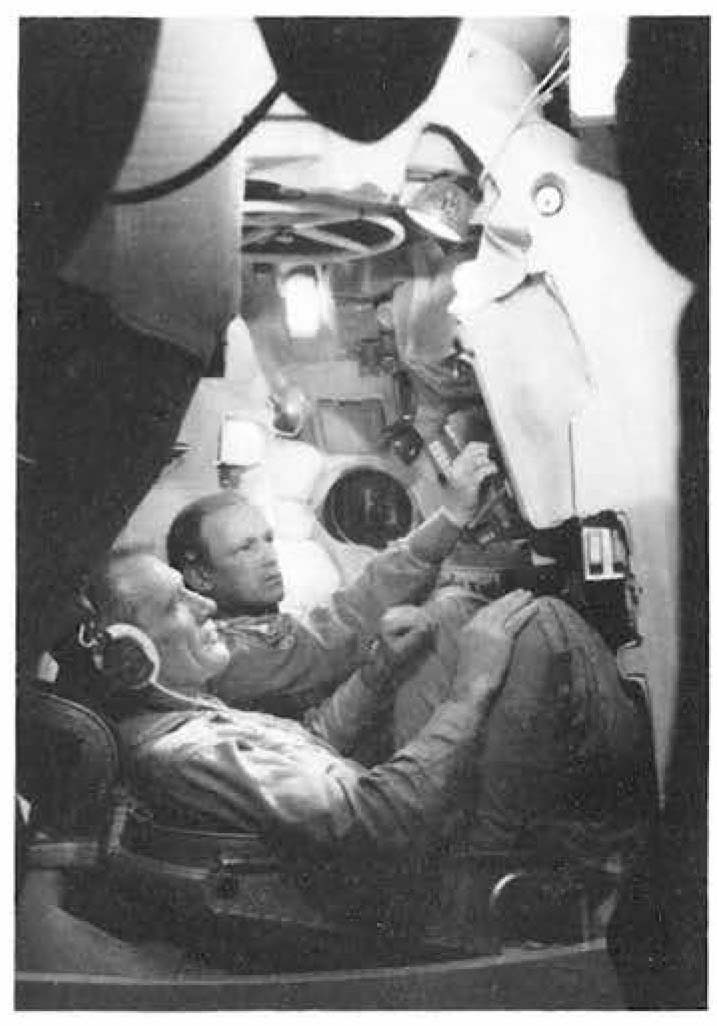
But there was time for some horseplay during that summer session in Russia. Ron Evans had brought half a suitcase of fireworks with him in anticipation of the Fourth of July. After attending the American Ambassador’s cocktail party, the Soviet and American crews returned to the astronauts hotel at Star City. About dusk, Evans began the show, setting off a string of firecrackers. Stafford recalled that “it sounded like a machine gun and all the lights were going on in the building across the lake. Pretty soon you could see all these flashing lights. ...” Once the police arrived, they formed a huddle. At this point, Stafford cried, “Hey, let’s give them a bottle rocket!” With that, they fired a small rocket from a mineral water bottle, and it arced over the heads of the policemen. Finally one of the officers approached the Americans. Stafford called out in Russian, “Dobriy vecher. Kak vi pozhivaete. [*] . .. It is the day of our revolution,” he explained. The official nodded that he understood the astronaut’s explanation and retired with a look of amazement on his face.39
* Good evening. How are you?
At the September exercises, the Americans had created a more elaborate simulation of inter-spacecraft communications. Working from a script prepared by the American crews and their language instructors, Leonov and Kubasov sat on one side of a glass-partitioned laboratory in the Flight Crew Training Facility at JSC and the Americans on the other side. This additional practice with flight conversations, coupled with further language training for both crews and more experience with hardware mockups, improved their ability to communicate with one another. As with all other aspects of preparing for the flight, learning Russian and English was an essential expenditure of long hours and hard concentration for both sides.40
QUESTIONS ABOUT SOYUZ
Concurrent with their training exercises in 1974, the astronauts became involved in a renewed controversy over the flightworthiness of the Soviet spacecraft. The first phase of this debate opened with the publication of two articles in Aviation Week that argued that Soyuz was a very marginal design when compared to Apollo, especially in the area of guidance and control. These stories, which came from conversations with some NASA astronauts, made several strong judgments about the quality of Soviet hardware, stating: “In some areas, Soyuz capability is below that available in the Mercury spacecraft flown by American astronauts almost 13 ears ago.”41 At the time these items were written, the NASA team still did not fully understand the operation of the Soviet spacecraft control systems. In fact, when the astronauts returned to Star City in June, they were given at their request a briefing on these systems by V. P. Legostayev to clear up several points of confusion resulting from data presented to them the preceding November.
Legostayev and his colleagues had created control systems for Soyuz that were sufficient for the earth orbital missions that the craft was expected to fulfill. From the start, Soyuz was basically a vehicle designed to be controlled automatically from the ground. As various unmanned Cosmos flights had indicated, Soyuz-type ships could be directed to rendezvous and dock from the ground. When manning Soyuz, the cosmonauts acted more as systems monitors than as pilots. This approach to manned space flight and the limited activities demanded in earth orbit meant that the Soviet designers did not need to develop the more complex guidance and navigation equipment that had been required for Apollo’s trips to the moon. They relied instead on sun sensors and earth horizon observation, plus limited use of gyroscopes for navigation and guidance.
In this area, Soyuz and Apollo represented completely different approaches to a problem. For American astronauts who were used to having their hands on the controls and flying by the seats of their pants, Soyuz was not the kind of ship with which they would feel comfortable. Being a passenger was not their cup of tea; thus, it was not unreasonable for them to make negative comparisons of Soyuz to Apollo. But such value judgments were at best subjective. The Soviet approach was not worse than the American way of flying-it was simply different. When Aviation Week took the facts of the difference in design and coupled them with astronaut opinions, it sounded as if the Soviets had an inferior spacecraft. Not surprisingly, the Soviets were offended by these comparisons, and Glynn Lunney cautioned his people to take care how they evaluated Soviet hardware when talking to the press. He advised them to stick to the facts and to beware of editorializing. He suggested that only a “damn fool” would mix fact with opinion.42
Phase two of the argument over the reliability of Soyuz started with the apparent failure of Soyuz 15 to complete its mission. Successful flights of Soyuz 12 (September 1973), Soyuz 13 (December 1973), and Soyuz 14 (launched for a 14-day mission during the June-July 1974 visit of the astronauts to Star City) had helped to reassure many of those public figures who were still worried about the Soyuz 11 tragedy. When Soyuz 15 failed to dock with Salyut 3 and returned to earth after just two days and made a night landing, cries arose from Capitol Hill and in the news media, questioning once again the wisdom of the joint flight.43 Most vocal among the congressional critics was Senator William Proxmire, who wrote to Administrator Fletcher asking for a complete safety review of Soyuz prior to the ASTP mission.”In particular,” he recommended “that the National Aeronautics and Space Administration go slow and proceed with all due caution.” And he felt that “present plans for a joint space mission should be seriously re-examined in light of the continuing difficulty in the Soviet program.” Proxmire said that he did not want the space agency to take chances with the lives “of our astronauts for the sake of some untangible diplomatic benefits of detente.”44
While the Senator’s concern was understandable, he was ill informed if he believed that anyone within NASA was about to gamble with the safety of either the American or Soviet crew. The whole purpose of exercises such as the safety assessment reports was to identify problem areas and establish that such potential trouble spots would not affect the execution of the mission. Lunney, in a regularly scheduled telephone conversation, had discussed the Soyuz 15 mission with Bushuyev on 27 August, the day after it was launched, and the Professor had told him that it was in no way related to AST, contrary to some media speculations. Bushuyev said it was a test of automatic docking systems.45
At their 26 August-20 September 1974 meetings in Moscow, Lunney and Bushuyev talked at considerable length about Soyuz 15 and the Cosmos 638 and 672 flights. The latter, flown in April and August, were unmanned tests of Soyuz as modified for AST, and they were unqualified successes. As recorded in the joint minutes, the objective of Soyuz 15 was:
the testing of a system of automatic approach and docking. This system is not used in the Apollo-Soyuz program. All Soyuz 15 systems that are analogous to those used in the AST flight worked in a satisfactory manner. During the final phase of approach not all of the monitored parameters for approach and docking were within the prescribed range. The crew, therefore, in accordance with previous instructions, switched off the automatic approach and docking system. Following completion of the planned flight program, the preplanned night landing was achieved for the purpose of verifying the feasibility of ...a night landing.46
In addition to the discussions between the Technical Directors, the American crews were briefed by the cosmonauts.
On 11 September 1974, Tom Stafford raised the Soyuz 15 issue in a Houston press conference. He said that he had been given the full story by General Shatalov at the beginning of their current training session. Since there was still some concern about the flight, however, Stafford gave the floor to Shatalov who had agreed to answer queries from the press. Shatalov told the reporters that Soyuz 15 had been a test of a svstem to permit automatic docking with Salyut, since one of the long range goals of the Soviet space program was the use of unmanned resupply craft that could dock with the space station and automatically transfer fuel and supplies. Cosmonauts G. V. Sarafanov and L. V. Demin had flown the mission to observe the functioning of the new system, and the Soviet spokesman reminded the press that this was the traditional role of the test pilot.
Further, he pointed out that while NASA might rely more heavily on ground-based simulations, the Soviet space engineers had traditionally flight tested their spacecraft. In the case of Soyuz 15, when it became apparent that the systems were not working properly, the flight was terminated.
Again, these experiences were not unusual in the business of flight testing hardware.47 Phase three of the Soyuz reliability debate came with the successful flight of Soyuz 16. Manned by the number two AST prime crew, Filipchenko and Rukavishnikov, this flight was a full dress rehearsal of the Soviet half of the joint mission. From the afternoon lift-off at 12:40
Moscow time on 2 December to the morning landing at 11:04 on the 8th, the flight of Soyuz was nearly perfect, and the results of the test of life support, docking, antenna deployment, and ground control systems were excellent. Shortly after launch, the Soviets had notified the Johnson Space Center, so the Spaceflight Tracking Data Network could begin tracking the spaceship.48
Lunney’s team in Houston had known that the Soviets were planning a manned flight for the end of 1974. In fact, the Soviets had been prepared to give the Americans advance notice of the launch.
It was agreed that during the upcoming manned Soyuz flight which is a precursor test flight for the ASTP mission, the American side will perform Soyuz spacecraft tracking with their own ground tracking stations and the two sides will subsequently compare tracking data. The American side will be informed about the launch date and planned orbital parameters 5 days prior to launch. State vectors of the spacecraft will also be provided after insertion into orbit.49
Subsequently, the Soviets added the restriction that this information would be given to NASA only if the agency agreed to withhold it from the press until the flight had actually begun. After lengthy discussions, which involved George Low, Glynn Lunney, Chet Lee, Arnold Frutkin, and John Donnelly, it was concluded that NASA’s tracking Soyuz 16 could be considered a joint activity.50 To withhold details from the public concerning such an exercise would not be consistent with the agency’s traditional practice of providing information. On 11 October, Lunney telexed Bushuyev:
We appreciate Soviet desire to make own announcement of launch notice and launch. However, because of our own involvement in this activity, we would find ourselves in a difficult position if we could not report this information to our press. Therefore, we prefer to receive no information in this case until you have released it or we can release it. When we learn of the launch under these conditions we will initiate tracking activities. . . . 51
At 6:35 Houston time on the morning of 2 December, V. A. Timchenko called JSC. The security guard who took the early morning call said that Mr. Lunney was not yet in his office. At the Soviets’ request, the guard notified the U.S. Technical Director that Moscow would be contacting him by telephone at 8:15. Less than two hours later, Timchenko and Lunney were talking about the mission manned by Filipchenko and Rukavishnikov. Lunney in turn advised the tracking team, giving them the data provided by Timchenko. These mathematical statements of the spacecraft’s location and velocity at a given time would permit the tracking stations to follow its path, an exercise that was essential for the rendezvous part of the joint mission.52
Bushuyev gave Lunney brief reports on this ASTP precursor flight during telecons on 3 and 8 December. Subsequently during the winter meetings in Houston, he provided full details of the Soyuz 16 mission to the American members of Working Group 4. On 31 January through his interpreter, Yu. S. Zonov, the Professor told Lunney that the flight had been a complete dress rehearsal for the Soviet portion of ASTP. The Soyuz spacecraft was identical to the one that would be flown in July, and the Soviets had designed the December flight plan to check out key parts of the ASTP plan. Of particular interest to the Americans were the reports provided by Bushuyev on the functional tests of the modified life support system. (See box below.53)
Life Support System Operation Timeline: Checkout of ASTP Modifications to Spacecraft During Soyuz 16 Flight*
| Ground elapsed time (hr:min) | Operation |
|---|---|
| Pre-launch preparations | |
| -3:30 | Descent vehicle gas analyzer, orbital module gas analyzer, and pressure integrity check unit activation. |
| -2:30 | Crew in pressure suits ingresses vehicle: SC connects his PG to OM fan assembly, activates OM panel and PG fan assembly, and begins pre-launch OM examination. FE ingresses DV, connects his PG to DV fan assembly, activates CSD and PG fan assembly, and begins pre-launch DV examination. Following examination, SC deactivates PG fan assembly and OM panel, disconnects PG from fan, transfers to DV, connects PG to the DV fan assembly and activates it. DV RA activation. |
| -1:30 | Begin status and operations check of DV systems. Close hatch 5. Close OM ingress hatch. Pressurize OM with 125 mm Hg of oxy-gen. OM pressure integrity by launch team. |
| -0:40 | Begin PG pressure integrity check. |
| -0:30 | End PG pressure integrity check. |
| -0:05 | Lower PG visors. |
| -0:00 | Launch: December 2, 1974, 12:40 Moscow time. |
| Orbital flight | |
| 0:14 | Raise PG visors. |
| 0:16 | Switch PICU to pressure leak monitor mode. |
| 0:30 | Remove PG gloves. |
| 0:49 | End pressure integrity monitoring of modules. Activate GMSS automatic controls. Close “TANK” valves. |
| 1:30 | Activate OM RA. Equalize DV-OM pressure and open hatch 5. DV RA “OFF.” Transfer to OM. Set OM PVV to “CLOSED” position. DV-OM pressure vent test. Remove PGs and begin drying. |
| 5:00 | End PG drying. |
| 6:43 to 8:28 | DV-OM pressure vent to 540 mm Hg. |
| 10:40 to 18:50 | Sleep. |
| 28:37 to 28:53 | Corrective pressure vent from 540 to 510 mm Hg. |
| 34:30 to 42:20 | Sleep. |
| 44:30 | Open bypass valve (initiation TCS LML coolant flow through Apollo radio station transceiver mounting assembly). |
| 48:00 | Close bypass valve. |
| 51:00 | OM RA CO, absorber on. |
| 51:10 | Don PGs. |
| 51:30 | Switch OM RA to minimum flow mode from OM panel. Transfer to DV and close hatch 5. |
| 52:10 | Open hatch 5. |
| 52:50 | Switch OM RA to automatic control mode and activate CO2 absorber. |
| 53:25 | Remove PGs, begin drying. |
| 56:40 | Stow PGs. |
| 58:20 to 66:00 | Sieep. |
| 82:00 to 89:40 | Sleep. |
| 102:21 | DV OM pressurization to 830 mm Hg. |
| 104:00 | "Disconnect removable condensation collector, transfer it to OM, and connect DV collector." |
| 105:50 to 113:25 | Sleep. |
| 119:20 | Transfer to DV and close hatch 5. Jettison APDS mock-up ring. |
| 120:10 | Open hatch 5. |
| 123:30 | DV-OM test pressure vent from 805 to 760 mm Hg. |
| 130:00 | Switch TCS ERL external line coolant temperature setting from 7° C to 5° C. |
| 130:00 to 137:00 | Sleep. |
| 137:00 | Switch gas temperature setting at heat exchanger-condenser output from 20° C to 15° C |
| Descent preparations and descent | |
| 137:10 | Set OM PVV handle to “ELECT CONTROL” position. |
| 137:40 | Don PGs. |
| 138:10 | Transfer to DV; close hatch 5. Connect PG to GMMS; activate PG fan. Activate DV RA. OM pressure vent by 125 mm Hg. Monitor hatch 5 pressure integrity. |
| 139:20 | Monitor PG pressure integrity. |
| 141:41 | OM pressure vent. |
| 141:47 | Lower visors. |
| 141:53 | DV-OM separation. |
| 142:24 | Landing: December 8, 1974, 11:04 Moscow time. |
* List of abbreviations:
- APDS
- Androgynous-peripheral docking system
- CSD
- Command signal device
- DV
- Descent vehicle
- ERL
- External radiator loop
- FE
- Flight engineer
- GMSS
- Gas mixture supply system
- LML
- Living module loop
- OM
- Orbital module
- PG
- Pressure garment (space suit)
- PICU
- Pressure integrity check unit
- PVV
- Pressure vent valve
- RA
- Regenerated assembly (oxygen generator)
- SC
- Soyuz commander
- TCS
- Thermal control system
Bushuyev also called to Lunney’s attention the fact that Soyuz 16 had been placed into an initial orbit different from the AST rendezvous orbit so that the Soviets could test the spacecraft’s maneuverability. The Professor went on to provide the Americans with details regarding the docking system evaluation:
As I said before, for the imitation of the operation of docking assembly of the Apollo spacecraft, we made a special technological ring which corresponded to the docking ring of the American assembly. During the flight, we tested the following items: the opening and the closing of the capture] latches. The retraction of the ring with the guides. The alignment of the ring. The opening of the [structural] latches. The closing of the latches. The undocking. The reserve opening of the active hooks. ... During the process of opening the hooks and undocking, the movement of the hooks was done not to the end but to the position of intermediate. This was done specially so we could do the final separation of the ring with the help of the pyrotechnics [i.e., to test the emergency release system].54
All the tests of the docking were carried out successfully with no problems.
Bushuyev was very confident that Soyuz was ready for the joint mission. After a nearly perfect flight by Soyuz 16, he had good reason to be optimistic. In fact, he commented that both Filipchenko and Rukavishnikov, veterans of earlier Soyuz flights, had indicated that all the changes incorporated into the spacecraft had made it a more flexible ship to fly.55 Filipchenko and Rukavishnikov spoke with the press on 13 December when the Soviets conducted a post-flight news conference, a check out of their public affairs procedures for ASTP. The two crewmen, plus Petrov, Beregovoy, Flight Director Shataloy, and Bushuyev, met with several hundred correspondents. Bob White, American Working Group 3 chairman in Moscow for the pre-flight tests of the docking systems, also attended. He noted that this was the first time the press had been able to directly ask questions of a Soviet crew after a mission and the first time most of them had been permitted to visit Star City where the press conference was held.56 The Soviets’ optimism over Soyuz 16 was soon shared by Lunney, his Working Group chairmen, and the crews. Soyuz was ready; the Soviet reports, joint test data, and safety assessment reports proved it. This evaluation was presented to the U.S. Aerospace Safety Advisory Panel (ASAP).
THE WATCHDOGS CONCUR
Created in the wake of the Apollo 204 fire, the Aerospace Safety Advisory Panel acted as an independent body reporting to the Administrator of NASA on the flight readiness of every manned mission from the standpoint of safety.57 As such, the panel looked over the shoulders of NASA and contractor personnel while they prepared for flights to make certain that all possible safety precautions were taken. Since early in 1973, this body had been conducting reviews of all ASTP-related activities that might affect the safety of the mission.
The panel concluded that the Apollo spacecraft (CSM 111 and 119), the launch vehicle, and ground support equipment appeared to be ready for the mission. They noted that modifications necessitated by the joint mission had been completed and subiected to detailed safety assessments and hardware qualification tests. Panel members were of the opinion that appropriate attention had been given to the effects of equipment aging during storage, a matter of some concern for both the CSMs and the launch vehicle, SA-210.
Turning to the new hardware, the panel was equally satisfied. For the docking module, ASAP commented, the designers had applied safety margins significantly greater than those used in prior manned vehicles. The 15.8-millimeter aluminum plate from which the docking module was constructed possessed inherent strength considerably greater than that required by any loads likely to be encountered during the mission. In a similar fashion, the high pressure gas vessels used in the docking module environmental control system had been designed with a safety factor of four. The reliability of the docking module and its subsystems had been proven by mathematical analysis and qualification testing that provided “a basis for confidence in the flight systems meeting mission requirements.”58
Of equal interest to the panel was the docking system, because it constituted the direct interface with Soyuz. In view of ASAP’s concern, Charles D. Harrington, a member of the panel, observed the Moscow portion of the compatibility testing in mid-November 1974. Commenting on this experience, the panel reported:
This ... provided further insight into the Soyuz hardware, joint working relations between technical and management personnel, and the joint testing program. The Panel examined the test program and its results to assure that the qualification testing was adequate and that no residual safety problems for the flight personnel could be identified. Of the many key system components, the docking system seals, locking latches, and alignment pins and sockets were of particular interest. Development tests and qualification tests have been conducted on these items to assure proper operation within the joint phases of the mission. All known problems have been resolved.59
Turning to the sensitive topic of Soyuz flight readiness, the panel indicated that its members had discussed at length with the Working Group chairmen the adequacy of Soviet management in the areas of design, testing, fabrication, and check-out. The chairman said that they “had found no management situations that would compromise NASA’s ability to provide for crew safety during the joint phase of the mission.” Since the panel did not have firsthand data concerning Soyuz, they had to rely upon the judgment of those who had been working with the Soviets. Considering that the Soyuz design had a long test and flight history, the panel concluded that the spacecraft was suitable for the joint mission. They did not see any circumstances that might endanger the crews, noting that almost all of the Soyuz systems were designed to operate automatically or semi-automatically with a minimized role for the cosmonauts. These elements and the testing program for the new onboard systems gave the panel reasonable confidence in the Soviet spacecraft. After looking at all aspects of the mission, ASAP stated, “confidence in crew safety for the joint phases is essentially equal to that for prior manned earth orbital flights.60
Presentation of the Aerospace Safety Advisory Panel’s findings was made in Washington on 5 February 1975. In addition to Administrator Fletcher and other senior officials of the space agency, staff members from the Senate Committee on Aeronautical and Space Sciences and the House Committee on Science and Astronautics were present during their report. On the following day, four members of the panel, two staff members, and a consultant traveled to Houston to talk with the two Technical Directors about specific aspects of ASTP that still concerned them. Prior to meeting with the Soviets, panel members Howard K. Nason, Charles Harrington, Herbert E. Grier, and Lieutenant General Warren D. Johnston met with Glynn Lunney. Chairman Nason, president of the Monsanto Research Corporation, told Lunney that the panel would like to ask the Soviets some specific questions in an effort to clarify a few points. General Johnston, Director of the Defense Nuclear Agency, in particular had a specific query that he wanted Lunney to have translated into Russian so it could be presented to Bushuvev.61
Lunney, sensitive to the anxiety that the appearance of a hitherto unfamiliar group asking probing questions might cause among the Soviets, suggested that there might be a better approach. He volunteered to ask the Professor to give his views on each of the areas of concern, thereby obtaining the information without appearing like an inquisition. Lunney added that the ASAP members might want to “put the shoe on the other foot” when they worried about the reliability of Soyuz. He said that sometimes American problems had to be resolved in a manner that might appear to an outsider to be unorthodox and unacceptable. He cited as an example a “crew alert” light that had indicated a problem during a checkout of the ASTP spacecraft at the Cape. NASA’s solution had been the reasonable one; they had disconnected the warning light and isolated the wiring leading to it when it was determined that indeed nothing was wrong. This was an acceptable procedure that the ASAP members could understand, but would it be fully comprehended by observers from another country? He asked them to reflect on how they might react if they were a Soviet safety board and they had found that the Americans planned to fly a spacecraft with a cabin atmosphere of 100 percent oxygen when a possible short could cause a fire. Johnson and the others indicated that they understood. Since they really only wanted to reassure themselves on a few points, they would let Lunney ask the questions.
Upon his return to the joint meeting site, Lunney asked the Professor and Alex Tatistcheff, Lunney’s interpreter, to join him in his temporary office to discuss the impending meeting with the Safety Advisory Panel. Tatistcheff, in an effort to allay any concern on the Professor’s part, was careful to point out that although in Russian there was only one word for both safety and security (bezopasnost’), in English these were two different words. The panel was simply a committee of technical experts selected by NASA’s Administrator to provide an independent evaluation of the safety precautions for all manned flights. It was not a body involved with any of the American intelligence or security organizations. Once this linguistic distinction was made clear, the Professor said that he was willing to speak with the panel members but that he would prefer not to be placed in the position where he might be required to present a lengthy defense of Soyuz. Lunney assured him that the Safety Panel would not expect him to engage in such an exercise, because there was adequate information available in the various AST documents. After the mission, Bushuyev quoted Lunney as having said, “You see, neither of us has any doubts about this, but members of the commission [ASAP] hear only my voice. For them, your opinion, your arguments will be very authoritative.” Bushuyev added, “I agree.”62 With the ground rules for the meeting established, Lunney brought the two groups together.
The early minutes of the gathering were very formal, and the Soviets were slightly defensive in their reactions. Lunney introduced the members of the Soviet delegation to the panel, and Nason introduced in turn his group and gave a brief explanation of the background and purpose of the panel. Responsible to the Administrator, they were just one more element of the overall agency effort to reduce accidents. In the case of manned flights, their goal was to be as certain as possible that every step had been taken to eliminate all flight hazards. In the case of ASTP, Nason pointed out that they were interested in the dangers posed by fire, toxic fumes, and an undocking of the spacecraft caused by a failure of the latches or inadvertent detonation of the pyrotechnics. A related area of interest was the ability of the crews and flight directors to react quickly and decisively in the event of an in-flight emergency. Lunney suggested that Bushuyev might want to comment on these topics, since the Panel had thus far only heard his own version.
Bushuyev prefaced his remarks by saying that safety had been a central concern of both sides since the very earliest days of the joint sessions. Through a series of detailed documents, the Soviet and American technical specialists had certified that their respective spacecraft were free from the hazards outlined by Nason. As for the ability of the crews and the flight directors to make command decisions in the event of an emergency, the Professor reminded the panel members of the extensive crew training in both flight procedures and language. The intercontrol center simulations, interpreters at the flight consoles, and visiting technical specialists in the two control centers were all for the purpose of providing split-second decision making on the ground as well. Given the experience with the crew and ground control training sessions to date, the Soviet director was convinced that by the time of the flight, the crews and the flight directors would be able to cope with any unforeseen circumstances. He added that his confidence was enhanced by his knowledge that every effort had been made to eliminate all possible sources of trouble. Lunney concurred and suggested that having worked together throughout most of the preparations for the flight the crews and flight directors would “understand each other’s thinking” in the unlikely event that an emergency should require an immediate, on-the-spot decision during the mission.
Having had a chance to talk with Bushuyev and to watch the manner in which the technical directors worked together, the ASAP members were convinced that a two-nation partnership had indeed been worked out that was capable of conducting the first international manned space flight. They also began to understand Lunney’s respect for the Soviet team. What they might not have fully appreciated, however, was the manner in which Lunney had handled Soviet concerns over issues that reflected the safety of Apollo. Safety was a full time interest of both teams, and there had been times when the Soviets had expressed concern about the manner in which Apollo was to be flown during the joint phase of the mission. The shoe could be on the other fellow’s foot.
SOVIET WORRIES ABOUT APOLLO MINUS X THRUSTERS
According to the Americans, there was nothing to worry about. As Apollo approached Soyuz, the attitude control motors used to brake the craft would not send exhaust far enough to burn the thermal insulating blanket that protected Soyuz from the heat of the sun, nor would the Soyuz radio antennas be affected. But the Soviets were worried that the plume of the thrusters might hit their craft if the astronauts forgot to shut down those -X engines* after capture by the docking gear. As in the case of the American worries over Soyuz, the home team could not quite see what all the fuss was about. Nevertheless, they had to attend to their visitors’ unease.63
* Minus X engines are the forward firing thrusters used to brake or slow down the Apollo spacecraft.
Ed Smith, whose Working Group 2 had to deal with such problems, traced the origin of the Soviet interest in the possible impingement of the - X thrusters on Soyuz to a Skylab movie that Max Faget had taken to the U.S.S.R. to show at a gathering of space scientists. In this movie, the Skylab parasol fluttered in reaction to firings of the Apollo thrusters as the docking approach was executed. Subsequently, at the August-September 1974 sessions in Moscow, Vladimir Timchenko, Soviet chairman of Group 1, asked his American colleagues if these thruster firings could be expected to have any effect on Soyuz. Timchenko’s concern was associated less with the possibility of damage to Soyuz than that the control system firings in the vacuum of space would upset the attitude of Soyuz and cause the ship to deviate from the reference attitude it needed to maintain during the docking maneuvers.
Richard Haken, a contract employee working with Group 2, said that he would pull together all the data JSC had concerning the expected lengths of time for -X thruster firings when Apollo was both approaching and docking with Soyuz. He gave his findings to the Soviets during the November 1974 Houston meeting, and they took them home to study. Following their analysis, they sent a specialist, B. P. Skotnikov, to Houston in December with a Working Group I delegation to work with Smith, Haken, Steven Pollock, and Roscoe Lee on the possibility that the Apollo control system firings could create disturbance torques that would upset Soyuz. They concluded in the negative:
At this meeting, both sides have presented and discussed the materials on the evaluation of the disturbance forces and torques, which affect the Soyuz spacecraft during operation of the Apollo RCS jets when docking. ... As described in USA WG2-051, during normal docking, the Apollo RCS jets work in pulses. It was noted that beginning with a distance of six meters during docking, Apollo RCS jet pulses of 0.5 sec and larger are extremely rare and their repetition extremely remote. Both sides concluded that when the Apollo RCS jets work in pulses, small disturbance torques exist which do not cause deviation in the attitude of the Soyuz spacecraft.64
But the Apollo thruster question did not end in November. At the January-February meetings, the Soviet delegation included A. G. Reshetin, an aerothermal expert who wanted to discuss the thermal impingement of the thruster firings on the surface of Soyuz. These talks covered the entire approach and docking sequence. From these reconsiderations of the - X thruster firings, the Americans came to understand that the basic worry the Soviets had was not how long the reaction control system (RCS) jets might be fired during approach but just what guaranteed that they would be shut off after capture by the docking system. The Americans said that one had to rely upon the crewmen to throw the switches that would inhibit further operation of the thrusters. This reliance on men bothered the Soviets, who would have preferred to have those engines controlled by an automatic system.
The “RCS impingement problem,” as it became known, bounced around during the January-February discussions until it promised to become a real issue of more magnitude than seemed justified in the minds of the Americans. To the Soviets, it continued to be a worrisome topic that needed further explanation and a definitive resolution. They wanted the Americans to state in their flight plan that the Apollo crew “shall not” use the -X thrusters within 10 meters of Soyuz. Lunney had to step in and take a firm hand because the entire discussion was getting out of hand and no resolution appeared in sight.
Following a frank meeting on 30 January in which Lunney and his team discussed the meeting’s progress to date, Ed Smith gave the Professor the run down on a procedure that would ensure that the -X engines would not be fired after capture was made by the docking system. As Smith explained it, when the Apollo docking system captured Soyuz, an indicator light would appear in Apollo, and the Command Module Pilot would call out “contact” to the Commander, who would cease forward translation. At that point, the Commander would switch control of the RCS engines from the stabilization and control system to a second system controlled by the command module computer in a free mode (CMC-free), which would operate only upon a manual command given through the hand controller. While the RCS system was in this dormant condition, the commander would reach up and turn off the four RCS automatic select switches that control the forward firing thrusters. Finally, the computer would take over again, correcting the pitch and yaw of the two spacecraft as needed. The entire process would take only a matter of seconds.
When Smith completed his description, there followed a 40-minute discussion, and the process was described again and again. Bushuyer had a number of questions. V. P. Legostayev explained the process in Russian to Petrov and the Professor, while sketches were passed back and forth across the table. With Yuri Zonov and Alex Tatistcheff interpreting, Lunney tried to answer the Soviets’ several questions. The scene was hectic, and in the end Bushuyev still had some doubt in his mind about relying upon the crew to throw those important switches.
At this point, the whole “RCS impingement” issue was becoming an emotional subject. Some of the astronauts were openly upset that the Soviets would question their training and discipline when it came to executing the proper sequence of actions. While Legostayev understood the Americans’ explanation, Yeliseyev, the flight director, was still not con-vinced. According to Zonov, “Yeliseyev was the big skeptic.” The issue was at last resolved on 5 February when Petrov and Yeliseyev climbed into the Apollo command module simulator and went through the procedures from the calling out of “capture” to throwing the proper switches. Once they saw how it worked, the troublesome issue seemed to go away. It also appeared that Petrov was growing tired of this recurring topic, and being personally convinced that there was no real problem he told his people to drop it. At the ASAP briefing the next morning, Bushuyev indicated that there had been some concern about the possibility of RCS impingement but that it had been the subject of enough discussion.
RCS impingement problem, January 1975
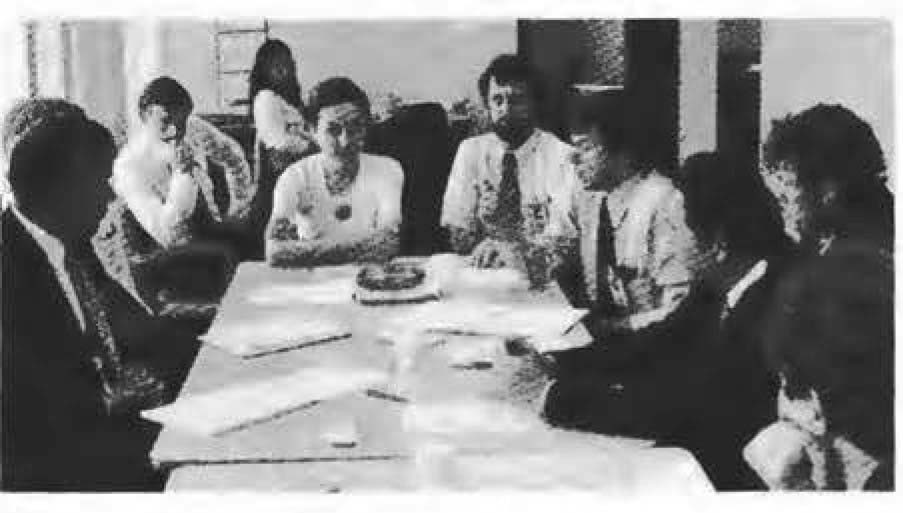
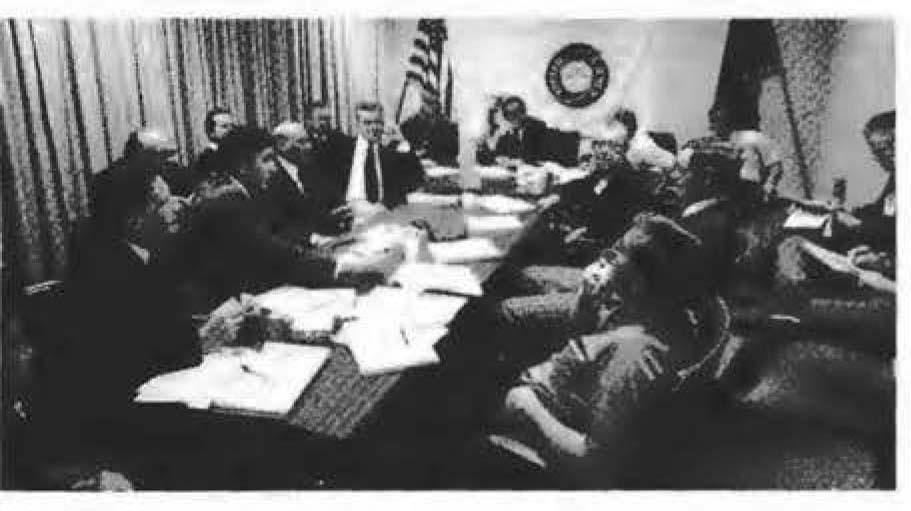
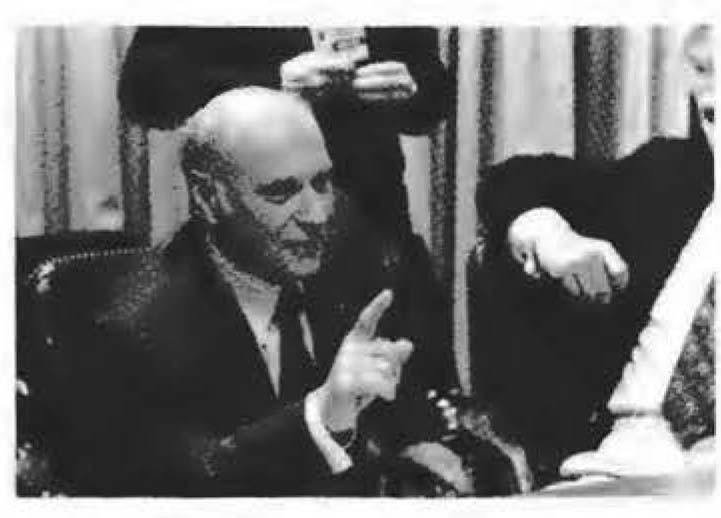
The RCS controversy demonstrated the different approaches to rendezvousing and docking spacecraft-automatic versus pilot controlled-and while it had been a real worry for many of the specialists, Lunney had not let it upset him. It was a problem for which there was a technical solution. Once his men told him how they intended to handle the matter, he explained it to the Soviets and invited them to the simulator where they could see that the proposed solution was indeed satisfactory. It was all part of a day’s work, and there was no need to become emotional. On 31 January, when the issue was still pending, Lunney was asked how the meeting was going. He responded, “This . .. is a piece of cake”; he wished that he could get away from the Grumman building, where the talks were being held, and go back across NASA Road I to clean up the paper work on his desk. When asked about the RCS situation, he smiled with a characteristic twinkle in his eyes and said, “Nyet problém.” Then he added, “If you think that is a hot issue, you should have seen some of our earlier go-arounds.” Chomping down on his cigar, he went in search of a cup of coffee.65
FINAL ROUND OF CREW TRAINING
While the technical specialists debated the readiness of the spacecraft, eight cosmonauts arrived in Washington on 7 February to begin their final training session in the United States. After being met in the nation’s capital by Tom Stafford, the men flew to Kennedy Space Center (KSC) the next morning. Joined there by the other AST astronauts, the two flight teams spent all of Saturday at the launch complex. They were given briefings on the operations conducted at the facilities, and they had an opportunity to see the nearly flight-ready CSM 111 and docking module, which were in the Vehicle Assembly Building along with the launch vehicle.66
ASTP Flight Menu
Alexei A. Leonov-SC
- Potato Soup
- Beef Steak
- Rye Bread
- Cheese Spread
- Almonds
- Strawberries
- Tea w/Lemon & Sugar
Valeriy N. Kubasov-FE
- Seafood Mushroom Soup
- Beef Steak
- Rye Bread
- Cheese Spread
- Almonds
- Strawberries
- Tea w/Lemon & Sugar
On Sunday, the 14 men visited Disney World. Like other tourists, the cosmonauts and astronauts rode a number of the rides in the amusement park, including one that featured miniature spaceships. After a trip on a Mississippi river boat and handshakes with Donald Duck and a space-suited Mickey Mouse, they left for the Kennedy Space Center, as Br’er Bear waved good-bye to the visitors.67
After a second day at the Cape, the crews flew to Houston. Tuesday morning was occupied by a welcoming ceremony and then briefings on the joint scientific activities planned for the flight. During the afternoon, the crews were given an update on contingency plans covering possible emergency situations.68 The two teams practiced all the joint flight activities in the Apollo, Soyuz, and docking module mockups, using the latest version of the onboard flight documents. While the prime crews did their walk-through, the backup crews practiced in the simulator. Later, as the prime crews rehearsed communication techniques, their backups practiced the joint activities. This training pattern continued into the weekend. After taking Sunday off, the crews got back to work on Monday, rehearsing the joint activities step by step until Friday the 28th.69
Each member of the prime crew completed 61.5 hours of language training during the February sessions. While the greater emphasis was placed on the joint phase, the men also found time to meet with the press and work out in the gym. Leonov and Kubasov tried out the American meals they would eat during their visit to Apollo.70 Their individual menus looked like the sample in the box at the top of the page. But the visiting Americans might find something different awaiting them aboard Soyuz. (See box below.)
ASTP Flight Menu
Tom Stafford-CDR
- Borsch
- Turkey in Jelly
- Yantar Cheese
- Apple and Cranberry Dressing
- Bread
- Candy “Praline”
- Apple Juice
Vance Brand-CMP
- Sorrel Soupe
- L’Atrecote
- Yantar Cheese
- Apple and Cranberry Dressing
- Cake “Stolichny”
- Apple Juice
A month and a half later, the crews met again, this time in the Soviet Union. From 14-30 April, the astronauts followed a pattern of activities similar to their Houston training. They practiced transfer and other joint phases of the flight in the Soyuz mockups and worked on numerous contingency situations in the Soyuz simulator. Radio communications skills were polished while “flying” the rendezvous and docking simulators. Two of the highlights of the trip for the Americans were the visit to the mission control center at Kaliningrad on 19 April and the journey to Baykonur Cosmodrome on the 28th. At the Soviet launch center, the U.S. team saw the actual flight hardware as well as the primary launch pad, which was about 2 kilometers distant. When they returned to the States in May, the U.S. crew told the press about what they had seen.71
The airfield they had flown into served Leninsk, the modern city of 50 000 built in the desert of Kazakhstan to provide living quarters and logistical support to the space projects at Baykonur. While they did not get exact information on the size of the center, Stafford’s visual impression was one of vastness. On their evening flight back to Moscow, the crews saw the lights on launch pads and related complexes for more than 15 minutes, and according to Stafford, “that makes Cape Kennedy look very small.”
At one point in the press session, Jules Bergman of ABC News broke in. It had been one of his “pet peeves for years” that the Soviets kept calling their launch complex the Baykonur Cosmodrome.
Baykonur, if you’ll look on the coordinates, is 135 miles [217 km] away or something. Tyuratam may only be a railhead, but it is the Tyuratam Launch Complex. They call it Baykonur, I know. ... I’m going to call it Tyuratam. ABC is going to call it Tyuratam. SAC [Strategic Air Command] calls it Tyuratam. Can we once and for all straighten that out and arrive at a .. name for it, Tom?72
Although Bergman thought that calling the facility Baykonur was like referring to KSC as the “Tampa Space Port,” as he put it, Stafford told him that Tyuratam was only “a little bitty old city” that butts up to the new city called Leninsk. Many reporters thought that the Soviets were calling it Baykonur to hide its true location, but Slayton told them that if they really wanted to use the name the Soviets commonly used, they would have to say Baykonur. Indeed, it appeared that the entire area was called Baykonur, much as Texans would talk about the Panhandle or the Gulf Coast.*
* With an area of 2 756 000 square kilometers, Kazakhstan is the largest of the union republics, second only to the Russian Soviet Federative Socialist Republic. Even Texans would be staggered by the size, since it is nearly four time larger than the Lone Star State.
Another source of questions from the reporters was the aborted Soyuz launch of 5 April. All the American crewmembers repeated the assurances given earlier by Glynn Lunney that the upper stage failure reported by the Soviets would have no effect on ASTP. The two technical directors had briefly discussed the matter on 8 April over the telephone. The launch vehicle that had failed was one of the earlier models of the basic booster. For ASTP, a newer vehicle with a higher thrust capacity for weight would be used, and that booster had a successful launch history. Bushuyer promised Lunney full details on the “Soyuz anomaly.” The astronauts were not worried about its impact on the flight; after all, the Soviets had a second spacecraft and launch vehicle set aside in the unlikely event of a repetition of the problem.73
Final round of training, February-April 1975
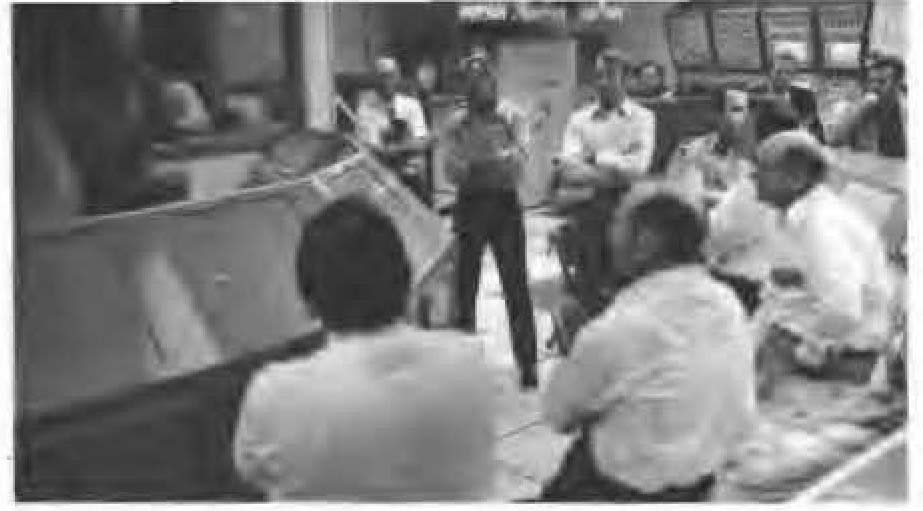
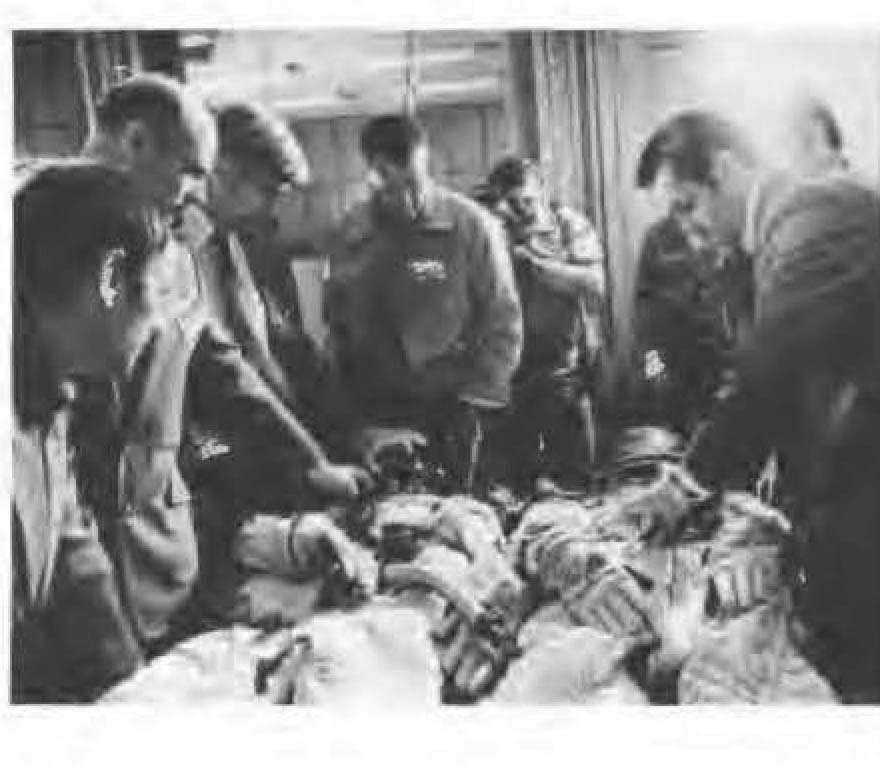
Nick Chriss of the Los Angeles Times asked Stafford if he would be “satisfied with the type of automatic abort system they have, since the two [cosmonauts] almost landed in China.” The astronaut replied that it had performed as it was supposed to; it had saved the cosmonauts’ lives. If an American crew ever had to use their abort system, it might put them down in the “mid-Atlantic or the far-Atlantic Ocean,* but wherever it put them the important thing is for the system to work. Stafford and Brand once again said that they were genuinely satisfied with the flightworthiness of Soyuz.74
The American crew was not particularly concerned about the 5 April Soyuz “anomaly,” but Senator Proxmire was. Three days after the failure, he had requested “that the Central Intelligence Agency (CIA) make a safety assessment of the Soviet manned space technology in view of the failure of another Soviet space mission ... and the pending U.S.-U.S.S.R. Apollo-Soyuz joint project.” He told fellow senators that the “in launch failure .. reinforces my deep concern that the upcoming ... experiment may be dangerous to American astronauts.” He did note that NASA claimed that the mission would be as safe as any other flight in the Apollo program and that they had produced a mass of studies to back up this assessment. But the senator from Wisconsin disagreed with their conclusions, saying “The history of the Soviet manned program shows an appalling lack of consistency. As soon as one severe problem is solved another occurs.” Proxmire presented a box score of Soviet failures:
Since April of 1967, the U.S.S.R. has conducted 18 manned Soyuz flights. Of these, two have been catastrophic failures with loss of four lives. In addition, two other flights, Soyuz 10 and Soyuz 15 have had docking problems and cannot be considered successes. Most recently was the launch failure of what would have been Soyuz 18. Thus, five out of 18 Soyuz flights have been marred by some sort of failure.75
Given this “poor track record.” Proxmire wanted the CIA to investigate the Soviet program and report to the HUD, Space, and Science subcommittee well in advance of the July launches.
As Senator Proxmire worried about the safety of Soyuz, the astronauts returned to their daily training routine. Stafford, Slayton, and Brand participated in the second session of a three-part series of intercontrol center simulations. On the morning of 13 May, 1 hour before the projected launch time of Soyuz, the simulations began. For over 25 hours into a simulated mission, the Soviet and American ground controllers and flight crews rehearsed both launches and made a number of the scheduled maneuvers. Beginning on the 15th, the two teams conducted a 56-hour continuous simulation that covered the period from 47 hours, 10 minutes, to 103 hours ground elapsed time following the Soyuz launch; rendezvous, docking, crew transfers, undocking, second docking, and final separation were rehearsed. Four days later, on the 20th; a 9-hour rerun of the rendezvous and docking exercise was performed. This training gave the control center personnel and the crews another chance to check out plans covering emergencies that might arise during the flight.76
Before the final simulation—29 June to 1 July--a major meeting took place in Moscow. Coming at the end of the last plenary gathering of the Working Groups, the Joint Flight Readiness Review chaired by V. A. Kotelnikov and George Low represented the final preflight evaluation. Once Kotelnikov and Low agreed that the spacecraft were ready to be flown, the two teams could attend to the final details -preparing the launch vehicles, as the clock ticked off the remaining hours to launch. Crew training would continue up to the very last day, the real test of their efforts coming on the 15th of July.
- NASA News Release, MSC, 73-12, "ASTP Crew Named," 30 Jan. 1973; Loyd S. Swenson, Jr., James M. Grimwood, and Charles C. Alexander, This New Ocean: A History of Project Mercury, NASA SP-4201 (Washington, 1966), pp. 440-442; and NASA News Release [redistributed at JSC], "Excerpt from a Medical Briefing with Dr. Charles A. Berry, March 13, 1972, Discussing Donald K. Slayton's Heart Condition and His Return to Full Flight Status," 14 July 1975.X
- NASA News Release, MSC, 73-12, "ASTP Crew Named," 30 Jan. 1973.X
- Ibid.; U.S. Congress, House of Representatives, Committee on Science and Technology, Astronauts and Cosmonauts: Biographical and Statistical Data, 94th Cong., 1st sess. (Washington, 1975), p. 80; Harold M. Schmeck, Jr., "U.S. Selects Space Crew for Flight with Russians." New York Times, 31 Jan. 1973; and Thomas O'Toole, "Crew Picked for Joint Space Mission," Washington Post, 31 Jan. 1973.X
- NASA Press Conference, MSC, "Apollo Soyuz Test Project Prime Crew Press Conference," 1 Feb. 1973. Lunney and Lee had sought to coordinate the public announcement of the crewmembers with notification to the Soviets and to interested members of Congress. This required some careful timing. NASA did not want word to leak from Moscow about the American crew selection before all bases were touched in Washington. Chester M. Lee to Dale D. Myers, memo, "Naming of ASTP Astronauts," 30 Jan. 1973, together with draft TWX to Bushuyev, draft news release, and recommended list of congressmen and senators to be notified.X
- Ibid.X
- Ibid.X
- Committee on Science and Technology, Astronauts and Cosmonauts, pp. 123, 129, 131, 136, 140, 143, and 148-149; NASA News Release, JSC, 73-93, "ASTP Cosmonauts to Visit JSC," 6 July 1973; FBIS-Soviet, "Soviet Cosmonaut Crew Announced for Joint Space Program," from Moscow Tass International Service, 25 May 1973.X
- "Apollo/Soyuz Spotlighting Cooperation at Paris Air Show," Aviation Week & Space Technology, 28 May 1973, p. 14; and Shirley Malloy to George M. Low, 25 May 1973, message relaying comment from Aviation Week editor Robert Hotz: "Your Paris exhibit is the star of the show."X
- "Minutes of Discussion on Organization of Joint Exhibition at the 30th International Aviation and Space in Paris, May 1973," 14-15 Dec. 1972.X
- Letter, Glynn S. Lunney to Konstantin Davydovich Bushuyev, 20 Feb. 1973, with enclosure "Minutes of Paris Air Show Telephone Conversation, February 8, 1973." X
- "Apollo/Soyuz Spotlighting Cooperation at Paris Air Show," Aviation Week & Space Technology, 28 May 1973, p. 15.X
- Hotz, "Paris Vintage 1973," Aviation Week & Space Technology, 11 June 1973, p. 7; and interview, Charles A. Biggs-Edward C. Ezell, 28 Oet. 1975.X
- "Glenn, Titor Get Together," Washington Star, 3 May 1962; and "Transcript of News Conference of Titov and Glenn," New York Times, 4 May 1962.X
- "Astronauts Take Paris Spotlight," New York Times, 20 June 1965; and "Space Twins Steal Some Red Thunder," Washington Daily News, 19 June 1965.X
- "Russian Cosmonaut Greets Cooper and Conrad in Athens," Washington Post, 18 Sept. 1965.X
- "Space Rivals Drink Toast," Baltimore Sun, 27 May 1967.X
- Wade St. Clair to Julian F. Scheer, memo, "Report on NASA Participation at 1969 Paris Air Show," 12 June 1969. The USIA press attaché attended the meetings between the astronauts and cosmonauts and briefed the press on these sessions. For press reactions, see "U.S. and Russian Spacemen Meet," Baltimore Sun, 3 June 1969; and Clyde H. Farnsworth, "Astronauts Hold Paris Rendezvous," New York Times, 3 June 1969.X
- Frank Borman to Ezell, 20 Aug. 1975; "Borman Hopes for Joint Mission in Space with Soviets during '70s," Washington Post, 4 July 1969; and Bernard Gwertzman, "Podgorny Meets Borman, Voices Hope for Successful Moon Trip," New York Times, 10 July 1969.X
- "Cordial Cosmonauts Field Questions of U.S. Press," Christian Science Monitor, 28 Oct. 1969; and Donnie Radcliffe, "Cosmonauts Are Lionized," Washington Evening Star, 1 Nov. 1969.X
- Interview, David R. Scott-Ezell, 21 Aug. 1974; and Scott to Lunney, memo, "ASTP Mission to Moscow, June-July, 1973," 31 July 1973. For press reports on meetings between astronauts and cosmonauts, see "Admirers Mob Armstrong in Leningrad," Baltimore Sun, 26 May 1970; "Moscow 'Chill' Mars Visit by Armstrong," Chicago Tribune, 2 June 1970; "Soviet Spacecraft Studies Earth Resources," New York Times, 6 Oct. 1970; James Stanton, "Astronaut Calls Space Flights Key to Amity," Philadelphia Evening Bulletin, 5 Oct. 1970; "2 Cosmonauts Arrive Here on Goodwill Trip," Washington Post, 19 Oct. 1970; Paul W. Valentine, "2 Soviet Cosmonauts Orbit City on Goodwill Tour of U.S.," Washington Post, 20 Oct. 1970; "Astronauts All," New York Times, 3 June 1971; and Walter Sullivan, "58 Layers Found in Lunar Sample," New York Times, 21 Sept. 1971.X
- "Apollo Soyuz Test Project Crew and Ground Personnel Training Plan," ASTP 40 700, 26 Mar. 1973.X
- "Soviet Space: A visit to Star City," Time, 9 July 1973. John Noble Wilford of the New York Times had been one of the first Western news persons to visit Star City when he toured the center in March 1972 during his month sojourn in the U.S.S.R. His evaluation of the Soviet center and the pace of the Soviet program was similar to those in Time and Aviation Week, Wilford, "Friendly, Yes, but Trying to Be First," New York Times, 28 Mar. 1972.X
- Donald C. Winston, "Soviet Space Center Being Expanded," Aviation Week & Space Technology, 25 June 1973, p. 18.X
- "Minutes, Joint Meeting of Working Group 1," in "Apollo Soyuz Test Project, Minutes of Joint Meeting, USSR Academy of Sciences and US National Aeronautics and Space Administration," 9-20 July 1973; and interview, Mike S. Brzezinski-Ezell, 23 Sept. 1975.X
- "Minutes, Joint Meeting of Working Group 1," 9-20 July 1973; and NASA News Release, HQ (unnumbered), "Comminique on Results of Apollo Soyuz Test Project Meetings, July 8-20, 1973" [20 July 1973].X
- NASA Press Conference, JSC, "Apollo-Soyuz Test Project (ASTP) Technical Directors' and Prime Crew Press Conference," 20 July 1973; Wilford, "Astronauts from Soviet and U.S. Begin a Briefing in Houston for Joint Mission," New York Times, 10 July 1973; "Cosmonauts Hear Lectures," Houston Post, 11 July 1973; and Jack Waugh, "Building U.S.-Soviet Space Team," Christian Science Monitor, 19 July 1973.X
- "Visiting Cosmonauts Have a W. Texas Rural Look," Houston Chronicle, 19 July 1973.X
- Owen G. Morris to Christopher C. Kraft, memo, "Flight Crews for ASTP," 18 Sept. 1972; Morris to Kraft, memo, "ASTP Language Training," 7 Nov. 1972; Myers to Rocco A. Petrone, memo, "Astronaut Proficiency in the Russian Language." 17 Oct. 1972: Petrone to Meyers, memo. "Astronaut Proficiency in the Russian Language," 20 Nov. 1972; Donald K. Slayton to Morris, memo, "Joint US/USSR Crew Training, 3, 15 Dec. 1972; interview, Brzezinski-Ezell, 23 Sept. 1975; and interview, Nicholas Timacheff-Ezell, 1 Oct. 1974.X
- Morris to Kraft, memo, "Flight Crew for ASTP," 18 Sept. 1972.X
- The titles of the nine brochures all dated Oct. 1973 presented to the astronauts were as follows: "Soyuz" Mission Profile, Soyuz Spacecraft General Description, Androgynous Peripheral Docking System (APDS), Onboard Systems Manual Control General Concept, Thermal Control System (TCS), Atmospheric Composition Control and Integrity Check Systems General Concept, "Soyuz' Radio and TV Communications Systems Operation, Food and Water Systems, and Waste Management Systems.X
- "Minutes, US Astronaut Crews Familiarization Courses at the Y[u]. A Gagarin Cosmonaut Training Center" 19-30 Nov. 1973; Eugene A. Cernan to Lunney, memo, "ASTP Crew Visit to USSR," 13 Dec. 1973; Hedrick Smith, "U.S. Astronauts in Soviet to Train with Russians," New York Times, 20 Nov. 1973; Michael McGuire, "Joint Space Bid Off to Bumpy Start," Chicago Tribune, 20 Nov. 1973; and Vladimir A. Shatalov, "Na orbite sotrudnichestva" [On the orbit of cooperation], in Soyuz i Apollon, rasskazivayut sovetskie uchenie inzheneri i kosmonavtiychastniki sovmestnikh rabot s amerikanskimi spetsialistami [Soyuz and Apollo, related by Soviet scientists, engineers and cosmonauts-participants of the joint work with American specialists], Konstantin D. Bushuyev, ed. (Moscow, 1976), p. 199-214.X
- Interview, Robert D. White-Ezell, 30 Sept. 1975; "Apollo Soyuz Test Project, Results of Apollo Soyuz Docking Systems Development Tests," IED 50 013, 25 Dec. 1973; NASA, MSC, "E&D Weekly Activity Report," 9-15 Jan. 1974; and White to James M. Grimwood, memo, "Comments on E. C. Ezell's Draft Manuscript of the ASTP History," 6 Jan. 1976.X
- "U.S.A. Docking Module Environmental Control System Breadboard Testing Quick-Look Report," in "Minutes, Working Group 5," 14-25 Jan. 1974.X
- Data given by Brzezinski, 23 Sept. 1975; and interview (via telephone), Walter W. Guy-Ezell, 1 Oct. 1975.X
- Interview, Thomas P. Stafford-Ezell, 6 Apr. 1976.X
- "Integrated Testing of the Soyuz Life Support System," 11-22 Mar. 1974; "Apollo Soyuz Test Project, Minutes, Working Group 5," 11-22 Mar. 1974; and interview (via telephone), Guy-Ezell, 1 Oct. 1975.X
- NASA News Release, JSC, 74-64, "ASTP Working Groups to Meet at JSC," 10 Apr. 1974; Brzezinski, "ASTP Activity Planning Guide, April Cosmonaut Visit," 14-27 Apr. 1974; interview, Lonnie D. Cundieff-Ezell, 14 Aug. 1975; and "ASTP Teams Make Progress on Procedures for Joint Flight," Aviation Week & Space Technology, 6 May 1974. p. 18.X
- NASA Press Conference, JSC "ASTP Joint Crew Press Conference," 26 Apr. 1974.X
- Interview, Stafford-Ezell, 6 Apr. 1976; interview, Slayton-Ezell, 2 Mar. 1976; and interview, Anatole Forostenko-Ezell, 15 Mar. 1976.X
- NASA News Release, JSC, 74-183, "ASTP Docking Test Near Completion," 2 Aug. 1974; interview, Brzezinski-Ezell, 23 Sept. 1975; V. Sisnev, "SShA: Sovmestnii kosmicheskii eksperiment; ikh budet pyatero" [USA: joint experiment in space; there will be five of them], Trud, 1 Jan. 1975; and "Start nazachen na 15 yulya" [The launch is scheduled for 15 July], Trud, 1 Jan. 1975.X
- "Soyuz Gives Cosmonauts Little Control," Aviation Week & Space Technology, 21 Jan. 1974, p. 38; Theodore Shabad, "Soviet Puts Soyuz 12 with 2 Aboard, into Earth Orbit," New York Times, 28 Sept. 1973; James Oberg, "U.S.-Soviet Space Flight," Los Angeles Times, 30 Sept. 1973; "Nas planetoi sovetski kosmicheskii korabl' v polete 'Soyuz-13* " [Above the planet, Soviet space ship, in the flight of "Soyuz-13"] Izvestiya, 19 Dec. 1973; "V polete-Soyuz-13' " [In flight-"Soyuz-13"], Pravda, 19 Dec. 1973; A. Pokrovskii, "'Soyuz-13'": Lydi i sud'bi" ["Soyuz-13": people and fates], Pravda, 19 Dec. 1973; "Soyuz-13': Den' Vtoroy" ["Soyuz-13": the second day], Pravda, 20 Dec. 1973; "Smooth Sailing for Companions in Orbit," Time, 31 Dec. 1973, p. 41; B. Komovalov, "Zdravstvei, zemlya!" [Hello, earth!], Izvestiya, 27 Dec. 1973; "Soviet Cosmonauts Link Up to Salyut 3," Newport Times Herald, 4 July 1974; "Cosmonauts Star on Moscow TV, Washington Star-News, 14 July 1974; Malcolm Browne, "Russian Crew Ready to Return to Earth," New York Times, 19 July 1974; and Kenneth W. Gatland, "Salyut 3: Soviets Still Catching Up," Christian Science Monitor, 22 July 1974.X
- Ezell, "Notes on 0745 Director's Tag-up Meeting," 17 Apr. 1974.X
- Robert G. Kaiser, "Cosmonauts in Orbit; First in Two Years," Washington Post, 28 Sept. 1973.X
- William Proxmire to James C. Fletcher, 3 Sept. 1974. Harold M. Schmeck, Jr., "Proxmire, Citing Failures, Asks Study of U.S. Soviet Space Plan," New York Times, 6 Sept. 1974; Richard D. Lyons, "Failures Mark Russian Space Program," New York Times, 26 Sept. 1974; "Cosmonauts Down Early but at Least Safely," New York Times, 1 Sept. 1974; "Soyuz Ends Flight; Salyut Linkup Fails," Aviation Week & Space Technology, 2 Sept. 1974, p. 23; Christopher S. Wren, "Soviet Astronauts Land Safely; Space Docking Apparently Fails," New York Times, 29 Aug. 1974; "Soyuz Ends Space Trip Early," Washington Post, 29 Aug. 1974; and Wren, "Two Soviet Astronauts in Good Health; First Night Landing Hailed in Moscow," New York Times, 30 Aug. 1974.X
- Lunney to Bushuyev, 3 Sept. 1974, enclosing "Minutes of the AST Telephone Conversation of August 27, 1974 [US Minutes]"; [Response to Query, HQl, "NASA's Reply to Proxmire Letter," 5 Sept. 1974; and Fletcher to Proxmire, 10 Sept. 1974.X
- "Summary of Results of the August-September 1974 Meeting of Specialists of the USA NASA and USSR Academy of Sciences on the Preparations for Conduct of the Test Flight of Apollo and Soyuz," 20 Sept. 1974, in "Apollo Soyuz Test Project Minutes of Joint Meeting, USSR Academy of Sciences and US National Aeronautics and Space Administration." 26 Aug.-20 Sept. 1974.X
- NASA Press Conference, JSC, "ASTP News Conference," 11 Sept. 1974.X
- NASA News Release, JSC, 74-272, "U.S. Tracking Soyuz 16," 3 Dec. 1974; "Minutes of the ASTP Telephone Conversation," 3 Dec. 1974; "Soyuz 16 Life Support Systems Operation," USSR WG5-035, 27 Jan. 1975; Elizabeth Pond, "Soviet Dress Rehearsal for U.S. Space Linkup," Christian Science Monitor, 3 Dec. 1974; Wren, "Soviet Orbits 2 in a Test for Joint Space Linkup," New York Times, 3 Dec. 1974; Soviets Orbit 2 Cosmonauts," Washington Post, 3 Dec. 1974; Wren, "Space Flight Test Pleases Soviet," New York Times, 8 Dec. 1974; A. Bessonov, "Provereno v kosmicheskom polete," Nove Vremya, 13 Dec. 1974, pp. 6-7 (for translation, see the English version, "Tested in Space," New Times, Dec. 1974, pp. 6-7); and V. Lesnikov, "Polet 'Soyuz A-16,' po sovmestnomu vapiantu" ("Soyuz-16," the joint version), Aviatsiya i Kosmonovtika (Jan. 1975), pp. 4-5.X
- "Minutes of Joint Meeting, USSR Academy of Sciences and US National Aeronautics and Space Administration," 26 Aug.-20 Sept. 1974.X
- Robert J. Shafer to John P. Donnelly, memo, "Advance Notification for Soyuz Launch," 7 Oct. 1974; and Shafer to Donnelly, memo, "Advance Notification for Soyuz Launch," 9 Oct. 1974.X
- TWX, Lunney to Bushuyev, 11 Oct. 1974; Gerald M. Truszynski to John F. Yardley, memo, "Procedure for Authorizing Tracking of Any ASTP Precursor Mission," 8 Nov. 1974; TWX, Lunney to Lee, "Tracking of Soyuz Flight," 8 Nov. 1974; and Yardley to Truszynski, memo, "Tracking of Soyuz Flight," 15 Nov. 1974.X
- Bushuyev to Lunney, 16 Dec. 1974, transmitting "Report on Telephone Exchanges during the Soyuz 16 Joint Tracking Experiment."X
- TWX, Lunney to Bushuyev, 11 Oct. 1974; "Minutes of Joint Meeting, USSR Academy of Sciences and US National Aeronautics and Space Administration," 20 Jan.-13 Feb. 1975; and "Soyuz 16 Life Support Systems Operation," USSR WG5-035, 27 Jan. 1975.X
- Transcription, report on Soyuz 16 by Bushuyev, 31 Jan. 1975.X
- Ibid.X
- White to Grimwood, memo, "Comments on E. C. Ezell's Draft Manuscript," 6 Jan. 1976.X
- NASA Management Instruction 1156.14A, "Aerospace Safety Advisory Panel," 18 June 1973. Members of the panel and staff were Howard K. Nason, Charles D. Harrington, Frank C. Di Luzio, Herbert E. Grier, Lee R. Scherer, Henry Reining, Ian M. Ross, Warren D. Johnson, Bruce T. Lundin, Gilbert L. Roth, V. Eileen Evans, William A. Arazek, and Carl R. Praktish.X
- Aerospace Safety Advisory Panel, "Annual Report to the NASA Administrator, Part 1-Apollo Soyuz Test Project, Section 1-Observation and Conclusions," Feb. 1975; and Nason to Fletcher, 5 Feb. 1975.X
- Harrington, "Trip Report: Observation of Working Group No. 3 at Academy of Sciences, Moscow, USSR," 27 Nov. 1974.X
- Aerospace Safety Advisory Panel, "Annual Report," Feb. 1975.X
- Reporting on this part of the ASAP meeting with the Soviets is based on notes taken by Ezell during the discussions, 6 Feb. 1975. See interview, Alex Tatistcheff-Ezell, 6 Feb. 1975.X
- Bushuyev, ed., Soyuz i Apollon, rasskazivavut sovetskie uchenie inzhineri i kosmonavtiychastniki sovmestrikh rabot s amerikanskimi spetsialistami [Soyuz and Apollo, related by Soviet scientists, engineers, and cosmonauts--participants of the joint work with American specialists] (Moscow, 1976), p. 28.X
- Interview, Herbert E. Smith, Richard Haken, Steven Pollock, and Roscoe Lee-Ezell, 12 Feb. 1975.X
- "Meeting Minutes, Joint Meeting of Working Group 1," 25 Nov.-20 Dec. 1974.X
- This description of the RCS impingement meeting is based upon notes taken by Ezell during that discussion and upon subsequent talks with Eugene A. Cernan, Lunney, and members of Working Group 2. Yuri Zonov's comment was made to Ezell after the trip to the simulator.X
- NASA News Release, JSC, 75-07, "Cosmonauts in U.S. for ASTP Training," 6 Feb. 1975; NASA, KSC, "News Clippings; Visit of Apollo Soyuz Test Project Cosmonauts and Astronauts," 8-10 Feb. 1975; and data supplied by Donalyn Epstein (handouts, briefing materials, and itineraries) from visit to KSC.X
- Viktor K. McElheny, "Soviet Astronauts Enjoy Flight into Fantasies of Disney World," New York Times, 10 Feb. 1975; and "Detente in Space," New York Times, 15 Feb. 1975.X
- "Status Report No. 1, Joint ASTP Crew Training," 12 Feb. 1975; and data provided by Brzezinski.X
- "Status Report No. 2, Joint ASTP Crew Training." 12 Feb. 1975; and "Status Report No. 7, Joint ASTP Crew Training," 24 Feb. 1975.X
- "Minutes of the Astronaut and Cosmonaut Joint Training Visit at the Johnson Space Center," 7-28 Feb. 1975; and TWX, Lunney to Bushuyev, 7 Jan. 1975.X
- "Minutes of the Training of Soviet and American ASTP Crews at Gagarin Cosmonaut Training Center," 14-30 Apr. 1975. In addition to the prime and backup crewmen, the four support crewmembers and Cernan went to the U.S.S. R. on this trip.X
- NASA Press Conference, JSC, "ASTP Crew Press Conference." 14 May 1975; "First Map of Baikonur Cosmodrome," Defense/Space Daily, 16 Apr. 1975; "New Map of Baikonur Cosmodrome," Defense/Space Daily, 17 Apr. 1975; Hal Piper, "Astronaut Describes Huge Soviet Center," Baltimore Sun, 15 May 1975; Thomas O'Toole, "Astronauts Tell of Huge Soviet Spaceport," Washington Post, 15 May 1975; and Ivan Borisenko, "The Baikonur Cosmodrome," Sputnik, (Apr. 1975); pp. 68-71. In F. Dennis Williams, memo to distribution, "Soviet Place Names for ASTP," 17 Apr. 1975, the Office of International Affairs took the following stance: "Soviet launch site: the Soyuz spacecraft will be launched from the Baykonur cosmodrome (also acceptable: 'Baykonur launch facility' or 'Baykonur launch complex' or 'Baykonur launch center') near the city of Tvuratam at about 40°N., 63°E. in the Kazakh Soviet Socialist Republic. Precise references should include both the name of the facility and the nearest city: That is, 'Baykonur launch complex near Tyuratam.' This (cf. Johnson Space Center, Houston) will avoid confusion that might arise from the fact that there is a well-known city called Baykonur (about 48° N., 66°E.) some 200 miles to the northeast of the launch complex. Since both Soviet and U.S. newsmen frequently use only 'Baykonur,' confusion about the physical location of the launch site might arise, a confusion which can best be avoided by use of the complete phrase: e.g., Baykonur launch facility near Tyuratam." In an interview, Reinhold H. Dietz-Ezell, 4 June 1975, Dietz emphasized the point that during the Working Group 4 tests at the launch site in May 1975 the Soviets used the work "Baykonur" to name the whole region surrounding Leninsk.X
- NASA News Release, JSC, 75-21, "USSR/USA Discussions on Soyuz Launch Failure " 8 Apr. 1975; "Minutes of the ASTP Telephone Conversation (US Minutes)," 8 Apr. 1975; and Epstein, "Non-Successful Launch of Soyuz, from Telecon, April 8, 1975," 9 June 1975.X
- NASA Press Conference, ISC, "ASTP Crew Press Conference," 14 May 1975; "Soyuz Off-Course, Mission Aborted," Washington Post, 7 Apr. 1975; James F. Clarity, "Soviet Space Shot with 2 Men Fails," New York Times, 7 Apr 1975; Thomas O'Toole, "Soyuz Mishap May Peril Joint Project," Washington Post, 8 Apr. 1975; O'Toole. "Soyuz Failure Termed No Threat to Project," Washington Post, 9 Apr. 1975; and U.S. Congress. Senate, Congressional Record, 94th Cong., 1st sess. (9 Apr. 1975), vol. 121, p. 55537.X
- News release, issued by the office of Senator William Proxmire, Wisconsin, 8 Apr. 1975. Bushuyev in Soyuz i Apollon, pp. 27-28, commented:
XSometimes members of the American press gave the impression that they intentionally create a tense atmosphere with their questions on the safety of the joint flight... Senator Proxmire also did not fail to add some fuel to the fire. He openly expressed concerns about the American astronauts' life during the joint flight. In the second half of 1974, . . Proxmire wrote a special letter to NASA Administrator, James C. Fletcher, requesting that he personally check out all of the factors related with the Soyuz/Apollo project and take the necessary steps to guarantee the safety of American astronauts.
To us, the participants of the project, it was perfectly clear that these artifically formed cautions had no foundation. The successful joint flight of the spacecraft Soyuz and Apollo confirmed this. . .. In spite of the concerns expressed by various prophets of doom on the subiect of such 'adventure' the first international space flight of Soviet and American spacecraft was crowned with success.
- For information on the first inter-control center simulations held in Mar. 1975, see Charles R. Lewis, memo to distribution, "Report on the March 1975 Joint Training Simulations," 7 Mar. 1975; and Linda N. Ezell, ASTP Narrative History Log Note 40, "Simulation Debriefing," 24 Mar. 1975. NASA News Release, JSC, 75-42, "Moscow/Houston Control Centers to Conduct Joint Apollo-Soyuz Simulations," 9 May 1975; and TWX, Lunney to Bushuyev, 3 June 1975.X