Final Examinations
In May 1975, George Low traveled once again to the Soviet Union, this time to inspect the Soviet spacecraft and to jointly chair the Flight Readiness Review (FRR). As with the Mid-Term Review, Low’s correspondence prior to the meeting had been with Soviet Academy President Keldysh. When the NASA delegation arrived in Moscow, Petrov told Low that Keldysh’s health had taken another turn for the worse: he was in the hospital. Three days later Petrov gave Low the news-Keldysh had decided to step down from his post. Vladimir Aleksandrovich Kotelnikov, as acting President, would supervise the FRR for the Soviet side. Kotelnikov, who had a good command of English, at 63 was well known throughout the U.S.S.R. for his textbooks in the field of radio and electronics engineering. While saddened at the news of Keldysh’s poor health, Low knew he could work with his successor. But prior to the review, Low and his colleagues visited Baykonur.
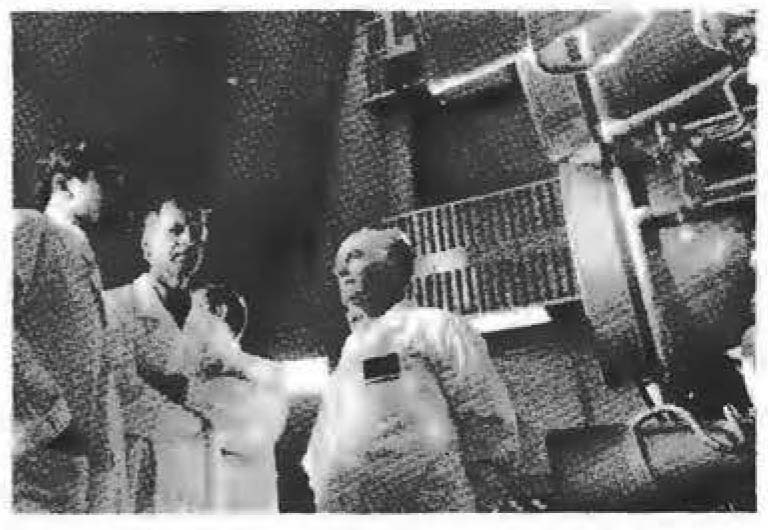
Final checkout of the American communications equipment and the docking target alignment tests had been carried out at the Baykonur Cosmodrome during mid-May. This last major activity involved 16 Americans and their Soviet colleagues under the direction of R. H. Dietz and B. V. Nikitin. They had finished their work on the 17th, ahead of schedule, in time for Low; Arnold Frutkin; Glynn Lunney; John F. Yardley, the Associate Administrator for Manned Space Flight; and Walter J. Kapryan, the Director of Launch Operations at Kennedy Space Center (KSC), to visit the cosmodrome on an inspection and orientation tour. Low and his group left Moscow’s Vnukovo airport on the afternoon of the 18th. After an evening’s stay at the Cosmonauts’ Hotel in Leninsk, the five Americans and Professor Bushuyev set out for the launch pad in the van usually reserved for transporting the cosmonauts. Their ride took them through the launch site industrial area to the launch stand.
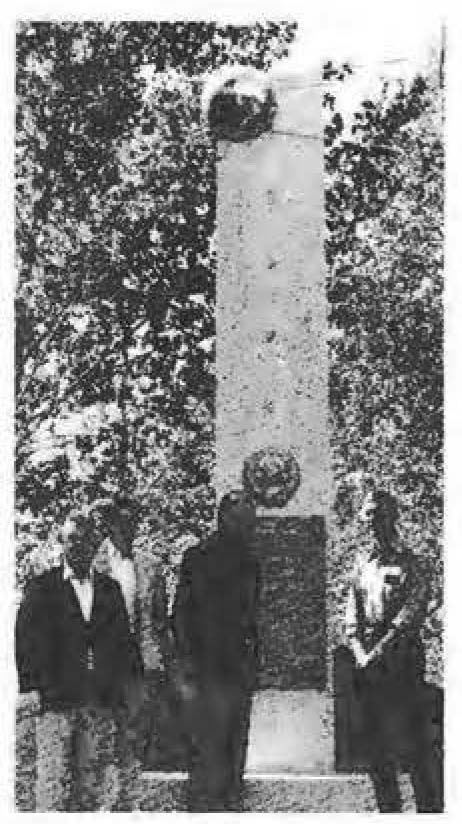
At the launch pad, they stopped first at a small monument commemorating Sputnik I, which had been launched from this stand on 4 October 1957. Low noted in his trip report:
[This same] pad was used for Sputnik I, for Gagarin’s flight, and will be used for one of the ASTP birds. We asked how many launch vehicles had gone off this pad and got two different answers: one being 100 and the second being
300. It was well preserved and painted, and apparently had been repainted prior to our visit. The basic sequencing is all mechanical. The vehicle is not held down but is guided by various arms which are part of the stand. It flies out of the launch pad without holddown, and the arms and booms which support the launch vehicle fall back under counter balance and the force of gravity. Various platforms underneath the launch vehicle are moveable and apparently collapse in a certain way so that they can all be rolled underneath the pad.1
Low also reported that it was very windy at Baykonur. He had been told “that the temperatures in the summertime go to 40°C and in the winter to -40°C.” The Soviets indicated that a minimum of work was done out of doors in the winter months.
While at the launch stand, the Soviets and Americans discussed various aspects of launching spacecraft. Bushuyev and Dmitri Bolshakov, the director of the Baykonur Cosmodrome, were interested to learn why the U.S. launch vehicles were held down for a short period of time after the engines were ignited. The Americans explained that this ensured smooth combustion and thrust buildup. Only after the engines were running satisfactorily were the launch vehicles released. Low noted, “apparently [the Soviets] measure the thrust buildup curve for all 20 engines and can shut down during the buildup until just before lift-off.” Since they did not need a hold down system, they avoided this complex procedure. The Soviet launch vehicle was also “slightly more efficient... from the point of view of fuel consumption,” and the Soviets said that they had never lost a launch vehicle as a result of improper thrust buildup.2 From the launch pad, the Americans were taken to the industrial area where the spacecraft were readied for their flights.
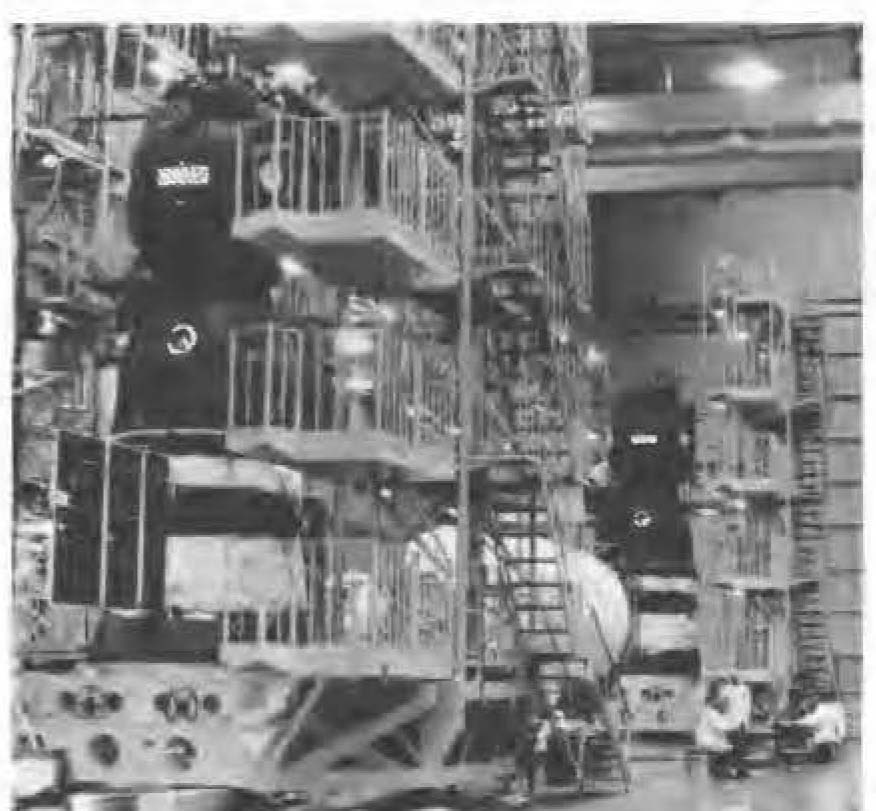
Since the industrial sector was only a short distance from the pad and since there were homes and a hotel there, Low asked if this area was evacuated during launches. Bolshakov responded that it was cleared just before a flight. After the Americans were escorted into a huge building that housed the equipment used to check out spacecraft systems, they visited the Soviet equivalent of the KSC vehicle assembly building. Along one side of the building, the prime launch vehicle rested horizontally. The two spacecraft (prime and backup), which the astronauts had examined in April and which Dietz’ team had checked out earlier that month, were also housed here. Low recorded that he “spent considerable time walking around the launch vehicle”; he “asked a lot of questions all of which were answered.” He had been told earlier that “the same [kind of] launch vehicle had been used since October 1957 and the first Sputnik launch.” Low concluded that the Soviets periodically introduced “block changes” into the launch vehicles either to enhance reliability or to replace obsolescent component parts. He continued his report:
We were told that the ASTP launch vehicle is one in a series of which more than 10 have already been flown. The April 5 launch was conducted with a launch vehicle left over from the previous series. The failure of the April 5 launch was explained to us again in detail, and our people appear to be satisfied with the explanation and with the fact that the changes made in the ASTP launch vehicle should prevent this kind of failure. The launch vehicle (all three stages) was on the right hand side of the center aisle. On the left side were the two spacecraft and the spacecraft shrouds. The launch vehicle was horizontal; the spacecraft were vertical. In order to place the spacecraft inside the shrouds, they are tipped to a horizontal position and cantilevered horizontally from the launch stand. The shroud is then slid over the spacecraft and attached to the bottom ring. At some point in the process, the spacecraft is then taken out on a railroad car and fueled. Then the launch vehicle and spacecraft are mated in a horizontal position on the car which ultimately takes them to the launch pad.3
The Americans spent the remainder of their visit to Baykonur attending a briefing on the communications electromagnetic compatibility tests just completed, touring the Korolev and Gagarin cottages at the launch site, and visiting Leninsk. During the stop at the Korolev house, the Americans got a rare insight into Bushuyev’s past. Throughout ASTP, the Soviets had given the Americans little information about their personal backgrounds in the space program. But when the U.S. team visited Korolev’s cottage, “Bushuyev told us that he spent much time there with Korolev and apparently stayed there on several occasions,” Low noted. On further questioning, Bushuyev told them that he had started working with Korolev right after World War II on the launch vehicle for Sputnik and on the spacecraft, too. Since then, he said, he had concentrated mostly on spacecraft. The Americans and their Soviet hosts then returned to Moscow for the FRR.4
REVIEWING FLIGHT READINESS
On 22 May, Low and Kotelnikov chaired the joint Flight Readiness Review at the Presidium of the Soviet Academy of Sciences. Reviewing the extensive preparations and testing that had taken place since the Mid-Term Review held in October 1973, the FRR was patterned after those traditionally conducted by NASA before all U.S. space flights. This formal management evaluation was designed “to assure that all appropriate steps [had] been taken by both sides to verify that the critical equipment and operations of each side [had] been planned or manufactured to meet the IED/ASTP Documentation Requirements.”5 Nearly all the joint pre-flight activities had been completed in time for the FRR. Concurrent with the launch site activities, representatives of Working Groups 2, 3, 4, and 5 had put the finishing touches on their pre-flight preparations, and the Technical Directors had cleared up their last minute questions of mutual interest.
Lunney and Bushuyev began the 5-hour review with technical histories of their respective spacecraft. In addition to comments about the readiness of ASTP hardware, the Technical Directors indicated that 133 documents had been negotiated and signed. While some flight-related documents were to be updated prior to the mission, only the post-mission report remained to be prepared. During their hour-presentation on Working Group 0 activities, Low raised a few questions. He asked Bushuyev if there had been any hardware anomalies in either of the unmanned ASTP test flights or in Soyuz 16 that would require changes in the ASTP flight hardware. Bushuyev indicated that there had been only two minor problems-the cabin cooling system had directed too much cool air on the cosmonauts’ feet, and the crew had had some minor difficulties with the food. Neither of these problems had required hardware changes. Bushuyev reported no difficulties with ASTP hardware during the test missions.6
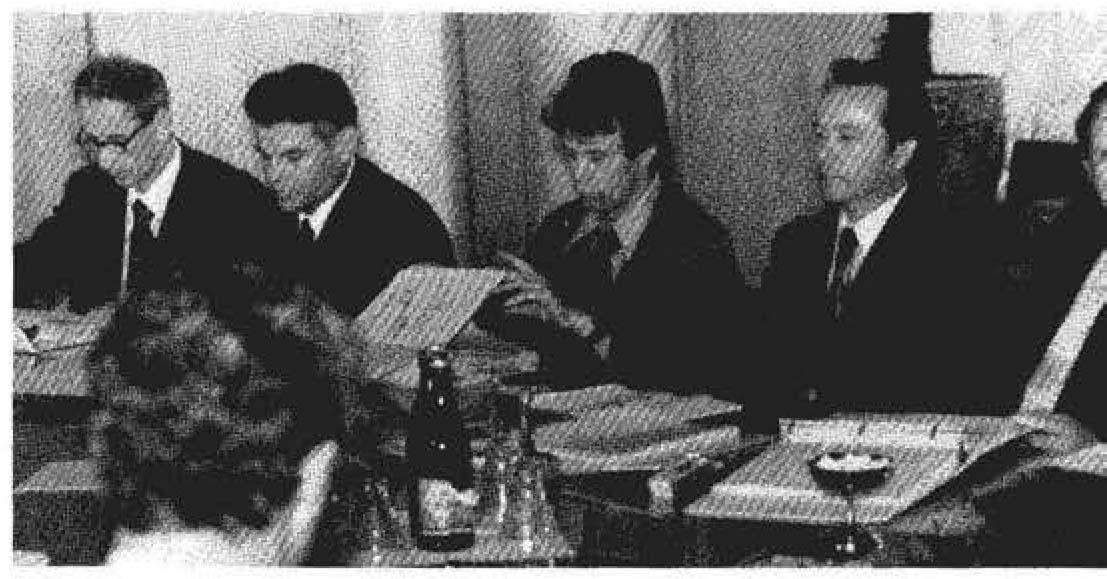
With the completion of their presentations, the Technical Directors turned the proceedings over to the Working Group chairmen. During the course of the review, fifteen Soviets and twelve Americans at the main conference table followed the presentations in specially prepared notebooks, which contained briefing charts and bilingual illustrations. The Working Group presentations were made by the co-chairmen who had not reported during the Mid-Term Review-V. A. Timchenko, V. P. Legostayev, R. D. White, B. V. Nikitin, and W. W. Guy.7
MISSION OPERATING PLANS-REVIEW
Timchenko, speaking for Working Group 1, addressed that team’s four major areas of responsibility-flight operations, operations training, experiments, and spacecraft compatibility. Planning the flight operations had been an exhausting and time consuming exercise, for besides planning for the projected 15 July launch date, the flight planners had had to map out alternative flight plans for a series of launch dates so as to be prepared for a postponement in case of equipment failures or weather problems. Mission planning analysts led by Kenneth A. Young and Oleg Georgiyevich Sytin had to consider a host of variable factors with each subsequent launch date. Lighting conditions at the Soviet and American launch and recovery sites constrained their planning considerably. Experiments keyed to the position of the sun or other stellar objects had to be juggled around in each flight plan to make certain that they would take place at the precise moment and place required by the experiment plan. Each alternate launch date also required its own tailored flight plan and trajectory computations, as well as documents verified in both Russian and English.
Timchenko reported that the process of planning for prime and alternate missions was completed. ASTP 40 301, “Joint Crew Activities Plan,” reflected their work. Furthermore, the other groups had verified these flight plans for compatibility; training exercises in the mockups and simulators had disclosed no difficulties in flying the mission as outlined. Timchenko concluded that there were no unresolved questions relating to flight procedures or the mission timeline.8
He then turned to discussion of the control centers interaction plan-how the two centers in Moscow and Houston would operate during the mission. Over the many months of negotiations, teams under M. P. Frank and F. C. Littleton and A. S. Yeliseyev and Timchenko had codified several key agreements concerning control of the mission. Flight operations were to be directed by a flight director in each control center, with each side having basic responsibility for its own spacecraft and crew. These men would converse with the crews through the spacecraft communicator and with each other through the Joint Flight Directors and their interpreters. Under both normal and emergency conditions, these interpreters would play a key role in the management of the mission. Once the mission was underway, the burden of the responsibility would be on the shoulders of the flight directors and the Joint Flight Directors. Lunney and Bushuyev would act in a liaison and advisory role. To ensure the prompt resolution of technical questions that might arise during the flight, each side was to appoint a group of visiting specialists (the “consultative group,” as the Soviets called these teams) to be present in a support staff room near the other country’s control center.
George Low asked Timchenko about contingency planning. Should an emergency call for a deviation from the established flight plan, who would make the decision about the proper corrective action to be taken? Timchenko replied that the flight director would make the decision with preference being given to a solution based upon procedures that had been worked out before the flight. Low then inquired as to which side would make the decision about an in-flight emergency. In the case of a problem involving crew safety, Timchenko answered, the country whose men were in danger could take unilateral action. For example, the endangered crew could call for an undocking, which would be evaluated by that side’s flight director, who would notify the other crew and ground controllers of his decision through the Joint Flight Director. Bushuyev interjected at this point that there were plans for a number of specific types of emergencies, the so-called “examined contingencies.” Low probed deeper and asked Timchenko what would happen in a case where there were no communications with the ground. The Soviet group chairman responded that such possibilities were specifically addressed in the “Flight Plan Guidelines,” ASTP 40 300, and the “Contingency Plan,” ASTP 40 500. Going still further, Low inquired what would happen in the event of an “unexamined contingency.” Timchenko said that the crews had been trained to make joint decisions on their own if necessary. Bushuyev added that each commander had the prime responsibility for his craft. Should a problem arise in Apollo, Stafford would have the responsibility to solve it; in Soyuz, such a decision would be Leonov’s burden.9
Pursuing the issue of command further, Timchenko indicated that one country’s spacecraft could communicate through the other country’s ground stations to its own control center. This arrangement especially broadened the amount of contact time Moscow control would have with Soyuz since the ASTP trajectory took the craft on a path away from many of the Soviet ground tracking stations. In addition, communications between the centers would consist of ten voice channels, two Teletype channels, two television channels, as well as channels for retransmitting communications with the crews and for transmitting facsimiles of document pages or computer printouts. This complex system, worked out by the subgroup on Intercontrol Center Coordination led by John H. Temple and Viktor Dmitriyevich Blagov, had been tested in December 1974 and in March and May 1975. These tests indicated that the system and the bilingual personnel assigned to work on both sides as interpreters could work satisfactorily under normal and emergency situations.10
In his report on crew and ground support personnel training, Timchenko summarized the joint training sessions. While the crew sessions had received considerable publicity, the equally important work of the control center personnel had not. Teams of flight controllers, visiting specialists, communications technicians, and interpreters had worked in both the Moscow and Houston control centers for ten-day familiarization exercises. The American controllers completed their training in Moscow on 27 September 1974, and the Soviets finished their studies on 6 November 1974 in Houston. These sessions had been followed by joint simulations, which not only provided an evaluation of the communications but also gave all parties an opportunity to work together in a condition similar to that of the mission. Problems and equipment failures were introduced by the training leaders to give the flight control teams experience in coping with emergency situations. Timchenko indicated that the crews and flight controllers had successfully completed their training and appeared to be ready for the flight.11
In the final part of his report, Timchenko summarized the preparations made for conducting the five joint experiments. The requirements for each of these (microbial exchange, zone-forming fungi, furnace systems, artificial solar eclipse, and ultraviolet absorption) were documented in separate interacting equipment documents, and the operating procedures and plans for each had been incorporated into the appropriate onboard instructions documents. Those procedures and plans had been verified and practiced by the crews in the mockups and simulators. Only the ultraviolet absorption experiment had required further work to perfect the flight maneuvers associated with it.12 Timchenko indicated that all the major tasks of Working Group 1 had been completed. The only remaining work related to solving some communications difficulties identified during the simulation and to conducting the June joint simulation. Otherwise, he reported that Group 1’s personnel were ready to carry out their part of the mission. Having completed his remarks, he turned the meeting over to V. P. Legostayev, who addressed Working Group 2’s preparations.
GUIDANCE AND CONTROL-REVIEW
Beginning with a report on the ASTP docking targets, Legostayev indicated that the primary target had been mounted on Soyuz and its proper alignment had been verified by Soviet and American specialists during the joint preparations at Baykonur during May. These checkout procedures involved the use of an American-designed fixture mounted on the face of the Soviet docking gear. A contingency target made from three fixed metal plates was also installed on Soyuz, in case the folded primary target failed to erect. In either event, the Apollo commander would have a target on which to sight during the final phase of docking.13 After discussing the orientation lights and the optical tracking hardware, Legostayev turned to the subject of control systems.
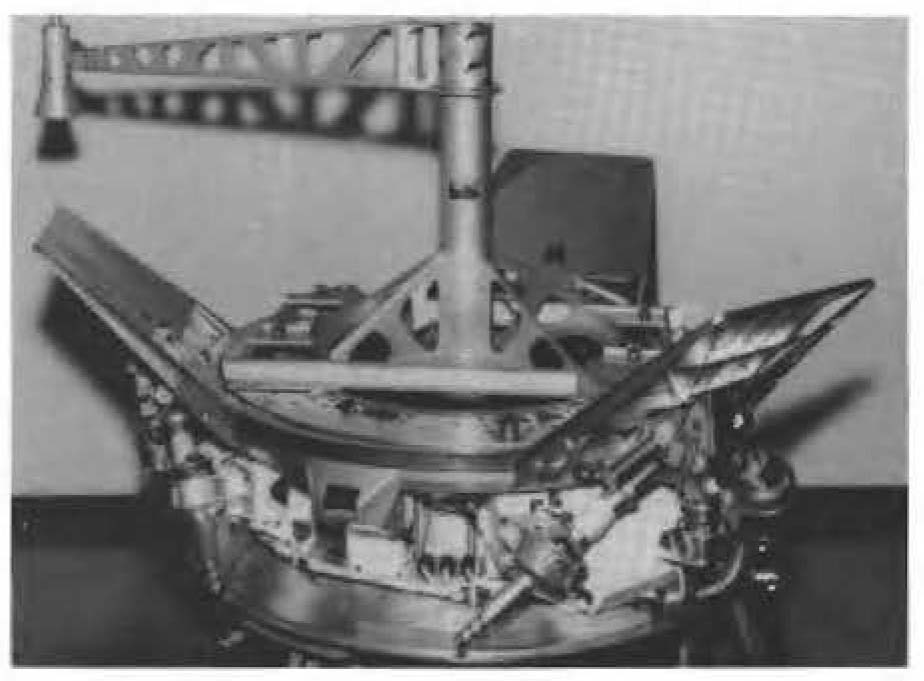
The Soviet Working Group 2 chairman noted that extensive studies had been made of the control system from operational and safety standpoints. The joint team had agreed to two major limitations on the use of the Apollo control system. First, to prevent undue stress from being placed on the Soyuz solar panels, the American agreed to use only two of the four roll jets to rotate the spacecraft during the docked phase of the flight. The second agreed restriction had to do with shutting down the Apollo forward-firing reaction control system (RCS) engines. As agreed during the final meeting in Houston, to protect Soyuz from the RCS plume, the forward-firing engines would be shut off within 2 seconds after docking system capture. No forward firing would be allowed during the docked part of the flight operations.14
The basic safety of the Apollo and Soyuz propulsion and control systems was documented in reports on each spacecraft, which provided a functional description of those systems and of how they operated. The Soviet and American specialists concluded that the control and propulsion systems of both spacecraft operated in a non-hazardous manner and posed no dangers to the crews during docked operations. Finally, Legostayev told the FRR Board that there were no outstanding issues; from Group 2’s point of view all was in readiness for the flight.15 After a few quick questions from John Yardley and Academician Petrov, the FRR attendees adjourned for lunch.
DOCKING SYSTEM-REVIEW
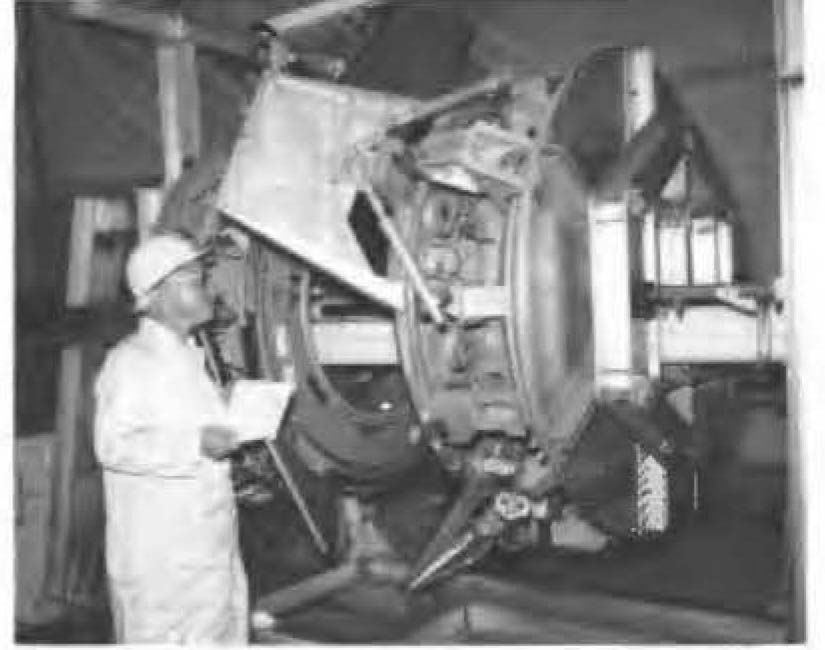
When the meeting resumed at 2:15, Bob White spoke for Group 3. After reviewing the major elements of the docking hardware, he summarized the recent test history of that equipment. Following the fourteen-week mate and dynamic development tests conducted in 1973, three more major test activities had been carried out successfully. The first of these, the mate and dynamic qualification testing, had been done in Houston (1 July-5 September 1974) to certify physical, functional, and operational compatibility, to verify the integrity of the docking systems under maximum docking loads; and to observe the operation of the guide ring and capture hooks on the active system. In two parts, the examination had covered the mate check and the functional test of the hardware when fit together under ambient temperatures. Subsequently, the hardware was placed on the dynamic docking vehicle simulator to test it at high (70°C) and low (-40°C) temperatures. The docking systems were run together in a conglomerate of experimental dockings to determine the operation of the systems under both normal and worst-possible circumstances. Roll, pitch, yaw, and axial misalignments were combined with various initial contact velocities to determine how this equipment, built to the same specifications as the flight hardware, could be expected to function in space.
Only one problem developed during these tests. When the U.S.S.R system went through the active phase of the cold temperature test, the resulting data did not agree with that obtained either during the earlier development tests or with the Soviet mathematical analysis. When the hot temperature test was run, the testers noticed oil leaking from the attenuator rods. Upon examination, they discovered that an anti-corrosion grease placed in the hollow rods to prevent rusting had not been removed. The grease had gummed up some operating parts. The second Soviet qualification unit did not have the grease problem, nor did the flight units back in Moscow. Once the errant lubricant was removed from the unit in Houston, it functioned satisfactorily. Otherwise, the U.S. and U.S.S.R. systems performed as expected.16
When he turned to the pre-flight compatibility verification test of the actual flight docking systems, White noted one major alteration that had been made during the test. The Americans had altered the alignment pins and sockets on their docking gear. Group 3 had recognized a potential problem with the existing alignment pins and sockets in October 1974 during the acceptance testing of the docking system at Rockwell International. This exercise, designed to prove the flight hardware was acceptable prior to the government’s paying for it, tested the docking systems in a special horizontal fixture, which took into account the absence of earth’s gravity in space. Guide rails with roller bearings kept the extended active guide and ring from drooping from its own weight. These guide rails were supposed to align the two docking gear, but there was a slight misalignment. When the two systems were brought together and capture was achieved, the active system could not fully retract to achieve structural latching. A gap of about 6 millimeters existed, a small distance but enough to prevent a transfer in space. Once the Rockwell engineers discovered that the guide rails were not aligning the two systems properly, they adjusted them and tried the exercise again. The second time there was no problem; there had been no difficulty with the prime flight docking system.17
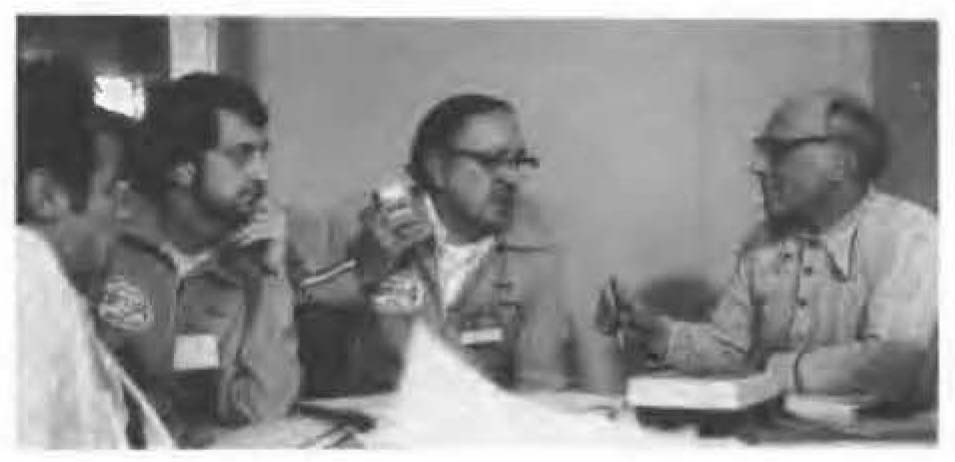
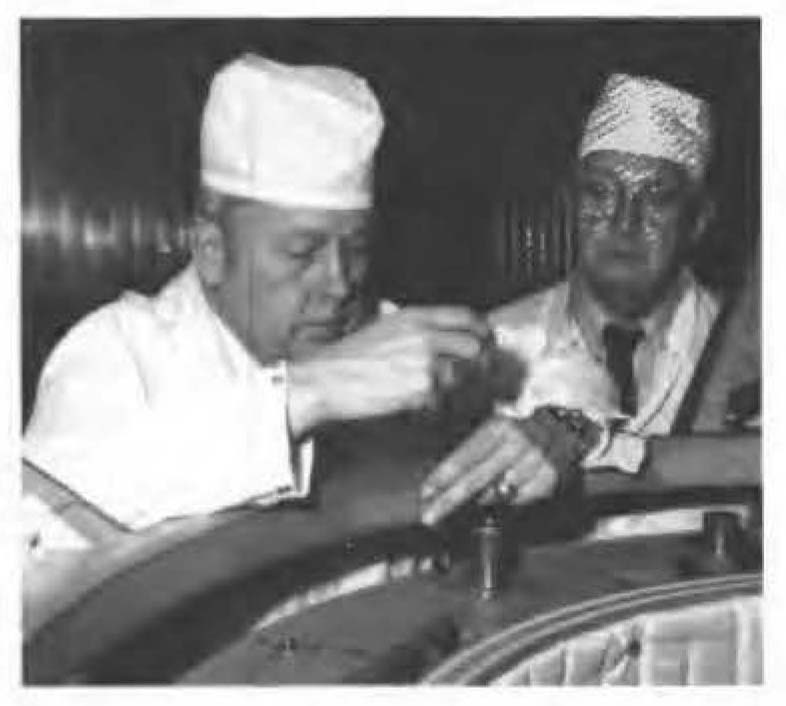
But this experience at Rockwell left Glynn Lunney with a nagging concern. He decided that the issue required further analysis. Meanwhile two of the docking systems were shipped to Moscow for the compatibility verification tests. Bob White and his eleven technical specialists followed Once Rockwell completed their analytical work on the so-called friction lock problem, Lunney called White to discuss the results. In Moscow, White and his colleagues, the “Dirty Dozen” as they called themselves, disagreed with Rockwell’s findings, which indicated that friction lock was a problem that could influence the conduct of the flight. White argued that Rockwell’s assumptions were too severe. The circumstances as described by Earl Holman, who conducted the analysis, were unlikely to occur in space. White also opposed changing the flight hardware at that very late date because the alterations were likely to create real problems while attempting to solve a possible one. Both sides had agreed that following the qualifications tests the design of the “interfacing hardware” (i.e., the docking system) would be frozen. No further changes should be made.
Nevertheless, Lunney, in consultation with NASA Headquarters and Rockwell, decided that the pins and sockets had to be altered. The agency saw the following hazard:
The potential pin and socket binding problem of both docking systems can lead to the stall of the guide ring drive in an active USA docking which can produce an overload in one of the three cables retracting the ring, which in turn can lead to its failure. Failure of a guide ring retract cable will result in the inability to further use the US docking systems either in the active or passive mode and, as a consequence, the failure to complete the basic purpose of the flight.18
As a consequence, Lunney telexed Professor Bushuyev and explained the problem to him.19 (See box on facing page.)
TO:
PROFESSOR K. BUSHUYEV
ACADEMY OF SCIENCES OF THE USSR
14 LENINSKI PR
MOSCOW, V-71, USSR
UNCLAS IN REPLY TO PA-LSN-213-74
MR. ALDRICH MENTIONED TO YOU DURING THE NOVEMBER 5 TELECON THAT WE WERE SOMEWHAT CONCERNED ABOUT THE POSSIBILITY THAT UNDER CERTAIN CONDITIONS IT MIGHT BE POSSIBLE FOR THE CURRENT DOCKING SYSTEM ALIGNMENT PIN AND SOCKET DESIGN TO BIND AND PREVENT FINAL RETRACTION. WE HAVE JUST COMPLETED A SERIES OF TESTS AND HAVE CONCLUDED THAT BINDING OF A U.S. PIN IN A U.S. SOCKET CAN OCCUR UNDER THE FOLLOWING CONDITIONS: A SIDE LOAD ON THE PIN ON THE ORDER OF 300 LBS [136 kg] OR GREATER WILL CAUSE BINDING WHEN A HESITATION AND RETRACTION OF THE PIN FROM THE SOCKET OF 0.020 INCHES [0.5 mm] OCCURS JUST AS THE PIN IS ENTERING THE CYLINDRICAL PORTION OF THE SOCKET. THE HESITATION AND REENTERING OF THE PIN CAUSES THE SOCKET TO ROTATE TO THE HARD STOP POSITION.
OUR ANALYSIS INDICATES THAT PREDICTED MISALIGNMENTS AND THERMAL CONDITIONS COULD PRODUCE WORST CASE IN-FLIGHT SIDE LOADS OF 250-450 LBS [113-204 kg]. WE ALSO FEEL THAT THE DYNAMIC ENVIRONMENT IS SUCH THAT A SLIGHT HESITATION AND RETRACTION OF THE PIN DURING DOCKING SYSTEM RETRACTION IS POSSIBLE, AS ARE MANY OTHER DYNAMIC EFFECTS.
BASED UPON THESE TESTS, WE ARE INCREASINGLY CONCERNED THAT THE CURRENT PIN AND SOCKET DESIGN IS INADEQUATE, AND ARE SERIOUSLY CONSIDERING THE POSSIBILITY OF CHANGING THE U.S. HARDWARE CURRENTLY IN MOSCOW. WE ARE IN THE PROCESS OF BUILDING THE PARTS NECESSARY TO CHANGE BOTH THE U.S. PIN AND THE U.S. SOCKET ON DOCKING SYSTEMS 5 AND 7. THIS HARDWARE WILL BE BROUGHT TO MOSCOW BY MR. ALDRICH ON NOVEMBER 18, ALONG WITH INSTALLATION TOOLING AND PROCEDURES.
THE OPTIMUM SOLUTION TO THE PROBLEM, HOWEVER, MAY BE TO REPLACE BOTH THE U.S. AND U.S.S.R. SOCKETS WITH A NEW NON-ROTATING SOCKET WHICH HAS A SHORTENED CYLINDRICAL SECTION, AND NOT CHANGE THE U.S. PIN. FOR THIS REASON, WE RECOMMEND THAT YOU PROCEED TO FABRICATE A NEW SOCKET. THIS WOULD ALLOW YOU TO BE PREPARED SHOULD WE DECIDE A CHANGE IS REQUIRED. MR. WHITE HAD THE PROPOSED SOCKET DESIGN. I HAVE ASKED MR. WHITE TO DISCUSS THIS PROBLEM WITH DR. SYROMYATNIKOV, AND WOULD APPRECIATE ANY INFORMATION OR TEST HISTORY WHICH YOU HAVE THAT MAY RELATE TO THIS PROBLEM. THESE DATA SHOULD BE PROVIDED TO MR. WHITE.
I PLAN TO TALK TO MR WHITE AGAIN ON TUESDAY, NOVEMBER 12, AT 5:00 PM MOSCOW TIME
I BELIEVE THAT WE MUST REACH A FINAL DECISION ON THIS QUESTION AT OUR NOVEMBER 19 TELECON
PLEASE PROVIDE MR. WHITE WITH A COPY OF THIS MESSAGE.
GLYNN S LUNNEY
MANAGER
APOLLO SPACECRAFT PROGRAM
NOV 8 1974
While Rockwell manufactured the new pins and sockets, Bob White discussed the problem with V. S. Syromyatnikov and Professor Bushuyev. White believed that “Vladimir was sympathetic to our problem and agreed that the change was necessary.20 Without Syromyatnikov’s understanding, it would have been very difficult to sell Bushuyev on the alteration. The only constraint the Soviets placed upon the Americans was that the U.S.S.R. pins and sockets would remain unchanged.
The USSR docking system guide pin and socket are installed from the back side of the structural ring front flange. In addition, the socket is installed before the docking system differential drive assembly is installed. Therefore, the socket removal and installation requires substantial docking system disassembly and readjustment of the kinematic coupling of six attenuator rods with the differential drive assembly which is a laborious operation.
Considering that all three USSR flight docking systems are assembled and in readiness for the Preflight Mate Test ... the docking system rework is impossible without a review of the schedule of preparing the spacecraft for flight and launch date itself.21
White and Syromyatnikov agreed that it would be sufficient to change only the U.S. pin and socket. This understanding was officially recognized by Lunney and V. A. Timchenko in their telephone conversation of 19 November. 22
To accomplish the modification in the shortest time, White and Syromyatnikov modified the test plans and worked out procedures to test the new components while waiting for Arnold D. Aldrich, Lunney’s Deputy, and Ray F. Larson, Rockwell’s command and service module manager, to arrive. Once in Moscow, Aldrich worked with the Soviets to draft minutes covering the changes and establishing a test plan for an additional examination of the modified system in January 1975 at Downey. Ray Larson and Earl Holman worked with the “Dirty Dozen” to complete the changes. The American Group 3 delegation divided into two groups; the “Mod Squad” made the alterations on one docking system, while the “Test Team” continued testing the other system. Whereas Rockwell had predicted that it would take four days to complete the modifications, the specialists actually needed only 4 to 5 hours for each docking system. Total time lost from the compatibility test was two days. Looking back, Bob White commented, “It’s amazing how much work you can do when you have no other choice but to get it done.” The Soviets were astounded, too!23
After the Moscow trials, joint pin and socket interaction verification tests using a Soviet and American docking system were conducted 16-23 January 1975 at Downey. This exercise confirmed that the alterations made to the American pin and socket eliminated any possibility of friction lock. Over a two-year period, Working Group 3 had conducted six major joint tests involving over thirty-three weeks of activity.24
COMMUNICATIONS AND TRACKING-REVIEW
After White’s 40-minute presentation at the FRR, Boris Nikitin gave a 10-minute summary of Group 4’s activities. Although he did not dwell on them, this group also had conducted an important series of tests since the Mid-Term Review. First, they had to establish that the spacecraft-to-space-craft radio and cable intercommunication systems would work without any interference from internal or external power sources. In addition, they had to verify the safety of the pyrotechnics used in the two spacecraft-for example, the explosive bolts reserved for emergency undocking. To prove that the radio waves from neither craft-especially from the powerful Apollo high gain antenna used to communicate with the ATS-6 satellite-could detonate those pyrotechnic components, Working Group 4 had directed a series of radiofrequency radiation experiments. All of these tests had been favorably concluded. Just prior to the Flight Readiness Review, R. H. Dietz and his fifteen teammates had participated in the checkout of the American communication and ranging equipment that had been installed into the prime and backup Soyuz spacecraft and in electromagnetic compatibility tests of American equipment scheduled to be transferred into Soyuz during the mission.
Every spacecraft had its own electromagnetic environment created by the sum of all the electronic and electric components onboard. Just as an electric drill may affect television reception or as a citizen’s band transmitter may affect FM radio reception, so too may the energy radiating from switches, fan motors, or power cables interfere with television cameras or communications gear. Electromagnetic compatibility (EMC) was not generally a problem when one party developed its own equipment for use in its own spacecraft. But the possibility of a problem with electromagnetic interference might arise when equipment from one electromagnetic environment was transferred to another. During January and February 1975, Soviet specialists had accompanied their counterparts to the Kennedy Space Center to check out their television camera inside the command and docking modules for EMC. And during May, the Americans had taken their television camera, motion picture camera, headsets, microphones, and speaker boxes to Baykonur to determine if the electromagnetic environment of Soyuz interfered with their performance. The test team found that all the American equipment operated satisfactorily. Although the Soviet half of Group 4 had experienced some difficulty meeting project deadlines before the Mid-Term Review, those problems had been resolved. Nikitin could report at the FRR that all their joint work had been completed.25
Academician Petrov had a few questions for Nikitin. His main concern was radio receiver interference on the Soviets’ 121.75-megahertz frequency. During Soyuz 16, the crew reported receiving broadcasts from commercial aviation sources transmitting on that frequency. Petrov had asked the Americans to help them get the international radio users to vacate that channel during the mission, but NASA had decided not to take such an action. So when Petrov asked Nikitin what plans had been made to deal with such interference if it developed during the flight, the Soviet chairman said that they would just try to identify the source and ask the transmittor to suspend broadcasts during the remainder of the mission. After some further discussion on this point, Walt Guy reported on Working Group 5.26
LIFE SUPPORT AND CREW TRANSFER-REVIEW
Group 5 had conducted a series of environmental control tests since the Mid-Term Review to determine the flight readiness of the Apollo docking module and Soyuz. Equally significant was the work done since October 1973 to ensure the non-flammability of American and Soviet equipment that was to be transferred from one spacecraft to another. This topic had not been addressed in any detail until the Mid-Term Review. Since the Soviets used an 80 percent nitrogen/20 percent oxygen atmosphere, spacecraft flammability was not as severe a worry as it was for the Americans in their nearly pure oxygen atmosphere spacecraft. Walt Guy, in looking back on this topic, commented:
We had seen movies in which they wore what appeared to be woolen clothes and fur hats, so we didn’t feel that they had addressed the question of flammability. At one point, we considered putting all transferred equipment-such as space suits-into our fire proof bags. After EVA went away, our concern became one of not introducing materials into each other’s spacecraft that could cause a fire. Our safety people were still concerned that their spacecraft might be on the lucky side instead of the safe side. Obviously, we flew a lot of missions before our Apollo disaster, which proved that we were more lucky that safe. There was a lot of concern about the basic design of the Soyuz from a safety point of view. Lunney got the Soviets to agree to a certification document for the non-flammability of each piece of transferred equipment. When we eliminated the EVA and reduced much of the equipment to be transferred, the list became much shorter; we were able to consolidate all those documents into a single document.27
After considerable discussion, the Soviets agreed to use the American flammability test procedures to determine the safety of their equipment. One key point dealt with the cosmonauts’ flight suits. Since the Americans could not let the Soviet crew enter Apollo wearing wool or cotton clothing, they volunteered to give the Soviets enough material to manufacture new suits. But Lavrov declined the offer, saying that the Soviets intended to develop a flameproof material of their own. After several experiments, Lavrov’s team produced a cloth that Walt Guy noted was superior in its self-extinguishing characteristics to the material used by the Apollo crew. In a pure oxygen environment, the Soviet cloth, called Lola, would self-extinguish, whereas the American material tended to burn very slowly. During the development of their fabric, the Soviets had brought successive samples of the material to the U.S. for the Johnson Space Center (JSC) specialists to test. Lavrov was proud of the work that his Group 5 people had done, and he had used the samples to demonstrate their progress to Guy and his colleagues.
Once they got involved in the fire safety topic, the Soviets subjected nearly all the items they planned to transfer to rigorous testing. On the American side, the NASA team used four methods to determine the flame-proof nature of their materials. In addition to testing, they used analysis, similarity, and waiver. Seventeen items of American equipment to be transferred to Soyuz were certified by analysis to be safe by virtue of the materials from which they had been fabricated, for example, sunglasses, wrist watches, writing instruments, sliderules, and the like.
Six other pieces of equipment, such as speaker boxes, had been approved for flight by determining that they were similar to hardware previously tested and found safe. Only four articles were certified using waivers. Walt Guy could tell the FRR Board that Working Group 5 had no open items. All equipment to be transferred had been cleared for fire safety. 28
Summarizing the Working Group reports, the Technical Directors indicated that all project milestones had been completed as scheduled. The two teams had finished their detailed review of joint flight safety issues and had prepared safety assessment reports to clarify the safety of selected design areas. Lunney and Bushuyev listed areas in which work remained to be completed:
- JUNE MCC [Mission Control Center] SIMULATION FINAL UPDATE OF ON-BOARD DOCUMENTS
- PREPARATION FOR JOINT SCIENTIFIC EXPERIMENTS
- ANALYSIS OF FAILURE OF SENSOR INDICATING UV [ultraviolet]
- RETROREFLECTOR OPEN
- POST FLIGHT REPORT
- PUBLIC INFORMATION ITEMS29
George Low recorded in his notes on the FRR that “there were no serious open issues, and it was quite clear that this review was considered to be a formality by the ... Soviet side.”30 R. H. Dietz noted that during the morning session of the FRR Low was the only person to extensively question the Directors and chairmen. Since the Deputy Administrator himself remarked about this after the lunch break, Petrov asked a few questions and Kotelnikov asked one when the meeting resumed. Low speculated that prior to the FRR the Soviets had satisfied themselves internally as to the readiness of the two sides for the mission. For his own part, Low felt that all his questions had been “well answered by the working group co-chairmen from both sides.” Still, he was a little uneasy about the possibility of clear cut decisionmaking in the event of an emergency. In his trip report, he noted:
My remaining concern after this FRR has to do with command and authority of command, particularly in contingency situations. At no time is there a single commander in space nor is there a single flight director on the ground who is in charge. The project had tried to accommodate this situation by trying to anticipate all possible contingencies. I asked what would happen in the event of an unanticipated contingency or in case there is a difference in interpretation of whether or not a contingency exists. Although these questions were answered rather forcefully, I am still not convinced that this is not a potential problem area.31
At the end of the review, Low and Kotelnikov signed a protocol indicating that “the Apollo-Soyuz Test Project is proceeding in accordance with the agreed schedule and ready to proceed toward the launching, planned for July 15, 1975.”32
REPORTING ON THE FRR
After Low returned to Washington, Administrator Fletcher reported on ASTP flight readiness to President Gerald R. Ford, a leading supporter of the project, and to Senator Proxmire, the major critic. Fletcher’s letter to the President was short and cordial. He noted that ASTP was on schedule and expressed his hope that Ford would take an active part in the last Apollo launch. “We believe your personal involvement would further demonstrate this country’s commitment to increasing cooperation with other nations.” Should his schedule preclude attendance at the Apollo launch, Fletcher suggested that the President might want to speak with the crews during the joint phase of the mission.33
In writing to Senator Proxmire, Fletcher forwarded him a full explanation on the Soviets’ 5 April Soyuz launch failure. During the course of the May meeting in Moscow, Glynn Lunney and Robert O. Aller, Chet Lee’s Deputy, had been given a detailed briefing by Professor Bushuyev on the Soyuz launch abort. Since Proxmire had expressed a desire to be kept informed of all developments possibly affecting the safety of ASTP, Fletcher enclosed a summary of the findings. He told the Senator that NASA had reviewed all the Soviet data in detail and had concluded that the failure would not affect the safety of the Apollo crew.
Professor Bushuyev had told the Americans that several minutes after lift-off, when the central sustainer core of the launch vehicle was supposed to separate from the third stage, a sequencer relay failed and permitted some pyrotechnic latches to fire prematurely. This disabled three other pyrobolts and prevented the complete release of the sustainer core. Since the third-stage engine had been ignited, the pyro failure caused the vehicle to stray from its path. The abort sequence was automatically initiated when the spacecraft reached a 10-degree deviation from the programmed flight path. In quick succession, the third stage engines were shut down, the spacecraft was separated from the lower stage, and the retrorockets were employed to ensure the proper trajectory for landing. At the time of the abort, Soyuz had reached an altitude of 180 kilometers, traveling at about 5.5 kilometers per second. Lazarev and Makarov-veterans of Soyuz 12-experienced g forces equivalent to nearly 14 times those on earth as they descended. Their landing site was 1800 kilometers downrange from the launch pad, covered with waist-deep snow.
In his briefing to Lunney and Aller, Bushuyev noted that there were two basic differences in the launch vehicle that failed and the ones assigned to ASTP. A new type of relay was being used, and the pyro lock circuitry had been changed to prevent a premature firing of the explosive bolts. These modifications, which made the asymmetric separation as experienced in the 5 April flight impossible, had been included in a series of launch vehicles prior to the failure. That updated group of boosters had been flown ten times, including the two unmanned ASTP precursor missions and Soyuz 16. NASA was convinced that the aborted April launch did not pose a hazard to the American crew of Apollo-Soyuz. Furthermore, the agency was satisfied that this type of failure would not occur on 15 July. But should something prevent the successful launch of the prime Soyuz, the Soviets would have a second launch vehicle, spacecraft, and crew ready to count down. Despite Senator Proxmire’s concerns, the people at NASA expected to meet the Soviets in orbit.34
PUBLIC AFFAIRS PREPARES FOR THE FLIGHT
While the Senator from Wisconsin pondered the safety of the joint mission, Soviet and American negotiators were completing Part II of the Public Information Plan. In the months that had passed since their October 1973 meeting in Moscow, the public affairs specialists had met many times to hammer out an agreement about flight-related activities. Central to all these discussions was the American insistence on live in-flight television coverage of ASTP. Negotiations of the television agreements were conducted at two levels-managerial and technical. While John Donnelly and Bob Shafer worked with I. P. Rumyantsev and V. S. Vereshchetin in an attempt to reach an accord on policy, several other Americans worked with the Soviet technical representative, Vladimir Aleksandrovich Denisenko. The U.S. television team was led by Jack King, Bennett W. James, and Gene Cernan. While King acted as policy coordinator, Ben James oversaw the requirements public affairs had for television and Gene Cernan managed the technical team, implementing the hardware and mission planning aspects of onboard television. The task was a large one, but it was not limited to in-house considerations. External to the space agency, for instance, NASA had to make provisions for the American networks to place a pool television production trailer on the recovery ship. Once Shafer and Donnelly discovered that the Soviets planned to cover their recovery live, arrangements had to be made to broadcast from the U.S.S. New Orleans. Then there was the question of the exchange and conversion of American and Soviet television signals during the mission. The agreement to exchange television was merely the first step. NASA and the Soviet Academy had to arrange to convert the signals so they would be compatible with each other’s system at the Raistings television ground station operated by the Postal Department of the Federal Republic of Germany. And finally, the European Broadcast Union was wired into the circuit so that continent could also watch the joint mission.
To get ASTP television pictures into millions of homes across the globe was a complex task. Realizing this, Bob Shafer had begun the discussions of ASTP television planning in August 1972, with a proposed scenario for mission video coverage. Up to that point, dialogue on onboard television had related principally to the desire to include cameras in the command and docking modules. Once it had been agreed that live television would be broadcast from the spacecraft, Shafer composed a new scenario describing how best to put it to use.35 After nearly a year of only limited Headquarters Public Affairs participation in the work on ASTP television, Donnelly and Shafer had advised George Low that the mission “would be flown in the dark” if he did not take some action to guarantee proper planning.36 On 31 August 1973, Low wrote a memo to Chet Lee, noting that “in preparing for Skylab, we had a great deal of last-minute confusion because the planning for television coverage had not been properly taken into account in the overall Skylab mission planning.” Since Low believed it essential to have “highly professional TV coverage of significant ASTP events,” he asked Lee to coordinate with Donnelly and Shafer, letting them know at an early date:
- The goals and objectives of ASTP TV.
- The planned hardware implementation to meet these goals.
- The planned programming implementation to meet these goals.
- Key milestones in meeting the objectives.
- A listing of responsible individuals who will make it happen.37
To smooth over possible intra-agency friction, Low had indicated in the same memo that “this [mission] has to be a joint effort with the Office of Public Affairs, with that office being responsible for programming requirements and for signing off on the hardware implementation.”38
But friction did exist. On 14 September 1973, Shafer addressed a memo to Lee that read, “unequivocally and for the record, no one in Public Affairs drafted Dr. Low’s memo to you, proposed its contents, suggested the language, or in any other way assisted in its preparation.” Shafer believed it imperative that Public Affairs and Manned Space Flight proceed with their work without any misunderstandings over the agency’s commitment to television as represented by the Low memorandum. “I would not think the management conviction it demonstrates should be at issue, particularly in connection with ASTP, but if that is the case perhaps you should discuss your concern directly with him.”39 These early differences were caused in part by the failure to understand some of the technical problems associated with providing television from such a low earth orbit. Lunney had advised Lee in September that the Apollo Office had been planning to use the Skylab type of video recorders because time for broadcasting live pictures was so limited-17.8 percent of each orbit. The argument over large-scale, live television coverage remained an academic debate until early October when the Office of Manned Space Flight (OMSF) gave its final approval for use of the ATS-F relay satellite to enhance all ASTP communications.40
On 2 October 1973, Lee briefed the House Manned Space Flight Subcommittee on the advantages of using the Applications Technology Satellite. He noted that ATS-F would permit direct communication with the ground for 48 minutes of each 88-minute orbit, an increase of 33 minutes per revolution over reliance only on ground station signal time. Dale Myers reported to Administrator Fletcher on 2 November on the status of ATS-F:
It was determined that the ASTP vehicle would accommodate the additional weight and instrumentation and funds were identified for incorporating the necessary instrumentation. Concurrently, discussions were held with the ATS-F Program Office, which established an acceptable plan to both OMSF and the Office of Applications for the use of the satellite. During the period of negotiations with the ATS-F Program Office, a tentative approval by the ASTP Program Office was given to JSC for expenditure of about 10% of the necessary funds in order to proceed with the necessary engineering details. Shortly after receipt of the Office of Applications’ support commitment letter of August 14, 1971, the ASTP Program Office approval was given to JSC to expend up to about $2.1M for the necessary modifications.41
Myers also told Fletcher that the Office of Tracking and Data Acquisition was working on both the hardware and the diplomatic aspects of placing a special ATS-F antenna at the Madrid Tracking Station.
Once all the television hardware elements had been identified, work began on preparing the equipment for the mission. A key to the success of this effort was Chet Lee’s decision to ask Lunney to appoint a single individual to be responsible for television communications.42 Lunney’s response “as a result of the very high priority placed on television during ASTP” was to establish “a special TV planning team to coordinate all of the necessary activities to assure the best television we can have.” Gene Cernan was designated chairman of this planning team, and he was directed to begin “a regular series of meetings to cover all aspects including policies and requirements, the hardware implementation (ground and air) and the plans for training and inflight use.” At the same time, Samuel Sanborn was given responsibility for the technical aspects of preparing the television hardware.43 In the 18 months between December 1973 and the Moscow FRR, a sizable team worked the technical issues associated with onboard television.44
By early 1974, the NASA television preparations were well on their way. The next task at hand was to obtain Soviet agreement on Part II of the information plan. Shafer told Donnelly:
The agreement is not only necessary, but urgently so, because neither their working group members nor ours can proceed much beyond the present status until the television requirements can be discussed as bilateral, rather than unilateral, considerations. Mission planning is moving ahead rather rapidly, and it will soon be virtually impossible to rework all of the technical issues involved in meeting those requirements.45
The first detailed discussions of Part II were held in Moscow at the end of March 1974. A second negotiating session spanned the April meeting in Houston.46 In March, Vereshchetin told the Americans that Part I had obviously been based on a NASA proposal. The Soviets, he said, were glad that Donnelly, Shafer, and King had shown the way. But Part I sounded just like an American document translated into Russian. As a consequence, Vereshchetin wanted Part II to sound more Russian. Donnelly and Shafer agreed to this consideration as long as the language reflected policies that NASA could accept. The task of reworking Vereshchetin’s proposed Part II fell to Jack King, who had a new draft completed by April. Negotiations at that meeting were slow and difficult, but before the Soviets departed from Houston, a basic agreement had been established. Donnelly indicated to Low that substantial progress had been made in the areas of real-time television exchange, news personnel accreditation, creation of mission press centers, press kits, and the like. After four months of feverish activity in Houston and Washington, the Americans went to Moscow in September 1974 to conclude agreement on Part II.47
Press reaction to the information accord was mixed. United Press International noted that “Russia has agreed to distribute live television coverage of the launch of two Soyuz cosmonauts and full radio communications during their joint orbital flight with an American Apollo.” The UPI wire story indicated that this was the first time live television and in-flight radio communications of a Soviet space flight would be released to the West. John Donnelly, in an interview with the UPI correspondent, said the information agreement called for the video broadcasts to begin as Leonov and Kubasov boarded their spacecraft about 2 hours before launch, followed by a live picture of the lift-off. The latter would be not only a first for Western viewers but also a unique event for Soviet citizens, who heretofore had seen only video replays.48
Despite the public affairs accomplishment, Aviation Week, among others, was critical of the American space agency because it had not held out for media access to the Soviet launch site. Aviation Week’s editors stated their feelings bluntly:
U.S. space negotiators have retreated another step in efforts to provide open access to the Apollo-Soyuz Test Project mission. With little protest from NASA officials, the Soviets have all but killed any prospects for U.S. or other Western press representatives to be present at Tyuratam during the Soyuz launch or at the Kalinin control center during the flight.49
Associated Press President and General Manager Wes Gallagher made a formal complaint to NASA about being excluded from the Soviet centers. Administrator Fletcher responded strongly to this criticism in a letter to Gallagher:
The public affairs agreement between NASA and the Soviet Academy of Sciences provides for the most complete, comprehensive release ever to the U.S. news media of real-time information related to a Soviet space mission. It provides among other things for the exchange and release of live airborne and ground-based television; for the transmission to and release by our control center of air-to-ground commentary between the Soviet control center and its spacecraft; for a running description by a Soviet commentator of mission events as they occur; for the operation of a press center to which U.S. correspondents will be registered to cover the mission; and for the exchange between press centers of public affairs officers and interpreters to assist the press in its coverage of the activities as they take place. All of these are firsts for the Russians.50
Fletcher added that something must have become “garbled somewhere along the way since the ASTP public affairs agreement in no way limits, restricts or excludes the American press from Baikonur.” The public information agreement related only to joint activities, while recognizing the right of each side to make decisions about independent activities, such as the Soyuz launch, in accordance with its own obligations and traditions.
NASA’s Administrator did not want to take any action that might compromise the agency’s policy of running an open program. “While the Soviets have held steadfast to their right to refuse to admit the U.S. press to Baikonur,” Fletcher saw no reason why NASA should retaliate by excluding Soviet newsmen from the American launch site. “It would compromise our own open-program principles without changing theirs.” Fletcher believed that upon reflection Gallagher would “agree that under no circumstances should we compromise our policy to parallel or conform more closely to another system.”51
Part II of the Public Information Plan provided a framework for mission and post-mission press activities. But during the nine months between the signing of Part II and the launch, the agreement was fleshed out somewhat. This work included developing detailed television transmissions, as well as preparing for the onboard press conference and determining when and where symbolic activities (exchanging flags, signing flight records, etc.) would take place. By the time of the Moscow Flight Readiness Review, all but a few minor questions had been resolved. Final ratification of the updated version of Part II was signed on 10 July, five days before the launch.52 Public Affairs was ready for the mission.
NEW WORRIES
On 2 July, Senator Proxmire voiced another objection to the joint flight. He made public the testimony of a top Central Intelligence Agency official who raised questions about the ability of the Soviets to control two space shots at one time-ASTP and Soyuz 18/Salyut 4, which had been launched on 24 May 1975. Proxmire had part of Carl Ducket’s testimony declassified so he could release it to the press. The Senator’s news release read in part:
During hearings before the HUD and Independent Agencies Subcommittee on June 4, the CIA Deputy Director for Science and Technology, Carl Ducket, stated, “I do not think they (the USSR) are in good shape to handle two missions at once from the command point of view.”
. . .
“This warning from the nation’s top scientific intelligence expert should not be taken lightly,” the Senator said.
The Soviet Union has announced that the two Russian cosmonauts already in space in the Salyut space lab will not be brought back to Earth before the July 15th launch of the joint US-USSR space mission.
In view of the potential hazards that already exist during the joint mission, the added complexity of having two space missions going at once should be avoided at all costs.
Soviet communications capabilities and central management facilities are greatly inferior to those of the U.S. Having two missions in space at once, including one involving two spacecraft of different nations, is complex enough to warrant concern that the ASTP mission may not get the full support it needs to be successful.
Particularly troublesome is the potential for inadequate command and control should one or the other mission encounter difficulty.53
Proxmire urged NASA to postpone the ASTP launch until the Soviets brought Soyuz 18 home. He said that it would be “a simple matter to de-orbit the two cosmonauts.... Then the joint mission could proceed without concern over this particular problem.”54 Administrator Fletcher responded on 3 July to Proxmire’s request to postpone the launch.55 “Although the Soviets have not made any official announcements with respect to their plans for the Salyut mission,” Fletcher told the Senator, the Soviet press on 27 June had quoted Leonov as saying that the Salyut mission would continue during ASTP. Since the final full-scale simulation for ASTP had involved the two countries’ control centers, Glynn Lunney had used that occasion to discuss the multiple flight control matter with Bushuyev.
The Professor indicated that there had been no final decision on the length of the Soyuz 18/Salyut 4 mission.56 During their conversation, Bushuyev assured Lunney that should the two missions overlap, the Soviets would use two separate ground control teams and control centers for the two missions. ASTP would be directed from the center at Kaliningrad, while Soyuz 18/Salyut 4 would be conducted. by the center that had been used prior to Soyuz 12. The Professor also told his American counterpart that the ASTP mission had been assigned priority if the two sets of space vehicles should pass simultaneously within the same zone of coverage of a U.S.S.R. tracking station. This, of course, would be highly unlikely because ASTP and Salyut had distinctly separate flight paths. In fact, NASA’s tracking specialists had made independent calculations that indicated that the two Soviet missions would be in communication with the same U.S.S.R. ground station only twice during the ASTP flight-and then only for intervals of about 0.5 and 1.5 minutes. Administrator Fletcher told Proxmire that based upon the data available and the nature of the two missions, “NASA has concluded that the Soyuz 18/Salyut 4 mission does not constitute a hazard to ASTP and that there is no reason to delay the launch of ASTP if the Salyut mission is still in operation.”57
Senator Proxmire, however, would not let the issue die. After inserting anti-ASTP articles in the Congressional Record on 11 July, he leveled another blast at the joint flight on the 14th, the eve of the launch.58 Citing CIA data, the Wisconsin senator noted that:
the Soviets have encountered severe problems in space and their technology is inferior to that of the U.S. in almost every category.
- the Soyuz rendezvous and docking system has failed almost half the time
- the current level of Soviet preparation still is below that of the US
- the threat of a minor fire poses a moderate risk to the ASTP while a major fire is much less likely
- Soviet communications are not up to the quality of US communications
- Cosmonaut training and ground control crew proficiency are inferior to that of US counterparts.
- There has been some technology flow to the Soviet Union as a result of the ASTP. Future joint missions would pose more of a potential for technology drain
- the primary advantage to the USSR from the ASTP has been in observing US management and program operational techniques
- the Soviet lunar program has produced a string of failures.
In summary, the US has a significant technological lead over the USSR in the following areas: communications, management and quality control, handling of emergency situations, launch coordination and procedures, computerized functions, capability for inflight mission changes, space medicine, and crew training.59
Looking back on the Senator’s remarks, American ASTP Commander Tom Stafford said that this was the first time that Proxmire had been worried about aerospace safety. Stafford had seen the Soviet flight hardware and had worked with the Soviet crews. And he was ready to fly. Stafford believed that Proxmire was simply opposed to space flight in general. Whatever the sources of his concern, NASA did not share them. Nearly everyone was ready for the launch, and the space agency personnel had said so at the Headquarters Flight Readiness Review on 12 June.60
REVIEWING APOLLO READINESS
Within NASA, a series of additional reviews were conducted before 15 July. The Headquarters FRR was held at the Kennedy Space Center on 12 June, when representatives from the Johnson, Marshall, and Kennedy Space Centers gathered at the Cape to report on their respective pre-flight preparations. Glynn Lunney led off by summarizing the Moscow FRR and showing filmed highlights of the NASA team’s visit to Baykonur Cosmodrome. The Technical Director said that he had been given full details on the April aborted Soyuz launch and explained the steps the Soviets had taken to prevent recurrence of the failure. M. P. Frank described the ASTP mission profile and enumerated the activities scheduled for the nine-day flight, and Arnold Aldrich listed the technical reviews to which the spacecraft had been subjected. Lunney’s assistant went on to indicate that there were no spacecraft hardware “issues” -problems to be resolved prior to launch-with CSM 111, SLA-18, DM-2, or DS-5 that might interfere with an on-time lift-off. Gary A. Coultas of the Apollo Project Engineering Office presented a similar evaluation of government furnished equipment (the color television subsystem, photo/optical equipment, space suits, and rescue equipment). Safety assessments for the spacecraft and experiment materials were delivered by Bobby J. Miller of the JSC Safety Office. After further remarks from Houston personnel on flight rules, mission control center readiness, flight controller, and crew preparedness, Ellery B. May, Saturn Program Manager at Marshall, reported on the Saturn IB launch vehicle.61
SA-210 had been built in 1967 and stored since then. By the date of the launch, several of its components would be nine years old. Since some of the materials used in fabricating the booster were subject to possible deterioration from aging, periodic inspections had been made to monitor the condition of its various components. May noted that during the course of one such routine inspection, cracks had been discovered in two of the mounting points for the large tail fins of the first stage. After an intensive study of the fins and the cracks (caused by stress corrosion), Marshall and Headquarters engineers decided to replace all eight of the first stage fins. Subsequent analysis and monitoring of the hardware indicated that this action had corrected the problem, and it appeared as a resolved anomaly in the FRR.* At the conclusion of his presentation, May stated that all Marshall offices and contractors had been polled; they agreed that SA-210 was ready to fly.
* A chronology of SA-210 related events, including the stress corrosion problem, is presented in appendix F.
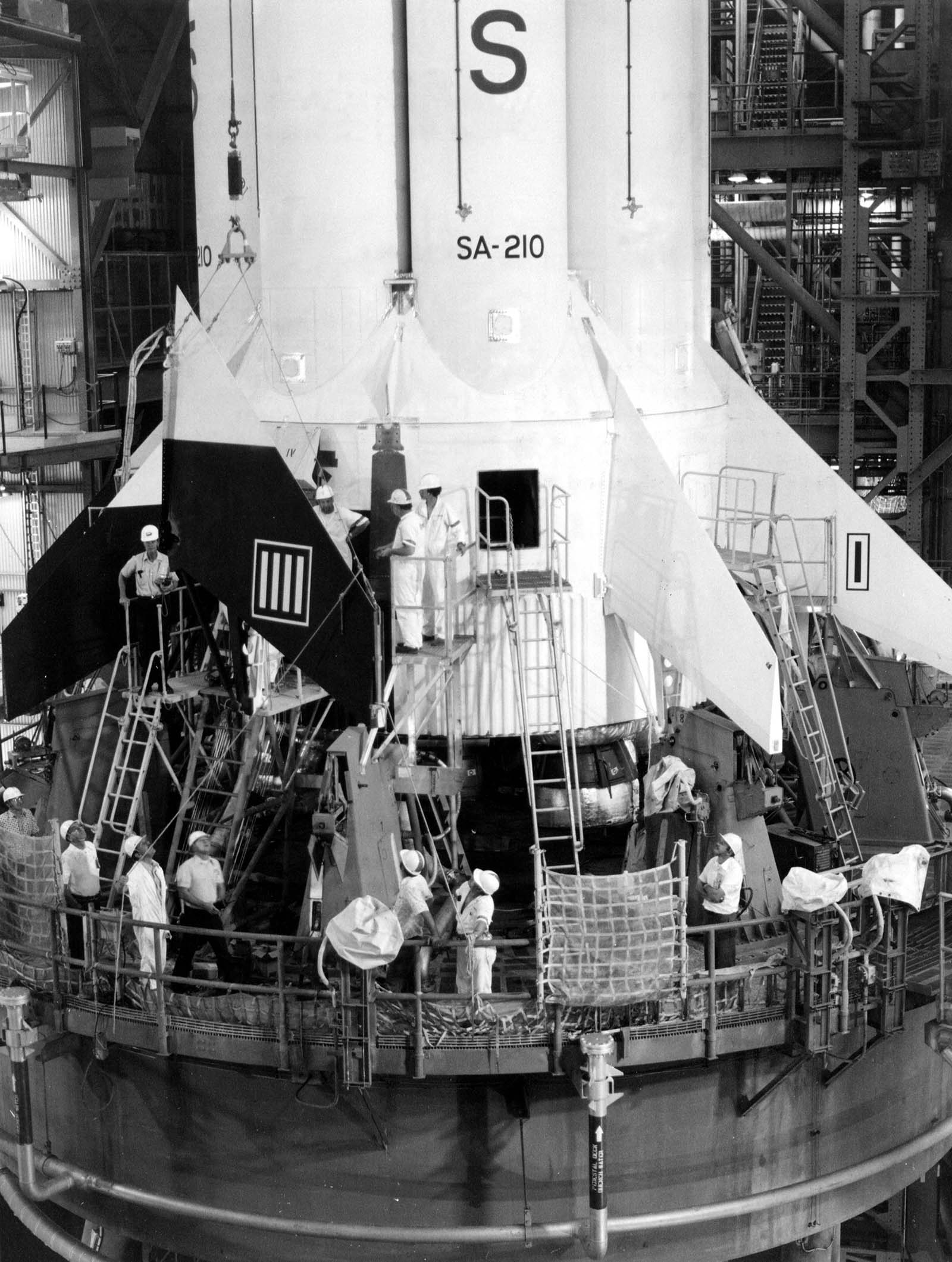
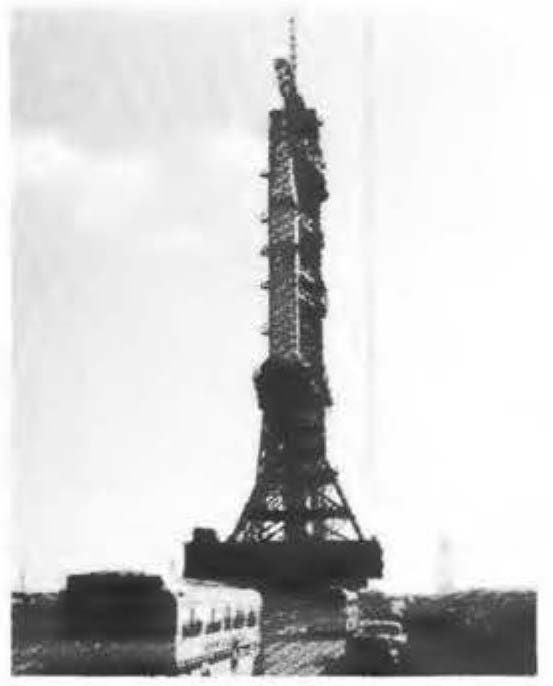
KSC personnel provided data on the launch center’s preparations for the flight. One of their major concerns was the possibility of thunderstorms and lightning strikes before and at the time of the launch. July was the worst time of the year for both at Cape Canaveral. William H. Rock, Manager for Sciences, Applications, and ASTP, spoke first for the launch team. In addition to covering all the ASTP-related modifications to the launch pad and control center, he gave some historical background on the ASTP lightning protection system installed on the mobile launcher. A lightning strike had long been a worry, one that had been reinforced by the twin bolts that had struck Apollo 12. To combat the effects of such a strike, the KSC team had installed a larger lightning rod atop the launch tower. This 25.6-meter fiberglass mast was designed so that the ground wires would not come any closer than 15 meters to the mobile launcher structure, thus eliminating the arcing of electrical current from the wires to the structure of the spacecraft. Rock noted that since 9 May four lightning strikes had been recorded; none had posed a threat to the hardware.* 62
* The lengthy efforts related to lightning protection are documented in note 62.
Although the lightning hazard appeared to have been minimized by the new arrestor, the possibility of rain storms and high winds still concerned the mission planners. Jesse R. Gulick, KSC staff meteorologist, reported on the weather prospects. Starting with a recapitulation of last year’s storm patterns, he said that, according to current mission rules, “we could not have launched on one-third of the days, that several such days could occur in a row... [but] there was no time last year when we could not have launched within a period of four days.” The thunderstorm probability for 15 July 1975 at the proposed lift-off hour was 23 percent. Probability of a tropical storm or hurricane winds affecting the KSC area was less than 3 percent. The mixed forecast, some good news and some bad, led to the crossing of fingers. While everyone hoped that they would not be needed, the mission planners were relieved that they had spent so much time working out alternative launch dates-just in case.63
Captain Lee took the floor after statements from KSC, Goddard (Spacecraft Tracking and Data Network), and Department of Defense personnel. He canvassed the Center Directors for comments, and they all remarked favorably on the preparations, expressing their confidence that the mission would be a success. George Low and John Yardley echoed these sentiments. Low said that he was especially impressed by all the effort and detail that had gone into building and checking out the ASTP hardware. Attention to detail had been one of the hallmarks of the Apollo and Skylab Programs, but he sensed a special feeling of pride behind the hard work and devotion of the ASTP team. Low believed that their energies would help assure a favorable outcome for the first international space flight. He asked them to continue their hard work until the mission was completed and the crews safely aboard the recovery ship. At the close of the FRR, Lee told the launch crews to continue with their preparations.64
COUNTDOWN TO LAUNCH
During the days remaining till the 15th of July, Lunney and Bushuyev kept in touch by telex and telephone. On 23 June, Lunney sent the “Launch minus 21 days” report to the Professor:
- SPACECRAFT:
- S-IB launch vehicle stage fuel (RP-1) loading was completed satisfactorily on July 23, 1975. Countdown demonstration test preparations have started and the nine-day test will start at 0700 EDT on June 25, 1975.
- GROUND SYSTEMS:
- ATS-6 satellite testing is complete. All MCC-H network interface testing is complete except for S-band tracking test to be conducted on June 25, 1975.65
Three days later, Lunney and Bushuyev discussed a variety of topics, including the joint control center simulations scheduled for the end of the month and some public affairs questions.66 Meanwhile, the astronauts continued their training.
At 2:50 on the afternoon of the 24th, the prime crew began a three-week preflight medical isolation program-the “Flight Crew Health Stabilization Plan.” Stafford, Slayton, and Brand were limited to specific working and training areas at JSC, and only previously screened personnel could come in contact with them. These “primary contacts” were required to wear surgical masks when in the presence of the crew. No one, especially the three astronauts, wanted a change in crew assignments because of the sniffles or any other common illness. In their off-duty hours, the prime three were quartered in mobile homes near the astronauts’ gym in the northeast corner of the space center. In addition to further practice in the simulators, they continued their work on Russian.67 (See table X-1.)
Table X-1. ASTP Crew Training Summary as of 15 July 1975
| Training activities | Hours accomplished | ||
|---|---|---|---|
| Stafford | Brand | Slayton | |
| Briefing/reviews: | |||
| Command and service module | 26.4 | 55.6 | 60.3 |
| Docking module | 8 | 21.5 | 24.9 |
| Launch vehicle | 2.6 | 3 | 2.6 |
| Experiments | 94.8 | 95.8 | 100.3 |
| Flight plan/checklist | 13.5 | 38 | 19.5 |
| Mission technique/rules | 29.5 | 61 | 23.5 |
| Soyuz | 2 | 2 | 2 |
| Systems Training: | |||
| Transfer procedures | 17.5 | 27 | 17.5 |
| Crew systems | 18.5 | 27.5 | 22.5 |
| TV | 2.5 | 5 | 5.5 |
| Photo | 12.5 | 12.5 | 11 |
| Experiments | 81.3 | 82.3 | 117.5 |
| Stowage | 1 | 2 | 7 |
| Bench checks | 12 | 12 | 12 |
| Egress/fire | 13 | 13 | 13 |
| Spacecraft test | 106.5 | 98.5 | 174.5 |
| Morehead planetarium | 0 | 0 | 12.5 |
| Medical | 33.5 | 22.5 | 31.5 |
| Simulators: | |||
| Command module simulator/docking module simulator | 428 | 474.2 | 549.3 |
| Command module procedures simulator | 32.5 | 0 | 56 |
| Russian language | 1016.5 | 923.5 | 1077.5 |
| Joint crew activities | 737.6 | 812.3 | 735.1 |
| Total hours | 2689.7 | 2789.2 | 3075.5 |
On 25 June, the Countdown Demonstration Test (CDDT) began at 7:00 a.m. After participating in the “Joint Orbital Operations Simulation” between the Houston and Moscow control centers, which began early on Sunday the 29th and continued for 56 hours, the prime crew departed Houston on 2 July for KSC, where they would take part in the manned portion of the CDDT. During one phase of the test that included a simulated ignition and lift-off, Vance Brand’s space suit leaked, as it had during a high altitude test run. This time the problem was traced-to one of the pressure-sealing slide fasteners. A minor modification to this “sophisticated zipper” fixed the leak, and technicians also altered Stafford’s and Slayton’s suits as a precautionary measure. As time ticked away toward the hour of launch, the tempo of activities quickened.68
After a one-day holiday and an additional check of Brand’s suit, the prime crew flew their T-38s back to Ellington Air Force Base on Saturday, 5 July. That afternoon, they reviewed the flight data file, and on Sunday they took to their T-38s again and later practiced Russian. As last minute checks went on at the Cape, the crew spent a busy week in the command module simulator. Rendezvous was practiced, with and without systems failures thrown in by their instructors, and solutions to possible docking malfunctions were studied and worked out in the simulator. On 13 July, the crewmen once again climbed into their jets and departed for Florida.69
Reports from Baykonur Cosmodrome indicated that the Soviet crewmembers were also in quarantine. After talking to Stafford on the 10th, Leonov and Kubasov continued reviewing their flight plans at the Soviet launch center. While they studied, the launch crews readied the two space vehicles. The prime spacecraft and booster were on the pad and fueling began on the 11th. Two days later, the second Soyuz and launch vehicle were transported to the secondary pad some 20 kilometers distant. All preparations were on schedule, and Soviet mission control advised the Americans that the tracking stations and tracking ships Akademik Sergei Korolev and Kosmonavt Yuri Gagarin were ready for the flight.70
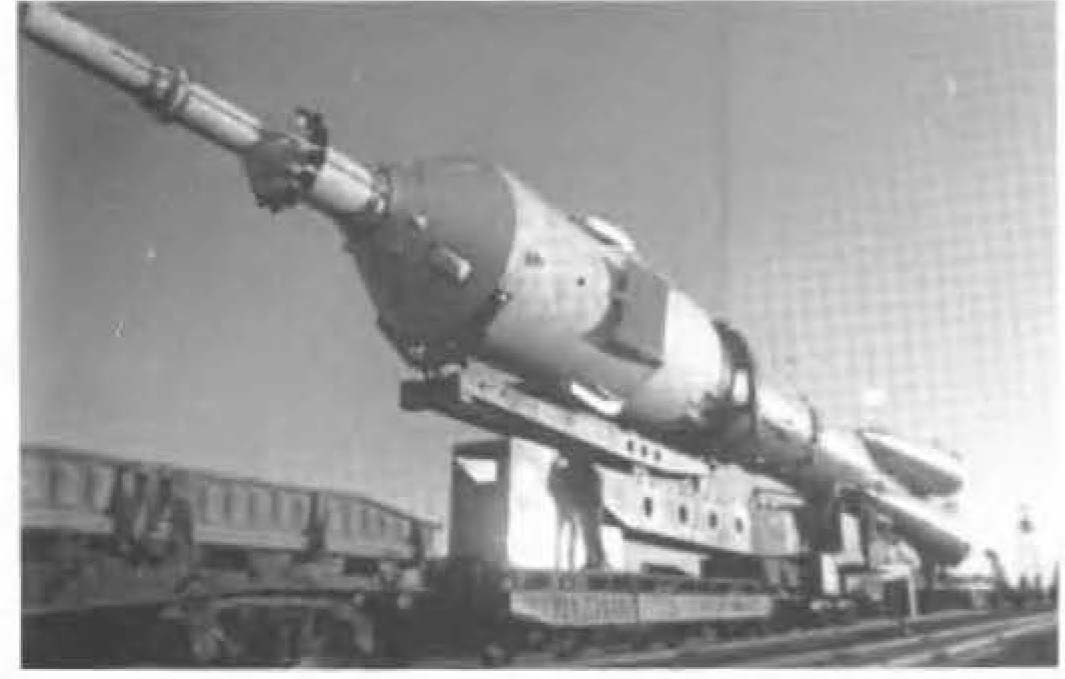
Since the personnel of the Soviet and American control centers were scheduled to start round-the-clock duty scheduled on 14 July, 24 hours before the launch of Soyuz, the teams of visiting specialists had to be in place ahead of time. A group of 15 specialists and interpreters from the Soviet Union had arrived in Houston on the 8th.* NASA’s flight control specialists led by Charles R. Lewis arrived at Moscow Sheremetyevo Airport on the 12th, where they were met by V. G. Kravets, V. D. Blagov, and S. P. Tsybin, members of the Soviet ground control teams.† With everyone in place, Chet Lee conducted the “L - 2 Day Review” to determine whether all systems were set for launch.71 Gulick could give a reasonably favorable weather forecast-broken clouds, wind out of the east southeast at 10 knots, a temperature of about 29°C, with about a 70-percent change of thunderstorms. All stations reported that they were ready to go.
* O. I. Babkov headed the delegation, which included S. G. Grishin, Deputy Director of MCC-M for Information; V. V. Illarionov, CapCom; A. S. Korolev, onboard systems specialist; V. V Kudryavtsev, docking systems specialist; V. K. Novikov life support system specialists; I. P. Shmyglevskiy, control system specialist; V. I. Staroverov, flight controller; V. D. Yastrebov, trajectory specialist; G. I. Kharitonov, Intercosmos; B. S. Kunashev, Space Studies Institute; and interpreters, B. P. Artemov, Y. N. Sergeyeva, and O. G. Yavorskaya.
† C. R. Lewis headed the delegation, which included R. F. Overmyer, Capcom; R. L. Haken, control system specialist; R. W. Becker, trajectory specialist; J. A. Kamman, guidance and navigation specialist; J. S. McLendon, electrical and instrumentation specialist; R. L. Grafe, ECS specialist; J. E. Riley, F. G. Williams, and A. P. Alibrando, public information; and interpreters J. O. Glikman, I. A. Mamantov, A. Rodzianko, T. Krivosheim, and K. Javorskaya.
- George M. Low, "Notes from Visit to Soviet Union, May 17-23, 1975," 5 June 1975.X
- Ibid.X
- Ibid.X
- Ibid.X
- "U.S. Proposal for a Joint ASTP Flight Readiness Review" [n.d.].X
- ASTP notebook, kept by Leonard S. Nicholson, for May-Nov. 1975.X
- Low, "Notes from Visit to Soviet Union, May 17-23, 1975," 5 June 1975. According to data supplied by R. H. Dietz on 6 June 1975, the Soviet lineup at the main table was as follows: B. V. Nikitin, Yu. S. Dolgopolov, V. S. Syromyatnikov, V. P. Legostayev, V. A. Timchenko, A. A. Leonov, Yu. V. Zonov, K. D. Bushuyev, V. A. Kotelnikov, B. N. Petrov, A. I. Tsarev, M. V. Sokolov, V. S. Vereshchetin, I. Rumyantsev, Tulin, and Sagdayev. The Americans present included C. M. Lee, H. E. Smith, R. O. Aller, A. W. Frutkin, A. B. Tatistcheff, G. M. Low, G. S. Lunney, J. F. Yardley, W. J. Kapryan, W. W. Guy, L. S. Nicholson, and R. D. White. See also "Apollo Soyuz Test Project, Flight Readiness Review, May 1975," 25 May 1975.X
- "Apollo Soyuz Test Project, Flight Readiness Review, May 1975," 25 May 1975, pp. WG-1-1 and WG-1-5; O. G. Sytin, "Ballistika EPAS" (ASTP trajectory questions), in Soyuz i Apollon, rasskazivayut soverskie uchenie inzhineri i kosmonavtichastniki sovmestnikh rabot s amerikanskimi spetsialistami [Soyuz and Apollo, related by Soviet scientists, engineers, and cosmonauts-participants of the joint work with American specialists], Konstantin D. Bushuyev, ed. (Moscow, 1976), pp. 77-99; and A. S. Yeliseyev and V. G. Kravets, "Upravlenie poletom" [Flight control], in Soyuz i Apollon, pp. 215-234.X
- ASTP notebook, kept by Nicholson, for May-Nov. 1975.X
- "Apollo Soyuz Test Project Flight Readiness Review, May 1975," 25 May 1975, pp. WG-1-12 and WG-1-13.X
- Ibid., pp. WG-1-22 and WG-1-26.X
- Ibid., pp. WG-1-27 to WG-1-40.X
- Ibid., p. WG-2-2. Results of the docking target verification tests were documented in "ASTP, Results of Verification Tests of Alinement Soyuz Docking Target," IED 50 203, 20 May 1975.X
- "Apollo Soyuz Test Project, Flight Readiness Review, May 1975," 25 May 1975, pp. WG-2-12 to WG-2-20.X
- Ibid., p. WG-2-21. The results of the safety assessments were presented in two documents: "ASTP Safety Assessment Report for Apollo Propulsion and Control Systems," ASTP 20 102, 3 May 1974, and "ASTP Safety Assessment Report for Soyuz Propulsion and Control Systems," ASTP 20 202.1, 1 May 1975. Soviet comments on guidance and control are contained in V. P. Legostayev, "Korabli idut na sblizhenie" [Spacecraft are approaching each other], in Soyuz i Apollon, pp. 100-115. The author emphasizes the superior automatic (or ground-controlled) guidance systems of the Soyuz and the changes that the Soviets had to make in their spacecraft to accommodate the Apollo systems and configuration incompatibilities.X
- "Apollo Soyuz Test Project, Flight Readiness Review, May 1975," 25 May 1975, p. WG-3-13; and interview (via telephone), Robert D. White-Edward C. Ezell, 23 Mar. 1976. X
- "Apollo Soyuz Test Project, Flight Readiness Review, May 1975," 25 May 1975, pp. WG-3-21 to WG-3-29; interview, White-Ezell, 23 Mar. 1976; White to Glynn S. Lunney, memo, "Debriefing Notes Regarding Docking Systems Preflight Compatibility Vertification in Moscow," 13 Mar. 1975; and Ray F. Larson to James M. Grimwood, "Contractor Comments on Edward C. Ezell's Manuscript of the ASTP Narrative History for Review and Comment (NAS9-13972)," 13 Jan. 1976.X
- "ASTP Working Group 3 Minutes on the Question of Resolving the Problem of Possible Binding of the Docking System Guide Pin and Socket," 22 Nov. 1974.X
- TWX, Lunney to Bushuyev, 8 Nov. 1974.X
- Interview, White-Ezell, 23 Mar. 1976.X
- "ASTP Working Group 3 Minutes on the Question of Resolving the Problem of Possible Binding of the Docking System Guide Pin and Socket," 22 Nov. 1974.X
- "Minutes of the ASTP Telephone Conversation [U.S. Minutes]," 19 Nov. 1974; and "Report on the Telephone Conversation of November 19, 1974 between Drs. Timchenko and Lunney (U.S.S.R. Minutes)," [n.d.].X
- White to Lunney, memo, "Debriefing Notes," 13 Mar. 1975; and interview, White-Ezell, 23 Mar. 1976.X
- "ASTP Meeting Minutes, Joint Meeting of Working Group 3," 16 Jan.-12 Feb. 1975; "ASTP Report of USA/USSR Docking System Alignment Pin and Socket Verification Test," USA WG3-042, 27 Jan. 1975; and White to Grimwood, memo, "Comments on E. C. Ezell's Draft Manuscript of the ASTP History," 6 Jan. 1976. Also see V. S. Syromyatnikov, "Stikovkaeto uzhe sotrudnichestvo" [To dock is to cooperate], in Soyuz i Apollon, pp. 116-148. The technical explanations covering the American and Soviet docking systems are very elaborate, with considerable effort being made to use layman's terminology. Syromyatnikov points out that, while the Soviet system, its design, technology, and construction never once caused any problems in manufacture, testing, or the flight itself, the American docking stem, "a copy of an existing Soviet design," was a cause for concern on many occasions. "American technology just was not sufficiently developed" to build a system better than that.X
- "Apollo Soyuz Test Project, Flight Readiness Review, May 1975," 25 May 1975, pp. WG-4-1 to WG-4-53; interview, Reinhold H. Dietz-Ezell, 6 June 1975; interview (via telephone), Dietz-Ezell, 24 Mar. 1976; and B. V. Nikitin and B. F. Ryadinski, "Apollon, ya-Soyuz! Kak slishite?" [Apollo, this is Soyuz! How do you read?I, in Soyuz i Apollon, pp. 149-165. X
- Interview, Dietz-Ezell, 18 Feb. 1976; interview; Dietz-Ezell, 24 Mar. 1976; and ASTP notebook, kept by Nicholson, for May-Nov. 1975.X
- Interview, Walter W. Guy and James R. Jaax-Ezell, 19 Jan. 1976.X
- Ibid.; "Apollo Soyuz Test Project Flight Readiness Review, May 1975," 25 May 1975, pp. WG-5-19 to WG-5-25; and I. V. Lavrov and Yu. S. Dolgopolov, "V poiskak obshcheiy atmosferi" [In search of a common atmosphere], in Soyuz i Apollon, pp. 166-179.X
- "Apollo Soyuz Test Project Flight Readiness Review, May 1975, 25 May 1975, p. WG-5-1.X
- Low, "Notes from Visit to Soviet Union, May 17-23, 1975," 5 June 1975.X
- Ibid.; and interview, Dietz-Ezell, 6 June 1975.X
- "Summary of the Joint Review of the Flight Readiness of the Apollo-Soyuz Project," 22 May 1975; "Space Officials Give Approval to Link-up of Apollo and Soyuz," New York Times, 23 May 1975; "All Systems Go," Washington Post, 23 May 1975; and "Apollo-Soyuz Flight is Okayed," Baltimore Sun , 23 May 1975.X
- James C. Fletcher to Gerald R. Ford, 29 May 1975.X
- Fletcher to William Proxmire, 4 June 1975, with enclosure, "Soyuz Launch Abort of April 5, 1975," 4 pp.; and Chester M. Lee, memo for record, "Information Regarding Soyuz 18," 18 Apr. 1975.X
- Robert J. Shafer to John P. Donnelly, memo, "Apollo/Soyuz Test Mission Television. 27 June 1972; Shafer to Donnelly, memo, "ASTP," 29 Aug. 1972; and TWX, Bushuyer to Lunney, 28 Mar. 1974.X
- Interview, Donnelly and Shafer-Ezell, 26 and 28 Jan. 1976. X
- Low to Lee, memo, "ASTP Television, 31 Aug. 1973.X
- Ibid.X
- Shafer to Lee, memo, "ASTP Television," 14 Sept. 1973; and Lunney to Lee, memo, "ASTP Television," 18 Sept. 1973.X
- Lunney to Lee, memo, "ASTP Television," 18 Sept. 1973; Lee to Shafer, memo, "Television Coverage During the ASTP Mission," 25 Oct. 1973; and Shafer to Lee, memo, "ASTP Television Coverage," 2 Nov. 1973.X
- Dale D. Myers to Fletcher, memo, "Summary of ASTP Actions Taken Regarding Use of the ATS-F Satellite," 2 Nov. 1973, with enclosure, "Chronology of ATS-F Coordination."X
- Lee to Low, memo, "ASTP Television Coverage" [12 Nov. 1973].X
- Lunney, memo to distribution, "ASTP Television," 14 Dec. 1973.X
- "ASTP TV Planning Team, Minutes," 8 Jan. 1974, 12 Feb. 1974, 1 May 1974, 4 June 1974, 10 July 1974, 6 Aug. 1974, 22 Aug. 1974, 10 Oct. 1974, 20 Feb. 1975, and 26 Mar. 1975.X
- Shafer to Donnelly, memo, "ASTP Television," 30 Jan. 1974. Cernan had a similar evaluation of the situation. See Eugene A. Cernan to Lunney, memo, "ASTP TV Status," 1 Feb. 1974.X
- Donnelly to Fletcher and Low, memo, "Moscow Trip Report," 28 Mar. 1974; Lee to Donnelly, memo, "ASTP Status Report," 7 June 1974; and Shafer to Donnelly, memo, "ASTP Public Information Plan, Part II-May 1974 U.S. Revisions," 10 June 1974.X
- "ASTP Public Information Plan-Part II," ASTP 20 050 Part II, 13 Sept. 1974.X
- UPI wire release, 9 Oct. 1974. The precise language of the agreement stated, "Beginning with the Soyuz launch and ending with Apollo recovery, inflight (on-board) information from both spacecraft, voice communications between the two spacecraft, US and USSR ground communications to and from both spacecraft, and ground-based and on-board television will be exchanged in real time as they are received. This information will be released by each side to the news media in accordance with its own obligations and practices," "ASTP Public Information Plan-Part II," ASTP 20 050 Part II, 13 Sept. 1974.X
- Aviation Week & Space Technology, 14 Oct. 1974, p. 11. Other comments included "Soviets Keep Soyuz Launch Site 'Off Limits,' Editor & Publisher, 30 Nov. 1974; "From Russia, with Live," Broadcasting, 14 Oct. 1974; "Soviet Refuses to Lift Its Ban on U.S. Newsmen at Launching," New York Times, 12 Oct. 1974; "Russians Insist on Bar on Press," New York Times, 24 Oct. 1974; "The Unwelcome Mat," Huntsville Times, 14 Oct. 1974; "Veil on Launch," Washington Star-News, 12 Oct. 1974; and "Russians To Provide Soyuz TV," Houston Post, 10 Oct. 1974.X
- Fletcher to Wes M. Gallagher, 22 Oct. 1974. This was also sent as a TWX.X
- Ibid.X
- "ASTP Minutes of Public Information Working Group Meeting, USSR Academy of Sciences and US National Aeronautics and Space Administration," 6-16 Apr. 1975; and "ASTP Public Information Plan-Part II," AST 20 050 Part II, 10 July 1975.X
- News release, issued by the office of Senator William Proxmire, Wisconsin, 2 July 1975.X
- Ibid.X
- Proxmire to Fletcher, 2 July 1975.X
- Fletcher to Proxmire, 3 July 1975.X
- Ibid.; and Thomas O'Toole, "U.S.-Soviet Flight Delay Is Rejected," Washington Post, 3 July 1975.X
- "Apollo-Soyuz Flight," Congressional Record, 11 July, S12417. Proxmire inserted 'Thomas O'Toole, "Apollo-Soyuz: Another 'Wheat Deal,'" Washington Post, 11 July 1975, and Tom Braden, "The Space Link-Up," Washington Post, 5 July 1975.X
- News release, issued by the office of Senator William Proxmire, Wisconsin, 14 July 1975.X
- Interview, Thomas P. Stafford-Ezell, 6 Apr. 1976.X
- NASA, OMSF, Apollo/Soyuz Test Program Office, "ASTP Flight Readiness Review," TM052-001-1A, June 1975.X
- Lightning had been a problem since Mercury and Geinini, with the first major incident occurring on 17 Aug. 1964 when a lightning strike at launch complex 19 interrupted testing of Gemini Launch Vehicle 2. This and other problems caused postponement of the GLV-2 flight until 19 Jan. 1965. Subsequently, GT-5 was postponed when a similar near miss affected the onboard computers. This resulted in a two-day delay. See James M. Grimwood, Barton C. Hacker, with Peter J. Vorzimmer, Project Gemini Technology and Operations; A Chronology, NASA SP-4002 (Washington, 1969), pp. 154 and 209. During the Apollo 12 launch, the spacecraft was affected by lightning-associated electrical disturbances at 36.5 and 52 seconds after liftoff. See NASA, "Analysis of Apollo 12 Lightning Incidents," MSC-01540, Feb. 1970. Following the Apollo 12 flight, greater attention was given to the lightning problem. For ASTP, see William R. Durett to Donald D. Arabian, memo, "KSC Lightning Research," 8 Aug. 1973; Lee to William H. Rock, memo, "Impact of Lightning Strikes on the ASTP Mission," 30 Aug. 1973; Lee to Rock, memo, "Impact of Lightning Strikes on the ASTP Mission," 11 Dec. 1973; Rock to Lee, memo, "Impact of Lightning Strikes on the ASTP Mission," 20 Dec. 1973; Richard G. Smith to Rock, memo, "Impact of Lightning Strikes on the ASTP Mission," 16 Feb. 1974; Rock to distribution, memo, "ASTP Lightning Review," 27 Mar. 1974; Rock to Lee, memo, "Impact of Lightning Strike on the ASTP Mission," 1 Apr. 1974; TWX, Lee to Lunney, Ellery B. May, Rock, and Walter J. Kapryan, "Plan for Lightning Investigation at KSC, Summer, 1974," 24 Apr. 1974; Lee to Lunney, May, and Rock, memo, "ASTP Lightning Meeting," 20 May 1974; TWX, Lee to Lunney, Rock, Isom A. Rigell, and May, "Spacecraft Lightning Tests," 24 June 1974; May to Lee, memo, "AS-210 Simulated In-Flight Lightning Test," 27 June 1974; Rock to Lee, memo, "ASTP In-Flight Lightning Tests," 2 July 1974; Lee to Lunney, May, and Rock, memo, "ASTP Simulated In-Flight Lightning Tests," 25 July 1974; Lunney to Kapryan, memo, "Simulated Lightning Test on CSM 119,"* 9 Aug. 1974; TWX, Rock to Lee, "Simulated Lightning Tests at KSC," 15 Aug. 1974; Rock to distribution, memo, "Crew Safety Panel Approval, Concept or Lightning Protection System for ASTP," 12 Aug. 1974; Lee to Lunney, May, and Rock, memo, "Launch Mission Rules Changes for Lightning," 19 Aug. 1974; TWX, Lee to Lunney, May, and Rock, memo, "ASTP Simulated In-Flight Lightning Tests," 6 Sept. 1974; TWX, Lee to Rock, Lunney, and May, "Lightning Review," 3 Oct. 1974; Rock to distribution, memo, "ASTP Launch Mission Rule," 4 Nov. 1974; John F. Yardley to Low, memo, "ASTP Severe Weather Launch Rules," 20 June 1975; Robert L. Blount, Richard D. Gadbois, Dwight L. Suiter, and John A. Zill, NASA, JSC, "ASTP Simulated Lightning Test Report," JSC-09221, Nov. 1975; NASA News Release, KSC-30-75, "Saturn/Apollo Launch Tower Sports 'New Look,'" 2 Mar. 1975; and NASA, OMSF, Apollo/Soyuz Test Program Office, "ASTP Flight Readiness Review," TM052-001-1A, June 1975.X
- Charles J. Newman, Weather Bureau, Office of Meteorological Operations, Space Operations Support Division, Frequency and Duration of Thunderstorms at Cape Kennedy, Part 1, WBTM SOS-2 (Silver Spring, Md., June 1968); and NASA, OMSF, Apollo/Soyuz Test Program Office, "ASTP Flight Readiness Review," TM052-001-1A, June 1975.X
- NASA, OMSF, Apollo/Soyuz Test Program Office, "ASTP Flight Readiness Review," TM052-001-1A, June 1975; NASA News Release, MSFC, 75-119, "Apollo Soyuz Flight Readiness Review Is Held," 12 June 1975; and NASA News Release, KSC-104075, "ASTP Given Clearance for Final Preparations," 12 June 1975. But Low still had some questions; see Low to Lee, memo, "ASTP Questions," 16 June 1975.X
- TWX, Lunney to Bushuyev, "Apollo Status Report,"* 23 June 1975.X
- "Minutes of the ASTP Telephone Conversation (U.S. Minutes)," 26 June 1975; and "Minutes of the June 26, 1975 Telephone Conversation between Lunney and Bushuyev [USSR Minutes],' 26 June 1975.X
- NASA News Release, JSC, 75-59, "ASTP Crew Begins Medical Isolation," 24 June 1975; [NASA News Release, KSC (unnumbered)], "ASTP Prime Crew Activities," 25-29 June 1975; and data supplied by Mike S. Brezinski.X
- NASA News Release, KSC-115-75, "ASTP Dress Rehearsal Begins Wednesday," 25 June 1975; [Response to query, JSC], "Suit Fitting Background" [n.d.]; and TWX, Lunney to Bushuyev, "Apollo Status Report," 29 June 1975. See also NASA, JSC, Engineering and Development, "Weekly Activity Report," 6-12 July 1975, p. 3:
During CDDT, excessive leakage was discovered in the suit loop of the spacecraft while in the low pressure (vent) mode, although no leakage was evidenced at high pressure (3.75 psi). Troubleshooting conducted in the spacecraft isolated the problem to Astronaut Brand's suit. Following completion of CDDI, Astronaut Brand's flight suits were returned to JSC where additional failure analysis established the source of this low pressure leak to be in the crotch radius area. The leak is induced when the crewman is tightly strapped into the couch position causing the zipper sealing lips to unseat. After examining several possible corrective concepts, a zipper insert [made of vinyl tubing] was designed which can be placed between the sealing zipper and the donning assist zipper thereby preventing the sealing lips from being unseated by the couch position condition. Certification tests of the zipper insert have been conducted to verify its acceptability for flight and to assure no adverse effects on use of the suits in the pressurized mode. Vance Brand had also fit checked his suits with the insert installed to verify acceptability.
X - [NASA News Release, KSC (unnumbered)], "ASTP Prime Crew Activities," 30 June-7 July 1975; TWX, Lunney to Bushuyev, "Apollo Status Report," 2 July 1975; [NASA News Release, KSC (unnumbered)], "Status Report ASTP-2," 4:30 p.m., 7 July 1975; [NASA News Release, KSC (unnumbered)], "ASTP Apollo Crew Activities," 7-8 July 1975; [ASTP News Release, KSC (unnumbered)], "ASTP Apollo Crew Activities," 8-15 July 1975; [NASA News Release, KSC (unnumbered)], Status Report ASTP 3," 8:00 a.m. EDT, 8 July 1975; [NASA News Release, KSC (unnumbered)], "Status Report-ASTP #4," 4:30 p.m., 8 July 1975; [NASA News Release, KSC (unnumbered)], "Status Report ASTP 5," 8:00 a.m., 9 July 1975; TWX, Lunney to Bushuyev, "Apollo Status Report," 9 July 1975; and data supplied by Brzezinski. See also TWX, Lunney to Bushuyev, "Apollo Status Report," 10 July 1975.X
- [NASA News Release, KSC (unnumbered)], "Status Report ASTP #12," 2:00 p.m., 11 July 1975; [NASA News Release, KSC (unnumbered)], "Status Report ASTP #14," 5:00 p.m., 11 July 1975; [U.S.S.R.], Press Bulletin No. 1, "ASTP Mission Events," 12 July 1975; [NASA News Release, KSC (unnumbered)], "Status Report #15," 9:30 a.m., 12 July 1975; [NASA News Release, KSC (unnumbered)], "Status Report ASTP #16, 2:30 p.m., 12 July 1975; [NASA News Release, KSC (unnumbered)], "Status Report #17," 5:00 p.m., 12 July 1975; [U.S.S.R.], Press Bulletin, "Two Days before the Liftoff," 13 July 1975; and A. I. Ostashev and N. I. Zelenshikov, "Soyuz 19 u poroga orbitiy" [Soyuz 19 on the threshold of space,] in Soyuz i Apollon, pp. 235-244.X
- TWX, Vladen S. Vereshchetin to Lunney, 7 July 1975; [NASA News Release, JSC (unnumbered)], "USSR Academy of Sciences ASTP Delegation for Mission" [n.d.]; [U.S.S.R.], Press Bulletin No. 3, "Two Days before the Liftoff," 13 July 1975; and [NASA, Apollo Program Office], "USA Specialists in Moscow during ASTP Mission" [n.d.].X