Forging a Partnership
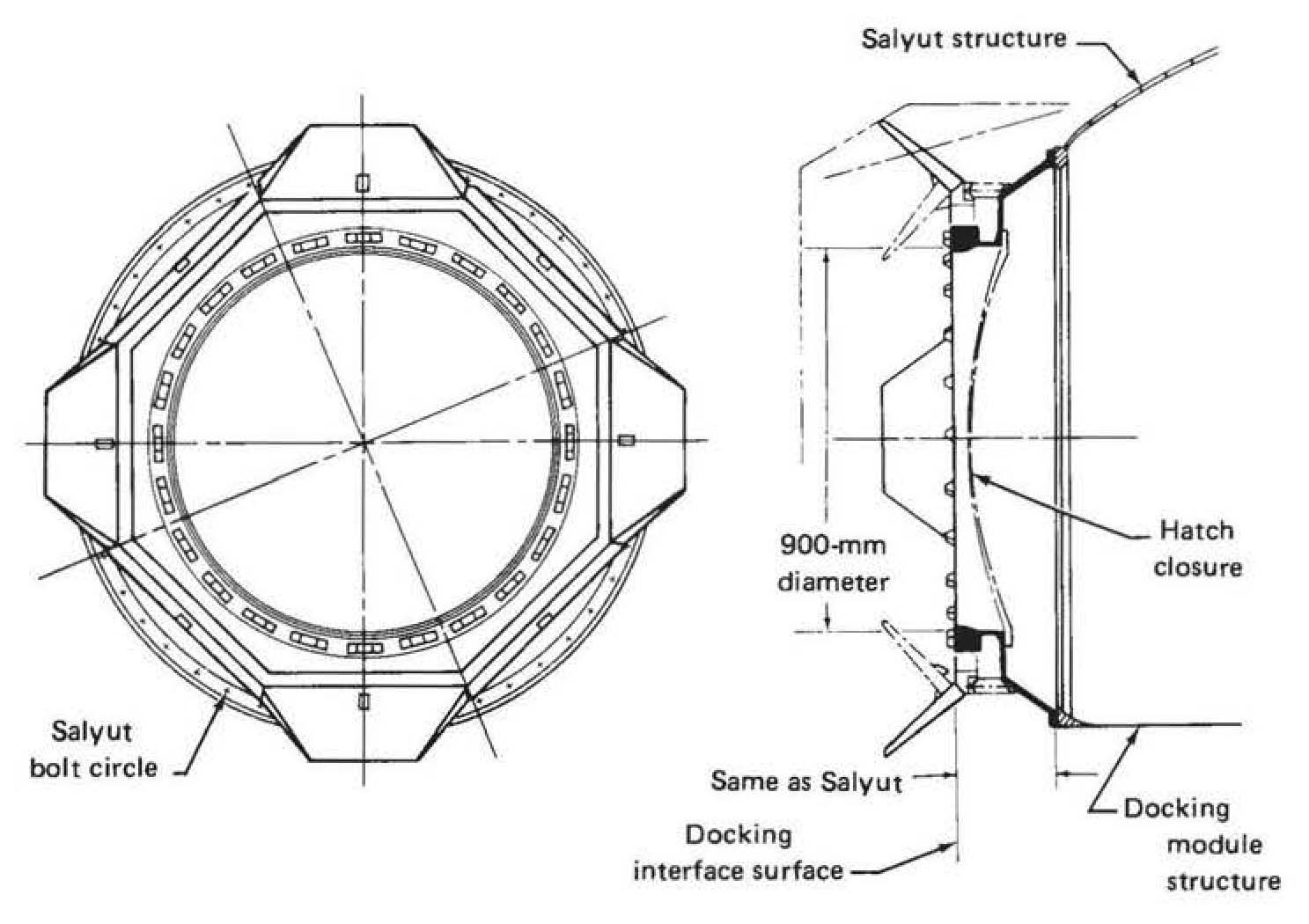
In planning for the third round of Soviet-American compatibility talks in the summer of 1971, Glynn Lunney wrote to Professor Bushuyev, expressing his condolences to the families and colleagues of the Soyuz 11 cosmonauts. “This sad accident has further strengthened our emphasis on the solution of the common docking problems.” Turning to the work being done in Houston, he commented, “As no doubt you are finding, there are many questions which arise as we have time to reflect upon and plan the work for our meetings later this year.” One of these questions concerned the diameter of the Salyut port. Bill Creasy and his design colleagues had planned to propose a docking mechanism for the Soviets to study, but they needed to know what size gear would fit beneath the Salyut launch shroud, which provided the space station with aerodynamic streamlining. Lunney enclosed in his August letter a sketch that reflected the Manned Spacecraft Center’s (MSC’s) understanding of the dimensional liminations that would govern the mounting of such a docking system on Salyut, and he asked Professor Bushuyev to verify the sizes involved, which he did on 9 September.1
During September, Lunney again sent correspondence to Moscow regarding a proposed agenda for their joint meeting; NASA would prefer a two-part approach. “As we agreed in June,” he wrote, “we have given priority consideration to a test mission between the Apollo spacecraft and the Salyut-type station,” but our two countries must also continue “work on the technical requirements and solutions for long-term capability.” To meet both needs, the NASA agenda separated the topics to be discussed into two categories-long range compatibility issues and a near term test mission. Lunney hoped that this format would clarify the distinctions between the immediate and longer range goals of the negotiations. He also pointedly played down the possibility of a joint mission with Skylab, by saying that it was much too early to talk about using such an untested, complex scientific space station.2
Bushuyev replied in October, agreeing that it appeared possible to look at both long range questions and an Apollo/Salyut mission “in parallel.”3 He also sent lists prepared for each Working Group regarding documents that the Soviets believed could be put into final form at this meeting. A fourth list presented several general documents that they felt should be agreed upon ultimately. Finally, the Professor suggested the joint meetings be held from 29 November to 7 December in Moscow. Since this was well within the time for which NASA had targeted, Lunney accepted and advised the Soviets that the Americans would plan to arrive on the evening of Saturday, the 27th.4
PREPARATION IN HOUSTON
Technical Director Lunney had already prepared an outline to guide his associates as they prepared for their discussions with the Soviets. (See box on next page.) He thought that “this outline should facilitate a comparison between the near- and far-term activities; it should also form the basis for summarizing our results to NASA personnel, and for our discussions with the Soviets this fall.”5 On 6 and 7 October, a detailed technical review was held at MSC, followed two weeks later by a management review for Gilruth and Kraft. Lunney, the Working Group chairmen, Berglund, and Johnson then went to Headquarters on 10 November to brief George Low.6
The Headquarters briefing identified a number of items that would have to be cleared up in the joint negotiations. The long range questions naturally tended to be broader in scope than the Apollo/Salyut issues, which were concrete and specific. But some top level decisions were needed in both areas before the trip to Moscow. For example, the MSC representatives wanted to know Headquarters’ position on scheduling a command and service module (CSM)/Salyut mission-1974 or 1975? Caldwell Johnson argued that a mid-1974 target date for launch would depend primarily upon the progress made in defining, developing, building, and testing a docking system. MSC also needed to know how and where Headquarters wished the docking system to be built. The Houston engineers assumed that the American half of the system would be built by a contractor, but would the United States try to build both halves, or would we negotiate a common interface specification and leave each side to fabricate its own part? The same questions arose concerning radio equipment. Would the U.S. lend the Soviets American receivers, or would we give them the technical specifications for the hardware and let them build the radios? Though this issue embraced the sticky subject of technology transfer, NASA knew that the radio and frequency used in Apollo would never be incorporated into Shuttle. So if they should be asked to build receivers for the Apollo frequency, the Soviets would be building a piece of hardware that was obsolescent, but which might contain technological concepts that were not.
Apollo-Salyut Test Mission Planning Activities-Manned Space Center
- Objectives
- Schedules
- Mission model
- Summary (include questions for the Soviets)
- Overall mission
- Assumptions (include questions for the Soviets)
- Ground rules
- Profiles (altitude, phasing, etc.)
- Timelines
- Consumables
- Docked mission
- Assumptions (include questions for the Soviets)
- Ground rules
- Timelines (procedures, equipment transfer, cooperative experiments, restrictions, etc.)
- Technical subjects*-requirements and solutions
- Atmospheres, life support
- Composition and characteristics of atmosphere
- Crew transfer (nominal and others)
- Constraints
- During docking
- While docked
- Coordinate systems
- Guidance systems
- Optical
- Radio
- Lights
- Docking targets
- Control systems
- During docking
- While docked
- Communications
- Air to air
- Air to ground
- Docking mechanism
- Functions
- Capabilities
- Parameters (geometry, kinematic envelope, etc.)
- Atmospheres, life support
- Other subjects
- Training
- Crew
- Mission team
- Mission control
- Mission rules, contingency procedures, etc.
- Training
* Each of these subject areas should be organized with separate paper on at least the following topics: (1) subjects and issues for discussion with U.S.S.R.; (2) recommended position and/or numerical values relative to discussion subjects; (3) expected implication of "recommended position" to the U.S. program; (4) technical analysis, trades, other options; (5) recommended methods to implement solutions (e.g., exchanged hardware); (6) qualification, testing; (7) launch checkout requirements, and (8) questions for the Soviets
Because MSC specialists wanted to develop an equal-partner relationship with the Soviets, they preferred to develop common specifications for that basic interface, the docking mechanism. Uniformity was absolutely necessary in the docking mechanism; elsewhere, compatibility was all that was required. The actual detailed execution of the design could vary as long as the functioning of the system met agreed specifications. When it came to equipment like the Apollo radio, MSC preferred to loan the Soviets the hardware, if possible, and save everyone time and needless work. Further away from the interface, understanding some systems would likely have to be based upon mutual assurances. MSC pointed out to Headquarters, “Conduct of such a mission warrants a measure of trust and the need to accept less than-100% knowledge and understanding of each other’s equipment.” But the critical areas in which full disclosure was necessary would be an issue to be resolved within each of the Working Groups.7
Looking at the long term, the planners saw here some important considerations that would also demand comment from Headquarters. On the American side, long-range requirements were being drafted with Shuttle-era spacecraft in mind (Shuttle Orbiter, modular stations, and space stations), but MSC was still unable to state specific needs for a number of Shuttle subsystems-communications, guidance, and tracking. The Houston representatives told the Washington staff that “In a number of technical areas, we should not agree on requirements (step A) [with the U.S.S.R.] until our long-term programs are better defined.” But the Soviets would seem prepared to finalize their technical requirements after their next meeting and move on to step B, the preliminary design of hardware. Caldwell Johnson had felt all along that there was a problem of semantics in using the word “future.” NASA tended to reserve this adjective for concepts that were still rather nebulously defined, while the Soviet engineers used future to describe any spacecraft that had not yet been flown.8
Even though the Americans were in the dark about the Soviets’ plans for the 1980s and unclear about details of their own next generation of hardware, Lunney and the others were sure that an actual test mission would have specific benefits. First, the Soviets and the Americans would learn to work together. Second, jointly designing a docking mechanism would be an opportunity to work out the specific issues involved in bringing two different engineering approaches together in a compatible piece of hardware. And third, an Apollo/Salyut mission would provide NASA time to define more fully its requirements for Shuttle-era subsystems. Clearly, the Manned Spacecraft Center favored a test mission not only for its educational value but also because it would permit NASA to “work the problem” of creating compatible systems with the Soviets in their discussions of future systems without prematurely foreclosing flexibility in Shuttle design.9
ROUND THREE-MOSCOW
Glynn Lunney, Bob Gilruth, and their 18 companions arrived in Moscow on Saturday evening, 27 November 1971, where their welcome by members of the Soviet delegation was given considerable attention by the Soviet news media. The Americans were processed quickly through immigration and customs formalities, arriving at the Hotel Rossiya about 90 minutes after landing. On the way to the hotel, Lunney and Bushuyev, accompanied by an interpreter, had a pleasant chat about their past work and plans for the coming week, a discussion which was continued later that evening at a Soviet-hosted dinner at the Rossiya. Sunday was essentially a free day, and most of the Americans went on a special bus tour of Moscow, which included the People’s Exhibition of Economic Achievements. Lunney noted that the space display at the exhibition grounds had some new exhibits-two full-scale Soyuz in docked configuration, the Luna 16 lander, which had visited the moon and returned with a small sample of lunar soil, and a replica of the moon rover Lunokhod.10
On Monday morning, the NASA delegation went to the Institute of Automatics and Telemechanics, a 30-minute bus ride from the hotel. The Institute, sponsored by the Soviet Academy of Sciences and devoted to the study of automatic control systems (cybernetics), was also home base for Academician Petrov. The NASA group gathered with the Soviets for a plenary session in a large lecture room. After introductory remarks and some discussion of the week’s agenda, Lunney gave the Soviets two papers. One summarized the present status of the American long-term technical requirements and the other details of a possible Apollo/Salyut mission.11 When the Soviets reciprocated at the end of the morning session, the two groups spent the remainder of the day translating and studying. The Soviets were reluctant to begin any detailed discussions until they had an opportunity to more fully understand this new material. While one of the American interpreters read aloud in Russian to the Soviets from the NASA papers, a quickly transcribed version of shorthand notes taken from a verbal translation of the Soviet materials was prepared for the Americans.
In addition to these basic documents, Lunney and his colleagues argued for and obtained a chance to present for the entire Soviet group highlights of the U.S. mission model and docking mechanism studies. The quick summary gave everyone, including Academician Petrov and his executive staff, a basic understanding of the NASA ideas for a joint mission. With this background, the three Working Groups could go their separate ways, but they would be negotiating within a more clearly understood framework.
Lunney reported that in Working Group 1, which he chaired, the Soviet side had “very capable experts on the subjects of life support and mission planning.” At various times during the week, the men were able to divide into smaller subgroups to discuss specific topics. With the aid of the interpreters, “a good deal of understanding was reached, and several enclosures on specific subjects were prepared for inclusion in the minutes.” Looking at the experiences of the other groups, Lunney commented, “Working Group #2 also used the splintering technique because of the multitude of systems that were covered.... Working Group #3 on the docking mechanism tended to work more as a group ... because of the nature of their [topic].” He believed that by following the Low precedent-preparing ahead of time documents similar to those agreements that were desired-the NASA representatives in Working Groups 1 and 2 “were able to lead most of the discussions and focus on the parts of the problem that we felt [were] significant.”12
The remainder of the week (29 November-3 December) was spent in Working Group sessions, with the specialists devoting most of Friday and part of Saturday documenting their results. Those who could get free that weekend were taken to Star City, where they toured the cosmonaut training facilities. Lunney saw K. P. Feoktistov there, and the designer-cosmonaut gave his American friend an in-depth briefing on the Soyuz control systems. After a stand-up buffet luncheon given by the Commanding General of Star City, the Working Group members returned to Moscow. Sunday was spent sightseeing, with a trip to the Zagorsk monastery, about 81 kilometers from Moscow.
On Monday, 6 December, the delegations met a final time at the Institute to verify and sign the minutes of their meetings, with the executive staffs reading and authenticating their minutes and those of the Working Groups. The Summary of Results, which included the minutes of each Working Group as attachments, was signed at the House of Scientists that evening.* Lunney subsequently commented that this whole procedure was “a fairly tedious process, [but] sufficient time must be programmed for this not-very-productive necessity.”13
* The names of the signatories to these and subsequent joint minutes are presented in appendix C.
ISSUES AND ANSWERS
The negotiations conducted in Moscow had indicated by their variety and scope the growing complexity of the joint effort. At the executive level, the question of more rapid and frequent communications between the Soviet and American Technical Directors had been raised. In the November briefing to Headquarters before the trip MSC had pointed out that preparations for a test mission could never be conducted by the slow process of exchanging letters through diplomatic mail: “If such a test mission is to be developed, we need to establish a method for more timely communications with the Soviets.”14 In Moscow, Chris Kraft had raised this matter, urging NASA and the Soviet Academy to establish weekly or biweekly telephone conference calls between the Technical Directors, with these discussions being confirmed by telex. At first, Petrov had balked, saying that it would be too expensive. He argued besides that they would have to bring in their telephone people before they could have direct telephone conversations with the Americans. For this reason, he could not discuss the topic. Kraft insisted that telephone conferences and telex exchanges had been required in the American manned space program since Project Mercury. Gilruth added, “It was essential to permit an easy flow of information and to establish a system for reassurance that progress was being made.” He told the Soviets that they “had to agree to this point or the mission would be impossible.” Kraft and Gilruth hammered away on this subject for some time, and finally Gilruth told the Soviets that should they be unwilling to agree to the telephone conversations the NASA delegation might as well pack up and go back to Houston. After some hesitation, the Soviets decided to try the telephone/ telex approach, and this agreement had been included in the Summary of Results.15
During the executive group meetings, having declared that “a test mission appears technically feasible and desirable,” the two sides did determine that it would be necessary to make an early decision about the practicality of scheduling a flight for 1975. With the American side proposing that the launch occur in the spring or summer of the year, the parties had included in the Results an agreement that each side would send the other by 1 April 1972 “a statement of its position on the prospects for the actual conduct of the test mission in 1975” and their concepts of such a mission. To pace the implementation of these decisions, the executive staff had drawn up a preliminary list of milestones, or major events, for the planning, design, and implementation phases of preparing for a test flight. (See box on next page.) This schedule was patterned after a standard NASA format, and the original draft would be subjected to further discussion prior to the April deadline. As the list grew, the need for closer communication became even more apparent. It also became clear that all letters, telexes, and telephone conversations should be coordinated by the Technical Directors. Many hands would work on the joint project, but they would have to be carefully orchestrated to assure success.16
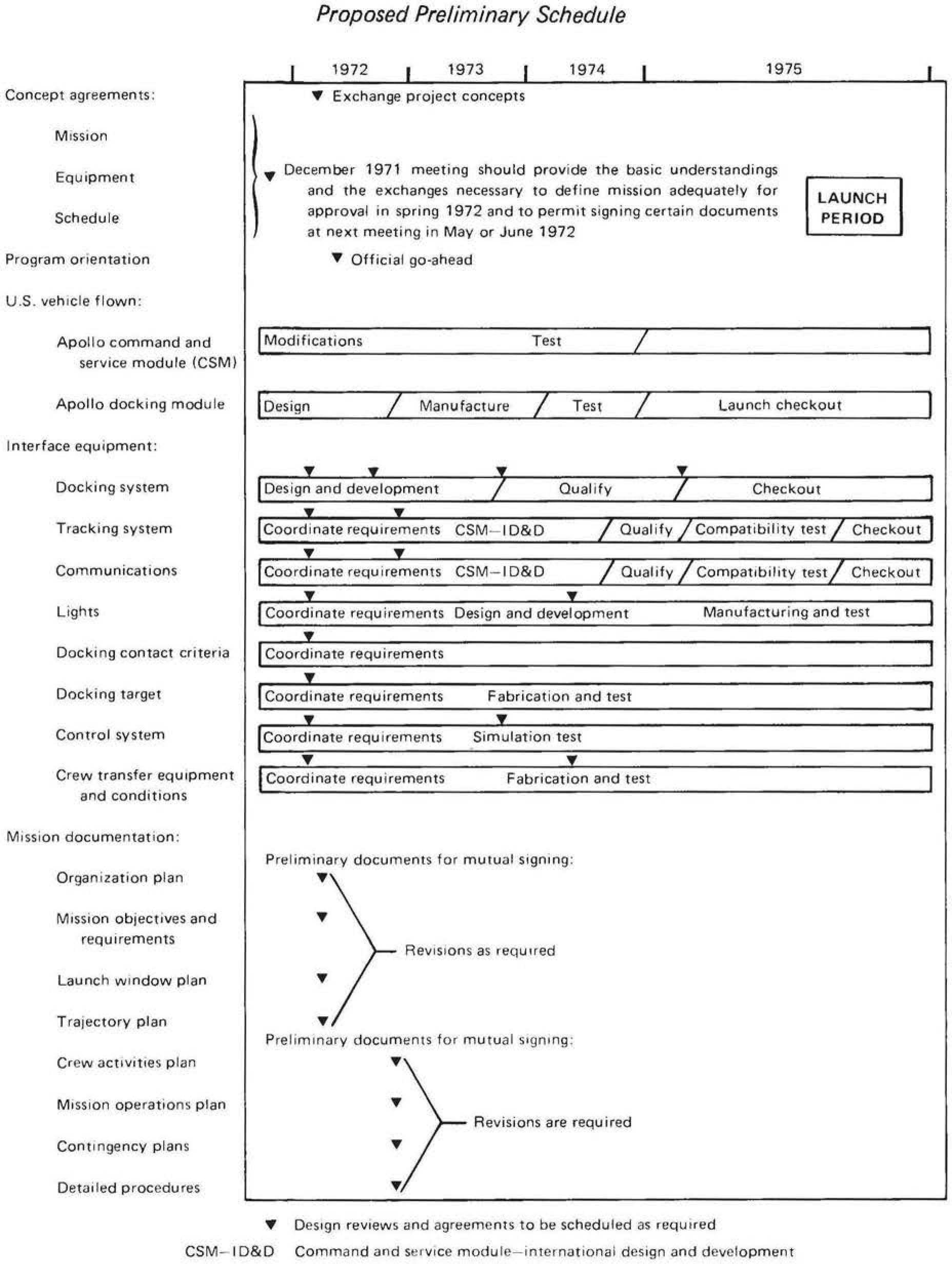
Various questions and issues had been raised in each of the Working Groups, and for the most part they had been resolved as the talks progressed. Group 1 completed the general documentation of its agreements on life support systems, coordinate systems, constraints on spacecraft configura-tion, and communications links between ground control centers. With respect to the proposed Apollo/Salyut test mission, the two sides spelled out the objectives of such a flight and listed the project documents that would have to be prepared for the mission. The chairmen of the Group agreed to a mutual exchange of data on launch windows within two months, on program information for the test mission by April, and on communications channels for the respective control centers within three months. The Americans also planned to provide a draft of an interface organizational plan for the project.17
Working Group 2 had also come to a number of significant decisions. They developed a list of guidance and control systems and other onboard equipment in the Soviet and American spacecraft that would have to be made compatible. The preparation of documentation covering the subjects of docking lights, docking targets, and contact conditions between space-craft, as well as the technical data on control systems and radio tracking, progressed satisfactorily. This group planned to reorganize the documentation into two volumes covering general requirements for the future and specific demands on the systems proposed for Apollo/Salyut. For the test mission, the two sides would need to develop communications and tracking systems to an agreed set of technical requirements. An Apollo-type VHF ranging system would be installed in the Salyut as a backup system, and the Soviets had said they would study the issue of building their part of the onboard communications system versus using equipment provided by NASA.
Group 2 had also delved into the control and guidance problems relating to docking. For example, by considering the relative velocity of the two spacecraft, the docking system engineers established numerical values for the force with which the two vehicles might dock. The two sides also concurred on docking targets. One would be mounted in the center of the Salyut docking hatch, providing the Apollo CSM pilot with a dynamic visual reference for alignment. A second target, of the passive type used in the Apollo program, would be placed on Salyut where it could be seen from the command module through the crewman optical alignment sight. In addition, each side had been assigned work on control stabilization requirements for the two spacecraft and had been asked to look further into the design, development, evaluation, and installation of the docking target concepts.18 Meanwhile, Group 3 had concentrated on the problems of creating a universal docking mechanism.
AN INTERNATIONAL DOCKING SYSTEM
Before the winter meeting, both Caldwell Johnson and Vladimir Syromyatnikov had been thinking about what they would like to incorporate into a compatible docking system. Johnson had been urging that the group accept the double ring and cone docking concept he had described to the Soviets on his first trip to Moscow. In June, he had had an opportunity to chat with Soviet docking specialist Valentin Nikolayevich Bobkov during a free-wheeling round table conversation among the engineers. In addition to Johnson and Bobkov, George Hardy, Robert “Ed” Smylie, Edgar “Ed” Lineberry, Leroy Roberts, Ilya Vladimirovich Lavrov, and Igor Petrovich Shmyglevskiy took part in the shop talk. While Shmyglevskiy was the only one present who spoke both English and Russian, Bobkov could read and write English, so the eight men drew sketches, translated words verbally and on the drawing pad, and made hand gestures to understand one another.
During this conference, Bobkov had indicated that the Soviets also favored some version of the double ring and cone. Bobkov illustrated through rough sketches that the overall diameter of the docking system could not exceed 1.3 meters, because any larger system would require a change in the launch shroud. When Johnson raised the question of altering the shroud, the Soviets stressed the major impact that such a modification would have. In addition to having to design a new shroud, they would have to test out the launch aerodynamics of the altered hardware. The Americans had hoped to argue for a larger tunnel, but such a change appeared to be too great for their counterparts. The Soviets in turn understood the American’s thoughts on an airlock module.19
After the June meetings in Houston, Johnson had put Bill Creasy and his mechanical designers to work on the preliminary design of a docking mechanism. By the time the NASA delegation left for Moscow, Creasy’s crew had designed and built a 1-meter double ring and cone docking system that had four guide fingers and attenuators on both rings, so either half could be active or passive during docking. The Structures and Mechanics Laboratory at MSC made 16-millimeter movies demonstrating this system in action, which Johnson took to Moscow in November, along with a booklet describing the system and a model of the capture latches. He had gone prepared to sell his idea.20
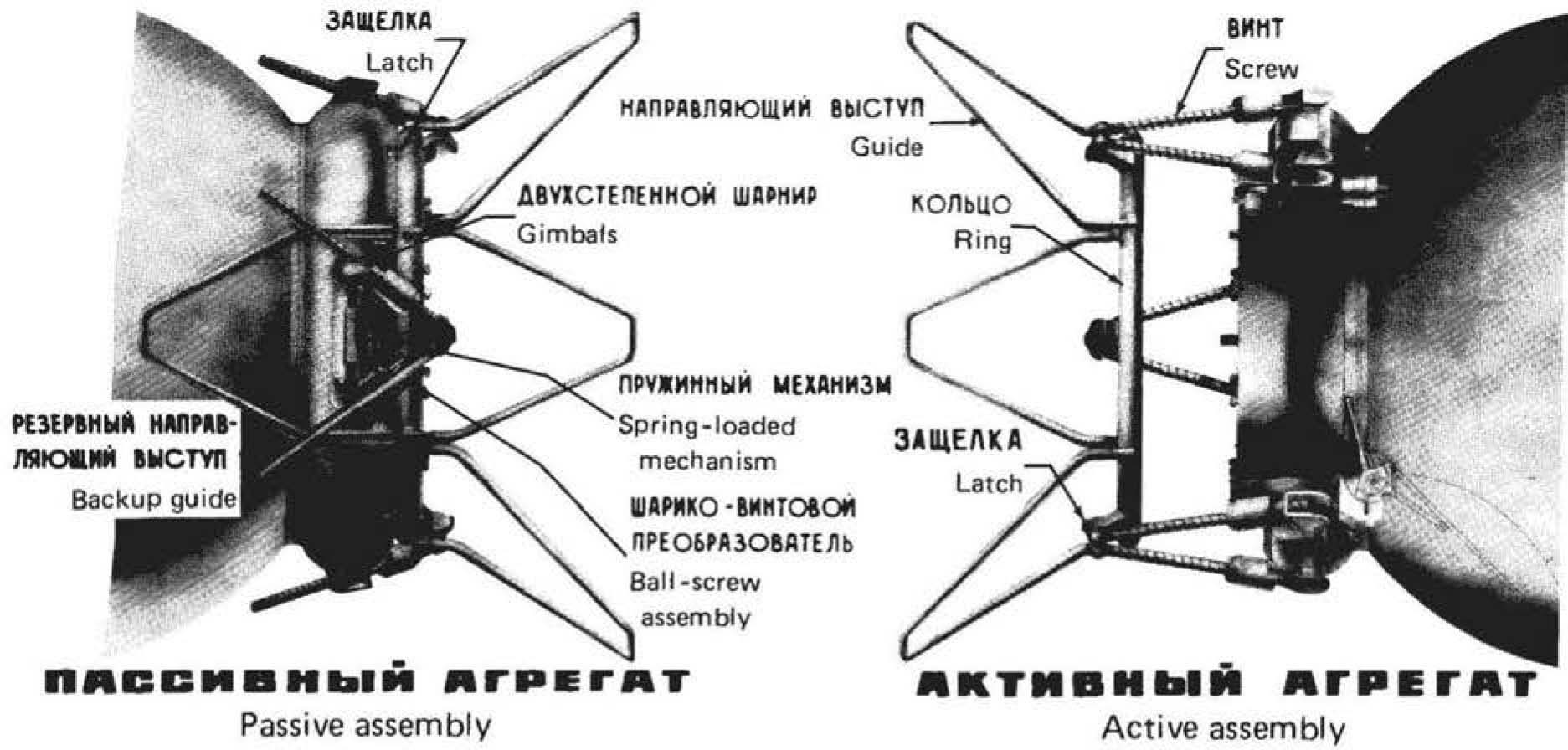
Once he was in the U.S.S.R., Johnson discovered, however, that his job was that of an engineer, not a salesman. Since October 1970, Syromyatnikov had been working on a variation of NASA’s ring and cone concept. Instead of the four guide fingers in the American proposal, Syromyatnikov suggested three, and in lieu of hydraulic shock-absorbers, he proposed electro-mechanical attenuators. In essence, the Soviets had accepted the idea of using a set of intermeshing fingers to guide the two halves of the docking gear from the point of initial contact to capture. The concept of using shock absorbing attenuators on the active spacecraft’s capture ring to buffer the impact of two spacecraft coming together was also acceptable. Both groups of engineers planned to retract the active half of the docking gear using an electrically powered winch to reel in a cable. Once retracted, structural or body latches would be engaged to lock the two ships together. Three basic issues had to be resolved-the number of guides, the type of attenuators, and the type of structural latches-before the design of a universal system could proceed.21
Johnson, Creasy, and the other engineers in the Spacecraft Design Division had wanted to use four guides because they believed that it provided the best geometry when using hydraulic attenuators. As Bill Creasy subsequently explained it, the most probable failure situation using hydraulic attenuators would be a leak that would cause one shock absorber to collapse on impact. A study of various combinations had led the MSC specialists to conclude that four guides and eight shock absorbers was the optimum design. Creasy pointed out too that the most likely trouble with an electromechanical system would be a freeze-up or binding of one of the pairs of attenuators. Thus, the Soviets had sought to minimize the number of pairs in their system for the same reason that the Americans had preferred a larger number-to limit the probability of something going wrong.* 22
* At an earlier meeting, V. Zhivoglotov had told R. D. White that the Soviets were opposed to a system using eight attenuators because the electrical device they had planned to employ to dissipate the docking energies could not be used with eight attenuators but it could be used with the six shock absorbers.
As Johnson talked this out with Syromyatnikov, it became clear that they both wanted to stay with systems that would give them maximum confidence in the design. But they agreed that a compromise could be reached. Johnson reported on his discussions with Syromyatnikov:
Since there was no conflict in principle, nor was there envisioned to be a conflict in subsequent engineering detail between interfacing features of the proposed US and proposed Soviet docking mechanisms, and since the US had no significant engineering or hardware equity in its proposed design, and since the USSR had considerable equity in its proposed design, the Soviet design was selected as a baseline for the next phase of study.23
By the end of the November-December meeting, the two Group 3 teams had signed a set of minutes outlining the basic concept for a universal androgynous docking system. The formal statement read, “The design concept includes a ring equipped with guides and capture latches that were located on movable rods which serve as attenuators and retracting actuators, and a docking ring on which are located peripheral mating capture latches with a docking seal.” Basic information on shapes and dimensions of the guides were also included in the minutes. They were to be solid and not rodlike, as first proposed by the Soviets, and three in number. As long as the requirement for absorbing docking forces was met, each side was free to execute the actual attenuator design as it best saw fit. The Soviets planned to use an electromechanical approach designed for the Soyuz docking probe, and the Americans proposed to stick with hydraulic shock absorbers similar to those used on the Apollo probe. This proposal also called for developing docking gear that could be used in either an active or passive mode; when one ship’s system was active, the other would be passive.
Looking into the detailed design of the mechanism, the two sides had further agreed that the capture latches would follow the design developed at MSC and the structural latches and ring would follow the Soviet pattern. These paired sets of hooks had been successfully used on both Soyuz and Salyut. In addition, Group 3 concurred on details regarding the alignment pins, spring thrusters (to assist in the separation of the spacecraft at undock-ing), and electrical connector locations. To evaluate the docking system concept and to ensure the establishment of compatibility at an early point in the development, the men planned to build a two-fifths-scale test model, the exact details of which would be decided at the next joint meeting.24
Upon his return to Houston, Caldwell Johnson prepared a memorandum to document some of the informal understandings reached in Moscow. He indicated that this reflected “upon the manner in which the two countries will conduct and coordinate the next phase of the engineering studies of those systems.... The understandings ... were reached more often than not outside of formal meetings, and so are not likely otherwise to be reported.” For example, in the area of hatch diameter, he noted that “it became apparent from the beginning... that a hatch diameter greater than about 800 mm could not be incorporated into the Salyut spacecraft without great difficulty,” but MSC had “long since reconciled itself” to a test hatch diameter of less than 1 meter. Johnson went on to comment that “the capture ring assembly had variously been called ring and cone, double ring and cone, and ring and fingers. It was agreed henceforth to call the capture ring ‘ring’ and the fingers ‘guides.” Thus it went-negotiation, understand-ing, compromise, and accommodation.25
The docking talks in Moscow had convinced Johnson that frequent face to face communications were necessary. He believed that an acceleration of the design process was also in order if they were to settle on a single design by June 1972. It would not be possible to develop a design through correspondence or meetings every six, three, or even two months. He saw two possible alternatives:
Accelerate the iterative process by very frequent and informal, face-to-face negotiation between the key designers-each having authority to make technical decisions on the spot; or, assign design responsibility for each interfacing element of the mechanism to one country or the other. Of the two alternatives, only the first is practicable, since apportionment of responsibility would likely take just as long as the design process.26
While tentative arrangements had been discussed for telephone and Teletype exchanges, Johnson thought that limited progress had already been made when it came to “the exchange of [al vast amount of technical detail data such as drawings, diagrams, performance analyses, etc., that are necessary for each side to understand the nature of the interfacing system.” The concerns expressed in Johnson’s memo reflected the thoughts that other members of the American delegation had as they returned home. A joint mission with the Soviets was clearly feasible from a technical standpoint, but the key to such a complex project would be creating the proper management format. That task would fall on Glynn Lunney’s shoulders.
After a day of shopping for gifts in Moscow, the NASA delegation had left the Soviet capital on 7 December via England, where they briefly visited the Royal Aircraft Establishment at Farnborough. This pleasant diversion, according to Lunney, took “many of us back to the NACA days.” In Houston, the Working Group members soon found that they had their work cut out for them. On 16 December, Lunney distributed a memo outlining tasks to be done and clarifying who was responsible for each. Lunney anticipated convening special joint sessions for the Group 2 members involved in radio tracking discussions and for the Group 3 members concerned with the docking mechanism. “In considering our experience so far in these discussion,” Lunney commented, “we have found it absolutely essential to have well-prepared documents for each meeting in order to efficiently conduct and the discussions and resultant agreement documents.” He believed most of the documents that had to be ready in the near future were relatively “straightforward” and easy to prepare, but they must schedule the work carefully and pursue it in a businesslike manner.27 (See box on facing page.) While Lunney and his colleagues began to work their specific tasks, the Office of Manned Space Flight (OMSF) staff in Washington was looking more deeply into the costs of an international flight.
Schedule for Next Six Months*
- Mid-February (two months)
- Long-term
- Exchange papers on:
- Connection of liquid cooled garments LOG's to other ship
- Quantitative characteristics and possible solutions for pre-breathing
- Exchange papers on:
- Apollo/Salyut
- Exchange papers on launch window constraints and solutions to daylight Apollo launch
- U.S. provide agendas for “Special Subject Meetings” in March
- Finalize Working Group 2 documents agreed to in December meeting
- March 1 meeting
- Special meetings in Houston on:
- Docking mechanism
- Radio tracking system
- Special meetings in Houston on:
- Long-term
- Mid-March (three months)
- Apollo/Salyut
- U.S.S.R. comments on U.S. proposal for communication between control centers
- U.S. proposal of organization plan
- Exchange outlines for project documentation
- U.S.S.R. provide Salyut life support system data
- Apollo/Salyut
- Mid-April (four months)
- Apollo/Salyut
- Each country exchange “Statement of Position”
- Each country exchange “Project Technical Proposal Document”
- Apollo/Salyut
- May to June (five to six months)
- Next full-scale meeting
* Informal planning schedule distributed by G. S. Lunney, Dec. 1970, after trip to Moscow.
ESTIMATING THE COSTS OF A MISSION
The possibility of flying a joint mission with the Soviets in mid-1975 posed some interesting problems for Dale Myers’ staff in OMSF. When they began to look at this problem in the fall of 1971, it became apparent that they would have to make some quick decisions about this yet-to-be-authorized project if they were to meet the proposed launch date. MSC would need to start the development work on the docking module and the docking system in early 1972. And modification of the CSM should start immediately. Limits on time and money were not the only problems. OMSF had been advised by North American Rockwell that beginning in October 1971 the labor force that had been building the command and service modules (CSMs) would be reduced. A decision on which CSMs to set aside for an international rendezvous and docking mission (IRDM) had to be made quickly. Gilruth had requested that 115 and 115A be completed because they were of the most recent series of CSMs, with a scientific instrument module (SIM) bay into which earth resources survey instruments could be placed. The older 111 CSM was closer to being ready for launch, but it did not have a SIM bay. CSM 119, the Skylab backup and rescue spacecraft, could not be allocated to IRDM until the final Skylab visit, then scheduled for 1974. When the money, time, and labor issues were balanced against the wishes of the mission planners, some hard choices had to be made.28
Dale Myers had written to Bob Gilruth four days before the delegation’s departure to Moscow to ask him to look over a list of “Suggested Guidelines for a Minimum Cost International Docking Module.” This list, prepared by William C. Schneider, Director of the Skylab Program, reflected OMSF’s concern for keeping the IRDM equipment simple and cost effective. Schneider, drawing from his experiences with Skylab, suggested that the module be kept as small as practical and that it be designed with a high safety factor. He thought it best to follow the Gemini design principle of placing many systems, particularly wiring, on the outside of the docking module, thus lowering flammability concerns. At the end of his recital of 20 items, he said:
The fundamental, you can see, is keep it simple. Of course, that’s how Skylab started in 1966. I have no solution to maintain that posture other than a generalized observation that an active Headquarters staff is invaluable in detecting and controlling policy variations.
I strongly urge that the Skylab system of PRR, PDR, CDR[*] be adhered to and that short cuts be resisted despite the immediate lure of maintaining schedule. Each time we’ve rushed, cancelled, or hurried by one of these milestones, I’ve come to regret it later on.29
* Preliminary Requirements Review, Preliminary Design Review, and Critical Design Review were elements of the NASA spacecraft development cycle, which had evolved since the early days of Apollo.
Schneider had additional thoughts when it came to keeping costs to a minimum. He proposed that Marshall Space Flight Center in Huntsville, Alabama, develop and build the docking module; according to Schneider they had a proven capability (Saturn launch vehicles, Apollo telescope mount, multiple docking adapter for Skylab), existing facilities, and the proper labor mix. These elements would permit Marshall to do the job more cheaply than MSC and a contractor. Furthermore, he believed that with Shuttle Orbiter and Skylab drawing heavily on Houston’s personnel, the docking module development “probably would not receive much attention or would divert talent from the other tasks.” Schneider could see only one area in which MSFC might have some difficulties-working with the Flight Operations Directorate at MSC. To solve that problem, he recommended that Clifford E. Charlesworth, Eugene F. Kranz, or Glynn Lunney be transferred to Marshall as “Module Manager to insure a clean interface.”30
Myers sent Schneider’s list of 20 guidelines to Gilruth, with the request that the MSC program plan include these points, but Schneider’s other thoughts about building the docking module at Marshall were not in-cluded.31 Gilruth responded that his team basically agreed with Schneider’s guidelines but countered that these points had already developed somewhat differently. He enclosed the fourth revision of the “International Rendezvous and Docking Mission Guidelines and Constraints Document” for OMSF’s perusal. Gilruth told Myers that MSC “would be glad to discuss the guidelines and the method of implementation in detail with you and your personnel at the appropriate time.”32 Implicit in his remarks was the idea that the IRDM was a Houston project. It involved Apollo spacecraft, and MSC knew how to get the job done. Only Frutkin, the interpreters, and several secretaries from Washington had joined the Houston delegation that went to Moscow in November. As the joint effort progressed, Marshall would be noticeably absent during the negotiations. The Americans might fly with Salyut, but it was not likely that the Soviets would rendezvous with Marshall’s Skylab. At the November-December meeting, the Soviets and Americans ruled out a union with the first Skylab; if such a mission was ever undertaken, it would be with “a Skylab or another type [of station] to put into orbit after 1975.”33
Continuing his dialogue with Gilruth, Myers sent his comments on the International Rendezvous and Docking Program Plan to MSC on 14 December 1971. Myers agreed that this document could serve as the basis for further discussions with the Advanced Missions Program Office at Headquarters, and he advised Gilruth that Phil Culbertson’s staff would “work with you and your people in finalizing such a plan.” OMSF and Advanced Planning had some specific items that they wanted Houston to look at again. MSC had proposed that North American Rockwell undertake developing the docking module on a sole source procurement plan. Myer’s staff questioned the justification for not soliciting other contractors in open competition, and they wanted Gilruth to think about competitive selection. Likewise, OMSF preferred that the prebreathing requirement during transfer be eliminated, if possible, and that the planing schedules be further refined.34 Gilruth’s staff worked on these problems throughout December and into February 1972.
MSC’s studies of the costs of an International Rendezvous and Docking Mission and the best way to contract for its equipment produced an avalanche of paper. Data indicated that such a mission, using CSM 115 and 115A, would cost in excess of $267 million and could run nearly as high as $280 million for three docking modules (one test, one backup, and one flight), seven docking mechanisms (two flight, four test, and one spare), and experiment packages. These investigations convinced the Center management that experience would produce economy in this case, so North American Rockwell should develop and fabricate the docking module and docking mechanism. As the builder of the CSM, Rockwell would be able to work with the command module/docking module interface with minimum difficulty. In addition, they had the Apollo manufacturing equipment and the necessary labor skills, if the job were begun before the company started laying off their experienced employees. However, the ultimate decisions about how much money NASA could afford to allocate to the mission and who the contractor would be had to come from Headquarters.35
Dale Myers met with the top management* on 24 February to discuss the cost of the proposed docking mission, and they reached three key decisions. First, the planning effort was to be oriented toward a program that would include a demonstration flight, but the total program effort was not to exceed $250 million. Based upon the data already generated, this ceiling precluded the use of either CSM 115 or 115A. Second, Houston would have to base its planning on the use of CSM 111 as the likely flight test vehicle and CSM 119 as a potential backup vehicle (assuming that it was not flown during Skylab). The budget included the necessary modifications for CSM 119 to make it flight ready, but it did not cover the expense of an actual mission based on 119. The final decision made on 24 February concerned experiments. Since the 111 and 119 service modules did not have scientific instrument bays, the experiments would have to be much simpler than the earth resources survey originally proposed. Of the $250 million total, $10 million were allocated for developing experiments that could be housed in the command and docking modules. No more work on CSM 115 and 115A was contemplated.36
* Those present were Administrator J. C. Fletcher, G. M. Low, W. H. Shapley, and A. W. Frutkin.
Managing the development of the IRDM hardware was the task of the Manned Spacecraft Center and its new Director, Christopher C. Kraft. Effective 14 January 1972, Robert Gilruth had assumed the position of Director of Key Personnel Development for NASA, and Deputy Director Kraft had moved into the number one position. Like his predecessor, Kraft was an old-timer in the American space program, joining NACA in 1945 and becoming one of the original members of the Project Mercury team. Before becoming Gilruth’s deputy in 1969, he had been Director of Flight Operations in Houston. The tasks facing his center in 1972 included preparing for Skylab, developing the multipurpose Space Shuttle,* and proceeding with Apollo/Salyut-whose teams were already preparing for the next round of discussions with the Soviets as Kraft settled into his new office.37
* The Space Shuttle had received Presidential approval on 5 Jan. 1972.
NEGOTIATION BY TELEPHONE
On 27 January 1972, Glynn Lunney wrote to Professor Bushuyev, proposing a list of questions to be discussed in their first telephone conference.38 The basic purposes of the conversation were to clarify arrangements for the March meeting of Group 3 in Houston, to clear up some technical questions associated with the design of the docking mechanism, and to discuss arrangements for the Group 2 meeting tentatively scheduled for June in Moscow. During January and February, the number of letters between Houston and Moscow had increased, indicating the growing complexity of the joint effort. The specialists needed faster answers; at the request of the Soviets MSC initiated a telephone call to Bushuyev on the morning of 2 March. Because the overseas circuits were busy, nearly 40 minutes passed before the NASA party reached the Academy of Sciences. For 75 minutes, the two sides struggled with the initially awkward process of talking through an interpreter over a not-too-perfect overseas telephone connection. On the Soviet side, the process was complicated by the fact that they were using two telephone handsets, but in Houston a conference arrangement circumvented the necessity of passing the phone from one person to the other.39
Glynn Lunney was in Washington at the time of the call so Caldwell Johnson spoke for MSC.† Bushuyev and Johnson discussed several questions associated with fitting the docking mechanism under the launch shroud of Salyut. The Soviets agreed to ease up on their height requirement for the docking mechanism, a change that would be discussed at the Houston talks scheduled for later in march. No date was selected for the Moscow visit of Working Group 2, but the American side restated its desire to hold the meeting after the 16 April launch of Apollo 16. After several minutes of speaking with Syromyatnikov about other docking mechanism questions and with Legostayev about Group 2 matters, Johnson bid Professor Bushuyev do svidaniya [good-bye]. The Professor in turn wished his best to Johnson and asked him to convey greetings to Lunney.40 (See box on facing page.)
† Present in Houston for the telecon were C. C. Johnson, D.C. Wade, R. D. White, J. C. Jones,J. C. Waite, W. K. Creasy, R. Reid, E. N. Harrin, and W. Karakulko. On the Soviet side, K. D. Bushuyev, V. P. Legostayev, V. S. Syromyatnikov, I. V. Lavrov, V. N. Bobkov, and B. P. Artemov were near the phones. Harrin, Karakulko, and Artemov acted as interpreters.
The first telecon was helpful but difficult. The Americans sent a transcript of the tape recorded conversation to Moscow, and the Soviets sent their version to Houston. Thereafter, exchanging minutes became another way to assure clear understanding of such communications. Nevertheless, the Soviets, and particularly the Professor, were not satisfied with the telephone as a medium for discussing technical matters. As a result, Lunney on his return to MSC wrote to his counterpart:
It is my strong personal belief that continued exchanges like the tele-conference and probably more frequent meetings are essential to the success of the project. The difficulties and dangers of this mission will be reduced in direct proportion to the increase in knowledge and understanding between us and our colleagues.41
Stressing this point further, Lunney suggested that the Group 2 meeting in Moscow be preceded by a similar telecon. The Americans were determined to establish fast and reliable communications with the Soviets. The work in the immediate weeks ahead would stress the necessity of spelling out specifications for the docking system.
DESIGNING THE INTERFACE
During the spring months of 1972, the personnel of the MSC Engineering and Development Directorate pursued the design of an international docking system. Working concurrently with the North American Rockwell team and the Soviet Group 3 members, the Houston engineers were attempting to ensure the speedy development of hardware. Starting a contractor to work on a project before design was firm was not unusual. In the Apollo program MSC had followed the same approach in the design and development of the command and service modules, the lunar module, and their various subsystems. The iterative process of design helped to ensure the timely delivery of hardware and the maintenance of tight schedules.
Except from Transcript of Telecon Between Manned Spacecraft Center, Houston, Texas, U.S., and Intercosmos, Moscow, U.S.S.R. from Approximately 9:30 to 10:45 CST
- American Translator:
- Good evening!
- Soviet Party:
- Hello!
- American Translator:
- This is the Manned Spacecraft Center speaking. May we speak to Professor Bushuyev?
- Soviet Party:
- Hello!
- American Translator:
- Hello, can you hear me?
- Soviet Translator:
- I hear you well.
- American Translator:
- Good! This is the MSC NASA USA, may we speak to Professor Bushuyev?
- Soviet Party:
- Prof. Bushuyev to the telephone? I will ask him.
- American Translator:
- Oh! That is you.
- Soviet Party:
- Yes.
- American Translator:
- Mr. Caldwell Johnson will now speak to you.
- Mr. C. Johnson:
- Sdravstvuitel [Hello!] (In English) Greetings from the MSC, Houston, Texas, to our Soviet colleagues in Moscow.
- Soviet Party:
- Hello!
- American Translator:
- Mr. Caldwell Johnson will now speak to you in English, and after, if you like, I will translate it to you in Russian. Will that be convenient for you?
- Soviet Party:
- Hello!
- American Translator:
- Hello!
- Professor Bushuyev:
- This is Professor Bushuyev speaking. I would like to propose the following. Do you hear me well?
- American Translator:
- Yes, can you speak a little louder?
- Professor Bushuyev:
- I would like to make the following proposal.
- American Translator:
- Please.
- Professor Bushuyev:-
- We have worked on the questions initiated by Dr. Lunney in the letter of 27 Jan. and propose to (or offer to) lay out the answer to these questions with the aid of our translator.
- American Transiator:
- Good.
- Professor Bushuyev:
- If Dr. Lunney agrees, I will transfer the phone to Dr. Lunney’s friend, a co-worker in our delegation Mr. Artemov.
- American Translator:
- It will be...
- Professor Bushuyev:
- What?
- American Translator:
- Who? Artemov?
- Professor Bushuyev:
- Mr. (tape garbled) of our delegation who participated in the meeting which took place in Moscow at the end of Nov.
- American Translator:
- Good! One second.
- Professor Bushuyev:
- I will transfer the telephone to Mr. (tape garbled).
- American Translator:
- Excuse us please. May we break in?
- Professor Bushuyev:
- Yes.
- American Translator:
- Mr. Caldwell Johnson will now speak, whom you know; he had been in Moscow. He would like to say something first. All right?
- Professor Bushuyev:
- All right. (Some Soviet speech, but unintelligible.)
- Mr. Johnson:
- Prof. Bushuyev ...
The 27 March-3 April visit of the Soviet Working Group 3 members to Houston was essential to the NASA plan of having North American Rockwell start the detailed engineering of an Advanced Missions docking system. The four-man delegation led by Syromyatnikov quickly got down to the task of joining in defining the dimensions and specifications of the docking sys-tem. This information was spelled out in the minutes of their meeting and in four sheets of engineering drawings.* Bill Creasy and several of his colleagues worked with Yevgeniy Gennadiyevich Bobrov at the drafting table to lay out these first Soviet-American engineering drawings. Larry Ratcliff drew the capture ring and guides on drafting paper, and Robert McElya supplied the details of the structural interface ring, while Bobrov prepared a similar drawing for the structural latches. T. O. Ross then took these drawings and conducted a dimensional analysis to be sure that all items were compatible.
* Following the formalization of ASTP in June 1972, these drawings became part of Interacting Equipment Document 50 004, “Apollo Soyuz Physical Interface Requirements.”
On 3 April, the two sides completed their drawings and wrote their minutes. These drawings were a blending of the way in which the Americans and the Soviets usually presented data on paper. Creasy said, “Their drawing procedure is different from ours and sometimes we joke and say that ... [these Group 3 drawings] must violate the drawing conventions of at least the U.S. and Russia and probably several other countries.” But each side could understand and work from the information as recorded, and that was the important point. Looking back on this effort, Creasy commented that, despite five subsequent updatings of the April drawings, the basic work only required some minor refinements and adding the tolerance dimensions.42
Agreement on technical specifications for the docking system cleared the way for NASA to begin discussions with Rockwell about building the docking module and the docking system and modifying the CSM. As MSC engineers worked with the potential contractor in drafting a statement of work for Apollo/Salyut test mission hardware, the procurement staff in Houston drew up their contracting plans.
At Headquarters, the agency’s senior staff was looking into various political aspects of conducting a joint mission, and two issues were paramount in these discussions. First, congressional authorization and appropriations would have to be obtained before NASA could begin to modify or build the necessary hardware. Second, a bilateral agreement between the United States and the Soviet Union would have to precede the request for funds. George Low was given the task of determining how to resolve this issue.
APRIL IN MOSCOW
Following the November-December 1971 meeting in Moscow, NASA Headquarters has recommended to the White House that a formal agreement on an Apollo/Salyut mission be included on the agenda for the May Summit meeting between President Nixon and Premier Kosygin. After several discussions with the White House during the ensuing months, Henry Kissinger asked NASA to make a firm recommendation by 15 April concerning the feasibility of conducting such a flight. In Glynn Lunney’s opinion, the Soviets would have to agree to three basic management documents before NASA could make a positive recommendation to the President. Draft versions of Lunney’s documents-a project technical proposal, an organizational plan, and a project schedule-were ready for transmittal to Moscow by the end of March. Fletcher and Low decided that Low, Lunney, and Frutkin should visit Moscow during the week of 2 April to discuss these documents and reach a common position on the most important points. Low remembered that they especially wanted “to determine whether the Soviets really understood what we were talking about.”43
Fletcher and Low also decided not to publicize this trip;* insofar as MSC was concerned, Lunney was visiting Washington, and Low was supposedly on leave “to take care of family business. To further assure that no one would know their destination, Low’s secretary went to a commercial travel agent to get his tickets instead of buying them through the NASA travel office. Low felt that the semi-clandestine nature of the trip lent some excitement to his normally closely regulated life. On this occasion only Fletcher, Mrs. Low, and Low’s secretary would know where he was.44 That is, they thought that was the situation until the Sunday morning newspapers appeared on 2 April.
* At the request of the White House, this trip was not publicized because NASA planned to discuss a possible agenda item for the forthcoming Summit meeting.
John Noble Wilford, on page one of the New York Times, reported an interview with Academician Petrov, in which Petrov mentioned an upcoming meeting with NASA officials. He pointed out that the negotiations thus far had “considered only the technical aspects of solving these problems” of a joint mission and that neither government had yet approved the flight. When did he expect such approval? Petrov said, “This would depend much on the meetings that will take place next week and probably on the joint meetings of all the working groups of engineers afterwards.” When Wilford asked if the necessary arrangements could be made in time for the Summit discussions, Petrov replied, “I would not like to guess on that. I know that on a government level there are a lot of very important problems to discuss, and whether [a joint mission] is one of them depends on the leaders, not us.”45 Fletcher and Low held their breath and waited to see if anyone would follow up the story. No one did.
Low, Frutkin, and Lunney departed Washington on Easter evening and arrived in Paris early Monday. After a short layover, they continued aboard an Aeroflot jet to Moscow, where they were met by Petrov, Bushuyev, and Vereshchetin. During their ride into the city, Petrov told Low that Keldysh had been hospitalized. Vladimir Alexandrovich Kotelnikov, acting in the capacity of Academy President, would be negotiating on behalf of the Soviets. Because of a schedule conflict, he would not be able to meet with the Americans until Tuesday afternoon. In their free time, the three Americans visited the American Embassy, where they were invited to lunch with Ambassador Jacob D. Beam and his guests later that week. Jack Tech, the science attaché at the Embassy, later asked Low if he knew who the guests for Thursday’s luncheon would be, and Low replied that Ambassador Kaiser and his son would be joining them. Tech responded by asking if he knew who Ambassador Kaiser’s son was. When Low confessed that he did not, Tech dropped the bombshell-Robert Kaiser was the Washington Post’s Moscow correspondent. Low went immediately back to Ambassador Beam and said that in light of the desire of the White House and the State Department to keep their visit quiet, he questioned the wisdom of dining with the press. The Ambassador assured Low that the luncheon would be a social affair and that there would be no need to discuss his mission. Furthermore, Beam said that he would take personal responsibility if there were any leaks. Although he was extremely skeptical about this whole idea, Low saw no way to avoid the invitation.46
For about two hours on Tuesday afternoon, the American trio met with Kotelnikov, Petrov, Bushuyev, Vereschetin, and I. P. Rumyantsev. After a typical Moscow lunch at the Club of the Scientists, they continued their discussions with Petrov until 7:00 that evening. The two groups reconvened the next morning and continued their negotiations until early afternoon. When the Americans adjourned, they ate a quick lunch at the American Embassy snack bar while they rewrote their version of the Summary of Results. The afternoon session with the Soviets lasted only 2 hours, and based upon the revised American draft and the basic understanding reached that morning, the two sides were able to conclude the substance of the talks. Frutkin and Vereshchetin completed the final editing of the agreement Thursday morning.
Low, Frutkin, and Lunney attended their obligatory noon meal on Thursday, which proved to be uneventful, while waiting for the English version of the Summary to be typed at the Embassy. The three returned to the Presidium of the Soviet Academy of Sciences (where all the discussions had been held) for the signing of the documents. The usual ceremony, in which both sides signed two English and two Russian copies, took place in Kotelnikov’s office. The Acting President told Low that according to legend Napoleon had slept in this room during his last night in Moscow 160 years earlier. There was a farewell dinner on the night of the 6th, and Low and his colleagues departed for home the next morning.
The Americans’ basic purpose for these meetings had been to obtain assurance from the Soviets that there could be agreement on the organizational structure to conduct a joint mission and that the mission could be carried out according to a specified timetable. Low in his opening remarks on Tuesday had told the Soviets that NASA was sure that a joint mission was technically feasible, but the agency was not sure that in managerial terms it was possible. Thus, Low’s goal for the Moscow meeting was to gain this assurance. Before the two sides pursued this point further, Kotelnikov said that he had an important statement that he would like to make.
Kotelnikov told the NASA people that in re-evaluating the proposed test mission the Soviets had come to the conclusion that it would not be technically and economically feasible to fly the mission using Salyut. Salyut had only one docking port and the addition of a second port would be very difficult technically and very costly in both time and money. Therefore, the Soviets proposed to conduct the test flight using Soyuz, which could accept all the modifications necessary for such a mission. They were quite forceful in stating that there would be no changes in any of the agreements made thus far.
Surprise was perhaps the mildest word for the Americans’ reaction. Nevertheless, Low quickly responded and told Kotelnikov that barring any technical difficulties, the switch from Salyut to Soyuz would be acceptable.47 He turned to Lunney and asked him if he saw any technical reason for opposing such a change, and Lunney could think of none. Operationally, this would present a simpler mission since it would involve only two coordinated launches-Apollo and Soyuz-and not three-Apollo, Salyut, and Soyuz. Low and Frutkin tried to think through any “political” implications and found none. It would still be possible to exchange crews, which would be the major public impact of the mission, and such a mission would give the Americans an added advantage-not calling attention to the fact that the Soviets already had a space station flying and NASA did not.
After Low agreed to this change, he took the opportunity to raise an issue that was of concern to NASA-the lack of Soviet responsiveness to the proposals concerning regular, direct voice communications between the two sides.48 Low mentioned that he was interested in more than just the basic issue of communication; he said that if this unresponsiveness was indicative of their attitude for the future, it would be very difficult to conduct a joint mission. Kotelnikov quickly understood why Low placed such importance on this issue and said it would be settled immediately. After considerable debate and discussion, the NASA position on regular communication between Lunney and Bushuyev prevailed.
On Tuesday afternoon, the discussion turned to the “Apollo/Salyut Test Mission Consideration,” which was essentially a summary of the organization plan. The Americans had hoped to agree on this plan in detail. As Lunney was presenting the document, the discussion fell apart and became quite confusing, with an inordinate amount of time being spent quibbling over the exact wording of each sentence. “We quickly saw,” Low reported, that we would be in Moscow for weeks rather than days were we to proceed this way.” Low called for a short recess, so the Americans could discuss their strategy.
Before the Americans went off to themselves, they showed the Soviets a draft version of the Summary of Results that they hoped would be the basis for their mutual agreement. Low told the Soviets that it was essential to reach an accommodation and full understanding of the “12 principles governing mission conduct” that were a part of the “Apollo/Salyut Test Mission Consideration” document, which Low now suggested might be included in the Summary. The Soviets said they would look at these materials while the Americans held their private discussion.49
After the recess, the Americans and Soviets resumed the negotiations, reviewing the 12 principles and the Summary of Results until Wednesday. The negotiations were long and difficult, and sometimes when it appeared that agreement had been reached in English on a specific point, the material when read back in English after being translated into Russian sounded like the text of a completely different agreement. Low continually had to emphasize the necessity of having complete concurrence on the substance of the text. At one point in the negotiations, he told the Soviets that unless he could come away from this meeting with a firm agreement on the basic principles of organization, documentation, and scheduling, he would be in no position to recommend the test mission to President Nixon. He stated further that he would even go so far as to make a negative report. On the other hand, he expressed a willingness to stay in Moscow until they were able to hammer out the necessary words.
On Wednesday when the three Americans returned from lunch with a freshly typed copy of the Summary of Results, Yu. V. Zonov translated the English draft and then called a recess so that the Soviets could discuss the document in private. The Soviets seemed amazed that anyone could have completely recast an entire document in such a short time. When they came back, the Soviets told the visitors that the revised paper, with some minor editorial exceptions, was completely acceptable to them. The alterations were performed by Vereshchetin and Frutkin.50
17 Points of Agreement Negotiation in Moscow, 4-6 Apr. 1972
- For the preparatory (pre-launch) period—
- Regular and direct contact will be provided through communication links and visits as required.
- A complete project schedule will be developed and commitments will be made on both sides to meet this schedule in order to avoid costly delays to either party.
- Arrangements will be made for necessary contact and understanding between specialists engaged in developing and conducting the project.
- A comprehensive test, qualification, and simulation program will be developed.
- A sufficient level of familiarization and training, where applicable, with the other country's vehicle and/or normal training equipment must be defined and provided for safety-of-flight assurance. The necessary training exercises will be conducted in each country for the other country's flight crew and ground operations personnel.
- The parties recognize in particular that they must jointly make a concerted effort to arrive at a full agreement on the engineering aspects of the mission during the meeting of the work groups in July 1972.
- Two years prior to the flight, responsible persons who will directly participate in the flight operations should be included in the working groups in order to assure a proper level of mutual understanding and continuity of personnel into the real-time operation.
- For the mission operation—
- Control of the flight of the Apollo type spacecraft will be accomplished by the American Control Center and that of the Soyuz by the Soviet Control Center, with sufficient communications channels between centers for proper coordination.
- In the course of control, decisions concerning questions affecting joint elements of the flight program, including countdown coordination, will be made after consultation with the control center of the other country.
- Joint elements of the flight will be conducted according to coordinated and approved mission documentation, including contingency plans.
- In the conduct of the flight, pre-planned exchanges of technical information and status will be performed on a scheduled basis.
- The host country control center or host country spacecraft commander will have primary responsibility for deciding the appropriate pre-planned contingency course of action for a given situation in the host vehicle. Each country will prepare detailed rules for various equipment failures requiring any of the pre-planned contingency courses of action.
- In situations requiring immediate response, or when out of contact with ground personnel, decision will be taken by the commander of the host ship according to the pre-planned, contingency courses of action.
- Any television downlink will be immediately transmitted to the other country's control center. The capability to listen to the voice communications between the vehicles and the ground will be available to the other country's control center on a pre-planned basis and, upon joint consent, as further required or deemed desirable.
- Both sides will continue to consider techniques for providing additional information and background to the other country's control center personnel to assist in mutual understanding (including the placement of representatives in each other's control centers).
- As a minimum, flight crews should be trained in the other country's language well enough to understand it and act in response as appropriate to establish voice communications regarding normal and contingency courses of action.
- A public information plan will be developed which takes into account the obligations and practices of both sides.
The Summary of Results that emerged from these efforts was the keystone in the negotiations for a joint test mission.51 Without the basic understandings that were forged at that time, the subsequent work would have been difficult, to say the least. In all, seventeen points (see box on facing page) illustrated the level of trust and understanding that would have to be established before a joint mission could be carried out. Of these points, the most difficult to negotiate were ones relating to crew training and the public release of information about the flight. After much dialogue, it was decided that the candidate crews would have to be identified one to two years before the flight so that they would have adequate time to train on the other nation’s hardware. On the point of releasing information about a joint mission, the Soviets agreed that everything during a normal flight should be released immediately. In case of a major disaster, they would be willing to release information just as they had done in the case of Soyuz 11. Their main concern seemed to lie with the minor abnormalities during a flight that might be blown out of proportion or misunderstood. In his turn, Low had stressed an absolute need for NASA to continue its policy of disclosing all information available at the control center and tracking stations. At the conclusion of the discussions, the two sides agreed that they would develop a public information plan that would take into account the “obligations and practices” of both sides.
Looking back on that experience in Moscow, Low was optimistic when he returned to Washington. He had reached the conclusion that the two sides were ready now to undertake a test mission. As for hardware matters, they had reached an understanding on all issues that had been identified so far and did not foresee any new problems that they would be unable to handle. On the management side, the Soviets and the Americans had decided on such matters as regular and direct contact through frequent telephone and telex exchanges, the requirements for and control of formal documentation, joint reviews of design and hardware of various stages of development, the requirement for joint tests of interconnecting systems, early participation by flight operations specialists, and the like. Based upon all these agreements, it was George Low’s recommendation that the United States government execute an agreement for a test mission.52
TESTING THE AGREEMENT
Working Group 2 was scheduled to have a joint meeting in Moscow early in May, and MSC believed this session would provide an opportunity to test the recent agreements reached in Moscow. On 10 April, three days after his return to Houston, Lunney sent a telegram to Bushuyev. MSC would call Moscow on “Friday, April 14, 1972, at 7:00 AM Houston time, 4:00 PM Moscow time” to discuss the agenda items outlined in this telegram.53 The first attempt to establish a telephone connection with the Professor was unsuccessful, because the Americans tried to tie Lunney, who was at Kennedy Space Center (KSC), into the line for a three-way conversation. On the second try, only the Houston people made the connection with Moscow. After initial greetings to Bushuyev, the remainder of the conference call was conducted by the respective Working Group 2 chairmen, Legostayev and Cheatham. They agreed that the Americans should visit Moscow on 15-20 May. Cheatham proposed that the May agenda include discussions of communications and television links between spacecraft, an exchange of data on the Apollo and Soyuz control systems characteristics, and further study of the docking target system. After a discussion of the radio frequencies to be used between spacecraft and between ground control centers, the two men answered each other’s general questions. While the telephone connection was still less than satisfactory, this second telecon was more successful than the first and helped both sides prepare for the upcoming meeting, the starting date of which was later advanced to the 10th.54
Group 2’s spring meeting was an important one in which a full agenda was addressed and progress made on a number of key issues. While discussion continued on the external lights, docking targets, coordinate systems, and other topics related to docking, the main subject was spacecraft-to-spacecraft radio communications and distance ranging. At previous meetings there had been considerable discussion about radio frequencies: Would each side exchange radio equipment for its frequency or give the necessary data to the other group so they could build the equipment? The Soviets had advised NASA at the November-December 1971 meeting that they would continue to use the 121.75-megahertz (MHz) frequency for their voice communica-tions. The Americans in turn advised the Soviets that they had yet to determine which frequency they would use but would do so by March 1972.55
While the obvious choice would have been to continue using the Apollo voice frequency, the Department of Defense was eager to have NASA abandon its use of frequencies in the 225- to 400-megahertz bands. The Apollo voice frequency had been loaned to NASA in 1958 by the military for Project Mercury, and they had been pressing the space agency since then to give it up. A 1968 agreement between NASA and the Department of Defense called for NASA to withdraw from all military frequencies by 1975. In an effort to save from $500 000 to $700 000 for new radio equipment, MSC had worked with NASA Headquarters during early 1972 to obtain Department of Defense approval for use of the 259.7 and 298.6-megahertz frequencies for a joint Soviet-American test project. This agreement had been tentatively reached just before the American delegation left for Moscow.56
A second issue that remained to be resolved both internally and with the Soviets centered on the “build versus exchange” question. At first glance, it seemed that it would be simpler for each country to give its radio equipment to the other for installation into their respective spacecraft. On the American side, this exchange appeared to be complicated by the fact that the Apollo VHF transceiver also embodied another assembly that provided a backup distance ranging capability between the CSM and the lunar module. This little unit, called the Range Tone Transfer Assembly, had been added after the original design of the transceiver in 1962, and it was rather sophisticated in terms of its solid-state circuitry. There was some concern at NASA and in the Defense Department that providing this hardware to the Soviets for a joint mission might also constitute a giveaway of valuable technological information. This problem of possible technology transfer had not yet been resolved by the time of the May meeting of Working Group 2. The Americans asked the Soviets to postpone a decision on radio transceivers, and they agreed to do so.
This “exchange-build” issue serves to illustrate how difficult the negotiations could be. Just defining the nature, scope, and implications of the many technical considerations involved in compatibility was a complex, time-consuming task, recalled R. H. Dietz of Group 2. And this process became even more complicated when neither side had a clear understanding of its own goals for a particular topic. In preparing for the negotiations, the Americans had drafted three Interacting Equipment Documents in two versions-the first could be used if a decision was made to exchange equipment, and the second was ready if they decided to build. While this applied to only three of the twenty-six documents that NASA took to Moscow, everyone would prefer to avoid double efforts.57
Not all the communications raised at the May meeting proved as thorny as the “exchange-build” issue. Considerable progress was made on the topics of cable links between spacecraft for voice communications after docking and communications systems for future missions. Donald Cheatham, the American chairman of Working Group 2, felt that the meeting was basically successful. The two sides had sufficient time to work out the points of agreement, and as a consequence they got all of the primary issues clearly defined and resolved. He felt that this session was a good indication on the Working Group level that there would be no irreconcilable differences in working out the technical aspects of a joint mission. The way seemed clear for the government-to-government agreement at the May Summit in Moscow. 58
THE NIXON-KOSYGIN SUMMIT
Upon his return to Washington from Moscow in April, George Low had informed Henry Kissinger that from NASA’s point of view a joint mission in 1975 was a realistic goal and that no additional meetings between the Soviet Academy of Sciences and NASA would be required before placing the topic on the agenda of the May Summit meeting. Low felt that the agreement between the two governments could be relatively short and straightforward. While Low was communicating with the White House, NASA’s public position on the topic was one of silence.
Low recalled that from mid-April to mid-May reporters had exhibited keen interest in the possibility of a joint docking mission proposal being part of the Nixon-Kosygin talks.59 In the many interviews between NASA officials and the press, “there was never any hint about the 4-6 April meeting, nor was there ever any hint that during the meeting the Soyuz spacecraft was substituted for the Salyut,” Low said. He believed that the agency had been able to keep discussions about its work leading up to the Summit to a minimum “only because a very small number of NASA people had been involved in the activities...” While their participation in the business of summitry had been successful, Fletcher and Low were puzzled over how slowly work on the Summit-level space agreement was going at the State Department.60
It was not until the week before the Summit meeting that the State Department and the White House began to coordinate with the Soviets the draft language of the document of space. On 20 May, the Soviets responded to the American proposed text with a much lengthier document which, among other things, included the text of the Low-Keldysh agreement of 21 January 1971 and the agreement hammered out in April 1972. When the Soviet response was received in Washington, Secretary of State Rogers and Kissinger were immediately contacted aboard their airplane over the Atlantic en route to Salzburg, Austria. Kissinger asked the State Department staff to contact Low and have him help them work out a suitable alternative to the Soviet proposal without significantly revising the text.
Low went over to the State Department at about 2:30 Saturday afternoon and worked with the staff there until the middle of the night. In the process of that lengthy session, they were able to revise the preamble of the agreement, while retaining the sense and meaning of the Soviet draft. In only one area, communications satellites, did they make any major change. This had not been part of the Low-Keldysh agreement because Low had told the Soviets that this was an area of commercial enterprise in the United States. Since NASA was not empowered to negotiate for these private companies, Low had this section eliminated from the draft sent to Kissinger that night.
After Low’s Saturday session with the State Department, NASA had no additional information about the status of the space agreement, except for “persistent signals” that it was scheduled to be signed on Wednesday, the 24th. On Tuesday, Low left Washington for San Diego where he was scheduled to give a speech-“NASA Looks Ahead in the 70s.” During the course of the evening after dinner, Low received a trans-Atlantic telephone call patched through the State Department operations center that involved himself, Frutkin, and a State staff member. There were still some questions about the wording of the text, and the three men worked out a final version just in time for Low to make his way back into the ballroom where he was being introduced as the evening’s main speaker.61
President Nixon and Premier Kosygin signed the “Agreement Concerning Cooperation in the Exploration and Use of Outer Space for Peaceful Purposes” at 6:00 p.m. Moscow time on the 24th. Later that afternoon (Washington time), Vice President Agnew introduced NASA Administrator James C. Fletcher to the press at a briefing held in the Executive Office Building. The reporters were given the text of the space agreement while Fletcher made the following statement: “We ... are extremely pleased that President Nixon’s meeting with officials of the Soviet Union in Moscow has brought to fruition the most meaningful cooperation in space yet achieved by our two nations.” He noted that they had been discussing the possibilities for such cooperation for some time and that this agreement molded these technical discussions into a “definitized program.” Of the various planned enterprises, “the most dramatic ... will involve the rendezvous and docking of a U.S. spacecraft with a Russian Soyuz spacecraft in 1975.”62
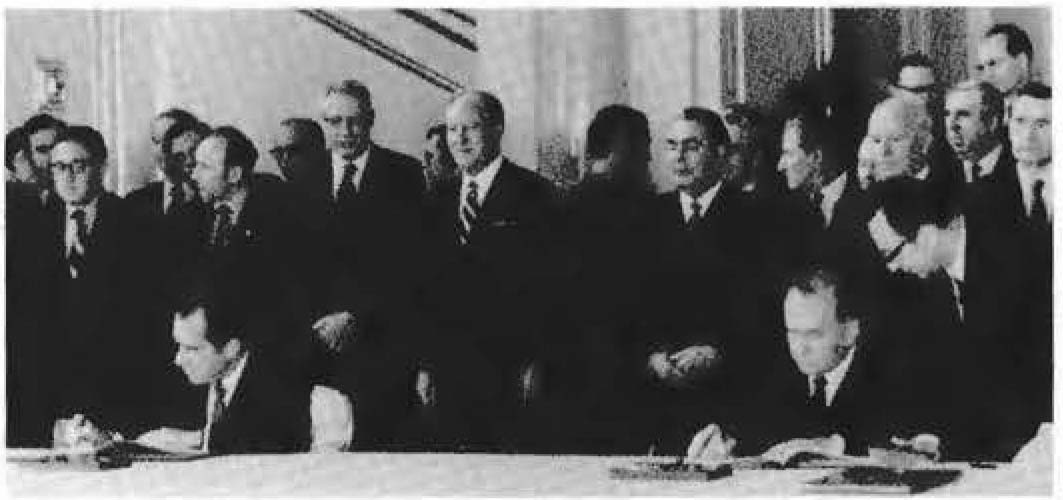
The space agreement was only one of a host of important issues discussed at the Summit. The Soviet and American leaders agreed on ways of working together to protect the natural environment, to advance health, to cooperate in science and technology, to prevent incidents at sea, and to expand trade between the two nations. President Nixon spoke over radio and television to the people of the Soviet Union on the evening of 28 May. He noted that one of his principal aims as President had been “to establish a better relationship between the Soviet Union and the United States.” Our two great nations, which have never faced one another on the battle field, “shall sometimes be competitors, but ... need never be enemies.”63 Nixon felt that it was “most important” that the two countries had “taken an historic first step in the limitation of nuclear strategic arms.”64 This agreement was signed on the 26th of May, the product of the Strategic Arms Limitations Talks (SALT) begun in 1969. However, it lacked one important element that did exist in the Apollo-Soyuz test flight agreement-the Apollo-Soyuz accord was tied to a specific timetable. The engineers of the U.S. and the U.S.S.R. would have to work hard and without discord if they were to meet it. The concrete goal of flying together by a given date promised to guarantee success, whereas the general agreement to limit strategic arms carried no such inherent assurances. The task ahead of Glynn Lunney and Professor Bushuyev was a challenging one-the forging of a partnership.
- NASA, MSC, "A Docking Mechanism for Apollo/Salyut-Type Spacecraft," 17 Nov. 1971; and Robert R. Gilruth to Arnold W. Frutkin, 29 July 1971, asking transmittal of letter, Glynn S. Lunney to Konstantin Davydovich Bushuyev, 3 Aug. 1971. Before this letter was sent, Frutkin asked for Chuck Mathews' concurrence. This formality was subsequently dropped as Lunney's authority broadened and efforts were made to speed communication. See J. Leroy Roberts to Charles W. Mathews, note, 2 Aug. 1971, with Mathews' concurrence dated 3 Aug.X
- Gilruth to Frutkin, 16 Aug. 1971, asking transmittal of letter, Lunney to Bushuyev, undated, with the following enclosures: NASA, MSC, Bidford F. Cockrell, "Coordinate Systems Standards for International Rendezvous and Docking of Spacecraft," MSC Internal Note No. 71-FM-312 (MSC-04746), 9 Aug. 1971; "Recom-mendations for a Communication Channel between the USA and USSR Mission Control Centers to Support International Manned Spacecraft Rendezvous and Docking" [n.d.]; NASA, MSC, "Technical Requirements for Compatible USA and USSR Docking Systems," 6 Aug. 1971; and NASA, MSC, "Several Concepts of Communications and Tracking Systems for US/USSR Compatibility Study," 13 Aug. 1971. See also Gilruth to Frutkin, 20 Sept. 1971, asking transmittal of letter, Lunney to Bushuyev [n.d.], with separate agendas for all three Working Groups attached. Rend Berglund had been concerned about the need to differentiate between the near and far term in June. See René A. Berglund to Gilruth, memo, "Notes on the June 21-25 Soviet Visit," 30 June 1971.X
- Bushuyev to Lunney, 8 Oct. 1971, with two enclosures: "Predlozheniya poznacheniyam parametrov sistem upravleniya, radionavedeniya i svazi, obespechivayushchikh sblizheniye i stykovku kosmicheskikh korabley i stantsiy SSR i SShA" Proposed value of parameters for control, radio guidance, and communication system ensuring the rendezvous and docking of USSR and USA spacecraft and stations] and "Tekhnicheskiye trebovaniya k atmosfere obitayemykh otsekov, sposobam perekhoda, agregatam i sistemam, neobkhodimyye dlya obespecheniya perekhods ekipazhey posle stykovki kosmicheskikh korabley ili stantsiy SSR i SShA** [ Specifications for crew compartment atmosphere, transfer methods, and units and systems needed to provide for the transfer of crews after USSR and USA spacecraft and space stations have docked].X
- Bushuyev to Lunney, 28 Oct. 1971; and Lunney to Bushuyev [n.d.].X
- Lunney to distribution, memo, "Organization of Material for US/USSR Activities," 8 Sept. 1971.X
- Lunney to distribution, memo, "Review of Material for US/USSR Meeting," 22 Sept. 1971; NASA, MSC, "E&D Weekly Activity Report," 2-8 Oct. 1971; NASA, MSC, "E&D Weekly Activity Report," 16-22 Oct. 1971, p. 11; NASA, MSC, "E&D Weekly Activity Report," 6-12 Nov. 1971, p. 11; and [MSC], "Review of Material for Next Meeting with USSR on Compatibility of Rendezvous and Docking," 10 Nov. 1971.X
- [MSC], "Review of Material for Next Meeting with USSR," 10 Nov. 1971.X
- Ibid.; and interview, Caldwell C. Johnson-Edward C. Ezell, 27 Mar. 1975.X
- [MSC], "Review of Material for Next Meeting with USSR,' 10 Nov. 1971.X
- Lunney to distribution, memo, "Trip Report on Visit to Moscow on Compatible Rendezvous and Docking" [n.d.].X
- The two American papers were NASA, MSC, "U.S. Summary of Possible Apollo-Salyut Test Mission," Nov. 1971; and NASA, MSC, "U.S. Summary of Present Status of Technical Requirements," Nov. 1971.X
- Lunney to distribution, memo, "Trip Report" [n.d.].X
- Ibid.X
- MSC, "Review of Material for Next Meeting with USSR," 10 Nov. 1971.X
- Interview, Gilruth-Ezell, 25 Mar. 1975; and "Summary of Results," 29 Nov.-6 Dec. 1971.X
- "Summary of Results," 29 Nov. 6 Dec. 1971.X
- "Minutes of Meetings, Working Group No. 1, 30 Nov.-6 Dec. 1971 [retyped 30 Dec. 1971].X
- "Minutes of the Working Group No. 2," 29 Nov.-7 Dec. 1971, with appendices.X
- Johnson to Gilruth, memo, "Miscellaneous Engineering Information Pertinent to CSM/Salyut Docking," 30 June 1971.X
- NASA, MSC, "A Docking Mechanism for Apollo/Salyut-Type Spacecraft," 17 Nov. 1971; interview, William K. Creasy-Ezell, 7 July 1975; and Johnson to Lunney, memo, "Documents and Visual Aids for Moscow Meeting," 16 Nov. 1971.X
- Johnson to Lunney, memo, "IRDM Docking Mechanism, Concept Verification Study, January through May 1972," 16 Dec. 1971; (V. S. Syromyatnikov), "Printsipal'naya konstruktivniaya skhema stukovochnogo ustroistva periferiinogo androginnogo tipa" [Design concept of a docking mechanism of the peripherial and androgynous type], 2 Dec. 1971; and R. W. Kubicki to W. W. Petynia and Johnson, memo, "International Docking System Design Review." 26 Oct. 1971, which presents an in-house systems engineering view of the hydraulic attenuators.X
- Interview, Creasy-Ezell, 7 July 1975.X
- Johnson to Lunney, memo, "IRDM Docking Mechanism, Concept Verification Study, January through May 1972," 16 Dec. 1971.X
- "Appendix C, Working Group No. 3, Minutes of Meetings on Assuring the Compatibility of the Docking Systems and Tunnel," 29 Nov.-6 Dec. 1971.X
- Johnson to Lunney, memo, "IRDM Docking Mechanism, Concept Verification Study," 16 Dec. 1971.X
- Ibid.X
- Lunney to distribution, memo, "Schedule of Work as a Result of the Third Meeting on International Compatibility of Rendezvous and Docking," 16 Dec. 1971. Lunney had taken drafts of the Summary of Results and Working Group minutes with him to Moscow in November. See also Dale D. Myers to Lunney and Frutkin, memo, "Sample Summary of Results," 22 Nov. 1971.X
- Myers to George M. Low, memo, "Need for FY '73 Funding for Post Skylab CSM Mission," 22 Oct. 1971; letter, Myers to Gilruth, 16 Sept. 1971; Myers to Rocco A. Petrone, memo, "Excess Apollo Flight Hardware," 29 Oct. 1971; Gilruth to Myers, 25 Mar. 1971, with NASA, MSC, "Post Skylab Missions Summary Report," 17 Mar. 1971 enclosed; and Gilruth to Myers, 25 Aug. 1971. This latter letter from Gilruth had argued for completion of 115 and 115A for the IRDM mission and provided specific cost figures. In the final months of 1971, several briefings were held at MSC on the subject of how best to use the remaining CSMs. See [MSC], "CSM Utilization Briefing," 28 Oct. 1971; NASA, MSC, "Utilization of Apollo Hardware Between Skylab Period and Shuttle Availability," 15 Nov. 1971 and, as revised, 7 Dec. 1971. 29. William C. Schneider to Myers, memo, "Docking Module," 24 Sept. 1971; and Myers to Gilruth, 22 Nov. 1971.X
- Schneider to Myers, memo, "Docking Module," 24 Sept. 1971.X
- Myers to Schneider, note, 28 Sept. 1971.X
- Gilruth to Myers, 13 Dec. 1971.X
- "Summary of Results," 29 Nov.-6 Dec. 1971; and Myers to Lunney and Frutkin, memo, "Sample Summary of Results," 22 Nov. 1971.X
- Myers to Gilruth, 14 Dec. 1971, with enclosure, NASA, MSC, "International Rendezvous and Docking Mission Program Plan." 21 Sept. 1971.X
- A sample of the documentation includes (MSC), "International Rendezvous and Docking Mission Contracting Situation," 23 Dec. 1971; [MSC], "Cost Estimate for USA/USSR Docking Mission," 7 Jan. 1972; [MSC], "Cost Assumptions," 27 Jan. 1972; [MSC], "Cost Assumptions," 28 Jan. 1972; [MSC], "Cost Assumptions." 1 Feb. 1972; [MSCI, "CSM/AMDS Status Briefing," 1 Feb. 1972; [MSC], "Program Options," 17 Feb. 1972; NASA, MSC, "CSM/AMDS Planning Briefing," 8 Mar. 1972; NASA, MSC, "Residual Apollo Hardware Status," 21 Mar. 1972; NASA, MSC, "Residual Apollo Hardware Status," 27 Mar. 1972; and NASA, MSC, "NR Sustaining: Currently Negotiated Manpower NR Recommended Sustaining," 14 Mar. 1972.X
- Myers, memo for record, "Compatible Rendezvous and Docking Study and Potential Flight Test," 29 Mar. 1972.X
- NASA News Release, MSC, 72-15, 14 Jan. 1972; and Carol H. Sweeny to distribution, memo, "Agreements and Action Items from January 11-12, 1972 Meeting (OMSF)," 31 Jan. 1972.X
- Christopher C. Kraft to Frutkin, 19 Jan. 1972, asking transmittal of letter, Lunney to Bushuyev [27 Jan. 1972], with enclosure, "Docking Mechanism Subjects for Discussion." See also Johnson to Lunney, memo, "Preparations for Possible Telecons and Meetings with Soviets," 11 Feb. 1972.X
- TWX, Jacob D. Beam to Lunney, "NASA/Interkosmos Conference Call," 1 Mar. 1972; and Johnson to Lunney, memo, "Initial Telecon with Soviets to Discuss Technical Aspects of Contemplated CSM/Salyut Mission," 3 Mar. 1972.X
- Johnson to distribution, memo, "Transcript of Telecon between MSC, Houston, and Intercosmos, Moscow, 2 March 1972," 22 Mar. 1972, enclosing a copy of the transcript; [Soviet Academy of Sciences], "Summary of the March 2, 1972, Telephone Conversation between the NASA and the Academy of Sciences" [n.d.]; and Roberts, notes, "Conference Call to Moscow" [n.d.].X
- Kraft to Frutkin, 22 Mar. 1972, asking transmittal of letter, Lunney to Bushuyev, 15 Mar. 1972.X
- Interview, Creasy-Ezell, 7 July 1975; and "Minutes of Meeting on Assuring Compatibility of Docking Systems and Tunnels," 3 Apr. 1972.X
- Interview, Low-Ezell, 30 Apr. 1975; [Low], "Visit to Moscow, April 1972, to Discuss Compatible Docking Systems for US and USSR Manned Spacecraft," 4-6 Apr. 1972; Lunney to Bushuyer [n.d.], with enclosure, "Apollo/Salyut Test Mission Considerations," 23 Mar. 1972; and Kraft to Frutkin, 4 Apr. 1972, asking transmittal of letter, Lunney to Bushuyev [n.d.], enclosing, NASA, MSC, "Project Technical Proposal for an Apollo/Salyut Test Mission" [n.d.] and NASA, MSC, "Proposed Project Schedule Document," ASTM 30 000, 3 Mar. 1972.X
- Interview, Low-Ezell, 30 Apr. 1975; [Low], "Visit to Moscow," 4-6 Apr. 1972.X
- John Noble Wilford, *U.S.-Soviet Accord in Sight on a Joint Space Mission," New York Times, 2 Apr. 1972.X
- Interview, Low-Ezell, 30 Apr. 1975; and [Low], "Visit to Moscow," 4-6 Apr. 1972. Kaiser had written articles on the docking talks in the past, a fact that brought little comfort to Low. Robert G. Kaiser, "U.S., Soviet Space Link-up Seen Near," Washington Post, 4 Dec. 1971.X
- Interview, Lunney-Ezell, 23 July 1974.X
- Ibid.: (Low), "Visit to Moscow," 4-6 Apr. 1972; and TWX, Secretary of State to Science Attaché, American Embassy, Moscow, "US/USSR Rendezvous and Docking Summary of Results," 25 Feb. 1972.X
- "Apollo/Salyut Test Mission Considera-tions," 23 Mar. 1972.X
- Interview, Low-Ezell, 30 Apr. 1975; and (Low), "Visit to Moscow," 4-6 Apr. 1972.X
- "Summary of Results," 4-6 Apr. 1972.X
- Interview, Low-Ezell, 30 Apr. 1975; and [Low], "Visit to Moscow," 4-6 Apr. 1972.X
- TWX, Lunney to Bushuyev, 10 Apr. 1972.X
- Lunney to Kraft, memo, "Minutes of the Apollo/Salyut Test Mission Telecon Held April 14, 1972," 26 Apr. 1972; and Donald C. Cheatham to Lunney, memo, "Telephone Conference with USSR Working Group No. 2 on April 14, 1972," 19 Apr. 1972.X
- "Working Group No. 2, May 11-17-Moscow 1972, Minutes of Meeting on Assuring Compatibility of Rendezvous and Docking Systems of USA/USSR Spacecraft," 17 May 1972; and interview, R. H. Dietz-Ezell, 28 June 1974.X
- Jack T. McClanahan to Robert N. Lindley, memo, "Voice Communication Frequency Assignments-US/USSR Cooperative Mission," 15 Feb. 1972; C. C. Kraft to D. D. Myers, 22 Mar. 1972; D. D. Myers to C. C. Kraft, memo, "Frequency Assignment and Rendezvous and Tracking System," 3 Apr. 1972; "USA/USSR Voice Communications System Frequency Selection Briefing Presented to M/Mr. Myers at Headquarters, April 5, 1972 by EG/D. C. Cheatham," 5 Apr. 1972; Leroy Roberts, "Minutes of Meeting-Voice Communication Frequency Assignment Meeting," § Apr. 1972; D. C. Cheatham to Robert A. Gardiner and G. S. Lunney, memo, "USA/USSR Voice Communications System Frequency Selection Meeting with Mr. Dale Myers, M/Associate Administrator Manned Space Flight." 6 Apr. 1972; and D. D. Myers to distribution, memo, "Frequency Assignment," 8 May 1972.X
- "Working Group No. 2 Minutes of Meeting," 17 May 1972, with "Appendix: The List of Documents Exchanged by the Sides at the Working Group No. 2 Meeting of May 11-17 1972"; and interview, Reinhold H. Dietz-Ezell, 30 July 1975.X
- Interview, Cheatham-Ezell, 24 July 1975.X
- "U.S.-Soviet Space Feat Likely by '75," Baltimore Sun, 5 Apr. 1972; Thomas O'Toole, "U.S.-Soviet Joint Efforts in Space Seen," Washington Post, 6 Apr. 1972; Jim Maloney, "Joint U.S., Soviet Space Trip Likely," Houston Post, 5 Apr. 1972; Al Marsh, "Deke Learning Cosmonaut Talk," Today, 17 Apr. 1972; "Deke Slayton Studies Russian and Dreams of Space," New York Times, 27 Apr. 1972; "Team Up with the Soviets? "The Chances Are Quite Good,'" U.S. News and World Report, 8 May 1972; Thomas O'Toole, "Summit in Space: June 15, 1975," Washington Post, 7 May 1972; Nicholas C. Chriss, "Joint Mission; NASA, Soviet Togetherness: It's Far Out," Los Angeles Times, 5 May 1972; and Jonathan Spivak, "Ivan and John? The U.S. and Russia Seem Ready To Join Hands in Outer Space; Soviets Need the Technology, NASA Needs the Money: Going to Mars Together? Hooking Up Apollo to Salyut," Wall Street Journal, 16 May 1972.X
- Interview, Low Ezell, 30 Apr. 1975; and [Low], "Visit to Moscow," 4-6 Apr. 1972.X
- Ibid.X
- A press package released by NASA on 24 May 1972 included Richard T. Mittauer, "Note to Editors" [n.d.]; NASA News Release, HQ [unnumbered], "Text of US/USSR Space Agreement," 24 May 1972; "Statement by Dr. Fletcher," 24 May 1972; NASA News Release, HQ, 72-109, "US/USSR Rendezvous and Docking Agreement," 24 May 1972; NASA News Release, HQ [unnumbered], "Background on Rendezvous Results," 4-6 Apr. 1972; and "Summary of Results of the Low-Keldysh Agreements," 18-21 Jan. 1971. See also NASA press conference, HQ, "News Conference on US/USSR Rendezvous and Docking Agreement," 24 May 1972; and "White House Press Conference of the Vice President; Dr. James C. Fletcher, Administrator of NASA; Glynn S. Lunney, Assistant to the Manager for Operational, Experiment and Government Furnished Equipment, NASA; and Dr. Edward E. David, Jr., Science Adviser to the President," 24 May 1972.X
- Congressional Quarterly, Inc. (comp.), Historic Documents 1972 (Washington, 1973), p. 440.X
- "Salt and the Moscow Summit, May 22-30, 1972," in Congressional Quarterly, Inc., comp., Historic Documents, 1972 (Washington, 1973). pp. 431-463.X