The Years Before
The predominant theme underlying the joint flight of Apollo and Soyuz was international cooperation in space exploration. After conducting separate and competitive programs for several years, the two major spacefaring nations embarked upon a collaborative effort to rendezvous and dock manned spacecraft in earth orbit. To understand why cooperation came slowly, the point and counterpoint of Soviet-American relations in the space age must be considered, because international relations and foreign policy decidedly influenced space programs.
For the study of geophysical questions of common international interest, man-made satellites had initially been promoted as valuable scientific instruments. But it soon became apparent that scientific endeavors could not easily cross national boundaries nor could science policy be separated from the realities of international politics. The technology that launched satellites could also deliver warheads. Thus, early proposals made in the name of scientific knowledge were frustrated by national interests and the demands for military security. From the beginning, the barriers to truly cooperative space projects seemed insurmountable. Before Apollo and Soyuz could fly together, the Americans and the Soviets had to seek out a rationale for cooperation.
Initial efforts to explore the new ocean of space developed as a result of the International Geophysical Year (IGY), a cooperative international program established to study a broad spectrum of scientific questions. The idea for an IGY, first suggested by a group of scientists gathered at the Silver Spring, Maryland, home of James Van Allen in the spring of 1950, grew rapidly in scope. Early discussions on the best way to obtain simultaneous measurements and observations of the earth and the upper atmosphere from a point above the earth had prompted Lloyd V. Berkner, head of the Brookhaven National Laboratory, to propose a re-creation of the International Polar Years (1882 and 1932), in which the scientists of many nations had studied a common topic-the nature of the polar regions. Berkner proposed shortening the interval between such programs to 25 years, to coincide with a period of maximum solar activity. The European scientific community endorsed the concept through the International Council of Scientific Unions, but expanded the project to study the whole planet and renamed it the International Geophysical Year, which embodied an 18-month period of study from 1 July 1957 through 1958. Ultimately, scientists from 67 nations took part.1
Several participants believed that the IGY would be enhanced by using artificial satellites to gather geophysical and astrophysical data from above the atmosphere. In September 1954, Berkner, as President of the International Scientific Union and Vice President of the Comité speciale de l’année géophysique internationale (CSAGI), set up two informal committees to study the utility of a scientific program. These committees were chaired respectively by S. Fred Singer of the University of Maryland and Homer E. Newell, Jr., of the Naval Research Laboratory. From these deliberations came resolutions favoring the use of such satellites. Berkner then sought endorsement by CSAGI.
The Comité speciale included members of the Soviet Academy of Sciences. At first, the Soviets had not responded to the invitations, and when the May 1954 deadline for submitting proposals passed without a word from the Academy, there was concern that the Cold War climate would prevent any significant cooperation. Then on the eve of the IGY meetings in Rome, the Soviet embassy there announced that U.S.S.R. scientists would attend. But during the meetings that followed, the Soviet representatives were remarkably silent. They sat without comment through the discussion and approval of an American proposal for orbiting an artificial satellite.2
The resolution drafted by the Americans at the IGY meeting presented a bold challenge:
In view of the great importance of observations during extended periods of time of extra-terrestrial radiations and geophysical phenomena in the upper atmosphere, and in view of the advanced state of present rocket techniques, CSAGI recommends that thought be given to the launching of small satellite vehicles, to their scientific instrumentation, and to the new problems associated with satellite experiments, such as power supply, telemetering, and orientation of the vehicle.3
Two nations had the wealth and the technology to respond to this challenge, the United States and the Soviet Union. Berkner and his colleagues knew that more than scientific riches would result from the first successful flight of a man-made moon. Political and psychological prestige would also proceed from such an accomplishment.
The competition between the United States and the Soviet Union for international prestige was part of the Cold War between those countries. Their alliance to defeat the Axis powers in World War II had been in many ways an uneasy one. With victory over the common enemy, they began to view each other with increasing apprehension and mistrust. Many in both countries decided that their respective ideologies were fundamentally incompatible and that, sooner or later, their countries would clash. This attitude fueled the flames of mistrust, as each side perceived hostility and threat in the other’s behavior and responded in such a way as to reinforce the initial suspicions.4
In the resultant rivalry, technology, as translated into both industrial capacity and military hardware, became a major indicator of national prestige and power. Both the United States and the Soviet Union had emerged as victors from World War II because the industrial sector of their societies could provide troops in the field with the machines of war in quantities that German industry proved incapable of sustaining. Among the new weapons devised during that war, two would become critical in the postwar world. One was the atomic bomb developed by the United States; the other was the V-2 rocket created by Germany. The significance of the first atomic weapons was immediately apparent after Hiroshima Nagasaki. The implications of ballistic rockets were less clearly seen immediately following the war, since the V-2s had been less than perfect as military weapons. Nevertheless, both the United States and the Soviet Union developed rockets and nuclear weapons.
By the early months of 1955, the CSAGI proposal for IGY satellites was a topic of serious consideration by scientific and military leaders in America. Alan T. Waterman, director of the National Science Foundation, spearheaded the effort to convince President Dwight D. Eisenhower that the IGY satellite project should be pursued. The military services hesitated to engage in purely scientific investigations because of the expense; however, enthusiasm over the opportunity to participate did exist. A Department of Defense study supported the scientific satellite proposal as long as it did not hinder the development of military satellites or impede other military programs. Further, a Defense spokesman said, “the satellite itself and much of the information as to its orbit would be public information; the means of launching would be classified.”5
While the discussion of an American satellite developed, the Soviets announced on 15 April 1955 that they had created a “permanent high-level, interdepartmental commission” within the U.S.S.R. Academy of Sciences “for interplanetary communications.” Moscow Radio announced on 26 April that the Soviet Academy of Sciences planned not only to launch a satellite but also to explore the moon by means of a remote-controlled vehicle. These statements fueled a growing belief within the Eisenhower administration that the Soviet Union was about to announce plans for an IGY satellite. At least one man in the administration, Nelson A. Rockefeller, was concerned over the propaganda potential of such an announcement. Rockefeller, the President’s special assistant, had reviewed the military comments on the proposed scientific satellite. He concluded that the project should be approved and announced before the Soviets made their statement:
I am impressed by the costly consequences of allowing the Russian initiative to outrun ours through an achievement that will symbolize scientific and technological advancement to people everywhere. The stake of prestige that is involved makes this a race we cannot afford to lose.6
The military comments, somewhat more cautious, noted that the “unmistakable relationship” of the IGY satellite “to intercontinental ballistic missile technology might have important repercussions on the political determination of free world countries to resist Communist threats.” The Central Intelligence Agency reportedly was convinced in the spring of 1955 that the Soviet Union intended to be the first nation to orbit an IGY satellite. Implicit in these attitudes and statements is acceptance of competition between the United States and the Soviet Union in space.7 On 29 July 1955, Presidential News Secretary James C. Hagerty officially announced that the United States would launch “small earth-circling satellites” as part of its participation in the IGY.
The announcement elicited an interesting response from the Soviets observing the sessions of the International Astronautical Congress in Copenhagen. Leonid Ivanovich Sedov, who headed the Commission on Interplanetary Communications, in a press conference held at the Soviet Legation in Copenhagen made the following comments on 2 August:
Recently in the U.S.S.R. much consideration has been given to research problems connected with the realization of interplanetary communications, particularly the problems of creating an artificial earth satellite. The practicability of technological artificial satellite projects is already well known to engineers, designers, and scientific workers engaged in or interested in rocket technology. In my opinion, it will be possible to launch an artificial earth satellite within the next two years, and there is a technological possibility of creating artificial satellites of various sizes and weights.
From a technical point of view, it is possible to create a satellite of larger dimensions than that reported in the newspapers which we had the opportunity of scanning today. The realization of the Soviet project can be expected in the comparatively near future. I won’t take it upon myself to name the date more precisely.8
While this statement was reported in various ways in the American press, there was general agreement that this was an official announcement that the Soviets would indeed launch a satellite. The edited official version of Sedov’s statement that appeared in Pravda was certainly more circumspect than the reports in the Western press. Reaction among American scientists was mixed. Some were alarmed, others were disdainful, but the majority were more curious about Soviet plans than they were concerned that the first satellite would not be launched by the United States.9
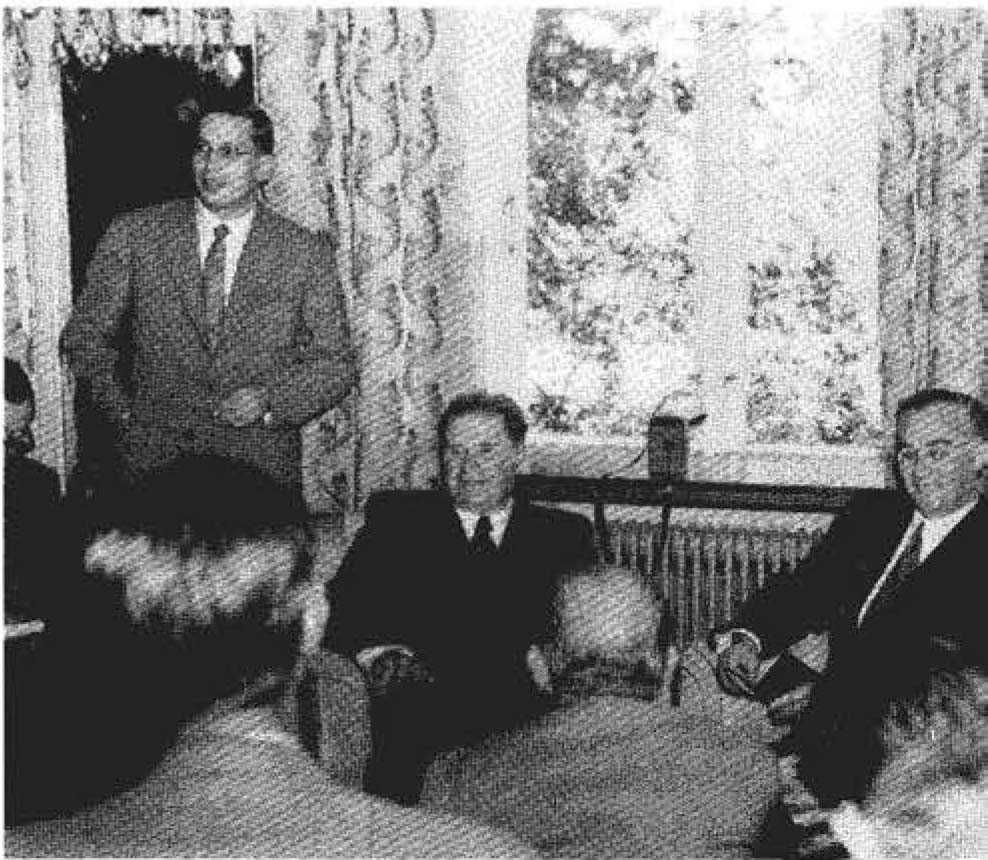
Against this backdrop of ideological differences and technological competition, the orbiting of Sputnik / by Soviet technicians on 4 October 1957, followed a month later by Sputnik II with its canine passenger Laika-and its implications for manned space flight-assumed great signifi-cance. The Soviets had obtained a visible and indisputable technological first and had apparently developed a rocket technology that also could be used for military purposes. Americans not only perceived the technological challenge of this accomplishment but also saw the obvious meaning of this first earth satellite for prestige and military power. As their Soviet counterparts reaped political, military, and scientific returns from their new star, American leaders embarked upon a period of deep, worried self-examination. The obvious response to the Soviet feat was an intensification of the American program to launch a satellite and an increase in the tempo of military rocket research. Declared or not, a bilateral technological competition had begun in space exploration and military rocketry.10
At the beginning it was impossible to separate the military and civilian aspects of the new competition-a circumstance that would complicate later attempts to cooperate in space. Soviet satellites were launched on military rockets, as was the first American satellite. Before it was transformed into NASA and entrusted with the civilian portion of the American space program, the National Advisory Committee for Aeronautics (NACA) showed a tendency to lump the scientific and military aspects of space into the single package of Cold War competition. NACA’s Special Committee on Space Technology surveyed the problem in the spring of 1958 and recommended an integrated program of development for long-range missiles and space vehicles, saying:
One of the prime objectives established in preparing this report was that of accomplishing a manned lunar landing in advance of the Soviets. Such an accomplishment would firmly establish Western technological supremacy and be of great psychological value. Due to the strategic location of the moon for space travel and warfare, an even greater and more permanent value would be derived by such a landing-that of claiming the moon for the United Nations of the Western World.
Clearly, the dominant theme was “to catch up with and ultimately surpass the Soviets in the race for leadership on this planet and for scientific and military supremacy in space.”11
Ironically, the cooperative spirit of the IGY that had spawned projects to orbit satellites became overshadowed by the urge to either maintain the lead or surpass the leader in this new technological arena. Two conflicting goals thus emerged. First was the desire to establish national pre-eminence in science and technology, as an adjunct to the broader Cold War rivalry. Second was the wish to develop international ties through cooperative studies of the cosmos, as reflected by the aims of the IGY. To meet the Soviet challenge, the American government created a separate space agency, and the conflicting themes of competition and cooperation were present in the discussions that led to the creation of the National Aeronautics and Space Administration. While the establishment of a space agency was in large measure a response to the Soviet achievement in launching the first satellite, the fact that the new organization was under civilian leadership testified to the desire of President Eisenhower to avoid, if at all possible, an extension of the military aspects of Cold War into outer space. From the very beginnings of the American satellite project, Eisenhower had supported the position that space exploration should be undertaken for peaceful purposes only.12
Through the months of work by various executive and congressional groups, the drafting and redrafting of bills, and the inevitable compromising on and off the floor of Congress, the two potentially conflicting themes survived. 13 The National Aeronautics and Space Act of 1958 opens with a declaration of policy that includes two specific purposes:
Sec. 102.
(c) (5) The preservation of the role of the United States as a leader in aeronautical and space science and technology ...;
(7) Cooperation by the United States with other nations and groups of nations....14
Arnold Frutkin, who was given the responsibility of directing the International Programs office of NASA* in 1959, later commented on the dual challenge placed before the new agency:
indentWhile facing up to the grim reality of competition between the great powers, the Congress nevertheless elected to place some hope, if not faith, in the simultaneous practice of cooperation....both courses of action-the competitive and the cooperative-were pursued simultaneously in the early years of the space age.
This parallel approach was entirely conscious. NASA’s second Administrator, James E. Webb, said on more than one occasion that “space, like Janus, looks in two directions.” As Frutkin perceived this complex process, “This was only part and parcel of the age old strategy of pursuing the battle vigorously while seeking and preparing for an armistice.”15 NASA’s Office of International Programs faced a unique and difficult task.
* See appendix A for the 29 Jan. 1959 NASA organization chart.
ORIGINS OF THE OFFICE FOR INTERNATIONAL PROGRAMS
It was not altogether clear at first exactly what role the Office of International Programs was to play in the overall mission of NASA. The Space Act of 1958 was signed into law on 29 July, and T. Keith Glennan and Hugh L. Dryden were sworn in as Administrator and Deputy Administrator on 19 August. NASA officially came into existence on 1 October. In the whirlwind rush, the question of international programs was just one of a host of pressing concerns.
As early as May, draft organization charts had shown a position for an Assistant for International Activities.16 The idea for this staff office reflected the view of the National Advisory Committee for Aeronautics on organization. When Glennan was appointed, he asked the management consultant firm McKinsey and Company to study the various proposals for NASA managerial structure. McKinsey suggested the creation of an office devoted solely to international questions. First, it would provide a central point of coordination and assistance for the Administrator and other officials in the development of a cooperative international program of “space research and development,” and, second, the office would provide staff support to the State Department on matters that concerned foreign policy and space affairs. The International Office was also to serve as a clearinghouse and coordinating body for exchange of scientific and technical information, arrangement of cooperative facilities in other countries, and coordination of a host of scientific activities, such as weather observation.17
Glennan accepted the recommendation and appointed a Director of the Office of International Cooperation, who, within nine months was replaced by Arnold Frutkin.18 The forty-one-year old Frutkin brought with him a sober realism born of his experiences during the IGY. In May 1957, Frutkin had joined the staff of the National Academy of Sciences as Director of the Office of Public Affairs of the U.S. Committee for the IGY. Concurrently, he served as Deputy to the Executive Director of that committee. As a consequence, Frutkin had witnessed firsthand many of the frustrations of working with other national committees, especially the difficulties encountered with the Soviet committee.
Frutkin reflected on the IGY and its meaning for the exploration of space in his book, International Cooperation in Space. Looking at the day-to-day efforts of the IGY, he held that the idea of “shoulder-to-shoulder cooperation” was “a substantially misleading picture.” In short, Frutkin saw the IGY as “a collection of national programs, independently working toward purely scientific objectives loosely coordinated by a nongovernmental mechanism.” While the IGY did construct “scientific bridges across political chasms,” he argued that “the bridges had no effect on the chasms; these remained and no traffic other than scientific crossed them.”19
From Frutkin’s vantage point, the broad success that characterized many cooperative scientific endeavors did not extend into space research. Scientific representatives of the Soviet Union “stubbornly restricted IGY agreements for the exchange of information in this area. ... attempts to improve the situation... were unavailing.” Frutkin summarized: “Extensive efforts to apply the usual IGY data exchange formulas to space came to naught. ... Clearly, the cold war had reached into the IGY and frostbitten one of its major arms, the space program.”20
But what did the experiences of the IGY say to the man who would be responsible for government-to-government considerations of collaboration in space activities? First, “it remains most important to recognize that those who molded the IGY were probably far freer from disabling political considerations than would have been the case if governmental representatives had attempted to frame a similar program.” Second, the IGY “was a notable element among the forces that gave the U.S. national space program its peculiar shape” when NASA was created in 1958. Clearly, Frutkin perceived that the difficulties experienced by his non-government colleagues in the IGY would be magnified within NASA should that agency negotiate for international cooperation with the representatives of other governments. His earlier experiences with the IGY and his concern for realism in international negotiations were to temper his approach to cooperative ventures in the years that followed.21
FIRST EFFORTS TO ESTABLISH A BASIS FOR COOPERATION
By the fall of 1959, NASA had the mandate to cooperate, and it had set up the administrative machinery to formulate policy concerning international programs; but what did cooperation and international programs mean? How and with whom would NASA cooperate? What would be the subject matter for international agreements? There were, of course, those areas in which NASA needed the assistance of other nations, notably to establish tracking stations for both manned and unmanned spacecraft. Also, NASA hoped to encourage other nations to join in scientific experiments involving American spacecraft. And there was a third category of possible cooperation-the Soviet Union. Skillful negotiation would be required in this pursuit, as the Soviet Union was a coequal, perhaps the technological leader, in space flight. Thus, while it was difficult enough to deal with nations nominally friendly, negotiations with the Soviets were always to be a special case. How and for what reasons would cooperative programs be developed between the Americans and the Soviets?22
Before Frutkin arrived at NASA, Deputy Administrator Hugh Dryden had made several important contacts with other nations. Homer E. Newell, Jr., Assistant Director for Space Sciences, had taken the lead to organize the international community interested in space flight by convening the first organizational meeting of the International Committee for Space Research (COSPAR) in November 1958. COSPAR had been created to perpetuate the cooperative aspects of space investigation that had been part of the IGY,* but the international body quickly became a victim of Cold War politics.23
* Over the years, COSPAR has grown in stature, but it still remains a non-governmental body, hence an unofficial point of contact at which scientists can exchange views. While delegates from the Soviet Academy of Sciences are official spokesmen for their country, representatives of the National Academy of Sciences do not speak for the U.S. government.
A debating society environment plagued the United Nations discussions of cooperation on the new frontier; nuclear disarmament was the stumbling block. Following Sputnik I, much had been said about preventing the introduction of weapons into space. Indicative of the divergence of opinion between the Americans and the Soviets on this subject were the letters exchanged during the spring of 1958 between Eisenhower and Soviet Premier Nikolai Bulganin. Eisenhower asserted that the peaceful use of space-prohibiting the use of space for military gain-was “the most important problem which faces the world today. ... We face a decisive moment in history....” Addressing the problem of developing rockets for military applications, Eisenhower raised the question of learning from past failures:
... a decade ago, when the United States had a monopoly of atomic weapons and of atomic experience, we offered to renounce the making of atomic weapons and to make the use of atomic energy an international asset for peaceful purposes only. ... The nations of the world face today another choice perhaps even more momentous than that of 1948. That relates to the use of outer space. Let us this time, and in time, make the right choice, the peaceful choice.
There are about to be perfected and produced powerful new weapons which, availing of outer space, will greatly increase the capacity of the human race to destroy itself.... can we not stop the production of such weapons which would use or, more accurately, misuse, outer space, now for the first time opening up as a field for man’s exploration? Should not outer space be dedicated to the peaceful uses of mankind and denied to the purposes of war? That is my proposal.24
Premier Bulganin responded that reserving space for peaceful purposes depended on prior solution of the problem of disarmament in general:
We, of course, do not deny the importance of the question of using outer space for peaceful purposes exclusively, i.e., first of all, of the question of the prohibition of intercontinental ballistic missiles with nuclear warheads. I hope, however, Mr. President, that you will agree that this question can be considered only as a part of the general problem of the prohibition of nuclear and rocket weapons. It is for that very reason that the Soviet Union, in the interest of strengthening peace and reaching agreement on questions of disarmament, is also prepared to discuss the question of intercontinental missiles, provided the Western powers are prepared to agree on the prohibition of nuclear and hydrogen weapons, the cessation of tests of such weapons and the liquidation of foreign military bases in the territories of other states....25
In the succeeding exchange of letters between the two states and in the debates in the U.N., the discussions bogged down over the relation of space to questions of national security and disarmament. The two space powers, who also were the two nuclear powers, defined differently the problem at hand. American leaders sought to ban the militarization of outer space; this seemed a logical step and an opportunity that should not be lost. The Soviets, however, saw sinister motives behind the American proposals. The Russians saw themselves surrounded by American and allied military power. In addition to their bases in the continental United States, the Americans had installations in the U.K., Western Europe, the Middle East, and the Far East. With such facilities, outer space was not needed to launch an attack. The Soviets, lacking such advanced bases, relied upon the development of the intercontinental ballistic missile (ICBM)—a strategic weapon whose parabolic trajectory arced into space. America’s proposal to neutralize space was thus seen as an attempt to deprive the Soviet Union of her only defense against the nuclear strike capabilities being developed by the Americans. Both nations sought to neutralize outer space, but only on terms that would be advantageous to themselves.26
Debate in the U.N. divided along ideological lines, and NASA’s desire to use that body as the foundation for developing a program of space cooperation foundered.* Glennan and his colleagues came to believe that negotiations with the Soviets would have to be direct, bilateral, and more private than the open forum of either COSPAR or the U.N. As a consequence, the NASA leadership sought to engage the Soviets in less formal talks. Typical of these early contacts were the discussions between representatives of the Soviet Academy of Sciences and NASA during the annual meetings of the American Rocket Society. At the mid-November 1959 meeting of the Society in Washington, for example, Soviet space scientists Sedov, Blagonravov, and V. I. Krassovsky presented papers on the nature of Soviet space research. 27 Dryden met privately with the Soviets to exchange views. They agreed that their countries should cooperate more closely in space science, and Dryden made it clear that NASA was ready to talk about issues of mutual interest. The Soviets warned that such an undertaking should proceed “step by step.” However, Frutkin reported that “when pressed, they were not prepared to identify the first possible step.”28
* In Jan. 1960, NASA created an ad hoe Office for the U.N. Conference that was to address the issues raised by the General Assembly call for an international conference on the peaceful uses of outer space. This office was headed by John Hagen. When the conference failed to materialize, the office was disbanded in Sept. 1961. Rosholt, Administrative History of NASA, pp. 127-128.
In an effort to demonstrate American willingness for closer relations, George Low gave the Soviet guests a tour of the Langley Research Center in Virginia, where among other things he showed them a model of a Mercury spacecraft. The Soviets were polite but noncommittal, and the hoped-for invitation to see Soviet space-flight facilities never materialized.29
The Soviets continued to insist that the proper forum for discussing space cooperation was the United Nations; and the Americans remained acutely aware that discussions in that arena, as long as the Soviets enjoyed the technological lead, could only result in a Soviet propaganda advantage.
COMPETITION VERSUS COOPERATION: 1959-1962
For NASA personnel interested in fostering cooperative projects with the Soviet Union, the political climate of 1959-1962 was frustrating. These were the years of Soviet Premier Nikita Sergeyevich Khrushchev’s foreign policy that on the one hand sought detente with the West while on the other exploited “every major trouble spot, every embarrassment” to damage Western influence and prestige. To quote one assessment:
There appeared to be two Khrushchevs: one, a “coexistentialist” eager for enhanced intercourse between the U.S. and the U.S.S.R.; dropping hints (to be sure so obscure as to remain at the time undecipherable) about the necessity for a virtual alliance of the two powers; the other, a militant Communist and bully ready to cash in on each and every weakness and hesitation of the West, threatening nuclear obliteration if his opponent would not submit.
Khrushchev did not want a crisis that would lead inexorably to nuclear disaster, but he was a skillful poker player who successfully bluffed the leaders of the country that had originated the game, until the confrontation over missiles in Cuba.30
Nineteen fifty-nine was a year of political maneuvering. Vice President Richard Nixon and Premier Khrushchev held their “kitchen debate” at an American exhibition in Moscow’s Sokolniki Park,31 and Khrushchev later made his ostentatious, but largely ceremonial, visit to the U.S. It was also the year of the first Soviet lunar probes. Luna I, launched in January, was the first spacecraft to penetrate interplanetary space; Luna II, launched during the Premier’s visit to the U.S., was the first spacecraft to hit the moon. Then in October, Luna III swung around the moon and photographed its back side. But the debates and visits did nothing to solve international problems; successful moon probes certainly did not enhance the chances for cooperation between the two nations-especially when contrasted with the high number of U.S. launch failures in 1959.
In the next year, however, Soviet and American heads of state had to deal with realities of international politics that could not be brushed aside. Khrushchev had wanted a summit meeting for several years; now such a meeting seemed less than desirable. Following his visit to the United States, Khrushchev had visited Peking. From the Soviet standpoint, discussions with the Chinese were unsatisfactory, causing the ideological split between the two nations to widen and heading the Chinese on an increasingly independent course. This problem, together with the hardening positions of the American, British, and French on the question of two Germanys, made a summit meeting with the Americans undesirable. Just as the potentially embarrassing get-together approached, American pilot Francis Gary Powers became an unintentional celebrity when his Lockheed U-2 high-altitude reconnaissance aircraft was downed deep in Soviet territory.
The U-2 incident had three immediate consequences. First, it solved Khrushchev’s dilemma. He could now avoid the summit meeting without accepting the responsibility for wrecking it. Second, the United States suffered a serious international embarrassment when President Eisenhower took personal responsibility for the U-2 flight.32 Third, the credibility of the National Aeronautics and Space Administration was questioned because it had served as a cover for this clandestine, intelligence-gathering overflight.
On 5 May 1960, on orders from the White House, NASA stated that one of its U-2 research planes used “to study gust-meteorological conditions found at high altitude” had been missing since 1 May. Then six days later, Eisenhower admitted publicly that the flight actually had been part of a military reconnaissance program conducted with his permission. While the administration had to cope with the impact of the U-2 mission at the abortive Paris summit conference and later during Khrushchev’s visit to the United Nations in September, NASA had to fight the notion that there was more to the civilian program than was being admitted in public.
An immediate issue was Soviet participation in the Tiros weather satellite program. “It’s part of our national policy that space research is for peaceful purposes,” Arnold Frutkin told a Wall Street Journal reporter. “We want to have an open program. And the best way to prove this to other countries is to have them participate in our experiments.”33 NASA had long planned to solicit the cooperation of other nations, including the U.S.S.R., in studying cloud photographs taken by the Tiros satellite. Soviet participation would have gone a long way to allay fears that Tiros was looking at more than the weather patterns, but the Soviets saw or purported to see-the satellite as another U-2. A year later NASA Administrator James E. Webb labeled as “political opportunism” their attacks on the Tiros program and their refusal to participate.34
Even without the U-2 incident, 1960 was not a propitious time to talk about cooperative ventures in space. The American public was watching a very close political contest between John F. Kennedy and Richard Nixon; a key campaign topic was the state of the nation’s defenses against nuclear attack by the Soviet Union. During the campaign, the trade journal Missiles and Rockets invited the candidates to respond to a series of statements on space and defense. The first proposition asked if they would “recognize as national policy that we are in a strategic space race with Russia.” Kennedy’s response was published first:
We are in a strategic space race with the Russians, and we have been losing. The first man-made satellite to orbit the earth was named Sputnik. The first living creature in space was Laika. The first rocket to the moon carried a Red flag. The first photograph of the far side of the moon was made with a Soviet camera. If a man orbits earth his year his name will be Ivan. These are unpleasant facts that the Republican candidate would prefer us to forget.
Control of space will be divided in the next decade. If the Soviets control space they can control earth, as in past centuries the nation that controlled the seas dominated the continents. This does not mean that the United States desires more rights in space than any other nation. But we cannot run second in this vital race. To insure peace and freedom, we must be first.35
Nixon responded later in a manner that was uncharacteristic of the Eisenhower administration, which had played down the idea of a space race. Candidate Nixon argued:
If the Eisenhower Administration had not long ago recognized that we were in a strategic race with Russia, our space record would not be as creditable as it is today.
Twenty-six satellites and 2 space probes have been launched successfully by the United States.
Six satellites and 2 space probes have been launched successfully by the Soviet Union.
Today 13 United States satellites are in orbit; only 1 Russian satellite remains in orbit.
Eight United States satellites in orbit are still transmitting; the sole Russian satellite in orbit is not transmitting.
The United States has recovered 2 satellite payloads from orbit while the U.S.S.R. claims to have recovered one.
Despite the greater weight of U.S.S.R. space vehicles, the United States has gathered far
more scientific information from space. In instrumentation, communications, electronics, reliability, and guidance, United States space vehicles have made gigantic strides.
In short, the United States is not losing the space race or any other race with the Soviet Union. Today we are ahead of the U.S.S.R. From a standing start in 1953, we have forged ahead to overcome an 8-year Russian lead. And we will continue to maintain a clear cut lead in the race for space.36
While the candidates debated, NASA and the Eisenhower administration attempted to keep a line open with the Soviets on space cooperation. Frutkin had talked informally with Academician Anatoliy Arkadyevich Blagonravov about the possibility of using Echo I, the balloon-like passive communications satellite, for communications experiments between the United States and the Soviet Union. Echo I had been launched on 12 August 1960, three days before the International Astronautical Congress convened in Stockholm, and the delegates had heard a message recorded by President Eisenhower, transmitted part of the way by the satellite.37 On 22 September, the President in an address to the United Nations suggested a four-point proposal for the peaceful exploration of space, using as his precedent the 1959 Antarctic Treaty, which had prompted scientific research and barred military activity from that continent.38 However, the future of Eisenhower’s hope for an agreement on the peaceful uses of outer space would depend upon the efforts of the new President and the individuals within NASA.
Kennedy’s election in November 1960 portended a number of changes for defense and space programs. Subsequently, Kennedy asked his Vice President-elect to serve as his senior adviser on space policy and as chairman of the National Aeronautics and Space Council. Lyndon B. Johnson’s first task was to recommend a new Administrator for NASA, Glennan having resigned effective the last day of the Eisenhower administration. As Johnson began the search, Kennedy announced on 11 January 1961 the appointment of Jerome B. Wiener of MIT to be his assistant for science and technology. The same month appeared the “Wiener Report,” prepared by a committee of science advisers who had worked with the Kennedy campaign.
Expanding upon campaign themes, this document criticized the space program under the Eisenhower administration. But while belaboring some aspects, especially the manned space-flight project, the report foresaw “exciting possibilities for international cooperation” in space exploration and communications. Such projects would prosper if “carried out in an atmosphere of cooperation as projects of all mankind instead of in the present atmosphere of national competition.”39 Kennedy pursued the same theme in his inaugural address.
Kennedy’s speech was notable because of its hopeful and skillful rhetoric, expressing the desire for new beginnings in foreign policy, including a reduction in the level of conflict between the United States and the Soviet Union. To that end, he appealed to the Soviets: “Let both sides seek to invoke the wonders of science instead of its terrors. Together let us explore the stars, conquer the deserts, eradicate disease, tap the ocean depths and encourage the arts and commerce....” And Kennedy continued to espouse the cooperative theme in his State of the Union address on 30 January 1961. The President invited all nations, including the U.S.S.R., “to join with us in developing a weather prediction program, in a new communications satellite program and in preparation for probing the distant planets of Mars and Venus, probes which may someday unlock the deepest secrets of the universe.” He repeated the hopes of his science advisers that the arms race could be kept from spreading into space. “Both nations would help themselves as well as other nations by removing these endeavors from the bitter and wasteful competition of the Cold War.” This was to be a recurring theme in Kennedy’s public comments.40
At the time of these pronouncements, and to this day, debate has existed over the depth of the new President’s initial understanding of the space issue relative to the realities of international power politics.41 Missiles and space had been a warm issue during the campaign; Kennedy had insisted that the previous administration had allowed national defense to slip in relation to Soviet strength. After Kennedy assumed the Presidency, the “missile gap” proved to have been a myth; but the problem remained to fit the national space program into the power equation by which American military and political leaders would evaluate the “strength” of their nation versus that of the Soviet Union.
Ten days after his inauguration, Kennedy followed the recommendation of his Vice President and nominated James E. Webb to be Administrator of the space agency. At first hesitant to accept the position, which he felt would have been more satisfactorily filled by a scientist or engineer, Webb had agreed once he understood that Kennedy was seeking a policy maker who could manage scientists and engineers. Upon accepting the assignment, Webb announced that Hugh Dryden, the other presidential appointee in NASA, would continue as Deputy Administrator. With directions from the President to make a comprehensive review of NASA programs, Webb went before the Senate for hearings on his confirmation. He was confirmed on 9 February and sworn in on the 14th.42
As the first months of 1961 slipped away, Kennedy and Webb became convinced that second place in space exploration would carry the negative impression that the United States was second rate in military strength as well. This conclusion once again pointed to the dilemma of competition versus cooperation in space exploitation. On the one hand, Kennedy genuinely wanted to cooperate in this arena with the Soviets; on the other hand, military and technical superiority had to remain with the United States. Events during the spring of 196l swiftly determined his choice between these conflicting goals.
The successful one-orbit flight of Yuri Alekseyevich Gagarin on 12 April 1961 was a significant element in the subsequent American deliberations. While this event was anticipated by the Kennedy administration, the Soviet feat was still another blow to the American image at home and abroad. The Soviet Union constantly stressed three themes in exploiting the first manned space flight:
- the Gagarin flight was evidence of the virtues of “victorious socialism”;
- the flight was evidence of the global superiority of the Soviet Union in all aspects of science and technology;
- the Soviet Union, despite the ability to translate this superiority into powerful military weapons, wanted world peace and general disarmament.43
Such a challenge could not go unanswered. Theodore Sorenson later commented, overdramatically perhaps, that “As the Soviet Union capitalized on its historic feat in all corners of the globe, Kennedy congratulated Khrushchev and Gagarin and set to work.”44
Even as John Kennedy was rolling up his sleeves and consulting his advisers, other events were unfolding that would complicate the political scene. None too secretly, a band of approximately 1500 Cuban refugees was preparing to launch an invasion of Fidel Castro’s Cuba. The exact impact of this military and political fiasco on the subsequent decision to go to the moon has been repeatedly argued by many of those associated with the Kennedy administration. John Logsdon concludes in his study of the events:
The fiasco of the Bay of Pigs reinforced Kennedy’s determination, already strong, to approve a program aimed at placing the United States ahead of the Soviet Union in the competition for firsts in space. It was one of the many pressures that converged on the president at the time, and thus its exact influence cannot be isolated. As president, Kennedy could treat few issues in isolation anyway, and there seems to be little doubt that the Bay of Pigs was in the front of his mind as he called Lyndon Johnson to his office on April 19 and asked him to find a “space program which promises dramatic results in which we could win.”45
By the end of April 1961, Kennedy had decided that the dramatic program would be a manned lunar landing. The suborbital flight of Alan B. Shepard in his Freedom 7 spacecraft on 5 May was a much needed positive accomplishment, which brought favorable public response. On 8 May, Vice President Johnson presented to the President a memorandum prepared by NASA Administrator Webb and Defense Secretary Robert S. McNamara- “Recommendations for our National Space Program: Changes, Policies, Goals.” The Webb-McNamara memorandum suggested that manned space flight could be an effective means of enhancing national prestige:
Major successes, such as orbiting a man as the Soviets have just done, lend national prestige even though the scientific, commercial or military value of the undertaking may by ordinary standards be marginal or economically unjustified... The non-military, non-commercial, non-scientific but “civilian” projects such as lunar and planetary exploration are, in this sense, part of the battle along the fluid front of the cold war.46
John Kennedy agreed.
On 25 May in a speech on “Urgent National Needs,” the President reminded the Congress that “these are extraordinary times. We face an extraordinary challenge.” After addressing himself to a number of other important issues, Kennedy turned to the subject of space. This new frontier was just another aspect of the “battle that is going on around the world between freedom and tyranny...” Therefore, “Now it is time to take longer strides-time for a great new American enterprise-time for this nation to take a clearly leading role in space achievement, which in many ways may hold the key to our future on earth.” One of those “longer strides” Kennedy proposed was the landing of an American on the moon. The President believed “that the Nation should commit itself to achieving the goal, before this decade is out, of landing a man on the moon and returning him safely to earth.” This goal was that bold type of challenge that had peculiar appeal to the young President. “No single space project in this period will be more impressive to mankind, or more important for the long-range exploration of space; and none will be so difficult or expensive to accomplish.”47
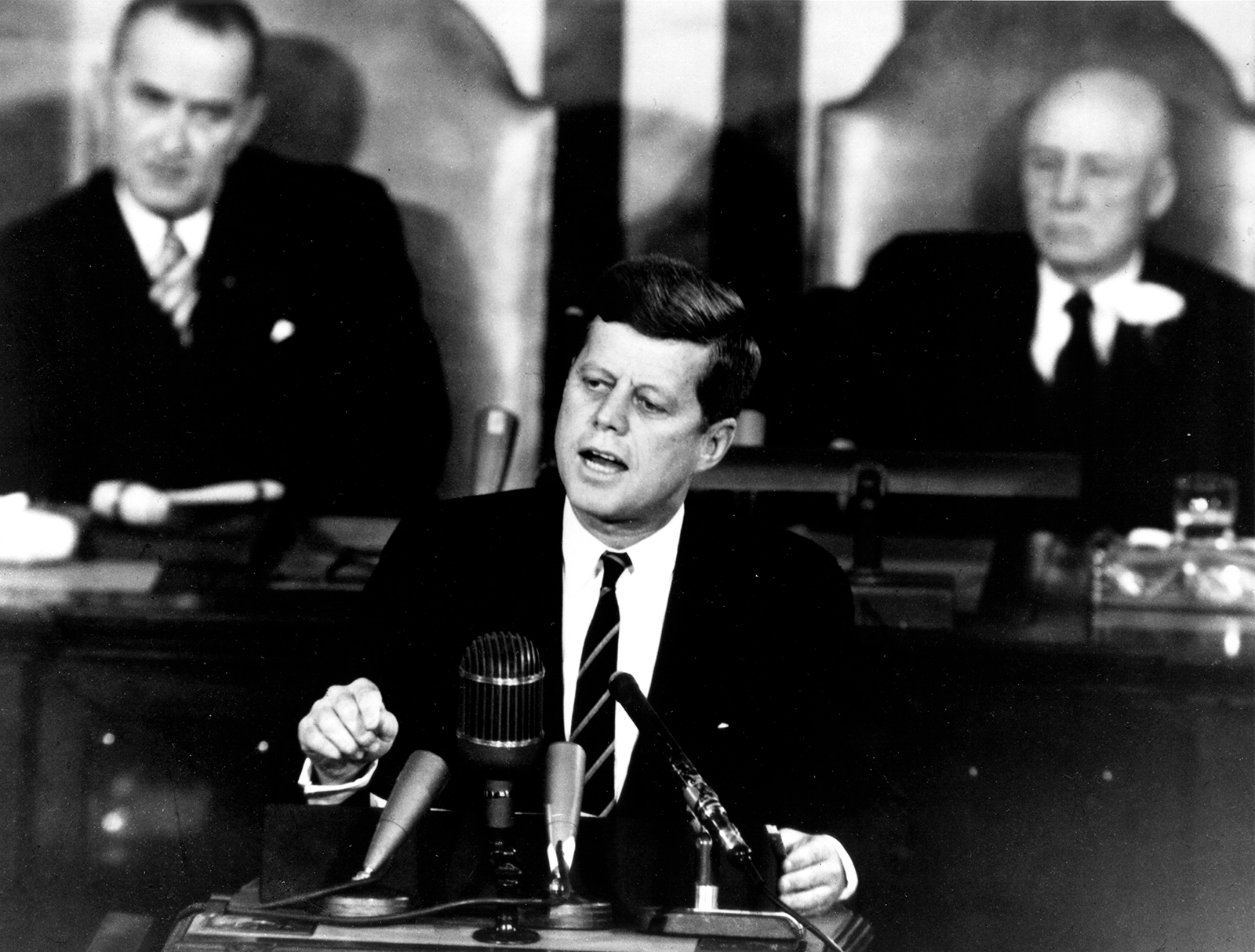
Thus, space competition between the United States and the Soviet Union was reaffirmed by Kennedy’s speech. What did this mean to NASA, and particularly what did it mean for NASA’s mandate to cooperate? During 1961, the NASA position on the prospects of Soviet-American space cooperation was one of basic skepticism. Administrator Webb was committed by the Webb-McNamara memorandum of 8 May to support a program of American technological pre-eminence in space. Any program of cooperation would have to occur within a framework that would not jeopardize America’s chances of establishing that position.
In June 1961, in response to questioning, NASA submitted a series of formal statements to the Senate Committee on Aeronautical and Space Sciences. “In general, how cooperative have the Soviets been in sharing the results of their space experiments?” NASA responded that the difference between the attitude of the U.S. and that of the U.S.S.R. was one of degree. The Soviets were judged to have been quite active in international meetings. They had presented papers and discussed problems of mutual interest with their international colleagues, but it was the NASA opinion that they had not operated with an openness comparable to that of scientists from other nations.48 Throughout 1961, NASA spokesmen told Congress and the American public that while NASA still sought space cooperation with the U.S.S.R., the attitude and actions of the Soviets left little hope for success.
Public remarks by Soviet officials in 1961 on space cooperation were equally ambivalent. On 13 February, Kennedy congratulated Khrushchev on the launch of a space probe to Venus.49 In his reply two days later, Khrushchev thanked Kennedy for his “high appraisal to this outstanding achievement of peaceful science.” The Soviet leader, in referring to Kennedy’s inaugural and State of the Union invitations to the Soviets, said that “such an approach... impresses us and we welcome these utterances of yours.” But the Soviet Premier still saw disarmament as the key to the problem: “We consider that favorable conditions for the most speedy solution of these noble tasks facing humanity would be created through the settlement of the problem of disarmament.”50
With Gagarin’s Vostok I April flight, the tone of the Soviet statements on cooperation in space changed. Clearly the Soviets enjoyed their sense of technological superiority, but still they did not totally abandon the thought of cooperation with the U.S. Academician Sedov,* in his public congratulations to Alan Shepard for suborbital flight, was careful to point out that the Gagarin flight was of greater significance. He also restated the Soviet position on the relationship of international cooperation in space flight to the question of disarmament:
Soviet scientists and scientists of other countries, who are occupied with scientific research in space, are participating in mutual discussions on the results achieved, and we can speak on the beginning of fruitful cooperation. Nonetheless, the problem of international scientific cooperation on space flights in general is still not resolved. It is evident that such cooperation will be successful only upon the favorable development of international relations and the realistic solution of the problem of disarmament.51
Later at the Washington meetings of the International Astronautical Federation during October, Sedov was asked if the U.S. and the U.S.S.R. would be able to collaborate in launching large payloads. Sedov replied, “1 think it will be possible in the future, not only between the Russians and Americans but with other countries as well.” Deputy Administrator Dryden observed at the time that “Sedov and I have discussed this possibility many times. If the decision were ours alone, there would be no problem.”52
* Sedov was Chairman of the Commission for the Promotion of Interplanetary Flights, U.S.S.R. Academy of Sciences, as well as President of the International Astronautical Federation.
Coming at a time when East-West tensions had worsened, optimistic statements about cooperation in space hardly seemed realistic. The two-day confrontation between Kennedy and Khrushchev during the June 1961 Vienna summit was from Kennedy’s perspective a disaster. But in one of the rare moments of amicability, Kennedy suggested that the two nations pool their space efforts and “go to the moon together.” Khrushchev’s immediate response was “all right,” but upon reflection the mercurial Soviet leader decided that such a venture would not be practical. The boosters used for manned space flight had military implications. That triggered considerations of disarmament, and that brought the discussions back to the Cold War. There the proposed joint trip to the moon died.53
The unsuccessful Vienna summit was followed by the crisis over the Berlin Wall. With that physical barrier between East and West Berlin erected on 13 August 1961, Khrushchev once again raised the question of the divided status of Germany. For the second time in three years, Khrushchev threatened to sign a separate peace treaty with the East German Government, thus forcing the Americans to deal with a separate communist state. On 25 July, Kennedy told the nation in a somber television address that the United States would go to war should that become necessary to defend a free Berlin. Khrushchev reacted strongly to what he perceived to be an ultimatum from the President of the United States, and while the two sides negotiated the Berlin issue, the Soviet Union dramatically broke the three-year old moratorium on atmospheric nuclear weapons tests. Beginning on 1 September 1961, the tests continued for two months. They were culminated with a 58-megaton explosion, the most powerful hydrogen device to have been tested at that time by either nation.54 While events such as these would seem to pose insurmountable barriers to cooperation in space, Russian and American scientists managed to keep the discussions alive.
Threats to world peace posed by the succession of summer and autumn crises, while not unnoticed, seemed far distant from the pleasant atmosphere of the lodge at Smugglers Notch, Vermont. For four days, 5-8 September 1961, scientists from ten countries, including the U.S.S.R., gathered for the Seventh International Conference on Science and World Affairs.* Included in a broad spectrum of proposals relating to greater cooperation among the world’s scientists were suggestions for a program of space cooperation between the U.S. and the U.S.S.R. Four areas in which the scientists felt that cooperation was possible were (1) a worldwide system of weather satellites and forecasting; (2) an international program of communications satellites; (3) an international exchange of data relating to space biology; and (4) a joint program for the scientific exploration of the moon and the planets.55 Despite the international debate engendered by the Soviet resumption of nuclear arms tests, there was an atmosphere of good will at Smugglers Notch.56 The fragility of such scientist-to-scientist efforts was clearly demonstrated two months later.
* Americans present included E. Rabinowitch, Professor of Biophysics, University of Illinois; H. Brown, California Institute of Technology; P. Doty, Harvard University; and I. I. Rabi, Professor of Physics, Columbia University. The Soviets included A. A. Blagonravov; A. V. Topchiev, Vice President, Soviet Academy of Sciences; I. Y. Tamm, physicist; and N. N. Bogolubov, physicist. British representatives included Professor P.M. S. Blackett, physicist, London University; Sir John Cockcroft, nuclear physicist, Cambridge University; and the Rt. Hon. Philip Noel-Baker. Henry Kissinger, Harvard, and George Kistiakowsky, former science adviser to President Eisenhower, attended the sessions on disarmament.
In November 1961, NASA and the U.S. Department of Commerce sponsored an International Satellite Workshop in Washington. American representatives explained their plans for the further exploitation of weather satellites and encouraged other nations to participate in the gathering and use of satellite data. The Americans expected delegates from the U.S.S.R., Poland, and Czechoslovakia, since visas had been sought by representatives of those countries. On the second day of the workshop, it became apparent that the Soviets would not attend. To most contemporary observers the lesson was clear: cooperation in space matters was a political consideration that could be understood only in the broader context of East-West relations.57 Nineteen sixty-one, the fifth year of the space age and NASA’s third, had not been a good year for space cooperation. Indeed, as one commentator has reflected: “For all the style and excitement of the new team, and all the great promise, 1961 was a terrible year for the Kennedy Administration.”58 International tensions would not lessen during 1962, but the opportunity for cooperation in space would seem more real. Two men would work hard to give that opportunity a chance to mature-Hugh Dryden of NASA and Anatoliy Blagonravo of the Soviet Academy of Sciences.
- Constance McLaughlin Green and Milton Lomask, Vanguard: A History, NASA SP-4202 (Washington, 1970), pp. 19-20; interview, Lloyd V. Berkner-Jay Holmes, 4 June 1959, pp. 22-24 and 26; and Berkner obituary, New York Times, 5 June 1967. For a summary of the IGY, see Walter Sullivan, Assault on the Unknown: I.G.Y. (New York, 1961); Hugh L. Dryden, "The International Geophysical Year: Man's Most Ambitious Study of His Environment," National Geographic Magazine 109 (Feb. 1956): 285-298; and Richard W. Porter, "International Cooperation in Space," in Astronautical Engineering and Science from Peenemunde to Planetary Space, Ernst Stuhlinger et al., ed. (New York, 1963), pp. 350-359.X
- Green and Lomask, Vanguard, pp. 22-23.X
- Ibid., p. 23.X
- Adam B. Ulam, The Rivals: America and Russia since World War II (New York, 1971), p. 382. Background on the differing interpretations of the Cold War and its origins can be found in Norman A. Graebner, ed., The Cold War: Ideological Conflict or Power Struggle? (Boston, 1963); Thomas G. Patterson, ed., The Origins of the Cold War (Lexington, Mass. [1970]); and Thomas G. Patterson, Soviet-American Confrontation: Post War Reconstruction and the Origins of the Cold War (Baltimore, 1974).X
- Green and Lomask, Vanguard, p. 33.X
- Ibid., pp. 31-32.X
- Richard S. Lewis, Appointment on the Moon (New York, 1969), p. 39; and Clifford C. Furnas, "Birthpangs of the First Satellite," Re. search Trends [Cornell Aeronautical Laboratory, Inc.] 18 (spring 1970): 15-18. Furnas, founder of Cornell Aeronautical Laboratories, was a member of the Ad Ho Advisory Group on Special Capabilities, a euphemism for the satellite study committee established by the Department of Defense in May 1955. Other members of the committee were H. J. Stewart, R. R. McMath, C. Lauritsen, J. B. Rosser, R. W. Porter, G. H. Clement, and J. Kaplan.X
- "Mezhdunarodni kongress astronavtov" [International congress of astronauts], Pravda, 5 Aug. 1955; a translated version of this Tass dispatch appears in F. J. Krieger, Behind the Sputniks: A Survey of Soviet Space Sciences (Washington, 1958), pp. 330-333.X
- Krieger, Behind the Sputniks, pp. 4-5, addresses the problem of interpreting Sedov's comments: "Although the White House announcement on July 29, 1955-that the United States intended to launch an earth satellite sometime during the International Geophysical Year (1957-1958)-led to considerable speculation concerning the Soviet position and capability in this field of technology, the imperturbable Russians, as usual, did not commit themselves....
A notable event occurred in the week following the White House announcement. The Sixth International Astronautical Congress sponsored by the International Astronautical Federation convened in Copenhagen, Denmark. It was notable because, unlike previous meetings, it was attended by two Soviet scientists, Academician L. I. Sedov, Chairman of the USSR Academy of Sciences Interdepartmental Commission on Interplanetary Communications, and Professor K. F. Ogorodnikov of the department of astronomy at Leningrad State University. ... The Russians were observers at the Congress and did not participate in any formal discussion of the papers. Sedov, however, did hold a press conference on August 2 at the Soviet Legation in Copenhagen, but unfortu nately some of the statements attributed to him were garbled in the Western press. Three days later, on August 5, Pravda published an official version of the press conference.
For a comparison, see New York Times, 3 Aug. 1955; New York Herald Tribune, 3 Aug. 1955; Green and Lomask, Vanguard, p. 39; Evgeny Riabchikov, Russians in Space (Garden City, N.Y., 1971), p. 142; and Frederick C. Durant, III, "Impressions of the Sixth Astronautics Congress," Jet Propulsion 25 (Dec. 1955): 738-739. Sedov's impressions of the Aeronautical Congress appeared in Pravda on 26 Sept. 1955 and are reprinted in Krieger, Behind the Sputniks, pp. 112-115. See also Leonid Ivanovich Sedov, “O poletakh v mirovoe prostranstvo” [On flights into world space], Pravda, 26 Sept. 1955, a translation of which appears in Krieger, Behind the Sputniks, pp. 112-115. X - Vernon Van Dyke, Pride and Power: The Rationale of the Space Program (Urbana, III. 1963), pp. 5-38 and 267-276; and John M. Logsdon, The Decision to Go to the Moon: Project Apollo and the National Interest (Cambridge, Mass., and London, 1970), pp. 40-62. For an inside view of post-Sputnik Washington, see Oliver M. Gale, "Post-Sputnik Washington from an Inside Office," Cincinnati Historical Society Bulletin 31 (winter 1973): 225-252.X
- National Advisory Committee for Aeronautics, Working Group on Vehicular Program, A National Integrated Missile and Space Vehicle Development Program (Washington, 1958), pp. 6-7. The background of the Stever Committee is presented in interview, H. Guyford Stever-Alex Roland and Eugene M. Emme, 4 Feb. 1974.X
- Loyd S. Swenson, Jr., James M. Grimwood, and Charles C. Alexander, This New Ocean: A History of Project Mercury, NASA SP-4201 (Washington, 1966); and interview, Gerald W. Siegel-Jay Holmes, 25 June 1968, which sheds light on the congressional scene. Siegel was counsel to the Preparedness Investigating Subcommittee and became the staff director of the Special Committee on Space and Aeronautics, which held the Senate hearings on the National Aeronautics and Space Act, May 1958. A longtime political adviser to Lyndon B. Johnson, he stresses the role the Senator from Texas played in the creation of a civilian space agency.X
- Robert L. Rosholt, An Administrative History of NASA, 1958-1963, NASA SP-4101 (Washington, 1966). pp. 8-13 and 34-36; Elisabeth A. Griffith, The National Aeronautics and Space Act: A Study in the Development of Public Policy (Washington, 1962); and Mary Stone Ambrose, "The National Space Program; Phase I: The Passage of the National Aeronautics and Space Act of 1958" (Master's thesis, American University, 1960).X
- Public Law 85-568, 72 Stat. 426.X
- Arnold W. Frutkin, International Cooperation in Space (Englewood Cliffs, N.J., 1965), p. 8.X
- Rosholt, Administrative History of NASA, p. 332; and T. Keith Glennan to James R. Killian, Special Asst. to the President for Science and Technology, 29 Oct. 1958.X
- McKinsey & Company, Inc., "Organizing Headquarters Functions: National Aeronautics and Space Administration," with letter of transmittal, 31 Dec. 1958, pp. 2-26, 2-27.X
- NASA News Release, HQ. "Henry E. Billingsley Named NASA's Director of the Office of International Cooperation," 6 Jan. 1959.X
- Frutkin, International Cooperation in Space, p. 19.X
- Ibid., p. 21.X
- Ibid., p. 22.X
- Ibid., pp. 28-84 describes U.S. efforts to create a basis for cooperation within the framework of NASA's programs.X
- Ibid., pp. 85-88.X
- Public Papers of the Presidents of the United States, Dwight D. Eisenhower, 1958 (Washington, 1959), p. 82.X
- Quoted in Dodd L. Harvey and Linda C. Ciccoritti, U.S. Soviet Cooperation in Space (Coral Gables, Fla., 1974), p. 16.X
- Frutkin, International Cooperation in Space, p. 142. For the subsequent exchange of letters between Eisenhower and the Soviet leaders see Harvey and Ciccoritti, U.S.-Soviet Cooperation in Space, pp. 17-22.X
- William Hines, "Soviet Space Scientists Tell Little of Ventures," Washington Star, 18 Nov. 1959.X
- George M. Low to Ezell, "Comments on December 1975 Draft of ASTP History." 29 Dec. 1975; Frutkin, International Cooperation in Space, p. 89; and U.S. Congress, Senate, Committee on Aeronautical and Space Sciences, Soviet Space Programs: Organization, Plans, Goals, and International Implications, 87th Cong., 2d sess., 1962, p. 179.X
- "Russians Unimpressed by Space Man Project," Washington Star, 23 Nov. 1959.X
- Ulam, The Rivals, p. 249.X
- Bela Kornitzer, The Real Nixon: An Intimate Biography (New York, 1960), pp. 297-310, gives material concerning the kitchen debate.X
- Strobe Talbot, tr. and ed., Khruschev Remembers: The Last Testament (Boston and Toronto, 1974), pp. 443-455.X
- NASA Hq News Release, "Memo to the Press," 5 May 1960; and David Wise and Thomas B. Ross, "The U-2 Affair: Memo to Press Hastily Drawn," Washington Star, 8 June 1962.X
- Louis Kraar, "Space Partnerships," Wall Street Journal, 26 Sept. 1960. Krasnaya Zvezda [Red Star], 23 July 1961, stated that Tiros III and Midas III were comparable to the U-2: "A spy is a spy, no matter what height it flies."X
- John F. Kennedy, "If the Soviets Control Space ... They Can Control Earth," Missiles and Rockets, 10 Oct. 1960, pp. 12-13; and in the same issue, Clarke Newlon, "Kennedy's Stand on Defense and Space," p. 50.X
- Richard M. Nixon, "Nixon: Military Has Mission to 'Defend' Space," Missiles and Rockets, 31 Oct. 1960, pp. 10-11; in the same issue, "Candidates' Views Compared," p. 12; and in the same issue, Clarke Newlon, "Nixon Drops Party Line on Space," p. 50.X
- Frutkin, International Cooperation in Space, pp. 89-91.X
- Public Papers of the Presidents of the United States, Dwight D. Eisenhower, 1960-1961 (Washington, 1961), p. 714-715.X
- Ad Hoc Committee on Space, Jerome B. Wiener, Chairman, "Report to the President-Elect of the Ad Hoc Committee on Space," 12 Jan. 1961; Swenson, Grimwood, and Alexander, This New Ocean, pp. 304-306; W. H. Lawrence, "Kennedy Warned of Space Setback," New York Times, 12 Jan. 1961; "Excerpts from Task Force's Report to Kennedy on U.S. Position in Space Race," New York Times, 12 Jan. 1961; and James Baar, "Space Shake-up Coming," Missiles and Rockets, 16 Jan. 1961, pp. 11-12.X
- Public Papers of the Presidents of the United States, John F. Kennedy, 1961 (Washington, 1962), pp. 1-2, 26-27, and 93-94.X
- The differing views can be seen by comparing Theodore C. Sorenson, Kennedy (New York, 1965), p. 524, with Logsdon, Decision to Go to the Moon, p. 93.X
- Interview, Hugh L. Dryden-Jay Holmes, 26 Mar. 1964.X
- Logsdon, Decision to Go to the Moon, pp. 111-112.X
- Sorenson, Kennedy, p. 524.X
- Logsdon, Decision to Go to the Moon, pp. 111-112.X
- Ibid., p. 126.X
- Public Papers of John F. Kennedy, 1961, pp. 405-406.X
- U.S. Congress, Senate, Committee on Aeronautics and Space Sciences, NASA Authorization for Fiscal Year 1962, Hearings on H.R. 6874, 87th Cong., 1st sess., 1961, p. 155.X
- TWX, Kennedy to Nikita Sergeyevich Khrushchev, 13 Feb. 1961, as printed in U.S. Congress, Senate, Committee on Aeronautical and Space Sciences, Documents on International Aspects of the Exploration and Use of Outer Space, 1954-1962, 1963, p. 190.X
- TWX, Khrushchev to Kennedy, 15 Feb. 1961, ibid.X
- Sedov, "Sovetskii Soyuzpioner v osvoenii kosmosa" [The Soviet Unionpioneer in space], Pravda, 9 May 1961.X
- William Beller, "AIAC Stressing Peace," Missiles and Rockets, 9 Oct. 1961, p. 14.X
- Dept. of State, Memo of conversation, "Vienna Meeting between the President and Chairman Khrushchev," 3 June 1961 [John F. Kennedy Library]; Pierre Salinger, With Kennedy (Garden City, New York, 1966), p. 178.X
- Salinger, With Kennedy, pp. 189-196; and Ulam, The Rivals, pp. 322-323.X
- Harrison E. Salisbury, "World Scientists Map Coordinations," New York Times, 8 Sept. 1961; and Salisbury, "Space Proposals for World Near," New York Times, 9 Sept. 1961.X
- For the tenor of the time, see Harry Schwartz, Khrushchev Presses Hard to Force Settlement on His Terms," New York Times, 11 Sept. 1961; John W. Finney, "U.S. Tests to Preserve Lead over Soviets," New York Times, 11 Sept. 1961; and Richard Lowenthal, "Negotiating with Russia-What's the Use," New York Times Magazine, 11 Sept. 1961, pp. 21 and 116-117.X
- John W. Finney, "Soviet Block Boycotts U.S. Weather Satellite Symposium," New York Times, 15 Nov. 1961.X
- David Halberstam, The Best and the Brightest (Greenwich, Conn., 1973), p. 82.X