Mission to Moscow
Between the spring of 1969 and the fall of 1970, the Paine-Keldysh correspondence had set the stage for serious discussions on developing compatible equipment and flight procedures. Tom Paine thought that cooperation in space was an important and timely idea and pushed for talks in furtherance of that goal-and he got them. Paine’s success with the Soviet officials was vastly different from the experiences that had spanned the preceding twelve years. In this instance, the spirit of the past was definitely not the prologue.
Knowledge of the letters between the NASA Administrator and the Soviet Academician had been shared by a limited number of NASA people. As long as the communications were general and exploratory, action was concentrated in the offices of the Administrator and his Assistant for International Affairs. On 10 July 1970, however, President Nixon publicly confirmed his interest in pursuing discussions of space cooperation, stating that negotiations should be conducted at the technical agency level.1 Thus, when talks with the Soviets appeared likely, NASA Headquarters geared up in preparation. Philip E. Culbertson’s Advanced Manned Missions Planning Group in the Office of Manned Space Flight (OMSF) was one of the first to be drawn into the widening discussions, having been assigned to consider the development of compatible rendezvous and docking systems.
In mid-August, OMSF began to “work the problem,”* an exercise in defining the technical considerations that would be involved in any American-Soviet negotiations. Dale D. Myers, Associate Administrator for Manned Space Flight, sent a note on 19 August to Culbertson, who in turn assigned Eldon W. Hall and James Leroy Roberts of the Advanced Developments Office the primary responsibility for coordinating this effort among Headquarters and Center offices.2
* Working the problem, a commonly used phrase in NASA, has descriptive significance beyond the convenience of jargon; it means the analysis of systems and the manner in which they impinge or “interface” with one another. By laying out all possible factors on paper, the NASA managers and engineers can begin to see more clearly the nature of a given task. “Working the problem” is shorthand for the NASA approach to understanding technological relationships.
After a 12-day “quick look,” Roberts submitted a draft report entitled “International Cooperation in Space,” which presented his initial thoughts on developing joint systems. Roberts felt that the interest expressed “by the Soviets for discussion leading to the possibility of a common docking mechanism at space stations” came at an appropriate time since NASA was getting into detailed hardware discussions relating to the Space Shuttle (a reusable spacecraft) and Space Station concepts.* While Roberts and others believed that the Soviets might greatly benefit from an “open discussion of our system,” they argued that “regardless of the Soviet intentions for the proposed discussions they should be pursued in depth.”3
* Space Shuttle and Space Station were advanced programs in 1970. By the time of ASTP, Shuttle had advanced into the mockup stage. Space Station was terminated in 1972 because of cuts in NASA’s budget.
The Advanced Developments staff explored two possible types of missions employing compatible docking equipment—a rescue mission using either an Apollo or a Soyuz spacecraft to assist a disabled vehicle of the opposite type, or a mission to test out rendezvous and docking procedures. For several reasons, rescue possibilities appeared to be limited to an Apollo retrieving the crew of a crippled Soyuz. It would have been very difficult for the Soviets to accommodate all three Americans aboard their spacecraft unless they attempted an unmanned rendezvous with Apollo, and Soyuz was essentially an earth orbital craft, while Apollo was designed for lunar missions. Also, the opportunities during which Soyuz could provide assistance were limited since the two spacecraft normally flew in different orbital paths.† Roberts concluded that “while a mission of this type is not impossible it is highly improbable.”
† The problems of the Apollo 13 flight in April 1970 were still fresh in the minds of NASA planners. At 56 hours into the mission, a service module oxygen tank had burst, forcing the cancellation of the lunar landing and emergency planning for the return trip. The spacecraft had to continue on, swing around the moon, and travel back to earth. A rescue capability limited to an earth orbit would have been of little assistance in this kind of emergency. Later, in the Skylab era, Soyuz might be capable of rendering aid in the event of trouble.
“With Apollo orbital and maneuvering capabilities we could provide assistance” to Soyuz, assuming an extravehicular transfer. Roberts went on to say that for NASA to seriously consider an actual rescue backup to a Soyuz mission, the Soviets would have to make their flight schedules and launch parameters available well in advance so the American agency could divert the necessary Apollo spacecraft and launch facilities in time for the Soviet missions. Roberts pointed out that such an equipment set-aside could also be used for an Apollo rescue, “thus negating consideration of a Soyuz mission as a back up for Apollo.”4 Space rescue was a far more complex and costly enterprise than it first appeared. Once the two countries shifted from one-mission spacecraft to reusable craft such as the Space Shuttle, space rescue would become a more feasible and realistic topic for discussion.
While Roberts could see little justification for developing a compatible docking capability simply to provide a space rescue system, he did see some promise in applying a universal docking system to Skylab or Space Station. With the creation of standardized international hardware, it would be relatively easy for the Soviets to conduct joint missions with American space laboratories or vice versa. Roberts suggested further:
It is essential for any fruitful discussion of common hardware to have a clear understanding of the Soviet system of rendezvous and docking. There is a possibility that our hardware may have to be modified to assist the Soviet spacecraft in rendezvous operations. The system can be made to work but an exchange of information by representatives as proposed is a necessary step in that direction.
Looking to the immediate future and the possibility of Soviet participation in Skylab, Roberts felt that it was “not likely that arrangements can be made and hardware requirements incorporated in time to meet the Skylab A mission.” But he was of the opinion that “there should be sufficient time ... to match the systems for later flights of Skylab and Space Station if there is a genuine interest in doing so.”5
Implicit in Roberts’ comments were several important “ifs.” NASA could develop the necessary rendezvous and docking systems if the Soviets were genuinely interested in cooperation and if such participation could be integrated into NASA’s schedule for manned missions. OMSF was not likely to recommend proposals that would seriously delay programs or adversely affect its budget. Clearly, those responsible for planning would have preferred to incorporate joint projects into future missions, thus giving them the opportunity to plan more leisurely and still not lose the opportunity to cooperate. Perhaps the Americans’ biggest “if” concerning cooperation lay in the uncertain future of manned space flight in the post-Skylab era.
Culbertson responded to the Roberts memo with some suggested changes. He thought it might be a good idea to break the problem into three major areas-rendezvous, docking, and transfer. “In each case a brief description of the difference in technique and hardware (U.S.S.R. vs U.S.A.) could be given as available from open literature.” Then it would be possible, he wrote, to describe solutions to these differences “in very brief fashion.” Culbertson also cautioned against making the topics under discussion too complex. “I wouldn’t use this memo as a mechanism for explaining the further opportunities for international cooperation. Let’s keep it on one topic.” He believed that one subject “should say something about early (Apollo) implications and follow on possibilities.” Culbertson added one final caveat: “Let’s also, in this memo, not question the U.S.S.R. motive. Leave that for other discussion.”6
Following Culbertson’s suggested format, Roberts sent memos to the Kennedy Space Center (KSC), the Manned Spacecraft Center (MSC), and the Skylab, Space Station, and Shuttle Offices at Headquarters. From Raymond J. Cerrato at KSC, he sought information concerning the technical feasibility of a standby rescue vehicle that could support Soviet space missions. Roberts especially wanted information about the problems associated with making a Saturn IB or Saturn V launch vehicle available for such an operation; for example, the lead time required for launch once the Soviets advised NASA of their intentions to conduct a manned flight.7 Queries to MSC were much broader in scope. Jack C. Heberlig and Willard M. Taub were asked to provide answers to a number of questions in Culbertson’s three categories. Specifically, they were requested to describe the known differences between American and Soviet hardware and techniques and to suggest possible steps toward eliminating those differences. The Office of Manned Space Flight that first week in September was doing its homework.8
One of the first responses to OMSF came from Skylab Program Director William C. Schneider. After taking “a fast look at the proposition of entertaining distinguished visitors in orbit,” his Skylab office had concluded that “there doesn’t seem to be anything that says it can’t be done,” but “there sure is a potful of things that would take a lot of joint planning. ... Schneider felt that an on-time launch, rendezvous, docking, and EVA transfer were all capabilities that had been proven within the Soviet and American programs. On the other hand, he did see areas in which considerable joint development would be necessary. We would need to interconnect the ground systems for tracking, mission control, and launch control, and develop a spacecraft-to-spacecraft voice communications link. After listing ten other topics that would have to be considered, Schneider said that his personnel would be glad to go into the subject of a joint mission at greater depth when needed.9
While there was limited enthusiasm for a joint flight in the Skylab Program Office, Paine on 4 September wrote a letter to Keldysh in which he proposed a Soyuz rendezvous with Skylab.10 NASA was still awaiting Keldysh’s response to the Administrator’s earlier letter of 31 July, in which he had suggested joint talks on compatible docking systems. Meanwhile, Leroy Roberts was coordinating the collection of technical data, which no one was certain would ever be used.
On 10 September, Roberts circulated a new draft memorandum to Hall, Culbertson, and Charles W. “Chuck” Mathews,* which Roberts had prepared for Dale Myers’ signature. Concentrating on the desirability of the Soviets providing information on docking mechanisms that might be used in future space stations, Roberts reported, “Soviet docking arrangements as we know them have been reviewed... and fruitful discussions at this time will be very helpful in defining design requirements for hardware still to be built for the space station.”11 Besides the work being conducted at MSC, North American Rockwell and McDonnell Douglas Aircraft Corporation were engaged in preliminary design studies of possible future docking mechanisms. Since these concepts were still in the drawing stage, it appeared to be an excellent time to obtain Soviet comments.
* Mathews was Deputy Associate Administrator of OMS and acting Space Station Task Force Director.
In addition to looking at future systems, Roberts appended to his memo the MSC materials comparing existing spacecraft. Will Taub,* one of the few NASA employees known to have followed closely the evolution of Soviet spacecraft, had prepared a series of sketches which compared the Soyuz and Apollo. These illustrations and MSC-prepared briefing charts permitted Headquarters personnel to develop a better understanding of the differences that existed between the American and Soviet approaches to space flight. These materials indicated that Soyuz was capable of either automatic or manual rendezvous and docking using radar and attitude control system responses from the target vehicle. The Soviet spacecraft could be flown unmanned or with crews of one, two, or three. Normal crew transfer from one Soyuz to another was an extravehicular maneuver, as demonstrated by the January 1969 flight of Soyuz 4 and 5.12 Direct (internal) transfer would require modification of the docking end of the orbital module.
* While many persons within NASA had followed the Soviet space program over the years, they had not concentrated sufficiently on technical details to develop an in-depth knowledge of the hardware. Taub had made an avocation of this subject and became especially useful in this early period.
By comparison, Apollo rendezvous and docking maneuvers were conducted manually, not requiring target participation. While the Apollo command module usually was operated with a crew of three, that number could be reduced or the cabin structurally modified to accommodate five astronauts. Transfer between the command module and the lunar module was made through a passageway between the two craft, the probe and drogue assembly having been removed after docking. Although extravehicular transfer was possible, it had not been a feature of Apollo missions. Another significant difference between Soyuz and Apollo was the cabin pressures. The Soviets continued to use a pressure equivalent to one earth atmosphere, while the Americans still relied on their pure oxygen environment at a much lower pressure. In the opinion of MSC specialists, however, none of the differences between the spacecraft posed a significant barrier to a joint mission.13
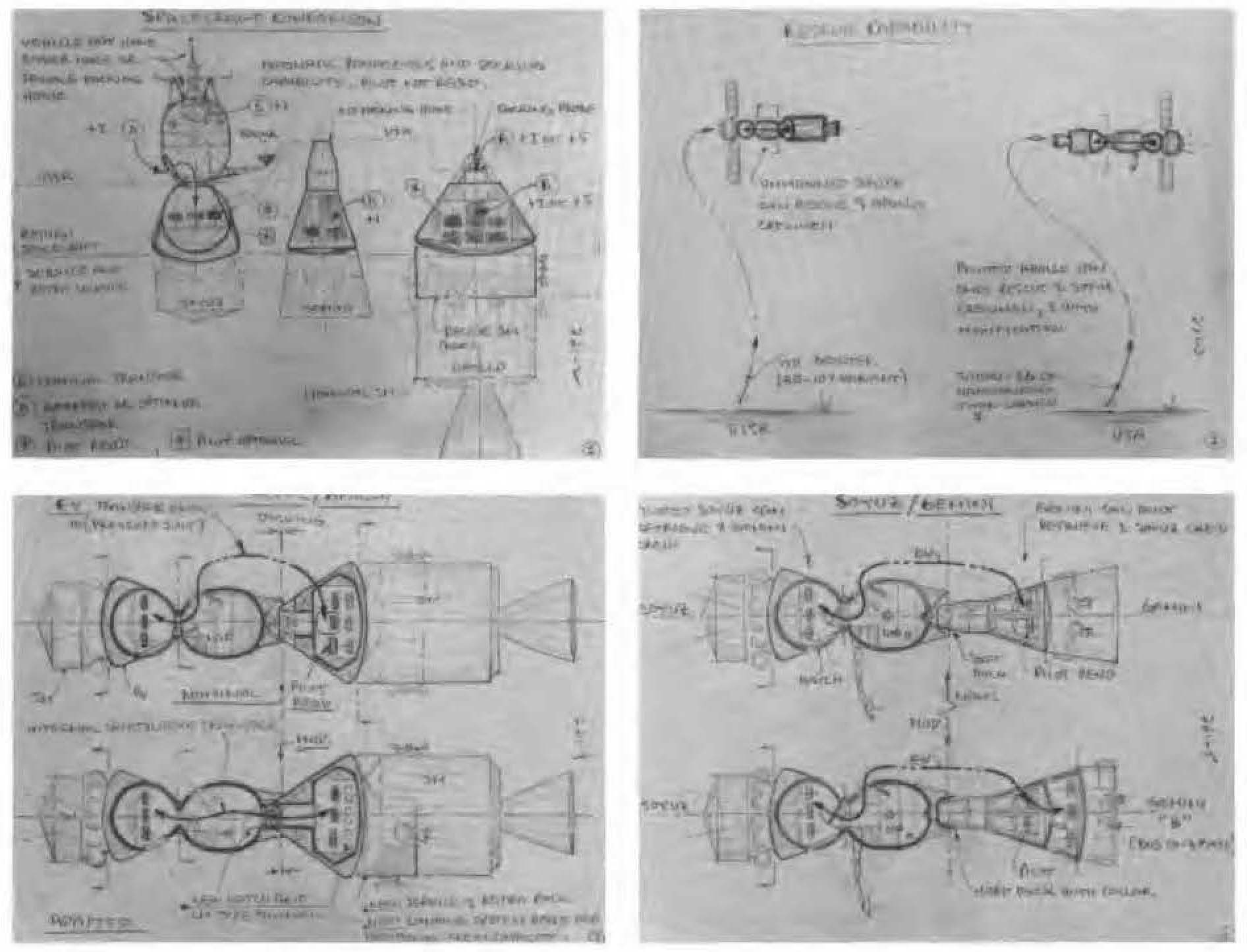
Chuck Mathews passed Roberts’ material along to Dale Myers on 15 September. Since there still had been no response from Keldysh, Mathews commented, “I hear that this item has cooled a bit but I think it is still good to send this ... along.”14 Myers signed the memo on the 17th and sent it to the Administrator’s office.15 OMSF and the Centers had investigated three possible types of cooperative missions-Apollo-Soyuz, Soyuz-Skylab, or future American-future Soviet spacecraft. Now the question remained as to the value of the exercise. When would the Soviets respond? What would they propose?
Acting Administrator George Low received a letter from Academician Keldysh on 23 September that brought an end to the suspense. Keldysh suggested that either October or late November would be a suitable time for the first talks, and he proposed that they be held in Moscow.16 Since President Nixon had given NASA the go-ahead to develop discussion with the Soviet Union, Low responded to Keldysh on the 25th, accepting the invitation and suggesting a meeting a month later.17
During the next several weeks, OMSF concentrated on preparing an agenda for the upcoming talks. On 23 September, Mathews, Hall, and Roberts met with Oscar E. Anderson, Jr., of the International Affairs Office to discuss the agenda and delegation for the Moscow trip. As the plans for the meeting went through several drafts, Low and Myers met to decide upon a suitable chief for the American group.18 Since Low felt it was premature for the head of NASA to go to the Soviet Union, he selected Robert Gilruth, Director of MSC, because of his technical background and common-sense approach to complex negotiations.19
Low and Myers asked Gilruth to select the necessary technical specialists to complete the delegation. From MSC, Gilruth chose Caldwell Johnson and Glynn Lunney. Gilruth took only two men from Houston, because he felt that a small delegation would have a better chance for success. Since he wanted men with a breadth of knowledge, Johnson and Lunney were the obvious choices. Johnson, “a very, very talented mechanical designer,” could discuss the mechanical and electrical questions associated with developing a compatible docking system. Lunney, “an expert flight controller,” had the necessary background in orbital mechanics and mathematics to discuss the mission planning aspects of a joint flight. In an effort to include the Marshall Space Flight Center in the talks, Gilruth called Director Eberhard Rees at Huntsville, Alabama, and asked him to nominate one person who could talk about Skylab. Rees recommended George B Hardy, Chief of Program Engineering and Integration for Skylab, who by virtue of his position had a broad understanding of the program. Arnold Frutkin, Assistant Administrator for International Affairs, represented Headquarters. William Krimer, an interpreter from the State Department, completed the six-man delegation.20
The news that they were going to Moscow came as a surprise to Johnson, Lunney, and Hardy. Lunney was presenting a speech on 7 October to the 1970 National Airport Conference in Oklahoma when he got the call telling him that he was going to the Soviet Union. “For me it was out of the clear blue sky. I did not know anything about [the proposed talks] until that time.” These three specialists met with Gilruth on the 9th to discuss the nature of their presentations to the Soviets. They would seek to provide their counterpart specialists with enough information to give them a common basis for further discussions, but not so much as to overwhelm the Soviets or to encourage comments at home that they were giving away too much.21 In Washington, Frutkin’s staff was preparing a briefing to inform the press about the mission to Moscow.
The head of the International Office met the press at NASA Headquarters in mid-October and summarized the background to the talks. He explained that the emphasis on compatible docking systems just happened to be the specific American proposal to which the Soviets had responded affirmatively.22
It is simply that the Soviets have chosen out of this long list of initiatives from the U.S. side this one case to explore in some depth at this time. It could have been something else. This one seems to be more meaningful to them.
So just as I say we regard it as important, presumably also they regard it as important.
Frutkin took care to point out the very preliminary nature of the talks and to make certain that his questioners did not make too much of the space rescue capabilities inherent in the development of compatible docking systems. But reporters were especially interested in that aspect of the story because of announcements at the 2lst lAF Congress in Konstanz, Germany, that the United States and Soviet Union had agreed to sponsor a space-rescue symposium.23
Frutkin cautioned that the IAF proposal was purely coincidental:
When you see a release out of Konstanz that says the Soviet Union and the United States have agreed to a symposium of that sort, this is simply a shorthand way of saying that some individuals from the United States who are interested in space rescue on a professional basis are going to meet with some individuals from the Soviet Union who are interested in the same subject, and talk about this matter, just as they talk about a lot of other things. But there is no correspondence between their private professional discussions and our governmental official discussions, there is no relationship whatever.24
Despite Frutkin’s statements about the nature of the discussions, the reporters still pressed him for a prediction on the earliest date that a joint mission might occur. The NASA representative responded that it was just too early to make such statements, but that Skylab was likely to be the first occasion. “We don’t know how long-we don’t know what the pace of our discussions is going to be.” Reflecting on his experiences in negotiating with the Soviets, Frutkin said that such talks tended to progress slowly. H conceded that the question of timing was “very difficult to answer. ...”25 While the reporters went off to file their speculations about the future, Frutkin and his colleagues conducted a dress rehearsal of their presentations.26
Gilruth, Lunney, Johnson, and Hardy flew to Washington for the “dry-run” on 16 October. Johnson recalled that the Headquarters staff, especially George Low, seemed to be interested in the type of presentation that each man planned to make. Low appeared to be particularly curious about the extent to which each man could vary his approach and think on his feet. Since so little was known about what the Soviets wanted to discuss, it was very likely that each man would have to sense out his audience as he spoke. The key to success might lie with a flexibility of mind and ability to react quickly to whatever direction the discussions might take. During the two-hour meeting, the five men were also briefed by representatives from the State Department, the Department of Defense, and the intelligence service.27
STEPS FORWARD
As the American delegation left New York’s Kennedy International on 23 October, each man wondered about the reception he would encounter in Moscow and reflected upon the warnings that had been given by representatives from the foreign service, defense, and intelligence communities. Gilruth later recalled that these professionals had been unanimous in their negative prognosis and had told the NASA specialists not to build up their hopes for early or easy agreements with the Soviets. It was the prevailing opinion that the Soviets would talk and talk, but in the end they would “break our hearts” by their refusal to cooperate.28 Caldwell Johnson remembered the final leg of the journey, the flight from Copenhagen to Moscow, particularly clearly. The NASA group had the plane nearly to themselves, and there was a sense of solitude and uncertainty as they approached their destination.
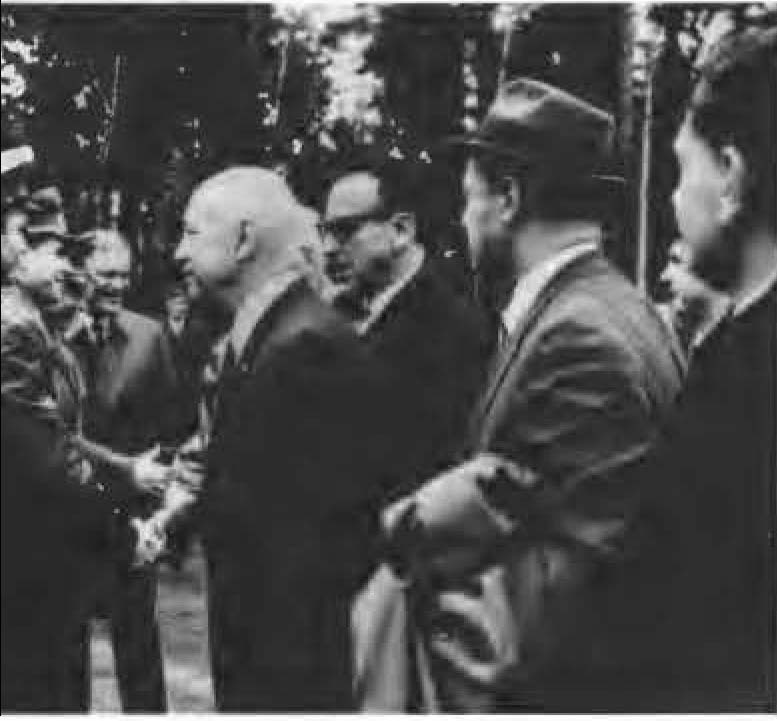
Gilruth and his colleagues reached Moscow’s Sheremetyevo airport late in the afternoon on 24 October 1970. The mid-afternoon sky had grown dark; visibility was limited by fog and a light mixture of snow and sleet. Looking back on his first steps onto Russian soil, Johnson commented, “I was awed by the situation and kind of uptight.” Seeing a large number of military uniforms and figures in heavy overcoats, he became uneasy because as he later put it, “I grew up in that period of history where those things were impressed upon me and my generation... as bad things.” However, his sense of concern quickly dissipated.29
Bob Gilruth sensed almost immediately that they were embarked upon a positive adventure. He had seen that same line of men waiting, but he had also noticed Cosmonaut Feoktistov, whom he had met the year before in Houston. Though his name momentarily eluded Gilruth, the smile did not. All the Soviets were smiling, and the motion picture cameras were at the ready. Instinctively, Gilruth felt that all would be well. He turned to the others and said, “It’s going to be all right, because they are welcoming us in style.”30
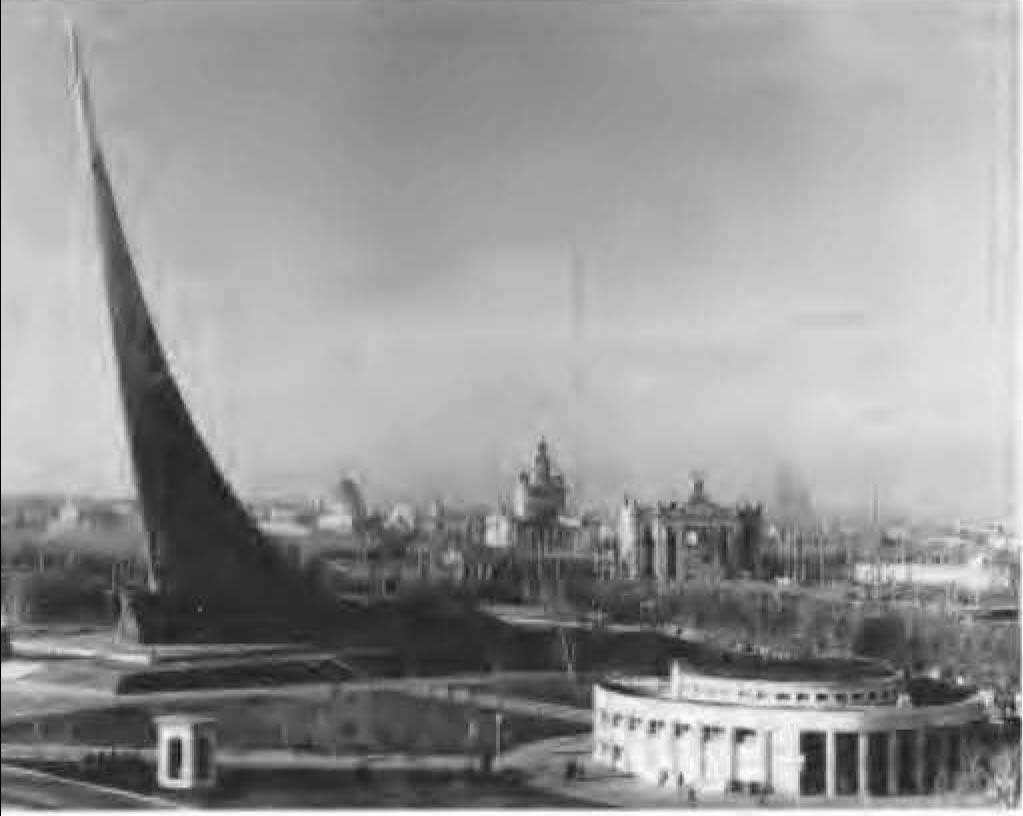
The airport greeting was warm and cordial. Immediately upon their entry into the airport terminal, the Americans were taken to a lounge where they exchanged introductions with Academician Boris Nikolayevich Petrov and his colleagues. After their luggage was gathered and cleared through customs, the Americans and their hosts were off to Moscow proper and their first introduction to the monumental Hotel Rossiya.31 Tired by their long journey, the NASA contingent was ready to turn in for the night when Petrov asked Gilruth if 40 minutes would be enough time for them to freshen up before dinner. Following a pleasant meal at the Rossiya, the Soviets took their guests on a tour of Moscow, which included a ride up the Lenin Hills for a view of the city, Moscow State University, and the Moscow River. From there, they drove through central Moscow for a visit to the Space Monument on the Avenue of the Cosmonauts.
Looking back on that experience, Gilruth recalled that the night had an eerie quality. The lights, reflected from the low clouds and diffused by the mist sweeping around the monument, made this impressive structure all the more awesome. Although the Americans were bone-tired when they finally reached their hotel at 11 o’clock, they felt more sure of success. To Gilruth, it was like something out of a dream, a pleasant dream.
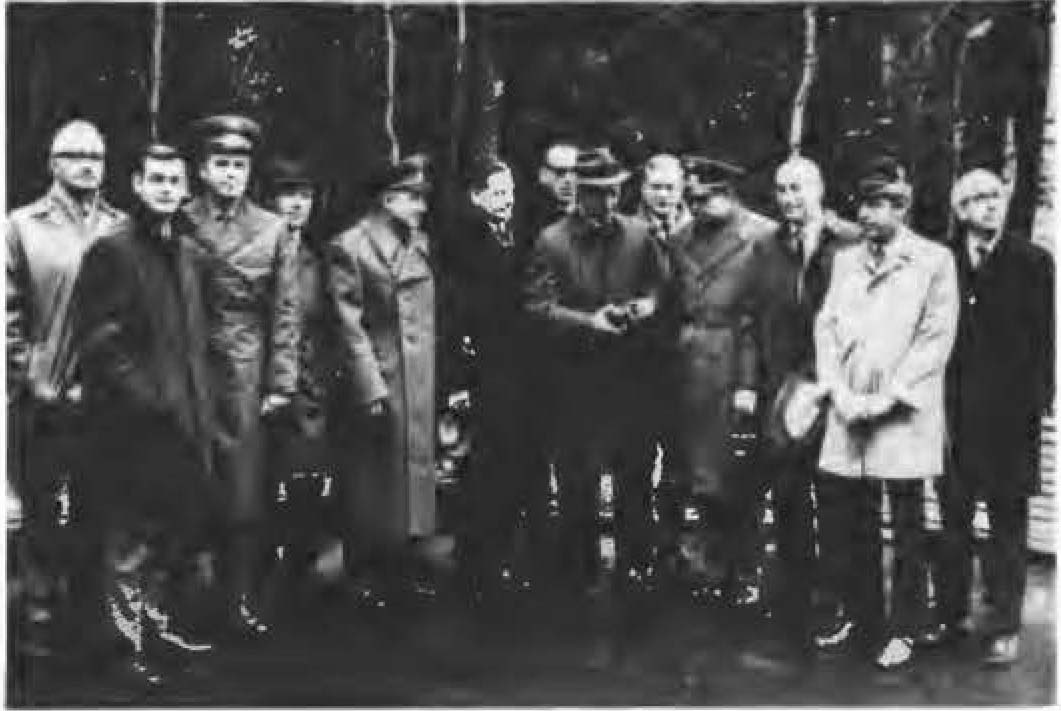
Early Sunday morning, the five Americans and their hosts went off to Zvezdny Gorodok (Star City), the cosmonaut training center, 40 minutes by car northeast of the capital. There they were greeted by Commandant General Andrei G. Kuznetsov, Major General Georgiy Timofeyevich Beregovoy, and Colonel Vladimir Aleksandrovich Shatalov. Following a brief greeting ceremony, the Americans were taken to the simulation facility where the cosmonauts practiced flight procedures. According to Lunney, the opportunity to examine the Soyuz simulators was one of the highlights of the visit.
The working part of the trip had begun. The simulators were arranged very much like those in Houston, with the training specialists seated at consoles where they could monitor replicas of the spacecraft control displays. Gilruth and Johnson were given a briefing on the simulators by Beregovoy, while Lunney and Hardy were accompanied by Shatalov. They were shown the general purpose trainer first. This simulator was situated in a vertical fashion, with the command/descent module positioned below the orbital module. Upon entering the latter, Lunney was impressed by the roomy feeling of the 2.2-meter by 2.65-meter interior. Although this cabin was the primary work and living station for the crew during a mission, Lunney was struck by the simplicity of the controls and instruments. As far as he could determine from his conversation through an interpreter with Shatalov, the crew seemed to be limited to controlling and monitoring the airlock, experiment, and biomedical functions carried out in the orbital module.
Passing through the airlock hatch that separated the orbital module from the command module during launch, docking, and EVA maneuvers, the three men entered the command module. “For three men this is a small volume,” reported Lunney, “but it is only used during takeoff, landing and rendezvous, and periodically in orbit. ...” He felt that the interior space was adequate since the cosmonauts flew in flight coveralls and wore suits only for EVA. Additional space was obtained by lowering the couches during flight; for landing, they were raised toward the control panel and supported by shock-absorbing attenuators during reentry.
Lunney and the others were particularly interested in the descriptions of the Soyuz control systems provided by Shatalov and Beregovoy. While occupied with the U.S. programs, the NASA representatives had followed the U.S.-U.S.S.R. competition only from accounts in American aerospace publications, but now they had the chance to hear those systems described first-hand by men who had worked with and flown the Soyuz. Lying in the command module couches, the Americans could see and touch the controls, getting a better feel for the Soviet approach to manned space flight.
Lunney later thought about the briefing he received while lying in the commander’s couch. Directly in front of him was the main control console. Starting at the upper left-hand corner of the instrument panel and proceeding clockwise, Shatalov explained the equipment. First, there was the rotating globe-the “space navigation indicator”-that gave the pilot his approximate position relative to the earth’s surface. Adjacent to that instrument was a panel of lights that displayed the status of various spacecraft systems. Next, Shatalov indicated a television screen through which the commander could observe the docking. Then there was a projection screen for displaying aspects of the flight program visually, while other data were presented on a digital data display. Above that latter unit was a chronometer to keep track of flight times.
Shatalov then pointed to an optical device located just above Lunney’s right knee. This navigation sight, used in conjunction with the television display during rendezvous and docking, gave the commander a fixed view of the scene directly ahead of the spacecraft. Next to this apparatus were a series of gages, switches, and additional clocks. With these, the commander could keep track of cabin pressures, temperature, and power levels and could also monitor time-critical control commands. On either side of the main console were located “command signal” panels with rows of lights and push buttons that permitted the crew to execute specific commands to the spacecraft systems. Manual control of the Soyuz was accomplished through two hand controllers at the commander’s side. Both Lunney and Johnson noted the large blank spaces on the walls of the command module covered by an off-white, felt-like padding. For Lunney, “the very strong impression was one of simplicity-no circuit breaker panels, no large number of switches, not many displays.”32
After getting a general orientation to the various Soyuz systems, the Americans were given an opportunity to look at the docking simulators. This set of trainers consisted of two command module mockups-one for active and another for passive rendezvous. These two simulated spacecraft could be maneuvered into the docked position with other small models of Soyuz, viewed by the cosmonaut either on the television monitor or through the docking periscope. After watching these replicas of the regular flight systems, Lunney and his associates felt that they had a much better understanding of Soviet rendezvous techniques. There were still unanswered questions, but this introduction proved to be a great aid in the technical discussions that occupied the next two days.33
After the familiarization session with the spacecraft trainers, the men walked to the main building of the Cosmonaut Training Center, where they watched a motion picture about Yuri Gagarin’s flight, following which they visited a manned space flight museum. Gilruth and the others saw the reconstruction of Gagarin’s office, as well as all the memorabilia collected by the first man in space on his subsequent trips around the world. After the tour, the group retired to a mid-afternoon luncheon.
General Kuznetsov began the pre-meal formalities with a long, carefully prepared toast. He spoke directly to the NASA representatives and said in effect that he was relying upon them to exert their influence on the American government to ensure cooperation in space. He wanted the U.S. representatives to convey to their leaders the necessity for keeping space endeavors peaceful; he expressed his hope that space would not be turned into something evil. Lunney especially felt the personal nature of this message: “He was talking directly at and to us. He was saying to me that he was holding us responsible to see that space continued to be a peaceful place.”34 Shatalov followed with a toast comparing the histories of the United States and the Soviet Union, in which he stressed the similarities of the two countries and their aspirations. The vodka and the meal behind them, the Americans and Soviets walked about the grounds at Star City.
As if this were not enough to occupy a full day, the Americans were taken back to Moscow for a visit to the major space museum housed on the grounds of the Exhibition of Economic Achievements. Following a ten-minute stop at the Rossiya, their evening was capped by a trip to the Bolshoy Theater for a performance of Rimsky-Korsakov’s opera The Tsar’s Bride.
Monday, 26 October, was given over to discussions* of rendezvous experiences and techniques and to descriptions of spacecraft docking assemblies. Glynn Lunney gave the first presentation, describing the spacecraft hardware capabilities NASA considered essential for orbital rendezvous, communications, guidance, and propulsion systems. For an international rendezvous, he saw that a number of issues would have to be studied-compatible equipment to provide information on the range between spacecraft and their rate of closure; suitable docking lights, reflectors, and targets; and vehicle-to-vehicle voice communications. Lunney also summarized for the Soviets rendezvous techniques as they had evolved through Gemini and Apollo. While there were many adequate techniques, the specific approach to the problem would ultimately depend upon the degree of automatic or manual control in a given spacecraft. Therefore, an accommodation would have to be reached whereby the basically automatic, radar-controlled rendezvous of Soyuz could be matched with the essentially manual approach of Apollo. These were by no means irreconcilable differences, but they would require much study. Lunney closed by telling the Soviets that NASA expected its future rendezvous techniques to be an outgrowth of the ones he had described.35
* The Soviets present in addition to Petrov included K. P. Feoktistov, V.S. Syromyatnikov, V. V. Suslennikov, I. V. Lavrov, and N. Khabarin. Also joining the Americans was W. N. Harben, Science Attache, U.S. Embassy, Moscow.
Next Feoktistov explained the Soviet methods of rendezvous, which were designed to work either manually or automatically from ground commands, though they definitely favored the latter approach. According to Feoktistov, the Soviets considered rendezvous in three distinct phases-delivery of the active spacecraft to the vicinity of the target spacecraft, automatic rendezvous maneuver to stationkeeping distances, and final approach to docking. Going into more detail, Feoktistov said that the first phase could be approached in two ways, direct ascent or rendezvous following placement of both ships in orbit. Direct ascent required precise timing, so that the second craft could catch the target within its first revolution. More satisfactory, they had found, was a rendezvous after the two vehicles were in basically similar orbits. The path of the active craft would be adjusted by engine burns generated by ground-based computers and transmitted by radio to the onboard guidance and propulsion systems. This maneuver would bring the two ships to a range at which a mutual automatic search would begin by the spacecraft tracking systems.
Phase two of the Soviet rendezvous process started when the radar antennas locked on and the guidance system oriented the ships in the proper attitude-nose-to-nose. The main engine of the active Soyuz would be fired automatically as directed by the guidance system to bring the two craft to within a range of 300 to 400 meters. During the third phase, the final approach to docking (prichalivaniye, literally mooring) would be completed by firing the 9-newton (2-pound) translational thrusters. While this final phase could be completed in either an automatic or manual mode, the Soviet specialists seemed to prefer the hands-off approach.36
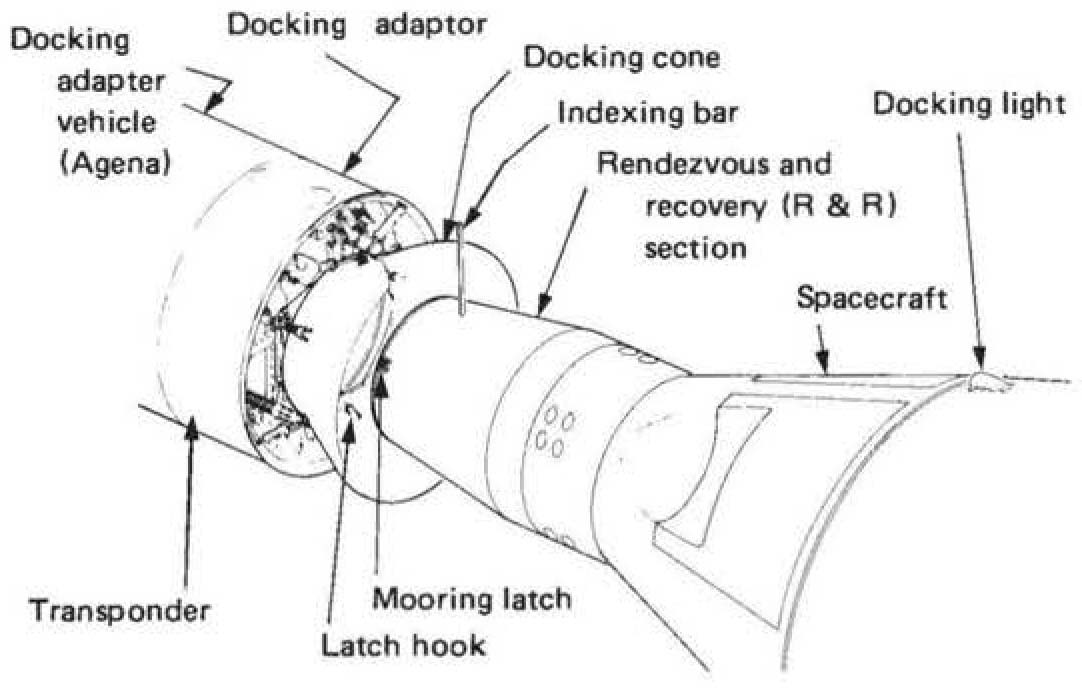
When discussion turned to the docking systems used to lock spacecraft together following rendezvous, Caldwell Johnson presented a description of the systems NASA had used during Gemini and Apollo, to preface his outline of future docking concepts.* According to Johnson, the configurations of Gemini and the Agena target vehicle were nearly optimum for manually controlled docking, “The Gemini crewmen were in an excellent position visually to monitor the condition of the docking gear and to control their docking maneuvers.” Furthermore, “both craft had full attitude and translation control capability, both as separate and connected vehicles.” In Apollo, the command and service module geometry did not permit the crew to see the docking gear on either the command or the lunar module. This had not posed a serious problem, but Johnson noted the desirability of visual monitoring of the docking mechanism and process in future spacecraft.
* Johnson defined the terms used in discussing docking equipment as follows: “The term docking as applied to spacecraft operations defines the mechanical, temporary joining together of two spacecraft, generally for the purpose of crew and cargo interchange. In that same context, docking systems refer to the collection of spacecraft equipment designed to perform the docking operation. Docking gear refers more specifically to the mechanisms that accomplish the mechanical joining.”
After some further discussion of Gemini and Apollo docking experiences and a short film illustrating the final approach of the Apollo 12 command and service modules to the lunar module, Johnson turned to a fuller description of future concepts for docking gear. He told the Soviets that previous systems had functioned satisfactorily enough, “but our experiences ... have pointed out areas where we feel that the docking gear of future spacecraft can be significantly improved.” He then went on to outline seven design features that he and his designers believed would greatly facilitate docking operations in future spacecraft. The first four criteria emerged from the experiences with Gemini and Apollo; the latter three came from studies of future systems. Johnson elaborated on each of these points in turn.
Safety, of course, was the preeminent consideration. The docking gear should be fail-safe, “at least to the extent that the gear suffer no damage during impact when the spacecraft are misaligned too greatly to allow capture,” Johnson said, and there should no situation in which automatic disengagement would be prevented. A failure to complete docking should under no circumstances preclude another attempt at capture. Johnson and his colleagues also believed that the astronauts should be able to transfer from one spacecraft to another without donning a spacesuit. This “worthwhile convenience” of shirtsleeve transfer required that the coupled spacecraft contain compatible atmospheres. While the Apollo and Soyuz. cabins had dissimilar environments, Johnson told the Soviets that NASA was planning to use sea level pressure in the future, thus eliminating any transfer problems from that source. Another transfer-related consideration centered on eliminating any docking gear that might block the passageway between spacecraft. The Apollo probe assembly, which had to be removed after the command and service modules were latched to the lunar module, had proved very inconvenient. “Every attempt should be made to select a docking gear that does not block the very passage it intends to effect.”37
The docking gear of all spacecraft to date-American and Soviet-had employed some variation of the probe and drogue. The probe, or male-like configuration, on one spacecraft would enter the drogue, or female-like configuration, on another spacecraft for docking. Johnson pointed out the shortcomings of such an approach:
There was or is no manner in which two spacecraft with only “probe” gear can dock together, nor is there any manner in which two spacecraft with “drogue” gear can dock together. That constraint has not been inconvenient to our limited spaceflight activities to date; but, we think we should avoid that constraint in future docking gear. We think future docking gear should exist in a limited number of standard classes, and that any new gear of a given class should be able to dock properly with any other gear of the same class.38
Such an androgynous* docking gear should be designed so that either of the two spacecraft could dock and undock without the active support of the second vehicle.
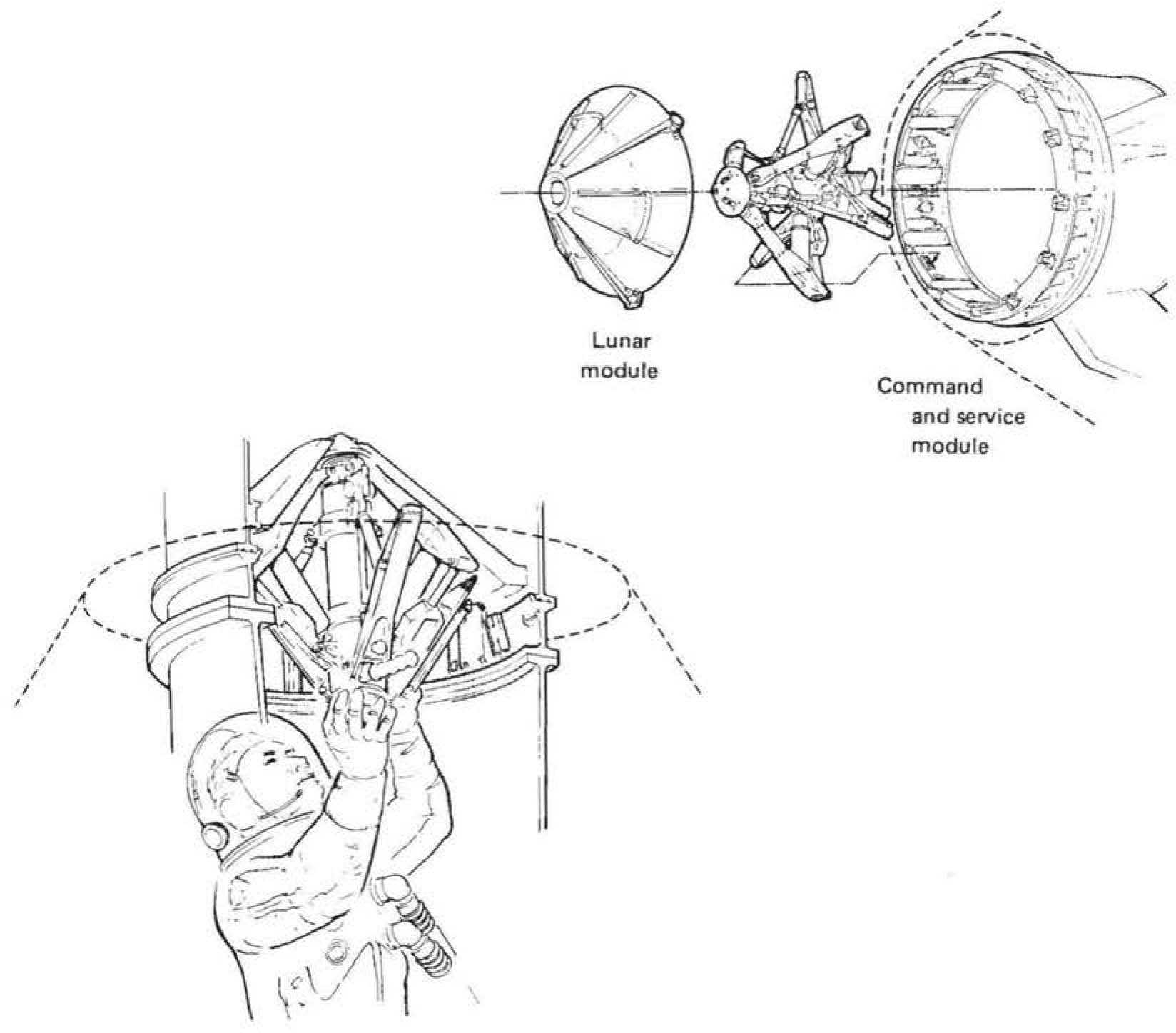
* Androgynous, a term taken from the life sciences, suggests the possession of characteristics of both sexes-sometimes called neuter.
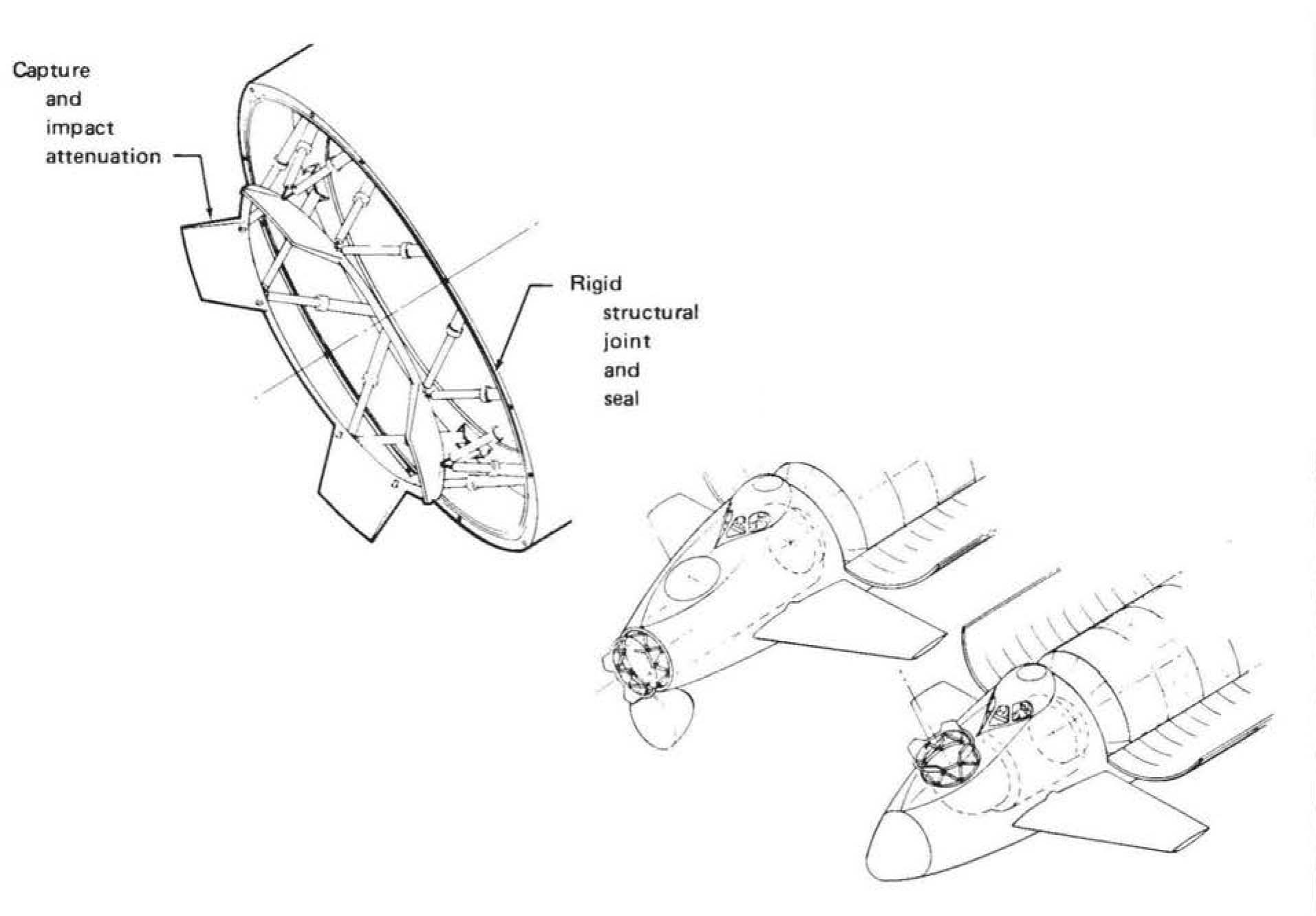
As the final requirement in his list, Johnson saw the need for two structural modes for future docking gear, since subsequent spacecraft were expected to be much larger than the existing generation. Johnson doubted the desirability or practicality of using the docking mechanism to effect the structural joint between such craft. “We believe, rather, that the docking gear should be expected to provide only a relatively compliant structural joint; that the burden of rigid joining be assumed by the particular spacecraft’s structural system.” Caldwell then projected a Vu-graph of an androgynous docking system that combined all the design features he had mentioned.39
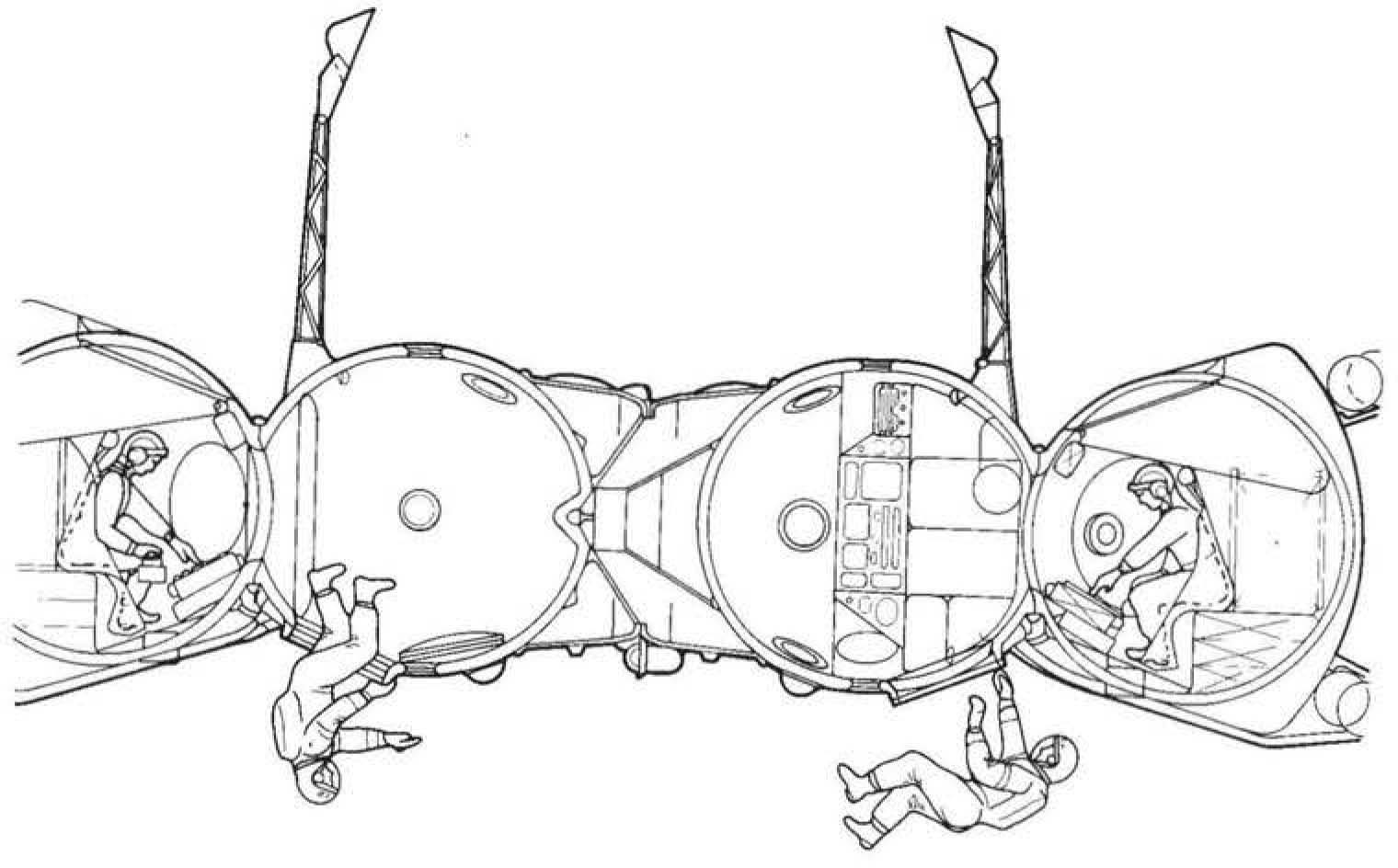
Described as a double ring and cone docking mechanism, this concept was one of Johnson’s pet ideas. As was the case with many of his colleagues at MSC, Johnson had never really been satisfied with the Apollo probe and drogue arrangement. The history of that docking mechanism dated back to May 1962, when NASA and North American Aviation prepared a preliminary outline for space docking. As the investigation of docking gear progressed, seven different concepts were considered before the November 1963 decision to adopt the North American probe and drogue design.40 Among the rejected ideas was the ring and cone concept designed in 1963 by Houston’s Preliminary Design Section of the Advanced Spacecraft Technology Division. But rejection of this idea did not mean that it was dropped. Over the years, several men including Johnson continued to propose variations on this theme.
Evolution of Ring and Cone Docking System Concept
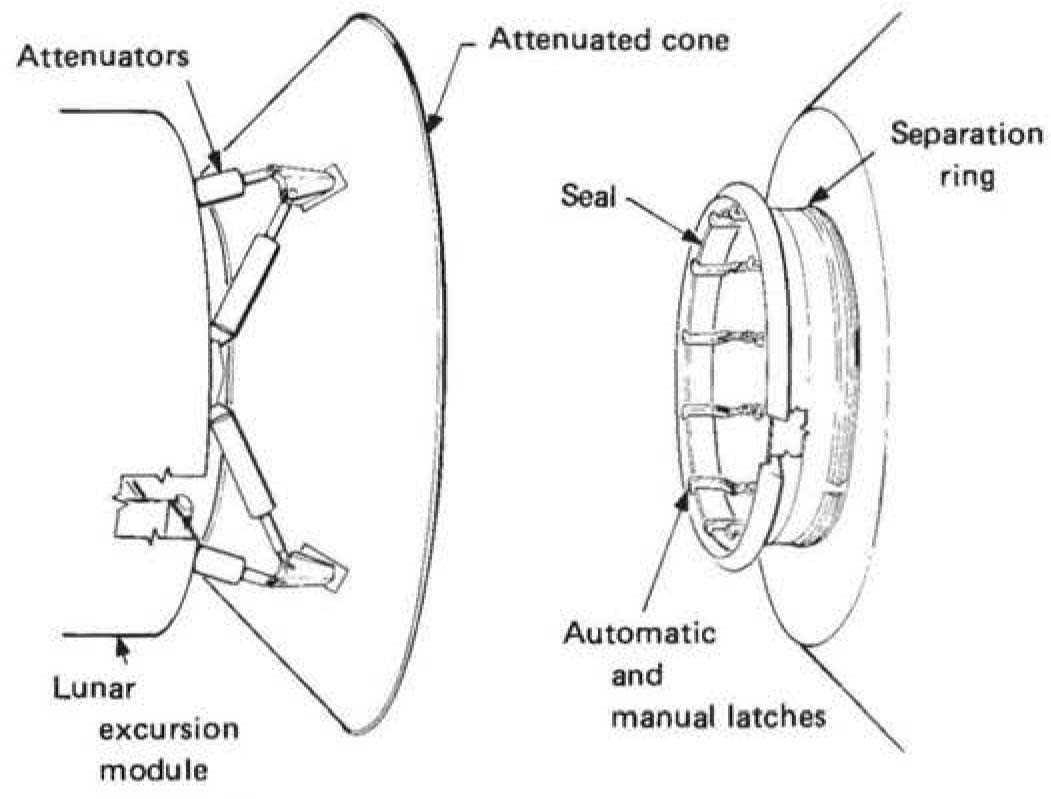
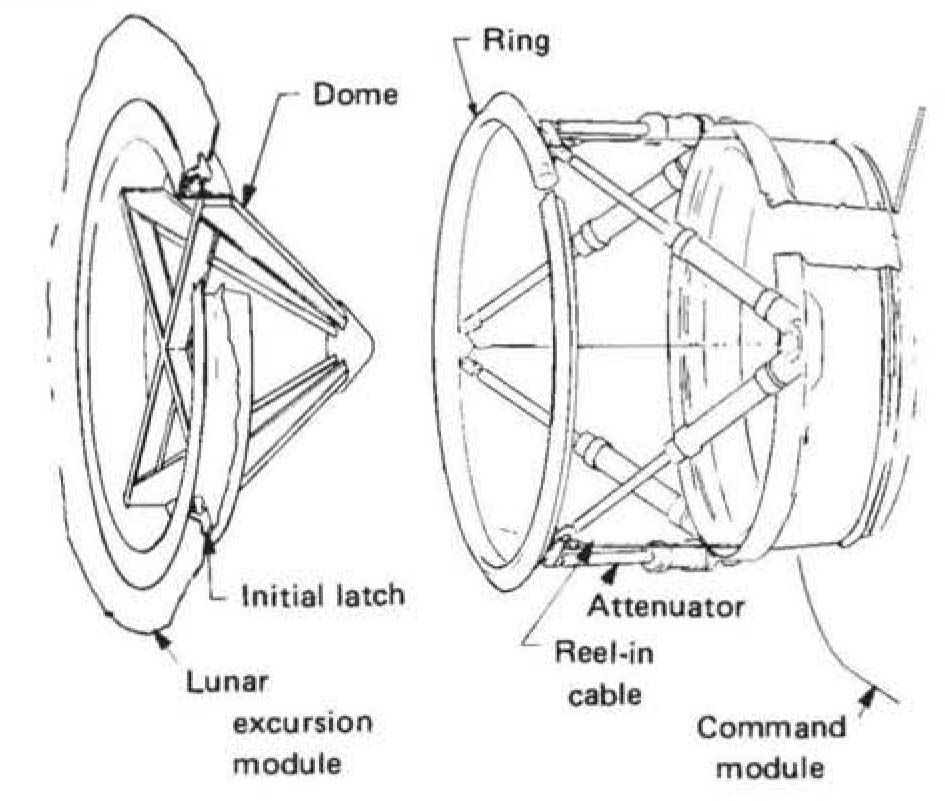
Johnson revived a variant of this docking gear in 1967 for the orbital workshop of the Apollo applications program, which became Skylab. He called his 1967 androgynous design a double interrupted ring and cone. The cone was divided into 12 discrete fingers or guides so that the “cone” of one gear would match the “ring” of the mating gear and vice versa. “The fingers of one will exactly intermesh with the fingers of the mating gear.” The proposed mechanism, which would not block the passageway between spacecraft, was androgynous, could accept a passive partner, and was fail-safe. Furthermore, Johnson had separated the capture latching mode from the structural latching mode.41 His proposal was rejected again because the existing hardware was acceptable; the new concept did not possess sufficient superiority to merit such a change. Johnson had been working on a four-“finger” version of his earlier gear when he received word that he had been selected to visit Moscow. When Gilruth called his delegation together on 9 October, the designer had proposed to discuss his docking system with the Soviets, as being illustrative of one of the future approaches that NASA might take. Nobody knew how the Soviets would react to a discussion of hardware, but as it turned out, they were eager to talk about mechanical systems.42
While there were no specific Soviet comments regarding Johnson’s presentation, they did give the Americans a detailed briefing on their Soyuz docking equipment. Vladimir Sergeyevich Syromyatnikov,* their 37-year-old mechanical design expert for docking systems, described the probe and drogue system currently used on Soyuz.43
* While Syromyatnikov was unknown personally to the NASA representatives, his reputation as an aerospace engineer had been known to the NASA community since his appearance at the Fifth Aerospace Mechanisms Symposium at the Goddard Space Flight Center, 15-16 June 1970, where he spoke on aspects of the Soyuz docking system.
While similar in concept to the Apollo system, the Soviet “pin and cone” gear was not designed for internal transfer. Syromyatnikov told the Americans that the U.S.S.R. had adopted a docking mechanism without provision for internal transfer because it could be developed in less time. (This reinforced Johnson’s opinion that there had been a “sense of urgency” associated with the development of Soyuz.) Returning to the main theme of this discussion, he reported that once capture was made, the Soviets employed an electric motor to retract the probe for final structural latching. In Apollo, the probe assembly was automatically retracted when the capture latches actuated the argon-gas-operated retraction mechanism. Lunney noted that the Soviet approach permitted repetitive docking and undocking, whereas Apollo was limited to two prime and two backup retractions. While the American system was sufficient for lunar missions, the heavier Soyuz docking equipment was more flexible.
New Soyuz Docking Mechanism Described by V. S. Syromyatnikov at October 1970 Meeting in Moscow

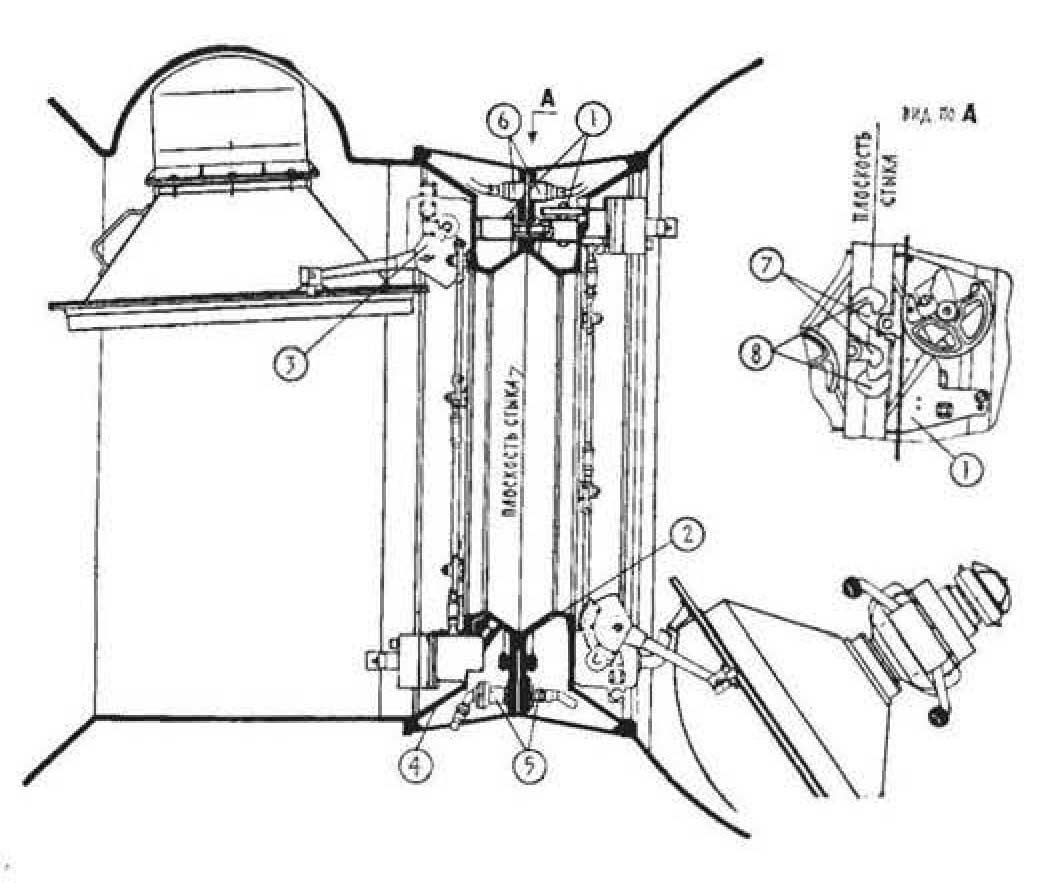
The difference in approach to docking taken by the Soviets and NASA was also illustrated by the degree of precision required in the Soyuz docking procedure. The Soviet docking equipment included electrical umbilical connectors contained in the face of the docking ring. These multiple prong and socket connectors required precise alignment, which the Soviets obtained by using 152-millimeter by 25-millimeter (6-inch by 1-inch) diameter guide pins. Once the head of the probe was engaged in the drogue, basic alignment having been accomplished by using docking targets, further alignment was completed by the guide pins of one craft entering sockets of the other craft. Like the American system, the Soyuz docking required matched pairs of spacecraft.
Syromyatnikov also talked briefly about a modified docking system that would permit internal transfers of crews and equipment. While this system had not yet flown, it appeared to be something that the Soviets planned to use in the relatively near future. Docking would be accomplished as in previous missions, but once the two ships were joined together the probe and drogue assembly could be unlocked and swung out of the way. The passageway between the two vehicles would then be open for a shirt-sleeve transfer. This new mechanism was a real step forward from the first-generation docking system with its solid face, and the Soviets agreed to provide NASA with a fuller description.44
After a lunch break, the talks resumed with a discussion of Skylab by George Hardy. Skylab had grown from the desire to exploit more fully the launch vehicles and spacecraft that had been developed for the Apollo program. He told the Soviets that the Skylab hardware was designed in such a manner to permit it to be revisited, resupplied, and reused for extended earth-orbital missions. The flight lengths being projected for the three missions-28, 56, and 56 days-appeared to intrigue his audience, especially in light of the Soyuz 9 flight the preceding June, which had lasted for a record 18 days. Hardy concluded with discussion on the rendezvous and docking operation associated with the program, showing the Soviets a model of the proposed spacecraft.45
Following a late afternoon adjournment, the Americans gave a party for their hosts at the home of the U.S. Embassy’s Science Attache. During the socializing, Gilruth and Feoktistov shared stories and views on manned space flight. Since both men were among the “old timers” in their respective programs, they had a lot in common. Gilruth had wondered for years about who had been responsible for the development of the Soviet spacecraft, and he was particularly interested in Feoktistov’s comments about having done the majority of the design work for Vostok, Voskhod, and Soyuz. But having risen to the position of Deputy Director of the Soviet manned space program, Feoktistov did not want to dwell on himself, so the conversation turned to other aspects of space flight-to Skylab, rotating space stations, and the ways one justifies manned space programs to scientists who prefer to use automatic probes. At evening’s end, the Americans felt as if they had been to a reunion with old colleagues.46
Meeting again on Tuesday morning, the first hour was given over to further comments on Skylab by George Hardy and a description of Soyuz radio guidance equipment by V. V. Suslennikov. After that basic exchange of information, the men turned their attention to the topic of compatible systems to determine which aspects of that subject should be studied. At the end of this discussion, Feoktistov gave Gilruth a list of technical questions for which he felt the two sides should share answers. These questions indicated a basic concern in working toward compatible systems, and it seemed logical to all present that these problems should be divided into subject areas that teams of specialists could address. At Feoktistov’s suggestion, three working groups were formed, following the precedent set by the 1962 Dryden-Blagonravov agreement. One working group would ensure the compatibility of overall methods and means for rendezvous and docking; another would concentrate on establishing compatibility between radio, optical, and other guidance and communications systems, and the final group would attend to compatibility questions related to docking assemblies and tunnels that might be created. The representatives then worked up a schedule of events that would guide their efforts during the next six months.
Assuming that there would be a joint meeting of the working groups in about six months, the two parties agreed to exchange further data. During November by correspondence they intended to trade technical materials on radio guidance and rendezvous systems, spacecraft atmospheres, and systems for voice communications. Later that winter, each side would send its counterpart a draft outline of those technical requirements that were considered essential to compatibility. This paper work would allow the two groups of engineers to get an idea of how the other worked. The spring 1971 meeting would then concentrate on further defining technical specifications for compatible systems, both sides having worked independently on preliminary designs. While all the men present were ready to get to work, no one expected their work to bear early fruit.
After lunch on Tuesday, Frutkin, Lunney, Feoktistov, and Ilya Vladimirovich Lavrov drafted an agreement incorporating the points discussed that morning. Feoktistov was ready once again with a draft. As Lunney later reported, they discussed the document for a relatively short time before coming to full agreement. Feoktistov’s original proposal was “98% of what we signed the next day.”47 It became clear to the Americans that Feoktistov was a very efficient person and one of the prime movers behind the Soviet desire to develop complementary systems as soon as practical.
With their work out of the way, the Americans went on a tour of the lunar science laboratories and then had a brief discussion with M. V. Keldysh. The NASA representatives were impressed with both, developing an even deeper appreciation for the capabilities and accomplishments of Soviet space personnel. Gilruth especially understood Keldysh’s comments about having to continually justify the space program to budgetary planners. After reviewing with his guests the progress that had been made, Keldysh invited them to dinner at the Prague restaurant. Following a pleasant evening of “shop talk” with Keldysh, Blagonravov, Petrov, and Feoktistov, the Americans returned to their hotel to rest up for their final day in Moscow.
On the morning of 28 October, the NASA and Soviet representatives assembled at the Presidium of the Soviet Academy to sign the “Summary of Results.” In contrast to the ornate physical surroundings, the ceremony was simple but impressive. There was no smugness in their sense of accomplishment, but a feeling that the time had come for the two nations to cooperate in space. In just three days, they had reached an agreement to work together; now they would have to make good their pact.
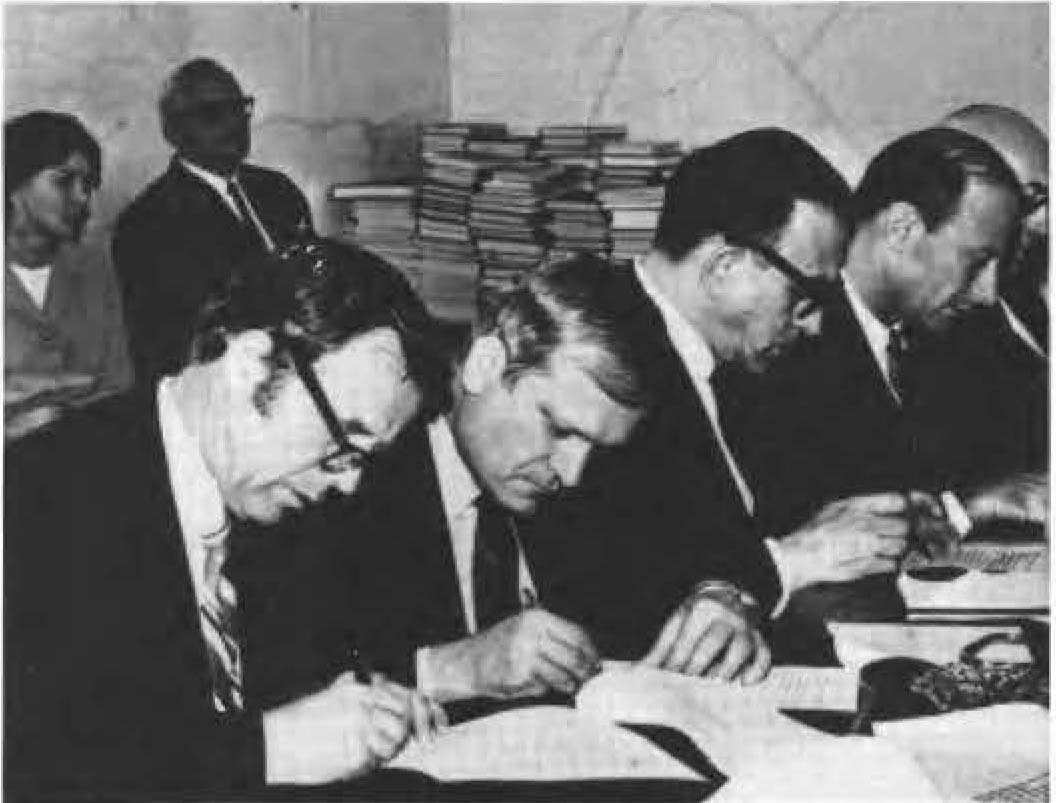
WORKING THE PROBLEM
When they returned to Houston, Gilruth, Lunney, Johnson, and Hardy sat down to discuss their accomplishments and the tasks ahead of them. The four men agreed that the discussion had been open and frank, and the problems they had anticipated had never materialized. Language differences had been their only barrier. Hardy felt that the Soviets “seemed very interested in achieving ... and implementing some agreement to capabilities for compatible docking.” He believed that they had done everything “that they knew how to do, to exchange information.... It was their suggestion ... that we exchange additional information with more details.” Hardy and the others, however, did not get a feeling for the Soviets’ motives. Hardy continued, “I don’t say this suspiciously, I just say it wondering.... it would seem to me that a rather significant policy decision on the part of NASA or maybe the Administration is in order.” Now that the door was cracked, he saw the possibility of making an overture to engage in “a significant venture of some sort in the immediate future, or ... to continue to discuss compatible docking in ... the abstract.”48
Caldwell Johnson was concerned about attempting to design systems in the abstract. He felt that considerable substance needed to be added to the discussions; for example, designing systems adaptable to current spacecraft rather than designing hardware for some unknown future vehicles. Gilruth suggested that the initiative lay with him and his three companions. “We’re the ones who are going to have to determine whether or not it’s feasible. And whether or not we want to do it.” Policy decisions would follow after their recommendations. Realizing the significance of their position, the men agreed that they would have to “wring out” thoroughly any proposals and not “go off half cocked.”
Speaking to the question of a real versus an abstract project, Lunney argued that a decision in favor of a more concrete effort was implicit in the schedule proposed by Feoktistov. Lunney believed that the Soviet Deputy Director realized the implications of the schedule. “I think he knew that we would have to go home and decide what applicability we were interested in.” Hardy added that he remembered hearing Keldysh say that he had invited George Low to visit Moscow for wider ranging talks on cooperation in space science. While the NASA delegation had not commented on it at the time, Hardy felt that should Low accept the invitation and should the timing of his visit coincide with the January exchange of technical requirements, “then he could possibly bounce this thing around a little bit... to see if we’re in fact on the right track or way out in left field.” Gilruth concurred, and said further that it might be appropriate for Low to present a gift to the Gagarin Museum at the same time, since the U.S. was conspicuous for its failure to remember the first man in space.49
Pursuing this thought on the need for concrete discussions, Caldwell Johnson decided to set down on paper some ideas for possible missions. In a 3 November document, “Initial Efforts toward the Development of Compatible Rendezvous and Docking Hardware and Software for USSR and US Spacecraft,” he presented several considerations to be studied by the personnel of the Spacecraft Design Office. He strongly felt that the designers should concentrate on developing hardware for a spacecraft currently being flown by the two nations, and he explained his rationale:
Since the approved manned spaceflight programs of the US [are] comprised of Apollo and Skylab A, and possibly, exploitation of surplus Saturn and Apollo hardware; and, since the USSR manned space-flight program appears to be limited to earth-orbital missions utilizing a single or two docked Soyuz spacecraft, initial efforts toward the development of compatible rendezvous and docking hardware and software should emphasize those spacecraft and missions.
Johnson thought that this approach would not prevent consideration of rendezvous and docking between spacecraft still in the planning stages, but he felt that work on future systems should be limited to “development of generalized requirements and concepts rather than engineering solutions for hypothetical problems.”50
The American designer believed that the initial efforts toward development of compatible systems should begin by studying the technical possibilities of two broad classes of Soviet-American flights-scheduled and non-scheduled earth-orbital missions. The scheduled flights provided three possibilities: Soyuz could dock with Skylab to demonstrate the feasibility of such an operation, conduct an experiment in cooperation with the American crew, or occupy Skylab after the NASA crew had departed. Or Apollo could dock with Soyuz or act as a propulsion stage to place the Soviet craft in a “different orbital situation.” Finally, Soyuz could dock with Apollo to prove its ability as the active rendezvous partner. The non-scheduled possibilities were essentially rescues performed by one nation for the other.51
To implement these studies, Johnson drew up a list of tasks to be performed at MSC. These spacecraft docking studies called for further work on the double ring and cone docking gear, a clearer definition of the new internal transfer docking gear developed by the Soviets, an initial investigation of mounting the new Soyuz probe or drogue in the Apollo CSM, and a “first-cut” study of the technical feasibility of docking existing Soviet and American spacecraft. While Clarke Covington of the Advanced Earth-Orbital section of the Spacecraft Design Office supervised this investigation, René Berglund of the Advanced Missions Office collected materials to send to the Soviets in November. At Headquarters, George Low and Arnold Frutkin briefed the White House (Henry Kissinger) and the State Department (U. Alexis Johnson). Low confirmed the acceptability of the “Summary of Results” by letter to Keldysh and prepared a response to Keldysh’s letter inviting the Acting Administrator to Moscow.52
As he had indicated to his visitors, Keldysh wanted Low to visit the Soviet capital to discuss the broader possibilities of cooperation in the space sciences. Low responded in late November, the day following the transmittal of the docking documents from MSC, saying that he would be very happy to travel to the U.S.S.R. for discussions with Keldysh and the Soviet Academy of Sciences. He had been “influenced by the technical discussions on rendezvous and docking which began so auspiciously in Moscow last month ... it may be that we should give priority to a few selected items which could be defined and treated in a very concrete fashion analogous to the rendezvous-and-docking case.” Low then went on to list four areas in which substantive cooperation could be undertaken-updating the mid-1960 agreements on developing better weather forecasting; broader sharing of scientific data (including the exchange of lunar samples); pooling knowledge of space biology and medicine; and jointly exploring the oceans by satellite. In a letter sent to Washington on 4 December, Keldysh agreed to Low’s agenda proposals and the mid-January meeting date his counterpart had suggested.53
With the initial docking studies underway, Low’s pending visit to the Soviet Academy of Sciences in January 1971 would give him an opportunity to discuss further the topic of manned space flight with the Soviets. Indeed, the in-house studies at the Manned Spacecraft Center took on new significance, as Clarke Covington oversaw the preparation of a document that would outline the various docking methods for Apollo and Soyuz. By the end of December, NASA was preparing to suggest to the Soviets that a real test mission might be not only feasible but more desirable than drawn-out discussions about abstract, hypothetical missions at some unspecified time in the future.
- Donald R. Morris to George M. Low, memo, 21 Sept. 1970.X
- Dale D. Myers to Philip E. Culbertson, note, 19 Aug. 1970.X
- Leroy Roberts to Eldon W. Hall, memo, "US/USSR Space Cooperation," 31 Aug. 1970; and Roberts, "International Cooperation in Space," 31 Aug. 1970.X
- Roberts to Hall, memo, 31 Aug. 1970.X
- Ibid.X
- Culbertson to Hall, note, Aug. 1970.X
- Roberts to R. Cerrato, memo, "Cooperative Space Activity," 3 Sept. 1970; and Roberts to Douglas R. Lord, William D. Green, Jr., and Richard J. Allen, "Cooperative Space Activity," 4 Sept. 1970.X
- Roberts to Jack C. Heberlig and Willard M. Taub, memo, "Cooperative Space Activities," 3 Sept. 1970. Background correspondence between Paine and Keldysh had been transmitted to Heberlig by Roberts on 26 Aug. 1970.X
- William C. Schneider to Myers, memo, "International Cooperation in the Skylab Program," 4 Sept. 1970.X
- Thomas O. Paine to Mstislav Vsevolodovich Keldysh, 4 Sept. 1970; and Paine to Keldysh, 31 July 1970.X
- Myers to Paine, memo, draft (prepared by Roberts), "US/USSR Space Cooperation," 10 Sept. 1970; and Lord to Roberts, memo, "Feasibility of Compatible US and USSR Docking Systems," 14 Sept. 1970.X
- "Station No. 1," Newsweek, 27 Jan. 1969, pp. 93-94. This article was passed around within OMSF, because it described the differences between Soviet and American spacecraft.X
- Myers to Paine, memo, draft, 10 Sept. 1970, with enclosures.X
- Charles W. Mathews to Myers, note, 15 Sept. 1970.X
- Myers to Low, memo, "US/USSR Space Cooperation," 17 Sept. 1970.X
- Keldysh to Paine, 11 Sept. 1970; Keldysh to Philip Handler, 10 Sept. 1970; and Lord to Low, memo, 21 Sept. 1970.X
- Low to Keldysh, 25 Sept. 1970.X
- Roberts, note for record (handwritten chronology of events, n.d.]; Mathews to Arnold W. Frutkin, memo, "Suggested Agenda Items," 24 Sept. 1970; and interview, Low-Edward C. Ezell, 30 Apr. 1975.X
- Myers to Frutkin, memo, "OMSF Participation in International Meeting," 5 Oct. 1970; and Mathews to Hall, note, 5 Oct. 1970.X
- Interview, Robert R. Gilruth-Ezell, 25 Mar. 1975; and Mathews to Frutkin, memo, "US/USSR Space Cooperation," 9 Oct. 1970.X
- Interview, Glynn S. Lunney-Ezell, 23 July 1974; interview, Caldwell C. Johnson-Ezell, 27 Mar. 1975; and interview (via telephone), George B. Hardy-Ezell, 4 Apr. 1975.X
- NASA News Release, HQ [unnumbered],"Background Press Briefings; U.S. and USSR Cooperation in Space," 13 Oct. 1970, p. 5; and NASA News Release, HQ, 70-173, "U.S.-Soviet Meeting," 12 Oct. 1970.X
- Walter Sullivan, "U.S.-Soviet Space Docking Is Said To Be under Study," New York Times, 8 Oct. 1970; "Russians to Join Talks on Space Rescue Plan," Washington Evening Star, 8 Oct. 1970; and Howard Benedict, "Joint Space Rescue Symposium Slated," Denver Post, 8 Oct. 1970. Space rescue was a subiect of considerable interest in the late 1960s, as exemplified by R. Cargill Hall in "Rescue and Return of Astronauts on Earth and in Outer Space," American Journal of International Law 63 (Apr. 1969): 197-210. Hall points out the need for hardware compatibility (p. 208).X
- NASA News Release, "Background Press Briefings; U.S. and USSR Cooperation in Space, 3) 13 Oct. 1970, p. 6.X
- Ibid., pp. 8-9.X
- For the press comment, see Albert Sehlstedt, Jr., "U.S., Soviet to Meet on Space," Baltimore Sun, 13 Oct. 1970; John Noble Wilford, "5 NASA Officials to Visit Moscow," New York Times, 13 Oct. 1970; "Space Linkup Far in Future," Washington Post, 14 Oct. 1970; "NASA to Discuss Docking with Russians," Washington Evening Star, 14 Oct. 1970; "Cooperation in Space," Houston Post, 14 Oct. 1970; and D. J. R. Bruckner, "Space Efforts Could Take Giant Leap through International Cooperation," Los Angeles Times, 16 Oct. 1970.X
- Interview, Gilruth-Ezell, 25 Mar. 1975; and interview, Johnson-Ezell, 27 Mar. 1975.X
- Interview, Gilruth-Ezell, 25 Mar. 1975.X
- Interview, Johnson-Ezell, 27 Mar. 1975.X
- Interview, Gilruth-Ezell, 2 Mar. 1975; and debriefing tape, made by Gilruth, Lunney, Johnson, and Hardy, following their return from Moscow [n.d.].X
- Hedrick Smith, The Russians (New York, 1976), p. 106.X
- Gilruth et al., debriefing tape; and Lunney to distribution, memo, "Trip Report-Delegation to Moscow To Discuss Possible Compatibility in Docking," 5 Nov. 1970.X
- Lunney to distribution, memo, 5 Nov. 1970; Gilruth et al., debriefing tape; and Vladimir Aleksandrovic Shatalov; "Komandnia rubka "Soyuza'" (Command module of the Soyuz), Aviatsiya i Kosmonovtika (Oct. 1970), pp. 34-36, describes the onboard systems of the command module and illustrates the control displays.X
- Gilruth et al., debriefing tape.X
- Lunney to distribution, memo, 5 Nov. 1970; and Vu-graphs from presentation by Lunney, Moscow, 26 Oct. 1970.X
- Lunney to distribution, memo, 5 Nov. 1970; and Viktor Pavlovich Legostayev and Boris V. Raushenbakh, "Avtomaticheskaya sborka v kosmose." paper presented at the 19th Congress of the IAF, New York, Dec. 1968 available in translation as "Automatic Assembly in Space," NASA Technical Translation F12, 113).X
- Johnson, "Fundamentals of Gemini and Apollo Docking and Crew Transfer and Docking Concepts for Future Spacecraft," with Vu-graphs, 20 Oct. 1970, p. 4.X
- Ibid., p. 5.X
- Ibid.X
- North American Aviation Corp., "Apollo Monthly Progress Report," SID 62-300-4, 31 May 1962, P. 66; North American Rockwell Corp., Space Division, Kenneth A. Bloom and George E. Campbell, "The Apollo Docking System," SD 69-42, Aug. 1969, p. I; and NASA, MSC, "ASPO Status Report," 4 Dec. 1963.X
- NASA, MSC, Advanced Spacecraft Technology Division, Johnson, "A Docking Gear Concept for AAP and Advanced Spacecraft," May 1967, pp. 2-3.X
- Interview, Johnson-Ezell, 27 Mar. 1975.X
- Frutkin sent a copy of Syromyatnikov's paper to Gilruth, see note, Frutkin to Gilruth, 3 Dec. 1970. Vladimir Sergeyevich Syromyatnikov, "Docking-Mechanism Attenuator with ElectroMechanical Damper," in Fifth Aerospace Mechanisms Symposium: Proceedings of a Conference Held at Goddard Space Flight Center, Greenbelt, Maryland, June 15-16, 1970, NASA SP-282 (Washington, 1971), pp. 43-48. Following his paper, Syromyatnikov showed a movie, "Docking of the Soyuz IV and V," and gave a narrative description of slides made from the article "Linked Soyuz Spacecraft Shown by Soviets at Japan's Expo 70," Aviation Week & Space Technology, 27 Apr. 1970, pp. 70-74. "Discussion: Soviet Spacecraft" is presented on pp. 49-57 of the Proceedings. Bloom and Campbell presented "Apollo Docking System" at the same symposium (pp. 3-8 of the Proceedings). This talk was a variation of their presentation cited in note 40.X
- Lunney to distribution, memo, 5 Nov. 1970. On 28 October, the Soviets gave the NASA representatives four papers: "Kratkoye opisaniye stykovochnogo ustroystva kosmicheskikh korabley tipa "Soyuz' " [A short description of the docking device of "Soyuz" type spacecraft]; "Kratkoye opisaniye stykovochnogo ustroystva kosmicheskikh korabley tipa 'Soyuz' (S vnyut-rennim perekhodom)" [A short description of the docking device of "Soyuz" type spacecraft (with internal passage)]; "Opisaniye printsipial'noy skhemy sblizheniya i prichalivaniy a kosmicheskikh korabley tipa 'Soyuz* " [A description of the conceptual arrangement for the rendezvous and docking of "Soyuz" type spacecraft]; and "Kratkoye opisaniye radioapparatury sblizheniya kosmicheskikh korabley tipa 'Soyuz'" [A short description of the radar approach equipment of "Soyuz" type spacecraft].X
- Lunney to distribution, memo, 15 Nov. 1970; and Gilruth et al., debriefing tape.X
- Gilruth et al., debriefing tape.X
- Ibid.X
- Ibid.X
- Ibid.; and Keldysh to Low, 19 Oct. 1970.X
- Johnson, "Initial Efforts toward the Development of Compatible Rendezvous and Docking Hardware and Software for USSR and US Spacecraft," 3 Nov. 1970. Johnson sent with this an undated note to Gilruth saying, "I wrote the attached only as a guide to feasibility studies that 1 propose to begin within Spacecraft Design Office."X
- Johnson, "Initial Efforts," 3 Nov. 1970.X
- Low to Henry A. Kissinger, 29 Oct. 19; Low to U. Alexis Johnson, 30 Oct. 1970; Lo to Keldysh, 5 Nov. 1970; Keldysh to Low, 2 Dec. 1970; TWX, Robert F. Freitag to Frank A. Bort, "US-USSR Agreements and Studies." 10 No 1970; René A. Berglund to Gilruth, memo, Status of USSR/USA Docking System Activities," 9 Dec. 1970; and interview (via telephone), Shirley Malloy-Ezell, 22 May 1975.X
- "Keldysh to Low, 19 Oct. 1970; Low to Keldysh, 24 Nov. 1970; Keldysh to Low, 4 Dec. 1970; and Low to Edward E. David, Jr., Science Adviser to the President, 2 Dec. 1970.X