Dryden and Blagonravov
Soviet-American discussion about cooperation in space received new impetus in the spring of 1962. Following the successful three-orbit flight of John H. Glenn, Jr., on 20 February, Premier Khrushchev sent a congratulatory message to President Kennedy. This letter, which called for closer cooperation in space activities, might first have appeared disingenuous when viewed against the tense political background of the preceding year. But there had been considerable planning in the Soviet Union for just such an overture.
At its Twenty-second Congress on 17 October 1961, the Communist party of the Soviet Union considered closer cooperation with other nations and urged the Soviet government to pursue such a policy “in the fields of trade, cultural relations, science, and technology.”1 An early step toward the implementation of this goal came in December 196l when the Soviet delegation to the United Nations ended its boycott of the Committee on the Peaceful Uses of Outer Space and other international organizations, such as the World Meteorological Organization2. These actions were but a prelude.
KHRUSHCHEV-KENNEDY LETTERS:
FEBRUARY-MARCH 1962
John Glenn’s flight in his Mercury spacecraft Friendship 7 was good for NASA, good for the United States, and excellent for international relations. Previously, the news media and public figures in the U.S.S.R. had spoken disparagingly of the American suborbital missions flown by Alan Shepard and Virgil I. Grissom. For example, at a session of the Twenty-second Party Congress, Cosmonaut Gherman Stepanovich Titov made a typical critique of the American space program. “We fly in orbit around the earth, and they jump up in ballistic curves.... We should like to wish them success in making orbital flights.” Adding a touch of comparative politics, he commented further, “if they do want to emerge into orbital flights let them build a reliable launching pad, let them build socialism.”3
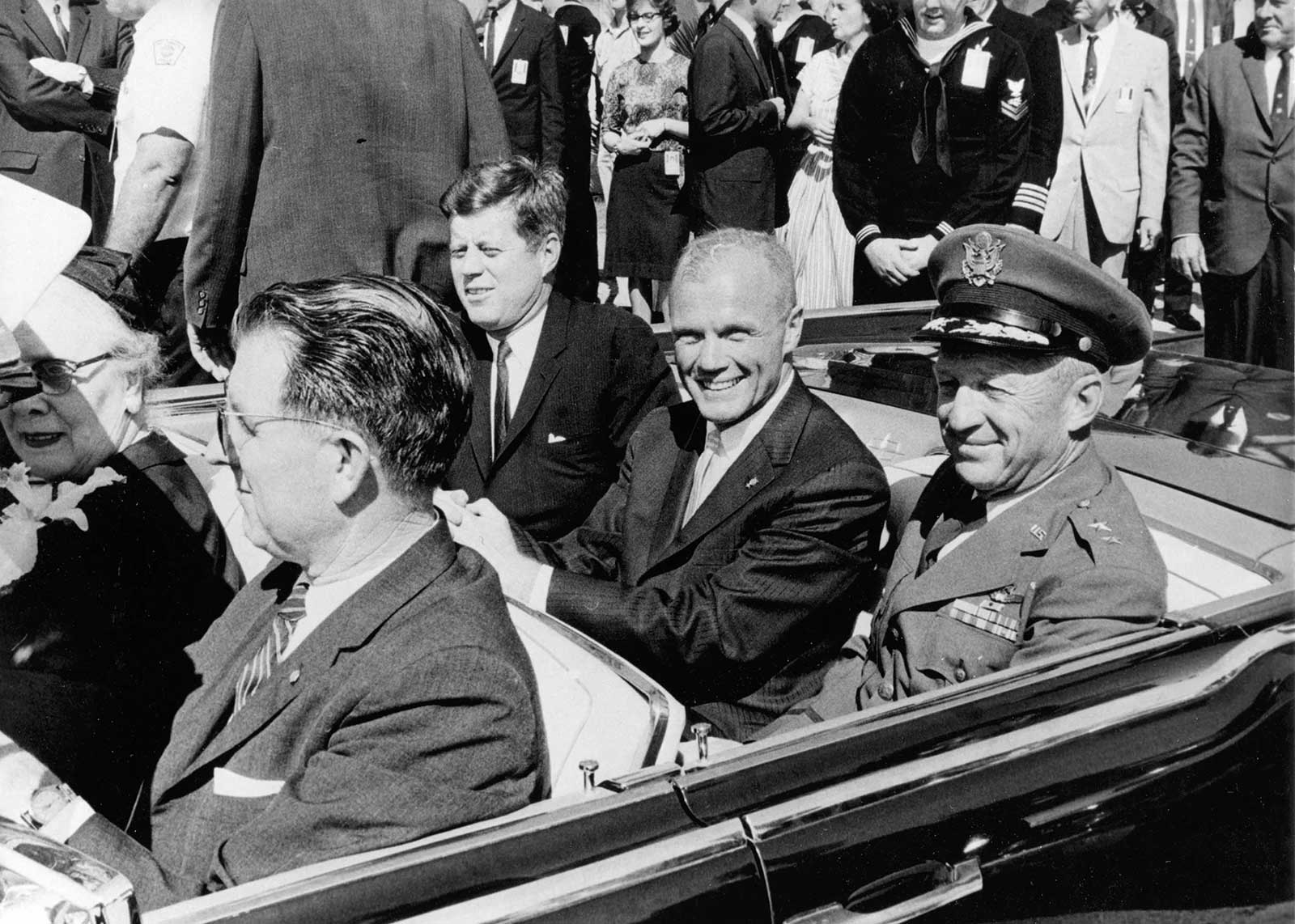
After Friendship 7’s 4-hour and 55-minute flight, the Soviet attitude changed. Although quick to point out that this achievement was simply a repeat, and a briefer one at that, of Titov’s day-long mission, the Soviet news media did give extensive coverage to the American flight.4 More significantly, newspapers that reported the details of the flight also carried the text of a congratulatory letter to Kennedy from Khrushchev.
Khrushchev congratulated the American people and their President for “the successful launching of a spaceship with a man on board.” The Premier saw this to be one more step “toward mastering the cosmos”; this time an American had been “added to the family of astronauts.” Khrushchev hoped that:
... the genius of man, penetrating the depth of the universe, will be able to find ways of lasting peace and insure the prosperity of all peoples on our planet Earth which, in the space age, though it does not seem so large, is still dear to all of its inhabitants.
If our countries pooled their efforts-scientific, technical, and material-to master the universe, this would be very beneficial for the advance of science and would be joyfully acclaimed by all peoples who would like to see scientific achievements benefit man and not be used for “cold war” purposes and the arms race.5
While the words of the Soviet leader could have been dismissed as a propaganda ploy, President Kennedy and his White House advisers decided to take the Soviet message at its face value and respond positively.
Kennedy’s reply was direct and immediate. “I welcome your statement that our countries should cooperate in the exploration of space.” Moreover, he told Khrushchev that he had “long held this same belief” and that he had championed such cooperation in his speeches to the American public. While supporting the supervisory role of the U.N. in the field of space cooperation, the President saw that the U.S. and the Soviet Union had a peculiar responsibility to lead the way toward international cooperation. As consequence, Kennedy said that he had asked certain members of his administration to prepare “new and concrete proposals for immediate projects common action” that he hoped would be discussed by representatives from the two countries at an early date “in a spirit of practical cooperation.”6
In a news conference on 21 February, the President reported that he found Khrushchev’s proposal “most encouraging” “beneficial to the advance of science.” The President also indicated, “It is increasingly clear that the impact of Colonel Glenn’s magnificent achievement yesterday goes far beyond our own times and our own country,” or, as Kennedy phrased it later in his press conference, now we “have more chips on the table than we did some time ago.”7 When asked by reporters how far the U.S. would go in cooperating with the Soviet Union, Kennedy responded that it would be “premature” for him to say, but he added that “we all know from long experience that it’s more difficult to transform these general expressions into specific agreements.” Only time would tell if practical results would follow, and the President promised to withhold judgment until “we see whether the rain follows the warm wind in this case.”8
At NASA, the Kennedy response to the Khrushchev suggestion for closer scientific and technological collaboration was a surprise.* The White House staff had prepared a reply to Khrushchev after an inquiry to Arnold Frutkin’s NASA International Programs Office concerning the possibility of developing a list of “concrete” proposals.9 Following the dispatch of the Kennedy letter to Khrushchev, representatives from the White House and the State Department worked with a list of possible joint activities drawn up by the space agency for inclusion in a more detailed letter to the Soviet Premier. During the work on these proposals, neither NASA Deputy Administrator Hugh Dryden nor Frutkin had any direct contact with the President or his White House staff. NASA worked at a distance with the Department of State acting as an intermediary.† 10 They knew the President wanted to cooperate with the Soviets on space projects if possible. But what was possible? Was the President willing to sacrifice other aspects of NASA’s programs to obtain a closer cooperative relationship with the Soviets? In the absence of a clear mandate from the President, Frutkin’s conservative approach toward cooperation prevailed. While not the dramatic stand desired by some Kennedy staff members, the NASA efforts were based upon previous experience with the Soviets in space negotiations.
* Dryden and Frutkin indicated that the initiative for the Kennedy response of 21 Feb. came from the White House, although NASA received the message through the State Department. Dryden felt that Presidential Science Adviser Jerome Wiener might have been the source of this particular response, but he was not certain.
† The NASA contacts in the State Department were George C. McGhee, Under Secretary of State for Political Affairs; Philip J. Farley, Special Assistant to the Secretary of State for Atomic Energy and Outer Space; and Robert F. Packard, Farley’s assistant.
The 7 March 1962 letter that Kennedy sent to the Soviet Union was based on a conscious strategy aimed at enhancing the possibility of obtaining a cooperative relationship.* 11 Negotiations would be conducted at the technical level, not at the head of state level where politics might intrude. Such discussions would involve coordination of efforts in space research without calling for the integration of experiments of one nation into the spacecraft or ground equipment of the other. This parallel effort would be coupled with the reciprocal exchange of data.
*There have been some charges that the Kennedy proposals represented nothing new. Former Kennedy White House science aide Eugene Skolnikoff also charged NASA with selecting “only those projects which it thought would be technically and politically desirable.” Accordingly, NASA was interested only in the exchange of information and not “intimate cooperation that would have involved joint research and development programs.” Arnold Frutkin would not disagree with the specifies, but he would take exception with the interpretation. He felt that NASA should deal with those projects that were possible, not with those that were desirable simply because they were idealistic and dramatic.
Arnold Frutkin has summarized the key topics proposed in Kennedy’s letter to Khrushchev:
- the establishment of an operational world weather satellite system through the coordinated launching by the US and the USSR of weather satellites in complementary orbits, the resulting data to be distributed globally through existing meteorological channels;
- the exchange of spacecraft tracking services, each side providing equipment suited to its own requirements to be erected and operated on the other’s territory by the other’s technicians;
- mapping of the earth’s magnetic field in space, a matter “central to many scientific problems,” by satellites which the countries would launch, one each, in complementary orbits;
- an invitation to the Soviet Union to join in programs already under way with other countries for the joint testing of intercontinental communications satellites (each country providing a ground terminal suitable for working with US communications satellites and participating in an international ground station coordinating committee). 12
Beyond these four points, Kennedy briefly touched on the possibility of pooling and exchanging data gathered in space medicine and of exploring plans for future manned and automated space flight. This effort on the part of the White House staff to keep broader topics open for discussion was indicative of a desire to let the Soviets know that dialogue could evolve into something larger. Kennedy therefore stressed that the points raised in his letter were not intended “to limit our mutual consideration of desirable cooperative activities.” 13
As the work on the Kennedy letter progressed, NASA, the State Department, and the President’s Science Adviser decided to go ahead and appoint a technical negotiator in anticipation of a positive response from Khrushchev.* Dryden, NASA’s Deputy Administrator, was the unanimous choice, and President Kennedy approved the appointment on 19 March. The following day the President received a reply from the Soviets. In Dryden’s words, “Now events moved very rapidly.14
* Administrator James E. Webb represented NASA in this discussion, with George McGhee of the State Department and Science Adviser Jerome B. Wiesner.
Chairman Khrushchev’s 20 March response to the Kennedy proposal contained a lengthy preamble restating a desire to preserve space for peaceful exploration and exploitation of those studies that would benefit all nations. Khrushchev’s shopping list of proposals contained some that were nearly identical to those suggested by Kennedy, plus two new ones. Suggestions that were similar centered on cooperation in communications and weather satellites, data collection relating to the earth’s magnetic field, exchange of space medicine information, and organization of a system for observing and tracking vehicles launched to the moon or the planets. The new topics dealt with the rescue of spacecraft and with space law. 15
Khrushchev was agreeable to drafting an international pact providing “for aid in searching for and rescuing spaceships, satellites and capsules that accidentally fallen.” This agreement seemed particularly important “since it might involve saving the lives of cosmonauts...” Rescue operations and returning space hardware pointed also to the further necessity of attending to the “important legal problems” of space that confronted the spacefaring nations. 16
To begin the dialogue, Khrushchev told Kennedy that the Soviet representatives to the U.N. Committee on the Peaceful Uses of Outer Space were being instructed to meet with their American counterparts. Further, Khrushchev seemed to indicate a relaxation of one of the barriers that had been hindering concrete discussions: disarmament no longer was held to be the basic prerequisite to such talks, though it was a conditioning factor. It seemed obvious to the Soviet leader “that the scale of our ... cooperation in the peaceful conquest of space ... is to a certain extent related to the solution of the disarmament problem.” Therefore, Khrushchev felt that “until an agreement on general and complete disarmament is achieved, both our countries will ... be limited in their abilities to cooperate in . . . space.” If the question of disarmament could be satisfactorily resolved, “Considerably broader prospects for cooperation and uniting our scientific-technological achievements, up to and including joint construction of spacecraft for reaching other planets-the moon, Venus, Mars-will arise....”17
In a news conference on 21 March, President Kennedy announced that he was gratified by the Khrushchev reply, and that steps would be taken to initiate an early discussion with the Soviets, with Dryden as his technical representative. Kennedy said that the U.S. would make “all possible efforts to carry forward the exploration and use of space in a spirit of cooperation for the benefit of all mankind.”18 The rhetoric sounded promising, but the work remained. As Kennedy said, “an agreement to negotiate does not always mean a negotiated agreement.”19
THE FIRST DRYDEN-BLAGONRAVOV AGREEMENT-1962
As Soviet and American reporters analyzed the exchange between their political leaders, NASA officials prepared for discussions with the Soviets.20 With State Department help, the NASA Office of International Programs drafted three informal position papers expanding the major points of Kennedy’s 7 March letter.21 Dryden and Frutkin then traveled to New York City to meet with Academician Blagonravov on 27 March for their first exploratory talks; the exchanges were informal and preliminary.* Both parties had agreed in advance that formal negotiations would begin later. The Kennedy-Khrushchev letters were discussed, but to Dryden “It became obvious as the talks proceeded that Academician Blagonravov had left Moscow [either] before the exchange of letters between Chairman Khrushchev and President Kennedy, or so soon thereafter that he had not discussed the several proposals in any detail with other scientists, and that he had received few instructions from Moscow.”22 Blagonravov promised to study the NASA position papers and respond with formal position statements at a subsequent meeting.
* The American delegation also included D. F. Hornig, J. W. Townsend, Jr., P. S. Thacher, R. W. Porter, and L. Bowdin. The other Soviet participants were Y. A. Barinov, G. S. Stashevsky, R. M. Timberbaev, and V. A. Zaitzev.
Dryden believed that these first conversations were “generally free of cold-war propaganda. On one or two occasions there were remarks that cooperation could be on a much larger scale if the disarmament negotiations were successful, but the main interest seemed to be ... finding possible beginning steps for cooperation.” At one juncture, Blagonravo raised the issue of American nuclear tests in the atmosphere, and subsequently at a meeting in the Soviet mission in New York City, he briefly mentioned spy satellites. Dryden replied politely but firmly that his authority was limited to technical matters; political and legal issues were outside his authority.23 Frutkin later reported that “Blagonravov accepted this position philosophically, not raising such issues again.** 24
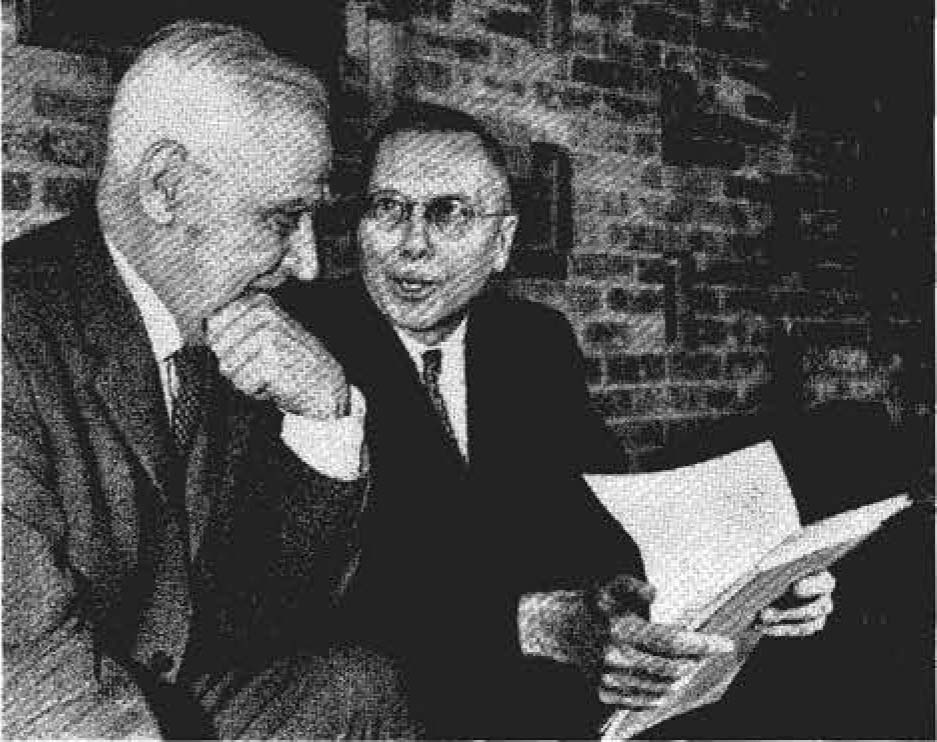
As Frutkin saw it, the Soviets seemed hesitant to discuss the possibilities of cooperative efforts in space medicine, even though this topic had been proposed by Khrushchev, and Blagonravo quickly dismissed the American proposal to conduct experiments with high-altitude balloons. He said that his country disliked balloons, an obvious reference to American programs to disseminate propaganda leaflets from balloons over Eastern Europe.25 On the question that had been raised by Khrushchev’s letter concerning outer-space pollution, Blagonravov “expressed concern” regarding the negative impact of one nation’s experiments on the scientific work of another. Specifically, he was referring to Project West Ford, a target for Soviet criticism.* Frutkin also perceived that the Soviets were not eager to become immediately involved in joint space flight. “Blagonravov stated that current programs were too far along to permit coordination at this date. The coordination of future programs ... seemed possible.”26
* Project West Ford, a USAF program conceived at MIT’s Lincoln Laboratory, involved launching into earth orbit 350 million copper threads (17.78 millimeters long and 0.254 millimeters in diameter), which would serve as reflector antennas for short wavelength communications (8000 megahertz). The experiment promised to make global radio coverage invulnerable to jamming. Project West Ford, approved on 4 Oct. 1961 by the White House, met with mixed international scientific reactions, being criticized by many scientists as a possible threat to the study of radio astronomy or as an alteration to the environment of space, but the project was praised by NATO politicians as a significant deterrent defense system. On 10 May 1963, a second attempt to orbit the disputed payload was successful; the dipoles ejected and formed a compact cloud, cireling the earth every 166 minutes in a near-polar orbit at a height of 3704 kilometers. Science on 16 Dee. reported that nearly all of Project West Ford’s dipoles had reentered the atmosphere.
The guarded sense of optimism felt by Dryden and Frutkin was expressed only in private.27 In a brief joint statement from Blagonravov and Dryden on 30 March, the press was told that the representatives of the two nations “have now concluded their preliminary discussions.” They also announced that they intended to meet again during either the COSPAR sessions scheduled for 30 April-10 May in Washington or the meeting of the Scientific-Technical and Juridical Subcommittee of the U.N. Outer Space Committee. Additional scientists from both nations would join in these technical discussions. This was not hard news, but the statement indicated that both parties realized their work had just begun.28
Soviet public reaction to the proposed cooperation was favorable. On 12 April 1962 at the government-sponsored Cosmonautics Day celebrations, both Gagarin and Titov were quoted in the Soviet press as favoring cooperation between the two countries, especially if it led to a reduction in armaments.* 29 Mstislav Vsevolodovich Keldysh, President of the Soviet Academy of Sciences, declared that he favored Soviet-American space cooperation as a route toward the solution of many scientific concerns.30 This basic theme was repeated in an interview with Khrushchev by Gardner Cowles, editor of Look magazine. Khrushchev saw a joint expedition to the moon as technically and scientifically possible; only the political problem of the military character of space rockets stood in the way.31
* Cosmonautics Day, 12 Apr., was created by the Presidium of the Supreme Soviet not only to celebrate the anniversary of Gagarin’s first space flight but also to remind the Soviet public and the world of the accomplishments and goals of the Soviet space program. It has become annually customary for Pravda and Izvestiya to feature articles at this time written by the cosmonauts on different aspects of space flight. Gagarin, until his death in an aircraft crash in Mar. 1968, and Titov were frequent authors of items promoting international peace and cooperation.
Reaction in the U.S. to space cooperation with the Soviets was mixed. Glenn’s flight had reassured many Americans who had been worried about the nation’s position in the space race. Most public figures were still committed to establishing American pre-eminence in space. Senator Margaret Chase Smith, the ranking Republican member of the Aeronautical and Space Sciences Committee, felt that the United States had little to gain from cooperation, especially since the nation was committed to “superiority over Russia on really important space development.”32 However, Representative George P. Miller, Chairman of the House Committee on Science and Astronautics, approached the possibility of cooperation in a more positive fashion. In welcoming the Khrushchev overture to cooperate, Congressman Miller said, “This is something we must do. We must accept their offer in good faith unless, and until, proven otherwise. The world expects this of us.* 33 The wider public reaction seemed to mildly favor cooperation so long as it did not have a negative impact on the American goal in space-the Kennedy-inspired goal to reach the moon during this decade.34
Vice President Lyndon Johnson, on 10 May 1962, summed up the feelings of many American politicians in a speech dedicating the NASA Space Exhibit at the Seattle World’s Fair. Cooperation in space could be the route to greater understanding between the United States and the Soviet Union. Joint scientific efforts might make other political areas easier to discuss, but the burden of cooperative programs was a mutual one. The Vice President, “with a spirit of cautious optimism,” was able to tell his audience “that the Soviet Union appears to realize that-in outer space, at least-there may be something to be gained by cooperating with the rest of humanity.”35
Meanwhile, Dryden was preparing for the next round of discussions with the Soviets, to be held at the end of May in Geneva.36 Dryden was concerned about the political considerations behind the Kennedy administration desire to discuss collaboration; thus, he sought to determine the President’s position. Unfortunately, Dryden never had the opportunity to discuss the matter directly with Kennedy or his top White House advisers. His closest contact to the President was George C. McGhee at the State Department.
Dryden, a scientist turned administrator called upon to be an international negotiator, sat down with McGhee on 18 May and asked him how the President wanted the negotiations conducted. Were these discussions intended to arrive at true cooperation, or were they only propaganda? Was it a sincere effort to get negotiations going or merely something for public display? As Dryden told McGhee, the nature of the goal “would make some difference in the approach.” McGhee assured Dryden that “the President had in mind real cooperation, that he was as anxious to go just as far as the Soviets would go.” With the nature of his mission somewhat more clear, Dryden made ready for his trip to Europe.37
Dryden and Blagonravov met in Geneva on 27 May 1962. Both men had traveled to the Swiss city for the first meeting of the Technical Subcommittee of the U.N. Committee on the Peaceful Uses of Outer Space. While there was no direct connection between the bilateral Soviet-American talks and the U.N. meeting, the negotiators found such an occasion convenient to pursue their private discussions. The two men, despite their obvious political constraints, worked well together. In 12 days, they succeeded in hammering out agreement on three points.* 38
* Frutkin in International Cooperation in Space gives a detailed account of the negotiations and some of the difficulties encountered by Dryden and Blagonravov.
As reported by Frutkin, “this first agreement embraced three projects, following the US proposals on meteorology and geomagnetism very closely and reflecting Blagonravov’s new interest in the Echo experiment in satellite communications.” The two principal negotiators were satisfied with their progress. Dryden commented to reporters that approval of the agreements by the American and Soviet governments would mark an “important step” in space cooperation. At the joint news conference on 8 June, Blagonravov added that they would have been wasting their time if they had not “believed the work to be of major significance.”39 The two men departed to their respective capitals to secure the necessary government approvals for their proposals.
The Dryden-Blagonravov agreement provided for a two-month study period, during which either party could suggest changes to the proposals. As it developed, neither country sought amendments, and Soviet Academy President Keldysh and NASA Administrator Webb exchanged letters on 18 and 30 October 1962 that formalized the agreements.40 Much political and technical work lay ahead-work that was hindered by the grave situation created by the discovery of Soviet Intermediate Range Ballistic Missiles in Cuba.* 41
* Kennedy publicly announced on 22 Oct. 1962 the presence in Cuba of Soviet missiles capable of striking a large part of the U.S. A naval blockade was imposed to intercept further shipments, and the President bluntly demanded that the Soviets withdraw their missiles. By early November, aerial reconnaissance showed that the Cuban bases were being dismantled and the missiles crated for return to the U.S.S.R.
When the joint announcement of the bilateral space agreement was made to the U.N. on 5 December 1962, the somber and tense days of October lingered in the minds of many American and Soviet political figures. Indeed, the joint announcement had been postponed until December because of a Presidential order during the Cuban crisis decreeing “that there be no further action on the U.S.-U.S.S.R. outer space bilateral until the Cuban situation has been settled.”42 An atmosphere of restraint accompanied the official announcements when they were made. Administrator Webb indicated simply:
This is an important step toward cooperation among nations of the world to increase man’s knowledge and use of his special environment. The careful preparation for such a joint cooperative effort made by Academician A. A. Blagonravov and Dr. Hugh L. Dryden is a sound basis on which to proceed. The United States will make every effort to facilitate this undertaking.43
The official Soviet news agency, Tass, stated briefly: “There is no doubt that this agreement will make a great contribution to the conquest of the universe and to the further advance of international cooperation between scientists.”44
The next step in implementing the agreements called for creating joint working groups. To facilitate the establishment of those technical parties, Dryden and Blagonravov met in Rome on 11-20 March 1963 and again in Geneva during the following May. The result of these two meetings was a document—the “First Memorandum of Understanding to Implement the Bilateral Space Agreement of June 8, 1962.45 The details for the weather satellite launching and the data exchange project were concluded with relative ease. But the agreement on the communications satellite experiments with Echo II was more difficult to arrange because of technical complexities. Proposals for a coordinated launch of geophysical satellites to study the earth’s magnetic field were finalized at the May meeting.* 46
* For details of the discussions, see Frutkin’s International Cooperation in Space, pp. 97-105. The co-chairmen of each of the three Working Groups were as follows: Working Group 1 (weather) -M. Tepper, Director, Program of Weather Satellite Applications, NASA, and V. A. Bugayev, Director, Central Institute of Weather Forecasting, U.S.S.R.; Working Group 2 (communications)-L. Jaffee, Director, Communications Systems, NASA, and I. V. Klokov, Deputy Minister of Communications, U.S.S.R.; and Working Group 3 (geomagnetic study)-L. Cahill, Director of Physics, Office of Space Sciences, NASA, and Yu. D. Kalinin, Deputy Director of the Institute of Terrestrial Magnetism, U.S.S.R.
The process for conducting the negotiations followed an unofficial protocol, which established a precedent for subsequent discussions. In Rome, the first two days were essentially ceremonial. Following the formalities held first at the American Embassy and then at the Soviet Embassy, the working sessions began. Generally, the pattern of the meetings called for the discussion of draft documents, during which the two negotiating teams compared points and argued matters of substance and wording until an agreed document was assembled in both English and Russian.47
In testimony before the Senate Committee on Aeronautics and Space Sciences, Dryden reflected on the possible motivations that underlay the Soviet decision to subscribe to these cooperative agreements. It was Dryden’s personal belief that “this group of scientists who are interested in collaboration have been given a hand to see what they can come up with.” Both groups of negotiators had decided that they “could not agree on anything which did not show a benefit to both countries.” Looking at the nature of the joint discussions, Dryden felt that there was a “possibility that the political elements in Russia may at some point shut this off.” Dryden was assuming, as did other American scientists, that Blagonravov and his associates in the Soviet Academy represented “what you might call a liberal group in Russia,” which sought to begin “limited cooperation within the political climate of their own country and of the times.”48 Frutkin, however, challenged the notion expressed by Dryden and others that “technical cooperation does not involve a party political line.”49
The concept that scientists have a unique position in the scheme of things, as a result of the international character of their work, has a long history. Equally strong is “the notion that the scientist can play a special role and effective role in establishing and cementing improved relations among nations...”50 In the post-World War II era, there has been a strong feeling of internationalism within the community of science and technology, especially in the U.S. where a number of scientists urged their fellows to lead the way toward greater scientific cooperation among nations. But among scientists, as among all peoples, there are both internationalists and nationalists. Frutkin contends:
The evidence appears to be overwhelming that scientists confronted with the exigencies of national need have reacted much as other patriotic citizens, professional and nonprofessional. In part, this follows from an interaction between science and government which produces a rough alignment even in democratic countries. International ties, real or fancied, have not weighed in the balance in any significant way.... When we say that science is international we mean that it is international where scientific matters of essentially professional character are concerned, and not really where political matters are concerned.51
Thus, Dryden was correct in his report that both teams of negotiators could only agree to those activities that were of mutual benefit, but he may have been too generous in his analysis when he said that politics did not influence technical cooperation. Simply, in some areas of negotiations, politics were less obtrusive than in other areas. Indeed, the passage of time would show that there were political considerations behind all the technical agreements.
American public response to the 16 August 1963 announcement of the Soviet-American bilateral space agreement was conditioned by the successful conclusion of the nuclear test ban treaty and speculation over rumors of a joint manned space flight. On 25 July 1963, representatives of the U.S., the Soviet Union, and the United Kingdom initialed a treaty prohibiting nuclear weapons tests in the atmosphere and space and under water; relaxation of nuclear tension made the space agreement between the Americans and Soviets seem all the more promising. A New York Times article on the Dryden-Blagonravov “Memorandum of Understanding” termed the idea of cooperative manned space flights “a logical outgrowth of the present agreement.”52 Rumors circulated that there might possibly be a joint lunar mission in the planning, speculation developed partly as a result of the visit of British astronomer Sir Bernard Lovell. In the latter half of 1963, according to Frutkin, there ensued in the story of U.S.-U.S.S.R. space relationships “by all odds the strangest chapter...”
THE KENNEDY PROPOSAL FOR A JOINT MOON FLIGHT
Sir Bernard Lovell, a professor at the University of Manchester and Director of the Jodrell Bank radio telescope facility, had been active in the international astronautics community for many years. The Jodrell Bank observatory was scheduled to play a key role in the Soviet-American communications satellite experiments agreed to in Rome. During June and July 1963, Sir Bernard was the guest of the Soviet Academy of Sciences on an unprecedented tour, for a Western scientist, of the major optical and radio observatories. In a letter to Dryden dated 23 July 1963, Lovell described his visit:
During this time I was taken to the major Soviet optical and radio observatories and to the deep space tracking network, a station which has not so far been seen by Western eyes or by many Soviet scientists so I was told, I mention this at the beginning of this letter because it does seem to underline the apparently genuine desire of the Academy to extend its cooperation with the West.53
After describing the “cooperative programs” that he had negotiated with the Soviets, he reported on conversations in which his hosts had discussed the plans for future Soviet efforts in space. Included in Soviet comments was an apparent postponement of a manned program of lunar exploration. Lovell told Dryden that President Keldysh of the Soviet Academy had given three reasons for favoring automated unmanned spacecraft for exploring the lunar surface:
- Soviet scientists could see no immediate solution to the problem of protecting the cosmonauts from the lethal effects of intense solar outbursts.
- No economically practical solution could be seen of launching sufficient material on the moon for a useful manned exercise with reasonable guarantee of safe return to earth.
- The Academy is convinced that the scientific problems involved in the lunar exploration can be solved more cheaply and quickly by their unmanned, instrumented lunar program.54
Sir Bernard reported that he had argued in favor of a manned lunar expedition, and Keldysh said that a Soviet program to send cosmonauts to the moon might be revived if the issues raised in the three objections could be overcome. Furthermore, Keldysh was reported to have suggested:
... that the Academy believed that the time was now appropriate for scientists to formulate on an international basis (a) the reasons why it is desirable to engage in the manned lunar enterprise and (b) to draw up a list of scientific tasks which a man on the moon could deal with which could not be solved by instruments alone. The Academy regarded this initial step as the first and most vital in any plan for proceeding on an international basis.55
In concluding his report to Dryden, Lovell said that he had promised Keldysh to convey the substance of these discussions to the “appropriate authorities in the United Kingdom and the United States of America.” Now that Lovell had discharged his promise, a major question remained. What did his conversation with President Keldysh signify?
There were various American interpretations of the Lovell letter. To some observers, this seemed to be strong, reliable data from a prominent scientist that the Soviets had dropped out of the race to the moon. Furthermore, the Soviet Union seemed willing to talk about cooperation in a joint program of lunar exploration. This would mean a dramatic shift from the concept of coordinated space ventures to integrated programs, a change that would require deeper study and extensive discussions between the U.S. and the Soviet Union. Other commentators on the Soviet space program, including Dryden, viewed the Keldysh remarks to Lovell simply as a propaganda ploy that would require the Americans to submit their lunar program to an international body for scrutiny56 Whatever the motivation, the conversations reported by Lovell were newsworthy, and the press asked President Kennedy to address the substance of these remarks on 17 July.
”Would we still continue with our moon program” if the Soviets should drop out of the lunar race, the press asked? The President said that he knew only what he had heard or read in news reports; therefore, he had to conclude that only time would tell what the true Soviet intentions were. Kennedy did see that the Soviets were “carrying on a major [technological] campaign and diverting greatly needed resources to their space effort. With that in mind,” the President thought, “we should continue” our effort to go to the moon. Betraying a sense of skepticism, he suggested that “the prediction in this morning’s paper that they are not going to the moon ... might be wrong a year from now.” When pressed to defend Apollo and the moon landing should the Soviets quit the race, Kennedy touched on the strategic importance of sending an American to the moon:
The point of the matter always has been not only of our excitement of interest in being on the moon, but the capacity to dominate space, which would be demonstrated by a moon flight, I believe is essential to the United States as a leading free world power. That is why I am interested in it and that is why I think we should continue, and I would be not diverted by a newspaper story.57
But two months later on 20 September, President Kennedy in a surprise address before the General Assembly of the United Nations raised the possibility of a “joint expedition to the moon.”58 How are Kennedy’s two positions to be reconciled? At one point, the President called for American domination of the space frontier in the 1960s, and at another time he argued that “space offers no problems of sovereignty,” so “why, therefore, should man’s first flight to the moon be a matter of national competition? Why should the United States and the Soviet Union, in preparing for such expeditions, become involved in immense duplications of research, construction, and expenditure?”59 The “why” of competition versus cooperation had been a matter of much discussion among the White House staff prior to Kennedy’s U.N. address.
Two days before Kennedy’s speech, McGeorge Bundy, a Presidential assistant, addressed the question of cooperation and competition in a “Memorandum for the President.” NASA Administrator Webb had reported to Bundy that the agency anticipated continued suggestions from the Soviets that the two nations cooperate in space. Indeed, the subject of the Lovell letter and the idea of cooperative lunar exploration had been discussed by Blagonravov and Dryden in a New York luncheon meeting.60 The dramatic newspaper reports of the meeting raised questions that Bundy passed along to Kennedy61 “The obvious choice was whether to press for cooperation or to continue to use the Soviet space effort as a spur to our own.” In this same memorandum, which was prepared as background for the President’s meeting that same morning with Administrator Webb, Bundy indicated that there was some “low-level disagreement” on this topic within NASA.* He argued that in his own “hasty judgment” a decision was called for on competition or cooperation. If competition was favored, then the U.S. should make every effort to meet the goal of a lunar landing before the end of the 1960s. “If we cooperate, the pressure comes off, and we can easily argue that it was our crash effort [in] ’61 and ’62 which made the Soviets ready to cooperate.”62
* The “low-level disagreement” Bundy mentions refers to press accounts of a 17 Sept. 1963 speech in which Manned Spacecraft Center Director Robert Gilruth had told the National Rocket Club that a joint American-Russian space flight-especially one to the moon-would present almost insuperable technological difficulties.
Later on the morning of 18 September, the President met briefly with James Webb. Kennedy told him that he was thinking of pursuing the topic of cooperation with the Soviets as part of a broader effort to bring the two countries closer together. He asked Webb, “Are you sufficiently in control to prevent my being undercut in NASA if I do that?” As Webb remembered that meeting, “So in a sense he didn’t ask me if he should do it; he told me he thought he should do it and wanted to do it....” What he sought from Webb was the assurance that there would be no further unsolicited comments from within the space agency. Webb told the President that he could keep things under control.63
Late on the following day, Bundy called Webb to tell him that the President had decided to include a statement about space cooperation with the Soviets in his U.N. address. Bundy informed Webb that Kennedy wanted “to be sure that you know about it.”64 The new paragraph, drafted by Arthur M. Schlesinger, Jr., another Kennedy aide, had not been included in the earlier drafts of the speech circulated at NASA.65 Upon receiving the President’s message, Webb immediately telephoned directions to the various NASA centers “to make no comment of any kind or description on this matter.”66
The President’s proposal for a joint expedition to the moon was intended to be a step toward improved Soviet-American relations. The impact of the speech was quite the reverse. Moscow and the Soviet press virtually ignored the U.N. address.* 67 Officially, the Soviet government did not comment.68 In the U.S., the public remarks either strongly supported the idea of a joint flight or equally forcefully opposed it.69
* The paper Za Rubezhom saw the Kennedy proposal as a propaganda stunt. A Walter Lippman column reprinted by Pravda saw the primary value of Kennedy’s speech to be the opportunity it offered the U.S. to escape a unilateral visit to the moon.
Reaction within NASA itself was varied. During a news conference in Houston on the day of the President’s address, Associate Administrator Robert C. Seamans, Jr., stated that Kennedy’s proposals came as no great surprise. He said that many “large areas” for cooperation existed, such as exchanges of scientific information and space tracking data, but he emphasized that there were no plans for cosmonauts to fly aboard an Apollo spacecraft. Deputy Associate Administrator for Manned Space Flight George E. Mueller shared Seamans’s view. He compared future U.S.-U.S.S.R. cooperation in space to joint explorations in Antarctica. Scientists from both nations worked in the same region, but “they got there in different ships.” Robert Gilruth, Director of MSC, expressed the concerns of technical specialists about an integrated mission.70
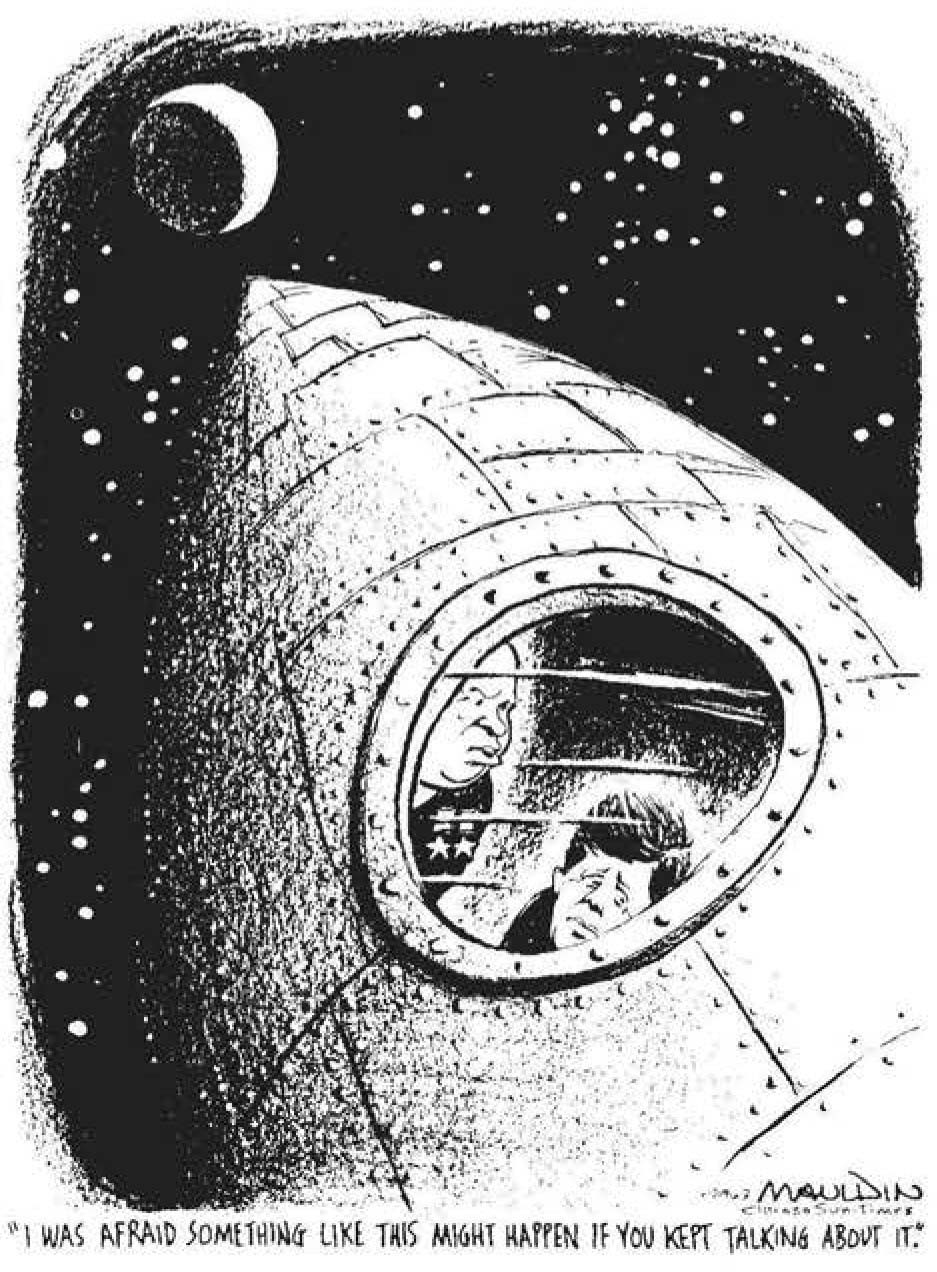
Speaking before the National Rocket Club three days before the Kennedy address to the U.N., Gilruth had said that he “would welcome the opportunity to go behind the scenes in the Soviet Union and see what they’re doing, what they have learned.” But then he added that a joint space flight involving the melding of equipment would pose difficulties. “I tremble at the thought of the integration problems.” Gilruth emphasized that he was speaking as a working engineer and not as “an international politician.” He said that American space engineers had enough difficulties mating the hundreds of electrical, mechanical, and pyrotechnic connections between American launch vehicles and spacecraft. Noting “how difficult these integration problems are” from a technical standpoint within a single agency, he said that the engineering problems inherent in combining the hardware of two nations would be “hard to do in a practical sort of way.” At the 20 September MSC news conference, he added that such problems “are very difficult even when [the hardware components] are built by American contractors.”71 Gilruth’s fears were unfounded for the time being; there would be no joint missions in the foreseeable future.
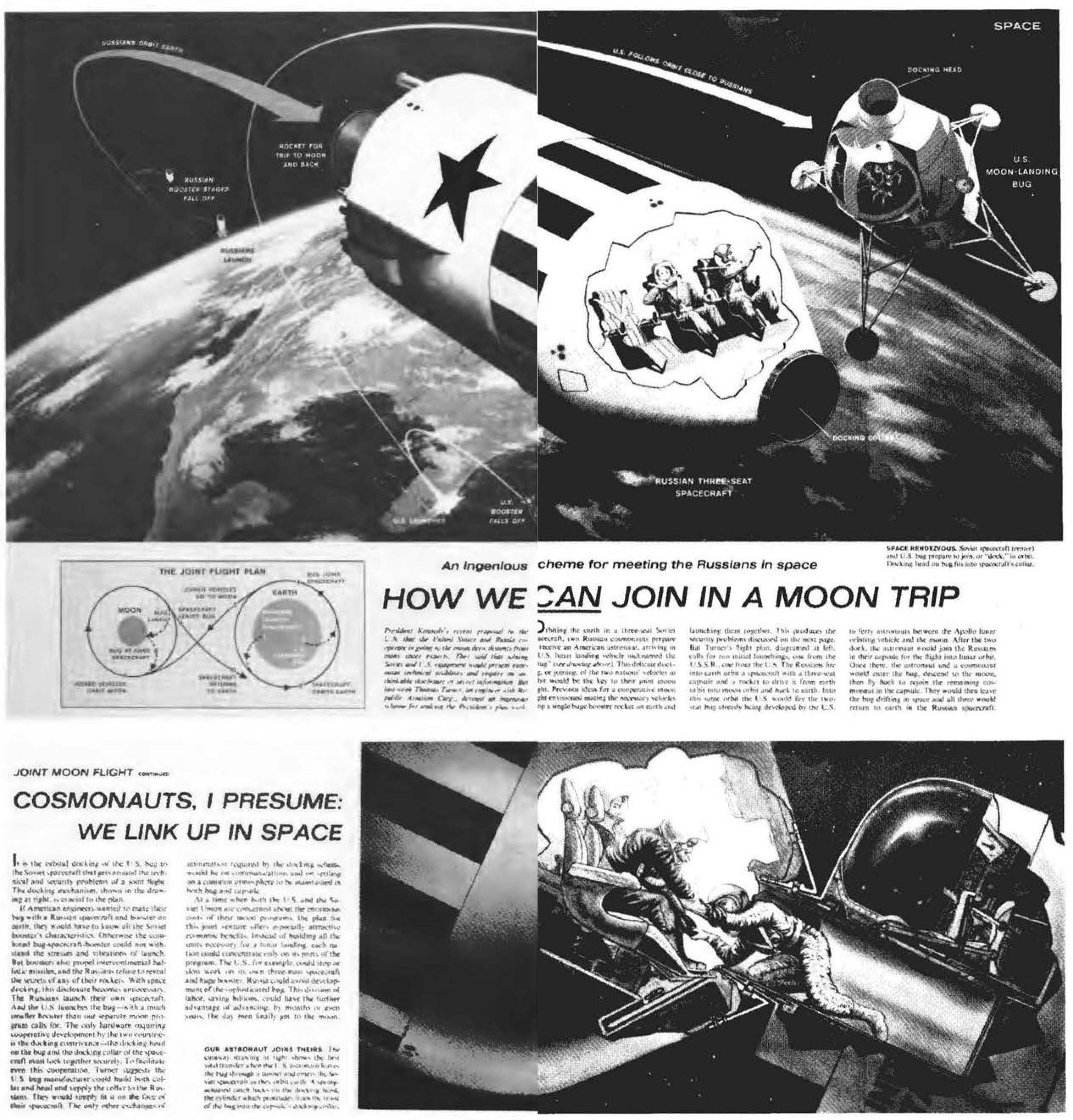
Thus the optimism generated by the Lovell report regarding joint flight ventures turned into disillusionment.* 72 The political climate domestic and international-would not support bold proposals for cooperation. Most Americans believed that the U.S. was firmly committed to be the first nation on the moon; an executive or scientific wish to cooperate should not deter the country from obtaining that goal. The clearest statement of the national attitude toward the Kennedy proposal of a joint moon venture came in December, when Congress passed an appropriations bill carrying the following stipulation:
No part of any appropriation made available to the National Aeronautics and Space Administration by this Act shall be used for expenses of participating in a manned lunar landing to be carried out jointly by the United States and any other country without consent of the Congress.73
This basic provision was repeated in the NASA appropriations acts for fiscal years 1964-1966. President Lyndon Johnson called this clause an “un-necessary and undesirable restriction.”74
* The Lovell letter was disavowed by the Soviets in the winter of 1963. Keldysh repudiated the letter in a radio broadcast on 14 Oct., while Khrushchev indicated that the U.S.S.R. was still part of the race to the moon.
Johnson attempted throughout the winter of 1963 to keep the door to cooperation open. On 2 December, Ambassador Adlai E. Stevenson told the Political Committee of the U.N. that the President had instructed him to reaffirm the Kennedy proposal for a joint Soviet-American expedition to the moon. Without referring to the political storm in Congress over the idea of any proposals for joint flight ventures, Stevenson said, “If giant steps cannot be taken at once, we hope that shorter steps can. We believe there are areas of work, short of integrating the two national programs, from which all could benefit.” Therefore, he suggested that “we should explore the opportunities for practical cooperation...”75 The task of negotiating these “small steps” fell once more upon the shoulders of Hugh L. Dryden and Anatoliy Arkadyevich Blagonravov.
THE DRYDEN-BLAGONRAVOV TALKS-1964-1965
At the outset of 1964, a tangible result of the initial Dryden-Blagonravo discussions came when NASA launched the communications satellite Echo II. Two weeks before the launch, Blagonravov had notified Dryden that the Academy of Sciences would participate in the tracking and communications experiments with Echo II as agreed in the Geneva talks of May 1963. In the same message, he informed Dryden that information would be forthcoming shortly detailing their plan for cooperation in meteorological studies. The Americans were cautiously enthused by this step forward.76
From Vandenberg Air Force Base on 25 January, the balloon satellite of laminated Mylar plastic and aluminum was placed in near-polar orbit.* 77 Two days later, Academician Blagonravov announced that Soviet ground stations were tracking Echo II. Some of these optical facilities had observed the inflation of the satellite, and three observatories had succeeded in photographing it.78 On that same date, NASA received raw tracking data, and later the Soviets forwarded photographic materials and a preliminary analysis of orbital data obtained when the satellite was not being observed by U.S. tracking facilities. The second phase of the experiments with the communications satellite, beginning 22 February and continuing into March, consisted of 34 communications exercises between the Manchester University radio telescope at Jodrell Bank in the U.K. and Zimenki Observatory at Gorki University in the Soviet Union.79
* Echo II, placed into orbit by a Thor-Agena B launch vehicle, weighed 243 kilograms, but when inflated it had a diameter of 41 meters.
Dryden discussed with guarded enthusiasm the meaning of the joint U.S.-U.S.S.R. tests with Echo II in testimony before the Senate Committee on Aeronautical and Space Sciences in March 1964. At first glance, Dryden thought that the real significance of the tests was that the two teams had taken “advantage of existing programs, approved and executed on their own merits, to provide an opportunity for scientists and engineers of both countries to gain experience in working together for their mutual benefit.” This was “a pioneer venture ... designed as a coordinated rather than joint effort.” Dryden thought it interesting that the Soviets had re-christened Echo II the “Friendly Sputnik.”80
A year later in March 1965, Dryden’s remarks to the Senate were to be less effusive. He prefaced his comments on cooperation with the U.S.S.R. with the statement: “we engage in cooperative international activities for two reasons-to further the NASA mission and to advance the foreign policy objectives of the United States.” He then bluntly presented a final assessment of the Echo II test project:
The Soviet side observed the critical inflation phase of the satellite optically and forwarded the data to us. They did not provide radar data, which would have been most desirable, but they had not committed themselves to do so. The Soviets provided recordings and other data of their reception of the transmissions via ECHO from Jodrell Bank. On the other hand, the communications were carried out in only one direction instead of two, at less interesting frequencies than we would have liked, and with some technical limitations at the ground terminals used. I do not want to over-emphasize any technical benefits from this project. It was, however, a useful exercise in organizing a joint undertaking with the Soviet Union.81
The intervening year had bred some caution and doubt at NASA as to the future of cooperation between the two space powers. At the end of May, Administrator Webb had commented on the twin goals of cooperation and competition. He did not see any inconsistency in pursuing both goals simultaneously:
I think it makes good sense. The greater our lead in space, the more willing the Soviet Union may become to give up its hopes for world domination and the victory of communism everywhere. The greater our lead in space the more ready the Soviet Union may become to cooperate with us in mutually beneficial ways that will lessen the dangers of nuclear war and advance the cause of freedom.
Webb also cautioned his audience not to expect cooperation overnight.82
Dryden and Blagonravov met twice in 1964, but their negotiations were short on concrete results. The first meeting, which coincided with the May COSPAR sessions in Florence, Italy, was limited to discussing an agenda for a second meeting to be held at Geneva during the convocation of a U.N subcommittee on the Peaceful Uses of Outer Space.83 During late May and early June, the two negotiators discussed the progress of implementing the details of the 1963 “First Memorandum of Understanding.” One major new point centered on an accord to publish several joint volumes of material on space biology and medicine, a field that Dryden indicated “has a considerable bearing on the future of manned space flight, although there was no talk at Geneva of a joint manned flight.* 84
* As a result of these negotiations, which were formalized in Oct. 1965, NASA and the Soviet Academy of Sciences jointly published in 1975 and 1976 a three-volume work in four books called Foundations of Space Biology and Medicine.
In reviewing the results of his 1964 meetings with Blagonravov, Dryden told the press that he had discussed cooperation with President Johnson prior to his departure for Geneva and that he had been instructed “to seek to widen the areas of cooperation with the Soviet Union” in space activities. In private conversations with Blagonravov, Dryden conveyed the President’s willingness to go as far with cooperative efforts as the Soviet government wished to proceed. As Dryden summarized the American position, “We are always, always have been, prepared to go somewhat farther than they have been willing to do.”85
Dryden also gave the press his perception of the Soviet attitudes toward cooperation. He noted “evidence of a very great desire to have cooperative agreements” and an equally strong wish to begin cooperation in space biology and medicine. Counterbalancing this apparent willingness to cooperate was the Soviet concern for secrecy. The “secrecy with regard to engineering and rockets and instruments and spacecraft” had assured a very slow pace and meager results for the two years of negotiations. Dryden felt that as long as the Soviets pursued this course of keeping space data classified, the future of Soviet-American efforts to cooperate would be determined by the pace that the U.S.S.R. wished to follow. Thus, the Deputy Administrator concluded that much patience was called for on the American side, but he also believed that patience was justified since “the prospects are good for a very slow widening of the area of cooperation. ...”* 86
* Pravda carried a Tass communique from Geneva listing the points of the Dryden-Blagonravov talks and noting that the joint efforts in space biology and medicine would be “of great practical value for assuring the life, health, and safety of cosmonauts making orbital flights, as well as for future flights into deep space.”
Dryden’s cautious testimony during the March 1965 congressional hearings indicated that progress had been slow. Data from ground-based magnetic observatories had been exchanged, and the transmission of weather data on the “cold line,” a special cable link between Moscow and Suitland, Maryland, had been started in October 1964.* 87 Dryden summarized the status of the joint efforts; “I would describe the situation as a form of limited coordination of programs and exchange of information rather than true cooperation.” He continued his report saying, “they have not responded to any proposals which would involve an intimate association and exposure of their hardware to our view.” Nor had the Soviets demonstrated “anything in the nature of a joint group working together.” When asked if the prospect for the future was one of continued competitiveness, Dryden answered in the affirmative, “As near as we can tell at the moment.”88
The “cold line” was so designated to differentiate it from the emergency “hot line,” which had been agreed to in 1963 by the Soviets and Americans to reduce the risk of war by miscalculation or accident.
But Dryden’s work was coming to an end. Since late 1961, he had been waging a quiet personal battle with an incurable malignancy. He had not yielded to his illness but instead had doubled his work load, as he labored to see Project Apollo and other key NASA programs started toward successful conclusions. In the last four years of his life, he seemed always on his way to attend an in-house conference or to catch a plane for an international meeting. On 16 November 1965, after a series of transcontinental speaking engagements, he entered the National Institutes of Health. Sixteen days later, on 2 December, Dryden was dead at the age of 67.89
The decade of the 1960s witnessed an increasing tempo of manned space flights; a central theme surrounding these flights was competition between the United States and the Soviet Union. From March 1962 to November 1964, Dryden and Blagonravo had met six times to formulate a basis for cooperation, but the element of competition had prevailed. With Dryden’s death, a strong voice for cooperation with the Soviets disappeared. Administrator Webb’s primary concern now was the goal of placing a man on the moon ahead of the Soviet Union. As the U.S. and the U.S.S.R. ventured forth on their separate routes to the conquest of space, the idea of cooperation remained, but only as a dream.90
- "Programme of the Communist Party of the Soviet Union Adopted October 31, 1961," in B. Dmytryshyn, A Concise History: USSR (New York, 1965), p. 479.X
- The Soviets also approved the General Assembly Resolution 1721 (XVI) on 20 Dec. 1961, which laid down the general ground rules for cooperative activities in space. The text of the resolution is given in U.S. Congress, Senate, Committee on Aeronautical and Space Sciences, International Cooperation and Organization for Outer Space, 89th Cong., 1st sess., 1965, pp. 201-203. The events leading to the passage of this resolution are described in U.S. Congress, Senate, Committee on Aeronautical and Space Sciences, Soviet Space Programs: Organization, Plans, Goals, and International Implications, 87th Cong., 2d sess., 1962, pp. 163-173; and Arnold W. Frutkin, International Cooperation in Space (Englewood Cliffs, N.J., 1965), pp. 91-142, 142-145 ff.X
- "Text of Gherman Titov's October 26 Speech," 22d CPSU Congress, 15: 56.X
- "SShAvtoraya strana, poslavshaya cheloveka v kosmos, polet Dzhona Glenna" [USA-second country to send a man into space, pilot John Glenn], Izvestiya, 22 Feb. 1962.X
- Nikita Sergeyevich Khrushchev to John F. Kennedy. 21 Feb. 1962, as printed in U.S. Congress, Senate, Committee on Aeronautical and Space Sciences, Documents on International Aspects of the Exploration and Use of Outer Space, 1954-1962, 88th Cong., 1st sess., 1963, p. 232.X
- Kennedy to Khrushchev, 21 Feb. 1962, as printed in Committee on Aeronautical and Space Sciences, Documents on International Aspects of Space, p. 233.X
- Public Papers of the Presidents of the United States, John F. Kennedy, 1962 (Washington, 1963), pp. 151-152 and 157-158; and Theodore C. Sorenson, Kennedy (New York, 1965), p. 529.X
- Public Papers of John F. Kennedy, 1962, pp. 157-158.X
- Interview, Hugh L. Dryden-Arnold W. Frutkin, Walter D. Sohier, and Eugene M. Emme, 26 Mar. 1964, p. 20.X
- Ibid., pp. 20-21; and A. W. Frutkin comments on draft history, 12 Feb. 1975.X
- "Address by the Director of the Office of International Programs, National Aeronautics and Space Administration [Frutkin], on International Cooperation in the Exploration of Space, February 16, 1960," as printed in Committee on Aeronautical and Space Sciences, Documents on International Aspects of Space, pp. 168-175. For an alternate and critical view, see Eugene B. Skolnikoff, Science, Technology and American Foreign Policy (Cambridge, Mass., 1967), pp. 32-36.X
- Frutkin, International Cooperation in Space, p. 93. For full text of the Kennedy letter, see Public Papers of John F. Kennedy, 1962, pp. 244-245; and Committee on Aeronautical and Space Sciences, Documents on International Aspects of Space, pp. 242-244.X
- Public Papers of John F. Kennedy, 1962, pp. 244-245.X
- Philip J. Farley to George W. Ball, memo, "Designation of Technical Representatives for U.S. Soviet Space Cooperation Talks," 9 Mar. 1962; Ball to Kennedy, memo, 'Designation of Technical Representatives for U.S. Soviet Space Cooperation Talks," 16 Mar. 1962; interview, Dryden-Frutkin, Sohier and Emme, 26 Mar. 1964, p. 22; Thomas J. Hamilton, "U.N. Space Panel Hears U.S. Urge Cooperation," New York Times, 20 Mar. 1962; and "Dryden Hard to Fool in Science or Politics," Washington Star, 22 Mar. 1962.X
- Khrushchev to Kennedy, 20 Mar. 1962, as printed in Committee on Aeronautical and Space Sciences. Documents on International Aspects of Space, pp. 248-251.X
- Ibid., p. 250. For further comment, see R. Cargill Hall, "Rescue and Return of Astronauts on Earth and in Outer Space." American Journal of International Law 63 (Apr. 1969): 197-210.X
- Khrushchev to Kennedy, 20 Mar. 1962, pp. 250-251.X
- Ibid., pp.251-252.X
- Public Papers of John F. Kennedy, 1962, p. 264.X
- See "Poslanie N. S. Khrushcheva Prezidenty SShA Dzh. Kennedi" [Message of N. S. Khrushchev to President of the USA John Kennedy], Pravda, 22 Mar. 1962; and "Kosmicheskie isspedovaniyana sluzhbu delu mira, poslanie N. S. Khrushcheva Prezidenty SShA Dzh. Kennedi" [Space investigation--into the affairs of the world, message of N. S. Khrushchev to President of the USA John Kennedy], Izvestiya, 22 Mar. 1962. The American newspapers treated the exchange of letters at some length. Milton Besser, 'Soviet Says It Would Help Set up Satellite Communications System," Washington Post, 21 Mar. 1962; Thomas J. Hamilton, "Soviet Promises Space Data to U.N.." New York Times, 21 Mar. 1962; "Khrushchev Accepts Bid for Cooperation in Space," New York Times, 22 Mar. 1962; "Russia Agrees to Plan for Joint Space Ventures," Wall Street Journal, 22 Mar. 1962; Carroll Kilpatrick, "U.S. and Soviet Move Toward Joint Space Use," Washington Post, 22 Mar. 1962; and "Joint Space Efforts," editorial, Washington Post, 24 Mar. 1962.X
- Dryden, "Preliminary Summary Report: U.S.-Soviet Space Cooperation Talks", New York, N.Y., March 27, 28, 30, 1962," 30 Mar. 1962; Frutkin, International Cooperation in Space, p. 95; and TWX, Adlai E. Stevenson to Secretary of State, 21 Mar. 1962. Stevenson reported the Soviets felt that the press treatment of the talks must be limited. The Soviets had "urged that if [the] talks are to be fruitful, they cannot be conducted in a goldfish bowl."X
- Dryden, "Preliminary Summary Report, U.S.-Soviet Space Cooperation Talks," p. 1. The NASA position papers were attached to the Dryden report: "Tentative Basis for Further Discussions of Meteorological Satellite Cooperation," "Tentative Basis for Further Discussions of Cooperation in Data Acquisition," and "Tentative Basis for Further Discussions of Mapping the Earth's Magnetic Field."X
- Ibid.X
- Frutkin, International Cooperation in Space, p. 95. X
- To follow the dialogue between the U.S. and the U.S.S.R. on the subject of "weather" and "propaganda" balloons, see in the Department of State Bulletin the following: correspondence and DoD press release, 8 Jan. 1956, p. 293; "Transcript of Secretary Dulles' News Conference." 20 Feb. 1956, pp. 280-282; "Correspondence with U.S.S.R. Concerning Weather Balloons," 20 Feb. 1956, pp. 293-295; "U.S. Restates Position on Weather Balloons," 12 Mar. 1956, pp. 426-428; text of 5 Sept. 1958 U.S. note, 29 Sept. 1958, p. 504; and "U.S. Replies to Soviet Note on Balloons" (10 Nov. 1958), pp. 739-740. Also, see "Balloons over the Red World," America; National Catholic Weekly Review, 18 Feb. 1956, p. 547; "The Russians, Too," Newsweek, 12 Mar. 1956, pp. 33-34; "Freedom Balloons Aimed" Science Newsletter, 25 Aug. 1951, p. 124; and "Iron Curtain Balloons," Flying, Dec. 1955, p. 79.X
- Frutkin, "Topical Summary of Bilateral Discussion with the Soviet Union, March 27-30, 1962," 1 May 1962, as cited in Dodd L. Harvey and Linda C. Ciceoritti, U.S.-Soviet Cooperation in Space (Coral Gables, Fla., 1974), p. 94; [Frutkin], "Status of US/USSR Bilateral Space Talks," 21 Apr. 1962; [Robert F. Packard, memo for record, "Meeting with Under Secretary McGhee Concerning US-USSR Cooperation in Outer Space Activities." 24 Apr. 1962; and NASA, Astronautics and Aeronautics, 1963: Chronology on Science, Technology, and Policy, NASA SP-4004 (Washington, 1964), p. 219. On 29 May 1963, a U.N. subcommittee on space addressed the U.N. Committee on the Peaceful Uses of Outer Space with the following message: the "urgency and importance of the problem of preventing potentially harmful interference with peaceful uses of outer space" cannot be overemphasized. This warning, referring to the USAF-sponsored Project West Ford communications experiment, had been initiated by the Soviet delegate Anatoliy A. Blagonravov. He denounced the experiment as a danger to other space studies, including flights by manned satellites. This charge was denied by Homer E. Newell, Jr., a U.S. representative.X
- Dryden to T. Keith Glennan, 26 Apr. 1962, as cited in Harvey and Ciccoritti, U.S.-Soviet Cooperation in Space, p. 94; and Dryden to James A. Van Allen, 20 Apr. 1962.X
- Howard Simons, "U.S. Russia Open Talks on Cooperation in Space," Washington Post, 28 Mar. 1962; Lawrence O'Kane, "U.S. and Soviet Start Space Talks," New York Times, 28 Mar. 1962; and "New Parley Slated on Space Research," New York Times, 31 Mar. 1962. Dryden commented privately on the drafting of this statement. The Americans "proposed to list the three specific projects on which agreement seemed possible but the Soviet delegation wished either to include all projects mentioned in the letters plus the reconnaissance satellite item or none. ." Nevertheless, Dryden considered the Soviet attitude businesslike and a "good sign," since "Blagonravov stated that he favored the negotiation of agreements for those projects on which we can agree as agreement is reached rather than attempting to cover all projects in a single negotiation. Such a procedure appears to dispose of the reconnaissance satellite pledge as a precondition for agreements and is favorable to a fruitful outcome of the negotiations." Dryden, "Preliminary Summary Report, U.S.-Soviet Space Cooperation Talks."X
- "Chelovechestvo raskroet tainy kosmosa" [Mankind gets back secrets from space], Pravda, 10 Apr. 1962; and "Blizkie prostopi vselennoy, interv'y c Yu. Gagarinim i G. Titovim" [Near Space is Universal, an Interview with Yu. Gagarin and G. Titov], Izvestiya, 12 Apr. 1962.X
- "Rech'tovarishcha M. V. Keldysha" [Speech by comrade M. V. Keldysh], Pravda, 13 Apr. 1962.X
- "Khrushchev Drops Summit Pressure," New York Times, 25 Apr. 1962.X
- Interview, Margaret Chase Smith over radio, 1 Apr. 1962, as cited in U.S. Congress, House of Representatives, Committee on Science and Astronautics, Astronautical and Aeronautical Events of 1962, Report, 88th Cong., 1st sess., 12 June 1963, p. 46.X
- U.S. Congress, House of Representatives, Committee on Science and Astronautics, George P. Miller, "Press Release," 23 Feb. 1962.X
- William E. Minshall of Ohio reprinted the results of a poll of his constituents. Of some 20 000 respondents, 47 percent were opposed and 13.4 percent had no opinion, U.S. Congress, House of Representatives, Congressional Record, 87th Cong., 1st sess., vol. 108 (18 Apr. 1962), p. A3035.X
- Committee on Science and Astronautics, Astronautical and Aeronautical Events of 1962, p. 74.X
- Dryden to Glennan, 28 Apr. 1963, indicates that Dryden did not expect the meetings to resume in Washington but in Geneva in May. X
- Interview, Dryden-Frutkin, Sohier, and Emme, 26 Mar. 1964, p. 23.X
- Frutkin, International Cooperation in Space, p. 96. The full text of the "Bilateral Space Agreement between the US and the USSR." together with letters of transmittal and news releases, are presented in Department of State Bulletin, 24 Dec. 1962, pp. 962-965. The agreement took shape much as Dean Rusk had predicted, Rusk to Kennedy, memo, 15 May 1962:
...the Soviets prefer to develop such arrangements on a step-by-step basis, not on the basis of an overall formal agreement between the two governments. Further, the Soviets are apparently interested in working primarily within multilateral programs (i.e., those of the World Meteorological Organization and the International Telecommunications Union), but on the basis of prior US-USSR agreement. It appears unlikely that significant joint effort in outer space activities will develop in the near term, but there is a prospect that the Soviets will agree to some modest cooperation in the form of coordinated satellite launch schedules, compatible instrumentation and some additional ex. change of technical information.
X - "U.S.-Russian Pact on Weather Probes Drafted in Geneva," New York Times, 9 June 1962; "Joint Communique on US-USSR Talks." 8 June 1962; and Packard to E. C. Welsh, H. L. Dryden, J. B. Wiener, W. P. Bundy, F. W. Reichelderfer, and H. Scoville, memo, "Meeting with Under Secretary McGhee Concerning U.S.-USSR Cooperation in Outer Space Activities." 12 June 1962, with attachments, "Dryden-Blagonravoy Memorandum." 8 June 1962, and "Joint Communique." The Americans participating in the Geneva talks who had not been in New York City were Furnas, Wexler, Heppner, and Valdes. The Soviet delegation consisted of Blagonravov, Barinov, Stashevsky, Klokov, Kalinin, and Bugaev.X
- James E. Webb to Keldysh, 30 Oct. 1962; "Bilateral Space Agreement between the US and the USSR," Department of State Bulletin, 24 Dec. 1962, pp. 964-965; and John W. Finney, "U.S. Prods Soviet on Space Accord," New York Times, 20 Sept. 1962.X
- Considering the political climate, Dryden had little difficulty in setting up the next meeting with Blagonravo, Dryden to Blagonravov, 11 Dec. 1963; and McGeorge Bundy to George C. McGhee, memo, "Bilateral Cooperation with the USSR in Outer Space Activities," 10 Dec. 1963. In Blagonravov to Dryden, 7 Jan. 1963, the Soviet representative asked that the meeting be scheduled for March rather than January as proposed by Dryden. In Dryden to Blagonravov, 21 Jan. 1963, Dryden agreed to the postponement but requested that a larger number of technical experts be present so the talks could be "more substantial and expeditious." See also Dryden to Donald F. Hornig, 21 Jan. 1963.X
- Richard J. H. Barnes, Acting Director, International Programs, to Webb and Robert C. Seamans, Jr., memo, "US-USSR Bilaterals," 1 Nov. 1962. Barnes commented on Webb's letter to Keldysh of 30 Oct.:
State understands that the Webb reply to Keldysh was sent by international registered mail Tuesday evening, October 30 and that Dr. Dryden was undertaking last night to notify Congressmen Miller and Fulton, and Senators Smith, Cannon, and Kerr, of the exchange of correspondence and the White House embargo on publicity. Both actions had been authorized by Undersecretary McGhee, and State had urged that the Congressional Committee members be informed yesterday because of the news stories and yesterday's editorial in the Washington Post.
See also "Light in Space?" editorial, Washington Post, 31 Oct. 1962; and John W. Finney, "Space Pact Nearer for U.S. and Russia." New York Times, 30 Oct. 1962. X - NASA News Release 62-257, "US-USSR Join in Outer Space Program," 5 Dec. 1962.X
- Tass International Service, 8 Dec. 1962.X
- "First Memorandum of Understanding to Implement the Bilateral Space Agreement of June 8, 1962, between the Academy of Sciences of the USSR and the National Aeronautics and Space Administration of the US," together with news releases and correspondence, is reproduced in Department of State Bulletin, 9 Sept. 1963, pp. 404-410.X
- Frutkin, International Cooperation in Space, pp. 97-105; [Joint U.S. USSR news release], "Progress Made in US-USSR Space Talks," 20 Mar. 1963; and "U.S. Soviet Agree to Program for Weather Probes in Space," New York Times, 21 Mar. 1963.X
- NASA News Release, HQ (unnumbered), "News Media Briefing: Joint US-USSR Talks on Cooperative Space Research Proiects Held in Rome, Italy," 25 Mar. 1963, pp. 8-9.X
- U.S. Congress, Senate, Committee on Aeronautical and Space Sciences, NASA Authorization for Fiscal Year 1964: Hearings on S. 1245, Pt. 1., 88th Cong., 1st sess., 1963, pp. 33-34; and John W. Finney, "Conflicts Peril Accord on Space," New York Times, 28 Apr. 1963.X
- Committee on Aeronautical and Space Sciences, NASA Authorization for Fiscal Year 1964, p. 35.X
- Frutkin, International Cooperation in Space, p. 12.X
- Ibid., pp. 14-15.X
- "Kommunike o podnisanii drugimi gosudarstvami dogovora o zapreshchenii ispitanii yadernoga oruzhiya v atmosfere, v kosmicheckom prostranstve i pod vodoy" (Communique about other countries signing the agreement on forbidding the testing of nuclear weapons in the atmosphere and under water), Pravda, 17 Aug. 1963; "V imya progressa, sovetskoamerikanskoe sotrudnichestvo v mirnom osvoenii kosmosa" [In the name of progress, Soviet-American collaboration in the peaceful use of space], Izvestiva, 17 Aug. 1963; and Robert C. Toth, *U.S. and Russia Agree to Share Satellite Data." New York Times, 17 Aug. 1963.X
- Sir Bernard Lovell to Dryden, 23 July 1963. This letter and the response from Webb are reprinted in full by Frutkin, International Cooperation in Space, pp. 127-131.X
- Frutkin, International Cooperation in Space, p. 129.X
- Ibid.X
- During congressional testimony, Dryden said, "the Russians are proposing an international forum of scientists to discuss our program not theirs," U.S. Congress, House of Representatives, Committee on Appropriations, Subcommittee on Independent Offices, Independent Offices Appropriations for 1964: Hearings, Pt. 3, 88th Cong., 1st sess., 1963, p. 105.X
- Public Papers of the Presidents of the United States, John F. Kennedy, 1963 (Washington, 1964), pp. 567-568. Expanded discussion of the Lovell letter and its impact is provided by Frutkin, International Cooperation in Space, pp. 105-111, and Harvey and Ciccoritti, U.S.-Soviet Cooperation in Space, pp. 112-119.X
- Public Papers of John F. Kennedy, 1963, pp. 695-696.X
- Ibid; and Julian Scheer, memo for record, 29 Oct. 1963, with distributed attachments designed to guide discussion on the value of Project Apollo: Attachment A-NASA response to UPI story that Russia had "withdrawn" from the "moon race," 26 Oct. 1963; Attachment B-NASA subsequent response to queries from news media; Attachment C-Presidential State of the Union speech, 25 May 1961; Attachment D-Webb speech except; Attachment E-List of reasons why the U.S. has mounted broad-based program as outlined in recent presentation.X
- Dryden, memo for record, 17 Sept. 1963, reprinted in part by Harvey and Ciccoritti, U.S.-Soviet Cooperation in Space, pp. 118-119.X
- John W. Finney, "U.S. Aide Rebuffs Soviets' Moon Bid," New York Times, 18 Sept. 1963; and Howard Simons, "Soviet Interest in U.S. Space Ties Seen Growing," Washington Post, 18 Sept. 1963.X
- Bundy to Kennedy, memo, "Your 11 a.m. Appointment with Jim Webb," 18 Sept. 1963.X
- Interview, James E. Webb, 19 Sept. 1972, as cited in Harvey and Ciccoritti, U.S.-Soviet Cooperation in Space, p. 122; and Webb, "Leadership Evaluation in Large Scale Efforts," paper presented to the General Accounting Office Fifty Year Anniversary Meeting [n.d.], pp. 14-15.X
- Interview, Webb, 19 Sept. 1972; and Webb to Ezell, [May 1975].X
- Interview, Dryden-Frutkin, Sohier, and Emme, 26 Mar. 1964, p. 25. Schlesinger's role is related in A. M. Schlesinger, Jr., A Thousand Days: John F. Kennedy in the White House (Boston and Cambridge, Mass., 1965), pp. 918-921.X
- Interview, Webb, 19 Sept. 1972.X
- Za Rubezhom [Abroad], 28 Sept. 1963, as cited in "Russian Says Moon Shot Idea of President Is Premature," Washington Post, 29 Sept. 1963. The Walter Lippman column, "Today and Tomorrow: Purifying the Moon Proj. ect," had been published in the American papers on 24 Sept. 1963 and was reprinted in Moscow as "Trezvil podkhod" [Sober approach], Pravda, 2 Oct. 1963.X
- Harvey and Ciccoritti, U.S.-Soviet Cooperation in Space, pp. 124-126.X
- A sample of the responses is as follows: Howard Simons, "Opinion Divided Here on Joint Moon Shot Plan": "Russian News Reports Delete Moon Trip Plan"; "Goldwater Criticizes Moon Plan"; "A Lofty Appeal," editorial, Washington Post, 21 Sept. 1963; Thomas J. Hamilton, "Kennedy Asks Joint Moon Flight by U.S. and Soviets as Peace Step; Urges New Accords in U.N. Speech; and John W. Finney, "Washington Surprised at Retreat from Insistence That U.S. Reach Moon First," New York Times, 21 Sept. 1963. A quick analysis of the Kennedy proposal was prepared for the RAND corporation by Alton Frye, The Proposal for a Joint Lunar Expedition: Background and Prospects, report no. P-2808 (Santa Monica, 1964).X
- Warren Burkett, "J. F. K. Offer to Cooperate 'No Surprise,' " Houston Chronicle, 21 Sept. 1963.X
- "Combined U.S.-Russian Space Problems Feared," Houston Chronicle, 19 Sept. 1963; and Burkett, "J. F. K. Offer." Gilruth was speaking at the Goddard Memorial Dinner where he was being honored with the Dr. Robert H. Goddard Memorial Trophy.X
- Space Business Daily, 7 Nov. 1963, p. 217 summarizes Khrushchev's reported position and commented editorially on its significance:
Soviet Premier Nikita Khrushchev has made it emphatically clear that the USSR has neither "deferred," postponed, or "withdrawn" its competitive lunar landing program. Rather, he says his country will launch a man to the Moon when all preparations have been completed that will ensure his safety. In making the announcement he chided United States speculation that the Soviet Union has changed its lunar landing plans for economic reasons. "In regard to the question of whether we have given up our lunar project. You're the ones who said that." Khrushchev's remarks, hopefully, coming at a time when the memories are still fresh, will be a warning to members of the general press and many members of our national leadership that inaccurate translation, quotation and interpretation or analysis of the antagonists proclamations on the still very technical and complex arena of space can afford a very embarrassing psychological victory to those antagonists. If members of the general press had resorted to the expediency of consulting with our own national space leadership, for instance, Dr. Edward Welsh of the National Space Council (a technical advisor more than a political appointment), it would not have appeared that our entire national space program was a tail wagged by Premier Khrushchev. This past year has seen an excess of spur-of-the-moment interpretations reflected in assaults upon the whole concept of the national space program and the age-old philosophy of national competition to a point where there has been a weakening of our nation's determination at a time when the antagonist is demonstrating a continuing space technology leadership. At the risk of being repetitive, it should be recorded that many of our general press have a history of placing our space leaders on trial by the proclamations from an audience either completely ignorant of the technology of space and its implications, or from foreign or antagonistic onlookers.
X - Public Law 88-215, An act making appropriations . . . for the fiscal year ending June 30, 1964,...., 88th Cong., 1st sess., 1963, p. 16. The rumor that the Soviets had withdrawn from the "moon race" had led to substantial cuts in the NASA budget. Kennedy Administration efforts to restore part or all of the $600 million were unsuccessful.X
- Public Papers of the Presidents of the United States, Lyndon B. Johnson, 1963-1964 I (Washington, 1964), pp. 72-73. Kennedy had begun to publicly back away from his proposal; see Kennedy to Albert Thomas, 23 Sept. 1963, in which he said, "In my judgment, therefore, our renewed and extended purpose of cooperation, so far from offering any excuse for slackening or weakness in our space effort, is one reason the more for moving ahead with the great program to which we have been committed as a country for more than two vears."X
- Louis B. Fleming, "Adlai Renews Proposal for Joint Trip to Moon," Washington Post, 3 Dec. 1963; and Kathleen Teltsch, "U.S. Renews Call to Soviet to Join in Moon Venture." New York Times, 3 Dec. 1963. NASA and the White House continued to study the topic of cooperation internally. See Kennedy to Webb, "Cooperation with the USSR on Outer Space Matters," National Security Action Memorandum No. 271, 12 Nov. 1963; and Webb to U. Alexis Johnson, 18 Dec. 1963, which included a NASA position paper, "US-USSR Cooperation in Space Research Programs," which had been developed by Frutkin's office in response to the President's memo of 12 Nov. X
- Blagonravov to Dryden, 14 Jan. 1964. "At present we are completing the preparation of the first stage of observations of the satellite during the period of its inflation. Our stations, which are located within the zone of visibility, will observe the moment of inflation by visual and photographic means only. ... For the purpose of facilitating the successful conduct of this work we should like to ask you to issue instructions that we be informed of the moment of the launch."X
- NASA News Release, HQ, 64-11, "NASA to launch Second Echo Communications Satel. lite," 21 Jan. 1964; Standard Packaging Corp., National Metallizing Division, news release, "Aluminum Coated Space Package Launched Is Historic Feat," 9 Aug. 1960; Mission Operation Report No. S-622-64-03, "Echo C Project," 20 Jan. 1964; and Bill Becker, "Echo 2 Is Orbited; Soviets to Aid Tests," New York Times, 26 Jan. 1964.X
- NASA News Release, HQ, 64-21, "Echo II Monitored by USSR," 27 Jan. 1964; "Russians Are Tracking Echo 2 in Joint Experiment with U.S.," New York Times, 27 Jan. 1964; "Observations of the Echo-II," Krasnaya Zvezda, 28 Jan. 1964; and "Mirror in the Cosmos (Echo-2)," Izvestiya, 28 Jan. 1964.X
- Blagonravoy outlined the program of radio communications experiments in a letter, Blagonravov to Dryden, 27 Jan. 1964; Homer Newell summarized the Echo II experiment results in U.S. Congress, House of Representatives, Committee on Science and Astronautics, Subcommittee on Space Science and Applications, 1966 NASA Authorizations: Hearings on H.R. 3730, No. 2, Pt. 3, 89th Cong., 1st sess., 1965, pp. 987-991; H. L. Baker, Project Manager, Echo II, to Harry J. Goett, memo, "A Quick Look Evaluation of USSR Optical Data as Submitted by Professor Massevich," 9 Apr. 1964; and Newell to Goett, memo, "Report on the Echo II Experiments with US-UK-USSR," 8 June 1964.X
- U.S. Congress, Senate, Committee on Aeronautical and Space Sciences, NASA Authoriration for Fiscal Year 1965: Hearings on S. 2446, Pt. 2, 88th Cong., 2nd sess., 1964, pp. 358-359.X
- U.S. Congress, Senate, Committee on Aeronautical and Space Sciences, NASA Authorization for Fiscal Year 1966: Hearings on S. 927, Pt. 1, 89th Cong., 1st sess., 1965, pp. 60-61.X
- Webb, "U.S. Soviet Space Capabilities," speech, Missouri Cotton Producers Association, Sikeston, Mo., 30 May 1964; Mission Operation Report No. S-622-64-03, "Echo II-Post Launch Report No. 1," 27 Jan. 1964; and Mission Operation Report No. S-622-64-03, "Echo II-Post Launch Report No. 2," 31 Mar. 1964.X
- Dryden to Blagonravov, 26 Mar. 1964; Dryden to Blagonravov, 1 Apr. 1964; TWX, Blagonravov to Dryden, 6 May 1964; "Suggestion for Private Meeting (D/B)** [n.d.]; TWX, Frutkin to State Department, 11 May 1964; and Leonard Jaffee to Dryden, memo, "Proposed Second Stage of US-USSR Echo Il Experiments," 19 May 1964.X
- "Second Memorandum of Understanding to Implement the Bilateral Space Agreement of June 8, 1962, between the Academy of Sciences of the USSR and the National Aeronautics and Space Administration of the US," 6 June 1964; "Protocol for the Establishment of a Direct Communications Link between the World Meteorological Center in Moscow and Washington in Accordance with the Bilateral Agreement on Outer Space Dated June 8, 1962, between the Academy of Sciences of the USSR and the National Aeronautics and Space Administration of the USA," 6 June 1964; and NASA News Release, HQ [unnumbered], "News Conference on Implementation of U.S.-U.S.S.R. Bilateral Space Agreement," 8 June 1964.X
- NASA News Release, "News Conference on Implementation," 8 June 1964.X
- Ibid.; "Mirnoe ispol'zovanie kosmosa" [Peaceful use of space], Pravda, 10 June 1964; and Blagonravov, "Collaboration between the USSR and the United States in Space Research," Vestnik Akademit Nauk SSSR [Herald of the Academy of Sciences USSR], No. 10 (1964) (JPRS Translation No. 28,890), pp. 82-84. Blagonravo summarized the joint talks through the summer of 1964 and presented the Soviet view.X
- An official report on the status of the Soviet-American meteorological exchange was presented by the U.S. Weather Bureau, as cited in Subcommittee on Space Sciences and Applications, 1966 NASA Authorization, p. 900.X
- U.S., Congress, House of Representatives, Committee on Appropriations, Subcommittee on Independent Offices, Independent Offices Appropriations for 1966: Hearings, Pt. 2, 89th Cong., 1st sess., 1965, p. 1007. For summary of Dryden's last meeting with Blagonravov, see "Memorandum of Conversation between Dr. Hugh L. Dryden, Deputy Administrator, NASA, and Academician A. A. Blagonravov, USSR Academy of Sciences, Held May 14, 1965, at Mar del Plata, Argentina, 2-3:15 PM; and diary note, Frutkin, "Notes on US/USSR Bilateral and Soviet Participation in COSPAR Meeting, May 1965, Mar del Plata, Argentina," 15 May 1965.X
- Richard K. Smith, comp. and ed., The Hugh L. Dryden Papers, 1898-1965: A Preliminary Catalogue of the Basic Collection (Baltimore, 1974), p. 32.X
- U.S. Congress, Senate, Committee on Aeronautical and Space Sciences, NASA Authorization for Fiscal Year 1969, Hearings on S.2918, Pt. 1, 90th Cong., 2d sess., 1969, p. 58; and A. J. Dessler, "Discontent of Space-Science Community," 30 Oct. 1969.X